Penn Law: Legal Scholarship Repository
Penn Law: Legal Scholarship Repository
Faculty Scholarship at Penn Law6-2017
Regulating by Robot: Administrative Decision Making in the
Regulating by Robot: Administrative Decision Making in the
Machine-Learning Era
Machine-Learning Era
Cary Coglianese
University of Pennsylvania Carey Law School David Lehr
University of Pennsylvania
Follow this and additional works at: https://scholarship.law.upenn.edu/faculty_scholarship
Part of the Administrative Law Commons, Civil Rights and Discrimination Commons, Computer Law Commons, Constitutional Law Commons, Law and Economics Commons, Law and Society Commons,
Policy Design, Analysis, and Evaluation Commons, Public Administration Commons, Robotics Commons, and the Science and Technology Law Commons
Repository Citation Repository Citation
Coglianese, Cary and Lehr, David, "Regulating by Robot: Administrative Decision Making in the Machine-Learning Era" (2017). Faculty Scholarship at Penn Law. 1734.
https://scholarship.law.upenn.edu/faculty_scholarship/1734
This Article is brought to you for free and open access by Penn Law: Legal Scholarship Repository. It has been accepted for inclusion in Faculty Scholarship at Penn Law by an authorized administrator of Penn Law: Legal Scholarship Repository. For more information, please contact [email protected].
Regulating by Robot: Administrative Decision
Making in the Machine-Learning Era
CARYCOGLIANESE*ANDDAVIDLEHR**
Machine-learning algorithms are transforming large segments of the
economy as they fuel innovation in search engines, self-driving cars,
product marketing, and medical imaging, among many other
technolo-gies. As machine learning’s use expands across all facets of society,
anxiety has emerged about the intrusion of algorithmic machines into
facets of life previously dependent on human judgment. Alarm bells
sounding over the diffusion of artificial intelligence throughout the
pri-vate sector only portend greater anxiety about digital robots replacing
humans in the governmental sphere. A few administrative agencies have
already begun to adopt this technology, while others have clear potential
in the near term to use algorithms to shape official decisions over both
rulemaking and adjudication. It is no longer fanciful to envision a future
in which government agencies could effectively make law by robot, a
prospect that understandably conjures up dystopian images of
individu-als surrendering their liberty to the control of computerized overlords.
Should society be alarmed by governmental use of machine-learning
applications? We examine this question by considering whether the use
of robotic decision tools by government agencies can pass muster under
core, time-honored doctrines of administrative and constitutional law. At
first glance, the idea of algorithmic regulation might appear to offend
one or more traditional doctrines, such as the nondelegation doctrine,
procedural due process, equal protection, or principles of reason-giving
and transparency. We conclude, however, that when machine-learning
* Edward B. Shils Professor of Law and Professor of Political Science, University of Pennsylvania; Director, Penn Program on Regulation. © 2017, Cary Coglianese & David Lehr.
** Research Affiliate, Penn Program on Regulation; Yale Law School, J.D. expected 2020. Research underlying this Article was generously supported by a grant from the Robert Wood Johnson Founda-tion. For helpful comments and discussions on an earlier version of this manuscript, we are grateful to Kaiya Arroyo, Tom Baker, Richard Berk, Tanner Bowen, Ronald Cass, Bryan Choi, Peter Conti-Brown, Adam Finkel, Claire Finkelstein, Jill Fisch, Josh Gold, Chelsey Hanson, Kelly Joyce, Joseph Kable, Seth Kreimer, Sandra Mayson, Paul Ohm, Aaron Roth, Gabriel Scheffler, Shana Starobin, Kenneth Steif, Kristene Unsworth, Jeffrey Vagle, R. Polk Wagner, Michael Weisberg, Christopher Yoo, and David Zaring, along with participants in the Regulatory Law and Policy Seminar at the University of Pennsylvania Law School and the editors of this journal. The views expressed in this Article are not necessarily those of the individuals or institutions we gratefully acknowledge here; we alone bear responsibility for our conclusions.
technology is properly understood, its use by government agencies can
comfortably fit within these conventional legal parameters. We recognize,
of course, that the legality of regulation by robot is only one criterion by
which its use should be assessed. Agencies should not apply algorithms
cavalierly, even if doing so might not run afoul of the law; in some cases,
safeguards may be needed for machine learning to satisfy broader,
good-governance aspirations. Yet, in contrast with the emerging
alarm-ism, we resist any categorical dismissal of a future administrative state in
which algorithmic automation guides, and even at times makes, key
decisions. Instead, we urge that governmental reliance on machine
learn-ing should be approached with measured optimism about the potential
benefits such technology can offer society by making government smarter
and its decisions more efficient and just.
TABLE OFCONTENTS
INTRODUCTION . . . 1149
I. MACHINELEARNING ANDITSADMINISTRATIVEAPPLICATIONS . . . 1155
A. WHAT IS MACHINE LEARNING?. . . 1156
B. EXISTING ADMINISTRATIVE APPLICATIONS . . . 1160
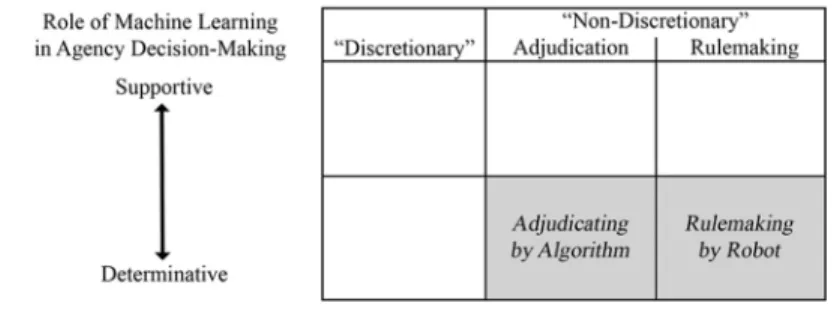
C. ADJUDICATING BY ALGORITHM,RULEMAKING BY ROBOT . . . 1167
II. THELEGALITY OFMACHINELEARNING IN THEADMINISTRATIVE STATE . . . 1176
A. NONDELEGATION . . . 1177
1. Cyberdelegation . . . 1179
2. Statutory Subdelegation . . . 1182
B. DUE PROCESS . . . 1184
1. Tests for Due Process . . . 1185
2. Evaluating Adjudicatory Algorithms . . . 1186
3. Cross-Examination of Adjudicatory Algorithms . . . 1189
C. ANTIDISCRIMINATION. . . 1191
1. Suspect Classifications . . . 1193
2. Inferring Discriminatory Intent . . . 1198
D. TRANSPARENCY . . . 1205
1. Reason-Giving . . . 1207
2. Disclosure . . . 1209
III. THEMERITS OFMACHINELEARNING IN THEREGULATORYSTATE . . . 1213
A. RELATED PUBLIC POLICY CONCERNS . . . 1215
B. OTHER GOOD GOVERNMENT PRINCIPLES . . . 1217
C. A PATH FORWARD . . . 1220
CONCLUSION. . . 1222
INTRODUCTION
Algorithms are not new. For decades, they have served as integral compo-nents of every computer program.1 But today, advanced machine-learning algorithms are creating a vastly automated society, transforming many facets of life. Many products and services, including email spam filters,2medical diagno-ses,3 product marketing,4 and self-driving cars,5 now depend on machine-learning algorithms and their ability to deliver astonishing forecasting power and speed. Today’s algorithms are digital “robots”6 that possess effectively autonomous abilities to adapt and learn.7 As this type of artificial intelligence becomes more intricately woven into the economy, a new kind of information
1. In the most general of terms, algorithms can be defined as “well-defined set[s] of steps for accomplishing a certain goal.” Joshua A. Kroll et al.,Accountable Algorithms, 165 U. PA. L. REV. 633,
640 n.14 (2017).
2. SeeThiago S. Guzella & Walmir M. Caminhas,A Review of Machine Learning Approaches to Spam Filtering, 36 EXPERTSYSTEMS WITHAPPLICATIONS10206 (2009).
3. SeeW. Nicholson Price II,Black-Box Medicine, 28 HARV. J.L. & TECH. 419, 432–34 (2015).
4. See Cade Metz, Now Anyone Can Tap the AI Behind Amazon’s Recommendations, WIRED
(Apr. 9, 2015, 8:09 PM), http://www.wired.com/2015/04/now-anyone-can-tap-ai-behind-amazons-recommendations/ [https://perma.cc/PQ33-JBG2].
5. SeeAlexis C. Madrigal,The Trick That Makes Google’s Self-Driving Cars Work, ATLANTIC(May
15, 2014), http://www.theatlantic.com/technology/archive/2014/05/all-the-world-a-track-the-trick-that-makes-googles-self-driving-cars-work/370871/ [https://perma.cc/XBM4-V7FK].
6. The word “robot” has historically evoked an image of a physical entity directly interacting with the world, but recent advances in artificial intelligence have expanded that narrow conception of robotics. Here we primarily discuss virtual robots contained within computer programs, but the machine-learning algorithms underpinning them also increasingly support the functioning of physical robots; self-driving cars developed by Google, for instance, can predict the behavior of other cars and pedestrians on the road using machine learning.Id.
7. The CEO of Nvidia recently stated that “[i]t wasn’t until the last few years that AI could do things that people can’t do.” Andrew Nusca,The Current State of Artificial Intelligence,According to Nvidia’s CEO, FORTUNE(Mar. 22, 2016, 9:00 AM), http://fortune.com/2016/03/22/artificial-intelligence-nvidia/
[https://perma.cc/Q6YJ-LHG6]. He also noted how, over the past two years, the number of companies using deep learning, a prominent kind of machine learning, has grown thirty-five times larger.Id.
revolution is beginning that may lead to fundamental changes in society.8 The ability of increasingly intelligent systems to replace human workers, for in-stance, has prompted widespread concern about the impact of machine learning on employment opportunities across a variety of occupational and professional fields.9 According to some projections, artificial intelligence threatens to dis-place workers in “all routinized jobs and skill-based jobs that require the ability to perform diverse kinds of ‘cognitive’ labor, from physicians to reporters to stockbrokers.”10
Even more ominously, some commentators worry about potentially new forms of human oppression that could stem from greater reliance on artificial intelligence. High-tech entrepreneur Elon Musk, for example, has warned that artificial intelligence presents the “biggest existential threat” to society, likening it to “summoning the demon.”11 Renowned physicist Stephen Hawking has
8. VIKTORMAYER-SCHONBERGER¨ & KENNETHCUKIER, BIGDATA: A REVOLUTIONTHATWILLTRANSFORM
HOWWELIVE, WORK,ANDTHINK7 (2013).
9. See generallyERIKBRYNJOLFSSON& ANDREWMCAFEE, THESECONDMACHINEAGE: WORK, PROG -RESS,ANDPROSPERITY IN ATIME OFBRILLIANTTECHNOLOGIES(2014) (describing how digital technologies
have prompted shifts in employment and life and how individuals can respond to these shifts); TYLER
COWEN, AVERAGE IS OVER: POWERING AMERICA BEYOND THE AGE OF THE GREAT STAGNATION (2013)
(describing recent developments in the labor force and how technology has played into those changes); MARTINFORD, RISE OF THEROBOTS: TECHNOLOGY AND THETHREAT OF AJOBLESSFUTURE(2015); Claire Cain
Miller,As Robots Grow Smarter, American Workers Struggle to Keep Up, N.Y. TIMES(Dec. 15, 2014),
http://www.nytimes.com/2014/12/16/upshot/as-robots-grow-smarter-american-workers-struggle-to-keep-up.html [https://perma.cc/X2X3-3T8V]; Eduardo Porter,Jobs Threatened by Machines: A Once ‘Stu-pid’ Concern Gains Respect, N.Y. TIMES(June 7, 2016), http://www.nytimes.com/2016/06/08/business/
economy/threatened-by-machines-a-once-stupid-concern-gains-respect.html [https://perma.cc/APL4-6JJH]; Jason Furman, Chairman, Council of Econ. Advisers, Is This Time Different? The Opportunities and Challenges of Artificial Intelligence, Remarks at AI Now: The Social and Economic Implications of Artificial Intelligence Technologies in the Near Term (July 7, 2016), https://www.whitehouse.gov/sites/ default/files/page/files/20160707_cea_ai_furman.pdf [https://perma.cc/D3M8-77QW].
10. JOHNMARKOFF, MACHINES OFLOVINGGRACE: THEQUEST FORCOMMONGROUNDBETWEENHUMANS ANDROBOTS327 (2015). Debates have begun to emerge over other scenarios made possible by machine
learning, such as a future transportation network that may be based on self-driving cars.SeeRobert Hutchinson, Driverless Cars: What Could Possibly Go Wrong?, HARV. BUS. REV. (Jan. 15, 2016),
https://hbr.org/2016/01/driverless-cars-what-could-possibly-go-wrong [https://perma.cc/XJ7U-DQVL]; Claire Cain Miller,If Robots Drove, How Much Safer Would Roads Be?, N.Y. TIMES(June 10, 2014),
http://www.nytimes.com/2014/06/10/upshot/if-robots-drove-how-much-safer-would-roads-be.html [https://perma.cc/8NRU-LPJY]; Tom Vanderbilt,Let the Robot Drive: The Autonomous Car of the Future Is Here, WIRED(Jan. 20, 2012, 3:24 PM), http://www.wired.com/2012/01/ff_autonomouscars/all
[https://perma.cc/YGN9-CSAK]. In addition, there is worry that algorithms are serving an inappropri-ate, editorial role in selecting which news items to display on social media feeds.SeeJeffrey Herbst,
The Algorithm Is an Editor, WALLST. J. (Apr. 13, 2016, 6:09 PM),
http://www.wsj.com/articles/the-algorithm-is-an-editor-1460585346 [https://perma.cc/FGW6-3BNF]. Finally, deep concerns about per-sonal privacy have been implicated by increasing reliance on big data analytics; the amount of potentially personally identifiable information being collected by commercial firms keeps growing exponentially, and even if this information is maintained by separate entities, new methods of analysis make it increasingly easy to piece together disparate information to form highly personal portraits.See
MAYER-SCHONBERGER¨ & CUKIER,supranote 8, at 152–57.
11. Samuel Gibbs,Elon Musk: Artificial Intelligence Is Our Biggest Existential Threat, GUARDIAN
(Oct. 27, 2014, 6:26 AM), http://www.theguardian.com/technology/2014/oct/27/elon-musk-artificial-intelligence-ai-biggest-existential-threat [https://perma.cc/SZD4-7WCL].
eerily forecasted that “[t]he development of full artificial intelligence could spell the end of the human race.”12 New York Times reporter John Markoff summarizes the views of a growing number of observers who worry that emerging “smart machines” risk constituting a new set of “masters” controlling humanity.13
These worries about artificial intelligence’s impact on human liberty have surfaced over the use of machine learning by private-sector institutions such as banks and media companies, but presumably the prospect of governmental reliance on autonomous, self-learning robots only magnifies any perceived risks of digital oppression. Machine learning uses by defense, homeland security, and criminal law enforcement authorities have understandably begun to trigger alarm and prompt serious ethical consideration. Waging war through robots, for example, presents obviously novel concerns.14The use of algorithms to analyze telephone records and other personal information has also sparked extensive public controversy over privacy issues.15 Similar controversies surround law enforcement agencies’ use of machine learning to detect, respond to, and perhaps even predict crime.16
12. Rory Cellan-Jones,Stephen Hawking Warns Artificial Intelligence Could End Mankind, BBC NEWS (Dec. 2, 2014), http://www.bbc.com/news/technology-30290540
[https://perma.cc/Q4YD-ZURC].
13. MARKOFF,supranote 10, at iv. One recent book characterizes modern algorithms as “weapons.” See generallyCATHYO’NEIL, WEAPONS OFMATHDESTRUCTION: HOWBIGDATAINCREASESINEQUALITY AND
THREATENSDEMOCRACY(2016).
14. SeeBill Keller, Opinion,Smart Drones, N.Y. TIMES(Mar. 16, 2013), http://www.nytimes.com/
2013/03/17/opinion/sunday/keller-smart-drones.html [https://perma.cc/R3N9-ZTUH]; John Markoff,
Fearing Bombs That Can Pick Whom to Kill, N.Y. TIMES(Nov. 11, 2014), http://www.nytimes.com/
2014/11/12/science/weapons-directed-by-robots-not-humans-raise-ethical-questions.html [https://perma. cc/735E-LNZR].
15. SeeACLU v. Clapper, 785 F.3d 787, 826 (2d Cir. 2015) (holding that the National Security Agency’s bulk telephone metadata collection exceeded the scope of what Congress had authorized in the USA PATRIOT Act). On the political debate over national security surveillance, see, for example, Glenn Greenwald & Ewen MacAskill,NSA Prism Program Taps in to User Data of Apple, Google and Others, GUARDIAN (June 7, 2013, 3:23 PM),
http://www.theguardian.com/world/2013/jun/06/us-tech-giants-nsa-data [https://perma.cc/XM4Q-QE32]; Andrea Peterson, NSA Reform Bill Passes House, Despite Loss of Support from Privacy Advocates, WASH. POST (May 22, 2014), https://www.
washingtonpost.com/news/the-switch/wp/2014/05/22/nsa-reform-bill-passes-house-despite-loss-of-support-from-privacy-advocates/ [https://perma.cc/Z52M-MTBP]. On legal issues raised by post-9/11 governmental surveillance, see, for example, Bruce Ackerman,The Emergency Constitution, 113 YALE
L.J. 1029 (2004); Kim Lane Scheppele,Law in a Time of Emergency: States of Exception and the Temptations of 9/11, 6 U. PA. J. CONST. L. 1001 (2004); Daniel J. Solove, Data Mining and the Security-Liberty Debate, 75 U. CHI. L. REV. 343 (2008).
16. SeeSteven M. Bellovin et al.,When Enough Is Enough: Location Tracking, Mosaic Theory, and Machine Learning, 8 N.Y.U. J.L. & LIBERTY556, 575–76 (2014) (advancing the proposition that the use
of machine learning to infer information about individuals is a new form of privacy invasion that needs to be squared with the Fourth Amendment). In addition, law enforcement authorities’ increasing use of machine learning to predict crime—so-called predictive policing—has similarly raised concerns about racially-biased targeting as well as questions about the very possibility that individuals with a propensity toward criminality could be identified and punished for crimes that they have not yet committed.SeeMAYER-SCHONBERGER¨ & CUKIER,supranote 8, at 157–63; Andrew Guthrie Ferguson, Policing Predictive Policing, 94 WASH. U. L. REV. (forthcoming 2017); Maurice Chammah with Mark
Notwithstanding the extensive attention given to the use of machine-learning algorithms by national security and criminal law enforcement agencies, the use of such artificial intelligence by other governmental institutions in the day-to-day operation of government has escaped sustained analysis. Granted, commen-tators have occasionally speculated about a fanciful future in which institutions like the Supreme Court17 or the presidency18 might be replaced by artificial intelligence. But such speculations are usually intended as absurdities. Most people believe that core governmental institutions and their decisions must be grounded in judgments made by real human beings: a “government of the people, by the people.”19 Even if machine-learning algorithms come to be widely accepted as substitutes for human control over automobiles or other functions in private life, a deeper, more fundamental suspicion about artificial intelligence will presumably remain about the use of machine learning in the governmental sphere. When it comes to making laws and other governmental decisions, the notion of using algorithms as substitutes for human decisions would appear to create a serious threat to democratic governance, conjuring images of unaccountable, computerized overlords.20
And yet, despite dire warnings about the dangers of runaway algorithmic governance, many aspects of public administration could undoubtedly benefit from the application of machine-learning algorithms, both today and in years to come. The vast work of administrative agencies, with their many routine regulatory responsibilities and adjudicatory processes, would seem ripe to
Hansen, Policing the Future, VERGE (Feb. 3, 2016, 8:01 AM), http://www.theverge.com/2016/2/3/
10895804/st-louis-police-hunchlab-predictive-policing-marshall-project [https://perma.cc/2T87-VJCQ]; Matt Stroud,The Minority Report: Chicago’s New Police Computer Predicts Crimes, But Is It Racist?, VERGE(Feb. 19, 2014, 9:31 AM),
http://www.theverge.com/2014/2/19/5419854/the-minority-report-this-computer-predicts-crime-but-is-it-racist [https://perma.cc/NX4G-5A99];see alsoMaria Kon-nikova, The Future of Fraud-Busting, ATLANTIC (Mar. 2016), http://www.theatlantic.com/magazine/
archive/2016/03/the-future-of-fraud-busting/426867/ [https://perma.cc/6CQM-X8QH] (discussing use of predictive analytics to identify future “con artists, and then interven[ing] before they cause trouble”). There have also been worries that current Fourth Amendment doctrine may be ill-equipped to handle law enforcement’s prediction of criminal activity using machine learning.See, e.g., Michael L. Rich,
Machine Learning, Automated Suspicion Algorithms, and the Fourth Amendment, 164 U. PA. L. REV.
871 (2016).
17. Sean Braswell, All Rise for Chief Justice Robot!, OZY (June 7, 2015), http://www.ozy.com/ immodest-proposal/all-rise-for-chief-justice-robot/41131 [https://perma.cc/G86F-9WYP].
18. Maureen Dowd,Beware Our Mind Children, N.Y. TIMES(Apr. 25, 2015), http://www.nytimes.com/
2015/04/26/opinion/sunday/maureen-dowd-beware-our-mind-children.html [https://perma.cc/NK4G-4896] (“Can [Alex Garland] envision an A.I. president, even more sleek and less emotive than the one we have now? ‘There could be an A.I. president; there could,’ he replies.”);Studio 360: The Computer as Artist, WNYC RADIO & PRI (Nov. 12, 2015), http://www.wnyc.org/story/the-computer-as-artist/
[https://perma.cc/LEK8-GTWE] (stating that his so-called “creativity machine,” an artificial intelli-gence system, should be used “in the White House”).
19. Abraham Lincoln, Gettysburg Address (Nov. 19, 1863).
20. Cf. Ed Felten,Accountable Algorithms, FREEDOM TOTINKER(Sept. 12, 2012),
https://freedom-to-tinker.com/2012/09/12/accountable-algorithms/ [https://perma.cc/TV9N-CGYA] (describing how the use of algorithmic decision making in lieu of human decision making may necessitate making these algorithms more technically accountable).
benefit from such automation. These agencies fulfill important oversight respon-sibilities over vital aspects of everyday life, from regulating the safety of the food we eat to setting the rules by which financial markets operate. Officials in these agencies must make an array of crucial judgments on a daily basis that are not unlike the kinds of judgments that machine learning has so clearly helped improve in the private sector.21 Moreover, with the private sector increasingly relying on algorithms to make faster, more precise decisions, the increased speed and complexity of economic activity in the machine-learning era surely demands that government agencies keep pace and make use of the same analytic tools in order to regulate the private sector more effectively.22 If machine learning can help regulatory agencies make smarter, more accurate decisions, the benefits to society could be considerable.
But can the prospect of the government regulating by robot, or adjudicating by algorithm, be accommodated within prevailing legal norms? Fitting machine learning into the regulatory state may turn out to be one of the most fundamen-tal challenges facing the U.S. governmenfundamen-tal system in the decades to come. Regulating by robot would hardly seem, at first glance, to fit naturally within prevailing principles of administrative law. That law, after all, is built on the assumption that governmental decisions will be made by humans. Such an assumption has led to a variety of legal constraints aimed at ensuring administra-tive decisions are democratically accountable and fair. Indeed, even with hu-mans at the helm, administrative agencies are already thought to constitute a vast bureaucratic “machinery” of government with an ever-present potential to grow detached from and unaccountable to the rest of society.23If many bureau-crats’ jobs come to be replaced by automated systems, the likelihood of an even more detached, possibly despotic, administrative government would only seem to increase.24
21. See supranotes 2–7.
22. Cary Coglianese, Optimizing Government for an Optimizing Economy, in SECTION 8:
POLITICS, NEW ENTREPRENEURIAL GROWTH AGENDA (2016), http://www.kauffman.org/neg/section-8#
optimizinggovernmentforanoptimizingeconomy [https://perma.cc/EUK2-EYSR]. Governments them-selves are increasingly recognizing the need to oversee artificial intelligence itself. For example, the UK’s House of Commons Science and Technology Committee recently launched an inquiry into “the social, legal, and ethical issues raised by developments of . . . artificial intelligence.” Science and Technology Committee (Commons), Robotics and Artificial Intelligence Inquiry Launched, U.K. PARLIAMENT(Mar. 24, 2016),
http://www.parliament.uk/business/committees/committees-a-z/commons- select/science-and-technology-committee/news-parliament-2015/robotics-and-artificial-intelligence-inquiry-launch-15-16/ [https://perma.cc/VQ49-9VQM]. Also, the White House Office of Science and Technology Policy hosted a series of public workshops in 2016 about the risks of machine learning, including its uses in government. Ed Felten,Preparing for the Future of Artificial Intelligence, WHITE
HOUSEBLOG(May 3, 2016, 3:01 PM),
https://www.whitehouse.gov/blog/2016/05/03/preparing-future-artificial-intelligence [https://perma.cc/3G6G-KRZF].
23. See generally F.A. HAYEK, THE ROAD TO SERFDOM (1944); THEODORE J. LOWI, THE END OF
LIBERALISM: THESECOND REPUBLIC OF THEUNITED STATES (2d ed. 1979); DAVID SCHOENBROD, POWER
WITHOUTRESPONSIBILITY: HOWCONGRESSABUSES THEPEOPLETHROUGHDELEGATION(1993).
24. Cf.Free Enter. Fund v. Pub. Co. Accounting Oversight Bd., 561 U.S. 477, 497 (2010) (“The diffusion of power carries with it a diffusion of accountability.”).
When contemplating the use of robotic algorithms, public officials, lawyers, and judges should ask how well the use of machine learning will conform to well-established legal principles of constitutional and administrative law. In this Article, we address significant but previously unanalyzed legal questions raised by machine learning. In particular, we consider how nonhuman decision tools would have to be used to comport with the nondelegation doctrine and with rules about due process, antidiscrimination, and governmental transparency. Although administrative agencies are still only beginning to use machine-learning algorithms, today’s widespread concern about the robotic control of other facets of life makes it opportune to examine carefully the potential for machine learning’s use by government agencies.25
Given the relative complexity of modern machine-learning algorithms, we begin in Part I by providing a brief, non-technical summary of how these algorithms operate. Drawing on this background, we also identify existing and likely future applications of machine learning within the administrative state. In Part II, we provide a legal analysis of such algorithmic applications by federal administrative agencies, considering whether various methods of implementing machine learning will likely offend principles of nondelegation, due process, antidiscrimination, and transparency. We conclude that government agencies should be able to rely on autonomous, learning decision tools without running afoul of legal standards. Contrary to popular perceptions, machine learning will not lead to a runaway government, as a series of technical limitations preclude a future in which complete regulatory or adjudicatory power can be ceded to autonomous algorithms over which humans exert little control. When used thoughtfully, these machine-learning applications should not offend the core legal foundations of the regulatory state.
25. We know of no other work of scholarship that comprehensively analyzes the constitutional and administrative law issues implicated by machine learning in the regulatory state. Admittedly, for more than a decade it has been clear that “many possibilities exist for applying information technologies in new ways to government rulemaking.” Cary Coglianese,E-Rulemaking: Information Technology and the Regulatory Process, 56 ADMIN. L. REV. 353, 369 (2004). A few scholars have recently identified
ways that machine learning could be used by regulatory agencies to improve regulatory outcomes.See
Anthony J. Casey & Anthony Niblett,The Death of Rules and Standards(Univ. of Chicago Public Law Working Paper No. 550, 2015), http://ssrn.com/abstract⫽2693826 [https://perma.cc/9YDG-RBRC] (noting how agencies may implement machine learning to let entities know whether their discrete actions would be aligned with broad legislatively-established standards); Joshua Mitts, Predictive Regulation (June 27, 2014) (unpublished manuscript), http://ssrn.com/abstract⫽2411816 [https://perma. cc/GVU5-VU5D] (discussing the use of machine learning to identify market trends indicating future need for regulation). Moreover, some recent or forthcoming papers provide some initial consideration of accountability or fairness issues related to the use of algorithms, broadly defined, across a range of decision-making settings. See, e.g., Kroll et al.,supra note 1 (briefly taking up machine-learning algorithms in the context of discrimination, but mainly focusing on algorithms more generally); Mariano-Florentino Cue´llar,Cyberdelegation and the Administrative State 1 (Stanford Public Law Working Paper No. 2754385, 2016), http://ssrn.com/abstract⫽2754385 [https://perma.cc/3EYG-62WJ]) (exploring “some of the questions and trade-offs associated with delegating administrative agency decisions to computer algorithms”).
After analyzing the administrative law implications of machine learning, we step back in Part III to reflect on the policy merits of applying machine learning to administrative tasks. We do recognize that machine learning could be imple-mented irresponsibly in ways that, even though legal, might still offend more conventional notions of good government.26As with any tool, artificial intelli-gence could be misused. And by no means should anyone think that machine learning constitutes a panacea for government. The use of machine learning in specific settings and for particular purposes may well prove inadvisable once all things are considered. The way algorithms are used will matter too, and at times some safeguards may need to be implemented to ensure consonance with the broader purposes standing behind the administrative law doctrines we consider here. In general, though, governmental decision making in the machine-learning era can and, in appropriate circumstances, should take advantage of the en-hanced public value that can be achieved from regulating by robot and adjudicat-ing by algorithm. Our detailed examination of the legal issues and policy tradeoffs leads us to be reasonably optimistic about machine learning and the instrumental role it can play in making a more promising future for administra-tive government.
I. MACHINELEARNING ANDITSADMINISTRATIVEAPPLICATIONS
Some of the most prominent examples of private-sector growth today—from Amazon27 to Zillow28—depend on the use of machine learning to optimize production processes, supply chains, marketing, and the pricing of goods and services. Machine learning undergirds future growth across a wide range of sectors, from the introduction of “fintech” firms in the financial industry29 to advances in healthcare delivery via precision medicine.30 Machine learning’s main attraction stems from how well it “outperforms human intelligence.”31As
26. Cf.Adrian Vermeule,Conventions of Agency Independence, 113 COLUM. L. REV. 1163 (2013)
(describing conventions and norms surrounding the administrative state, particularly agency independence).
27. SeeMetz,supranote 4 (describing Amazon’s use of machine learning to recommend products to consumers).
28. SeeJessica Davis,Zillow Uses Analytics, Machine Learning to Disrupt with Data, INFORMATION
-WEEK (Oct. 14, 2016, 11:06 AM),
http://www.informationweek.com/big-data/zillow-uses-analytics-machine-learning-to-disrupt-with-data/d/d-id/1327175 [https://perma.cc/8UTD-QX6S] (describing Zillow’s use of machine learning to provide forecasts of housing prices).
29. SeeFalguni Desai,The Age of Artificial Intelligence in Fintech, FORBES(June 30, 2016, 10:42
PM), http://www.forbes.com/sites/falgunidesai/2016/06/30/the-age-of-artificial-intelligence-in-fintech [https://perma.cc/EK89-DD3Y] (describing how fintech firms use artificial intelligence to improve investment strategies and analyze consumer financial activity).
30. For a discussion of these and other examples of an increasingly optimizing economy, see Coglianese,supranote 22.
31. NICK BOSTROM, SUPERINTELLIGENCE: PATHS, DANGERS, STRATEGIES11 (2014). Of note, machine
learning recently bested human intelligence in the incredibly complex game of Go.SeeDavid Silver et al.,Mastering the Game of Go with Deep Neural Networks and Tree Search, 529 NATURE484, 484
private firms pursue significant efficiency gains through the kind of smarter and more contextualized decisions made possible by algorithmic analysis of big data, the government will undoubtedly need to follow suit, not merely to keep up with new risks these private-sector uses of machine learning might bring, but also to improve government’s ability to address a host of existing risks and regulatory problems.32Machine learning promises to make the government, like the private sector, smarter and more efficient. In this Part, we introduce machine learning and discuss how government agencies are already beginning to explore its use to optimize administrative tasks, an endeavor that is likely to grow both in size and scope in the years ahead. We first explain what machine learning is and describe its distinguishing features. We then discuss how agencies are already using machine learning. Finally, we show how this technology could, in the future, potentially transform the administrative state through what we call “rulemaking by robot” and “adjudicating by algorithm.”
A. WHAT IS MACHINE LEARNING?
Fundamentally, machine-learning algorithms are used to make predictions. This emphasis on prediction contrasts markedly with traditional statistical techniques which seek tomodelunderlying data-generating processes in the real world. Although traditional statistical techniques can also generate predictions, they do so only when the model created by the analyst fits well with the underlying processes being modeled. These traditional techniques require the analyst first to specify a mathematical equation expressing an outcome variable as a function of selected explanatory variables put together in a particular way, and then to see how well the data fit with the analyst’s choices. For example, when analysts employ the traditional techniques of ordinary least squares regression or logistic regression, they specify equations that represent their a priori beliefs about the functional relationships that exist between independent
(or explanatory) and dependent (or outcome) variables. What regression does, in essence, is estimate the magnitude and direction of these relationships between the two types of variables that are selected and specified by the analyst. The relationships in the statistical model ostensibly represent the relationships in the real world, which is why regression results are often used to support causal inferences.
By contrast, machine learning is nonparametric in that it does not require the researcher to specify any particular functional form of a mathematical model in advance. Instead, these algorithms allow the data themselves to dictate how information contained in inputvariables is put together to forecast the value of
32. SeeCoglianese,supranote 22. A senior strategist at the National Security Agency has noted how advanced analytic techniques are particularly essential for agencies that will soon be forced “to operate at cyberspeed and at scale.” GOV’T BUS. COUNCIL, GOV’T EXEC. MEDIA GRP., DATAANALYTICS: A
STRATEGICASSET TOGOVERNMENT2 (2015), http://cdn.govexec.com/media/gbc/docs/2015-09-03_qlik_
an output variable.33 Machine-learning algorithms do not generate quite the same kind of information on the magnitude or direction of the effects that might be associated with any single input variable on the output variable, controlling for the other variables. The functional relationships in machine learning are not necessarily the complete set of those in nature’s true data-generating process. As a result, no claim can be made that the machine-learning process represents any set of true relationships in the world, and thus none of the causal inferences that typically characterize statistical modeling can be applied to results of machine learning. In short, with machine-learning results, causal relationships between inputs and outputs may simply not exist, no matter how intuitive such relation-ships might look on the surface. If a machine-learning algorithm tends to forecast that older individuals commit fewer crimes than younger individuals, for example, it cannot be claimed on the basis of the machine-learning process that older age causes any reduction in the propensity to commit crimes.34
Nevertheless, from a technical standpoint, machine learning’s distinctive predictive and nonparametric focus turns out to be paramount to its impressive usefulness in generating reliable forecasts. Also of central importance, and what gives machine learning its name, is how such algorithms mathematically “learn” to generate their predictions. There are many machine-learning algorithms that do so in different mathematical ways, but they all attempt, as one textbook explains, to “optimize a performance criterion using example data or past experience.”35 In other words, these algorithms make repeated passes through data sets, progressively modifying or averaging their predictions to optimize specified criteria.
To illustrate this functioning, consider a common application of machine learning that has proven critical to improvements in the government’s handling of postal mail and other paperwork-processing tasks—the recognition and classification of handwritten digits.36In this simple application, an algorithm’s performance criterion, or objective function, is classification accuracy—that is, how often it correctly recognizes, say, a handwritten number two as a two. To
33. SeeRICHARDA. BERK, STATISTICALLEARNING FROM AREGRESSIONPERSPECTIVE13 (2008).
34. For a discussion of the inferential value of outputs from machine-learning algorithms, seeid.at 9–17.
35. ETHEMALPAYDIN, INTRODUCTION TOMACHINELEARNING3 (2d ed. 2010). In the broader field, the
varied types of machine learning are referred to by a dizzying array of different terms, some technical, some colloquial, for example: smart machines, expert systems, neural networks, deep learning, hierarchi-cal learning, reinforcement learning, structured learning, and more. Although we explain some of these different terms in this Part, for the most part throughout this Article we use the terms “machine learning,” “algorithms,” and “artificial intelligence” for convenience to capture all possible variations in terms, as we are concerned primarily with the legal issues surrounding the general use of this family of techniques.
36. See, e.g., Cheng-Lin Liu et al.,Handwritten Digit Recognition: Benchmarking of State-of-the-Art Techniques, 36 PATTERN RECOGNITION 2271 (2003); Y. LeCun et al., Comparison of Learning
Algorithms for Handwritten Digit Recognition, Presented at the International Conference on Artificial Neural Networks (1995), http://yann.lecun.com/exdb/publis/pdf/lecun-95b.pdf [https://perma.cc/2NGQ-85FS].
perform this classification, an algorithm must “learn” what aspects of a handwrit-ten digit make it likely to be a two. Over the course of iterative passes through the data, such an algorithm tries to use many different mathematical descrip-tions of shapes, as well as reladescrip-tionships of shapes, in the pictures of handwritten digits to make its classifications. If a particular descriptive method is optimal, the algorithm will be “rewarded” with a low error rate; if the descriptions are not optimal, the algorithm will be “punished” with a high error rate. It can learn, for example, that a handwritten digit is likely to be a two if the topmost section of the digit depicted is semicircular and facing downward. Ultimately, the algorithm will seek to make classifications based on mathematical descriptions of shapes that yield the lowest error rates.37
This handwriting recognition example provides an illustration of machine-learning algorithms applied to classification problems, where the goal is to sort objects into classes. But classification problems represent only some of the diverse applications of machine-learning techniques. Machine-learning algo-rithms can also be used to predict numerical values, such as house prices or stock market index values—endeavors that are often termed regression prob-lems.38They also can be applied to scenarios, such as playing chess, where an algorithm can be used to determine the optimal sequence of actions.39Variety in the types of machine-learning algorithms means that they can be used in a wide variety of predictive endeavors.
Admittedly, many “non-learning” techniques have long been used to pursue these same endeavors. For example, ordinary least squares regression can estimate numerical outcomes, and logistic regression is commonly used as a binary classifier. Given the existence of these alternative statistical techniques, what advantages do machine-learning algorithms offer? Put simply, they outper-form standard procedures in terms of predictive accuracy and statistical effi-ciency (that is, the increased ability to obtain predictions with both low bias and low variance).40 Furthermore, many phenomena that analysts want to forecast
37. This is an example of supervised machine learning, where each handwritten digit is labeled with its correct digit so that the algorithm knows when it is making errors. Unsupervised learning uses unlabeled data, so that performance criteria being optimized are not measures of error rates, because the truth is not known, but measures of similarity between digits determined by the algorithm to be the same.SeeALPAYDIN,supranote 35, at 11–13.
38. See id.at 9–11.
39. See id.at 13–14;see alsoCade Metz,In a Huge Breakthrough, Google’s AI Beats a Top Player at the Game of Go, WIRED (Jan. 27, 2016, 1:00 PM),
http://www.wired.com/2016/01/in-a-huge-breakthrough-googles-ai-beats-a-top-player-at-the-game-of-go/ [https://perma.cc/9YQ9-LHM4]. 40. These benefits result from the mathematical techniques of boosting or bagging (or both). For demonstrations of these benefits resulting from boosting, see Robert E. Schapire, The Boosting Approach to Machine Learning: An Overview, Presented at the MSRI Workshop on Nonlinear Estimation and Classification (2002), https://www.cs.princeton.edu/picasso/mats/schapire02boosting_ schapire.pdf [https://perma.cc/64PZ-PY57]. For an illustration of similar benefits resulting from bag-ging, see Leo Breiman,Some Infinity Theory for Predictor Ensembles(U.C. Berkeley Technical Report 577, 2000), https://www.stat.berkeley.edu/breiman/some_theory2000.pdf [https://perma.cc/KZ3D-RWMY]; Peter Bu¨hlmann & Bin Yu, Explaining Bagging, Presented at the Seminar fu¨r Statistik (2000),
are extraordinarily complex, and analysts often lack the a priori knowledge necessary to specify an accurately forecasting conventional model. By eschew-ing this dependency on existeschew-ing knowledge and the need to identify the func-tional form of any relationships, machine learning can apply to a wider range of problems and yield vastly enhanced accuracy over its alternatives, whether human intuition, expert judgment, or traditional statistical techniques.41 Learn-ing algorithms can also adapt more dynamically; as new data become available, they can search for new patterns and thereby improve forecasting accuracy.
Although machine-learning algorithms are known and prized for their accu-racy, this benefit does come at an interpretive cost. This cost is frequently invoked by references to machine-learning algorithms as “black-box” proce-dures.42The black-box nature of machine learning holds important implications for administrative law, so to understand this feature of machine learning con-sider again the classification of handwritten digits. We said that an algorithm might learn that certain geometric characteristics of the shapes of handwritten digits are useful for determining which digits they represent—yet we cannot really know what precise characteristics any machine-learning algorithm is keying in on. Machine-learning algorithms transform a series of inputs to a series of outputs by optimizing a performance criterion, but that is where the analyst’s easy ability to interpret the algorithms’ workings comes to an end. The user of an algorithm cannot really discern which particular relationships be-tween variables factor into the algorithm’s classification, or at which point in the algorithm they do, nor can the user determine how exactly the algorithm puts together various relationships to yield its classifications.43 For this reason, machine-learning algorithms are often described as transforming inputs to outputs through a black box. An analyst cannot look inside the black box to understand how that transformation occurs or describe the relationships with the same intuitive and causal language often applied to traditional statistical
http://e-collection.library.ethz.ch/eserv/eth:23905/eth-23905-01.pdf [https://perma.cc/CPE2-QEAF]. For a demonstration of the benefits resulting from combined classifiers achieved through both bagging and boosting, see V. Koltchinskii & D. Panchenko,Empirical Margin Distributions and Bounding the Generalization Error of Combined Classifiers, 30 ANNALSSTAT. 1 (2002).
41. See, e.g., Volodymyr Mnih et al.,Human-Level Control Through Deep Reinforcement Learning, 518 NATURE529, 529 (2015); Kaiming He et al., Delving Deep into Rectifiers: Surpassing
Human-Level Performance on ImageNet Classification, Presented at the IEEE International Conference on Computer Vision (2015), http://arxiv.org/abs/1502.01852 [https://perma.cc/5ERE-L2HK]; Bo Pang et al., Thumbs Up? Sentiment Classification Using Machine Learning Techniques, Presented at the Conference on Empirical Methods in Natural Language Processing (2002), http://www.cs.cornell.edu/ home/llee/papers/sentiment.pdf [https://perma.cc/G4VS-XYM2].
42. See, e.g., Leo Breiman,Statistical Modeling: The Two Cultures, 16 STAT. SCI. 199, 199 (2001).
43. For example, a common machine-learning algorithm known as random forests generates its predictions by, roughly speaking, producing thousands of decision trees (called classification or regression trees) and then averaging predictions across all trees.SeeLeo Breiman,Random Forests, 45 MACHINELEARNING5, 5 (2001). The analyst can examine the structure of a particular tree and determine
to some extent how variables and interactions between variables functionally affect the predictions, but this will tell the analyst nothing about all such processes in the forest as a whole.
modeling.44
Despite this interpretive limitation, machine-learning algorithms have been implemented widely in private-sector settings. Companies desire the savings in costs and efficiency gleaned from these techniques, and the lack of intuitive interpretability is of little concern in endeavors where accuracy, not causality, is the valued metric. Netflix, for instance, employs a form of machine learning called “artificial neural networks” to suggest entertainment options to its custom-ers based on their prior viewing habits.45 Google uses machine learning to identify house numbers in its Street View imagery,46 to save energy in its data centers,47 and to keep its self-driving cars from crashing.48 Machine learning has also shown great utility in the financial sector, where it is employed to predict the value of investments and financial instruments.49 The benefits of learning algorithms have also promoted their adoption in academic research in disciplines closely connected to policymaking, where predictive accuracy is critical. For example, researchers have shown that machine-learning algorithms can help predict the propensity of probationers and parolees to commit violent crimes,50 estimate population densities of homeless persons in cities,51 and forecast student retention at universities.52 In these ways, both private busi-nesses and academic researchers have embraced machine learning, and machine-learning applications in a wide variety of settings are already actively shaping society.
B. EXISTING ADMINISTRATIVE APPLICATIONS
For much the same reason that machine learning has been exploited in the private sector, its use holds potentially great value to government agencies. We
44. SeeBreiman,supranote 42, at 199–200.
45. Alex Chen et al.,Distributed Neural Networks with GPUs in the AWS Cloud, NETFLIXTECHBLOG
(Feb. 10, 2014), http://techblog.netflix.com/2014/02/distributed-neural-networks-with-gpus.html [https:// perma.cc/T7CR-7QGM].
46. Ian J. Goodfellow et al.,Multi-Digit Number Recognition from Street View Imagery Using Deep Convolutional Neural Networks, CORNELL UNIV. LIB. COMP. VISION & PATTERN RECOGNITION (2013),
http://arxiv.org/abs/1312.6082 [https://perma.cc/H7KK-DZJT].
47. Joe Kava,Better Data Centers Through Machine Learning, GOOGLE OFFICIALBLOG (May 28,
2014), http://googleblog.blogspot.com/2014/05/better-data-centers-through-machine.html [https://perma. cc/ZEP4-2Z8M].
48. SeeMadrigal,supranote 5.
49. SeeQuentin Hardy,Wealth Managers Enlist Spy Tools to Map Portfolios, N.Y. TIMES, (Aug. 3,
2014), http://www.nytimes.com/2014/08/04/technology/wealth-managers-enlist-spy-tools-to-map-portfolios.html [https://perma.cc/K4F4-VZEE];see alsoMICHAELLEWIS, FLASHBOYS: A WALLSTREET
REVOLT36 (2014).
50. See, e.g., Richard Berk et al., Forecasting Murder Within a Population of Probationers and Parolees: A High Stakes Application of Statistical Learning, 172 J. ROYALSTAT. SOC’YSERIESA (STAT.IN
SOC’Y) 191 (2009).
51. See, e.g., Brian Kriegler & Richard Berk,Small Area Estimation of the Homeless in Los Angeles: An Application of Cost-Sensitive Stochastic Gradient Boosting, 4 ANNALSAPPLIEDSTAT. 1234 (2010).
52. See, e.g., Dursun Delen,A Comparative Analysis of Machine Learning Techniques for Student Retention Management, 49 DECISIONSUPPORTSYS. 498 (2010).
have already noted that national security and law enforcement agencies are starting to rely on machine learning to support functions as varied as assessing risks of street crime and automating weapons delivery systems. Outside the security and law enforcement context, other government agencies have also begun to explore uses of machine learning, revealing growing recognition of its promise across a variety of policy settings and at all levels of government.53
Although we mainly focus in this Article on the use of machine learning by the federal government, the nation’s largest cities have received much attention so far for their embrace of machine learning and its potential to improve governmental efficiency and effectiveness.54The City of Chicago, for example, has established an award-winning SmartData Platform initiative through which city officials are using machine learning to support a range of city services, from identifying restaurants that should be inspected55to predicting where and when rodent control bait should be placed throughout the city.56New York City has established a Mayor’s Office of Data Analytics,57 which, among other things, is working with the city’s fire department to use machine learning to decide where to send building inspectors.58 Flint, Michigan has partnered with Google and the University of Michigan to address its recent water crisis by targeting pipe replacements based on machine-learning predictions of lead contamination.59 The City of Los Angeles has installed sensors in all of its streets that continuously feed data into a machine-learning system that automati-cally determines when traffic signals should turn red or green to optimize traffic
53. Although outside our scope, we note that courts are also increasingly looking to machine learning as a tool for discovery in the litigation process.See, e.g., Wallis M. Hampton, Predictive Coding: It’s Here to Stay, SKADDEN (May 5, 2014), https://www.skadden.com/sites/default/files/
publications/LIT_JuneJuly14_EDiscoveryBulletin.pdf [https://perma.cc/4WHG-ZLKF] (noting courts’ increasing interest in and favorable inclination toward the use of machine learning to assist in e-discovery).
54. See, e.g., STEPHENGOLDSMITH& SUSANCRAWFORD, THERESPONSIVECITY: ENGAGINGCOMMUNITIES
THROUGHDATA-SMARTGOVERNANCE(2014); Bechara Choucair, Jay Bhatt & Raed Mansour,How Cities Are Using Analytics to Improve Public Health, HARV. BUS. REV. (Sept. 15, 2014), https://hbr.org/2014/09/
how-cities-are-using-analytics-to-improve-public-health/ [https://perma.cc/R26N-7RU2].
55. Nick Rojas,Chicago and Big Data, TECHCRUNCH(Oct. 22, 2014), http://techcrunch.com/2014/10/
22/chicago-and-big-data/ [https://perma.cc/P47F-9JKV];see alsoEdward L. Glaeser et al., Crowdsourc-ing City Government: UsCrowdsourc-ing Tournaments to Improve Inspection Accuracy, 106 AM. ECON. REV. 114,
114 (2016). Interestingly, similar restaurant hygiene algorithms deployed in Boston were developed via crowdsourcing, a potentially cost-effective alternative to private contracting in certain situations.Id.
56. Ash Center Mayors Challenge Research Team,Chicago’s SmartData Platform: Pioneering Open Source Municipal Analytics, DATA-SMARTCITYSOLUTIONS(Jan. 8, 2014), http://datasmart.ash.harvard.edu/
news/article/chicago-mayors-challenge-367 [https://perma.cc/MY8X-PDD6].
57. THEMAYOR’SOFFICE OFDATAANALYTICS, CITY OFNEWYORK, http://www1.nyc.gov/site/analytics/
index.page [https://perma.cc/4QTF-M3UL].
58. Brian Heaton,New York City Fights Fire with Data, GOV’TTECH. (May 15, 2015), http://www.
govtech.com/public-safety/New-York-City-Fights-Fire-with-Data.html [https://perma.cc/XG7W-5UYH].
59. Gabe Cherry,Google, U-M to Build Digital Tools for Flint Water Crisis, U. MICH. NEWS(May 3,
2016), http://ns.umich.edu/new/multimedia/videos/23780-google-u-m-to-build-digital-tools-for-flint-water-crisis [https://perma.cc/GV4C-LR6N].
flow.60
At the federal level, one of the earliest domestic applications of machine learning came from, as we already noted, the U.S. Postal Service’s need for a method to sort mail automatically by predicting the zip codes written on envelopes.61Meteorologists within the National Oceanic and Atmospheric Ad-ministration have explored the use of machine learning to improve forecasts of severe weather events.62 Other federal agencies have also started to rely on machine learning to support various regulatory and administrative activities.63
Analysts at the U.S. Environmental Protection Agency (EPA), for example, have developed a program called ToxCast to help the agency predict toxicities of chemical compounds.64 Chemical toxicity has traditionally been established using animal testing, but these laboratory techniques are costly and time consum-ing, not to mention often harmful to animals. Faced with tens of thousands of chemicals that could be potentially subject to EPA regulation, the agency developed ToxCast to prioritize which of the multitude of chemicals in produc-tion should undergo more in-depth testing. ToxCast applies machine-learning algorithms—specifically, linear discriminant analysis—to data on chemicals’ interactions obtained from in vitro testing to predict their toxicities.65 In one
60. Ian Lovett,To Fight Gridlock, Los Angeles Synchronizes Every Red Light, N.Y. TIMES(Apr. 1,
2013), http://www.nytimes.com/2013/04/02/us/to-fight-gridlock-los-angeles-synchronizes-every-red-light. html [https://perma.cc/25T2-DCFG]; David Z. Morris, How Swarming Traffic Lights Could Save Drivers Billions of Dollars, FORTUNE(July 13, 2015, 4:47 PM),
http://fortune.com/2015/07/13/swarming-traffic-lights [https://perma.cc/KP8C-N88S].
61. By 1988, USPS contractors had developed one of the first methods for extracting visual images from envelopes and compiling them into an analyzable data set. SeeChing-Huei Wang & Sargur N. Srihari,A Framework for Object Recognition in a Visually Complex Environment and Its Application to Locating Address Blocks on Mail Pieces, 2 INT’LJ. COMP. VISION125, 125 (1988). This data set then
enabled the development of early algorithms analyzing handwritten zip codes. SeeO. Matan et al., Handwritten Character Recognition Using Neural Network Architectures, Presented at the 4th USPS Advanced Technology Conference (1990), http://yann.lecun.com/exdb/publis/pdf/matan-90.pdf [https:// perma.cc/P4LS-5HZH].
62. David John Gagne II et al., Day-Ahead Hail Prediction Integrating Machine Learning with Storm-Scale Numerical Weather Models, Presented at the Twenty-Seventh Conference on Innovative Applications of Artificial Intelligence (2015), http://www.aaai.org/ocs/index.php/IAAI/IAAI15/paper/ view/9724/9898 [https://perma.cc/ZZ97-3UCJ].
63. More than a decade ago, the General Accountability Office surveyed 128 federal agencies and found that fifty-two of them were engaged in “data mining” activities, defined broadly “as the application of database technology and techniques—such as statistical analysis and modeling—to uncover hidden patterns and subtle relationships in data and to infer rules that allow for the prediction of future results.” U.S. GEN. ACCOUNTINGOFFICE, GAO-04-548, DATAMINING: FEDERALEFFORTSCOVER A
WIDERANGE OF USES4 (2004). It is not clear from the report how many of these efforts involved
machine-learning techniques as opposed to more traditional statistical methods. We know of no comparable effort to survey agencies across government about their use of machine learning.
64. U.S. ENVTL. PROT. AGENCY, TOXCASTFACTSHEET(2013), http://www.epa.gov/sites/production/files/
2013-12/documents/toxcast-fact-sheet.pdf [https://perma.cc/P3UU-YL4X].
65. Robert Kavlock et al.,Update on EPA’s ToxCast Program: Providing High Throughput Decision Support Tools for Chemical Risk Management, 25 CHEMISTRYRES. TOXICOLOGY1287, 1295 (2012). On
the use of machine learning in toxicology, see Huanxiang Liu, Xiaojun Yao & Paola Gramatica,The Applications of Machine Learning Algorithms in the Modeling of Estrogen-Like Chemicals, 12 COMBINA -TORIALCHEM. & HIGHTHROUGHPUTSCREENING490 (2009).
application during ToxCast’s first phase, analysts estimated that using machine learning could save the government $980,000 per toxic chemical positively identified.66Although the EPA presently uses ToxCast to identify chemicals for additional testing through more traditional means, its underlying predictive approach could eventually form an independent basis for justifying the imposi-tion of regulatory controls.67
The U.S. Internal Revenue Service (IRS) has also used machine-learning algorithms to aid its auditing and enforcement functions. In 2001, it began developing a “risk-based collection model” that prioritized the IRS’s collection cases for small businesses and self-employed taxpayers by using machine-learning algorithms, including neural networks, to predict risk of nonpayment.68 In that same year, the agency began to use support vector machines, another type of machine-learning algorithm, to predict abuse and fraud in tax returns and to allocate cases for human review based on the probability of abuse and the magnitude of the dollar amount of the abuse.69More recently, in 2009, the IRS launched an Information Reporting and Document Matching program, which applies algorithms to credit card and other third-party data to predict tax underreporting and non-filing by businesses.70The IRS increased its requested funding for enforcement targeting from $1.4 million in 201271 to over $39 million in 2016,72 specifically to develop better ways to use machine-learning algorithms, including neural networks, to “identify emerging areas of non-compliance.”73
66. Matthew T. Martin et al.,Economic Benefits of Using Adaptive Predictive Models of Reproduc-tive Toxicity in the Context of a Tiered Testing Program, 58 SYS. BIOLOGYREPROD. MED. 3, 4–6 (2012).
67. Richard S. Judson et al., Estimating Toxicity-Related Biological Pathway Altering Doses for High-Throughput Chemical Risk Assessment, 24 CHEM. RES. TOXICOLOGY451, 457–60 (2011).
68. Jane Martin & Rick Stephenson, Risk-Based Collection Model Development and Testing, Presented at the Internal Revenue Service Research Conference (2005), http://www.irs.gov/pub/irs-soi/ 05stephenson.pdf [https://perma.cc/M65K-D9D7].
69. David DeBarr & Maury Harwood, Relational Mining for Compliance Risk, Presented at the Internal Revenue Service Research Conference (2004), http://www.irs.gov/pub/irs-soi/04debarr.pdf [https://perma.cc/Y9F8-RWNK].
70. SeeCHRISWAGNER ET AL., TAXPAYERADVOCATESERV.,IRS Policy Implementation Through Systems Programming Lacks Transparency and Precludes Adequate Review, in 2010 ANNUAL REPORT TO
CONGRESS71, 76, http://www.irs.gov/pub/irs-utl/2010arcmsp5_policythruprogramming.pdf [https://perma.
cc/3DHR-ZXAT]. Interestingly, this program was temporarily halted in 2014 not because of issues with its predictive algorithms, but due to continued reliance on human tax examiners; the Automated Underreporter System that predicts underreporting was successfully deployed, but the Case Manage-ment System that then handed flagged cases to humans for further examination did not meet technical requirements.SeeTREASURYINSPECTORGEN.FORTAXADMIN., 2014-20-088, THEINFORMATIONREPORTING ANDDOCUMENTMATCHINGCASEMANAGEMENTSYSTEMCOULD NOT BEDEPLOYED (2014), https://www.
treasury.gov/tigta/auditreports/2014reports/201420088fr.pdf [https://perma.cc/E3CS-VLEL].
71. U.S. INTERNALREVENUESERV., FY 2012 BUDGETREQUEST63 (2011), https://www.treasury.gov/about/
budget-performance/Documents/CJ_FY2012_IRS_508.pdf [https://perma.cc/GB72-GXW5].
72. U.S. INTERNALREVENUESERV., FY 2016 PRESIDENT’SBUDGET88 (2015), https://www.treasury.gov/
about/budget-performance/CJ16/02-06.%20IRS%20FY%202016%20CJ.pdf [https://perma.cc/2BXV-DPFQ].
In addition to the EPA’s and the IRS’s use of machine learning, the U.S. Food and Drug Administration (FDA) has conducted research on the use of machine-learning techniques to extract information about known equipment failures, errors, or other adverse events from medical device reports.74 This safety agency is also currently engaged in a five-year collaborative research agreement with the Massachusetts Institute of Technology (MIT) focusing on “artificial intelligence, advanced statistical machine learning and data mining methods.”75 MIT researchers have also recently collaborated with researchers at the U.S. Department of the Treasury’s Office of Financial Research (OFR) to survey methods of evaluating systemic risk in consumer credit markets, including the use of classification and regression trees.76 Separately, academic researchers have demonstrated how machine-learning algorithms can be used to predict cases of financial statement fraud,77 electoral fraud,78 and even illegal fishing practices.79Agencies like the Commodity Futures Trading Commission and the Securities and Exchange Commission (SEC) have also taken note of these new approaches to fraud detection.80
For machine-learning algorithms to work, they depend on accessible and analyzable data. Toward that end, many agencies are beginning to recognize the importance of so-called big data—or large volumes of information—in ways
74. Commissioner’s Fellowship Program: Final Report Abstracts, U.S. FOOD & DRUG ADMIN.,
https://www.fda.gov/AboutFDA/WorkingatFDA/FellowshipInternshipGraduateFacultyPrograms/ CommissionersFellowshipProgram/ucm413253.htm [https://perma.cc/67MG-UXJL]. Work by the same researcher has similarly used machine-learning algorithms to extract laboratory test informa-tion from FDA decision summaries of device premarket notificainforma-tions. Yanna Shen Kang & Mehmet Kayaalp, Extracting Laboratory Test Information from Biomedical Text, 4 J. PATHOL. INFORM. 23
(2013).
75. U.S. FOOD& DRUGADMIN., MOU 225-12-0010, MEMORANDUM OFUNDERSTANDINGBETWEEN THE
UNITEDSTATESFOOD ANDDRUGADMINISTRATION ANDMASSACHUSETTSINSTITUTE OFTECHNOLOGY(2012),
http://www.fda.gov/AboutFDA/PartnershipsCollaborations/MemorandaofUnderstandingMOUs/Academia MOUs/ucm318476.htm [https://perma.cc/DUA8-9KM4].
76. For the research surveyed, see Amir E. Khandani et al., Consumer Credit Risk Models via Machine-Learning Algorithms, 34 J. BANKING& FIN. 2767 (2010).
77. See, e.g., Johan Perols, Financial Statement Fraud Detection: An Analysis of Statistical and Machine Learning Algorithms, 30 AUDITING19 (2011).
78. Francisco Cantu & Sebastian M. Saiegh,A Supervised Machine Learning Procedure to Detect Electoral Fraud Using Digital Analysis(Caltech/MIT Voting Technology Project, Working Paper No. 11, 2010), http://ssrn.com/abstract⫽1594406 [https://perma.cc/NSJ2-9FD9].
79. Cleridy E. Lennert-Cody & Richard A. Berk,Statistical Learning Procedures for Monitoring Regulatory Compliance: An Application to Fisheries Data, 170 J. ROYALSTAT. SOC’YSERIESA (STAT.IN
SOC’Y) 671 (2007);see alsoRichard Berk,Forecasting Consumer Safety Violations and Violators,in
IMPORTSAFETY: REGULATORYGOVERNANCE IN THEGLOBALECONOMY131, 135–36 (Cary Coglianese, Adam
M. Finkel & David Zaring eds., 2009).
80. See, e.g., Scott W. Bauguess, Deputy Chief Economist, U.S. Sec. & Exch. Comm’n, The Hope and Limitations of Machine Learning in Market Risk Assessment (Mar. 6, 2015), http://cfe.columbia.edu/ files/seasieor/center-financial-engineering/presentations/MachineLearningSECRiskAssessment030615 public.pdf [https://perma.cc/HY5T-GKXH]; Scott D. O’Malia, Commissioner, U.S. Commodity Futures Trading Comm’n, Opening Statement at the 12th Meeting of the Technology Advisory Committee (June 3, 2014), http://www.cftc.gov/PressRoom/SpeechesTestimony/omaliastatement060314 [https:// perma.cc/RK4T-UK84].
that suggest that the analytical infrastructure needed to use machine learning more extensively may soon be realized. Officials at the U.S. Federal Aviation Administration (FAA), for example, have recognized that in the service of aviation safety “there is significantly more potential” for the use of big data.81 The U.S. Federal Deposit Insurance Corporation (FDIC) has included as a component of a recent Business Technology Strategic Plan the maturation of “the back-end disciplines of in-memory analytics, big data, and data quality.”82 Similarly, the U.S. Federal Communications Commission (FCC) has developed a Data Innovation Initiative to support the goal of improving its data analytic capacity.83Throughout the Obama Administration, the White House prioritized big data use across the executive branch through a Big Data Research and Development Initiative,84with President Obama’s 2016 budget calling for a $1 billion increase in funding for statistical programs.85
Efforts remain underway not only to create large data sets to support agency functions but also to make big data more readily analyzable. One example can be found in the creation of the global Legal Entity Identifier (LEI), a universal reference code for each entity active in financial markets.86 Treasury’s OFR launched an effort to establish LEI in 2010,87 and by 2014 the LEI Regulatory Oversight Committee had assumed operational responsibility for its develop-ment.88 Having such a unique identifier will enhance regulators’ ability “to identify parties to financial transactions instantly and precisely,” allowing the
81. Letter from R. John Hansman, Chairman, U.S. Fed. Aviation Admin. Res., Eng’g & Dev. Advisory Comm., to Michael P. Huerta, Administrator, U.S. Fed. Aviation Admin. (Oct. 2, 2013), http://www.faa.gov/about/office_org/headquarters_offices/ang/offices/tc/about/campus/faa_host/rdm/ media/pdf/Guidance-FY2016.pdf [https://perma.cc/2VDQ-SVZ3];see alsoU.S. FED. AVIATIONADMIN.,
MEETING MINUTES OF THE RESEARCH, ENGINEERING,AND DEVELOPMENTADVISORYCOMMITTEE 7 (2012),
http://www.faa.gov/about/office_org/headquarters_offices/ang/offices/tc/about/campus/faa_host/rdm/ media/pdf/minutes-FullComm_09262012.pdf [https://perma.cc/DNG9-GET4] (noting that the agency is “taking a look at overarching data management”).
82. U.S. FED. DEPOSITINS. CORP., BUSINESSTECHNOLOGYSTRATEGICPLAN 2013–2017, at 8 (2013),
https://www.fdic.gov/about/strategic/it_plan/BusinessTechnologyStrategicPlan2013-2017.pdf [https:// perma.cc/L7KE-KPT4].
83. Michael Byrne,Big Data, FCC BLOG(Oct. 28, 2010, 1:06 PM), https://www.fcc.gov/news-events/
blog/2010/10/28/big-data [https://perma.cc/AU7Q-J6XA].
84. SeePress Release, Office of Sci. and Tech. Policy, Obama Administration Unveils “Big Data” Initiative: Announces $200 Million in New R&D Investments (Mar. 29, 2012), http://www.whitehouse. gov/sites/default/files/microsites/ostp/big_data_press_release_final_2.pdf [https://perma.cc/GX57-AB83].
85. Aaron Boyd, Obama Budget Pushes Better Decisions Using Open Data, FED. TIMES(Feb. 3,
2015), http://www.federaltimes.com/story/government/management/budget/2015/02/03/open-data-evidence-based-decisions-funded-2016-budget/22802323 [https://perma.cc/63U6-CQUG].
86. See generally Legal Entity Identifier–Frequently Asked Questions, U.S. OFF. OF FIN. RES.,
http://financialresearch.gov/data/legal-entity-identifier-faqs [https://perma.cc/LH9B-YUG9] (answering frequently asked questions about the legal entity identifier).
87. SeeStatement on Legal Entity Identification for Financial Contracts, 75 Fed. Reg. 74,146 (Nov. 30, 2010).
88. Matthew Reed,Legal Entity Identifier System Turns a Corner, U.S. OFF.OFFIN. RES. (July 3,
2014), https://financialresearch.gov/from-the-management-team/2014/07/03/legal-entity-identifier-system-turns-a-corner/ [https://perma.cc/6H64-VFFL].