Synthesising Web Search Queries
from
Example Text Documents
by
Sunanda Patro, MCA
Submitted in fulfilment of the requirements for the
Degree of Master of Science (Computing)
This is to certify that the thesis entitled ‘
Synthesising Web Search Queries from Example Text Documents’contains no
material which has been accepted for a degree or diploma by
the University or any other institution, except by way of
background information and duly acknowledged in the
thesis, and to the best of the candidate’s knowledge and
belief no material previously published or written by another
person except where due acknowledgement is made in the
text of the thesis, nor does the thesis contain any material
that infringes copyright.
contribution to the co-authored published papers
A number of co-authored papers have been presented at refereed conferences incorporating the candidate’s work reported in this thesis. The already published papers include:
1. Johnson, David,Malhotra, Vishv ,Vamplew, Peter and Patro, Sunanda
(2004) Refining Search Queries From Examples Using Boolean Expressions and Latent Semantic Analysis. In Proceedings AISAT2004: International Conference on Artificial Intelligence in Science and Technology, pages 120-125, Hobart, Tasmania, Australia.
2. Malhotra, Vishv and Patro, Sunanda and Johnson, David (2005)
Synthesise Web Queries:Search the Web by Examples. In Chen, C-S and Filipe, J and Seruca, I and Corderio, J, Eds. Proceedings Proc. of 7th International Conf. on Enterprise Information Systems 2, pages 291-296, Miami, Florida, USA.
3. Patro, Sunanda and Malhotra, Vishv (2005) Characteristics of the Boolean Web search query: Estimating success from characteristics. In Filipe, Joaquim, Eds. Proceedings First International conferecne on WEB Information Systems and Technologies (WEBIST 2005), Miami, Florida.
For each publication all co-authors have contributed to the idea, its formalisation, development, refinement and presentation in varying degree. For each paper, authors are listed in the order of their contribution and role to the subject matter of the paper.
The present thesis is a true and just record of the contributions made by the candidate, Sunanda Patro to the above listed publications.
Vishv Malhotra
Thesis Supervisor School of Computing,
ABSTRACT
The huge number of documents available on the Web represents a challenge for the information retrieval (IR) systems. The explosive growth in the number of documents published on the Web has made the web search engines the main means of initiating the interaction with the Internet. There are many good search engines, but users are often not satisfied with the results provided by the search engines. In many cases, the answers returned by the search engines are not relevant to the user information need, forcing the user to manually sift through the long list to locate the desired documents.
Often, when using a search engine the user needs to repeatedly refine their query as they do not have enough domain knowledge to formulate the query precisely. Although the average users know what kind of information they want, it becomes difficult for them to translate it to the search engine in an effective way so that the search engine understands the user needs. The specification of such a query is limited by the user’s vocabulary and knowledge of the search domain. Even when disjunctions or conjunctions of keywords are chosen as the way of expressing the search goal, as existing search engines do, the user may not know what set of keywords they should use to define the collection of the desired documents precisely. Good query formulation requires that a user can somehow predict which terms appear in documents relevant to the information need. Accurate term prediction requires extensive knowledge about the document collection. Such knowledge may be hard to obtain, especially in large document collections.
This research explores the use of relevance feedback techniques to automatically discover related words to a query from the contents of the user-identified relevant documents. With these set of words it gives an algorithm to synthesise the user query in the form of a Boolean expression. The basic idea is that, a synthesised query providing a richer representation of the user’s query would increase the number of relevant documents retrieved when used as a query to a search engine. The three objectives for the algorithm are to ensure that the synthesised query has good recall, good precision and not least, is of a form and size acceptable to the intended search engine.
The query synthesis algorithm starts by imposing a task in the form of a first-cut search query to a search engine. The outcome from the search engine is displayed in terms of a set of documents. Considering that the documents found on the Web being text documents, the user would attribute the documents as Relevant or Irrelevant based on their information needs. From these two sets of documents the algorithm creates a Boolean search query in the following five steps:
1. The Boolean query construction begins with the construction of a CNF (Conjunctive Normal Form) Boolean expression of terms that selects every document in set Relevant and rejects every document in set Irrelevant. However the expressions so constructed are often too large to be acceptable to a search engine.
2. The CNF expression is transformed into equivalent DNF (Disjunctive Normal Form) expression. Redundant minterms are removed from further consideration and the set of non redundant minterms are referred as Mset.
3. A Boolean expression Query is constructed by selecting minterms from Mset.The goal is to select a small set of minterms that selects each document in set Relevant. The constructed query is then written in a form suitable to the search engine.
4. The process stops if the Query is acceptable to the search engine. Boolean expression Query becomes the required synthesised query. Otherwise, the Query needs modification in step 5.
In this research, Google is used as the prime example of a search engine because of its popularity and cached link features on the Web. To confirm the success of the proposed query synthesis algorithm, a survey was organised with day to day users of a general purpose search engine like Google. To conduct the survey, a list of topics in diverse domains was chosen to collect data from the Web and a set of queries were generated by applying the proposed algorithm on these data sets. The participants were then asked to create queries for these host topics consistent with the information need. No constraint was placed on them regarding the time, number of tries or quality of their query. The target was to compare the quality of the human generated queries with the synthesised queries using evaluation measures known as precision, coverage and their combination called F1 measure.
The traditional precision and coverage measurements collected during the survey show that the synthesised queries overwhelmingly perform better than the user queries. F1 measure is employed as the main evaluation metric as it combines both precision and recall into a single metric and favour a balanced performance of the two metrics. It resolves the anomalous situations, where a query with large coverage but low precision may not be considered as satisfactory as one with a modest coverage but high precision. The number of relevant documents among the first 10 and 20 retrieved links is used as a measure of the precision. Due to the difficulties of calculating recall, a new measure called coverage is used. The result shows that the synthesised queries can provide better values of F1 measure than the queries generated from a user’s best effort. Higher values in F1 measure indicates the high values of precision and coverage obtained by the synthesised queries. Besides achieving the above goals, the proposed algorithm is able to synthesise queries in a form and size acceptable to the search engine. To verify whether the outcome of the survey is not resulted by chance a statistical procedure known as paired t-test is applied on the data obtained from the survey. The results of this test suggest that the synthesised queries provide better results when compared to human generated queries, which is statistically significant (P-value<0.00001).
Acknowledgements
I extend my sincerest gratitude to my supervisor, Dr. Vishv Malhotra, Deputy Head, School of Computing for his guidance and support throughout the course of my research work. I am grateful to him for his timely suggestions and prudent observations that helped me solve many a knotty problem with ease and aplomb.
I am grateful to my associate supervisor, Prof. Y. J. Choi, Professor and Head, School of Computing for his timely help and unconditional support during the entire research work.
I am extremely thankful to Julia Mollison, Executive Assistant to Head for her friendly attitude and timely assistance.
My co-scholars in the Computing Laboratory, Alistair, Michael, Robert, Bradley… deserve special mention for making my work environment a very pleasant and memorable one.
I extend sincerest gratitude to all my family members in India and friends at Launceston for their encouragement and co-operation shown during this period.
It was a difficult proposition for me to undertake Research studies away from home with the responsibilities of my kids. Finally and most importantly I appreciate my little gems, Suman and Shruti who have waited patiently in the background while I spent much of my time on my research work.
List of Figures
Figures Page no.
3.1 Different possible strategies for query expansion 14
4.1 Algorithm Build_CNF_BE 36
4.2 Aalgorithm Build_Maxterm 37
4.3 Algorithm Purge_redundant_minterms 40
4.4 Algorithm Mimimum_minterm_cover 42
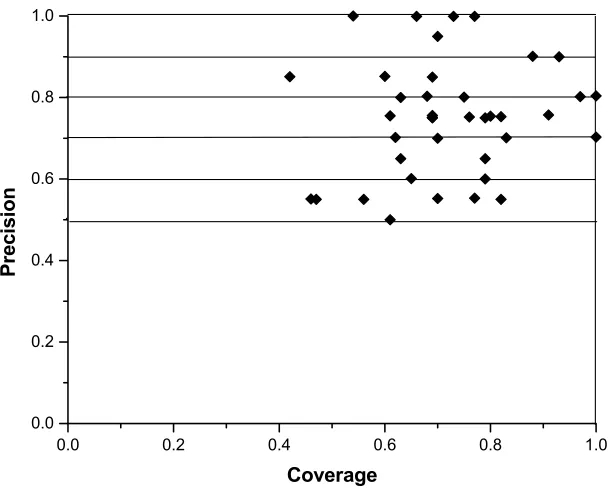
4.5 Algorithm Generate_All_Reduced_Size_Minterms 46 4.6 Algorithm Generate_well_Sized_Queries 47 5.1 Scatter plot for coverage and precision for user queries from top
10 documents. 57
5.2 Scatter plot for coverage and precision for user queries from top
20 documents 57
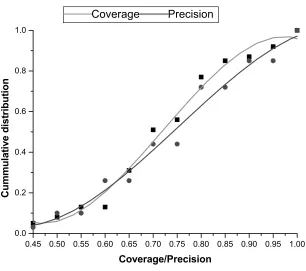
5.3 Cumulative distributions for coverage and precision of user
queries from top 10 documents 58
5.4 Cumulative distributions for coverage and precision of user
queries from top 20 documents 58
5.5 Average precision (P@10), coverage (C@10) and F1 measure (F@10) for the test queries (naïve, user, synthesised) at top 10
documents 63
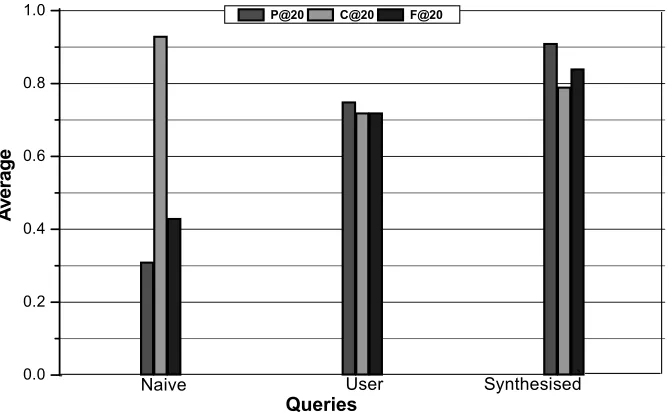
5.6 Average precision (P@20), coverage (C@20) and F1 measure (F@20) for the test queries naïve, user, synthesised) at top 20
documents 63 5.7 Scatter chart comparing precision (P@10) of user and synthesised
queries at top 10 documents 68
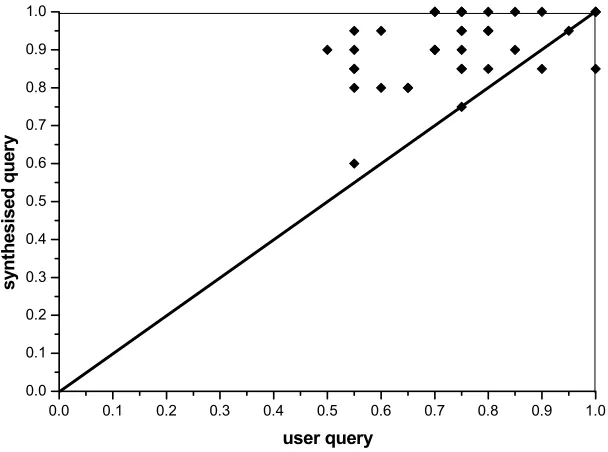
5.8 Scatter chart comparing precision (P@20) of user and synthesised
queries at top 20 documents 69
5.9 Scatter chart comparing precision (P@10) of naive and
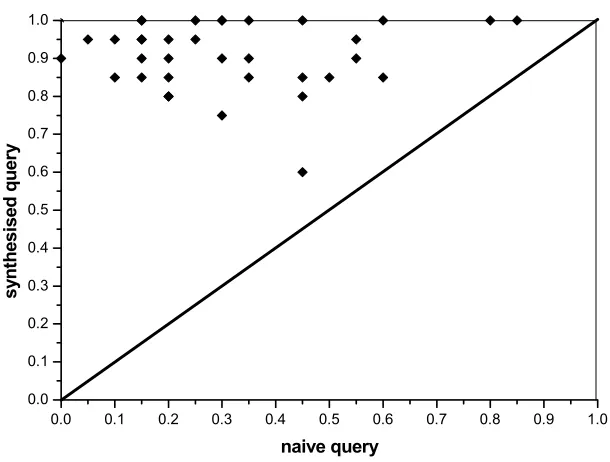
synthesised queries at top 10 documents 70 5.10 Scatter chart comparing precision (P@20) of naive and
synthesised queries at top 20 documents 71 5.11 Scatter chart comparing precision (P@10) of naive and user
queries at top 10 documents 72
5.12 Scatter chart comparing precision (P@20) of naive and user
queries at top 20 documents 73
5.13 Scatter chart comparing F1 measure (F@10) of user and
5.14 Scatter chart comparing F1 measure (F@20) of user and
synthesised queries at top 20 documents 75 5.15 Scatter chart comparing F1 measure (F@10) of naïve and
synthesised queries at top 10 documents 76 5.16 Scatter chart comparing F1 measure (F@20) of naïve and
synthesised queries at top 20 documents 77 5.17 Scatter chart comparing F1 measure (F@10) of naïve and user
queries at top 10 documents 78
5.18 Scatter chart comparing F1 measure (F@20) of naïve and user
queries at top 20 documents 79
6.1 Precision as a function of coverage (excludes human effects) 81 6.2 Coverage as a function of precision (excludes human effects) 81 6.3 Precision as a function of coverage (induced by the variations in
the query quality) 83
6.4 Coverage as a function of precision (induced by the variations in
the query quality) 84
6.5 Precision as a function of number of attempts to improve the query 85 6.6 Precision as function of terms in query (query improved once) 86 6.7 Precision as function of terms in query (query improved twice) 86 6.8 Linear relationship between number of terms and precision of
List of Tables
Tables Page No. 4.1 Examples of search topics, domain of interest and the number of
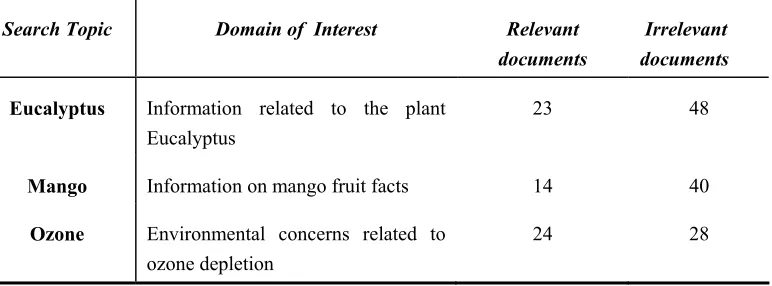
relevant and irrelevant documents obtained for the search topics 35 4.2 Number of key words obtained for the example search topics 35 4.3 Quality value and the synthesised query obtained for the example
search topics 48
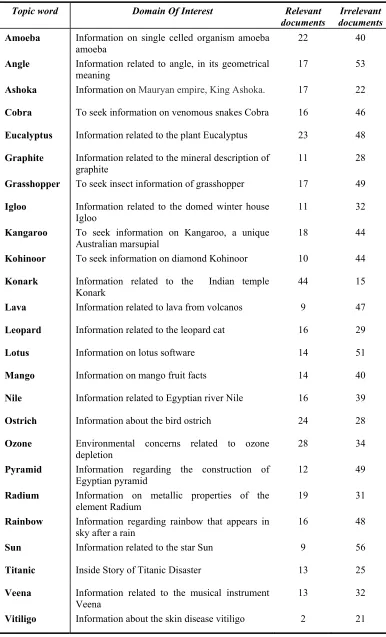
5.1 The search topics and the corresponding domain of interest with the number of relevant and irrelevant documents obtained to
synthesise query 52
5.2 The number of key words, quality value and the synthesised query
obtained for the search topics 53
5.3 Description of the symbols and computational rules/formula used
for the evaluation metrics 59
5.4 Comparison of retrieval performance in average precision, coverage and F1 measure between naïve query, user provided
query and synthesised query 62
5.5 Comparison of retrieval performances in average precision (%)
for all pair queries 64
5.6 Comparison of retrieval performances in average F1 measure (%)
for all pair queries 65
5.7 Results of paired t-test (based on precision) for synthesised query
vs. user query 68
5.8 Results of paired t-test (based on precision) for synthesised query
vs. naive query 70
5.9 Results of paired t-test (based on precision) for user query vs.
naive query 72
5.10 Results of paired t-test (based on F1 measure) for synthesised
query vs. user query 74
5.11 Results of paired t-test (based on F1 measure) for synthesised
query vs. naive query 76
5.12 Results of paired t-test (based on F1 measure) for user query vs.
naive query 78
6.1 Average query precision as a function of terms in query and
number of attempts to improve query 85 6.2 Fraction of queries with stated precision characteristics as function
of terms in query 88
6.3 Distribution of terms in two groups of volunteer queries marked
Contents
ABSTRACT i
Acknowledgement iv
List of Figures v
List of Tables vii
Chapter 1 Introduction
1-4
1.1 Introduction 1
1.2 Outline of this thesis 3
1.3 Outcome from this research 3
Chapter 2
Web Based Searches
5-12
2.1 Introduction 5
2.2 Some problems with current web search 5 2.3 Requirements of web searches 7 2.4 Ranking algorithms for web based searches 7
2.4.1 Boolean model 7
2.4.2 Vector space model 8
2.4.3 Extended Boolean model 9
2.4.4 Probabilistic model 9
2.4.5 Logical model 10
2.4.6 Cluster model 10
2.4.7 Neural network model 11
2.4.8 Inference network model 12
2.5 Conclusion 12
Chapter 3
Query Expansion and Literature Review
13-27
3.1 Introduction 13
3.2 Query Expansion 13
3.3 Relevance Feedback 15
3.3.1 User dependent methods 15
3.3.2 User independent methods 18
3.3.3 User query logs 20
3.4 Example of query expansion 21
3.5 Conclusion 27
Chapter 4
Query Synthesis Algorithm and its Implantation 28-48
4.1 Introduction 28
4.2 Overview of query synthesis problem 28
4.3 Query synthesis procedure 29
4.3.1 Document indexing 29
4.3.1.1 Feature extraction 30 4.3.1.2 Dimensionality reduction 30
4.3.2 Query construction 32
4.3.2.1 Preliminaries and notations 33
4.3.2.2 Examples 35
4.3.2.3 Constructing CNF Boolean expression 36 4.3.2.4 Optimise query expression: Distribute AND over OR 39
4.3.2.5 The web search query: Minimum minterm cover for set
Relevant
40
4.3.2.6 Fitting query to search engine 43
4.4 Conclusion 48
Chapter 5
Experiments
49-79
5.1 Introduction 49
5.2 Experimental set-up 50
5.2.1 Data collection 50
5.2.2 Web page classification 50
5.2.2.1 Guidelines for judging documents 50 5.2.2.2 Document classification 53
5.3 Evaluation metrics 55
5.4 Survey procedure 60
5.4.1 Survey results 62
5.6 Precision of the queries 67
5.6.1 Synthesised query vs. user query 67 5.6.2 Synthesised query vs. naïve query 69
5.6.3 User query vs. naïve query 71
5.7 F1 measure of the queries 73
5.7.1 Synthesised query vs. user query 73
5.7.2 Synthesised query vs. naïve query 75
5.7.3 User query vs. naïve query 77
5.8 Conclusion 79
Chapter 6 Characteristics of User Query
80-89
6.1 Introduction 80
6.2 Session length and termination condition 80 6.3 Trading coverage for improved precision 81
6.4 Characteristics of a successful query 84
6.5 Conclusion 89
Chapter 7 Discussion and Conclusion
90-93
7.1 Introduction 90
7.2 Concluding remarks and future work 92
References 94-100
Appendices 102-113
Appendix 1 102
Appendix 2 103
Appendix 3 104
Appendix 4 105
Chapter
ONE
INTRODUCTION
1.1 INTRODUCTION
The huge number of documents available on the Web represents a challenge for the information retrieval (IR) systems. The explosive growth in the number of documents published on the Web has made the web search engines the main means of initiating the interaction with the Internet. There are many good search engines, but users are often not satisfied with the results provided by the search engines. In many cases, the answers returned by the search engines are not relevant to the user information need, forcing the user to manually sift through the long list to locate the desired documents.
Often, when using a search engine the user needs to repeatedly refine their query as they do not have enough domain knowledge to formulate the query precisely. Thus the users typically refine their query, over several stages, adding or deleting terms to adjust the retrieval result to the sort of pages they want. The way the user uses a search engine is like a dialogue between the user and the engine: the user sends a query to the engine, and the engine uses the query to search the index database and returns a list of links. The user then provides the engine with the refined query to improve its next search by obtaining a list of refined list of links.
query is limited by the user’s vocabulary and knowledge of the search domain (Khan et al. 2004). Even when disjunctions or conjunctions of keywords are chosen as the way of expressing the search goal as existing search engines do, the users may not know what set of keywords they should use to define the collection of the desired documents precisely. Good query formulation requires that a user can somehow predict which terms appear in documents relevant to the information need. Accurate term prediction requires extensive knowledge about the document collection. Such knowledge may be hard to obtain, especially in large document collections.
In the field of information retrieval, it has been recognised that, although users had difficulty expressing exactly the information that they required, they could judge the retrieved documents as relevant or irrelevant based on their information need (Ruthven et al. 2003). This lead to the notion of Relevance feedback: users marking documents as relevant to their needs and presenting this information to the information retrieval system. The system can use this information to retrieve more documents like the relevant ones by a process known as Query expansion.
Relevance feedback in information retrieval systems was first proposed in the late 1960’s (Rocchio 1971). Since then it has been used as a controlled, automatic process for query reformulation, that is easy to use and can prove unusually effective. The main idea consists in choosing important terms or expressions, attached to certain previously retrieved documents that have been identified as relevant by the users and of enhancing the importance of these terms in a new query formulation.
words long). The effectiveness of these queries is proved by using some evaluation measure described in chapter 5. Throughout my experiment, Google is selected as a prime example of a search engine because of its popularity and cached link features on the Web.
1.2 OUTLINE OF THIS THESIS
The remaining chapters of this thesis are organised as follows:
• In chapter 2, the issues related to a search engine are discussed and various retrieval methods of a document retrieval system are outlined.
• In chapter 3, the concepts of query expansion and relevance feedback are summarised. Examples of query expansion and past work on relevance feedback are also provided.
• In chapter 4, the query synthesis problem is discussed and the proposed algorithm is described briefly with examples.
• In chapter 5, the experimental design of the proposed work is described. Some evaluation measures are discussed and the results are presented.
• In chapter 6, the results of the experiment are analysed to draw some conclusions.
• In chapter 7, the concluding remarks about improving the effectiveness of the proposed algorithm and propose avenues for future investigation into this problemare proposed.
1.3 OUTCOME FROM THIS RESEARCH
The details of the research papers based on the present research work reported in the thesis are presented below:
1. Sunanda Patro and Vishv Malhotra, Characteristics of the Boolean web search query: Estimating success from characteristics in Proceedings of WEBIST 2005: International Conference on Web Information Systems, pp. 339-344, May 26-28,2005, Miami, USA. 2. Vishv Malhotra, Sunanda Patro and Johnson, David, Synthesise
Web Queries: Search by Examples in Proceedings of ICEIS2005:
3. David Johnson, Vishv Malhotra, Peter Vamplew, and Sunanda
Patro, Refining Search Queries from Examples Using Boolean
Expressions and Latent Semantic Analysis in Proceedings
AISAT2004: International Conference on Artificial Intelligence in Science and Technology, pp. 120-125, Hobart, Tasmania, Australia. Nov 22-24, 2004.
4. Sunanda Patro, Vishv Malhotra and David Johnson, Generating Web Search Queries from Examples (to be submitted for a journal publication).
Chapter
TWO
WEB BASED SEARCHES
2.1 INTRODUCTION
In this chapter, the problems faced with current web information retrieval systems and the requirements of an efficient web search system are discussed. Various ranking algorithms used for web based searches are also discussed in this chapter.
2.2 SOME PROBLEMS WITH CURRENT WEB SEARCH
People use search engines when they need information that they believe is present in the system’s collection of web documents. Because of the explosive growth and wide range of topics covered by the web documents, users find it hard to make a precise query to retrieve all and only the documents relevant to their information need. A user’s information need may also be task-related and depend on his or her background knowledge and information seeking experience. The lack of information is exacerbated when they have only a vague idea of what they want (Cunningham et al. 1997). For example, a student researching a topic for a paper will probably begin with just a few keywords that characterize the information they want. They will certainly not have titles and authors of every paper in the collection related to their topic.
synonymy etc) and the different interpretation of a query (the same query term perceived differently by different users), make it impossible for any retrieval system to present the user with every relevant document given such an imprecise description. For example for the query “trumpet”, some users may be interested in documents dealing with “trumpet” as “musical instrument”, while some others users may want documents related to the “bird”. Current search engines such as Google or Yahoo! have hierarchies of categories to help users to specify their intentions. However, categories returned from a typical search engine are still independent of a particular user and many of the categories do not reflect the intention of the searcher.
Further, as numerous authors have created their web sites independently the vocabularies of authors vary greatly. There is an acute requirement for search engine technology to help users exploit such an extremely valuable resources. Simply stated, people often use different words to describe concepts in their queries than authors use to describe the same concepts in their documents. This problem of word mismatch is a fundamental problem to information retrieval (Xu et al. 1996). The severity of the problem tends to decrease as queries get longer, since there is more chance of some important words co-occurring in the query and relevant document. In many applications however, the queries are very short with a few keywords, which are likely to be different from those index terms of the documents of the Web.
It can therefore be a frustrating experience to ask someone to describe the information that is lacking. Returning all documents related in some way to the initial set of keywords is the simplest response, but in addition to relevant documents this would include many links that are irrelevant. As a result people often use multiple queries to increase the effectiveness of the search process. This is again a tedious and time consuming process, as it unnecessarily increases the volume of documents for the user to browse through.
2.3REQUIREMENTSOF WEB SEARCHES
In view of the difficulties experienced with the web based searches, it becomes a challenge for the search engines to have features to conduct effective searches. The requirements of a system to perform efficient web document searches are listed below (Hu et al. 2001):
1. The system’s effectiveness in locating and ranking web documents.
2. The efficiency of the system’s web document search and ranking algorithms. 3. The system’s unbiased access to pages.
4. The expressiveness and usefulness of the search results obtained by the system.
5. The system’s access to up-to-date web information. 6. How thorough the system’s web coverage is. 7. The system’s adaptability to the user queries.
2.4 RANKING ALGORITHMS FOR WEB-BASED SEARCHES
Having represented the document collection and the information need (query) in some manner, the next step of information retrieval is to determine the “relevance” relationship between the two. The determination of how the document is likely to be relevant to a query depends largely on the underlying assumptions (ranking algorithms) of the information retrieval models.
A variety of techniques have been developed for ranking retrieved documents for a given input query. Detailed information regarding ranking algorithms used by major search engines is not publicly available. In this section, references to some classical techniques are given which can be modified for use by web search engines.
2.4.1 Boolean model
and synonyms (OR) as well as the fast response time from the search made the Boolean information retrieval system as a popular one.
The Boolean model has been used in a large number of on-line public access catalogue (OPAC), but has been shown to demonstrate a number of difficulties (Ruthven et al. 2003). Firstly traditionally Boolean systems do not use term weights and consequently return the complete set of documents that match the query as an unordered set. As a result, the user may have to add or remove terms or generate more complex query expression to reduce the set of retrieved documents to a manageable size. Secondly the user has to have some knowledge to the search topic for the search to be efficient, e.g. a wrong word in a query could make a relevant document non-relevant. Despite of these problems the Boolean models do remain popular because of its ability to offer explicit control to the search query and web search engines often use this model to allow Boolean style query.
2.4.2 Vector Space model
To overcome the weakness of the Boolean model many refinements to this model exists. The most commonly used are term-weighing or vector space models where the frequency of appearance of an attribute (e.g., key words) or the location of the appearance is taken into account (Kobayashi et al. 2000). The vector space model has been widely used in the traditional information retrieval field and most search engines use similarity measures based on this model to rank web documents. The model creates a space in which both documents and queries are represented by vectors. For example, a document D is represented by a vector of n weights as D = (d1, d2, d3… dn ), where n is the number of unique terms in the document collection.
Though the vector space model overcomes some of the problems of Boolean model by providing a similarity measure between the document set to the query, it fails to provide a real theoretical basis as to how the similarity should be calculated or query weights should be assigned. Secondly in vector space model the terms are assumed to be independent, i.e. no relation exists between the terms which may not be true in practice (Scott et al. 1990). For example for the synonymous words (e.g. car and automobile) this can lead to the fact that the similarity of some relevant documents with the query is very low just because they do not share the same words.
2.4.3 Extended Boolean model
Extended Boolean model is a hybrid model that strengthens the Boolean model by combining the Boolean operators with the vector space model. The extended Boolean model introduced by Salton et al (Salton et al. 1983) aims to make use of term weight to a Boolean query. The P-norm method developed by them allows query and document terms to have weights, which have been computed by using term frequency statistics with the proper normalization procedures. These normalized weights can be used to rank the documents in the order of decreasing distance from the point (0, 0... 0) for an OR query, and in order of increasing distance from the point (1, 1... 1) for an AND query. Further, the Boolean operators have a coefficient P associated with them to indicate the degree of strictness of the operator. Though the Extended Boolean model approach gives the system more flexibility, it increases the computational cost by adding complexity to calculations
2.4.4 Probabilistic model
by summing its individual term relevance weights which estimates the probability of appearance of query terms in relevant and non-relevant document sets. The probabilistic model suffers from the same limitation as the vector space model by making some simplifying assumptions of term independence, an assumption introduced merely for the sake of computation simplicity (Yang 2002, p.18).
2.4.5 Logical model
The logical model seeks to establish an inference relation between the query and the document by making an assumption that both can be represented by logical formulas. The basic principle of this model is that the relevance of a document to a given query can be measured by the probability that the information in the document infers the information in the query.
This class of model originates from a proposal by Van Rajsbergen (Rijsbergen 1986) where relevance can be modelled as a process of uncertainty principle. According to this proposal the evaluation of P
(
d →q)
that is the relevance of a document representation d can be measured by the probability that the information in a document infers the information in a query q can be measured by using the following principle:“Given any two sentences x and y; a measure of the uncertainty ofy→x related to a given data set is determined but the minimal extent to which we have to add information to the data set, to establish the truth ofy→x”.
Though theoretically sound, the difficulty of translating text into formal logic makes this model hard to implement (Yang 2002, p.18). Even if the text-to-logic translation can be automated, an information retrieval system based on the logical model will have problems upon encountering contradictions and uncertainties that are often present in documents.
2.4.6 Cluster model
The cluster model is an extension of vector space model, which is based on the hypothesis that similar documents will match the same information, needs (Liu et al. 2004). Cluster based retrieval groups a list of documents into clusters and returns a list of documents based on the clusters that they come from.
represents the topic covered by those queries and each cluster is given a weighing which is proportional to the number of documents retrieved from that collection. The new queries are then matched with the most similar cluster and that cluster’s weighing model is used to determine the proportion of documents to retrieve from each collection (Cunningham et al. 1997).
In the past decade, cluster model has been put forward as an important tool for web search engines and has been shown to improve the effectiveness as well as efficiency of the information retrieval systems. Despite the popularity of the cluster model, there has been no guarantee that document clustering can be used to improve retrieval results, especially on test collections of realistic size and where no relevance information is available. Another limitation with the cluster model is that it suffers from high computational cost for its construction and maintenance.
2.4.8 Neural network model
A neural network model is an interconnected assembly of simple processing elements or units or nodes, whose functionality is loosely based on the animal neuron (He 1999). In this model the information retrieval process is presented as neural network of queries, index terms and documents, where term nodes are connected to document and query nodes by weighted links. The retrieval is typically done by “spreading the activation” from the query vector to a document vector via a term layer containing nodes representing all terms contained in all document descriptions (Cunningham et al. 1997). At this stage the activation level constructed by a document node indicates the relevance of the document to the query. Activation then spreads backward to the term layer, reinforcing query terms and adding activation to new terms in relevant documents, and then forwards again to the document layer, where additional documents may be activated by the new terms. The documents are then ranked for retrieval according to their activation level.
obtain the same results. Although these models are able to generate a solution to many problems, are unable to explain how they arrive at their results.
2.4.9 Inference Network model
The inference network model combines the approaches of probabilistic model and neural network model to rank the documents. The inference network model is basically a Bayesian Network used to model documents, the document contents and the query. In the simplest implementation of this model, a document instantiates a term with certain weight, and the credit from multiple terms is accumulated by a given query to compute the equivalent of a numeric score for the document (Singhal 2001). The documents are then ranked in order of decreasing probability that they satisfy the user’s information need. Some strong points of this model are that it allows structured and weighed queries to be evaluated and makes an efficient inference in multiple document representations. However the limitation with this model is that it fails to assign any defined term weights for a document and interprets probability as a degree of belief which may not always be true.
2.5 CONCLUSION
Chapter
THREE
QUERY EXPANSION AND
LITERATURE REVIEW
3.1 INTRODUCTION
In this chapter, the description of the various strategies of query expansion process and the concept of relevance feedback is discussed. Earlier research on relevance feedback is discussed and an example of query expansion is provided.
3.2 QUERY EXPANSION
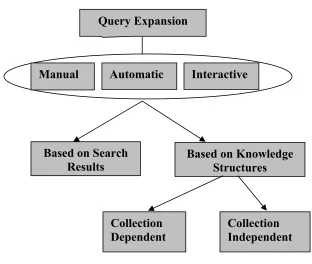
Query expansion (or term expansion) is a process (or method) that describes a set of techniques for modifying a query in an attempt to provide better retrieval performance. In most cases, terms are added to an existing query, although query expansion also encompasses techniques for the reweighing of terms as well as the deletion of terms. The method itself is applicable to any situation irrespective of the retrieval techniques used and can be considered as one of the most indispensable methods to achieve successful information retrieval. There are basically three modes of query expansion shown in Figure 3.1, which can be performed automatically by the system or manually by the user or semi-automatically (Ethimiadis, 1996):
2. Automatic Query Expansion (AQE) refers to techniques that modify a query without user control. For example, a system that always adds thesaurus terms to a query would be considered as AQE system.
3. Interactive Query Expansion (IQE) refers to techniques where the user has some interaction with the system in the query expansion process. This set of techniques encompasses Relevance Feedback and is the focus of this present work.
[image:27.595.172.484.252.516.2]
Figure 3.1: Different possible strategies for query expansion
The two key aspects that need to be considered in any query expansion technique are: the source from which expansion terms are selected and the method to weight and integrate expansion terms (i.e. ranking algorithms) (Efthimiadis 1996). Possible strategies for query expansion are shown in Figure 3.1. One of the types of query expansion is based on the previously retrieved search results which relates to the relevance feedback process. The other type is based on some priori knowledge structure which in turn may or may not be collection dependant.
Query Expansion
Manual Automatic Interactive
Based on Search
Results Based on Knowledge Structures
Collection Dependent
The four term selection methods for query reformulation (Ethimiadis, 1996) are identified as:
1. Uses only original query terms.
2. Uses original query and terms from some other sources.
3. Uses combinations of the terms derived from the original query and terms from the documents retrieved and judged relevant.
4. Abandons the original query terms and uses only terms from the retrieved set of documents.
The present work utilises a combination of methods 2 and 3 above, where the “some other source” is the words (or terms) derived from a set of documents judged relevant and irrelevant by applying a technique known as Relevance feedback.
3.3 RELEVANCE FEEDBACK
Relevance feedback (Ethimiadis, 1996) is a process through which a query is selectively modified to retrieve more relevant documents from a collection than the unmodified original version. The query can be modified by either adjusting the term weights, by adding new terms or by using the combination of these two approaches. New terms are generally selected based on the most important terms from a set of documents deemed relevant to the query. Key factors in the relevance feedback process are the determination of the relevant documents and the selection of new terms. There are three main types of relevance feedback: one which is dependant upon user input to determine relevant documents and one that performs independently of any user intervention by assuming that the top-ranked documents are relevant to the query and the third depends on the information of the user query logs. The three main type of relevance feedback methods are discussed in the following sub sections.
3.3.1 User-dependant methods
that are considered useful to retrieve more relevant documents. The idea is that since the newly formed query is based on documents that are similar to the desired relevant documents, the returned documents will indeed be similar (Chen et al. 1998).
Most of the work in user dependant relevance feedback was carried out by Rocchio (Rocchio 1971) on vector space model. The basic operational procedure of his work is based on the merging of document vectors and original query vectors. This automatically reweighs query terms by adding the weights from the actual occurrence of those query terms in the relevant documents and subtracting the weights of those terms occurring in the non-relevant documents. Adding all the terms not in the original query that are in the relevant documents and non-relevant documents automatically expands queries. They are expanded using both positive and negative weights based on whether the terms are coming from the relevant or non-relevant documents.
Ide (Ide 1971) extended Rocchio’s (Rocchio 1971) research by eliminating the vector normalization. He not only verified the positive results, but also investigated two different feedback strategies such as Ide Regular and Ide dec-hi. The Ide Regular method uses all the non-relevant documents whereas the Ide dec-hi method uses the top non-relevant documents retrieved in the first set. In his experiments on a small test collection, Ide discovered that the use of non-relevant documents for feedback seemed to raise the ranks of fairly high-ranking relevant documents, at the same time lower the ranks of some low-ranking relevant documents.
A detailed comparison of three different feedback methods is reported by Salton and Buckley (Salton et al.1990) on the work of Rocchio (Rocchio 1971) and Ide (Ide 1971) across six different collections. Their results favoured the Ide dec-hi method although the other methods follow close behind.
Wu (Wu et.al 1981) expanded the queries using the vector expansion method developed by Rocchio (Rocchio 1971), but then reweighed all the query terms using a revised term distribution method. The most improvement came from reweighing with a smaller increment from the added terms.
Croft (Croft 1983) further extended the probabilistic weighing model of Robertson and Jones (Robertson et al.1976) by adapting the probabilistic model to handle within-document frequency weights.
Harman (Harman 1992) reported relevance feedback results using a simple probabilistic model and single document collection. She looked at the effect of reweighing terms, various methods for selecting terms to expand query and the number of terms added to the query. The method of selecting terms and the number of terms added had a noticeable effect on performance. Her experiments showed that adding as few as 20 well-selected terms could result in performance improvements of over 100% and for a variety of selection methods, she found increase in precision of about 65% to 110%. Additionally performing multiple iterations of feedback was shown to be highly effective.
Hains and Croft (Haines et al.1993) describe extensions to an inference network model of information retrieval to include relevance feedback techniques. In their inference network model, queries are represented as links between query nodes and the information need node. A variety of methods were used for selecting terms and these terms were incorporated by adding new links between the information node and query node. The weight associated with a query term is used to predict the probability that the information need is satisfied given that a document has that term. In their experiments of term reweighing and adding new terms to query could increase the performance of the retrieval system.
Bhuyan and Raghavan (Bhuyan et al.1991) stored relevance feedback information from several users in three graphs denoting different relationships between pairs of documents. Documents considered jointly relevant by a number of users are placed in the same group. The graphs are then combined to form clusters that are used in later stages to improve the retrieval performance.
Yang and Korfhage (Yang et al.1994) use genetic algorithm to modify user queries rather than document descriptions. They measured the fitness of a variety of queries containing different weightings for query terms by using the relevance feedback over the document sets retrieved by each weighed form of the query. Their experiments show that this technique achieves higher precision than the original unmodified queries.
posterior probabilities of relevance of the documents. This method has been used to design several query term reweighing and query expansion techniques.
While user dependant relevance feedback methods have been shown to improve query responses, the major drawback to all these algorithms is their dependence upon user relevance judgements during their intermediate stages. Another drawback of this method is that user takes more time to assess the documents to provide relevant judgments.
3.3.2 User-Independent Methods
More recently user independent relevance feedback methods have been described as adhoc or blind or pseudo relevance feedback. This method takes the form of “pseudo” relevance feedback, where actual input from the user is not required. In pseudo relevance feedback, a pre-determined number of documents retrieved by the original query are assumed to be relevant without any intervention by the user. These assumed relevant documents are then used in a relevance feedback process to construct an expanded query, which is then run to retrieve the set of documents actually presented to the user.
Attar et al (Attar et al.1977) used the top ranked documents for a query which was proposed as a source of information for building an automatic thesaurus. Terms in these documents were clustered and treated as quasi-synonyms for improving the retrieval effectiveness.
Information from the top ranked documents is used to re-estimate the probabilities of term occurrence in the relevant set for a query in Croft and Harper (Croft et al.1979). The weights of query terms were modified without adding new terms. Their experiment produced effective improvements based on a small test collection.
Efthimiadis and Biron (Efthimiadis et al.1994) investigated the performance of query expansion with and without relevance information by varying the number of documents that are treated as relevant and the number of terms that are included in the expansion. In their experiment with Okapi retrieval system the combination of adding 10 terms from the 5 or 10 top ranked documents contributed to better retrieval performance.
to cluster the top ranked documents into different key concepts and selected terms from each clusters for expanding the query.
Mitra et al (Mitra et al. 1998) suggested improving query expansion by refining the set of documents used in pseudo feedback with Boolean filters and proximity constraints.
Xu and Croft (Xu et al. 1996, 2000) focused on techniques that analyse the corpus to discover word relationships and those that analyse documents retrieved by the initial query. From top-ranked documents, noun groups are selected according to their co-occurrences with the query terms. Since the expansion terms used here are based on the co-occurrences with terms in the query and not on the frequencies in the top-ranked documents, this approach solves the problem of insufficient statistical data to some extent. However, the approach is based on the hypothesis that a frequent term from the top-ranked relevant documents will tend to co-occur with all query terms within the top-ranked documents, which is not always true.
Hoasi et al (Hoasi et al. 1999) proposed a Query Expansion method based on a measure called word contribution and proved its effectiveness by experiments through a comparison with the well-known Rocchio algorithm (Rocchio 1971). They proposed a weighing scheme which can be implemented by extracting not only the importance of the word in relevant documents, but also the influence of the word to query-document similarity.
Imae et al (Imae et al. 1999) explored the combination of query expansion methods for reformulating the original query to suit user’s needs more appropriately. They applied two query expansion methods, similarity thesaurus and pseudo feedback in sequence to improve the retrieval performance.
In the recent work by Cai et al (Cai et al.2004) explored the use of page segmentation algorithms to partition web pages into blocks and took advantage of block-level evidence to improve retrieval performance in the web context. They used top-ranked pages to select terms for query expansion in a way similar to the traditional pseudo-relevance feedback algorithm.
3.3.3 User -Query logs
A simple variant of pseudo feedback is based on the exploitation of query logs. One important assumption behind this method is that the clicked documents are “relevant” to the query. Log-based query expansion collects and analyses all user’s historical relevance judgements as a whole without intervention of users. This approach may be viewed as a special case of pseudo feedback because its expansion terms are derived from a subset of documents.
Cui et al (Cui et al. 2002) developed a method which aims to establish the correlation between query terms by exploiting the query logs. The central idea is to extract probabilistic correlations between query terms and document terms by analysing query logs, which are then used to select quality expansion terms for new queries. In their recent study (Cui et al. 2002), they further extended the previous utilization of user logs by trying to extract relationships between query terms and document terms. These relations are then used for query expansion. Wen and Zhang (Wen et al. 2002) tried to cluster queries according to user logs in order to find Frequently Asked Questions (FAQs). These FAQs are then used to improve the effectiveness of question answering.
Klink et al (Klink et al.2002) employed a simple variant of the pseudo-relevance feedback, which is based on using term concepts learned by other queries. In this approach for all query terms concepts are learned from previous queries and relevant answer documents. A new query is transformed by replacing the original query terms by the learned concepts. The vital advantage of this approach is that in a multi-user scenario users can benefit from concepts learned by other users.
Billberk et al (Billberk et al. 2003) used associated queries as a source of terms for query expansion, based on selecting terms from past queries that are associated with the documents in the collection.
Shen et al (Shen et al 2003) used the user’s own history queries to expand the current query by using maximum likelihood estimator. Web query log has been used as a source for query history information. Their experiment results showed an improvement in both average precision and precision at 20 documents.
context of the query to improve retrieval effectiveness of web search. But this method fails to collect the relevant documents for a topic searched by an unknown user.
Relevance information based on clicked documents overcomes the query drift problem faced by pseudo feedback. However as clicking information is not an accurate judgement of relevant document, this method increases the user’s responsibility, which can resultedly cause inconvenience or introduce confusion. Also, by attempting to automatically learn the user’s categories of interest, the system becomes susceptible to the inevitable problem of noise. In this approach it becomes hard for the system to determine the relevant documents for a topic searched by an unknown user.
While concluding the description of the relevance feedback methods, in real life context, the user is the best judge to make any relevant decision. Again user dependent relevant method overcomes the serious drawbacks experienced by other two methods. The present research is based on the relevance feedback information explicitly provided by the user (user dependant method) despite the time constraint being considered.
3.4 EXAMPLE OF QUERY EXPANSION
In this section, a typical example is presented to show, how the proposed algorithm on query expansion helps to improve the search results. The details of the implementation part of this algorithm are described in the next chapter. Considering that the user is interested in documents, which describe the fruit facts or growing information of the fruit mango. With the search word mango, Google returns the following results in top 20 documents (documents marked *** are found to be relevant):
1. MANGO – Fashion for the young, urban woman
MANGO presents you its new collection. Have a look at our online catalogue and discover the latest fashion trends surfing along the jeans, T-shirts and ...
www.mango.es/ - 6k
2. MANGO – Moda para la mujer joven y urbana
MANGO te presenta su nueva colección. Accede al catálogo online y descubre las últimas tendencias en moda visitando las secciones de jeans, ...
3. Mango
Página en Internet de la marca española de moda MANGO en la que puedes encontrar el catálogo de temporada, información sobre las últimas tendencias en moda ...
www.mangoshop.com/ - 3k
4.
***
MANGO Fruit FactsOrigin: The mango is native to southern Asia, especially Burma and ... Forms: The mango exists in two races, one from India and the other from the ...
www.crfg.org/pubs/ff/mango.html - 25k -
5. Mango: management accounting for non governmental organisations
Mango provides financial management services to agencies working in relief and development projects in developing and disaster stricken countries. www.mango.org.uk/ - 9k - 17 Apr 2005
6.
***
MangoComprehensive chapter covering history of cultivation, botanical description, comparison of varieties, and nutrient content of fruit. www.hort.purdue.edu/newcrop/morton/mango_ars.html - 99k - 17 Apr 2005
7. Mango - Open Source mealmaster compatible recipe management
Recipe management software for Unix that is mealmaster compatible and includes support for RecipeML. [Open Source]
mango.sourceforge.net/ - 6k
8. Mango Recipes from Northern Territory Australia
Mango Recipes mango jam, mango pickles and many other ideas for mangoes including eating and storing mangoes.
members.ozemail.com.au/~mjl1/mangorecipes.html - 49k
9. The Mango Book Club:
Mango - the ultimate book club for girls on the go is packed with funky fiction, riotous romps, gripping thrillers and more, all at discounted prices.
www.mango.co.uk/ - 82k - 17 Apr 2005
10. MaNGO online
Macedonian NGO Portal which contains news, event calendar, projects and foundations directory.
www.mango.org.mk/en_news.asp - 48k -
11. FREE website templates, custom website design, and custom graphic
Offers free website templates with graphics, as well as custom website design. www.mango-graphics.com/ - 17k - 17 Apr 2005
12. MaNGO Online
MaNGO Online is web service for Macedonian NGO community, Makedonija. www.mango.org.mk/ - 4k - 17 Apr 2005
13.
***
All about mangos featuring mangoe recipes, mango history, eatingMangos. Mangoes featuring mango recipes, mangos for your health, history of mangoes, how to select and store mangos, how to eat mangos.
freshmangos.com/aboutmangos/ - 19k - 18 Apr 2005
14. Mangoshop.com
... 2005 Mango-On line, SA.
www.mangoshop.com/entrada_IN.htm - 12k
15. The Mango Library
A Java library consisting of a number of iterators, algorithms and functions, loosely inspired by the C++ Standard Template Library. [Open source, LGPL] www.jezuk.co.uk/cgi-bin/view/mango - 7k - 17 Apr 2005
16. Mango DSP Ltd.
Dsp at Mango DSP. Your source for video surveillances, video security, machine vision and video over ip.
www.mangodsp.com/ - 26k
17. Mango Verde
Photos and sounds for almost 2000 bird species; field guide quick indices. www.mangoverde.com/ - 2k
18. Mango Tribe Productions
... The mission of Mango Tribe is to use experimental community-based theater ...
press kit or surf through our site for all the details about Mango Tribe. ...
mangotribe.thecollectivechicago.org/ - 8k
19.
***
Mango MadnessSmall collection of mango recipes plus advice on selecting, handling, and ripening mangos.
www.globalgourmet.com/food/kgk/2000/0600/kgk062400.html - 11k
From the above links, it can be observed that only 4 links (shown with “***”) are somewhat relevant to the information need of the search query mango. At this stage, it is difficult for a user to figure out which words should be used to expand or refine the current search. Hence the proposed algorithm can be used to expand the current search. The reformulated Boolean query (which is described in the next chapter) from the present algorithm is mango ((indica OR
green) tree). If this query is run on Google, the following top 20 links are retrieved:
1.
***
Database Mango - Mangifera indica... 100 important rainforest medicinal plants included Mango - Mangifera indica.
... When mango trees are in bloom, it is not uncommon for people to suffer ...
www.rain-tree.com/mango.htm - 21k
2.
***
MANGO Fruit Facts... Growth Habit: Mango trees make handsome landscape specimens and shade trees.
... Tree dense, low branching. Fruit small (6-8 oz.), yellow-green with red ...
www.crfg.org/pubs/ff/mango.html - 25k
3.
***
Mango... of astonishment to many that the luscious mango, Mangifera indica L., ...
The extent to which the mango tree shares some of the characteristics of its ...
www.hort.purdue.edu/newcrop/morton/mango_ars.html - 99k - 17 Apr 2005
4.
***
[PDF] Mangifera indicaMangoFile Format: PDF/Adobe Acrobat - View as HTML
... attractive dark green, tropical foliage make Mango a. popular home landscape item in very ... falling from a Mango tree to litter the lawn. Place it ...
hort.ifas.ufl.edu/trees/MANINDA.pdf
5.
***
Mango... medium to large evergreen mango tree is also attractive in the home landscape.
... 'Kent', a green, red and yellow mango of about a pound and a half in ...
aggie-horticulture.tamu.edu/ extension/homefruit/mango/mango.html - 11k
6.
***
ORIGIN: Common mango (Mangifera indica L... Common mango (Mangifera indica L.) originated as alloploid and its native home was ... Truly wild common mango trees have been recorded in Bangladesh ...
7.
***
PlantFiles: Detailed information on Mango (Mangifera indica)... Mango trees are deep-rooted, symmetrical evergreens that attain heights of 90 feet and ... Mangifera indica is known as 'Bowen Mango' in Australia. ...
davesgarden.com/pf/go/2250/
8.
***
Mango... The Mango, Mangifera indica L., is the most economically important fruit crop
... to see mango trees in kitchen gardens, in pastures, or as street trees ...
www.uga.edu/fruit/mango.htm - 30k
9.
***
Spice Pages: Mango (Mangifera indica, aam, aamchur)... Mangifera indica: Mango fruits. Mango fruit cluster, close to ripe ...
Wild mango trees are known only from North-East India and Burma, ...
www-ang.kfunigraz.ac.at/~katzer/engl/Mang_ind.html - 20k - 17 Apr 2005
10. Office Scapes Direct
... Our silk mango is a very lush and full plant. Great for any dark, rich interior. Nicely textured leaves have a deep green/burgundy appearance on top and ...
www.officescapesdirect.com/ Products/index.cfm/N/2;9/T/2;9/P/237 - 70k
11.
***
Fruit > Mangoes... Green tree ants, once established in an orchard and correctly managed, ...
in the amount of green skin at ripe (see the DPI Newsletter Mango Care no. ...
www.growinglifestyle.com.au/au/j348541/ - 31k
12.
***
Mango - King of Fruits - Trees of Haryana - Flora - Mangifera ...Haryana Online - Mango - Trees of Haryana - Flora - Fauna - Mangifera indica - Forest ... Coppery to purplish-red at first but becoming green at maturity, ...
www.haryana-online.com/Flora/mango.htm - 16k
13.
***
Mango (Mangifera indica)... Mangoes are very attractive trees, covered of large glossy deep green leaves
... It is a good tree to try. Mango (Mangifera indica). Cultural Practices: ...
www.desert-tropicals.com/Plants/ Anacardiaceae/Mangifera_indica.html - 10k
14.
***
Mangifera Indica L - MangoMango is a tall tree growing up more than 100 feet with a dense, heavy crown ...
MANGIFERA INDICA L. - MANGO. Mangifera Indica Synonyms: mangifera domestica
...
15.
***
Ethnobotanical Leaflets... The mango's scientific name is Mangifera indica. Asia has held the mango with high ... were erected to depict the mango tree as a concept of royalty. ...
www.siu.edu/~ebl/leaflets/mango.htm - 9k
16.
***
Insect Richness Project Home Page... indica trees to Guacimo trees further away from the Mangifera indica trees, we hoped to assess the impact the Mango trees have on species richness. ...
www.woodrow.org/teachers/ esi/2001/CostaRica/palo_verde2/insects/ - 12k
17.
***
Mango varieties: green eating... Small picture of mango tree. Green eating mango varieties are distinguished from others by their flavour at the hard green mature stage. ...
www.dpi.qld.gov.au/horticulture/5332.html - 23k
18.
***
Mango. DermNet NZ... or green mangos can be eaten with salt or are cooked to make mango chutney.
... LaWarre S. Botanical briefs: the mango tree--Mangifera indica L. Cutis. ...
www.dermnetnz.org/dermatitis/plants/mango.html - 10k
19.
***
Mango - Mangifera indica... Beautiful, large tropical tree to 50-80ft. Mango trees are not strictly ...
main races of mango, the Southeast Asian varieties which have red and green ...
www.tradewindsfruit.com/mango.htm - 10k
20.
***
Vegetarians in Paradise/Mango History, Mango Nutrition, Mango... The earliest mention of mango, Mangifera indica, that means "the great fruit
... Symmetrical in shape, the mango tree is a beautiful ornamental that is ...
www.vegparadise.com/highestperch37.html - 22k
3.5 CONCLUSION
Chapter
FOUR
QUERY SYNTHESIS ALGORITHM AND ITS
IMPLEMENTATION
4.1 INTRODUCTION
This chapter discusses the query synthesis problem by addressing some of the issues mentioned in the previous chapters. It explains the implementation of the query expansion techniques described in the previous chapter, in designing an algorithm that aims to generate a web search query from a set of example text documents. The various modules of this query construction algorithm are illustrated with examples.
4.2 OVERVIEW OF QUERY SYNTHESIS PROBLEM
Boolean logic (and, or, not, adjacency operators), many search engines assist users in making the query more precise. However general users find it hard to formulate such queries that keep a balance of high precision and recall. Again the search engines have their own restrictions and limitations to the syntax and size of the search query that makes it very difficult for a user to write a precise query. The query synthesis problem addresses the above goals by presenting an algorithm that generates a Boolean search query from a set of initially retrieved documents. The three objectives for the algorithm are to ensure that the constructed query has good recall, good precision and not least, is of a form and size acceptable to the intended web search engine.
4.3 QUERY SYNTHESIS PROCEDURE
From the point of view of a web searcher, the query synthesis procedure begins with an initial imprecise query to a search engine. The query would return links to web resources. The searcher indicates if the resource is of interest or not, either based on the short description that accompanies the displayed link or by explicitly downloading the resource. All retrieved resources are assumed to be text documents and these text documents are partitioned into two sets: Relevant and Irrelevant. The set Relevant contains a set of documents marked as relevant by the searcher whereas the set Irrelevant contains the set of documents marked as irrelevant by the searcher. Based on these two sets of text documents the query synthesis is carried out in two phases. The first phase is the document indexing phase and second, query construction phase.
4.3.1 Document indexing
document collection. In my implantation of the algorithm, the indexing has been carried out in two steps: Feature extraction and Dimensionality reduction.
4.3.1.1 Feature Extraction
The feature extraction phase is an important phase in the system as the query synthesis process is primarily based on the features extracted during this phase. The features should provide some valuable information about the document and at the same time be computationally inexpensive. In this algorithm, binary arrtibutes (words) are considered as the possible features. Each attribute represents whether or not the corresponding word occurs in a given text document.
4.3.1.2 Dimensionality Reduction
Unfortunately the use of all distinct words in any web page would produce a huge and impractical number of attributes. In the information retrieval situation we are cursed with a high dimensionality term space (Efthimiadis 1996), i.e. with a large number of attributes, which in this case are the terms. In other words, one has to face with the complete set of index terms in the document collection for the decision of selecting terms for query construction and this huge number of terms makes such a decision nearly impossible. To improve performance and generalizability, dimensionality reduction is performed using a three step process explained as:
1. First, a basic text processing is performed that is often used in text mining, where stop words as well as punctuation are removed. Stop words are words that convey little or no useful information in areas of text mining- e.g. “the”, “and”, “they”.