The Effects of Dispositional Academic Self-
handicapping on Performance Expectations,
Performance Outcomes and Affect.
Jane Direen
BA (Hons)
I declare that this thesis is my own work and that, to the best of my knowledge and belief,
it does not contain material from published sources without proper acknowledgement, nor
does it contain material which has been accepted for the award of any higher degree or
graduate diploma in any university. The research contained in this thesis has been granted
ethics approval.
This thesis is not to be made available for loan or copying for two years following the
date this statement was signed. Following that time the thesis may be made available for
loan and limited copying in accordance with the Copyright Act, 1968.
negative effects such as poor academic performance and negative affect. However, there
has been little research investigating these effects in situations where real life goals are
salient and where specific academic self-handicapping measurement tools are used. In
addition, research directly investigating dispositional self-handicapper's performance
expectations is limited to laboratory settings. Studies have indicated a need for the
development and validation of academic self-handicapping scales that are more reflective
of self-handicapping in the academic domain. Consequently, further research
investigating the above areas in a field setting using a specific academic
self-handicapping tool is advised. In study 1, participants (N = 240) completed a package of
questionnaires including the Revised Academic Self-Handicapping Scale (RASH) and 140 participants returned to complete the second questionnaire package four weeks later. The
RASH was revised to form a 12-item scale (RASH-I I ). The RASH-II was found to have
two subscales: Procrastination and Achievement Anxiety, and was found to be a psychometrically sound instrument, which has good reliability and validity. Study 2
examined the relationship between dispositional academic self-handicapping and claimed
handicaps, performance expectations, performance and affect in a naturalistic context
using the RASH-II as a specific academic self-handicapping assessment tool. Participants
(N = 78) completed the RASH-II and were provided the opportunity to claim handicaps,
report performance expectations, and report affect at various times during the semester.
In addition, participants' grades on assignments and examinations were obtained.
This was despite similar performances throughout the year. In addition, these participants
also reported higher levels of negative affect. These fmdings confirm previous research
into the effects of chronic handicapping whilst using a new academic
self-handicapping measurement tool and focussing on real life performance situations for
I wish to thank Dr. Ted Thompson and Mr Peter Ball for their ongoing support and
guidance. Thank you also to Dr. Frances Martin for her practical advice and support.
Thank you to Dr. Georgina O'Donnell and my many other work colleagues and friends
for their emotional support. My family and husband Dickie deserve a big thank you for
their patience and love and finally thank you to all the students who gave up their time to
Situational Self-handicapping Strategies
1
Dispositional Self-handicapping
3
The
Self-Handicapping Scale (SHS)4
Academic Self-handicapping
6
The
Academic Self Handicapping Questionnaire (ASHQ)6
Performance Expectations
7
Performance
10
Affect
16
Research Designs
20
Summary and Hypotheses
S
21
Study 1
21
Study 2
23
Study 1
25
Summary of Hypotheses
26
Method
26
Participants
26
Instruments
27
Procedure
32
Results
32
Factor Analysis
32
Correlates of the Revised Self-Handicapping Scale-II 34
Discussion 35
Factor Structure 36
Relations with Neighbouring Constructs 37
Study 2 40
Summary of Hypotheses 41
Method 42
Participants 42
Instruments 42
Procedure 45
Results 46
Treatment of Data 46
Claimed Handicaps 48
Performance Expectations 49
Performance 53
Affect 57
Discussion 58
Predictive Validity of the RASH-II 59
Performance Expectations 60
Performance 61
Affect 62
Directions for Further Research 65
Conclusion 66
References 68
List of Appendices 81
Appendix A: Data Analyses
Al: Study 1; ANOVA on Scale Order Variations 82
A2: Study 1; Factor Analysis of the RASH 83
A3: Study 1; Item/item Total Correlations 84
A4: Study 1; Test-retest Reliability Analysis 85
A5: Study 1; Internal Consistency Analysis 86
A6: Study 2; Conversion of Grades Needed to Percentages 87
A7: Study 2; RASH-II Low, Medium and High Groups 88
A8: Study 2; Post hoc Analyses 89
A9: Study 2; Analyses on Achievement Anxiety Subscale for
Performance Measures 93
Appendix B: Experimental Materials
Bl: RASH-H Scale 94
B2: General Performance Expectations Measures 97
B3: Claimed Handicap Scale 98
B4: Positive Motivation Scale 100
B5: Claimed Handicap Instructions 101
serving bias' enables an individual to deny personal responsibility for unsuccessful
outcomes, thereby avoiding any negative implications, and assume responsibility for
successful outcomes. In so doing, they assert the link between performance and evaluation.
Berglas and Jones (1978) have suggested that these principles of self-image protection are
also used proactively. They coined the term self-handicapping to represent the
characteristic of actively seeking or creating factors that interfere with performance in order to provide an external explanation for failure and enhanced responsibility for
success.
Situational Self-handicapping Strategies
Situational self-handicapping strategies occur in situations when certain factors or characteristics are present such as non-contingent success or high task difficulty. It has been suggested that self-handicapping occurs in situations where the outcome is uncertain
(Jones & Berglas, 1978; Berglas & Jones, 1978; DeGree & Snyder, 1985; Harris &
Snyder, 1986; Snyder, 1990; Snyder & Smith, 1982) and that self-handicaps are strategies
designed to reduce uncertainty regarding one's abilities (Maracek & Mettee, 1972). In their
initial demonstration of self-handicapping behaviour, Berglas and Jones provided
participants who were allocated to either (a) contingent success or (b) non-contingent
success feedback, the opportunity to self-handicap for an upcoming test by ingesting what
they believed to be a debilitating drug. Participants who had experienced non-contingent
success chose to take the debilitating drug presumably as a means to undermine the
these findings utilising both drug ingestion (Kolditz & Arkin, 1982) and alcohol
consumption (Tucker, Vuchinich, & Sobell, 1981). Snyder and colleagues (Frankel &
Snyder, 1978; Snyder, Smoller, Strenta, & Frankel, 1981) suggested that lack of effort
could be utilised as an impediment to performance and afford the self-handicapper the
same benefits as drug ingestion and alcohol consumption. They found that participants
who had been given unsolvable problems followed by music said to facilitate performance,
did in fact reduce effort on the upcoming task. Reductions in effort have also been found in
other studies (Baumeister, Hamilton, & Tice, 1985; Pyszczynski & Greenberg, 1983;
Rhodewalt & Fairfield, 1991).
Arkin and Baumgardner (1985) suggest an organisational scheme to classify
situational self-handicapping behaviour. Alcohol consumption, drug ingestion and
reductions in effort constitute an "acquisition of an impediment to accurate appraisal" (p.
175), where an individual deliberately behaves in a certain manner prior to performance situations. By contrast, it is suggested that claims of handicaps also occur (such as claiming test anxiety). These handicaps are also known as self-reported handicaps (Hirt,
Deppe, & Gordon, 1991) and represent handicaps that individuals claim to have prior to a performance situation.
In an investigation of the performance-related consequences of self-handicapping
and state self-confidence among physical education students, Ryska (2002) utilised an
open-ended response format to measure claimed impediments to performance. Participants
claimed performance impediments such as inadequate physical preparation, other sport
commitments, pre-competitive anxiety, injury/illness, social activities, poor concentration,
Rhodewalt and Hill (1995) and Thompson and Richardson (2001) found that individuals
with a disposition for self-handicapping behaviour claimed handicaps such as test anxiety,
financial worries, feeling off colour and headaches as impediments to future performance.
Arkin and Baumgardner suggest that the above classes of internal handicaps can be
contrasted with external handicaps such as the choice of difficult goals, or non-diagnostic contexts. Internal handicaps represent those handicaps with an internal locus of control whereas external handicaps are termed as such due to an external locus of control.
Dispositional Self-handicapping
Edward E. Jones and colleagues in the 1970's believed that there are differences
among people in the extent to which they utilise situational self-handicaps (Berglas 8c Jones, 1978; Jones & Berglas, 1978). Specifically, it was postulated that some individuals
will use any possible claim or behavioural impediment to performance if it is available across a variety of situations and over a long period of time. These individuals can be thought of as Wispositional self-handicappers These individuals are thought to have a
tenuous and uncertain sense of esteem (Harris & Snyder, 1986) and thus, their tendencies
towards self-handicapping reflect an uncertainty about how competent they are (Berglas &
Jones). In addition, research has shown a higher level of self-criticism amongst
dispositional self-handicappers (Eronen, Nurmi, & Salmela-Aro, 1998; Rhodewalt & Hill,
1995). When people are faced with a task they feel is a threat to their self-esteem, fear of
failure or fear of evaluation can develop (Deppe & Harackiewicz, 1996; Newman &
Wadas, 1997) and self-handicapping or failure avoidant behaviours are utilised.
In relation to views about the self, Thompson and Muskett (2003) have asserted
or ability is seen as a fixed, immutable, stable trait. Hence poor performance on a task
implies that a person has low ability relative to that task. When people who hold an entity
view of ability encounter a situation in which they are uncertain of their ability to perform
well, they may be more likely to engage in self-handicapping behaviours in order to deflect
explanations of ability for the failure.
In the late 1970s, Jones devised a questionnaire to directly probe individuals about
their self-handicapping behaviours and motivations (Jones & Berglas). Initial work with
this scale produced correlations with low self-esteem (r's .30 to .50). Consequently the
Self-Handicapping Scale (SHS; Jones & Rhodewalt, 1982, cited in Rhodewalt, 1990) was designed to assess preferences for the use of self-handicapping strategies with as little
overlap with self-esteem as possible.
The Self-Handicapping Scale (SHS)
In its original form, the SHS consisted of 20 items that probed respondents' tendency to claim handicaps such as lack of effort, illness, procrastination or emotional
upset in situations involving evaluative threat. Items include: "I would do a lot better if!
tried harder," "I tend to put things off to the last minute," and" I suppose! feel 'under the
weather' more often than most people." Participants indicate their agreement with each
statement on a 6-point scale with end-points "Strongly Disagree" and "Strongly Agree." A
25-item version of the scale also exists. Both versions have been used in research and the
basic item content in the 20-item version is contained in the 25-item scale. In addition to
this, various modifications of the response alternatives and changes to the number of
response alternatives (four, five, six and seven) have been reported. Psychometric data is
be internally consistent (a = .78) and temporally stable (test — retest at one month = .74)
from a mass testing of 685 college undergraduates (M = 67.5, Median = 67; Rhodewalt,
Saltzman, & Wittmer, 1984). More recently, Ross, Canada, and Rausch (2002) reported a
similar internal consistency for the scale (a = .76).
In addition, the scale has continued to show good predictive validity for a variety of
handicapping strategies. Strube and Roenunele (1985) demonstrated that high
self-handicappers who had a reason for self-protection (low self-esteem) deliberately chose a
test form that maximised potential pride whilst minimising potential shame. In addition,
Thompson and Richardson (2001) found a trend for high self-handicappers (as measured
by the SHS) to claim more handicaps (such as test anxiety, financial worries and feeling off
colour) than low self-handicappers prior to an intellectually evaluative event. Similarly,
Hirt et al., (1991) found that high handicapping men engaged in behavioural
self-handicapping and reported greater stress when it served as a viable excuse for poor
performance than low self-handicappers.
Rhodewalt et al., (1984) revealed that competitive swimmers and professional
golfers who scored high on the SHS did not increase the amount of effort they put into
practicing prior to an important performance situation, whereas the low self-handicappers
did. In addition, McCrea and Hirt (2001) found that high self-handicapping individuals
claimed to prepare less for an exam than low self-handicappers. In support of the above
research, Rhodewalt and Fairfield (1991) found that when a task was difficult (i.e. when
individuals did not expect to succeed), high self-handicappers as measured by the SHS,
studies support the utility of the SHS in predicting a reduction in effort and practice as a self-handicapping strategy in high dispositional self-handicappers.
Although the SHS shows good predictive validity and good levels of internal consistency and temporal stability, factor analytic studies suggest that the psychometric
properties of the scale can be improved (Martin & Brawley, 1999; Prapavessis & Grove,
1998; Rhodewalt, 1990; Strube, 1986). Ten-item and 14-item scales have been developed
with at least as good reliability and validity as the SHS. Researchers continue to utilise all versions of the scale with much similar results.
Academic Self-handicapping
The SHS was originally designed to measure tendencies towards self-handicapping across all domains, however it has been validated predominantly in academic contexts.
Although the validation and reliability data for the SHS in academic contexts is good, the scale items are worded in more general terms and are not necessarily reflective of
self-handicapping in the academic domain (Urdan & Midgley, 2001). In addition, Murray and
Warden (1992) suggest that a questionnaire that is specifically tailored to academic
self-handicapping may have greater potential for the identification of individuals who have a
tendency to use self-handicapping strategies academically.
Academic Self-Handicapping Questionnaire (ASHQ; Warden, 1987, cited in Murray & Warden, 1992)
Warden (1987, cited in Murray & Warden, 1992) adapted the Academic Self. Handicapping Questionnaire (ASHQ) from Jones and Rhodewalt's (1982, cited in
Rhodewalt, 1990) SHS. The ASHQ contains 22 items that relate specifically to academic
.76; Murray & Warden). Murray and Warden evaluated the validity of the ASHQ in
predicting handicapping behaviours by testing two hypotheses: (1) that
self-handicapping strategies result in a reduction in effort and (2) that self-handicappers are
more critical of their performance than others are about their performance.
Results showed that there was an inverse relationship between self-handicapping
and the amount of studying prior to an exam and that self-handicapping also correlated
negatively with actual performance on the exam. The authors suggest that these results
validate the ASHQ as a measure of academic self-handicapping behaviour. In addition,
people who scored high on the ASHQ tended to have relatively low expectations of
performance and low perceived performance on the exam. Furthermore, their perceived
performance, after receiving feedback, was lower than that of low scorers on the ASHQ
who performed comparably. The authors state that this further supports the use of the
ASHQ as a measure of academic self-handicapping (Murray & Warden, 1992). Warden and
Murray (personal communication, 1999) revised the ASHQ to produce a 24-item scale
known as the Revised Academic Self-Handicapping Scale (RAW. There appears to be no
other research utilising the ASHQ, and no psychometric data at all to support the use of the
RASH in academic contexts.
Performance Expectations
In their original conceptualisation of self-handicapping behaviour, Berglas and
Jones (1978) suggested that self-handicapping occurs when future outcome uncertainty and
uncertain self-images are created. This has been achieved in the literature by manipulating
task importance and prior exposure to non-contingent success (success which is undeserved
& Rhodewalt, 1988; Rhodewalt & Davison, 1986; Tucker et al., 1981). Similarly, C. R.
Snyder and colleagues (e.g., Smith, Snyder, & Handelsman, 1982; Snyder, 1990; Snyder &
Smith, 1982) emphasise the role of an uncertain anticipatory set in self-handicapping
behaviour and suggest that this requires tasks to be presented as diagnostic of a valued
attribute such as intelligence (DeGree & Snyder, 1985; Greenberg, 1985; Pyszczynski &
Greenberg, 1983; Rhodewalt et al., 1984; Sheppard & Arkin, 1989; Smith et al.).
Both conceptualisations of self-handicapping behaviour emphasise the role of
"efficacy expectancies" in self-handicapping behaviour. "Efficacy expectancies" refer to a
person's beliefs about whether a behaviour can be performed (Bandura, 1977). On the one
hand, individuals with uncertain self-images doubt their ability to perform efficaciously
and on the other, the manipulation of uncertainty concerning future performance outcomes
challenges individuals' perceived ability to achieve a certain outcome.
Much of the research has focussed on situational self-handicapping and the
manipulation of efficacy expectancies in a laboratory setting usually by manipulating the
difficulty of the task. It appears that only limited research has investigated whether high
dispositional self-handicappers have chronically low efficacy expectancies. It is implicit in
the above conceptualisations of situational self-handicapping behaviour that individuals
who chronically self-handicap are likely to exhibit chronically low efficacy expectancies.
That is, high dispositional self-handicappers might chronically expect poorer performance
on tasks and expect that they are less likely/less able to achieve their goals on tasks than
low dispositional self-handicappers.
Although not a primary focus of either study, Feick and Rhodewalt (1997) and
upcoming exam. Their primary focus was on participants' attributional, affective, and
self-esteem responses to test grades that were not as high as expected and grades that met or
exceeded expectations. They used a set of questions designed by Rhodewalt and Hill,
which probed students' expectations for their performance on the first examination. These
included asking participants to indicate what grades they expected to receive on the first
exam. They circled one of 13 possible grades (A+, A, A-, ...F) for each item.
Surprisingly, both Feick and Rhodewalt and Rhodewalt and Hill reported that participants'
expected test grades were unrelated to dispositional self-handicapping as measured by the
SHS.
Similarly, McCrea and Hirt (2001) measured performance expectations. Although
not a primary focus of their study, they found that expectations for the second exam, whilst
controlling for the first exam performance, did not differ as a function of dispositional
self-handicapping.
Although these studies suggest that high dispositional self-handicappers do not
expect to perform more poorly than low dispositional self-handicappers, Murray and
Warden (1992) investigated university students' study habits, expectations for performance
and actual performance on a midterm examination and found that dispositional
self-handicapping was negatively correlated with expected scores on the examination. That is,
high dispositional self-handicappers reported lower expectations than low dispositional
self-handicappers. Similarly, Eronen et al., (1998) measured success expectations as part of
an investigation of achievement strategies, academic success and well-being. Participants
who showed a self-handicapping pattern had fewer success expectations than participants
In summary, investigations where participants' expectations for success or failure
are manipulated in a laboratory setting result in changes in situational self-handicapping
behaviours. It is implicit in the original conceptualisations of self-handicapping behaviour
that those individuals who have a disposition for engaging in self-handicapping behaviour
are likely to exhibit chronically low performance expectations. However there has been
limited research that has investigated whether high dispositional self-handicappers have
chronically low efficacy expectancies. Feick and Rhodewalt (1997), McCrea and Hirt
(2001) and Rhodewalt and Hill (1995) have shown that dispositional self-handicappers do not expect to perform more poorly than others. However, Eronen et al., (1998) and Murray
and Warden (1992) suggest that they do expect to perform more poorly than others.
Those studies failing to report a relationship between dispositional
self-handicapping and performance expectations utilised the SHS to identify dispositional self-handicappers, whereas a scale developed specifically for academic contexts (ASHQ) was
used by Murray and Warden and behavioural patterns known to specifically relate to
academic self-handicapping were used to categorise the self-handicapping group in Eronen
et al.,'s study. It is possible that the differing results are a function of how the researchers
identify dispositional self-handicappers. There is quite obviously a need for further
research into dispositional self-handicapping and performance expectations to clarify this.
Performance
If self-handicapping behaviour involves the creation of impediments to performance
in settings where the potential for feedback that damages self-images is likely (Berglas &
Jones, 1978; Jones & Berglas, 1978), then one would expect poor performance as a result
results from negative evaluation expectancies (Sanna, 1992; Sanna & Pusecker, 1994;
Sanna & Shotland, 1990). If one were to assume that dispositional self-handicappers expect
to perform poorly, then it follows that performance will be impaired. However, some
researchers have found performance benefits as a result of self-handicapping behaviour
(e.g., Sanna & Mark, 1995). Evidence suggests that the relationship between
self-handicapping and performance is complex and depends on whether the handicap is claimed or acquired, and whether it is internal or external.
Drexler, Ahrens, and Haaga (1995) suggest that acquired handicaps are more likely
to interfere with performance than claimed handicaps. Although one would expect internal, acquired handicaps such as a reduction in effort, consumption of alcohol or drug ingestion
to interfere with performance, research on these handicaps is limited for ethical reasons.
Contrary to Drexler et al.,'s suggestion, it has typically been shown that the acquisition of external handicaps, such as choice of difficult goals or listening to debilitating music,
improves performance. It has been suggested that this may be a result of reduced anxiety
and lowered concern about expending effort (Rhodewalt & Fairfield, 1991), or the
alleviation of pressure created by performance concerns, which enables the individual to
have a more adaptive attentional focus (Baumeister & Showers, 1986). This results in
enhanced self-confidence, improved ability, and increased motivation and performance
(Deppe & Harackiewicz, 1996).
In support of the above comments, Sanna and Mark (1995) randomly assigned
University students to one of three conditions, where they (a) did not listen to music, (b)
listened to what was described as debilitating music or (c) listened to what was described
difficulty of the preliminary task and manipulated levels of expected evaluation. They
found that when participants were provided with a handicap, greater performance was
found when a negative evaluation was expected. This was especially the case for high
dispositional self-handicappers as measured by the SHS. Similarly, Snyder et al., (1981)
had participants perform tasks that were either (a) solvable with response contingent
feedback, or (b) unsolvable with non-contingent feedback. Participants performed a second
task whilst either (a) listening to debilitating music or (b) not listening to debilitating
music. Participants who experienced unsolvable problems and thus expected to fail the
upcoming task, and who listened to debilitating music did not display any performance
deficits relative to solvable problem participants. This suggests that the distracting
performance setting provided them with an alternative means of self-esteem protection and
thus, freed them to try and do well without concern about the implications of failure.
The conclusion that acquired, external handicaps lead to enhanced effort, and
possibly enhanced performance, is qualified by Rhodewalt and Davison (1986). In their
study, participants performed a cognitive task and received success or failure feedback that
was either response contingent or non-contingent. Participants then chose whether to listen
to distracting music during the administration of a second cognitive test. Participants who
expected to fail in the up-coming task and self-handicapped, performed at a higher level
than all others. Participants exposed to non-contingent success who self-handicapped
performed more poorly than all other groups. Thus, it can be suggested that acquired,
external handicaps facilitate performance following failure but not following
non-contingent success or that which cannot be confidently attributed to one's own efforts or
It is widely recognised that individuals with no overt psychological dysfunction
may respond to situation specific threats to self-esteem by claiming handicaps or by
behaviourally self-handicapping (Berglas, 1990). This may afford the situation specific
self-handicapper (who is not necessarily a chronic self-handicapper) performance benefits.
These individuals may utilise such strategies on limited occasions, when the right
conditions exist. Thus, we may expect to see the benefits of self-handicapping behaviour in
those studies which focus on situational self-handicapping. Although this may be the case,
it is the chronic self-handicapper who exhibits similar symptoms to the situational
self-handicapper, but on an enduring basis who Berglas believes will experience negative consequences such as poor performance, negative affect and poor well-being as a result of
long-term self-handicapping.
Research that has been conducted into dispositional self-handicapping and
performance shows that dispositional self-handicappers perform poorly as a result of
chronic self-handicapping behaviours (long-term self-handicapping). In a study by Rhodewalt and Fairfield (1991), participants scoring in the top and bottom thirds of a
sample distribution of SHS scores were led to believe that they were about to take a test which was described as either (a) important or (b) unimportant and in which they were led
to anticipate would be (a) difficult or (b) easy. Prior to taking the test, participants reported
how hard they intended to try. The results showed that there were no differences in
performance when participants were led to expect the test to be easy. However, when they
were led to expect it to be difficult (low probability of success), high dispositional
self-handicappers indicated they intended to put forth less effort and performed more poorly
Supporting these results in a naturalistic setting, Beck, Koons, and Milgram (2000)
studied undergraduate psychology students. Prior to taking an exam, participants
completed a package of questionnaires and recorded the time spent studying. High
dispositional self-handicappers claimed that they studied less and performed more poorly
on the exam than low self-handicappers. Similarly, Murray and Warden (1992) found that
University students who were grouped as high dispositional self-handicappers reported that
they studied less and they did not achieve as well on an examination compared to low
dispositional self-handicappers. Eronen et al., (1998); Martin, Marsh, and Debus (2001)
and Zuckerman, Kieffer, and Knee (1998) showed that University students who
chronically self-handicap are least successful in their studies compared with students who
self-handicap less.
In qualification of the above results, McCrea and Hirt (2001) examined
self-handicapping behaviours and test performance among undergraduate university students
over the course of a semester. They found that high dispositional self-handicappers
performed poorly relative to low self-handicappers after claiming poor preparation,
however not after claiming stress. This suggests that future performance is not affected
uniformly by dispositional self-handicapping and depends largely on the types of claims or
behaviours that dispositional self-handicappers use in an attempt to buffer self-esteem.
Midgely, Urdan, and colleagues (1995, 1996, 1998) showed that this pattern of
underachievement is not restricted simply to University contexts. They conducted a series
of survey style studies with school age children. Although their primary focus was not on
self-handicapping and performance alone, their results consistently showed that for fifth
achievers. In a similar vein, Nurmi, Onatsu, and Haavisto (1995) found that
underachieving high school students reported a pattern of attributions and affect that was
consistent with self-handicapping.
In contrast to the above studies that suggest dispositional self-handicapping
negatively affects performance, Rhodewalt and colleagues (Feick & Rhodewalt, 1997;
Rhodewalt & Hill, 1995) have found no such relationship. Using undergraduate
psychology students' course examinations as performance indicators, the authors obtained
information about dispositional self-handicapping at the beginning of term. Participants
then completed a checklist of claimed handicaps at a point prior to taking the first exam
(during the same class; Feick & Rhodewalt, and two days prior to the exam; Rhodewalt &
Hill). Their results showed that dispositional self-handicapping was not related to actual
grade achieved. In support of these results, Wesley (1994) had undergraduate University
students complete procrastination and self-handicapping questionnaires and obtained
Grade Point Average (GPA) information. Regression analyses showed that
self-handicapping, as measured by the SHS, played no part in the statistical prediction of GPA.
Results suggested that self-handicapping and procrastination overlap in the portion of
variance accounted for in GPA.
In summary, evidence suggests that the relationship between situational
self-handicapping and performance depends on whether the handicap is claimed or acquired,
internal or external. Research has typically shown that the acquisition of external
handicaps, such as choice of difficult goals or listening to debilitating music, improves
performance, at least following failure. Research into dispositional self-handicapping and
chronic self-handicapping behaviour patterns. However, some research has shown no
relationship at all. It is possible that dispositional self-handicapping, in and of itself, may
not be enough to predict poor performance rather that the types of claims that are made by
dispositional self-handicappers, and whether these are actually a true indication of their
behaviour, provide a clearer indication of future performance.
Affect
Just as one might expect self-esteem benefits from engaging in self-handicapping
behaviour, so too might one expect to obtain affective benefits. Research has supported the
suggestion that short-term affective benefits occur as a result of self-handicapping
behaviour. In a study of level and certainty of self-esteem and self-handicapping, Harris
and Snyder (1986) measured participant anxiety levels following an 'intelligence test'.
They found that uncertain participants derived affective benefits, in the form of reduced
anxiety, from using the self-handicapping strategy of reduced practice. Similarly, Feick
and Rhodewalt (1997) found that although post-performance affect was predicted
predominantly by performance, the number of claimed handicaps also contributed to
increases in affect. The measures of affect used in this study were the positive and negative
affect subscales of the Resultant Self-esteem Scale (McFarland & Ross, 1982, cited in
Rhodewalt & Hill, 1995). This scale was also used in a similar study by Rhodewalt and
Hill where the authors found that affect was not predicted by dispositional
self-handicapping.
The most comprehensive measure of affect appears to be that used in a study by
Drexler et al., (1995) in which the Positive and Negative Affect Scale (PANAS, Watson &
task affect of University undergraduates. Participants were given the opportunity to choose
what was described as debilitating music whilst performing a task purported to be
indicative of intelligence and future success. Participants who self-handicapped, reported
smaller decreases in positive affect than those who did not. There were no differences for
negative affect. This study also lends support to the suggestion that there are short-term
affective benefits associated with self-handicapping behaviour.
However, according to Covington (1984) the temporary relief afforded by
failure-avoiding tactics such as situational self-handicapping is illusory as their repeated use may
destroy an individual's will to learn. Covington (1992) found that although people who
self-handicap may convince others that their performance did not reflect lack of ability,
they continue to describe themselves in self-deprecatory terms such as "lazy" and
"shiftless". This is especially the case for people who believe they have responsibility for
their own actions as they may experience feelings of guilt later for successful excuses that
enabled them to avoid responsibility (Jung, 1991). Thus, although there appear to be
short-term affective benefits as a result of employing specific self-handicaps, those dispositional
self-handicappers, who use these strategies across situations and time, are likely to develop
negative affective states. Research suggests a link between chronic self-handicapping and
negative affective states is likely.
Aunola, Stattin, and Nurmi (2000a) have shown that maladaptive achievement
strategies used by adolescents (such as self-handicapping) contribute to the development of
depressive symptomatology. Similarly, a lack of 'feeling in control' is a characteristic of
maladaptive achievement strategies (Diener & Dweck, 1978; Dweck, 1986) and has been
Ey, & Grant, 1993). Maladaptive achievement strategies have also been linked with
emotion-focussed coping, which is related to depression and overall low adjustment
(Rijavec & Brdar, 1997).
More specific to self-handicapping, Strube (1986) examined the psychometric
properties of the SHS and found that higher self-handicapping was related to higher levels
of depression. Similarly, Weary and Williams (1990) have shown that self-handicapping is
associated with depression. In addition, drawing from a population of undergraduate
psychology students, Ross et al., (2002) investigated the relationship between
self-handicapping and the Five Factor Model of personality (Costa & McCrea, 1992, cited in
Ross et al.). The Five Factor Model is an empirically-derived model that represents
personality in terms of five factors (Neuroticism, Extraversion, Openness to experience,
Agreeableness and Conscientiousness). Results showed that the Neuroticism factors
predicted self-handicapping, with the lower order factor of depression being the strongest
predictor. These results support other findings suggesting that depressive symptoms are
characteristic of people who repeatedly engage in self-handicapping behaviour (Adams &
Adams, 1991; Eronen et al., 1998; Greaven, Santor, Thompson, & Zuroff, 2000; Nurmi,
1993; Weary & Williams).
The majority of studies have focused primarily on depressive symptomatology.
There is very little research into general affective states of self-handicappers. Two studies
have focused on general affect and self-handicapping. Murray and Warden (1992) found
that affect was predominantly mediated by performance. However, self-handicapping was
also an important mediator with high self-handicappers expressing less positive affect than
handicapping as a dispositional variable over time. They used the PANAS as a measure of general affect and found that for both time 1 and time 2, the SHS was negatively related to
positive affect (PANAS PA) and positively related to negative affect (PANAS NA). In addition, higher SHS scores at time 1 resulted in more negative affect over time. Higher negative affect and lower positive affect at time 1 resulted in higher SHS scores over time.
Thus the authors suggested that self-handicapping reinforces negative affect but, in turn, is
also reinforced by this construct.
Research has shown that the NA subscale of the PANAS, but not the PA subscale, is related to self-reported stress and poor coping (Clark & Watson, 1986, cited in Clark &
Watson, 1988; Kanner, Coyne, Schaefer, & Lazarus, 1981; Wills, 1986), health complaints
(Beiser, 1974; Tessler & Mechanic, 1978) and frequency of unpleasant events (Stone,
1981; Warr, Barter, & Brownbridge, 1983). In addition, Tellegen (1985, cited in Watson,
Clark, & Tellegen, 1988) suggests that low PA and high NA are distinguishing features of
depression and anxiety. This is consistent with the above results linking depression with
maladaptive achievement strategies and high NA and self-handicapping.
In summary, research has provided evidence for the short-term affective benefits of
situational self-handicapping, however, Covington (1984, 1992) and Jung (1991) suggest
that the temporary affective relief afforded by failure-avoiding tactics such as situational
self-handicapping, is limited as people who are chronic self-handicappers continue to
describe themselves in self-deprecatory terms. This is supported by research showing a
close link between chronic self-handicapping and depressive symptomatology. The above
research suggests that a link between chronic self-handicapping and negative affect is
limited research to date suggests that dispositional self-handicapping is related to higher
levels of negative affect and lower levels of positive affect. Only one longitudinal study to
date has used the PANAS as a measurement of general affect. The PANAS scale is useful, as it has well established links with other constructs and issues that assist in providing a
more detailed account of what 'negative affect' and 'positive affect' actually entail.
Research Designs
Much of the early research into academic self-handicapping behaviour has been
conducted in experimental settings. This allowed controlled investigations of situational
self-handicapping and has provided invaluable insight into the short-term benefits of
situational self-handicapping behaviour. However, long-term self-handicapping can create
pervasive patterns of avoiding esteem or control threatening situations, which can
undermine the individual's self-esteem (Berglas, 1990). It has been shown that chronic
self-handicapping may also lead to other types of problem behaviour such as dropping out
of school, subsequent unemployment and norm breaking behaviours such as substance use
and delinquency (Nurmi, 1993; Nurmi, Salmela-Aro, & Ruotsalainen, 1994).
Consequently, there is a need for researchers to focus on chronic forms of
self-handicapping behaviour.
The appearance of longitudinal and field investigations in the study of dispositional
self-handicapping has only occurred over the last decade. These studies vary in their
approach, however the majority utilise a survey style, in which questionnaires are
completed by a large number of participants at one or two points in time. This style of
research has typically involved correlation and regression analyses to investigate the
being constructs such as depression, affect, self-esteem, and coping style (Aunola et al.,
2000a; Aunola, Stattin, & Nurmi, 2000b; Martin et al., 2001; Martin, Marsh, & Debus,
2002; Midgley et al., 1996; Midgley & Urdan, 1995; Nurmi et al., 1995; Ross et al., 2002;
Urdan et al., 1998; Wesley, 1994). These designs, however, have rarely involved the
investigation of self-handicapping behaviour in response to real life threats which provides
invaluable information on self-handicapping in natural contexts, rather than contrived
situations. Consequently, there is a real need for further investigations utilizing real-life
naturalistic designs.
Summary and Hypotheses
Study 1
More recently, researchers have begun to recognize the importance of investigating
dispositional self-handicapping in real life contexts. However, limited research has utilized
tools specifically designed to assess academic self-handicapping (Urdan & Midgley, 2001). A questionnaire that is specifically tailored to academic self-handicapping may have
greater potential for the identification of individuals who have a tendency to use
self-handicapping strategies academically (Murray & Warden, 1992). The SHS has been used
in the majority of research on dispositional self-handicapping. Although the validation and
reliability data for the SHS in academic contexts is good, the scale items are worded in
more general terms and are not necessarily reflective of self-handicapping in the academic
domain (Urdan & Midgley). Thus, there is a need for specific academic self-handicapping
communication, 1999), however there appears to be no psychometric data at all to support
the use of the RASH in academic contexts.
As academic handicapping is a domain specific form of general
self-handicapping, it was hypothesized that the RASH-II would correlate positively with the Self-Handicapping Scale (Jones & Rhodewalt, 1982, cited in Rhodewalt, 1990). Research
suggests that dispositional self-handicappers have a tenuous and uncertain sense of esteem
and that self-handicapping tendencies reflect an uncertainty about how competent one is.
Thus, it was hypothesized that the RASH-II would correlate positively with the Causal Uncertainty Scale (Weary & Edwards, 1994) and the Global Self-Esteem Uncertainty Scale (Marsh, 1990) and negatively with the Confidence in Ability Scale (Henderson et al.,
1992, cited in Hong et al., 1995) and the Academic Self-Esteem Scale (Marsh).
Research suggests that when people are faced with a task that they feel will be a
threat to their self-esteem they usually develop a fear of failure or fear of evaluation.
Therefore, it was hypothesized that the RASH-II would correlate positively with the Fear of Negative Evaluation Scale (Leary, 1983).
Self-handicappers have been shown to have higher levels of self-criticism than non
self-handicappers. The Attitudes Toward Self Scale (Carver & Ganellen, 1983) measures
individuals' tendencies to be self-punitive. Consequently, it was hypothesized that the
RASH-II would correlate positively with the Attitudes Toward Self Scale and its three subscales (Overgeneralisation, High Standards and Self-Criticism).
It has been asserted that self-handicapping is related to having a view of ability as a
fixed trait (Thompson & Muskett, 2003). Consequently, these individuals believe that poor
would correlate positively with the Implicit View of Ability Scale (Henderson et al., 1992, cited in Hong et al., 1995).
Self-worth protection and impostor fears are considered to be failure-avoiding
strategies. Both self-worth protection and self-handicapping involves strategies to protect
self-esteem in situations of evaluative threat. Impostor fears involve intense feelings of
intellectual phoniness such that people harbor doubts about their own abilities. It has been
suggested that self-handicappers also have doubts regarding how competent they are. Thus,
it was hypothesized that the RASH-II would correlate positively with the Self-Worth Protection Scale (Thompson & Dinnel, 2004) and the Clance Impostor Phenomenon Scale (Clance, 1985). It was hypothesized that the RASH-II would have stronger correlations
with those constructs related to academic contexts (such as the ASE, CIA and WA Scales) than would the SHS.
Study 2
As the RASH-II is a measure of dispositional self-handicapping in academic contexts, it was hypothesized that High Self-handicappers (as measured by the RASH-II)
would claim more handicaps on all measures than Low Self-handicappers. This would provide adequate evidence for the predictive validity of the RASH-II in an academic
context.
It appears that only limited research has focussed primarily on dispositional
self-handicapping and efficacy expectancies. Of these studies, three have shown that
dispositional self-handicappers do not expect to perform more poorly than others whilst
other studies suggest the opposite. Given that one's expectations for success or failure are
understanding of chronic self-handicappers' efficacy expectancies. Those studies failing to
report a relationship between dispositional self-handicapping and performance
expectations used the SHS to identify dispositional self-handicappers, whilst other studies
have used questionnaires specifically designed for academic contexts. It is possible that the
differing results are a function of how the researchers identify dispositional
self-handicappers. Thus, it was hypothesized that High Self-handicappers would expect lower
grades for assignments than Low Self-handicappers. With regard to self-handicappers'
failure expectations, it was hypothesized that High Self-handicappers would feel they have
less 'margin for error' than Low Self-handicappers with regard to performing above what
they consider to be a failure.
It was hypothesized that High Self-handicappers would report that they are less
likely to achieve the grades needed to reach their goals than Low Self-handicappers. To
ensure that any difference here was not a function of the actual grades they believe they
needed in order to achieve their goals, a 'grades needed' measure was also taken. There is
no evidence to suggest that self-handicappers would differ in their perception of the grades
they required to reach their goals, consequently no difference was expected between
self-handicapping groups for this measure.
Research into dispositional self-handicapping and performance suggests that
dispositional self-handicappers perform poorly as a result of chronic self-handicapping
behaviour patterns. However, some research has failed to show any relationship at all. It is
possible that dispositional self-handicapping, in and of itself, may not be enough to predict
poor performance and that the types of claims that are made by dispositional
clearer indication of future performance. The majority of the research supports a link
between chronic self-handicapping and poor performance. Thus, it is hypothesized that
High Self-handicappers would achieve lower grades across all measures than Low
Self-handicappers.
Previous studies have shown that a link between chronic self-handicapping and
negative affect is likely. However, only limited research has focused on positive and
negative affect. The limited research to date suggests that dispositional self-handicapping
is related to higher levels of negative affect and lower levels of positive affect, yet only one
dispositional self-handicapping study has used the PANAS as a measure of general affect.
The PANAS scale is useful as it has well established links with other constructs and issues
that assist in providing a more detailed account of what 'negative affect' and 'positive
affect' actually entail. Thus, it was hypothesized that High Self-handicappers would report
higher levels of negative affect and lower levels of positive affect than Low
Self-handicappers. It has been suggested that chronic self-handicapping may destroy an
individual's will to learn. Consequently, it was hypothesized that High Self-handicappers
would report less Positive Motivation toward their studies than Low Self-handicappers.
STUDY 1
There is a need for specific academic self-handicapping tools to be developed and
used in future research, therefore the aim of Study 1 was to subject the Revised Academic
Self-Handicapping Scale (RASH) to a psychometric evaluation of its items, reliability, and
validity and revise it for use as the dispositional self-handicapping measure in the second
Summary of Hypotheses
It was hypothesised that the
RASH-IIwould correlate positively with the
Self-Handicapping Scale
(Jones & Rhodewalt, 1982, cited in Rhodewalt, 1990),
Causal Uncertainty Scale(Weary & Edwards, 1994),
Brief Fear of Negative Evaluation Scale(Leary, 1983),
Self-Worth Protection Scale(Thompson & Dinnel, 2004),
AttitudesTowards Self Scale
(Carver & Ganellen, 1983),
Overgeneralisation, Self-Criticismand
High Standardssubscales of the
Attitudes Toward Self Scale, Implicit View of Ability Scale(Henderson et al., 1992, cited in Hong et al., 1995), the
Clance Impostor PhenomenonScale
(Clance, 1985) and the
Global Self-Esteemsubscale of the
Self-Descriptive Questionnaire(Marsh, 1990-formatted to assess
uncertainty of self-esteem).It was hypothesised that the
RASH-IIwould correlate
negativelywith the
AcademicSelf-Esteem
subscale of the
Self-Descriptive Questionnaire(Marsh, 1990) and the
Confidence in Ability Scale
(Henderson et al., 1992, cited in Hong et al., 1995). It was also
hypothesised that the
RASH-IIwould have stronger correlations with the
AcademicSelf-Esteem Scale, Confidence In Ability Scale
and
Implicit Views of Ability Scalethan would
the
Self-Handicapping Scale.Method
Participants
participants, one hundred and forty participants returned questionnaire packages for the
second testing (109 females, 31 males) four weeks later.
Instruments
Participants were asked to complete a questionnaire package that contained the
Revised Academic Self-Handicapping Scale (Warden & Murray, personal communication,
1999), the Self-Worth Protection Scale (Thompson & Dinnel, 2004), the Causal Uncertainty Scale (Weary & Edwards, 1994), the Clance Imposter Phenomenon Scale
(Clance, 1985), the Academic Self-Esteem subscale of the Self-Descriptive Questionnaire III (Marsh, 1990), the Global Self-Esteem subscale of the Self-Descriptive Questionnaire III (Marsh - formatted to assess uncertainty of self-esteem), the Attitudes Toward Self Scale
(Carver & Ganellen, 1983), the Self-Handicapping Scale (Jones & Rhodewalt, 1982, cited in Rhodewalt, 1990), the Brief Fear of Negative Evaluation Scale (Leary, 1983), the
Confidence in Ability Scale (Henderson et al., 1992, cited in Hong et al., 1995), and the Implicit View of Ability Scale (Henderson et al., cited in Hong et al.). Nine scales were
used to give an adequate indication of both convergent and divergent validity. There were
five different scale orders within the packages to compensate for order effects. Participants
were also asked to provide their age, sex and package completion date on the front cover.
Revised Academic Self-Handicapping Scale (Warden & Murray, Personal Communication, 1999)
The Revised Academic Self-Handicapping Scale (RASH) is a revision of the 22-item
Academic Self-Handicapping Questionnaire developed by Warden and Murray. The RASH is a 24-item scale that measures dispositional self-handicapping in academic contexts.
help me" and "I find myself easily distractible when I am trying to work." Respondents
rate each item on a 6-point scale (1 = "Strongly Disagree", 2 = "Moderately Disagree", 3 =
"Mildly Disagree", 4 = Mildly Agree", 5 = "Moderately Agree", 6 = "Strongly Agree").
Self-Worth Protection Scale (Thompson & Dinnel, 2004)
The Self-Worth Protection Scale (SWAPS) is a 33-item scale that identifies students who manifest self-worth protection strategies. An example of an item on this scale is: "I avoid
academic situations in which I can't do as well as I would like." Respondents are asked to
rate each item on a 7-point scale with end-point designations (1 = "Not very true of me"; 7
= "Very true of me"). The SWPS has been shown to have a test-retest reliability of .90 for a four week interval and an internal consistency (coefficient alpha) of .90.
Confidence in Ability Scale (Henderson et al., 1992, cited in Hong et al., 1995)
The Confidence in Ability Scale (CIA) contains three pairs of items, one indicating high confidence in ability and the other indicating low confidence in ability. Respondents select
between the option in each pair of items that best describes them (e.g., "I usually think I
am intelligent" vs "I wonder if! am intelligent") and then rate the degree to which the
selected item is true of them on a 3-point scale (1 = "Sort of true", 3 = "Very true").
Scoring is then recoded to a 6-point scale in which a high score indicates a more confident
view of ability. Henderson et al., (cited in Hong et al.) demonstrated high internal
consistency for the CIA Scale (a = .81) and high test-retest reliability for a 1-week period
(r = .83). In addition, Neemann and Harter (1986, cited in Hong et al.) found that the CIA Scale was highly correlated (r = .77) with the perceived Intellectual Competence subscale
Self-Handicapping Scale (Jones & Rhodewalt, 1982, cited in Rhodewalt, 1990) The Self-Handicapping Scale (SHS) is a 20-item scale that measures respondents' tendencies to voluntarily adopt or claim a handicap to account for possible poor
performance. An item from this scale is "I sometimes enjoy being mildly ill for a day or
two because it takes off the pressure." Respondents rate each item on a 6-point scale with
end-point designations of 1 = "Strongly Disagree and 6= "Strongly Agree." For the
purpose of the present study, Rhodewalt's 14-item SHS was used.
Glance Impostor Phenomenon Scale (Glance, 1985)
The Glance Impostor Phenomenon Scale (GIPS) is a 20-item measure designed to assess the degree to which individuals are anxious that others will discover that they are not truly
intelligent and that they will be eventually exposed for the impostors that they believe they
are. Items such as "I can give the impression that I am more competent than I really am"
are rated on a 5-point scale (with end-point designations of 1 = "Not at all true of me" and
5 = "Very true of me"). Chrisman, Pieper, Clance, Holland, and Glickauf-Hughes (1995)
found the CIPS to have a coefficient alpha of .92.
Academic Self-Esteem subscale of the Self-Descriptive Questionnaire III (Marsh, 1990)
The Academic Self-Esteem subscale (ASE) measures individuals' self-esteem in academic situations using 30 items such as "I learn quickly in most academic subjects." Respondents
are asked to indicate their level of agreement to each item on a 9-point scale (1 = "strongly
disagree; 9 = "strongly agree").
Global Self-Esteem subscale of the Self-Descriptive Questionnaire III (Marsh, 1990) The Global Self-Esteem subscale (GSE) has 12-items that measure how individuals' feel
items into a dichotomous point format ("like me", "unlike me"), then asking participants to
rate their responses on a five-point scale with end point designations of 1 = "Not at all
certain" and 5 = "Very certain." However, responses were recoded such that a high score
reflected global self-esteem uncertainty (GSEUS-see Thompson, 1993; Thompson,
Davidson, & Barber, 1995). Marsh reports a coefficient alpha of r = .93 for the GSE Scale.
Although psychometric data are not available for the Global Self-Esteem Uncertainty
Scale, Marsh has provided information about the GSE and the ASE. Measures of internal
consistency (Cronbach's alpha) for these two measures of self-esteem have ranged from
.76 to .95 with a mean of .89. Marsh also reported median test-retest reliabilities of .87 for
a 1-month interval and .74 for an 18-month interval.
Attitudes Toward Self Scale (Carver & Ganellen, 1983)
The Attitudes Toward Self Scale (A TS) is an 18-item scale that measures individuals'
tendencies to be self-punitive. Respondents are asked to rate the degree to which each item
is true of themselves on a 6-point scale (1 = "extremely untrue"; 6 = "extremely true").
From a factor analytic perspective, Carver and Ganellen found three component scales of
the ATS: Overgeneralisation, High Standards, and Self-Criticism. An item from each of
the three subscales of the ATS is "my feelings about myself drop if I notice any weakness
or shortcomings at all", "other people think I expect a lot from myself', and "when my
behaviour doesn't live up to standards, I feel I have let myself or someone down"
Brief Fear of Negative Evaluation (Leary, 1983)
The Fear of Negative Evaluation Scale (FNE: Watson & Friend, 1969) is a 30-item scale
that assesses the extent to which people experience apprehension about being negatively
evaluated by other people. An item from the FNE is "I worry about what other people
think of me even when I know it won't make any difference." Respondents are asked to
rate the degree to which each item is characteristic of them on a 5-point scale with
designations "not at all characteristic of me", "slightly characteristic of me", "moderately
characteristic of me", "very characteristic of me" and "extremely characteristic of me".
The brief form of the FNE scale (Leary), used in the present study, has 12 of the original 30 items from the FNE. An inter-item reliability of .90 and test-retest reliability of .75 are
reported for the brief form (Leary).
Causal Uncertainty Scale (Weary & Edwards, 1994)
The Causal Uncertainty Scale (CUS) is a 14-item scale that measures the degree to which
individuals are uncertain of the causes of events in their lives and others' lives. An item
from the GUS is "When things go right, I generally do not know what to do to keep them
that way." Respondents are asked to rate each item on a 6-point scale (1 = "Disagree very
much", 2 = "Disagree pretty much", 3 = "Disagree a little", 4 = "Agree a little", 5 =
"Agree pretty much", 6= "Agree very much"). Edwards, Weary, and Reich (1998)
reported a coefficient alpha of r = .86 and found that the CUS was significantly correlated with depression (r = .37), perceived lack of control (r = .51), anxiety (r = .41), intolerance
of ambiguity (r = .26), self-esteem (r = -.40), neuroticism (r = .32), decisiveness (r = -.28)
Implicit View of Ability Scale (Henderson et al., 1992, cited in Hong etal., 1995)
The Implicit View of Ability Scale (NA) is a 3-item scale in which respondents indicate the
degree to which they believe intelligence is a stable construct. A sample item from this
scale is "Your intelligence is something about you that you can't change very much."
Respondents are asked to rate their agreement with each item on a 6-point scale (1 =
"Disagree very much"; 6 = "Agree very much"). Hong et al., found that the [VA correlated highly (r = .77) with the Intellectual Competence subscale of the Self-Perception Profile
and was moderately correlated (r = .43) with the Rosenberg Self-Esteem Scale. Hong et al.,
also reported a coefficient alpha of r = .81 and a test-retest reliability of r = .83 for a one-week delay.
Procedure
Participants were given the questionnaire package to fill out in their own time
within one week. Participants were instructed to read the items carefully and to respond
without thinking excessively about each item. Participants were asked to return four weeks
later to complete the RASH a second time to provide an assessment of re-test reliability.
Results
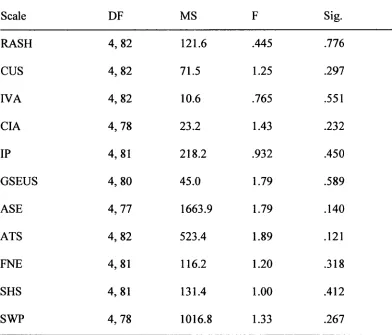
A one-way ANOVA was performed to compare scores on all scales across the five
different order combinations (see Appendix Al). There were no significant differences
between the five combinations for any of the dependent measures (p> .05). Therefore, data
across all combinations were collapsed for all further analyses.
Factor analysis
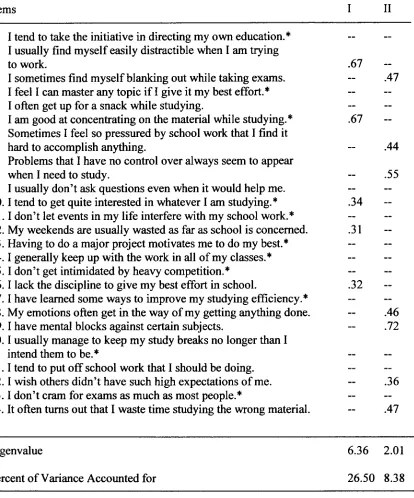
In order to assess the degree to which the RASH scale measures a unitary construct,
with an oblique rotation (see Appendix A2). A number of methods of extraction were
employed, however the principle axis extraction method was chosen as the results were
more psychologically meaningful. From the scree test, it was determined that two factors
best described the data. These two factors combined accounted for 34.9% of the variance.
The first factor accounted for 26.5% of the variance and seems to focus primarily on a
Procrastination component of self-handicapping. The second factor accounted for 8.4% of
the variance and seems to focus primarily on an Achievement Anxiety component of
self-handicapping. When a factor loading criterion of .30 or higher was used, five items (2, 6,
10, 12, 16) loaded solely on the first factor whereas seven items (3, 7, 8, 18, 19, 22, 24)
loaded solely on the second factor. Twelve items (1, 4, 5, 9, 11, 13, 14, 15, 17, 20, 21, 23)
did not load on either factor at criterion level.
Corrected Item/Item Total Correlations
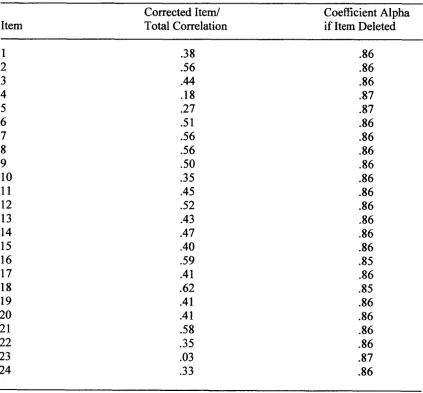
Correlations between the response to a particular item and the sum of the responses
to all other items were obtained. Items were considered potentially problematic if they did
not exceed .30 (see Appendix A3). Three items (4, 5, 23) failed to achieve this criterion
level.
Based on these item analyses, twelve items (1, 4, 5, 9, 11, 13, 14, 15, 17, 20, 21,
23) were eliminated from further consideration. The decision was taken to pursue the
analyses with a global measure of self-handicapping based on the items which loaded on
the two subscales (as a total score) as this was the primary interest of the investigation. The
formation of a total RASH-II score is defensible since the correlation between the two
subscales was r = .45. The practice of generating a total score from moderately correlated
inter-correlate at .20, .25 and .60, Thompson & Dinmel, 2004; the
Contingencies ofSelf-Worth Scale
subscales inter-correlate at .53, .45, .54, and .42, Crocker, Cooper &
Bouvrette, 2003; the
Objectified Body Consciousness Scalesubscales inter-correlate at .66
and -.51, McKinley & Hyde, 1996; and the
Levels of Self-Criticism Scalesubscales
inter-correlate at .45, Thompson & Zuroff, 2004). Thus, for all further analyses, a total score on
the
RASH-IIscale consisted of the sum of the responses to the remaining 12 items. The
Procrastination
subscale of the
RASH-IIconsisted of the sum of the responses to the five
items listed above from Factor One and the
Achievement Anxietysubscale of the
RASH-IIconsisted of the sum of the responses to the seven items listed above from Factor Two.
Reliability Analysis
Participants were asked to complete the
RASH-IIscale on two separate occasions,
at least four-weeks apart. A test-retest reliability of .79 was established for the
Procrastination
subscale, .82 for the
Achievement Anxietysubscale, and .83 for the total
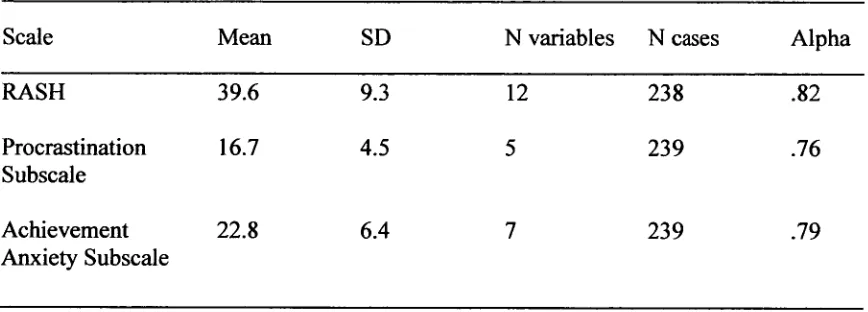
RASH-IIscore (the sum of the two subscales-see Appendix A4). A measure of internal
consistency was computed for the subscales of the
RASH-IIscale. The internal consistency
using coefficient alpha was .76 for the
Procrastinationsubscale and .79 for the
Achievement Anxiety
subscale. For the total
RASH-IIscore, the internal consistency
(coefficient alpha) was .82 (see Appendix A5).
Correlates of the Revised Academic Self-Handicapping Scale-II