Available online throug
ISSN 2229 – 5046
NEW AUGMENTED ZAGREB INDICES
V. R. KULLI*
Department of Mathematics, Gulbarga University, Gulbarga 585106, India.
(Received On: 08-07-17; Revised & Accepted On: 07-08-17)
ABSTRACT
W
e introduce some new augmented Zagreb indices: second, third and fourth augmented Zagreb indices of a molecular graph. A topological index is a numerical parameter mathematically derived from the graph structure. In this paper, we compute augmented zegreb index and Sanskruti index of triangular benzenoid Tn, hexagonal parallelogram nanotube P(m, n) and zigzag-edge coronoid fused with starphene nanotube ZCS(k, l, m) by using the line graphs of the subdivision graphs of these important chemical graphs.Keywords: augmented Zagreb index, triangular benzenoid, hexagonal parallelogram nanotube, zigzag-edge coronoid fused with starphene nanotube.
Mathematics Subject Classification: 05C05, 05C12, 05C35.
1. INTRODUCTION
Let G = (V, E) be a simple connected graph. The degree dG(v) of a vertex v is the number of vertices adjacent to v. The
edge connecting the vertices u and v will be denoted by uv. Let SG(v) denote the sum of the degrees of all vertices
adjacent to a vertex v. We refer to [1] for undefined term and notation.
A molecular graph or a chemical graph is a simple graph related to the structure of a chemical compound. Each vertex of this graph represents an atom of the molecule and its edges to the bonds between atoms. A topological index is a numerical parameter mathematically derived from the graph structure. These topological indices are useful for establishing correlations between the structure of a molecular compound and its physico-chemical properties, see [2].
In [3], Furtula et al. introduced the augmented Zagreb index of a graph. The augmented Zagreb index of a graph G is defined as
( )
( )
( ) ( )
( )
( )
3
.
2
∈
=
+
−
∑
G Guv E G G G
d
u d
v
AZI G
d
u
d
v
This topological index has proved to a valuable predictive index in the study of the heat formation in octanes, and heptanes, whose prediction power is better than atom bond connectivity index, see [3]. This index was also studied, for example, in [4, 5].
Motivated by the previous research in augmented Zagreb index and its wide applications, we now introduce the second, third and fourth augmented Zagreb indices of the molecular graph as follows:
The second augmented Zagreb index of a molecular graph G is defined as
( )
( )
3
2
2
∈
=
+
−
∑
u v uv E G u vn n
AZI
G
n
n
where the number nu of vertices of G lying closer to the vertex u than to the vertex v for the edge uv of a graph G.
Corresponding Author: V. R. Kulli*
The third augmented Zagreb index of a molecular graph G is defined as
( )
( )
3
3
2
∈
=
+
−
∑
u v uv E G u vm m
AZI G
m
m
where the number mu of edges of G lying closer to the vertex u than to the vertex v for the edge uv of a graph G.
The fourth augmented Zagreb index of a molecular graph G is defined as
( )
( ) ( )
( ) ( )
( )
3
4
2
ε
ε
ε
ε
∈
=
+
−
∑
uv E G
u
v
AZI
G
u
v
where the number ε(u) is the eccentricity of all vertices adjacent to a vertex u.
In [6], the Sanskruti index of a graph G is introduced by Hosamani and it is defined as
( )
( )
( ) ( )
( )
( )
3
.
2
G G
uv E G G G
S
u S
v
S G
S
u
S
v
∈
=
+
−
∑
In this paper, we compute the augmented Zagreb index and Sanskruti index of line graphs of subdivision graphs of triangular benzenoid Tn, hexagonal parallelogram nanotube P(m, n) and zigzag-edge coronoid fused with starphene
nanotube ZCS(k, l, m). For benzenoid structures, see [7].
Recently, some topological indices were studied, for example, in [7, 8, 9, 10, 11, 12, 13, 14].
The line graph L(G) of a graph G is the graph whose vertex set corresponds to the edges of G such that two vertices of
L(G) are adjacent if the corresponding edges of G are adjacent. The subdivision graph S(G) of a graph G is the graph obtained from G by replacing each of its edges by a path of length two.
We need the following results.
Lemma 1 [1]: Let G be a (p, q) graph. Then L(G) has q vertices and
( )
21
1
2
=−
∑
p G i id
u
q
edges.Lemma 2: Let G be a (p, q) graph. Then S(G) has p+q vertices and 2q edges.
2. RESULTS FOR TRIANGULAR BENZENOIDS Tn, n ∈ N
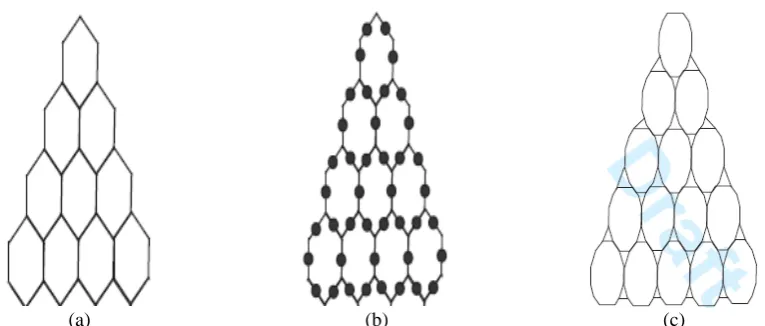
In this section, we consider triangular benzenoids which is a family of benzenoid molecular graphs. We denote the triangular benzenoid molecular graph by Tnin which n is the number of hexagons in the base of a graph, as shown in
Figure 1(a). We see that a triangular benzenoid Tnhas n 2
+ 4n + 1 vertices and
3
2
n (n+3) edges.
(a) (b) (c)
Figure-1: (a) triangular benzenoid T4, (b) subdivision graph of T4, (c) Line graph of the subdivision graph of T4.
The line graph of the subdivision graph of triangular bonzenoid T4 is shown in Figure 1(c).
Theorem 2.1: Let G be the line graph of the subdivision graph of a triangular benzenoid Tn, n∈N. Then AZI(G) = 51.2578125 n2 + 89.0859375n – 44.34375.
Proof: The graph of a triangular benzenoid Tnhas n2+4n+1 vertices and
3
2
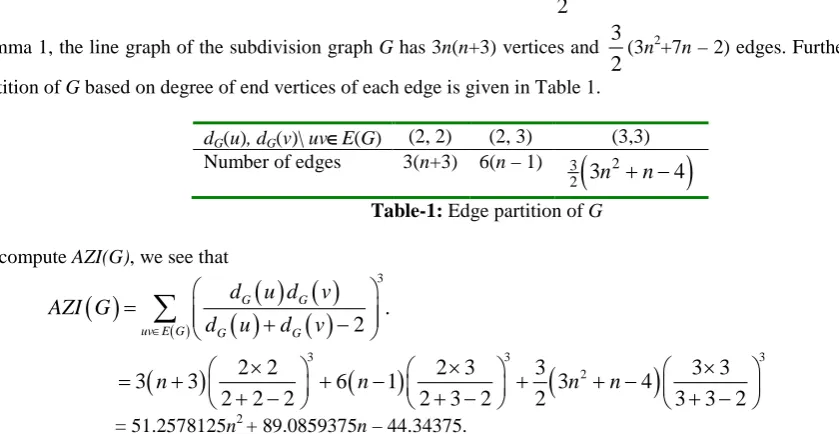
n (n+3) edges. By Lemma 2 andLemma 1, the line graph of the subdivision graph G has 3n(n+3) vertices and
3
2
(3n 2+7n – 2) edges. Further, the edge
partition of G based on degree of end vertices of each edge is given in Table 1.
dG(u), dG(v)\ uv∈E(G) (2, 2) (2, 3) (3,3)
Number of edges 3(n+3) 6(n – 1) 3
(
2)
23
n
+ −
n
4
Table-1: Edge partition of GTo compute AZI(G), we see that
( )
( )
( ) ( )
( )
( )
3
.
2
∈
=
+
−
∑
G Guv E G G G
d
u d
v
AZI G
d
u
d
v
(
)
2 2
3(
)
2 3
33
(
2)
3 3
33
3
6
1
3
4
2
2
2
2
3 2
2
3 3 2
n
×
n
×
n
n
×
=
+
+
−
+
+ −
+ −
+ −
+ −
= 51.2578125n2 + 89.0859375n – 44.34375.
In the following theorem, we compute Sanskruti index of the line graph of the subdivision graph of a triangular benzenoid.
Theorem 2.2: Let G be the line graph of the subdivision graph of a triangular benzenoid Tn, n∈N. Then
( )
9 81
3 225
340
332
372
315 81
33
6
3
6
2 16
8
11
7
15
2 16
S G
=
n
+
+
+
+
−
n
3 3 3 3 3 3
8
20
25
40
32
81
9
6
6
6
3
3
,
3
7
8
11
7
16
+
+
−
−
−
+
if n≠ 1,256
,
3
=
if n =1,Proof: The edge partition based on the degree sum of neighbor vertices of each edge of G is obtained, as given in Table 2.
SG(u), SG(v)\ uv ∈E(G) (4,4) (4,5) (5,5) (5, 8) (8, 8) (8, 9) (9, 9)
Number of edges 9 6 3(n – 2) 6(n – 1) 3(n – 1) 6(n – 1) 32(3n2 – 5n + 2)
Table-2: Edge partition of G
Case-1: Suppose n ≠ 1.
To compute S(G), we see that
( )
( )
( ) ( )
( )
( )
3
.
2
G G
uv E G G G
S
u S
v
S G
S
u
S
v
∈
=
+
−
∑
(
)
(
)
3 3 3 3
4 4
4 5
5 5
5 8
9
6
3
2
6
1
4
4
2
4
5
2
n
5 5
2
n
5 8
2
×
×
×
×
=
+
+
−
+
−
+ −
+ −
+ −
+ −
(
)
8 8
3(
)
8 9
33
(
2)
9 9
33
1
6
1
3
5
2
8 8
2
8 9
2
2
9
9
2
n
×
n
×
n
n
×
+
−
+
−
+
−
+
+ −
+ −
+ −
3 3 3 3 3 3
2
9 81
25
40
32
72
15 81
3
6
3
6
2 16
n
8
11
7
15
2 16
n
=
+
+
+
+
−
3 3 3 3 3 3
8
20
25
40
32
81
9
6
6
6
3
3
.
3
7
8
11
7
16
+
+
−
−
−
+
Case-2: Suppose n = 1.
To compute S(G), we see that
( )
( )
( ) ( )
( )
( )
3 3
4 4
256
9
.
2
4
4
2
3
G G
uv E G G G
S
u S
v
S G
S
u
S
v
∈
×
=
+
−
=
+ −
=
∑
3. RESULTS FOR HEXAGONAL PARALLELOGRAM P(m, n) FOR ANY m , n ∈ N NANOTUBES
In this section, we consider hexagonal parallelogram nanotubes. These nanotubes usually symbolized as P(m, n) for any
m, n ∈ N in which m is the number of hexagons in any row and n is the number hexagons in any column, see Figure 2(a). A hexagonal parallelogram P(m, n) has 2(m+n+mn) vertices and 3mn + 2m + 2n – 1 edges.
(a) (b) (c)
Figure-2: (a) hexagonal parallelogram P(3, 4) (b) subdivision graph of P(3, 4) (c) line graph of the subdivision graph of P(3,4)
The line graph of the subdivision graph of hexagonal parallelogram P(3,4) is depicted in Figure 2(c).
In the following theorem, we compute augmented Zagreb index of the line graph of the subdivision graph of a hexagonal parallelogram.
Theorem 3.1: Let G be the line graph of the subdivision graph of a hexagonal parallelogram P(m, n) for any m, n ∈ N.
Then
AZI(G) = 102.515625 mn + 25.21875m + 25.21875n – 56.953125.
Proof: The graph of a hexagonal parallelogram P(m, n) has 2 (m + n + mn) vertices and 3mn + 2m + 2n – 1 edges. By Lemma 2 and Lemma 1, the line graph of the subdivision graph G has 2(3mn+2m+2n – 1) vertices and 9mn + 4m + 4n
– 5 edges. Further, the edge partition of G based on degree of end vertices of each edge is given in Table 3.
dG(u), dG(v)\e = uv∈E(G) (2, 2) (2, 3) (3,3)
Number of edges 2(m + n + 4) 4(m + n – 2) 9mn –2m – 2n – 5
Table-3: Edge degree partition of G
To compute AZI(G), we see that
( )
( )
( ) ( )
( )
( )
3
.
2
∈
=
+
−
∑
G Guv E G G G
d
u d
v
AZI G
d
u
d
v
(
)
2 2
3(
)
2 3
3(
)
3 3
32
4
4
2
9
2
2
5
2
2
2
2
3 2
3 3 2
m
n
×
m
n
×
mn
m
n
×
=
+ +
+
+ −
+
−
−
−
+ −
+ −
+ −
= 102.515625mn + 25.21875m + 25.21875n – 56.953125.
In the following theorem, we compute Sanskruti index of the line graph of the subdivision graph of a hexagonal parallelogram.
Theorem 3.2: Let G be the line graph of the subdivision graph of a hexagonal parallelogram P(m, n) for any m, n ∈ N. Then
( )
25
340
332
372
381
32
4
2
4
8
11
7
15
16
S G
=
+
+
+
+
n
3
8
10
3
+
3
20
4
7
+
3 3 3 3 3
25
40
32
72
81
4
4
2
4
,
8
11
7
15
16
−
−
−
−
−
(
)
3 3 3 3 3 3
81
25
40
32
72
81
9
2
4
2
4
8
16
mn
8
11
7
15
16
m
n
=
+
+
+
+
−
+
3 3 3 3 3 3 3
8
20
25
40
32
72
81
8
8
8
8
4
8
7
,
3
7
8
11
7
15
16
+
+
−
−
−
−
+
if n≠ 1, m >1.Proof:Case 1. The edge partition based on the degree sum of neighbor vertices of each edge of G is obtained, as given Table 4.
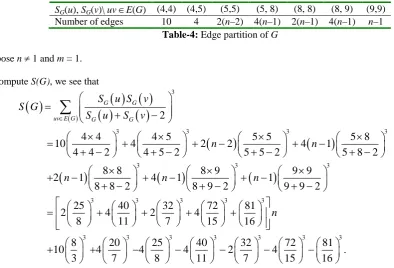
SG(u), SG(v)\ uv ∈E(G) (4,4) (4,5) (5,5) (5, 8) (8, 8) (8, 9) (9,9)
Number of edges 10 4 2(n–2) 4(n–1) 2(n–1) 4(n–1) n–1
Table-4: Edge partition of G
Suppose n≠ 1 and m = 1.
To compute S(G), we see that
( )
( )
( ) ( )
( )
( )
3
2
G G
uv E G G G
S
u S
v
S G
S
u
S
v
∈
=
+
−
∑
(
)
(
)
3 3 3 3
4 4
4 5
5 5
5 8
10
4
2
2
4
1
4
4
2
4
5
2
n
5 5
2
n
5 8
2
×
×
×
×
=
+
+
−
+
−
+ −
+ −
+ −
+ −
(
)
8 8
3(
)
8 9
3(
)
9 9
32
1
4
1
1
8 8
2
8 9
2
9
9
2
n
×
n
×
n
×
+
−
+
−
+
−
+ −
+ −
+ −
3 3 3 3 3
25
40
32
72
81
2
4
2
4
8
11
7
15
16
n
=
+
+
+
+
38
10
3
+
320
4
7
+
3 3 3 3 3
25
40
32
72
81
4
4
2
4
.
8
11
7
15
16
−
−
−
−
−
Case-2: The edge partition based on the degree sum of neighbor vertices of each edge of G is obtained, as given in Table 5.
SG(u), SG(v)\ uv∈E(G) (4,4) (4,5) (5,5) (5, 8) (8, 8) (8, 9) (9,9)
Number of edges 8 8 2(m+n–4) 4(m+n–2) 2(m+n–2) 4(m+n–2) 9mn–8(m+n)+7
Table-5: Edge partition of G
Suppose n≠ 1, and m>1.
To compute S(G), we see that
( )
( )
( ) ( )
( )
( )
3
2
G G
uv E G G G
S
u S
v
S G
S
u
S
v
∈
=
+
−
∑
(
)
(
)
3 3 3 3
4 4
4 5
5 5
5 8
8
8
2
4
4
2
4
4
2
4
5
2
m
n
5 5
2
m
n
5 8
2
×
×
×
×
=
+
+
+ −
+
+ −
+ −
+ −
+ −
+ −
(
)
8 8
3(
)
8 9
3(
(
)
)
9 9
32
2
4
2
9
8
7
8 8
2
8 9
2
9
9
2
m
n
×
m
n
×
mn
m
n
×
+
+ −
+
+ −
+
−
+
+
+ −
+ −
+ −
(
)
3 3 3 3 3 3
81
25
40
32
72
81
9
2
4
2
4
8
16
mn
8
11
7
15
16
m
n
=
+
+
+
+
−
+
3 3 3 3 3 3 3
8
20
25
40
32
72
81
8
8
8
8
4
8
7
.
3
7
8
11
7
15
16
+
+
−
−
−
−
+
4. RESULTS FOR ZIGZAG-EDGE CORONOID FUSED WITH STARPHENE NANOTUBES ZCS(k, l, m)
In this section, we consider the system which is a composite benzenoid obtained by a zigzag-edge coronoid ZC(k, l, m)
with a starphene St(k, l, m). This system is called a zigzag-edge coronoid fused with starphene nanotubes, denoted by
ZCS(k, l, m), see Figure 3(a). We see that a zigzag edge coronoid fused with starphene nanotube ZCS(k,l,m) has 36k – 54 vertices and 15(k+l+m) – 63 edges.
(a) (b) (c)
Figure-3: (a) Zigzag-edge coronoid fused with starphene nanotube ZCS(4, 4, 4), (b) Subdivision graph of ZCS (4, 4, 4), (c) Line graph of subdivision graph of ZCS(4, 4, 4)
The line graph of the subdivision graph of zigzag-edge coronoid fused with starphene nanotube ZCS(4, 4, 4) is shown in Figure 3(c).
In the following theorem, we compute augmented Zagreb index of the line graph of the subdivision graph of a zigzag coronoid fused with starphene nanotube.
Theorem 4.1: Let G be the line graph of the subdivision graph of a zigzag-edge coronoid fused with starphene nanotube ZCS(k, l, m) for every k = l = m≥ 4. Then
AZI(G) = 383.203125 (k +l+m) – 1356.234375.
Proof: The graph of a zigzag edge coronoid fused with starphene nanotube ZCS(k.l,m) has 36k – 54 vertices and 15(k + l + m) – 63 edges. By Lemma 2 and Lemma 1, the line graph of the subdivision graph G has 30(k+l+m) – 126 vertices and 39(k+l+m) – 153 edges. Further, the edge partition of G based on degree of end vertices of each edge is given in Table 6.
dG(u), dG(v)\e = uv∈E(G) (2, 2) (2, 3) (3,3)
Number of edges 6(k+l+m) – 30 12(k+l+m) – 84 21(k+l+m) – 39
Table-6: Edge partition of G
To compute AZI(G), we see that
( )
( )
( ) ( )
( )
( )
3
2
G G
uv E G G G
d
u d
v
AZI G
d
u
d
v
∈
=
+
−
∑
(
)
2 2
3(
)
2 3
3(
)
3 3
36
30
12
84
21
39
2
2
2
2
3 2
3 3 2
k
l
m
×
k
l
m
×
k
l
m
×
=
+ +
−
+
+ +
−
+
+ +
−
+ −
+ −
+ −
= 383.203125 (k+l+m) – 1356.234375.
In the next theorem, we compute Sankruti index of the line graph of the subdivision graph of ZCS(k, l, m).
Theorem 4.2: Let G be the line graph of the subdivision graph of a zigzag-edge coronoid fused with starphene nanotube ZCS(k, l, m) for every k=l=m ≥ 4. Then
( )
25
340
332
372
381
3(
)
6
12
6
12
3
8
11
7
15
16
S G
=
+
+
+
+
k
+ +
l
m
3 3 3 3 3 3 3
8
20
25
40
32
72
81
6
12
8
84
54
60
75
.
3
7
8
11
7
15
16
+
+
−
−
−
−
+
SG(u), SG(v)\ uv∈E(G) (4,4) (4,5) (5,5) (5, 8) (8, 8) (8, 9) (9,9)
Number of edges 6 12 6(k+l+m –8) 12(k+l+m –7) 6(k+l+m –9) 12(k+l+m –5) 3(k+l+m +25)
Table-7: Edge partition of G
To compute S(G), we see that
( )
( )
( ) ( )
( )
( )
3
2
G G
uv E G G G
S
u S
v
S G
S
u
S
v
∈
=
+
−
∑
(
)
(
)
3 3 3 3
4 4
4 5
5 5
5 8
6
12
6
8
12
7
4
4
2
4
5
2
k
l
m
5 5
2
k
l
m
5 8
2
×
×
×
×
=
+
+
+ + −
+
+ + −
+ −
+ −
+ −
+ −
(
)
8 8
3(
)
8 9
3(
)
9 9
36
9
12
5
3
25
8 8
2
8 9
2
9
9
2
k
l
m
×
k
l
m
×
k
l
m
×
+
+ + −
+
+ + −
+
+ + +
+ −
+ −
+ −
(
)
3 3 3 3 3
25
40
32
72
81
6
12
6
12
3
8
11
7
15
16
k
l
m
=
+
+
+
+
+ +
3 3 3 3 3 3 3
8
20
25
40
32
72
81
6
12
8
84
54
60
75
.
3
7
8
11
7
15
16
+
+
−
−
−
−
+
REFERENCES
1.
V.R.Kulli, College Graph Theory, Vishwa International Publications, Gulbarga, India (2012).2.
I. Gutman and N. Trinajstić, Graph theory and molecular orbitals. Total π-electron energy of alternant hydrocarbons, Chem. Phys. Lett. 17 (1972) 535-538.3.
B. Furtula, A Graovac and D. Vukičević, Augmented Zagreb index, J. Math. Chem. 48(2010) 370-380.4.
V.R.Kulli, Some topological indices of certain nanotubes, Journal of Computer and Mathematical Sciences, 8(1) (2017) 1-7.5.
V.R.Kulli, Computation of some topological indices of certain networks, International Journal of Mathematical Archive, 8(2) (2017) 99-106.6.
S.M. Hosamani, Computing Sanskruti index of certain nanostructures, J. Appl. Math. Comput. (2016) DOI: 10.1007/s12190-016-1016-9.7.
S.Akhter and M. Imran, On molecular topological properties of benzenoid structures, Canadian J. Chem.(2016) 1-27.
8.
V.R. Kulli, On K edge index of some nanostructures, Journal of Computer and Mathematical Sciences, 7(7) (2016) 373-378.9.
V.R. Kulli, Computation of general topological indices for titania nanotubes, International Journal of Mathematical Archive, 7(12) (2016) 33-38.10.
V.R.Kulli, F-index and reformulated Zagreb index of certain nanostructures, International Research Journal of Pure Algebra, 7(1) (2017)489-495.11.
V.R.Kulli, Multiplicative connectivity indices of nanostructures, Journal of Ultra Scientist of Physical Sciences, A 29(1) (2017) 1-10. DOI:http://dx.doi.org/10.22147/jusps-A/290101.12.
V.R.Kulli, Two new multiplicative atom bond connectivity indices, Annals of Pure and Applied Mathematics, 13(1) (2017) 1-7. DOI:http://dx.doi.org/10.22457/apam.vl3nlal.13.
V.R.Kulli, Some new multiplicative geometric-arithmetic indices, Journal of Ultra Scientist of Physical Sciences, A, 29(2) (2017) 52-57. DOI: http://dx.doi.org/10.22147/jusps-A/290201.14.
V.R.Kulli, New K Banhatti topological indices, International Journal of Fuzzy Mathematical Archive, 12(1) (2017) 29-37. DOI: http://dx.doi.org/10.22457/ijfma.v12n1a4.Source of support: Nil, Conflict of interest: None Declared.