Subspace-Based Blind and Group-Blind Space-Time Multiuser Detection for the Generalized
Multicarrier DS-CDMA Uplink
Bin Hu, Lie-Liang Yang and Lajos Hanzo School of ECS, University of Southampton, SO17 1BJ, UK.
Tel: +44-23-8059 3125, Fax: +44-23-8059 4508
Email: bh202r,lly,[email protected]; http://www-mobile.ecs.soton.ac.uk
Abstract— Subspace-based blind and group-blind space-time multiuser detection is invoked for a smart antenna aided generalized MC DS-CDMA system communicating over a dispersive Space-Time (ST) Rayleigh fad-ing channel, where the channel estimates are attained by usfad-ing subspace-based blind techniques. In the generalized MC DS-CDMA system consid-ered, smart antennas are employed, in order to provide increased degrees of freedom and hence to improve the attainable performance and user ca-pacity. Furthermore, our simulation results confirm that in the proposed multiple antenna aided generalized MC DS-CDMA system, the blind and group-blind space-time multiuser detectors equipped with the subspace-based blind channel estimator are capable of achieving a similar perfor-mance to that exploiting the perfect knowledge of the channel.
I. INTRODUCTION
Recently, considerable amount of research has been devoted to Multi-User Detection (MUD) [2], [3], [4], [5], [1], which is capable of essentially eliminating the effects of multiuser interference and hence has the potential of substantially increasing the capacity of CDMA systems. Verdu’s optimum MUD presented in [2] is capable of attain-ing a near-sattain-ingle-user performance at the expense of an exponentially increasing complexity imposed by increasing the number of users sup-ported. By contrast, a decorrelating MUD having a lower complexity was proposed in [6], where a slight increase of the achievable BER was incurred. Training sequence based adaptive MUD was introduced in [7], [8], [9], which requires the knowledge of the signature waveform and the timing information of the desired user, but no other knowledge is necessitated. In contrast to training sequence based adaptive MUD, the Minimum-Output-Energy (MOE) based blind adaptive MUD [3] does not require any training sequence and hence achieves an increased spectrum efficiency, although its performance is suboptimum in the high-SNR region. In [4], [10], Wang and Poor proposed a novel blind MUD for single-carrier DS-CDMA systems based on the philosophy of signal subspace estimation, which benefits from a lower compu-tational complexity and a better performance compared to the MOE based blind MUD. Group-blind MUDs having the prior knowledge of all signature waveforms of the intracell users were then proposed in [5] for the uplink of a single-carrier DS-CDMA system, which exhibited a significant performance improvement over that of the blind MUDs advocated in [4], [10]. Furthermore, in [11], a subspace-based MMSE receiver was proposed for a Multi-Carrier Direct Sequence Code Di-vision Multiple Access (MC DS-CDMA) system, where the orthogo-nality between the noise subspace and the desired signal vector was exploited for blindly extracting both the required timing and channel information.
In this contribution, subbased blind and group-blind space-time MUDs are invoked as joint space-space-time-frequency domain MUDs
The financial support of the European Union under the auspices of the Phoenix and Newcom projects and that of the EPSRC is gratefully acknowl-edged.
for the smart antenna aided generalized MC DS-CDMA system of [12], since subspace-based estimation techniques [4], [10], [11] are ca-pable of extracting the channel estimates required.More explicitly, the novelty of this contribution is that we combine the benefits of subspace-based blind and group-Blind space-time MUDs with those of the smart antenna aided generalized MC DS-CDMA system of [12] for the sake of improving the achievable performance of the system by jointly per-forming multiuser detection in the space-time-frequency domain, while achieving both frequency and spatial diversity.
The rest of this paper has the following structure. In Section II the philosophy of the generalized MC DS-CDMA system employing smart antennas will be described and characterized. Then, a subspace-based blind channel estimation technique is invoked for the smart an-tenna aided generalized MC DS-CDMA system considered in Section III. Section IV develops subbased blind and group-blind space-time MUDs in the context of a smart antenna aided generalized MC DS-CDMA system. The attainable performance of these MUDs is studied comparatively in Section V. Finally, we provide our conclu-sions in Section VI.
IFFT P/S LPF
cos(2πfct)
bk(t)
ak(t)
ck[2]
ck[M]
[image:1.595.322.558.400.458.2]ck[1]
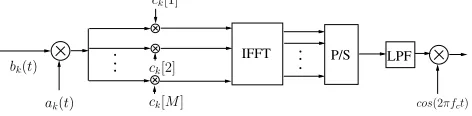
Fig. 1. Transmitter schematic of MC DS-CDMA using bothN-chip time-domain andV-chip frequency-domain spreading
II. SYSTEMMODEL
The transmitter of the generalized MC DS-CDMA system is por-trayed in Fig.1. At the transmitter side, the binary data streambk(t) having a bit duration of Tb is spread using an N-chip Time Do-main (TD) DS spreading waveformck(t)and the chip duration was
Tc = Tb/N. The DS spread signals are simultaneously modulated using BPSK and then spread using an orthogonal Frequency Domain (FD) spreading sequenceck = [ck,0, ck,1, . . . , ck,V−1]of length V, where we haveck·cHk = 1. In this section we assume that OFDM
usingV subcarriers was invoked [13], whereV consecutive chips of the MC DS-CDMA spreading sequences were mapped toV different subcarriers during an OFDM symbol and hence the OFDM-chip dura-tion wasTc = NVTb . The spread OFDM chip-vector ofV subcarriers can be expressed assk(t) =ckbk(t)ck(t) = [s1(t), s2(t), ..., sV(t)].
The Inverse Fast Fourier Transform (IFFT) is then invoked for modu-lating theV subcarriers by using the spread OFDM chip-vectorsk(t)
[13]. The output signal of the IFFT-based demodulator is a block of V number of time domain samples in parallel form. After Parallel to
Serial (P/S) conversion, a sufficiently long cyclic prefix is inserted in the OFDM symbol for the sake of compensating for the delay-spread-induced Inter-Symbol Interference (ISI) imposed by the dispersive channel [13]. Then, these time domain signals are transmitted through a multipath fading channel, which is assumed to haveLpaths for all theKusers. Upon assuming that at the Base-Station (BS) there areM number of receiver antenna elements and the channel encountered is time-invariant during three consecutive bits, the Spatio-Temporal (ST) Channel Impulse Response (CIR)hkm(t)between thekth user and the mth Antenna Element (AE) can be expressed as
hkm(t) =
L−1
l=0
hkm,lδ(t−lTc), (1)
wherehkm,lis the complex-valued channel gain experienced by the
signal of thekth user in thelth path impinging on themth AE, which obeys Rayleigh fading.
At each AE, the time domain samples of the received signal corre-sponding to the cyclic prefix are first removed andV-point Fast Fourier Transform (FFT) is invoked for demodulating the remainingV sam-ples and for generating the demodulated subcarrier signals in the fre-quency domain [13]. Consequently, the received signal can be written asr(t) = [rT0(t),rT1(t), . . . ,rTM−1(t)]T, whererm(t)∈ RV is given by
rm(t) =
K
k=1
CkHkm MF−1
i=0
Akbk[i]ck(t−iTb−τk)
+nm(t) (2)
and Hkm = [Hkm,0, Hkm,1, . . . , Hkm,V−1]T denotes the
Frequency-Domain Channel Transfer Function (FDCTF) between the kth user and themth AE. In (2),MF is the length of the transmitted
data frame, whileAk,{bk[i]}and0≤τk< Tbrepresent the received signal amplitude, symbol stream and the delay of thekth user, re-spectively. The spreading sequenceck(t) =Nj=0−1ck(j)ψ(t−jTc)
in (2) denotes the signature waveform of thekth user, whereck(j)
assumes values of +1 or -1 with equal probability, while ψ(t) is a normalized chip waveform of duration Tc. Furthermore, in (2), Ck = diag{ck} and nm(t) represents the AWGN vector
associated with the covariance matrix of σ2IV, where IV denotes the(V ×V)-dimensional identity matrix. Since we assume that a sufficiently long cyclic prefix was inserted and we have V ≥ L, every subcarrier experiences flat fading and hence no OFDM ISI is incurred. Therefore, the FDCTFHkm in (2) can be expressed as
theV-point DFT ofhkm = [hkm,0, . . . , hkm,L−1]T in the form of
Hkm = FL·hkm, whereFLis an(V ×L)-dimensional matrix,
which is given by the firstLcolumns of the DFT matrixFformulated
asF=
1 1 . . . 1
1 e−j2π/V . . . e−j2π(V−1)/V ..
. ... . .. ...
1 e−j2π(V−1)/V . . . e−j2π(V−1)(V−1)/V
.
A set ofM ·V chip-matched filters are used for sampling the re-ceived signalr(t)at a rate of1/Tc. Since the delay spread is often
assumed to be one symbol interval ofTbduration in practical CDMA systems [10], we observe the chip-matched filter outputs for a du-ration of2Tb so that despite the channel-induced ISI a completely interference-free symbol of the desired user is guaranteed to be ob-served. Hence thenth received signal sample of thevth chip-matched filter corresponding to themth AE during thelth symbol has the form
of
rm,v[l, n] =rm,v(lTb+nTc) = K
k=1
ykm,v[l, n] +nm,v[l, n], (3)
wherenm,v[l, n]is the AWGN component and
ykm,v[l, n] = AkHkm,vck,v MF−1
i=0 N−1
j=0
bk[i]ck(j)
×ψˆ((lN+n−j−iN)Tc−τk) (4)
is the component due to thekth user’s signal received at themth AE. The functionψˆ(t) = −∞∞ ψ(s)ψ∗(s−t)dsin (4) represents the chip waveform output of the chip-matched filter.
Let us define the 2N-dimensional vectors
¯
rm,v[l] = [rm,v[l,0], . . . , rm,v[l,2N−1]]T, n¯m,v[l] = [nm,v[l,0], . . . , nm,v[l,2N−1]]T and y¯km,v[l] =
[ykm,v[l,0], . . . , ykm,v[l,2N−1]]T. By concatenating these V M vectors corresponding to theV subcarriers and theM AEs, we obtain the following2N V M-dimensional vectors
r[l] = [¯rT00[l], . . . ,r¯T(M−1)(V−1)[l]
V M
]T
, n[l] =
[¯nT00[l], . . . ,n¯T(M−1)(V−1)[l]
V M
]T
and yk[l] =
[¯ykT0,0[l], . . . ,y¯kT(M−1),V−1[l] V M
]T. Hence, (3) can be rewritten
as
r[l] =
K
k=1
yk[l] +n[l]. (5)
Without loss of generality, letbk[l]represent the specific bit of the
kth user that falls completely in thelth symbol period and let us nor-malize the value ofτk ∈ Tb to the chip durationTc. Therefore, we
haveτk = nkTc, wherenk is an integer between zero andN −1. Letck= [ck(0), ck(1), . . . , ck(N−1),0, . . . ,0
N
]Tdenote a vector of
length2N, consisting of theNelements of the spreading sequence of thekth user followed byNzeros. Following the notation in [9], we de-fineTLandTRas the acyclic left shift operator and the acyclic right
shift operator processing vectors of length2N, respectively. Then, we useTnLandTnRto denotenapplications of these operators, resulting
innleft and right shifts, respectively. Based on these operators, we definev−k1=T
N−nk
L ck,v0k=TnRkckandv1k=TNR+nkck. For each asynchronous user, three consecutive bit intervals overlap with a given observation interval of length2Tb. Furthermore, since
the system is chip asynchronous, two adjacent chips contribute to each chip sample. The contribution of thekth useryk[l]to the received vectorr[l]∈ R2NV Min (5) for thelth symbol is therefore given by
yk[l] = ˇDk(bk[l−1]ˇv−k1+bk[l]ˇv0k+bk[l+ 1]ˇv1k), (6)
where Dˇk = diagDk0,Dk1. . . ,Dk(M−1) is a (2N V M × 2N V M)-dimensional matrix and
Dkm = diag(AkHkm,0ck,0, . . . , AkHkm,0ck,0, . . . , AkHkm,V−1ck,V−1, . . . , AkHkm,V−1ck,V−1).
Furthermore, we have vˇ−k1 = [(v−k1)T, . . . , (v−k1)T
V M
]T, ˇ
v0k =
[(v0k)T, . . . , (v0k)T V M
]T
andvˇ1k = [(v1k)T, . . . , (v1k)T
V M
]T
sub-stituting (6) into (5), we arrive at
r[l] = Dˇ1b1[l]ˇv01+ K
k=1
ˇ
Dk(bk[l−1]ˇvk−1+bk[l+ 1]ˇv1k)
+
K
k=2
ˇ
Dkbk[l]ˇvk0+n[l], (7)
and for notational convenience, (7) can be rewritten as
r[l] =b1[l]ˇp1+ J
j=2
bj[l]ˇpj+n[l], (8)
by using the equivalent synchronous model described in [9], where b1[l]is the desired bit andpˇ1 = ˇD1vˇ01, while the remaining vectors
correspond to the ISI and MAI vectors in (7). Note that we have2K≤ J≤3K.
III. BLINDCHANNELESTIMATION
The eigen-decomposition of the autocorrelation matrixRof the re-ceived MC DS-CDMA signal vectorris given by [5]
R = E{rrH}=P ˇˇPH+σ2I2NV M
= UΛUH= [Us Un]
Λs 0
0 Λn
UHs
UHn
, (9)
where we have Pˇ = [ˇp1, . . . ,pˇJ], U = [Us Un] and Λ =
diag(Λs,Λn). Without loss of generality, we assume that the vectors
ˇ
p1, . . . ,pˇJ are linearly independent and thatJ < 2N V M. There-fore, the matrix Pis a ”tall” matrix having a rank of rank(P) =
rank(PPH) = JandΛs = diag{λ1, . . . , λJ}contains the largest
Jeigenvalues of the received signal’s autocorrelation matrix R. In contrast to the signal space Us = [u1, . . . ,uJ], the noise space
Un = [uJ+1, . . . ,u2NV M]contains the(2N V M −J)orthogonal eigenvectors corresponding to the smallest eigenvaluesσ2inΛn.
As shown in [5], [10], the M L-dimensional CIR vector h1 =
hT10, . . . ,hT1m, . . . ,hT1(M−1)
of the desired user can be estimated by exploiting the orthogonality between the signal subspace and the noise space. More specifically,Unis orthogonal to the column space ofPˇ
andpˇ1represents the column space ofPˇ. Therefore, we have
UHnpˇ1=UnHVˇ10dˇ1=A1UHnVˇ01Cˇ1FˇLh1= 0, (10)
where we have the(2N V M×V M)-dimensional TD spreading code matrixVˇ01 = diag(v01, . . . ,v01), the(V M×V M)-dimensional FD
spreading code matrixCˇ1 = diag(C
1, . . . ,C1)and the(M V × M L)-dimensional matrixFˇL=diag(FL, . . . ,FL).
The estimate h¯1 of the CIR vector h1 can be gener-ated by computing the minimum eigenvector of the matrix ˇ
FHLCˇH1( ˇV10)HUnUHnVˇ01Cˇ1FˇL. The necessary condition for such an estimate to be unique is that we haveJ ≤ 2N V M−LM. For the worst case scenario ofJ = 3K, a necessary condition imposed on the number of users for the sake of uniquely determiningh1 is then K ≤ (2NV3−L)M. When we have M ≥ 2, the number of users supported can beK = N V, provided that the condition of
(2M−3)NV
M ≥Lis met, which can be readily satisfied by appropriately
choosingM,NandV. Compared to the generalized MC DS-CDMA system using a single antenna, the smart antenna aided system is capa-ble of supporting more users, because generally speaking, increasing the number of AEs has the potential of providing a higher degree of
freedom and hence it is capable of improving both the achievable sys-tem performance and the user capacity. Furthermore, with the aid of an appropriately chosen cyclic prefix, we can remove the phase ambiguity encountered in the channel estimation process by using the techniques proposed in [14].
If the value ofτ1is not available, joint timing and channel estima-tion must be carried out, which is summarized as follows:
1) Hypothesize a value for τ1 ∈ Tb and construct the matrix ˇ
V10(τ1)based on this hypothesized value;
2) Obtain the best estimate h¯1(τ1) by
comput-ing the minimum eigenvector of the matrix
ˇ
FHLCˇ H
1 ( ˇV01(τ1))HUnUHnVˇ01(τ1) ˇC1FˇL;
3) Repeat Steps 1) to 2) for different values ofτ1;
4) Attain the best timing estimateτ¯1 by solving the minimization problem of
¯
τ1=arg min
τ1∈Tb
UHnVˇ01(τ1) ˇC1FˇLh¯1(τ1)2
Vˇ01(τ1) ˇC1FˇLh¯1(τ1)2 ;
(11)
5) Arrive at the best estimateh¯1(¯τ1)based onτ¯1.
In practice, we have to quantize the infinite number of possible hy-pothesized values of τ1 in the interval[0, Tb]to a finite set. Since
the optimization problem in (11) is one-dimensional, not all choices of the pair (τ1,h1)are legitimate. The procedure described above
leads to the best estimate h¯1(τ1) for a specific hypothesized value ofτ1. Therefore, the search space is substantially reduced, render-ing the above method more practical. Furthermore, sinceΩ(τ1) =
UHnV01(τ1)C1FLh¯1(τ1)2
V0
1(τ1)C1FLh¯1(τ1)2 is a continuous function ofτ1, it must have
a minimum within the closed interval[0, Tb], which hence guarantees
the optimal choice ofτ1that minimizes the cost function, provided that we search on a sufficiently fine grid.
IV. BLIND ANDGROUP-BLINDMULTIUSERDETECTION Given the prior knowledge of the desired user’s signature waveform, the linear MMSE MUD weightsw1 =m1can be expressed in terms
of the signal subspace componentsUs,Λs,σ2and the estimated com-posite signature waveformp¯1 = ˇV01(τ1) ˇC1FˇLh¯1as
m1=UsΛs−1UHsp¯1, (12)
which is obtained by solving the following optimization problem [5]
m1=arg min
w∈R2NV ME{|b1−w H
r|2}=R−1p¯1. (13)
Furthermore, the so-called form-II linear hybrid group-blind MUD ¯
w1[5], which exploits the knowledge of a group ofK˜ composite sig-nature waveforms corresponding to K˜( ˜K ≤ K) intracell users, is given by the solution of the following constrained optimization prob-lem [5]
¯
w1 = arg min w1∈range(P)
E{|b1−wH1r|2} (14)
subject to wH1 P˜ = 1T1, where 11 is a J˜-dimensional vector hav-ing all-zero elements, except for the1st element, which is one, and
˜
P= [¯p1, . . . ,p¯J˜]is a(2N V M×J˜)-dimensional matrix constructed
based on the estimated CIRs, on the timing information and on the TF-Domain spreading signature waveforms of all theK˜ intracell users. Hence we have2 ˜K≤J˜≤3 ˜K. Using the method of Lagrange mul-tipliers [5] in (14), we obtain the form-II linear hybrid group-blind MUD’s weight vector in the form of [5]
¯
For the group-blind MUD of (15), the interfering signals arriving from ’known’ intracell users are nulled by a projection of the received sig-nal onto the orthogosig-nal subspace of these users’ sigsig-nal subspace. The unknown interfering users’ signals inflicted by other-cell users are sup-pressed by identifying the subspace spanned by these intercell users, followed by a linear transformation in this subspace based on the MMSE criterion.
V. PERFORMANCERESULTS
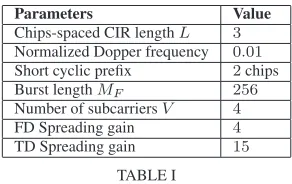
All investigations of this section were based on evaluating the per-formance of the subspace-based blind and group-blind MUDs em-ployed in the uplink of a smart antenna aided generalized MC DS-CDMA system, when communicating over a dispersive ST Rayleigh fading channel contaminated by AWGN. An antenna array havingM number of AEs is considered in our investigations. When the AEs are located sufficiently far apart, the MC DS-CDMA signal experiences independent fading upon reaching the different AEs, hence we have the cross-correlation coefficientρ= 0among the AEs. By contrast, when the AEs are separated by a distance of half a wavelength, we haveρ = 1, which implies that these AEs are fully correlated. The basic parameters of the blind and group-blind MUDs invoked for the generalized MC DS-CDMA system considered are summarized in Ta-ble I.
Parameters Value
[image:4.595.329.546.54.397.2]Chips-spaced CIR lengthL 3 Normalized Dopper frequency 0.01 Short cyclic prefix 2chips Burst lengthMF 256 Number of subcarriersV 4 FD Spreading gain 4 TD Spreading gain 15
TABLE I
BASIC SIMULATION PARAMETERS FOR THE BLIND AND GROUP-BLIND
MUDS INVOKED FOR THE GENERALIZEDMC DS-CDMAUPLINK.
In Figure 2(a), three different types of antenna arrays, namely a single antenna as well as an array havingM = 2correlated AEs or M = 2 uncorrelated AEs were employed. The simulation results showed that the group-blind MUD benefitting from the knowledge of more intracell users’ signature waveforms attained a better BER per-formance. Furthermore, Figure 2(a) demonstrated that as expected, the blind MUD operating in conjunction with an antenna array having M= 2uncorrelated AEs achieved a better BER performance than that havingM = 2correlated AEs. The blind MUD employing a single antenna attained the worst BER performance. In Figure 2(b) we ob-serve that the blind and group-blind space-time MUDs equipped with the subspace based CIR estimator perform only slightly worse than the estimator exploiting the perfect knowledge of the CIRs, which implies that the associated performance degradation imposed by the channel estimator error is negligible.
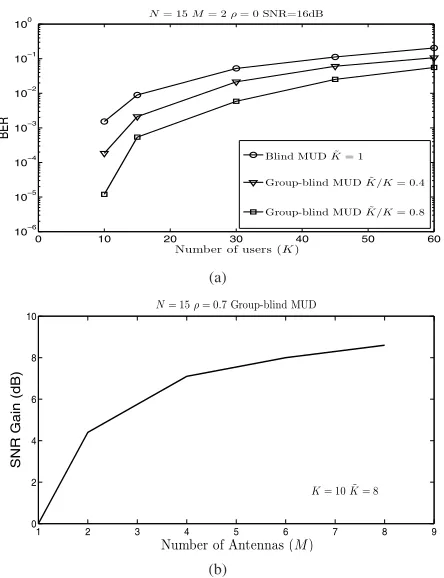
In Figure 3(a), an antenna array havingM = 2uncorrelated AEs was employed and we hadρ = 0, where the BER performance of the blind and the group-blind MUDs was presented as a function of the number of users supported. Note that the system havingV = 4, N= 15and hence capable of servingK= 60users was full loaded. Finally, Figure 3(b) characterizes the SNR gains achieved by increas-ing the number of AEs, demonstratincreas-ing that increasincreas-ing the number of AEs is capable of providing an increased degree of freedom and hence
0 2 4 6 8 10 12 14 16 18 20 10−4
10−3 10−2 10−1 100
SNR(dB)
BER
N= 15K= 10
Blind MUDM= 1
Group-blind MUD ˜K= 8M= 1 Blind MUDM= 2ρ= 1
Group-blind MUD ˜K= 8M= 2ρ= 1 Blind MUDM= 2ρ= 0
Group-blind MUD ˜K= 8M= 2ρ= 0
Single User
(a)
0 2 4 6 8 10 12 14 16 18 20 10−4
10−3 10−2 10−1 100
SNR(dB)
BER
N= 15M= 2ρ= 0
Blind MUD estimation of channel
Group-blind MUD estimate of channel
Blind MUD perfect knowledge of channel
Group-blind MUD perfect knowledge of channel
K= 10 ˜K= 8
Single User
(b)
Fig. 2. BER performance of the various MC DS-CDMA MUDs considered. A total ofK= 10users were supported and the group-blind MUDs benefitted from the knowledge ofK˜ = 8intracell users’ spreading codes. The remaining system parameters are summarized in Table I. (a) In this figure, three different types of antenna arrays were studied, namely a single antenna as well as an antenna array havingM = 2correlated and uncorrelated AEs. (b) In this figure, an antenna array havingM = 2uncorrelated AEs was employed and we hadρ = 0. Both the scenario of having the perfect knowledge of the complex-valued CIRs and their realistic estimation were considered.
of substantially improving the attainable system performance at the expense of a higher system complexity.
VI. CONCLUSIONS
[image:4.595.102.248.320.412.2]0 10 20 30 40 50 60 10−6
10−5 10−4 10−3 10−2 10−1 100
Number of users (K)
BER
N= 15M= 2ρ= 0 SNR=16dB
Blind MUD ˜K= 1
Group-blind MUD ˜K/K= 0.4
Group-blind MUD ˜K/K= 0.8
(a)
1 2 3 4 5 6 7 8 9
0 2 4 6 8 10
N= 15ρ= 0.7 Group-blind MUD
Number of Antennas (M)
SNR Gain (dB)
K= 10 ˜K= 8
[image:5.595.66.288.52.341.2](b)
Fig. 3. (a) BER versus the number of users,K, performance of the various MC DS-CDMA MUDs considered. An antenna array havingM = 2 uncor-related AEs was employed and we hadρ= 0. The SNR was fixed to 16dB. When considering the group-blind MUDs, the ratio ofK/K˜ was assigned to 0.4 or 0.8. (b) SNR gain versus the number of the receive antennas,M, per-formance of group-blind MUDs at a BER of10−4. Antenna arrays having a cross-correlation coefficient ofρ= 0.7were used. A total ofK = 10users were supported and the group-blind MUDs benefitted from the knowledge of
˜
K= 8intracell users’ spreading codes. The remaining system parameters are summarized in Table I.
REFERENCES
[1] L. Hanzo, L. L. Yang, E. L. Kuan, and K. Yen,Single- and Multi- Carrier DS-CDMA. John Wiley & Sons - IEEE Press, 2003, 1060 pages. [2] S. Verdu,Multiuser Detection. Cambridge University Press, 1998, 474
pages.
[3] M. Honig and U. Madhow and H. V. Poor, “Blind Adaptive Multiuser Detection,”IEEE Transactions on Information Theory, vol. 41, pp. 944– 960, July 1995.
[4] X. Wang and H. V. Poor, “Blind Multiuser Detection: A Subspace Ap-proach,”IEEE Transactions on Information Theory, vol. 44, pp. 677–690, March 1998.
[5] X. Wang and A. Host-Madsen, “Group-Blind Multiuser Detection for Uplink CDMA,”IEEE Journal on Selected Areas in Communications, vol. 17, pp. 1971–1984, Nov. 1999.
[6] R. Lupas and S. Verd´u, “Linear Mulituser Detectors for Synchronous Code Division Multiple Access Channel,”IEEE Transactions on Com-munications, vol. 35, pp. 123–136, Jan. 1989.
[7] D. S. Chen and S. Roy, “An Adaptive Multiuser Receiver for CDMA Systems,”IEEE Journal on Selected Areas in Communications, vol. 12, pp. 808–816, June 1994.
[8] G. Woodward and B. S. Vucetic, “Adaptive detection for DS-CDMA,” Proceedings of the IEEE, vol. 86, pp. 1413–1434, July 1998.
[9] U. Madhow, “MMSE interference suppression for timing acquisition and demodulation in direct-sequence CDMA systems,”IEEE Transactions on Communications, vol. 46, pp. 1065–1075, Aug. 1998.
[10] X. Wang and H. V. Poor, “Blind Equalization and Multiuser Detection in Dispersive CDMA Channels,”IEEE Transactions on Communications, vol. 6, pp. 91–103, Jan. 1998.
[11] J. Namgoong and T. F. Wong and J. S. Lehnert, “Subspace multiuser de-tection for multicarrier DS-CDMA,”IEEE Transactions on Communica-tions, vol. 48, pp. 1897–1908, Nov. 2000.
[12] L.-L. Yang and L. Hanzo, “Performance of generalized multicarrier DS-CDMA over Nakagami-mfading channels,”IEEE Transactions on Com-munications, vol. 50, pp. 956 – 966, June 2002.
[13] L. Hanzo, M. Munster, B. J. Choi, and T. Keller,OFDM and MC-CDMA. John Wiley & Sons - IEEE Press, 2003, 960 pages.