
The role of government in setting an appropriate environment for public infrastructure development : a case study of hydropower development in Lao PDR : a thesis presented in partial fulfilment of the requirements for the degree of Master of Philosophy in
165
0
0
Full text
(2) The Role of Government in Setting an Appropriate Environment for Public Infrastructure Development: A Case Study of Hydropower Development in Lao PDR. A thesis presented in partial fulfilment of the requirements for the degree of Master of Philosophy in Development Studies at Massey University, Palmerston North, New Zealand.. Richard B. MacGeorge 2011.
(3) ABSTRACT The role of government in setting an appropriate environment for public infrastructure development is explored to understand whether there are strong links between infrastructure, development and government. In examining this subject, a number of related issues are also considered, including why infrastructure is important to development, how managing resources well leads to better infrastructure outcomes and why is it essential that infrastructure is managed more effectively. Each of these leads to a better understanding of the roles government should play in infrastructure management. The methodology is designed to develop a definition for infrastructure and understand what the literature says about the links between government, development and infrastructure. The manner in which infrastructure has been provided historically is also considered and this research supports a system of infrastructure management. The system is then investigated through a hydropower project in Laos that is examined as a qualitative case study. The links between government, development and infrastructure are found to be strong in this thesis, but governments have had mixed involvement in infrastructure provision through the ages. At the end of the last century government is seen to have increasingly engaged with the private sector in a structured way. The core roles of government that cannot be left to others are found to include planning, procurement and regulation of infrastructure outcomes. These roles should be delivered within an overarching national infrastructure plan that is carried out by a centralised Infrastructure Management Unit. The case study project highlights some enhancements that can be made to the system proposed in the thesis and helps explain why there are sometimes exceptions to application of the whole system, although exceptions should be limited because caseby-case project development is suboptimal to initiatives that are formed as part of a national infrastructure planning process.. ii.
(4) ACKNOWLEDGEMENTS I would like to acknowledge the following people who have made contributions of various kinds to be developments of this thesis. My supervisors at Massey University in New Zealand have provided important guidance to me over the years, encouraging me at times when I might otherwise have given up and, at other times, they have simply put me through the meat grinder! First, I would like to acknowledge my first supervisor, Beth Greener. Beth stuck with me during the period where I was tackling the thesis on and “on again, off again” basis but she was eventually called off to more important things and Professor Regina Scheyvens took up the mantle from there. Regina was a tremendous support and I particularly valued her direct and helpful feedback. I would also like to acknowledge Rochelle Stewart-Withers for providing a helpful pathway toward developing my methodology. In Laos, I would like to extend thanks to all those who took part in my discussions in Vientiane. Laos is very dear to me and I hope this thesis and its recommendations are helpful to the country and other emerging markets in some small way. Thank you also to Tania, James and Carol, my colleagues at Ridgway Capital Projects. Each of you graciously reduced your hours and time commitment to the business in order for me to focus on my studies. My sincere thanks go to my wife, Sally, and my children: Rebecca, Hamish and Matthew. Thank you for putting up with me saying “this is the year that I will complete my thesis” at the start of each year. Thank you also for the sacrifices that you have made along the way as I have focused on my studies. To Andrew Lavery, who proofed the thesis and helped with the rigour needed for good referencing, my sincere thanks. Finally, two major earthquakes in Christchurch, where I live, have interrupted the writing of this thesis. The second of these has wreaked massive damage on the city and its infrastructure. I hope that some of what I have written finds its way into Christchurch’s reconstruction.. iii.
(5) TABLE OF CONTENTS Abstract ...................................................................................................... ii Acknowledgements ....................................................................................... iii List of Figures ............................................................................................ vii List of Tables ............................................................................................. vii List of Abbreviations ................................................................................... viii Chapter 1 : Introduction ................................................................................. 1 1.1 . Justification for the Research ......................................................................................... 1 . 1.2 . Research Aims and Objectives ...................................................................................... 2 . 1.3 . Outline of the Thesis Structure ...................................................................................... 3 . Chapter 2 : Methodology and Positionality of the Researcher ................................... 5 2.1 . Introduction .................................................................................................................... 5 . 2.2 . Positionality ................................................................................................................... 6 . 2.3 . Philosophical Underpinnings of the Research ............................................................... 7 . 2.4 . Qualitative Case Study Approach .................................................................................. 8 . 2.5 . Ethical Considerations ................................................................................................. 10 . 2.6 . Fieldwork Methods ...................................................................................................... 12 . 2.7 . Data Analysis ............................................................................................................... 13 . 2.8 . Conclusions .................................................................................................................. 13 . Chapter 3 : Linkages Between the State, Infrastructure and Development ................. 15 3.1 . The Role of the State in Development ......................................................................... 15 . 3.2 . Defining Development ................................................................................................. 15 . 3.2.1 . Evolution of Development Theory ....................................................................... 15 . 3.2.2 . Recasting the Role of the State in a Post-Developmentalist World ..................... 18 . 3.2.3 . Toward a Transformation of State Involvement in Development ........................ 20 . 3.3 . The Role of Infrastructure in Development ................................................................. 21 . 3.3.1 . Infrastructure Defined ........................................................................................... 21 . 3.3.2 . The Relationship between Infrastructure and Development ................................. 25 . 3.4 . Summary ...................................................................................................................... 35 . Chapter 4 : The Evolution of Infrastructure Provision and Implications for Developing Countries .................................................................................................. 37 4.1 . Introduction .................................................................................................................. 37 . 4.2 . Historical Provision of Infrastructure .......................................................................... 37 . 4.2.1 . European Infrastructure ........................................................................................ 37 . 4.2.2 . Infrastructure in the United States ........................................................................ 39 . iv.
(6) 4.2.3 4.3 . Social Changes and Development ........................................................................ 40 . Contemporary Themes in Infrastructure Reform ......................................................... 42 . 4.3.1 . Deregulation and Privatisation .............................................................................. 42 . 4.3.2 . Private Participation in Infrastructure (PPI) ......................................................... 45 . 4.3.3 . The Involvement of Public Agencies in the Financing of PPI Projects ................ 49 . 4.3.4 . Private Finance Initiative and Public-Private Partnerships ................................... 59 . 4.3.5 . Evolution of Infrastructure Management Units .................................................... 70 . 4.3.6 . National Infrastructure Planning ........................................................................... 73 . 4.4 . Summary ...................................................................................................................... 75 . Chapter 5 : Good Practice Considerations For Infrastructure Management ............... 76 5.1 . Introduction .................................................................................................................. 76 . 5.1.1 . Visualising the Infrastructure Needed to Serve Society’s Reasonable Expectations .......................................................................................................... 76 . 5.1.2 . Engaging with Society .......................................................................................... 77 . 5.1.3 . Encapsulating Society’s Expectations in the Plan ................................................ 77 . 5.1.4 . Working with Competing Criteria and External Stakeholders ............................. 79 . 5.1.5 . Establishing a Decision Framework ..................................................................... 80 . 5.1.6 . Essential Elements of an Infrastructure Management System .............................. 82 . 5.1.7 . Introduction ........................................................................................................... 82 . 5.1.8 . Establishing a National Infrastructure Unit (Step 1) ............................................ 84 . 5.1.9 . Developing a National Infrastructure Plan (Step 2).............................................. 84 . 5.2 . Implementing the National Infrastructure Plan (Step 3) .............................................. 90 . 5.2.1 . Listing projects that are consistent with the NDP and Infrastructure Development Objectives (Step 3a) .............................................................................................. 91 . 5.2.2 . Applying a prioritisation methodology to ensure the right projects are chosen (Step 3b) ................................................................................................................ 92 . 5.2.3 . Ranking projects to arrange the order in which development is to take place (Step 3c) ......................................................................................................................... 93 . 5.2.4 . Analyse the range of forms of cooperation applicable to projects (Step 3d) ........ 94 . 5.2.5 . Consider risks and Value for Money to decide upon the best form of cooperation (Step 3e) ................................................................................................................ 96 . 5.2.6 . Determining the degree to which government support is provided (Step 3f) ....... 99 . 5.2.7 . Procuring providers of services (Step 3g)........................................................... 103 . 5.2.8 . Implementing the project and ensuring assets are managed in accordance with expectations (Step 3h) ......................................................................................... 106 . 5.2.9 . Managing the assets and outcomes evolving from the National Infrastructure Plan (Step 3i)............................................................................................................... 107 . 5.3 . Summary .................................................................................................................... 108 . Chapter 6 : Comparison of the Good Practice System to a Case Study Project ........... 109 . v.
(7) 6.1 . Introduction to the Case Study: The Nam Theun 2 Hydropower Project .................. 110 . 6.1.1 . Laos ..................................................................................................................... 110 . 6.1.2 . Early History of Electricity Generation in Laos ................................................. 111 . 6.1.3 . The Nam Theun 2 Project ................................................................................... 113 . 6.2 . Good Practice Infrastructure Management System as Applied to Nam Theun 2 ...... 117 . 6.2.1 . Policy and Legal Framework Supporting Nam Theun 2 .................................... 117 . 6.2.2 . Institutional Setting for the Project ..................................................................... 117 . 6.2.3 . The Process of Identifying and Prioritising the Project ...................................... 119 . 6.2.4 . Designating the Project’s Form of Cooperation and Procurement ..................... 120 . 6.2.5 . Deciding on the Degree of Government Support for the Project ....................... 122 . 6.2.6 . Implementation, Monitoring and Evaluation ...................................................... 124 . 6.3 . Project Comparison with Holistic Infrastructure Management ................................. 126 . Chapter 7 : Conclusions ............................................................................... 130 7.1 . Thesis Summary ......................................................................................................... 130 . 7.1.1 . Purpose of the Research ...................................................................................... 130 . 7.1.2 . Relationships between the State, Infrastructure and Development .................... 130 . 7.1.3 . The Evolution of Infrastructure Provision and Implications for Developing Countries ............................................................................................................. 132 . 7.1.4 . Good Practice Considerations for an Infrastructure Management System ......... 133 . 7.1.5 . Comparison of the System to a Case Study Project............................................ 134 . 7.2 . Research Conclusions ................................................................................................ 136 . 7.2.1 . Infrastructure is a not a universally defined term ............................................... 136 . 7.2.2 . Historically Governments have Played an Important but Mixed Role in Infrastructure ....................................................................................................... 137 . 7.2.3 . Structured Private Sector Involvement in Infrastructure is the Legacy of 20th Century Infrastructure Evolution ........................................................................ 137 . 7.2.4 . Relationships between Government, Infrastructure, and Development are Strong ............................................................................................................................ 138 . 7.2.5 . Government has an important role to play as Planner, Procurer and Regulator of Infrastructure, but can often leave other Aspects to the Private Sector .............. 139 . 7.2.6 . An Infrastructure Management System for all Projects within a Country is Superior to Case by Case Project Development ................................................. 139 . 7.3 . Recommendations ...................................................................................................... 140 . Appendix: Information Sheet ........................................................................ 142 References ................................................................................................ 144 . vi.
(8) LIST OF FIGURES Figure 1 – Categories of Environmental Indicators .................................................................................... 33 Figure 2 – Links among infrastructure, poverty reduction, and growth ...................................................... 34 Figure 3 – Milestones in Infrastructure Reform in the United States, United Kingdom and the European Union ........................................................................................................................................................... 45 Figure 4 – Volume of PPI Infrastructure Investment from 1990–2008 ...................................................... 47 Figure 5 – Life Cycle Cost Assessment ...................................................................................................... 61 Figure 6 – Forms of Public -Private Partnership ......................................................................................... 64 Figure 7 – Functions of an Infrastructure Management Unit ...................................................................... 72 Figure 8 – Internal and External Planning Linkages between Infrastructure and Development Outcomes 82 Figure 9 – Steps toward an Infrastructure Management System................................................................. 83 Figure 10 – Typical Structure of a Commercially Financed Infrastructure Project .................................... 87 Figure 12 – Project Feasibility Map Example ............................................................................................. 96 Figure 13 – The Process for Determining the Best Form of Cooperation .................................................. 97 Figure 14– Deciding on Government Financial Support .......................................................................... 100 Figure 15 – Balance of Financial Relationships in a Project .................................................................... 101 Figure 16 – Illustration of Project Economic and Financial Benefits and a “Viability Gap” ................... 102 Figure 17 – Typical Infrastructure Procurement Process .......................................................................... 105 Figure 18 – Map of Laos and Nam Theun 2 Location .............................................................................. 114 Figure 19- Comparison of Proposed Infrastructure Management System with Nam Theun 2 ................. 128 . LIST OF TABLES Table 1 – Infrastructure Categories, Types and Governmental Responsibilities in Australia .................... 23 Table 2 – Principal Lao Power Sector Studies .......................................................................................... 112 . . vii.
(9) LIST OF ABBREVIATIONS ADB AfDB BOT CA CAREC CBA CDF CPI DAC DSM EBRD ECA EdL EGAT EGCO EPD G8 GDP GNI IADB IBRD ICSID IDA IFC IFRIC IMU IRN IPP ITD JBIC JICA LHSE MDGs MEM MIGA MOF. Asian Development Bank African Development Bank Build-Operate-Transfer Concession Agreement Central Asia Regional Economic Cooperation Cost-Benefit Analysis Comprehensive Development Framework Committee for Planning and Investment of Lao PDR OECD Development Assistance Committee Demand Side Management European Bank for Reconstruction and Development Export Credit Agency Electricite du Laos Electricity Generating Authority of Thailand Electricity Generating PCL Energy Promotion Department Group of Eight Gross Domestic Product Gross National Income Inter-American Development Bank International Bank for Reconstruction and Development, part of the World Bank Group International Committee for the Settlement of Investment Disputes International Development Association International Finance Corporation International Financial Reporting Interpretations Committee Infrastructure Management Unit International Rivers Network Independent Power Project Italian-Thai Development PCL Japan Bank for International Cooperation Japan International Cooperation Agency Lao Holding State Enterprise Millennium Development Goals Ministry of Mines and Minerals of Lao PDR Multilateral Investment Guarantee Agency Ministry of Finance viii.
(10) MOU MW NEM NEPAD NGO NIMBY NPM NPV NTPC ODA OECD PDA PFI PPI PPIAF PPP PRSP PSC PSOD PSSS PV UNCITRAL UNDP UNECA UNECE UNESCAP UNIDO USD VfM WTO. Memorandum of Understanding Megawatt New Economic Mechanism New Partnership for Africa’s Development Non Governmental Organisation Not In My Back Yard New Public Management Net Present Value Nam Theun 2 Power Company Official Development Assistance Organisation for Economic Co-operation and Development Project Development Agreement Private Finance Initiative Private Participation in Infrastructure Public-Private Infrastructure Advisory Facility Public-Private Partnership Poverty Reduction Strategy Paper Public Sector Comparator Private Sector Operations Division of the ADB Power Sector Policy Statement Present Value United Nations Commission on International Trade Law United Nations Development Program United Nations Economic Commission for Africa United Nations Economic Commission for Europe United Nations Economic and Social Commission for Asia and the Pacific United Nations Industrial Development Organization US Dollars Value for Money World Trade Organization. . ix.
(11) Chapter 1: INTRODUCTION 1.1. Justification for the Research. For over 20 years, I have been a financial advisor to organisations developing largescale infrastructure and utility projects in developing countries. While my professional career started in New Zealand, I really “cut my teeth” in the infrastructure world when I started working for a merchant bank in London during the 1980s. That was followed by five years working in East Asia, a short period in Australia, and an eventual return to New Zealand in 2000. Since then, I have worked mostly for governments in developing countries and development banks helping with the upstream policy and planning aspects of infrastructure. Planning is such an important function and one that I feel strongly about, because I have had first hand experience of project failure. For example, between 1994 and 1998 I worked on a large power project in Thailand that failed to complete its planning phase and the opportunity cost to Thailand was substantial. By comparison to the Thai experience, in 1999 I moved to Australia and worked on an even larger energy project that completed its planning phase successfully within four months. I was stunned at the differences between major project development in an emerging market, and in one that is well developed. The contrast of the Australian experience struck me, leading me to think that one major difference between projects in developing versus developed countries is the degree and quality of upstream planning. Therefore, the proposition that I wish to examine through my thesis research is that the effectiveness of infrastructure development in developing countries depends on how effective governments are in setting policies, planning for and implementing infrastructure. When I speak with people socially and they ask what I do, as soon as I mention “infrastructure” often there is a noticeable glazing over of their eyes. The reason why my friends’ eyes flirt with the door is because in developed countries we have come to take infrastructure for granted, yet without its quiet presence our lives would be much, much poorer for it. That quiet presence exists because over time, infrastructure, such as roads, water supplies, and electricity has been provided by publicly owned. 1.
(12) organisations and financed through taxes imposed by central, regional, and local governments and, what is more, we have paid them. Governments in developing countries do not have the level of financial and human resource enjoyed by their developed counterparts. This problem is only made worse because of the sheer scale of infrastructure development needed now by fast growing developing countries. For example, as much of the world’s production has shifted to Asia, there has been a parallel increase in urbanisation, which has placed substantial pressure on provision of basic services in Asia’s cities. This brings me to the essence of my thesis, which is that developing countries must use their limited resources especially wisely if they are to meet this infrastructure challenge.. 1.2. Research Aims and Objectives. Building on Section 1.1, the principal research question that my thesis addresses is: Does government have an important role to play in setting an appropriate environment for public infrastructure development? To answer this overarching question, a number of related questions also need to be answered and these are: •. Why is infrastructure important to development?. •. How can managing resources well lead to better infrastructure outcomes?. •. Why is it essential that infrastructure is managed more effectively and what roles do governments play in that management?. My starting perspective is that the effectiveness of infrastructure development in developing countries depends on there being an appropriate environment to attract developers and financiers, minimise the cost of finance, and arrive at a service that end users can enjoy cost-effectively. Such an environment depends on governments being effective regarding the setting of policies, planning for, and procuring and managing targeted infrastructure outcomes. To answer these research questions, a series of objectives must be achieved. These are: • Understanding the relationships between infrastructure, development and the role of government. This is important because it must be demonstrated that infrastructure is significant to development and that the government has a major role to play in infrastructure.. 2.
(13) • Examining how infrastructure has been developed and operated through the ages and how this is currently organised. This is important, because to understand the current state of infrastructure provision we must contrast this with how infrastructure provision has evolved over time. • Developing a view on good practices for infrastructure provision that draws on current thinking in infrastructure that are relevant in a development context. This will be done as part of this thesis in order to consider how well the case study project was prepared. • Investigating the infrastructure system against an actual case study. This will provide an understanding of how well good practices were applied in that case, whether the good practices system is appropriate, and how the hypothetical system may be improved. • Making recommendations about what interventions governments in developing countries should be making with regard to infrastructure. The resulting system should serve as a useful basis for assessing a developing country’s infrastructure management and identifying the areas where improvements can be readily made. My thesis involves an analysis of a hydropower project in Laos to assess the system against an actual case. The analysis will include policy setting, the legislation and public institutions that give effect to that policy, project planning, procurement and project monitoring. These are ingredients for success, which if not well managed will lead to ineffective social outcomes. I want to develop a deeper understanding of what governments can be doing, so their limited resources are allocated properly.. 1.3. Outline of the Thesis Structure. This thesis has been organised under the following chapters: Chapter 1 –This chapter introduces the core purpose of this research, which is to understand the role of government in setting an appropriate environment for public infrastructure development. The background to the hypothesis that government is important in this context is discussed and the chapter provides an outline of the thesis structure. Chapter 2 – Considers the methodology used in this thesis and the positionality of the researcher. Consideration is given to the relative merits of, and approach to, a 3.
(14) qualitative case study. Importantly, the Chapter foreshadows a central element of this thesis, which is to reconstruct the arguments supporting the trend towards increasing private sector involvement in the delivery of infrastructure. Chapter 3 – Provides a critical literature review of the linkages between the State, infrastructure and development. The chapter explores why strong relationships must exist between each of these elements as a foundation for the thesis. The evolution of development theory and the implications for infrastructure are reviewed and a definition for the commonly known, but poorly defined, term “infrastructure” is derived. Chapter 4 – Analyses literature on the manner in which infrastructure provision has evolved over time, and describes the current thinking governments have regarding how infrastructure is provided. This is relevant because private actors are providing infrastructure increasingly, which raises questions about the role government plays in what have traditionally been considered public services. Chapter 5 – Sets out a system for infrastructure management that is appropriate to developing countries. The system is based on judgements about what is best practice with some adjustments being made to account for the differences between developed and developing economies. Chapter 6 – Compares the system developed in Chapter 4 with a case study. The selected case study is the Nam Theun 2 hydropower project in Laos. The project is considered by many to be a gold standard by comparison to other projects, but it also leaves a mixed legacy. The tensions between the advantages and disadvantages of the project are a helpful basis for understanding the infrastructure system put forward in Chapter 5. Chapter 7 – Draws on the discussion of the previous chapters to arrive at a number of conclusions regarding the role of government in ensuring successful infrastructure delivery outcomes. The chapter concludes with some reflections regarding the methodology for this thesis, summarises the thesis, arrives at a range of conclusions, and makes some recommendations regarding actions that government can take to positively influence infrastructure delivery outcomes. . 4.
(15) Chapter 2: METHODOLOGY AND POSITIONALITY OF THE RESEARCHER 2.1. Introduction. In reflecting on the research questions posed in the introductory chapter, this chapter seeks to articulate in detail the methodology that frames this research. As such, preparations prior to fieldwork, such as ethics, the rationale for taking a qualitative case study approach and the methods used during the fieldwork to collect and analyse the data will be discussed. In keeping with a qualitative approach to researching, consideration to my personal position as the researcher, positionality, will be reflected upon in detail. Turning first to methodology, I make the distinction between “methodology” and “method”. The first deals with the acquisition of knowledge, how we know what we know and how we go about knowing, and the second relates to the process of research (O'Leary 2009). My interpretation of this process in the context of this thesis is to understand what the literature says about my research topic, where there is a common agreement, differences, and knowledge gaps. Added to this is an examination of a particular project through a qualitative case study, primarily because literature alone will not lead me to the best means of answering my research question. I accept then that there is not a “one size fits all” methodology that can be applied when seeking to understand the world. Hence the importance of differing methodological approaches is acknowledged and the approach taken by the researcher is very dependent on what the researcher is trying to discover, that is it is dependent on the aim of the research and the nature of the research question being posed. Moreover, because different people see the world in different ways the application of differing methodologies is acknowledged, as is the idea that there is not a single truth. That is there is no single way to acquire knowledge, and there are multiple realities and knowledges. Consequently, the analysis of literature and the case study project will be interjected with some personal judgement about how I interpret and understand the world. It is here where I must acknowledge my own subjectivity and positionality, which must be explored so that readers can “see where I am coming from”. With this in mind, the following section deals with my positionality as a researcher and then the philosophical positioning of the research.. 5.
(16) 2.2. Positionality. In considering the different epistemological positions that one might take, the two that struck a particular chord with me are relativism but also social constructions. Vivien Burr (1995, p.20) tells us “We could see the person we are as the product of social encounters and relationships – that is, socially constructed”. Consequently, we are ourselves socially constructed and our reality is also socially constructed. When we describe something we give it identification. That identification is based on how we see that thing, which may be seen differently by somebody else, perhaps like colourblindness (Burr 1995, p. 21.). Thus, the way I see things is a function of the way that my personality has been socially constructed through all the experiences and interactions I have had throughout my life. I have my own worldview, which will not be the same as the worldview held by others. My worldview therefore has an important implication for the overall direction for this thesis. In part, this is because a central element of this thesis is to reconstruct the arguments supporting the trend towards increasing private sector involvement in the delivery of infrastructure, which traditionally has been a public sector undertaking on the basis that infrastructure services are “public services”. Rather than just restate the arguments however, I intend also to take a position, so there is an element of persuasiveness in my thesis. My philosophical position is that there is an important role for the private sector to play in infrastructure, but that the State has an equally important role to play as the referee on behalf of society. Much of this thesis therefore explores the role of government to act as that referee, and what tools it should be using to be at its most effective. Influences that affect my positionality and are especially important to this thesis are that I have an economics background, and therefore have a bias towards economic rather than social and environmental considerations. I also see development more in terms of economic development than other modes. This is most probably because for many years I have been an infrastructure financial adviser who likes to see tangible outcomes delivered as efficiently as possible. Politically, I could be described as having a centreright political outlook, and I tend to see the big picture, having a preference for dealing with national issues rather than dealing directly with people adversely affected by infrastructure projects. I could therefore probably be accused of being removed from affected peoples, but this is also an advantage when trying to produce outcomes that are 6.
(17) for the greater good. I am also a middle aged, moderately affluent, and perhaps also a physically imposing Caucasian male. This paints a certain picture, but I have also acted on the side of society by advising governments for most of my career, so am sensitive to the needs of developing countries. Overall, I accept that I bring biases, but that also brings an interest in trying to answer my research questions in a fair-minded way. For the case study, I was the financial adviser to the Government of Lao PDR with regard to the Nam Theun 2 project. I am fortunate in having worked in Laos for a number of years, and having built up a range of relationships with important decisionmakers within the electricity sector. It can be difficult to have access to these people and to obtain qualitative information (Scheyvens and Storey 2003, p. 182) but I have been fortunate in this regard. This provides me with some advantages, but it also carries some responsibility regarding ethical questions. These are explored more fully in Section 2.5.. 2.3. Philosophical Underpinnings of the Research. I accept both naturalism and constructivist/post-modernist views have a place in my worldview. However, as I have a financial background, I have a tendency to try and quantify things and distil them down to some numerical form. In doing that, I have come to learn that when looking for numerical inputs for a particular situation, that it is often difficult to identify a single number that is the most appropriate to apply. The reason for this is because there are actually many possibilities. The corollary in statistical modelling is the distinction between providing for single data inputs that produce a single deterministic output, versus using multiple inputs that are each assigned probabilities and, when run using Monte Carlo type simulation, lead to a single “expected” output – this is a little like naturalism versus constructivism. In short, I acknowledge that for some people there is one single reality, yet for others there are multiple realities and interpretations. When thinking about research therefore, the researcher must lean towards the methodology approach and methods of data collection and analysis that will best help them to answer the research questions that have been posed. Thus the methodological approach for this research will be qualitative in design and involve a case study, the rationale for which I explore next.. 7.
(18) 2.4. Qualitative Case Study Approach. In trying to determine the right analytical approach to the research contained in this thesis, a central question was whether the research should be primarily quantitative or qualitative. O’Leary rather helpfully quotes Albert Einstein, who told us that “not everything that can be counted counts, and not everything that counts can be counted” (O'Leary 2009, p. 256). This is meaningful because infrastructure has many dimensions that in my view cannot be reduced to numbers alone. Some of those dimensions include economic development, sustainability, poverty alleviation, human rights, globalisation, and conflicting theories of development. The big picture for this thesis is to understand why infrastructure is important, how it can be best organised and what role government plays in that organisation. O’Leary (2009) describes the fundamental difference between qualitative and qualitative research. The first focuses more on themes, and the second more on statistics. This thesis will rely more on understanding a series of interrelated themes than trying to draw information from statistical data. That is not to say that my qualitative research will be any less rigorous than quantitative approaches, because my intention is to establish a system for government involvement in infrastructure and to then investigate that system against a particular project. As mentioned in Section 2.2, I have selected the Nam Theun 2 hydropower project in Laos as the case study project. This is because: • It is an infrastructure project • It is situated in Laos which is a developing country • The project involves renewable energy, yet it has significant opposition because of environmental concerns • The project has a far reaching impact on Lao society • The project involved a multitude of parties, each having their own perspective, that needed to be reconciled for the project to go ahead • I have access to people and data relevant to the project.. 8.
(19) In deciding on a research method for this thesis, I settled on a case study approach. Case studies are a common method in social sciences because they are well suited to dealing with an event that has many aspects not easily examined by other approaches (O'Leary 2009). Aside from being a systematic way to collect, analyse, and report on data, the case study is a helpful way of investigating an issue in detail, which is effectively the system that I have developed in Chapter 5. Case studies are not without their detractions, because they are subjective and can be subject to the researcher’s own biases. The researcher cannot control all the variables as might be achieved in a laboratory test (O'Leary 2009). The researcher therefore must rely on their interpretation and becomes part of the study as a consequence, so in qualitative research process is what counts. Overall then, the case study has its flaws but is nonetheless a means of adding to our collective experience (Stake, 1978) and, for this reason, the case study approach has merit. The basis of information for my case study is three-fold, involving: (i) a case study on Nam Theun 2; (ii) literature about the Nam Theun 2 project, especially a book published recently that is specifically about the Nam Theun 2 project and; (iii) through discussions with a range of people that have first-hand knowledge of the project. The case study I refer to is one that I developed for the Asian Development Bank (ADB) for a workshop in Chengdu, China in 2009. The workshop was for members of the Central Asia Regional Economic Cooperation (CAREC), who were particularly interested in understanding the attractions and pitfalls of major infrastructure publicprivate partnerships (PPPs). Preparation for the workshop involved development of a paper and presentation materials. In travelling to Laos and interviewing people who were involved with the project from a governmental, developer and financier viewpoint I gained insights into the project that led to published material. The purpose of the case study was to develop an understanding of why a PPP modality was chosen for the project and how effective it proved to be. This is different to my research question, but the study is still helpful because it examined the role of government in the project. Where the case study is less useful is in examining the relative merits about the project as a PPP, because I am more concerned with a whole-of-country infrastructure system. The principal reference I have used from literature is a book entitled “Doing Dams Better: The Challenges of Lao Nam Theun 2”, written by World Bank staffers Ian. 9.
(20) Porter and Jayasankar Shivakumar (Porter and Shivakumar 2011). The book will be examined closely in order to compare the Nam Theun 2 project with my hypothetical model approach to infrastructure. As both of the authors have strong associations to the World Bank, and the World Bank was not without criticism with regard to its involvement (which is continuing) with the Nam Theun 2 project, it cannot be assumed that this book goes without bias. Therefore, to take a more holistic approach requires a review of literature, written by opponents of the project, together with other reports and papers that I will consult. People who have written about the Nam Theun 2 project generally have a particular point of view. I am included in that number, particularly because I was involved with the project for two years. However, notwithstanding that bias (which is discussed further in Section 2.5 below), I attempt to understand the project so that it can be properly compared to a system that is not designed for hydropower projects alone, but for all infrastructure.. 2.5. Ethical Considerations. The approach to this thesis was evaluated by peer review before any field work commenced. An internal ethics review process involved filling in an ethics application form dealing with issues such as embarrassing interviewees, exposing them to potential discrimination and whether I have any conflicts of interest, then meeting with my supervisor and other academic staff members to discuss ethical concerns. Subsequently, the proposed approach to fieldwork was sent to the Massey University Human Ethics Committee as a low risk application, and consent to undertake that research was granted by the committee. During the fieldwork, all research was undertaken in accordance with the Massey University Human Ethics Committee Code of Ethical Conduct Research, Teaching and Evaluations Involving Human Participants (2006). The main issues that were given particular attention during the ethics review process are discussed as follows: With respect to recruitment and access to participants, my aim was to access voices from government, donors (such as the World Bank and the Asian Development Bank), and industry participants. With this in mind, a list of public stakeholders involved in the power sector in Lao PDR, power project developers, and other organisations, and people that are important to the electricity sector in Lao PDR was developed. Some 18 10.
(21) organisations were identified to be important to the research and 18 individuals identified through my personal network were asked to participate. This form of purposeful sampling (Scheyvens and Storey 2003) was considered appropriate, because I needed to identify people with specialist knowledge of the Nam Theun 2 project. An information sheet was developed, sent to all participants, and their permission to conduct a questionnaire was requested. As I personally know each of the participants, it was possible that they would feel compelled to participate because they want to help me. This was discussed with my thesis supervisors. In my information sheet, I made it very clear that their participation would be voluntary, and there would be no negative consequence for them should they choose not to participate. Anonymity and confidentiality issues were considered, and it was determined that the questionnaire and interviews would not be anonymous but confidential. I am the only person who knows who the respondents were, and the names of respondents are not given in the thesis or other published documentation. All fieldwork information collected was analysed and aggregated so that themes can be drawn from the responses. There was the potential for a conflict of roles in the research because some of the people I was to interview are past, present, and probably future clients. This had the potential to lead to a conflict, because it was possible that I would be unwilling to be forthcoming in this work as candid comments could cause offence and reduce workflow in future. However, I understood that this was a critical academic study and my income from Lao PDR projects is not sufficiently significant to warrant such caution. A further area of potential conflict identified in the ethics review process, was that fieldwork participants might feel conflicted between being open and protecting their employer, particularly because Laos is a communist country. However, the governmental candidates to be interviewed were senior and are involved in the development of policy, so they are more inclined to express an opinion whilst declaring where that differs from policy that has been formalised. Overall, the Nam Theun 2 Case Study Project has been analysed to such a degree by participants in the project and civil society, that there is very little excluded from the public domain. However, as I have a close association with the project, and am familiar in a different context with the interviewees selected for the fieldwork, there were a number of sensitivities that needed to be taken into account during the research. For. 11.
(22) example, the Lao people are not quick to criticise, and so shortcomings and lessons learned needed to be addressed diplomatically, usually by posing the question “What could be done better next time?” When I tried this though, such a general question was often met with blank looks in Laos (and many other places besides), leading me to focus on specific issues. I learnt this in my first interviews when I asked questions such as “What would you differently if you were do the project again?” Later, I learnt that a question such as “If you were to do the project again, what would you do differently about resettlement?” elicited better responses. Learning that discussions are the best way to gather information in Laos brought about a dramatic shift in the approach to my fieldwork methods.. 2.6. Fieldwork Methods. My original approach to fieldwork was to ask the 18 individuals selected for the fieldwork research to complete an open-ended online questionnaire. The questionnaire was intended to take about 15 minutes to complete, and the responses would then be themed and compared to literature and the case study referred to earlier. The online questionnaire proved to have some shortcomings however, because respondents were passively resistant, indicating a clear preference for face-to-face discussions. The intention was that from the 18 individuals, 6 would be selected for face-to-face discussions based on the online questionnaire responses. In the event the questionnaire approach did not work because I failed to encourage respondents from such a long distance to make the investment in a questionnaire, but they were happy to meet and have a discussion. I hadn’t fully appreciated that people in Laos prefer discussion, instead of reading documents unless they are brief and preferably in the Lao language. How they retain so much information in their heads while dealing with multiple languages and new issues is a marvel! In any event, more contact than I had anticipated was needed and discussions were carried out with 12 people over four trips to Laos in February, April, and June 2010, February 2011 and by telephone. These included five government officials, three professional advisors to Government, two project development team members and two bankers. My initial approach to interviews was to have a structured interview because I believed that such an approach would be most effective. However, it was during the first of these interviews that it became clear that a structured interview approach would not allow 12.
(23) candidates to speak freely and range over the subjects they felt were important. For example, in one meeting I asked an interviewee about the role of government in the project, and this morphed into a discussion on the fiscal benefits of the project being directed, in their view, to the wrong sectors. I typed up notes from my semi structured interviews and then brought these together into a series of themes that are discussed in Chapter 6. As the “Doing Dams Better” book was not published until 2011, I was able to draft Chapter 6 from my own material and then go back to that chapter when I received a copy of the book to identify consistencies, conflicts, and gaps.. 2.7. Data Analysis. With transcripts of 12 interviews, the data analysis of field information was relatively straightforward. I used a thematic coding system as is common in qualitative research. From my notes of raw data I identified a number of key themes, such as such as legal framework, institutions, project selection, project modality, procurement and implementation, monitoring and evaluation. I developed a series of codes for each of these themes and developed a table using Microsoft Word that had two columns. The left-hand column contained the code and the right-hand column contained narrative from my notes that I cut and pasted into the table. I then sorted the table so that likesubjects were aggregated together. There were a number of duplications that needed to be deleted or merged into other rows. I then introduced a third column into the table and called this “rank”, which was used to sort what I considered to be the most significant subjects relating to each theme. By doing this I was able to find themes, patterns, and relationships that led me to be able to summarise the data into descriptive form. As I drafted the summary, I was able to add in my own analysis while reflecting on the literature as elaborated on in Chapter 6.. 2.8 Conclusions My thesis seeks an understanding about what the literature says about my research topic, where there is a common agreement, differences, and knowledge gaps. I concluded that an examination of a particular project through a qualitative case study would be helpful to my research, even though the case study project involves some personal judgement about how I interpret and understand the world.. 13.
(24) A central element of this thesis is to reconstruct the arguments supporting the trend towards increasing private sector involvement in the delivery of infrastructure. On this, my philosophical position is that there is an important role for the private sector to play in infrastructure, but that the State has an equally important role to play as the referee on behalf of society. Much of this thesis therefore explores the role of government to act as that referee. With regard to my positionality, I conclude that my economics background provides a bias towards economic rather than social and environmental considerations. I also have a centre-right political outlook and was the financial adviser to the Government of Lao PDR with regard to the Nam Theun 2 project, which is the subject of the case study, so I bring my biases to the research whilst attempting to consider matters in a fair-minded way. The basis of information for my case study is three-fold, involving: (i) a case study on Nam Theun 2; (ii) literature about the Nam Theun 2 project and; (iii) through confidential discussions with a range of people that have first-hand knowledge of the project. My original approach to fieldwork had some shortcomings because I hadn’t fully appreciated that people in Laos prefer discussion to speak freely and range over the subjects they felt were important. I concluded that I could adapt to this change through thematic coding of topics and then summarising the data into descriptive form.. 14.
(25) Chapter 3: LINKAGES BETWEEN THE STATE, INFRASTRUCTURE AND DEVELOPMENT 3.1. The Role of the State in Development Government is like fire – at best an uncertain servant; at worst a fearful master - George Washington. This chapter sets out to explore the appropriate role of government in setting the right environment for the development of public infrastructure. To explore this issue involves understanding (a) what development is, (b) the role of the State in development, (c) what infrastructure is, and (d) the role infrastructure plays in development. For the State to have a role in development of public infrastructure, the answers to these questions need to conclude that both infrastructure and the State are important to development.. 3.2 Defining Development Turning our minds to the first of the above four issues, in order to define development we must give it some character and understand a little about its history. There are a range of definitions of development, including one contained in the 1991 Human Development Report of the United Nations Development Program, which defines development as: to enlarge the range of people’s choices to make development more democratic and participatory. These choices should include access to income and employment opportunities, education and health and a clean and safe physical environment. Each individual should also have the opportunity to participate fully in community decisions and to enjoy human, economic and political freedoms. (UNDP 1991, p. 1). There are other definitions, but this is a helpful overview of the ideals of modern development because themes of development and the services provided by infrastructure are brought together. Other definitions have prevailed over time and these have each influenced and been influenced by development ideology as it has evolved. 3.2.1. Evolution of Development Theory. Development thinking through the Age of Enlightenment, neoclassical economics, Marxism, and Keynesianism was based on “grand theories” that created a total “vision of society” that underpinned our understanding of development (Brohman 1995, p. 15.
(26) 122). Much development theory since World War II has been dominated by the idea of modernisation. This was based on a “single model of modernity based on the experience of a few (industrialised) countries” (Brohman 1995, p. 122). Modernisation in turn, underpinned the “development project” that started with the establishment of the United Nations in 1943 and, following Bretton Woods in 1944, the establishment of the World Bank and the IMF. The project was based on the concept that the nation-state would be “the arena in which development was to be pursued” buttressed by international institutions (McMichael, 1996, p. 147). In other words, development was a national endeavour with support from other countries and supranational bodies. Those supranational bodies were essentially First World agencies; a term coined during the Cold War, which describes democratic countries employing a capitalist economic system that were aligned with the United States. Underlying post World War II development was the influence of the two main opposing ideologies of Communism and Capitalism. The development industry became an extension of foreign policy as Western nations sought to limit the spread of Communism and Communist countries, led by the USSR, sought to expand it (Cohen 1972). The development project through the 1950s and until the 1990s typically focused on economic development through industrialisation, rural development, and structural reform. The period of “developmentalism” dominated until the 1970s and this period was notable for the central role of the State, high levels of nationalism, and a sense of nation building. Markets were heavily regulated, and the State led the way on large capital projects, some of which were aimed at import-substitution ideals (McMichael, 1996). From the early 1970s however, there was a “downgrading of the role of the State”, partly as a result of the positive impacts that liberalising markets had in developed economies in the 1960s. The oil crisis of 1973 also helped cement the move towards smaller government (Wade 1990, p. 9) and the World Bank declared that an ideal post-developmentalist policy would involve countries integrating with the world economy (McMichael, 1996). In the 1980s, structural reform policies led the World Bank to shift its focus from project based lending to structural adjustment loans that would create “good policy environments” in which government had poverty alleviation driving all its activities (Pender 2001, p. 408). The World Bank was by this time also oriented towards liberalisation and the adoption by its beneficiary governments of. 16.
(27) market-led economic development as a principal development yardstick (McMichael 2004, p. 295). The World Bank started in the mid 1990s to move from development based mainly on economic markers to a more multidimensional approach. The Comprehensive Development Framework (CDF) launched by the World Bank in 1999 signalled a move towards holistic measures of development (Pender 2001, p. 397). At its heart was a new aid paradigm aimed at poverty alleviation, sustainable development, and empowering Southern actors. Consequently, the World Bank’s World Development Report of 2000/2001 identified a range of areas to be included in the CDF, and these were centred on improving opportunities for people, increasing empowerment and enhancing security (World Bank 2000, p. 31). The CDF marked a significant move away from project based lending and structural adjustment, and importantly, signalled a transition from prescriptive measures to a more open and participatory engagement with developing countries. This “new aid paradigm” is based on inclusiveness, where the intent is for beneficiary countries to have greater input and be less led by donor conditions (Doug 2003). As part of the paradigm, development policy also became geared toward a single measure of poverty alleviation (United Nations 2000), but arriving at this point was somewhat haphazard (Renard and Antwerpen 2006). In part, this is because of inconsistencies between two separate initiatives that have been brought together and blended. The first initiative is the Poverty Reduction Strategy Paper (PRSP) approach developed by the IMF and World Bank in 1999 (Renard and Antwerpen 2006). The second are the Millennium Development Goals (MDGs) that arose from the Millennium Declaration of the UN General Assembly in late 2000. In this regard, a major criticism of the MDGs is that they are helpful to donors and Non Governmental Organisations (NGOs), but not to beneficiaries. This is because they are not country specific and do not provide adequate local ownership. An example is the sixth MDG regarding combating HIV/AIDS and Malaria, which is hardly relevant to countries like Turkmenistan, that suffer from neither affliction (Renard and Antwerpen 2006, p. 9). Beyond the means by which the new aid paradigm is constituted, are wider issues about whether aid is effective. These have been articulated in particular by the four voices of Geoffrey Sachs (Sachs 2006), William Easterly (Easterly 2007), Dambisa Moyo (Moyo 2009) and Paul Collier (Collier 2008). Where Sachs’ populist book, “The End of 17.
(28) Poverty” called for increased aid commitments from wealthy countries, Easterly criticised the ineffectiveness of aid delivery and Moyo called for effective abolition of aid altogether, on the basis that is not just unhelpful but is harmful because of the dependency culture it creates. Moderating these voices is Collier, who argued that several common factors underpin poverty. These include conflict, poor geography, relying on natural resources at the expense of other economic activity (the “Dutch Disease”), and weak governance (Negin 2010, p. 18). Not everyone believes that aid is ineffective however, and a representative view of this comes from Amartya Sen, who says development “can be seen… …as a process of expanding the real freedoms that people enjoy” (Sen 1999, p. 3). Today, then, we are faced with a system of development that has its detractors but nonetheless the main development relationships remain between Northern countries (including their Bretton Woods intermediaries) and Southern actors, however they might be evolving. 3.2.2. Recasting the Role of the State in a Post-Developmentalist World. The role of the State has been much debated in development studies in recent times by notable academics such as economist Joseph Stiglitz (1989), political science professor Leo Panitch (1996), international security and conflict studies professor Thomas Biersteker (Biersteker 1990) and London School of Economics professor Nicholas Barr (2001). This debate has been held across a spectrum between post-developmentalism (where countries and their communities define and achieve their own goals) and globalisation (where individual tailor-made development is under pressure to yield to common standards). It is a little like comparing a boutique café with Starbucks. If post-developmentalism has evolved into a new aid paradigm that gives greater autonomy to beneficiary countries, but the governments of those countries are seemingly less relevant because of the impacts of globalisation, then the role that governments play needs to be re-defined. The alternative is to let development just happen or to find another referee to set the rules. These approaches would be rather at odds with the neoclassical view of the role that government should play, which is that good economic outcomes come from finding a balance between market based principles and appropriate government intervention (Wade 1990). The ingredients of government interventions are to:. 18.
(29) (1) maintain macroeconomic stability; (2) provide physical infrastructure; (3) supply public goods, such as defence and national security; (4) develop institutions that promote, for example, labour and financial markets; (5) stabilise prices where there is “market failure”; and (6) redistribute income to the poor.” (Wade 1990, p.11). This neoclassical view of a government’s central role has been shared in all the social sciences. For example, economics dealt with national issues or issues of trade between countries. Cultural studies focused on national identity as a factor in what sets one country apart from another in a cultural sense. Development studies also placed the State in a pivotal role during the developmentalist period, which is evident in each of modernisation theory, dependency theory, and theories regarding world systems (Schuurman 2000, p. 12). As the development project was followed by a period of post-developmentalism, there became a “demise of the project in development as globalisation took hold” (McMichael 2004) and a re-classification of the role of the State in development, particularly with globalisation as a backdrop. Phillip McMichael, a Professor of Development Sociology at Cornell University, observed this through a sociologist’s remark that “In circumstances of accelerating globalisation, the nation-state has become too small for the big problems of life and too big for the small problems of life” (McMichael, 1996, p. 149). Thus, for example, globalisation has brought about an environment where many global commercial organisations have more economic clout than the countries with which they are dealing. If this is so, then under these conditions the challenge for government is to identify the problems that are just the right size for government to manage. The answer to the challenge to governments might be found in liberalisation, which is at the core of the debate about what roles are left over for government. This is because the role of the State is “being hollowed out from above as well as from below” through the application of liberal policies (Schuurman 2000, p. 12). From above, there is increasing involvement from international organisations in civil conflicts that have hitherto been left untouched and, from below, local governments have rising prominence. Added to these forces are deregulation, industrial reform, and privatisation which have weakened the role of government in the economy. Financial markets too, are now globalised and beyond the control of individual States. Alan Greenspan, a former chairman of the United States Federal Reserve, believed this to be so too, but argued that the principle 19.
(30) of an independent central bank is important for the depoliticisation of interest rate management and economic controls over inflation (Greenspan 2008, p. 110). Within this is the realisation that even the Federal Reserve has limited influence over market forces (Greenspan 2008, p. 196), but this is how it should be for as long as Adam Smith’s “invisible hand of the market” is functioning properly. 3.2.3. Toward a Transformation of State Involvement in Development. Where some have a pessimistic view of the role of the State in the face of globalism, others do not. McMichael, for the pessimists, sees an integrated plan of policy makers favouring market based development strategies over those managed by the State. International trade rules set by the World Trade Organisation (WTO) and, implicitly, the Group of Eight (G8) manifest themselves as policy conditions associated with multilateral support for developing countries. Southern governments that liberalise as a result are then exposed to international companies and banks, and those countries become subordinate to their market power (McMichael, 1996), (Chomsky 2010, p. 35). The consequent result is the need for a smaller and perhaps less influential role of the State. Others question whether the State’s role in global governance is actually declining (Kjaer, 2004). Those others do not have a unified view, however, because neo-liberal economists believe that economics is most important and political scientists think politics are most important in deciding the debate, as if these are mutually exclusive. Neo-liberal economists like Rosenau (Rosenau 2006, p. 24), Mathews (Mathews 1998, p. 104) and Waltz (Waltz 1999, p. 694) argue that globalisation weakens the power of the State, while political scientists like Weiss (1995), Wade (1990) and Evans (1996) subscribe to a view that “States perform essential political and social-economic functions and no other organization appears as a possible competitor to them” (Waltz 1999, p. 699). Between the economy-centric and politico-centric positions lie the transformationlists. They believe that States are not necessarily in decline because they still control many aspects of government, but States do need to transform the role they have traditionally played towards one that complements the pressures of globalisation. They also say that international organisations actually give States more opportunities for collective action. Rather than global governance institutions and States being competing models for organisation, Kjaer believes that they are rather more complementary and each have their place (Kjaer 2004, p. 81).. 20.
(31) The debate on the idea of globalisation causing a retreat of the State, and the rising significance of local government and civil society is ultimately framed by the view that the State still remains important in a political and strategic sense, because local governments are less well placed to take on “globally organised capitalism”. The military strength of the State still characterises how countries inter-relate as well, and globalisation assigns undue weight to economic and cultural definitions of the State. What has really been happening is there has been a shift in emphasis between the State’s role as a politico-military power to a techno-economic focus, which is evolution at work rather than a weakening of the State. Instead, the “definition of the State should be updated” (Schuurman 2000, p. 17). As the role of the State has changed, the role of civil society has changed. In essence, civil society (given democracy) shapes governments that in turn shape their State. On this basis, civil society does not replace the State and elected government, it drives its being (Schuurman 2000, p. 18). From all this comes more than a glimmer of hope that the State, despite the pressures of globalisation and perhaps because of it, remains a relevant political and economic unit, but its role is evolving. Consequently, in modern times the State might not have less purpose, but it may place a different emphasis in providing the functions formerly perceived as being a public preserve. If so, the new aid paradigm and States do have a part to play together and consequently the State is an important infrastructure stakeholder. Whether infrastructure is important to achieving national goals has still to be explored and this is the subject of the next section.. 3.3 The Role of Infrastructure in Development You and I come by road or rail, but economists travel by infrastructure – Margaret Thatcher. 3.3.1 Infrastructure Defined We think of infrastructure as a term that is well known popularly, but few would be able to adequately define infrastructure if put to the test (Torrisi 2009, p. 6). The term “infrastructure” has only been used recently, emerging into common parlance in the 1960s (Torrisi 2009, p. 6). The American Heritage Dictionary states that the term has been used since 1927 to mean “roads, bridges rail lines, and similar public works” (The Free Dictionary, 2010). However, the 1952 edition of the Concise Oxford Dictionary has no entry for infrastructure, nor is the term found in important writings from the end of World War II to 1962 (Prud’homme 2004, p. 3). The Oxford English Dictionary 21.
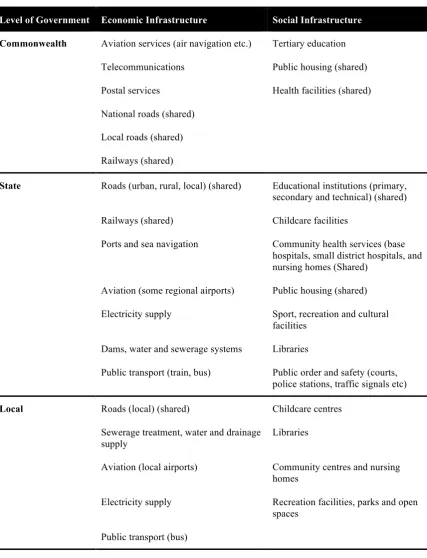
(32) certainly has an entry today, referring to infrastructure as “the basic physical and organizational structures (e.g. buildings, roads, power supplies) needed for the operation of a society or enterprise” (Oxford Dictionaries, 2008). What is interesting about this definition is that the physicality of infrastructure is present, as it is in the definition found in the American Heritage dictionary, but the reference to “public works” is now absent. I will refer to this a little later, but a recurring definition of infrastructure is that it involves the: “physical structures that form the foundation for development” (BBC, 2008). Again the physical essence of infrastructure has been given in this definition, and this tangibility is clear because it is evident that a power station, for example, physically exists. However, if that same power station has no staff or fuel to operate then it is unable to produce electricity and contribute to the “operation of a society”. In other words, if the infrastructure cannot be used to provide a service, then it cannot contribute to the operation of society as the Oxford dictionary tells us – the definition is therefore incomplete. Remy Prud’homme, an economics Professor at the University of Paris, gives an alternative perspective. He states that: First, [infrastructure] are capital goods. They are not consumed directly. Rather, in combination with labour, and possibly other inputs, they provide services. (Prud’homme 2004, p. 155). This helps narrow down the definition of infrastructure into capital goods that are operated to provide services. The power station example fits this definition, but so does a private house that is rented to a private tenant. Intuitively, the latter example should not be considered as infrastructure because the service is provided exclusively to a particular tenant. However, the definition of infrastructure should provide for a public housing scheme that is provided to the public as a social service. Therefore, infrastructure is perhaps best described as involving capital goods that are operated to provide services to society (Torrisi 2009, p. 26). The types of services to society that would meet this definition would include energy systems, health services, water and sewerage, and communications. In turn, energy systems include the sub-components of electricity generation, transmission and distribution, and gas delivery systems. Communications include postal services, telecommunication, transportation and so forth. Richard Webb, an Australian economist, developed a useful distinction between the various types of infrastructure and how the responsibilities for each are divided between 22.
Figure


+7



Outline
Historical Provision of Infrastructure 37
Deregulation and Privatisation 42
Private Participation in Infrastructure (PPI) 45
The Involvement of Public Agencies in the Financing of PPI Projects 49
Private Finance Initiative and Public-Private Partnerships 59
Evolution of Infrastructure Management Units 70
Developing a National Infrastructure Plan (Step 2) 84
Determining the degree to which government support is provided (Step 3f) 99
Designating the Project’s Form of Cooperation and Procurement 120
Project Comparison with Holistic Infrastructure Management 126
Related documents
Study on risk assessment of toxic chemical in natural environment Identification and offering appropriate procedures in risk management Toxicology and toxicity evaluation of
When tested with simulated data, the ROC curves and true positive comparison indicate that a kernel size of roughly 0.20 should show an improvement over CCA (Figure 4), but
Densitometric parameters (such as mean lung density [MLD], standard de- viation of lung density [SD-LD], kurtosis, and skewness) de- rived from CT attenuation histograms have served
Anti-inflammatory effects of the preparation were studied according to the below methods: S.Salamon– burn induced inflammation of the skin, caused by hot water (80 0 C) in white
Hence, in spite of VAD being present in children younger than 6 months (Humphrey, et al., 2000), supplementation in neonates, 1-5 month old children and women (for their own sake
The result established that processing techniques, such as, germination and fermentation, improved on the mineral, amino acid and fatty acid composition; and also, eliminate
Materials and Methods: The specificity of the assay was tested using reference strains of vancomycin-resistant and susceptible enterococci.. In total, 193
