This is a pre-copy-editing, author-produced PDF of an article accepted for publication in The British Journal of Occupational Therapy following peer review.
The definitive publisher-authenticated version is:
Exploring Changes in Occupational Therapy Students’ Approaches to Learning during Pre-registration Education.
Judith Chapman, Jo Watson, Jo Adams
Scholarly Paper Education
Word Count: 3937
Judith Chapman (MSc, MCSP) Lecturer in Physiotherapy
Jo Watson (MSc, BAppSc (OT), BAOT) Lecturer in Occupational Therapy
Jo Adams (MSc, DipCOT, BAOT) Lecturer in Occupational Therapy
For Correspondence:
Jo Watson
Lecturer in Occupational Therapy
School of Health Professions and Rehabilitation Sciences University of Southampton
Highfield Southampton Hampshire SO17 1BJ
Ph: 023 8059 5303 e-mail: [email protected]
Abstract
This article describes a longitudinal cohort study that examined the preferred
approaches to learning of pre-registration occupational therapy students (N=55) as
they progressed through the three years of an undergraduate BSc (Hons)
programme. Students‟ orientations to learning were measured using the Short
Inventory of Approaches to Studying (ASI) (Entwistle 1981) and results were
compared descriptively across repeat measures undertaken during each year of
study. Inferential statistics are used to examine whether there were any statistically
significant differences in preferred learning approaches throughout the three years of
study. The results show moderate changes in learning approaches that are
associated with more successful outcomes of learning. Evidence of the use of these
deeper approaches to learning were accompanied by statistically significant
decreases in less desirable, superficial approaches; with reductions in the mean
scores between year one and year three for Operation Learning (p<0.005) and
Learning Pathologies (p<0.05). The implications of the findings are discussed in
relation to learning and teaching and assessment methods in undergraduate health
professional education. Students may be encouraged to become more independent
and to develop deeper approaches to learning by reducing formal contact time and
developing assessment strategies that emphasise the exploration and application of
Introduction
The aim of this cohort study undertaken in a BSc (Hons) Occupational Therapy (OT)
degree programme was to determine whether students‟ approaches to learning
change over the three years of the programme. Emphasis in the literature has
previously been placed on developing creative student-centred teaching methods in
order to enhance academic and clinical performance (Watson 2005, Martin et al
2004, Reeves et al2004, Higgs & Edwards 2002, Bonello 2001, Paterson &
Adamson 2001, Sweeney et al 2001). Less attention has been devoted to
considering students‟ preferred learning approaches; how these develop throughout
an undergraduate degree programme and the impact they may have on syllabus
delivery or the achievement of relevant learning outcomes.
Literature Review
A search for relevant literature was undertaken using the International ERIC (1976–
2005), Web of Science (1970–2005), Zetoc (1993–2005), PsychInfo (1985–2005) ,
CINAHL(1982–2005) , AMED (1985–2005) , EMBASE (1980–2005) and MEDLINE
(1976 – 2005), with key words „learning styles‟, „learning approaches‟ , „learning
preferences‟ and „occupational therapy students‟.
Research into differing styles of learning and motivation to learn originates from the
psychology field and has been evident for the last four decades. There has been
little research into the application of these tested principles within the specific field of
OT education. Readers are directed to Cassidy (2004) and Desmedt and Valcke
(2004) for excellent reviews of theory, terminology and models regarding learning
styles and preferences.
Approaches to Learning
Marton and Säljö (1976) conducted early research into approaches to learning and
identified two types of learning that are still accepted today. They identified a
surface approach to learning involving rote memorisation of specific information; and
a deep approach in which the student seeks meaning and is actively involved in
developing a conceptual understanding and application of information. A third,
strategic approach to learning has also been identified, in which students focus their
attention on the achievement of high grades, utilising a variable approach to learning
selected on the basis of its potential to achieve success in a given assessment
context (Newble & Entwistle 1986). It has been suggested that the match between
learning environment, teaching approaches and preferred learning style is important
(Curry 1999, Newble & Entwistle 1986) arguably not only to facilitate successful
student outcomes in professional examinations, but also to enable effective
continuing professional development as a competent therapist.
Within an extensive literature-base considering learning styles and approaches to
learning, few studies have focussed on learning within the health care professions
specifically. Given the significant practical skills element in OT education, the
transferring of results from studies focusing on strictly academic programmes should
be undertaken with caution.
What has emerged from the literature suggests that age and individual
characteristics influence approaches to learning (Jamison & Dirette 2004, Hardigan
& Cohen 2003, Aaron & Skakun 1999, Cavanagh & Coffin 1994). Additionally, there
Newble & Clarke 1986, Newble & Entwistle 1986). In investigations into learning
styles in medical schools, researchers have demonstrated that new students tend to
exhibit a preference for more superficial learning (Aaron & Skakun 1999); but that
approaches to learning are not necessarily static and change may occur in adult
learners over a one-year period (Severiens et al 2001). Coles (1985) demonstrated
that over the course of undergraduate education some medical students in a school
with a traditional curriculum actually moved away from a deep approach towards a
more superficial, strategic approach in order to pass their assessments.
It is the deep approach to learning that educators are more likely to encourage
because it is the most conducive to successful academic & professional
development. Newble and Entwistle (1986) suggest that the way in which students
learn and their subsequent success is partly attributable to their preferred
approaches to learning. In a longitudinal study of two cohorts of medical students,
Arnold and Feighny (1995) demonstrated that deeper learning approaches had a
positive correlation with both high academic achievement (for both cohorts) and
better clinical performance (for only one cohort).
Measuring Approaches to Learning
There have been many attempts to investigate learning styles and approaches to
learning; and many instruments developed (Cassidy 2004, Desmedt & Valcke 2004).
Curry (1999) points out that there is a need to differentiate between a learning style
which is indicative of someone‟s typical performance (trait characteristic) and an
approach to learning, which is a choice made according to the requirements of the
task in hand (state characteristic). She discusses the conceptual differences
characteristics of the information processing involved; and 3) preferences for
different types of instruction (Curry 1983). An instrument focussing particularly on
identifying the level and depth of learning was developed by Entwistle and
colleagues (Entwistle et al 1979; Entwistle & Ramsden 1983). It records both student
motivation and information processing during a learning activity. The Approaches to
Studying Inventory (ASI) identifies three approaches: deep learning in which
understanding is sought; surface learning with an intention to memorise and
reproduce; and strategic learning with a focus on the demands of assessments and
an intention to excel.
The original ASI was a 64 item questionnaire with sixteen subscales grouped into
three major areas: Meaning Orientation, Reproducing Orientation, Achieving or
Strategic orientation; and further sub-grouped into Styles and Pathologies of
learning. Responses are provided on a five point Likert scale where the most positive
responses are given a value of 4; while the statements producing least agreement
are given a value of zero (Entwistle & Ramsden 1983). The ASI has been used
extensively in educational research in this country and is known to have moderately
sound psychometric properties (Cassidy 2004, Coffield et al 2004, Duff 2000). The
ASI has been adapted over time and there are several shorter inventories that have
emerged. Test-retest reliability has been documented as ranging from moderate to
good with reliability coefficients ranging from 0.40 to 0.78 on a 30 item version
(Arnold and Feighny 1995).
„Meaning Orientation‟ is associated with deep learning and an intrinsic interest in the
regarded as being strategic and aimed at the achievement of successful assessment
outcomes (Newble & Entwistle 1986).
Deep learning is characterised by two distinct approaches: „Operation Learning‟
involves a logical, step-wise approach and becomes a deep approach to learning
when combined with an acceptance of generalisations only with sound supporting
evidence. „Comprehension Learning‟ adopts a broad focus considering
interconnection of ideas and previous knowledge. The most successful „Versatile‟
learners are those who are able to adopt either of these two approaches where
appropriate.
Learning Pathologies become evident in a number of ways. Students who show
„Improvidence‟ adopt the step-wise element of an Operation Learning approach but
fail to understand the interrelationship between concepts and ideas; and therefore
develop a limited view of the topic. „Globetrotting„ students predominantly use
Comprehension Learning, but tend towards a superficial approach in which
premature conclusions are drawn without appropriate supporting evidence (Newble
& Entwistle 1986, Newble & Clarke 1986).
„Prediction of Success‟ combines various subscales in the inventory: the competitive
element of Achievement Motivation, learning for comprehension and meaning along
with the emphasis on facts and logical analysis found in Versatility; moderated by the
score for Learning Pathologies. „Elaboration‟ is the ability to link material in order to
Approaches to Learning in Occupational Therapy Education
There have been only a handful of previous studies examining the approaches to
learning adopted by OT students; all of which are based in the USA (Jamison &
Dirette 2004, Hardigan & Cohen 2003, Barris et al 1985). Previous literature,
including more generic studies unrelated to OT education, seem to suggest that in
busy curricula learning can be assessment driven; and that deeper more meaningful
learning that is likely to prove more relevant to clinical and professional development
may be hindered as a result (Ramsden 2003 p182, Seale et al 2000, Biggs1999
p141, Gibbs & Habeshaw 1989 p92).
It is to be hoped that students on pre-registration OT programmes will move from
possible early rote learning approaches, to a more reflective and analytical approach
(congruent with ongoing development in professional practice) during their
undergraduate studies. Examining learning approaches that students enter their
degree programmes with and determining whether these approaches change during
pre-registration education may have implications for developing methods of teaching
to optimise student learning, clinical reasoning skills and ongoing professional
development. To date, there has been no investigation into OT students‟ preferred
learning approaches upon entry and whether these changes as they progress
through an honours degree programme.
This study was a small longitudinal cohort study which aimed to examine the
progression of one cohort of undergraduate OT students‟ preferred approaches to
learning over the three years of their pre-registration education, in order to provide
Research Questions
What are the preferred approaches to learning of OT students undertaking an
undergraduate Honours degree programme and is there a difference, as measured
by the short ASI (40 item), over the three years of the programme?
Ethical approval
Prior to data collection, ethical approval was awarded by an established ethics
committee within the facility under investigation.
Methodology
The study drew participants from a three-year, modular based pre-registration BSc
(Hons) Occupational Therapy degree programme. All students in a single cohort of
new undergraduate OT students (N=55) were asked to voluntarily complete the short
40 item ASI self-report questionnaire on three occasions during their programme of
study: within two weeks of commencing the course, at the beginning of their second
year, and again shortly after graduation from their third and final year.
Consent to participate in the study was assumed by the completion and return of
questionnaires. The short ASI took no more than 10 minutes to complete. Students
used their Student ID number to maintain anonymity. In years one and two,
questionnaires were distributed by the primary investigator who was a physiotherapy
lecturer in the School. In the final year students were sent a copy of the
questionnaire within three months of graduation, along with a covering letter from the
primary investigator inviting participation and assuring anonymity via the use of
student numbers. They were supplied with a stamped, addressed envelope to
Data Analysis
Data from the questionnaires was scored according to the standardised protocol and
analysed using the Statistical Package for the Social Sciences (SPSS) data base
(SPSS version 11.0 Chicago Inc). The scored questionnaire responses provided an
interval level of measurement, and preliminary analysis revealed it to be normally
distributed. Descriptive statistics (range, mean and standard deviation) present the
summary scores for the primary ASI subscales for each year group. As there was
variability in the students who completed the questionnaire at each episode of data
collection, the three years have been treated as different groups. Analysis of
Variance was used, applying a post hoc Bonferonni analysis for significant (p< 0.05)
findings, as recommended by Field (2000).
Results
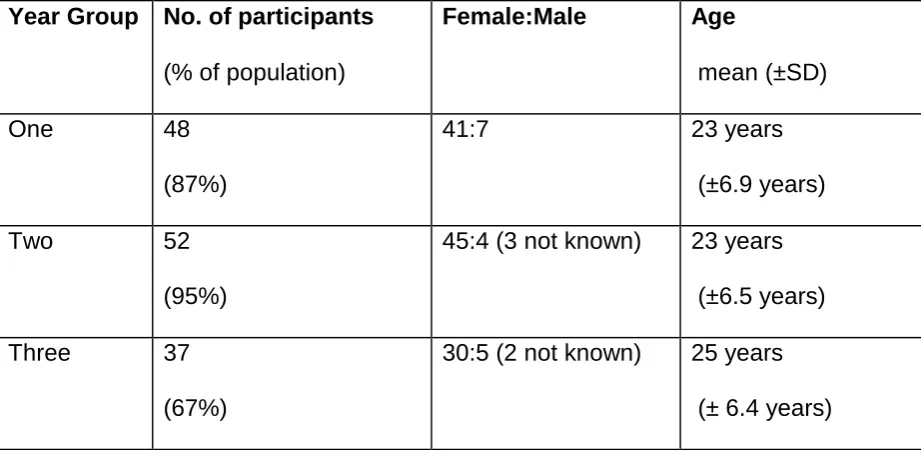
Baseline demographic information of the three years is presented below in Table 1.
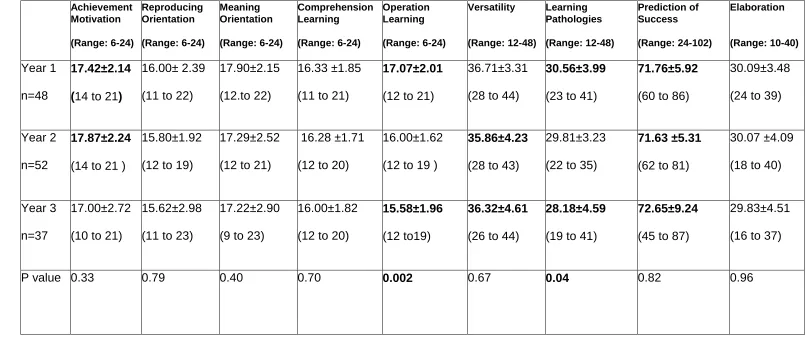
Table 2 describes the ranges of scores for the primary ASI subscales between the
years and presents p values for the differences between year groups.
Table 1: Demographic information of the three year groups.
Table 2: Range of scores across ASI dimensions between years, with p
values for the differences between year groups.
In all dimensions except dimension Achievement Motivation there was a decrease in
the overall mean score between year one and year two. Achievement Motivation
two and year three, the overall mean score in this dimension fell to below that of year
one (17.00) (Table 2). Despite an overall decrease (not statistically significant) in the
dimension of Versatility between years one and three, there was an improvement in
the score from year two (35.86) to year three (36.32). „Prediction of Success‟ which
combines Achievement Motivation and Versatility was the only dimension to show an
increase in the mean score between year one (71.76) to year three (72.65), although
this was not statistically significant.
Table 3: Multiple Comparisons Bonferroni
Table 3 reveals statistically significant differences between year groups within the
Operation Learning (p<0.005) dimension and the Learning Pathologies (p<0.05)
dimension. There were no other statistically significant changes in learning
approaches between year groups within the cohort of students.
Discussion
Educational theorists espouse the benefits of developing independent, autonomous
learners. Expectations laid out in the Health Professions Council‟s (HPC) Standards
of Proficiency for Occupational Therapists (HPC 2004) identify the responsibility of
professionals to maintain and enhance their competence and effectiveness as
clinicians by becoming reflective, independent thinkers who challenge and develop
their practice throughout their careers. It is to be hoped therefore, that the learning
and teaching methods presented to undergraduate students during their
The aim of this study was to determine whether OT students‟ approaches to learning
change during their undergraduate programme. Analysis of the data revealed little
statistically significant change in students‟ approaches to learning between the first
and the third year; however there was a modest overall trend towards the
development of approaches considered to be associated with deeper learning.
Over the three years, the superficial strategy of Reproducing Orientation was seen to
decrease steadily each year. It seems that by the beginning of year two, students
had adopted a more strategic approach which focused on exam success, as seen by
the increased score in Achievement Motivation between year one and year two.
Scores in this dimension then declined in the final round of data collection;
suggesting that students may be looking for more meaning. This hypothesis
however, is not directly supported by the parallel decline in Meaning Orientation and
Comprehension which are dimensions associated with deep approaches to learning.
More supportive evidence for the hypothesis seems to come from the increase in
Versatility scores between year two and year three; coupled with the significant
decline in Learning Pathologies during this period. It is proposed that the decline in
Operation Learning is not necessarily a negative feature. Newble and Clarke (1986)
demonstrated a significantly higher Operation Learning score in students studying on
a traditional medical programme at year three. This finding was associated with an
increase in the pathology of Improvidence; reinforcing that Operation Learning can
be focused solely on superficial, sequential strategies. It may be therefore, that the
decline in Operation Learning seen in this cohort, accompanied by a decline in
Prediction of Success was seen to drop very slightly in year two, paralleling the
increase in Achievement Motivation and the decline in Versatility at that point.
Overall, however, the dimension shows an increase beyond the year one scores by
the third year. Although this was not statistically significant, it is linked with reduced
focus on exam success (Achievement Motivation) and with greater emphasis on
understanding (Versatility).
Contextualising Approaches to Learning
It would be misguided to consider approaches to learning without also considering
the environment in which learning takes place. The context in which learning occurs
plays a significant role in determining the approaches that students adopt. The two
primary aspects of the learning environment that receive repeated attention in the
literature in this regard are student workload and assessment formats (Ramsden
2003, Biggs 1999, Curry 1999, Newble & Entwistle 1986, Newble & Clarke 1986).
Students need time to think and to consolidate learning and to be able to apply it in
different situations. If they are put under undue pressure to complete tasks within
limited timeframes, or are presented with a syllabus that emphasises coverage and
high contact hours, superficial approaches to learning are a predictable outcome.
Tan and Thanaraj (1993) point out that in the absence of sufficient time to grapple
with complex ideas, crammed curricula can lead to simplification of concepts by
students and a fear of failure that may prompt the avoidance of difficult tasks.
Further, they suggest that the same demanding curriculum may force students to
seek more strategic approaches to studying focused on securing examination
Early indicators that this cohort of students moved towards a more strategic
approach between year one and year two may therefore be a consequence of the
learning and teaching strategies and modes of assessment to which first year
students were exposed. At that time, the course seemed to focus predominately on
the acquisition and reproduction of facts in an attempt to develop an appropriate
knowledge-base from which to launch professional practice. The newness of much
of the material may have made it difficult for students to identify links between
concepts; and the heavily contacted timetable may have encouraged students to
adopt a preference for acquiring information in a structured, step-wise manner in an
effort to keep up.
Such a learning environment might also account for the decreased Versatility score
in the first year. Work by Coles (1985) also showed a significant decline (p<0.001) in
the Versatility scores of a group of medical students in a conventional programme
over the first year of their training. Students in a problem-based programme
demonstrated significantly higher Versatility score than the conventional group by the
end of year one (p<0.01). This suggests that experiencing a full, factually based
curriculum during the first year may have a detrimental influence on students‟ study
habits. Coles (1985), Newble and Clarke (1986), and Titchen and Coles (1991) all
demonstrated a dramatic shift towards the use of superficial approaches with rises in
Reproducing Orientation in the first year of traditional programmes. Despite the
demands of their programme, the cohort in this study however, tended to adopt a
more strategic rather than superficial approach in their first year (as demonstrated by
an increase in Achievement Motivation accompanied by the decrease in
Approaches to Learning and Assessment
It is widely acknowledged that assessment formats also have a profound effect on
the approaches to learning adopted by students. If assessments focus on recall of
factual knowledge, memorisation of these facts will become the focus of student
attention, drawing those who might otherwise focus on developing understanding
towards this more strategic approach. Biggs (1999) stresses the importance of
constructive alignment where learning activities and assessments are aligned to
specific learning outcomes designed for that level of education. In the first year of the
programme being considered, students needed to grasp the foundation sciences
underpinning clinical practice and this primarily emphasised the demonstration of an
acquisition of facts. At the time of this study, the assessment in this area dominated
student attention and was based almost entirely on factual recall and recognition;
inevitably driving students to be strategic in their learning.
During successive years of study, the programme aimed to encourage students to
engage in higher order learning and critical thinking such as application, analysis,
synthesis and evaluation (Bloom 1956) in order to accommodate the uncertainties of
clinical practice. Demonstration of greater Versatility by the students towards the end
of the programme suggests a more flexible approach to learning, which may reflect
these advanced demands of the programme. The significant reduction in Operation
Learning coupled with the smaller significant decrease in Learning Pathologies
would also seem to indicate that by the end of their pre-registration education,
students were able to contextualise material and recognise useful interrelationships
Despite a lack of change in Comprehension Learning, the students demonstrate a
more balanced approach in their learning resulting in a small positive change in the
Prediction for Success. The changes observed in Achievement Motivation
(increased in the first year, but decreased overall by year three) suggest that
students moved from being solely focussed on passing their exams to seeking a
broader, more integrated understanding of the syllabus. However, caution must be
exercised in the interpretation of these results as the ASI merely asks students to
reflect on their approaches to studying and may not actually represent what they do
in practice (Newble & Clarke 1986).
Implications for educational practice
Our findings suggest that the strategies that have been adopted in teaching
undergraduate students could be challenged. It is suggested that analysis of the
framework in which learning occurred over the three years may highlight that greater
emphasis on contextualising information and demonstrating links to clinical practice
would be beneficial to the development of student understanding. Examining the
alignment between changes in approaches to learning evident in this cohort and the
context of their actual educational and assessment experiences across the three
years will be the subject of a further paper.
Limitations
The findings of this work need to viewed in light of the fact that the limited number of
participants were drawn from one particular, modular-based pre-registration
programme and therefore the results may not be generalizable to other programmes;
to learning are worthy of consideration in all programmes. There was some variation
in the students who participated in each round of data collection which limits the
depth of statistical analysis possible; and therefore the results only reflect trends
within the cohort. Further, the sample size may have been too small to detect
meaningful changes.
As the researchers were lecturing staff within the facility from which participants
were drawn, it is possible that students may have felt compelled to participate in the
study and provide what they perceived to be the desired information. However, the
response rate was variable from year to year; and given the lengthy time periods
between episodes of data collection, it is unlikely that participants would be able to
accurately recall how they had previously completed the questionnaire.
The psychometric properties of the instrument have been identified as moderately
sound, however instrument error may nevertheless account for some of the changes
noted. Since this data was collected, the ASI has been superseded by revised
versions which have updated the questions and terminology used.
Conclusion
We have seen that approaches to learning do change over time, so any attempt to
match instructional style with initial student learning preferences is liable to be
marginally effective at best; not least because of the range of learning approaches
that may be evident within a classroom at any one time. If encouraging students to
develop deep learning approaches is the desired outcome, it makes sense that the
pre-registration years; while strategies promoting superficial approaches are
positively discouraged (Biggs 1999).
With a tripartite requirement of ensuring fitness to practice, fitness for purpose and
fitness for award, structuring the design and content of busy pre-registration OT
courses such that deep approaches to learning are encouraged can certainly be
challenging. It is not always easy to completely overhaul an established programme
of study; but small incremental changes could arguably enhance the learning
environment and support the development of deep approaches to learning. Evidence
available in the literature suggests that a reduction in didactic teaching, a balanced
workload, an increase in self-directed learning activities and assessments that focus
on the demonstration of understanding and application of knowledge would all
contribute to such an ambition (Ramsden 2003, Seale et al 2000, Biggs1999, Gibbs
& Habeshaw 1989). The pursuit of this vision in spite of any challenges can only
benefit the profession by enhancing the quality of pre-registration learning and by
promoting an attitude to learning that will encourage reflective practice and life-long
Acknowledgements
The authors would like to thank all of the students who participated in this study. We
also extend our gratitude to colleagues and the two anonymous reviewers who have
References
Aaron S, and Skakun E (1999) Correlation of students‟ characteristics with their
learning styles as they begin medical school. Academic Medicine, 74(3), 260-262.
Arnold L, and Feighny K M (1995) Students‟ general learning approaches and
performances in medical school: A longitudinal study. Academic Medicine, 70(8),
715-722.
Barris R, Kielhofner G and Bauer D. (1985) Learning preferences, values and
student satisfaction. Journal of Allied Health, 14(1), 13-23.
Biggs J (1999) Teaching for Quality Learning at University. Buckingham: The Society
for Research into Higher Education & Open University Press.
Bloom B S (Ed) (1956) Taxonomy of Educational Objectives: The Classification of
Educational Goals. Handbook 1: Cognitive Domain. New York ; David McKay Co.
Inc.
Bonello M, (2001) Fieldwork within the context of higher education: a literature
review. British Journal of Occupational Therapy, 64(2), 93 – 98.
Cassidy S, (2004) Learning styles: an overview of theories, models, and measures.
Cavanagh S J and Coffin D A (1994) Matching instructional preference and
teaching styles: a review of the literature. Nurse Education Today, 14, 106-110.
Coffield F, Moseley D, Hall E and Ecclestone K (2004) Should we be using learning
styles? What research has to say to practice. London: Learning and Skills Research
Centre, LSDA.
Coles C R (1985) Differences between conventional and problem-based curricula in
their students‟ approaches to studying. Medical Education, 19, 308-309.
Curry L. (1983) Learning Styles in Continuing Medical Education. Ottawa: Council on
Medical Education, Canadian Medical Association.
Curry L (1999) Cognitive and learning styles in medical education. Academic
Medicine, 74(4), 409-412.
Desmedt E and Valcke M (2004) Mapping the learning styles “jungle”: an overview of
the literature based on citation analysis. Educational Psychology, 24(4), 445-464.
Duff A (2000) Learning styles measurement: the revised Approaches to Studying
Inventory (RASI). Bristol Business School Teaching and Research Review, Issue 3.
Entwistle N J (1981) Styles of Learning and Teaching: An Integrated Outline of
Educational Psychology for Student Teachers and Lecturers. Chichester: John
Entwistle N J, Hanley M and Hownsell D J (1979) Identifying distinctive approaches
to studying. Higher Education, 8, 365-380.
Entwistle N J and Ramsden P (1983) Understanding Student Learning. London,:
Croom Helm.
Field A (2000) Discovering Statistics Using SPSS for Windows. London: Sage.
Gibbs G and Habeshaw T (1989) Preparing to teach: An introduction to effective
teaching in higher education. Bristol: Technical & Educational Services.
Hardigan P C and Cohen S R (2003) A comparison of learning styles among seven
health professions: implications for optometric education. The Internet Journal of
Allied Health Sciences and Practice 1(1), Available at:
http://ijahsp.nova.edu/articles/1vol1/HardiganCohen.html, Accessed 24/02/05.
Health Professions Council (2003) Standards of Proficiency: Occupational
Therapists. London, Health Professions Council.
Higgs J and Edwards H (2002) Challenges facing health professional education in
the changing context of university education. British Journal of Occupational
Therapy, 65(7), 315 – 320.
Jamison P W and Dirette D (2004) Personality type in occupational therapy students:
Martin M, Morris J, Moore A, Sadlo G and Crouch V (2004) Evaluating practice
education models in occupational therapy: comparing 1:1, 2:1 and 3:1 placements.
British Journal of Occupational Therapy, 67(5), 192 – 200.
Marton F and Säljö R (1976) On qualitative differences in learning; I: outcome and
process. British Journal of Educational Psychology, 46, 4-11.
Newble D I and Clarke R (1986) The approaches to learning of students in a
traditional and an innovative problem-based medical school. Medical Education, 20,
267-273.
Newble D I and Entwistle N J (1986) Learning styles and approaches: implications
for medical education. Medical Education, 20, 162-175.
Patterson M and Adamson L (2001) An international study of educational
approaches to clinical reasoning. British Journal of Occupational Therapy, 64(8),
403 – 405.
Ramsden P (2003) Learning to Teach in Higher Education (2nd Ed). London,
Routledge Falmer.
Reeves S, Summerfield Mann L, Caunce M, Beecraft S, Living R and Conway M
(2004) Understanding the effects of problem-based learning on practice: findings
from a survey of newly qualified occupational therapists. British Journal of
Seale J K, Chapman J and Davies C (2000) The influence of assessments on
students‟ motivation to learn in a therapy degree course. Medical Education 34, 614
– 621.
Severiens S, Ten Dam G and Van Hout Wolters B (2001) Stability of processing and
regulation strategies: two longitudinal studies on student learning. Higher Education,
42, 437-453.
Sweeney G, Webley P and Treacher A (2001) Supervision in occupational therapy,
Part 3: accommodating the supervisor and the supervisee. British Journal of
Occupational Therapy, 64(9), 416 – 431.
Tan C M and Thanaraj K (1993) Influences of context and preferred learning
environments: approaches to studying physiology. Medical Education, 27, 143 – 159.
Titchen A C and Coles C R (1991) Comparative study of physiotherapy students‟
approaches to their study in subject-centred and problem-based curricula.
Physiotherapy Theory and Practice, 7, 127 – 133.
Watson J (2005) Supporting success in diverse student populations. British Journal
Table 1: Demographic information of the three year groups.
Year Group No. of participants
(% of population)
Female:Male Age
mean (±SD)
One 48
(87%)
41:7 23 years
(±6.9 years)
Two 52
(95%)
45:4 (3 not known) 23 years
(±6.5 years)
Three 37
(67%)
30:5 (2 not known) 25 years
Table 2: Range of scores across ASI dimensions between years, with p values for the differences between year groups. All data are presented as mean ± SD (range). Emboldened figures are specifically referred to within the text.
Achievement Motivation (Range: 6-24) Reproducing Orientation (Range: 6-24) Meaning Orientation (Range: 6-24) Comprehension Learning (Range: 6-24) Operation Learning (Range: 6-24) Versatility (Range: 12-48) Learning Pathologies (Range: 12-48) Prediction of Success (Range: 24-102) Elaboration (Range: 10-40) Year 1 n=48 17.42±2.14 (14 to 21)
16.00± 2.39
(11 to 22)
17.90±2.15
(12.to 22)
16.33 ±1.85
(11 to 21)
17.07±2.01
(12 to 21)
36.71±3.31
(28 to 44)
30.56±3.99
(23 to 41)
71.76±5.92
(60 to 86)
30.09±3.48
(24 to 39)
Year 2
n=52
17.87±2.24
(14 to 21 )
15.80±1.92
(12 to 19)
17.29±2.52
(12 to 21)
16.28 ±1.71
(12 to 20)
16.00±1.62
(12 to 19 )
35.86±4.23
(28 to 43)
29.81±3.23
(22 to 35)
71.63 ±5.31
(62 to 81)
30.07 ±4.09
(18 to 40)
Year 3
n=37
17.00±2.72
(10 to 21)
15.62±2.98
(11 to 23)
17.22±2.90
(9 to 23)
16.00±1.82
(12 to 20)
15.58±1.96
(12 to19)
36.32±4.61
(26 to 44)
28.18±4.59
(19 to 41)
72.65±9.24
(45 to 87)
29.83±4.51
(16 to 37)
Table 3: Identifying the year groups between which the statistically
significant differences lie using multiple comparisons Bonferroni.
Dimension Year Group Year Group p value
Operation Learning
1 2 0.076
3 0.003
2 1 0.076
3 0.693
3 1 0.003
2 0.693
Learning Pathologies
1 2 0.753
3 0.040
2 1 0.753
3 0.309
3 1 0.040
2 0.309