C. T. Freeman, P. L. Lewin and E. Rogers
University of SouthamptonSchool of Electronics and Computer Science, University Road, Southampton, SO17 1BJ, United Kingdom Email: [email protected]
Keywords: Learning control, non-minimum phase systems, optimisation.
Abstract: In this paper a general ILC algorithm is examined and it is found that the filters involved can be selected to satisfy frequency-wise uncertainty limits on the plant model. The probability of the plant model being at a given point in the uncertainty space is specified, and the filters are then chosen to maximise the convergence rate that can be expected in practice. The magnitude of the change in input over successive trials and the residual error have also been incorporated into the cost function. Experimental results are presented using a non-minimum phase test facility to show the effectiveness of the design method.
1
INTRODUCTION
Iterative Learning Control (ILC) is a control method that is applicable to systems which perform the same action repeatedly. Operating in this way it is able to use past control information such as input signals and tracking errors in the construction of the present trol action. This sets ILC apart from most other con-trol techniques and has allowed it to provide improved performance with reduced knowledge of the plant when compared with other control approaches. A lit-erature survey of ILC can be found in (Moore, 1998) and there exist textbooks on the subject (Moore, 1993; Bien and Xu, 1998). One such ILC update law is given by
uk+1=F(z)uk+S(z)ek (1)
whereek = yd−yk andF(z)andS(z)are filters
which may be non-causal. This has been analysed in the frequency-domain in, for example, (Norrlöf and Gunnarsson, 1999) and (Norrlöf, 2000). Conversion of (1) to the frequency-domain using the sampling pe-riod,Ts, gives
Uk+1=F(ejωTs)Uk+S(ejωTs)Ek (2)
Let the uncertain plant be described byG(ejωTs) =
G0(ejωTs)U(ejωTs)whereU(ejωTs)is a
multiplica-tive uncertainty andG0the nominal plant model. In
this case the error evolution is
Ek+1= F(ejωTs)−S(e
jωTs)G
0(ejωTs)U(ejωTs)
Ek
+ 1−F(ejωTs)
Yd
(3) so that
F(ejωTs)−S(ejωTs)G0(ejωTs)U(ejωTs)
<1
(4) is a necessary condition for stability since, for each frequency, (3) represents a state-space system in the iteration domain having a state transition matrix with eigenvalues less than 1. In particular, ifF(ejωTs) = 1 this becomes a necessary condition for monotonic convergence which can be shown to be essentially a sufficient condition as well (Longman, 2000). More generally, the same argument means
F(ejωTs)−S(ejωTs)G0(ejωTs)U(ejωTs)
< l
(5) is a sufficient condition for the eigenvalues of the state transition matrix to be less thanl, or a reduction of 1l in the magnitude of the error over consecutive cycles ifF(ejωTs) = 1. To accommodate both these cases,
satisfying (5) will be said to produce a convergence rate of 1l.
Remark 1 Adding a filter,T(z), on the(k+ 1)th
cy-cle error to the algorithm given in (1) produces uk+1=F(z)uk+S(z)ek+T(z)ek+1 (6)
and we can then write yk+1= 1+GG(z()zT)T(z()z)yd+
G(z)
to give
uk+1=1+GT((zz))T(z)yd+ 1
1+G(z)T(z)(F(z)uk+S(z)ek) (8)
The substitutionsyˆd =
T(z)
S(z)+ 1
yd and Gˆ(z) =
G(z)
1+G(z)T(z), or alternativelyyˆd =
1
S(z)+ 1
T(z)
yd
andGˆ(z) = 1+GG(z()zT)T(z()z), allow this to be written as (1). Any design method forS(z)andF(z)can there-fore be implemented as (6) using these substitutions. Any robustness properties, however, will only apply to
ˆ
G(z)instead ofG(z).
2
DFT
An alternative expression for (2) is found by taking the Discrete Fourier Transform (DFT) of both sides of the update law (1) which results in
ˆ
uk+1= ˆF⊙uˆk+ ˆS⊙ˆek (9)
which is possible sinceek anduk are known prior to
thek+ 1th trial. Here ⊙denotes component-wise
multiplication anduˆis the DFT ofu. Similarly, the DFT of (3) results in an alternative description
ˆ
ek+1= ( ˆF−Gˆ0⊙Uˆ⊙Sˆ)⊙ˆek+ (I−Fˆ)⊙yˆd (10)
Note that now the design is conducted in the frequency-domain, the designer can select each ele-ment Sˆi and Fˆi individually and build the new
in-putuk+1using (9) combined with expressions for the
DFT and IDFT of a signal. Similar transparency can-not be found in the time domain. Since (4) is a steady-state requirement which assumes a reasonable tran-sient response, the use of a steady-state update of the input is not disadvantageous. It just remains to choose the value of the filtersSandF at every frequency.
3
APPROACH TO FILTER
DESIGN
By introducing the variablev=U(ejωTs)it is
possi-ble to write (5) as
sup ω∈[0,2π]
|f(v)|< l (11)
where
f(v) =F(ejωTs)−S(ejωTs)G
0(ejωTs)v v∈C
(12) Let the open disc of radiuslcentred at the origin, and its boundary be defined as
D={rejθ|θ∈[−π π), r∈[0l)},
δD={lejθ |θ∈[−π π)} (13)
so that the inverse function
f−1(v) = F(ejωTs) +v
S(ejωTs)G0(ejωTs) v∈
C (14)
applied to D gives the range of values taken by
U(ejωTs)for (5) to be satisfied.
The domain and co-domain can be enlarged to equal the extended complex plane Cˆ (Jones and Singerman, 2004) which is the union of C and the point at infinity; thus Cˆ = C∪ {∞}. In this case
f−1(v)is an extended Möbius transformation when ωandTsare fixed, and maps
• Cˆ one-one ontoCˆ
• generalised circles onto generalised circles
A generalised circle is defined as either a circle or an extended line (see (Jones and Singerman, 2004) for details).
It is therefore possible to applyf−1(v)toδDand
find the boundary of the region U(ejωTs)must
oc-cupy to ensure a convergence rate of 1l, or monotonic convergence ifl ≤1. The image of a Möbius trans-formation can be found by simply applyingf−1(v)to
three points ofδDand finding the unique generalised circle which passes through the resulting points (see (Jones and Singerman, 2004)). Since{±l, lj} ∈δD,
f−1(+l) =S(ejωTsF(ejωTs)G0()+ejωTsl ) f−1(−l) = F(ejωTs)−l
S(ejωTs)G0(ejωTs) f−1(lj) = F(ejωTs)+lj
S(ejωTs)G0(ejωTs)
(15)
belong to this extended circle. However a simpler method involves noting that the inverse points ofδD
are0and∞so that the inverse points of the image are given by
f−1(0) = F(ejωTs)
S(ejωTs)G0(ejωTs), f
−1(∞) =∞
(16) and the mapping has the form
z− F(e
jωTs)
S(ejωTs)G0(ejωTs)
=k(ejωTs) (17)
Sincef−1(l) = F(ejωTs)+l
S(ejωTs)G0(ejωTs)∈δDthen
F(ejωTs) +l
S(ejωTs)G0(ejωTs)−
F(ejωTs)
S(ejωTs)G0(ejωTs)
=k(ejωTs) = l
|S(ejωTs)G0(ejωTs)| (18)
which is the equation for a circle with centre,λ, and radius,r, where
λ= F(e
jωTs)
S(ejωTs)G0(ejωTs), r=
l
|S(ejωTs)G0(ejωTs)|
This circle can then be drawn for every frequency of interest and hence the regionU(ejωTs)must occupy
in order to guarantee monotonic convergence. Note that a Möbius transformation,t(z), maps a regionR
in its domain to a regiont(R), and the boundary of
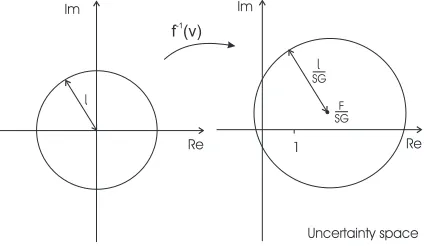
Rto the boundary oft(R). Figure 1 shows the ac-tion off−1(v)onδDand the regionU(ejωTs)must
occupy for a convergence rate of 1l. Any uncertainty
F SG
Re Im
1
Uncertainty space
SG
Re Im
f (v)-1
l
[image:3.595.309.522.99.194.2]l
Figure 1: Geometry of uncertainty space
that is contained within the right-hand circle for all frequencies will satisfy (5). At a general point,p, in the uncertainty space we can equate the distance from
ptoλwithr
p− F(e
jωTs)
S(ejωTs)G0(ejωTs)
= l
|S(ejωTs)G0(ejωTs)|
(20) in order to find the convergence rate at that frequency
1
l =
1
p−
F(ejωTs) S(ejωTs)G0(ejωTs)
|S(e
jωTs)G0(ejωTs)|
= 1
|S(ejωTs)G
0(ejωTs)p−F(ejωTs)|
(21)
This provides a useful means of selectingS andF: Let us choose to maximize the convergence rate that can be expected given that the probability that the plant is at the pointpat a given frequency is known or can be estimated. It will be assumed that this prob-ability is symmetrical about the nominal value, that is +1 in the uncertainty space. This is a situation which is realistic given the methods of obtaining a plant model commonly used in practice. In this case it will be a function of the distance to the nominal plant model which equals |p−11| in the uncertainty space. The optimisation will therefore take the form
max
S,F J(S, F) (22)
with the cost function
J(S, F) =
Z
A
1
p−
F SG0
|SG0|
P
1
|p−1|
δp
= 1
|SG0|
Z
A 1
p−
F SG0
P
1 |p−1|
δp
(23)
where P(·) is the probability that the plant is at p, andA is a region of uncertainty over whichP(·)is valid. The frequency dependence of the filters has been dropped for conciseness. Note that a small circle around the singularity must be removed if the equa-tion is solved numerically. Figure 2 shows three cases using the probability function P(x) = x−α and α
equal to2,1and0.5. The probability function is able
0 0.5 1
0 5000 10000
x
P(x) = x
−2
0 0.5 1
0 50 100
x
P(x) = x
−1
0 0.5 1
0 5 10
x
P(x) = x
−0.5
Figure 2: Examples ofP(x)
to shift focus between robustness and convergence speed by varying the weighting of the optimisation. In the first caseP(x)is only large forx ≈ 0so the maximisation will lead to a solution which is tailored to only values close to the nominal plant model. Asα
is reduced it becomes more important to chooseSso that the whole ofAhas a value ofl <1. These cases are shown in Figure 3. In a) SG1 ≈1to give a high convergence rate for the nominal plant, whilst in b) it is smaller but most of the regionAhas the property of satisfying (5). This choice ofP(x)produces the cost
Re Im
1
1 SG
Re Im
1
1 SG
a) b)
f (1)-1
A A
[image:3.595.75.287.204.327.2]f (1)-1
Figure 3: Optimal solutions for a)α >1and b)α <1
J(S, F) = 1 |SG0|
Z
A
|p−1|α
p−
F SG0
[image:3.595.311.521.535.647.2]
and the values ofSandFare found by solving
∂
∂SJ(S, F) = 0 and
∂
∂FJ(S, F) = 0 (25)
at each frequency and ensuring that it is a global max-imum. IfF is fixed at1then any solution,S∗which solves (25), so that
dJ(S∗,1)
dS = 0 (26)
will also solve the optimisation using
J
S
F
= |F|
|S||G0|
Z
A
|p−1|α
p−
F SG0
δp (27)
since only a substitution of variables has been applied.
SandF can assume any values as long as FS =S∗. IfF is now fixed atFˆ, the corresponding value ofSˆ
isF Sˆ ∗. This must also solve the optimisation using (24) as this is simply (27) multiplied by a constant. Therefore it is enough to solve the optimisation using (24) with F = 1 and simply substitute Sˆ = ˆF S∗ to obtain the solution for every other value ofF. The resulting cost isJˆ=|Fˆ|J∗whereJ∗is the cost using
F= 1. In order to incorporate other considerations in the cost, let us consider the change in input from one trial to the next. Since this is given by
uk+1−uk = (F−1)uk+Sek (28)
which, with the repeated application of (3), becomes
uk+1−uk =S(F−SG0U)ke0+
S(1−F) k−1
X
i=0
(F−SG0U)iyd+ (F−1)uk (29)
and the residual error is given by
ek = (F−SG0U)ke0+(1−F)
k−1
X
i=0
(F−SG0U)iyd
(30) It can be seen that reducingF from 1 therefore has the effect of reducing the cost (24) with the compro-mise of a likelihood of increased residual error and input change. To tackle these effects directly for an arbitrary e0 andyd, it is required that each term in
(29) and (30) has a small modulus for each frequency considered. Assuming that (4) is satisfied it remains to reduce|S|and also the bound,λ, on the remaining term which is given by
(1−F)Pk−1
i=0 (F−SG0U)iyd<1−(F1−−SGF 0U)
=λ
(31) This can be achieved using the mapping technique that has already been described. Using this, we find
that at a point in the uncertainty space,p, the boundλ
equals
1−F
SG0
p+
1−F SG0
= 1
SG0 1−Fp+ 1
(32)
Therefore the functions Q(|S|−1) and R
SG0 1−Fp+ 1
can be incorporated into the
cost to limit the upper bound of the residual error and change in successive inputs. Since these are dependent on the plant and choice ofyd, they will be
neglected in order to maintain focus on the general case.
3.1
Experimental Test Facility
The experimental non-minimum phase test-bed has previously been used to evaluate a number of Repet-itive Control and ILC schemes (see (Freeman et al., 2005) for details) and consists of a rotary mechanical system of inertias, dampers, torsional springs, a tim-ing belt, pulleys and gears. An encoder records the ouput shaft position and a standard squirrel cage in-duction motor drives the load. The system has been modelled using a LMS algorithm to fit a linear model to a great number of frequency response test results. The resulting continuous time plant transfer function has thus been established as
G0(s) =
1.202(4−s)
s(s+ 9)(s2+ 12s+ 56.25) (33)
A PID loop around the plant is used in order to act as a pre-stabiliser and provide greater stability. The PID gains used areKp = 137,Ki = 5andKd = 3. The
resulting closed-loop system constitutes the system to be controlled.
4
EXPERIMENTAL RESULTS
In polar co-ordinates let us define the region
A={rejθ|θ∈[θ
mθM], r∈[rmrM]} (34)
in the uncertainty space over which the probabil-ity function is valid. The parameters T = 6 and
n = 1024are chosen for convenience to give f s =
1024/6. Let us solve the optimisation using (24) with
F = 1andα= 0.2. Figure 4 shows a Bode plot of the resultingSvectors when usingθm=−π6,θM = π6,
rm = 0 and rM =
1+T ω
2πλ
|G0|2 with λ = 4,6,8,10.
These have been chosen using previous experience of the plant uncertainty. Asλincreases, rM decreases,
100 101 102 −150
−100 −50 0
Gain (dB)
Frequency (rad/s)
100 101 102
−2000 −1000 0 1000 2000
Phase (degrees)
G
0
λ = 4
λ = 6
λ = 8
λ = 10
G0
λ = 4
λ = 6
λ = 8
[image:5.595.75.284.91.255.2]λ = 10
Figure 4: Bode plot using variousrM functions andα =
0.2
Ais symmetrical about the real axis which results in
∠S =−∠G0. Figure 5 shows error results using the
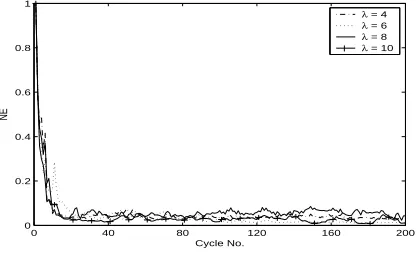
sinewave demand (shown in figure 11). The normal-ized error ‘NE’ is the cumulative error incurred over an iteration divided by the integral of the reference de-mand. Data has been recorded over the course of 200 iterations. It can be seen that smallerλvalues lead to reduced fluctuations in the cycle error. Figure 6 shows
0 40 80 120 160 200
0 0.2 0.4 0.6 0.8 1
Cycle No.
NE
λ = 4
λ = 6
λ = 8
λ = 10
Figure 5: Cycle error for sinewave demand
error results using the sinewave demand (shown in figure 7). Due to the higher frequencies present in the demand, the convergence is slower and the resid-ual error greater. Higher frequency properties of the optimisation play a greater role and so the effect of
λon the learning transients is more pronounced than previously. The convergence of the output to the de-mand is shown in figure 7 usingλ= 6. The repeating sequence demand is also drawn.
To investigate the effect of variation in α, the op-timisation using (24) with F = 1 has again been solved but using α = 0.1,0.3,0.5,0.7. Figure 8 shows a Bode plot of the resulting S vectors when
0 40 80 120 160 200
0 0.2 0.4 0.6 0.8 1
Cycle No.
NE
λ = 4
λ = 6
λ = 8
[image:5.595.311.519.93.224.2]λ = 10
Figure 6: Cycle error for repeating sequence demand
Figure 7: Output tracking using repeating sequence demand andλ= 6
usingθm=−π6,θM =π6,rm= 0andrM =
1+T ω
2πλ
|G0|2
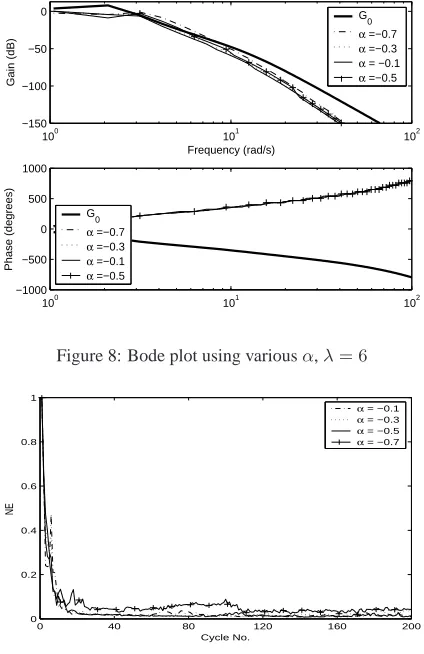
withλ= 6. Asαincreases in magnitude more em-phasis is put on fast convergence for the nominal plant and the gain is larger for a greater range of frequen-cies. Figure 9 shows error results using the sinewave demand and it can be seen that higher αvalues pro-duce greater learning transients, and, ultimately, di-vergence. They do, however, produce faster initial convergence. Figure 10 shows error results using the repeating sequence demand which confirm the previ-ous findings. The convergence of the output to the demand is shown in figure 11 using α = −0.5 and the sinewave demand which is also shown.
5
FUTURE WORK
[image:5.595.312.521.278.418.2] [image:5.595.77.286.413.541.2]accu-100 101 102 −150
−100 −50 0
Gain (dB)
Frequency (rad/s)
100 101 102
−1000 −500 0 500 1000
Phase (degrees)
G0
α =−0.7
α =−0.3
α =−0.1
α =−0.5
G
0
α =−0.7
α =−0.3
α = −0.1
[image:6.595.76.286.93.255.2]α =−0.5
Figure 8: Bode plot using variousα,λ= 6
0 40 80 120 160 200
0 0.2 0.4 0.6 0.8 1
Cycle No.
NE
α = −0.1
α = −0.3
α = −0.5
[image:6.595.312.520.94.224.2]α = −0.7
Figure 9: Cycle error for sinewave demand
racy as the iterations progress. At the same time, the added confidence in the nominal plant value could al-low the focus of the optimisation to be shifted from robustness to convergence speed. This would be achieved by adaptively varying the probability func-tion from trial to trial and seeking to reduce the radii of circles corresponding to convergence rates for each frequency around the nominal plant model. This use of adaptive parameter tuning will be investigated in conjunction with different plant models to confirm its effectiveness.
The terms that have been derived in order to tackle the magnitude of the residual error and the change in input over successive cycles must be added to the cost function and experiments conducted to examine their performance in practice.
REFERENCES
Bien, Z. and Xu, J. (1998). Iterative Learning Con-trol, Analysis, Design, Integration and Applications. Kluwer Academic Publishers.
0 40 80 120 160 200
0 0.2 0.4 0.6 0.8 1
Cycle No.
NE
α = −0.1
α = −0.3
α = −0.5
[image:6.595.74.286.96.423.2]α = −0.7
Figure 10: Cycle error for repeating sequence demand
Figure 11: Output tracking using sinewave demand and α= 0.5
Freeman, C. T., Lewin, P. L., and Rogers, E. (2005). Exper-imental evaluation of iterative control algorithms for non-minimum phase plants. International Journal of Control, 78(11):806–826.
Jones, G. A. and Singerman, D. (2004). Complex Func-tions: An Algebraic and Geometric Viewpoint. Cam-bridge University Press.
Longman, R. W. (2000). Iterative learning control and repetitive control for engineering practice. Interna-tional Journal of Control, 73(10):930–954.
Moore, K. L. (1993). Iterative Learning Control for Deter-ministic Systems. Springer-Verlag.
Moore, K. L. (1998). Iterative learning control - an expos-itory overview. Applied and Computational Controls, Signal Processing and Circuits, 1(1):151 – 214. Norrlöf, M. (2000). Comparative study on first and second
order ilc- frequency domain analysis and experiments. In Proceedings of the 39th Conference on Decision and Control, pages 3415–3420.
[image:6.595.310.520.268.403.2]