Smooth and sharp creation of a spherical shell
for a (3 + 1)-dimensional quantum field
Margaret E. Carrington,1,2,*Gabor Kunstatter,2,3,†Jorma Louko,4,‡ and L. J. Zhou1,2,3,5,§
1
Department of Physics, Brandon University, Brandon, Manitoba, R7A 6A9 Canada
2Winnipeg Institute for Theoretical Physics, Winnipeg, Manitoba, R3B 2E9 Canada 3
Department of Physics, University of Winnipeg, Winnipeg, Manitoba, R3B 2E9 Canada
4School of Mathematical Sciences, University of Nottingham, Nottingham NG7 2RD, United Kingdom 5
Department of Physics and Astronomy, University of Manitoba, Winnipeg, Manitoba, R3T 2N2 Canada
(Received 23 May 2018; published 19 July 2018)
We study the creation of a spherical, finite radius source for a quantized massless scalar field in3þ1 dimensions. The goal is to model the breakdown of correlations that has been proposed to occur at the horizon of an evaporating black hole. We do this by introducing at fixed radiusr¼aa one parameter family of self-adjoint extensions of the three dimensional Laplacian operator that interpolate between the condition that the values and the derivatives on the two sides ofr¼acoincide fort≤0(no wall) and the two-sided Dirichlet boundary condition fort≥1=λ(fully-developed wall). Creation of the shell produces null, spherical pulses of energy on either side of the shell, one ingoing and the other outgoing. The renormalized energy densityhT00idiverges to positive infinity in the outgoing energy pulse, just outside the light cone of the fully-formed wall att¼1=λ. Unlike in the3þ1point source creation, there is no persistent memory cloud of energy. As in the creation of a1þ1 dimensional wall, the response of an Unruh-DeWitt detector in the post-shell region is independent of the time scale for shell formation and is finite. The latter property casts doubt on the efficacy of this mechanism for firewall creation.
DOI:10.1103/PhysRevD.98.024035
I. INTRODUCTION
It has been more than thirty years since Hawking first suggested[1]that black hole formation might give rise to a fundamental breakdown of predictability. Many approaches have been taken in order to resolve this apparent dilemma
[2]. Among these is the suggestion[3–6]that the horizon of a radiating black hole might be more singular than suggested by standard quantum field theory on a curved background
[7,8]. Specifically, there might exist an“energetic curtain”
[5]or“firewall”[6]whose purpose is to break correlations between objects falling into the horizon and those remaining on the outside. An important question then is whether there exists a local mechanism for creating such a firewall, one that does not rely on a detailed knowledge of the underlying theory of quantum gravity.
Recently Brown and Louko[9]explored a1þ1 dimen-sional model of firewall creation based on the imposition of time dependent boundary conditions at a fixed point in space. These boundary conditions were equivalent to the insertion of a wall that broke correlations between the quantum field on the left side of the wall and that on
the right. They found that in the rapid creation limit this scenario resulted in the creation of a divergent null pulse of energy emanating from the point at which the boundary conditions were imposed. It is this pulse of energy that plays the role of the firewall in this model because in the spacetime of an evaporating black hole, the firewall is supposed to be forming near the horizon, which is a null surface. Brown and Louko[9]found that the response of an Unruh-DeWitt detector crossing this pulse remained finite, irrespective of how rapidly the wall was created, suggesting that this mechanism could not produce sufficient energy to break all correlations as required.
A potentially more realistic 3þ1 dimensional model was studied in [10], where time dependent boundary conditions interpolating between Neumann-type (ordinary Minkowski dynamics) and Dirichlet-type were imposed at the spatial origin. This corresponds to the smooth creation of a point source, as opposed to a wall separating two regions of space. As one might expect from standard quantum field theory, the field’s energy and the detector response are more divergent in 3þ1 dimensions than in 1þ1dimensions. The3þ1renormalized energy density hT00iwas shown to be well defined everywhere away from the source but unbounded both above (after) and below (before) the energetic pulse. Moreover, in this model a cloud of positive energy lingers near the source after the
source is fully formed. The total energy of this cloud is positive infinity. At fixed radius,r,hT00iis not static and diverges as t→∞. In the limit of rapid source creation hT00i diverges everywhere in the timelike future of the creation event. The response of an Unruh-DeWitt detector traversing the shell is divergent as desired for the firewall mechanism, but the divergence appears to be primarily due to the energetic cloud that surrounds the source.
The purpose of the present work is to extend the study of this mechanism further by considering the creation of a spherical wall in 3þ1 dimensions. We do this by intro-ducing at fixed radiusr¼aa one parameter family of self-adjoint extensions of the three dimensional Laplacian operator that interpolate between the condition that the values and the derivatives on the two sides of r¼a coincide for t≤0 (no wall) and the two-sided Dirichlet boundary condition fort≥1=λ(fully-developed wall). As in the previous studies, wall creation produces a null pulse of energy on either side of the shell, one ingoing and the other outgoing. We find that hT00i diverges to positive infinity in the outgoing energy pulse, just outside the light cone of the fully-formed wall at t¼1=λ. Unlike in the 3þ1point source creation, there is no persistent memory cloud of energy. As in the 1þ1 dimensional wall, the response of the detector in the post-shell region is inde-pendent of the time scale1=λand finite, once again casting doubt on the efficacy of this mechanism for breaking all entanglement at black hole horizons.
The paper is organized as follows. In Sec.II, we set up the massless Klein-Gordon equation with the boundary conditions atr¼arequired for shell formation. We solve for the mode functions for time t < a and quantize the field. We restrict to t < a in order to ensure that the ingoing pulse does not have time to reach the origin and re-disperse, thereby simplifying the calculation signifi-cantly. In Sec. III, we discuss the quantized total energy with focus on the energy density in the regions to the “future” of the outgoing pulses. A discussion of the energy density in the intermediate regions can be found in Appendix D. Section IV investigates the response of an Unruh-DeWitt detector. Section V concludes with a summary of the results and conclusions. Technical details are given in five Appendices.
II. QUANTIZATION
We consider a real massless scalar field ϕ in (3þ1 )-dimensional Minkowski spacetime with field equation
ð∂2
t −∇2Þϕ¼0: ð2:1Þ
In spherical coordinates, the Laplacian is
∇2¼ 1 r2∂rðr
2∂rÞ þ 1 r2∇
2
S2 ð2:2Þ
where ∇2S2 is the Laplacian on the unit S2 sphere. We
consider only the spherically symmetric sector and there-fore we define
ϕ¼fðt; rffiffiffiffiffiffiÞ
4π p
r; ð2:3Þ
so that the field equation(2.1)becomes
ð∂2
t −∂2rÞfðt; rÞ ¼0: ð2:4Þ
We want to consider the formation of a wall, or spherical shell, at positionr¼abetween timest¼0andt¼1=λ. In order to do this, we replace the Laplacian with a one parameter family of self-adjoint extensions defined on L2ðR3Þ with the sphere at r¼a removed. Some details are given in Appendix A; we summarize the important points below. The self-adjoint extensions of the Laplacian are parametrized by the functionθðtÞ, and we assumeθ∈ ½0;π=2so that the spectrum of the self adjoint extensions of the Klein-Gordon equation has no tachyonic modes. The angle θðtÞ can be written in terms of a function h of a dimensionless variable T¼λt which is defined by the equation
θðtÞ ¼cot−1½LλcotðhðλtÞÞ: ð2:5Þ
L is a positive constant of dimension length which is introduced for convenience; its length is considered fixed. The real solutions of the Klein-Gordon operator satisfy the boundary conditions
fðt;0Þ ¼0 ð2:6Þ
fðt; a−Þ ¼fðt; aþÞ; ð2:7Þ
f0ðt; aþÞ fðt; aþÞ−
f0ðt; a−Þ
fðt; a−Þ ¼2λcotðhðλtÞÞ: ð2:8Þ
In order to model the creation of a shell at r¼a we choose a smooth functionhðTÞ that interpolates between hð0Þ ¼π=2 andhð1Þ ¼0
hðTÞ ¼π=2 forT≤0; ð2:9aÞ
0< hðTÞ<π=2 for0< T <1; ð2:9bÞ
hðTÞ ¼0 forT ≥1: ð2:9cÞ
firewall scenario, we would have to show that it produces a pulse of energy, as explained in Sec.III.
We will quantize the scalar field by writing
ϕðt; rÞ ¼
Z ∞
0 ðakϕkðt; rÞ þa
†
kϕkðt; rÞÞdk; ð2:10Þ
or equivalently
fðt; rÞ ¼
Z ∞
0 ðakUkðt; rÞ þa
†
kUkðt; rÞÞdk; ð2:11Þ
where
Ukðt; rÞ ¼
ϕkðt; rÞ
ffiffiffiffiffiffi
4π p
r ; ð2:12Þ
and the annihilation and creation operators have the commutators ½ak; a†k0 ¼δðk−k0Þ. The mode functions Ukðt; rÞ will be normalized so that the field and its time derivative have the correct equal-time commutator. The vacuumj0iis the state that is annihilated by allak. We work in the radial null coordinatesu≔t−randv≔tþr, and write the field equation (2.1)
∂u∂vf¼0: ð2:13Þ
We construct an ansatz for the mode functions in two regions inside (r < a) and outside (r > a) the shell. We consider the case whena >1=λwhich means that (in units wherec¼1) the timescale for wall formation is less than the distance between the location of the wall and the origin. Physically this means that during the wall formation process only left-movers are modified inside the shell, and only right-movers are modified outside the shell. Our ansatz is
Ukðt; rÞ ¼
8 > > > < > > > :
1
ffiffiffiffiffiffiffiffi
4πk
p ðe−ikvþE
kðuÞÞ forr > a; 1
ffiffiffiffiffiffiffiffi
4πk
p ðGkðvÞ−e−ikuÞ for0< r < a:
ð2:14Þ
This form ofUksatisfies the Klein-Gordon equation for any choice of the functionsGkðuÞandEkðvÞ. Our goal is to find a solution for these functions so that the boundary conditions
(2.6)–(2.8)are satisfied. Substituting(2.14)into(2.7),(2.8)
we obtain
−e−ikðt−aÞþGkðtþaÞ ¼e−ikðtþaÞþEkðt−aÞ ð2:15aÞ
2λcothðλtÞ ¼−ike
−ikðtþaÞ−E0 kðt−aÞ e−ikðtþaÞþE
kðt−aÞ
−−ike−ikðt−aÞþG0kðtþaÞ
−e−ikðt−aÞþG kðtþaÞ
ð2:15bÞ
where the prime indicates differentiation with respect to the argument. To solve(2.15), we use the dimensionless time variableT ¼λtintroduced previously and define the aux-iliary functionBðTÞ
BðTÞ ¼
8 < :
1 forT≤0;
exp
Z T
0 cotðhðzÞÞdz
for0< T <1: ð2:16Þ
From (2.9) it is easy to see that Bð0Þ ¼1 and that for 0≤T <1,BðTÞis smooth and satisfies
B0ðTÞ
BðTÞ ¼cotðhðTÞÞ: ð2:17Þ
In AppendixBwe show that1=BðTÞand all of its derivatives approach zero asT →1−, and therefore1=BðTÞis smooth at T¼1, butBðTÞ→∞asT→1−.
Rearranging (2.15) we obtain first order differential equations for the derivatives ∂tEkðt; aÞ and ∂tGkðt; aÞ. Introducing the additional dimensionless variables K¼ k=λ and A¼aλ, y¼λu and w¼λv, and defining the functionsRKðyÞ ¼EkðuÞ andSKðwÞ ¼GkðvÞwe obtain
RKðyÞ ¼
8 > > < > > :
−e−iKy y <−A
−e−iKyþ2isinðAKÞ BðyþAÞ
RyþA
0 e−iKzB0ðzÞdz y∈ð−A;1−AÞ
−e−iKðyþ2AÞ y >1−A
ð2:18Þ
SKðwÞ ¼
8 > > < > > :
e−iKw w < A
e−iKwþ2isinðAKÞ Bðw−AÞ
Rw−A
0 e−iKzB0ðzÞdz w∈ðA;1þAÞ:
e−iKðw−2AÞ w >1þA
ð2:19Þ
In order to write equations in a more compact form we sometimes use a shorthand notation in which functions that depend only onyþAare written without their arguments, for exampleB≔BðyþAÞ. This notation is used through-out the Appendices.
The solutions in Eqs.(2.18), (2.19)have the following features:
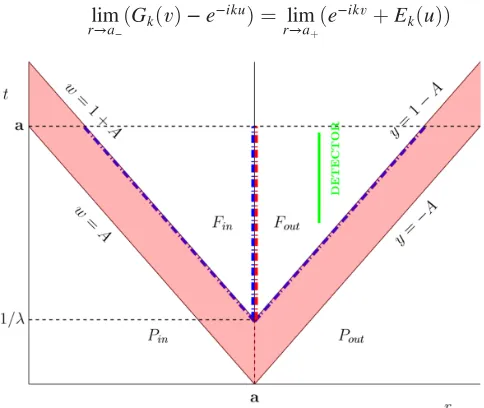
(1) The regions in Fig. 1 marked Pout and Pin
corre-spond to the early time regions, relative to the
wall creation. The top line of either (2.18) or
(2.19) gives the mode functions in these regions, which are just those of the Minkowski vac-uum:Ukðt; rÞ ¼pffiffiffiffiffiffi41πkðe−ikv−e−ikuÞ ¼−
ie−iktsinðkrÞ ffiffiffiffi
πk
p .
(2) The regions in Fig.1markedFoutandFincorrespond to the late time regions, relative to the wall creation. The mode functions in these two regions are obtained from the bottom lines of(2.18),(2.19)which give
Ukðt; rÞ ¼
−ie−ikðtþaÞsin½kðr−aÞ
ffiffiffiffiffi
πk
p ; y >1−A and r > a½regionFout;
Ukðt; rÞ ¼−ie
−ikðt−aÞsin½kðr−aÞ
ffiffiffiffiffi
πk
p ; w >1þA and r < a½regionFin:
Comparing with the above expression we see that when ka¼2nπ, which means that wall formation occurs at a node of the original mode, the mode function in the late time region is the same as the original Minkowski mode.
(3) The middle lines of (2.18) and (2.19) give, respec-tively, the expressions for the mode functions on the inward and outward light cones of the events where the boundary condition changes [atr¼aandt∈ð0;λ−1Þ]. (4) For t < a we have
lim r→a−ð
GkðvÞ−e−ikuÞ ¼ lim r→aþð
e−ikvþE kðuÞÞ
and therefore the mode functionsUkðt; rÞ are con-tinuous at the location of the shellr¼a.
(5) It is easy to see thatRKðyÞis smooth fory <1−A and in AppendixB we show that it is also smooth at y¼1−A. Similarly SKðwÞ is smooth for w≤1þA.
(6) The mode functions are normalized so that
ðϕk;ϕk0Þ ¼i
Z ∞
0 drr 2Z
S2
dΩðϕk∂tϕk0−ð∂tϕkÞϕk0Þ
¼δðk−k0Þ
for any constant time hypersurface witht <λ−1. (7) The late time region inside the shell (w >1þAand
r < awhich is denoted regionFin in Fig.1) is not
part of our calculation. One problem is that this part of the spacetime diagram would be influenced by waves reflected at the origin, so that we do not expect the ansatz(2.14)to be satisfied in this region. Physically, once the shell is fully formed, an infinite potential separates the regions inside and outside, which means there is no flow of probability be-tween them.
Useful alternate expressions for the functions RKðyÞ and SKðwÞare obtained by integrating the middle lines in(2.18) and(2.19)by parts:
RKðyÞ ¼−e−iKðyþ2AÞ−2isinðAKÞ BðyþAÞ
−2KsinðAKÞ
BðyþAÞ
Z yþA
0 e
−iKzBðzÞdz; ð2:20Þ
SKðwÞ ¼e−iKðw−2AÞ−
2isinðAKÞ Bðw−AÞ
−2KsinðAKÞ
Bðw−AÞ
Z w−A
0 e
[image:4.612.54.296.379.583.2]−iKzBðzÞdz: ð2:21Þ FIG. 1. Spacetime diagram of the evolving boundary
condi-tions. The interpolation between θ¼π=2 and θ¼0 at r¼a
occurs over0< t <λ−1, and the null cones of the events where the boundary condition changes fill the regionsð−A < y <1− A; r > aÞ and ðA < w <1þA; r < aÞ in the spacetime. The triangular regions markedPout,Pin,Foutand Finindicate what
We note that the mode functions in the future regions Fin
and Fout, from the third lines of (2.18) and (2.19), areλ
independent. As we will see in the Sec.IV, this means that the detector response in the future regions does not depend onλ, which is the parameter that controls how fast the shell evolves atr¼a.
III. TOTAL ENERGY
The expression for the energy density outside of the shell in terms of the mode functionsRKðyÞhas exactly the same form as in Ref.[10]. We summarize the calculation and give the result below. The renormalized energy density of the quantized field in the statej0iis obtained by point-splitting the field operators, taking the expectation value in j0i, subtracting the corresponding expectation value in the Minkowski vacuumj0iM, and taking the coincidence limit. This gives
hT00i ¼ h0jT00j0iren ¼ulim
1;u2→u v1;v2→v
ð∂u1∂u2þ∂v1∂v2Þ
×½h0jϕð1Þϕð2Þj0i−h0Mjϕð1Þϕð2Þj0Mi
¼ 1 4π
hð∂ufÞ2i r2 þ
hfð∂uf−∂vfÞi þc:c
2r3 þ
hf2i 2r4
:
ð3:1Þ
Using Eq.(2.11)and the first line of(2.14)we obtain in the outside region (r > a)
hT00i ¼ λ 2 16π2r2
Z ∞
0 dK
K ½jR
0
KðyÞj2−K2
− 1
32π2r2
∂ ∂r
Goutðt; rÞ
r
ð3:2Þ
where Gout is defined as
Gout¼
Z ∞
0 dK
K ½je
−iKwþR
KðyÞj2−je−iKw−e−iKyj2:
ð3:3Þ
Using the second line of(2.14)gives for the inside region (r < a)
hT00i ¼ λ 2 16π2r2
Z ∞
0 dK
K ½jS
0
KðwÞj2−K2
− 1
32π2r2
∂ ∂r
Ginðt; rÞ
r
ð3:4Þ
with the definition
Gin¼
Z ∞
0 dK
K ½jSKðwÞ−e
−iKyj2−je−iKw−e−iKyj2: ð3:5Þ
In the early time regions, which are denotedPoutandPin
in Fig.1,hT00ivanishes by construction. In the late time regions Fout and Fin, the first terms in (3.2) and (3.4)
vanish, as can be seen from(2.18), (2.19). The functions Gout andGin are easily calculated. We obtain
Gout future¼Gin future ¼ln½ðr−aÞ2−lnðr2Þ ð3:6Þ
hT00ifuture¼ 1
16π2r4ðlnjr−aj−lnðrÞÞ− 1 16π2r3
1 r−a−
1 r
:
ð3:7Þ
This result shows that the energy density goes discontinu-ously from positive infinity just inside the shell to negative infinity energy just outside the shell. However, the spatial integral of the energy density along a constant time hyper-surface which crosses r¼a produces a finite energy, if interpreted at r¼a in the principal value sense. In AppendixD we consider the intermediate outside region r > aand−A < y <1−Aand consider the continuity of the energy density asyþA→1−. We show that the energy density is finite everywhere except to the immediate past of the light cone of the point where boundary condition finishes changing, where it is positively divergent.
IV. DETECTOR RESPONSE
In this section we consider an inertial Unruh-DeWitt (UDW) detector [11,12] that is linearly coupled to the quantum field and at a fixed spatial location. Using first-order perturbation theory, the probability that the detector undergoes a transition from a state with energy 0 to a state with energy ω is proportional to the response function
[7,8,11,12]
FðωÞ ¼
Z ∞
−∞dt1
Z ∞
−∞dt2e
−iωðt1−t2Þχðt1Þχðt2ÞWðt1; t2Þ;
ð4:1Þ
where the smooth real-valued switching functionχ spec-ifies how the detector’s interaction with the field is turned on and off, and W is the pull-back of the field’s Wightman function to the detector’s worldline. We consider a detector located outside the spherical shell (r > a) and operating only in the future regiony >1−A. The response function is
ΔFðωÞ ¼
Z ∞
−∞dt1
Z ∞
−∞dt2e
−iωðt1−t2Þχðt
1Þχðt2ÞΔWðt1; t2Þ;
ð4:2Þ
ΔWðt1; t2Þ ¼ 1 4πr2
Z ∞
0 ðUkðt1−r; t1þrÞUkðt2−r; t2þrÞ
−UM
k ðt1−r; t1þrÞUMkðt2−r; t2þrÞÞdk: ð4:3Þ
The functionsUk andUk are obtained from the first line in
(2.14)withEkðuÞ ¼RKðyÞandRKðyÞgiven by the last line of(2.18);UM
k andUMk are obtained in the same way except using the first line of(2.18). Substituting these expressions and collecting terms we find
16π2r2ΔWðt 1; t2Þ ¼
Z ∞
0 dk
k ðe
ikð2r−t1þt2Þþe−ikð2rþt1−t2Þ
−eikð2a−2r−t1þt2Þ−e−ikð2a−2rþt1−t2ÞÞ:
ð4:4Þ
Doing thekintegral we get
16π2r2ΔWðt
1; t2Þ ¼ln
j4ða−rÞ2−ðt1−t2Þ2j j4r2−ðt1−t2Þ2j
þiπsgnðt1−t2Þθðr−jt1−t2j=2Þ ×θða−rþ jt1−t2j=2Þ: ð4:5Þ
The change in the Wightman function isλindependent, and therefore one does not obtain a divergent response in the limitλ→0, which would correspond to instantaneous wall creation. There is a divergence whenjt1−t2j ¼2r, but this divergence is only logarithmic.
V. CONCLUSION
We have extended previous work on firewall creation via time dependent boundary conditions by considering the smooth and sharp creation of a fixed radius shell in (3þ1 )-dimensional Minkowski space. This was implemented by introducing atr¼aa one parameter family of self-adjoint extensions of the three dimensional Laplacian operator that interpolate between the condition that the values and derivatives on the two sides of r¼a coincide for t≤0 (no wall) and the two-sided Dirichlet boundary condition fort≥1=λ(fully-developed wall). Wall creation produces null pulses of energy on either side of the shell, one ingoing and the other outgoing. As in the previous two calculations,
[9,10], the boundary condition is being changed by an external agent whose dynamics is not included in the field action. The total energy of the field hence need not be conserved on its own since the external agent may inject energy into the field. Since we are primarily interested in the detector response across the energy pulse, we have not calculated all the contributions to the field energy on hypersurfaces of constant Minkowski time, in particular the contributions from inside the shell, and therefore have
not established whether the total energy of the field can be unambiguously defined.
We found that the process of shell creation is signifi-cantly more divergent than in (1þ1)-dimensions [9], but less divergent than for point-like source creation in (3þ1 )-dimensions [10]. In the present case, the energy density hT00i diverges to positive infinity in the outgoing energy pulse, just outside the light cone of the fully-formed wall at t¼1=λ. Unlike in the 3þ1 point source creation case, there is no persistent memory cloud of energy. As in the 1þ1dimensional wall case, the response of the detector in the post-shell region is independent of the time scale1=λ and finite, casting doubt once again on the viability of wall creation as a possible mechanism for breaking entangle-ment at the event horizon of an evaporating black hole.
Finally, we note that in order to determine how well breaking correlations by changing boundary conditions models the breaking of correlations in the proposed quantum gravitational firewall scenario, one would need to address the gravitational dynamics. This remains a question for future work.
ACKNOWLEDGMENTS
This work was funded in part by the Natural Sciences and Engineering Research Council of Canada (M. E. C. and G. K.) and by the Science and Technology Facilities Council (JL, Theory Consolidated Grant No. ST/P000703/1). For hospitality, G. K. thanks the University of Nottingham, and J. L. thanks the University of Winnipeg and the Winnipeg Institute for Theoretical Physics.
APPENDIX A: SCALAR LAPLACIAN ONR3
WITH A SPHERICAL SHELL
Defining the short hand notation⨍∞0dr¼Ra−
0 þ
R∞
aþand scalingg¼f=r, we can map the 3 dimensional Laplacian and the L2 inner product on a positive half line with a spherical shell atr¼ato
∇2⇒∇2¼∂2
rþ 1 r2∇
2
S2;
ðg1; g2Þ⇒ðf1; f2Þ ¼
Z
S2 dΩ
⨍
∞0drf¯1f2: ðA1Þ
We consider only the spherically symmetric case [see Eq.(2.3)], and Hermiticity of∇2 requires
ðf1;∇2f2Þ−ð∇2f1; f2Þ
¼
⨍
∞0dr∂r½f1ð∂rf2Þ−ð∂rf1Þf2 ¼0: ðA2ÞSðt; xÞ ¼ 1
ð2iLÞðjL∂rf−ifj
2−jL∂rfþifj2Þ: ðA3Þ
Following the method in [13], we find that the boundary conditions are given by
0 B @
Lf0þ−ifþ
Lf0−þif−
Lf00−if0
1 C
A¼U
0 B @
Lf0þþifþ
Lf0−−if−
Lf00þif0
1 C
A ðA4Þ
where we have used the shorthand notation fðt;0Þ ¼f0, fðt; a−Þ ¼f− and fðt; aþÞ ¼fþ, and the choice of a unitary 3×3 matrix U specifies the boundary condition. Generally, the matrix U would be decomposed by Gell-Mann matrices. We choose an expression ofUthat ensures no flow of probability through the origin and depends on one free parameter which is a time dependent function chosen to model the formation of the wall atr¼a. We use
U¼
0 B @e−iθðtÞ
cosθðtÞ isinθðtÞ isinθðtÞ cosθðtÞ
1
1 C
A ðA5Þ
and Eq. (A4) gives the conditions
fð0Þ ¼0 ðA6Þ
f−¼fþ ðA7Þ
2
LcotθðtÞ ¼ f0þ fþ−
f0−
f− ðA8Þ
We note that the continuity of the wave function atr¼ais a result of our choice of UðθÞ, and does not have to be imposed as an extra condition.
APPENDIX B: MODE FUNCTION REGULARITY
In this Appendix we show that the mode functionRKðyÞ isC26aty¼1−A. We follow closely Appendix B of[10].
1. Smoothness of 1=BðyÞ
First we show that 1=BðyÞand all its derivatives go to zero as y→1−. We write gðyÞ≔tanðhðyÞÞ and from Eq. (2.9) we see that gðyÞ>0, and gðyÞ and all its derivatives approach 0 as y→1−.
Using (2.16)we obtain
BðyÞ ¼exp
Z y
0 dz gðzÞ
ðB1Þ
B0ðyÞ ¼BðyÞ=gðyÞ: ðB2Þ
DefiningBinðyÞ¼1=BðyÞ, we haveBin0 ðyÞ ¼−BinðyÞ=gðyÞ. For n∈N, induction gives
BðinnÞðyÞ ¼ ð−1ÞnP
nðyÞfnðyÞ; ðB3aÞ
fnðyÞ ¼ BinðyÞ
ðgðyÞÞn; ðB3bÞ
where eachPn is a polynomial ingand its derivatives and PnðyÞ→1asy→1−. We show below thatfnðyÞ→0þas y→1−, and therefore BðinnÞðyÞ→0. From(B3b) we have
lnðfnðyÞÞ ¼−
Z y
0 dz gðzÞ
1þnlnRyðgðyÞÞ
0gdzðzÞ
: ðB4Þ
Asy→1−, the first parentheses in(B4)tend to∞, while the second parentheses tend to 1 by l’Hôpital. Hence lnðfnðyÞÞ→−∞ as y→1− and therefore fnðyÞ→0þ asy→1−.
2. Differentiability of RKðyÞ
We make the definitions
JKðyÞ ¼
Z y
0 BðzÞe
−iKzdz ðB5Þ
FKðyÞ ¼JKðyÞ=BðyÞ ðB6Þ
HKðyÞ ¼JKðyÞ=ðgðyÞBðyÞÞ; ðB7Þ
and rewrite the mode function(2.20)as
RKðyÞ ¼−e−iKð2AþyÞ−2isinðAKÞ
B −2KsinðAKÞFKðyþAÞ: ðB8Þ
We will show thatRKðyÞisC26atyþA→1− by showing thatFKðyÞisC26 asy→1−. We outline the steps below. (1) Calculate derivativesFðKnÞðyÞ using(B2)to remove factors ofB0ðyÞ, so that the result does not contain derivatives ofBðyÞ.
(2) Define denðyÞ ¼ BðyÞðgðyÞÞn and numðyÞ ¼
FðnÞ
K ðyÞdenðyÞ. In order to use l’Hôpital n times, calculate numðnÞðyÞand denðnÞðyÞ, again using(B2) after taking each derivative.
(3) Define numðnÞðyÞ ¼ numðnÞðyÞ=BðyÞ and
denðnÞðyÞ ¼denðnÞðyÞ=BðyÞand replace all remain-ing factors ofJKðyÞbyFKðyÞBðyÞ. The limit of the nth derivative ofFðyÞasy→1− now has the form
lim y→1−F
ðnÞðyÞl’⟶Hopitalˆ lim y→1−
numðnÞðyÞ
denðnÞðyÞ : ðB9Þ
numðnÞðyÞ ¼PðyÞ; denðnÞðyÞ ¼1þQðyÞ
where PðyÞ and QðyÞ are polynomials of gðyÞ and its derivatives,FðyÞ, and factorse−iKy, and each term contains at least one power ofFðyÞorgðjÞðyÞj∈ð0; nÞ. This means that bothPðyÞandQðyÞgo to 0 asy→1−. We therefore have from(B9)thatFðyÞisC26aty¼1. We stopped the calculation atn¼26because of limitations of computing time and memory. If the proof extends ton∈N, we would have thatRKðyÞis smooth at y¼1.
APPENDIX C: LEMMA AND CONDITIONS ON g
Lemma C.1.
(i) For a complex-valued function fðy; zÞ that is bounded fory∈½0;1 andz∈½0;1þA, we have
lim yþA→1−
1 BðyþAÞ
Z yþA
0 BðzÞfðy; zÞdz¼0: ðC1Þ
(ii) If in addition∂yfðy; zÞis bounded fory∈½0;1and z∈½0;1þA, we have
lim yþA→1−∂y
1 BðyþAÞ
Z yþA
0 BðzÞfðy; zÞdz
¼0:
ðC2Þ
Proof.
(i) By boundedness of f, there is a positive constant Csuch thatjfðy; zÞj≤C. For0< yþA <1, using the triangle inequality and the positivity of B, we have
Bðy1þAÞZ yþA
0 BðzÞfðy; zÞdz
≤ C
BðyþAÞ
Z yþA
0 BðzÞdz: ðC3Þ
When yþA→1, the rightmost expression in(C3)
goes to zero, using l’Hôpital and(B2).
(ii) For0< yþA <1, we expand out the derivative in
(C2)using(B2)and make some cancellation. After repeatedly applying l’Hôpital as yþA→1 and using lemma(C1), the proof is done. ▪ Conditions C.2. We introduce the technical assumption that g000ðyÞ<0for0<y<1. It follows thatg00ðyÞ>0and g0ðyÞ<0for0< y <1. For0< z≤yþA <1, this implies
g0ðzÞ≤gðyþAÞ−gðzÞ yþA−z ≤g
0ðyþAÞ; ðC4Þ
g00ðyþAÞ≤g
0ðyþAÞ−g0ðzÞ
yþA−z ≤g
00ðzÞ; ðC5Þ
where the quotients are understood at z¼yþA in the limiting sense.(C4)can be verified by writing the numerator as the integral ofg0 and using the monotonicity ofg0, and
(C5)can be verified similarly be writing the numerator as the integral ofg00. We will derive three consequences which are used in Secs.D 2andD 3.
(i) First consequence: limyþA→1−g 0ðyþAÞ
gðyþAÞ ¼−∞. For0< yþA <1, using the monotonicity ofg0, we have
gðyþAÞ ¼−
Z 1
yþA
g0ðzÞdz≤ −g0ðyþAÞ
×
Z 1
yþA
dz¼−ð1−y−AÞg0ðyþAÞ:
ðC6Þ
Hence g0ðyþAÞ=gðyþAÞ≤ −1=ð1−y−AÞ, which implies limyþA→1−gg0ððyyþþAAÞÞ¼−∞.
(ii) Second consequence:limyþA→1−CðyÞ ¼0 For 0< yþA <1, we define
CðyÞ ¼ 1 BðyþAÞ
Z yþA
0 dzcosðyþA−zÞB
0ðzÞ
×gðyþAÞ−gðzÞ
yþA−z ; ðC7Þ
C−ðyÞ ¼ 1 BðyþAÞ
Z κ
0 dz
gðyþAÞB0ðzÞ yþA−z −
BðzÞ yþA−z
;
ðC8Þ
CþðyÞ ¼Bðy1þAÞ
Z yþA
κ dzB
0ðzÞgðyþAÞ−gðzÞ
yþA−z ; ðC9Þ
˜
C−ðyÞ ¼− 1 BðyþAÞ
Z κ
0 dz BðzÞ
yþA−z; ðC10Þ
˜
CþðyÞ ¼Bðy1þAÞ
Z yþA
κ dzB
0ðzÞg0ðzÞ; ðC11Þ
where 0<cosðyþA−zÞ≤1, B0ðzÞ>0 and g0ðzÞ<0 for 0< z < yþA, and we have intro-duced a constant κ with 0<κ< yþA <1. We haveC˜−ðyÞ<C−ðyÞandC˜þðyÞ≤CþðyÞusing(C4). Therefore
˜
CþðyÞ þC˜−ðyÞ<CþðyÞ þC−ðyÞ<CðyÞ<0 ðC12Þ
As yþA→1−, both integral C˜−ðyÞ and integral
˜
CþðyÞ tend to 0. From (C12) it then follows
(iii) Third consequence: limyþA→1−DðyÞ ¼0 We define
DðyÞ ¼1 B
Z
yþA
κ dzB
0ðzÞcosðαÞ
α
×
gðAþyÞ−gðzÞ
α −g0ðAþyÞ
; ðC13Þ
D2ðyÞ ¼B1
Z yþA
κ dzB
0ðzÞ1
α
×
gðAþyÞ−gðzÞ
α −g0ðAþyÞ
; ðC14Þ
D3ðyÞ ¼ 1 B
Z
yþA
κ dzB
0ðzÞ1
αðg0ðzÞ−g0ðAþyÞÞ; ðC15Þ
D4ðyÞ ¼−1 B
Z
yþA
κ dzB
0ðzÞg00ðzÞ; ðC16Þ
where α≔yþA−z, 0<cosðyþA−zÞ≤1 and B0ðzÞ>0for 0< z < yþA. Using Eqs. (C4)and
(D.2), there is
D4ðyÞ≤D3ðyÞ≤D2ðyÞ<DðyÞ<0: ðC17Þ
Further use of l’Hôpital on D4ðyÞ we find limyþA→1−D4ðyÞ¼0, which means limyþA→1−DðyÞ¼0.
APPENDIX D: BEHAVIOR OF hT00iOUTSIDE
THE SHELL IN THE INTERMEDIATE REGION
In this section we study the behavior of the energy density outside the shell (r > a) in the intermediate region (−A≤y≤1−A), which is given in Eq. (3.2) with the function Gout defined in (3.3), and RKðyÞ given in the middle line of (2.18). We rewrite these expressions as
hT00i ¼ λ 2
16π2r2½FðyÞ þF˜ðyÞ ðD1Þ
FðyÞ ¼
Z ∞
0 dK
K ½jR
0
KðyÞj2−K2 ðD2Þ
˜
FðyÞ ¼− 1 w−y
∂w−∂y− 2
w−y
Gout; ðD3Þ
where the notation suppresses the dependence ofFðyÞand
˜
FðyÞonw. We comment that the denominators in(D3)are produced by the factor1=rin Eq.(3.2), and the action of the derivative ∂r on this factor.
1. Preliminaries
From(2.20)we have for fixedy∈ð−A;1−AÞthe small K estimates
RKðyÞ ¼−1þOðKÞ; ðD4Þ
jR0KðyÞj2¼OðK2Þ; ðD5Þ
and the largeK estimates
jRKðyÞj2¼1þ2B
0
B
sinð2AKÞ K þOðK
−2Þ; ðD6Þ
jR0
KðyÞj2¼K2þ 2B0
B Ksinð2AKÞ þOðK
−1Þ: ðD7Þ
Using these results it is straightforward to show that the integrals in Eqs. (D2) and (D3) are well defined fory∈ð−A;1−AÞ.
At y¼−A both integrands vanish. At y¼1−A the integrand in (D2) vanishes, and a straightforward calcu-lation gives Goutjy¼1−A¼2½lnðr−aÞ−lnr in agreement with(3.6). In the remainder of this Appendix we study the continuity of FðyÞ and F˜ðyÞ in Eqs. (D2) and (D3)
asyþA→1−.
2. Term FðyÞ
We divide the integral in(D2)into two pieces defined as
F−ðyÞ ¼
Z 1
0 dK
K ½jR
0
Kj2−K2; ðD8Þ
FþðyÞ ¼
Z ∞
1 dK
K ½jR
0
Kj2−K2: ðD9Þ
To show thatF−ðyÞis finite, we use the form ofRKðyÞin Eq. (2.20). Differentiating and substituting into (D8), we get an expression withHKas defined in Eq.(B7)andfi≔ fiðyþAÞas defined in Eq.(B3b). It is then straightforward to show with l’Hôpital that limyþA→1−F−ðyÞ exists and is finite.
Now we study the second termFþðyÞ. Our strategy is as follows:
(1) Integrate by parts inz, taking the antiderivative of the factor eiKz, until we have enough powers of 1=K so that theK-integral is convergent.
(2) Switch the order of thezandKintegrals and do the K integral.
(3) Integrate by parts again so that derivatives are removed from factorsBðzÞ.
(4) Analyse the behavior of the remaining integrals. Defining
VK¼ 1 B
Z yþA
0 dzB
the result of step (1) is
FþðyÞ ¼
Z ∞
1 dK
4VKVKsin2ðAKÞ K3g2 −
4sin2ðAKÞðVKeiKðAþyÞþVKe−iKðAþyÞÞ K3g3 þ
4isin2ðAKÞðVKeiKðAþyÞ−VKe−iKðAþyÞÞ K2g2
þ2isinðAKÞðVKeiKy−VKe−iKyÞ
Kg þ
4sin2ðAKÞ K3g4 þ
2sinð2AKÞ g
: ðD11Þ
The integral over large K has terms of the form
R∞
1 dKsinð2AKÞ which is regularized with a factor e−δK to obtain a finite result in the limit δ→0. The other K integrals can be done using
Z ∞
1 dK
K ðe
iKαþe−iKαÞ ¼−2CiðαÞ ðD12Þ
Z ∞
1 dK K2ðe
iKαþe−iKαÞ ¼2cosðαÞþ2αSiðαÞ−πα ðD13Þ
Z ∞
1 dK K3ðe
iKαþe−iKαÞ ¼cosðαÞ−αsinðαÞ þα2CiðαÞ
ðD14Þ
whereα>0and Ci and Si are the cosine and sine integrals in the notation of[14].
First, for terms that includeVK as defined in(D10), we interchange the integration by the absolute convergence of multiple integral, and we evaluate the integration overKto reach an expression containing elementary functions and expressions like (D12). Many terms would contain factor B0orB00, but we simply integrate by part to reduce them to combinations involving(C1)and(C2).
Next we introduce the parameters α≔Aþy−z, β≔A−yþz, γ≔3Aþy−z, which will be used in 2nd, 3rd and 4th terms of (D11) for which we have z∈ð0; yþAÞ; and ρ≔2A−xþz, σ≔2Aþx−z and τ≔x−zfor the 1st term of (D11)where x∈ð0; yþAÞ andz∈ð0; xÞ. Using our original assumptionA >1these parameters are all positive over the full range of the corresponding integrals. We therefore find out that single integrals not having factors CiðαÞand double integrals not having CiðτÞ can be easily proven to be bounded whenyþA→1−.
Third, we consider the remaining contributions to(D9)
which contain factors CiðαÞ and CiðτÞ. These are the difficult terms and we label themIhard. The terms contain-ing CiðτÞare double integrals of variablexandz, we handle them by first integrating by part in z then x and then integrating by part inx thenz. This two different ways of integration by parts generate two equivalent expressions of the double integral. A lot of terms cancel out when we represent the double integral using its two equivalent expres-sions, further use of Lemma C.1, limyþA→1−CþðyÞ ¼0and limyþA→1−DþðyÞ ¼0in Appendix C.2 eventually reduce the result to
lim yþA→1−
Ihard¼− lim
yþA→1− g0
g2: ðD15Þ
ThereforeFðyÞis divergent asyþA→1−.
3. The termF˜ðyÞ
The integral in(D3) can be divided into two pieces
G−
out¼
Z 1
0 dK
K ½je
−iKwþR
KðyÞj2−je−iKw−e−iKyj2; ðD16Þ
Gþ
out¼
Z ∞
1 dK
K ½je
−iKwþR
KðyÞj2−je−iKw−e−iKyj2:
ðD17Þ
We use two different forms for RKðyÞ: in G−out we use
Eq.(2.20), and inGþout we use Eq. (2.18).
First we look at the easy piece (D16). We define the factors
l1ðzÞ ¼cosðzÞ−1
z ; l2ðzÞ ¼
cosðzÞ−1 z2 þ
sinðzÞ
z ; ðD18Þ
and in addition to the definitions α;β;γ;ρ;σ;τ, we use μ≔2A−z,ν≔2Aþz,ξ≔Aþw−zandχ≔w−z−A. It is straightforward to show that the parameters μ, ν, ξ, andχ are all non-negative for A >1, z∈ð0; yþAÞ and y∈ð−A;1−AÞ. We also note thatl1ðzÞandl2ðzÞand their derivatives are bounded on z∈ð0; yþAÞ. Using this notation the result after doing theKintegral can be expressed in compact form, where the integrands can be expressed using factorsl1ðzÞ; l1ðαÞ; l2ðρÞ etc. Further use of results from AppendixB 1, l’Hôpital’s rule and Lemma C.1 renders
lim yþA→1−G
−
out¼ lim
yþA→1−
2ln
w−y−2A w−y
−2Ciðw−y−2AÞ þ2Ciðw−yÞ
: ðD19Þ
Gþ
out¼
2 B
Z yþA
0 dzB
0ðzÞCiðαÞ
þ2 B
Z yþA
0 dzB
0ðzÞðCiðχÞ−CiðβÞ−CiðξÞÞ
− 4
B2
Z yþA
0 dxB
0ðxÞZ x
0 dzB
0ðzÞCiðτÞ
þ 2 B2
Z yþA
0 dxB
0ðxÞZ x
0 dzB
0ðzÞðCiðρÞ þCiðσÞÞ:
ðD20Þ
We pass the lengthy procedures of carefully manipulating the double integrals using Lemma C.1 and l’Hôpital and point out that the nonvanishing terms inGþoutcancel out the
cosine integrals in(D19). Final result is
lim
yþA→1−Gout¼yþlimA→1−
2ln
w−y−2A w−y
ðD21Þ
which is in agreement with(3.6).
APPENDIX E: INSIDE REGION
In this section we look at the energy density in the region r < a. The idea is to see if there is a symmetry between the inside and outside regions that would allow us to extract the final result for the inside region from the results we have already calculated which are valid outside the shell. We consider each of the four pieces:F−,Fþ, G−, and Gþ.
We have already outlined how to calculate Fout
− in the outside region, doing the same calculation in the inside region we find out
Fin
−ðy; wÞjA→−A−Fout− ðy; wÞ ¼0: ðE1Þ Here,Fin
−ðy; wÞjA→−A is the inside expression transformed by making sign change onA→−Aand switchesðy; wÞ→ ðw; yÞ. A similar expression holds for G−inðw; yÞ through transformationðy; w; AÞ→ðw; y;−AÞ
G−
inðw; yÞjA→−A−G−outðy; wÞ ¼0: ðE2Þ
Defining positive definite variables throughout the inside region
ˆ
α¼−Aþw−z; ˆγ¼Aþw−z; βˆ¼3A−wþz;
ˆ
σ¼2Aþx−z; ρˆ¼2A−xþz;
we transform the inside result again and find
Finþðw; yÞjA→−A−Foutþ ðy; wÞ ¼imaginary: ðE3Þ
With additional definitionsχˆ ¼Aþy−z, ηˆ¼A−yþz, we obtain
Gþ
inðw; yÞjA→−A−Gþoutðy; wÞ ¼imaginary: ðE4Þ
From Eqs.(E1)–(E4)we see that the energy density inside the shell can be obtained from the outside results by performing the transformationðy; w; AÞ→ðw; y;−AÞand dropping any imaginary parts that are produced.
[1] S. W. Hawking, Breakdown of predictability in gravitational collapse,Phys. Rev. D14, 2460 (1976).
[2] For recent reviews see: D. Marolf, The black hole informa-tion problem: Past, present, and future,Rep. Prog. Phys.80, 092001 (2017); W. G. Unruh and R. M. Wald, Information loss,Rep. Prog. Phys.80, 092002 (2017).
[3] S. D. Mathur, The information paradox: A pedagogical introduction, Classical Quantum Gravity 26, 224001 (2009).
[4] S. D. Mathur, The information paradox and the infall problem,Classical Quantum Gravity28, 125010 (2011). [5] S. L. Braunstein, Black hole entropy as entropy of
entan-glement, or it’s curtains for the equivalence principle, arXiv:0907.1190v1; S. L. Braunstein, S. Pirandola, and K. Źyczkowski, Better Late than Never: Information Retrieval from Black Holes, Phys. Rev. Lett. 110, 101301 (2013).
[6] A. Almheiri, D. Marolf, J. Polchinski, and J. Sully, Black holes: Complementarity or firewalls?,J. High Energy Phys. 02 (2013) 062; A. Almheiri, D. Marolf, J. Polchinski,
D. Stanford, and J. Sully, An apologia for firewalls,J. High Energy Phys. 09 (2013) 018.
[7] N. D. Birrell and P. C. W. Davies, Quantum Fields in Curved Space (Cambridge University Press, Cambridge, England, 1982).
[8] R. M. Wald,Quantum Field Theory in Curved Spacetime and Black Hole Thermodynamics (University of Chicago Press, Chicago, 1994).
[9] E. G. Brown and J. Louko, Smooth and sharp creation of a Dirichlet wall in1þ1quantum field theory: How singular is the sharp creation limit?,J. High Energy Phys. 08 (2015) 061.
[10] L. J. Zhou, M. E. Carrington, G. Kunstatter, and J. Louko, Smooth and sharp creation of a pointlike source for a (3þ1)-dimensional quantum field, Phys. Rev. D 95, 085007 (2017).
[11] W. G. Unruh, Notes on black hole evaporation,Phys. Rev. D
14, 870 (1976).
by S. W. Hawking and W. Israel (Cambridge University Press, Cambridge, England, 1979).
[13] G. Bonneau, J. Faraut, and G. Valent, Self-adjoint exten-sions of operators and the teaching of quantum mechanics, Am. J. Phys.69, 322 (2001).