INDIRA CHATTERJI† AND GRAHAM NIBLO
Abstract. We explain how to adapt a construction due to M. Sageev in order to construct a proper action of a group on a CAT(0) cube complex starting from a proper action of the group on a wall space.
Introduction
A group is said to be a-T-menable if it admits a proper isometric action on a Hilbert space. The existence of such an action yields in-formation about the unitary representation theory of the group, and in particular the Baum-Connes conjecture is known to hold for a-T-menable groups, see [6].
In [8] the second author, together with Martin Roller, described a method to construct isometric actions on Hilbert space by adapting a technique of Sageev [10]. The construction can be interpreted as giving a recipe for embedding a CAT(0) cube complex in the unit cube in a Hilbert space so that the group of cellular isometries of the cube complex acts by affine isometries on the Hilbert space. A similar construction can be used to derive affine actions on Hilbert space from actions on so-called spaces with walls (see [5], [4] or [8]). In [3] the notion of a space with walls is generalized to that of a measured wall space. The relationship between spaces with walls and measured wall spaces is roughly analogous to the relationship between a classical tree and an R-tree, and in [3], Cherix, Martin and Valette showed that a finitely generated group admits a proper action on a measured wall space if and only if it is a-T-menable. It is natural to ask whether or not groups which act properly on measured wall spaces must also admit proper actions on spaces with walls. The motivation of this note is to highlight a partial answer to the following question:
“Are there discrete a-T-menable groups which cannot act properly on a discrete wall space?”
We will show that a group acts (properly) isometrically on a space with walls if and only it acts (properly) isometrically on a CAT(0)
Date: February 18, 2009.
† Partially supported by the Swiss National Funds.
cube complex of dimension k, where k is the cardinality of a maximal family of pairwise crossing walls. The first author with Kim Ruane in [2] prove that a group acting properly and with uniformly bounded point stabilisers on a CAT(0) cube complex of finite dimension cannot contain amenable subgroups of super-polynomial growth, so we obtain the following.
Theorem 1. Let G be a group containing an amenable subgroup H of super-polynomial growth. If G acts properly on a space with walls and with uniformly bounded point stabilisers then there are arbitrarily large families of walls in the space which pairwise cross.
cross. The example has been pointed out by S. Mozes, and consists of
P GL2(Fp[t, t−1
]), which acts properly on a product of two trees. We would like to mention that an attractive alternative of the cubu-lation procedure has been simultaneously and independently described by Bogdan Nica in [9].
1. Basic definitions
In this section we shall recall some basic definitions and notations concerning wall spaces and CAT(0) cube complexes. Aspace with walls
(or wall space) is a set Y with a non-empty collection of non-empty subsets H ⊂ P(Y) called half-spaces, closed under the involution
∗:H → H
h 7→ hc =Y \h
For any p, q ∈ Y, there exists only finitely many half-spaces h ∈ H such thatp∈hand q∈hc (such a half-spaceh is then said toseparate
p fromq).
The walls are the pairs h={h, hc}, so that the set of walls is W = H/∗. We say that two walls h and k cross if all four intersections
h∩k, h∩kc, hc ∩k and hc∩kc
are nonempty. We define the intersection number of W by
h
-h
k
-k
r p
Let G be a group acting on the spaceY, we say thatG acts on the space with walls if the action is such that
g(h)∈ H for all h∈ H and g ∈G.
The space with walls Y inherits a pseudo-metric by
d(p, q) = ♯{h={h, hc} ∈W|h separates p from q}.
to infinity, then d(gn(p), p) tends to infinity in R+ for any p ∈ Y). If
G acts on the space with walls Y, then Galso acts on the set of walls
W.
Let us now briefly recall that acube complex Xis a metric polyhedral complex in which each cell is isomorphic to the Euclidean cube [0,1]n and the gluing maps are isometries. A cube complex is called CAT(0) if the metric induced by the Euclidean metric on the cubes turns it into a CAT(0) metric space. We shall denote by Xi the i-skeleton of
X, and say that X is finite dimensional if there is n < ∞ such that
Xm is empty for any m > n. In the sequel we shall use an equivalent characterization of CAT(0) cube complexes, given by the following.
Theorem 2 (Gromov, see Thm 5.4 page 206, [1]). Let X be a cubical complex. Then X is CAT(0) if and only if
(ii) X is simply connected.
Recall that aflag complex is a simplicial complex in which each sub-graph isometric to the 1-skeleton of a k-dimensional simplex actually is the 1-skeleton of a k-dimensional simplex.
2. Sageev’s construction
In his thesis Sageev showed how to construct a CAT(0) cube complex starting with a finitely generated groupGand a so-called codimension-one subgroup. Here we will adapt Sageev’s construction to the more general situation of a group acting on a space with walls. More precisely we explain the proof of the following.
cube complex X on which Gacts properly. Moreover, in the case where
I(W) is finite, then dim(X) = I(W).
In the first part of this section we will explain how to build a cube complex associated to a given wall space. Next we will show that the complex thus obtained is CAT(0) and demonstrate that a proper action of a group on the wall space induces a proper action of the same group on this complex.
The vertices X0
of the cube complex are given by a subset of the sections for the natural map
π:H → H/∗=W h 7→ {h, hc}.
or half-space. The sections we require all satisfy the following compat-ibility condition:
σ(h)6⊆σ(k)c for any h, k ∈W.
In other words, if two walls w1 and w2 are disjoint, then the corre-sponding half-spaces σ(wi) are not disjoint. Notice that the condition says nothing for walls which cross, but for disjoint walls the following picture never occurs:
h
σ(h)
k
Those sections satisfying this condition will be called admissible and our vertex set is the set of all admissible sections. We connect two vertices with an edge if and only if, regarded as functions, their values differ on a single wall, so that now we have a graph. Each edge is labeled by the wall on which the associated sections differ. This graph is, in general, not connected, and we now explain which connected component to consider.
Choose a pointp∈Y and define a section σp for π as follows:
σp(h) is the element of the set {h, hc} containing p.
This is clearly a vertex ofX, that we will refer to asspecial vertex. We denote by Γp the component of the graph containing σp.
Lemma 2.1. For any p, q ∈ Y, then Γp = Γq i.e., the vertices σp, σq
Proof. First note that the sectionsσpandσqagree on all but the finitely many walls separating p and q. Let {h1, h1}c , . . . ,{hn, hcn} denote the set of walls on which they differ, and labeled so that for each i, p ∈
hi, q ∈ hci. The half-spaces hi form a finite partially ordered set (by inclusion) and so among them we can find a minimal element, which, by relabeling if necessary, we may assume to be h1. Now consider the section σ which is obtained from the admissible section σp by setting
σ({h, hc}) = σ
p({h, hc}) if h 6= h1 and σ({h1, h−1c}) = hc1, so that
σ agrees with σp in every coordinate but one, where it agrees with σq instead. We claim that σ is an admissible section. If this were not the case then σ{h, hc}=h, σ{k, kc}=k for some walls{h, hc},{k, kc} with h ⊆ kc. Since σ agrees with the admissable section σ
Case 1, {h1, hc1}= {h, hc}. We have h1 = σp{h1, hc1} 6= σ{h1, hc1}=
hc
1 =h and k =σp{k, k
c}= σ{k, kc}. Hence hc 1 ⊆k
c ork ⊆h
1 which does not contain q. The half-space h1 was assumed to be minimal among those containing p but not q and so k cannot contain p either. It implies that kc =σp{k, kc}=σ{k, kc}=k which is a contradiction.
Case 2,{h1, hc1}={k, kc}. Here we haveh1 =σp{h1, hc1} 6=σ{h1, hc1}=
hc
1 = k and h = σ{h, hc}= σp{h, hc}. Hence h ⊆ kc = h1 which does not contain q. The half-space h1 was assumed to be minimal among those containing p but not q and so h cannot contain p either. This implies that hc =σp{h, hc}=σ{h, hc} =h which is a contradiction.
Hence σ is admissible and since it differs from σp in a single coordi-nate it represents a vertex adjacent toσp. It also differs fromσq in only
n−1 coordinates (the walls {h2, h2}c , . . . ,{hn, hcn}). By induction on
Remark 2.2. Corresponding to any special vertex σp in Γp there is a nonempty subset xσ of Y, which is the intersection of {σp(h)|h∈W}. The set xσ consists of all the points in Y which are not separated from p by any walls. It is reduced to a single point exactly when the wall space Y is such that any two distinct points are separated by at least one wall. At that stage, if we say that two points in Y are wall-equivalent when there are no wall separating them, we can identify the set of special vertices in X with the set of wall-equivalence classes in
such that σ(h) = h and σ(k) = k, where h = {h, hc} and k ={k, kc} are the walls associated to the half-spacesh andk respectively. In this case we will say that σ lies in h∩k.
We will now show how to attach cubes to the graph X1
= Γp to construct a cubical complex. We first start with an easy fact.
Lemma 2.3. Any closed loop has even edge length. Proof. As noted above passing along an edge in X1
corresponds to changing the value of a section on a single wall. As we proceed along a closed loop the value on each wall must be changed an even number of times to get back to the original sectionσ, so we must pass along an
even number of edges.
walls h1, . . . , hk labeling the edges pairwise cross. For each i let τi de-note the vertex adjacent toσ along the edgeei. We have the following.
Lemma 2.4. Anyk-corner σis contained in a unique subcomplexC ⊆
X1
isomorphic to the 1-skeleton of a k-cube.
Proof. We can represent ak-dimensional cube Ck as follows:
Ck ={v :{h
1, . . . , hk} →[0,1]},
so to prove the lemma it is enough to simplicially embed the 1-skeleton of Ck in X1
, with one corner of Ck mapped to σ. To do this, we first map the vertex (0, . . . ,0) to σ, and the vertices vi(hj) =δij toτi for all
vertex v ∈Ck, we first extend v toW as follows: ˆ
v :W → [0,1]
h 7→
v(hi) if h=hi for somei
0 otherwise
and use this extension to define a map from the vertices v of the cube
Ck to the set of sections W → H as follows:
τv(h) =
σ(h) if ˆv(h) = 0
σ(h)c if ˆv(h) = 1.
We need to prove that all the sections constructed in this way are admissible. Denote by |v| the number of non-zero coefficients of v. If |v|= 1, thenτv is adjacent toσ via one of the edgesei by construction, hence it is one of the τi, which is admissible by construction. Let us assume by induction that τv is admissible for any |v| ≤ n and some
We know by the induction hypothesis that the section
τ(h) =
σ(h) if vˆ(h) = 0
σ(h)c if h =h
j, j = 1, . . . , n
σ(h)c if h=h n+1
is admissible, so it remains to check that the section
τv(h) =
τ(h) if h6=hn+1
σ(h)c if h6=h n+1
is admissible, i.e. that τ(hn+1)c is never contained in τ(h)c for hn+1 6=
h, but this is clear since if h = hs for s = 1, . . . , k and s 6= n + 1 then hs crosses hn+1, and if h 6= hs for all s = 1, . . . , k, since the section obtained fromσby v(hj) = δn+1j is admissible, thenσ(hn+1) =
exactly if their defining maps differ on a single hi, which means that the sections obtained differ on exactly a single wall, hence are adjacent in X1
. Notice that the embedding is completely determined by the corner itself, so that each corner defines a unique cube.
We can now define a cube complex by gluing a k-dimensional cube to each k-corner. The existence of a k-dimensional cube implies the existence of a k-corner and hence I(W) is the dimension of the cube complex when I(W) is finite.
It remains to show that the cube complex is CAT(0). To do so we will use Gromov’s theorem (Theorem 2 of this note) in the spirit of the Cartan-Hadamard theorem, that a geodesic cell complex is CAT(0) if and only if it is locally CAT(0) and simply connected.
Proof. That the link is simplicial is straightforward: A k-simplex in the link corresponds to a (k + 1)-corner, and the intersection of two corners is again a corner (of smaller dimension). That the link of a vertex is a flag complex is also more or less by construction, as the vertices of the 1-skeleton of a (k−1)-dimensional simplex in the link of a vertex σ are labeled by hyperplanes h1, . . . , hk pairwise sharing a square, i.e. pairwise crossing. This means that σ is a k-corner, on which by construction has been glued a k-cube, and a k-cube gives a (k −1)-dimensional simplex in the link, from which we deduce that the 1-skeleton of a (k−1)-dimensional simplex actually belongs to a
(k−1)-dimensional simplex.
Lemma 2.6. The cube complex X is simply connected.
Proof. Choose a vertex σ0 in X and let γ be a loop in X based at
σ0. Homotopeγ into the 1-skeleton X1
homotoped to a point. Without loss of generality we can assume thatℓ
does not backtrack. Let σdenote any vertex on ℓwhich maximizes the distance fromσ0, in the combinatorial distance d1 on the 1-skeleton of
X. This is the cardinality of a shortest edge path between two points, which amounts to the cardinality of the set of walls on which the two sections differ, and which we will denote by n.
Denote bya and b the two adjacent vertices to σ in the loop ℓ. Due to Lemma 2.3, combined with the assumption that σ is furthermost from σ0, we know that d1(σ0, a) = d1(σ0, b) = n−1. Denote by ha (resp. hb) the wall on which the section defining σ differs from the one defining a (resp. b). Since ℓ does not backtrack we know that the vertices a and b are distinct so that the walls ha, hb are distinct and carry distinct labels. We claim that σ with the two edges to a
hc
a∩hcb are all non-empty. Without loss of generality we can assume that σ lies in ha∩hb (i.e. that σ(ha) =ha and σ(hb) =hb, see end of Remark 2.2), and by assumptiona(ha) =hc
a andb(hb) =hcb. But since
bonly differs fromσon the wallhb andaonly differs fromσ onha, and since ha 6= hb, b agrees with σ on the wall ha, and hence b(ha) = ha and similarly a(hb) = hb. Henceb lies in ha∩hcb and a lies inhca∩hb so that they are both non-empty. It remains to show thathc
a∩hcb is non-empty, which we do by showing that σ0 lies in it. Suppose this were not the case. Then either σ0(ha) =ha orσ(hb) =hb and by relabeling if necessary we may assume that σ0(ha) = ha. It follows that the wall
ha does not separate σ and σ0, so the set of walls on which σ0 and σ differ does not include ha. But the sections σ and a agree on all the walls on which σ0 and σ disagree, and also on the wallha itself, hence
We have shown that there is a 2-corner at σ so that the following section is admissible:
τ(h) =
σ(h) if h6=ha, hb
σ(h)c if h=h a
σ(h)c if h=h b
Furthermore d1(σ0, τ) = n−2 (because σ0 and τ coincide on exactly
n−2 walls). We homotop ℓ to a closed loopℓ′ which coincides with ℓ
everywhere except in a neighborhood of σ where we replace the edges fromb to σ and fromσ toa by the edges fromb to τ and fromτ toa. The homotopy is supported on the unique square defined by these four vertices. Repeating this procedure to all furthermost vertices toσ0 we obtain a loop homotopic toℓand lying in a ball of strictly smaller radius in the (integer valued) d1 metric around σ0. Iterating the procedure
If a group Gacts on the wall space Y, then it induces an action on the set of walls W, and we define an action on the vertices X0
of the cube complex as follows:
g(σ)(h) =g σ(g−1 (h))
.
This action is obviously simplicial, because ifσ and τ share a common edge, it means that there is a unique wallk on which they differ, so for any g ∈G and any wall h such thatg−1
(h)6=k, then
g(σ)(h) =g σ(g−1 (h))
=g τ(g−1 (h))
=g(τ)(h),
whereas for g−1
(h) =k, then
g(σ)(h) = g σ(g−1 (h))
=g σ(k)
6=g τ(k)
=g τ(g−1 (h))
=g τ(h)
.
wall structure corresponds to the combinatorial distance given by the 1-skeleton of X (see Remark 2.2). Notice that we didn’t say anything about cocompactness, and indeed we shall see in the next section (Ex-ample 2) that sometimes a cocompact action on a wall space yields a non-cocompact action on the corresponding cube complex.
3. Examples
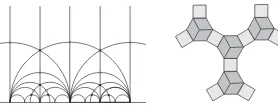
in the tessellation (i.e. intersections of two single walls). Part of the cube complex is also illustrated in Figure 1 and it may be viewed as a thickening of the Bass-Serre tree associated to the classical splitting of PGL2(Z) as an amalgamated free product:
P GL2(Z) =D2 ∗
Z2
D3.
The dihedral groupsD2andD3 in the splitting are the two finite special subgroups hs1, s3i and hs1, s2i respectively, in the standard Coxeter presentation
P GL2(Z) =hs1, s2, s3 |s 2 1 =s
2 2 =s
2
3 = (s1s3) 2
= (s1s2) 3
= 1i.
Example 2. Consider the Euclidean Coxeter group
G=ha, b, c|a2 =b2
=c2
= (ab)3
= (bc)3
Figure 1. The Coxeter complex for the group PGL2(Z) embedded in the hyperbolic plane, and the corresponding CAT(0) cube complex.
This group acts co-compactly on the Euclidean planeE2
as a reflection group, and the G-equivariant tiling by equilateral triangles defines a a discrete and G-equivariant family of geodesic lines which form the wallsW. Let us explain how the wall space structure gives, under the construction described in Section 2, a cubing which is isomorphic to that ofR3
the family of walls parallel to Ox, Oy and Oz respectively and choose
ω a point at infinity which is not an end of Ox, Oy or Oz. A vertex σ of the cube complex is an admissible section, so it uniquely determines (due to compatibility conditions) a pair of consecutive parallel walls in each of the families X, Y and Z. For each of those 3 pairs of walls, choose the one which is nearest to ω. The number of walls of X, Y and Z respectively which are in-between those 3 walls andOx,Oy and
Oz (with a positive sign if the wall is in-between Ox, Oy or Oz and ω and a negative sign otherwise) gives an isometric isomorphism of the vertices of our cubing with Z3
, which is the 0-skeleton of the standard cubing of R3
.
The action of the group is affine, and preserves the plane perpen-dicular to the vector (1,1,1) on which it acts co-compactly, however it cannot act co-compactly on R3
As pointed out by Valette, this group has Serre’s property (FA), i.e., any action on a tree has a global fixed point. This follows from the observation that the group is generated by two elements of finite order whose product is also of finite order. Nonetheless our example shows that it acts cellularly and properly on a product of trees.
References
[1] M. Bridson, A. Haefliger.Metric spaces of non-positive curvature.Grundlehren der Mathematischen Wissenschaften,319. Springer-Verlag, Berlin, 1999.
[2] I. Chatterji and K. Ruane.Some Geometric Groups with Rapid Decay.Preprint 2003.
[3] P-A. Cherix, F. Martin and A. Valette. Espaces `a murs mesur´es, propri´et´e de Haagerup et propri´et´e (T). To appear in Ergodic Theory and Dynamical Systems.
[4] P-A. Cherix, M. Cowling, P. Jolissaint, P. Julg, A. Valette. Groups with the Haagerup property. Gromov’s a-T-menability. Progress in Mathematics, 197.
[5] F. Haglund, F. Paulin, Simplicit´e de groupes d’automorphismes d’espaces `a courbure n´egative. Geometry and Topology Monographs Vol 1: The Epstein Birthday Schrift, I. Rivin, C. Rourke, C. Series, eds, (1998) 181-248, Interna-tional Press. http://www.maths.warwick.ac.uk/gt/gtmcontents1.html
[6] N. Higson, G. Kasparov.E-theory andKK-theory for groups which act properly and isometrically on Hilbert space.Invent. Math.144(2001), no. 1, 23–74.
[7] G. Niblo.A geometric proof of Stallings’ theorem on groups with more than one end. To appear in Geom. Ded.
[8] G. Niblo, M. Roller.Groups acting on cubes and Kazhdan’s property (T).Proc. Amer. Math. Soc.126(1998), no. 3, 693–699.
[9] B. NicaCubulating spaces with walls .Algebraic & Geometric Topology Volume
4, (2004) 297–309.
[10] M. Sageev. Ends of group pairs and non-positively curved cube complexes. Proc. London Maths. Soc. (3) Vol.71, (1995) 585–617.