LIKELIHOOD DETECTION IN
MULTIPLE-ANTENNA-AIDED
MULTICARRIER SYSTEMS
Jos Akhtman and Lajos Hanzo∗ University of Southampton
Southampton, SO17 1BJ, UK
{yja02r,lh}@soton.ecs.ac.uk
Abstract In this contribution we explore a family of novel Optimized Hierar-chy Reduced Search Algorithm (OHRSA)-aided space-time processing methods, which may be regarded as an advanced extension of the Com-plex Sphere Decoder (CSD) method. The algorithm proposed extends the potential application range of the CSD method, as well as reduces the associated computational complexity.
1.
Introduction
Multi-Carrier (MC) modulation techniques [1, 2] have found their way into several wireless broadband communications standards as well as into local area networks. Owing to their advantageous properties they also constitute strong contenders for the next-generation cellular mobile communications standards.
The relevant information-theoretical analysis predicts [3] that sub-stantial capacity gains are achievable in wireless communication systems employing a Multiple Input Multiple Output (MIMO) architecture using multiple antennas. Specifically, provided that the fading processes cor-responding to different transmit-receive antenna pairs may be assumed to be independently Rayleigh distributed, the associated attainable
ca-∗Acknowledgements: The work reported in this paper has formed part of the Wireless
pacity was shown to linearly increase with the smaller of the numbers of the transmit and receive antennas. Additionally, the employment of a MIMO architecture allows for the efficient exploitation of the spatial diversity available in a wireless MIMO environment, thus an improve-ment of the system’s transmission integrity, as well as a further increase in the system’s capacity becomes possible.
Hence, in this contribution we propose a novel Optimized Hierar-chy Reduced Search Algorithm (OHRSA)-aided space-time processing method, which may be regarded as an advanced extension of the Com-plex Sphere Decoder (CSD) method, portrayed in [4]. The algorithm proposed extends the potential application range of the CSD methods of [5] and [4], as well as reduces the associated computational complexity. Moreover, the OHRSA-aided SDM detector proposed combines the near-optimum performance of the ML SDM detector with the low-complexity of the linear MMSE SDM detector, which renders it an attractive design alternative for practical systems.
The rest of this paper is structured as follows. The system model as well as the principles of ML space-time detection are briefly outlined in Section 2.1. A novel recursive ML detection technique is derived in Sec-tion 2.2. The corresponding bitwise real-valued system model is derived in Section 2.3. Furthermore, the search optimization rules are described in Section 2.4. The achievable performance of the proposed technique is quantified using extensive computer simulations and the correspond-ing results are provided in Section 3, before offercorrespond-ing our conclusions in Section 4.
2.
Optimized Hierarchy Reduced Search
Algorithm
2.1
Maximum Likelihood Detection
The subcarrier-related MIMO-OFDM system model considered is given by [1]
y=Hs+w, (1)
wherey,wandxdenote thenr-dimensional received signal and AWGN
sample vectors as well as themt-dimensional transmitted signal vector,
respectively. Furthermore,Hrepresents a (nr×mt)-dimensional matrix
of subcarrier-related CTF coefficients. Note that for the sake of brevity we omit the OFDM subcarrier and symbol indiceskandn. As outlined in [1], the ML SDM detector provides an mt-antenna-based estimated
of legitimate solutions. More explicitly, we have
ˆ
s= arg max
ˇ
s∈Mmt
P{ˇs|y,H}, (2)
whereMmt is the set ofall possible m
t-dimensional candidate symbol
vectors of themt-antenna-based transmitted signal vector s.
Furthermore, it was shown in [1] that the probability maximization problem of Equation (2) is equivalent to the corresponding Euclidean distance minimization problem. Specifically, we have
ˆs= arg min
ˇs∈Mmtky−Hˇsk
2, (3)
where the probability-based objective function of Equation (2) is sub-stituted by the objective function determined by the Euclidean distance between the received signal vector y and the corresponding product of the channel matrix H with the a priori candidate of the transmitted signal vector ˇs∈ Mmt.
2.2
Recursive ML Detection
Subsequently, our detection method relies on the observation, which may be summarized in the following lemma. For the sake of brevity in this contribution we omit the proof of Lemma 1.
Lemma 1 The ML solution of Equation (2) of a noisy linear problem described by Equation (1) is given by
ˆs= arg min
ˇs∈Mmt
kU(ˇs−xˆ)k2 , (4)
where U is an upper-triangular matrix having positive real-valued ele-ments on the main diagonal and satisfying
UHU = (HHH+σw2I), (5)
while
ˆ
x= (HHH+σw2I)−1HHy (6)
is the unconstrained MMSE estimate of the transmitted signal vectors.
Using Lemma 1, in particular the fact that the matrixU is an upper-triangular matrix, we may introduce an objective functionJ(ˇs) described as follows
J(ˇs) =kU(ˇs−xˆ)k2 = (ˇs−xˆ)HUHU(ˇs−xˆ)
=
mt
X
i=1
mt
X
j=i
uij(ˇsj−xˆj)
2
=
mt
X
i=1
φi(ˇsi), (7)
where J(ˇs) and φi(ˇsi) are positive real-valued cost and sub-cost
func-tions, respectively. Elaborating a little further, we have
φi(ˇsi) =
mt
X
j=i
uij(ˇsj−xˆj)
2
=uii(ˇsi−xˆi) + mt
X
j=i+1
uij(ˇsj −xˆj)
| {z }
ai
2
. (8)
Note that the termaiis a complex-valued scalar, which is independent of
the specific symbol value ˇsi of the ith element of the a priori candidate
signal vector ˇs.
Furthermore, let Ji(ˇsi) be a Cumulative Sub-Cost (CSC) function
recursively defined as
Jmt(ˇsmt) =φmt(ˇsmt) =|umtmt(ˇsmt −xˆmt)|
2 (9a)
Ji(ˇsi) =Ji+1(ˇsi+1) +φi(ˇsi), mt−1,· · · ,1, (9b)
where we define the candidate subvector as ˇsi = [ˇsi,· · · ,sˇmt]. Clearly, Ji(ˇsi) exhibits the following essential property
J(ˇs) =J1(ˇs1)> J2(ˇs2)>· · ·> Jmt(ˇsmt)>0 (10)
for all possible realizations of ˆx ∈Cmt and ˇs ∈ Mmt, where the space
Cmt contains all possible unconstrained MMSE estimates ˆxof the
trans-mitted signal vector s.
2.3
Bitwise System Model
It is evident that each phasor point cm of an M-QAM constellation
map may be represented as the inner product of a unique bit-based vector dm = {dml = −1,1}l=1,···,b and the corresponding quantisation
vector q. Specifically, we have
For instance, the quantization vectors corresponding to the modulation schemes of QPSK and 16-QAM areq= √1
2[1, j] andq= 1
√
10[1, j,2,2j],
respectively.
Furthermore, we define a (bmt×mt)-dimensionalquantization matrix
Q=I⊗q, whereI is an (mt×mt)-dimensional identity matrix and q
is the aforementioned quantization vector, while ⊗ denotes the matrix direct product [6]. Consequently the M-QAM-modulated signal vectors
may be represented as
s=Qt, (12)
where t = [tT
1,· · ·,tTmt]
T is a r = bm
t-dimensional column supervector
comprising the bit-based vectors ti associated with each transmitted
signal vector componentsi. Substituting Equation (12) into the system
model of Equation (1) yields
y=HQt+w. (13)
Moreover, sincet is a real-valued vector, we can elaborate a bit further and deduce a real-valued system model as follows
˜
y=
R{y} I{y}
=
R{HQ} I{HQ}
t+
R{w} I{w}
= ˜Ht+ ˜w, (14)
where ˜His a real-valued (2nr×bmt)-dimensional bitwise channel matrix.
Substituting the system model of Equation (1) by the bitwise real-valued system model of Equation (14) and subsequently exploiting the properties of the corresponding objective functionJ(ˇt) of Equation (10) enables us to employ a highly efficient reduced-complexity search algo-rithm, which decreases the number of objective function evaluations of the minimization problem outlined in Equation (4) to a small fraction of the set Mmt. This reduced-complexity search algorithm is outlined
in the next section.
2.4
Search Strategy
Firstly, we commence the recursive search process with the evalua-tion of the CSC funcevalua-tion value Jr(ˇtr) of Equation (9a). Secondly, at
each recursive stepiof the search algorithm proposed we stipulate two legitimate hypotheses -1 and 1 concerning the value of the transmitted bitwise symbol ti and subsequently calculate the conditioned sub-cost
functionJi(ˇti) of Equation (9b). Furthermore, for each tentatively
as-sumed value of ˇti we execute a successive recursive search step i−1,
recursive process, a complete candidate vector ˇtis hypothesized and the corresponding value of the cost functionJ(ˇt) formulated in Equation (7) is evaluated.
Observe that the recursive hierarchical search procedure described above may be employed to perform an exhaustive search through all pos-sible values of the transmitted signal vector ˇt and the resultant search process is guaranteed to arrive at the ML solution ˆt, which minimizes the value of the cost functionJ(ˇt) of Equation (7). Fortunately however, as opposed to other ML search schemes, the search process described above can be readily optimized, resulting in a dramatic reduction of the associ-ated computational complexity. Specifically, the potential optimization complexity gain accrues from the fact that most of the hierarchical search branches can be discarded at an early stage of the recursive search pro-cess. The corresponding optimization rules proposed may be outlined as follows.
Rule 1 We reorder the system model of Equation (1) as suggested in [7]. Specifically, we apply the best-first detection strategy outlined in [1], which implies that the transmitted signal vector components are de-tected in the decreasing order of the associated channel quality. More specifically, the columns of the bitwise channel matrix ˜H are sorted in the increasing order of their norm. Namely, we have
k( ˜H)1k2≤ k( ˜H)2k2 ≤ · · · ≤ k( ˜H)rk2, (15)
where ( ˜H)i denotes theith column of the bitwise channel matrix ˜H.
Rule 2At each recursive detection stepi=r,· · · ,1, the potential can-didate valuesdm={−1,1}of the transmitted bitwise signal component
ti are considered in the increasing order of the corresponding value of
the sub-cost function φi(ˇti) = φi(dm,ˇti+1) of Equation (8), where we
have
φi(d1,ˇti+1)< φi(d2,ˇti+1) (16)
Rule 3We define acut-off value of the cost functionJmin= min{J(ˇt)}
as the minimum value of the total cost function obtained up to the present point of the search process. Consequently, at each arrival at step i= 1 of the recursive search process, the cut-off value of the cost function is updated as follows
Jmin = min{Jmin, J(ˇt)}. (17)
Rule 4Finally, at each recursive detection stepi, only the high proba-bility search branches corresponding to the highly likely bitwise symbol candidates dm resulting in particularly low values of the CSC function
3.
Simulation results
10-6 10-5 10-4 10-3 10-2 10-1 100
-5 0 5 10 15
BER
Eb/N0 [dB]
sdm-hard-cmp ber : 06-Sep-2005
MMSE OHRSA mt=6,nr=
16QAM 4 QPSK 4 QPSK 6
(a)
102 103 104 105 106
107 108 109
-5 0 5 10 15
Complexity per QAM symbol
Eb/N0 [dB]
sdm-hard-cmp cmplx : 06-Sep-2005
MMSE OHRSA ML mt=6,nr=
16QAM 4 QPSK 4 QPSK 6
[image:7.595.146.461.155.347.2](b)
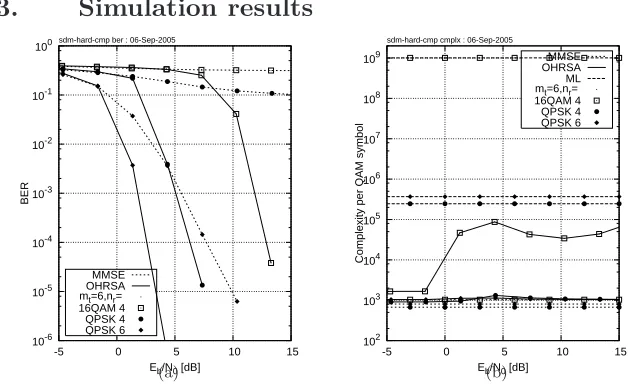
Figure 1. (a)Bit Error Rate and (b) the correspondingcomplexityexhibited by the rate-1
2 turbo-codedSDM-OFDMsystem employing theOHRSA-MLSDM
detector. The abscissa represents the averageEb/N0.
Our simulations were performed in the base-band frequency domain. The OFDM system considered utilises 128 QAM-modulated orthogonal subcarriers. For forward error correction (FEC) we use 12-rate turbo coding [8] employing two constraint-length K = 3 Recursive System-atic Convolutional (RSC) component codes and the standard 124-bit WCDMA UMTS turbo code interleaver of [9]. The octally represented RCS generator polynomials of (7,5) were used. We assume a 9-tap CIR Rayleigh-fading multipath channel and stipulate the assumption of per-fect channel knowledge, where the knowledge of the frequency-domain subcarrier-related coefficients H[n, k] is deemed to be available in the receiver.
Figure 1(a) characterizes the achievable BER performance of the MIMO-OFDM system employing the OHRSA detector proposed, as well as that of the MMSE detector. We can see that as opposed to the MMSE detec-tor, the proposed OHRSA detector performs equally well both in fully-loaded as well as in overfully-loaded scenarios, where the number of transmit antennas exceeds that of the receive antennas and thus we havemt> nr.
Furthermore, the OHRSA method exhibits an equally good performance, when employed in the overloaded 16-QAM-modulated MIMO-OFDM system.
Ob-serve that the complexity exhibited by the OHRSA method in the QPSK scenario is only slightly higher than that exhibited by the MMSE de-tector. Moreover, the complexity exhibited by the OHRSA detector in the overloaded 16-QAM scenario is more than four orders of magnitude lower than that exhibited by the exhaustive ML detector, while their BER performance is expected to be similar. We note however that the BER performance of the ML detector is not shown since it would impose a more than 104-times higher complexity.
4.
Conclusion
We proposed a novel OHRSA-ML space-time detector, which may be regarded as an advanced extension of the CSD method. We demon-strated that the MIMO-OFDM system employing the OHRSA-ML de-tector proposed is capable of achieving the near optimum ML perfor-mance in the overloaded scenario, where the number of transmit anten-nas exceeds that of the receive antenanten-nas.
References
[1] L. Hanzo, M. M¨unster, B.J. Choi, and T. Keller. OFDM and MC-CDMA for Broadband Multi-user Communications, WLANs and Broadcasting. John Wiley and IEEE Press, 2003. 992 pages.
[2] L. Hanzo, L-L. Yang, E-L. Kuan, and K. Yen. Single- and Multi-Carrier DS-CDMA. John Wiley and IEEE Press, 2003. 430 pages.
[3] A. Goldsmith, S. A. Jafar, N. Jindal, and S. Vishwanath. Capacity limits of MIMO channels. IEEE Journal on Selected Areas in Communications, 21(5):684–702, June 2003.
[4] D. Pham, K. R. Pattipati, P. K. Willet, and J. Luo. An improved complex sphere decoder for V-BLAST Systems. IEEE Signal Processing Letters, 11(9):748–751, September 2004.
[5] B. M. Hochwald and S. ten Brink. Achieving near-capacity on a multiple-antenna channel. IEEE Transactions on Communications, 51(3):389–399, March 2003. [6] R. D. Schafer. An Introduction to Nonassociative Algebras. Dover, New York,
1996.
[7] M. K. Varanasi. Decision feedback multiuser detection: A systematic approach.
IEEE Transactions on Information Theory, 45:219–240, January 1999.
[8] L. Hanzo, T. H. Liew, and B. L. Yeap. Turbo Coding, Turbo Equalisation and Space-Time Coding. John Wiley and IEEE Press, Chichester, UK; Piscataway, NJ, USA, 2002. 766 pages. (For detailed contents, please refer to http://www-mobile.ecs.soton.ac.uk.).