University of Southern Queensland
Faculty of Engineering and Surveying
Validation of Cooling Grid Model and
Testing of Alternatives
A dissertation submitted by
Andrew Thomas Watt
in fulfilment of the requirements of
Courses ENG4111 and 4112 Research Project
towards the degree of
Bachelor of Engineering (Agricultural)
Abstract
The Great Artesian Basin Sustainability Initiative, (GABSI), is a joint state and
federal government project which rehabilitates artesian bores and replaces bore
drains with polyethylene pipeline systems to tanks and troughs for stock water. The
naturally pressurised artesian water can reach temperatures of up to 99˚C due to
the heat convection at great depths within the Earth’s crust. The heated artesian
water is required to be cooled to below 45 ˚C to prevent heat deterioration of the
polyethylene pipe and to maintain a 50 year design life of the entire reticulation
system. Historically, a submerged network of copper pipes has been designed for
each system to provide a cooling mechanism and maintain the natural pressure of
the bore.
The project’s main aim was to predict and confirm the heat transfer parameters for
cooling grids submerged in water and air, investigate alternative cooling options
and validate the design model to accurately reflect existing operation. The testing
procedure utilised a 12 metre length of the three pipe materials under investigation,
which were tested at four representative flow rates surrounded by air and then
submerged underwater. Inlet, outlet, ambient and pond temperatures were
monitored along with relative humidity and weather observations.
The experimental results and research allowed for model to be validated and
deemed accurate with an appropriate factor of safety. The alternative designs
tested were comparatively analysed accounting for costs, cooling performance,
pipeline flow characteristics, material availability, corrosion resistance and
maintenance requirements. Aluminium was determined to exhibit the most
desirable traits and was recommended as the most suitable alternative cooling grid
pipe material. Air as a heat transfer medium was deemed inappropriate for cooling
Certification
I certify that the ideas, designs and experimental work, results, analyses and
conclusions set out in this dissertation are entirely my own effort, except where
otherwise indicated and acknowledged.
I further certify that the work is original and has not been previously submitted for
assessment in any other course or institution, except where specifically stated.
Andrew Thomas Watt
Student Number: 0050026431
____________________________________ Signature
Acknowledgements
Mr Joseph Foley for his supervision, guidance and mentoring, as well as his input
in the project and comments on the dissertation.
Associate Professor David Buttsworth for his supervision and help with the
thermodynamic areas.
Thomas Bean, Simon Orphant and Emile Seiler from the Department of Natural
Resources and Water for their supervision, sponsorship and help during the project
and during testing.
Robert and Sally Hemming, landholders of ‘Beverleigh’ property, Dirranbandi for
Table of Contents Andrew Watt
Table of Contents
Abstract
………. iiAcknowledgements
………. vList of Figures
………. ixList of Tables
………. xChapter 1: Introduction
………. 1Chapter 2: Background
………. 62.1 The Great Artesian Basin
…………. 72.2 Water Usage in the Great Artesian Basin
…………. 92.3 Environmental Impacts
…………. 102.4 The Great Artesian Basin Sustainability Initiative
……. 122.5 Cooling Grids
…………. 14Chapter 3: Literature Review
………. 163.1 Review of Previous Work
………….. 173.2 Heat Transfer Mechanisms
………….. 213.2.1 Conduction ………….. 21
3.2.2 Convection ………….. 22
3.2.3 Radiation ………….. 23
3.3.4 Heat Transfer in Cooling Grids ………….. 24
Table of Contents Andrew Watt
3.4 Alternative Water Cooling Practices
………….. 263.4.1 Gas Refrigeration ………….. 26
3.4.2 Cooling Tanks/Towers ………….. 28
3.4.3 Passive Radiator Cooling Systems ………….. 28
3.4.4 Heat Pipes ………….. 29
3.4.5 Applications to Artesian Bore Water Cooling ………….. 30
3.5 Flow Characteristics in Pipelines
………….. 323.6 Pipe Material Selection
………….. 33Chapter 4: Model Description & Sensitivity Analysis
….. 354.1 Model Calculations
………….. 364.1.1 User Inputs ………….. 37
4.1.2 Defined Constants ………….. 37
4.1.3 Calculations ………….. 38
4.2 Sensitivity Analysis
………….. 44Chapter 5: Experimental Methodology
……….. 465.1 Field Testing Procedure
………….. 475.2 Limitations on Experimentation
………….. 515.3 Experimental Design Justification
………….. 525.4 Heat Transfer Predictions
………….. 53Chapter 6: Experimental Results & Model Validation
…. 556.1 Heat Transfer Test Results
………….. 566.2 Experiment Conditions and Ambient Temperatures
… 60Table of Contents Andrew Watt
Chapter 7: Discussion & Implications
………. 687.1 Heat Transfer in Air Tests
…………. 697.2 Heat Transfer in Water Tests
…………. 707.3 Design Optimisation
…………. 727.4 Implications
…………. 74Chapter 8: Conclusions
……… 768.1 Conclusions
………….. 778.2 Further Work
………….. 79List of References
……… 80Appendix A – Project Specification
………. 82Appendix B – Spreadsheet Model
……….. 85Appendix C – Risk Assessment
………... 88Appendix D – Resources
………... 90List of Figures
Figure 1.1 Schematic of Typical Cooling Grid
Figure 2.1: Map of Great Artesian Basin
Figure 2.2: Great Artesian Basin Formation
Figure 2.3 Environmental Problems with Bore Drains
Figure 2.4 Controlled Bore Piped to Tanks
Figure 2.5 Installed Cooling Grid
Figure 2.6 Installed Cooling Grid
Figure 3.1 Gas Absorption System
Figure 3.2 Heat Pipe
Figure 5.1 Air Test Apparatus
Figure 5.2 Data logger and manual readings during pipe in air test
Figure 5.3 Water test apparatus with submerged test material fixed to steel posts
Figure 6.1 Pipe in-air test results indicating inlet and outlet temperatures as well as
the 20 minute regions of varied flowrates for the ALUMINIUM pipe material
Figure 6.2 Pipe in-air test results indicating inlet and outlet temperatures as well as
the 20 minute regions of varied flowrates for the COPPER pipe material
Figure 6.3 Pipe in-air test results indicating inlet and outlet temperatures as well as
the 20 minute regions of varied flowrates for the STAINLESS STEEL pipe material
Figure 6.4 Pipe in-water test results indicating inlet and outlet temperatures as well
as the 20 minute regions of varied flowrates for the ALUMINIUM pipe material
Figure 6.5 Pipe in-water test results indicating inlet and outlet temperatures as well
as the 20 minute regions of varied flowrates for the COPPER pipe material
Figure 6.6 Pipe in-water test results indicating inlet and outlet temperatures as well
as the 20 minute regions of varied flowrates for the STAINLESS STEEL pipe
material
Figure 6.7 The relative error of measured ∆T vs modelled ∆T at each flowrate for
List of Tables
Table 3.1 Typical values of the convection heat transfer coefficient
Table 3.5 Thermal conductivity of some materials
Table 4.1 Sensitivity Analysis Results
Table 6.1a Aluminium Air Test Ambient Temperatures
Table 6.1b Copper Air Test Ambient Temperatures
Table 6.1c Stainless Steel Air Test Ambient Temperatures
Table 6.2a Aluminium Water Test Ambient Pond Temperatures
Table 6.2b Copper Water Test Ambient Pond Temperatures
Table 6.2c Stainless Steel Water Test Ambient Pond Temperatures
Table 6.3 Average Equilibrium Temperatures and Differences
Table 6.4 Measured ∆T
Table 6.5 Modelled ∆T
CHAPTER 1
Chapter 1: Introduction Andrew Watt
1.0 Introduction
Artesian groundwater flowing to the surface from a 1 to 3 kilometre deep
sandstone aquifer called the Great Artesian Basin, is an important natural resource
and has provided a secure water supply for the settlement and development of
expansive grazing areas throughout western Queensland, north-western New
South Wales, north-east South Australia and the south-east Northern Territory. The
free flowing groundwater can vary in temperature from 30 to 99 ° Celsius at the
surface.
Historically, the water has been distributed across the landscape by gravity through
earthen channels called ‘bore drains’. These extensive man-made networks of
earth channels extend for tens to hundreds of kilometres across pastoral grazing
properties to distribute this artesian water to previously uninhabitable (dry) regions
to produce water stock animals. Without the requirement of cooling, the water has
been allowed to flow uncontrolled under the action of gravity into the bore drain
network which can service up to 200 kilometres from a single outlet. Although the
system is effective in transporting water, the efficiency of water delivery is very low
with as much as 97% of water flowing into the drains being lost to evaporation and
seepage, not to mention the environmental impacts such as weed infestation,
salinity and harbouring of feral animals caused by the drains themselves.
In addition to these high losses, as more bores have been drilled the natural
pressure of the entire basin has dropped significantly, further highlighting the need
for conservation to protect the sustainability of such an important natural resource.
The Great Artesian Basin Sustainability Initiative (GABSI) is a joint federal and
state government project undertaken by the Queensland Government Department
of Natural Resources and Water (DNR&W) which is tasked with ensuring the
Chapter 1: Introduction Andrew Watt
losses from the basin by replacing bore drains with polyethylene pipes supplying
tanks and troughs at designated watering points. The project also tests and
inspects bores and bore casings, rehabilitating where necessary, to ensure
efficient water delivery to the surface.
By replacing the open drains with polyethylene pipe, losses to evaporation and
seepage are virtually eliminated, as are the surface environmental impacts created
by the drains.
A water temperature of less than 45 °C will ensure a 50 year design life is
achievable for the medium density PE 80B polyethylene pipe used to replace the
bore drains. However, as the water flowing to the surface is still at a high
temperature the water must be cooled before it enters the system to guarantee the
polyethylene pipe will not degrade over time with the excess heat.
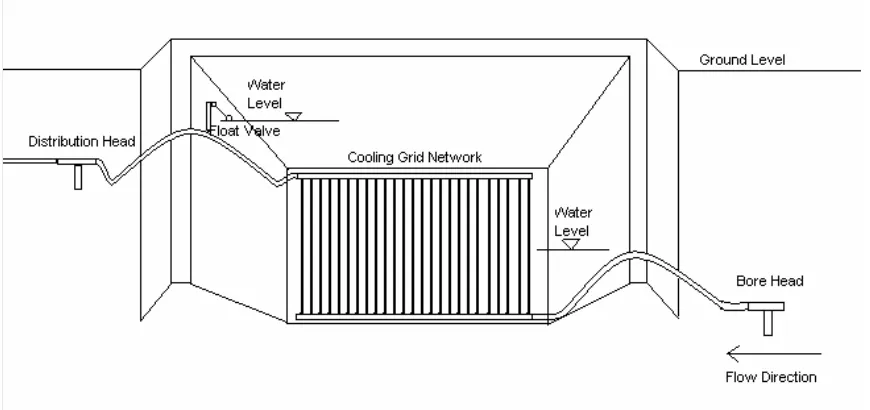
Cooling of the artesian water is achieved by the installation of a cooling grid. A
typical cooling grid is a network of pressurised copper pipes arranged in a radiator
type configuration through which the high temperature bore water is cooled and
delivered to the pipe network distribution head. This grid is submerged in a pond at
a depth of 2 metres where conductive, convective and evaporative cooling effects
dissipate the heat from the artesian water cooling it to below 45 °C before delivery
to the polyethylene pipe system (see Figure 1.1).
Chapter 1: Introduction Andrew Watt
Figure 1.1 Schematic of Typical Cooling Grid
Currently each individual cooling grid is designed and sized using a spreadsheet
design model according to the individual bore temperature and discharge
characteristics to guarantee the required outlet temperature at the maximum
flowrate of the system. The design model utilises a number of variables, constants,
and theoretical calculations to determine the length of pipe that is required for the
desired amount of heat to be transferred from the hot artesian water into the
cooling pond.
This project is aimed at analysing this design model to determine its accuracy in
designing each cooling grid as well as investigating the possible alternative pipe
materials that may be used within each grid to minimise costs whilst maintaining
the desired heat transfer.
The principal aims of this project are to predict and confirm the heat transfer
parameters for cooling grids submerged in water ponds used for cooling artesian
Chapter 1: Introduction Andrew Watt
parameters within the existing design model to more accurately reflect existing
operation.
The specific objectives of the project are as follows:
1. Research material properties of alternate pipe materials, heat transfer
mechanisms through air and water, alternative cooling techniques, flow
characteristics and associated hydraulics theory for pipe networks.
2. Undertake sensitivity analysis of the spreadsheet design model to verify
important variables to aid in pipe material selection.
3. Design a cooling grid test setup for on-site use and an experimental procedure
to compare its performance using differing pipe materials to theoretical
calculations from the existing spreadsheet design, test in field to compare the
heat transfer characteristics in air and water using the selected pipe materials.
4. Comparatively analyse designs tested accounting for costs, material
availability, flow characteristics at different flow rates, cooling performance and
maintenance requirements.
5. Validate and calibrate the current DNR&W design spreadsheet using
measured data, and make recommendations.
6. Write a dissertation and submit by 30/10/2008
By undertaking the necessary research and testing the project will allow increased
accuracy when designing cooling grid systems whilst ensuring the efficient use of
CHAPTER 2
Chapter 2: Background Andrew Watt
2.0 Background
2.1 The Great Artesian Basin
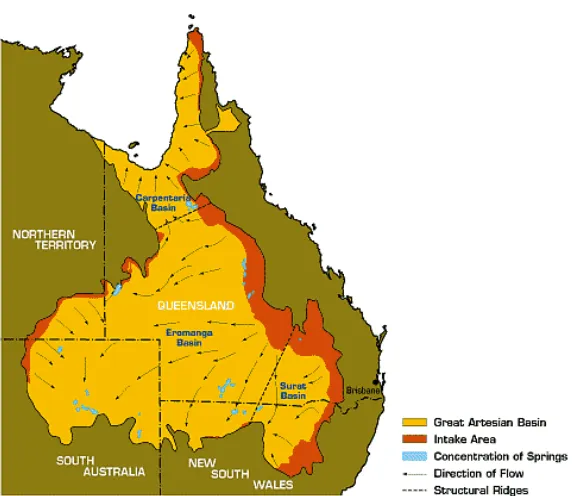
The Great Artesian Basin (GAB) is one of the largest artesian groundwater basins
in the world. It underlies approximately one-fifth of Australia and extends beneath
arid and semi-arid regions of Queensland, New South Wales, South Australia and
the Northern Territory, as shown in Figure 2.1. The GAB covers a total area of over
1 711 000 square kilometres and has an estimated total water storage of 64 900
[image:17.595.183.469.381.629.2]million megalitres.
Chapter 2: Background Andrew Watt
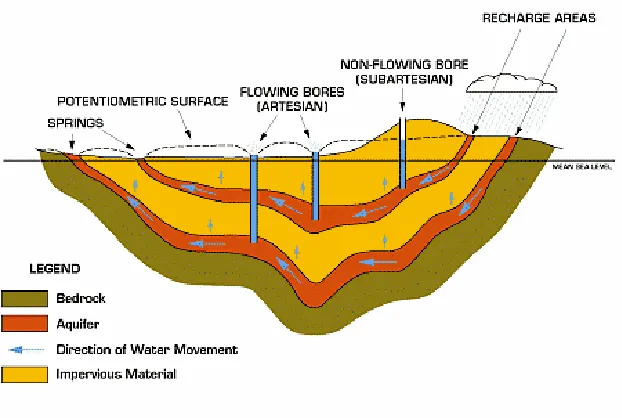
The Great Artesian Basin consists of alternating layers of permeable sandstone
aquifers and impermeable siltstones and mudstones. The depth of these layers
varies from less than 100 metres at the Basin boundaries to over 3 000 metres in
the deeper parts of the Basin. The rate at which water flows through the
sandstones varies between one and five metres per year. Water enters the Basin
by infiltration of rainfall into the outcropping sandstone aquifers mainly along the
western slopes of the Great Dividing Range. This infiltration and flow pressurizes
the water between the permeable and impermeable layers. Pressurised
groundwater is then discharged via approximately 10 000 bores within the Basin
and also naturally from artesian springs in the south-western area because the
[image:18.595.168.479.392.601.2]potentiometric surface is above ground level (see Figure 2.2).
Figure 2.2: Great Artesian Basin Formation, Source: NR&W Qld.
Water temperatures vary from 30˚C in the shallower areas to up to 99˚C in the
deeper areas. Heating of the water occurs naturally because of its proximity to the
Chapter 2: Background Andrew Watt
2.2 Water Usage in the Great Artesian Basin
Prior to human development of the Basin, it is estimated that approximately 300
Megalitres/day of water entered the permeable aquifers of the Great Artesian Basin
in Queensland. All of this inflow, as well as the recharge from other states,
discharged as surface springs, or leakage through the ground surface. In this way
a natural equilibrium of inflow to outflow was maintained.
Europeans first discovered the artesian groundwater of the Great Artesian Basin in
1878 when a shallow bore sunk near Bourke in New South Wales produced
flowing water. A bore is simply a deep hole lined with a metal casing which usually
ranges in diameter from 100 to 300 millimetres. Many bores were soon drilled
throughout the Basin in north-west New South Wales and north-east South
Australia. The first flowing artesian bore in Queensland was drilled in 1887 near
Cunnamulla. Following this discovery, over 500 bores were sunk over the next
decade and by 1915 a total of 1500 bores were supplying an approximate
discharge of 2000 Megalitres/day of uncontrolled artesian water to Queensland
properties.
This seemingly endless supply of water allowed the development of extensive
grazing country throughout the grass plains of western Queensland. Thousands of
kilometres of bore drains were excavated to transport water throughout the
properties. Bore drains are shallow earth trenches which are excavated to allow
the water to travel across the ground surface. However, this increased outflow of
water from the Basin resulted in significant pressure losses with up to a third of all
bores now requiring pumps to bring the water to the surface. Regulations were
introduced to all new bores in 1954, stating that all bores must have a control valve
in place and use pipelines to distribute the water other than open drains. These
Chapter 2: Background Andrew Watt
gradual return to equilibrium between recharge and discharge throughout the Basin
today.
2.3 Environmental Impacts
Artesian water, being easy and inexpensive to utilise, is often used inefficiently
after it reaches the surface. In many areas, artesian water is traditionally flowing
uncontrolled from bores into open drains and creeks for stock to drink with nearly
14 000 km of bore drains currently in use throughout Queensland alone. Even in
well-maintained drains, up to 97 per cent of the water is lost through evaporation
and seepage.
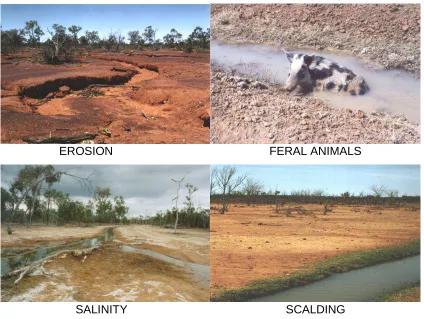
This ineffective and inefficient method of water transport results in serious
environmental impacts and land degradation issues (see Figure 2.3). Some of the
impacts include:
• Feral animals are provided with a habitat and permanent water supply
• Infestations of invasive woody weeds, such as prickly acacia, in and around bore drains
• Erosion problems often result from drains overtopping or breaking their banks
• Salinity problems can be created or aggravated
• Bore drains built across a slope catch run off water, reducing rainfall infiltration below drains and thereby limiting pasture growth
• Concentration of minerals by evaporation (e.g. Sodium and Fluoride) can negatively affect animal health or induce scalding on the soil surface
Chapter 2: Background Andrew Watt
EROSION FERAL ANIMALS
[image:21.595.115.539.129.448.2]SALINITY SCALDING
Chapter 2: Background Andrew Watt
2.4 The Great Artesian Basin Sustainability Initiative
The Great Artesian Basin Sustainability Initiative (GABSI) is a joint Federal and
State government project designed for the continued sustainability of the vast
hidden artesian water resource that is the Great Artesian Basin. GABSI’s role is to
work in conjunction with landholders to rehabilitate uncontrolled bores drilled prior
to 1954, and replace bore drains with pipelines delivering the water to tanks and
[image:22.595.159.495.333.585.2]troughs at designated watering points.
Figure 2.4 Controlled Bore Piped to Tanks, Source: DNR&W
To rehabilitate an uncontrolled bore, the bore and its casing are tested using
geophysical logging probes and a dye test to determine the casing condition, size
and strata details. This information is then used to determine the correct method of
Chapter 2: Background Andrew Watt
bore casing near ground level and new headworks, relining of the bore casing by
inserting a smaller diameter pipe into the bore and cementing the annulus between
the two casings, or by plugging the entire bore with concrete to stop flow and
drilling a new bore nearby using inert casing.
Once the bore has been successfully rehabilitated, the water is piped throughout
the areas which the bore drains were previously servicing to new designated
watering points. Each watering point’s location and size is designed to;
• hold at least 2 days supply of water for the stock in the area,
• maintain a maximum walking distance between watering points of 1.5 kilometres for sheep and 2 kilometres for cattle,
• minimise the opportunity for feral animals by using specifically designed high sided troughs and,
• reduce erosion by installing concrete aprons around all watering points.
By capping and piping the artesian bores farm management becomes easier,
productivity increases whilst water is conserved. Other benefits include the
reduction of feral animal habitat, reduced maintenance time, stock weakened by
drought are better able to drink from troughs, the water quality in these piped
systems is considerably better at the watering point when compared to that using
bore drains and when a number of properties are serviced by one bore all
properties, including the ones farthest from the supply are guaranteed water.
A well designed system allows the effective use of the whole property all year
round with pipeline systems that can deliver water to parts of the property that
previously could not be reached by bore drains. Spear traps, which allow animals
to enter safely but not to exit, can be installed at watering points so stock can self
muster and managers can ensure more effective spelling of paddocks as watering
points are turned off. Also, it is possible to deliver food supplements and
Chapter 2: Background Andrew Watt
2.5 Cooling Grids
Artesian water can reach very high temperatures because of the naturally high
temperatures at large depths near the earth’s mantle. The temperature of the water
throughout the GAB ranges from 30˚C up to 99˚C at depth. The high temperature
of the water is not of concern when it is flowing uncontrolled into bore drains,
however when the water is piped the temperature presents a problem in terms of
polyethylene pipe degradation.
The medium density polyethylene (PE 80B) pipe that is used for piping the artesian
water throughout the GAB requires a temperature below 45°C to maintain a design
lifespan of greater than 50 years (James Hardie Pipelines, 1997). At higher
temperatures the PE 80B pipe will only remain viable for 25 years or less because
of the heat deterioration of the pipeline. Hence, the water must be cooled before
entering the reticulation system.
The current practice used to cool artesian water utilises the natural pressure of the
bore to pump the hot water through a network of 19.1mm plain walled copper pipes
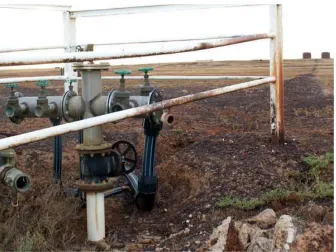
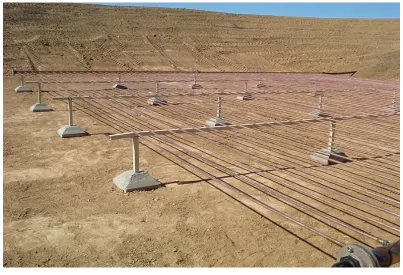
submerged in an earthen walled pond at a depth of 2 metres (see Figure 2.5). The
copper pipes are arranged in parallel which are fed and collected by 100 mm
copper manifolds at either end (see Figure 2.6). Each copper grid is sized
according to the individual bore characteristics of pressure, temperature, and
maximum flowrate using a spreadsheet model which will be discussed later.
At present, the cooling grid design model spreadsheet that is used to size each
grid in each scheme is relatively untested. There is a need to validate this design
model to ensure the correct sizing of grids for sustainable resource management
and to ensure that the theoretical calculations are truly representative of in field
results. This study will focus on the theoretical versus practical performance of the
Chapter 2: Background Andrew Watt
Figure 2.5 Installed Cooling Grid, Source: DNR&W
[image:25.595.124.527.451.726.2]CHAPTER 3
Chapter 3: Literature Review Andrew Watt
3.0 Literature Review
This chapter will review literature on previous work to expand upon the material
outlined in previous sections whilst providing a context for this project. A review of
the physical heat transfer principles and alternative cooling practices will follow to
provide an increased understanding of the subject.
3.1 Review of Previous Work
Copper cooling grids are a relatively new cooling method for artesian water and
have only been in use for less than a decade. Water running uncontrolled into
drains required no cooling as it was exposed to convective and evaporative cooling
effects. Prior to the use of copper grids piped artesian water was cooled using steel
or polyethylene pipe submerged in an earthen walled dam. This system utilised
little to no design process. The steel or polyethylene would simply be replaced as
necessary. Some piped schemes employed no cooling technique at all which
rapidly deteriorated the polyethylene pipe requiring regular maintenance.
Since the copper cooling grids have been utilised by the Department of Natural
Resources and Water many changes to their design have occurred. It was thought
by the GABSI staff that by using copper pipe with a ‘crinkled’ or ‘finned’ surface the
heat transfer into the pond would be greater because of the increased surface area
of the pipe. Over time this practice was deemed unreliable as the finned pipe
allowed for considerable algal growth requiring frequent cleaning to maintain the
desired heat transfer capacity. This algal growth was factored into the design for a
Chapter 3: Literature Review Andrew Watt
performance and loss of heat transfer. The choice of pipe was converted back to
plain walled copper pipes in both the design and installation of systems.
The design model used in the creation of copper cooling grids has also been
subject to change over time and has come under review in previous studies. As the
model has developed and been added to over time, a broader scope of
calculations has been included allowing for increased accuracy in design.
It is important to note the above continued changes to cooling grids and their
design to understand the previous studies undertaken and set the context in which
they were produced.
Martin (2003) analysed the practical versus theoretical performance of finned
copper cooling grids and developed a design spreadsheet to account for any
inaccuracies. Martin (2003) tested the theory on two separate bores using varied
flowrates over a period of time. The flow control valve used in their experiments
significantly affected the pressure in the system inducing a 2 to 3 metre head loss
through the valve. In addition to the experiments performed, Martin (2003) also
evaluated the possibility of modifying current practice by employing different
materials. No practical or theoretical testing was conducted and only cooling
towers and stainless steel as an alternative pipe material in the grid were
mentioned.
Martin (2003) states that…
“stainless steel does not offer the heat transfer capabilities of copper so
a larger grid is required…the anaerobic environment in a cooling pond
would not allow the protective oxide film to develop and therefore you
would not expect stainless steel to stand up to corrosion better than
Chapter 3: Literature Review Andrew Watt
These claims were examined during this project’s research and testing.
Martin (2003) reports that cooling towers offer no substantial benefit to the cooling
of piped artesian water in Queensland because of the loss of natural bore pressure
and requirement of power for pumping. Martin (2003) confirmed Eigland (2000)
which is a report for the ‘Capping and Piping the Bore Program’ in New South
Wales by the Department of Land and Water Conservation. The schemes are
designed in Queensland to utilise the natural bore pressure and flow so as to
remove the power requirement for pumping.
Webb (2002) evaluated the performance of the addition of heat dissipating fins to
the cooling grid pipes as well as varied pipe wall thicknesses. These heat
dissipating fins were proven to be impractical during installation. Webb (2002) also
analysed the performance of the grids without any cost evaluation giving no real
world validation of the ‘improved’ design. The fins also promoted increased
external algal growth inhibiting the overall heat transfer and introducing the
requirement of manual cleaning of the pipe exteriors.
An internal report conducted by Alsemgeest and Zuino (2002) for the Department
of Natural Resources and Water evaluated the necessity of cooling grids
altogether. The report investigated the effects of piping the water claiming the
increased pressure from piping would reduce the bore temperature enough to
allow for a sacrificial length of polyethylene pipe to be used close to the bore to
provide an area for cooling. The difficulty in prediction of the length of sacrificial
pipe required presented a problem as well as the prediction of temperature
decrease from pressure recovery. PEX polyethylene pipe is a new pipe designed
to withstand temperatures up to 80°C. This PEX pipe may become a viable option
for an extended length from the bore head to allow for cooling as its price
decreases with continued usage. This pipe is currently in use by GABSI to connect
Chapter 3: Literature Review Andrew Watt
connection distance. The result of the Alsemgeest and Zuino (2002) report
certainly presents an area of further study when the price of PEX pipe reduces.
Watt (2007) analysed the theoretical performance of varied cooling grid pipe sizes
and grid configurations. The report used the current design model to investigate
the performance of cooling grids with larger and smaller pipes as well as having a
‘stacked’ grid with one set of pipes above another. Cost, performance,
maintenance requirements and ease of installation were considered as criteria for
optimisation which yielded a recommendation of a 31.8mm pipe size for the current
grid and a 38.1mm pipe size for a ‘stacked’ design. Although real world costs were
involved no practical testing was conducted which assumed the design model
reflected actual performance. Watt (2007) indicated the necessity of cooling grid
performance evaluation to optimise design.
It is still unknown whether the current design model accurately represents in situ
results which are the main focus of this project. As a result of previous
investigations there is a need to validate the design model to analyse how the
previous findings have been used to alter the current model. At this point in time,
NR&W do not have confidence that the existing cooling grid design model
Chapter 3: Literature Review Andrew Watt
3.2 Heat Transfer Mechanisms
Heat transfer is defined as the energy transferred when a temperature gradient
exists within a system, or whenever two systems at different temperatures are
brought into contact (Kreith & Bohn, 2001). The physics of heat and heat transfer
are well known but are included here in a brief review on the subject.
There are three main modes of heat transfer. They are conduction, convection and
radiation. Each of these will be discussed in-turn.
3.2.1 Conduction
Conduction of heat occurs in gases, liquids and solids and is assumed to involve
no bulk motion. Heat is transferred from rapidly moving high energy molecules
which randomly collide with low energy slow moving molecules in a fluid where a
temperature gradient exists (Janna, 2000). These random collisions exchange
momentum and energy and therefore heat. It is possible to quantify the amount of
heat transferred per unit of time through the mode of conduction using Fourier’s
Law of Heat Conduction, equation 3.11 (Incropera & DeWitt, 1996).
L T k q L T T k q ∆ = ⇒ − −
= 1 2
(3.11)
where q = heat flux perpendicular to direction of transfer [ W/m2 ];
k = thermal conductivity [W/m.K ];
L = length [ m ]; and
Chapter 3: Literature Review Andrew Watt
3.2.2 Convection
Convection of heat through liquids is comprised of two mechanisms. Heat is
transferred by random molecule collisions as outlined above as well as by the bulk
motion within the fluid (Incropera & DeWitt, 1996). Heat transfer by convection can
be forced or natural, or free, in nature. Forced convection occurs when an external
force such as an agitator or pump creates the fluid motion which will transfer heat
between areas of higher temperature and lower temperature. In contrast, natural or
free convection occurs from the buoyancy forces which are created by the density
differences between areas of higher temperature and lower temperature (Kreith &
Bohn, 2001).
In both forced and free convection the heat flux created can be quantified using
Newton’s Law of Cooling, equation 3.12 (Incropera & DeWitt, 1996).
(
T1 T2)
h
q= − (3.12)
.
where q = heat flux perpendicular to the direction of transfer [ W/m2 ];
h = convection heat transfer coefficient [W/m2.K ]; and T = temperature [ °K ].
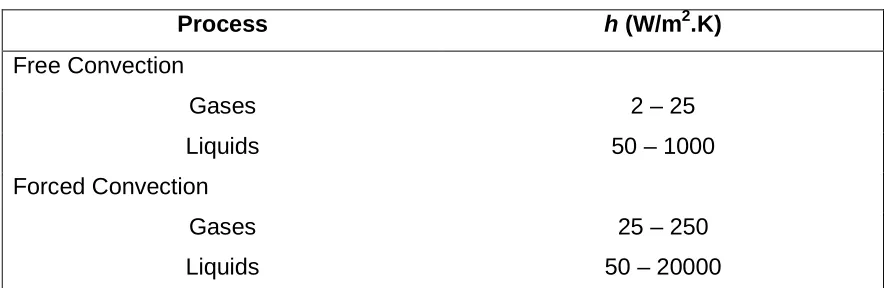
This law utilises a proportionality constant, h [ W/m2 .K ], known as the convection
Chapter 3: Literature Review Andrew Watt
Table 3.1 Typical values of the convection heat transfer coefficient
(Incropera & DeWitt, 1996).
Process h (W/m2.K)
Free Convection
Gases 2 – 25
Liquids 50 – 1000
Forced Convection
Gases 25 – 250
Liquids 50 – 20000
It is also important to note that if a temperature gradient exists between a fixed
surface and a free fluid a consequence is the development of a region in the free
fluid where the bulk velocity varies from zero at the surface to a finite value
associated with the relative conditions. This is because of the viscous forces within
the fluid and is referred to as thermal boundary layer development which will vary
from system to system (Kreith & Bohn, 2001).
3.2.3 Radiation
Radiation or thermal radiation is the energy emitted by a body by virtue of its
temperature and at the expense of its internal energy. Radiation needs no
transport medium and is most efficient in a vacuum (Incropera & DeWitt, 1996). All
heated solids, liquids and some gases emit thermal radiation to their surroundings.
This heat flux can be quantified using equation 3.13 if both the surroundings and
Chapter 3: Literature Review Andrew Watt
(
)
(
)
(
2)
2 2 1 2 1 2 1 T T T T h where T T Ah q + + = ⇒ − = εσ (3.13)
where q = heat flux perpendicular to the direction of transfer [ W ]; h = radiation heat transfer coefficient [W/m2.K ];
A = surface area [ m2 ];
ε = emissivity [ dimensionless ];
σ = Stefan-Boltzmann constant [ 5.67 x 10⁻⁸ W/m2.K4 ];
T1 = surface temperature [ °K ]; and
T2 = surrounding temperature [ °K ];
3.2.4 Heat Transfer in Cooling Grids
All three heat transfer mechanisms contribute to heat loss through cooling grids.
Heat energy is conducted through the metal pipes into the pond. Free convection
occurs within the pond as the temperature difference between the pipes and the
pond creates a buoyancy effect from density changes resulting in convection
currents throughout the pond. Heat is also radiated from the hot bore water through
the pipe and into the pond.
Solar radiation is of great importance as well because of its contribution to heat
loss. As solar radiation strikes the surface of the cooling pond it contributes to the
evaporation of water molecules. This evaporation requires a large input of energy
from the molecule’s surroundings as it changes phase from liquid to gas. This
energy comes partly from solar radiation but mainly from the surrounding water
molecules, hence cooling the water in the pond. This is known as the evaporative
cooling effect (Allen et al, 1998). Ambient temperature and windspeed are also
Chapter 3: Literature Review Andrew Watt
Cooling grids are designed to provide the appropriate amount of heat transfer for
the system’s maximum designed flowrate, which occurs as the pipeline system is
filled. After the initial ‘filling’ of the pipe, tank and trough system the actual
operating flowrate is considerably reduced. The flowrate required to maintain this
level is dependent upon the stock drinking requirements, losses due to pipe
leakage and evaporation from the troughs. This means that over 99% of the
system’s working life will be at a flowrate considerably less than that required at fill.
3.3 Cooling Grid Design Spreadsheet
A Microsoft Office Excel spreadsheet has been developed by NR&W using worked
examples from the POLIPLEX Polyethylene Pipe Design Textbook, 1997 from
James Hardie Plumbing and Pipelines Pty Ltd, Australia. The spreadsheet is used
to calculate the length of pipe required in the grid to reduce the temperature of the
water in the pipe to the required outlet temperature of below 45 °C, the number of
pipes required in the grid using a predetermined individual pipe length as well as
the friction loss through the grid.
The user inputs are of peak flow rate, inlet temperature, pressure head at inlet and
the length of individual pipe between the manifolds. The spreadsheet model will be
Chapter 3: Literature Review Andrew Watt
3.4 Alternative Water Cooling Practices
There are many ways in which water can be cooled. However the method chosen
is dependent upon the individual cooling purpose, cost, infrastructure, power
availability and design efficiency to name a few. Some commonly used water
cooling practices include gas refrigeration, cooling tanks/towers, passive radiator
cooling systems and heat pipes. These alternative water cooling techniques to
cooling grids will be discussed to outline any possible applications to the GABSI
schemes.
3.4.1 Gas Refrigeration
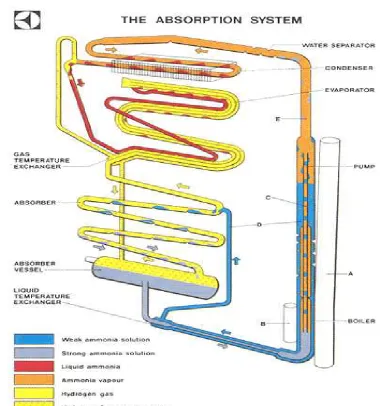
Gas refrigeration involves a process which utilises the heat changes as a
substance is evaporated and condensed continuously throughout a system of
Chapter 3: Literature Review Andrew Watt
[image:37.595.132.512.131.537.2]Figure 3.1 Gas Absorption System. Source: Lehman’s Gas Refrigerators, 2007
This continuous absorption system has no moving parts, absorbs heat efficiently
and requires minimal maintenance. However, a supply of heat either from
electricity, gas or kerosene is required to drive the system. Put simply, liquid
ammonia is passed through a network of tubes called the evaporator, the ammonia
then vaporises because of a change in pressure caused by the introduction of
Chapter 3: Literature Review Andrew Watt
gas is then mixed with water to separate it from the surrounding hydrogen and then
boiled to extract the pure ammonia gas. This gas is then condensed in a heat
exchanger to form liquid ammonia and the process begins again (Lehman’s Gas
Refrigerators, 2007).
3.4.2 Cooling Tanks/Towers
Cooling towers are used in the many industries to dissipate waste heat to the
atmosphere through the cooling of a water stream to a lower temperature. This
cooling technique employs the evaporative cooling effect where a small amount of
the water is allowed to evaporate to provide cooling to the rest of the water stream
(Cooling Technology Institute, 2007). The heat energy from the water stream is
transferred to the surrounding air increasing its temperature and relative humidity.
This heated air is then released to the atmosphere and replaced with cooler
ambient air through inlets at the base of the tower using the forces of convection.
Cooling tanks are simply water holding tanks which give the heated water time to
cool. These tanks also utilise the evaporative cooling effect to remove the majority
of the heat energy to the atmosphere. Cooling tanks can be situated on the ground
surface or raised off the ground to take advantage of gravitational forces for cool
water delivery.
3.4.3 Passive Radiator Cooling Systems
Another cooling technique which utilises the convection mode of heat transfer is
Chapter 3: Literature Review Andrew Watt
similar to that used in car radiators. These fins are filled with the water to be cooled
and subjected to free and forced heat convection in a natural outdoor environment.
The heat is transferred through the fins through the mode of conduction and
removed to the atmosphere by the mode of convection. To maintain optimum
conditions passive radiator cooling systems should be shaded from sunlight to
maintain the maximum possible temperature gradient between the heated water
and the atmosphere and prevent solar radiation interference.
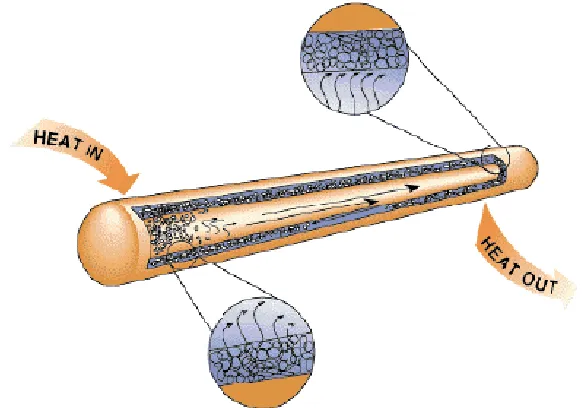
3.4.4 Heat Pipes
A heat pipe is simply a pipe that can quickly and efficiently transport heat from one
area to another. They are often referred to as superconductors of heat because of
their extraordinary heat transfer capabilities (CheResources, 2008). Heat pipes
consist of a sealed copper or aluminium tube. Within this tube the inner surface is
lined with a wick-like structure which allows for the transportation of a liquid or
working fluid. The working fluid is usually liquid ammonia which evaporates from
the wick when subjected to heat and travels through the hollow centre of the tube
in gaseous form. If the heat pipe is subjected to a hot and cool environment on
either end, the ammonia gas will then condense at the cool end and be absorbed
back into the wick. The ammonia liquid then travels back to the hot end through the
wick due to gravitational forces, if the pipe has a vertical orientation as well as by
the flux created by the evaporating ammonia at the other end (Chisholm, 1971). A
Chapter 3: Literature Review Andrew Watt
Figure 3.2 Heat Pipe Source: CheResources, 2008
Heat pipes are used in a wide range of cooling applications including laptops,
refrigeration, air-conditioning, heat exchangers and in space technology.
3.4.5 Applications to Artesian Bore Water Cooling
Gas refrigeration is a minimal maintenance self sufficient system which requires
only one input of heat. It presents as a possible alternative for some artesian bore
water cooling systems if the heat of the bore could be used as this heat source.
The temperature of the bore would need to be higher than that of the boiling point
of the hydrous ammonia. The relative size is a limiting factor and the system’s
ability to handle high flowrates may present as a problem which would require
significant development if this process was chosen as an alternative.
Cooling towers require the use of some of the water stream for cooling. Artesian
Chapter 3: Literature Review Andrew Watt
pressure of the bore to remove the need for powered pumping, therefore cooling
towers may not be a viable option for this type of water cooling. Cooling tanks
however, are able to utilise gravity for the system’s pressure requirements. This
may prove effective in the Queensland artesian bore piping schemes where the
terrain is mostly flat and the bore pressure is sufficient to reach an elevated tank.
Cooling tanks are used in conjunction with powered pumps in most New South
Wales piping schemes.
Passive radiator cooling systems can maintain the bore pressure, are relatively
cheap and open up the possibility of recycling used radiators. However, as air has
a low heat transfer capacity a larger surface area for cooling would be required.
Increased development of this passive cooling technique may increase its potential
for its application in artesian water cooling systems.
Heat pipes, although relatively more expensive than other cooling techniques,
require little to no maintenance, are fully self sufficient and depend on the physics
of the working fluid. Applications of this technology to the cooling of artesian bore
water would require significant research and design to extract the heat energy from
the water and dissipate it to the environment whilst maintaining the natural
pressure of the bore.
The above systems all require fewer earthworks than the current cooling grid
system which would reduce costs and maintenance requirements. Further
investigation into one or all of these systems may be viable in the future but was
Chapter 3: Literature Review Andrew Watt
3.5 Flow Characteristics in Pipelines
As the velocity of fluid flowing within pipelines change, the physical characteristics
of the flow profile also vary. At smaller velocities water particles flowing in pipelines
are observed to move in straight lines which slide over one another with little to no
mixing occurring within the fluid. The fluid appears to move by the sliding of
laminations of miniscule thickness over adjacent layers (Finnemore & Franzini,
2002). Hence, this type of flow is labelled laminar flow.
As the velocity within a pipeline increases, the paths of the water molecules
become more varied. A period of transition is observed in which the water particle
movement may become wavy with no definite wave frequency and with a small
amount of particle mixing. Following this transition period turbulent flow is
observed. Turbulent flow is characterised by the irregular motion of a large number
of water particles with no observable pattern during a small time interval
(Finnemore & Franzini, 2002).
The type of fluid flow can be easily determined when the flow parameters are
known using Reynold’s number. Reynold’s number is simply a ratio of inertia forces
to viscous forces and assumes no gravitational or capillary action in a completely
filled pipeline (Finnemore & Franzini, 2002). Reynold’s number values of between
0 and 2000 are identified as laminar flows, values of between 2000 and 4000
identify the transition period of flows and values of above 4000 are categorised as
turbulent flows. Reynolds number can be calculated using equation 3.5 (Finnemore
Chapter 3: Literature Review Andrew Watt
ν
VD
Re= (3.5)
where Re = Reynold’s number [ dimensionless ];
V = flow velocity [ m/s ];
D = pipe diameter [ m ]; and
ν = kinematic viscosity of fluid [ m2/s ].
3.6 Pipe Material Selection
In order to identify improvement in the cooling grid design differing pipe materials
need to be analysed to ensure continuity in the model as well as to optimise the
overall design. Pipe material selection is important because of availability, cost,
maintenance requirements, application suitability, heat transfer parameters and
ease of installation.
To maintain good experimental design copper was chosen as the control material.
Copper is the pipe material of choice at present and the design model was created
for this metal. Copper has been used in the design of cooling grids because of it’s
availability in the correct diameter, excellent heat transfer abilities and resistance to
corrosion (Janna, 2000).
Aluminium was the second choice for pipe material. Aluminium is similar to copper
in that it is low cost, offers good heat transfer capacity, good workability and
resistance to corrosion with the formation of an aluminium oxide film to resist
oxidation (Janna, 2000). The third choice for pipe material was stainless steel.
Stainless steel was chosen to provide a comparison in heat transfer capacity
Chapter 3: Literature Review Andrew Watt
Stainless steel is also relatively low cost and has good availability in the correct
diameter. A chromium oxide film is present on stainless steel when exposed to
oxygen which provides rust protection (Janna, 2000). Martin (2003) also
discounted stainless steel as a possible alternative, as outlined in Section 3.1, so
[image:44.595.111.541.290.439.2]the material is included here to prove or disprove Martin (2003).
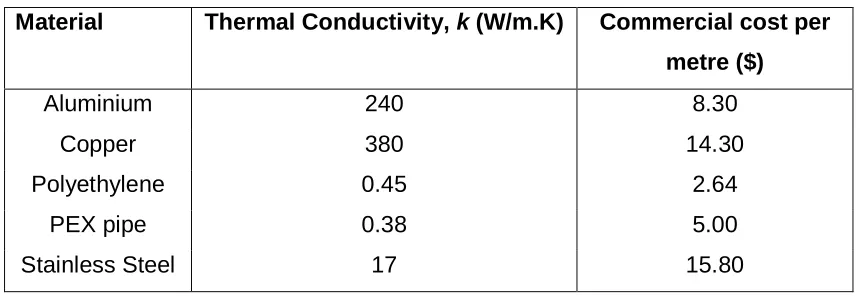
Table 3.5 Thermal conductivity of some materials. Source: Janna, 2000
Material Thermal Conductivity, k (W/m.K) Commercial cost per
metre ($)
Aluminium 240 8.30
Copper 380 14.30
Polyethylene 0.45 2.64
PEX pipe 0.38 5.00
Stainless Steel 17 15.80
The spreadsheet model will now be discussed in detail to provide an understanding
of the model itself, the sub-models and hydraulic equations used. A sensitivity
analysis of the model will be discussed to identify important variables and areas for
CHAPTER 4
MODEL DESCRIPTION & SENSITIVITY
Chapter 4: Model Description & Sensitivity Analysis Andrew Watt
4.0 Model Description and Sensitivity Analysis
The spreadsheet model developed by Andrew Brier for NR&W utilises worked
examples from the POLIPLEX Polyethylene Pipe Design Textbook, 1997 from
James Hardie Plumbing and Pipelines Pty Ltd, Australia to determine the correct
cooling grid size for each individual GABSI scheme.
User inputs and defined constants are used to calculate the convection heat
transfer coefficients for forced convection in the cooling grid pipes and natural
convection in the cooling pond. These heat transfer coefficients are then used to
calculate the overall heat transfer coefficient for the entire system. The amount of
heat required to be transferred to the pond can then be determined.
Temperature gradients, pipe radii and material properties are then used to
calculate the area of pipe material, and therefore the pipe length, required to
transport this heat. The frictional head loss through the grid is also calculated.
4.1 Model Calculations
The model is complex and interactive with values taken from graphs and trials
being calculated to determine the correct grid size. The user inputs, defined
constants and equations 4.1 to 4.25 are outlined below to illustrate the processes
Chapter 4: Model Description & Sensitivity Analysis Andrew Watt
4.1.1 User Inputs
Peak Water Demand (L/s) - Q
Inlet / Bore Temperature (°C) - Ti
Pressure Head at Inlet (m head) - P
Length of Individual Pipe (m) - L2
Required Outlet Temperature (°C) - To
Water Temperature of Pond (°C) - Tp
Inside Diameter of Pipe (m) - Di
Outside Diameter of Pipe (m) - Do
4.1.2 Defined Constants
Specific Heat of Water
Cw = 4180 J / kg .°C
Conduction Coefficient for Pipe Material
Kc = 380 W / m . °C
Conduction Coefficient for Water
Kw = 0.56 W / m . °C
Density of Water
Chapter 4: Model Description & Sensitivity Analysis Andrew Watt
Kinematic Viscosity of Water (calculated from graph)
ν = 0.000000500 m2 / s
Fouling Factor for Water (>50˚C)
Rf = 0.0 m2 . °C / W
Coefficient of Roughness
k = 0.000003 m
Pi
π = 3.14159… dimensionless
4.1.3 Calculations
Average Temperature in Grid – Ta (°C)
2 ) (Ti To
Ta= + (4.1)
Inside Radius of Pipe – ri (m)
2
i i
D
Chapter 4: Model Description & Sensitivity Analysis Andrew Watt
Outside Radius of Pipe – ro (m)
2
o o
D
r = (4.3)
Left Fluid Temperature Difference – ∆Ta (°C)
Tp Ti
Ta= −
∆ (4.4)
Right Fluid Temperature Difference – ∆Tb (°C)
Tp To
Tb= −
∆ (4.5)
Log – Mean Temperature Difference – ∆TLM (°C)
) / ln( Tb Ta
Ta Tb TLM ∆ ∆ ∆ − ∆ = ∆ (4.6)
Correction Factor – F (dimensionless)
Calculated from graph
Mean Temperature Difference – ∆TMEAN (°C)
F T TMEAN =∆ LH *
∆ (4.7)
Velocity in Pipes – V (m / s)
n Di Q V
= ( *( )/4)
Chapter 4: Model Description & Sensitivity Analysis Andrew Watt
Reynold’s Number in Pipes – Re (dimensionless)
ν
) * (
Re= Di V (4.9)
Prandtl Number in Pipes – Pr (dimensionless)
Kw Cw* * ) (
Pr= ρ ν (4.10)
Nusselt Number in Pipes – Nu (dimensionless)
4 . 0 8 . 0 Pr * Re * 023 . 0 = Nu (4.11)
Heat Transfer Coefficient in Flowing Water – h1 (W / m2 . °C)
Di Kw Nu
h1 =( * ) (4.12)
Mean Temperature for Natural Convection in Pond – Tm (°C)
2 ) (Ta Tp
Tm= + (4.13)
Kinematic Viscosity for Natural Convection – ν (m2 / s)
Chapter 4: Model Description & Sensitivity Analysis Andrew Watt
Volume coefficient of Expansion for Water – B (m3 / °C)
Calculated from graph and Tm
Grashof Number – Gr (dimensionless)
2 3 ) * ) ( * * ( ν
β Ta Tp Do g
Gr= − (4.14)
Rayfield Number – Ra (dimensionless)
Pr *
Gr
Ra= (4.15)
C (dimensionless) Calculated from graph and Ra
n (dimensionless) Calculated from graph and Ra
Nusselt Number for Natural Convection in Pond – Nu1 (dimensionless)
n Ra C
Nu1 = * (4.16)
Heat Transfer Coefficient in Still Water – hs (W / m2 . °C)
Do Kw Nu hs ) * ( 1 = (4.17)
Modified Coefficient for Algal Growth – h2 (W / m2 . °C)
s h
Chapter 4: Model Description & Sensitivity Analysis Andrew Watt
Heat required to be transferred to pond – q (W)
) (
* *
*Cw Ti To
Q
q= ρ − (4.19)
Overall Heat Transfer Coefficient – U (W / m2 . °C)
+ + + + = ) * ( ) * ) ( ) ln( * ) ( ) 1 ( 1 2
1 r h
r Rf r r r r Kc r Rf h U o i o i i o i (4.20)
Area of Pipe Required – A (m2)
) *
(U TMEAN q A
∆
= (4.21)
Total Length of Pipe Required – L (m)
) * ( Di A L π
= (4.22)
Pipe Friction Factor – f (dimensionless)
+ +
= 0.33
Re 106 ) * 20000 ( 1 0055 . 0 Di k f (4.23)
Frictional Loss through Pipes – hf (m head)
+ = 100 20 1 * ) * * 2 ( ) * *
( 2 2
Di g L f
Chapter 4: Model Description & Sensitivity Analysis Andrew Watt
Remaining Head at Outlet – Pt (m head)
hf P
Pt= − (4.25)
The model produces outputs of total length of pipe required, friction loss through
the grid, number of pipes required and the length of each pipe. The length of each
pipe is a user defined input and is reported here as a reminder to the user. The
number of pipes required is simply the total length divided by the length of each
pipe.
Each 6 metre cooling grid manifold has 30 pipe outlets, and the cooling pipes are
also produced in 6 metre lengths. Knowing this, the user can then use the model to
vary the length of each pipe, in multiples of 6 metres, to gain an output from the
model of the number of pipes required to as close to a multiple of 30 as possible.
The user can then design the appropriate sized cooling grid using these values.
For example, with the individual pipe length defined by the user as 18.0 metres, the
model declares that 77 pipes of this length is required to transfer the calculated
amount of heat in a hypothetical cooling grid system. Therefore, the cooling grid
would need to be 18.0 metres long by 3 manifolds, or 18.0 metres, wide. This
would include 13 extra pipes and would therefore be over designed.
By varying the length of each pipe to 24.0 metres, the model then declares that
only 55 pipes are required for cooling and the system would now be 24.0 metres
long by 2 manifolds, or 12 metres, wide. Only 5 extra pipes would be required,
Chapter 4: Model Description & Sensitivity Analysis Andrew Watt
4.2 Sensitivity Analysis
A sensitivity analysis of the spreadsheet design model was conducted at the
beginning of the project to identify important variables. By identifying the most
influential components of the design, the testing and experimentation phases were
better able to focus on analysing these areas. Each input and some constants
were varied by a percentage and the relative change in the model’s output was
noted. The percentage by which each input was varied depended upon their initial
values and their purpose in the design. For example, the temperature of the pond
could not be varied by 50% as it may become higher than the bore inlet
temperature which is highly unlikely in a real world situation. Table 4.1 below
[image:54.595.105.554.436.738.2]outlines the results of the sensitivity analysis.
Table 4.1 Sensitivity Analysis Results
Variable Material Model Output (No. of pipes) Variance
Copper k = 380 52 0 %
Aluminium k = 240 52 0 %
Thermal Conductivity k
(W/m.K)
Stainless Steel k = 17 54 3.8 %
Variable % Varied Initial Value Output (No. of pipes) Variance
+ 50 % 78 + 50 %
Maximum Flowrate Q
(L/s) - 50 %
52
26 - 50 %
+ 10 % 68 + 33 %
Bore Temperature Ti
(°C) - 10 %
52
33 - 33 %
+ 50 % 52 0 %
Pressure head at Inlet P
(m) - 50 %
52
52 0 %
+ 10 % 27 - 48 %
Outlet Temperature
Required To (°C) - 10 %
52
90 + 73 %
+ 10 % 71 + 37 %
Pond Temperature Tp
(°C)
- 10 %
52
Chapter 4: Model Description & Sensitivity Analysis Andrew Watt
From the sensitivity analysis, the most important variables were identified as
maximum flowrate as well as the outlet, bore and pond temperatures. The required
outlet temperature proved to be the most influential factor with larger variances in
the model output than the other input variables. For design purposes it is important
to note that this required outlet temperature remains constant. Maximum flowrate,
Q, affected the model output by the same value as it was varied. The bore, Ti, and
pond, Tp, temperatures altered the model output by slightly greater than that by
which the variables were altered. Pressure head at inlet had no effect on the model
output which was expected as this value is used in pressure and friction
calculations only.
Interestingly, the thermal conductivity, k, of the pipe material had no significant
impact on the model output. This was quite surprising as indicated by the change
from copper to stainless steel values of more than 2200% yielding a variation in
model output of only 3.8%.
The results of the sensitivity analysis provided an overall perspective of the
model’s ability to cope with change and allowed for the selection of alternative pipe
materials to be unrestricted by their relative thermal conductivity values. The
sensitivity of the other various inputs will allow for a more guided model analysis
and optimisation.
The following chapter outlines the field testing procedure, justification and
CHAPTER 5
Chapter 5: Experimental Methodology Andrew Watt
5.0 Experimental Methodology
5.1 Field Testing Procedure
Testing of alternative cooling grid pipe materials was conducted on the ‘Beverleigh’
property bore, 5 kilometres east of Dirranbandi, Qld. The bore itself has a
maximum temperature of 62°C and maximum discharge o f approximately 15 L/s.
The headworks of the bore have been recently rehabilitated by NR&W staff and the
property was in the process of becoming fully serviced by pipelines to tanks and
troughs. A 16m by 16m cooling pond and 12m by 12m grid was installed
approximately 30 metres north east of the bore head. The cooling grid had not yet
been in service because of a damaged coupling to a manifold.
The three pipe materials to be tested were aluminium (28.4mm outer diameter
(OD)), copper (19.1mm OD), and stainless steel (25.4mm OD). The testing
apparatus was set up on the western edge of the cooling grid within the dry pond
with steel posts and hooks to hold the single 12m pipe material approximately 0.5m
above the pond floor (see Figure 5.1). The water inlet and outlet temperatures
were recorded using an EMS 050D data logger equipped with RTD PT100
temperature probes. The probes were inserted into the centre of the flow using a
blanking plug in an upright poly T-junction and were sealed using rubber
grommets. The data logger recorded readings at 15 second intervals.
Discharges representing 1, 3, 5 and 7 L/s through an entire grid were simulated in
the single pipe using 0.017, 0.05, 0.083 and 0.117 L/s flowrates respectively. This
was calculated by dividing the flow by the number of pipes within the grid, in this
Chapter 5: Experimental Methodology Andrew Watt
overall operating spectrum of cooling grid systems as well their particular flow
characteristics. The velocity profile and Reynolds number of the 1 and 3 L/s
flowrates indicates laminar and transitional flow respectively, whereas the 5 and 7
L/s flowrates represented the turbulent end of the spectrum. Kinematic viscosity, ν,
[image:58.595.112.542.292.540.2]was varied to 5.0 x 10⁻⁶ m2/s for water at 60 °C.