
primate primary visual cortex
.
White Rose Research Online URL for this paper:
http://eprints.whiterose.ac.uk/64403/
Version: Published Version
Article:
Webb, B S, Tinsley, C J, Barraclough, N E orcid.org/0000-0003-2818-326X et al. (2 more
authors) (2003) Gain control from beyond the classical receptive field in primate primary
visual cortex. Visual neuroscience. pp. 221-230. ISSN 0952-5238
https://doi.org/10.1017/S0952523803203011
[email protected]
https://eprints.whiterose.ac.uk/
Reuse
Items deposited in White Rose Research Online are protected by copyright, with all rights reserved unless
indicated otherwise. They may be downloaded and/or printed for private study, or other acts as permitted by
national copyright laws. The publisher or other rights holders may allow further reproduction and re-use of
the full text version. This is indicated by the licence information on the White Rose Research Online record
for the item.
Takedown
If you consider content in White Rose Research Online to be in breach of UK law, please notify us by
Gain control from beyond the classical receptive field
in primate primary visual cortex
BEN S. WEBB, CHRIS J. TINSLEY, NICK E. BARRACLOUGH, AMANDA PARKER,
andANDREW M. DERRINGTON
School of Psychology, University of Nottingham, University Park, Nottingham, NG7 2RD, UK
(ReceivedSeptember 6, 2002;AcceptedApril 8, 2003)
Abstract
Gain control is a salient feature of information processing throughout the visual system. Heeger (1991, 1992) described a mechanism that could underpin gain control in primary visual cortex (V1). According to this model, a neuron’s response is normalized by dividing its output by the sum of a population of neurons, which are selective for orientations covering a broad range. Gain control in this scheme is manifested as a change in the semisaturation constant (contrast gain) of a V1 neuron. Here we examine how flanking and annular gratings of the same or orthogonal orientation to that preferred by a neuron presented beyond the receptive field modulate gain in V1 neurons in anesthetized marmosets (Callithrix jacchus). To characterize how gain was modulated by surround stimuli, the Michaelis–Menten equation was fitted to response versus contrast functions obtained under each stimulus condition. The modulation of gain by surround stimuli was modelled best as a divisive reduction in response gain. Response gain varied with the orientation of surround stimuli, but was reduced most when the orientation of a large annular grating beyond the classical receptive field matched the preferred orientation of neurons. The strength of surround suppression did not vary significantly with retinal eccentricity or laminar distribution. In the marmoset, as in macaques (Angelucci et al., 2002a,b), gain control over the sort of distances reported here (up to 10 deg) may be mediated by feedback from extrastriate areas.
Keywords: Marmoset, Primary visual cortex, Receptive field, Gain, Context
Introduction
The classical receptive field has long been regarded as the funda-mental functional unit in primary visual cortex (V1) (Hubel & Wiesel, 1962, 1968). Numerous physiological studies have shown, however, that descriptions of the classical receptive field may also need to take account of input from beyond the classical receptive field (for reviews see, Allman et al., 1985; Fitzpatrick, 2000; Lamme & Spekreijse, 2000; Wörgötter & Eysel, 2000; Albright & Stoner, 2002). A stimulus beyond the classical receptive field is, by definition, not able to drive a V1 neuron, but typically it can modulate its response (Blakemore & Tobin, 1972; Maffei & Fioren-tini, 1976; Nelson & Frost, 1978; Gilbert & Wiesel, 1990; DeAn-gelis et al., 1994; Li & Li, 1994; Sillito et al., 1995; Levitt & Lund, 1997; Polat et al., 1998; Sugita, 1999; Walker et al., 1999; Palmer & Nafziger, 2002).
V1 neurons are thus able to integrate information over large areas, and may be able to perform much more complex operations than previously thought. Some higher order visual processing— traditionally postulated as an emergent property of extrastriate
neurons with large receptive fields—may be carried out as early as V1. Several studies with higher order stimuli have shown that interactions between stimuli inside and outside the receptive field of V1 neurons may form the substrate for contour integration (Kapadia et al., 1995), perceptual grouping (Mizobe et al., 2001), perceptual “pop-out” (Kastner et al., 1997; Nothdurft et al., 1999), and figure-ground segregation (Lamme, 1995; Zipser et al., 1996, but see Rossi et al., 2001). These perceptual phenomena tend to be represented in V1 as a relative increase in neural activity.
Research on the properties of surround interactions has shown that the response of a V1 neuron can be increased or decreased by changing the relative contrast and0or orientation (Toth et al., 1996; Levitt & Lund, 1997; Polat et al., 1998; Chen et al., 2001; Mizobe et al., 2001) or direction of motion (Palmer & Nafziger, 2002) inside and outside the receptive field. However, there is skepticism whether increases in the activity of V1 neurons due to the presence of surround stimuli genuinely originate from beyond the classical receptive field (Walker et al., 2000). Because of the dynamic nature of the receptive field (Kapadia et al., 1999; Sceniak et al., 1999) and underestimation of its size in some studies (Walker et al., 2000), such increases in activity may be explained by surround stimuli encroaching onto and activating the receptive field (Walker et al., 2000; Cavanaugh et al., 2002a,b). Much more robust is the finding that surround interactions in V1 are
predom-Address correspondence and reprint requests to: Ben Webb, School of Psychology, University of Nottingham, University Park, Nottingham, NG7 2RD, UK. E-mail: [email protected]
Visual Neuroscience (2003), 20, 221–230. Printed in the USA. Copyright © 2003 Cambridge University Press 0952-5238003 $16.00 DOI: 10.10170S0952523803203011
inantly suppressive, and maximal when surround stimuli match stimuli on the receptive field (DeAngelis et al., 1994; Walker et al., 2000; Cavanaugh et al., 2002b).
Little attention has been given to the function(s) served by input from beyond the classical receptive field. Gain control, which is fundamental to information processing in V1, is a strong candidate (Albrecht & Hamilton, 1982; Ohzawa et al., 1985; Sclar et al., 1989; Heeger, 1991, 1992; Geisler & Albrecht, 1992; Carandini et al., 1997; Truchard et al., 2000). Heeger (1991,1992) proposed a mechanism for contrast gain control in V1. The model posits that the range of contrasts over which a V1 neuron responds is reset by dividing its output by the total output of a nearby ensemble of neurons. Contrast gain control scales the semisatura-tion constant by a factor k; put another way, effective stimulus contrast is changed by 10k. Moreover, according to this model,
gain controls signals are pooled over a broad range of orientations and spatial frequencies (Heeger, 1991, 1992).
Sengpiel et al. (1998) tested whether a range of inhibitory phenomena could be explained in terms of a single divisive gain-control mechanism. Contrary to the predictions of Heeger’s model, they found that surround suppression, cross-orientation suppression, and interocular suppression, in cat V1, were best explained by different inhibitory mechanisms. A response gain model provided the best description of surround suppression, a contrast gain model described cross-orientation suppression best, and a combined response gain and contrast gain model provided the best description of interocular suppression (Sengpiel et al., 1998). However, surround modulation of gain was measured only with annular gratings of the same orientation as that preferred by neurons. It is not clear from this study whether gain-control signals from beyond the classical receptive field are pooled over a range of orientations or activated only by a restricted range of orientations. In the current experiment, we examine how flanking and annular gratings of the same and orthogonal orientation to that preferred by neurons modulate the gain of V1 neurons in anesthe-tized marmosets. In the lateral geniculate nucleus (LGN) of the marmoset, we found that large surround stimuli of the same or orthogonal orientation to that on the receptive field reduced re-sponse gain in a divisive fashion (Webb et al., 2002). In the LGN, gain control is probably mediated by the feedback projection from V1 (Przybyszewski et al., 2000; Webb et al., 2002). Here we find that gain-control signals from beyond the classical receptive field of V1 neurons are also modelled best as a reduction in response gain. We also found that response gain was not the same for all orientations: gain was reduced most when the orientation of sur-round stimuli matched the preferred orientation of the neuron.
Materials and methods
Animal preparation
Extracellular recordings were made in four adult marmosets
(Cal-lithrix jacchus) that weighed between 362– 414 g. One of the
animals was male and the others were female. All surgical and preparatory procedures were in accordance with the guidelines of the UK Animals (Scientific Procedures) Act of 1986.
Animals were initially anesthetized with Saffan (Alphadalone0
Alphaxalone acetate; 1.5 ml0kg i.m.). The lateral tail veins and the trachea were cannulated. In the male the urethra was catheterized. Animals were artificially respired with a N2O (70%), O2(30%)
mixture. Surgical anesthesia was maintained with a venous infu-sion of fentanyl citrate (20 mg{kg21 h21) in a saline-glucose
solution, at a rate of 1.5 ml0kg0h. Skeletal muscles were paralyzed with vecuronium bromide (0.1 mg{kg21 h21). End-expired CO
2
was maintained at between 4 and 5% in the expired air by adjusting the stroke volume of the animal. Body temperature was maintained close to 37.58C by an electric blanket controlled by a rectal thermistor. An appropriate depth of anesthesia was main-tained by continuous monitoring of electrocardiogram and electro-encephalogram activity. Supplementary anesthesia (fluothane) was given if necessary.
Physiological recording
A craniotomy was made over V1 and a dural flap was reflected to expose the surface of the cortex. Extracellular responses of single neurons were recorded with either glass-insulated tungsten elec-trodes (Merrill & Ainsworth, 1972) or epoxy-coated tungsten electrodes (FHC Inc., Maine). The signal from the electrode was amplified, band-pass filtered, sampled, and time-stamped with a resolution of 100 ms. Single units were isolated by matching incoming spikes to a template constructed from the shape of action potential traces. To prevent respiratory movement of the brain during recording sessions, the craniotomy was filled with agar (3% in saline) and sealed with candle wax.
Optics
The pupils were dilated with atropine sulphate and the eyes were protected by gas-permeable contact lenses of zero-added power. The refractive error of each eye was corrected with miniature spectacle lenses that optimized the response of an isolated neuron to a high spatial frequency sine-wave grating. The optic disk and fovea of each eye were plotted on a tangent screen 57 cm in front of the animal, with a reversing ophthalmoscope.
Visual stimuli
Stimuli were generated by a Macintosh computer using a Radius 10-bit graphics card and presented initially on a tangent projection screen, subtending approximately 87 deg367 deg at a viewing distance of 57 cm. On the tangent projection screen, we searched for cells with a large patch of drifting sinusoidal grating that varied its orientation. Receptive fields were mapped with a drifting grating at the preferred orientation, and then positioned on the center of a CRT display monitor with a front-surfaced mirror. The CRT display (Sony Model No. GDM 200PST) subtended 15.5 deg 311.5 deg at a viewing distance of 114 cm, had a mean luminance of approximately 50 cd0m2, and a frame rate of 120 Hz.
The display nonlinearity was corrected using a lookup table. Contrast of visual stimuli was specified by Michelson contrast
~Lmax2Lmin)0~Lmax1Lmin).
On the CRT display, we used drifting sinusoidal gratings to map the receptive field and obtain tuning curves for each neuron. We mapped receptive fields by measuring the response of the neuron as the length and width and position of a patch of grating were independently changed. The position of a 0.5–2 deg patch of grating that evoked the maximum obtainable response was desig-nated as the center of the receptive field. All stimuli used here were centered on this location. We regularly checked the centering of the receptive field. If it shifted from its original position, it was recentered using the same method.
patch of drifting grating along each of these dimensions. The peak values for each of these measures were used in subsequent tests. We then compared the response of the neuron to an annular patch of drifting grating of different inner diameters and a blank screen of the same mean luminance. The inner diameter of the annular grating that evoked no response from the neuron was designated as the diameter of the summation field.
In the experiment reported here a drifting sinusoidal grating, at the preferred orientation, spatial frequency, and temporal fre-quency of the neuron, was presented within the classical receptive field for 1000 ms. The grating could have several different con-trasts, covering the range 0–1, and was presented alone or sur-rounded by a drifting grating of the same or orthogonal orientation contained within either (1) a larger annular field that was 10 deg3
10 deg in size, (2) flanks at the preferred orientation that were the length of the receptive field and 10 deg wide, or (3) flanks at the orthogonal orientation that were the width of the receptive field and 10 deg in length. The spatial phase of surround stimuli was the same as the stimulus on the classical receptive field.
The different conditions were presented 60 times (10 repeti-tions of 6 contrast levels of the grating presented to the classical receptive field), in an interleaved fashion with interstimulus inter-vals of 500 ms.
Histology and track tracing
Microlesions (5–10mA for 5–10 s, electrode negative) were made at different depths on each penetration. These were used to recon-struct each electrode track and assign cells to layers. At the end of each experiment an overdose of pentobarbitone (Sagatal; 60 mg0
kg) was given. Once electrocardiogram, electroencephalogram, and CO2traces were flat, animals were perfused through the left
ventricle, initially with phosphate buffer, and then with 4% form-aldahyde. The brain was removed and stored in a 30% sucrose solution until it sank. Sagittal sections were taken every 60mm with a freezing microtome; sections were mounted and stained with cresyl violet.
Data analysis
To quantify the differential modulation of the response versus contrast function by stimuli beyond the classical receptive field, the response of a neuron to each stimulus configuration was compared, by fitting the Michaelis–Menten equation to each cell’s response versus contrast function by minimizing the squared error. The equation is
R5Rmaxcn0~cn1c50n!1M. (1)
Rmaxis the maximum attainable response, c50is the contrast at
which the response reached half its maximum value, n indicates the steepness of the curve, and M is the spontaneous firing rate. We used the Nelder–Mead simplex search method to generate the curve fits. The fraction of variance explained by the curve fits was used as a goodness-of-fit criterion.
Cells were designated as simple or complex by calculating the ratio of the first harmonic~F1) and mean of the response~F0) to an
optimal drifting grating (Skottun et al., 1991). F1and F0amplitude
were used as the measure of a simple and complex cell’s response, respectively. We calculated an index of direction selectivity with the following equation:
~RBD2ROD!0~RBD1ROD!, (2)
where RBD is the response to the preferred direction of motion
minus the spontaneous activity, and ROD is the response to the
opposite direction of motion minus the spontaneous activity. Cells were designated as direction selective if the index of direction selectivity was.0.3.^
Results
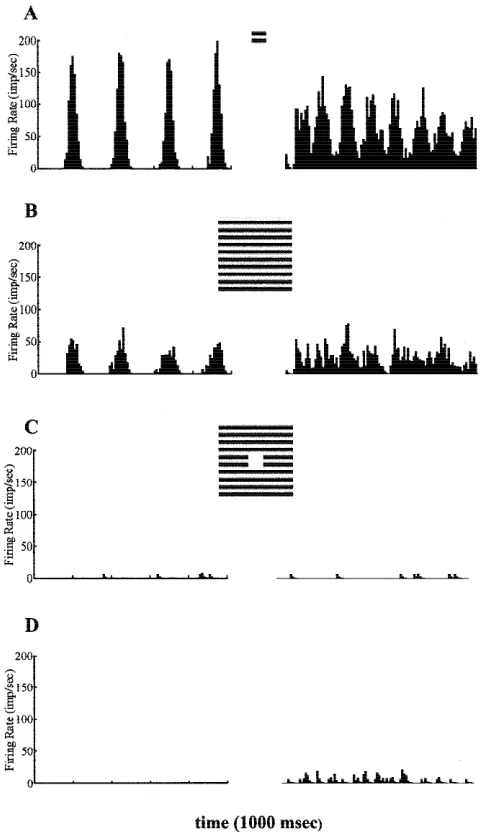
The data described here were obtained from 34 simple and 33 complex cells in primary visual cortex (V1) of the marmoset. Neurons were recorded at eccentricities between 1.02 and 9.9 deg. Fig. 1 shows typical responses of a simple cell (left column) and complex cell (right column). The top row of Fig. 1 illustrates that a grating drifting across the receptive field at the preferred orien-tation, spatial frequency, and temporal frequency evoked a re-sponse that peaks at 180 impulses0s from the simple cell (Fig. 1A left) and one that peaks at 120 impulses0s from the complex cell (Fig. 1A right). The presence of an annular grating beyond the classical receptive field of the same orientation as that preferred by the neuron reduced the peak response of the simple cell by approximately 130 impulses0s (Fig. 1B left), and of the complex cell by about 60 impulse0s. When an annular grating was pre-sented alone, it evoked no response from the simple cell (compare Fig. 1C left with Fig. 1D left) and suppressed the spontaneous activity of the complex cell (compare Fig. 1C right with Fig. 1D right).
Surround modulation of gain
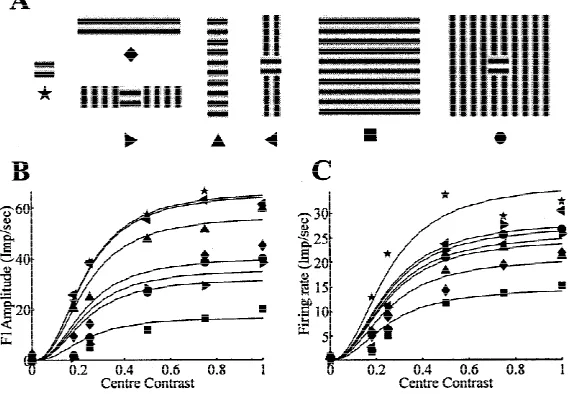
The primary aim of the study was to examine how flanking and annular stimuli of the same and orthogonal orientation to the receptive field presented beyond the receptive field modulated the gain of responses to an optimal stimulus on the receptive field. To characterize how different surround stimuli modulated gain, the Michaelis–Menten equation was fitted to response versus contrast functions obtained under seven stimulus conditions (Fig. 2A). We estimated values of each of the parameters Rmax, c50, and n that
were required to produce curves that fit the neuron’s response
versus contrast function under the seven stimulus conditions. For
each neuron, the seven curves were fit simultaneously and two parameters were constrained to have the same value for all seven curves, while the third parameter and M were allowed to vary from curve to curve. We compared the fits produced by varying each of the three curve parameters, Rmax, c50, and n. Allowing c50to vary
explained more variance than allowing n to vary, but allowing
Rmaxto vary explained the most variance (see Table 1). The mean
fraction of variance explained by allowing Rmaxto vary was 91%.
More than 90% of the variance was explained in 30 (88%) simple cells and 27 (82%) complex cells. The following analysis is confined to Rmaxvalues obtained from these neurons.
Figs. 2B and 2C are examples of constrained fits to data obtained under seven stimulus conditions from a simple and a complex cell, respectively. In both examples, surround stimuli reduced Rmax to the grating on the classical receptive field by
different amounts. Rmax was reduced most when the surround
stimulus was a large annular grating of the same orientation as the grating on the classical receptive field. The response was reduced by up to 75% of the Rmaxin the simple cell, and by up to 60% in
the complex cell. There is no evidence that surround stimulation
increases the response to the grating on the classical receptive field.
The Rmaxvalues obtained in each stimulus condition for each
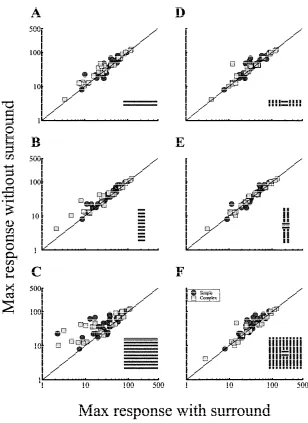
neuron are plotted in Figs. 3A–3F. In each graph, Rmaxvalues for
simple and complex cells obtained in the grating-alone condition are plotted against the Rmaxvalues obtained in each of the surround
stimulus conditions. Data points above the diagonal indicate that the Rmaxwas reduced by the presence of a surround stimulus. Data
points below the diagonal indicate that the Rmaxwas increased by
the presence of a surround stimulus. In the flanking conditions
(Figs. 3A, 3B, 3D, & 3E), the Rmaxof some neurons was usually
reduced but rarely increased. When the orientation of an annular grating was orthogonal to that of the grating on the classical receptive field, the Rmaxwas reduced in a small number of cells
(Fig. 3F). When the orientation of an annular grating matched that of the grating on the classical receptive field, the Rmaxof most
neurons was reduced.
Selectivity and spatial distribution of surround interactions
To examine whether particular stimuli at different locations be-yond the classical receptive field were more effective than others in modulating the gain of V1 neurons, we calculated a Rmaxratio:
@~RmaxEC2RmaxC!0RmaxC#. (3)
RmaxEC is the maximum firing rate obtained during a surround
condition and RmaxC is the maximum firing rate obtained when
only the classical receptive field was stimulated. A ratio of 0 indicates that the Rmax was unaffected by the presence of a
surround stimulus, a positive ratio indicates that the Rmax was
increased by the presence of a surround stimulus, and a negative ratio indicates that it was reduced by the presence of a surround stimulus. Histograms of the Rmaxratio for each surround stimulus
condition are plotted in Fig. 4. The main effect of surround stimulation was to reduce the Rmaxratio. The proportion of
neu-rons in which the reduction in the Rmaxratio was not significant
(i.e. the reduction was less than 10%) in each stimulus condition depicted in Fig. 4 was as follows: panel A, 30057, panel B, 33057, panel C, 20057, panel D, 40057, panel E, 39057, panel F, 33057. It was increased for a minority of cells, but this increment does not appear related to any particular stimulus configuration. One-sample t-tests revealed that the mean Rmaxratio was significantly
less than zero in all stimulus conditions except that depicted in panel E of Fig. 4. Surround gratings with the same orientation as the grating on the classical receptive field reduced the mean Rmax
ratio more (panel A, P,0.001, mean20.1, SEM60.03; panel B, P,0.001, mean20.1, SEM60.03; panel C, P,0.000001, mean20.26, SEM60.04) than surround gratings with a different orientation (panel D, P,0.01, mean20.08, SEM60.02; panel E, P50.125, mean20.03, SEM60.02 ; panel F, P,0.01, mean
20.08, SEM60.03). But, the mean Rmaxratio was reduced most
by large surround stimuli of the same orientation as that preferred by neurons (panel C, P,0.000001, mean20.26, SEM60.04). The mean Rmaxratio and standard error of the mean in each
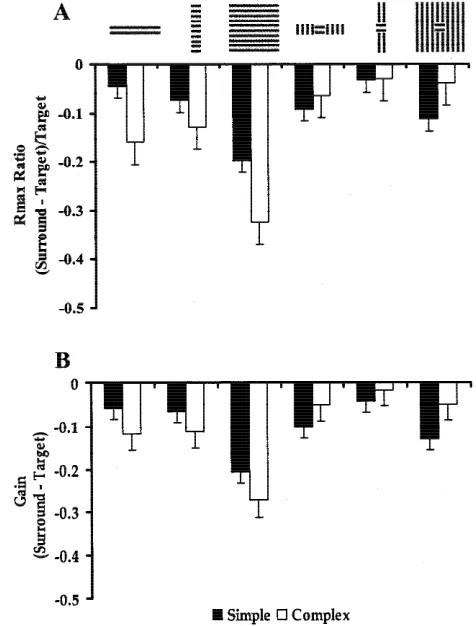
surround stimulus condition for simple and complex cells are plotted in Fig. 5A. The Rmaxratio for both simple and complex
cells was reduced most by annular gratings of the same orientation as the grating on the receptive field. Both flanking and annular gratings of the same orientation as that on the receptive field seemed to be more effective in reducing the Rmaxratio of complex
cells than simple cells. A 2 (cell type: simple vs. complex)32 (grating orientation: horizontal vs. vertical) ANOVA revealed there was a main effect of orientation@F~1, 169!525.53, P,0.000001] and an interaction between cell type and grating orientation
@F~1, 169!513.04, P,0.001]. This analysis shows that surround gratings of the same orientation as the grating on the receptive field were more effective than surround gratings of the orthogonal orientation at reducing the Rmaxratio of V1 neurons. The
[image:5.612.59.301.59.476.2]inter-action indicates that the Rmaxratio in complex cells was reduced
Fig. 1. The response of a simple cell (left column) and complex cell (right
more than the Rmaxratio in simple cells by surround gratings of the
same orientation as the grating on the receptive field.
An alternative measure of gain to changes in Rmaxis the slope
of the response versus contrast function, expressed as the incre-ment in firing rate for each 1% increase in contrast. For compar-ison, we conducted the same analysis as above on the average slope of the response versus contrast function measured over the range of contrasts from 0% to 25%, for each surround stimulus condition. To show how this measure of gain was modulated by surround stimulation, these values were normalized, by subtracting the slope measured in the absence of a surround grating. The mean reduction in gain and standard error of the mean are plotted in Fig. 5B. An ANOVA showed that there was a main effect of grating orientation@F~1, 169!522.79, P,0.00001] and an interaction between cell type and grating orientation@F~1, 169!512.36, P,
0.002]. As was found with the Rmaxratio, surround gratings with
the same orientation as the grating on the receptive field were more effective than orthogonal gratings at reducing the gain of V1 neurons. The gain of complex cells was also reduced more than simple cells by gratings of the same orientation as the classical receptive field.
Walker et al. (1999) found that suppression frequently origi-nated from a single asymmetric location beyond the classical
receptive field. To test whether there was a locus of surround suppression, we examined whether the strength of suppression originating from the ends of the receptive field and the sides of the receptive field were correlated. We consider only cells for which the Rmaxratio was clearly reduced (i.e. by more than 10%) by the
presence of a large annular grating of the same orientation as that preferred by the neuron. There was no evidence of a statistically significant correlation between the reductions in the Rmax ratio
caused by stimulating the ends and sides of the receptive field with gratings of the same orientation as that on the receptive field [Pearson’s r~38!50.08, P50.65]. This suggests that suppression may originate from localized regions beyond the classical recep-tive field.
Direction-selective and bi-directional neurons
Our sample consisted of 38 direction-selective neurons, 15 bi-directional neurons, and four neurons that were not selective for orientation or direction of motion. To ensure that the surround effects reported here are not due to this sampling bias, we con-ducted the same analyses as above on direction-selective and bi-directional cells. The mean Rmaxratio and standard error of the
mean and mean reduction in gain (as above, measured at 25% contrast) and standard error of the mean, for each surround stim-ulus condition for direction and bi-directional cells, are plotted in Figs. 6A and 6B, respectively. Separate ANOVAs revealed that there were only main effects of grating orientation on the Rmax
ratio@F~1, 157!510.17, P,0.01] and on gain measured at 25% contrast@F~1, 157!515.78, P,0.001] . The Rmaxratio and gain
of both direction-selective and bi-directional neurons was reduced most by surround gratings with the same orientation as the grating on the classical receptive field. The important point here, however, is that there were no differences between direction-selective and bi-directional neurons in the extent of modulation from beyond the classical receptive field.
Laminar distribution and retinal eccentricity
[image:6.612.55.339.68.265.2]We were interested to know if there was any laminar organization to neurons that are susceptible to modulation from beyond the Fig. 2. Effects of each surround stimulus (A) on response gain
of a simple cell (B) and complex cell (C). In both cells, the seven curves are best-fitting results of eq. (1), with the parameters fit simultaneously with the following constraints. Parameters c50and n were constrained to have the same value
for all seven curves while Rmaxand M were allowed to vary
[image:6.612.53.294.627.690.2]from curve to curve. The presence of a large annular grating of the same orientation as the grating on the classical recep-tive field was most effecrecep-tive in reducing the response gain of these neurons.
Table 1. The fraction of variance explained (FOVE) by fitting
curves to response versus contrast functions obtained in seven stimulus conditionsa
Best-fitting parameters Rmax c50 n
Simple cells (FOVE.90%) 88% 73% 47%
Complex cells (FOVE.90%) 82% 52% 39%
All cells (Mean FOVE) 91% 83% 69%
aThe seven curves were fit simultaneously, while each of the three
param-eters, Rmax, c50, and n [see eq. (1)], were varied and two of them were
constrained to have the same value for all seven curves. Varying Rmaxwhile c50and n were held constant explained the largest fraction of variance in both simple cells and complex cells.
classical receptive field. Ten neurons could not be assigned to layers, so are not considered further here. Fig. 7 shows the Rmax
ratio for neurons recorded when an annular grating was at the same orientation as the grating on the classical receptive field, plotted against normalized percent depth from the cortical surface. There does not appear to be any laminar organization to neurons that are susceptible to reductions in the Rmax ratio. Unfortunately, there
were not sufficient neurons in each layer to perform any statistics. We recorded data from neurons at a range of retinal eccentric-ities (1.02–9.9 deg). To test whether there were any difference in the strength of surround suppression at different eccentricities, we looked for differences between foveal (1–5 deg) and peripheral (5–9.9 deg) neurons on the Rmaxratio. Even though there was a
trend towards stronger surround suppression in peripheral neurons (20.34,60.07) than in foveal neurons (20.21,60.06), a t-test revealed no statistical difference.
Discussion
We measured how stimulation beyond the classical receptive field modulated the gain of neurons in primary visual cortex (V1) of the
marmoset. Surround stimulation reduced the response gain of V1 neurons in a divisive fashion. Response gain varied with the orientation of the surround stimulus and was reduced most by large surround stimuli of the same orientation as that preferred by neurons. The strength of surround suppression did not vary with laminar distribution or retinal eccentricity.
Below, we compare our results with previous studies on sur-round interactions and the predictions derived from a model of gain control. We also discuss the anatomical substrates of gain control from beyond the classical receptive field.
Surround interactions in V1
Research on surround interactions in V1 has produced contradic-tory results. The definition of the classical receptive field, or center field, adopted by different research groups and the different meth-ods used to map it, are probably at the heart of many discrepancies in the literature (Fitzpatrick, 2000; Walker et al., 2000). The minimum response field method (Barlow et al., 1967) tends to underestimate the size of receptive fields (Bishop & Henry, 1972; Schiller et al., 1976). It provides a smaller estimate of receptive-Fig. 3. Effects of each surround stimulus on the Rmax
of each neuron. The best-fitting Rmaxvalues for the
grating-alone condition are plotted against the best-fitting Rmax values for each surround stimulus, for
each neuron. Rmaxis reduced to the greatest degree in
most neurons by a large annular grating of the same orientation as the grating on the classical receptive field. Other surround stimuli reduced Rmaxin some
[image:7.612.60.368.55.478.2]field size than summation field measurements do with spatially extensive stimuli, such as sinusoidal gratings (Walker et al., 2000; Cavanaugh et al., 2002a). A stimulus that is beyond the minimum response field and evokes no excitatory response is not necessarily beyond the summation field of a neuron. Therefore, some reports that stimuli outside the receptive field increase responses evoked from inside the receptive field (e.g. Gilbert & Wiesel, 1990; Kapadia et al., 1995) may simply be caused by surround stimuli encroaching onto and activating relatively insensitive regions of the summation field. When stimulated alone these regions may evoke only a subthreshold response, but when stimulated in con-junction with the minimum response field, they may evoke a suprathreshold response that is greater than stimulating the mini-mum response field alone. Here we attempted to overcome many of these problems by mapping the summation field of V1 neurons with spatially extensive grating stimuli. We gave particular atten-tion to the centering of stimuli on the classical receptive field and ensuring that surround stimuli did not encroach onto the summa-tion field of V1 neurons (see Materials and methods).
The extraclassical surround in V1 is broadly tuned and less selective than the classical receptive field (DeAngelis et al., 1994; Li & Li, 1994; Cavanaugh et al., 2002b). Suppression of activity in V1 neurons by stimuli in the surround is independent of spatial phase, and is strongest when the parameters of stimuli outside the classical receptive field match the preferences of the neuron (Blakemore & Tobin, 1972; DeAngelis et al., 1994; Li & Li, 1994; Cavanaugh et al., 2002b). Consistent with this work, we found here that responses of marmoset V1 neurons were reduced most when the orientation of surround stimuli matched what neurons preferred on their receptive field. Cavanaugh et al. (2002b) have recently extended this finding and shown that surround suppres-sion is strongest when the parameters of stimuli inside and outside the receptive field match each other, regardless of whether they match the preferences of the neuron.
Stimuli outside the excitatory summation field can, under cer-tain conditions, increase the activity of V1 neurons. Here we use the terms “increase” and “reduce” to mean relative to the response
[image:8.612.310.548.61.374.2]evoked by an optimal stimulus within the summation field of a V1 neuron. An increase in response seems to be mediated by the relative configuration and sign of stimuli within and beyond the summation field. The response of a V1 neuron can be increased when the luminance contrast (Toth et al., 1996; Levitt & Lund, 1997; Polat et al., 1998; Chen et al., 2001; Mizobe et al., 2001), orientation (Sillito et al., 1995; Jones et al., 2002), or direction of motion (Jones et al., 2001; Palmer & Nafziger, 2002) of stimuli within and beyond the summation field are different. Changing the relative luminance contrast and0or orientation of stimuli inside and outside the receptive field can change the sign of the response (Sillito et al., 1995; Toth et al., 1996; Levitt & Lund, 1997; Polat et al., 1998; Chen et al., 2001; Mizobe et al., 2001; Jones et al., 2002). At all luminance contrasts within the summation field, we found that the activity of most V1 neurons was only ever reduced by the presence of a surround stimulus. When stimuli inside and outside the summation field had orthogonal orientations—a con-figuration sometimes found to increase the response of V1 neurons (Sillito et al., 1995; Cavanaugh et al., 2002b; Jones et al., 2002)—we found that they were simply less effective at reducing the response of V1 neurons than when they were at the same orientation. The activity of a minority of neurons in our sample was increased by Fig. 4. Population histograms of the Rmaxratio [eq. (3)] for each surround
stimulus condition. A large annular grating with the same orientation as the grating on the classical receptive field was most effective in reducing the
Rmaxratio. (The distribution is markedly skewed to the left in panel C.) Vertical dashed line represents the mean Rmaxratio.
Fig. 5. Effects of each surround stimulus on the gain of simple and
complex cells. A: Mean Rmaxratio [eq. (3)] for each surround stimulus
condition. B: Average slope of the response versus contrast function measured over the range of contrasts from 0% to 25% (normalized by subtracting the slope measured in the absence of a surrounding grating) for each surround stimulus condition. Both measures of gain were reduced most by surround gratings of the same orientation as the grating on the classical receptive field.
[image:8.612.60.291.63.241.2]stimulation beyond the classical receptive field. But these small response increments were rare and were not produced systemati-cally by any particular stimulus configuration.
Walker et al. (1999) found that surround suppression frequently originated from a single asymmetric region beyond the classical receptive field. The stimuli we used here were not appropriate to test for such effects. But the lack of a correlation between the strength of suppression originating at the ends and sides of the receptive field that we found here suggests that surround effects in marmoset V1 may originate from localized regions beyond the receptive field. Indeed, we suspect that, as Walker and his col-leagues found in cats, surround effects in marmoset V1 originate from asymmetric, symmetric, and broadly distributed locations beyond the classical receptive field.
Gain control
There are several different ways in which surround interactions might modulate the contrast–response relationship of V1 neurons. These can be represented by changes in the parameters of the Michaelis–Menten equation, which is known to provide a good description of the contrast–response relationship of most neurons
in V1 (Albrecht & Hamilton, 1982). An increase in the semisatu-ration constant shifts the contrast–response curve rightwards, re-ducing contrast sensitivity by a constant proportion (contrast gain control). A reduction in the maximum obtainable response com-presses the contrast–response curve downwards, scaling the re-sponse at all contrasts (rere-sponse gain control). An increase in the steepness of the contrast–response curve limits the range of con-trasts to which a neuron can increase its response.
Heeger’s contrast normalization model (Heeger, 1991, 1992) predicts that inhibition in V1 can be explained by a single contrast gain-control mechanism. We (results reported here), and others (Sengpiel et al., 1998; Cavanaugh et al., 2002a), have found that a response gain model provides the best description of the effects of surround stimulation on gain (but see, DeAngelis et al., 1994). Other cortical phenomena, such as cross-orientation suppression (Bonds, 1989; Sengpiel et al., 1998) and contrast adaptation (Ohzawa et al., 1985; Sclar et al., 1989), are better described by a contrast gain model. A model that includes both response gain and contrast gain mechanisms provides a better description of interocular sup-pression (Sengpiel et al., 1998). Taken together, these results suggest that surround suppression has a neural substrate that is distinct from other cortical inhibitory phenomena. Heeger’s model also predicts that gain control signals are pooled over a range of orientations. Contrary to these predictions, we found that surround suppression is described best by a response gain mechanism that is selective for orientation.
[image:9.612.317.553.57.233.2]Although we presented stimuli in apertures covering different regions of the visual field—one that covered the summation field and one that surrounded it—spatial summation experiments sug-gest that center and surround mechanisms actually overlap. The center and surround fields of V1 neurons are modelled as over-lapping excitatory and inhibitory Gaussian sensitivity functions. Typically, the surround mechanism is more spatially extensive and has a subtractive influence on the center mechanism (DeAngelis et al., 1994; Sceniak et al., 1999; Walker et al., 2000; Sceniak et al., 2001; Levitt & Lund, 2002). One implementation of this model revealed that the summation field of a V1 neuron is dynamic: it Fig. 6. Effects of each surround stimulus on the gain of direction-selective
[see eq. (2)] and bi-directional neurons. A: Mean Rmaxratio [eq. (3)] for
each surround stimulus condition. B: Average slope of the response versus contrast function measured over the range of contrasts from 0% to 25% (normalized by subtracting the slope measured in the absence of a sur-rounding grating) for each surround stimulus condition. Surround stimuli had equivalent effects on the gain of direction-selective and bi-directional neurons.
Fig. 7. Laminar distribution of surround suppression. The Rmax ratio,
[image:9.612.66.297.58.375.2]samples more of the visual field at low contrast than at high contrast (Sceniak et al., 1999). Our data, however, are clearly more consistent with a model in which the surround has a divisive influence on the center mechanism (Cavanaugh et al., 2002a; Sceniak et al., 2001). Cavanaugh et al. (2002a) have devised a model that implements a general form of divisive suppression. Center and surround mechanisms are modelled as overlapping Gaussians, but each has its own gain control. Independent gain-control mechanisms in the center and surround enable the divisive influence of the surround to scale responses up and down, depend-ing on the relative strength of each mechanism. The apparent increase in size with contrast occurs because of this scaling of sensitivity (Cavanaugh et al., 2002a).
Anatomical substrates for surround interactions
Surround interactions were not localized to any particular cortical layer(s). In each layer from which we obtained data, the strength of signals from the surround field of neurons ranged from negli-gible to weak to very strong. As others (Sceniak et al., 2001; Cavanaugh et al., 2002a; Levitt & Lund, 2002; Yao & Li, 2002) have found, it seems that surround interactions are a general property of V1, with different neurons being affected to different extents.
What is the circuitry that mediates surround interactions in V1? Surround interactions may be mediated by intrinsic lateral and0or feedback connections in V1 (Rockland & Lund, 1982, 1983; Livingstone & Hubel, 1984; Kennedy & Bullier, 1985; Gilbert & Wiesel, 1989; Malach et al., 1993; Budd, 1998; Lamme & Roelf-sema, 2000; Bullier, 2001). Combined anatomical and physiolog-ical studies conducted by Angelucci and her colleagues (Angelucci et al., 2002a,b) suggest that feedback connections from extrastri-ate cortex are the most likely substrextrastri-ate. They compared the spatial extent of feedforward input from the lateral geniculate nucleus (LGN), intrinsic lateral connections, and feedback connections from extrastriate cortex with that of the minimum response field, the summation field, and extraclassical surround field of V1 neu-rons. They concluded that in V1 LGN input mediates activity in summation fields measured with high contrast stimuli, horizontal connections mediate activity in summation fields measured with low contrast stimuli, and feedback connections mediate inter-actions between stimuli within and beyond summation fields (An-gelucci et al., 2002a,b).
Gain control appears to be a fundamental property of early visual processing. We have found that, in both the LGN (Webb et al., 2002) and V1 of marmosets (results reported here), response gain is reduced in a divisive fashion by input from beyond the classical receptive field. In the LGN, gain control may be mediated by the feedback projection from V1 (Przybyszewski et al., 2000; Webb et al., 2002). In V1, modulation of gain-control signals from beyond the summation field are probably mediated by feedback from extrastriate cortex (Angelucci et al., 2002a,b).
Cortical feedback projections may control information flowing through the visual hierarchy by modulating the gain of neurons at the preceding stage. In the LGN, this mechanism is mediated by an excitatory feedback projection from V1 that influences responses evoked from inside the classical receptive field (Przybyszewski et al., 2000). Inhibition from outside the classical receptive field modulates the excitatory influence of the cortex in the LGN (Webb et al., 2002). In V1, feedback from extrastriate cortex may have a more direct effect on inhibitory influences from outside the sum-mation field, possibly via inhibitory interneurons.
Conclusion
Input from beyond the classical receptive field reduced response gain in a divisive fashion. Reductions in response gain were most prominent when the orientation of large stimuli beyond the clas-sical receptive field matched that preferred by neurons. Response gain control in the early visual system may be mediated by the interaction between cortical feedback and inhibitory influences from beyond the classical receptive field.
Acknowledgments
This work was supported by grants from the Wellcome Trust, the BBSRC, and a Wellcome Prize studentship to Ben S. Webb. We thank Carl Espin for technical support, Peter Lennie for allowing us to use his software, and the two anonymous reviewers for their comments.
References
Albrecht, D.G. & Hamilton, D.B.(1982). Striate cortex of monkey and cat: Contrast response function. Journal of Neurophysiology 48, 217–237.
Albright, T.D. & Stoner, G.R.(2002). Contextual influences on visual processing. Annual Review of Neuroscience 25, 339–379.
Allman, J., Miezin, F. & McGuinness, E. (1985). Stimulus specific responses from beyond the classical receptive field: Neurophysiologi-cal mechanisms for loNeurophysiologi-cal-global comparisons in visual neurons. Annual Review of Neuroscience 8, 407– 430.
Angelucci, A., Levitt, J.B. & Lund, J.S.(2002a). Anatomical origins of the classical receptive field and modulatory surround field of single neurons in macaque visual cortical area V1. Progress in Brain Research 136, 373–388.
Angelucci, A., Levitt, J.B., Walton, E.J.S., Hupé, J.M., Bullier, J. & Lund, J.S.(2002b). Circuits for local and global signal integration in primary visual cortex. Journal of Neuroscience 22, 8633–8646.
Barlow, H.B., Blakemore, C. & Pettigrew, J.D.(1967). The neural mechanism of binocular depth discrimination. Journal of Physiology 193, 327–342.
Bishop, P.O. & Henry, G.H. (1972). Striate neurons: Receptive field concepts. Investigative Ophthalmology 11, 346–354.
Blakemore, C. & Tobin, E.A.(1972). Lateral inhibition between orien-tation detectors in the cat’s visual cortex. Experimental Brain Research 15, 439– 440.
Bonds, A.B.(1989). Role of inhibition in the specification of orientation selectivity of cells in the cat striate cortex. Visual Neuroscience 2, 41–55.
Budd, J.M.L. (1998). Extrastriate feedback to primary visual cortex in primates: A quantitative analysis of connectivity. Proceedings of the Royal Society (B) (London) 265, 1037–1044.
Bullier, J.(2001). Integrated model of visual processing. Brain Research Reviews 36, 96–107.
Carandini, M., Heeger, D.J. & Movshon, J.A.(1997). Linearity and normalization in simple cells of the macaque primary visual cortex. Journal of Neuroscience 17, 8621–8644.
Cavanaugh, J.R., Bair, W. & Movshon, J.A. (2002a). Nature and interaction of signals from the receptive field center and surround in macaque V1 neurons. Journal of Neurophysiology 88, 2530–2546.
Cavanaugh, J.R., Bair, W. & Movshon, J.A.(2002b). Selectivity and spatial distribution of signals from the receptive field surround in macaque V1 neurons. Journal of Neurophysiology 88, 2547–2556.
Chen, C.C., Kasamatsu, T., Polat, U. & Norcia, A.M.(2001). Contrast response characteristics of long-range lateral interactions in cat striate cortex. Neuroreport 12, 655– 661.
Deangelis, G.C., Freeman, R.D. & Ohzawa, I.(1994). Length and width tuning of neurons in the cat’s primary visual cortex. Journal of Neurophysiology 71, 347–374.
Fitzpatrick, D. (2000). Seeing beyond the receptive field in primary visual cortex. Current Opinion in Neurobiology 10, 438– 443.
Geisler, W.S. & Albrecht, D.G.(1992). Cortical neurons: Isolation of contrast gain control. Vision Research 32, 1409–1410.
Gilbert, C.D. & Wiesel, T.N.(1989). Columnar specificity of instrinsic horizontal and corticocortical connections in cat visual cortex. Journal of Neuroscience 9, 2432–2442.
Gilbert, C.D. & Wiesel, T.N.(1990). The influence of contextual stimuli on the orientation selectivity of cells in primary visual cortex of the cat. Vision Research 30, 1689–1701.
Heeger, D.J.(1991). Nonlinear model of neural responses in cat visual cortex. In Computational Models of Visual Processing, ed.Landy, M. & Movshon, J.A., pp. 119–133. Cambridge, Massachusetts: MIT Press.
Heeger, D.J.(1992). Normalization of cell responses in cat striate cortex. Visual Neuroscience 9, 181–197.
Hubel, D.H. & Wiesel, T.N.(1962). Receptive fields, binocular inter-action and functional architecture in cat’s visual cortex. Journal of Physiology (London) 160, 106–154.
Hubel, D.H. & Wiesel, T.N. (1968). Receptive fields and functional architecture of monkey striate cortex. Journal of Physiology (London) 195, 215–243.
Jones, H.E., Grieve, K.L., Wang, W. & Sillito, A.M.(2001). Surround suppression in primate V1. Journal of Neurophysiology 86, 2011– 2028.
Jones, H.E., Wang, W. & Sillito, A.M.(2002). Spatial organization and magnitude of orientation contrast interactions in primate V1. Journal of Neurophysiology 88, 2796–2808.
Kapadia, M.K., Ito, M. & Gilbert, C.D.(1995). Improvement in visual sensitivity by changes in local context: Parallel studies in human observers and V1 of alert monkeys. Neuron 15, 843–856.
Kapadia, M.K., Westheimer, G. & Gilbert, C.D. (1999). Dynamics of spatial summation in primary visual cortex of alert monkeys. Proceedings of the National Academy of Sciences of the U.S.A. 96, 12073–12078.
Kastner, S., Nothdurft, H.C. & Pigarev, I.N.(1997). Neuronal corre-lates of pop-out in cat striate cortex. Vision Research 37, 371–376.
Kennedy, H. & Bullier, J.(1985). A double-labeling investigation of the afferent connectivity to cortical areas V1 and V2 of the macaque monkey. Journal of Neuroscience 5, 2815–2830.
Lamme, V.A.F.(1995). The neurophysiology of figure-ground segregation in primary visual cortex. Journal of Neuroscience 15, 1605–1615.
Lamme, V.A.F. & Spekreijse, H.(2000). Contextual modulation in pri-mary visual cortex and scene perception. In The New Cognitive Neuro-sciences, ed.Gazzaniga, M., pp. 279–290. Cambridge, Massachusetts: MIT Press. .
Lamme, V.A.F. & Roelfsema, P.R.(2000). The distinct modes of vision offered by feedforward and recurrent processing. Trends in Neurosci-ences 23, 571–579.
Levitt, J.B. & Lund, J.S. (1997). Contrast dependence of contextual effects in primate visual cortex. Nature 387, 73–76.
Levitt, J.B. & Lund, J.S.(2002). The spatial extent over which neurons in macaque striate cortex pool visual signals. Visual Neuroscience 19, 439– 452.
Li, C.Y. & Li, W.(1994). Extensive integration field beyond the classical receptive field of cat’s striate cortical neurons—classification and tuning properties. Vision Research 34, 2337–2355.
Livingstone, M.S. & Hubel, D.H.(1984). Specificity of intrinsic con-nections in primate primary visual cortex. Journal of Neuroscience 4, 2830–2835.
Maffei, L. & Fiorentini, A.(1976). The unresponsive regions of visual cortical receptive fields. Vision Research 16, 1131–1139.
Malach, R., Amir, Y., Harel, M. & Grinvald, A.(1993). Relationship between intrinsic connections and functional architecture revealed by optical imaging and in vivo targeted biocytin injections in primate striate cortex. Proceedings of the National Academy of Sciences of the U.S.A. 90, 10469–10473.
Merrill, E.G. & Ainsworth, A.(1972). Glass-coated platinum-plated tungsten microelectrodes. Medical and Biological Engineering 10, 662– 672.
Mizobe, K., Polat, U., Pettet, M.W. & Kasamatsu, T.(2001). Facili-tation and suppression of single striate-cell activity by spatially discrete pattern stimuli presented beyond the receptive field. Visual Neurosci-ence 18, 377–391.
Nelson, J.I. & Frost, B.(1978). Orientation selective inhibition from beyond the classical receptive field. Brain Research 139, 359–365.
Nothdurft, H.C., Gallant, J.L. & Van Essen, D.C.(1999). Response modulation by texture surround in primate area V1: Correlates of “popout” under anesthesia. Visual Neuroscience 16, 15–34.
Ohzawa, I., Sclar, G. & Freeman, R.D.(1985). Contrast gain control in the cat’s visual system. Journal of Neurophysiology 3, 651– 667.
Palmer, L.A. & Nafziger, J.S.(2002). Effects of surround motion on receptive-field gain and structure in area 17 of the cat. Visual Neuro-science 19, 335–353.
Polat, U., Mizobe, K., Pettet, M.W., Kasamatsu, T. & Norcia, A.M.
(1998). Collinear stimuli regulate visual responses depending on cell’s contrast threshold. Nature 391, 580–584.
Przybyszewski, A.W., Gaska, J.P., Foote, W. & Pollen, D.A.(2000). Striate cortex increases contrast gain of macaque LGN neurons. Visual Neuroscience 17, 485– 494.
Rockland, K.S. & Lund, J.(1982). Widespread periodic intrinsic con-nections in the tree shew visual cortex. Science 215, 1532–1534.
Rockland, K.S. & Lund, J.(1983). Intrinsic laminar lattice connections in primate visual cortex. Journal of Comparative Neurology 216, 303–318.
Rossi, A.F., Desimone, R. & Ungerleider, L.G. (2001). Contextual modulation in primary visual cortex of macaques. Journal of Neuro-science 21, 1698–1709.
Sceniak, M.P., Ringach, D.L., Hawken, M.J. & Shapley, R.(1999). Contrast’s effect on spatial summation by macaque V1 neurons. Nature Neuroscience 2, 733–739.
Sceniak, M.P., Hawken, M.J. & Shapley, R. (2001). Visual spatial characterization of macaque V1 neurons. Journal of Neurophysiology 85, 1873–1887.
Schiller, P.H., Finlay, B.L. & Volman, S.F.(1976). Quantative studies of single-cell properties in monkey striate cortex. I. Spatiotemporal organization of receptive field. Journal of Neurophysiology 39, 1288– 1319.
Sclar, G., Lennie, P. & Depriest, D.D.(1989). Contrast adaptation in striate cortex of macaque. Vision Research 7, 747–755.
Sengpiel, F., Baddeley, R., Freeman, T.C.B., Harrad, R. & Blakemore, C.(1998). Different mechanisms underlie three inhibitory phenomena in cat area 17. Vision Research 38, 2067–2080.
Sillito, A.M., Grieve, K.L., Jones, H.E., Cudeiro, J. & Davis, J.(1995). Visual cortical mechanisms detecting focal orientation discontinuities. Nature 378, 492– 496.
Skottun, B.C., De Valois, R.L., Grosof, D.H. & Movshon, J.A.(1991). Classifying simple and complex cells on the basis of response modu-lation. Vision Research 31, 1079–1986.
Sugita, Y.(1999). Grouping of image fragments in primary visual cortex. Nature 401, 269–272.
Toth, L.J., Rao, S.C., Kim, D., Somers, D. & Sur, M. (1996). Sub-threshold facilitation and suppression in primary visual cortex revealed by intrinsic signal imaging. Proceedings of the National Academy of Sciences of the U.S.A. 93, 9869–9874.
Truchard, A.M., Ohzawa, I. & Freeman, R.D.(2000). Contrast gain control in the visual cortex: Monocular versus binocular mechanisms. Journal of Neuroscience 20, 3017–3032.
Walker, G.A., Ohzawa, I. & Freeman, R.D.(1999). Asymmetric sup-pression outside the classical receptive field of the visual cortex. Journal of Neuroscience 19, 10536–10553.
Walker, G.A., Ohzawa, I. & Freeman, R.D.(2000). Suppression outside the classical cortical receptive field. Visual Neuroscience 17, 369–379.
Webb, B.S., Tinsley, C.J., Barraclough, N.E., Easton, A., Parker, A. & Derrington, A.M.(2002). Feedback from V1 and inhibition from beyond the classical receptive field modulates the responses of neurons in the primate lateral geniculate nucleus. Visual Neuroscience 19, 583–592.
Wörgötter, F. & Eysel, U.T.(2000). Context, state and the receptive fields of striatal cortex cells. Trends in Neurosciences 23, 497–503.
Yao, H. & Li, C.Y.(2002). Clustered organization of neurons with similar extra-receptive field properties in the primary visual cortex. Neuron 35, 547–553.
![Fig. 6. Effects of each surround stimulus on the gain of direction-selective[see eq. (2)] and bi-directional neurons](https://thumb-us.123doks.com/thumbv2/123dok_us/8092931.231911/9.612.66.297.58.375/fig-effects-surround-stimulus-direction-selective-directional-neurons.webp)
