consistency checking
.
White Rose Research Online URL for this paper:
http://eprints.whiterose.ac.uk/2648/
Article:
Paige, Richard F. orcid.org/0000-0002-1978-9852, Brooke, Phillip J. and Ostroff, Jonathan
S. (2007) Metamodel-based model conformance and multiview consistency checking.
ACM Transactions on Software Engineering and Methodology. 11. B1-B49. ISSN
1049-331X
https://doi.org/10.1145/1243987.1243989
[email protected] https://eprints.whiterose.ac.uk/ Reuse
Items deposited in White Rose Research Online are protected by copyright, with all rights reserved unless indicated otherwise. They may be downloaded and/or printed for private study, or other acts as permitted by national copyright laws. The publisher or other rights holders may allow further reproduction and re-use of the full text version. This is indicated by the licence information on the White Rose Research Online record for the item.
Takedown
If you consider content in White Rose Research Online to be in breach of UK law, please notify us by
Universities of Leeds, Sheffield and York
http://eprints.whiterose.ac.uk/
This is an author produced version of a paper to be/subsequently published in
ACM Transactions on Software Engineering and Methodology. (This paper
has been peer-reviewed but does not include final publisher proof-corrections or
journal pagination.)
White Rose Research Online URL for this paper:
http://eprints.whiterose.ac.uk/2648
Published paper
Paige RF, Brooke PJ, Ostroff JS. Metamodel-Based Model Conformance and
Multi-View Consistency Checking. ACM Transactions on Software Engineering
and Methodology 2007 Association for Computing Machinery; 16 (3): B1-B49.
Metamodel-Based Model Conformance and
Multi-View Consistency Checking
RICHARD F. PAIGE University of York, UK. PHILLIP J. BROOKE University of Teesside, UK. and
JONATHAN S. OSTROFF York University, Canada.
Model-driven development – using languages such as UML and BON – often makes use of multiple diagrams (e.g., class and sequence diagrams) when modelling systems. These diagrams, presenting different views of a system of interest, may be inconsistent. A metamodel provides a unifying framework in which to ensure and check consistency, while at the same time providing the means to distinguish between valid and invalid models, i.e., conformance. Two formal specifications of the metamodel for an object-oriented modelling language are presented, and it is shown how to use these specifications for model conformance and multi-view consistency checking. Comparisons are made in terms of completeness and the level of automation each provide for checking multi-view consistency and model conformance. The lessons learned from applying formal techniques to the problems of metamodelling, model conformance, and multi-view consistency checking are summarized.
Categories and Subject Descriptors: D.2.2 [Software Engineering]: Design Tools and Tech-niques—Object-oriented design methods
General Terms: Design; Languages; Verification
Additional Key Words and Phrases: Metamodelling, multi-view consistency, formal methods, automated verification
This research was partially supported by the National Sciences and Engineering Research Council of Canada, and by the European Commission under IST # 51173.
Authors’ addresses: Richard F. Paige, Department of Computer Science, University of York, Heslington, York YO10 5DD, UK. [email protected]. Phillip J. Brooke, School of Computing, University of Teesside, Middlesbrough, TS1 3BA. [email protected]. Jonathan S. Ostroff, Department of Computer Science and Engineering, York University, Toronto, Ontario, Canada. [email protected].
c
ACM, 2007. This is the author’s version of the work. It is posted here by permission of the ACM for your personal use. Not for redistribution. The definitive version was published in ACM TOSEM 16(3), July 2007. http://doi.acm.org/10.1145/1243987.1243989
Permission to make digital/hard copy of all or part of this material without fee for personal or classroom use provided that the copies are not made or distributed for profit or commercial advantage, the ACM copyright/server notice, the title of the publication, and its date appear, and notice is given that copying is by permission of the ACM, Inc. To copy otherwise, to republish, to post on servers, or to redistribute to lists requires prior specific permission and/or a fee.
c
1. INTRODUCTION
Modelling languages such as UML 2.0 [Object Management Group 2003b] and BON [Walden and Nerson 1995] form the basis of model-driven approaches to building
software systems. The Model-Driven Architecture (MDA) initiative of the OMG
[Object Management Group 2003a] makes modelling languages the primary tool of developers in all stages of the systems engineering process, whether carrying out requirements engineering, system modelling, deployment, implementation, testing, or transformation. The modelling languages used during model-driven development must be carefully designed, supportable and supported by tools, and understand-able and explainunderstand-able to developers and domain experts.
A modelling language is typically described using one or moremetamodels
[Ob-ject Management Group 2003b], which are used to define thesyntax of the language,
the well-formedness constraints it must obey, and the semantics of the language’s constructs. Most often, metamodels are constructed to represent abstract syntax and well-formedness constraints, though some efforts are beginning to appear on metamodels of language semantics [Xactium 2006] and concrete syntax [Fondement and Baar 2005].
Metamodelling is now accepted as a critical part of the design of modelling lan-guages [Evans et al. 2005]: without a precise, consistent, and validated metamodel specification, it is difficult to explain a language, build tools to support it, and produce consistent and unambiguous models. The importance of metamodelling is reflected in the literature – e.g., the recent workshop on metamodelling for support of MDA [Evans et al. 2003] – the substantial effort placed in reengineering the metamodel of UML for version 2.0 [Object Management Group 2004b], the empha-sis on metamodelling in Eclipse, via the Eclipse Modelling Framework [Budinsky et al. 2003], and the focus of the EU Integrated Project MODELWARE, wherein metamodelling pervades all aspects of the project. Metamodelling is also widely accepted as a non-trivial task, especially for industrial-strength languages, which
have large and complex syntaxes and semantics, and often make use of multiple
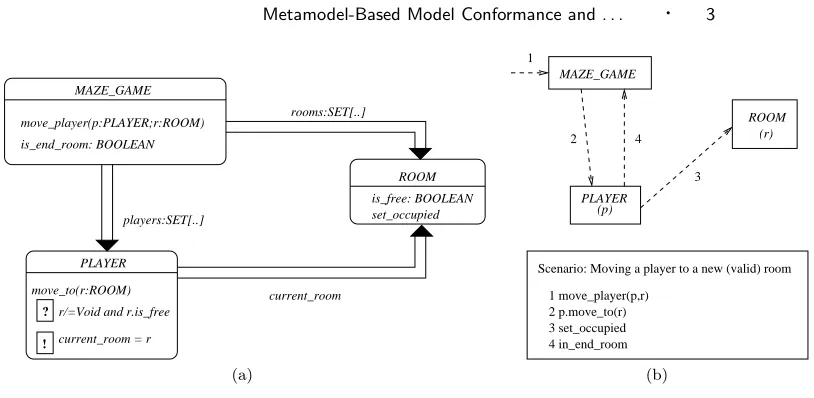
cross-cutting views. A view is a description that represents a system from a partic-ular perspective (e.g., system architecture, behaviour, contract, deployment), and thus includes a subset of the system’s elements (e.g., modules). A view is often represented using a separate diagram, e.g., class diagrams for structure, communi-cation diagrams for system behaviour (though standards such as IEEE 1471 [IEEE 2000] do not require this). Consider, for example, the simple system model pre-sented in Fig. 1, which illustrates two commonly used views, each reprepre-sented using a separate diagram.
On the left is a class diagram in BON syntax and on the right is a dialect of UML 2.0 communication diagrams. These represent the same system but from different perspectives: the architectural and the behavioural. A third view, represented by
current_room
?
!
move_player(p:PLAYER;r:ROOM)
is_end_room: BOOLEAN MAZE_GAME
ROOM
players:SET[..]
rooms:SET[..]
is_free: BOOLEAN set_occupied
r/=Void and r.is_free
current_room = r move_to(r:ROOM)
PLAYER
(a)
3 set_occupied
MAZE_GAME
ROOM (r)
PLAYER (p)
1
2
3 4
Scenario: Moving a player to a new (valid) room 1 move_player(p,r)
2 p.move_to(r)
[image:5.595.127.534.92.291.2]4 in_end_room (b) Fig. 1. Diagrams presenting a multi-view model
precondition is nottrue before a routine is called. We return to this example later, in Section 4. More complex and realistic examples showing the value of multi-view consistency checking are discussed in, e.g., [MODELWARE 2005].
The contribution of this paper is a comparison of two metamodelling approaches that can be used to detect inconsistencies like the ones contained in Fig. 1. The approaches differ in terms of their completeness (i.e., the kinds of inconsistencies that can be detected) and the level of automation provided. We make this more precise in the next subsection.
1.1 Model conformance and multi-view consistency checking
The presence of a clearly specified, understandable, tool-supported metamodel for a
modelling language makes it feasible to carry outmodel conformanceandmulti-view
consistency checking (MVCC). A metamodel captures the syntax and semantics of all the modelling concepts in a language (e.g., concepts such as classes, objects, pro-cedures, processes, documents, and services) and thus provides the context needed for expressing well-formedness constraints for models and on multiple views. With model conformance, it is checked that a model satisfies the constraints captured in the metamodel, i.e., that the model is indeed a valid instance of the metamodel. With MVCC, it is shown that two or more diagrams, each presenting a different view, do not contradict each other according to a set of (meta-level) rules. As we shall see shortly, it is possible to unify the definitions of MVCC and model conformance checking.
The constraints encoded in a metamodel in turn lead us to a precise definition of model conformance and multi-view consistency as follows.
Formally, model conformance – i.e., checking that a model satisfies the well-formedness constraints of a language – and multi-view consistency checking can be
defined as follows. LetLbe a modelling language, andMM a metamodel forL. Let
M be a model, expressed in the language L. MM consists of a set of constraints,
which can conceptually be partitioned into those capturing the abstract syntax of
can, conceptually, be partitioned into those that define the semantics of a single view (e.g., class diagrams in UML) and those that define the consistency of multiple views1. Thus, if v1 andv2 are views expressible in languageL, then
SEM =b ∀v1∈L•SVC(v1)∧
∀v1,v2∈L|v16=v2•MVC(v1,v2)
whereSVC(v1) is the set of semantic constraints on the viewv1, andMVC(v1,v2)
is the set of semantic constraints on the two viewsv1,v2.
The notion of modelM conforming to the metamodelMM is defined as follows.
conforms(M,MM)=b ∀c∈MM •M satc
i.e., the modelM satisfies each well-formedness constraintcof the metamodelMM.
Note that if the modelM consists of two or more views (e.g., a class diagram and
a statechart in UML) thenconforms(M,MM) will establish that (a)M conforms
to the metamodeland (b) the views are mutually consistent.
Of course, steps (a) and (b) can be separated – i.e., the definitions of conformance and multi-view consistency can be constructed independently, and this may be use-ful in specifying the behaviour of separate conformance and consistency checking tools. Our definition suggests that – for metamodel-based approaches – it is ap-propriate to unify the notions of model conformance and multi-view consistency,
at least conceptually2. It also implies that mathematical techniques can play a
substantial role in these processes.
In practice, a variety of different views are used in model-driven development [Object Management Group 2004b] Most widespread are the views presented by a variety of UML 2.0 diagrams: class diagrams (i.e., a structural view), state charts (i.e., a behavioural view pertaining to the properties of a single class or object), communication diagrams (i.e., a behavioural view pertaining to the properties of more than one object), and executable code. Class contracts – e.g., pre- and post-conditions of routines of a class – can also be considered as views, though they are not usually represented using diagrams, and are often integrated within other views (e.g., in Catalysis [D’Souza and Wills 1998] and in BON). As well, different
versions of the same kind of diagram can be perceived as presenting different views of a system which must be consistent. Conceptually, there is no difference between multi-view consistency checking when applied to different kinds of diagrams versus different versions of diagrams, and similar techniques can be used for each, e.g., see [MODELWARE 2005]. However, additional model management problems exist when dealing with different versions of models, such as the need to carry out model merging. We do not discuss this related topic further in this paper.
Most of the previous work on metamodel-based multi-view consistency – dis-cussed in Section 2 – has focused on class diagrams and state charts, and very little has examined the use ofcontracts – i.e., pre- and postconditions on messages appearing in sequence diagrams – unlike the work in this paper. Contracts are
of increasing importance in model-driven development – they are supported by a number of languages and methodologies, such as UML 2.0 and Catalysis, as well as the recent Architecture Analysis and Design Language (AADL) standard [Society of Automotive Engineers 2005], which makes use of a contract annexe for improving the precision of modelling, and improving capabilities for analysis. As such, it is important to address their impact on multi-view consistency checking.
1.2 Aims of this paper
This paper contributes a detailed comparison of using two different (tool-supported) approaches for metamodelling, model conformance, and multi-view consistency checking, including contracts. The work applies to any modelling language – such as UML 2.0 with OCL and BON – that supports views presented by class
dia-grams and communication diadia-grams, and that also supports use of contracts for
capturing detailed behaviour of objects. In particular, we contribute techniques and comparisons of approaches used for handling the consistency issues raised by using contracts in the diagrams. By including contracts we implicitly introduce a third view, that which describes the behaviour of classes of objects.
We have focused on these views because they present more challenges – partic-ularly when considering contracts – than other views, and also because there is less related work. There is nothing in the approaches presented and compared in this paper that prevent them being extended to additional views (e.g., deployment, business rules). The extension process may be made easier by having a clear un-derstanding of how to construct metamodels and carry out consistency checking for the structural and behavioural views discussed earlier.
We present this synthesis in order to suggest guidelines and recommend practices on the development of modelling languages. Our aim is to provide pragmatic advice to users and developers of modelling languages on useful ways in which to carry out metamodelling and metamodel-based conformance and multi-view consistency checking in a practical, tool-supported way, based on the use of formal techniques. This advice in turn could influence decisions on the techniques used to construct and validate metamodels, and language designs, in the future.
To this end, we compare and contrast two approaches to metamodelling for object-oriented languages: one approach uses the PVS specification language [Owre et al. 1999], while the second uses Eiffel [Meyer 1992] as aspecification language, i.e., we make use of Eiffel’sdeclarative specification techniques, particularly agents (discussed in Section 2) for expressing metamodels. Both approaches also sup-port model conformance checking. The two languages used for metamodelling and checking in these approaches – theorem proving and object-oriented programming, respectively – are very different and have advantages and disadvantages, which we attempt to draw out in our discussion. We choose PVS as it is representative as state-of-the-art in theorem proving technology. We choose Eiffel as it is representa-tive of state-of-the-art executable object-oriented languages that support contracts; an alternative to Eiffel might be Spec# [Microsoft 2006], but it is still under devel-opment.
lessons learned in terms of thecompleteness of the approaches – i.e., does the ap-proach support all elements of the modelling language in full? – and in terms of the level ofautomation offered in checking theconforms relation, i.e., for carrying out conformance and multi-view consistency checking.
It is important to note that when comparing the two approaches to metamod-elling, we are not attempting a like-for-like comparison, i.e., attempting to use the same approach to metamodelling in both PVS and Eiffel. Instead, we will
con-siderbest practices with each technology, focusing on the typical way in which an
engineer might use PVS or Eiffel for metamodelling, model conformance, and multi-view consistency checking. Since the approaches offered are – as one would expect – quite different, we will need to identify criteria in order to have a common basis for comparison. These will be precisely specified in Sections 3 and 4; an informal summary of the criteria that will be used is in Table I. There is a level of subjectiv-ity in comparisons involving these criteria; the aim of the comparison is to provide general guidance on how to construct metamodels, as well as select metamodelling languages and multi-view consistency checking approaches.
—Understandability: the extent to which the descriptions used are understandable to a rea-sonably experienced software engineer who has modelling language, but not necessarily formal methods, experience.
—Correctness: the extent to which metamodel descriptions have been checked against their specifications.
—Completeness: the extent to which all features of the modelling language (including multi-view consistency constraints) are supported in the metamodelling approach.
—Maintainability: the extent to which the descriptions support extension, refactoring, and wholesale modification.
—Tool construction: the extent to which tools are available to support producing the descrip-tions.
—Tool-based V&V:the extent to which tools are available to assist in verifying and validating the descriptions.
—Automation in MVCC:the extent to which multi-view consistency checking can be carried out automatically.
Table I. Criteria for comparison of metamodelling and MVCC approaches
We are not aiming at a comprehensive overview of the field; in particular, we do not consider all aspects of consistency checking in the domain of the MDA. We omit refinement-based consistency in MDA, though many of the techniques in this paper, we claim, can be extended to handle this; see [Paige et al. 2005] for more details on this. Further, we are focusing on metamodel-based techniques, since these are critical and widely used in the model-driven development community, rather than fully considering the problems of model conformance and consistency.
The comparisons will be carried out using the BON modelling language [Walden and Nerson 1995] as an exemplar (see Section 2). BON is concise enough so as to convey and cover all of the language within this paper. BON provides three views: a static view presented by class diagrams, a dynamic view presented by a dialect of
collaboration diagrams, and a behavioural view presented usingcontracts(pre- and
some modelling languages. Contracts are widely used in object-oriented program-ming and are also used via OCL in UML 2.0. However, while contracts increase the expressiveness of a modelling language, they introduce additional challenges for metamodelling and multi-view consistency checking. Integrating support for con-tracts into metamodelling and MVCC approaches is one of the key contributions of this paper. While our arguments and presentation are framed in terms of BON and its diagrams, they can easily be generalized to apply to UML as well, as we discuss in Section 2.
We start with an overview of BON, and also describe other related recent work in metamodelling and multi-view consistency checking. As well, we relate BON to UML in order to broaden the scope of the work; we summarise the key differences between BON and UML. We then describe two approaches to metamodelling and model conformance for BON, and compare and contrast the results. The meta-models are next used in two approaches to multi-view consistency checking. At key points while presenting the metamodels and techniques, we briefly explain how the techniques could apply to UML as well. A summary of our findings and a discussion conclude the paper.
2. BON AND RELATED WORK 2.1 BON
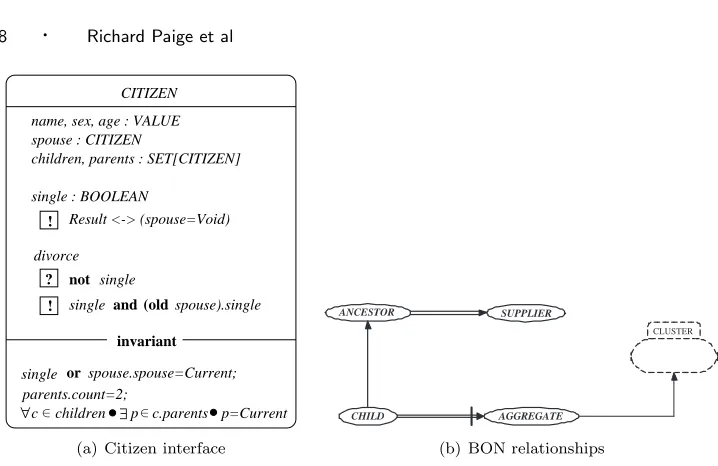
BON [Walden and Nerson 1995] is an object-oriented method, consisting of a mod-elling language and development process for building reliable systems. It is sup-ported by a number of tools, including Visio and EiffelStudio. Its language has been designed to work seamlessly and reversibly with Eiffel: BON diagrams can automatically be produced from Eiffel code; and Eiffel code can be generated from BON diagrams. There are three main parts to BON’s language. The first, class interfaces, is demonstrated with an example in Fig. 2(a).
The name of the class is at the top of of Fig. 2(a). The middle section is made up of features (attributes or routines). Routines are either functions (returning a value) or procedures (effecting state changes), and may have preconditions (denoted using a ? in a box, which are assertions that must be true before any call to the routine) and postconditions (denoted using a ! in a box, which are assertions that must be true after the routine body has executed). At the bottom of the class is itsinvariant, a set of assertions that must be true before and after each client call to a function or procedure. Assertions are written in BON’s first-order dialect of predicate logic, which includes propositions, universal and existential quantifiers, type interrogation, and reference types (along with the usual arithmetic and boolean operators and values).
The second part of BON is the class diagram notation. Class diagrams consist of classes organized inclusters(drawn as a dashed rounded rectangle in Fig. 2(b)), which interact via two kinds of relationships.
—Inheritance: Inheritance defines a subtype relationship between child and one
or more parents. The inheritance relationship is drawn between classesCHILD
spouse.spouse=Current;
p=Current spouse : CITIZEN
children, parents : SET[CITIZEN]
single : BOOLEAN
Result <-> (spouse=Void)
!
divorce
? single name, sex, age : VALUE
not
single and (old spouse).single
single or parents.count=2;
children
∀c ∃p c.parents
!
CITIZEN
invariant
∈ ∈
(a) Citizen interface
ANCESTOR
CHILD
SUPPLIER
AGGREGATE
CLUSTER
(b) BON relationships
Fig. 2. BON syntax for interfaces and relationships
source or target is a cluster (a set of one or more classes or other clusters), e.g.,
as drawn betweenAGGREGATE andCLUSTER in Fig. 2(b). In this particular
example, the inheritance arrow indicates thatAGGREGATE inherits behaviour
from one or more classes inCLUSTER.
—Client-supplier: there are two client-supplier relationships, association and
aggregation. Both relationships are directed from a client class to a supplier
class; the relationship has an optional label. With association the client class has a reference to an object of the supplier class. With aggregation the client class contains an object of the supplier class. The aggregation relationship is drawn
between classesCHILD andAGGREGATE in Fig. 2(b), whereas an association
is drawn fromANCESTORto classSUPPLIER.
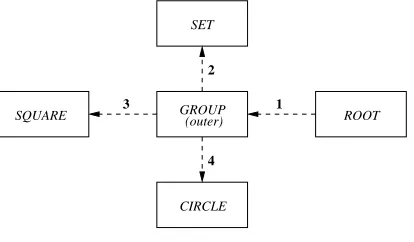
The third part of BON’s language is dynamic diagrams (similar to communication diagrams in UML 2.0). The syntax for these diagrams is very similar to UML; it is used to depict objects, messages sent between objects, and sequencing information, where a message corresponds to a potential routine call on a target object. An example is shown in Fig. 3. Rectangles represent objects, while dashed arrows
represent messages. Four objects are anonymous in Fig. 3, whereas objectouter is
of classGROUP. Each message has a number that is cross-referenced to a scenario
[image:10.595.127.486.81.314.2]SQUARE
CIRCLE SET
ROOT GROUP
(outer)
1 2
[image:11.595.204.411.118.239.2]4 3
Fig. 3. BON dynamic diagram
2.1.1 BON, UML, and domain-specific modelling. BON was chosen as the
lan-guage of discourse in this paper because of its size and conciseness, and also because of its integrated support for contracts. However, the lessons and observations made in this paper apply to UML 2.0 as well, and also to domain-specific modelling languages, such as the aforementioned AADL. To help clarify this, we now briefly contrast BON with UML and domain-specific modelling.
BON is equivalent to a profile of UML 2.0, consisting of a subset of class di-agrams, the Object Constraint Language (OCL), and communication diagrams. BON purposely omits all other diagrams to maintain semantic coherence [Walden and Nerson 1995; Meyer 1997].
BON class diagrams are equivalent to UML class diagrams, omitting UML aggre-gation (which is inexpressible in BON). BON provides a single concept – the class – which subsumes UML’s interface, abstract class, and class. BON uses stereo-types on classes to denote variants of the general-purpose class concept; this allows specification of interface-like concepts. BON supports only a small set of fixed stereotypes, unlike UML. Aggregation is omitted because it cannot be mapped di-rectly into a programming language [Walden and Nerson 1995]; UML composition, by contrast, can be mapped into Eiffel’s expanded types, or C++’s variables, and is supported in BON via its “aggregation” notation (this is admittedly confusing, but the short of it is that BON aggregation is equivalent to UML composition).
BON dynamic diagrams are semantically equivalent to UML 2.0 communication diagrams, omitting guards. UML’s concept of guards are subsumed in BON within the contracts of individual routines. Constraints on repetition of messages in UML are expressed either using routine contracts, or by using multi-messages (i.e., mes-sages that are sent to multiple objects simultaneously); the former is preferred. A syntactic novelty with BON dynamic diagrams is that it provides precise rules for flattening or expanding collections of messages using clusters; this is helpful for improving the readability of diagrams.
1999a; Spencer 2005]. The former contrasts BON with UML and OCL in detail, while the latter implements a substantial subset of OCL using Eiffel’s contract language (which is effectively a subset of BON).
BON can also be viewed as a domain-specific modelling language for Eiffel. BON has been designed to (a) be useful for visually representing substantial parts of Eiffel programs, and (b) so that each BON concept maps seamlessly and reversibly to an Eiffel concept (i.e., each concept in BON has a direct equivalent in Eiffel). This makes it straightforward to implement code generators and reverse engineering tools for BON, but it raises questions about using BON for analysis, as it omits a number of modelling constructs that UML provides. However, the BON contract language (a dialect of first-order predicate logic) is considered suitably rich and expressive as to mitigate for the (visual) modelling constructs omitted from the language [Walden and Nerson 1995].
2.2 Eiffel
Eiffel is an object-oriented programming language [Meyer 1997]; it provides con-structs typical of the object-oriented paradigm, including classes, objects, inheri-tance, associations, composite (“expanded”) types, generic (parameterised) types, polymorphism and dynamic binding, and automatic memory management. It has a comprehensive set of libraries – including data structures, GUI widgets, and database management system bindings – and the language is integrated with .NET.
A short example of an Eiffel class is shown in Fig. 4. The class CITIZEN
in-herits fromPERSON (thus defining a subtyping relationship). It provides several
attributes, e.g.,spouse,children which are of reference type (spouserefers to an
ob-ject of typeCITIZEN, whilechildren refers to an object of typeSET[CITIZEN]); these features are publicly accessible (i.e., are exported toANY client). Attributes are by default of reference type; a reference attribute either points at an object on
the heap, or is Void. The class provides one expanded attribute,blood type.
Ex-panded attributes are also known as composite attributes; they are not references, and memory is allocated for expanded attributes when memory is allocated for the enclosing object.
The remaining features of the class are routines, i.e., functions (likesingle, which
returns true iff the citizen has no spouse) and procedures (like divorce, which
changes the state of the object). These routines may have preconditions (require
clauses) and postconditions (ensure clauses). Finally, the class has an invariant, specifying properties that must be true of all objects of the class at stable points in time, i.e., before any valid client call on the object. In writing the invariant of CITIZEN we have used Eiffel’s agent notation. Agents are a way to encapsu-late operations in objects; the operation can then be invoked on collections (e.g., a set or linked list) when necessary. Two built-in agents in Eiffel arefor_alland there_exists, which can be used to implement quantifiers over finite data
struc-tures. In this example, one agent is used in the class invariant: for_all iterates
over all elements ofchildren and returnstrue if its body – applied to each element – returnstrue. The body is a boolean expression which returnstrue iff the current citizen is a child of one of its parents. In other words, the agent expression is true iff all children have links to their parents.
dis-class CITIZEN inherit PERSON feature {ANY}
spouse: CITIZEN
children, parents: SET[CITIZEN] blood_type: expanded BLOOD_TYPE
single: BOOLEAN is
do Result := (spouse=Void) ensure Result = (spouse=Void) end
set_spouse(s:CITIZEN) is do spouse := s end
feature {BIG_GOVERNMENT}
divorce is
require not single
do spouse.set_spouse(Void); spouse := Void end ensure single and (old spouse).single
end
invariant
single or spouse.spouse = Current; parents.count <= 2;
children.for_all((c:CITIZEN):BOOLEAN do Result := c.parents.has(Current) end); end -- CITIZEN
Fig. 4. Eiffel class interface
patch, multiple inheritance, and static typing. We refer the reader to [Meyer 1992] for full details on these and other features.
2.2.1 Eiffel as a formal specification language. Eiffel is a wide-spectrum
lan-guage [Meyer 1997; Paige and Ostroff 1999b; 2004] suitable for both programming and lightweight formal specification. It has been designed to support seamless de-velopment, where one language is used throughout the development process. Eiffel is not a small language, but a subset of it can be identified and applied for for-mal specification. AnEiffel formal specification is written using only the following constructs.
—Classes and class interfaces (containing routine signatures and attributes). —Local variables of routines.
—Boolean expressions (including agents)
—Routine calls of the formo.f, whereo is a variable or attribute, andf a routine.
—Assignment statements in routine bodies.
All other Eiffel constructs are excluded. This subset is roughly similar to the subset identified in the Eiffel Refinement Calculus [Paige and Ostroff 2004], which allows Eiffel formal specifications to be refined to programs. A formal semantics for these constructs can be found in [Paige and Ostroff 2004].
2.3 Overview of the BON metamodel
The BON metamodel was specified in BON itself in [Paige and Ostroff 2001], keep-ing with the approaches followed in the UML community. We give a summary of the metamodel in this section, focusing on the key components and packages. This metamodel will be used for comparing different approaches in later sections.
Fig. 5 contains an abstract depiction of the BON metamodel. BON models are
instances of the class MODEL. Each model has a set of abstractions. The two
clusters, representing abstractions and relationships, will be detailed shortly.
ABSTRACTIONS RELATIONSHIPS
MODEL
abs: SET[..]
Fig. 5. The BON metamodel, abstract architecture
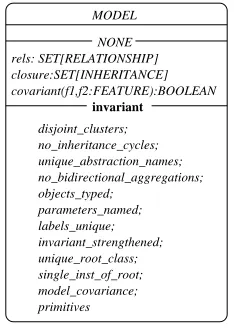
The classMODELpossesses a number of features and invariant clauses that will
be used to capture the well-formedness constraints of BON models. These features
are depicted in Fig. 6, which shows the interface forMODEL. We will not provide
all the details of the individual clauses of the class invariant of MODEL, though
examples will be considered in the following sections.
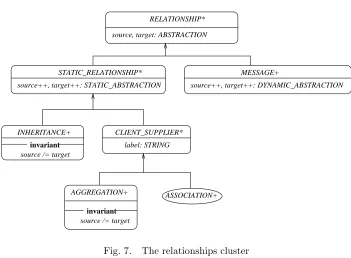
The relationships cluster describes the four basic BON relationships (including messages between objects), as well as constraints on their use. The details of the cluster are shown in Fig. 7.
invariant
disjoint_clusters;
unique_abstraction_names;
objects_typed; parameters_named; labels_unique;
covariant(f1,f2:FEATURE):BOOLEAN closure:SET[INHERITANCE]
invariant_strengthened; unique_root_class; single_inst_of_root; rels: SET[RELATIONSHIP]
NONE MODEL
primitives model_covariance; no_inheritance_cycles;
no_bidirectional_aggregations;
[image:14.595.163.447.293.336.2] [image:14.595.247.364.490.654.2]STATIC_RELATIONSHIP*
CLIENT_SUPPLIER*
label: STRING
invariant
source /= target
invariant
source /= target
source++, target++: STATIC_ABSTRACTION source++, target++: DYNAMIC_ABSTRACTION RELATIONSHIP*
source, target: ABSTRACTION
MESSAGE+
INHERITANCE+
AGGREGATION+ ASSOCIATION+
Fig. 7. The relationships cluster
Covariant redefinition3 is used in Fig. 7 to capture well-formedness conditions,
e.g., that inheritance can connect only static abstractions.
Invariants are written on classes representing inheritance and aggregation rela-tionships to express that these relarela-tionships cannot be self-targeted.
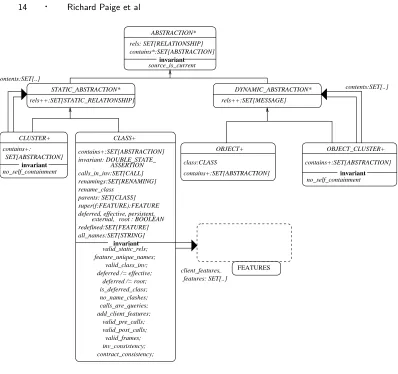
The abstractions cluster describes the abstractions that may appear in a BON model. It is depicted in Fig. 8.
ABSTRACTION is a deferred class: instances of ABSTRACTIONs cannot be created. Classification is used to separate all abstractions into two subtypes: static
and dynamic abstractions. Static abstractions areCLASSes andCLUSTERs.
Dy-namic abstractions are OBJECTs andOBJECT CLUSTERs. Clusters may
con-tain other abstractions according to their type, i.e., static clusters concon-tain only static abstractions.
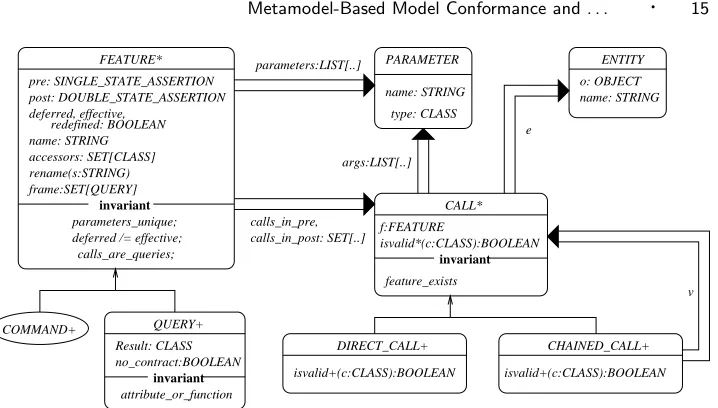
The features cluster describes the notion of a feature that is possessed by a class. Features have optional parameters, an optional precondition and postcondition, and an optional frame. The pre- and postcondition are assertions. Query calls may appear in assertions; the set of query calls that appear in an assertion must be modelled in order to ensure that the calls are valid according to the export policy of a class. Each feature will thus have a list of accessors, which are classes that may use the feature as a client. A call consists of an entity (the target of the call), a feature, and optional arguments. The frame is a set of attributes that the feature may modify. Fig. 9 depicts the cluster.
[image:15.595.129.480.107.365.2]contains+:SET[ABSTRACTION]
contains+:SET[ABSTRACTION] class:CLASS
contains+: SET[ABSTRACTION]
invariant
invariant
contents:SET[..]
DYNAMIC_ABSTRACTION*
CLUSTER+
OBJECT+ OBJECT_CLUSTER+
ABSTRACTION*
invariant
source_is_current
STATIC_ABSTRACTION* contents:SET[..]
rels++:SET[MESSAGE] contains*:SET[ABSTRACTION]
rels: SET[RELATIONSHIP]
rels++:SET[STATIC_RELATIONSHIP]
no_self_containment no_self_containment
FEATURES
client_features, features: SET[..]
add_client_features; calls_are_queries; no_name_clashes; is_deferred_class; deferred /= root; deferred /= effective;
valid_class_inv; feature_unique_names;
valid_static_rels;invariant all_names:SET[STRING] redefined:SET[FEATURE]
external, root : BOOLEAN deferred, effective, persistent, super(f:FEATURE):FEATURE parents: SET[CLASS] rename_class
renamings:SET[RENAMING] calls_in_inv:SET[CALL]
ASSERTION invariant: DOUBLE_STATE_ contains+:SET[ABSTRACTION]
valid_pre_calls; CLASS+
valid_post_calls; valid_frames; inv_consistency; contract_consistency;
Fig. 8. The abstractions cluster
2.3.1 Summary. This subsection has summarised the BON metamodel,
primar-ily to illustrate that the BON language – while smaller than UML – still provides useful modelling constructs and is non-trivial from a metamodelling perspective. This (semiformal) summary attempts to promote understandability by diagram-matically expressing well-formedness constraints, and by allowing projection of ab-stract views of the metamodel. In this sense, this mimics the approach taken in the OMG to metamodelling UML.
The main disadvantage with specifying the BON metamodel in BON directly is that the language’s semantics is not fully and formally defined (parts of the language are formalised in [Paige and Ostroff 1999b]), and there are as of yet no tools that can be used to directly check the correctness of the invariants and assertions contained within the classes. This criticism only partly applies to the UML 2.0 metamodel: while a full formal semantics for UML 2.0 does not yet exist, the fact that UML 2.0
[image:16.595.108.506.92.466.2]PARAMETER
name: STRING
type: CLASS parameters:LIST[..]
calls_in_post: SET[..] calls_in_pre,
args:LIST[..] FEATURE*
pre: SINGLE_STATE_ASSERTION post: DOUBLE_STATE_ASSERTION
o: OBJECT name: STRING
e
deferred /= effective; parameters_unique;
calls_are_queries;
invariant
frame:SET[QUERY] rename(s:STRING) accessors: SET[CLASS] name: STRING deferred, effective,
redefined: BOOLEAN
DIRECT_CALL+ CHAINED_CALL+
isvalid+(c:CLASS):BOOLEAN isvalid+(c:CLASS):BOOLEAN v ENTITY
COMMAND+
Result: CLASS no_contract:BOOLEAN
attribute_or_function
invariant
QUERY+
f:FEATURE
isvalid*(c:CLASS):BOOLEAN
invariant
CALL*
feature_exists
Fig. 9. BON metamodel, features cluster
is defined in terms of MOF, and there are tools that partly support MOF, means that partial checking of the UML metamodel can be carried out automatically.
Given the lack of formal semantics and the need to use translation to obtain verification and validation capabilities, the value of using BON to express its meta-model directly is circumscribed. A second, related disadvantage is that it is difficult to use the metamodel, as specified, to carry out multi-view consistency checking – again because of a lack of formal semantics and automated tool support. A final disadvantage is that it is difficult to validate and verify the metamodel expressed directly in BON. The advantage of using BON (or other visual languages) to ex-press metamodels is that the results are generally more easily understood than other representations.
2.4 Related work on OO metamodelling and multi-view consistency checking
Our focus in this paper is specifically on metamodelling and consistency checking in the domain of object-oriented and systems modelling, and this guides our overview of related work. There has been much recent related work on OO metamodelling, and on using these metamodels to carry out conformance checking and checking the consistency of multiple views. More general work on consistency, e.g., for requirements [Finkelstein et al. 1994], for handling and managing inconsistency using model checking [Chechik et al. 2003] and general XML-based tool support [Gryce et al. 2002] is discussed elsewhere and is outside our scope.
[image:17.595.130.489.95.299.2]Man-agement Group 2004b], XMF-Mosaic [Xactium 2006], MML [Clark et al. 2001a], Executable UML [Mellor and Balcer 2002], and the template-based approaches to specification in Z [Amalio et al. 2004]. The semi-formal modelling work tends to be more complete (in terms of supporting different diagrams) than the formal-based work. The formal-formal-based work tends to focus on supporting specific views – e.g., class diagrams and statecharts – or proves incomplete specifications of several views. The formal-based metamodelling work has a number of similarities to efforts made on formal modelling of object-oriented systems, e.g., using Spec# [Microsoft 2006], JML [Leavens et al. 2005], or algebraic specification languages such as CASL [Bidoit and Mosses 2004], though these languages are generally used to reason about programs rather than metamodels and language definitions.
The general view in the UML community is that using a semiformal modelling language (such as UML, or MOF) to capture a metamodel is preferable to using formal techniques, since more developers – particularly, tool builders – will be able to construct, interpret, and implement a metamodel expressed in UML as opposed to, e.g., a formal language such as Z or PVS where there are substantial differences between the domains of discourse. Even so, it is generally more difficult to reason about and analyze metamodels that are specified using a semi-formal language like UML. Some reasoning and analysis is possible with languages such as XMF-Mosaic and OCL, predominantly via simulation techniques, though the former is only sup-ported by a single tool, and the latter is frequently only supsup-ported for a subset. The OCLE tool (discussed below) [Chiorean 2005] provides very rich support for OCL currently, and supports the entire language. In general, for semiformal meta-models, it is difficult to verify and validate the specifications, because of a lack of a formal semantics, or because of limited simulation and execution mechanisms.
There is less related work on using OO metamodels for model conformance. In part, this is because many tools for OO modelling treat the metamodel as a specification for user interface constraints – i.e., the interface for the tool attempts to prevent illegal models from being constructed. However, tools such as Visio [Microsoft 2005], which allow rule checking to be turned off and on as desired, require an explicit encoding of well-formedness rules in some form. Some specific related work on OO metamodelling and model conformance is described below.
—The OCLE tool [Chiorean 2005] supports OCL 2.0 and UML 1.5, and provides the means to check UML models against the metamodel constraints and more general rules. It is a stand-alone modelling tool that can be interfaced with other tools via XML and XMI specifications. For practical use, the tool could be used as a back-end to a full-featured modelling tool, providing rule checking facilities via simulation. There may be challenges in terms of linking feedback from OCLE simulations to such a modelling tool.
—Similarly, the Kent Modelling Framework (KMF) [Akehurst et al. 2004] supports the metamodel for OCL 2.0 and provides parsing, simulation, and execution facilities. The framework aims to provide a full-featured, open-source package for modelling based on UML-compatible metamodels, and conceptually can be used for conformance and consistency checking, by specifying metamodel rules in OCL and executing them against models.
envi-ronment that provides, amongst other things, an implementation of the UML metamodel. The tool can be instantiated with metamodels and thereafter ports the construction of models that conform to the metamodel. The tool sup-ports an executable dialect of OCL – XOCL – and thus also provides the means for checking UML diagrams against the metamodel via simulation and execu-tion. The emphasis with XMF is tool customization based on metamodelling techniques, as well as expressing language transformations and supporting the QVT proposal.
—Similarly, MMT [Clark et al. 2001b], a stand-alone meta-modelling tool for MOF-compliant languages, provides support for a subset of OCL and enables checking instances of the metamodel against one or more rules captured in the metamodel. MMT appears to have been deprecated by the development of XMF-Mosaic. —The Dresden OCL toolkit [Hussman et al. 2000] supports compilation of OCL
constraints; it has been integrated in the Argo/UML tool. In principle it could be used to help validate the UML metamodel expressed in UML and OCL. —The KeY project [Ahrendt et al. 2005] offers an extension of the Together
Con-trolCentre case tool that provides theorem proving technology for checking OCL constraints. As with the Dresden OCL toolkit, it could be applied to metamodel validation.
—The USE stand-alone tool [Richters and Gogolla 2000] is an OCL simulator that can be used to execute OCL constraints against model snapshots. Used in batch mode, it can be applied to carry out model validation and verification. It has been recently updated to support substantial parts of OCL 2.0, and as such can be used for validating and testing parts of the UML metamodel. USE is distinctive as it is one of the few pieces of work that reports on how to check models against the metamodel using semi-automated tool support.
Work related to metamodelling and conformance checking arises in the domain of multi-view consistency. The basic problem is to ensure that separate descriptions of an OO system are mutually consistent, i.e., that information in one description does not contradict information contained in a separate description.
Many solutions have been presented for this problem. The recent series of work-shops on consistency checking in the context of UML [Huzar et al. 2002; 2003; 2004; Kuzniarz et al. 2005] demonstrate techniques that consider different system views (particularly static and behavioural) and different lightweight and heavy-weight techniques for implementing consistency checking. Some of these approaches require use of specialised tools – such as xlinkit [Gryce et al. 2002], a general-purpose rule-based tool for consistency checking documents based on XML – or mathemati-cal languages, e.g., B [Marcano and Levy 2002] – for expressing the well-formedness constraints that establish multi-view consistency.
transition system, thus enabling the use of a model checker to identify inconsisten-cies. The advantage of this approach is that the model checking will be automatic; however, there are limitations on what can be expressed in terms of properties and models. In an alternative approach, UML model consistency is checked via the Sherlock tool [Sourrouille and Caplat 2002], wherein actions, models, and a knowledge base are combined. This approach approach is particularly promising as it also considers extensions to UML profiles that target specific problem domains. Krishnan [Krishnan 2000] considers OCL contracts in the context of UML, and for-malises multi-view consistency in PVS. [Krishnan 2000] requires users to formally unroll sequencing of method calls arising in sequence diagrams, which can be very awkward for large sequence and collaboration diagrams; an alternative approach is presented in Section 4. Work at IBM Haifa has studied metamodel extensions for consistency checking in the context of Rational’s XDE tool [Huzar et al. 2004]. This work is similar in scope to what we present in the next section.
A key limitation that can be identified from this work is that much of it does not consider contracts – i.e., method pre- and postconditions – when carrying out multi-view consistency checking; [Krishnan 2000] is an exception but is difficult to use. Both approaches to metamodelling and multi-view consistency checking presented in the next sections consider contracts, in different ways.
3. METAMODELLING IN PVS AND EIFFEL
We now contrast two approaches to specifying the metamodel for BON; the meta-model was semi-formally specified in an earlier section. We contrast two formal specifications: one written in PVS and one in Eiffel. Both these metamodels are formal as they are specified in languages with both formal syntax and semantics, and have tools to support checking models against the metamodel. What is inter-esting and different about the two formal metamodels is (a) their design; (b) the executability of the resulting spcifications and (c) their completeness. Again, we are not attempting a like-for-like comparison of metamodel specifications: we will construct the metamodels using the best practices available for PVS and Eiffel. As such, some differences in terms of how well-formedness constraints are captured will arise.
3.1 Metamodel specification in PVS
The disadvantages that were apparent with the metamodel specified in BON were primarily due to the lack of a formal semantics for the BON language. These dis-advantages can be alleviated by using a different language with a formal semantics. In this section, we present a formal specification of the BON metamodel in the PVS specification language. We present the PVS version of the metamodel selectively, and attempt to give the flavour of using PVS for this purpose. We note that PVS is a general purpose theorem proving environment, and as such it is not tailored for metamodelling.
3.1.1 Theory of abstractions. To express the cluster of abstractions in PVS, we
introduce a new non-empty type and a number of subtypes, effectively mimicking the inheritance hierarchy presented in Fig. 8. A similar technique could be used for expressing the UML 2.0 concept of Classifier [Object Management Group 2004b] and its subtypes or implementations, if one desired to use PVS to express the
UML 2.0 metamodel. This information is declared in the PVS theoryabs_names.
Note that this specification includes both static language constructs (like classes) as well as dynamic constructs (like objects), thus supporting both class and dynamic diagrams from BON.
abs_names: THEORY BEGIN
ABS: TYPE+
% Static and dynamic abstractions. STATIC_ABS, DYN_ABS: TYPE+ FROM ABS
% Instantiable abstractions
CLASS, CLUSTER: TYPE+ FROM STATIC_ABS OBJECT, OBJECT_CLUSTER: TYPE+ FROM DYN_ABS END abs_names
The PVS theoryabstractionsthen usesabs_namesto introduce further
mod-elling concepts as well as the constraints on abstractions that appear in models. Further concepts that we need to model include features and entities (that appear in calls), calls themselves, and parameters and arguments to routines. Primitive
BON classes, e.g., INTEGER, are modelled as PVS constants: objects of CLASS
type. We also define conversions so that the type checker can automatically convert BON primitives into PVS types.
We must now describe constraints on abstractions. In the BON version of the metamodel, these took the form of features and class invariants. In the UML 2.0 metamodel [Object Management Group 2004b], these generally take the form of OCL constraints. In PVS, the well-formedness constraints will appear as functions, predicate subtypes, and axioms.
For example, a number of constraints will have to be written on features. To accomplish this, we introduce a number of functions that will let us acquire infor-mation about a feature, such as its properties, precondition, and postcondition4.
feature_pre, feature_post: [ FEATURE -> bool ]
% Properties of a feature.
deferred_feature, effective_feature, redefined_feature: [ FEATURE -> bool ]
% The set of classes that can legally access a feature. accessors: [ FEATURE -> set[CLASS] ]
We now provide examples of axioms, which define the constraints on BON models. The first example ensures that all features of a class have unique names (BON does not permit overloading based on feature names or signatures).
feature_unique_names: AXIOM
(FORALL (c:CLASS): (FORALL (f1,f2:FEATURE):
(member(f1,class_features(c)) AND member(f2,class_features(c))) IMPLIES (feature_name(f1) = feature_name(f2)) IMPLIES f1=f2))
Here is an example of specifying that an assertion is valid according to the export
policy used in a model. The axiomvalid_precondition_callsensures that: (a)
all calls in a precondition are legal (according to the accessor list for each feature); and (b) all calls in the precondition are queries.
valid_precondition_calls: AXIOM
(FORALL (c:CLASS): (FORALL (f:FEATURE): member(f, class_features(c)) IMPLIES (FORALL (call:CALL): member(call, calls_in_pre(f)) IMPLIES
QUERY_pred(f(call)) AND call_isvalid(f(call)))))
3.1.2 Theory of relationships. The theory of relationships mimics the
Relation-ships cluster in the BON version; it defines the three basic relationRelation-ships and the
well-formedness constraints that exist in BON5. To express the relationships in
PVS, we introduce a new non-empty type and a number of subtypes. As with abstractions, we mimic the inheritance hierarchy that was presented in Fig. 7.
rel_names: THEORY BEGIN
% The abstract concept of a relationship. REL: TYPE+
% Instantiable relationships. INH, C_S, MESSAGE: TYPE+ FROM REL AGG, ASSOC: TYPE+ FROM C_S END rel_names
Therel_namestheory is then used by the relationshipstheory. In BON, all relationships are directed (or targetted). Thus, each relationship has a source and a target, and these concepts are modelled using PVS functions.
relationships: THEORY BEGIN
IMPORTING rel_names, abstractions
% Examples of the source and target of a relationship. inh_source, inh_target: [ INH -> STATIC_ABS ] cs_source, cs_target: [ C_S -> STATIC_ABS ]
Now we can express constraints on the functions; once again, these correspond to invariants in BON and well-formedness constraints in OCL. We give one example of relationship constraints: that inheritance relationships cannot be self-targeted.
% Inheritance relationships cannot be directed from an abstraction to itself. inh_ax: AXIOM (FORALL (i:INH): NOT (inh_source(i)=inh_target(i)))
The theory of relationships is quite simple, because many of the constraints on the use of relationships areglobalconstraints that can only be specified when it is possible to discuss all abstractions in a model (e.g., that there are no circularities in a chain of inheritance relationships). Thus, further relationship constraints will be added in the next section, where we describe constraints on models themselves.
3.1.3 The metamodel theory. The PVS theory metamodeluses the two
previ-ous theories – of abstractions and relationships – to describe the well-formedness
constraints on all BON models. Effectively, the PVS theorymetamodelmimics the
structure of the BON model in Fig. 5, and captures the invariants on classMODEL.
metamodel: THEORY BEGIN
IMPORTING abstractions, relationships
% A BON model consists of a set of abstractions. abs: SET[ABS]
rels: SET[REL]
Now we must write constraints on how models can be formed from a set of ab-stractions. The complete details are in [Paige and Ostroff 2001]; we present two examples. The first constraint we write ensures that inheritance hierarchies do not have cycles; a similar constraint, written in OCL, appears in the UML 2.0 meta-model in [Object Management Group 2004b]. We express this by calculating the
inheritance closure, the set of all inheritance relationships that are either explicitly written in a model, or that arise due to the transitivity of inheritance in BON.
inh_closure: SET[INH]
% Closure axiom #1: any inheritance relationship in a model is also % in the inheritance closure.
closure_ax1: AXIOM
(FORALL (r:INH): member(r,rels) IMPLIES member(r,inh_closure))
% Closure axiom #2: all inheritance relationships that arise due to % transitivity must also be in the inheritance closure.
closure_ax2: AXIOM (FORALL (r1,r2:INH):
(member(r1,rels) AND member(r2,rels) AND inh_source(r1)=inh_target(r2)) IMPLIES (EXISTS (r:INH): member(r,inh_closure) AND
inh_source(r)=inh_source(r2) AND inh_target(r)=inh_target(r1)))
% Inheritance relationships must not generate cycles. inh_wo_cycles: AXIOM
(FORALL (i:INH): member(i,inh_closure) IMPLIES
NOT (EXISTS (r1:INH): (member(r1,rels) AND i/=r1) IMPLIES inh_source(i)=inh_target(r1) AND inh_target(i)=inh_source(r1)))
appears in the UML metamodel with respect to packages). The third example shows that bi-directional aggregation relationships are forbidden; this is equivalent
to the UML metamodel constraint that bi-directionalcompositions are forbidden.
% All clusters in a model are disjoint. disjoint_clusters: AXIOM
(FORALL (c1,c2:CLUSTER): (member(c1,abst) AND member(c2,abst)) IMPLIES (c1=c2 OR empty?(intersection(cluster_contents(c1),cluster_contents(c2)))))
% No bidirectional aggregation relationships are allowed. no_bidir_agg: AXIOM
(NOT (EXISTS (r1,r2:AGG): (member(r1,rels) AND member(r2,rels)) IMPLIES (cs_source(r1)=cs_target(r2) AND cs_target(r1)=cs_source(r2)))
3.1.4 Model conformance checking in PVS. Model conformance, i.e., checking
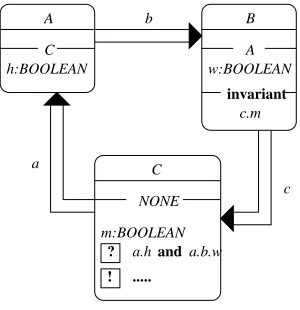
thesatrelation in equation (1), resolves to proving a conjecture in PVS. The con-jecture is that an encoding of a BON model (written as a set of PVS expressions) satisfies all axioms that capture metamodel well-formedness constraints. An iden-tical approach could be applied directly to UML model conformance, i.e., showing that a UML model satisfies the well-formedness constraints of its metamodel. This is illustrated by the following example. Consider the BON model in Fig. 10.
invariant
c.m B
A
?
!
a.h and a.b.w
...
C
NONE a
b
c
m:BOOLEAN
w:BOOLEAN C
A
[image:24.595.139.481.169.246.2] [image:24.595.231.381.347.502.2]h:BOOLEAN
Fig. 10. Model conformance checking
We show how to check that this model does not conform to the metamodel of BON, because there is a violation of the export policy of at least one class in the model. Note thatmis a private feature of classC; thus the callc.min the invariant
ofB is illegal. Similarly, the calla.b.w in class C is illegal in the precondition of
m, because w is accessible only to the client A. We would like to show that this
model does not conform to the BON metamodel. We will show that, as an example,
the invariant ofB is not well-formed. To prove that the model is not well-formed,
info_hiding: THEORY BEGIN
IMPORTING metamodel
a, b, c: VAR CLASS h, w, m: VAR QUERY
call1, call2, call3: VAR CALL
test_info_hiding: CONJECTURE
(NOT (EXISTS (a,b c: CLASS): EXISTS (h,w,m:QUERY): EXISTS (call1,call2,call3: CALL):
member(c,accessors(h)) AND member(a,accessors(w)) AND empty?(accessors(m)) AND f(call1)=h AND f(call2)=w AND f(call3)=m AND member(call1,calls_in_pre(m)) AND
member(call2,calls_in_pre(m)) AND member(call3,calls_in_inv(b)))) END info_hiding
To prove the conjecture, we first skolemize three times, then flatten. We introduce
the axiomvalid_class_invariant, and substitute class B and call call3 for the
bound variables of this axiom. We use typepred to bring the type assumptions
on m into the proof, and then one application of grind proves the conjecture
automatically. The model is therefore invalid according to the well-formedness constraints of the metamodel.
Considerable expertise with PVS is necessary in discharging the conjecture, par-ticularly in terms of selecting instantiation and skolem constants. However, strate-gies can be defined to automate parts of the process, though user guidance for selecting skolem constants is likely to always be necessary.
We should point out what happens with contracts when carrying out model con-formance checking: all well-formedness constraints that are related to contracts are checked. These constraints effectively check thestatic well-formedness of contracts, e.g., that the assertions are syntactically well-formed, functions that are called in contracts are accessible, etc. Nothing pertaining todynamic (or behavioural) well-formedness is checked; this is one of the tasks for multi-view consistency checking.
3.1.5 Summary. The advantages of expressing the BON metamodel in PVS are
as follows.
—Tool support: the PVS type checker and theorem prover can be used to verify and validate the metamodel, particularly for consistency, but also for correctness via proving that models satisfy the metamodel [Paige and Ostroff 2001].
—Formality: the semantics of the PVS specification of the metamodel is formally defined, and this semantics is implemented in the PVS toolkit. This provides stronger guarantees as to the soundness of the PVS specification, and therefore the metamodel itself.
—Completeness: all aspects of the BON metamodel can be expressed in PVS.
The disadvantages are as follows.
since much of the hierarchical structure in the metamodel presented in the pre-vious section is captured in PVS using type hierarchies, which do not present themselves in the overall theory structure. This can substantially impede under-standing of large specifications – like the BON metamodel.
—V&V:validating the metamodel in PVS corresponds to encoding BON models as PVS constants and proving that the models satisfy (or fail to satisfy) the ax-ioms in the metamodel. This process can be partly automated, but it is certainly not fully automatic – additional proofs in [Paige and Ostroff 2001] demonstrate that in many instances user intervention and guidance is needed. Further exper-iment on validation is continuing via the PVS ground evaluator, which allows simulation.
In general, the PVS version of the metamodel should be preferred to the BON version in terms of available automated tool support for expressing the metamodel and validating it; and for its completeness. However, it falls short in understand-ability and general usunderstand-ability. As well, there are challenges in using the PVS version for multi-view consistency checking, which we discuss in Section 4.
3.2 Metamodel specification in Eiffel
A key advantage of the BON metamodel specified in PVS is that tools can be used to validate and verify it. However, these tools are complex, expensive to use, and typically require user interaction and intervention. We now present a formal specification of the BON metamodel in Eiffel. Eiffel, while a programming
language, can also be used as a declarative specification language via its agent
technology. We illustrate this technology throughout the following section. It is important to emphasise that we are not simply writing Eiffel programs to encode models, metamodels, and well-formedness constraints. Rather, we use Eiffel to declaratively specify (albeit in an executable form) these artifacts.
We do not attempt to reformulate the PVS version of the metamodel in Eiffel; rather we will present an Eiffel specification that conforms to the best practices of using Eiffel, and which attempts to exploit Eiffel’s existing tool support (particu-larly compilers, debuggers, testing frameworks, and class libraries), as well as its language facilities.
Eiffel is an object-oriented language, and as such the structure of the metamodel specification in Eiffel will directly reflect the structure of the metamodel in BON. This is a result of the seamless integration of BON and Eiffel that has been de-signed in to the two languages. As we did with PVS, we present the metamodel specification selectively, and attempt to give the flavour of applying Eiffel for this purpose.
3.2.1 Expressing the metamodel structure. Each class in the BON diagram in
second is infrastructure needed to initialise objects and provide setter and getter routines. The user of the metamodel in Eiffel need not know about this infrastruc-ture – a single routine call is provided to set up the objects. This infrastrucinfrastruc-ture is essential as Eiffel is a programming language and objects must have memory allo-cated for them; by contrast, no allocation is explicitly necessary in a specification language like PVS.
Much of this infrastructure is added as private features of class MODEL. The
added routines are as follows.
—A constructor (creation procedure) make which allocates memory for the
set-based data structures used to encode models. This constructor implements a Factory Method [Gamma et al. 1995] which calls default constructors on each attribute.
—Accessor and mutator routines for each attribute.
—A prepare routine which ensures that all data structures are initialised. This routine is invoked by the user after they have constructed their model, i.e., when they desire to test the metamodel and check conformance. It effectively provides a Facade for initialising the model, hiding the infrastructure required by Eiffel from the user. This routine in turn invokes a number of private routines that set up different data structures for use in conformance and consistency checking.
Additional attributes were added as private features in order to simplify some agent expressions; see [Paige et al. 2004] for some details.
3.2.2 Expressing assertions. This is the most challenging part of expressing the
metamodel in Eiffel, and requires capturing BON assertions using Eiffel agents6.
BON’s assertion language is more expressive than Eiffel (because in BON quantifiers can be written on arbitrary domains, whereas in Eiffel agents must be applied to finite data structures). In general, to translate a BON assertion into Eiffel, we
can introduce a model of BON’sSET type, following [Meyer 2003]. However, given
that the BON metamodel makes use of finite sets, and the metamodel assertions are computable, all assertions in the BON version of the metamodel can be translated to Eiffel. Assertions are expressed as follows.
—Each invariant clause in a class in the BON metamodel is translated to a
boolean-valued function in Eiffel. For example, the clauseno inh cycles in classMODEL
in the BON diagram is translated to a boolean function in the Eiffel class model,
and a call to the function appears in the invariant forMODEL.
—Each pre- and postcondition is encoded as a predicate agent. Thus, the Eiffel
class representing aROUTINE includes two attributes, as follows.
pre :PREDICATE[ROUTINE,TUPLE[ANY]]
post :PREDICATE[ROUTINE,TUPLE[ANY,ANY]]
The precondition is encoded as a predicate agent that takes a tuple, consisting of the state of the agent, as argument. The state includes arguments for the
routine, as well as any attributes used by the routine. The postcondition takes a pre- and poststate as arguments.
—Each occurrence of the quantifiers∀or∃in BON is translated to the Eiffel agent for_all or there_exists, respectively. (In general, each BON assertion must be computable to translate to Eiffel.)
—Bound variables introduced in postconditions and invariants to represent inter-mediate state are instead represented using local variables (we show an example shortly). These local variables are local to anagent, and as such are not accessible or visible to clients of a routine, thus preserving encapsulation.
We provide three examples of metamodel constraints: the constraint establishing cycle-free inheritance graphs in a class diagram; the constraint expressing that there are no bidirectional aggregations, and the constraint establishing model covariance, i.e., that any redefined routines that appear in the class diagram modify the routine signatures covariantly (as required by Eiffel and BON). The first two constraints appear in the UML metamodel (as discussed in Section 3.1), but the third does not and is distinctive of BON.
3.2.3 No cycles in the inheritance graph. In the BON metamodel, this was
cap-tured by defining a private attribute,closure, which contains the transitive closure of the graph defined by inheritance relationships in the class diagram. The same
approach is used in Eiffel. The invariant in Eiffel classMODELincludes a call to
the boolean routine shown in Fig. 11. This should be contrasted with the PVS specification of the same constraint in Section 3.2.
no_inheritance_cycles: BOOLEAN is do
Result := closure.for_all((i1:INHERITANCE): BOOLEAN -- iterate over closure once
do
Result := closure.for_all((i2: INHERITANCE): BOOLEAN -- iterate over closure twice do
-- return true iff two selected inheritance relationships do not -- form a cycle
Result := not (i1.source=i2.target and i1.target=i2.source) end)
end) end
Fig. 11. Invariant: no cycles in the inheritance graph
In this invariant there are two agents iterating over the closure set. The final
Resultline in the second (inner) agent says that it is not the case that there are two inheritance relationships where the source of one is the target of the other (and vice versa). If this condition is violated for any pair of classes in the closure, there is a cycle. This is a declarative, rather than operational, specification of the cycle-free property.
The closure set is calculated by an invocation of the prepare routine. In this
and adds any implicit inheritance relationships that arise due to transitivity to the closure set.
3.2.4 No bidirectional aggregations. This constraint is similar to the one found in UML on part-of relationships, i.e., that an object cannot recursively contain itself. The specification in Eiffel is as shown in Fig. 12.
no_bidirectional_aggregations: BOOLEAN is do
-- iterate over aggregations in model
Result := not aggregations.there_exists((a1: AGGREGATION): BOOLEAN do
-- iterate over aggregations in model again
Result := aggregations.there_exists((a2: AGGREGATION): BOOLEAN do
-- return true iff the two selected aggregations are different -- but form a loop
Result := (a1/=a2) implies
(a1.source=a2.target and a1.target=a2.source) end)
end) end
Fig. 12. Invariant: no bidirectional aggregations
This constraint has a structure similar to that in Fig. 11. It requires two agents iterating over the set of all aggregations, this time applying a function to check if there are any cycles in the aggregation graph. Note that this time a transitive closure operation does not need to be applied since aggregations in BON are not transitive.
3.2.5 Model covariance. The last example is more complex and shows how to
capture the covariant redefinition concept in Eiffel using agents. Recall covariant redefinition from [Meyer 1992]. Consider the following routine in a classA:
r(x :X) :Y
and supposer is redefined (overridden) in classB which is a descendent ofA. The new signature ofr in B is
r(x :U) :W
For the redefinition to be valid in BON, classU must be a (not necessarily proper)
descendent of X andW must be a (not necessarily proper) descendent ofY. We
capture this as follows in Eiffel. First, we define a routine subtype which, given
two classes, returns true iff the second is a subtype (a descendent) of the first. This can be easily expressed using an agent iterating over the transitive closure of
the inheritance graph. We can then define a routinecovariant as in Fig. 13. The
routine returnstrue iff the second argument covariantly redefines the first.
The definition ofcovariant appears to be complex, but can be easily explained.