promoting access to White Rose research papers
White Rose Research Online
Universities of Leeds, Sheffield and York
http://eprints.whiterose.ac.uk/
This is an author produced version of a paper published in
Journal of
Computational Biology.
White Rose Research Online URL for this paper:
http://eprints.whiterose.ac.uk/77603
Published paper
Dissimilarity-Based Algorithms For Selecting
Structurally Diverse Sets Of Compounds
PETER WILLETT
Krebs Institute for Biomolecular Research and Department of Information Studies,
University of Sheffield, Western Bank, Sheffield S10 2TN, UK
ABSTRACT
This paper commences with a brief introduction to modern techniques for the computational analysis of molecular diversity and the design of combinatorial libraries. It then reviews dissimilarity-based algorithms for the selection of structurally diverse sets of compounds in chemical databases. Procedures are described for selecting a diverse subset of an entire database, and for selecting diverse combinatorial libraries using both reagent-based and product-based selection.
Key words: combinatorial chemistry, dissimilarity-based compound selection, library design, molecular diversity
1. MOLECULAR DIVERSITY ANALYSIS
The pharmaceutical industry makes extensive use of highly sophisticated systems for the
processing of chemical structure information (Ash et al., 1991). A chemical structure diagram is
represented by a graph, whose nodes and edges denote the atoms and the bonds, respectively, of a
molecule; graph representations can also be used for the representation and searching of databases
of 3D structures (Martin and Willett, 1998). This representation enables a range of database
searching facilities to be provided by means of graph isomorphism algorithms that provide an
effective, and surprisingly efficient, way of identifying molecules from a database that satisfy
user-defined structural queries, e.g., the retrieval of all molecules that contain a penicillin ring
system or of those molecules that are most similar to a known drug. These database-searching
methods are now increasingly being used to support programmes in combinatorial chemistry
(Chaiken and Janda, 1996; DeWitt and Czarnik, 1997). This is the name given to a body of
libraries, that contain large numbers (hundreds or thousands) of structurally related molecules.
Such techniques are increasingly replacing the traditional approach to drug discovery, which
involved a sequential mode of processing with molecules being synthesised and then tested for
biological activity one molecule at a time.
The need to ensure coverage of the largest possible expanse of chemical space in the search for
bioactive molecules means that combinatorial approaches seek to maximise the diversity of the
library, i.e., the degree of structural variation that is present within the set of product molecules
resulting from a combinatorial synthesis. There has thus been much interest in the development of
computational tools for maximising chemical diversity, especially as the techniques that have been
developed are also applicable to related tasks such as the identification of structural overlap in
databases and the mapping of structural space (Dean and Lewis, 1999).
The concept of diversity is normally quantified using techniques derived from those developed for
similarity searching in chemical databases (Downs and Willett, 1995). Similarity searching
involves comparing the set of structural descriptors that characterise a user-defined target structure
(typically a molecule that has been shown previously to exhibit activity in a biological test) with
the corresponding sets of descriptors for each of the database structures. Each such comparison
results in the calculation of a measure of inter-molecular structural similarity. The similarity
scores are sorted to give a ranked list in which the structures that the system judges to be most
similar to the target structure, the nearest neighbours, are displayed first to the user. Descriptors
for similarity and diversity studies are reviewed by Brown (1997): thus far, the two most
important types have been fragment substructuresand physical properties. In the former case, a
molecule is checked for the presence of various atom- or bond-centred fragment substructures and
their presence encoded in a bit-string vector, or fingerprint. The similarity between a pair of
molecules is then calculated by a simple comparison of their associated fingerprints; alternatively,
a molecule can be characterised by calculating a set of physical properties that describe its
topological, electronic, steric, lipophilic or geometric features. Many coefficients are available for
the calculation of inter-molecular similarities based on such descriptors (Willett et al., 1998)
Considerations of cost-effectiveness dictate that as few compounds as possible should be selected
for synthesis and biological testing while still ensuring coverage of the full range of structural
diverse n-compound subset of an N-compound database or library (where, typically, n << N),
which involves generating each of the
N
n N n
! !( )!
possible subsets and then calculating their diversities using a diversity index(as discussed below).
Such a procedure is computationally infeasible for large values of nand N(Kuo et al., 1993) and
there has thus been much interest in alternative approaches for selecting diverse sets of molecules,
with three principal methods having been described thus far: cluster-based selection,
partition-basedselection and dissimilarity-based selection (Dean and Lewis, 1999).
Cluster analysis, or clustering, is the process of sub-dividing a group of objects (chemical
molecules in the present context) into groups, or clusters, of objects that exhibit a high degree of
both intra-cluster similarity and inter-cluster dissimilarity (Everitt, 1993; Sneath and Sokal, 1973).
It is thus possible to obtain an overview of the range of structural types present within a dataset by
selecting one, or some small number, of the molecules from each of the clusters resulting from the
application of an appropriate clustering method to that dataset (Willett, 1987). Cluster-based
methods have been widely used for molecular diversity studies (Brown and Martin, 1996, 1997;
Dunbar, 1997; Shemetulskis et al., 1995) but they are increasingly being supplanted by
dissimilarity-based and partition-based approaches.
Partition-based compound selection requires the identification of a set of pcharacteristics, these
typically being molecular properties that would be expected to affect the ability of a small
molecule to bind to a protein (Mason and Pickett, 1997). The range of values for each such
characteristic is divided into a set of ranges. The combinatorial product of all possible
sub-ranges then defines a p-dimensional grid of bins (or cells) that is referred to as a partition, and
each molecule is assigned to the bin that matches that molecule’s set of characteristics. A subset
is obtained by selecting one (or some small number) of the molecules from each of the bins.
Partition-based selection is very fast in operation, and has the advantage that it permits the rapid
identification of those sections of structural space that are under-represented, or even
unrepresented, in a database (Pearlman and Smith, 1998).
Cluster-based and partition-based approaches identify a set of dissimilar molecules indirectly,
since the approaches involve the identification of clusters or bins of similar molecules.
dataset directly, using some quantitative measure of dissimilarity (Lajiness, 1997). This class of
approaches is discussed in detail in subsequent sections of this paper.
The many selection techniques that are available has encouraged interest in comparative studies to
ascertain which are the most effective. Such studies are vitally important if one wishes to identify
the best procedures, but they require some quantitative measure of effectiveness. This has led to
the development of several diversity indices, which provide a single-number quantification of the
degree of structural variation within a dataset. Examples of such approaches include a count of
the number of bits that are set in the union of all of the fingerprints for a dataset (Martin et al.,
1995), the number of distinct substructures that can be generated from all of the molecules in a
dataset (Bone and Villar, 1997), the fraction of the bins in a partition that contain some minimal
number of molecules (Pickett et al., 1996), and the sum of the pairwise inter-molecular
dissimilarities for a dataset (Turner et al., 1997).
Having provided a brief overview of the current status of computational tools for the analysis of
molecular diversity, we now focus on dissimilarity-based methods for compound selection,
illustrating the range of procedures that are available by reference to work carried out over the last
three years in the University of Sheffield (Gardineret al., 1998; Gillet et al., 1997, 1999; Holliday
et al., 1995; Snarey et al., 1998).
2. SELECTION OF COMPOUNDS FROM A DATABASE
The most obvious selection task is to identify a diverse subset of an entire database, this being
most commonly done when there is a need to select some representative number of compounds
from a company’s corporate database for testing in a novel bioassay; this requirement, indeed,
provided the rationale for the very first work on systematic methods for compound selection,
using cluster-based approaches, back in the mid-Eighties (Willett, 1987). We have already noted
that the identification of the n most diverse molecules in a dataset containing N molecules is
generally infeasible for non-trivial values of nand N(but see Section 4 below for an exception to
this general rule), and practicable approaches to dissimilarity-based compound selection hence
involve approximate methods that are not guaranteed to result in the identification of the most
dissimilar possible subset (see, e.g., Bawden, 1993; Clark, 1997; Hudson et al., 1996; Lajiness,
1990, Marengo and Todeschini, 1992; Nilakantan et al., 1997; Pickett et al., 1998; Polinsky et al.,
sub-optimal (Gillet et al., 1997). Thus far, two major classes of algorithm have been described:
maximum-dissimilarityalgorithms and sphere-exclusionalgorithms (Snarey et al., 1998)
The basic maximum-dissimilarity algorithm for selecting a size-n Subsetfrom a size-N Datasetis
shown in Figure 1. This algorithm, which was first described by Kennard and Stone (1969) and
which was applied to compound selection by Lajiness (1990) and Bawden (1993), permits many
variants depending upon the precise implementation of Steps 1 and 3. Possible mechanisms for
the choice of the initial compound in Step 1 include: choosing a compound at random; choosing
that compound that is most dissimilar to the other compounds in Dataset; or choosing that
compound that is nearest to the centre (in some sense) of Dataset,inter alia. Step 3 in the figure
requires a quantitative definition of the dissimilarity between a single compound in Datasetand
the group of compounds that comprise Subset, so that the most dissimilar molecule can be
identified in each iteration of the algorithm.
There are several ways in which “most dissimilar” can be defined, with each definition resulting
in a different version of the algorithm and hence in the selection of a different subset (Holliday
and Willett, 1996) (in just the same way as different clustering methods result from the use of
different similarity criteria in hierarchic agglomerative clustering (Lance and Williams, 1967).
Examples of such definitions include MaxSum (Pickett et al., 1998) and MaxMin (Polinsky et al.,
1996). Let DIS(A,B) be the dissimilarity between two molecules, or sets of molecules, Aand B.
Consider a single compound, J, taken from Datasetand the mcompounds that form the current
membership of Subsetat some stage in the selection process; then the dissimilarity between Jand
Subset,DIS(J,Subset), is given by
DIS J K( , ) and minimum DIS J K{ ( , )}
in the case of the MaxSum and MaxMin definitions, respectively, with K(1 K m) ranging over
all of the mmolecules in Subsetat that point. The molecule chosen for addition to Subsetis then
that with the largest value of DIS(J,Subset).
Insert Figure 1 about here
The basic maximum dissimilarity algorithm shown in Figure 1 has an expected time complexity of
O(n²N); as nis normally some small fraction of N(such as 1% or 5%), this represents a running
time that is cubic in N, which makes it extremely demanding of computational resources if
complexity of O(nN), using an equivalence that had been developed for the rapid implementation
of hierarchic agglomerative document clustering using the group-average clustering method
(Voorhees, 1986). However, an analysis of the MaxSum definition by Agrafiotis and Lobanov
(1999) suggested that it could result in subsets containing groups of closely-related molecules, and
this limitation was subsequently demonstrated by Snarey et al. (1998) in a comparison of several
different methods for dissimilarity-based compound selection. Although not as fast in practice as
MaxSum, MaxMin can also be implemented with an O(nN) algorithm (Higgs et al., 1997;
Polinsky et al., 1996) and the comparative evaluation of Snarey et al. (1998) showed it to be more
effective than MaxSum in identifying database subsets exhibiting a range of biological activities;
accordingly, it is probably the method of choice for this class of selection algorithms.
A further variant of the basic approach shown in Figure 1 is to specify a threshold dissimilarity, t,
and then to reject the molecule selected in Step 2 if it has a dissimilarity less than twith any of the
compounds already in Subset. The inclusion of such a threshold results in a maximum
dissimilarity algorithm that is not too far removed from the basic sphere-exclusion approach
described by Hudson et al. (1996). Here, a threshold tis set, which can be thought of as the radius
of a hypersphere in multi-dimensional chemistry space. A compound is selected, either at random
or using some rational basis, for inclusion in Subsetand the algorithm then excludes from further
consideration all those other compounds within the sphere centred on that selected compound, as
shown in Figure 2. Many variants are again possible, depending upon the manner in which Stage
2 is implemented. Thus, one can choose that molecule that is most dissimilar to the existing
Subset, in which case different results will be obtained (as with the maximum dissimilarity
algorithms) depending upon the dissimilarity definition that is adopted. Alternatively, a
compound can be selected at random, as in the MDISS (DiverseSolutions, 1996) and DIVPIK
(Nilakantan et al., 1997) programs, this resulting in an exceptionally fast, but non-deterministic,
algorithm. Several examples of sphere-exclusion algorithms were evaluated by Snarey et al.
(1998), who found that they were broadly comparable in performance to the MaxMin maximum
dissimilarity algorithm.
Insert Figure 2 about here
The close relationship that exists between these two classes of algorithm has recently been
highlighted by Clark (1997), who describes a program called OptiSim (for Optimizable
of selected compounds, here called Subsample. An inspection of this figure shows that the mode
of processing is determined by the value of K(the size of Subsample) that is specified, with values
of K equal to 1 and to N corresponding to (versions of) sphere-exclusion and maximum
dissimilarity, respectively. Clark presents a detailed discussion of how the choice of Kaffects the
behaviour of the algorithm and the trade-offs that are to be expected between what he describes as
the representativeness of subsets generated by sphere-exclusion methods and the diversity of
subsets generated by maximum-dissimilarity methods; a further discussion of these characteristics
is provided by Clark and Langton (1998).
Insert Figure 3 about here
In concluding this section, it is perhaps worth noting that the use of any selection procedure
should be preceded by the application of a filtering mechanism to ensure the removal from further
consideration of those molecules that exhibit some sort of undesirable characteristic (Walters et
al., 1998). Examples of such characteristics include: the presence in a molecule of highly reactive
or toxic substructures that have been catalogued in a corporate “badlist” of undesirable fragments
(Lajiness, 1997); and restrictions on the values of properties such as the molecular weight, the
octanol-water partition coefficient, and the numbers of rotatable bonds and chiral centres (Lipinski
et al., 1997). Similar comments apply to the library design procedures discussed in the following
sections of this paper.
3. REAGENT-BASED DESIGN OF COMBINATORIAL LIBRARIES
Thus far, we have considered dissimilarity-based algorithms for identifying a subset of an entire
database; however, the rapid development of combinatorial chemistry methods has spurred the
development of selection tools for designing combinatorial libraries. Consider the simple amide
reaction shown below, in which a primary amine is coupled with a carboxylic acid:
R1 NH2 HO
O
R2 NH R2
O
R1
+
Databases of commercially available compounds, such as the Available Chemicals Directory, will
reveal literally thousands of amines and acids (the R1and R2, respectively) that might be used for
this reaction: it is thus possible, in principle at least, to create a combinatorial library containing
millions of amides if all of the possible reactions were to be carried out. The similar property
exhibit similar properties and activities; thus, if many of the products in the reaction above are
similar to each other, there is little novel structure-activity information to be gained from their
synthesis. Accordingly, it should be possible to increase the cost-effectiveness of lead-discovery
programmes by synthesising just a subset of the entire combinatorial library, subject to that subset
encompassing the full range of structural types present in that library. One normally differentiates
between a combinatorial library, which is the one that is actually synthesised and tested, and a
virtual library, which is the library that would be obtained by the exhaustive enumeration of all of
the possible products. Typically, a virtual library exists only as a computer data structure, from
which the actual combinatorial library is chosen with some selection algorithm (Cramer et al.,
1998).
There are two basic approaches to the design of structurally diverse combinatorial libraries. The
initial approach, first described in detail by Martin et al. (1995), takes as its basis the assumption
that if it is possible to identify maximally diverse (or, more realistically, near maximally diverse)
sets of reactants, then their use will result in the generation of a maximally diverse combinatorial
library of products when the reactants are combined in a combinatorial synthesis. This
reagent-basedapproach is computationally attractive, as it means that the selection algorithm need only be
applied to the individual sets of reagents, and it rapidly established itself as the method of choice
for designing combinatorial libraries. For example, assume that there are 1000 acids and 1000
amines available within a company’s corporate files, and that there is the capacity to synthesise
and test 10,000 amides; then these amides can be achieved by selecting 100 structurally diverse
acids and 100 structurally diverse amines. Analysis of the full virtual library, conversely, would
require consideration of all 1,000,000 possible amide products, and this second, product-based
approach thus received little attention until recently (as discussed further in Section 4 of this
paper).
Any of the selection algorithms described above can be used for reagent-based selection, with the
need for structural diversity increasingly being complemented by consideration of the
physicochemical properties of the molecules involved (Martin and Critchlow, 1999). Here, we
describe a maximum dissimilarity selection algorithm that has been designed for reagent-based
selection and that has the ability to find all possible subsets that satisfy an external diversity
criterion, rather than just the single subset that is the output of most other algorithms that have
been designed for this purpose. The starting point for the work was a detailed verification of the
known activity, Brown and Martin show that there is a high a prioriprobability that any near
neighbour of Iwill also be active, where a near neighbour is deemed to be one that has a Tanimoto
similarity of at least 0.85 when Iand each of the other molecules in a database are characterised
by Tripos UNITY 2D fingerprints. While it is most unlikely that this precise value provides the
best cut-off for all possible types of biological activity, it does provide a very simple basis for
dissimilarity-based compound-selection, by applying a (dis)similarity threshold in Step 3 of
Figure 1 to ensure that no two molecules in Subset will be strongly similar to each other. The
algorithm of Gardiner et al. (1998) is designed to identify all such subsets that satisfy this
dissimilarity criterion.
Let Mbe an N Ndissimilarity matrix in which M(I,J) contains the dissimilarity between the I-th
and J-th compounds in a dataset containing Ncompounds (typically this dataset will be all of the
available reagents of some particular type, e.g., all of the primary amines in the Available
Chemicals Directory or in a company’s corporate database). A subset-selection graph, G, is
created from Mby applying a threshold dissimilarity, t, and then setting each element M(I,J) to
one (or zero) depending upon whether it is greater than (or not greater than) the threshold. The
complete set of subsets satisfying the dissimilarity criterion is then the set of cliquesof size n(i.e.,
containing nvertices) in G, where a clique is a subgraph in which every vertex is connected to
every other vertex and which is not contained in any larger subgraph with this property. Clique
detection is known to be NP-complete, except in the case of special types of graph, and the
observation that diverse-subset selection and clique detection are equivalent is of little practical
use unless it is possible to identify clique-detection algorithms that are sufficiently rapid in
execution to permit the processing of subset-selection graphs of non-trivial size. Algorithms for
clique-detection in graphs have been extensively studied (Pardalos and Xue, 1994). Gardiner et
al. report a comparison of several such algorithms when applied to the processing of
subset-selection graphs, and suggest that one due to Babel (1991) is sufficiently fast to enable the
procedure to be applied to the selection of reagents for combinatorial synthesis. Once all of the
subsets have been generated by the procedure, which is summarised in Figure 4, a further filtering
step (based on criteria such as cost, physicochemical-parameter or diversity-index values or other
characteristics such as those discussed at the end of Section 2), can be employed to identify the
particular subset that will be chosen for use in some application (Gardiner et al., 1998).
4. PRODUCT-BASED DESIGN OF COMBINATORIAL LIBRARIES
Consider a combinatorial library, c, that is synthesised from reactants contained in two reactant
pools, r1 and r2, of sizes n1 and n2, respectively (in the following, we consider only dimer
libraries for the purpose of simplicity but the analysis can be extended to reactions that involve a
greater number of reactants). These two reactant pools have previously been selected as
representing diverse subsets of two larger potential-reactant pools,R1 and R2, of sizes N1 and N2,
respectively, using some subset-selection algorithm. Let Vbe the corresponding virtual library,
i.e., the fully enumerated combinatorial library that would have been generated from all possible
combinations of R1 and R2 if the subset-selection procedure had not been used. Thus, cand V
contain n1n2 and N1N2 dimers, respectively. The assumption underlying reagent-based selection
is that the library cwill be as diverse as a library obtained by employing the same subset-selection
procedure that was used to create the reactant pools r1 and r2, (i.e., that was used to identify the
n1 most dissimilar molecules in R1 and the n2 most dissimilar molecules in R2) to identify the
most dissimilar n1n2-molecule library from amongst the N1N2 molecules in V. This subset is
referred to subsequently as library L.
The validity of this assumption was challenged by Gillet et al. (1997), who took three published
combinatorial syntheses, generated libraries by both of the procedures described above, and then
calculated the diversities of the two libraries using the diversity index described by Turner et al.
(1997): in all cases, the library L had a diversity that was greater than that of the library c. Thus,
the greater effort involved in generating L, which involves the analysis of N1 N2 product
molecules as against the analysis of the N1+N
2 reactant molecules required to generate c, results in
an increase in the diversity of the final library. However, while L is a library, it is not a
combinatorial library in that it contains a maximally diverse set of independent product molecules,
rather than a set that can be synthesised using a combinatorial reaction.
The synthetic inefficiency that can result from performing selection at the product level is
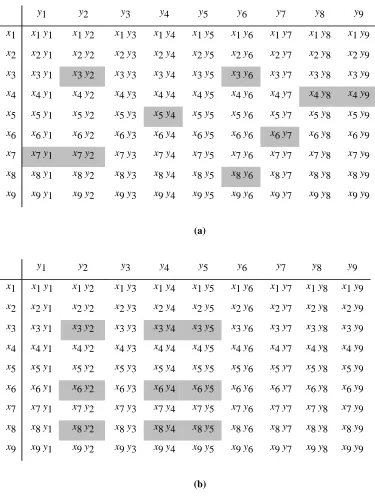
illustrated in Figure 5(a), in which a virtual library, V, built from two reactant pools is represented
by a 9 9 matrix. The rows of the matrix represent the N1 reactants (x1...x9) available in pool R1,
and the columns of the matrix represent the N2 reactants (y1...y9) in pool R2. The N1N2 elements
the reactants in R1 with all the reactants in R2. Assume that we wish Lto contain the nine most
diverse compounds from C. Then a selection algorithm can select compounds from anywhere
within the matrix: for example, the resulting library might correspond to the shaded elements, as
shown: such a “cherrypicking” approach is, of course, analogous to that employed when selecting
individual compounds from a full database, as discussed in Section 3. The potential synthetic
inefficiency of this approach is highlighted by the fact that thirteen reactants are required to build
the nine-member library (vizsix reactants -x3, x4,x5, x6, x7 and x8 - from pool R1 and seven
reactants - y1, y2, y4, y6, y7, y8 and y9 - from pool R2), rather than the three from each pool
required to build a nine-member subset that is a combinatorial library.
A nine-member subset of V that does represent a true combinatorial library can be selected by
intersecting three rows of the matrix with three columns: for example, a 3 3 library built from
reactants x3,x6 and x8 reacted with reactants y2,y4 and y5 is shown by the shaded elements of the
matrix in Figure 5(b). Finding the optimal library then requires consideration of all possible n1n
2-member sets of products obtained by reacting combinations of n1 reagents selected from R1and
n2 reagents selected from R2. We have devised a genetic algorithm (GA) for this demanding
search problem, with each chromosome in the population representing one possible combinatorial
library. For an n1n2-member library, a chromosome consists of two parts: the first part represents
the n1 reactants selected from pool R1 (i.e., the rows of the matrix) and the second part represents
the n2 reactants selected from pool R2 (i.e., the columns of the matrix). The fitness of a
chromosome is obtained by constructing the n1n2-member combinatorial library represented by it,
and then calculating the diversity of this library using a diversity index. The index used here was
the mean pairwise dissimilarity (specifically the complement of the Tanimoto coefficient) when
averaged over all the pairs of molecules in a size-n1n2library, the molecules being represented by
molecular fingerprints. This index is discussed by Pickett et al. (1998) and Turner et al. (1997)
and was used here since it can be calculated very rapidly, a pre-requisite for use in a GA-based
application where very large numbers of fitness values may need to be calculated. The GA
operators are applied to maximise the average diversity and hence to identify the maximally
diverse library.
Experiments with several published combinatorial library designs showed that the diversities of
the libraries resulting from the GA’s product-based selection were consistently greater than the
diversities of the corresponding libraries resulting from conventional reagent-based selection
(Gillet et al., 1997). As well as being effective in operation, the algorithm is also surprisingly
efficient given the size of the search-space that needs to be explored, with the selection of 40 40
reagent pools from a 160,000-member virtual library requiring approximately 20 minutes for a C
program running on a Silicon Graphics R10000 processor. In addition to choosing a structurally
diverse combinatorial library, the SELECT program of Gillet et al. (1999) also ensures that the
constituent molecules exhibit “drug-like” properties. This is achieved by means of a
multi-objective fitness function of the form
wD(D) + wC(C) + wf1 f1+wf2 f2…
where the first term describes the diversity of the library that is being designed, as in the basic
version of the GA described previously. The second term is designed to force the library to be
different from some existing reference collection; for example, it may be desirable to ensure that
the library is maximally dissimilar from a library that has already been synthesised and tested.
The remaining terms in the fitness function relate to physical properties of molecules that are
thought to affect their ability to function as a drug (such as the molecular weight, the numbers of
rotatable bonds, hydrogen donors and acceptors, and the octanol/water partition coefficient) and
that can be calculated sufficiently rapid for the processing of libraries of realistic size. A physical
property of the library is optimised by comparing the distribution of its values in the library with
the distribution of values of the same property in some reference collection (for which we use the
World Drugs Indexdatabase of known drugs). The various wterms act as weights that reflect the
relative importance of each of the various components of the fitness function, thus allowing the
designer to control the sorts of library that are produced (Gillet et al., 1999).
Other types of combinatorial search algorithm can, of course, be used to explore library space, and
there have been several reports of the use of simulated annealing (SA) for library design. In this
work, molecules are represented by principal components derived from calculated physical
properties (topological and information content indices, and electronic, hydrophobic and steric
descriptors) (Hassan et al., 1996) or by low-dimensionality autocorrelation vectors describing the
distribution of the electrostatic potential over the van der Waals’ surface of a molecule (Agrafiotis,
1997), and the scoring function for the SA uses one of several different inter-molecular distance
functions in the resulting descriptor space. Another example of the use of SA as a searching tool
by its constituent three-point pharmacophores, these being generated from an approximate 3D
structure, and the diversity of a set of molecules, such as a putative combinatorial library, is given
by a function based on the number of distinct pharmacophores present in that particular library.
As with SELECT, the scoring function encompasses not just structural diversity but also a
physicochemical property. Specifically, an attempt is made to ensure an approximately even
distribution of a library’s members across three properties that provide a crude, but rapidly
computable, measure of molecular shape: these are the number of heavy atoms in a molecule, the
largest triangle perimeter for any of the three-point pharmacophores in that molecule, and the
largest triangle area for any of these pharmacophores.
5. CONCLUSIONS
Computational methods for the processing of chemical structure information have been used to
support drug-discovery programmes for more than three decades; however, the introduction of
combinatorial approaches to drug discovery has now focused the industry’s interest on tools that
can analyse and control the floods of chemical and biological data resulting from such approaches.
In this paper, we have reviewed some of the techniques that have been developed for selecting
diverse sets of compounds from chemical structure databases, both real (as with corporate
structure files or files of available synthetic reagents) and virtual (as with fully enumerated
combinatorial libraries), illustrating the techniques by focusing upon methods for
dissimilarity-based selection that have been developed in our laboratory in Sheffield.
Although the techniques discussed here, and many others that have been reviewed elsewhere
(Dean and Lewis, 1999), provide effective and efficient means of selecting compounds there is
still much scope for further work. A very simple, but important, task is that of comparing the
many available methods to find those that are most suitable, both in terms of efficiency and
effectiveness. Such studies are now appearing in the literature (Brown and Martin, 1996, 1997;
Matter, 1997; Patterson et al., 1996) but only that by Snarey et al. (1998) has provided a detailed
analysis of some of the dissimilarity-based selection methods considered in this paper. More
importantly, the full value of methods for analysis molecular diversity will only be obtained when
they are linked to other, existing approaches to computer-aided molecular design, such as ligand
docking, pharmacophore mapping and quantitative structure-activity relationships (Martin and
docking of combinatorial libraries (Jones et al., 1999; Kick et al., 1997), and we can expect many
further such reports in the next few years.
ACKNOWLEDGEMENTS
I thank the following: John Bradshaw, Eleanor Gardiner, Val Gillet, Darren Green, John Holliday,
Mike Snarey, Nick Terret and David Wilton for their contributions to the work reported here; the
Engineering and Physical Sciences Research Council, GlaxoWellcome, Pfizer Central Research
and Tripos Inc. for funding; and Daylight Chemical Information Systems and Tripos Inc. for
software support. The Krebs Institute for Biomolecular Research is a designated centre of the
Biotechnology and Biological Sciences Research Council.
REFERENCES
Agrafiotis, D.K. 1997. Stochastic algorithms for maximising molecular diversity. J. Chem. Inf. Comput. Sci. 37, 841-851.
Agrafiotis, D. and Lobanov, V.S. 1999. An efficient implementation of distance-based diversity measures based on k-dtrees. J. Chem. Inf. Comput. Sci. 39, 51-58.
Ash, J.E., Warr, W.A. and Willett, P. 1991. Chemical Structure Systems, Ellis Horwood, Chichester.
Babel, L. 1991. Finding maximum cliques in arbitrary and special graphs. Computing46, 321-341.
Bawden, D. 1993. Molecular dissimilarity in chemical information systems, 383-388. InWarr, W.A., ed., Chemical Structures 2. The International Language of Chemistry. Springer-Verlag, Heidelberg.
Bone, R.G.A. and Villar, H.O. 1997. Exhaustive enumeration of molecular substructures. J. Comput. Chem. 18, 86-107.
Brown, R.D. 1997. Descriptors for diversity analysis. Perspect.Drug. Disc. Design7/8, 31-49. Brown, R.D. and Martin, Y.C. 1996. Use of structure-activity data to compare structure-based
clustering methods and descriptors for use in compound selection. J. Chem. Inf. Comput. Sci. 36, 572-584.
Brown, R.D. and Martin, Y.C. 1997. The information content of 2D and 3D structural descriptors relevant to ligand-receptor binding. J. Chem. Inf. Comput. Sci.37, 1-9.
Chaiken, I.M. and Janda, K.D., eds., 1996. Molecular Diversity and Combinatorial Chemistry. Libraries and Drug Discovery, American Chemical Society, Washington.
Clark, R.D. 1997. OptiSim: an extended dissimilarity selection method for finding diverse representative subsets. J. Chem. Inf. Comput. Sci. 37, 1181-188.
Clark, R.D. and Langton, W.J. 1998. Balancing representativeness against diversity using optimizable k-dissimilarity and hierarchical clustering. J. Chem. Inf. Comput. Sci. 38, 1079-1086,
Cramer, R.D., Patterson, D.E., Clark, R.D., Soltanshahi, F. and Lawless, M.S. 1998. Virtual compound libraries: a new approach to decision making in molecular discovery research. J. Chem. Inf. Comput. Sci. 38, 1010-1023.
DeWitt, S.H. and Czarnik, A.W., eds., 1997. A Practical Guide to Combinatorial Chemistry, American Chemical Society, Washington.
DiverseSolutions User’s Manual 1996. Tripos Inc., St Louis.
Downs, G.M. and Willett, P. 1995. Similarity searching in databases of chemical structures. Rev. Comput. Chem.7, 1-66.
Dunbar, J.B. 1997. Cluster-based selection. Perspect.Drug. Disc. Design7/8, 51-63. Everitt, B.S. 1993. Cluster Analysis. 3rd edition, Edward Arnold, London.
Gardiner, E.J., Artymiuk, P.J. and Willett, P. 1998. Clique-detection algorithms for matching three-dimensional molecular structures. J. Mol. Graph. Model.15, 245-253.
Gillet, V.J., Willett, P. and Bradshaw, J. 1997. The effectiveness of reactant pools for generating structurally diverse combinatorial libraries. J. Chem. Inf. Comput. Sci.37, 731-740. Gillet, V.J., Willett, P., Bradshaw, J. and Green, D.V.S. 1999. Selecting combinatorial libraries
to optimise diversity and physical properties. J. Chem. Inf. Comput. Sci. 39, 169-177. Good, A.C. and Lewis, R.A. 1997. New methodology for profiling combinatorial libraries and
screening sets: cleaning up the design process with HARPick. J. Med. Chem. 40, 3926-3936.
Hassan, M., Bielawski, J.P., Hempel, J.C. and Waldman, M. 1996. Optimization and visualization of molecular diversity of combinatorial libraries. J. Comput.-Aid. Mol. Design2, 64-74.
Higgs, R.E., Bemis, K.G., Watson, I.A. and Wikel, J.H. 1997. Experimental designs for selecting molecules from large chemical databases. J. Chem. Inf. Comput. Sci.37, 861-870.
Holliday, J.D., Ranade, S.S. and Willett, P. 1995. A fast algorithm for selecting sets of dissimilar structures from large chemical databases. Quant. Struct.-Activ. Relat.14, 501-506.
Holliday, J.D. and Willett, P. 1996. Definitions of ‘dissimilarity’ for dissimilarity-based compound selection. J. Biomolec. Screen.1, 145-151.
Hudson, B.D., Hyde, R.M., Rahr, E. and Wood, J. 1996. Parameter based methods for compound selection from chemical databases. Quant. Struct.-Activ. Relat.15, 285-289.
Johnson, M.A. and Maggiora, G.M., eds., 1990. Concepts and Applications of Molecular Similarity, John Wiley, New York.
Jones, G., Willett, P., Glen, R.C., Leach, A.R. and Taylor, R. 1999. Further development of a genetic algorithm for ligand docking and its application to screening combinatorial libraries. In the press.
Kennard, R.W. and Stone, L.A. 1969. Computer aided design of experiments. Technometrics11, 137-148.
Kick, E.K., Roe, D.C., Skillman, A.G., Liu, G., Ewing, T.J.A., Sun, Y., Kuntz, I.D. and Ellman, J.A. 1997. Structure-based design and combinatorial chemistry yield low nanomolar inhibitors of cathepsin D. Chem. Biol. 4, 297-307.
Kuo, C.-C., Glover, F. and Dhir, K.S. 1994. Analyzing and modeling the maximum diversity problem by zero-one programming. Decision Sci. 24, 1171-1185.
Lajiness, M.S. 1990. Molecular similarity-based methods for selecting compounds for screening, 299-316. InRouvray, D.H., ed., Computational Chemical Graph Theory, Nova Science Publishers, New York.
Lajiness, M.S. 1997. Dissimilarity-based compound selection techniques. Perspect.Drug. Disc. Design7/8, 65-84.
Lance, G.N. and Williams, W.T. 1967. A general theory of classificatory sorting strategies. I. Hierarchical systems. Comput. J.9, 373-380.
Lipinski, C.A., Lombardo, F., Dominy, B.W. and Feeney, P.J. 1997. Experimental and computational approaches to estimate solubility and permeability in drug discovery and development settings. Adv. Drug Deliv. Res., 23, 3-25.
Martin, E.J., Blaney, J.M., Siani, M.A., Spellmeyer, D.C., Wong, A.K. and Moos, W.H. 1995. Measuring diversity: experimental design of combinatorial libraries for drug discovery. J. Med. Chem. 38, 1431-1436.
Martin, E.J. and Critchlow, R.E. 1999. Beyond mere diversity: tailoring combinatorial libraries for drug discovery. J. Combin. Chem. 1, 32-45.
Martin, Y.C. and Willett, P., eds., 1998. Designing Bioactive Molecules: Three-Dimensional Techniques and Applications, American Chemical Society, Washington.
Mason, J.S. and Pickett, S.D. 1997. Partition-based selection. Perspect.Drug. Disc. Design7/8, 85-114.
Matter, H. 1997. Selecting optimally diverse compounds from structure databases: a validation study of two-dimensional and three-dimensional molecular descriptors. J. Med. Chem. 40, 1219-1229.
Nilakantan, R., Bauman, N. and Haraki, K.S. 1997. Database diversity assessment: new ideas, concepts and tools. J. Comput.-Aid. Mol. Design11, 447-452.
Pardalos, P.M. and Xue, J. 1994. The maximum clique problem. J. Global Optimiz. 4, 301-328. Patterson, D.E., Cramer, R.D., Ferguson, A.M., Clark, R.D. and Weinberger, L.E. 1996.
Neighbourhood behaviour: a useful concept for validation of “molecular diversity” descriptors. J. Med. Chem. 39, 3049-3059.
Pearlman, R.S. and Smith, K.M. 1998. Novel software tools for chemical diversity. Perspect. Drug Disc. Design9/11, 339-353.
Pickett, S.D., Luttman, C., Guerin, V., Laoui, A. and James, E. 1998. DIVSEL and COMPLIB -strategies for the design and comparison of combinatorial libraries using pharmacophore descriptors. J. Chem. Inf. Comput. Sci.38, 144-150.
Pickett, S.D., Mason, J.S. and McLay, I.M. 1996. Diversity profiling and design using 3D pharmacophores: pharmacophore-derived queries (PDQ). J. Chem. Inf. Comput. Sci. 36, 1214-1223.
Polinsky, A., Feinstein, R.D., Shi, S. and Kuki, A. 1996. LiBrain: software for automated design of exploratory and targeted combinatorial libraries, 219-232. InChaiken, I.M. and Janda, K.D., eds., Molecular Diversity and Combinatorial Chemistry. Libraries and Drug Discovery, American Chemical Society, Washington DC.
Shemetulskis, N.E., Dunbar, J.B., Dunbar, B.W., Moreland, D.W. and Humblet, C. 1995. Enhancing the diversity of a corporate database using chemical database clustering and analysis. J. Comput.-Aid. Mol. Design9, 407-416.
Snarey, M., Terret, N.K., Willett, P. and Wilton, D.J. 1998. Comparison of algorithms for dissimilarity-based compound selection. J. Mol. Graph. Model. 15, 372-385.
Sneath, P.H.A. and Sokal, R.R. 1973. Numerical Taxonomy, WH Freeman, San Francisco. Turner, D.B., Tyrrell, S.M. and Willett, P. 1997. Rapid quantification of molecular diversity for
selective database acquisition. J. Chem. Inf. Comput. Sci.37, 18-22.
Voorhees, E.M. 1986. Implementing agglomerative hierarchic clustering algorithms for use in document retrieval. Inf. Proc. Manag. 22, 465-476.
Walters, W.P., Stahl, M.T. and Murcko, M.A. 1998. Virtual screening - an overview. Drug Discov. Today, 3, 160-178.
Willett, P. 1987. Similarity and Clustering in Chemical Information Systems, Research Studies Press, Letchworth.
1. Initialise Subsetby transferring a compound from Dataset.
2. Calculate the dissimilarity between each remaining compound in Datasetand the
compounds in Subset.
3. Transfer to Subsetthat compound from Datasetthat is most dissimilar to Subset.
4. Return to Step 2 if there are less than ncompounds in Subset.
Fig. 1. General maximum-dissimilarity algorithm
1. Define a threshold dissimilarity, t.
2. Transfer a compound, J, from Datasetto Subset.
3. Remove from Datasetall compounds having a dissimilarity with Jof less than t.
4. Return to Step 2 if there are compounds remaining in Dataset.
Fig. 2. General sphere-exclusion algorithm
1. Define a threshold dissimilarity, t.
2. Initialise Subsetby transferring a compound, J, from Dataset.
3. Select a compound, J, from Dataset. If it has a dissimilarity less than twith any
compound in Subsetthen remove it from Dataset; otherwise add it to Subsample.
4. Repeat Step 3 until Subsamplecontains Kmolecules.
5. Transfer to Subsetthat compound from Subsamplethat is most dissimilar to Subset.
Return the remaining members of SubsampletoDataset.
6. Return to Step 3 if there are less than ncompounds in Subset.
Fig. 3. OptiSim algorithm (Clark, 1997).
1. Define a threshold dissimilarity, t.
2. Generate an N Ndissimilarity matrix in which M(I,J) contains the dissimilarity
between molecules Iand J.
3. Generate a graph, G, from Mby setting each element M(I,J) to one (or zero) if it is
greater than (or not greater than) t.
4. Use a clique-detection algorithm to identify the set of size-ncliques in G.
y1 y2 y3 y4 y5 y6 y7 y8 y9
x1 x1y1 x1y2 x1y3 x1y4 x1y5 x1y6 x1y7 x1y8 x1y9
x2 x2y1 x2y2 x2y3 x2y4 x2y5 x2y6 x2y7 x2y8 x2y9
x3 x3y1 x3y2 x3y3 x3y4 x3y5 x3y6 x3y7 x3y8 x3y9
x4 x4y1 x4y2 x4y3 x4y4 x4y5 x4y6 x4y7 x4y8 x4y9
x5 x5y1 x5y2 x5y3 x5y4 x5y5 x5y6 x5y7 x5y8 x5y9
x6 x6y1 x6y2 x6y3 x6y4 x6y5 x6y6 x6y7 x6y8 x6y9
x7 x7y1 x7y2 x7y3 x7y4 x7y5 x7y6 x7y7 x7y8 x7y9
x8 x8y1 x8y2 x8y3 x8y4 x8y5 x8y6 x8y7 x8y8 x8y9
x9 x9y1 x9y2 x9y3 x9y4 x9y5 x9y6 x9y7 x9y8 x9y9
(a)
y1 y2 y3 y4 y5 y6 y7 y8 y9
x1 x1y1 x1y2 x1y3 x1y4 x1y5 x1y6 x1y7 x1y8 x1y9
x2 x2y1 x2y2 x2y3 x2y4 x2y5 x2y6 x2y7 x2y8 x2y9
x3 x3y1 x3y2 x3y3 x3y4 x3y5 x3y6 x3y7 x3y8 x3y9
x4 x4y1 x4y2 x4y3 x4y4 x4y5 x4y6 x4y7 x4y8 x4y9
x5 x5y1 x5y2 x5y3 x5y4 x5y5 x5y6 x5y7 x5y8 x5y9
x6 x6y1 x6y2 x6y3 x6y4 x6y5 x6y6 x6y7 x6y8 x6y9
x7 x7y1 x7y2 x7y3 x7y4 x7y5 x7y6 x7y7 x7y8 x7y9
x8 x8y1 x8y2 x8y3 x8y4 x8y5 x8y6 x8y7 x8y8 x8y9
x9 x9y1 x9y2 x9y3 x9y4 x9y5 x9y6 x9y7 x9y8 x9y9
[image:20.595.99.474.154.653.2](b)
Fig. 5. A fully enumerated, dimer library (V) represented by a 9 9 matrix. In (a) the shaded
compounds and that was chosen by applying a selection algorithm to V. In (b) the n1n2 subset of