On the Development of a Meshless Method to Study
Multibody Systems Using Computational Fluid Dynamics
Thesis submitted in accordance with the requirements of the University of Liverpool for the degree of Doctor in Philosophy
by
David J. Kennett (MMath)
Copyright © 2013 by David J. Kennett
Abstract
Multibody systems, which consist of several separate or interconnected, rigid or flexible
bodies, occur frequently in problems of aerospace engineering. Such problems can
be difficult to solve using conventional finite volume methods in computational fluid
dynamics. This is particularly so if the bodies are required to undergo translational or
rotational displacements during time-dependent simulations, which occur, for example, with cases involving store release or control surface deflection. These problems are
generally limited to those when the movements are small or known a-priori. This
thesis investigates the use of the meshless method to solve these difficult multibody systems using computational fluid dynamics, with the aim of performing moving-body
simulations involving large scale motions, with no restrictions on the movement. An implicit meshless scheme is developed to solve the Euler, laminar and
Reynolds-Averaged Navier-Stokes equations. Spatial derivatives are approximated using a least
squares method on clouds of points. The resultant system of equations is linearised and solved implicitly using approximate, analytical Jacobian matrices and a preconditioned
Krylov subspace iterative method. The details of the spatial discretisation, linear solver
and construction of the Jacobian matrix are discussed, and results which demonstrate the performance of the scheme are presented for steady and unsteady flows in two and
three-dimensions.
The selection of the stencils over the computational domain for the meshless solver is vital for the method to be used to solve problems involving multibody systems
accu-rately and efficiently. The computational domain is obtained using overlapping point
distributions associated with each body in the system. Stencil selection is relatively straight forward if the point distributions are isotropic in nature; however, this is rarely
the case in computations that solve the Navier-Stokes equations. A fully automatic
method of selecting the stencils is outlined, in which the original connectivity and the concept of a resolving direction are used to help construct good quality stencils with
limited user input. The methodology is described, and results, that are solutions to the
Acknowledgements
I would like to acknowledge my supervisors Professor Ken Badcock and Professor
George Barakos for their assistance and support. I particularly wish to thank Pro-fessor Badcock without whom I would certainly have been lost. His encouragement
and ideas to this work are very much appreciated. Thanks also to the other members
of the Computational Fluid Dynamics Laboratory at the University of Liverpool, both past and present, with special thanks to Dr Sebastian Timme for his invaluable help in
this project.
I would also like to thank the members of the Advanced Technology Centre at BAE
Systems for welcoming me and making my industrial placement very productive and
enjoyable. I am especially grateful to Nick Leppard for his help and guidance on this visit.
Last, but not least, my friends and family, near and far, shall not be forgotten for their support and patience.
Declaration
I confirm that the thesis is my own work, that I have not presented anyone else’s work as
my own and that full and appropriate acknowledgement has been given where reference has been made to the work of others.
David J. Kennett
List of Publications
Kennett, D. J., Timme, S., Angulo, J. J., and Badcock, K. J., “Semi-Meshless
Stencil Selection on Three-Dimensional Anisotropic Point Distributions with Parallel
Implementation,” AIAA Paper 2013–0867, Presented at the 51st AIAA Aerospace
Sciences Meeting, Grapevine, Texas, Jan 2013.
Kennett, D. J., Timme, S., Angulo, J. J., and Badcock, K. J., “Semi-Meshless
Stencil Selection for Anisotropic Point Distributions,” International Journal of
Computational Fluid Dynamics Vol. 26, Nos. 9–10, 2012, pp. 463–487
Kennett, D. J., Timme, S., Angulo, J. J., and Badcock, K. J., “An Implicit
Meshless Method for Application in Computational Fluid Dynamics,” International
Journal for Numerical Methods in Fluids Vol. 71, No. 8, 2012, pp. 1007–1028
Kennett, D. J., Timme, S., Angulo, J. J., and Badcock, K. J., “An Implicit
Semi-Meshless Scheme with Stencil Selection for Anisotropic Point Distributions,”
Table of Contents
Abstract i
Acknowledgements iii
Declaration v
List of Publications vii
List of Figures xiii
List of Tables xvii
List of Symbols xix
1 Introduction 1
1.1 Moving-body problems in CFD . . . 2
1.2 Meshless methods . . . 6
1.3 Features of meshless methods in CFD . . . 9
1.4 Stencil selection . . . 11
1.5 Aim of work and outline of thesis . . . 14
Part I: Meshless Flow Solver 16 2 Spatial Discretisation 19 2.1 Navier-Stokes equations . . . 19
2.1.1 Reynolds-averaged Navier-Stokes equations . . . 20
2.1.2 Euler equations . . . 22
2.1.3 Domain discretisation . . . 23
2.2 Meshless method . . . 24
2.2.1 Overview of the meshless method . . . 24
2.2.2 Weighting . . . 25
2.2.3 Shape function . . . 27
2.2.5 Derivatives of the approximated function . . . 28
2.2.6 Partition of unity . . . 29
2.3 Discretisation of the Navier-Stokes equations using the meshless method 31 2.3.1 Evaluating the inviscid flux . . . 31
2.3.2 Evaluating the viscous flux . . . 34
2.3.3 Evaluating the turbulence model terms . . . 35
2.3.4 Boundary conditions . . . 37
3 Time Integration 41 3.1 Implicit method . . . 41
3.2 Time derivative . . . 42
3.3 Choice of linear solution method . . . 44
3.4 Linear solver method . . . 45
3.5 Constructing the approximate Jacobian matrix . . . 47
3.6 Parallel implementation . . . 51
4 Method Evaluation 53 4.1 Two-dimensional cases . . . 53
4.1.1 Steady inviscid flow over a NACA 0012 aerofoil . . . 54
4.1.2 Steady laminar flow over a NACA 0012 aerofoil . . . 57
4.1.3 Steady laminar flow over a circular cylinder . . . 57
4.1.4 Unsteady laminar flow over a circular cylinder . . . 58
4.1.5 Steady turbulent flow over the RAE 2822 aerofoil . . . 59
4.1.6 Unsteady turbulent flow - AGARD CT1 . . . 60
4.1.7 Unsteady turbulent flow - AGARD CT8 . . . 62
4.2 Three-dimensional cases . . . 63
4.2.1 Goland Wing . . . 65
4.2.2 MDO Wing . . . 66
4.2.3 ONERA M6 Wing . . . 68
Part II: Development for Multibody Systems 70 5 Meshless Preprocessor 73 5.1 Scheme requirements . . . 73
5.2 Preprocessor steps . . . 79
5.3 Preprocessor in two-dimensions . . . 80
5.3.1 Redefining boundaries . . . 80
5.3.2 Blanking points . . . 82
5.3.3 Stencil selection . . . 84
5.3.4 Final boundary check . . . 88
5.4.1 Subsonic steady state flow . . . 89
5.4.2 Transonic steady flow using input domains of varying density . . 90
5.4.3 Laminar steady state flow . . . 94
5.4.4 RANS steady state flow . . . 95
5.4.5 Deflected control surface case . . . 96
5.5 Preprocessor in three-dimensions . . . 100
5.5.1 Redefining boundaries . . . 100
5.5.2 Blanking points . . . 102
5.5.3 Stencil selection . . . 102
5.6 Results in three-dimensions . . . 106
5.6.1 Single geometry stencil selection . . . 107
5.6.2 DLR-F6 fuselage-wing configuration . . . 108
5.6.3 Open Source Fighter . . . 110
6 Moving Body Problems 113 6.1 Stencil selection with moving bodies . . . 113
6.1.1 Adaptive stencil selection . . . 113
6.1.2 Points changing type during simulation . . . 114
6.1.3 Point velocities . . . 116
6.2 Moving-body results . . . 116
6.2.1 Control surface deflection . . . 117
6.2.2 Two-dimensional prototype store release . . . 118
6.2.3 Goland wing and store body prototype store release . . . 120
6.2.4 Open Source Fighter store release . . . 122
7 Conclusions and Future Work 125 Bibliography 131 A Navier-Stokes equations in vector form 141 B Derivation and properties of least squares matrix 143 C Three-dimensional computational geometry algorithms 147 C.1 Ray-triangle intersection . . . 147
C.2 Triangle-triangle intersection . . . 149
List of Figures
1.1 Domain decomposition methods . . . 3
1.2 Form of a meshless domain . . . 5
2.1 Effect of parameter on the weighting function . . . 26
3.1 Comparison of convergence rates using first and second order Jacobian
matrices . . . 49
3.2 Parallel solver performance . . . 52
4.1 NACA 0012 aerofoil connectivities . . . 53
4.2 Transonic inviscid flow for NACA 0012 aerofoil at Mach 0.8 and zero
degrees angle of attack using a quadratic polynomial reconstruction . . . 54
4.3 Supersonic inviscid flow for NACA 0012 aerofoil at Mach 1.2 and 7.0
degrees angle of attack using a quadratic polynomial reconstruction . . . 55
4.4 Laminar flow for NACA 0012 aerofoil at Mach 0.5, angle of attack 3.0
degrees and Reynolds number of 5000 using a quadratic polynomial
re-construction . . . 56
4.5 Laminar flow over circular cylinder with Reynolds number of 40 . . . 58
4.6 Instantaneous contour plot of thexcomponent of velocity for the circular
cylinder, unsteady case with Reynolds number of 100 . . . 59
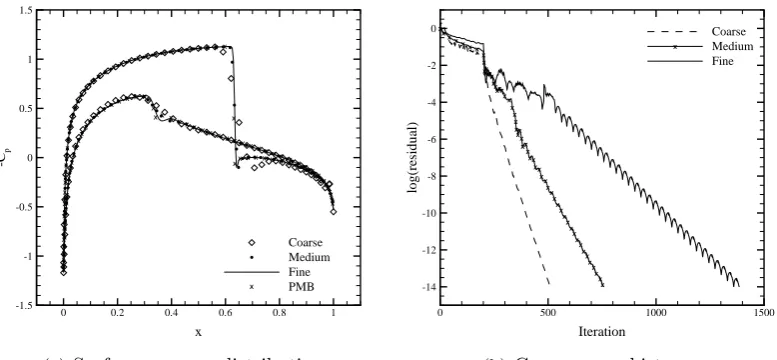
4.7 Pressure distributions and convergence histories for RAE 2822 aerofoil
case 9 . . . 60
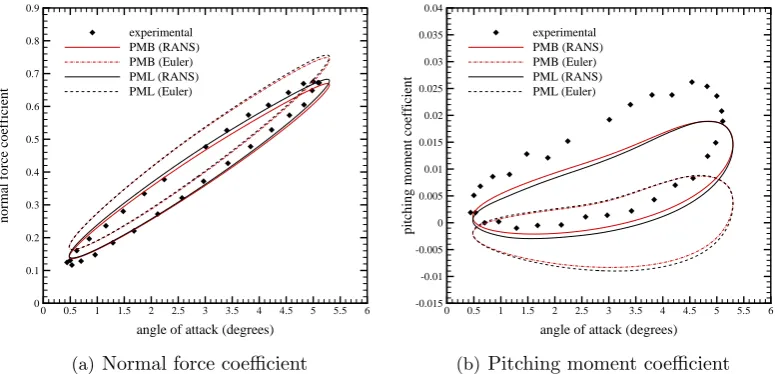
4.8 Normal force and pitching moment coefficients for forced pitching motion
of AGARD CT1 test case . . . 61
4.9 Unsteady pressure distributions of AGARD CT1 test case . . . 61
4.10 Initial, steady state pressure contours and surface pressure distribution
for AGARD CT8 test case . . . 62
4.11 Comparison of real and imaginary parts of surface pressure distribution
for AGARD CT8 test case . . . 63
4.12 Stencils used by PML for three dimensional flow solver validation . . . . 64
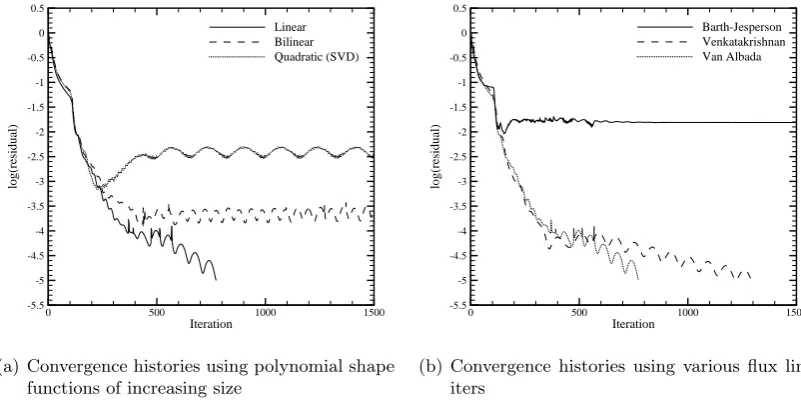
4.13 Comparison of convergence histories using shape function
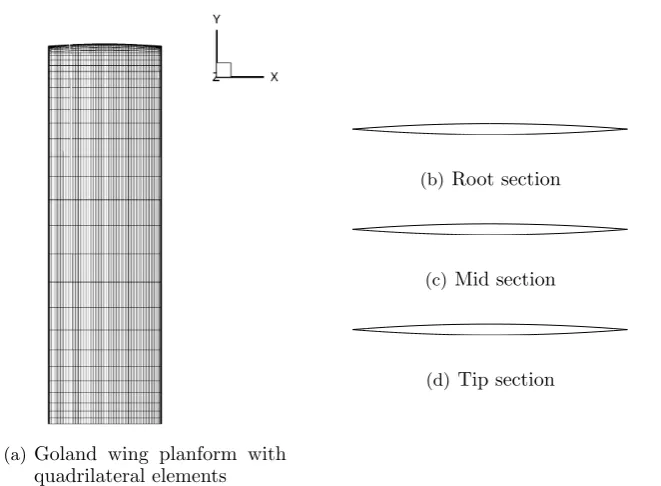
4.14 Goland wing planform with quadrilateral elements and cross sections . . 65
4.15 Pressure coefficients for the Euler equations using quadrilateral and tri-angular elements at three freestream Mach numbers and two spanwise locations for the Goland wing . . . 66
4.16 MDO wing planform and cross sections . . . 67
4.17 Comparison of computed inviscid pressure coefficients with PMB for the MDO wing test case . . . 67
4.18 ONERA M6 wing planform and cross sections . . . 68
4.19 Comparison of computed inviscid pressure coefficients with PMB and experiment for the ONERA M6 wing test case . . . 69
5.1 Common neighbourhood concepts based on geometric criteria . . . 75
5.2 The partitioning process of the quadtree . . . 76
5.3 Candidate point search and stencil selections using nearest neighbour algorithms and anisotropic point distributions . . . 77
5.4 Required input for preprocessor . . . 79
5.5 Tests to determine if edges intersect using bounding boxes . . . 80
5.6 Boolean addition and subtraction of two overlapping cylinders . . . 81
5.7 Boundary intersection and reallocation diagrams for two bodies requiring Boolean addition . . . 82
5.8 Blanking point operations . . . 83
5.9 Situation with possible multiple flaggings . . . 83
5.10 Comparison of results using classical nearest neighbour algorithm and presented stencil selection method for solution of the Blasius boundary layer on anisotropic point distributions . . . 85
5.11 Defining the initial resolving vector and method of summation of over-lapping stencils . . . 86
5.12 Defining coordinate system and parameters for the merit function . . . . 87
5.13 Results for biplane configuration solving the Euler equations at Mach 0.5 and zero degrees angle of attack . . . 90
5.14 Results for biplane configuration at inviscid flow conditions Mach 0.755 and angle of attack 0.016 degrees . . . 91
5.15 Results for biplane configuration at inviscid flow conditions of Mach 0.755, angle of attack 0.016 degrees with a coarse, medium and fine upper aerofoil point distribution . . . 92
5.16 Results for the laminar biplane case at Mach 0.8, angle of attack 10 degrees and Reynolds number 500 . . . 93
5.18 Results for the RANS biplane case at Mach 0.7, angle of attack 1.49
degrees and Reynolds 9 million . . . 95
5.19 Input connectivities of the main body and control surface geometries . . 96
5.20 Close-up of boundary layer region at the intersection between the body and control surface . . . 97
5.21 Point distribution of the main body and control surface configuration at various angles of deflection, with pressure coefficient plots at turbulent flow conditions Mach 0.2, zero degrees angle of attack and Reynolds number 5 million . . . 98
5.22 Element bounding boxes in three-dimensions . . . 100
5.23 Method of redefining the solid boundaries after intersection . . . 101
5.24 Blanking point operations in three-dimensions . . . 102
5.25 Determining the resolving vector using the principal axes of inertia . . . 103
5.26 Directions of anisotropy for stencils in three-dimensions . . . 104
5.27 Selection of points in basis for three-dimensional point distributions . . 105
5.28 Comparison of PML flow solution and convergence history using initial grid connectivity and stencil selection methods on a Goland wing at freestream Mach number 0.9 and 0 degrees angle of attack . . . 106
5.29 Configuration of the fuselage and wing input geometries, and new ele-ments that are created by the preprocessor as a result of the geometries intersecting for the DLR-F6 test case . . . 107
5.30 Surface pressure coefficient plots for the DLR-F6 test case at Mach 0.8 and zero degrees angle of attack . . . 108
5.31 Resultant geometry of the OSF Case 2 when components are assembled 109 5.32 Surface pressure coefficient plots for the OSF Case 1, at Mach 0.85 and 2.12 degrees angle of attack . . . 110
5.33 Pressure contours for OSF Case 2 at Mach 0.85, angle of attack 2.12 degrees . . . 111
6.1 Reconstruction of the stencils in regions with different flow types using the adaptive selection method and a new parameter . . . 114
6.2 Points moving in and out of the computational domain . . . 115
6.3 Point distributions at maximum control surface deflections . . . 116
6.4 Normal force and pitching moment coefficients for unsteady forced con-trol surface deflection case . . . 117
6.6 View of stencils along the outer region of the input domain of the smaller
aerofoil, before and after the adaptive scheme has been applied, for the
laminar store release case . . . 120
6.7 Pressure coefficient contours at two time steps for the Goland wing and store body case at inviscid flow conditions Mach 0.5 and zero degrees angle of attack . . . 121
6.8 Transonic store release from OSF using prescribed motion . . . 122
6.9 Close up of missile, pylon and wing configuration for the OSF store release test case . . . 123
7.1 Limitations in the summing of resolving vectors from two overlapping stencils . . . 127
7.2 Issues regarding point locations . . . 128
C.1 Ray-triangle intersection test . . . 148
C.2 Testing if the triangles lie in the same plane . . . 149
C.3 Tests to see if the triangles intersect using the intervals of the triangles on the line of intersection between the planes containing them . . . 150
C.4 Flag points belonging to two intersecting triangles . . . 152
C.5 Define the edges to be used in triangulation . . . 153
C.6 Candidate points per edge to be used in triangulation . . . 154
C.7 Remove non-conforming boundary points from candidate list . . . 155
C.8 Overlap of triangles belonging to same body . . . 156
C.9 Overlap of triangles belonging to opposite bodies . . . 157
List of Tables
1.1 Summary of classification of meshless methods . . . 8
4.1 Convergence of lift, drag and moment coefficients for inviscid transonic
case using linear and quadratic reconstructions using coarse, medium
and fine point distributions . . . 54
4.2 Convergence of lift, drag and moment coefficients for inviscid supersonic
case using linear and quadratic reconstructions using coarse, medium
and fine point distributions . . . 55
4.3 Convergence of lift, drag and moment coefficients for laminar case using
linear and quadratic reconstructions using coarse, medium and fine point
distributions . . . 56
4.4 Angle of separation and drag coefficients for laminar flow over circular
cylinder with Reynolds number of 40 . . . 57
4.5 Comparisons of computed Strouhal number, mean pressure and mean
friction drag coefficients . . . 59
4.6 Real and imaginary lift and moment coefficients for AGARD CT8 test
case . . . 63
5.1 Timings for each stage of the preprocessor in seconds and as a percentage
of total computational time for the subsonic biplane case . . . 89
5.2 Timings for each stage of the preprocessor in seconds and as a percentage
of total preprocessor time for the DLR-F6 case . . . 109
5.3 Components of the Open Source Fighter cases . . . 110
6.1 Timings for each stage of the laminar two-dimensional store case
prepro-cessor in seconds and as a percentage of total time . . . 118
6.2 Average timings for each stage of the preprocessor in seconds and as a
percentage of total time for the Goland wing and store body case. . . . 121
6.3 Size and quantity of additional components for the OSF store release case122
6.4 Timings for each stage of the preprocessor in seconds and as a percentage
List of Symbols
a = speed of sound
A = Jacobian matrix (=∂R/∂p)
b, c, d = meshless shape function derivatives
c = chord length
Cd = drag coefficient
Cf = skin friction coefficient
Cl,Cm = coefficients of lift and pitching moment
Cp = pressure coefficient
cp,cv = coefficients of specific heat
E = total energy
fi,fv = inviscid and viscous fluxes in xdirection
gi,gv = inviscid and viscous fluxes in y direction
hi,hv = inviscid and viscous fluxes in zdirection
I = identity matrix
I = inertia tensor
k = reduced frequency
k = turbulence kinetic energy
L = reference length scale
m = pseudo-time level
m = order of polynomial
M∞ = freestream Mach number
M = number of points on which local flux depends
n = number of points in stencil
N = number of points in computational domain
N = shape function
n = unit normal vector
n = real-time level
P r,P rt = Prandtl number and turbulent Prandtl number
p = pressure
p = vector of base monomials
p = vector of primitive variables
q = heat flux vector
R = residual vector
R = gas constant
Re = chord Reynolds number
t = real-time
T = temperature
t = unit tangential vector
u = vector of Cartesian velocity components
v = resolving vector
w = weighting function
w = vector of conservative variables
Greek Symbols
α = freestream angle of attack
α = pitch angle
α = vector of reconstructed polynomial coefficients
β = control surface angle of deflection
γ = smallest distance in initial stencil
γ = ratio of specific heats
δ = boundary layer thickness
δij = Kronecker delta
ϵ = increment or tolerance
ζ = mapped coordinate system
η = spanwise location
η = basis vector
κ = thermal conductivity
µ,µt = dynamic viscosity and turbulent (eddy) viscosity
e
ν = intermediate variable of Spalart–Allmaras turbulence model
ξ = vector of basis coefficients
ρ = density
τ = stress tensor
τ = pseudo-time
ϕ = flow variables
ˆ
ϕ = meshless approximating function
ψ = flux limiter
Subscripts
a = amplitude
e = effective value
e = average of flow variables within a set
h = halo value
i = interior point
i = star point
j = neighbouring point
L = left side of Riemann problem
o = orthogonal
R = right side of Riemann problem
t = turbulent
v = viscous model
0 = steady state solution, mean value or initial value
∞ = freestream value
Acronyms
6-DOF = six-degree of freedom
BILU = block incomplete lower-upper
CFD = computational fluid dynamics
CFL = Courant-Friedrichs-Lewy
DLR = German Aerospace Center
GCR = generalised conjugate residual
MDO = multidisciplinary optimisation
MLS = moving least squares
MPI = message passing interface
MUSCL = monotonic upstream–centered scheme for conservation laws
NS = Navier–Stokes
ONERA = French Aerospace Lab
OSF = open source fighter
PMB = parallel multiblock
PML = parallel meshless
POU = Partition of unity
RANS = Reynolds–averaged Navier–Stokes
SA = Spalart–Allmaras
Chapter 1
Introduction
The prediction of fluid flow involving moving aircraft components is a challenging prob-lem. An example of such an application is in store release, in which the store, a weapon
or countermeasure device, is released from the aircraft at high speed. Store
separa-tion analysis includes determining the trajectory during the initial stage of the release, and the identification of safe separation zones to avoid mid-air collisions between the
store and the aircraft that released it. For this, important parameters such as the
miss distance, which is the smallest distance between any part of the store and the aircraft during the early part of the trajectory, are needed for all of the different load
configurations and flight conditions that are possible for the aircraft in question.
Originally, such parameters could only be determined with flight tests, in which the stores were dropped from an aircraft at gradually increasing speeds until the store came
close to or actually hit the aircraft [1]. These tests were very dangerous for the test
pilots, and expensive in terms of time, implementation and the possible loss of aircraft. For many years wind tunnels were the only alternative; though with the recent advances
in computer hardware it is becoming more feasible to numerically compute the required
parameters using computational fluid dynamics (CFD). Such methods were first used to provide a solution for a store in an aircraft flow field in the 1970s [2, 3]. The continuing
development of computer resources and numerical algorithms, has meant that CFD has
matured to a state where it can work in conjunction with wind tunnel data and flight tests in aerodynamic design.
The numerical methods employed in CFD require some discretisation of the
compu-tational domain: this is most commonly achieved through the use of a mesh, also called a grid. The mesh consists of a set of non-overlapping cells, which in some way conform
to the geometry of the problem, and ensure the conservation of the flow variables. The
fluid flow over the geometry is simulated by transforming the governing equations of fluid dynamics into a discretised algebraic form, which is solved on the mesh to obtain
numerical (as opposed to analytical) solutions. For a store release case, these equations
on the store. This data is then used by a six-degree of freedom (6-DOF) module to
solve the rigid body equations of motion, and, thus, predict the store trajectory at each
time step. The computational domain for such simulations must include, at the very least, the aircraft from which the store is released and the store itself; hence, they form
what is called a multibody system. By classification multibody systems may be static;
but the fluid-structure interaction between the various bodies in the store release case inevitably leads to changing geometries during the time-dependent computation. This
means that there are elemental changes in the configuration over time as the bodies
move relative to one another. The difficulties in handling such changes within a dis-cretised domain to account for this movement, is one of the important issues in the
simulation of this class of problem.
1.1
Moving-body problems in CFD
The most intuitive way to simulate moving-body problems is to generate a new grid at
each time step, with the bodies in the new locations as predicted by the calculations
made in the previous step. This means that each successive discretisation will require an interpolation of the flow solutions between the grids, which leads to inaccuracies that
arise from the large number of interpolations that are needed. Also, as grid generation
can be a difficult and time consuming process, remeshing the geometry after each time step is a very unattractive proposition. These disadvantages mean that researchers
have looked to alternative, more elaborate techniques.
One such technique is to deform the mesh to account for the body movement. In
this approach, the boundaries move according to the 6-DOF model after each time step, while the cells of the mesh expand and contract to accommodate the movement,
while keeping the connectivity unchanged between time steps [4–8]. This method is
relatively easy to implement into a CFD solver, and is adequate for motions that are simple. Problems arise when the bodies undergo large scale changes in their position,
meaning that the required mesh deformations are excessive: then the mesh quality
deteriorates and so must be reviewed during each iteration. Reference [9] presents a method in which the mesh is completely regenerated when it exhibits bad quality
measures. A local remeshing procedure is used in Ref. [10], in which a hole is cut in the
domain where the mesh quality has deteriorated; this region is then remeshed using an unstructured grid generator, thus, reducing where solution interpolation must occur.
Alternative methods arise by a decomposition of the domain into a set of simpler
subdomains. For example, it is convenient to generate independent grids around each
body separately, as subdomains, which can then be composited together in some way. If the grids meet at an interface, as in Fig.1.1(a), then they can slide past one
an-other to simulate the relative movement between the bodies. The meshes adjacent to
(a)Sliding mesh method (b) Overset grid method
Figure 1.1: Domain decomposition methods.
number of cell faces; hence, solutions must be passed through the interface by means
of an interpolation. This method requires that the motion of the bodies be known a-priori, and is restricted to movement along the interface. Applications, for which it has
been used with a great deal of success for time-dependent simulations, include
turbo-machinery [11], where non-matching and rotating cell faces are used for the simulation of the flow between adjacent blade rows of engines; a study of noise generation from
propeller and propeller-wing configurations [12]; and the analysis of helicopter
aerody-namics [13], for which the unsteady flow over a fuselage and rotor blades is computed for a helicopter in forward flight. The restriction that the exact location of the bodies
must be known after each time step means, however, that there are limited
applica-tions to the sliding mesh approach; and it cannot be used to simulate many multibody problems with unknown geometry changes, such as those that occur in store release
cases.
A more flexible method is obtained if instead of the domains meeting at the
inter-face, they are allowed to overlap, as shown in Fig.1.1(b). This means that the grids can move rigidly with their associated body components, and therefore, in theory, the
bodies can move in any direction relative to one another during the computation. This
grid movement can be performed without any deformation or remeshing, and communi-cation between the grids is achieved through data interpolation. This method is called
the overset grid method, though it is also commonly known as the Chimera method,
and was introduced in Ref. [14] by Steger et al. in 1983. The overset grid strategy not only has the benefit of being able to simulate difficult moving-body problems, but it can
also alleviate some of the difficulties in generating a full finite volume mesh, particularly
for multibody systems. The technique of overlapping grids to form the computational domain means that the engineer can construct meshes around bodies, or components
of bodies, independently, which is simpler and less time consuming than generating the
overset grid codes have been developed, such as those in Refs. [15–21]; these, and other
codes, have been used to solve moving-body problems in a wide range of applications
including helicopter flight [22, 23], tiltrotor flight [24], flow through a turbine [25] and store release [1, 26–32].
The use of overlapping grids means that a preprocessor stage is required to first
cre-ate a computational domain on which the flow solver can opercre-ate. This stage basically
consists of three steps: hole cutting, identification of interpolation cells and identifi-cation of corresponding donor cells. The hole cutting stage is necessary for regions of
grids that fall into solid bodies, or other non-flow regions, when the overlap occurs:
these grid regions are removed from the computational domain. Interpolation cells are needed to establish the communication of the flow solution between the grids; for each
grid, these cells will lie along hole boundaries and in other regions where interpolation boundaries are identified. Donor cells are then required from the other grids to create
stencils with the interpolation cells to make the inter-grid communication possible. In
steady state problems these procedures only need to be performed once, as the grid geometries remain invariant during the simulation. For problems with moving-bodies
the preprocessor stage has to be done after each time step, when the relative orientation
of the overset grids changes.
Unfortunately, these interpolation/donor cell identification steps can be very diffi-cult. Ideally the donor and recipient cells will be of the same size in the overlap region;
if this is not the case, such as when one grid is highly refined, this mismatch can cause
serious errors in the interpolation. This is because cells with lower resolution do not capture the flow features that form in the areas of high resolution; and, consequently,
the magnitude of numerical error increases with the gradients of the flow variables being
communicated [33]. This difficulty is often dealt with by the inclusion of another grid as a transition between the mismatching grids. This will increase the computational costs,
as a three-fold grid overlap in three-dimensions can be expensive, and additional
com-plexities in the above steps may arise. Also, the possibility of this happening at multiple geometric orientations during an unsteady, moving-body simulatation means that this
fix is not ideal. There is also the problem of orphan points, which are interpolation
cells for which no valid interpolation is possible; this can happen, for example, if there is insufficient overlap of the grids. Accuracy can also be compromised if an instance
occurs such that the donor elements in a grid are also interpolation locations. This communication of flow data between grids is more problematic for viscous cases. These
difficulties mean that despite the successful applications of the Chimera method, there
are still limitations on its automatic use in moving-body problems when the bodies can move anywhere in the domain.
The above techniques all use the finite volume method, which uses cells to enforce
the conservation of mass, momentum and energy of the fluid; as such, there is a clearly
if a cell comes into contact with another cell that has been used to discretise the flow
around another body, then how to deal with the subsequent form of the cells, and
the fluid inside each, is a major concern. This problem of the collision of such rigid structures invites the idea of breaking the restrictions that the cells impose. If only
the nodes were used, then there should be no problem in moving bodies relative to one
another: this is the basic idea behind the meshless method.
Meshless methods are characterised by the domain Ω requiring only a
distribu-tion of points for the soludistribu-tion of the equadistribu-tions. The flow variables ϕ are each
represented by an approximating function ˆϕ, and are calculated by the use of
lo-cal clouds, or stencils. In the finite volume method, the surrounding cells
con-tribute to the stencil of each cell; in the meshless technique, each point i has a local
subdomain of neighbouring points Ωi that forms the stencil, as shown in Fig. 1.2.
O
0O
1O
2O
3O
4O
5O
1-½O
2-½O
3-½O
5-½O
4-½Q
Q
iQ
Q
i iFigure 1.2: Form of a meshless domain.
As cells are not used at all, then some of
the difficulties associated with grid genera-tion can be avoided. In a similar manner
to the Chimera method, one can generate a
distribution of points around each body sep-arately, which adequately resolves the
geo-metric features, and the union of the point
distributions can then form the full compu-tational domain on which the solver directly
operates. Any incremental changes in the
geometry due to the bodies moving during a simulation will not require a complete regeneration of the points: only the local
sten-cils must change if the points within have moved. This is also beneficial in the design
stage of aerospace vehicles: if only one component of the geometry needs to be changed, then only a regeneration of the points where the changes have occured is necessary.
As the separate distribution of points around each body is treated as an entity by the flow solver, then, unlike with the Chimera method, there is no interpolation process
involved. This means that the rigorous and costly identification of donor and
interpo-lation cells is not required, as the equations are solved directly in the regions where the point distributions overlap. It also means that there is no restriction on the resolution
of the various point distributions that overlap; and the bodies are, therefore, free to
move in any position relative to one another. This robustness is highly desirable with the large scale movements involved in some moving-body problems. The construction
of the stencils on the set of points may, however, be equally as difficult as the
identifi-cation of the interpolation stencils for the Chimera method. Research into algorithms for stencil selection are very important to determine if the method has the potential
to be a practical alternative to the Chimera method for problems involving multibody
1.2
Meshless methods
The Smoothed Particle Hydrodynamics (SPH) method [34, 35] is generally considered
to be the first meshless method; and was introduced in 1977 to model astrophysical phenomena. Despite its initial success, it was only after the 1990s that SPH was applied
to a wider range of problems, such as impact, magnetohydrodynamics, heat conduction
and computational mechanics [36, 37]. In the SPH method an integral representation of a function, called a kernel approximation, is used to solve the governing partial
differential equations using a Lagrangian approach. The Reproducing Kernel Particle
Method [38] was proposed to correct the lack of consistency in SPH, by adding a correction function to the base kernel approximation, and so improving the accuracy.
Another class of meshless method, which was proposed later and has its origin in
data fitting, can be obtained if one uses a moving least squares (MLS) interpolation to determine the approximation functions used for the governing equations. The Diffuse
Element Method [39] was the first to use such a procedure; it was later refined and
modified in the Element Free Galerkin (EFG) method [40]. EFG has become one of the most popular of the meshless methods, and has been applied to a wide range of
problems, such as fracture and crack propogation, wave propogation, acoustics and
fluid flow [41–44].
As pointed out in Ref. [45], each of these methods share many common features,
and, in most cases, MLS methods are identical to kernel methods. Any kernel method in
which the parent kernel is identical to the weight function of a MLS approximation, and is rendered consistent by the same basis, is identical. In other words, a discrete kernel
approximation which is consistent must be identical to the related MLS approximation. Underlying the two methods is the concept of the partition of unity (POU), which
provides a rational method for constructing localised approximations to global functions
with a greater degree of flexibilty. The POU concept is used in the hp-cloud method [46] in conjunction with a MLS interpolation.
For all of these methods, the approximation function ˆϕwithin each subdomain Ωi,
for the pointi, can be expressed in the form
ˆ
ϕi(x) =
∑
j
Nj(x)ϕj (1.1)
where the sum is taken over each of the pointsj in the subdomain, andNj is the local
shape function. This form is also used in many finite element, including finite volume,
discretisations. The major difference, however, is that the local shape functions are
not reciprocal: this means that the shape function between a point and its neighbour within one stencil, is not the same as when the star is a point within the stencil of
the neighbouring point. Reciprocal shape functions mean that all interior fluxes cancel
the domain boundaries. As a result, the meshless scheme cannot guarantee the
conser-vation of the flow variables in the same way that conventional finite volume methods
can. The non-reciprocal shape functions make meshless calculations much slower than their mesh based counterparts; and, more importantly, the non-conservation may lead
to reduced accuracy. How much the lack of strict conservation will affect the solution,
especially for turbulent flows, is an area of ongoing research; though the issue has lead to doubts about the use of meshless methods in the scientific community.
As the various meshless methods are theoretically similar, a more useful way of
clas-sifying them is by their implementation. Generally, meshless methods can be classed as either Galerkin type methods or point collocation methods. Galerkin type methods
solve the weak form of the governing equations; formulations based on this form can
produce a stable set of algebraic equations, though integration procedures are required since the weak form satisfies the global integral form of the governing equations. This
integration is often done by the use of a background grid, which is used to create a
structure to define the quadrature points; consequently, such methods are not truly meshless. In practical terms though they can still be called meshless, as the grid
re-quired is very simple, and does not need to be compatible with the points in the domain.
The Meshless Local Petrov-Galerkin method [47], however, is based on the weak form, though it has a local nature in which the integral in the weak form is satisfied over
a local domain. As such, a global background integration is not required: only much simpler local integrals. This scheme has been used to solve the incompressible
Navier-Stokes equations in Ref. [48]. Point collocation methods, on the other hand, solve the
strong form of the governing equations on the set of points. Although obtaining the exact solution for a strong form system is often more difficult and less stable, point
collocation methods are less complicated to implement, and are much less costly as
no background grid integration is required. It is for their speed and flexibility that point collocation methods are generally preferred in CFD. The clouds of points are
used to solve the equations by first discretising the derivatives of the partial differential
equation. This is done using an equivalent form of Eq. (1.1), which can be written
∂ϕˆi
∂x =
∑
j̸=i
b(i)j(ϕj−ϕi) (1.2)
where b(i)j is another local shape function for the subdomain i, associated with the
derivative of ˆϕi with respect to x; in this form, these shape functions must obey the
property ∑
j
b(i)j = 0 (1.3)
which is the equivalent of the partition of unity; and is called the partition of nullity for
Method System Approximation
Smoothed Particle Hydrodynamics Strong kernel
Reproducing Kernel Particle Method Strong or weak kernel
Diffuse Element Method Weak MLS
Element Free Galerkin Weak MLS
Meshless Local Petrov-Galerkin Weak MLS
Finite point method Strong MLS
hp-cloud Weak POU, MLS
Table 1.1: Summary of classification of meshless methods by system as strong or weak, and approximation by kernel, moving least squares (MLS), or partition of unity (POU).
performing a local least squares approximation. Least squares methods already see wide
use in more traditional CFD methods, often as a means of reconstructing higher order variables in finite volume schemes [49]; meshless collocation methods are effectively an
extension of this, in that we use least squares to directly compute the flux derivatives.
The discretisation of the unknown function and its derivatives are defined only by the position of the points, which means that domain overlap and multibody configurations
can be accommodated [46].
The first use of point collocation meshless methods to solve problems in CFD was
by Batina [50], in which the Euler and Navier-Stokes equations were solved using an un-weighted least squares discretisation. This method was then used in Ref. [51] for simple
three-dimensional problems. This work can be seen as a precursor to the finite point
method developed by O˜nate et al., which was used for convection-diffusion problems
and compressible fluid flow [52, 53]. Improvements to the scheme include a suitable
mapping for increased stability [54], and an iterative QR decomposition method for
more robust shape function computation [55].
Most meshless methods used for CFD in the literature (including this work) use the finite point method or some variant. An example of such a variant is in the use of
a Taylor series representation of the approximating function, as opposed to a
polyno-mial representation. A Taylor series representation has been used in the Least-Squares Kinetic Upwind Method (LSKUM) [56, 57], which uses a meshless discretisation of the
Boltzmann equation, leading to an upwind scheme at the Euler level after taking
mo-ments. The stencils used are split stencils; and are selected according to the coordinate positions of the neighbouring points. The use of such stencils gives split flux
deriva-tives and the upwind character to LSKUM. Praveen developed the Kinetic Meshless
Method [58], which differs from LSKUM primarily in that a single stencil is used at each point; the upwinding is then introduced with the help of a modified least squares
approximation, called the dual least squares approximation. Katz and Jameson [59]
framework using grid connectivities. A multicloud algorithm, which enables simple
and automatic coarsening procedures to accelerate convergence for explicit schemes,
was also presented in Ref. [60]. A comparison is made between methods based on Taylor expansion, polynomial basis and radial basis function schemes in Ref. [61]. It
is shown that for transonic flows with shocks, both the polynomial and Taylor series
representations performed well; however, there was a slight improvement in the lift and drag coefficients when a polynomial representation is used.
A summary of the meshless methods described briefly in this section is given in
Table 1.1; for a more detailed overview of the methods see Refs. [45, 62, 63].
1.3
Features of meshless methods in CFD
Another potential benefit of meshless methods is in the reduced effort required on behalf of the user to obtain CFD results. The lack of a mesh means that there is no predefined
connectivity; this provides flexibility in adding or deleting points from a domain during
a computation for the purpose of automatic, adaptive refinement. Such techniques are designed to capture physical features, for example shock waves, with high resolution. In
finite volume methods, this involves an often complicated procedure of splitting the cells in the areas of high gradient: the so called h-adaptivity. As meshless methods require
only a set of arbitrarily distributed points, an operation placing additional points in
these high gradient areas is a much simpler task. These regions are often identified by the use of some sort of error estimate at each point, which checks the resolution of the
solution. In a similar manner, one can easily take points away from regions where the
flow is constant to save computational costs. The use of adaptive procedures means that reduced effort is required in generating the points; and accurate computation of
the smaller scales of the flow field can be made, especially when we do not have a-priori
information concerning the solution.
Some examples in the literature include Ref. [64], which uses an error indicator to construct a list of points to be refined; additional points are then inserted to surround
each of the points in the list. This is used in conjunction with an increased order of
polynomial in the approximating function, to form the full hp-adaptivity technique. Error estimates that use the difference in gradients at points and their neighbours
are also seen in Refs. [65] and [66]. The former adds the additional points using a
Voronoi/Delaunay technique; the latter adds points at the midpoint of the edge to be refined. Instead of inserting and deleting points from the domain, one can alternatively
move the points around so that the errors in the estimators are minimised. This will
keep the computational costs constant between the refinement stages, as the points
gradually approach the vicinity of the important flow features. This movement is
generated using a spring analogy between the points in Ref. [67], while a reference
The flexibility of meshless methods means that they can be used alongside other
CFD techniques. One such example is in the enforcement of boundary conditions for
embedded boundary systems: these systems arise in the use of non-conforming grids. The most common type of grid used is the Cartesian mesh due to ease of generation,
low storage requirements and low operation counts per cell compared to body-fitted
grids; also, the lack of skewness and distortion of the cells often leads to improved convergence properties. The use of such grids means that the cells will often extend
through the surface of solid components. In finite volume boundary embedded schemes,
this problem can be overcome by the use of cut-cell methods. These methods can be very complicated, and lead to extremely small cells near the boundary, which may
not be ideal. Instead, one can use the meshless method to implement the boundary
conditions, which is much simpler. Reference [69] uses such a scheme to impose inviscid, slip boundary conditions on aerofoils: a simple finite difference numerical method is
used on the Cartesian nodes, and the surface points have meshless stencils formed from
the points making up the intersected cells. Additional points can be added in the sparse regions between the boundaries and Cartesian cells, formed as a result of the
intersection with the body geometry, to improve the stencil quality and resolution in
this region. Reference [70] presents a similar method to solve the Euler equations, but a finite volume method is used on the Cartesian mesh, and a simpler meshless approach
is employed in discretising the surface.
In the schemes outlined above, only a small fraction of the computational domain
is meshless. As meshless methods are typically more computationally expensive than
finite volume methods, these techniques exploit the advantages of the meshless method, but keep the costs low. To perform viscous calculations, however, it is not practical
to use solely unit aspect ratio Cartesian cells throughout the domain, as can be used for inviscid calculations. For this reason, the boundary embedded scheme has been
extended to other methods, using more of a hybrid of meshless, and finite difference
or finite volume techniques to solve the Navier-Stokes equations. The meshless clouds are preferred to resolve the viscous flow features, so there are more meshless layers
of points than with the boundary embedded schemes. The Upwind Least Squares
based Finite Difference solver [71, 72] is one of the few meshless solvers to solve the Reynolds-Averaged Navier-Stokes (RANS) based turbulent flow equations; this is done
in Ref. [73] using a hybrid of body-fitted cells, Cartesian cells and points in which the
meshless computations take place. The body-fitted cells have very high aspect ratio to capture the turbulent effects, so are only a few layers thick, the Cartesian cells are
generated in the inviscid region, and the meshless points are located in the interface.
A preprocessor stage is needed to cut holes in the domain where grids overlap other grids and solid bodies; this preprocessor stage is also to classify each of the points, as
there are multiple solution methods involved. The points obtained from the body-fitted
computing least squares derivatives on highly stretched point distributions; the points
from the Cartesian grid use a finite difference methodology to compute the derivatives
inexpensively; and a traditional, least squares meshless procedure is used on the points that fall between the body-fitted and Cartesian point distributions.
Hybrid methods have also been used to solve three-dimensional flow problems. A
Singular Value Decomposition Generalised Finite Difference scheme [74] solves viscous
problems using meshless clouds generated from the boundary surfaces in successive layers. The support nodes are selected simply by using the closest points contained
within the cells of the background Cartesian mesh, thus, the procedure can operate
across the different grid schemes. This method has been used further in Ref. [75] for the problem of bodies undergoing large boundary movement, namely free falling and
rotating spheres: the Cartesian nodes remain stationary, while the meshless nodes move
with the motion of the bodies with which they are associated. A similar hybrid method was used in Ref. [76]; in this paper, blocks of Cartesian grids were generated, inside
which a box is cut to contain the geometry of the problem. The box is then filled with
meshless points, generated from an unstructured grid generator; and transition points, which form the vertices of the Cartesian cells next to the boundary of the meshless
region, provide the communication between the two regions. This solver format was used to study a time-dependent, inviscid store release case.
1.4
Stencil selection
Some of the solvers and methods described above may, on first thought, seem
contra-dictory, since point distributions obtained from meshes are used to perform meshless computations. One can argue, however, that meshes have strict requirements regarding
the domain decomposition, which is lost when a solver uses only the point locations:
the concept of the cell and volume, the fundamental parts of a mesh, are ignored by a meshless solver (or the meshless part of a hybrid solver). The use of generated grids
for meshless computations means that there will be an adequate distribution of points
to resolve the geometric features that make up the problem. It also means that any type of grid can be used by the meshless solver, irrespective of its topology; and the
quality of the grids is not as strict as for the finite volume solvers, so requirements
such as positive volume, orthogonality, smoothness and skewness are not an issue. As mentioned, some of the difficulties associated with generation are alleviated further
when one generates points for a meshless computation around bodies, or components
of bodies, individually; the full point distribution is then obtained from combining these point distributions. Nevertheless, some effort must still be expended in obtaining the
points; and, unless a generic, fully automatic point generation strategy is imposed, it
As well as obtaining the points for meshless methods, how the points form a
con-nectivity is also a concern. The stencils for each point used by the meshless solver take
the form of a set of neighbouring points on which the least squares approximations can take place. The full connectivity obtained in the meshing process has been used in
many papers concerning meshless solvers; the most common way is to simply use the
nodes from neighbouring cells in the grid connectivity to form the stencils. The test cases for which they are used are generally steady state problems for the purpose of
solver validation; the points are therefore stationary, and so there is no reason to change
the connectivity. Unsteady calculations with fixed grid connectivities are performed in Ref. [77], in which an aerofoil is allowed to pitch and plunge within a fixed domain. The
points change position to accommodate this movement, though the stencil
connectivi-ties do not change due to the mapping used during the point movement. The motion of the points during the simulation are very similar to those in the finite volume mesh
deformation method described earlier.
The main reason for the development of meshless methods, however, is for their greater flexibility and freedom in the domain decomposition. This means that the points
that make up the domain would not start with a full connectivity; and so one would
need a method to establish the stencils for each point in a preprocessor stage. Therefore, the problem of stencil selection is unavoidable if meshless methods are to satisfy their
purpose for practical CFD calculations, otherwise the more established finite volume
methods could be used instead. As the choice of points in a stencil can seriously affect accuracy and cost, this process is crucial if the method is to be competitive with finite
volume methods. Despite its importance, the problem of appropriate stencil selection
is, unfortunately, one that has not been addressed a great deal in the literature [78]. The construction of the local clouds is not trivial, and, although some papers have been
published on this subject, which are to be discussed, there does not appear to be a fully
robust, efficient method for choosing the best stencils from any point distribution.
The points chosen for each stencil must be adequate for the least squares approxi-mations to take place; so there must be a minimum number of points that make up the
clouds to result in an overdetermined linear system. The points must not be arranged
to give a singular least squares matrix: so they cannot be collinear in two-dimensions, or coplanar in three-dimensions. One must also choose the points so that the functions
derived approximate the fluid flow accurately; for example, a boundary layer cannot be resolved accurately if a point that lies inside the highly viscous region uses flow values
from points deep within the inviscid region of the flow in its stencil. Making sure that
this is not the case for random point distributions, particularly if they are not well spread or isotropic, is very difficult.
Other issues include cost and automation. For any CFD problem in which the
bodies do not move, the stencil selection only has to be done once; as a result, there is
if the time taken to create the connectivity is less than the time needed to completely
mesh the problem. For use with time-dependent, moving-body problems, in which the
movement is not limited or known beforehand, the stencils will have to be selected after each time step when the points move relative to one another. Therefore, there can be no
user input for such cases; and as many stencil selection processes must take place within
the course of a computation, the selection must be done quickly and automatically.
A simple quadrant procedure in two-dimensions is described in Ref. [46], in which
the closest points in each quadrant around a given point are chosen for the stencil.
This is an improvement on a very simple nearest neighbour approach; and ensures that there are points in all directions around the point at which the flow variables
are calculated, which means that the resultant stencils will be well-conditioned. A
Delaunay triangulation of local candidate points is presented in Ref. [79], in which the points that make up the triangles around the point (the first layer) are retained for
the stencil. This method is effectively a meshing procedure, with the stencils looking
similar to those of unstructured grids. Reference [80] uses a Gauss-Jordan pivoting method on a set of points to select the best points so that the shape functions satisfy
the Kronecker-delta property
bij =
{
1 ifi=j
0 ifi̸=j
This means that the consistency conditions and the partition of unity will be satis-fied; though it means that the number of points in the stencil will always be equal to
the number of unknown coefficients in the function to be approximated. Stencils are
selected with the property of positivity for the Laplace operator in Ref. [81]; positive stencils obey the POU of Eq. (1.3), and have a central local shape function coefficient
b(i)i that is negative, while the neighbouring coefficients are positive. This means that
the values ofb(i)j in Eq. (1.2) are all positive; and so a local minimum cannot decrease,
and a local maximum cannot increase. These stencils lead to an M-matrix structure,
which is beneficial for linear solvers; however, there are necessary assumptions on the
point distributions that are made to ensure that positive stencils always exist. Geomet-rically, this condition is a cone criterion, in which points must be contained within a
cone with a defined opening angle in whichever direction the cone points. If this is not
the case, then the points are defined as not distributed nicely, and positive stencils are not guaranteed. A black box rule is given in Ref. [82] to select stencils of five points,
which are the nearest neighbours that satisfy a regularity restriction in the selecting
area. To do this, there are conditions which include restrictions on the collinearity of the points, and whether these points lie on a defined quadratic curve.
The stencil selection methods described above can be classed as purely meshless
connec-tivity. Although this approach is ideal, the difficulties associated have lead to methods
that use some limited or initial connectivity as a guide to produce stencils: these
ap-proaches can be classed as semi-meshless. The hybrid schemes described in Section 1.3 use the body-fitted and Cartesian mesh connectivities to form the meshless clouds in
the interface, so fall into this category. Similarly, a method in which clouds are formed
using the cell structures of grids is given in Ref. [83]. The grids are overlapped fully like in the Chimera method, and intersecting cells from each mesh form the stencils
that link them. The original connectivities are used throughout the rest of the domain
for the meshless solver. A set of lines eminating from boundary walls, defined as a semi-mesh, is used in Ref. [84] as an aid in the stencil selection. These lines are used
to measure the orthongonality of the points; and a merit function is used that balances
the point distances and this orthogonality, to rank the neighbouring candidate points as the best to form the stencil.
As noted in Ref. [85], the type of stencils selected should depend on the equations
that are to be solved; and so a stencil selection algorithm should be developed, for a
specific set of equations, with this in mind. The reference, for example, uses the Laplace operator, which is isotropic, so the stencils should mimic this property; however, such
stencils could cause instabilities if a hyperbolic class of equation is to be solved, and
other stencil methods are preferable. The Navier-Stokes equations are not isotropic; and so the use of isotropic point distributions (or those with near unit aspect ratio)
are not practical to solve them. Instead, the point distributions are anisotropic in
regions near the boundary wall or in the wake, to capture high gradient flows efficiently; consequently, a stencil selection algorithm that is to be used to solve the Navier-Stokes
equations should be developed with point distributions of this sort in mind. It means
that classic nearest neighbour algorithms (or variants of) are generally not sufficient for the task of selection over the entire domain. This poses difficulties regarding the efficient
selection of accurate, well-conditioned stencils on such point distributions, which this
thesis proposes to address.
1.5
Aim of work and outline of thesis
The aim of this work is the development of a CFD technique for the simulation of
moving-body flows. The meshless method is used to solve the flow equations globally
on a domain consisting of overlapping point distributions, which have been generated around each of the bodies independently. These point distributions are used to solve the
Navier-Stokes equations, so are anisotropic in form. Using overlapping point
distribu-tions, which are obtained from structured grids, means that there should be a sufficient number of points around the bodies to resolve the flow; and moving-body cases can
be simulated by moving the input domains belonging to the bodies individually. The
initial connectivity of the individual point distributions as a guide, so the method can
be classified as semi-meshless; though the method is not a hybrid method, and putting
precedence on a single grid, or regions of several grids is not performed. For this work, we also avoid adding, moving or removing points from the domain to achieve the
sten-cils. The majority of the work presented is with regards to the development of a new
code at the University of Liverpool that has been written partly for the purpose of solving multibody problems, called Parallel MeshLess (PML) [86–91]. This thesis is
divided into two parts, for each of the main functions of the code: Part I consists of
Chapters 2, 3 and 4, and concerns the development of the meshless flow solver; Part II consists of Chapters 5 and 6, and concerns the stencil selection method and application
to multibody systems.
Chapter 2 outlines the Navier-Stokes equations, which are the governing equations
of fluid dynamics that are solved in this work. The spatial discretisation of these
equations using the meshless method is described: the method closely resembles the
finite point scheme mentioned earlier, in that the meshless approximation takes the form of a polynomial function, which is found using a weighted least squares method.
The calculation of the shape functions that are used to find the flux derivatives, and
the method of enforcement of the required boundary conditions is described.
Chapter 3 presents the temporal discretisation and the method of integration to
solve the differential equations provided by the meshless discretisation. The equations are solved implicitly using an iterative, preconditioned Krylov subspace method with
approximate, analytical Jacobian matrices. The parallelisation of the solver, so that
calculations can run on several computers, is also described.
Chapter 4 concerns validation to build confidence in the PML flow solver. Standard
inviscid, laminar and turbulent test cases for various steady and unsteady flows are
computed in two and three-dimensions; and the results are compared with experimental data and other finite volume CFD solvers.
Chapter 5 presents the stencil selection method that is used to create the
connectiv-ity between the points that is used by the meshless flow solver for multibody systems. The algorithm is described for two and three-dimensional cases; and is designed to
select robust stencils from any point distribution, regardless of their relative positions
and form. The novel concept of the resolving vector for accurate resolution of the flow features is used for this purpose, and is applied to various steady state problems.
Chapter 6 uses the stencil selection method of Chapter 5, and is applied to
multi-body systems in which some of the bodies are moving in time-accurate computations. The additional complexities of simulating flows with moving-bodies, such as point
ve-locities and solution interpolation, are described; and the method is tested finally by
Part I
Chapter 2
Spatial Discretisation
2.1
Navier-Stokes equations
The governing equations of fluid dynamics considered are the Navier-Stokes equations.
These equations are derived from the principle of conservation of mass (continuity), momentum (Newton’s second law) and energy (the first law of thermodynamics) of the
fluid. For a Newtonian, isotropic fluid with no heat sources, body forces or volumetric
heating, the Navier-Stokes equations can be written, for density ρ, components of
Cartesian velocityui and total energyE, in differential, conservative form as
∂ρ
∂t +
∂(ρui) ∂xi
= 0
∂(ρui)
∂t +
∂(ρuiuj) ∂xj
+ ∂p
∂xi
= ∂τij
∂xj ∂(ρE)
∂t +
∂ ∂xj
[uj(ρE+p)] =
∂ ∂xj
(uiτij−qj) (2.1)
wheret is the time, pis the pressure, τij is the viscous stress tensor and qi is the heat
flux vector. Respecting Stokes’ hypothesis for an isotropic, Newtonian fluid, the viscous
stress tensor can be written in component form as
τij =µ
[(
∂ui ∂xj
+∂uj
∂xi
)
−2
3δij
∂uk
∂xk
]
whereµis the coefficient of viscosity (dynamic viscosity) andδij is the Kronecker delta
symbol. The heat fluxes can be obtained using Fourier’s law of thermal conduction,
which states that
qi=−κ
∂T ∂xi
whereκ is the thermal conductivity andT is the temperature. To close this system of