Covert Java: Techniques for Decompiling, Patching,
and Reverse Engineering
Copyright 2004 by Sams Publishing
All rights reserved. No part of this book shall be reproduced, stored in a retrieval system, or transmitted by any means, electronic, mechanical, photocopying, recording, or otherwise, without written permission from the publisher. No patent liability is assumed with respect to the use of the information contained herein. Although every precaution has been taken in the preparation of this book, the publisher and author assume no responsibility for errors or omissions. Nor is any liability assumed for damages resulting from the use of the information contained herein. International Standard Book Number: 0-672-32638-8
Library of Congress Catalog Card Number: 2003116632 Printed in the United States of America
First Printing: May 2004
07 06 03 04 4 3 2 1
Bulk Sales
Sams Publishing offers excellent discounts on this book when ordered in quantity for bulk purchases or special sales. For more information, please contact
U.S. Corporate and Government Sales 1-800-382-3419
For sales outside of the United States, please contact International Sales
1-317-428-3341
Trademarks
All terms mentioned in this book that are known to be trademarks or service marks have been appropriately capitalized. Sams Publishing cannot attest to the accuracy of this information. Use of a term in this book should not be regarded as affecting the validity of any trademark or service mark.
Warning and Disclaimer
Every effort has been made to make this book as complete and as accurate as possible, but no warranty or fitness is implied. The information provided is on an “as is” basis. The author and the publisher shall have neither liability nor responsibility to any person or entity with respect to any loss or damages arising from the information contained in this book.
Contents at a Glance
Introduction ...1
1 Getting Started...5
2 Decompiling Classes...13
3 Obfuscating Classes ...27
4 Hacking Non-Public Methods and Variables of a Class...43
5 Replacing and Patching Application Classes ...51
6 Using Effective Tracing ...63
7 Manipulating Java Security ...69
8 Snooping the Runtime Environment...75
9 Cracking Code with Unorthodox Debuggers ...81
10 Using Profilers for Application Runtime Analysis ...89
11 Load-Testing to Find and Fix Scalability Problems...105
12 Reverse Engineering Applications ...121
13 Eavesdropping Techniques ...127
14 Controlling Class Loading...139
15 Replacing and Patching Core Java Classes...149
16 Intercepting Control Flow...155
17 Understanding and Tweaking Bytecode ...165
18 Total Control with Native Code Patching ...185
19 Protecting Commercial Applications from Hacking...201
A Commercial Software License ...227
B Resources...233
C Quiz Answers ...239
Table of Contents
Introduction 1
1 Getting Started 5
Techniques Overview—When and Why to Use Each Method ...5
Improving Productivity with File Managers ...7
FAR and Total Commander ...8
Java IDEs ...10
Sample Application Functionality and Structure ...11
Quick Quiz ...12
In Brief ...12
2 Decompiling Classes 13 Determining When to Decompile ...13
Knowing the Best Decompilers ...14
Decompiling a Class ...16
What Makes Decompiling Possible? ...22
Potential Problems with Decompiled Code ...23
Quick Quiz ...25
In Brief ...25
3 Obfuscating Classes 27 Protecting the Ideas Behind Your Code ...27
Obfuscation As a Protection of Intellectual Property ...28
Transformations Performed by Obfuscators ...29
Stripping Out Debug Information ...29
Name Mangling ...29
Encoding Java Strings ...30
Changing Control Flow ...31
Inserting Corrupt Code ...32
Eliminating Unused Code (Shrinking) ...33
Optimizing Bytecode ...33
Knowing the Best Obfuscators ...33
Potential Problems and Common Solutions ...34
Dynamic Class Loading ...34
Serialization ...35
Naming Conventions Violation ...35
Maintenance Difficulties ...35
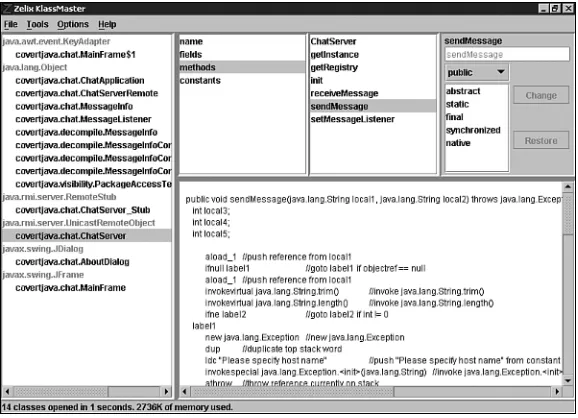
Using Zelix KlassMaster to Obfuscate a Chat Application ...36
Cracking Obfuscated Code ...40
Quick Quiz ...41
In Brief ...41
4 Hacking Non-Public Methods and Variables of a Class 43 Accessing Packages and Protected Class Members ...44
Accessing Private Class Members ...46
Quick Quiz ...49
In Brief ...49
5 Replacing and Patching Application Classes 51 What Do We Do When We Have Tried Every Road but Failed? ...51
Finding the Class That Has to Be Patched ...53
The General Approach ...53
Searching for Text Strings ...54
Working with Obfuscated Code ...54
A Sample Scenario That Requires Patching ...55
Using the Class Name ...56
Searching for Text Strings ...57
Using the Call Stack to Navigate Application Logic ...58
Patching a Class to Provide New Logic ...58
Reconfiguring the Application to Load and Use the Patched Class ...59
Patching Sealed Packages ...60
Quick Quiz ...61
In Brief ...61
6 Using Effective Tracing 63 Introduction to Tracing ...63
Tracing As an Effective Method of Learning the Software ...65
Tracing and Logging Tools and APIs ...65
Tracing Do’s and Don’ts ...66
Tracing Do’s ...66
Tracing Don’ts ...67
Quick Quiz ...67
7 Manipulating Java Security 69
Java Security Overview ...69
Bypassing Security Checks ...71
The Security Manager Is Not Installed ...72
The Security Manager Is Installed with a Default Policy ...72
The Security Manager Is Installed with a Custom Policy ...73
Quick Quiz ...73
In Brief ...74
8 Snooping the Runtime Environment 75 The Value of Understanding the Runtime Environment ...75
System Properties ...76
System Information ...77
Memory Information ...78
Network Information ...79
Accessing Environment Variables ...79
Quick Quiz ...80
In Brief ...80
9 Cracking Code with Unorthodox Debuggers 81 Understanding the Internals of Unknown Applications ...81
Conventional Debuggers and Their Limitations ...82
Hacking with an Omniscient Debugger ...82
Recording Chat Execution ...83
Navigating the Message Processing Code ...84
Using ODB to Crack the Obfuscated Version of Chat ...86
Quick Quiz ...87
In Brief ...87
10 Using Profilers for Application Runtime Analysis 89 Why and When You Should Use Profiling ...89
The Best Profilers for Java ...90
Investigating Heap Usage and Garbage Collection Frequency to Improve the Performance ...90
Browsing Object Allocation and References to Find and Fix Memory Leaks ...92
Identifying Expensive Methods to Improve Performance ...100
Investigating an Application at Runtime Using a Thread Dump ...101
Quick Quiz ...102
In Brief ...103
11 Load-Testing to Find and Fix Scalability Problems 105 The Importance of Load-Testing ...105
Load-Testing RMI-Based Servers with JUnit ...107
Load-Testing with JMeter ...110
JMeter Overview ...111
WebCream Overview ...112
Creating a Web Test Plan ...113
Quick Quiz ...119
In Brief ...120
12 Reverse Engineering Applications 121 User Interface Elements and Resources ...121
Hacking Text ...122
Hacking Images ...123
Hacking Configuration Files ...125
Quick Quiz ...125
In Brief ...126
13 Eavesdropping Techniques 127 Eavesdropping Defined ...127
Eavesdropping on HTTP ...128
Using a Tunnel to Capture the HTTP Message Exchange ...128
Using a Network Sniffer to Capture the HTTP Message Exchange ...130
Protecting Web Applications from Eavesdropping ...132
Eavesdropping on the RMI Protocol ...133
The RMI Transport Protocol ...133
Using a Network Sniffer to Intercept RMI Messages ...133
Protecting RMI Applications from Eavesdropping ...135
Eavesdropping on JDBC Driver and SQL Statements ...135
Quick Quiz ...137
In Brief ...138
vii
14 Controlling Class Loading 139
JVM Internals from a Class Loading Perspective ...139
Writing a Custom Class Loader ...143
Quick Quiz ...147
In Brief ...147
15 Replacing and Patching Core Java Classes 149 Why Bother? ...149
Patching Core Java Classes Using the Boot Class Path ...150
Example of Patching java.lang.Integer...151
Quick Quiz ...153
In Brief ...153
16 Intercepting Control Flow 155 Control Flow Defined ...155
Intercepting System Errors ...155
Intercepting System Streams ...156
Intercepting a Call to System.exit ...158
Reacting to a JVM Shutdown Using Hooks ...160
Intercepting Methods with a Dynamic Proxy ...160
The Java Virtual Machine Profiler Interface ...163
Quick Quiz ...164
In Brief ...164
17 Understanding and Tweaking Bytecode 165 Bytecode Fundamentals ...165
Viewing Class Files Using the jClassLib Bytecode Viewer ...166
The JVM Instruction Set ...167
Class File Format ...168
Field and Method Descriptors ...168
Class File Structure ...170
Attributes ...173
Bytecode Verification ...173
Instrumenting and Generating Bytecode ...174
BCEL Overview ...174
Instrumenting Methods ...175
Generating Classes ...179
Bytecode Tweaking Compared with AOP and Dynamic Proxies ...182
Quick Quiz ...183
In Brief ...183
18 Total Control with Native Code Patching 185 Why and When to Patch Native Code ...185
Native Code Usage in the Java Virtual Machine ...186
JNI Overview ...186
JNI Implementation Example ...188
Generic Approaches to Patching Native Methods ...190
Patching a Java Method Declaration ...190
Substituting Native Libraries ...190
Patching Native Code ...191
Patching Native Code on the Windows Platform ...191
Portable Executable Format ...191
Patching a Native Function Using the Function Replacer Utility ...194
Manual Patching Using Microsoft Detours Library ...196
Patching Native Code on Unix Platforms ...198
Quick Quiz ...199
In Brief ...200
19 Protecting Commercial Applications from Hacking 201 Setting Goals for Application Protection ...201
Securing Data with Java Cryptography Architecture ...202
Java Cryptography Architecture Overview ...204
Securing Chat Messages with JCA ...204
Protecting Application Distribution from Hacking ...208
Protecting Bytecode from Decompiling ...208
Protecting Bytecode from Hacking ...209
Protecting Application Content from Hacking ...212
Implementing Licensing to Unlock Application Features ...216
Modern Software Licensing Models ...216
Implementing Licensing to Unlock Commercial Features ...217
Web Activation and License Registration ...224
Quick Quiz ...225
In Brief ...225
ix
A Commercial Software License 227
B Resources 233
Utilities and Tools ...233
Decompiling ...233
Obfuscating ...234
Tracing and Logging ...234
Debugging ...235
Profiling ...235
Load-Testing ...235
Eavesdropping ...236
Bytecode Tweaking ...237
Native Code Patching ...237
Protection from Hacking ...238
C Quiz Answers 239 Chapter 1 ...239
Chapter 2 ...239
Chapter 3 ...240
Chapter 4 ...240
Chapter 5 ...240
Chapter 6 ...241
Chapter 7 ...241
Chapter 8 ...241
Chapter 9 ...242
Chapter 10 ...242
Chapter 11 ...243
Chapter 12 ...243
Chapter 13 ...244
Chapter 14 ...244
Chapter 15 ...245
Chapter 16 ...245
Chapter 17 ...245
Chapter 18 ...246
Chapter 19 ...247
About the Author
Alex Kalinovsky was born in Ukraine in 1974 and moved to the United States in 1997. He has been in the IT industry for more than 10 years, with experience that ranges from writing C and C++ applications to developing enterprise Java solutions. Since 1997, Alex has worked solely with Java and is proud to be one of its original evangelists. He has taught more than 15 classes on Enterprise Java technologies and worked as a mentor for many teams. Alex has written for various publications, including JavaWorld, Sun JavaSoft, Information Week, and the Washington Post. He is a Certified Enterprise Java Architect consulting for leading companies that use Java and J2EE. He is also a lead architect for WebCream, a revolutionary Java product that bridges Swing and HTML. In his spare time, Alex enjoys traveling, reading, wind-surfing, snowboarding, and bodybuilding.
Dedication
I would like to dedicate this book to my parents, Stanislav and
Lubov Kalinovsky, who have given me everything they could from
day one of my life. It is only with age that one starts to truly
understand and appreciate the impact that the family has on
one’s life, and I would like to take this opportunity to thank my
parents for all the sacrifices they made and for all the patience
they had. This work is also a tribute to the other two people who
had a tremendous influence on my life, my brother Andrew
Kalinovsky and my second dad and mentor Sergei Boiko. Thanks
Acknowledgments
Throughout the long hours I have spent writing this book, many people have helped me to accomplish this project. I would like to thank my closest friends LaWanda Tetteh and Gleb Tulukin for giving me support and encouragement when I needed it. Special credit goes to Amie Koker for being patient and understanding and to Tricia Riviere for her sense of humor and quick wit. Troy Davis and Yves Noel have been great in sharing their technical and personal views and in reviewing my work. This book would not have been possible without Todd Green, Sean Dixon, and the rest of the team at Sams Publishing who shared their expertise and professionalism. I want to express my appreciation to everyone, mentioned here or not, who has helped me in completing this goal.
We Want to Hear from You!
As the reader of this book, youare our most important critic and commentator. We value your opinion and want to know what we’re doing right, what we could do better, what areas you’d like to see us publish in, and any other words of wisdom you’re willing to pass our way.
As an associate publisher for Sams Publishing, I welcome your comments. You can email or write me directly to let me know what you did or didn’t like about this book[md]as well as what we can do to make our books better.
Please note that I cannot help you with technical problems related to the topic of this book. We do have a User Services group, however, where I will forward specific technical questions related to the book.
When you write, please be sure to include this book’s title and author as well as your name, email address, and phone number. I will carefully review your comments and share them with the author and editors who worked on the book.
Email: [email protected]
Mail: Michael Stephens Associate Publisher Sams Publishing 800 East 96th Street Indianapolis, IN 46240 USA
Introduction
There are many good books written on Java. It sometimes amazes me how many books you can see on the same subject. Searching on www.amazon.comfor a book on Enterprise JavaBeans (EJB) returns more than 50 results. Come on, people! EJB is a complex technology and today every self-respecting Java developer has to have it on his resume, but 50books? So, what right do I have to add another tome to the Java bookshelf? Well, I believe that there are a few less-publicized development techniques that, when used correctly, can yield astonishing results. Most of the methods deal with core Java concepts and issues and therefore can be used in a variety of applications. The techniques presented in this book are unorthodox solu-tions to common problems in Java development. Some of them are controversial and should be used with great care, but all of them are powerful methods of achieving what you want. Learn them, and you will be able to separate yourself from the majority of other developers by delivering a solution when everyone else is grasping to understand what the problem really is. You might have used some of the techniques presented in this book already, and I congratulate you if this is the case, but I am confident that you’ll pick up at least a few helpful new tricks as you peruse the advice I give here.
A large portion of the book is dedicated to techniques that are commonly considered to be hacking. Hackingis used rather freely in the media and oftentimes with negative connota-tion. Hackers are frequently portrayed as crazy geeks wanting to boost their self esteem, and for some cases this is certainly true. The methods presented here, however, are intended for professional software developers and each technique has a real-life application.
Who Will Benefit from This Book?
Java developers and architects stand the best chance of learning the most from this work. To truly appreciate the problems and solutions presented in this book, you should have
It is worth noting that the techniques presented here are largely independent of one another. Because the presentation of the material follows a “most common simpler methods first” order, feel free to skip chapters and go directly to the one you are interested in. Chapter 1, “Getting Started,” has a section that briefly describes each of the techniques and when to use it, so I recommend familiarizing yourself with it first.
The Moral and Legal Aspects of Hacking
Most of the chapters are strictly technical, but it is extremely important to understand that not all the techniques can be freely applied when working with applications. Not every approach presented in the book is “hacking” but, if used without first checking the legal consequences, it can certainly get you in trouble. Let’s start by trying to give a broad defini-tion of hacking and then look at how to tread that treacherous water.
Merriam-Webster’s dictionary has the following definition for the term hacker: “an expert at programming and solving problems with a computer.” However, there is another meaning given right after it: “a person who illegally gains access to and sometimes tampers with infor-mation in a computer system.” Being an expert at programming is certainly a great thing; fiddling with illegal stuff lands you in jail. The short message is that this book is for the good guys, and if you are a bad guy, please stop reading right now and get a new job with the testing team. Any information or discovery can be used for good or ill. It is not the informa-tion but the use of it that determines whether the outcome is considered positive or negative.
By now, there have been a number of high-profile court cases revolving around digital copy-rights, reverse engineering, and patent violations. Companies and individuals have lost millions of dollars and sometimes reputations as well. Although the laws are complex and the license agreements are written by lawyers for lawyers, it is not that difficult to steer clear of legal problems. Here are the two basic rules to follow:
n If an author expects you to pay for her work, do so.
n If you are tinkering with something, be sure that it does not hurt the author’s interests.
It is important to remember that the software we are working with is written by people just like you and I, and just like you and I they have to pay bills. Open source is a different phenomenon, and because the source code is freely available, you don’t need to use extreme methods to learn something about or change something in the product. But most of the soft-ware developed today is commercial and most of the innovation is done by commercial vendors. Hacking the software to avoid paying the license fees is counterproductive because it undermines the software market and indirectly hurts the developers. Stealing ice cream from a shop next door will either raise the price of the ice cream or drive the shop out of business. And if you own a bakery, the owner of the ice cream shop might start stealing cookies from you.
The two rules cover the moral aspects of hacking, but what generally covers the legal aspects are the copyright and intellectual property laws and end user license agreements (EULAs). The laws are complex and not easy to read, but EULAs are a must because they generally are more restrictive than the laws. They are written to provide the author with the protection that might not be adequately granted by the respective laws, and users are generally required to explicitly agree to the terms of the agreement before using a product. For example, even though reverse engineering is not prohibited by law, most software products forbid it in the EULA. It is therefore imperativeto thoroughly study the EULA before using the techniques described in this book on a product. To avoid repetition and to keep the contents of the book strictly technical, the material of the chapters does not mention the legal aspects associated with the techniques. It is yourresponsibility to ensure the legality of your actions.
Special Features of the Text
Several typographic conventions are used in Covert Java: Techniques for Decompiling, Patching, and Reverse Engineeringto make the text more readable. Italic fontis used for emphasis and to indicate new terms. Monospace fontis used for parts of code, filenames, and URLs. Monospace italic fontindicates placeholders in code syntax.
In addition, a few special elements are used in this book. “Stories from the Trenches” describe my own experiences in working with the various techniques described throughout Covert Java: Techniques for Decompiling, Patching, and Reverse Engineeringto help you understand how these techniques work out in actual practice. Each chapter ends with an “In Brief” section summarizing the main points of the chapter, as well as a quiz section to help you review the material.
3
IN THIS CHAPTER
.
Techniques Overview—
When and Why to Use
Each Method
5
.
Improving Productivity
with File Managers
7
.
Sample Application
Functionality and
Structure
11
.
Quick Quiz
12
.
In Brief
12
1
Getting Started
Techniques Overview—When
and Why to Use Each Method
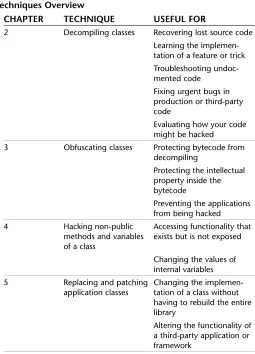
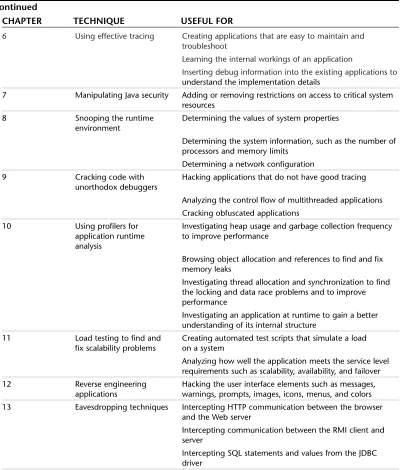
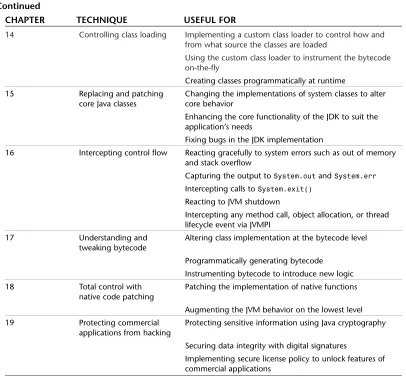
Table 1.1 presents a brief overview of techniques that are discussed in more detail in the corresponding chapters. Use this as a road map to getting started with this book.
TA B L E 1 . 1
Techniques Overview
CHAPTER TECHNIQUE USEFUL FOR
2 Decompiling classes Recovering lost source code Learning the implemen-tation of a feature or trick Troubleshooting undoc-mented code
Fixing urgent bugs in production or third-party code
Evaluating how your code might be hacked
3 Obfuscating classes Protecting bytecode from decompiling
Protecting the intellectual property inside the bytecode
Preventing the applications from being hacked 4 Hacking non-public Accessing functionality that
methods and variables exists but is not exposed of a class
Changing the values of internal variables 5 Replacing and patching Changing the
implemen-application classes tation of a class without having to rebuild the entire library
[image:20.530.64.319.264.618.2]6 Using effective tracing Creating applications that are easy to maintain and troubleshoot
Learning the internal workings of an application
Inserting debug information into the existing applications to
understand the implementation details
7 Manipulating Java security Adding or removing restrictions on access to critical system resources
8 Snooping the runtime Determining the values of system properties environment
Determining the system information, such as the number of processors and memory limits
Determining a network configuration
9 Cracking code with Hacking applications that do not have good tracing unorthodox debuggers
Analyzing the control flow of multithreaded applications Cracking obfuscated applications
10 Using profilers for Investigating heap usage and garbage collection frequency application runtime to improve performance
analysis
Browsing object allocation and references to find and fix memory leaks
Investigating thread allocation and synchronization to find the locking and data race problems and to improve performance
Investigating an application at runtime to gain a better understanding of its internal structure
11 Load testing to find and Creating automated test scripts that simulate a load fix scalability problems on a system
Analyzing how well the application meets the service level requirements such as scalability, availability, and failover 12 Reverse engineering Hacking the user interface elements such as messages,
applications warnings, prompts, images, icons, menus, and colors 13 Eavesdropping techniques Intercepting HTTP communication between the browser
and the Web server
Intercepting communication between the RMI client and server
Intercepting SQL statements and values from the JDBC driver
TA B L E 1 . 1
Continued
[image:21.530.59.461.93.563.2]14 Controlling class loading Implementing a custom class loader to control how and from what source the classes are loaded
Using the custom class loader to instrument the bytecode on-the-fly
Creating classes programmatically at runtime
15 Replacing and patching Changing the implementations of system classes to alter core Java classes core behavior
Enhancing the core functionality of the JDK to suit the application’s needs
Fixing bugs in the JDK implementation
16 Intercepting control flow Reacting gracefully to system errors such as out of memory and stack overflow
Capturing the output to System.outand System.err
Intercepting calls to System.exit()
Reacting to JVM shutdown
Intercepting any method call, object allocation, or thread lifecycle event via JVMPI
17 Understanding and Altering class implementation at the bytecode level tweaking bytecode
Programmatically generating bytecode Instrumenting bytecode to introduce new logic 18 Total control with Patching the implementation of native functions
native code patching
Augmenting the JVM behavior on the lowest level 19 Protecting commercial Protecting sensitive information using Java cryptography
applications from hacking
Securing data integrity with digital signatures
Implementing secure license policy to unlock features of commercial applications
Improving Productivity with File Managers
The techniques discussed here serve the purpose of increasing the productivity of the devel-opment. At the end of the day, quality and productivity are what differentiate expert programmers from novice programmers, and because this book is meant to turn readers into experts, I feel it is my duty to introduce a few productivity tools. Hacking and regular devel-opment require manipulation of files and directories, and getting the right tool can make
7
Improving Productivity with File Managers
TA B L E 1 . 1
Continued
[image:22.530.80.486.94.471.2]doing so much easier. Obviously, it is up to you to decide whether to use a tool. You should remember that most of the tools require upfront investment in installing, configuring, and learning—not to mention the possible license fees. But as with most tools, the investment pays off very quickly.
We are going to look at two advanced replacements for the combination of Windows
Explorer, Notepad/Text Editor, and CMD.EXE. We will focus on Windows because that is where most of the Java development is taking place, but productivity tools might be available on other platforms as well. It might sound silly that we’re starting an advanced Java book by talking about Notepad and CMD.EXE, but a large number of the developers I have seen are still using it, so I want to present a better alternative.
Windows Explorer is a simple shell easily understood by regular users, but it is not capable of helping with the tasks a programmer needs to perform. A very simple example is creating and running a .batfile. Using the default Windows interface, you would have to navigate to the target directory, click the mouse through a few dialog boxes to create a new file, and then open that file in Notepad and edit it. To run the file, you could double-click it, but any output or errors would be lost with the CMD window that was automatically opened by Explorer. A better way, therefore, is to open a CMD.EXE, navigate to the directory, and then run the file. In the end, you must deal with three open windows that are not synchronized or interrelated. A better alternative is using integrated file management software that combines a directory navigating interface with a text editor, a command line for running scripts, archive support, and a multitude of features that make common tasks easy.
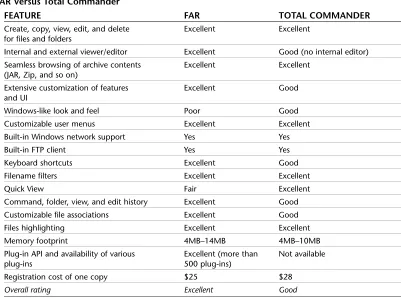
FAR and Total Commander
TA B L E 1 . 2
FAR Versus Total Commander
FEATURE FAR TOTAL COMMANDER
Create, copy, view, edit, and delete Excellent Excellent for files and folders
Internal and external viewer/editor Excellent Good (no internal editor) Seamless browsing of archive contents Excellent Excellent
(JAR, Zip, and so on)
Extensive customization of features Excellent Good and UI
Windows-like look and feel Poor Good Customizable user menus Excellent Excellent Built-in Windows network support Yes Yes Built-in FTP client Yes Yes Keyboard shortcuts Excellent Good Filename filters Excellent Excellent Quick View Fair Excellent Command, folder, view, and edit history Excellent Good Customizable file associations Excellent Good Files highlighting Excellent Excellent Memory footprint 4MB–14MB 4MB–10MB Plug-in API and availability of various Excellent (more than Not available plug-ins 500 plug-ins)
Registration cost of one copy $25 $28
Overall rating Excellent Good
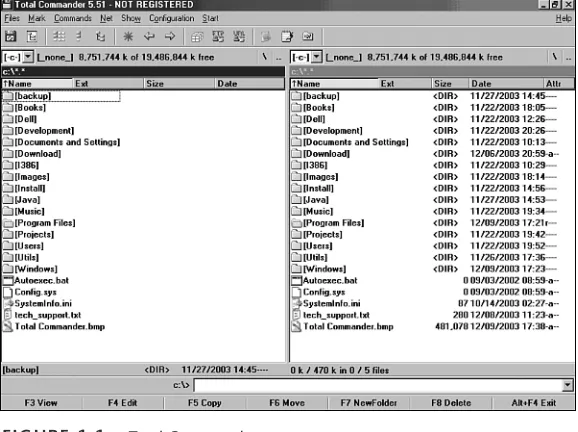
Although both tools provide a better alternative to Windows Explorer reinforced with other software, FAR proves to be more powerful. Even in its default packaging, it provides more features and productivity gains than Total Commander. In addition, with more then 500 plug-ins written by other developers, its functionality is virtually boundless. The downside of FAR is its somewhat unappealing user interface, although it is something you can get used to. Total Commander, shown in Figure 1.1, looks more like Windows Explorer; if you don’t need the ultimate customization and functionality, it can be a better choice.
Regardless of your preferences, please try an integrated file manager, even if you feel it is difficult to use. It will pay off in the long run!
9
[image:24.530.81.482.99.397.2]FIGURE 1.1 Total Commander.
Java IDEs
Most of the techniques in this book do not involve a lot of coding, and with a tool like FAR, you can easily accomplish all the required tasks. However, integrated development environ-ments (IDEs) make coding much easier, so this section presents a brief overview of the leading IDEs and a recommendation of the one to use.
Today, when it comes to IDEs the question is not whether you should use IDEs or not, but which IDE you should use. A lot of it has to do with development background and personal preferences, so I won’t spend a lot of time talking about them. The two leading free IDEs are Eclipse (http://www.eclipse.org) promoted by IBM and NetBeans (http://
www.netbeans.org) promoted by Sun. Both are good, although Eclipse has a little more steam and following. The best commercial IDEs are IntelliJ IDEA, Borland JBuilder, and Oracle JDeveloper.
Sample Application Functionality and Structure
Throughout most of this book, we will be working with the same sample application. It is not very sophisticated, but it does contain a basic set of components found in most standalone Java programs. This section describes the application and its implementation.
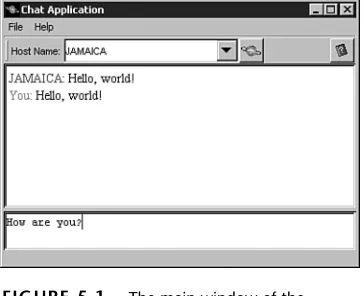
Chat is a simple TCP/IP chat implementation in Java. It enables users to exchange instant messages via the network. Chat maintains a history of the conversation and uses colors to differentiate between the sent and received messages. It has a menu bar and About dialog box. Chat can be started using chat.batscript in the distrib/bindirectory. Figure 1.2 shows Chat running.
11
Sample Application Functionality and Structure
Chat is implemented using Java Swing for the user interface and RMI for network communica-tion. When running, each instance of Chat creates an in-process RMI registry that is used by other instances to post messages to the user. Users are required to enter the hostname of the user to which they want to post a message. When the user sends a message, Chat looks up the remote server object and calls a method on it. For testing purposes, messages can be sent to
“localhost”, in which case the same message is added to the conversation as was sent and received.
[image:26.530.73.256.227.379.2]The UML class diagram for Chat is shown in Figure 1.3. FIGURE 1.2 The Chat application.
interface
MessageListener
java.rmi.Remote interface
ChatServerRemote
UnicastRemoteObject
ChatServer
JFrame ActionListener
MainFrame
ChatApplication
[image:26.530.73.360.414.591.2]The Chat directory structure follows the de-facto standards for Java application development. The “home” folder for the application directories is called CovertJava. The subdirectories it contains are listed in Table 1.3.
TA B L E 1 . 3
Chat Application Directory Structure
DIRECTORY NAME DESCRIPTION
bin Contains the scripts and the development and test scripts
build Contains Ant’s build.xmland other build-related files
classes Compiler output directory for .classfiles
distrib Contains the application in its distribution form
distrib\bin Contains scripts that run the application
distrib\conf Contains configuration files, such as Java policy files
distrib\lib Contains libraries used to run the application
distrib\patches Contains patches for classes
lib Contains libraries used to build the application
src Contains application source files
A Chat application can be built by Ant using build.xmlin the build directory.
Quick Quiz
1. Which techniques can be used to learn about the internal implementation of an application?
2. Which techniques can be used to change the internal implementation of an application?
3. Which techniques can be used to capture the communication between a client and a server?
4. Which Windows applications are substituted by FAR and Total Commander?
In Brief
n Various techniques presented in this book can be used to learn about the internals of
implementation to hack an application or to work with the JDK at the system level.
n Integrated file management applications increase productivity and are worth the
IN THIS CHAPTER
.
Determining When to
Decompile
13
.
Knowing the Best
Decompilers
14
.
Decompiling a Class
16
.
What Makes Decompiling
Possible?
22
.
Potential Problems with
Decompiled Code
23
.
Quick Quiz
25
.
In Brief
25
2
Decompiling Classes
“When all else fails, read the manual.”
Murphy’s Technology Laws
Determining When to
Decompile
In an ideal world, decompilation would probably be unnecessary, except when learning how other people who don’t like to write good documentation implemented a certain feature. In the real world, however, there are often situations where a direct reference to the source code can be the best, if not the only, solution. Here are some of the reasons to decompile:
n Recovering the source code that was accidentally lost
n Learning the implementation of a feature or trick
n Troubleshooting an application or library that does
not have good documentation
n Fixing urgent bugs in third-party code for which no
source code exists
n Learning to protect your code from hacking
Some people might argue that you shouldn’t have to resort to extreme measures such as decompiling and that you should rely on vendors of the bytecode for support and bug fixing. In a professional environment, if you are a developer of an application, you are responsible for the functionality being flawless. The users and management do not care whether a bug is in your code or in third-party code. They care about the problem being fixed, and they will hold you accountable for it. Contacting the vendor of the third-party code should be a preferred way. However, in urgent cases when you must provide a solution in a matter of hours, being able to work with the bytecode will give you that extra edge over your peers, and maybe a bonus as well.
Knowing the Best Decompilers
To embark on the task of decompiling, you need the right tools. A good decompiler can produce the source code that will be almost as good as the original source code that was compiled into bytecode. Some decompilers are free, and some are commercially available. Although I support the principles behind commercial software, it needs to offer a useful premium over its free counterparts for me to use it. In the case of decompilers, I have not found the free ones lacking any features, so my personal recommendation is to use a free tool such as JAD or JODE. Table 2.1 lists some of the commonly used decompilers and includes a
At Riggs Bank we were preparing to go live with a very large and important J2EE application that was deployed into a cluster of application servers from a leading J2EE vendor. Several teams were waiting for the production environment to be ready, but for some strange reason the application server would not start on some of the hosts. The exact same installation would run on some machines but fail on others with an error message about an invalid configuration URL. To make matters worse, the URL in the error message could not be found in any of the configuration files, shell scripts, or environment variables.
Several days were spent trying to fix the problem in vain, and the situation was ready to explode because several teams were about to miss a critical deadline. After copying and reinstalling the application server failed, we finally resorted to finding the class in the application server libraries that was producing the error message. Decompiling it, and a few other classes that were using it, revealed that the URL was programmatically generated based on the server installation directory. The installation directory was determined by executing the pwdUnix command. It turned out that on the failing hosts there were no permissions to execute pwd, but the misleading error message did not make that obvious. Fixing the permissions took a matter of minutes, and the whole process from the time we found and decompiled the class took less than an hour. Thus, a looming disaster was turned into a big win for the IT team.
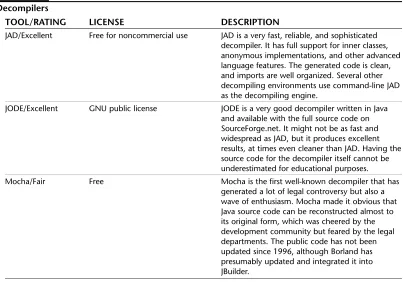
short description highlighting the quality of each one. The URLs presented might become outdated, so doing a Google search is typically the best way of finding the decompiler’s home page and the latest version to download.
A very important criterion is how well the decompiler supports more advanced language constructs such as inner classes and anonymous implementations. Even though the bytecode format has been very stable since JDK 1.1, it is important to use a decompiler that is
frequently updated by its authors. The new language features in JDK 1.5 will require an update in decompilers, so be sure to check the release date of the version you are using.
TA B L E 2 . 1
Decompilers
TOOL/RATING LICENSE DESCRIPTION
JAD/Excellent Free for noncommercial use JAD is a very fast, reliable, and sophisticated decompiler. It has full support for inner classes, anonymous implementations, and other advanced language features. The generated code is clean, and imports are well organized. Several other decompiling environments use command-line JAD as the decompiling engine.
JODE/Excellent GNU public license JODE is a very good decompiler written in Java and available with the full source code on SourceForge.net. It might not be as fast and widespread as JAD, but it produces excellent results, at times even cleaner than JAD. Having the source code for the decompiler itself cannot be underestimated for educational purposes. Mocha/Fair Free Mocha is the first well-known decompiler that has
generated a lot of legal controversy but also a wave of enthusiasm. Mocha made it obvious that Java source code can be reconstructed almost to its original form, which was cheered by the development community but feared by the legal departments. The public code has not been updated since 1996, although Borland has presumably updated and integrated it into JBuilder.
Although you might find other decompilers on the market, JAD and JODE are certainly good enough and therefore widely used. Many products provide graphical user interfaces (GUIs) but rely on a bundled decompiler to do the actual work. For instance, Decafe, DJ, and Cavaj are GUI tools bundled with JAD and therefore were not included in the review. For the rest of this book, we will use command-line JAD to produce the source code. Most of the time, the command-line decompiler is all you need, but if you prefer to use a GUI, just be sure that it uses a solid decompiler such as JAD or JODE.
15
[image:30.530.80.483.205.487.2]Decompiling a Class
In case you haven’t used one before, let’s see how good a job a decompiler can do. We will work with a slightly enhanced version of the MessageInfoclass, which is used by Chat to send the message text and the attributes to a remote host. MessageInfoComplex.java, shown in Listing 2.1, has an anonymous inner class (MessageInfoPK) and a main()method to illus-trate some of the more complex cases of decompiling.
LISTING 2.1 MessageInfoComplexSource Code
package covertjava.decompile;
/**
* MessageInfo is used to send additional information with each message across * the network. Currently it contains the name of the host that the message * originated from and the name of the user who sent it.
*/
public class MessageInfoComplex implements java.io.Serializable {
String hostName; String userName;
public MessageInfoComplex(String hostName, String userName) { this.hostName = hostName;
this.userName = userName; }
/**
* @return name of the host that sent the message */
public String getHostName() { return hostName;
}
/**
* @return name of the user that sent the message */
public String getUserName() { return userName;
/**
* Convenience method to obtain a string that best identifies the user. * @return name that should be used to identify a user that sent this message */
public String getDisplayName() {
return getUserName() + “ (“ + getHostName() + “)”; }
/**
* Generate message id that can be used to identify this message in a database * The format is: <ID><UserName><HostName>. Names are limited to 8 characters * Example: 443651_Kalinovs_JAMAICA would be generated for Kalinovsky/JAMAICA */
public String generateMessageId() {
StringBuffer id = new StringBuffer(22);
String systemTime = “” + System.currentTimeMillis(); id.append(systemTime.substring(0, 6));
if (getUserName() != null && getUserName().length() > 0) { // Add user name if specified
id.append(‘_’);
int maxChars = Math.min(getUserName().length(), 8); id.append(getUserName().substring(0, maxChars)); }
if (getHostName() != null && getHostName().length() > 0) { // Add host name if specified
id.append(‘_’);
int maxChars = Math.min(getHostName().length(), 7) ; id.append(getHostName().substring(0, maxChars)); }
return id.toString(); }
/**
* Include an example of anonymous inner class */
public static void main(String[] args) { new Thread(new Runnable() {
17
public void run() {
System.out.println(“Running test”);
MessageInfoComplex info = new MessageInfoComplex(“JAMAICA”, “Kalinovsky”); System.out.println(“Message id = “ + info.generateMessageId());
info = new MessageInfoComplex(null, “JAMAICA”);
System.out.println(“Message id = “ + info.generateMessageId()); }
}).start(); }
/**
* Inner class that can be used as a primary key for MessageInfoComplex */
public static class MessageInfoPK implements java.io.Serializable { public String id;
} }
After compiling MessageInfoComplex.javausing javacwith default options, we get three class files: MessageInfoComplex.class, MessageInfoComplex$MessageInfoPK.class, and
MessageInfoComplex$1.class. As you might know, inner classes and anonymous classes have been added to Java in JDK 1.1, but the design goal was to preserve bytecode format compati-bility with earlier versions of Java. That is why these language constructs result in somewhat independent classes, although they do retain the association with the parent class. The final step of our test is to run the decompiler on the class file and then compare the generated source code with the original. Assuming that you have downloaded and installed JAD and added it to the path, you can run it using the following command:
jad MessageInfoComplex.class
Upon completion, JAD generates the MessageInfoComplex.jadfile. This is renamed to
MessageInfoComplex_FullDebug.jad, as shown in Listing 2.2.
LISTING 2.2 MessageInfoComplexDecompiled Code
// Decompiled by Jad v1.5.7g. Copyright 2000 Pavel Kouznetsov.
// Jad home page: http://www.geocities.com/SiliconValley/Bridge/8617/jad.html // Decompiler options: packimports(3)
// Source File Name: MessageInfoComplex.java
package covertjava.decompile;
import java.io.PrintStream; import java.io.Serializable;
public class MessageInfoComplex implements Serializable {
public static class MessageInfoPK implements Serializable {
public String id;
public MessageInfoPK() {
} }
public MessageInfoComplex(String hostName, String userName) {
this.hostName = hostName; this.userName = userName; }
public String getHostName() {
return hostName; }
public String getUserName() {
return userName; }
public String getDisplayName() {
return getUserName() + “ (“ + getHostName() + “)”; }
public String generateMessageId()
19
{
StringBuffer id = new StringBuffer(22) ;
String systemTime = “” + System.currentTimeMillis(); id.append(systemTime.substring(0, 6));
if(getUserName() != null && getUserName().length() > 0) {
id.append(‘_’);
int maxChars = Math.min(getUserName().length(), 8); id.append(getUserName().substring(0, maxChars)); }
if(getHostName() != null && getHostName().length() > 0) {
id.append(‘_’);
int maxChars = Math.min(getHostName().length(), 7); id.append(getHostName().substring(0, maxChars)); }
return id.toString(); }
public static void main(String args[]) {
(new Thread(new Runnable() {
public void run() {
System.out.println(“Running test”);
MessageInfoComplex info = new MessageInfoComplex(“JAMAICA”, “Kalinovsky”); System.out.println(“Message id = “ + info.generateMessageId());
info = new MessageInfoComplex(null, “JAMAICA”);
System.out.println(“Message id = “ + info.generateMessageId()); }
})).start(); }
String hostName; String userName; }
Take a few moments to review the generated code. As you can see, the code is almost a 100% match to the original! The order of variables, methods, and inner class declarations is differ-ent, and so is the formatting, but the logic is absolutely the same. We have also lost the comments, but well-written Java code such as ours is self-evident, isn’t it?
Our case produced good results because full debugging information is included by javac when the -goption is used. If the source code was compiled without the debug information (the -g:noneoption), the decompiled code would lose some of the clarity, such as the para-meter names of methods and names of local variables. The following code shows the constructor and a method that uses local variables for MessageInfoComplexwith no debug-ging information included:
public MessageInfoComplex(String s, String s1) {
hostName = s; userName = s1; }
public String generateMessageId() {
StringBuffer stringbuffer = new StringBuffer(22); String s = “” + System.currentTimeMillis(); stringbuffer.append(s.substring(0, 6));
if(getUserName() != null && getUserName().length() > 0) {
stringbuffer.append(‘_’);
int i = Math.min(getUserName().length(), 8); stringbuffer.append(getUserName().substring(0, i)); }
if(getHostName() != null && getHostName().length() > 0) {
stringbuffer.append(‘_’);
int j = Math.min(getHostName().length(), 7); stringbuffer.append(getHostName().substring(0, j)); }
return stringbuffer.toString(); }
21
What Makes Decompiling Possible?
Java source is not compiled to binary machine code like C/C++ source is. Compiling Java source produces intermediate bytecode, which is a platform-independent representation of the source code. Bytecode can be interpreted or compiled after loading, which results in a two-step transformation of the high-level programming language into the low-level machine code. It is the intermediate step that makes decompiling Java bytecode nearly flawless. Bytecode carries all the significant information found in a source file. Even though the comments and formatting are lost, all the methods, variables, and programming logic are obviously preserved. Because the bytecode does not represent the lowest-level machine language, the format of the code closely resembles the source code. The JVM specification defines a set of instructions that match Java language operators and keywords, so a fragment of Java code such as
public String getDisplayName() {
return getUserName() + “ (“ + getHostName() + “)”; }
is represented by the following bytecode:
0 new #4 <java/lang/StringBuffer> 3 dup
4 aload_0
5 invokevirtual #5 <covertjava/decompile/MessageInfoComplex.getUserName> 8 invokestatic #6 <java/lang/String.valueOf>
11 invokestatic #6 <java/lang/String.valueOf> 14 invokespecial #7 <java/lang/StringBuffer.<init>> 17 ldc #8 < (>
19 invokevirtual #9 <java/lang/StringBuffer.append> 22 aload_0
23 invokevirtual #10 <covertjava/decompile/MessageInfoComplex.getHostName> 26 invokevirtual #9 <java/lang/StringBuffer.append>
29 ldc #11 <)>
31 invokevirtual #9 <java/lang/StringBuffer.append> 34 invokestatic #6 <java/lang/String.valueOf> 37 invokestatic #6 <java/lang/String.valueOf> 40 areturn
Potential Problems with Decompiled Code
Most of the time, decompiling produces a readable file that can be changed and recompiled. However, on some occasions decompiling does not render a file that can be compiled again. This can happen if the bytecode was obfuscated, and the names given by the obfuscator result in ambiguity at the compilation. The bytecode is verified when loaded, but the verifica-tions assume that the compiler has checked for a number of errors. Thus, the bytecode veri-fiers are not as strict as compilers and obfuscators can take advantage of that to better protect the intellectual property. For example, here is the JAD output on the anonymous inner class from the MessageInfoComplex main()method that was obfuscated by the Zelix ClassMaster obfuscator:
static class c
implements Runnable {
public void run() {
boolean flag = a.b;
System.out.println(a(“*4%p\002\026&kj\016\0135”));
b b1 = new b(a(“2\000\006_\”;\0”), a(“3 ‘w\005\02778u\022”)); System.out.println(a(“5$8m\n\037$kw\017X|k”).concat(String.valueOf ➥(String.valueOf(b1.d()))));
b1 = new b(null, a(“2\000\006_\”;\0”));
System.out.println(a(“5$8m\n\037$kw\017X|k”).concat(String.valueOf ➥(String.valueOf(b1.d()))));
if(flag) b.c = !b.c; }
private static String a(String s) {
char ac[]; int i; int j;
ac = s.toCharArray(); i = ac.length; j = 0;
if(i > 1) goto _L2; else goto _L1 _L1:
ac; j;
23
_L10:
JVM INSTR dup2 ; JVM INSTR caload ; j % 5;
JVM INSTR tableswitch 0 3: default 72 // 0 52
// 1 57 // 2 62 // 3 67;
goto _L3 _L4 _L5 _L6 _L7 _L4:
0x78; goto _L8 _L5:
65; goto _L8 _L6:
75; goto _L8 _L7:
30; goto _L8 _L3:
107; _L8:
JVM INSTR ixor ; (char);
JVM INSTR castore ; j++;
if(i != 0) goto _L2; else goto _L9 _L9:
ac; i;
goto _L10 _L2:
if(j >= i)
return new String(ac); if(true) goto _L1; else goto _L11 _L11:
}
As you can see, it is a total fiasco, not even closely resembling Java source. What’s more disturbing, JAD produced source code that cannot be compiled. The other two decompilers have reported an error on the class file. Needless to say, the JVM recognizes and loads the bytecode in question with no problems. Obfuscation is covered in detail in Chapter 3, “Obfuscating Classes.”
A powerful way of protecting the intellectual property is encoding the class files and using a custom class loader to decode them on loading. This way, the decompilers cannot be used on any of the application classes except for the entry point and the class loader. Although not unbreakable, encoding makes hacking much more difficult. A hacker would first have to decompile the class loader to understand the decoding mechanism and then decode all the class files; only then could he proceed with decompiling. Chapter 19, “Protecting
Commercial Applications from Hacking,” provides information on how to best protect the intellectual property in Java applications.
Quick Quiz
1. What are the reasons to decompile bytecode?
2. Which compiler options affect the quality of decompilation, and how?
3. Why is decompiled Java bytecode almost identical to the source code?
4. How can you protect the bytecode from decompiling?
In Brief
n Decompiling produces the source code from bytecode, which is almost identical to the original.
n Decompiling is a powerful method of learning about implementation logic in the absence of documentation and source code. However, decompiling and reverse engi-neering might be explicitly prohibited in the license agreement.
n Decompiling requires downloading and installing a decompiler.
n Decompiling Java classes is effective because the bytecode is an intermediate step between the source code and machine code.
n A good obfuscator can make decompiled code very hard to read and understand.
25
IN THIS CHAPTER
.
Protecting the Ideas
Behind Your Code
27
.
Obfuscation As a
Protection of
Intellectual Property
28
.
Transformations Performed
by Obfuscators
29
.
Knowing the Best
Obfuscators
33
.
Potential Problems and
Common Solutions
34
.
Using Zelix KlassMaster to
Obfuscate a Chat
Application
36
.
Cracking Obfuscated Code
40
.
Quick Quiz
41
.
In Brief
41
3
Obfuscating Classes
“Any sufficiently advanced technology is indistinguishable from magic.”
Murphy’s Technology Laws
Protecting the Ideas Behind
Your Code
Reverse engineering and hacking have been around since the early days of software development. As a matter of fact, stealing or replicating someone else’s ideas has always been the easiest way of creating competitive products. There is, of course, a perfectly acceptable method of building on previous discoveries by others—and as long as the others don’t mind, it works fine. Most inventors and researchers, however, would like to get credit and possibly a financial reward for their work. In simpler terms, they also have mortgages to pay and vacations to take.
Is the risk of having your application hacked real? If it has good ideas, then absolutely. Most of the widely publicized reverse engineering cases at the time of this writing did not occur with Java products, but here’s an excerpt from a Java vendor (DataDirect Technologies):
ROCKVILLE, MD., July 1, 2002—DataDirect Technologies, Inc., an industry-leading data connectivity vendor has filed a lawsuit against i-net Software GmbH alleging copyright infringement and breach of contract. DataDirect Technologies is seeking both preliminary and permanent injunctive relief to prevent i-net from engaging in further efforts to market and sell products which DataDirect Technologies believes were illegally reverse-engineered from its products.
DataDirect Technologies claims that a competitor reverse engineered its product, and yet even today its product has only minimal protection from decompiling.
In the real world, copyrighting the code and getting a patent for an approach cannot provide adequate protection if a competitor or hacker can easily learn the implementation from the source code. The issues of legal protection are discussed in a separate chapter, but for now, let’s focus on smart ways to protect the intellectual property (IP) of Java applications.
Obfuscation As a Protection of
Intellectual Property
Obfuscationis the process of transforming bytecode to a less human-readable form with the purpose of complicating reverse engineering. It typically includes stripping out all the debug information, such as variable tables and line numbers, and renaming packages, classes, and methods to machine-generated names. Advanced obfuscators go further and change the control flow of Java code by restructuring the existing logic and inserting bogus code that will not execute. The premise of the obfuscation is that the transformations do not break the validity of the bytecode and do not alter the exposed functionality.
Obfuscation is possible for the same reasons that decompiling is possible: Java bytecode is standardized and well documented. Obfuscators load Java class files, parse their formats, and then apply transformations based on supported features. When all the transformations are applied, the bytecode is saved as a new class file. The new file has a different internal struc-ture but behaves just like the original file.
Transformations Performed by Obfuscators
No standards exist for obfuscation, so the level of protection varies based on the quality of the obfuscator. The following sections present some of the features commonly found in obfuscators. We will use ChatServer’s sendMessagemethod to illustrate how each transforma-tion affects the decompiled code. The original source code for sendMessageis shown in Listing 3.1.
LISTING 3.1 Original Source Code of sendMessage
public void sendMessage(String host, String message) throws Exception { if (host == null || host.trim().length() == 0)
throw new Exception (“Please specify host name”);
System.out.println(“Sending message to host “ + host + “: “ + message); String url = “//” + host + “:” + this.registryPort + “/chatserver”; ChatServerRemote remoteServer = (ChatServerRemote)Naming.lookup(url);
MessageInfo messageInfo = new MessageInfo(this.hostName, this.userName); remoteServer.receiveMessage(message, messageInfo);
System.out.println(“Message sent to host “ + host); }
Stripping Out Debug Information
Java bytecode can contain information inserted by the compiler that helps debug the running code. The information inserted by javaccan contain some or all of the following: line numbers, variable names, and source filenames. Debug information is not needed to run the class but is used by debuggers to associate the bytecode with the source code.
Decompilers use this information to better reconstruct the source code. With full debug infor-mation in the class file, the decompiled code is almost identical to the original source code. When the debug information is stripped out, the names that were stored are lost, so decom-pilers have to generate their own names. In our case, after the stripping, sendMessage para-meter names would appear as s1and s2instead of hostand message.
Name Mangling
Developers use meaningful names for packages, classes, and methods. Our sample chat appli-cation’s server implementation is called ChatServerand the method that sends a message to another user is called sendMessage. Good names are crucial for development and mainte-nance, but they mean nothing to the JVM. Java Runtime (JRE) doesn’t care whether
sendMessageis called goShoppingor abcdefg; it still invokes it and executes it. By renaming 29
Transformations Performed by Obfuscators
the meaningful human-readable names to meaningless machine-generated ones, obfuscators make the task of understanding the decompiled code much harder. What used to be
ChatServer.sendMessagebecomes d.a
;
when many classes and methods exist with the same names, the decompiled code is extremely hard to follow. A good obfuscator takes advantage of polymorphism to make matters worse. Three methods with different names and signatures doing different tasks in the original code can be renamed to the same common name in the obfuscated code. Because their signatures are different, it does not violate the Java language specification but adds confusion to the decompiled code. Listing 3.2 shows an example of a decompiled sendMessageafter obfuscation that stripped the debugging information and performed name mangling.LISTING 3.2 Decompiled sendMessageAfter Name Mangling
public void a(String s, String s1) throws Exception
{
if(s == null || s.trim().length() == 0) {
throw new Exception(“Please specify host name”); } else
{
System.out.println(String.valueOf(String.valueOf(( new StringBuffer(“Sending message to host “) ).append(s).append(“: “).append(s1)))); String s2 = String.valueOf(String.valueOf((
new StringBuffer(“//”)).append(s).append(“:”) .append(b).append(“/chatserver”)));
b b1 = (b)Naming.lookup(s2);
MessageInfo messageinfo = new MessageInfo(e, f); b1.receiveMessage(s1, messageinfo);
System.out.println(“Message sent to host “.concat( String.valueOf(String.valueOf(s))));
return; }
}
Encoding Java Strings
can betray the method purpose. In our case, ChatServer.sendMessageoutputs a trace message using the following:
System.out.println(“Sending message to host “ + host + “: “ + message);
Even if ChatServer.sendMessageis renamed to d.a, when you see a trace like this one in the decompiled message body, it is clear what the method does. However, if the string is encoded in bytecode, the decompiled version of the class looks like this:
System.out.println(String.valueOf(String.valueOf((new
StringBuffer(a(“A\025wV6|\0279_:a\003xU:2\004v\0227}\003m\022”)) ).append(s).append(a(“(P”)).append(s1))));
If you look closely at the encoded string, it is first passed to the a()method, which decodes it and returns the readable string to the System.out.println()method. String encoding is a powerful feature that should be provided by a commercial-strength obfuscator.
Changing Control Flow
The transformations presented earlier make reverse engineering of the obfuscated code harder, but they do not change the fundamental structure of the Java code. They also do nothing to protect the algorithms and program control flow, which is usually the most important part of the innovation. The decompiled version of ChatServer.sendMessage shown earlier is still fairly understandable. You can see that the code first checks for valid input and throws an exception upon error. Then it looks up the remote server object and invokes a method on it.
The best obfuscators are capable of transforming the execution flow of bytecode by inserting bogus conditional and gotostatements. This can slow down the execution somewhat, but it might be a small price to pay for the increased protection of the IP. Listing 3.3 shows what sendMessagehas become after all the transformations discussed earlier have been applied.
LISTING 3.3 Decompiled sendMessageAfter All Transformations
public void a(String s, String s1) throws Exception
{
boolean flag = MessageInfo.c; s;
if(flag) goto _L2; else goto _L1 _L1:
JVM INSTR ifnull 29; goto _L3 _L4 _L3:
s.trim();
31
_L2:
if(flag) goto _L6; else goto _L5 _L5:
length();
JVM INSTR ifne 42; goto _L4 _L7 _L4:
throw new Exception(a(“\002)qUe7egDs1,rM6:*g@6<$yQ”)); _L7:
System.out.println(String.valueOf(String.valueOf((
new StringBuffer(a(“\001 zP\177<\”4Ys!6uSsr1{\024~=6`\024”)) ).append(s).append(a(“he”)).append(s1))));
String.valueOf(String.valueOf(
(new StringBuffer(a(“}j”))).append(s).append(“:”) .append(b).append(a(“}&|Ub! fBs “))));
_L6:
String s2; s2;
covertjava.chat.b b1 = (covertjava.chat.b)Naming.lookup(s2); MessageInfo messageinfo = new MessageInfo(e, f);
b1.receiveMessage(s1, messageinfo);
System.out.println(a(“\037 gGw5 4Gs<14@yr-{Gbr”).concat(String.valueOf ➥(String.valueOf(s))));
if(flag) b.c = !b.c; return;
}
Now that’s a total, but powerful, mess! sendMessageis a fairly small method with little condi-tional logic. If control flow obfuscation was applied to a more complex method with for
loops, ifstatements, and local variables, the obfuscation would be even more effective.
Inserting Corrupt Code
more closely adheres to the specification. Even if it is not an issue with the majority of JVMs today, it might become a problem later.
Eliminating Unused Code (Shrinking)
As an added benefit, most obfuscators remove unused code, which results in application size reduction. For example, if a class called Ahas a method called m()that is never called by any class, the code for m()is stripped out of A’s bytecode. This feature is especially useful for code that is downloaded via the Internet or installed in unsecured environments.
Optimizing Bytecode
Another added benefit touted by obfuscators is potential code optimization. The vendors claim that declaring nonfinal methods as final where possible and performing minor code improvements can help speed up execution. It is hard to assess the real performance gains, and most vendors do not publish the metrics. What is worth noting here is that, with every new release, JIT compilers are becoming more powerful. Therefore, features such as method finalization and dead code elimination are most likely performed by it anyway.
Knowing the Best Obfuscators
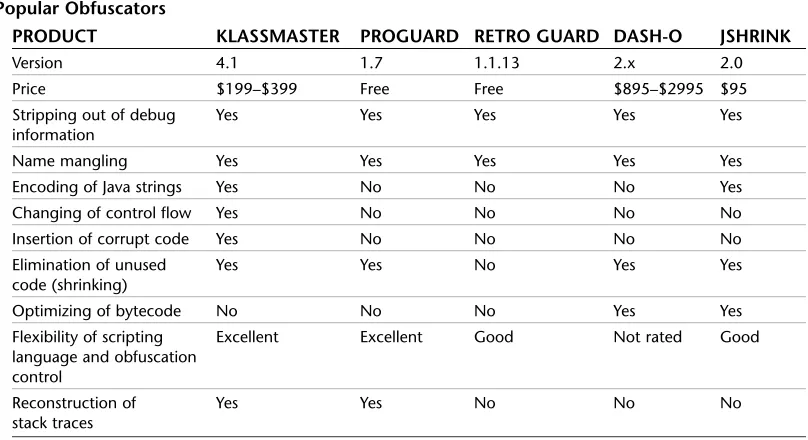
Plenty of obfuscators are available, and most of them contain the same set of core features. Table 3.1 includes just a few of the most popular products, both free and commercial.
TA B L E 3 . 1
Popular Obfuscators
PRODUCT KLASSMASTER PROGUARD RETRO GUARD DASH-O JSHRINK
Version 4.1 1.7 1.1.13 2.x 2.0 Price $199–$399 Free Free $895–$2995 $95 Stripping out of debug Yes Yes Yes Yes Yes information
Name mangling Yes Yes Yes Yes Yes Encoding of Java strings Yes No No No Yes Changing of control flow Yes No No No No Insertion of corrupt code Yes No No No No Elimination of unused Yes Yes No Yes Yes code (shrinking)
Optimizing of bytecode No No No Yes Yes Flexibility of scripting Excellent Excellent Good Not rated Good language and obfuscation
control
Reconstruction of Yes Yes No No No stack traces
33
[image:48.530.79.483.396.616.2]