A THESIS
SPACE-DISTRIBUTION OF X-RAY PHOTOELECT'RONS EJECTED FR01li: THE K AUD 1 ATOivIIC ENERGY-LETuiJS
*******
************************************* Presentedby
Carl D. Anderson
*********************************************
In :fulfillment o:r the for the of Doctor of
California Institute of Pasadena, California
1
A 13 S T R A C T
A O. T. Wilson ex:pans ion-chamber was used to
the of from a. gas
electrons
A
moreic :x-rays. Distribution curves were for from both the K and the L atomic
space-distribution was found for el
from the L evels than for those from the K
•
The distribution of the electrons from the1 less isotropic an increase in
s.
the the
of the incident radiation. For a radiation,
forward momentum of electrons from the K energy-level was found to decrease with an increase in the binding energy of the atom. Within experimental error, how-ever, for electrons from the K energy-level, even for different binding , the average forward momentum remained the same for a given veloc
or
ejectionor
the electron. The average momentum of electrons ejected from the 1 levels was than for electrons from the Klevel for a velocity of ejection. The average forward momentum of the electrons ejected from the K shell was in fair
accord with recent results of mechanics. The observed
values of average momentum of the
from L were sl th.an those
2
The of
e from a gas by x-rays has been extensively s by
means of C. T .. R. several
invest
•
The of the distribution curvefor electrons ejected from the K and the on the
obtain.ed for the
from the 1
of the incident radiation has
and are in with the
expressions. Results so far
ihution of electrom~ Aject.ed
are rather meager. It has been shown, however, that a more isotropic space-distribution exists in this ease. In the present work, the distrib1..1.tion
of electrons from the L energy-levels is found to become less isotropic as the frequency of the incident radia-tion is increased.
The
c.
T. R. Wilson expansion-chamber employed in this investigation was essentially that described by Simon and Loughridgeo minor refinements were effected to insure accu..racy in data obtained.filtering of the ion from
an x.-re.y tube wo.o found to produce ro.diat ion not suff ic
monochromatic.
electron s
made of the
filtered
of
photo-ion shmved
" I
of"-/; leoo / ' / ;;· /eod sh~dds
,1
I/
cc~,C~
ftlterj
1 metal
if t'Odia/°2
u ,
I
c\:
l1 /
I
~ Ir~\
/
I
I i~
u.i=
1·
expoosioi-1/ chamber
~
pnmary .r-ray6etvn
Fig. I. Fluorescence radiator as source
[image:4.613.69.537.56.719.2]fluorescence
x-rays
:rJ.
A.in
,
line-radiation of radiator.
obtained it
necessary to of 55-40
4
I
Source izer
A
lfo tube Calcite .71 A
tt tt Silver .56 A
VI tt n radiator .59 A
"
"
Tin radiator AThe relat faint K
f
lines of were filtered out means of a ruthenium filter. The filter consisted of a 3 mm. thiclmess of ized ruthenium nitrate between two vertical of thin cardboard. The presence of the Kfl
lines in the othercases was not e.
In the of increased accuracy in the
of the tracks some in the stereo-comparator previously described were found
The scale and vernier for of the
the cross-hairs were replaced by a micrometer screw and scale calibrated to read to .001 cm.
much finer cross-hairs and povler lenses were , and a frame and cross-hair were substituted for the s
of the two
an essential i.n the
employed. in the measurements was found to be
the surf ace
due to
one
faces. If tllis
5
of the in the expans
cover the ch.amber will on
the scatter of various
ints on these surfaces. It is
rotate sl one of
so that the cross-hairs as seen to
trivial
of these
s1rr-is not made
errors in measurement a very
of one of the two these ions were taken
reduced five fold and track measurements could be within limits of 3°.
A brief discussion of the errors in measurement may not be out of at this point. may be
clas-0
a into three groups, random errors, errors
and ::.statietical :flu.ctua.ti<ms.
""'~"'""''··"'•"" errors variations which occur in
of
, a.nd ( 2) the offco·t of'
of the gas as well as
(l)
naturala cross-hair upon a
nuoloi a.nd
initial direction
deflections the
the effect o:f these random errors will cancel out
to some ex.tent for a
final effect will, in
rrumber of meam.J.rements, their
curve decrease its so of fine structure,
ic errors
error
for cross-hair is
directed ... Y" .. ~T...,.,.,.r,
Hs forward
of chamber, and ncreasi
car:i.era, of
i.f i.t occurs in one its forward
it occurs in the
chamber. The final effect is to
of' the
a forward to the average f orv.~rd of a number of tracks.
This error may be corrected by tVlo meas\U"ements
on each the in the
comparator for the second measurement. If, however,
a.p-an nurnber of tracks are directed
as downward in the vu·-vJ.1.G4AJ,1V~i~f this error will
balance a very small second order effect. a careful
can ment
Statistical
of x-ray beam
about a
are
may be reduced a
of are made.
but
7
ult is
rather hard to estimate. It is to be noted the average later
is sensitive to error in measurement.
of 2° in the where the
of tracks occur, L.eo COS 6 = , mean an
error of in cos
e •
For this reason the value ofcos
e
{cbs.) listed below be in error by The other data, however, should be considerably more accurate.A comparison of the ive merits of the to t11at in which two
method as
cameras are their f'ocal axes
to one another, is hard to make since
cision used in the construct ion 01~ the
care and
pre-is tb.e
""''"-=-..·m ... h factor. The latter hol'lever,
fewer readings to be taken for each track and can be used re a di a number of tracks.
EXPERIMENTAL RESULTS
The curves,
the
direction of
Vlere
or
emission per unit offunction of between the
AIR
72 0" ,,,\ = .708A0
54 i
36
-18
o· 30• ,,..:::'. .Pt:).
J'ig.
Il
AIR
56 - A=.56zA
42
--213
~-14
0 0 0
o· 30° 60 ° .90° !P0° !50° /80°
[image:10.612.85.523.39.728.2]8
effect of the energy level from which the electron is and also the effect of a in the
of "the incident radiation •
In • II and III are the results
obtained respectively from measurements on 272 tracks in
air
air by radiation of .56 A. Each small circle
0
the mmi.ber of electrons ejected in a 15
interval the plotted at an corresponding
to the center of the interval. Points are plotted every
o·
5 and therefore represent overlapping intervals. In order to study the distribution where the
, C H Br was introduced into 2 5
the expansion-chamber in an atmosphere of The photoelectrons were produced by radiation of .59 A, most of them ejected from the K shell of the bromine atom. .About 64 per cent of the energy of incident radiation was required to remove the electron from the the
36 per cent as kinetic energy. The
secondary and could be easily
distinguished from one
length. ejected levels other
than the K level of bromine or from atoms could be
64
48
oi
o· 30°
CzkBr
-A-.586 A
_J ---'---'---'--=~-'
60° 90• 120· 150° 180"
[image:12.612.87.512.47.750.2]---
,
- - - ,-48 1--~--+----+---~1
24
12
0
J'ig.
T
36
24
12
0
60° goo
Fig. VI
CH.ii
"1 =.706' A
1zo· 150·
C
/-!.]
I
.A::.48 7 A
[image:13.613.73.517.27.741.2]9
in the • Thus, the photoeiectrons
their in the K of bromine were included.
IV represents the distribution curve as before for 233 tracks of electrons from the K level of bromine by radiation of .59 A.
For the of the distribution of electrons
e :from L levels, C~I was introduced into
the charnber in an
or
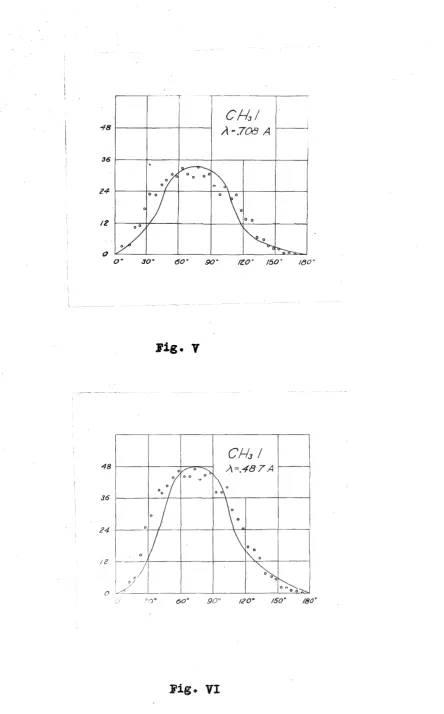
andof .71 A and .49 A emiss being' from the L levels of iodine. The results of measurements on 200 tracks formed by radiation of .71 A are shown in
v.
In agreement with the work of the curveis broader than that found for the K electrons indicating a more isotropic distribution. The small circles as before
represent the points. VI represents
the a1stribut1on or Z64 photoelectrons ejected rrom the L levels of iodine radiation of .49
A.
The curve here ia narrower than in V, indicating a decrease inthe ieiotropy of the distribution with an increa5e in the
frequency of the incident radiation. Watson and Van den Akker have shoVJn that photoelectrons ejected from the L
11 and L 111 energy levels have a
ibu-tion more isotropic than those from the K and 1
1 energy levels and Robinson and Cassie have found the relative
ratio electrons was
of be 2.5.
photo-10
number of L
1 electrons to increase with an increase in the of the incident radiation. The narrower
distribution curve of VI may then be the
presence of a of 1
1 electrons is the
case for the curve of
v.
A expression derived by
Wentzel on the basis of mechanics,
the probab ion per unit Of a
electron from the K energy level as a function of the
O,
between the direction of and the for warddirection of the x-ray where v the velocity
of ejection.
V
the of the incidentand h, m and c are the •
The solid-line curves of • II, III and IV
P{fl) with the :proper of v ,;' inserted, the curves on a scale to conform to the
•
The observed of the distribution about
a normal to the x-ray beam may be with the
theory in ways. The value of cos (!J over
all the tracks, a to
11
(see
(z)
if first order terms {" are retained. Ta"ble
the values of cos (J (obs.) cos (J { c~lc.).
I I
Gas
~
cose
(obs.) cos tJJ (calc.)
"~'''~----K Air .71 A .182 .210
K Air .56 A 0210
K C2H5
Br
.59 A .133 .138L CH
3I
.n
A .230L CH
3I .49 A .255
The e .. verage forvi.rard momentum of the K electrons for a
radiation decre~ses \vith an increase of the b ... ~, ... ~
of the at om. fli thin error, however,
K electrons of the same initial veloc have the sar~e average forward momentum. It is to be noted, moreover, that in accord with the results of , and Watson and Van den for
of electrons have an average
than of the electrons. The difference in behavior of the and 1 electrons is more
bi-partition
at the apex of a cone ch divides the into two groups of numbers, is Calculation of cos
8D
shows it to be firstlectrons
v to - to a
c
( :3) •
(s)
Table III the values of cos ~ (obs.} and
cos ~ (calc.).
K K K L L For electrons e
TA~L.r.; III
a.as
)
Air .71 A Air .56 A
c
2R5Br .59 A~I .71 A
CH
5I .49 A
v
value of - the c
from 1
nearer 90° th.an for those from the K the conclusions of
cos t3(obs.} cos ~(calc.)
.242 .262
.292 .294
.191 .173
.174 .242
it ion for seems to occur
, in
The ratio of the number of electrons
[image:17.614.122.511.343.654.2]13
f
1 is {4):(4)
values of
f
(obs.) andf
(ca.le.} in Table IV.TAJ3LE
Level Gas
~
f_-
_:1
(calc.)K •71 A 2.17 2.30
K Air .56 A 2.59 2.58
K C2H5!3r .59 A 1.74 1.70
L CH
3I .71 A 2.00
L CI\
1I 049 A 2.30
It is to be noted that no
found in the behavior of
9
for the K and L electrons.basis of
for the
the 1
Calculations made G. Schur on the
mechanics expression
ibution of from
of an om:
(
.-'-/.
',sin'
B
+
~v-
J/n 3tJ CPS BI -
~'r)
I +
(I
-t-/I ..
ll_
;(r
fcoss
14
mE~an of
of
,
other Hies remainas before.
The curves of
• V
andVI
Q( e) the proper
the curves be on a. scale to conform to the
observed
•
Calculation of the average value of cos
e
for L electrons (Appendix B), in the manner carried out for K electrons, leads to the resul.ts,TABLE V'
Level Gas
/\
Cose
(obs.} Cos e (ca.le.}L
o.n
A .23 017L CHIZ! 0.49 A .25 .22
Ii)
The l1ere 1s not sat the
observe.-tions a average forward momentum
of the than the
of
9 ,
defined as above, leads toTABLE VI
Level Gas
/\
(ca.le.)L
o.n
2.0L CH I A
3
to
r
'
and are inaccord.
A decrease in the of the
curve for L electrons, with an increase
in the of the incident radiation, as was found
above, is also to be from the The ratio
of the number of 1
11 and electrons to the L1 is
(s
for case, to
TABLE VII
Gas Level
L CH
3I 0.71 A 67
%
33%
L CH
16
For the harder radiat due to the
ion of 1
1 electrons e a narrov:er
17
APPElIDIX A
SPACE DISTRIBUTION OF ELECTRONS
of the incident radiation and the
atom. For electrons of not too
v
agree to f ir~t order terms in - but may differ in the
0
order terms. We shall consider that relation
derived by G. Wentzel, and communicated in a series of
lectures at the Norman in January
1930.
He finds for the ity of ion
of a photoelectron from the K energy-level of an atom
where is the measured between direction of
of the the vector of
incident radiation,
e
the between the direct ionof ion the of the x-ray
v the vel of
,J
the of theincident and h, m c are the
If the
• f'
1 ... consider the
of
P(eJ
18
space
ion per unit e is
Jin..r&
[ / -
~
CPJ&OF
cose
ized, and the
,
The mean value of cos t1 over all the
photoelectrons to the
average momentum of the ion
of the ion of the radiation, be calculated as follows:
Consider first the
I,
where
and
.,,--;
P~J
cos
o
de
/)
in the numerator:
c
sub st
tl -f):,
19
;_(1-
1/)
11. -d
ti
(a-}
u)+
z .;:; a
----)u.. ,
I
(
(P:..-4
2-r
j+j
tl-f,,ti
3-aJ
2+
sub st the limits of int
- /,4
/!Ja.J
'
I
.;lj
J(a
-1f
/
2/(}-bj,
z
Cons
of ):
I=
.2.substitut
=
I
j,
Ju
now the in
(i-"' -
du
(ii
-)u.;
4u
-it<
~
,
2
tl
+
q,,Z
4-.:t..
~
,/...tl
J
.s4
(a
denominator
+
z..21
Hence
a0~
+I
()ab
ICvJ
--1-
b
4-where
I
andSince in the of (1), electron
spin and relat were cons and various
other made
only to first order terms in .!..
c
we find
COJ
&
the third and
±
s
c
BI-PARTITION' 1UTCLE
ion above is icant
v
in terms of - ,
3
-1-order terms,
c
The it ion
e, ,
thethe apex of a cone which divides the into two
groups of number is defined (5)
22
As saw
a
f
&Hence
J;J.
z.Jr;
::·-
"'
"' tJ/.J
PJ I)+
.1 ,b .!I ti ,h tJf.)
..,
(..
0
and
,,-""""
2..
~
~ c.
CJ
J&
:::;:".3 L: (.d.'J<J ..J
(
(3) then becomes:
=
.;!., ' z.
a -6
.if;_j, J..-
.J,r;j;
UM&,,
-+Jb
~PJ
2
~
J
23
and third and
t erms in -. v :
c
3a
aj,
+
J
Q .J Gt?J ~ z,; t)where
/-l-
and..2mc .z..
Hence
RATIO OF lfil.MJ3ER OF
EJECT:E.'D FORWARD OF THE PLAlrE UOI-h'UAL TO THE
X-RAY BE.Mi! TO l'ITI'.£J.BER EJECTI~D BACKWARD.
~1he ratio of the number of electrons
order
c
for ward of the normal to the :x.-ray beam to the number
j ,
is byJ
r
;?_Ft~J
Je
()
( 7 J ,
As shown in section,
,.;! . <.
a -'7
+
.J
where
Hence
and
After
..,,-/-~!
d&
f
::::.Sub st
!
-24
ii
~b
.l.::;.
(tl
-1-
j, /
.7p .ii. ~ ..z.. -3.(),). -1-
b
<3
(a -
.b/
2.
..7 i--1
,za-3-1--Ja:z.£ -
)
.J3t7J~
J
t:l
-for a and b and
,2
+
c
£
-,6
ect third
DIRECTION OF GREAT".tl;ST EMISSION
The of the maximum of the
25
3
=-
0
-.Ye1
26
APPE1IDIX B
SPACE DISTRIBUTIOU L l~LECTR OMS
G. Schur has a theoretical
expression the
from the L evels of an He finds
for the of of a from
the L
I
where
1L
represents the mean value of the binding energy of the L electron-levels, and the other remained as previously defined.If the incident radiation is unpolarized, and if
we consider the the
27
Qto)
oculn B
- .J+
I
. .l
- r}/J1
&
-1-Jtn
~8
( I+
//
(l
lmAN VALUE COS f)
The mean value of cos 8 , for L electrons, is by,
(&)
CtJJ 8J&
I
-()J
&
-(BJ
c:.
f
d::
Then,
71
c
I
-/+
28
114
t:/r
t
;rr
f
c5/Mt!J
G (}J" BJ&
d
j
U!r,, 3&
C t7S 6ldtf)
0
-,,-+
g_
J
s1>?
&cos
2&
do
-1- Cl(}
J;
=
4-
7T
+
Therefore,
t1
+
-where a, b, c, d,
RATIO EJECTED
X-RliY
J,
TO
29
7T
Jt;r'& c,cJ &-
Je
-,,-j/#1
tr
c,PJ t9J
6' -/- CJd
::::.
e are by • ( 13).
OF
BAC1rnARD
The ratio of the number of
forward of the normal to x-ray beam to the number
30
d&
!
)zr
dB
;2
For L electrons, as shown
d& -
J/>7d&
-1- tiJ
.
+
Cle}lj,,J&
CM&c/I}+
111
(JtJJ&
J
B
Therefore,
:tr"
1.
dt1
=
+
a/J
4
+
c
-1-cc/+
4- -1-oec.
4-and
7T
dB
+
cd
ac
QeC-
-+
4
Hence
eel
-f-
4-y
32
c
Values of for
0.71 A lZ87
0.56 A 1621
0.59 A 1555
0.49 A 16'71
:tn Terms of ;;.;,
Atom
h-t
O, N {Air)
Br - K level 993
356
I ?158
L 111 'tt
33
Velocities of ion of Electrons
Radiation Atom Velocity
0.71 A
O, N (Air)
.262 c0.56 A
o,
c0.59 A Br K .173 c
0.71 A I L c
34
c.
• R .. Wilsonl)
Proco Soc. Volo 85, • 285,2) u u n Vol. 87, 277, { 1912)
•
3) tr tt tt
Vol. P• 1 • 192,
·g. Bothe
4) ZelL::>. f'.
•
Vol. 4, P• 300, {1921)5) tt H Volo
12'
P•
117'6) n u
"
Vol. 13, :P• 368, (1923)7) tt tf n Vol. 1 p. 319, (192~1}
8)
"
rt n Vol. 20, 237,•
9) tt n Vol.
23, P• 214,
10) tr ff t1 Volo 26,
P• 59,
11) ft tt tt Vol.
26, P• 74, 12) tt tt tt Vol. 37,
P• 547, (1926)
F. :Bubb
13) • Rev. Vol. 2~, p.
14) Phil. Vol. 49, P• (1925) 15) Nature, Vol. 112, p. 363, (1923}
Fritz Kirchner
16)
17)
19)
• it. • 27, •
• Vol.
•
' ( 1
, (1926)
0 ' {1927)
• 899' ( 1927)
35
20) o Bev. v-01. 26, • 697, (1
Vol. 30, P•
22) Jour. • Soc. • 13, • 679, {
'!ft
~-
c.
Watson23)
.
Rev. Vol. 30' • 4:79,(l
ft
"
Vol. 31, :P. 728, (1928)25) Proc .. Mat .. A.cad .. Vol .. J 3.., (1
Watson and J. A. Van den Akker
26) Proc .. Soc. Vol. 126, p. 138, (1929)
M. P.
27) Vol. 177, • 169, (1923)
28)
''
''
Vol. 178, :p.29) Jour. d. • et Rad. Vol. 8,
P•
85, { 1927}30) n n n n n Vol. 9, 225, (
•
31) • Rend. Vol. 186,
.
?58, (1928)32)
"
"
Vol. 187, • 1141, (1928)33)
'"
ff Vol.80, :D. ) 7 4.2, { 1
35) Jour. d. • et
,
{
E. J. Williams 35}
'
Vol. 121, p. 137) n Vol. P• 758, (1928)
'
38) i t Vol. 123,
P•
565, {1929)!59) Proc. • Vol. 121, , ( 1
c.
D. Anderson40) ... fi4'7, { 1
Vol. , p. , (1930}
A. IL. Compton
42) • Vol • • 549, (
H.
Cassie43) Proc. Soc. Vol. 113, • 296, (
G. Wentzel
37
J.
l,ili) Zeits .. 'f'.
.
291, ( 192 7)A.
Vle 11 en.me chani s cher
A. 1.llld G. Schur
47) Arm. d. • Vol •
'
(1930)A.
48) Ze:i.ts. f.
.
Vol. 56, p • (1929)s.
E.
Szczeniowski49) • Rev.
•
35,P•
G. Schu..r