1x1 m x % b q ! F a i l f m e a t af the R~qairemants For the blegree of
A e ~ ~ ~ u t i c a l Engineer
California fno&i$u$s of T e ~ B n ~ i o g y Pasadem, Califor mi&
The author wishes to express his appreciation to EJrofesgior Lester L e e s whcss groundwork for this investigation was invalblable,
and to Pxofeesor Tosbi Kubota for the great amount of time, energy, and expert guidance e w e - d e d in the r e ~ e a r c h . He i s gratefml to P4rI
~ 3 u l Baloga and member a cf the hyper s c n i ~ e s a f for sugge stione and asslismnce in all phases cf model pregasation and test; to Mr.
C.
A. Bartosh and membass of the GALGPT machine o h c p far the carefulproduction of models and t e s t devices; ta Mre. Betty Eaue and Miss
Georgette Pauwels for t h ~ computing; to Mrs. Betly Wood and M r S.
The physical chtlracteristlcs of the ablation pawe ns are deesribed. A theora?rical approach to calculate the heat transfer to the w a l l of an ablating body under flow conditions encounfared in the CALCIT hyperrrcnis.
tunnets is outlined. Simplification i e achieved by assunling the, -par pressure next to the sublimiag'body i e at its equilibri vaiue. The G A L G n hypersonic teat facilities ara deacrfbed briefly. Methods of nunufacture a r e given for COZ-ice, NZO-ice, and Gl0H1 60-ice models. Teckmiquee a d special tesr eguipnient ueed in obtzrining experiments resultst with HZO-ice and
ClQNl6Q'i~e
(camphor) are dkiaeribed. An illuvtration of the computational technique used to determine the heat ~ o n a f a s rate@ to the waif and the w a l l temperatux@ dietxibutisno i.8included. Figures tc show the agreement batweea theory and experiment are presented and reasonable results are obtained for temperature
Acknowledgment 8
Abstract
Table sf Gontsnts List sf Figureo Eiat af Symbols
U.
Theory of Wsat Transfer to Ablating Bcdiea 5 U. 1. Goncentration and Stagnation EothlpyDistxibutions in the Boundary U y e r ,
LB
=
pr=
Sc'=
1 53. Blowing Correction for N e a t Transfer 9
XU4 Gxper in,antal hvestigation BO
UX. 1
.
l n i t r o d u ~ t i s a BOaB0
2. W i n d Tunaels 10UI. 3. Model Support and Shield 11
Ux.4. M a w d a c ~ u r e of Models I d
III.
5. Exploratory T e s t s , Role cf the Tripla mint 14 Ulb. 6. Teat Conditioe~o f s z Q ~ n t i m e i v a 16HII.
9 . ataGathering Technique % 7UU.8. Equillbrim-Sbpe Modelrr 18
XV. R e s u l t s and Db scusaioa 22
[image:4.530.40.486.50.700.2]PART P&*GE
Appendix A
--
Roperties of Materials 3 2 AppsndixB
--
illustration of the ComputationalTechnique 3 4
Appendix G
--
Gorrectien for Canduetion Effects at&be Nose 37
LIST
OF
4 The GALCIT Leg 2 Hypersonic
T
Leg 2 Model RoLecE~rSolubility of BZ(PJZ) in H20 when Pirrtial Pressure of Gaa Plus H 2 0 Vapox messare.
=
1arm.
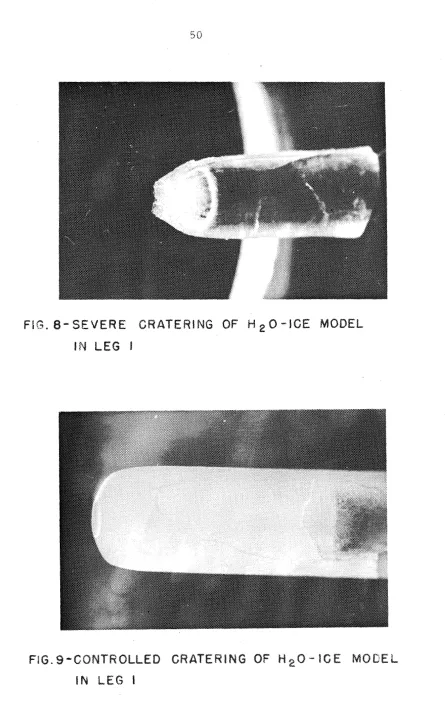
8 Severe Cratering of WZO-Ice Model in Leg 1 50
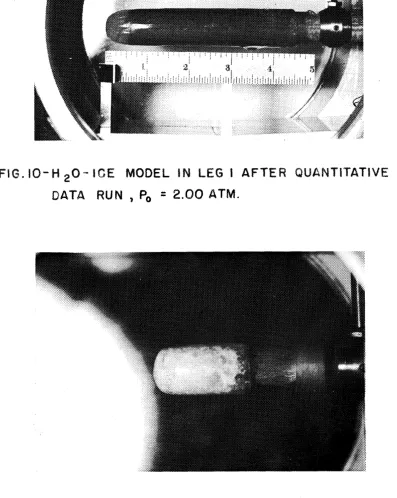
9 Goatrotled Gratering of M20-Ice Model in L e g 1 58 lbd HZO-Ice Madel i n Leg; f. After Quantitative Data
Run,
Po
=
2.00 atm. 5 fl l
CIOH160wI~e
Model in Leg 1 Dwing Q ~ n t i t a t i v emta Run,
Po
=
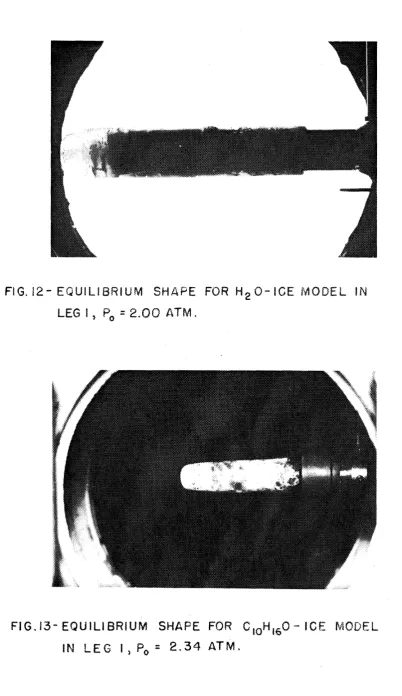
2 . 3 4 atm. 5412 S b p e for .H20-Ice Model in Leg 1,
= 2 . 0 0 atm. 5 2
,
EqubiBibri pe for C1 OH1 $Q-Pce Model in Leg 1
Po
=
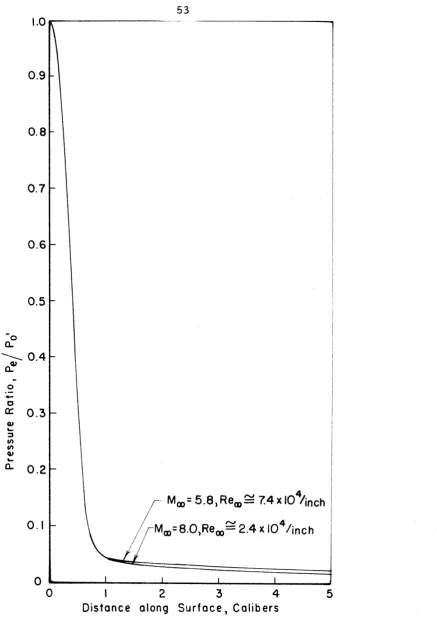
2.34atm.15 Pressure Distribution can
-M
=
5.8 Equilibrium-Shape Pressure Model, ClOHlBO*I~e 54
Ablation Ptars at the Ncae, ClON1 $B-lce
Ablation Rate at the Noss, CiON160-l~@
Ablation F ~ t o at the Nose,
CIOHi6Q-Ice
Surface Temperature, W 2 0 - l c e Surface Temperature, MZQ-Ice
Surface Tamperatura, G Pi OmIce .
ao
a6Surface Temperature, CIOPI168-Ice
Ablation Heat T ransPe+ Rate Along Surface, WZO-lee
Ablation Neat Transfer Rate Along Surface, W,O-Ice
Ablation Meat Transfer Rate Along Surface. C1 &0-Ice
Ablation Heat Transfer P3ate Along Surface,
C10H160-I~@
Abhtioa Heat Tranktfer Ra$a Along S U P ~ B C B 09
Aa,
=
5.8 Equilibxiura- pe Model, Gl0N1 60-Pce Axial Abiatfoa Rate Across theNo@@
Area onM
=
5 . 8 Equilibri -Shape Model,C10H160wI~e
e
P
specific heat at conc~tant prsesur e32 diameter of b&y
z
coefficient of m a a s diffusion of specie8 1 into species 2(9) in the g a s pbaee
$3 e f f e c t i v e heat capacity
k esaefficient sf ebarmal c&rradu~tivity
KE
se fracrion of subliming matextar1"i so fzactian of the ith species
Z~ internal ternpa x0tu.r heat capacity
of
aclid& rate of mass aildigion to the b o u n a ~ y layer
~a her, gp,/pw) C H o
Re.
~ ? rI? @ a t f c p3e"6?883Ug@
PO' sBgmtion p;a~e@bure behind narmel
smmtHc;
pv vapor prerPeure of t b ~ subliming
X* ber, (ep p ) / k
4
local beat transfer rateh,
net heat transfer rate ts inf;er4sf0;3p of solids radiue of curature st nose of body
radiue of cross-seedion d body af revolution
r w a f r e e stream E;eyxlolds n her per u i t length
-..----
p ,
g
8) in the solid phase8 df stgnce along sufa'erce, nleasured from forward stagnation poinr
*
beg*( p / p ~ ~
9
0 time
absolute temperaLure
v conlponenls of velocity parallel and normal to gas- eolid interface
axial ablation velocity
'8,IV *
L molecular weight of the ith species
elope of curve G H J ~ N
=
I t9
Ef
absolute viaccssity density
9 a n g a r diamnee from the nopie
air or gas composing free stream flow
flow quantities evaluated at outer edge of g a s bourndary layer aslid material
8 zero maas additioa; a l a s re,z;esvoir value
t3 solid
s. p. ~ t a g m t i o n p i n t
w waft
Ablation is the process whereby a body absorbs heat by giving up p r t of its nhasu, either by r~2ilelting w i t h or witixou svsporation, or
by direct sublinlation from the eolid stare. Ablation s h i l a r to the type ~~a?r~icPereP;B i a this report ba f~uascE nicr~st ~5;$a~jf?+loaky ia M B ~ U P B S In t1'118 farm of meteorites which enter the earth's atmosphere
at
high vslocity and generally (if they are neitiler too large nor too sanall) ~ p c r i e e bofcro: t hey strike the ground.*
AbIaticn s b w s promise a s an engineering wwpon againsz high heat transfar ratea a d , high alaterisl temperaturea i u several applications, the n.ost cbvicus being for noee cones of bllis- l i e mlseiles, or other bo4ieo entering the earth's atmosphere. Lees 2yointn out that the heat transter rate at the throat 4f liquid fuel rocket
2
nczales can be as high as 1000 B I ' u / ~ ~ . see., and ~ l u e s of the order
uf 2500
-
3000 BTV/P/~~.' soc. m ~ a y be reached at the forward stagnationSublimation abliltion or meIting ablation where
a
significant par- tion of the molten material is vaporised offerss
reduetion in the heat transfer rate to the b d y for two general xeaaons:(1) Absorption of it significant portion cf t$e incident heat in
iataat h a t of sahib Eion (evaporation) of the body
( 2 ) Insulation of the bcdy by i t s own vapor in the boundary l a y e r . Gonsider a semi-infinite slab of material subjected to an im-
pulsive consant beat transfer at the surlace.*%i Zfthe temperature, eha
1
9 Sin-I Cheng pre seats gome interesting comments on and photographs of meteoric abfation. (Super scripts denote references at the emad ~f ~ Q X * .
2
**
L e e s points out that a t r i a n g u l a r timewise d i s t r i b u t i o n of heatdistilnee from the surface, the :in:e, and ::?B heipk flu^ are denoted by
T , X, t and for reapectivc'ly, then
where p, c, k, and K.
,
are rsgpectively the density, specific heat, rharrnal condue tivity and thar*mal diflueivity of the golida r f c (s) dsno tea the c plemenWr y error function. h parlicubr, at the @-face X s 0 , the tennperat*e i s given by
&ad henee, dvm. in the c&o@ 8f a% terra1 with high conductivity and heat
capacity, there is a limit tc the h ~ a t transfer rate tbta~aintains eurface t~rnpratures below the fusion point a$ the material involved. When the materlal begins to malt
at the
surface, a c e r e f n amount ~f beat i s absorbed i a changing the phaseof
the mataris1 f r gotid to liquid &ad&e heat transfer into &a ~soEid iB@ rgduced by that amouat. (TBids d s a ~ nor aplJly to amcrphasoua terials wbjch do net b v e o sIa1.p melting
temperature. )
tf
the Liquefied raaterial i s ccnvecfsd aamy from the melting region and resolidifies i n the region or' Low heat triznrsfer xateor i n the wake, namely if ~orodywrnic ablaticn occurs, the melted
terial acts Eta an sgeat wMeh redistributes c r reduces the h a t
t ~ a n s f e r to the aolid body. 5ubl tfon ablatioa affers
a
particularly good means cf regur;lting surface temperatures to tolerabla levelehecauea of Elre heat blocWng effect af the ablered material and abscabticn
w h e s ~ Q t conseant, an increase ir T w i l t reg& in an increase in p V
end hence he heat absorption and bloc-go effect by blowing will be increased until a balanca is achiev-do By thig mechianis=, the teablarion pnociens i s self-regulating. 1x1. addition rhe vapor pssseure curve ver s u ~ i tenlperarure i a B O steep trkdt theoretically one b.ss only lo fin4 a saritsabla n;arerial go reguhts the nlaximPwi> ter;.pcratuse experienced to a given leveL. Further, as shown by ~ r i a n : s ~ for applicaticn~ ~ u c h as recovery of a s t e l l i t o rhs rcq.aired ~e~b~:-ei~iu- ior an ablating uosc cone n a y be l e s s t-n f o r a radiarinp noge conc +when zhs requixed -*eight f o r i n ~ d t i a n i s co;lsidered. Schemes where a gas is cjccred ar the nose of a body have tha! d i ~ d m ~ t a g e of excess vieight and mechanical c o f i ; ~ p l @ x i t y of p
am
A . g a t i n g 1 devices, aild p f ~ ~ l b t 3 g ~
Lsee
'*
''
5, KuboLa6
,
Bethe 9 and Adrns, Fay 8 srnd Riddell,soberts9, and others tlave worked out the theory Ear the heat transfer rare to bodiee in hypetsonic flaw including the e f f e c t s of ioniwkion,
d i s sochtion, combustlen in the bounder y byer, recombine$ion, radiatf on from the hot g a s e s behind the bow shock and hack lradiati~n from $he body.
By
speeialieing these general seaults to the conations existing in the GALCIT hyper sonib tunnels*, i t i s possible to o b a i n theoretical r eijultay be ueed to predict the salient iru3croscopic par
tem~perature, heat tranefes rate, and ablation rate for
a
given material, model s-pe, and tunnel operating conditions. These result@ are based on well under stood nuid mechanical sapects cf the p ~ o b l e m and allowthe experimental r esul'ia obtained to atlrve a e
a
check on the portions of the theory still retained. Si'ince the flow cc&itions in hyper sonic tunnel& of the GALCIT type ase now well known, it f s hoped that these reeulte will prove an intereeting supplamcsnt t o the result@ obtained in high energy Boareps such ae air arc jets and socket e aasts where high5
Lees shows that
for
flows of b~llndary layer t y p e whers L e=
Pr
=
Sc=
1,KA
and hs ~ a t i s f y identical diuer ent2sl equations. Hence* it the bounbry condittcns impsed cn Q and hB at the wall and rst the edge of the boundary lslyer are comprrtible, and EA and hs are slowlyw w
vsrying along the body surface, then the distributions of ha and
KA
w i l l be $ibihr. msbd %hi B f & ~ t , the? C O ~ @ @ E V & ~ ~ Q W g*~fchemical specie s, and defining
&(Ly
+
tT)
=
p, U, C (h * hA.
@ e W
ing Ulat the vapor preseure of the solid matarial is at i t s thermo- dymraig: equili bri
and Ep. f l ) becwnee
*
6
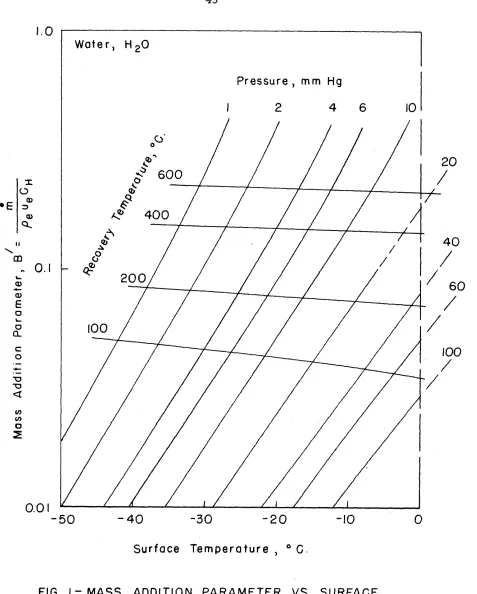
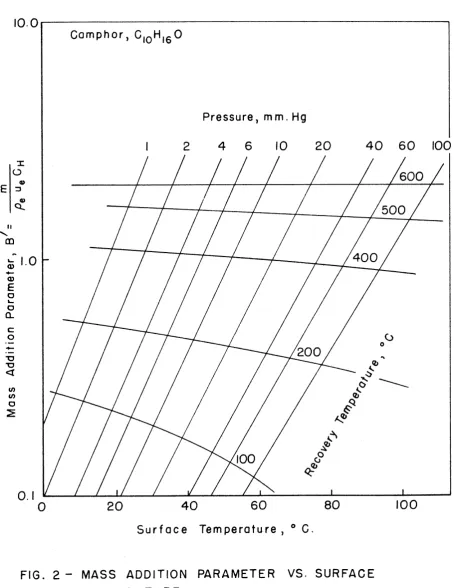
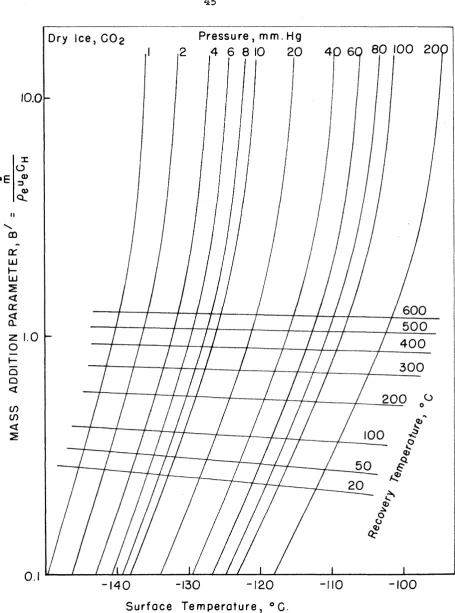
Figures 1 through 3 w e r e prepared by T. Kutota from Eqs. (2)
Glausius-Clapeyron vapor prsseure equation. W i t h figures such as 1
*&rough 3 for 6% p a r t i c d r wall terial, the equilibrium wall temperature can immediately be determined once the recovery temperature and pressure distrf b a $ i ~ n are kgaowa.
at the surface of any body immersed in
a
fluid. Coneider an ablating gas-@@lid interface with coordknates fixed in the interface.&a the ga pbase $hare are three terms t o be conaidered for the treat transfer at the wall:* (1) conduction to tba wall. (k 8T ) ;
s i ; ~
( 2 ) diffusion of different species ta the wall carrying their associated BKi
@ ~ ~ & I P Y *
(P Dl
1
hiIw
i (3) blowing of material away from itha wall
=
& hw (g).
In the $@lid pbase there
are
two term8 to be conaidered for the heat tranl~lfer at the wall: f l ) conduction of hmt into the interiorof
the 'solid*
4ps
; ( 2 ) convection of entbalpy to the wall (since the coordiwtes are fixed in the interface), 65 h, (s).
*.w
Hence balancing heat to the waH in tihe gas
=
heae sway from thehw(gl a
[C
X~
hi] W(a)
=
$< h, . ( g ) + ( l - P i ) l a (g)Ew &w Ew Aw
*
We ignore here radiation and chemical reactions at the wall.Substituting Lqs. (51, (61, and (7) in Eqo (4) and rearranging terms
where
1
hE (g)-
hE (s)]_
i s the &tent heat of sublimation Ly.
DefiningGa
=
xihLT
,
6.2
(LV
+
LT) = Be UeC
(h-
hA )E-I
' e wu GH (ha
-
hA ) then I f 4 is takenaa pew
@ w
Gw
5 x=h[ L V +
LT) 0In order to obtirin results that will allow use of pioneering work by other 10
authors in computing the heat transfer parameter, one can define
The oxperlmenwl investigation of subliming ablation was conducted in t h ~ GALCIT hypersonic wind tunnels. The models used in the experf-
=&Gats w e r e hemisphere-cylinders of l-inch diameter made of H20-ice, CION1 60-ice, and GOZ-ice. In the fir st phase of the investigation, the nlodels were tested at wide ranges of temperature and pressure in order tc explore the general behavior cf these material@ in hypersonic air
streams. (See Sactian
UI.
5. )In
the aecond p h s e of the investigation, the temperature distributions and the rate e of ablation w e r e meaeured on NZO-ice a dCl
OWlbOwlce models. ltn the third phase of the investigatiotl, a e t a y of the equilibri e h a p s of ablating bodies was conducted w i t h W 2 0 - i c e and GH
O-ice models initially of hemisphere-@ ylinder sbaape.10 14
In addftfm to the a b k t i o n n~eadelo, two m e a l pa.eeBuge model8 were chine& with oriffceg d f ~ t x i b u l s d on thasi ~sr~%rEac$; one =&ode1 was of
\
hemis&ere-cylinder arbpe, and the other of $be "eguitibri
''
s b p e ~b&b~l~@gl;aa b b t f ~ n pg t e s ware computed by the method outlined in Seetion 11. and
compared w i t h experimental values.
The experiments were performed in. the GAECIT hypersonic wind tunnels legs 1 and 2. Both tunnels are of the continuous running closed
forth in the following table:
Leg 1 Leg 2
- - - - . - - -- -
m c h No. aangs 5.8 [mla?r%n) 6 eo l o
-% Reservoir Temp., OC 149
M a x Reservoir Preo~urs, peig 108 T e s t Section, a m e n a i ~ n s ~ b. 5 x 5
Leg 1 i s a fixed contour nozzle and leg 2 ie a virriable contour nozzle with ten pairs of hand-operated jacks. ( S e e Figure 4. ) Leg 2 is a complete operating 3/8 scale model of rha 21 x 2 i inch hypersonic tunnel at the
Caltech Jet Propuleion Laboratory. Both legs 1 and 2 feature alltomatic control of the reoervcir temperature and pressure. The temperatures
are maintained by niclnr ome w i r e electrical-resistance heaters imm~diately preceding the t e s t seclicns.
Becau.se of the higi2 te~rperatures encountered in the CrALCIT leg 2 hypersdnic tunnel i t 18 necessary to bring t h ~ t el airaow up to t e n p ~ r a t u r e while the wind
is
blowing: also f l ~ w hati to be started atH ~ U C ~ Mgher pressures than w e r e used for these tests. Hence in order
ta prseerve bodies w i t h low melting points cr htgh vapor presleure
cbrircter, such as HZO-iee or solid camphor (@
H
O), i t was man&- $6 16protective case which could be opened and a l l o w the model tc be, raised into the air stream through a cutout in the tunlie1 flcor after the deeired
flow conditions had baan established. The device for accomplishing
Cask is shown in Figure 5. Becauee of the high melting point cf camphor and the high Lidtent heat of HZ0-ice, i t was satisfactorgr tc coal the model
with ordinary atmospheric cooling air. Had GO3-ice or other low mairing point materials been tested in leg 2, cooler tsnnperaturtrs could have been obuined by using liquid
NZ
for the coaling medium. Cooling b y a meansd
liquidN2
wae t r i a d in leg 1 and model tsmperature?s on the order of - 2 0 0 ~ ~ were obtained.In
leg i because of the lower reservoir temperatures, i t is possible to bring the airnow up to full sagmtion temperature while the tunnel air is cbnneled through by-pass lines and then to establish flow in the tunnel at: full stagnation conditions in about cae minute after model installation; hence no device for model protection was; required.rn
40The GOZ-ice models were first de by placing commercial dry ife in
a
high pressure mold kith micarta eting fixed in place. The GO2 was allowed to melt, and was then refrozen by immersing the mold i nLiquid
N2
.
The molds weze then tbawad to remove the atcdels whichoften came ouL with eoneiderable velocity (this can ba
a
dangerousneuver i f one i e eurioue enough t o look down into tbe mold). Later COZ-ice modele were nufactwad by compressing the crushed dry i c e in
a
mold, which i s a far better and safer technique.the air had to be removed from
a
supply of distilled water by holding the water under mcuurn. The solubility of O2 andN2
inM20
i a given byHenry's law,
Ki
=
St p.
4ti2
where
K
is concentration of the i gas species, Sr i e the coefficient cfH
eolubility at a given temperature, and p irr the partial presaure of the &as over the liquid. (See Figure 6 for values of
M
and KN in Hz8m )a2 2
Because of the solubility cbracterletlcrr of air in water, the gas over
the water to be used f ~ r the models was evacuated of air for a period
of
at lease one day to scavenge the air from the liquid. Then rha water was a e c t e d into molds with micarta stings fixed in place, held under if m c u
and frozen (under vacuum) in an ordinary freeeez. In order for thiis
the anolde so that the bubbles of vapor, which bave a large area, w i l l scavenge all the air from the eyrtem. The greatest difficulty with HZQ- i c e models lies in keeping the sides af the model. uniform. Any slight irregularity in eurface slope causes considerable variation in both
pressure and prestaure gradient, and hence heat transfer rate, or ablation rate, thus rnaking it very difficult to o b h i n good d a k repeatability with
this type of model. These difficulties appeared to l a v e little effect cn the
surfme temperature distrlbutian, hawever, becauae of the steepness of the v a p r presauret cuxve varouo temperature.
denoity*, and is recommended Par G I O W l b O - i ~ e and GOZ-ice models. The accuracy of r h i ~ technique is reflected in the u n i f ~ r m i t y of ablation results for the camphor models.
To
obtain model temperature data, copper-cons&ntsm thermo-couplee models wsrs de (See Figure 7. ), a t h the thermocouples fixed on the e a e r i o r of
a
hallow m ~ i c a r a sting. The thermocouple w i r e s werelead $a a ~ S r c ferentht dizection on the micsrl;st sting far 0.20 to 0 . 5 0
inch fro=. the thermoc~uple junction in order to decraage e r r o r s eauecd by conduction in the thermocouple wire itself. The i c e was then froeen on the stings in the ease of the WZO-ice model%, or depoolted in auecessive l a y e r s similar to
a
candle-model S.
5 Z x g t s r a t ~ r v Testa: B&oIe o.f the TsfpPs mint
Exploratory teats w e r e r m in legs 1 and 2 w i t h HZO-ice and GOZ-ice models tc e ine general aspects of the ablation phenomena. The n~odels were tested at zero angle of attack er Md@ ~ 0 n d i t l ~ n a d temperature and pressure and were viewed by Clae &-ked eye and through
a
short focal length telescope. The GOZ-ice models w e r e found to exhibit fklring on the surface and hence to lose a W r g e s h r e cf their material by fragmentation.**
For thia reason and bacauae ~f the? digficulties ofn;anufacture and storage of GOZ-ice models, no quantiative dam were attempted with this type of model. It should also be noted (See Figures
*
Tha wlue of the density achieved in this manner with C10H160* i c e was 4 per cent lower %ban the value listed in phydcarl tizbles.2 and 3. ) that the wlues of
B*
achieved with GOZ-ice and 6 1 0 H 1 6 C ) - % ~ ~ are very nearly the -me and ti~erafore preclude working with bothmaterials to spread the range of $3' values attainable. The miues
of
A h obtained with GOZ-ice w i l l be larger, however, because of .the lowerwall temperatures.
The H 2 0 - i c e modeis were observed to melt at the nose in leg I
for supply pressures greater than 34 p ~ i a at To 2 149@6. If the pressure
wae appreciably greater than tMt5 value,
a
distinct crater or melt regicnof
gzeater or less aeverity would form at the nolae. depending on thegnitude cf the reservoir pressure. (See Figures 8 and
9.)
T h eIn the sketch, the loeus of points OA represent the boilfng temperature of the given substance i n the liquid state at t h e corroajponding pressures the locus of points
OB
represents the melting conditiaas for the solid s a t e ; the locus of pointsOC
gfvca the conations under whfch the solid will sublima, and O i s the triple point at which all thee qtates may eaaA@C. The d o t t ~ d line from Q represeats suppreesion of the freeeingpoint, or supercooling. The triple poiar fog tkw ntcst comrncn form of
ZZO-ice occurs at O@C and 0.0686 p e h pressure. At a recovery tcm-
0
perature af 149
C
in leg 1, it was found possible to hold T, less t b nO ~ C so lorag a s
rhe
reservoir pressure was l e ~ s than 2 atm. and melting at the nose w a s not t t p p r e n t at pressaree l e s s than 34 prria.Baeed on this sh&ple relationship and using Figure 1, i t i s easy to determine the reservoir conditions of ternpsrature and pressure which will induce stagnation p i a t melting at any given Xaach n
af tke low v i s c o s i t y of water, once the HZO-ice melted i t was ~onvected
b
away, thus causing the cratering effect. Malting was not
a
problem with any of the other rn~teterials thkt were tested.Since say cratering w i t h the models made accurate qusntitative dsur imgossible to obtain, ell t e s t s with N20-ice models were run at
reservoir gemperatares and pressures such t h t the model nose tsm-
0
perature was approxin~ately O 6. I
Moo 5,8 8,O
OC 1 49 48 2
Po
am.(C10M160)
2. 34, 3. 79 5,86%
aem.(HZO)
2, OQ 3,70Angle of AtWck 8 Q
To obtain quantitative cia& on ablation rates, t i m e lapiae pharo- graphs w a r e taken of the model profiles w i t h
a
35 mm single~jlense r e f l e x camera fitted with a, 135 mm telephoto lensa w i t h extension tubefor close w c r k
By
toking:a
eeries of photographsof
a model atspecified time p e r i d s during
a
run, a tima: laprae sesies of the abhtion prcceas wae obtlrined. The photographie f gea of ~kae model were later carefuHy measured on an optical cornparatas to aeewaciea on the order. c-f 0.0003 inches on the f i l m f. 001 inches absoluta), giving the ablation
rate at all points on thht silhouette of the mially ~ymmetric body. (See
Figures 10 rhrough 13. )
T h e Camera was inwlbriaably positioned at E~ast 3 $see from the
1-inch diameter model, hence the cosine error introduced in photographing the model silhouetrs was negligible. Errors rcaused by distortion in the photcgraphic process were cheeked by pbtogragiaing
a
&-inch ocale cmdPerhaps the largest source of error w a e lack of picture etarpness. caused nlainly by the tunnel plate glasp, windows; this effect u7as
aggravated by the oil always present in the funnel and found on the windows after tunnel o~mra tion.
3Aoilel ten2psrature a t a were recorded or, a Brown self-isalancing
potentiometer, which w a s calibrated to the temperature of distillel ice slush and boiling distilled watel-. Becaj~se t e m p r a t a r e gradients will exist within the nlatarial eveit a f t e r the wall temperature hae stabilized, accurate mil temperatuxe ilata are obtained only when the thermocouple is coincident with the gas-soliil i l t e r f a c e ,
To
minimize this effect, only~ ; ~ Q L T ) S C ten-iperatu~e data v,tMch w e r o obtained at the end of a data rran were
used.
Model prassusa data w e r e recorded
on
a precision lead-serow mercusy micro-n~anometer for the higher presoures near the stagnation point (local body slope iriore t a n 45@ to the Qcw directioa) and a silicone oil multipze manometer bank for the pressure o r i f i c e s farther back on .the body. (See Figuses 14 and 15. )
There is good reasoll to believe that an ablating body under con- ditions such as w e r e encountered in these t e s t o will approach an equilibrium
shape, if one cl;amines the two extrenies of body shape for laminar b o a n a r y layer flow: (1) If the nose s k a p ~ is highly ccnvex or pointed (see sketch)
heat tranefsz and E L ~ X ~ I T ~ U ~ ~ ab=1Xat%on rate x v i l l dcp@Cur
at
( 8 ) Highly Convex (b) Fkt Nose
03
NO@@
rstee near the @boulder are brger than at the forwazd stagnation point. This fact can be seen from Eq. (91.
If
the nose i s Plat, then ue w i l l increase a e the flow opproach~s the shoulder;aleo
dueids will increase apprwehing idinityat the
corner.*
*
ern^'^,
Rose. and Detra show axperimenrally and theoreticallythat the peak heat transfcr rate tor a flat-noaei! cylindrical body 4 t h
a,
11 corner ra&us ie reached at the eahcgadesp and not
art:
the farwards t k g ~ t i o n point. ~ b o n e s l Lf px s experimental data to show that the
h p a e tranefer prameter,
~ u /
and the non-dimensional velocity,Initially then, these two extremes in body sbape wtfi be expected to approach each other and there may exlst some intermediate s b p a ,
ao in
the f o r s g ~ f n g sketch.In
part (c) of the &katch, the feedback batweantsansfar rate per unit cross plecticn area i s nearly constant. wMle the
ablation rate per unit crose aseftion area i e eona*mt.
The condition fos
an
rquilibri shape d e e d on eimple geomerrical2
~@n@idssstload i IB
T . Kubolir* he& ammined the determiation of the equiLibri
ehape theorertically, ass in@
a
m d i f i e d Nawtonhn pres sura distribution near the etagnation p i s t ,as
0. and using the 8( ~ u /
Iws
a s usedin
Beference 10. (Sic AppendicesB
and D. ) His reaults indicate tWt the radius at the r s a g ~ t i o n pPnt increase8 w i t h time.a
Ae shown in AppendFv
D8
ha alao obtained b reeultwrlue for due/d(a/r) to f i t tMs relationship. ing an ellipsoidnrl nose e b p e one can determine the ratio
of
thethe ellipsoid that w i l l agree with ehis aquation For the fonditions of tha
fiZO-fce at
Po
n 2.34 atmosphere&, MIp3 t 5.8, andTo
=
149'~, hiswould bave i t s aaaJor
a d s
perpandlcuhr tb tha now ctlrection and a ratioof
major axis to minor adsof
4.6 to ]I. For the eanditionsof
610M160-iceat
P
2 . 0 0 atmospPlerea,Mw
e 5.8 and To=
L49
OC,hi@
resulte indicatethat an ellipsoid with i r e nlajor ads perpendicillar to the W w direction,
and
s ratio of amjor a x i s t6a anlncr arcis Df 6 . O t o 1 would be obained.To check these ideas, WZO+Lce and C 1 Q W 1 6 0 e I ~ e models with langth tct
diameter ratios on the order of 7 were constructed and tested in leg 1. (See Figuree 12 and 13. ) Tbatee moclela were run for 3 4 minutes and
39 minutas rerapectfvely to allow them to approach thais equilibri sbpct 8s clolsely a s poseibla. An examination
cf
Figures 12 and 13indicates t b t the nose skpes can indeed ba quite accurately approximated by oblate elltpsoida with their 1 to the fksw diraceion out to the region cf @lopa. on the order of 30 degrees to the now d?lreeti~xo Fer the case
of
HZB-ise the ratio of major axis to minorB obtained experimsntally w a ~ 1.7 to 1,
a d
forC
W
0-ice the 10It6
GIOMl
bO-Lce moclel,a
preasutrs made1was
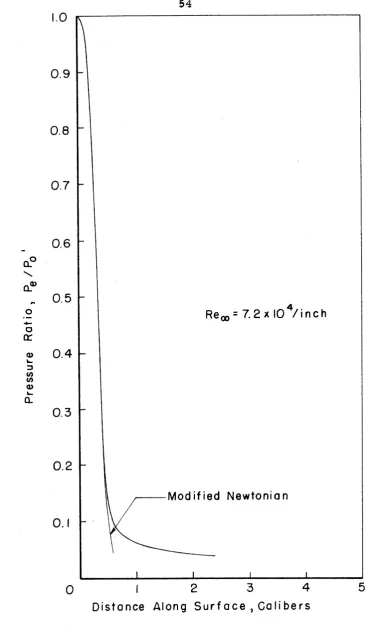
constsucted duplicating the fi~%Eal @hope of the actiuzl ~ 4 ~ d e L and w&la tested in leg 1 to determine the pseesure distributian along Ule surfrtce. From these pressure ata,cctlcaticns were n&ade af the haat t r a n e f e ~ rate and eac~psa2.ed w i t h the
The prarraure distributions obtained for both the hemisphere- cylinder and the equitibri -shape m d s l s are pzesentad in Figures 14
PV. RESULTS AND
DISGUSSIQNParticutax hope for the accuracy of the experimental dlata i s derived from the excellent linearity Car the ablation rates at the nose. (See Figuree 16 thsough 2 0 . f At the start of each teat there was an adjustment period while the gunel flow conditions and model temperature
stabilized although the tunnet was run for approxi tely 15 minutes at full r a ~ e r v o i r coladftio9ee;i baflklrra eals=h t e s t to deer-@@ $he efface@ of nrarozaitba block temperature agiuetmcnt. Thsse transient effecte caueed some
lies ts accur in the abliatiaa rateo fer the first mfnuta or two 0% each run. Hence, the plots of ablartion rate at the nose do not include the f i r s t data points where obvious errors were involved. That is, t
=
0 and x O are taken at the time and nose p o i t i o n arbcut 2 minuteeafter the start of the flow. (The ablation rate at the nose is defined as th@ rate at wMch the nose rseedertis with time. )
The temperature measuring system as
a
whols -- the Brown self- balancing potentiometer and the copper-constantan thermocouples-
waeQ o
cartainly accurate to within
-
1 C. However temperature gradients within the ablating matorfwls caused such islcatter in the experimentalFigures 21 through 25. ) The fact that the cnset of melting at the nose is predicted accurately and with good repeatability by Figure 1 in the
kase of HZO-ice indicmrtee that the actual wall temperatures w e r e close
to the theoretieat predictions.
A calcuhtion was carxiad out $0 @st% te the rate of conducttow
tempegatuta distribution at the hemiepherical nose! and a s s
uniform temperature distribution over l;ha badre of the hemiswere. (See
Appendfx
C.
) Newever, the a s stributicn over the base of the hemtaphere probably laads to higher
tempratwe gradients prt the sagnation p i n g than would actually be
achieved, and hence $he sstimaeed ccnduction effects at the nose might be larger than the actual effects. Expe~imenta with the H P - i c e models to measure the temperature difference across the micarta midway b c k on he body indirated that no measurable difference in temperature
edated hence the conduetioat etffscte on the afterbody are prea
small. The accuracy this a s s ption was enhanced in the case of the HzO-ice models by the high latent heat of sub1
lu
(i. B.
Ly
+
LT=
LV).
and in the case of t$nz C 110 PI, 314 O-ice n l ~ d s l s by the low coefficient of thermal conductivity oi solid camphor.Ths comparison batween the theoretical and experimental ahlation rates at the noae are given in the table on page 24.
Note that the theoretical vsluesa for Chs stzignarton p i n t ablation
rate are greater than the experimental ~ l u e s in all cases. One principal
errcs in the theoretical rehiults coatd be the exirstence of non-equjllibri
conditions at the surface. For elrampie convection in the boundrrry loyer flow may cause the M v r ~011~enLr~Lion next tc the wiall tc be leee thsn the equilibri value; tU@ we~uld cautiser the
B'
value ts d s c s e a ~ e 1 0 ~constant
To
(See Eq. 3 . and hence the constant preseure lines inFigures 1 through 3 would be shdftad to the right.
If
this should hiappen,Reservcir Ablation Rate at the Noee (em. /mine )
% @ Q B u ~ @ a ._
8,QB1 .075
8.350 $340
0.391
.
aso
are l e s s than the tfiecreti~al values. Gonveraely, ff the vapor concentration next to the wall is higher than the equilibrium value, than t h e wall tem-
perature will decr sase,
If
the expsrimentll, tempratwe dgta are qutrlitatively correct on the model afterbody, &en Figures 21 and 23 indicate thatKE
was lesson the afterbady for H 2 8 - i c e and greater than equilibriunl
on the afterbody for
G I O W i b O ~ i e ~ o
Conduction of heat into the ineerfox of the body (pogitive
kg)
would cauae 8' to decrease far ffxedTW
(See Eq. (2). ) and hence would caulse the conersL~t reservoir fempelraturs lines to shift do in Figures 1thro~ngh 3. Thi$ would cause the equilibri TW to decrease, but only very slightly since the vapor pressure curve8 are very eteap. In any
..I
LE
-
GW
-
4@
Senee, positive
is
w o d d effecta
reduction in the local ablation rate. Aa adQitSsw1 error incurrad in the thasrettcal calcrtabtione is that. in general Le, Pr, and Sc are, not equal to 1,Factors contributing to the reliability of the theoretical r e suits
$ 0 ~ 6 3 &FB 46 g 0 1 1 8 ~ 8 :
( I ) E (To
-
Tw) i s Large thenes
be corner^ relatively lees impormat with rarsipect toil,.
Thia reeulf i s seen in the t a M e on p a g e 24 where the tkcrstical predicricne for ablation rate in leg 2 are much better than t b d e in Leg 1.( 2 )
If
PCE at the wall i s amal'l, then the appp+oxii s conetaat across the boundary layer i s m o l e valid. Here it i s seen in the, tablo on p g e 24 t b t the theoraticat ablation rates f ~ r H 2 0 - i c e are better thrrn t h c s s for C10W160-I@e. Also if
ME:
is saran, .any errore incurred in computingG
/C are reduced commenraurstely.(3) The blowing correction
C
/C
is baaed on iicorrelation ofPIo
theosetieal and axpsrimeatal results for mstexio~ls wirh
W E
lessl than 44. Nsnce the c?xtrapolaticn of these resralts to material& with high moleculzbt weight ~ u s h a s camphor (molecmler weight 152.23) i r a guesticnable.Becauaa the vapor in the nose region could be cenvected around the shoulder of the body before i t hae erufficient time to diffuee thsough
'
tba bundary layer, and aleo because pe and T, decrease along the surface,
the rapbr preaaure on the afterbody y be g r a t e r tban the thermod equilibrium value.
In
this case resolidification which i s by definition characteristic of an equilibri. process may become prcncunced encughbeyond the shoulder than would be otherwise exprlenced. Examination of the model film data and teleeccpic observations indicate! t b t resoldi- f i a t i o n did occur, but no pronounced effects on &ha? a b W i o n results are apprent. (See Figures 26 through 31. ) Resolidification also b e the
effect of increasing the modal roughness, (See garticukrly Figure 12 near the shoulder. ) and hence Cf or CH with a proportionat increase i s
il,
; the magnitude of this effefr 19 not known. However, the model~cughneset obsarved was on a vary small surla incagable of tripping the b c ~ t n d a r y k y e r , and nowhere in the data is there a laharp increase in Beat trsaisf~sp sate aucb a s would b v e bema e rienced if boundirry l a y e r transition to turbulent flow had occurred.
A s seen by the pbatographa of the eguilibri -shape models (Figures 12 and 1 3 ) the nose ebapee remain canvex. This result has
ifications in that if one is to measure expe~imentally the ablation rate of a particular body ahape i t is iragorwnt that the ablaticn data be obtained before the bcdy sup i s appreciably altered. Ideally, I h a body shape at the s&arr of each t e s t should duplifate the equilibri body shape For the eqiitlibri body shape obmined experimentally in
1 ablation velocity increases by less than 4 per cent from the ~Mgnation point to the shoulder. (See Figure 32. ) The shoulder i s taken tc be the point where the body slope is 45O to the flow directfano
The pressure distribution for the equilibri
sirr.ilar tc the distribution for the hemisphere-cylinder and agrees w e l l
with the modified Mewbnian pedictfon out ta O
=
6 0 ~ .The siwaple theory developed buased on an energy balance at the
I gas- solid Interface and ulaiag a heat-transfer Wrameger suggested by
other reaearchegs, give& good sesults for v v a l tempratwre, but over- eetin~ertes the ablation rate by ao much a e a factor of two. Howeve+, the results for the abktion ratee are greatly improved for the greater values
oZ
(To
* Tw) and the lowerKE
at the wall. The tkeoryapplication for estimating the rektiva merits of different materials. %adtation batween the gas and tbe body, combustion of the! ablating:
terhla, and recombination of ehemicerl speciee at the suriace can be accomted for by simple addieiva terms t o the baaic heat transfer eqvstian developed in Lhis report. Alsc for more deafled analyses, more complete
account cculd be taken af hsat conduction into the salid by constructing figures based on Eqs. ( 2 ) and (31, bug not taking $& t 0. However, this
l1 comghlred tc the sianAple additive term for
4
used in t h i ~ report.I
More se;~@ase%n % e clhsrrly ine%%ezated to dstsrriline $Eae
the shielding effect from blawing by heavy molecules.
Tha H21ZO-ice and camphor models teeted in leg 1 for long periods nose shapes in a sense that the c h a g e a of shape w i t h t i m e ware imprceptibty small. They wsse close kc o b b t e
needs niore accurate relations hctween the body ahape and the flow
properties outside the boundary layer than those a s s u n ~ ~ e d in the analysis. Transient effocts vdthln thc &blaring material represents an interesting and challenging area foz investigation.
I1
this region, one could nieasure the ear'iy timewise arblation rate a ~ ~ d temperature dig- tribution within the eolid taking care tc regulate the initial model tam- perature. Also there i s room for uaefd reaearch investigating the boundary layer, measwing coneeatration, temperature, and velocity profiles near ablating bodies. The heat transfer to the vd.all obwined1. Cheag. S i n 4 : Meteoric Ablation through Interfacial InsLability. ARS Jourrd1, Vnl. 29,
NJ.
8. p 579-587, nugu&i, 1353.2. Lees,
L.
: Ablarion in EIyper ootiic Flowso -per prssented at thesrican Codereace, sponsored jointly by the Royal New York, N.
Y.
,
October 5-7,1959.
3. Aderms,
M.
C. : Recent Advances in Ablation ARS Journal. Val. 29, No. 3, pg. 625-632, Scyembor, 1959.4. Lees,
Lo
: Recovesy Dytblmics--
Ijeat Transfer at Hyper sonic Speeds ina
Pkaetary Atmasphere. Chapter 12, Space Technology,pp. 12-01 to 12-20, john W i l e y a r ~ d Sons, N e w Yoxk, N. Y . a 1959.
5. Leas,
L.
I Convective HaaL Txangfer with Mass Addition andChemical Reactioae. h-oceediags of the Third Combustion and F+ropulgicn Colloqui Advisory Group fcr Aeronautical Reeearch and Devafopment. U T O , RLlerrno. Sicily, I ~ a l y , March 17-21, 1958, pp. 451*498, Pergamon Press, 1358.
6.
XuboU,To
: Study of AblLarion with Ice Modelat
=
5.8. -par presented at the ARS Semi-Annual Meeting, 6 s n Diego, California* June,1959.
7. Bethe,
H.
A. and M. C. Adarns: A Theory for the A b l ~ t i o n of Classy PMterials. J.af
the ~ e r o / ~ p a c e Sci., Vol. 26,Mc.
6, pp. 321-328, June,1959.
8. F a y t J. A o and
Fo R.
a d d e l l : Theory of Smgnation Point Heat T r a a f e r fn Diag~~cfibreaS, Air.J.
sf the? Aaro. S C ~ . , vd,. 25, NO: pp. 73-85, F e b r u a r y , 1958.9. Roberts,
Lo
: Stagnation- Pcint Shielding by $bf\ilei~ing and Vapriaation. NASA ReportNo.
10, April, 1959.10. Cohen, C. 8. anel
E.
Rsshotko: The Compserserible Laminar Boundblry Layer with Heat Transfer and Arbitrary Pressure Grad2 6 ent.NACA Technical Note 3326, April, 1955.
11. Gaslay,
C.;
Do
J. l\rlasaon; 9. F o Gross: General Chratteristicsof Binary Bounrlary Layers with Apglicatians tu Sublimation Cooling. Third Sympcsi Sigh S p e d Aerc~d mi^
s
and $tr uc tur e s,San Diego, CalUamia, Vol. 1, pp. 301-347, M r c h 25-27, 1958. 12. Bsookc, 32. 60 : Heat Transfer t o D r y Ice Spheres Subjected to
13. Kemp,
N o
no
; P.H.
Rose;R.
W. Detra: Laminar Heat Transf es around Blunt Bodies in Dissociated Air. Jaurnal or' the ~ e r o / g p c e Science&, Vole 26,No.
7, pp. 431-430, July,1959.
14. Ghonepl. A.
J o
: Heat-Trander and preseure Moasuxemahtr on Flat- Faced Flared- Tail CirculiLr Cylinders and Normal Dirac cs.NAVORD
Report 6669, June 15. 1959.k af Chismil~try and Physics, 39th Edition, 60
D o
H&gEditor, Cleveland Chemlca Rubber Publiebiq Company, March, 1958.
16.
Weiss,Ro
: Subli tfon ofa
Wemispbere in Supaxsonic Flow.Masslrchareetts Inc~titute
of
Technology, Naml Super sonic Uboratcr y, Tachnical Report 391, July, 1959.17'. %~tsermtTomk Gri&da=;iaX Tablea sf arfcal -- Phyalcrs, Chemistry and Technology. Nostionat R e s e Council, Msw
Y O P ~ ,
MC*@SP&W* Mill, ha.,1936,
7 vollL8. Rcehotko,
E.
: Simplified Mat for Esrtimeflng Compresrsibta Umimsp aaaQ T ~ a n ~ f a r w i t h Res3gura Gradient. NAW Techwfe;$ilI Note 3888, Decembsr, 1956.PROPERTIES
OF
Molecular Weight
(WE)
18,Q2-teat Heat of Sublimation (LV)
(-1, /pm.
1
DifQuaion Coefficient of 0 , 2 2 0 **@**@
Vapor in Air
(Dl
Z )(cam ' / 8 8 ~ . )
Viscosity o Vapor at O@C ( ) 88 ******a
6
(gois@
.
10 )*
Reference I 5 , page 2256.**
Reference 16. page 30.#*PBb Refersnc~! 15, page 1985. **ergo ope eit.. pgera 2134, 2138.
0.953
expsr imena1ly
determined
*****
ope cit,, page 2248.******
Reference 17, Val. 5, page 62.Ccnsider a blunt-nosad adally syrnnirzkric body in
a$
a t r g t r ~ a mber Ma with a how ehock and boundary laye-s behind the shock eovering the body
as
in the following: sketch.Sq (9) u7as used to ~ o l v e for the heat transfer
rate
to the wall along the body sayface. The values for the heat transfer pkrameter(NU/
were @omput& by a procedure warkc8 out by Cohen bO) W
a ~ d Reel20tko oe outlined balskv,
The pressure ratio P,/p,' w a s computed by the modified Newtonian
I
2 2
P ~ / P ~ ' 5 cca O
+
{pw',/Po') sin Qup to values of
Q
at which the slope of the N e w t o a h a pressure dietributicn, d(p,/p,r)/d~a was equal tc the magnitude and slope ohmf ned by thePr~ndt'l-Me yar function, The pressure was then aers esid to folllsw a h-inndtl-Meyer diatriburion out ro O
=
70@ f r ~ m where the data warefair ed intc r h ~ e!xpecperimental ~ l u e a . E;xperiment&1 values of P , / P ~ ?
were measured on a 3/4 sacsrte model at B
=
oO.
4Ei0, ,0'9 and at n r i o u e stations along the body, The m distr$butfon was ffound to give excallent agreement with experiment atQ
x 85'. Once the pressuredistribution w i r s determined, &cb n ber and T ~ / T ~ were determined
ara~rlyticaliy from pe/poB& and Tw wars determined directly from the
.was obminad from Figure 2 , page 13, in Refersnce 18, versus n and T \ J T ~ . Than,
where a was taken as 1/3.
Values ob
p
W ~ F B determined from Sutfncrhnd's formula sndQ w w a s deeermined from the equation af state tor a perfect gatl both wla;tes are for air at th@ w&PP &@aature,
Once ( N U / ( P ~ )W i a determined in t h b manner i t i~ eaqr to solve Eqo ( 9 ) fos
aw
itlong the aurface.~ a l / ~ r n ~ ~ , and 1.4, raspectively.
T h i s method bpi the advantage of being straightforward and
requiring no iteration. The n er ical integration is b e s t done anal ytf catty near the stagaation point relnee ~lrs tntagrgl (a small n bsr) must ba
divided by the inkegrand
{a
small number). Naor the stagnation pointI
an@ aaay fakg
For tha calculations with b b n t bodies encountered in this report, this linear equation was found to be accurate within 5 per cent out to values of @/I)
=
0.2, Further,B'
i s such an insensitive function of p that TiB