This is a repository copy of
FUNCTIONAL PEARL : lazy wheel sieves and spirals of
primes
.
White Rose Research Online URL for this paper:
http://eprints.whiterose.ac.uk/3784/
Article:
Runciman, C. orcid.org/0000-0002-0151-3233 (1997) FUNCTIONAL PEARL : lazy wheel
sieves and spirals of primes. Journal of Functional Programming. pp. 219-225. ISSN
1469-7653
https://doi.org/10.1017/S0956796897002670
[email protected] https://eprints.whiterose.ac.uk/ Reuse
Items deposited in White Rose Research Online are protected by copyright, with all rights reserved unless indicated otherwise. They may be downloaded and/or printed for private study, or other acts as permitted by national copyright laws. The publisher or other rights holders may allow further reproduction and re-use of the full text version. This is indicated by the licence information on the White Rose Research Online record for the item.
Takedown
If you consider content in White Rose Research Online to be in breach of UK law, please notify us by
c
1997 Cambridge University Press
F U N C T I O N A L P E A R L
Lazy wheel sieves and spirals of primes
COLIN RUNCIMAN
Department of Computer Science, University of York, Heslington, York YO1 5DD, UK
e-mail:[email protected]
1 Summary
The popular method of enumerating the primes is the Sieve of Eratosthenes. It can be programmed very neatly in a lazy functional language, but runs rather slowly. A little-known alternative method is the Wheel Sieve, originally formulated as a fast imperative algorithm for obtaining all primes up to a given limit, assuming destructive access to a bit-array. This article describes functional variants of the wheel sieve that enumerate all primes as a lazy list.
2 A standard solution
Few readers of this journal will be unfamiliar with the following program to enumerate the primes usingThe Sieve of Eratosthenes:
primes = sieve [2..]
sieve (p:xs) = p : sieve [x | x <- xs, x mod p > 0]
This little program, or something very like it, has been part of the stock-in-trade of lazy list-processing for over twenty years (Turner, 1975). For all its dainty appearance, however, the program makes brutal demands on the reduction machine. Suppose we computepk, thekth prime. Sample reduction counts†are:
p100: 36,558 p1000: 3,124,142 p5000: 75,951,324
Why is the computation so costly? There are two main reasons for inefficiency in generate-and-test programs: the generator may be too simple, producing com-paratively few successful candidates among many failures; or the test may be too complex, performing unnecessarily extensive checks. Both reasons apply here. The generator [2..] offers all integers > 1 as candidate primes. The multi-stage test makes pk+1 an item inpk intermediate listsbetween the initial list of candidates and the final list of primes – sieve’s argument at recursion depth d being the list of numbers> pd not divisible by any ofp1· · ·pd.
220 C. Runciman
primes = sieve [2..]
sieve (p:xs) = p : [x | x <- xs, noFactorIn primes squares x]
noFactorIn (p:ps) (q:qs) x =
q > x || x mod p > 0 && noFactorIn ps qs x
squares = [p*p | p <- primes]
Fig. 1. A circular program with fewer intermediate lists and fewer tests for divisors than the standard solution using a recursive sieve.
3 A circular program with a cheaper test
The technique of circular programming (Bird, 1984) can be used to avoid the inter-mediate lists of the recursive sieve. By reformulatingsieveso that it refers directly to the list of primes it is producing, it need no longer be recursive. Instead of checking for a single prime factor in the list comprehension of each recursive call, we check for all possible prime factors in one qualifier.
To implement this scheme, we need some way of cutting short the search for factors in primes. Otherwise the computation will fall into an unproductive black hole of self-reference. We use an elementary fact: ifx is composite, it must have a prime factor pwithp≤√x; so if we reach a prime larger than√xwithout passing a factor of x, we may conclude that x is prime. The revised program is shown in figure 1. The addition of the testq > xnot only avoids the black hole; it also avoids many of the tests for divisors carried out by the recursive sieve. This double gain is reflected in reduction counts less than 35% of the original even when computing only as far as p100, and less than 4% when computingp5000.
p100: 12,395 (<35%) p1000: 267,152 (<10%) p5000: 2,325,932 (<4%)
4 Wheels: a series of generators
Imagine a wheel of unit circumference, with a spike at one point on its rim. Roll this wheel along a tape. After n revolutions, there are nregularly-spaced holes through the tape, one unit apart. This wheel is equivalent to the generator we have used so far. Numbering the first hole 2, it generates 2,3,4,5, . . ..
But this wheel is only the smallest, W0, in an infinite series of wheels, Wk for
k = 0,1,2,3, . . .. Following Pritchard (1982), let Πk = p1.p2.· · ·.pk the product of the first k primes. Then Wk is a wheel of circumference Πk, with spikes positioned at exactly those points x units round the circumference where xmodpn > 0 for
5 Computing wheels from primes...
A wheel can be represented by a construction including its circumference and a list of spike positions.
data Wheel = Wheel Int [Int]
For example, W0 is represented by Wheel 1 [1]. The full infinite series of wheels
can be defined as in figure 2. Wk+1 is generated by rolling Wk around a rim of circumference Πk+1, excluding multiples ofpk+1 from the spike positions obtained.
wheels = Wheel 1 [1] :
zipWith nextSize wheels primes
nextSize (Wheel s ns) p =
Wheel (s*p) [n’ | o <- [0,s..(p-1)*s], n <- ns,
n’ <- [n+o], n’ mod p > 0] 6 3
2
2 1 5
4
Fig. 2. Defining an infinite series of wheels of increasing size. The diagram shows howW1 is used to generateW2, illustrating the applicationnextSize (Wheel 2 [1]) 3.
...and primes from wheels
Our primes programs so far have only used W0 as generator. What options are
there for the use of larger wheels?
Fixed wheel solutions. We could simply use Wk for some fixedk, but this has two disadvantages. First, we have to make some special arrangement to compute the first
k primes (or else write them into the program explicitly) as they are needed to build
Wk. Secondly, whateverkwe choose, it will be a poor choice in some circumstances: if few primes are needed, a small wheel is best; if many are needed, a large one is best.
Variable wheel solutions. The alternative is a circular program that computes both wheels and primes according to demand. The larger the primes to be computed, the larger the wheel used. But this raises a key question: When exactly should the wheel be changed?At least two different answers can be given:
1. Change when it is most convenient to do so. The program will be simple, and the change-over will be cheap. Specifically, roll Wk exactly (pk+1−1) times
before changing toWk+1. Then the change occurs at exactly the point where Wk+1 would have started its second revolution had it already been in use.
2. Change just often enough to avoid all residual sieving. This maximises the benefits of using a series of wheels, but at the cost of a more complex program. Specifically, rollWkonly until it reachesp2k+1, then change toWk+1 which must
take up the computation part way through a revolution.
[image:4.595.135.465.253.340.2]222 C. Runciman
6 Lazy wheel sieve Mark I
First, a solution changing wheels at a point that allows the new wheel to start a complete revolution. Figure 3 gives the new definitions ofprimesandsieve.
primes = sieve wheels primes squares
sieve (Wheel s ns : ws) ps qs =
[ n’ | o <- s : [2*s,3*s..(head ps-1)*s], n <- ns,
n’<- [n+o | s <= 2 || noFactorIn ps qs n’] ] ++ sieve ws (tail ps) (tail qs)
Fig. 3. The Mark I wheel-sieve.
The comprehension in the sieve computation is similar to that in nextSize: both roll a given wheel a number of times determined by a given prime. But circularity makes thesievedefinition more delicate, and in several places we must tread carefully to avoid a black hole. Rather than pattern-match eagerly against the sequence of primesps presented assieve’ssecond argument, head and tail are applied when needed. We further avoid dependence on psby separating the first of the offsets ofrom a range computation for the rest that is strict in its upper limit, and by searching for factors in psonly whens>2.
The performance of the Mark I Wheel Sieve compares favourably with the circular sieve (which uses only the equivalent of W0). Sample reduction counts are:
p100: 4,920 (∼40%) p1000: 131,713 (∼50%) p5000: 1,445,789 (∼60%)
7 Lazy wheel sieve Mark II
In the alternative wheel-changing solution, each wheel is changed just in time to avoid residual sieving. This method is more awkward to program because the old wheel must stop rolling in mid revolution. List comprehensions no longer provide a convenient way to express wheel-rolling. Instead of a comprehension such as
roll ns s p =
[n’ | o <- 0,s,..(p-1)*s, n <- ns,
n’ <- [n+o], c n’]
we resort to explicit recursion and the use offoldr:
roll ns s p = roll’ (p-1) 0 where
roll’ 0 _ = []
roll’ t o = foldr (turn o) (roll’ (t-1) (o+s)) ns turn o n xs =
let n’ = o+n in
To express a wheel change in mid-revolution, we can redefine theturn auxiliary so that it conditionally substitutes for xsa recursive call using a different wheel.
Another tricky aspect of the Mark II wheel-sieve is that the new wheel must start rolling in mid revolution. The simple list-of-spikes representation would force an ungainly and expensivedropWhile (< p*p). This motivates a revised representation of wheels: split the spikes of Wk into two lists, the first containing all spikes < p2k and the second those> p2
k.
data Wheel = Wheel Int [Int] [Int]
A change of representation for wheels entails a new definition of nextSize. Because of the split spike-list we usefoldr in place of a comprehension. As there is no longer any residual sieving, thesievefunction is renamedspiral: it too uses the foldr technique, and the major recursive call representing a wheel-change is made within theturnauxiliary. Figure 4 shows a full program for the Mark II sieve. The application of dropWhile to the recursive spiral computation may be surprising. Didn’t we change the representation of wheels to make this unnecessary? Indeed, the revised representation makes it easy to skip values < p2k from the first revolutionof a new wheelWk; but for very small values ofk the circumference Πk is less than p2k, so it is necessary to skip values beyond the first revolution. After
wheels =
Wheel 1 [1] [] :
zipWith3 nextSize wheels primes squares
nextSize (Wheel s ms ns) p q = Wheel (s*p) ms’ ns’
where
(xs,ns’) = span (<=q) (foldr (turn o) (roll (p-1) s) ns) ms’ = foldr (turn 0) xs ms
roll 0 _ = [] roll t o =
foldr (turn o) (foldr (turn o) (roll (t-1) (o+s)) ns) ms turn o n rs =
let n’ = o+n in [n’ | n’ mod p > 0] ++ rs
primes = spiral wheels primes squares
spiral (Wheel s ms ns : ws) ps qs = foldr (turn 0) (roll s) ns where
roll o =
foldr (turn o) (foldr (turn o) (roll (o+s)) ns) ms turn o n rs =
let n’ = o+n in
if n’==2 || n’ < head qs then n’:rs
else dropWhile (<n’) (spiral ws (tail ps) (tail qs))
224 C. Runciman
three wheel changes, dropWhileacts as an identity but for the small overhead of one comparison at each subsequent change.
Measured by reduction counts, Mark II out-paces Mark I, but the margin between the two is very slight until several hundredprimes have been computed. Even by
p1000 the margin is only 12%.
p100: 4,841 (∼98%) p1000: 116,646 (∼88%) p5000: 1,245,756 (∼86%)
8 Giant wheels and lazy spirals
The similar performance of the two wheel-sieve variants is more striking when one considers the sizes of wheels involved. Suppose we evaluate primes as far as
p5000(= 48,611). The largest wheel used by the Mark I wheel-sieve isW6 since
Π6= 30,030< p5000<510,510 = Π7.
Drawn to the scale of figure 2, W6 would comfortably encircle a large building –
quite a big wheel, though its representation does not involve numbers beyond the scope of single-word machine arithmetic. The Mark II wheel-sieve, however, reaches
W47 since
p47= 211<√p5000<223 =p48.
Now Π47, the circumference of W47, is an 86-digit number. On the same scale as
before, the dimensions ofW47far exceed those of the visible universe! We must not
construct any more of such a huge wheel than is strictly necessary. Lazy evaluation is essential. Continuing with the illustration of computing primes up to p5000, of
the three components in the representation of W47: the circumference Π47 is never
evaluated; the spikes less thanp247 = 44,521 are never evaluated; only afragmentof the rim ofW47 beyondp247 is constructed, containing just 373 spikes.
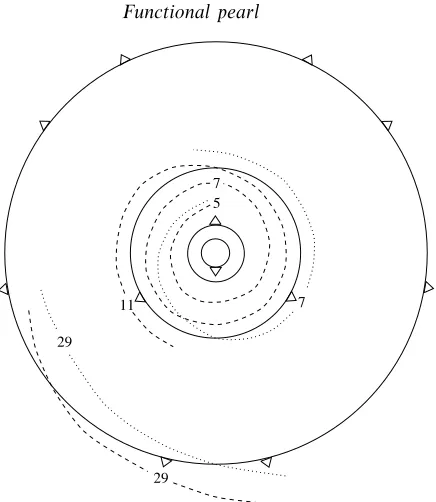
Figure 5 shows a way of tracing the enumeration of primes by a wheel-sieve program. Drawing the wheels concentrically, the computation can be traced as a spiral. Beginning on the rim of W0, the spiral orbits the centre once for each
completed revolution of a wheel, and its increasing radius is equal to that of Wk at the point where the program switches to Wk as a new wheel. Each generated prime is marked at the appropriate point on the spiral, positioned on a radius passing through the spike that generated it.
9 Final remarks
There is some scope for improving the wheel-sieve programs given here. For example, during the construction of Wk+1 using Wk, each candidate spike is tested for
non-divisibility by pk+1. But the failing candidates are exactly the products ofpk+1 and
29 29
7 7
5
[image:8.595.201.419.116.367.2]11
Fig. 5. Fragments early in the spirals of primes resulting from the two alternative wheel-changing rules: the dotted spiral traces Mark I, and the dashed spiral Mark II. (W3 is shownhalf-sizeto resolve a conflict of scale.)
Reduction counts are handy and machine-independent. But they give only a rough indication of comparative costs. Among the factors they ignore, for example, the Mark II program uses more memory than Mark I.
One could of course write wheel-sieve variants for the indefinite enumeration of primes in an imperative language, but I’d rather not. On the way to the functional solutions the worst one meets is the odd black hole, which a helpful compiler-writer may arrange to be pin-pointed in the source program. All the most intricate problems of scheduling and memory management are solved for free as part of the paradigm.
It is hard to beat the cute simplicity of the two-line sieve with which we began. But even after improvement, it cannot match the wheel-sieve programs for speed. Besides, the spirals have an elegance of their own.
Acknowledgements
My thanks to Richard Bird and John Hughes for helpful comments.
References
Bird, R. S. (1984) Using circular programs to eliminate multiple traversals of data. Acta Informatica,21(3), 239–250.
Pritchard, P. (1982) Explaining the wheel sieve. Acta Informatica,17, 477–485.
![Fig. 2. Defining an infinite series of wheels of increasing size. The diagram shows how W1 isused to generate W2, illustrating the application nextSize (Wheel 2 [1]) 3.](https://thumb-us.123doks.com/thumbv2/123dok_us/8096934.233087/4.595.135.465.253.340/dening-innite-increasing-diagram-generate-illustrating-application-nextsize.webp)