The Beginning of the End, or Just
Another New Chapter?
Recent developments in EU competition policy
control of regional state aid
Fiona Wishlade
November 2004
European Policies Research Paper
Number 54
Published by:
European Policies Research Centre University of Strathclyde
40 George Street Glasgow G1 1QE United Kingdom
European Policies Research Centre University of Strathclyde
40 George Street Glasgow G1 1QE
Tel: +44 141 548 3061 Fax: +44 141 548 4898
Author email:
Preface
This paper on the reform of EU competition policy and the control of regional state aid provides an assessment of the debate on the proposals put forward by DG Competition for the operation of regional aid after 2006. The paper was originally drafted for the EoRPA (European Regional Policy Research Consortium), which is a grouping of national government authorities from countries across Europe. The Consortium provides sponsorship for the EPRC to undertake regular monitoring and comparative analysis of the regional policies of European countries and the inter-relationships with EU regional and competition policies.
EoRPA members currently comprise the following partners:
Austria
• Bundeskanzleramt (Federal Chancellery), Vienna
Finland
• Sisäasiainministeriö (Ministry of the Interior), Helsinki
France
• Délégation à l’aménagement du territoire et à l’action régionale (DATAR), Paris
Germany
• Bundesministerium für Wirtschaft und Arbeit (Federal Ministry for Economics and Labour), Berlin
• Sächsischen Staatsministerium für Wirtschaft und Arbeit (Saxony State Ministry for Economics and Employment), Dresden
Ireland
• Department of Enterprise, Trade and Employment, Dublin
Italy
• Ministero dell’ Economia e delle Finanze (Ministry of Economics and Finance), Rome
Netherlands
• Ministerie van Economische Zaken (Ministry of Economic Affairs), The Hague
Norway
• Kommunal-Og Regionaldepartementet (Ministry of Local Government and Regional Development), Oslo
Sweden
• Näringsdepartementet (Ministry of Industry, Employment and Communications), Stockholm
United Kingdom
• Department of Trade and Industry, London
The research for this paper was undertaken by EPRC in consultation with EoRPA partners. It involved a programme of desk research and fieldwork visits among national and regional authorities in Member States during Spring/Summer 2004. The paper has been drafted by Fiona Wishlade. It draws on country-specific research contributed by the following research team
• Dr Sara Davies (Austria, Germany) • Laura Polverari (Italy)
• Dr Martin Ferry (United Kingdom) • Professor George Petrakos (Greece)
• Professor Henrik Halkier (Denmark) • Nina Quiogue (Norway, Sweden)
• François Josserand (Belgium, France
Luxembourg) •
Carlos Méndez (Portugal, Spain)
• Dr Irene McMaster (Ireland) • Professor Douglas Yuill (Finland, Netherlands)
Many thanks to everyone who participated in the research. The European Policies Research Centre also gratefully acknowledges the financial support provided by Sponsors of the EoRPA Consortium.
It should be noted that this paper was drafted in September 2004 based on information – notably the positions of Member States – available at the time.
European Policies Research Centre
November 2004
Disclaimer
Abstract
RECENT DEVELOPMENTS IN EU COMPETITION
POLICY CONTROL OF REGIONAL STATE AID
TABLE OF CONTENTS
1. INTRODUCTION 1
2.
NEW FRAMEWORKS: LASA AND LET 1
2.1 Draft Framework for Lesser Amounts of State Aid (LASA)... 2
2.1.1 Scope... 2
2.1.2 Aid limits ... 3
2.1.3 Procedural and administrative aspects ... 3
2.1.4 Observations ... 3
2.2 Draft Framework for Aid with a Limited Effect on Intra-Community Trade (LET) ... 6
2.2.1 Scope... 6
2.2.2 Aid values and limits... 7
2.2.3 Procedural and administrative aspects ... 7
2.2.4 Observations ... 7
2.3 Multisectoral Framework 2002... 8
3. REGIONAL
AID
GUIDELINES 9
3.1 National Perspectives on the Initial Consultation... 93.1.1 Population coverage... 9
3.1.2 Article 87(3)(a) definition ... 10
3.1.3 Article 87(3)(c) coverage ... 10
3.1.4 Article 87(3)(c) area designation ... 11
3.1.5 Aid intensity ... 11
3.1.6 Relationship with the Structural Fund areas... 13
3.2 Community Perspectives: the Genesis of a Reform ... 13
3.3 DG Competition ‘Working Paper’ on Regional Aid Guidelines ... 14
3.3.1 Article 87(3)(a) criteria and coverage ... 15
3.3.2 Article 87(3)(c) criteria and coverage ... 15
3.3.3 Award rates and ceilings ... 17
3.3.4 Other proposals / issues... 18
3.3.5 Observations ... 18
3.4 National Perspectives on the DG Competition Working Paper... 22
3.4.1 Assisted areas ... 23
3.4.2 Award values ... 28
3.4.3 Relationship with other policies ... 31
RECENT DEVELOPMENTS IN EU COMPETITION
POLICY CONTROL OF REGIONAL STATE AID
1. INTRODUCTION
State aid control is evolving rapidly against the background of a changing economic and geopolitical context. The so-called Lisbon agenda and subsequent Council conclusions have emphasised the objectives of “less, but better” aid, which in turn have begun to influence Commission thinking on aid discipline. More fundamentally, perhaps, enlargement of the Union to 25 members in May 2004 not only radically alters the economic landscape of the Community as a whole, but also presents formidable challenges for both the formulation and implementation of State aid control policy. At the same time, a number of State aid frameworks are due for renewal before 2007, providing the Commission with “an unprecedented window of opportunity for a comprehensive review of the horizontal, and particularly Lisbon, objectives, and the new cohesion policy set out in the forthcoming Structural Fund regulations as well as to consolidate, and wherever possible simplify the rules.”1
The control of regional State aid is by no means immune from the effects of this general climate of change: the current guidelines expire at the end of 2006 and the upcoming reform of Cohesion policy adds a further variable to the complex mix of issues to be taken into account in revising regional aid control in an enlarged EU. Moreover, the increasing tendency for policy objectives to be interlinked and for State aid control to evolve as a matrix of rules and codes means that regional policies will be impacted not only by the revised regional aid guidelines but also by developments in adjacent policy areas.
Following this introduction, this paper begins by looking at recent changes in State aid policy with implications for regional aid, before examining the Commission’s proposals for regional aid reform per se. It concludes by drawing out wider issues and implications.
2.
NEW FRAMEWORKS: LASA AND LET
Previous research in this annual series of papers on competition policy2 highlighted
four key elements underpinning the changing context for State aid control, namely: the role of market failure as a justification for State aid approval; concerns with the efficiency and effectiveness of aid; the place of economic analysis in State aid control; and the simplification, modernisation and clarification of the State aid rules. Over the past year the Commission has begun to add substance to these themes, introducing a number of changes and floating new policy proposals with the Member States. These new developments reflect an approach that focuses increasingly on measures that are perceived to be most damaging and which aims to ensure that those aids which are approved facilitate the achievement of Community objectives. Moreover, recent decisions and pronouncements suggest a growing preoccupation with the evaluation of the effects of State aid not only from the perspective of competition distortion, but also in relation to substantive policy objectives.
1 European Commission (2004)
A Pro-active Competition Policy for a Competitive Europe, COM(2004)
293 final, 20 April 2004, Brussels.
2 Wishlade, F. (2003) ‘Regional Aid Control After 2006: the Forces of Change’ EoRPA Paper 03/03,
An important new policy initiative has been the development of significant impact tests in the form of draft Communications providing for frameworks for the assessment of lesser amounts of aid (LASA) and aid which has a limited effect on trade (LET).3 These proposals were heavily trailed by Commissioner Monti and the
Director-General, Philip Lowe, during the course of 2003.4 In principle, they both aim
to improve the proportionality of scrutiny in relation to aids that are perceived to be potentially less harmful and to increase the flexibility available to Member States in designing aid instruments.
2.1 Draft Framework for Lesser Amounts of State Aid (LASA)
The LASA framework introduces a new category of State aid: aid which exceeds the de minimis threshold, but which is still regarded as too modest to pose a serious threat to competition, provided that it contributes to the achievement of certain Community objectives and that specified criteria are met. This contrasts with the de minimis provision that aid “not exceeding a ceiling of €100,000 over any period of three years does not affect trade between the Member States and/or does not distort or threaten to distort competition…”.5 According to the LASA draft, the Commission
considered raising the de minimis threshold but concluded that any increase that could be allowed would be too modest to improve the flexibility available to Member States. Instead, LASA builds on what the Commission calls the principle that “size matters” providing a framework for the approval of aid which remains limited in scale, and subject to certain constraints. Nevertheless, LASA aid is still subject to prior notification to the Commission under Article 88(3) either as a scheme or as ad hoc aid.
2.1.1 Scope
LASA applies to all sectors except agriculture, fisheries, aid to transport companies for investment in road haulage vehicles or inland waterway vessels and coalmining. It also applies to firms of any size.
To qualify for approval under LASA, measures must contribute to the achievement of one of the following Community objectives: research and development; environmental protection; creation of new and better employment; training; risk capital; SME development; and regional development. Aid to firms in difficulty and export-related aid cannot be approved under LASA; nor can aid to a firm solely to reduce its indebtedness, irrespective of whether the firm is in difficulty.
In principle, LASA aid can be in any form. However, less ‘transparent’ forms of aid (such as repayable advances, guarantees etc.) are disadvantaged to the extent that the whole of the amount advanced or guaranteed counts against the LASA limit, and not just the aid element. Moreover, the Commission will not approve LASA in the form of tax deductions or exemptions unless the Member State can provide
3 ‘Draft Communication from the Commission: A new framework for the assessment of lesser amounts
of State aid’ and ‘Draft Communication from the Commission: A new framework for the assessment of State aid which has limited effects on intra-Community trade’ available on the DG Competition WebSite at: www.europa.eu.int/comm/competition/state_aid/others/
4 Philip Lowe, ‘Introduction’,
EC Competition Policy Newsletter, 2003(1) Spring; Mario Monti (2003) ‘New
developments in State aid policy,’ Paper to British Chamber of Commerce, Brussels, 1 December 2003; Philip Lowe, ‘State aid: the Commission’s plans for reform,’ Paper to British Chamber of Commerce,
Brussels, 1 December 2003.
5 Commission Regulation (EC) No 69/2001 of 12 January 2001 on the application of Article 87 and 88 of
undertakings based on a worst-case scenario that the ceilings for LASA will not be exceeded.
2.1.2 Aid limits
LASA aid is subject to three aid ceilings:
! 30 percent of project costs;
! a total of € 1 million per independent enterprise in any three-year period;
! an annual limit on the amount of LASA aid that may be granted by each Member State. The aim is to limit LASA aid at Community level to around five percent of other aid. National LASA spending ceilings would be calculated as follows:
0.025% x (EU GDP per head x national population)
With the exception of de minimis support, LASA aid may not be cumulated with any other aid in respect of the same project.
2.1.3 Procedural and administrative aspects
As already mentioned, LASA does not obviate the need for notification to and approval by the Commission of the measure before implementation. The basis for approval is Article 87(3)(c), namely, aid to facilitate the development of certain economic activities or of certain economic areas, where such aid does not adversely affect trading conditions to an extent contrary to the common interest. LASA schemes will initially be approved for up to four years. In the first instance, the LASA framework will remain in force until 31 December 2006.
An important aspect in retaining control over LASA aid are the monitoring obligations imposed on the Member States. Approval of LASA aid is conditional on the establishment of a database that is publicly accessible through the internet and which, as a minimum, identifies the name of the beneficiary, the amount of LASA aid provided and the national legal basis for the aid. This aims, among other things, to ensure that LASA aid from different sources is not cumulated.
The LASA framework also provides for the evaluation of approved measures. Not later than two years after approval, Member States must prepare a report on the effects of the aid measure and the extent to which it has met the targets set. Failure to produce such a report by the end of the third year following approval will result in approval lapsing.
2.1.4 Observations
scope and impact of LASA may, in practice, be quite modest and this for several reasons.
First, Member States may be dissuaded from using the provisions because of the onerous monitoring obligations. These involve the establishment of a publicly-accessible database, covering all LASA aid, enabling beneficiaries to be identified; some national policymakers may have concerns about issues of commercial confidentiality. Second, and related, while ex-post monitoring is onerous, this is not compensated for by a streamlined notification and approval process; while the Commission has indicated that a major objective of the LASA approach is to focus resources on cases most likely to raise concerns, the LASA draft does not indicate any substantive differences in the treatment of notified LASA aid from other forms of aid. Third, treatment of non-grant forms of aid is ungenerous: for reasons of simplicity, the amount of aid involved in guarantees, equity injections, repayable advances and soft loans is taken to be the whole amount guaranteed, injected or advanced. On this basis, loans could readily reach the aid ceiling although the real aid element might be very small indeed. Moreover, ‘innovative’ or risk-sharing approaches to support could be disadvantaged by the approach to calculating aid values.
Other aspects of the framework are unclear. For example, what would be the relationship between LASA aid and existing frameworks where the objectives coincide – such as R&D? It is clear that LASA aid cannot be cumulated with aid approved under another framework and that LASA does not amend those frameworks, but could LASA aid exceed the limits allowed under those frameworks in respect of the same project?
Another issue is the interpretation of ‘Community objectives’. These are listed in broad terms in the framework, but it is not known how these would be viewed in practice. For example, would support for R&D in a very highly-specialised activity not otherwise targeted by EU R&D policy nevertheless be considered to ‘demonstrably facilitate’ the promotion of R&D in Community terms? More pertinently, perhaps, in the present context, how would the Community objective of regional development be interpreted? Does this imply a map-based approach? Could it be used to address urban, rural, fisheries, upland areas etc., or would its application be limited to areas targeted by EU Cohesion policy?
Also interesting are the budget limits on LASA spend. This is in line with the ‘less aid’ objective underlined at successive Council meetings. However, there is an inherent contradiction in capping the spend on LASA aid, on the one hand, and claiming, on the other, that “There is ample evidence that Member States often subsidize industries in an inefficient manner, and do not sufficiently address market failures in other areas such as R&D training, innovation, and venture capital.”6 (emphasis
added). Moreover, the competition policy rationale for limiting LASA budgets is not clear; if measures do not raise competition issues on a case-by-case basis, then why should they in the aggregate? At a practical level, the budget limits could raise some difficult operational issues. This will depend on the extent of the take-up of the LASA option by policymakers, but it is possible to envisage problems in the allocation of LASA budget quotas between potential granting authorities, especially in Member States where economic development responsibilities are wholly or partially devolved.
6 European Commission (2004) A pro-active Competition Policy for a Competitive Europe, COM(2004)
LASA aid limits would be calculated in a uniform manner for all EU countries, set as a percentage of EU GDP and adjusted for population size. However, the practical effects of this may be quite variable, depending on current levels of spending. Although on average LASA aid would be limited to around 5 percent of total aid spending (excluding agriculture, fisheries and transport), the relative importance of the LASA budget limit would differ widely between countries, with high-spending countries having a low LASA ceiling and vice-versa. For example, in the UK, the LASA ceiling would amount to around one-sixth of aid expenditure; by contrast, in Denmark, LASA would be equivalent to around 2 percent of spending. Figures for the acceding countries differ yet more widely, but it seems plausible to assume that the data may be somewhat less reliable, given the shorter history and difficulties in data collection. In general, however, it is probable that differences in the relative values of the LASA limits will impact on Member States’ willingness to put in place the administrative mechanisms to take advantage of the facility.
Figure 1: LASA Budget Limit Estimates LASA aid limit
(€m), based on 2000 data
Aid spend 2000 €m (ex agriculture, fisheries and transport)
LASA ceiling as % of 2000 Aid Spend
Austria 39.4 434.0 9.1
Belgium 50.5 808.5 6.2
Denmark 26.3 1412.1 1.9
Finland 25.5 314.5 8.1
France 299.0 6859.2 4.4
Germany 404.2 13694.1 3.0
Greece 53.7 609.7 8.8
Ireland 18.9 728.6 2.6
Italy 284.4 4536.9 6.3
Luxembourg 2.2 41.9 5.2
Netherlands 78.8 667.7 11.8
Portugal 50.5 1254.2 4.0
Spain 197.7 3010.6 6.6
Sweden 43.7 525.7 8.3
UK 288.8 1742.1 16.6
EU15 1863.5 36639.8 5.1
Cyprus 3.5 87.4 4.0
Czech Rep 50.2 569.8 8.8
Estonia 6.7 4.2 161.3
Hungary 50.0 539.5 9.3
Latvia 11.6 27.6 41.9
Lithuania 17.1 43.4 39.4
Malta 1.9 not available ~
Poland 189.7 1626.0 11.7
Slovak Rep 26.5 64.6 41.1
Slovenia 9.8 165.8 5.9
AC10 366.9 3128.2 11.7
EU25 2230.4 39768.0 5.6
Note:Calculations use 2000 GDP and aid expenditure data – the most recent year for which figures are available for EU25.
Source: Own calculations from REGIO, State aid Scoreboard Special Edition on the Candidate Countries, COM(2002) 638 final and DG Competition online scoreboard at: http://europa.eu.int/comm/competition/state_aid/scoreboard/
Commission approval of the scheme lapsing. But what of the content of the report? If targets are not met or the scheme is perceived to be viewed as inefficient or ineffective (but nonetheless innocuous from a competition perspective) could these be grounds for approval to be withdrawn? Irrespective of whether there are sanctions for poorly performing measures, it is of interest that competition policy instruments are, in effect, giving legal force to more general economic policy aspirations.
2.2 Draft Framework for Aid with a Limited Effect on Intra-Community Trade (LET)
The LET framework is cast in a similar mould to LASA. While the principle underlying LASA is that ‘size matters’, the objective of LET is to provide a simplified framework for measures that can be expected only to have a limited effect on trade and need not be a cause for concern at Community level;7 in other words, ‘activity matters’ too.
More generally, the Commission identifies a number of factors relevant to the assessment of the impact on trade, namely:
! amount of aid
! tradable/non-tradable nature of the aided activity
! competitive structure of the market concerned
! possible market power of the beneficiaries
! availability of the aid to different operators in the market.
These considerations in turn limit the scope and value of LET aid. Like LASA aid, LET aid is still subject to notification under Article 88(3).
2.2.1 Scope
LET applies to all sectors except agriculture, fisheries, aid to transport companies and coalmining. It also applies to firms of any size. Of key importance, however, LET applies to a limited number of activities that, by nature, are considered not to produce significant cross-border effects or be characterised by high concentration or barriers to entry. It includes a very limited number of manufacturing activities (lime, plaster, articles of concrete, plaster and stone); some construction activities (site preparation, building installation and completion), although building construction per se is excluded; and a wide range of services activities, but excluding banking and insurance and network industries.
As with LASA, to qualify for approval under LET, measures must contribute to the achievement of one of the following Community objectives: research and development; environmental protection; creation of new and better employment; training; risk capital; SME development; and regional development. Aid to firms in difficulty and export-related aid cannot be approved under LET; nor can aid to a firm solely to reduce its indebtedness, irrespective of whether the firm is in difficulty.
In principle, LET aid can be in any form. However, the same rules on less ‘transparent’ forms of aid and tax deductions and exemptions apply as under LASA.
2.2.2 Aid values and limits
LET aid is subject to several limits relating to undertakings and project costs. Specifically:
! LET aid is subject to a ceiling of 30 percent of the project costs incurred for the development of the aided activity
! The total amount of LET aid that any undertaking can receive, for all projects combined, is limited to €3 million per year
In addition, LET aid must be operated: through a tender procedure which ensures that the amount of aid is limited to the minimum necessary; or, through a scheme which is open to any undertaking able to carry out the identified activities and does not allow for any single beneficiary to receive more than 10 percent of the total budget of the scheme actually spent.
With the exception of de minimis support, LET aid may not be cumulated with any other aid in respect of the same project. Unlike LASA aid, however, there is no overall cap on the budget for LET aid.
2.2.3 Procedural and administrative aspects
As already mentioned, LET does not obviate the need for notification to and approval by the Commission of the measure before implementation. The bases for approval are Articles 87(3)(c) and (d), namely, aid to facilitate the development of certain economic activities or of certain economic areas, and aid for culture and heritage conservation where such aid does not adversely affect trading conditions to an extent contrary to the common interest.
LET schemes will initially be approved for up to four years; in the first instance, the LET framework will remain in force until 31 December 2006. These timescales are the same as under the LASA framework.
LET aid is subject to the same monitoring obligations as LASA: approval of LET aid is conditional on the establishment of a database that is publicly accessible through the internet and which, as a minimum, identifies the name of the beneficiary, the amount of LET aid provided and the national legal basis for the aid. This aims, among other things, to ensure that LET aid from different sources is not cumulated and that the amount of aid granted does not exceed the limits set out above. Different from LASA, however, there is no obligation to undertake evaluations of LET aid.
2.2.4 Observations
The draft LET framework raises some of the same issues as LASA, notably whether the framework will have any real impact given the relatively onerous monitoring requirements.
Last, the activity coverage of the framework includes some activities carried out by firms with international operations – notably in the property and construction sectors – and excludes others where aid would be likely to have purely local effects – such as community-based mutual funds or credit unions.
2.3 Multisectoral Framework 2002
At the opposite end of the size spectrum recent developments have reinforced controls over aid to large projects. The 2002 Multisectoral Framework8 became of
general application from 1 January 2004,9 replacing the 1998 Multisectoral
Framework,10 which was perceived to have a number of shortcomings.11
[image:16.595.80.511.356.428.2]The essence of the 2002 Multisectoral Framework is essentially two-fold: first, a matrix is applied to reduce the standard award maxima for projects exceeding € 50 million investment (this is set out in Figure 2); second, for projects exceeding € 100 million investment, individual notification is required if the aid amount proposed exceeds that for which a € 100 million investment would have qualified. For such projects, Member States have to show that the project does not reinforce a high market share or increase capacity in a stagnant sector in order for the award matrix to apply. Member States were required to modify existing regional aid schemes to take account of the new award matrix and notification requirements.
Figure 2: Rate Reduction Matrix for Large Projects Eligible expenditure Aid ceiling
Up to € 50 million 100 % of prevailing regional aid ceiling For the part between € 50 million and € 100
million 50 % of prevailing regional aid ceiling For the part exceeding € 100 million 34 % of prevailing regional aid ceiling
One of the aims of the 2002 Multisectoral Framework was to bring sectoral aid within a horizontal framework and replace the existing rules for different activities. In addition, the Commission was, by end 2003, to draw up a list of sectors with structural difficulties in which aid would be prohibited. In the interim, aid to large firms in the synthetic fibres industry was prohibited and aid for the motor industry was subject to a ceiling of 30 percent of the prevailing regional aid maximum. In practice, the adoption of such a list was postponed due to “methodological and technical difficulties” and to take account of Member State requests.12 The “technical feasibility
and the political and economic opportunity” to adopt a list of sector with structural difficulties will be examined again by the Commission before end 1995,13 but in the
meantime the interim provisions for the synthetic fibres and motor vehicle industry have been extended to 31 December 2006. Last, as will be seen, DG Competition has floated the possibility of incorporating the Multisectoral Framework into the Regional Aid Guidelines, post-2006.
8 Multisectoral Framework on regional aid for large investment projects – Rescue and restructuring aid
and closure aid for the steel sector, OJEC No C 70 of 19 March 2002.
9 The provisions relating to the steel sector had come into force on 24 July 2002 and those for the motor
vehicle and synthetic fibre industries on 1 January 2003.
10 Multisectoral framework on regional aid for large investment projects, OJEC No C 107 of 7 April 1998. 11 See ‘Regional aid and large investment projects’in Wishlade, F. G. (2003)
Regional State Aid and Competition Policy in the European Union, Kluwer Law International, The Hague, for an overview of the 1998 Multisectoral Framework and its impact.
12 European Commission, XXXIIIrd Report on Competition Policy, SEC(2004)658 final at point 389. 13 S. Cavallo and K. Junginger-Dittel, (2004) ‘The Multisectoral Framework 2002: new rules on regional
3. REGIONAL
AID
GUIDELINES
Of central importance to regional aid control, in 2003 DG Competition began a review of the Regional Aid Guidelines with a view to reforming the rules for the post-2006 period. The review was initiated by letter to the Member States in April 2003 requesting comments, observations or information relevant to the review by 30 May 2003.14 In parallel, external studies were commissioned, bilateral discussions were
held between DG Competition and national authorities and a questionnaire in the form of a ‘non-paper’ was circulated to Member States.15 The questionnaire raised an
eclectic mix of issues ranging from the effectiveness of investment aid to large firms to points of detail about aid values and population coverage. It was initially anticipated that DG Competition would produce some proposals by summer 2003; in practice, this did not take place until spring 2004.
3.1 National Perspectives on the Initial Consultation
In practice many Member States were rather tardy in making responses to the Commission letter and questionnaire; some did not respond directly to the questionnaire, and others did not submit a formal response at all. In general, however, most Member States took the existing rules as the basis for their comments, arguing that the basic principles should be retained. Some suggested quite detailed amendments and responded to the issues of whether and how enlargement should affect regional policy in the existing membership. The Italian and UK responses took as their starting points internal reviews of regional policy that provided a somewhat different context for the future role of regional aid.16
The following discussion highlights the issues raised by Member States on the key elements of the Guidelines.
3.1.1 Population coverage
The starting point for the 1998 Guidelines was the view that regional aid should be the exception rather than the rule and, consequently, that coverage should not exceed 50 percent of the EU population. The 2000-06 ceiling took account of the enlarged population then envisaged and the objective of ‘coherence’ between the national and the EU regional aid maps; coverage of 42.7 percent was judged to be the minimum necessary to enable the Structural Funds areas to be contained within the national assisted areas maps.
Most responses endorsed the view of continued discipline over population coverage. The French response to the Commission supported the view that population coverage should be constrained and suggested a ceiling of 50 percent of the European population, this was supported by Finland and the Belgian region of Wallonia but the French also argued that decisions of key importance to Member States – such as population coverage – should be endorsed by the Council of Ministers. The German and Irish responses also favoured overall population control
14 The consultation was extended to the EEA Member States, Iceland, Lichtenstein and Norway and the
ten acceding countries.
15 The external studies were made available in July 2004 on the DG Competition website at:
<http://europa.eu.int/comm/competition/state_aid/regional/>; national responses have kindly been provided by policymakers for the purposes of this study.
16 Memorandum sulla riforma della politica regionale di coesione comunitaria, in the case of Italy, and
and suggested a ceiling of 50 percent of the EU25 population, but argued that this should be raised for a transitional period to accommodate some of the negative impacts of enlargement on the current membership. The Austrian authorities argued that the existing rule that coverage should not exceed 50 percent of the Community population would have to be abandoned.
By contrast, the Italian authorities took the view that population thresholds and maps were not suitable for regulating regional aids and did not allow the flexibility to respond to changing circumstances; instead, discipline could, it was suggested, be based on expenditure ceilings. Similarly, the UK, whilst not explicitly rejecting the notion of population thresholds, focused on alternative, essentially horizontal and impact-based mechanisms for disciplining regional aids.
3.1.2 Article 87(3)(a) definition
The 1998 Guidelines define Article 87(3)(a) areas on the basis of top-down criteria – a threshold of 75 percent of EU GDP(PPS) per head is applied and the population eligible on this basis is subtracted from the global ceiling (currently 42.7 percent) to determine Article 87(3)(c) coverage. The major questions related to the future definition of Article 87(3)(a) concern the treatment of regions losing eligibility as a consequence of the statistical effect of enlargement, the relationship between Objective 1 and Article 87(3)(a) and the treatment of the outermost regions.
In practice, the formal submissions to the Commission did not explore these issues in depth. The French position did not address the question of the statistical impact of enlargement on Article 87(3)(a) coverage, but instead argued that, whatever levels of GDP per head pertain, Article 87(3)(a) should include the outermost regions and mountainous areas such as Corsica where a significant proportion of GDP is accounted for by the public sector. The Spanish submission also highlighted the question of the outermost regions, arguing that all should be included in Article 87(3)(a), irrespective of levels of GDP and that the population of the outermost regions should not be included in any calculations for national population quotas. The German authorities stressed the need for appropriate transitional provisions for regions losing Article 87(3)(a) status, but did not propose any change to the Article 87(3)(a) criteria. A similar stance was taken by Austria and Ireland.
3.1.3 Article 87(3)(c) coverage
Under the 1998 Guidelines, Article 87(3)(c) coverage is determined by the global coverage decided by the Commission, less the population eligible for Article 87(3)(a) on the basis of top-down criteria. This in turn is shared between the Member States on the basis of a complex methodology, complemented by a series of adjustments.17
Regarding Article 87(3)(c) coverage, the French authorities argued that in future this should be distributed on the same basis as under the 1998 Guidelines, but with greater transparency in the application of the methodology. A further proposal concerned the need for a transitional period for areas losing Article 87(3)(c) status, as applied under the Structural Funds Regulation in 2000-06. The German submission proposed a major change to the distribution methodology for Article 87(3)(c) regions: namely, that this should be determined by the number of inhabitants
17 For a full description, see Guidelines on National Regional Aid, Annex III, OJEC No C74 of 10 March
outside the Article 87(3)(a) regions in each Member State. This proposal was strongly resisted by the Irish authorities who argued in favour of a safety net. Finland and Austria also stressed the need for safety nets to ensure that coverage in the existing Member States was not ‘squeezed’ as a consequence of enlargement but in the absence of any real improvement in the prevailing economic conditions.
3.1.4 Article 87(3)(c) area designation
The 1998 Guidelines contain a number of rules relating to the methodologies for the selection of assisted areas. These concerned the number and type of indicators, the geographical units of analysis and the relationship between the national and the Structural Funds assisted areas. The designation of Article 87(3)(c) areas was a major source of difficulty for many countries in the 1999-2000 map negotiations.18
Although ostensibly the Guidelines increased the freedom of Member States in selecting Article 87(3)(c) areas, in practice they were highly prescriptive.
The main thrust of national views concerned the need for greater flexibility in area designation within the Article 87(3)(c) ceiling. The German authorities considered that the Commission should limit itself to examining whether Member States had used homogeneous regional units chosen according to objective, transparent and consistently applied national criteria; this implied that the Commission should focus solely on the choice of geographical building block. This contrasted with the French position insofar as their submission argued for the scope to subdivide building blocks and to abolish the minimum 100,000 population rule. The Finnish position also proposed a revision to the 100,000 population rule, reflecting the fact that this represents around two percent of the national population; the Austrian authorities, too, criticised the emphasis on “homogeneity” and “compactness” and the use of NUTS units. Moreover, the Austrians argued that eligibility should not be determined by a rigid demarcation of geographical areas, but rather by the impact of individual projects on the relevant assisted area.
The French submission also noted the need to take account of industrial restructuring, particularly given the historical nature of the area designation indicators and the absence of any mechanism to respond to specific problems without recasting the map in its entirety. In this context, a ‘floating’ Article 87(3)(c) population quota of 10 to 20 percent of the national population was suggested; according to the French proposal, this could be used for designating areas affected by restructuring for a maximum period of two or three years.
Finland and Sweden, not surprisingly, emphasised the importance of the low population density criterion. Norway argued that low population density should be supplemented by other indicators and suggested that ‘accessibility’ be taken into account and together with Austria noted the need to take account of the special needs of mountain regions.
3.1.5 Aid intensity
Historically, aid intensity has tended to be a much less contentious issue in regional aid relations between the Commission and the Member States; authorised award
18 See ‘The impact of competition on regional aid policies’ in F. G. Wishlade (2003)
op cit. and Wishlade
F, Yuill D and Méndez C (2003) Regional Policy in the EU: A Passing Phase of Europeanisation or a Complex Case of Policy Transfer? European Policy Research Paper 50, European Policies Research
values have typically been higher than the levels that policymakers wanted to offer (for budgetary reasons) or at least have not constrained award decisions. However, the 1998 Guidelines saw the beginnings of national concerns over the competition policy limits on award values and this for two main reasons. First, the Guidelines reduced aid intensities to a level at which they were likely to bite – this was especially so in the more prosperous regions with relatively low unemployment in relation to the European average where a maximum aid ceiling of 10 percent was set.
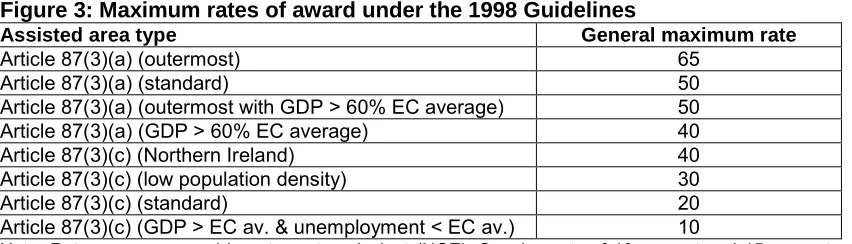
Figure 3: Maximum rates of award under the 1998 Guidelines
Assisted area type General maximum rate
Article 87(3)(a) (outermost) 65
Article 87(3)(a) (standard) 50
Article 87(3)(a) (outermost with GDP > 60% EC average) 50 Article 87(3)(a) (GDP > 60% EC average) 40
Article 87(3)(c) (Northern Ireland) 40
Article 87(3)(c) (low population density) 30
Article 87(3)(c) (standard) 20
Article 87(3)(c) (GDP > EC av. & unemployment < EC av.) 10
Note: Rates are expressed in net grant-equivalent (NGE). Supplements of 10 percent and 15 percent gross for small and medium-sized enterprises apply on top of these ceilings, except, it transpired, in the case of the sparsely-populated regions.
Source:Drawn up on the basis of the text of the Regional Aid Guidelines, point 4.8.
The second reason for the emergence of national concerns at the impact of competition policy on regional aid values was the introduction of the first Multisectoral Framework in 1998, now superseded by the 2002 Multisectoral Framework (see Section 2.3 above). These rules concern aid to particularly large projects and have the capacity to reduce award values to a level at which, some would argue, aid loses its incentive effect and windfall gains may be increased.
In responding to the consultation, the Irish authorities argued that aid intensities should not be reduced, but rather maintained at a level at which they could be effective. The German authorities suggested a significant reduction in award maxima across the board in both the Article 87(3)(c) and the Article 87(3)(a) regions. In parallel, they argued that, given these much lower aid intensities, the Multisectoral Frameworks should be abolished in order to avoid award values being reduced to a level at which they have no effect on investment decisions.
Austria expressed concern at the differential in maximum aid intensities between the Austrian border regions and neighbouring regions in the new Member States. Similarly, the Swedish submission argued that the aid differentials between Article 87(3)(a) and (c) regions be reduced.
A fundamental issue raised in the French response concerned the ‘decoupling’ of regional aid and SME aid ceilings; in other words, the argument that the regional aid map should not determine the ceilings for SME aid. Instead, an award matrix for SMEs was proposed with rates differing depending on whether firms are located in designated rural areas, the PAT (prime d’aménagement du territoire, regional policy grant) map and or the Objective 2 map.
interest of legal certainty with Spain specifically suggesting that land be excluded from the calculation of eligible investment.
3.1.6 Relationship with the Structural Fund areas
Under the 1998 Guidelines, the emphasis on coherence between the national and the EU assisted areas resulted in an important derogation from the general rules on area designation for Article 87(3)(c). This enabled Objective 2 areas to be proposed as part of the Article 87(3)(c) map without needing to comply with the single building block requirement. In practice, only Italy used this derogation in its initial map proposal (and this proposal was rejected on the grounds that the Objective 2 map had not been decided); moreover, in Germany, recourse to this provision in order to enable parts of labour market areas to be designated was not accepted by the Commission. Elsewhere, however, it was to become an important device in diffusing sometimes difficult disputes between DG Competition and national policymakers; the main motivation for national policymakers lay not in the principle of coherence but rather in securing approval for national assisted area proposals.
As to the future relationship between national and EU regional policies, the German authorities expressed the view that the State aid rules should be developed separately from the rules on the Structural Funds and that eligibility for national regional aid should not be dependent on eligibility for the Structural Funds. Similarly, the Austrian submission proposed a decoupling of national and EU assisted area maps. The UK also argued that the two policies be targeted separately, reflecting the broader UK position that EU cohesion policy be focused on the poorest Member States. The French position paper did not address the role of the Structural Funds derogation directly (and France benefited from this considerably in the 1999-2000 negotiations) but argued that the national (PAT) and Structural Funds maps should be different since their policy objectives are not the same. However, the French authorities also argued that, for rural Objective 2 areas outside the PAT map, SMEs should qualify for a higher rate of award than that indicated under the SME aid guidelines.
3.2 Community Perspectives: the Genesis of a Reform
The main lines of DG Competition thinking became apparent during the course of 2003, although its stance was not confirmed until the publication of the Third Cohesion Report and the Working Paper sent to the Member States in May 2004.
expressed by Philip Lowe (Director-General of DG Competition) in a paper given in June 2003;19 this outlined two “provisional scenarios”.
The first scenario would involve limiting regional aid map coverage to Article 87(3)(a) areas (those regions with per capita GDP below 75 percent of the EU25 average) and to “earmarked” Article 87(3)(c) regions (those losing Article 87(3)(a) status because of the statistical effect of enlargement or rising GDP, areas with low population density and outermost regions). Coverage would amount to around 34 percent of the EU25 population. Investment aid to large firms would not be allowed outside the regional aid maps.
The second scenario would build on a simplification of the current approach. In addition to the Article 87(3)(a) and “earmarked” Article 87(3)(c) regions, further Article 87(3)(c) areas could be designated, subject to an overall ceiling of 50 percent of the EU25 population. These would be designated on the basis of a simplified version of the 1998 Regional Aid Guidelines, the only restriction being that a minimum size of geographical unit be used in drawing up the maps.
Philip Lowe argued that the first scenario would be simpler and best satisfy the considerations and constraints on DG Competition’s agenda, namely, the objective of less and better State aid, the need to reconcile the reduction of State aid volumes with the aim of economic and social cohesion, the modernisation and simplification of the rules and the experience with the 1998 Regional Aid Guidelines.
It was hardly surprising, perhaps, that this view held sway in the Third Cohesion Report. This stated that the consistency between cohesion and competition policies was “a key question” and went on to outline the main principles: that Article 87(3)(a) should apply to regions with GDP per head below 75 percent of the EU average; that regions impacted by the “statistical effect” of enlargement be eligible under Article 87(3)(c) with award values to decline over the period to 2013; and that outermost regions outside the new Convergence Objective benefit from a specific transitional State aid regime.20
3.3 DG Competition ‘Working Paper’ on Regional Aid Guidelines
The Working Paper on the review of the Regional Aid Guidelines sets out DG Competition’s current thinking on the reform of regional aid control post-2006.21 The
paper states that it draws on the comments submitted by the Member States in response to its earlier consultation, as well as taking account of the literature on the economics and effectiveness of aid, including two preparatory studies commissioned for the review,22 the conclusions of recent Council meetings and its own experience
with the 1998 Guidelines. However, the future form of regional aid control is unclear: the paper indicates that the Commission does not propose to present a complete draft of the new Regional Aid Guidelines at this stage; at the same time, there is
19 Philip Lowe (2003) “State aids and Cohesion Policy”, Paper to Sub Rosa strategic discussion
Regional Policy after 2006: co-operation, co-existence or conflict, University Club, Brussels, 13 June
2003; available at: <http://europa.eu.int/comm/competition/speeches/text/sp2003_061_en.pdf>
20 Third Cohesion Report, pp xxxiii-xxxiv. 21
Review of the Regional Aid Guidelines – a first consultation paper for the experts in the Member States, available at: <http://europa.eu.int/comm/competition/state_aid/regional/>
22 Ibex consultants Ltd,
Review of Community guidelines for national regional aid, final report to DG
mention of the possibility of a regional aid block exemption regulation being adopted in the future. Member States are asked to submit their comments to the Working Paper by 1 July 2004. The key features of the proposals for future regional aid control are essentially threefold:
! that Article 87(3)(a) areas be defined on the basis of EU25 GDP(PPS) per head data, rather than EU15 averages;
! that Article 87(3)(c) coverage be limited to so-called “earmarked” regions, rather than based on national population quotas as at present; and,
! that aid ceilings across the board be reduced.
These features are reviewed briefly in turn.
3.3.1 Article 87(3)(a) criteria and coverage
As mentioned above, the main change with respect to Article 87(3)(a) is the move to EU25, rather than EU15 averages, reflecting enlargement to include 10 new Member States: the Working Paper proposes that the threshold for Article 87(3)(a) be 75 percent of EU25 GDP(PPS) per head.
As is well-known, the main effect of this is to lower the limit for Article 87(3)(a) status thereby excluding a number of regions in EU15 from eligibility. This would mean that Article 87(3)(a) coverage in EU15 would fall from around 22 percent of the population to just over 14 percent; coverage in the 10 new Member States would be in excess of 92 percent (the exclusions are Prague, Bratislava, Budapest, Malta and Cyprus).
According to the Working Paper, under the new definition, and using data for 1999-2001, Article 87(3)(a) would cover 27.11 percent of the EU25 population.
3.3.2 Article 87(3)(c) criteria and coverage
For Article 87(3)(c), DG Competition proposes to replace the current system of “population quotas” with an approach based on so-called “earmarked” regions. The Working Paper proposes four such categories of region.
(i) “Statistical effect” regions
Hainaut fall within this category.23 Among the new Member States, Malta would also
be a statistical effect region.
According to the Working Paper, the statistical effect regions would cover 4.18 percent of the EU25 population.
(ii) Economic growth regions
A further group of regions would have ceased to qualify for Article 87(3)(a), even without enlargement, owing to a relative increase in levels of GDP per head. About half the population concerns two Spanish regions (Valencia and Castilla y León); Border, Midlands & Western (Ireland), Sardegna and South Yorkshire, among others, are also in this grouping.
According to the Working Paper, the economic growth regions account for 2.71 percent of the EU population.
(iii) Outermost regions
The Outermost regions are treated as a distinct category, reflecting the conclusions of the Third Cohesion Report and the provisions of Article 299 of the Treaty. In practice, most fall within Article 87(3)(a). However, GDP per head in Madeira and the Canaries would place these regions in the “economic growth” grouping. Like the Outermost regions that do fall within Article 87(3)(a), Outermost regions within Article 87(3)(c) may benefit from operating aid.
According to the Working Paper, the Outermost regions covered by Article 87(3)(c) account for 0.43 percent of the population.
(iv) Low population density areas
The Working Paper proposes to continue to make special provision for regions of low population density, using the same definition as at present, this being NUTS III regions with a population density of less than 12.5 inhabitants per km2. The Working
Paper notes that “transportation aid can continue as before” and proposes that for arctic areas suffering from continued depopulation, the Commission may authorise “other types of operating aid where such aid is necessary to stop depopulation”.
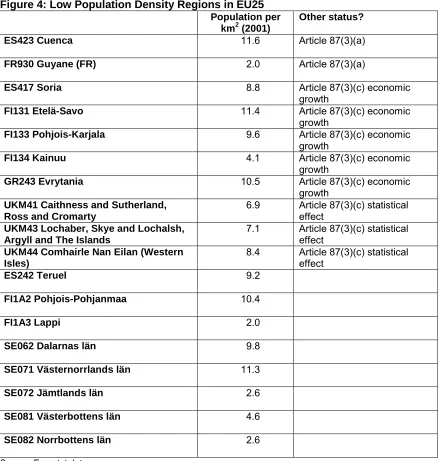
Although special provision for low population density regions was initially associated with the accession of the Nordic Member States to the EU, in practice, small parts of Greece, Spain and the UK also meet the criterion (see Figure 4). For the most part, these other regions are covered either by Article 87(3)(a) or fall into one of the other earmarked Article 87(3)(c) categories. As a result, all of the low population density regions, with the exception of Teruel in Spain, are in Finland or Sweden.24
According to the Working Paper, the low population density areas cover 0.41 percent of the EU population.
23 According to the data published in the Third Cohesion Report, the UK region of Tees Valley and
Durham would also qualify as a statistical effect region. However, “non-provisional” data for the same period suggests that it would not.
24 The Third Cohesion Report refers to sparsely-populated areas in the “far north”, but there is no such
Figure 4: Low Population Density Regions in EU25 Population per
km2 (2001)
Other status?
ES423 Cuenca 11.6 Article 87(3)(a)
FR930 Guyane (FR) 2.0 Article 87(3)(a)
ES417 Soria 8.8 Article 87(3)(c) economic
growth
FI131 Etelä-Savo 11.4 Article 87(3)(c) economic
growth
FI133 Pohjois-Karjala 9.6 Article 87(3)(c) economic
growth
FI134 Kainuu 4.1 Article 87(3)(c) economic
growth
GR243 Evrytania 10.5 Article 87(3)(c) economic growth
UKM41 Caithness and Sutherland, Ross and Cromarty
6.9 Article 87(3)(c) statistical effect
UKM43 Lochaber, Skye and Lochalsh, Argyll and The Islands
7.1 Article 87(3)(c) statistical effect
UKM44 Comhairle Nan Eilan (Western Isles)
8.4 Article 87(3)(c) statistical effect
ES242 Teruel 9.2
FI1A2 Pohjois-Pohjanmaa 10.4
FI1A3 Lappi 2.0
SE062 Dalarnas län 9.8
SE071 Västernorrlands län 11.3
SE072 Jämtlands län 2.6
SE081 Västerbottens län 4.6
SE082 Norrbottens län 2.6
Source: Eurostat data.
3.3.3 Award rates and ceilings
An important element of the Working Paper is the proposal to reduce rates of award across the board, (except for SMEs, where the Commission intends to raise the ceilings). This is achieved through the combined effects of reductions in nominal award values and the setting of rates of award in gross rather than net terms. In addition, in the statistical effect regions, rates of award would fall over the 2006-13 period, reflecting the phasing-out of eligibility for Article 87(3)(c) over the longer term.
Figure 5: Rates of Award post 2006? (gross grant equivalents)
Large Medium Small
Article 87(3)(a) < 50% GDP 50 60 70
Outermost Article 87(3)(a) < 60% GDP 50 60 70
Article 87(3)(a) < 60% GDP 40 50 60
Outermost Article 87(3)(a) < 75% GDP 40 50 60
Article 87(3)(a) < 75% GDP 30 40 50
Outermost Article 87(3)(c) statistical effect 40 → 30 50 → 40 60 → 50
Article 87(3)(c) statistical effect 30 → 20 40 → 30 50 → 40
Other Article 87(3)(c) (low population density; economic growth)
20 30 40
Non-assisted 0 10 20
Source:Regional Aid Working Paper.
3.3.4 Other proposals / issues
Several other issues are raised by the Working Paper. Regarding regional aid specifically, there is reference to the definition of eligible investment and especially the treatment of land and intangible investment. There is also the suggestion that the definition of initial investment be clarified.
More generally, it is proposed to increase rates of award for small and medium-sized enterprises in the non-assisted areas from 15 percent and 7.5 percent gross to 20 percent and 10 percent respectively (as illustrated in Figure 5). In addition, as mentioned earlier, the Commission sees the current period as a ‘window of opportunity’ for reviewing many of the existing State aid frameworks.
3.3.5 Observations
Overall, the Working Paper represents a very significant shift in the rules governing regional aid. There are both sharp cutbacks in coverage, most of which are borne by the EU15 Member States, and significant reductions in award values for those regions that will be eligible. As Figure 6 shows, the implication of the proposals for the EU15 is a cutback in assisted area coverage of 20 percentage points compared to the current position (43 percent to just over 23 percent). There are a number of more specific points to be made about the outcomes presented in Figure 6.
First, there are some small discrepancies between the coverage resulting from calculations based on the latest Eurostat data and that presented in the DG COMP Working Paper. These principally concern the figures for Article 87(3)(a) and the Article 87(3)(c) statistical effect regions. It seems probable that the difference in the statistical effect coverage is mainly accounted for by the UK regions and Tees Valley and Durham; data presented in the Third Cohesion Report suggests that GDP per head in the region for the latest three years is 75 percent of the EU15 average, although more recent data puts the figures higher. The region contains 0.25 percent of the EU25 population. The remaining (very small) differences may be accounted for by the treatment of Ceuta and Melilla for which up-to-date information is not available.
Third, some observations are worth making about the new Member States. There is some uncertainty surrounding the existence and status of an assisted area map for Hungary. Although the whole country is designated as Objective 1 for the 2004-6, there does not appear to be a corresponding regional aid map approved under Article 87(3)(a) and (c). In consequence, the region of Budapest (which would otherwise have been an Article 87(3)(c) economic growth region) is excluded from eligibility. This has some implications for coherence with the Structural Funds assisted areas since the region appears to be classified as a “phasing-in” region for cohesion policy purposes. As single region countries, Cyprus and Malta are in somewhat anomalous positions with respect to the relationship between EU competition and cohesion policies. Both countries would, on the basis of current data, qualify for the Cohesion Fund (which is based on GNI(PPS) per head at the national level) but neither would gain either Article 87(3)(a) or Convergence status, which is based on GDP(PPS) per head at NUTS II, in spite of the fact that they are single region countries. Last, it is worth noting that the NUTS II boundaries of Slovenia (also a single region country at the moment) are currently being negotiated with Eurostat; it seems probable that, unless the country is divided into more than one NUTS II regions, the whole territory would cease to qualify under Article 87(3)(a) post-2006.
Figure 6: Assisted Area Coverage Post-2006 (% of population)
Coverage post 2006? Coverage 2000-6 (EU15)
Pop (2001)
000s
Article 87(3)(a)
Stat Effect
Outer-most Econ growth Sparse pop
Article 87(3)(c)
Total Article
87(3)(a) Article 87(3)(c)
Total
EU25 (DG COMP) 27.11 4.18 0.43 2.71 0.41 7.73 34.84
EU25 454325.9 27.08 3.96 0.44 2.71 0.41 7.51 34.59
EU15 304512.7 14.22 4.64 0.52 3.24 0.49 8.89 23.11 21.9 21.1 43.0
NMS10 149813.3 92.39 0.53 0.00 0.00 0.00 0.53 92.91
Austria 8031.6 0.00 0.00 0.00 3.45 0.00 3.45 3.45 3.5 24.1 27.6
Belgium 10286.6 0.00 16.79 0.00 0.00 0.00 16.79 16.79 0.0 30.9 30.9
Germany 82340.3 10.59 6.16 0.00 0.00 0.00 6.16 16.75 17.2 17.7 34.9
Denmark 5355.1 0.00 0.00 0.00 0.00 0.00 0.00 0.00 0.0 17.1 17.1
Spain 40265.5 31.83 5.80 4.31 16.29 0.34 26.74 58.57 58.4 20.8 79.2
Finland 5188.0 0.00 0.00 0.00 13.08 10.74 23.82 23.82 13.4 28.9 42.3
France 60916.6 2.83 0.00 0.00 0.00 0.00 0.00 2.83 2.8 33.9 36.7
Greece 10937.7 56.50 35.69 0.00 7.81 0.00 43.50 100.00 100.0 0.0 100.0
Ireland 3838.9 0.00 0.00 0.00 26.36 0.00 26.36 26.36 26.6 73.4 100.0
Italy 57926.1 29.32 1.04 0.00 2.84 0.00 3.88 33.20 33.6 10.0 43.6
Luxembourg 442.0 0.00 0.00 0.00 0.00 0.00 0.00 0.00 0.0 32.0 32.0
Netherlands 16046.2 0.00 0.00 0.00 0.00 0.00 0.00 0.00 0.0 15.0 15.0
Portugal 10299.2 68.51 3.82 2.37 0.00 0.00 6.20 74.71 66.6 33.4 100.0
Sweden 8896.0 0.00 0.00 0.00 0.00 13.08 13.08 13.08 0.0 15.9 15.9
United Kingdom 58836.7 0.85 6.09 0.00 2.15 0.00 8.24 9.10 8.6 22.1 30.7
Cyprus 701.5 0.00 0.00 0.00 0.00 0.00 0.00 0.00
Czech Republic 10224.2 88.61 0.00 0.00 0.00 0.00 0.00 88.61
Estonia 1364.1 100.00 0.00 0.00 0.00 0.00 0.00 100.00
Hungary 10187.6 72.22 0.00 0.00 0.00 0.00 0.00 72.22
Lithuania 3481.3 100.00 0.00 0.00 0.00 0.00 0.00 100.00
Latvia 2355 100.00 0.00 0.00 0.00 0.00 0.00 100.00
Malta 393 0.00 100.00 0.00 0.00 0.00 100.00 100.00
Poland 38641 100.00 0.00 0.00 0.00 0.00 0.00 100.00
Slovenia 1992 100.00 0.00 0.00 0.00 0.00 0.00 100.00
Slovak Republic 5379.8 88.86 0.00 0.00 0.00 0.00 0.00 88.86
Aside from questions related to spatial coverage, some wider issues emerge. At a country level, within EU15, the proposals virtually eliminate the possibility of conducting “traditional” regional policy in many Member States: this is the case, for example, for France and the Netherlands, where there would be no Article 87(3)(c) areas. Even in countries with some coverage, such as the UK, Austria and Germany, Article 87(3)(c) areas are, like Article 87(3)(a) areas, designated on a top-down basis, rather than by national policymakers, and may only partially correspond to nationally-determined needs and priorities. As a matter of principle, one might question whether it is legitimate for EU competition policy to dictate the substance and targeting of national regional policy in this way.
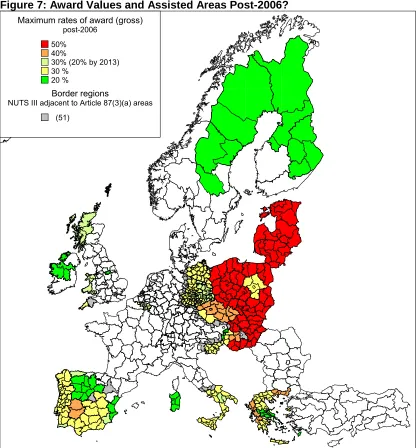
[image:29.595.90.507.300.748.2]Across the EU as whole the proposals involve significant differences in maximum award values. Of particular importance, the effective absence of Article 87(3)(c) designation means there are often no ‘intermediate’ zones between Article 87(3)(a) and non-assisted areas. This ‘border effect’ impacts on over 50 NUTS III regions; moreover, some non-assisted areas border Article 87(3)(a) regions across a national frontier – notably in Austria, Germany and Italy.
Figure 7: Award Values and Assisted Areas Post-2006? Maximum rates of award (gross)
post-2006
50% 40%
30% (20% by 2013) 30 %
20 %
Border regions
NUTS III adjacent to Article 87(3)(a) areas
(51)
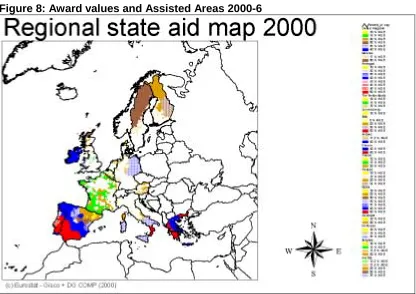
Figure 8: Award values and Assisted Areas 2000-6
Source:DG Competition.
There is also the question of whether such a dramatic reduction in assisted area coverage and award values might affect the competitiveness of the EU as a whole as a location for internationally-mobile investment. Financial incentives are seldom the key factor in location decisions, but they can be a deciding factor between locations offering broadly similar advantages. Some national policymakers, especially in countries where foreign direct investment is viewed as important, may be concerned at the loss of regional aid as a useful policy instrument in the competition for mobile projects.
At a practical level, there are some important issues for the Member States. Not the least of these is the fact that approval of the current regional aid maps expires at the end of 2006. This means that there is the risk of a policy vacuum if new Guidelines cannot be agreed in good time.
3.4 National Perspectives on the DG Competition Working Paper
As already noted, DG Competition sought comments from the Member States by 1 July 2004. Most EU15 Member States appear to have responded within that timeframe, with some, notably France and the United Kingdom, making their responses provisional pending the outcome of wider consultation.
In relation to the form of regional aid control, there is widespread support for the introduction of a block exemption regulation.25 However, Finland argues that this
should not cover aid to large firms and Germany that the possibility of individual notification should be retained. This presumably means that the Commission should
25 This is, in principle, provided for under Council Regulation (EC) No 994/98 of 7 May 1998 on the
still have some measure of discretion to approve aid in individual cases where the precise criteria of the block exemption notification are not met. Only the Netherlands is opposed to a regional aid block exemption regulation, favouring instead “strict, central and independent monitoring of State aid”.
Procedural issues aside, the remainder of this section focuses on the substantive matters raised by the Working Paper; the discussion that follows aims to synthesise the views of the EoRPA sponsoring countries, as expressed in their responses to DG Competition,26 in relation to assisted areas, award values and the relationship
between regional aid and other policies.
3.4.1 Assisted areas
As discussed, the main thrust of DG Competition’s proposals was to shift the criteria for Article 87(3)(a) onto a EU25 basis, thereby excluding most current Article 87(3)(a) areas in EU15 from eligibility and to limit the application of Article 87(3)(c) to certain ‘earmarked’ regions. The spectrum of responses from the Member States is wide. On the one hand, the Netherlands argued for an even tougher approach, suggesting that investment aid should only be allowed in the new Member States, with transitional arrangements for currently eligible regions in EU15. In contrast, as will be seen, many countries (Austria, France, Germany, Ireland and the United Kingdom) expressed concern at the loss of scope for national policy to target underperforming regions, with Ireland and the United Kingdom questioning the appropriateness of NUTS II as the effective building block for area designation. The remainder of this section discusses the various area designation issues raised in the national responses.
(i) Article 87(3)(a)
The change in criteria for Article 87(3)(a) designation pass largely unremarked by the national authorities. This doubtless partly reflects the widely-held expectation that the thresholds for Article 87(3)(a) would be adjusted post-enlargement, which had also been confirmed in the Third Cohesion Report and paralleled the approach taken to the new Convergence Objective. Instead, the focus for many policymakers had been on the status of regions losing Article 87(3)(a) eligibility and/or the future of Article 87(3)(c) regions.
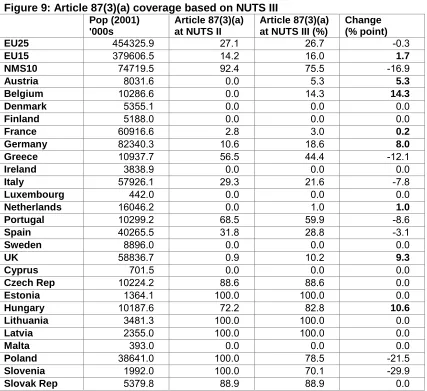
The United Kingdom is alone in making observations about Article 87(3)(a) designation criteria. Its initial response to DG Competition expresses concern at the use of NUTS level II arguing that this would “prevent aid being targeted at some of the least favoured areas of the EU, while other more relatively prosperous areas would benefit.” Instead, the UK proposes that Article 87(3)(a) be designated at NUTS III, this being the only alternative that would ensure a consistent approach across the EU.
The outcome of designating Article 87(3)(a) areas on this basis is illustrated in Figure 9. Direct comparisons between NUTS II and III are slightly complicated by some gaps in the availability of data. Nevertheless, while overall Article 87(3)(a) coverage would remain broadly similar, there would be an increase in Article 87(3)(a) coverage in EU15 (with Austria, Belgium, Germany and the UK being the chief beneficiaries,
26 National responses have kindly been provided by policymakers for the purposes of this study. They