Developing Definitions of
Local Authority Services
and Guidance for Future
Development of the
Children in Need Census
Research Report DCSF-RW033
Mike Gatehouse, Harriet Ward and Lisa Holmes
Centre for Child and Family Research
Developing Definitions of Local Authority
Services and Guidance for Future
Development of the Children in Need Census
Mike Gatehouse, Harriet Ward and Lisa Holmes
Centre for Child and Family Research
Loughborough University
The views expressed in this report are the authors’ and do not necessarily reflect those of the Department for Children, Schools and Families
© Loughborough University 2008
ISBN 978 1 84775 145 4 Research Report No
Contents
Introduction ... 3
Key findings ... 3
Other findings ... 4
Background... 6
The 2008-09 CIN Census ... 7
Methodology ... 8
CIN data in management information systems (MIS) ... 12
Children’s Social Care Management Information Systems ... 13
Other Service Provider Recording Systems... 19
Other sources of CIN Data ... 23
Paper records... 23
Free text data ... 23
Electronic case files & document management systems... 23
Financial records ... 23
ICS Exemplars ... 25
Resource Panel records ... 26
Additional services, definitions and data... 26
Definitions ... 27
Children with Disabilities... 28
Emotional Well-being... 29
Drug, Alcohol and Health Promotion... 30
Teenage Pregnancy and Sexual Health ... 31
Family Support ... 32
Early Years... 33
Independent Living, Employment and Transitions ... 34
Special Educational Need... 35
Alternative Educational Provision ... 37
Youth Justice... 38
Young Carers ... 39
Children in Need: some case histories ... 40
Concept and practice: discussion of key issues ... 42
What is a census? ... 42
Which children are ‘Children in Need’? ... 42
Access routes to services ... 43
What is a service? ... 45
Measuring ‘volume’ of service ... 48
Recommendations ... 51
References ... 53
Appendix A Additional services accessed by Children in Need and their definitions... 54
Appendix B Local Authority Visit MIS and Service Datasheets... 60
Appendix C Pilot Test Templates ... 69
Introduction
The Children in Need (CIN) Census aims to collect data on all children receiving support from Children’s Social Care Services, including children looked after (CLA), those supported in their families or independently (CSF/I) and children subject to a Child Protection Plan. The Census provides evidence on which the Department for Children, Schools and Families (DCSF) can develop policy, make Spending Review bids, allocate resources to Local Authorities, understand the growth in spending on children’s services and measure their output in the National Accounts.
The CIN Census was suspended after 2005 but is being reintroduced in 2008-09. The present research was commissioned to discover whether the scope of the Census could be extended after 2009 to include some of the numerous additional services used by Children in Need, including those provided by or in partnership with education, youth justice,
Connexions, health services and the voluntary sector.
This study therefore explored whether data on the delivery and use of such services is available, is recorded, can be accessed and could feasibly be systematically collected for the CIN Census. It examined not only the likely quality and completeness of such data, but the practical difficulties of extracting it from various management information systems (MIS) and the constraints of consent, confidentiality and data protection.
Key findings
1 This study identified and drew up working definitions for 11 additional services accessed by children in need:Children with Disabilities; Family Support; Early Years; Special Educational Need; Youth Justice;Emotional Wellbeing; Drug and Alcohol Services and Health Promotion; Teenage Pregnancy and Sexual Health; Independent Living, Employment and Transitions; Alternative Educational Provision; Young Carers. These definitions were agreed with the participating authorities and could be included in the guidance for the Children in Need (CIN) Census.We recommend that priority for inclusion in the CIN Census be given to the first five of the services listed(in bold, above).
The principal problem is not the definitions of the services as such, but the myriad different ways in which the services may be named, commissioned, paid for and delivered, even within the same authority, and hence the lack of uniform recording and storage of data. This finding closely mirrors that of the related Mapping Exercise, also undertaken by the Centre for Child and Family Research (CCFR) (Ward, et al., 2008 forthcoming).
Issues of consent and confidentiality will significantly impede most data collection from outside Children’s Social Care, but especially from health-related services such as CAMHS.
It will not be easy to collect uniform child-level census data on most additional services and it may be necessary to consider alternative ways of collecting data to explain expenditure on these services. Certain additional services (SEN, Youth Justice, Connexions) already provide Government with substantial data collections and, if
problems of consent and matching child identifiers can be resolved, it may be possible to extract data from these at national level rather than asking local authorities to collect the same data again for the CIN Census.
1
In many cases it will be possible to determine that a service was provided, but very difficult to obtain a meaningful, consistent and accurate measure of the volume of service provided and therefore of the cost incurred. This is especially true of the wide and
disparate range of services comprised by Family Support and Early Years, two areas where we believe that additional research may be necessary.
The census definition of ‘Children in Need’ may need to be revised, in line with the Children Act 1989, to include the increasing number of vulnerable children accessing additional services from local authorities without a formal referral to Children’s Social Care, sometimes as a result of assessment under the Common Assessment Framework (CAF). An even wider population of children access preventive services partly or wholly funded by Children’s Social Care. The question is: should these services and these children be included in the CIN Census?
The best data on services is available either from financial systems, or where there is a clear relationship between a service delivery and a payment (for instance with looked after placements, short-break care and direct payments for disabled children and Section 17 payments for children in need). In the management information systems (MIS) of Children’s Social Care, data on service use is very limited because the Integrated Children’s System (ICS) and other practice and recording systems do not establish a formal framework for recording servicedeliveries(as distinct from plans and reviews). Much data is recorded in free text fields from which it cannot feasibly be extracted for a Census.
Changes to the CIN Census after 2008-09 should be phased in gradually, giving time for consultation and for small-scale pilots to test the new provisions. Experience ofimplementing electronic data collections suggests that those which require changes to MIS require at least two years to implement.
Other findings
In the 2005 CIN Census the diary records provided a single, uniform data format for all records on service delivery. In the new Census, especially when additional services are added, data will need to be extracted from numerous different recording systems, each of which uses its own formats, classifications and identifiers, and the process of matching and compiling the data into uniform records is likely to be very onerous, while issues of consent, confidentiality and data protection will be more problematic. A similar challenge is being addressed in work by CCFR to extend the Cost Calculator for Children’s
Services, due to be completed in 2009.
It will be difficult to capture non-contact and non-child time associated with additional services, as well as time spent with whole families and with related adults. In the 2005 CIN Census these were partially captured by staff activity diaries. In future it may be possible to estimate them by using the Cost Calculator for Children’s Services2and other similar tools.
None of the field work authorities has made significant progress in integrating or even linking their children’s social care and education management information systems (MIS) and any plans to do this appeared to be at a very early stage. This was true also for links to MIS in CAMHS, Youth Justice and Connexions.
2
It was surprising that almost all local authorities and services rely on time-consuming manual methods to match child identifiers in different information systems. We found only one service (Connexions) which makes use of a software solution, perhaps because it was built into their MIS. For others the high cost of add-on software may be a deterrent.
ContactPoint should assist to some extent in identifying services accessed by each child, but it will not be fully deployed until Spring 2009, and it will not provide data on the detail and amount of service accessed.
Most local authorities will struggle to provide the Unique Pupil Number (UPN) of all school-age Children in Need which is required for the 2008-09 CIN Census.
The paucity of collectable data on service delivery does not mean that no information is being recorded. Much is still recorded on paper. Even where recording is electronic, most of the information is contained in free text fields and notes from which it cannot reliably be extracted other than by time-consuming reading and manual processes. In general, data held on paper or electronically in free-text form is not feasibly collectable for a CIN Census.
With the exception of statutory visits to looked after children and those subject to child protection procedures, visits by social workers and other staff to children and families are not at present consistently recorded and, where they are, generally only as free-text case notes. Thus visits and travel time and expense, which form a significant part of the cost of service delivery, cannot be captured reliably for the CIN Census.
Service deliveries should be picked up in the ICS Chronology but, in practice, they are recorded, if at all, in free text fields from which little useful data can be extracted. Some of the practical difficulties of collecting data can be judged by reading the sample case histories(see p.40).
In some local authorities, resource panels (often developed from looked after children placement panels) are being used to authorise packages of services for children in need. If the panel decisions are recorded electronically in a structured way, this offers a
promising means of collecting more accurate service usage data in future.
Background
The Children in Need (CIN) Census (DfES, 2000) was the first attempt to collect data on the numbers of children identified as being ‘in need’(see definition, p.42)and the services provided to them by local authorities. The census was repeated in 2001, 2003 and 2005 (DfES, 2005a) and provided quantifiable, cost-related data on the numbers and
characteristics of children in need, including those looked after away from home, and the services provided to them by local authorities.
However, the CIN Census was restricted to the collection of data on services provided or funded by local authority social services departments. Although it collected comprehensive data on social services activity and expenditure, it provided little quantified information on the exact type of services being received, a point raised by the Atkinson Review (2005, 11.62). Moreover, changes introduced by the Every Child Matters agenda and the Children Act 2004 have meant that the original data collected through the census no longer meets the needs of stakeholders. Children’s social services are now set within the broader structures of
children’s services departments; at least in theory, these have introduced greater integration of services, often underpinned by joint commissioning and shared funding arrangements. A new Census would need to take these issues into account and collect data not only on social services activity, but also on the activities of other children’s services such as education, youth justice and health, that now work together at both a general and a specialist level to promote the wellbeing of children in need.
In response to concerns about the burden of data collection laid on local authorities, the new Census is planned to utilise data already collected and held on electronic information
systems, rather than requiring special recording for census purposes. In particular, it was hoped that the marked improvements in these systems that have been noted in recent years (Ward, 2004) would render unnecessary the laborious completion of diaries of time spent by all staff working with children in need.
However, to date little has been known about the availability of such data, how items can be stored or retrieved, or the extent to which data held by one agency can be accessed by another. Before a new, extended CIN Census can be introduced it will be necessary to answer some of these questions. The Department for Children, Schools and Families therefore commissioned the present research from the Centre for Child and Family
Research, Loughborough University. The aims of the study include a ‘scoping exercise on data availability of some additional services and to look at how these are defined across local authorities’. The study was also to ‘provide guidance on how local authorities should adhere to these definitions when recording data to ensure consistency across LAs’.
The specific objectives were:
Development of definitions on additional children’s services not covered in the 2005 CIN Census;
Production of final definitions of these services and guidance on adhering to these definitions for inclusion in the new CIN collection from 2009/10;
Scoping the availability of child-level data from LAs for these additional services.
The study was limited to data about service use and was specifically exempted from
considering the scope and availability of financial data3and how the two types of data would
3
be combined to ‘account for all the resources being spent on children in need’ by each local authority (DCSF, 2008, p.3).
This study has benefited extensively from a further study undertaken in parallel by CCFR to map services to children in need (Ward, et al., 2008 forthcoming - hereafter referred to passim as the CCFR Mapping Exercise), as part of a wider project to develop and extend the Cost Calculator for Children’s Services. Services identified in the mapping exercise made up an initial set from which to select ‘additional services’ for the CIN Census, and the local authorities which participated in the fieldwork and the pilot testing in this study were mostly selected from those which participated in the mapping.
We are also indebted to the Durham University Children’s Mapping Pilot (Durham, 2007a - in this report termed the ‘Durham Mapping Pilot’), whose extensive list of services we
consulted and whose draft definitions we used as a basis for the wording of our own definitions of additional services.
The 2008-09 CIN Census
The Department for Children, Schools and Families (DCSF) has introduced a new CIN Census, to be run annually from 2008-09 and to collect data over the entire financial year from 1 April to 31 March. Exceptionally, to give local authorities more time to prepare, the first Census will cover only the six month period from 1 October 2008 to 31 March 2009. This first new census does not include most ‘additional services’ and will not be affected by the findings of the present study. However, it is necessary to consider the provisions of the 2008-09 Census in some detail, as they are likely to form the base upon which any additions made in subsequent census years will be built.
The main changes from the 2005 CIN Census, as outlined in the Guidance4(DCSF, 2008, p.4), are:
The change of scope from a census week (in 2005 and previously) to an entire financial year (apart from 2008-09);
Removal of data on finance and unit costs. Instead, CIN data will be used in conjunction with local authority finance returns to calculate unit costs;
Removal of the diary of staff time spent with children;
Inclusion of child movement in and out of ‘In Need’ and ‘Looked After’ status over the year, and ‘Protection Plan’ status at 31 March;
Inclusion of linking to the National Pupil Database (NPD) and SSDA903 return on Children Looked After; and
The CIN Primary Need Code will no longer capture the main current need during the Census period (a single week, under the old Census), but the ‘main reason why the child started to receive services’.
4
Methodology
Research was conducted in 9 local authorities in England, four of which participated in a pilot test for data collection. Interviews were conducted with some 50 key staff responsible for managing and commissioning children’s services5, performance information and
management information systems (MIS) deployment.
Selection of participating authorities
Local authorities were selected initially from the pool of sixteen which had already agreed to participate in the CCFR Mapping Exercise. In the event seven of these agreed to take part and a further two were recruited for special visits because they had experience of collecting information on specific services of interest to the study (SEN and CAMHS, respectively). Four of the nine authorities agreed to undertake additional work to pilot test collection of actual data on additional services (see Table 1).
Table 1 - The nine participating authorities
Description Visit Special
visit
Pilot Test
No of child cases in pilot
Shire Counties 1 1 1 *
Inner London Boroughs 2
Outer London Boroughs 1 1 19
Unitary Authority Inner City 2 1 20
Metropolitan Borough 1 1 1 11**
* Authority G had not been able to select cases prior to the pilot test, but child case records were explored as issues of service delivery were examined.
** Authority D had selected 20 cases, but a number of these were discarded as they were looked after children.
Identification of additional services
We had to define at the outset in what sense services are ‘additional’. We understood this to mean all those services other than those which are sometimes described as the ‘core’ or ‘acute’ services which were traditionally, and are still in most cases, provided directly by in-house teams in Children’s Social Care (CSC, previously Children’s Social Services). These acute services are: referral and assessment; child protection; accommodation of looked after children; and adoption. In line with the Children Act 1989 (Sections 17a and c), Children’s Social Care also provides services for family support, leaving care and for children with disabilities, although provision for children and young people who require these services is increasingly diverse. Children accessing this range of services were the subject of most of the data in the 2005 CIN Census. The CIN Census 2008-09 is likely to focus more strongly on children requiring services under Section 17a of the Children Act 1989, as it will be collated with data from the SSDA903 return for looked after children and will include data on all children subject to a Child Protection Plan6.
5
We did not speak directly to social workers
6
We therefore arrived at the following definition of ‘additional services’:
“Additional services for children in need are services provided by or with the financial or in-kind participation of a local authority, which wholly or in part target and are accessed by children in need for the purpose of helping them to achieve and maintain a reasonable standard of health or development.
“Such services are ‘additional’ in that they are distinct from and in addition to the key services of looking after, child protection, adoption and those family support and disabled children’s and care leavers’ services normally provided by children’s social care.
“Include all such services...
provided directly by children’s social care (e.g. by disability teams);
commissioned by and wholly or in part paid for by the local authority;
to which the local authority makes a financial contribution;
to which the local authority contributes by secondment or co-location of staff;
provided by multi-agency arrangements or partnerships in which the local authority participates and to which it makes a financial or in-kind contribution.”
There is some overlap in the areas of family support and services for children with
disabilities and care leavers. These were already included in the 2005 CIN Census, at least when they were provided directly by Children’s Social Care. As we have already suggested, however, these services are now being provided in more diverse ways and in some cases to children who may not have had a formal referral to Children’s Social Care and will therefore not be counted as Children in Need for the purposes of the 2008-09 census.
A number of additional services were named as examples in the research specification. We initially proposed to begin with a wider set of services identified in the CCFR Mapping Exercise. However, that project had found much greater than expected volume and
complexity of services: in one authority over 150 services were identified (Ward et al., 2008 forthcoming). It became clear from our first fieldwork visit that asking questions about availability of data for the CIN Census in all the services identified was impossible given the time and resources at our disposal. At the same time, the Mapping Exercise was working on a set of ‘core services’, defined as ‘those most frequently cited and taking up the highest proportion of the [local authority children’s social care] budget’.
At an early stage in the research, therefore, we drew up ‘a priori’ a list of additional services, based on the examples given in the research specification, the services identified in the Durham Mapping Pilot (Durham, 2007a) and the list of core services emerging in the CCFR Mapping Exercise. The following services were identified:
Children with Disabilities;
Emotional Wellbeing;
Drug and Alcohol Services and Health Promotion;
Teenage Pregnancy and Sexual Health;
Family Support and Early Years;
Independent Living, Employment and Transitions;
Special Educational Need;
Alternative Educational Provision;
Youth Justice; and
The set of services and the definitions we adopted focus on the function and purpose of the service rather than on the specific mode of its delivery. This accounts for some of the differences between our definitions and those in the Durham Mapping Pilot.
The list was validated in the field research, requiring only minor modifications: Early Years was separated from the rest of Family Support and changes were made to the definition of Short-break Care for Children with Disabilities.
The 11 services thus identified correspond closely, but are not identical to those identified as ‘Core Services’ in the CCFR Mapping Exercise. The parameters for selection and grouping of services differ in the following respects:
The present study does not group services by Every Child Matters outcome since, whatever the desirability of doing so in other contexts, no such grouping yet
characterises either the functional organisation of services, or the collection and storage of their data;
The Mapping Exercise does not make the same distinction between ‘acute’ and ‘additional’ services;
The present study was not required to collect financial data and therefore did not attempt to rank services according to the proportion of the children’s social care budget they consume.
This list of 11 additional services, together with their definitions, and Durham and CCFR Mapping Exercise equivalents is given inAppendix A. The availability of data for each of these services and issues concerning its collection, together with definitions and suggested guidance, is discussed fully below(see p.26).
For each additional service the research sought to determine: how is child-level data recorded and stored? Does the data indicate the volume and frequency of service access, which can then be related to cost? Can data held in different database systems be collated? Is it feasible to collect this data for a future CIN Census? If not, what are the barriers?
The Fieldwork Visits
Fieldwork with the 9 authorities consisted of a visit, structured interviews with staff involved in service and information management and follow-up work by post and telephone, using questionnaire-style ‘datasheets’ to collect details of the recording, storage and availability of child-level data in each of the additional services7.
The visit used a list of additional services plus two datasheets as a basis for discussion and follow-up work (see Appendix B). The first was designed to discover details of the data recorded in the main Children’s Social Care MIS. Where possible, we asked authorities to arrange a meeting with:
a manager with knowledge of or commissioning role for the wide range of services to children in need;
the officer responsible for compiling statistical returns to government (who was
responsible for the 2005 CIN Census or will be responsible for the 2008-09 Census); and
an officer with knowledge of the main MIS for children's social care (for instance, Swift or Carefirst)
7
We additionally asked to meet, where possible, with officers responsible for Disability Services, SEN and Family Support and suggested that after the main meeting, separate interviews be arranged with staff in specific additional services.
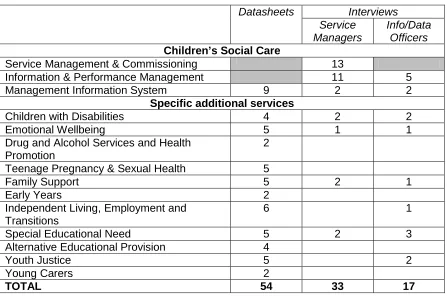
[image:12.595.67.514.225.521.2]Following the visit, the MIS datasheet was completed and submitted for checking to the lead officer in the local authority. Service datasheets were left for completion by the relevant officers and were sent subsequently to the research team. While not all the datasheets were completed, the response rate was good. Table 2 summarises the datasheets completed for the project as a whole, and the numbers of service managers, and information/data officers interviewed during the fieldwork visits.
Table 2 - Fieldwork Datasheets & Interviews
Interviews Datasheets
Service Managers
Info/Data Officers Children’s Social Care
Service Management & Commissioning 13
Information & Performance Management 11 5
Management Information System 9 2 2
Specific additional services
Children with Disabilities 4 2 2
Emotional Wellbeing 5 1 1
Drug and Alcohol Services and Health Promotion
2
Teenage Pregnancy & Sexual Health 5
Family Support 5 2 1
Early Years 2
Independent Living, Employment and Transitions
6 1
Special Educational Need 5 2 3
Alternative Educational Provision 4
Youth Justice 5 2
Young Carers 2
TOTAL 54 33 17
The project workshop
The pilot tests
Four authorities agreed to participate in the pilot test and were visited a second time. The methodology used required the selection of a small number of cases of children in need, an attempt to identify the services they had accessed during a given time period and
examination of the source, quality and accessibility of the data on their service use. The pilot authorities were asked to choose up to 20 children8who had been open cases to children’s social care for at least part of a recent 6-month period (and hence, would be children in need under the present CIN Census definition), and were neither looked after, nor child protection cases. We excluded children with child protection plans because, although these children also access additional services, their cases tend to be more fully documented than those of other children in need.
The plan was then to examine the data on each of the sample children available in the main Children’s Social Care management information system, compile as much evidence as possible from this source on the services they had accessed and then examine, separately, the information available from other sources: resource panel records; financial systems; and the separate recording systems, databases and MIS of the various additional services.
Priority was given to those services which had scored highest in the straw poll conducted at the Loughborough workshop. These were: Youth Justice, SEN, Children with Disabilities, Independent Living and Transitions, Alternative Educational Provision, Early Years and Family Support. The last two were included, despite low collectability scores, because of their general importance and complexity.
It rapidly became apparent that an exhaustive exploration of even 20 cases would have involved a far greater expenditure of time both by CCFR researchers and local authority staff than was feasibly available. Staff in one pilot authority spent 17.5 hours just on a preliminary trawl of case records of 19 children in their main Children’s Social Care MIS. To have repeated this exercise in each of the additional services and in the numerous different information systems each employs, would have vastly increased the time spent. However, exploration of the first few cases in each authority quickly revealed issues which were common to some or all of the services and were repeated in the other local authorities. Two templates used for collecting the information are included in Appendix C. The number of cases selected is given in Table 1(p. 8)
CIN data in management information systems (MIS)
Note:Throughout this section, the initials CSC are frequently used to stand for Children’s Social Care and MIS for management information system.
In the 2005 CIN Census the primary source of data on service deliveries was the special staff diary records. These records included contact, non-contact and non-child time(see the discussion of time recording below, p.46 ).Although the recording and collection was very onerous, diary records had one significant advantage: they were simple and uniform and, once problems of child identifiers were resolved, required no special processing, whatever the service or provider.
8
The new CIN Census eschews diary records and relies on existing records in MIS. Our research has highlighted a number of obstacles to this method of collecting data on the use of additional services by children in need:
The main MIS in Children’s Social Care at present contain very little consistent and collectable data on service use;
Most of the data on service use is contained in free-text notes;
Each additional service may have its own, separate MIS, database, spreadsheets, electronic and paper registers and lists, with distinctive data formats and child identifiers. Therefore a good deal of work, different procedures and software will be necessary to extract the data for each service and recode it in a uniform format for CIN Census collection;
Issues of consent, confidentiality and data protection may make it harder to obtain data from other providers than was the case with the staff diary records in the 2005 CIN Census; and
Other means will have to be found for estimating case management, non-contact and non-child time, without which it will not be possible to account accurately for expenditure on services. One promising approach is to use data on standard process and activity times and unit costing tools such as the Cost Calculator for Children’s Services(See discussion below, p.46)
We will examine in detail the potential for extracting CIN Census data from the main MIS in use in Children’s Social Care in the participating local authorities, and then consider briefly what we were able to learn or observe about some of the principal MIS in use in other service providers: Education, Youth Justice, CAMHS and Connexions.
Children’s Social Care Management Information Systems
The principal source of data for the CIN Census is the MIS used by Children’s Social Care. A considerable number of different software systems are in use, both those systems provided by commercial software developers and those developed in-house by local authority IT staff. Most such systems seek to be compliant, either directly or by means of add-on modules, with the Integrated Children’s System and its underlying data model. ICS implementation is comparatively new in all authorities9, and in the local authorities we visited it was clear that it is not yet being used to its full potential either in the recording or the retrieval of information. However, as noted above(p.25), it does not appear that, even when fully implemented, the ICS will solve the problem of recording deliveries of additional services in a form from which CIN Census data could easily be extracted.
Only one of the nine local authorities visited comes close to being able to retrieve systematic data on use of additional services from its main MIS. This authority has a highly formal system of resource panel approval for most services, uses a coded list of services and is fairly systematic in its use of service deliveries recording in CareFirst, its main MIS. Even here, however, although CareFirst supplies a calendar form on which the number, frequency and duration of session-based services can be recorded, when we looked at the sample child cases, the recording of such details was largely absent.
To understand how data is currently recorded on additional services, it is helpful to read some sample case histories(see below, p.40).
9
The MIS in use in the fieldwork authorities are shown in the table below:
Table 3 - Children's Social Care MIS in use in the fieldwork local authorities
Local Authority
CSC MIS Notes
A PARIS Only implemented Nov 2006 B In-house +
ShareCare for ICS
20-year-old in-house system due for replacement soon. Not linked to ShareCare.
C Framework-I D CareFirst E Framework-I F CareFirst + Recall
(document management) + CareAssess + CarePay
Fully electronic case files with all documents attached and managed via Recall
Payments for LAC placements, leaving care and S24 managed in CarePay. Not clear whether S17 payments also managed in this way.
G CareFirst Only implemented Nov 2007 H SWIFT + Anite ICS
I Protocol Recent implementation, replacing CareFirst. Children only (not adults). No built-in payments. No document management.
Our research into the MIS in the nine fieldwork authorities can be summarised in the following key issues:
1. Identifying Children in Need
All the MIS can return a list of children who meet the criteria for inclusion in the CIN Census for 2008-09 - being, at some time during the census period, cases open to Children’s Social Care. However, there may be some variation in the way different authorities and MIS define an open case. This could mean that some of the special categories enumerated in the 2008-09 CIN Census Guidance (DCSF, 2008: p.2) are not treated as open cases, for example:
children receiving some provision via adult teams (for example, young people with disabilities who are in transition to adult services; and young carers);
disabled children whose names are on the disability register, who receive information but no other specific service from the local authority. In Authority G, for instance, the
disability register is not held on the main MIS and parents can withhold consent for their child’s name to be added to the CSC MIS(see discussion at p.20). However, all families with children on the register receive a newsletter and should therefore be counted for the CIN Census (DCSF, 2008, p.2).
2. Identifying other children who access additional services
3. Identifying professionals associated with child
Most of the CSC MIS have a section of the child’s record where relationships or other professional contacts can be entered. If these are recorded and updated consistently they should provide strong evidence that a child is accessing particular types of service
(especially CAMHS, some SEN, Connexions and Youth Justice). Similar hopes are expressed for ContactPoint, once it is implemented10. However, such records will give no specifics of the type or quantity of service accessed, nor of dates. A CAMHS manager in Authority A told us that they will not add a child’s details to ContactPoint if the parents withhold consent.
4. Key categories of child
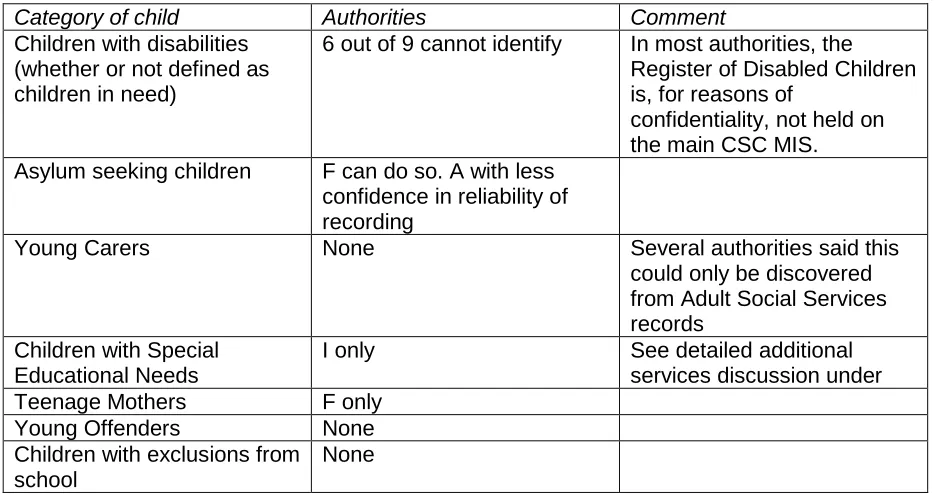
[image:16.595.65.536.337.584.2]Certain categories of children are likely to receive particular additional services. We asked whether these can be identified from simple type or status fields in the main CSC MIS. The answer, in most cases, was that they cannot - either the fields do not exist or the data is not routinely recorded and updated.
Table 4 - Key Categories of Children
Category of child Authorities Comment
Children with disabilities (whether or not defined as children in need)
6 out of 9 cannot identify In most authorities, the Register of Disabled Children is, for reasons of
confidentiality, not held on the main CSC MIS. Asylum seeking children F can do so. A with less
confidence in reliability of recording
Young Carers None Several authorities said this could only be discovered from Adult Social Services records
Children with Special Educational Needs
I only See detailed additional services discussion under Teenage Mothers F only
Young Offenders None Children with exclusions from
school
None
Note: some children in these categories may of course be identifiable in other ways, by reading Case Notes, noting team assignment or school type, examining Contact and other records and by recourse to other MIS, databases and lists. But they cannot be identified consistently and easily within the MIS of Children’s Social Care.
10
5. Availability to and use by staff outside the main offices of Children’s Social Care
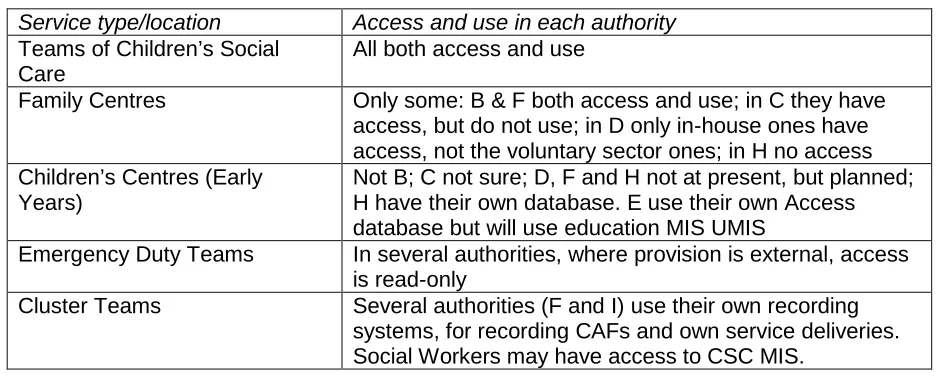
[image:17.595.63.535.175.364.2]We also asked local authorities whether their CSC MIS is accessible to and used by all of the relevant staff and service locations. If it is not, then some data on service use is likely to be missing. As the table shows, this is particularly problematic for Family Support and Early Years services.
Table 5 - Use of CSC MIS by additional services
Service type/location Access and use in each authority
Teams of Children’s Social Care
All both access and use
Family Centres Only some: B & F both access and use; in C they have access, but do not use; in D only in-house ones have access, not the voluntary sector ones; in H no access Children’s Centres (Early
Years)
Not B; C not sure; D, F and H not at present, but planned; H have their own database. E use their own Access database but will use education MIS UMIS
Emergency Duty Teams In several authorities, where provision is external, access is read-only
Cluster Teams Several authorities (F and I) use their own recording systems, for recording CAFs and own service deliveries. Social Workers may have access to CSC MIS.
Note:in multi-agency teams and service locations different staff will often have access to and use the recording system of their own employer. So, in a Cluster Team, the social workers may use the CSC MIS, education workers use the Education MIS, and the Team may have its own systems.
6. Links to and integration with other key MIS
We had expected to find some degree of linkage and integration between the main MIS involved in service delivery to Children in Need and, in particular, between the systems of Children’s Social Care and Education since, in all or most local authorities, these services are now under a single directorate. Such linkage would enable CIN Census data to be extracted directly from the other systems or at least would make it easy to resolve matching of child identities.
The research showed that none of the authorities has integrated systems. Only one, G, has some degree of linkage between its Children’s Social Care and Education MIS. In this authority, performance information staff for both departments sit side by side in a single office, but each accesses a different system. D has had some discussion about purchasing ‘middleware’ (software) to effect linkage, while G is considering setting up a ‘data
warehouse’ to pull together data from Children’s Social Care, Education, Connexions, Early Years and possibly Youth Justice. H commented that several suppliers of the main MIS software offer middleware products for system linking, but that these are prohibitively expensive.
7. UPNs
The key identifier in Education MIS is the Unique Pupil Number or UPN, essential to retrieve data on SEN, Alternative Educational Provision and some nursery provision. All the CSC MIS have a field for UPN, but in most authorities this is recorded only for looked after children and those with Child Protection Plans. Only Authority E currently records most UPNs, while Authority F is beginning to add them. Since the CIN Census 2008-09 requires the UPNs of all Children in Need of school age, all authorities will have to resolve this problem within the next 12 months. The process of adding UPNs is manual in all authorities except G, where there is a partial link with the education MIS for this purpose.
8. Coded list of services
The MIS cannot identify the services accessed by Children in Need unless there is a standard way of referring to each service, normally in the form of a set of codes or a drop-down list of available services. If services are described in free text, reference to them will not be standard and reliable data cannot be collected. We asked each authority whether they have created such a list. Authorities E, F, G and H have such lists(seeAppendix D -Examples of coded lists ofservices). Examination of the lists, however, shows that they tend to be very long. Any drop-down list containing more than 10 categories is unlikely to be used well by staff entering data on the computer.
9. CIN Primary Need code
For the CIN Census 2008-09, local authorities have to supply the CIN Primary Need Code for each child, to give the ‘main reason why a child started to receive services’. Only Authorities A, B and F currently record this on their CSC MIS for all open cases.
10. Common Assessment Framework (CAF)
A child who receives a CAF assessment may access some additional services without, or prior to a formal referral to Children’s Social Care. Cluster Teams(see p.43)and multi-agency teams undertaking preventive work, funded at least in part by Children’s Social Care, are increasingly using CAFs and may provide some services on the basis of a CAF.
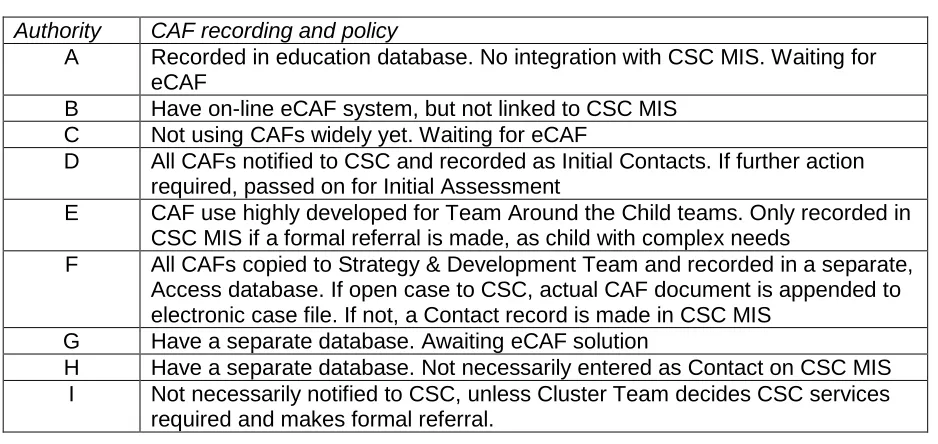
We therefore asked local authorities whether their CSC MIS have records for all children who have had CAFs and whether they show that a particular child has had a CAF. In most cases the answer was negative. Three authorities stated that they are awaiting an eCAF11 solution, but this may not solve the problem: Authority B has implemented eCAF, but not linked it to its CSC MIS.
11
Table 6 - Recording of CAFs
Authority CAF recording and policy
A Recorded in education database. No integration with CSC MIS. Waiting for eCAF
B Have on-line eCAF system, but not linked to CSC MIS C Not using CAFs widely yet. Waiting for eCAF
D All CAFs notified to CSC and recorded as Initial Contacts. If further action required, passed on for Initial Assessment
E CAF use highly developed for Team Around the Child teams. Only recorded in CSC MIS if a formal referral is made, as child with complex needs
F All CAFs copied to Strategy & Development Team and recorded in a separate, Access database. If open case to CSC, actual CAF document is appended to electronic case file. If not, a Contact record is made in CSC MIS
G Have a separate database. Awaiting eCAF solution
H Have a separate database. Not necessarily entered as Contact on CSC MIS I Not necessarily notified to CSC, unless Cluster Team decides CSC services
required and makes formal referral.
11. CIN Plans
Children in Need Plans are a potential source of information about additional services. We asked how these are recorded. In most cases, they are recorded only as free text, or with the services not itemised and described in free text. Not all authorities are completing Children in Need Plans. In Authority F, plans are being made by their cluster (Team Around the Child or TAC) teams and are not recorded in their CSC MIS. Authority H uses Anite-ICS for recording plans, which can itemise plans and identify services from a coded list.
However, social workers are not yet making use of this facility.
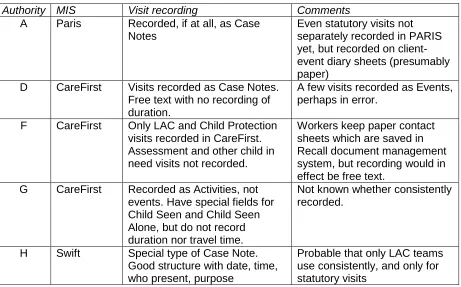
12. Visits
We asked how visits to the child or family are recorded, as these form a significant part of service delivery, especially for Family Support. In most authorities, visits, other than statutory ones to looked after children and those with child protection plans, are not systematically recorded. Most teams have paper client-event or diary sheets but these are not
subsequently entered into MIS. Authorities A and H record visits in Case Notes and in H’s SWIFT MIS there is a well structured record including time spent. Neither authority could give us any assurance that visits, other than statutory ones, are being recorded. G records visits as Activities, but only if they are part of an ICS process.
13. Service deliveries
Table 7 - Recording of Service Deliveries
Authority Type of record Details
A Case Note, not itemised
B None
C Free text
D Diary Note, free text
E None except for Aids &
Adaptations
All S17 expenditure approved by a Multi-Disciplinary Support Panel, but not currently recorded in Framework-I. No data on sessional services
F Service Elements in CareFirst
Resource Panel Agreement forms are processed by Admin staff and details recorded in CareFirst Service Elements. Also recorded in separate spreadsheet tracked by finance. However, dates and sessions are in free text only. Calendar records available in CareFirst but are often not completed. Not sure if S17 payments are recorded in CareFirst and paid via CarePay
G Interventions in CareFirst
When agreed by Panel, a Service Agreement is recorded in CareFirst and linked to the Intervention. Calendar can be completed to record session length and frequency. Implementation of system is very new, so it is too early to tell how consistently it will be used. However amounts such as S17 payments are often entered as single
amount (e.g. vouchers for groceries and gas and electric) with recurrence not quantified, or only in an attached case note. It may be possible to retrieve exact figures from Oracle-based finance system which will, eventually, be linked to CareFirst.
H In Anite-ICS Plans, itemised
Services can be recorded as separate actions within the relevant plan, picked from a coded list(see Appendix D). However it is uncertain how widely social workers are using the itemisation. Many records may be free text only. Also, these are only planned, not actual service deliveries. I Case Notes, free
text only
Considering trying to include service deliveries in Plan Updates to ICS Plan Exemplars
Other Service Provider Recording Systems
It is apparent from the preceding section that much of the required data on service deliveries is not available at present in the MIS of Children’s Social Care. The most viable recourse, therefore, must be to seek to extract data from the many separate recording and MIS used by each specific service or service location, whether the provider is local authority or external. The amount of work involved should not be under-estimated, as separate procedures would be required for each source of data.
We already enquired in the preceding section about linkage and integration between the Children’s Social Care MIS and those of other principal providers (Education, Adult Social Services, CAMHS, Youth Justice, Connexions) and discovered that even minimal links are mainly absent. Some authorities are starting to discuss ways of linking their Children’s Social Care and Education systems, but have been deterred by the cost of the software or
This problem is also addressed in the Cost Calculator for Children’s Services, which includes a data import mechanism designed to import data from different MIS to use in cost
calculations.
Consent and data protection
The absence of such links also means that standard protocols for data exchange are largely absent and will have to be specifically negotiated for the CIN Census. These must address issues of consent, confidentiality and data protection which are always difficult and present extremely sensitive issues for all health-related services such as CAMHS and Sexual Health.
Even within the domain of Children’s Social Care consent issues can in practice impede access to data. For instance, two authorities told us that, as a matter of policy, their registers of disabled children are not held by their Children with Disabilities Team and are not entered on their Children’s Social Care MIS. This is probably the case for most local authorities. The consequence of this is:
not all children on the register have records on the MIS - they will only have a record if their case is or has been either a Contact or an open referral;
fields for disability on the MIS may not be complete and may show different data from those on the register;
the register itself may not contain all children with disabilities, since some parents withhold their consent for their child to be registered;
Thus there may be disabled children accessing services for children in need who are not open cases to Children’s Social Care, have no records in the CSC MIS and may not even be on the register of disabled children.
Matching identities
In the absence of electronic links between databases, a key problem is matching identities: how can we determine that the Paul Smith whose CareFirst number is 937042 is the same Paul Smith who appears in the ONE MIS in education with a UPN of H801200001001 or the one whose number in the RIO system used in CAMHS is MRX8027, and so on? Date of birth is helpful, but is sometimes missing or wrongly recorded.
Two questions need to be addressed:
Are there fields within the various systems for recording identifiers from the others (for instance, does CareFirst have a field for the child’s UPN)? Most MIS allow users to create some additional fields. The more important questions are: are the fields
completed, how frequently are they checked and updated and who is responsible for this task? As we saw earlier(see p.17), even when fields are provided, they are not
necessarily filled. With the possible exception of some education systems, none of the other service databases we observed contained fields for the child’s Children’s Social Care identifier.
Do the means exist for matching children in one system to those in the others?
Matching of ID numbers and de-duplication are common problems in all database
applications and software is widely available to address these problems. However, we were told of only one instance of such software being used (by Connexions). Elsewhere, several authorities told us of long and time-consuming manual work being undertaken by
All authorities except C and F are struggling to add UPNs for all Children in Need of school age to their Children’s Social Care database, which is a requirement for the CIN Census 2008-09.
Selecting the data on children in need
Finally, assuming that consent has been obtained, there are two possible methods to obtain child-level data for the CIN Census from the MIS of a provider.
1. Children’s Social Care would supply a list of children in need with names, dates of birth and perhaps addresses. Staff at the provider would match the list with children in their own system, match identities and then extract the required service provision data, assuming it is available and contains sufficient detail.
2. The Provider would supply service provision data on all children recorded in its system and Children’s Social Care staff would carry out the identity matching and extract those records corresponding to children in need.
Both methods present problems. The first would select only children known to Children’s Social Care and would exclude others, arguably children in need, who access the service without having been referred to children’s social care(see the discussion, below, on Access Routes, p.43 ). And it would place the onus for carrying out identity matching on the provider. The second method would pose greater problems of consent and confidentiality, as well as potentially involving the transfer of far larger amounts of data. A Connexions data manager, for example, told us that this method would be wholly impracticable.
Education
A number of different systems are in use in the authorities visited, including EMS/One, IDEAR, SENNET, UMIS and IMPULSE. All provide pupil records and use the UPN as the main identifier. None, as far as we could determine, includes a field for the child’s Children’s Social Care identifier, even if this were known, but all include fields for Child Looked After and On Child Protection Register (or subject to a Child Protection Plan).
All systems, or add-on modules linked to them, provide means of recording a child’s SEN status and may give details of SEN services provided. Schools submit pupil data directly to DCSF, but the present study did not investigate whether data could be extracted from this national collection for CIN Census purposes (e.g. to track provision of SEN, Alternative Educational Provision and Early Years services to Children in Need).
The SEN2 national data collection provides numbers of SEN statements issued by each local authority, and the schools, units, early years and other settings in which the
statemented children are being educated. But it does not identify the children (so that child-level records could be linked to the CIN Census) and does not provide data on the services (other than special schools) they are accessing.
CAMHS
We spoke to CAMHS managers in only two authorities. In what might be termed ‘clinical CAMHS’, most use large NHS recording systems, one RIO, the other LORENZO. Other systems mentioned were CareNotes and MAISIE. The approach in both appears to be modelled on medical case notes and, in theory, very detailed service provision data could be extracted. However, it is clear that serious unresolved issues of consent and confidentiality make this very unlikely. In lower tier, multi-disciplinary CAMHS work a variety of different systems are in use and it was very difficult to identify where the data might be captured.
Youth Justice
Two main systems are in use, YOIS and Careworks RAISE. There appears to be a high level of standardisation in recording. RAISE, at least, has fields for LAC and Child Protection status and returns to the Youth Justice Board require these to be counted.
Whatever the MIS in use in each authority, it should be possible, given a clear specification, for the Youth Justice service to provide Children’s Social Care with the data required for the CIN Census, and this requirement would contribute in future to linking or integrating the Youth Justice and Children’s Social Care MIS.
Connexions
We interviewed only one Connexions manager, in a London sub-regional service where the present Connexions Customer Information System (CCIS) MIS will be maintained at sub-regional level after most other aspects of the service are devolved to individual local authorities in April 2008.
Although CCIS is supported by software from several different providers, the system itself appears to be highly standardised. Connexions collects and stores in CCIS detailed child-level data on all children aged 13-19 in its catchment area and in addition to any statistical returns, copies its entire database monthly to the Department of Children, Schools and Families. The child-level records do not include any Children’s Social Care identifiers,
although they may flag children who are looked after. Assuming child identify matching could be achieved, it would be possible to extract child level data for the CIN Census at national level from the data submitted by each Connexions office.
Alternatively, whatever the MIS in use in each authority, it should be possible, given a clear specification, for Connexions to provide Children’s Social Care with the data required for the CIN Census, and this requirement would contribute to the future integration or linking of Connexions and Children’s Social Care MIS.
Other sources of CIN Data
Paper records
We have assumed that, given the scale of data collection required for the new CIN Census (from 2009/10 onwards complete 12-month records on all children in need), any data recorded on paper cannot feasibly be collected.
Free text data
Within MIS and databases used both by Children’s Social Care and additional service providers, much data on service use is contained in free-text case, diary, service and event notes and in plans and review records. This means that, in general, it is not possible to tell what the service was, when and what volume of it was delivered, without reading the free text. Even then it may be hard to determine the nature of the service because staff use their own words to describe services rather than a standard coded item from a drop-down list. The implications of free text data recording are clear from a reading of the sample case histories(see below, p.40).
Electronic case files & document management systems
Paradoxically, the use of document management software, scanning and OCR to produce electronic case files can sometimes serve to exacerbate the problem of data retrieval on service deliveries.
One of the pilot authorities has a sophisticated MIS, backed up by wholly electronic case files. Paper documents are all scanned and e-mails, forms and all other case-related documents are managed in a sophisticated and seemingly very effective document
management system with excellent information retrieval facilities. Nevertheless, it took staff 55 minutes per child to examine an average of 77 case-related documents on a sample of 19 children, and we were able to verify (by checking records for the same children held in the different systems of two additional services) that the details of additional service use retrieved in this way were incomplete.
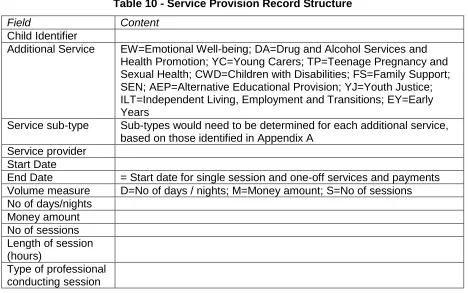
It is important to note that although all the records were held and retrieved electronically, because they were, in effect, free text, they could only be processed and information extracted from them by reading each document, searching for evidence of service use, interpreting the information and then recording the result into a pro forma similar to the one proposed in Table 6, above.
This experience confirmed our view that, even where document management software is in place, little data on service delivery can be feasibly extracted from free-text documents or fields. It is important to stress this conclusion, because it is easy to assume that, because documents are stored and managed electronically, it is easy to obtain data from them.
Financial records
The present study was not required to examine financial records and data on the cost of services. However, it soon became apparent that some of the best data on service use is available either in finance systems or because specific payments have to be approved, made and monitored. The data on the placements of looked after children is relatively
Additional service usage data could also, in principle, be extracted from financial systems. In most cases these are Oracle-based systems separate from the Children’s Social Care MIS. Some authorities use payment modules within or linked to these MIS (e.g. CarePay for CareFirst) to pay foster carers and, sometimes, to make Section 17, Section 24 (care
leavers) and Direct Payments. However, payment systems and procedures for other kinds of services are very diverse, depending on the type of payment model, service level
agreement, invoicing and contractual arrangements. In many cases the same service (e.g. Short-break care for Children with Disabilities) may be provided partly in-house, where no payment is made, and partly by external providers who are paid against invoices. In such cases service usage data based on payment records alone would be incomplete.
Other services that follow this pattern include Day-care; Section 17, Section 24 and direct payments; aids and adaptations. In each case approval of a service involves approval of a specific expenditure; and payment is easily identified as payment to or for the child or family.
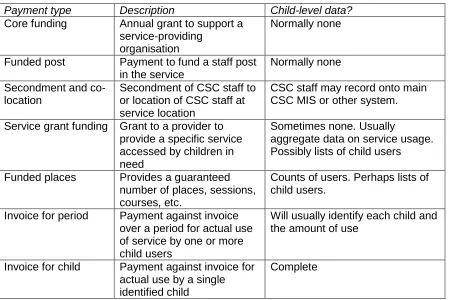
Payment models
[image:25.595.68.518.353.653.2]For the remaining additional services, however, much depends on how the service is paid for by the local authority. The table below sets out a typology of service payment types.
Table 8 - Service payment models
Payment type Description Child-level data?
Core funding Annual grant to support a service-providing
organisation
Normally none
Funded post Payment to fund a staff post in the service
Normally none
Secondment and co-location
Secondment of CSC staff to or location of CSC staff at service location
CSC staff may record onto main CSC MIS or other system.
Service grant funding Grant to a provider to provide a specific service accessed by children in need
Sometimes none. Usually
aggregate data on service usage. Possibly lists of child users
Funded places Provides a guaranteed number of places, sessions, courses, etc.
Counts of users. Perhaps lists of child users.
Invoice for period Payment against invoice over a period for actual use of service by one or more child users
Will usually identify each child and the amount of use
Invoice for child Payment against invoice for actual use by a single identified child
Complete
Service level agreements and contracts
Several of the participating local authorities mentioned that reporting on use of services commissioned from outside providers is generally specified in service level agreements. Authority G suggested that it would be useful to tighten up on these and make uniform reporting of child-level data on service use a condition of funding. This would appear to be an appropriate and valuable way forward. It has the advantage that the local authority can standardise and specify the form of report and the exact content of child-level data, including use of identifiers.
ICS Exemplars
By providing a structure for the practice and recording of referral, assessment, planning and review for all children in need, the Integrated Children’s System and its exemplars provide detailed data on all the processes of case management which will provide much of what is required for the CIN Census in relation to the work of social work teams within Children’s Social Care. However it does not appear that the ICSper sewill provide similar data on deliveries of additional services.
We asked local authorities about the way they use and record ICS Plans for Children in Need (the Initial Plan, Outline Child Protection Plan and Child/Young Person’s Plan). The relevant ICS exemplars provide a grid with cells for ‘actions or services to be taken / provided’, ‘frequency & length of service’ and ‘Person/agency responsible’. However, implementation of these plan exemplars appears to be at an early stage among the Children’s Social Care Teams in the study: planned services are not clearly itemised; the details are generally recorded as free text; and the plans themselves tend to be regarded as single documents rather than structures for recording and retrieving data. Similar
considerations apply to Reviews, where recording of service details is even less
comprehensive. Reviews, where present, were mostly Word documents containing free text and from which no data could realistically be extracted.
In Anite ICS (the ICS module which accompanies the SWIFT MIS), the details of both plans and reviews can be itemised and services chosen from a drop-down list. However, when we examined some actual plan records in one pilot authority, the details had not been
completed. In CareFirst, the Service Deliveries screens allow for completion of a calendar-style service timetable which would allow for accurate determination of the volume of service delivered. However, when we examined the child records we found that these timetables were mostly left blank.
We did not specifically ask local authorities about the way in which they are using the ICS Chronology Exemplar. None, however, mentioned it either as a place for recording service deliveries or from which CIN Census data might be retrieved. During the pilot tests we worked alongside staff in four local authorities to retrieve data on sample cases and in no case was the Chronology accessed for this purpose.
Resource Panel records
We explored with several authorities the use of Resource Panels to authorise service provision for children in need. Such panels, under a variety of names such as ‘Complex Needs Panel’, ‘Children’s Commissioning Panel’, ‘Single Area Panel’, ‘Multi-Disciplinary Support Panel’ and others, have developed in most cases from Placement Panels used to approve high-cost and out of county placements for looked after children. Panels are likely to be used to approve, in addition to looked after placements, Section 17 payments above a certain level; Direct Payments; all forms of overnight care for disabled children; and possibly other services. It appears that panels, for the most part, authorise only service provision where there will be a specific, identified cost (the last two types in Table 8, above), and payment is made to an external provider.
Authority F stated that their panels would soon consider the full range of services to be provided to a child in need, whether or not these were ‘cost-incurring’. In common with other authorities, they used the term ‘packages’ (of service or care) which is common in adult services and makes it easy to identify service deliveries. This authority provided us with a sample ‘Resource Panel & Service Package Agreement Form’. Services included in the package are itemised, coded and costed and the results entered by administrative staff into CareFirst as Service Deliveries.
Authority G’s Single Area Panels emerged from former SEN Panels, but now also make decisions about services to looked after and children in need. However, budgets are not devolved to areas, so decisions are not based on cost. Because of the SEN origin of the Panels, decisions are recorded in IDEAR, the authority’s pupil information system. Outcomes (which may identify services) are classified for SEN, but not yet for Children in Need.
Authority E is planning to record its resource panel decisions in future in its main MIS, which may enable child-level data to be extracted. Another authority told us that the supplier of their CareFirst MIS is considering developing a care-package approach to recording of children’s services.
Thus resource panel records are a useful potential source of data on services, providing the data is held electronically in a suitable form and can be accessed by staff compiling the data. Itemisation and coding is likely to be better than in plan and review exemplars, because these are linked to financial approval and payment processes. However, we believe it could be some years before resource panel recording reaches the required level of consistency and detail in even the most advanced authorities.
Additional services, definitions and data
This discussion of additional services makes no attempt to determine which are the most important in terms of need, effectiveness or budget. Our research did not examine financial data and could reach no conclusion about the proportion of Children’s Social Care budgets spent on each additional service. Authority G wondered whether so much effort to collect data on these services, especially those provided externally, would be worthwhile. In their case, total annual expenditure on services commissioned through service level agreements (excluding residential care places for looked after children) amounts to less than 1.25 per cent of their total Children’s Social Care budget.
However, we have decided to select out a short-list of those services which could be prioritised for inclusion in a future CIN Census taking into account both the availability of child-level data and the apparent importance of the service. These are:
Children with Disabilities
Family Support
Early Years
Special Educational Need
Youth Justice.
We did not include Emotional Well-being and CAMHS, because of the great difficulty in obtaining consent for data sharing. Family Support and Early Years present special difficulties because of the very varied gamut of services they comprise, some of them informal or group-based, and the fact that they are often accessed without a formal referral to Children’s Social Care. Part of their work is preventive work with vulnerable children. We believe that further research is necessary to determine how best to map these services and gather the data.
Definitions
The definitions provided for each Additional Service were agreed with participating
authorities and could be used in future guidance for the CIN Census if the various problems noted can be resolved.
The way in which we arrived at the list of 11 additional services for Children in Need has been described above under Methodology(see p.8 ). Definitions of each additional service were drafted, based on those established in the Durham Mapping Pilot (Durham, 2007a) and tested both at the project workshop in Loughborough and in the visits and pilot tests with individual authorities. These definitions are listed at the head of each additional subsection, below, and also in Appendix A. Below each definition, following the Durham pattern
(Durham, 2007b), is a list of ‘service options’, specific examples of service sub-types. While we have tried to include in the options lists most of the common sub-types, these should not be regarded as definitive, especially as there is so much variation both in terminology and in service structures (cf. Ward, et al., 2008 forthcoming).
It became clear that the principal difficulties lie not with the definitions as such, but with the vast and varied panoply of service commissioning and delivery. The difficulties were less in deciding what a particular service is than in simply enumerating all the possible instances of services, essential if complete data is to be collected. There are often different providers for the same service covering different geographical areas within one local authority, and different local names are used.
Some additional services present special problems:
SEN and Alternative Educational Provision Services: funding arrangements are complex, with some service elements financed out of school budgets and some schools then buying back into local authority provided services. We anticipate that relating service data to expenditure will be difficult.
centres may supply services to children of all ages. Family Support is a particularly complex area which comprises many types of provision and we recommend that further research be carried out in this area.
Children with Disabilities
Services to support children and young people who are disabled and / or have complex health needs and their families.
Include:
early identification of need through integrated diagnosis and assessment; early intervention and support;
provision of ongoing care management and support;
support to participate in out of school and leisure activities in the community; day care and outreach services for disabled children
systems to safeguard disabled children from abuse;
multi-agency transition planning for disabled young people entering adulthood; palliative care for those who need it;
specific therapies (occupational, physiotherapy, speech and language);
Short-break care outsid