SB 30/2013 21 March2013
Initial Teacher Training in Wales, 2011/12
This bulletin provides information about students on courses of Initial Teacher Training (ITT) leading to Qualified Teacher Status (QTS) in 2011/12. It mainly focuses on information about students on courses provided through higher education institutions (HEIs) in Wales.
Following an internal assessment and a subsequent review, published in 2006, the Welsh Government has been reducing the number of new entrants to ITT courses to better meet the needs of maintained schools in Wales.
In 2011/12, numbers were again reduced, compared with 2010/11, from 755 to 750 for Primary phase and from 1,045 to 1,030 for Secondary phase. Primary phase undergraduate courses were reduced from 330 to 300, whilst postgraduate intake targets were increased from 425 to 450; secondary phase
undergraduate courses decreased from 100 to 95, and postgraduate courses were reduced from 945 to 935. These figures do not include an additional 25 postgraduate secondary places at the Open
University.
There are alternative employment-based routes to obtaining QTS but these are not covered in this bulletin. The data included here are taken from the Higher Education Statistics Agency’s (HESA) Student Record. Unless otherwise stated, comparisons are with 2010/11 figures.
Key points
• There has been a year on year decline in first year enrolments on ITT courses in Wales in recent years, but this must be viewed in the context of the policy to reduce the number of new entrants to ITT courses.
• There were 1,760 first year enrolments on ITT courses in Wales, one per cent lower than in 2010/11 and 24 per cent lower than in 2005/06.
• The number of first year Welsh domiciled students enrolled on ITT courses in Wales fell by two per cent to 1,400 in the past year. There was a two per cent increase in enrolments from outside Wales.
• 80 per cent of first year students on ITT courses in Wales were Welsh domiciled, the same proportion as in 2010/11 and five percentage points higher than in 2005/06.
• The number of students completing ITT courses in Wales was five per cent lower than in 2010/11. Of these completers, 13 per cent completed a course that either enabled them to teach bilingually or led to a formal certificate of bilingual education.
Statistician: Alastair Cameron Tel: 029 2082 5043 Email: [email protected] Next update: March 2014 (Provisional)
Policy context
Each year the Welsh Government sets intake targets for recruitment to ITT courses in Wales. Following an internal assessment and subsequent review, the Welsh Government has, since 2004/05, been
reducing the number of new entrants to ITT courses to better meet the needs of maintained schools in Wales. The Review of ITT Provision in Wales was held in 2005/06 and reported in January 2006. A copy of the report can be seen on the Welsh Government’s website at:
Welsh Government: ITT Provision Report
Following this, the then Minister for Education, Lifelong Learning and Skills published a statement on 29 March 2006 setting out an ITT Change Plan to restructure ITT so that intake targets, courses and course availability could deliver teachers with Qualified Teacher Status to better meet the needs of maintained schools in Wales. A copy of this can be seen on the National Assembly for Wales’s website at:
National Assembly for Wales: Statement on ITT Restructuring
The intake targets set by the Welsh Government are notified to the Higher Education Funding Council for Wales (HEFCW). HEFCW allocates the total intake figures, varying the figures within agreed limits if necessary, to individual institutions. Further details can be found on the HEFCW website at:
HEFCW: Intake Targets
Section A: ITT students and qualifiers from Welsh HEIs
Chart A.1: First year students on ITT courses in Wales by phase
0 200 400 600 800 1,000 1,200 1,400
2005/06 2006/07 2007/08 2008/09 2009/10 2010/11 2011/12
Nu
m
b
e
r
Primary Secondary
• Between 2010/11 and 2011/12, first year enrolments on Primary phase courses in Wales remained unchanged at 765, after an 11 percent decrease in the previous year (Table A.1).
Chart A.2: First year ITT students in Wales, by country of domicile (a)
0 500 1,000 1,500 2,000 2,500
2005/06 2006/07 2007/08 2008/09 2009/10 2010/11 2011/12
Nu
m
b
e
r
Wales England Other All
(a) Other includes Scotland, Northern Ireland, UK unknown, Republic of Ireland, Other EU, Other Europe and Other Overseas
• The number of all first year enrolments on ITT courses (1,760) was one per cent lower than the previous year and 24 per cent lower than in 2005/06. (Table A.2).
• The number of first year Welsh domiciled students enrolled on ITT courses in Wales decreased by two per cent, while enrolments from outside of Wales increased by two per cent. (Table A.2)
• 80 per cent of first year ITT students were Welsh domiciled and 16 per cent were English domiciled. (Table A.2)
Chart A.3: First year ITT students in Wales, by gender
0 500 1,000 1,500 2,000 2,500
2005/06 2006/07 2007/08 2008/09 2009/10 2010/11 2011/12
Nu
m
b
e
r
Males Females All
• First year female enrolments increased by four per cent in the past year whilst first year male enrolments decreased by 11 per cent. (Table A.1)
First year ITT students by level of study, language, ethnicity and age
• In 2011/12, 77 per centof first year ITT students were enrolled on PGCE courses, unchanged from the previous year, and 10 percentage points higher than five years ago. (Table A.1)
• 15 per cent of first year ITT students opted to take a course that either enables them to teach
bilingually or leads to a formal certificate of bilingual education, the same proportion as in 2010/11. (Table A.1)
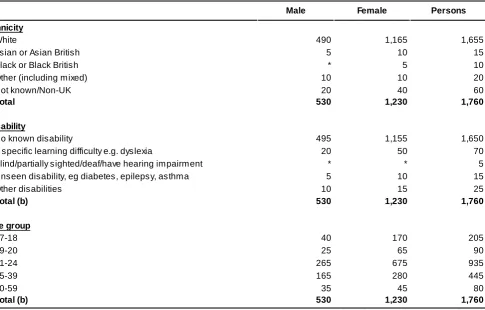
• 94 per cent of first year ITT students recorded their ethnicity as white in 2011/12, while 53 per cent of students were aged between 21 and 24, a two percent increase from the previous year. (Table A.3)
Chart A.4: First year ITT students in Wales, by secondary subject grouping 2011/12
0 20 40 60 80 100 120
Business studies General science Drama Physics RE Chemistry Geography Music Art Welsh History IT Modern languages Physical Education English Biology Design and technology Mathematics
Num ber
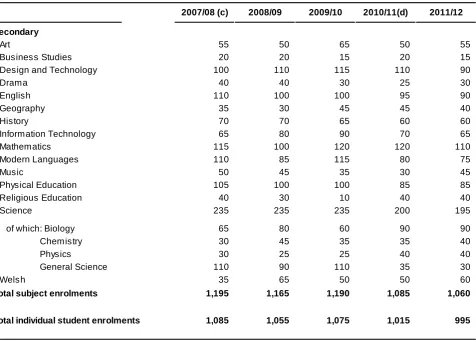
• The highest proportion of first year Secondary phase enrolments was Mathematics (11 per cent) and Design and Technology (eight per cent). (Table A.4)
• Biology accounted for eight per cent of the all first year enrolments to Secondary phase ITT courses compared to four per cent for Physics and for Chemistry and three percent for General Science. (Table A.4)
• Business studies made up only one per cent of all first year enrolments to Secondary phase ITT courses. (Table A.4)
All students on ITT courses in 2011/12
Students completing ITT courses in 2011/12
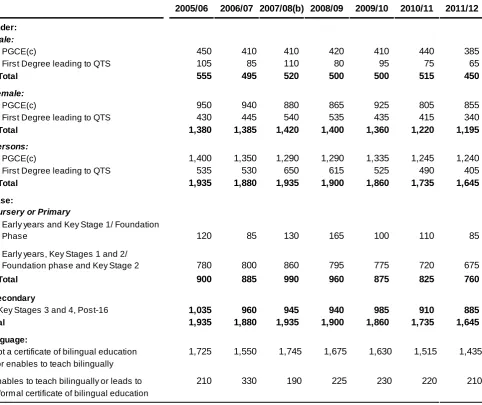
• The number of students completing ITT courses in Welsh HEIs was 1,645, five per cent lower than in 2010/11. (Table A.6)
• 75 per cent of students in Welsh HEIs completing ITT courses were from PGCE courses. (Table A.6)
• 13 per cent of students (210) in Welsh HEIs completed a course that either enabled them to teach bilingually or led to a formal certificate of bilingual education, the same proportion as in 2010/11. (Table A.6)
Section B: Welsh domicile ITT students
First year Welsh domicile ITT students at UK HEIs, 2011/12
• There were 1,795 Welsh domiciled entrants onto ITT courses at UK HEIs. Of those, 78 per cent were enrolled at a Welsh HEI and 22 per cent at an English HEI. There were no first year students
studying in Northern Ireland and only a small number studying in Scotland in 2011/12. (Table B.1)
• The number of male Welsh domiciled entrants onto PGCE courses at Welsh HEIs was 15 per cent lower than in 2010/11, whereas the number of female entrants increased by seven per cent respectively (Table B.1)
All students on ITT courses, 2011/12
• In total, there were 2,655 Welsh domiciled enrolments onto ITT courses. Of these 77 per cent were enrolled at a Welsh HEI and 54 per cent of these students were enrolled on a PGCE course while the rest were enrolled on a first degree leading to QTS (Table B.2).
Section C: ITT students and qualifiers from English HEIs
First year ITT students in English HEIs, 2011/12
• The number of first year enrolments to English HEIs in 2011/12 was 28,510, a seven per cent decrease on the previous year, and 10 per cent lower than in 2005/06. (Table C.1)
• The majority of first year ITT students were female, 74 per cent. (Table C.1)
All students on ITT courses at English HEIs in 2011/12
• There were 46,790 students enrolled on ITT courses in at English HEIs, of these 50 per cent were enrolled on a PGCE and 77 per cent were female. (Table C.2)
Students completing ITT courses in 2011/12
Tables
Table A.1: First year students on ITT courses in Wales, by gender, level of study, phase and language (a)
2005/06 2006/07 2007/08 (b) 2008/09 2009/10 2010/11 2011/12
Gender: Male:
PGCE(c) 525 480 480 470 475 490 435 First Degree leading to QTS 135 140 125 105 105 105 90
Total 660 620 605 575 580 595 530
Female:
PGCE(c) 1,020 995 975 935 975 880 920 First Degree leading to QTS 645 585 530 525 380 305 310
Total 1,665 1,580 1,505 1,460 1,360 1,185 1,230
Persons:
PGCE(c) 1,545 1,475 1,450 1,405 1,450 1,370 1,360 First Degree leading to QTS 780 720 655 630 485 415 400
Total 2,325 2,200 2,105 2,035 1,940 1,780 1,760
Phase:
Nursery or Primary (d)
Early years and Key Stage 1/ Foundation
Phase 135 90 115 100 90 130 70
Early years, Key Stages 1 and 2/
Foundation Phase and Key Stage 2 1,000 995 910 880 770 635 695
Total 1,135 1,085 1,020 980 860 765 765
Secondary
Key Stage 3 and 4, Post 16 1,190 1,115 1,085 1,055 1,075 1,015 995
Language: (e)
Not a certificate of bilingual education 2,065 1,710 1,890 1,805 1,685 1,510 1,495 nor enables to teach bilingually
Enables to teach bilingually or leads to 265 490 215 230 250 270 265 a formal certificate of bilingual education
(a) Enrolments throughout the year.
(b) From 2007/08 students w ho w ere studying at the Open University and w ere funded by HEFCW are included in the figures.
(c) PGCE includes Postgraduate Certificate in Education, Professional Graduate Certificate in Education and Postgraduate Diploma in Education.
and Key Stage1/ Foundation Phase.
certificate of bilingual education'. (f) Data are rounded to the nearest 5.
Source:Higher Education Statistics Agency (HESA)
(d) In 2006/07 one institution incorrectly coded some students to the Early years, Key Stages 1 and 2/Key Stage 2 instead of the Early years
Table A.2: First year students on ITT courses in Wales, by country of domicile (a)
Domicile 2005/06 2006/07 2007/08 (b) 2008/09 2009/10 2010/11 2011/12
Number:
Wales 1,855 1,795 1,700 1,600 1,555 1,430 1,400 England 350 380 340 330 255 245 290
Scotland 10 5 5 5 * * 5
N Ireland 20 15 15 15 5 20 10
UK Unknown * * * * * * *
Republic of Ireland 145 105 110 95 80 50 35 Other EU (c) 25 30 15 30 25 20 10
Total EU 2,405 2,325 2,180 2,075 1,920 1,765 1,750
Other Europe * * * * * * *
Other Overseas 5 * 15 30 15 15 10
Total 2,415 2,325 2,200 2,105 1,940 1,780 1,760
Percent:
Wales 77 77 77 76 80 80 80
England 14 16 15 16 13 14 16
Scotland - - -
-N Ireland 1 1 1 1 - 1
UK Unknown - - -
-Republic of Ireland 6 5 5 5 4 3 2
Other EU (c) 1 1 1 2 1 1 1
Total EU
Other Europe - - -
-Other Overseas - - 1 1 1 1 1
Total 100 100 100 100 100 100 100
(a) Enrolments throughout the year. Percentages may not add to 100 due to rounding.
(b) From 2007/08 students w ho w ere studying at the Open University and w ere funded by HEFCW are included in the figures. (c) Includes Channel Islands and Isle of Man.
(d) 0, 1, 2 are rounded to 0 and represented as ‘*’. (e) All other numbers are rounded to the nearest 5.
(f) Percentages have been calculated using precise raw numbers. Percentages less than 0.5 per cent are represented by ‘-‘.
Source: Higher Education Statistics Agency (HESA) -1
Table A.3: First year students on ITT courses in Wales, by ethnicity, disability status and age, 2011/12 (a)
Male Female Persons
Ethnicity
White 490 1,165 1,655
Asian or Asian British 5 10 15
Black or Black British * 5 10
Other (including mixed) 10 10 20
Not known/Non-UK 20 40 60
Total 530 1,230 1,760
Disability
No known disability 495 1,155 1,650
A specific learning difficulty e.g. dyslexia 20 50 70
Blind/partially sighted/deaf/have hearing impairment * * 5
Unseen disability, eg diabetes, epilepsy, asthma 5 10 15
Other disabilities 10 15 25
Total (b) 530 1,230 1,760
Age group
17-18 40 170 205
19-20 25 65 90
21-24 265 675 935
25-39 165 280 445
40-59 35 45 80
Total (b) 530 1,230 1,760
Source: Higher Education Statistics Agency (HESA) (a) Enrolments throughout the year.
(b) Total includes unknow n.
Table A.4: First year secondary phase students on ITT courses in Wales, by subject of study (a) (b)
2007/08 (c) 2008/09 2009/10 2010/11(d) 2011/12
Secondary
Art 55 50 65 50 55
Business Studies 20 20 15 20 15
Design and Technology 100 110 115 110 90
Drama 40 40 30 25 30
English 110 100 100 95 90
Geography 35 30 45 45 40
History 70 70 65 60 60
Information Technology 65 80 90 70 65
Mathematics 115 100 120 120 110
Modern Languages 110 85 115 80 75
Music 50 45 35 30 45
Physical Education 105 100 100 85 85
Religious Education 40 30 10 40 40
Science 235 235 235 200 195
of which: Biology 65 80 60 90 90
Chemistry 30 45 35 35 40
Physics 30 25 25 40 40
General Science 110 90 110 35 30
Welsh 35 65 50 50 60
Total subject enrolments 1,195 1,165 1,190 1,085 1,060 Total individual student enrolments 1,085 1,055 1,075 1,015 995
(a) Enrolments throughout the year.
under both subjects. This table provides tw o lines, the number of subject enrolments and the number of individual student
(c) Students w ho w ere studying at the Open University and w ere funded by HEFCW are included in the figures.
specific. Providers w ere told that chemistry and physics subjects could be linked w ith w ider science content, but only courses Source: Higher Education Statistics Agency (HESA)
(b) Students may be recorded under more than one subject e.g. if a student studies Mathematics and IT then that student w ill appear
enrolments. The number of individual student enrolments matches the secondary phase totals in Table A.1.
(d) From 2010/11 the ITT intake targets in respect of science (previously one figure for all science courses) have become more
w here chemistry or physics w ere the main component w ould qualify for inclusion in the priority subject intake grouping. Providers
(e) All numbers are rounded to the nearest 5.
courses are being recorded, rather than changes in enrolment patterns.
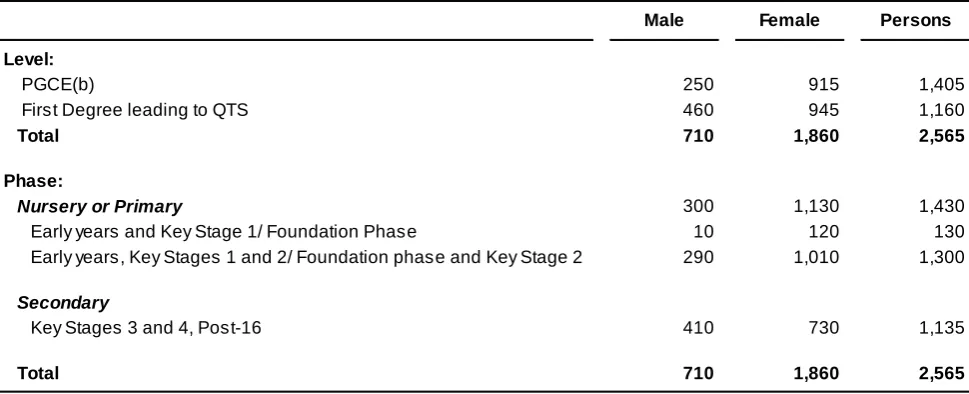
Table A.5: All students on courses of ITT in Wales, by gender, level of study and phase, 2011/12(a)
Male Female Persons
Level:
PGCE(b) 250 915 1,405
First Degree leading to QTS 460 945 1,160
Total 710 1,860 2,565
Phase:
Nursery or Primary 300 1,130 1,430
Early years and Key Stage 1/ Foundation Phase 10 120 130 Early years, Key Stages 1 and 2/ Foundation phase and Key Stage 2 290 1,010 1,300
Secondary
Key Stages 3 and 4, Post-16 410 730 1,135
Total 710 1,860 2,565
Source: Higher Education Statistics Agency (HESA) (a) Enrolments throughout the year.
Education.
(c) All numbers are rounded to the nearest 5.
Table A.6: Students completing ITT courses in Wales, by gender, level of study, phase and language (a) (Please refer to revisions section of the notes)
2005/06 2006/07 2007/08(b) 2008/09 2009/10 2010/11 2011/12
Gender: Male:
PGCE(c) 450 410 410 420 410 440 385 First Degree leading to QTS 105 85 110 80 95 75 65 Total 555 495 520 500 500 515 450
Female:
PGCE(c) 950 940 880 865 925 805 855 First Degree leading to QTS 430 445 540 535 435 415 340 Total 1,380 1,385 1,420 1,400 1,360 1,220 1,195
Persons:
PGCE(c) 1,400 1,350 1,290 1,290 1,335 1,245 1,240 First Degree leading to QTS 535 530 650 615 525 490 405 Total 1,935 1,880 1,935 1,900 1,860 1,735 1,645
Phase:
Nursery or Primary
Early years and Key Stage 1/ Foundation
Phase 120 85 130 165 100 110 85
Early years, Key Stages 1 and 2/
Foundation phase and Key Stage 2 780 800 860 795 775 720 675 Total 900 885 990 960 875 825 760
Secondary
Key Stages 3 and 4, Post-16 1,035 960 945 940 985 910 885
Total 1,935 1,880 1,935 1,900 1,860 1,735 1,645
Language:
Not a certificate of bilingual education 1,725 1,550 1,745 1,675 1,630 1,515 1,435 nor enables to teach bilingually
Enables to teach bilingually or leads to 210 330 190 225 230 220 210
a formal certificate of bilingual education
(a) All student enrolments associated w ith an aw ard of an ITT qualification during the academic year.
(b) From 2007/08 students w ho w ere studying at the Open University and w ere funded by HEFCW are included in the figures.
(c) PGCE includes Postgraduate Certificate in Education, Professional Graduate Certificate in Education and Postgraduate Diploma in Education. (d) All numbers are rounded to the nearest 5.
Table B.1: First year Welsh domicile ITT students at UK HEIs, by country of institution, level of study and gender (a)
2005/06 2006/07 2007/08(b) 2008/09 2009/10 2010/11 2011/12
Studying in Welsh HEIs Male:
PGCE(c) 385 355 340 350 370 375 320 First Degree leading to QTS 105 115 90 85 75 85 70
Total 490 470 430 435 445 460 390
Female:
PGCE(c) 780 760 735 740 800 710 760 First Degree leading to QTS 525 470 435 440 310 260 250
Total 1,305 1,230 1,170 1,180 1,110 970 1,010
Persons:
PGCE(c) 1,165 1,115 1,075 1,095 1,170 1,085 1,080 First Degree leading to QTS 630 585 525 525 385 345 320
Total 1,795 1,700 1,600 1,615 1,555 1,430 1,400
Studying in English HEIs Male:
PGCE(c) 125 100 105 115 110 100 105 First Degree leading to QTS 20 15 10 15 15 15 20
Total 145 115 115 130 125 115 125
Female:
PGCE(c) 225 230 210 205 220 215 205 First Degree leading to QTS 70 90 50 50 55 90 65
Total 295 320 260 255 275 310 270
Persons:
PGCE(c) 350 330 310 320 325 315 310 First Degree leading to QTS 90 105 65 65 70 105 85
Total 445 435 375 385 400 420 395
Total (d) 2,245 2,135 1,980 2,005 1,955 1,850 1,795
(a) Enrolments throughout the year.
(c) PGCE includes Postgraduate Certificate in Education, Professional Graduate Certificate in Education and Postgraduate Diploma in Education.
(d) Some years include a small number of enrolments at Scottish HEIs. (e) All numbers are rounded to the nearest 5.
Source:Higher Education Statistics Agency (HESA)
Table B.2: All Welsh domicile ITT students at UK HEIs, by Country of Institution, level of study and gender (a)
2005/06 2006/07 2007/08 (b) 2008/09 2009/10 2010/11 2011/12
Studying in Welsh HEIs
Male
PGCE(c) 390 365 350 365 380 390 335 First Degree leading to QTS 290 275 270 240 220 200 185 Total 680 640 620 610 600 590 525
Female
PGCE(c) 790 780 750 775 820 725 785 First Degree leading to QTS 1,520 1,455 1,325 1,250 1,075 910 750 Total 2,310 2,235 2,075 2,020 1,895 1,640 1,535
Persons
PGCE(c) 1,180 1,145 1,100 1,140 1,200 1,120 1,120 First Degree leading to QTS 1,810 1,730 1,590 1,490 1,295 1,110 940 Total 2,990 2,875 2,695 2,630 2,500 2,230 2,060
Studying in English HEIs
Male
PGCE(c) 145 115 115 125 125 105 110 First Degree leading to QTS 45 40 45 45 50 50 50 Total 190 160 160 170 175 155 160
Female
PGCE(c) 250 250 225 225 230 235 215 First Degree leading to QTS 250 275 225 200 165 195 215 Total 500 525 450 420 400 430 435
Persons
PGCE(c) 390 365 340 345 360 340 330 First Degree leading to QTS 295 315 270 245 215 245 265 Total 690 680 610 590 575 585 595
Total (d) 3,685 3,560 3,305 3,225 3,075 2,815 2,655
(a) Enrolments throughout the year.
(c) PGCE includes Postgraduate Certificate in Education, Professional Graduate Certificate in Education and Postgraduate Diploma in Education.
(d) Some years include a small number of enrolments at Scottish HEIs. (e) All numbers are rounded to the nearest 5.
Source: Higher Education Statistics Agency (HESA)
English HEIs’. Please refer to the notes for further explanation.
2005/06 2006/07 2007/08 (b) 2008/09 2009/10 2010/11 2011/12
Male:
PGCE(c) 7,060 6,625 6,425 6,640 7,110 7,210 6,345 First Degree leading to QTS 1,285 1,155 1,180 1,100 1,295 1,350 1,190
Total 8,345 7,775 7,605 7,740 8,405 8,560 7,540
Female:
PGCE(c) 16,635 16,140 15,550 15,390 16,075 15,875 14,955 First Degree leading to QTS 6,850 6,725 6,420 6,465 6,655 6,230 6,015
Total 23,485 22,865 21,970 21,855 22,730 22,105 20,970
Persons:
PGCE(c) 23,690 22,760 21,975 22,030 23,185 23,085 21,300 First Degree leading to QTS 8,135 7,880 7,600 7,565 7,950 7,580 7,210
Total 31,830 30,640 29,575 29,595 31,135 30,665 28,510
(a) Enrolments throughout the year.
(b) From 2007/08 students w ho w ere at the Open University and funded by HEFCW w ere excluded from this table (please refer to the notes).
(c) PGCE includes Postgraduate Certificate in Education and Professional Graduate Certificate in Education. (d) All numbers are rounded to the nearest 5.
[image:14.595.41.522.72.255.2]Source: Higher Education Statistics Agency (HESA)
Table C.1: First year students on ITT courses in England, by level of study (a)
Male Female Persons
Level:
PGCE(b) 6,975 16,535 23,515
First Degree leading to QTS 3,775 19,500 23,275
Total 10,750 36,040 46,790
Source: Higher Education Statistics Agency (HESA) (a) Enrolments throughout the year.
[image:14.595.43.465.362.438.2](c) All numbers are rounded to the nearest 5.
Table C.2: All students on courses of ITT in England, by gender and level of study 2011/12 (a)
(b) PGCE includes Postgraduate Certificate in Education and Professional Graduate Certificate in Education.
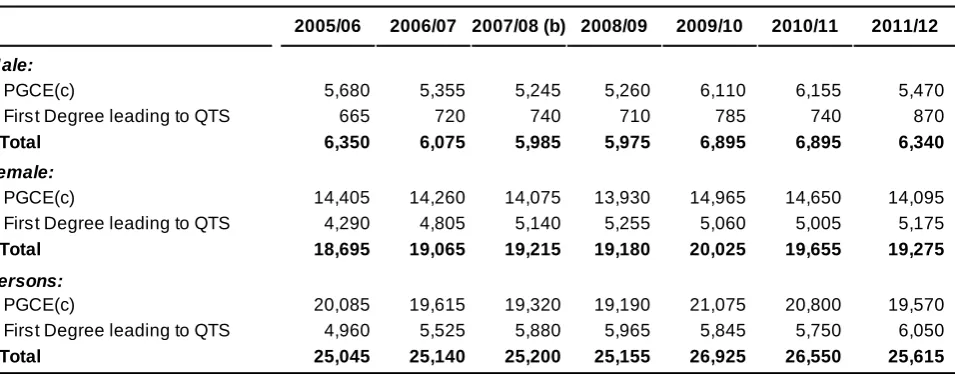
Table C.3: Students completing ITT courses in England, by gender and level of study (a)
2005/06 2006/07 2007/08 (b) 2008/09 2009/10 2010/11 2011/12
Male:
PGCE(c) 5,680 5,355 5,245 5,260 6,110 6,155 5,470 First Degree leading to QTS 665 720 740 710 785 740 870
Total 6,350 6,075 5,985 5,975 6,895 6,895 6,340
Female:
PGCE(c) 14,405 14,260 14,075 13,930 14,965 14,650 14,095 First Degree leading to QTS 4,290 4,805 5,140 5,255 5,060 5,005 5,175
Total 18,695 19,065 19,215 19,180 20,025 19,655 19,275
Persons:
PGCE(c) 20,085 19,615 19,320 19,190 21,075 20,800 19,570 First Degree leading to QTS 4,960 5,525 5,880 5,965 5,845 5,750 6,050
Total 25,045 25,140 25,200 25,155 26,925 26,550 25,615
(a) All students enrolments associated w ith an aw ard of an ITT qualification during the academic year.
(b) From 2007/08 students w ho w ere at the Open University and funded by HEFCW w ere excluded from this table (please refer to the notes).
(c) PGCE includes Postgraduate Certificate in Education and Professional Graduate Certificate in Education.
[image:14.595.52.530.504.691.2]NOTES
1. Related Publications
The Welsh Government releases a headline and tables coveringdestinations data for those completing ITT courses. The headline for 2010/11 was published in October 2012 and can be found here:
http://wales.gov.uk/topics/statistics/headlines/post16education2012/121025/?lang=en 2. Data Source
The Higher Education Statistics Agency (HESA) collects data on students, staff and resources of Higher Education Institutions (HEIs) in the UK. The data presented in this bulletin are taken primarily from the HESA Student Record which contains information on all students enrolled on credit bearing courses at UK HEIs, including those enrolled on ITT courses.
A summary of the Student data collection process for 2011/12 covering timescales, validation and business rules and checking processes is included on the HESA website at:
http://www.hesa.ac.uk/index.php?option=com_studrec&Itemid=232&mnl=11051
In addition, HESA published a circular in July 2009 (REF: C08051) to provide further guidance to
institutions returning data, covering a summary of previously announced changes to the data collection system, guidance on fields identified as having data quality issues in 2007/08, plus a summary of the data collection system and timetable and checks required to optimise the quality of data returned. A link to circular C08051 is provided here:
http://www.hesa.ac.uk/index.php?option=com_content&task=view&id=1543&Itemid=233
3. Definitions
3.1 Coverage
This bulletin provides information about courses of Initial Teacher Training (ITT) leading to Qualified Teacher Status (QTS) provided through higher education institutions.
To teach as a qualified teacherin a maintained school or non-maintained special school in Wales or England, students need to obtain QTS. Students can do this at higher education institutions by either undertaking a first degree course which combines a degree – usually a BEd, BA or BSc – with QTS or by completing a postgraduate course which leads to QTS. PGCE courses are usually postgraduate courses; however, some non postgraduate courses such as the Professional Graduate Certificate in Education (which is pitched at an undergraduate level) are classified as PGCE. Other levels such as Postgraduate Diploma in Education may also be offered.
Professional Graduate Certificate in Education courses are offered by English providers as a level 6 qualification which is classed as ‘other undergraduate’, but requires a first degree on entry. In Wales only the Open University offers this qualification with the ‘leading to QTS’ option, although other Welsh HEIs may award this qualification if a student studying for a Postgraduate Certificate in Education is deemed not to have achieved sufficient credits at masters level.
In this Bulletin figures for English HEIs includes the numbers on Training and Development Agency for Schools (TDA) funded flexible provision.
3.2 Level of study and length of course
Initial teacher training courses vary in length. Most first degree courses which combine a degree with QTS are 3 year courses but 2 and 4 year courses are also offered, depending upon qualifications on entry and the type of course. Postgraduate Certificate in Education (PGCE) courses which lead to QTS are almost all one year courses taken following completion of a degree course.
Course lengths can change: for example, many previously 4 year first degree courses are now 3 year courses, which can make comparisons with previous years difficult.
3.3 Year of study
Figures for first year students cover those entering both types of course in one academic year.
Figures for allstudents on ITT courses will also include those on first degree courses, which started in the previous academic years. Similarly figures for allstudents completing ITT courses include the completion of courses which started in different academic years.
3.4 Disabilities
With the introduction of the Disability Equality Duty, and on the recommendation of the Equality Challenge Unit (ECU), HESA has introduced a version of the coding frame introduced by the Disability Rights Commission (DRC). The disability categories indicate the type of disability that a student has on the basis of their own self-assessment, and are consistent with those used by the Universities and Colleges Admissions Service (UCAS). For continuing students, where the information is not already known, institutions have the option of recording the student's disability as not sought. As a result, some institutions have not returned disability data for some of their students. In addition, students are not obliged to report a disability. HESA therefore advises that the figures reported in analyses are derived from a subset which may not be representative of the total student population.
3.5 Subject of study
All secondary ITT students must be trained in at least one specialism. Prior to 2007/08 the main specialism was recorded in the first subject of study field. Up to two other specialisms may also have been recorded. The analysis by subject of study is a headcount of enrolments by main specialism. From 2007/08 students were counted under more than one subject grouping rather than being placed under their subject of specialism. Table A.4 provides a count of enrolments falling within each subject area but also gives a count of individual student enrolments. These student level totals match those in Tables A1, A2 and A3 and eliminate the double counting which occurs at subject level.
3.7 Open University
The Open University restarted ITT provision in Wales in July 2008. From 2007/08 the tables and charts showing students on ITT courses in Wales include those students at the Open University who were funded by HEFCW. Those charts and tables showing students on or completing ITT courses in England now exclude those students who are at the Open University and funded by HEFCW.
4. Rounding Strategy
The presentation of figures in this Statistical Bulletin follows the principals of the HESA rounding strategy. The strategy is intended to prevent the disclosure of personal information about any
individual. This strategy involves rounding all numbers to the nearest 5. A summary of this strategy is as follows:
• 0, 1, 2 are rounded to 0 and represented as ‘*’.
• All other numbers are rounded to the nearest multiple of 5.
Total figures are also subject to this rounding methodology; the consequence of which is that the sum of numbers in each row or column may not match the total shown precisely. Percentages have been
5. Key Quality Information
This section provides a summary of information on this output against five dimensions of quality: Relevance, Accuracy, Timeliness and Punctuality, Accessibility and Clarity, and Comparability. It also covers specific issues relating to quality of 2011/12 data, and describes the quality management tool applied to this area of work.
5.1 Relevance
HESA is the official agency for the collection, analysis and dissemination of quantitative information about higher education. It was set up by agreement between the relevant government departments, the higher education funding councils and the universities and colleges. The primary purpose of the Student data collection is to provide each of the bodies listed above with accurate and comprehensive statistical information regarding student enrolments.
The statistics are used both within and outside the Welsh Government to monitor trends in ITT provision at Welsh HEIs and also to monitor provision across the UK for Welsh domiciled students. Some of the key users are:
• Ministers and the Members Research Service in the National Assembly for Wales;
• Officials in the Welsh Government;
• Other government departments;
• The Higher Education Funding Council for Wales;
• Higher Education Institutions and representative bodies;
• Students, researchers, and academics;
• Individual citizens, private companies, and the media;
These statistics are used in a variety of ways. Some examples of these are:
• Advice to Ministers;
• To inform the education policy decision-making process in Wales;
• To forecast future expenditure of student support schemes for Welsh domiciled students;
• To help model future supply and demand for teachers and inform ITT intake targets.
5.2 Accuracy
The Student Record contains information about individual enrolments, which, because a student can be enrolled on more than one programme of study, will exceed the number of students. Previous analysis has shown that for Welsh HEIs full-time enrolments are less than 1 per cent higher than full-time student numbers; part-time enrolments are less than 2 per cent higher than part-time student numbers.
Postdoctoral students are not included in the HESA Student Record.
The Student record is an annual census of students. The steps taken by HESA to ensure data qualities were outlined in the ‘Data Source’ paragraph earlier in this section.
The errors occur where completers who were on ITT courses were coded as ‘First degree with honours’ rather than ‘first degree with honours leading to QTS/ registration with a GTC’, which meant that they were missing from the original table. Figures have been revised for all academic years to allow accurate comparisons across years to be made.
5.3 Timeliness and Punctuality
HESA collected student enrolment data for the 2011/12 academic year between August and October 2012.
5.4 Accessibility and Clarity
This statistical bulletin is pre-announced and then published on the Statistics section of the Welsh Government website. It is accompanied by more detailed tables on StatsWales, a free to use service that allows visitors to view, manipulate, create and download data.
5.5 Comparability
There are no published figures for the 2011/12 academic year for other UK countries that can be directly compared to figures in this bulletin.
The Training and Development Agency for Schools (TDA) operates as a national agency and recognised sector body responsible for the training and development of the school workforce in England; its
publications on ITT can be found here: http://dataprovision.tda.gov.uk/public/page.htm?to-page=ITTStatistics
5.6 Data quality issues
From 2007/08 those students enrolled at the Open University and funded by HEFCW were no longer counted under English HEIs, but instead were counted under Welsh HEIs. Although the numbers are small, it was felt that these changes helped to better inform funding policy.
The HESA standard registration population is a count of all enrolments with the reporting year 1 August until 31 July. In 2007/08 the standard population was redefined to no longer include students who were writing up or on sabbaticals. This change has not affected the data in this bulletin.
For 2006/07 one institution incorrectly coded postgraduate students with ‘Welsh’ as their main specialism as ‘enables to teach bilingually or leads to a formal qualification’. This accounts for the relatively large change between the years.
For 2006/07 one Welsh institution incorrectly coded some students to the Foundation Phase, Key Stages 1 and 2 rather than the Foundation Phase and Key Stage 1. This accounts for the relatively large change between the years.
Prior to 2007/08 subject level enrolment counts were not available. Table A.4 has been revised for this 2011/12 bulletin to provide both subject level and individual student level counts.
The Higher Education Funding Council for Wales (HEFCW) publishes information on ITT enrolments in ‘Initial Teacher Training in Wales – Performance Information’ each year. The enrolment figures may differ to those presented in this Bulletin, as institutions are able to make corrections to their data after the HESA Student Record has closed.
STATS WALES
Tables associated with this bulletin containing a greater amount of detail are available on the Welsh Government’s interactive data dissemination service StatsWales (www.statswales.gov.uk).
Prior to 2005/06 the enrolment population used in the Initial Teacher Training (ITT) bulletin was based on enrolments at 1December. To maintain the trend the following link provides a time series from 1994/95 based on the December population, in addition to tables providing full year enrolment figures.