
Addressing new challenges in dynamic conservation planning
186
0
0
Full text
(2) Addressing new challenges in dynamic conservation planning. PhD thesis submitted by Piero Visconti BSc(Hons) in June 2011. For the degree of Doctor of Philosophy in the School of Marine & Tropical Biology James Cook University, and the School of Animal Biology, Department of Biology and Biotechnologies, Sapienza Università di Roma. 1.
(3) Statement of access I, the undersigned, author of this work, understand that James Cook University will make this thesis available for use within the University Library, via the Australian Theses Network, or by other means allow access to users in other approved libraries.. I understand that as an unpublished work, a thesis has significant protection under the Copyright Act and beyond this, I do not wish to place any restriction access to this thesis.. 29/10/2011____________________ Signature, Piero Visconti. Date. 2.
(4) Statement of sources declaration This thesis is my own work and has not been submitted in any form for another degree or diploma at any university or other institution of tertiary education except James Cook University and Sapienza Università di Roma. Information derived from the published or unpublished work of others has been duly acknowledged in the text and a list of references is given. I would be pleased to hear from any copyright owner who has been omitted or incorrectly acknowledged.. 29/10/2011_____________________ Signature, Piero Visconti. Date. 3.
(5) Statement on the Contribution of Others Research funding:. •. IDP Australia Postgraduate Mobility Scholarship (stipend for 3years) $75,000. •. Grant from Supervisor Prof. Robert L. Pressey (conference travel expenses for 3 years) $12,000. Thesis committee: • Professor Robert L. Pressey, Australian Research Council, Centre of Excellence for Coral. Reef Studies, James Cook University •. Dr. Carlo Rondinini, Global Mammal Assessment program, Department of Biology and Biotechnology, La Sapienza Università di Roma. •. Dr. Natalie Ban, Australian Research Council, Centre of Excellence for Coral Reef Studies, James Cook University. Editorial support: Prof. Robert L. Pressey Dr. Natalie Ban Dr. Carlo Rondinini Prof. Atte Moilanen Mr. Daniel Segan Dr. Toby Gardner Dr. Michael Bode Dr. Luigi Maiorano Dr. Brendan Wintle Dr. Michel Bakkenes Ms. April Reside Mr. Thomas Brewer Dr. Rob Alkemade Dr. Tien Ming-Lee Dr. Anni Arponen Dr. Alessandra Falcucci 6 Anonymous reviewers of my published chapters The handling editors of my published chapters: Prof. Jean Paul Metzger Dr. Robin Naidoo Prof. Ana Rodrigues. 4.
(6) Acknowledgements Coming to Australia and joining Prof. Bob Pressey's lab was the best choice I could have made for my career. I am greatly indebted to Bob for facilitating my arrival to Brisbane, welcoming me to his lab and mentoring me in all aspects of my PhD. From Bob I learnt a lot about conservation planning theory and practice. Bob has shared his personal experience and many anecdotes that not only enriched my knowledge but also added a personal touch to foster my passion for this field of research. Bob has offered infinite availability and shown a great deal of patience with me, even with my initial struggle with English was a second language, and writing scientific papers. So many iterations of my papers and not a sign of frustration! I thank Bob for having facilitated contact with other researchers in the field, and for providing me with professional development by supporting my attendance to workshops, course, seminars and conferences. My gratitude extends to Bob's family, Libby and Tim who always made me feel so welcome any time I visited. I could probably go on for much longer but I will finish here, with a big THANK YOU.. I would also like to thank Dr. Natalie Ban, my co-supervisor at JCU. Natalie thank you especially for your support over the last 3 months, I don't know how I would have done it without you. You have been so caring and available to me that I don't think I can ever thank you enough. For those that do not know Natalie, she has the world record of fastest turnaround time of a draft, average time 1 day (n~15). I thank you Natalie for your knowledge, wisdom and experience that you have shared with me for the last two and a half years. I also thank you for being a great friend, always with a nice word and a smile for me, and always keen to play Settlers of Catan!. 5.
(7) Thank you also to Dr. Carlo Rondinini. I wish to thank you for introducing me to systematic conservation planning and putting me in contact with Bob which eventually led to a conjoint PhD between Italy and Australia. You and Prof. Luigi Boitani (thank you!) contributed to the last 4 fantastic years with your encouragement and support from Rome. Thank you also for agreeing to co-supervise me and giving me the opportunity to work on the Global Mammal Assessment program. You have built a small but very promising group of young researchers and I am proud to be part of it. Thank you for involving me in many interesting projects that the GMA is bringing forward, you have been extremely open and supportive of collaborative projects and I have enjoyed participating in the research that lead to the special issue on PTRS. Thank you for the many, many, hours spent in developing the ideas that went into my last chapter of the thesis and in the forthcoming papers on global priorities for mammals. I have learnt a lot by talking to you and I really hope to continue this wonderful collaboration into the future.. This thesis has benefit from useful comments from my PhD examiners Dr. Tom Brooks and Prof. Atte Moilanen whom goes a big thank you for the thorough and helpful review provided.. Special thanks go to many colleagues with whom I have collaborated in the last 3 years of PhD and that contributed significantly to the inception and development of the ideas and results of this thesis. Daniel Segan, Toby Gardner, Luigi Maiorano, Stephanie Januchowski-Hartley, Michel Bode, Vanessa Adams, Takuya Iwamura, Jorge Alvarez-Romero, Tom Brewer, April Reside, Morena Mills, Madeleine Bottrill, Jonhathan Kool, Duan Biggs, Michel. 6.
(8) Bakkenes, Rob Alkemade, Luigi Boitani, Che' Elkin, Chris Brown, Oscar Venter, Alessandra Falcucci, Daniele Giorgini, Brendan Wintle, James Watson.. I am grateful to Terry Hughes and David Yellowlees for giving me the opportunity to join the Centre of Excellence for Coral Reef Studies. My appreciation extends to the Centre's staff Olga Bazaka, Janet Swanson, Jennifer Lappin, Louise Lennon, Rose-Marie Vasiljuk, for having made everything so easy for me in the last three years and for checking on me every now and then with genuine interest. I would like to thank the Graduate Research School staff: Barbara Pannach, Chris Ende and Lauretta Grasso for your availability and support throughout my course at JCU.. My research would have not been possible without the individuals and institutions that provided data and models. I would therefore like to thank the University of Melbourne and the Lower Hunter and Central Coast Regional Environment Management Strategy administration for providing the environmental layers and the species distribution maps used in Chapter 3 and the Nederland Environmental Assessment agency for providing the land use change maps for Chapter 5.. I am also thankful to James Cook University, the ARC Centre of Excellence for Coral Reef Studies and IDP Australia for providing financial support during my PhD.. But most importantly I would like to thank my friends and colleagues. A big thank you goes to the GMA lab, Moreno Di Marco, Daniele Baisero, Daniele Giorgini,. 7.
(9) Tanya Santolamazza, Federica Chiozza, Alessia Battistoni, for the great time spent together in Rome and for being always very supportive and helpful whenever I had some query or needed to brainstorm ideas.. An equally big thank you goes to the other members of the Centre of Excellence for Coral Reef Studies program 6 lab: Alana Grech, Christina Hicks, Debora Freitas, Johnathan Kool, Jorge Alvarez-Romero, Ian Craigie, Georgina Guerney, Mariana Fuentes, Milena Kim, Morena Mills, Salvador Zarco-Perello, Stephanie Januchowski-Hartley, Steven Ban, Tatjana Good, Vanessa Adams and Vera Horigue. I feel privileged to have spent 3 years with most of you, I have learnt a lot both professionally and personally and you have made a very stimulating, collaborative, and joyous working environment.. Especially, I would like to thank my office mates, Jorge, Morena, Pip, Steph and Vanessa, who probably should have all the title of co-supervisors given the time we spent on the white board or drinking coffee and talking about our respective projects. We also spent a lot of fun times which made my three years at JCU even more enjoyable.. Tom Brewer, April Reside and Kate Nairn, besides being colleagues have been fantastic friends and flat mates. I will miss you. Equally, I thank all my friends from Australia for their support and loyalty: Amelia, Ana, Christian, David W., Duan, Eric, Fraser James T. Johnathan, Jorge, Josh, Katie, Lisa, Madeleine, Mariana, Michelle, Milena, Morena Natalie, Oscar, Paulina, Rocio, Rod, Tak, Vanessa, Sara, Steph, Steven, Vera. I will miss you all.. 8.
(10) Finally I would like to thank my girlfriend, Susanne who (almost!) never complained about my complete dedication to the PhD and instead supported me throughout the last three years. You are and will be my soul mate and your love has done more than you can imagine, keeping me strong and motivated in the last three years of our long long-distance relationship. Thank you mein schatz.. And....I can't forget my family! My dad Luigi my brother Fabrizio and my sister Simona. Despite they suffered of the long distance that separated us, they always encouraged my idea to go to Australia and were proud of my scientific advancement. Their constant presence and the many signs of affection, practical and moral support helped me to endure all these years apart. THANK YOU!. 9.
(11) "The goal of working with scenarios is not to predict the future, but to better understand uncertainties in order to reach decisions that are robust under a wide range of possible futures". Peter Schwartz. "The art of the long view" Doubleday 1991.. Abstract The available resources for biodiversity conservation are so chronically limited that conservation agency must choose what to protect immediately and what to leave for the future, understanding that some of what they leave remains at risk. This implies not only the choice of areas or species requiring protection, but also what to protect first, that is, designing a conservation schedule. Scheduling is the coordination of actions over time and space depending on the urgency for intervention, the spatial options for protecting features, the availability of funds, and other factors. Because most of these factors are poorly known, several simplifications are commonly made when setting priorities. These simplifications, or assumptions, concern both the socioeconomic and the ecological aspects of biodiversity conservation. The uncritical use of assumptions reduces the effectiveness of conservation actions and prevents further progresses towards best practice in conservation. In this regard, I set four objectives for my thesis the achievement of which would may foster the progress in the field of systematic conservation planning: 1. Providing a framework to identify influential assumptions in dynamic conservation planning and testing their effects on the spatial pattern of conservation priorities and on the effectiveness of a proposed plan; 2. Explicitly incorporate biodiversity processes (habitat fragmentation) and variable site costs in dynamic conservation planning; 3. Identifying the planning contexts in which habitat vulnerability needs to be accounted for in dynamic conservation planning; 4. Assessing the utility of future global change scenarios, for conservation planning by applying them to predict the future conservation status of terrestrial mammals.. The first, introductory chapter, provides the context for the thesis by retracing the history of systematic conservation planning with a focus on dynamic conservation planning. The second chapter (first research chapter) investigates the influence of assumptions on 10.
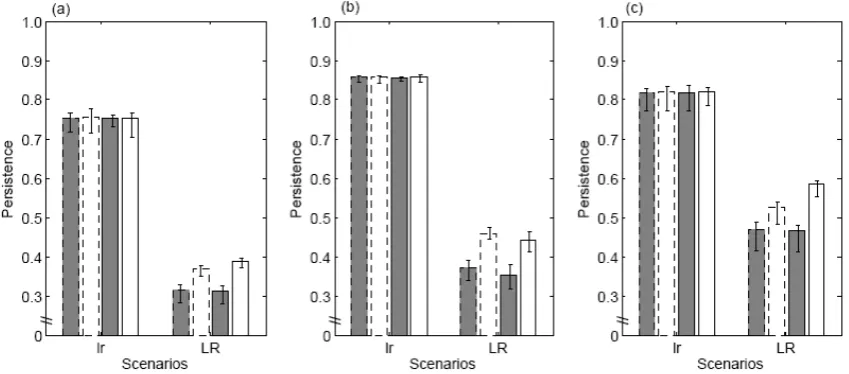
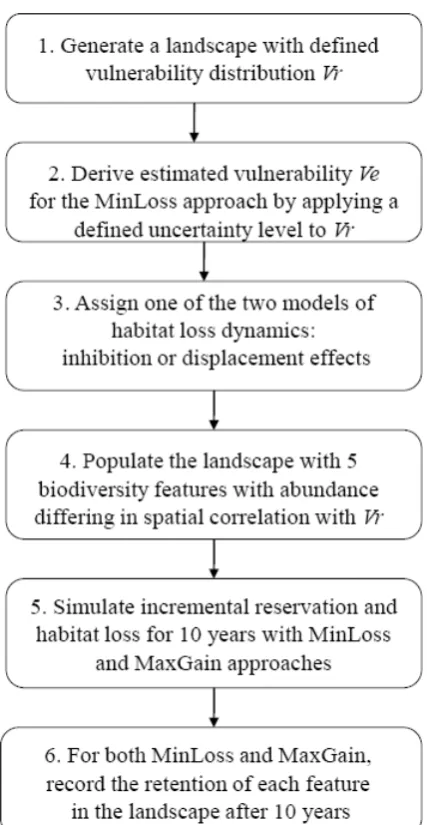
(12) conservation-decision making with a focus on proactive and reactive approaches to priority setting. In this chapter I propose that the process of making assumptions explicit and testing them with scenarios and sensitivity analyses can help in reconciling apparently contrasting approaches to prioritization, and find an informed and more effective balance between proactive and reactive conservation. I find that assumptions regarding the irreplaceability of areas under threat, the viability of species in habitat fragments, and the relationship between costs and threats can significantly affect the spatial allocation of conservation efforts by shifting priorities in different ways with respect to the South American deforestation frontier. These assumptions should be critically evaluated before choosing an approach to priority setting, from the local to the global scale.. In the third chapter I test the implications for conservation effectiveness (persistence of three forest-dwelling species) of two assumptions when scheduling conservation actions: 1) that populations are viable in small fragments; and 2) that costs are homogeneous in the study area. I do this by incorporating realistic estimates of acquisition cost of private land and simulating the species-specific effect of fragmentation on the distribution of three forest-dwelling species in coastal New South Wales (Australia). I tested two approaches to scheduling Maximizing short term gain of biodiversity in reserves (MazGain) and Minimizing short term loss of biodiversity in the planning region (MinLoss). This is a local scale application respectively of a proactive and reactive approach to conservation. I find that, although accounting for fragmentation and variable site cost reduces the cost-effectiveness of MinLoss, this approach remains the most effective with respect to MaxGain.. In the fourth chapter I identify the conditions in which it is useful to incorporate information about habitat vulnerability (probability of development) in prioritization algorithms. I use computer simulations to investigate the role of various parameters in determining the best choice between three options: 1) using available vulnerability estimates when setting priorities; 2) investing in data collection to improve the accuracy of vulnerability estimates before selecting priority areas; or 3) discarding vulnerability altogether and selecting priority areas based only on biodiversity value and cost. I find that uncertainty in vulnerability estimate can alter the balance between proactive and reactive investments. In fact, when vulnerability estimates are on average 11.
(13) wrong by at least 50%, discarding vulnerability and taking a proactive approach is best. Improving vulnerability estimates is the most effective choice when vulnerability variance is high and uncertainty is between 20% and 50%, otherwise, using existing vulnerability estimates with a reactive approach is best.. In the fifth chapter I explore the implications for the conservation of terrestrial mammals in four global scenarios of human development from the Millennium Ecosystem Assessment (Millennium Ecosystem Assessment 2005b) and identify the future hotspots of global mammal conservation. I find that, across all scenarios, Mexico, most of South America and Sub-Saharan Africa will experience large losses of suitable habitat for many terrestrial mammals. Projected agricultural expansion both for food and energy crops will pose a severe threat to mammals in the coming decades.. This thesis has contributed to the theoretical advancement of the field by shedding light on the relative performance of different conservation planning approaches and testing their sensitivity to approximations in data and models. My research has also provided an empirical framework to evaluate the role of assumptions in conservation planning. The first step is to frame a conservation planning problem using decision-theory to identify conservation objectives, actions, benefits, costs, and constraints. Then a series of questions related to the validity of the data and models available to solve the problems is used to identify the parameters and processes (ecological and socio-economic) for which more uncertainty exists. Different assumptions and different approaches to solve the conservation planning problem are then tested with different scenarios, each reflecting a different assumption about parameters and models. Combining the structured approach to problem-solving of decision-theory with the flexibility and foresight of scenario planning allows planners to make and learn from false assumptions without paying the consequences of real world mistakes. This, in turn, can provide insights on the approach to conservation that is most robust to future uncertainties.. This thesis might also contribute to advancing conservation practice. The rules of thumb and recommendations on optimal priority setting for conservation practitioners stemming from my research can have important practical consequences for conservation decisions at local to global 12.
(14) scales.. 13.
(15) Publications associated with this thesis This thesis is based on the following manuscripts published or in preparation which have been edited here to reduce redundancy and ensure a consistent terminology •. Visconti P., Pressey R.L., Ban N.C. Gardner T.A. Bottrill M.C., Watson J.E.M., Balancing proactive and reactive conservation approaches: the role of assumptions. In preparation. •. Visconti, P., Pressey, R.L., Segan, D.B., Wintle, B.A., 2010. Conservation planning with dynamic threats: The role of spatial design and priority setting for species' persistence. Biological Conservation 143, 756-767.. •. Visconti, P., Pressey, R.L., Bode, M., Segan, D.B., 2010. Habitat vulnerability in conservation planning—when it matters and how much. Conservation Letters 3, 404-414.. •. Visconti, P., R. L. Pressey, D. Giorgini, L. Maiorano, M. Bakkenes, L. Boitani, R. Alkemade, A. Falcucci, F. Chiozza, and C. Rondinini. 2011. Future hotspots of terrestrial mammal loss. Philosophical Transactions of the Royal Society B 1578.. 14.
(16) Table of Contents Statement of sources declaration .................................................................................................... 3 Abstract ........................................................................................................................................ 10 List of Figures ............................................................................................................................... 19 List of Tables ................................................................................................................................ 21 Chapter 1: Introduction ................................................................................................................. 22 1.1 Global biodiversity loss and conservation biology ................................................................. 22 1.2 Introduction to systematic conservation planning .................................................................. 23 1.2.1 Ad hoc conservation planning .......................................................................................... 23 1.2.2 The rise of systematic conservation planning .................................................................. 23 1.2.3 Conservation planning algorithms ................................................................................... 25 1.2.4 Recent evolution of systematic conservation planning.................................................... 26 1.3 Dynamic conservation planning ............................................................................................. 27 1.4 Emerging issues in dynamic conservation planning ............................................................... 29 1.4.1 Conservation costs ........................................................................................................... 29 1.4.2 Biodiversity processes ..................................................................................................... 30 1.4.3 Methods to deal with uncertainty in biodiversity data, costs and threats ........................ 31 1.4.4 Incorporating conservation planning into future global change scenarios ...................... 33 1.5 Thesis objectives ..................................................................................................................... 34 1.6 Thesis outline .......................................................................................................................... 34 Chapter 2. Balancing proactive and reactive conservation approaches: the role of assumptions. 36 2.1 Introduction ............................................................................................................................. 37 2.2 Methods................................................................................................................................... 42 2.2.1 Identification of assumptions ........................................................................................... 42 2.2.2 Data and models ............................................................................................................... 43 2.2.3 Analyses of assumptions .................................................................................................. 44 2.3 Results and Discussion ........................................................................................................... 46 2.3.1 Assumptions..................................................................................................................... 46 2.3.2 Assumptions and proactive/reactive conservation ........................................................... 53 2.3.3 Further improvements of the method............................................................................... 54 2.3.4 Beyond assumptions ........................................................................................................ 54 15.
(17) 2.3.5 Conclusions ...................................................................................................................... 55 Chapter 3: Conservation planning with dynamic threats: the role of spatial design and priority setting for species’ persistence...................................................................................................... 57 3.1. Introduction ............................................................................................................................ 58 3.2. Methods.................................................................................................................................. 60 3.2.1 Study region and species .................................................................................................. 60 3.2.2 Planning units................................................................................................................... 61 3.2.3 Study design ..................................................................................................................... 62 3.2.4 Simulation of reserve scheduling ..................................................................................... 63 3.2.5 Species models ................................................................................................................. 64 3.2.6 Land use change model .................................................................................................... 65 3.2.7 Cost of reservation ........................................................................................................... 66 3.2.8 Reserve selection strategies ............................................................................................. 66 3. 2.9 Evaluation of the performance of reserve selection strategies........................................ 68 3.2.10 Measuring the effect of fragmentation ........................................................................... 69 3.3 Results ..................................................................................................................................... 69 3.3.1 Correlation between vulnerability, species abundance and cost ...................................... 69 3.3.2 Reserve selection strategies ............................................................................................. 70 3.4. Discussion .............................................................................................................................. 74 Chapter 4. Habitat vulnerability in conservation planning - when it matters and how much....... 78 4.1 Introduction ............................................................................................................................. 79 4.2 Methods................................................................................................................................... 82 4.2.1 Study design ..................................................................................................................... 82 4.2.2 Simulations ...................................................................................................................... 83 4.2.3 Evaluation ........................................................................................................................ 85 4.3 Results ..................................................................................................................................... 86 4.3.1 Minimum retention .......................................................................................................... 86 4.3.2 Features with different spatial correlation with vulnerability .......................................... 90 4.3.3 Overall effects and interactions ....................................................................................... 91 4.4 Discussion ............................................................................................................................... 94 4.4.1 Spatial correlation between biodiversity value and vulnerability of areas ...................... 94 16.
(18) 4.4.2 Displacement or inhibition of biodiversity loss by new reserves .................................... 94 4.4.3 Spatial variance in vulnerability ...................................................................................... 95 4.4.4 Uncertainty in estimates of vulnerability ......................................................................... 95 4.4.5 Rules of thumb for conservation decision-making .......................................................... 96 4.4.6 Applying the rule of thumb to real-world case studies .................................................... 97 4.4.7 Limitations ....................................................................................................................... 99 Chapter 5. Future hotspots of terrestrial mammal loss ............................................................... 100 5.1. Introduction .......................................................................................................................... 101 5.2. Methods................................................................................................................................ 102 5.2.1 Habitat suitability and land use change models ............................................................ 102 5.2.2. Loss measures ............................................................................................................... 104 5.2.3 Analyses ......................................................................................................................... 106 5.3. Results .................................................................................................................................. 107 5.3.1 Richness weighted by global loss .................................................................................. 107 5.3.2 Richness weighted by national contribution to global loss ............................................ 108 5.3.3 Richness of species with large global declines .............................................................. 108 5.3.4 Overlap between current global priorities and future hotspots of loss for mammals .... 111 5.4. Discussion ............................................................................................................................ 111 5.4.1 Patterns of global and national losses in relation to scenarios of the Millennium Ecosystem Assessment ........................................................................................................... 111 5.4.2 My results relative to other global assessments ............................................................. 113 5.4.3 Current and future international conservation priorities ................................................ 114 5.4.4 National conservation priorities and reporting .............................................................. 116 5.4.5 Limitations ..................................................................................................................... 116 5.4.6 Challenges in avoiding predicted losses ........................................................................ 118 Chapter 6: General discussion and conclusions .......................................................................... 120 6.1 Thesis outcomes .................................................................................................................... 121 6.2 Limitation of this study and future research directions ........................................................ 124 6.2.1 Conservation actions in addition to protected areas ...................................................... 124 6.2.2 Algorithms to minimize habitat loss and fragmentation when scheduling conservation actions ..................................................................................................................................... 125 17.
(19) 6.2.3 Accuracy of land-use change models ............................................................................ 125 6.2.4 Further examination of uncertainty in vulnerability estimates ...................................... 125 6.2.5 Incorporating conservation opportunities ...................................................................... 126 6.2.6 Effectiveness of expanding protected area networks in the context of future human development scenarios ............................................................................................................ 127 6.3 Cutting edge dynamic conservation planning science .......................................................... 127 6.3.1 Improved prioritization algorithms ................................................................................ 128 6.3.2 Biodiversity distribution and dynamics ......................................................................... 129 6.3.3 Land use change modelling ........................................................................................... 129 6.3.4. Conservation costs ........................................................................................................ 130 6.3.5 Conservation opportunities ............................................................................................ 131 6.4 Concluding remarks: integrating dynamic conservation planning with land use planning and socio-economic scenario modelling............................................................................................ 131 Bibliography ............................................................................................................................... 135 Appendices .................................................................................................................................. 155 7.1 Appendices chapter 2 ............................................................................................................ 155 7.2 Appendices chapter 3 ............................................................................................................ 158 7.3 Appendices chapter 4 ............................................................................................................ 167 7.4 Appendices chapter 5 ............................................................................................................ 176. 18.
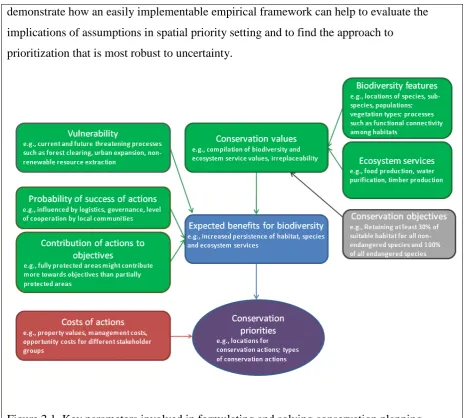
(20) List of Figures Figure 1.1 Thesis structure. Blue boxes represent data chapters, the red box is a context element, and green boxes depict the general introduction and discussion. ................................................. 35 Figure 2.1. Key parameters involved in formulating and solving conservation planning problems. ....................................................................................................................................................... 42 Figure 2.2 South America with the threat frontier in red (hatched) and IUCN category I-IV protected areas (UNEP-WCMC 2009) in yellow. ........................................................................ 48 Figure 2.3. Variation in area allocated for conservation of South American terrestrial mammals across wilderness and threat frontier............................................................................................. 49 Figure 3.1 The study region. ......................................................................................................... 61 Figure 3.2 Study design. ............................................................................................................... 63 Figure 3.3 Effects of habitat fragmentation on study species. ...................................................... 71 Figure 3.4 Pairwise comparisons of reserve selection strategies in the base scenarios. ............... 73 Figure 3.5 Pairwise comparisons of reserve selection strategies using area as a surrogate for cost. ....................................................................................................................................................... 73 Figure 4.1. Study design. .............................................................................................................. 83 Figure 4.2. Difference in minimum retention across 5 biodiversity features between MinLoss and MaxGain and implications for managers. ..................................................................................... 87 Figure 4.3. Distribution of values of minimum retention across 5 biodiversity features for MinLoss and MaxGain with inhibition and displacement effects. ............................................... 89 Figure 4.4. Differences in retention between MinLoss and MaxGain across 5 biodiversity features. ......................................................................................................................................... 91 Figure 5.1 Global patterns of projected mammal loss in relation to global Biodiversity Hotspots ..................................................................................................................................................... 110 Figure 5.2 Scatter plot of countries in relation to the two weighted richness measures. ............ 115 Figure 7.1 Richness of under-represented species when opportunity costs for agricultural activities were spatially variable. ................................................................................................ 157 Figure 7.2. An example of the vulnerability distributions tested with different variances. ........ 170 Figure 7.3 Absolute difference between MinLoss and MaxGain in minimum retention across 5 biodiversity features, using an alternative application of uncertainty about estimated vulnerability. ............................................................................................................................... 172 19.
(21) Figure 7.4. Difference between MinLoss and MaxGain in minimum retention across 5 biodiversity features with the permutation-based application of uncertainty about vulnerability estimates and 2% habitat loss rate. ............................................................................................. 173 Figure 7.5. Difference between MinLoss and MaxGain in minimum retention across 5 biodiversity features with the alternative application of uncertainty about vulnerability estimates and 2% habitat loss rate. ............................................................................................................. 174 Figure 7.6. Average number of declining species across all scenarios versus average National Contribution to Global Loss (NCGL). ........................................................................................ 179 Figure 7.7. Present and future conservation priorities at 6' resolution........................................ 184 Figure 7.8. Mammal richness weighted by average global loss across the four scenarios and by the proportion of species range in each country (GLC). ............................................................. 185. 20.
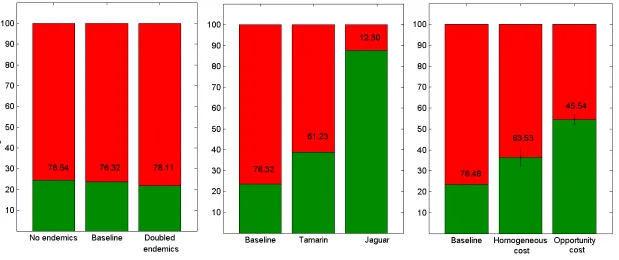
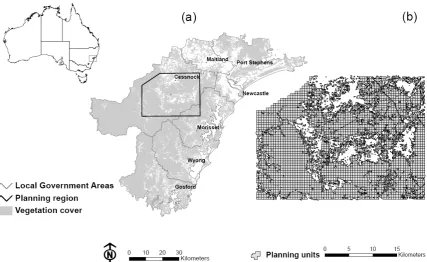
(22) List of Tables Table 3.1. Explanation for symbols .............................................................................................. 67 Table 4.1. Factors known or expected to affect the relative performance of MaxGain and MinLoss. ....................................................................................................................................... 81 Table 4.2 ANOVA results with the response variable being the difference between MinLoss and MaxGain in minimum retention across all 5 features. .................................................................. 92 Table 4.3. ANOVA results with the response variable being the difference between MinLoss and MaxGain in retention for each of the 5 features individually. ...................................................... 93 Table 4.4. Two case studies investigating relative performance of MinLoss and MaxGain. ....... 98 Table 7.1. Abbreviated names and definitions of the final predictor variables in the “local” and “neighbourhood” habitat models. ............................................................................................... 159 Table 7.2. Final Local and Neighbourhood models and bootstrapped estimates of predictive discrimination given by the area under the Receiving Operating Characteristic Curve ............. 160 Table 7.3 Fifth, 50th and 95th percentiles of persistence values (proportion of occurrences still extant at a given time) for all species and all strategies at years 10, 20, 30, 40. ........................ 163 Table 7.4 Classes in Global landcover classification 2000 (GLC2000) ..................................... 176 Table 7.5. Conversion of GLOBCOVER classes into GLC2000 classes for habitat suitability models ......................................................................................................................................... 180 Table 7.6 The 43 countries and territories excluded from this study because of small size ....... 182 Table 7.7 Country names and abbreviated labels in figure 5.2 and figure 7.4.1. ....................... 182. 21.
(23) Chapter 1: Introduction. 1.1 Global biodiversity loss and conservation biology The present and projected rate of species extinction and habitat degradation is such that some argue that we have entered a new era, the "Anthropocene", in which humans exert such a powerful influence on the physical aspects of the planet as to bring it into new stable states (Crutzen 2002; Rockström et al. 2009). Despite progress where conservation actions have been implemented (Hoffmann et al. 2010), most biodiversity indicators point to a steady decline of biodiversity (Butchart et al. 2010) caused by habitat loss and degradation, direct killing and harvesting, invasive species, and climate change, among other factors (www.iucnredlist.org). Conservation biology is the discipline tasked with providing the scientific knowledge to address the human-induced biodiversity crisis (Soule 1985). Within conservation biology, conservation planning is the body of knowledge that addresses the problem of identifying and managing priority areas and species for conservation to protect them from threatening processes (Margules & Pressey 2000).. Setting conservation priorities is necessary because the financial resources available are largely insufficient to protect all areas of high biodiversity value from current and future threats. Globally, it is estimated that the expansion and management of a comprehensive network of conservation areas would cost US$18-28 billion annually over the next 30 years (James et al. 2001). This is far in excess of current expenditure, estimated at around US$6 billion per year (Balmford et al. 2003). Conservation planning is tasked with finding methods that identify areas for protection that advance the most towards set conservation objectives at the least cost or within budgetary constraints (Margules & Pressey 2000).. This thesis expands on the existing body of knowledge in conservation planning, with a focus on the allocation of conservation priorities over space and time: i.e. scheduling conservation actions, or dynamic conservation planning. In particular, I address some of the major challenges of adding a dynamic component to systematic conservation planning by considering biodiversity 22.
(24) responses to habitat loss and fragmentation and understanding the role of threat estimates in setting priorities at the landscape or seascape scale. I investigate the effect of adding these realworld complexities in the light of different approaches to priority setting: proactive conservation which avoids threatened areas and reactive conservation that prioritize them. My thesis also provides advancement to the broader discipline of conservation planning by investigating the effects of assumptions underlying decisions about conservation priorities, and the utility of using scenario planning to set priorities. Below I explain the necessity of dynamic conservation planning by briefly summarizing the history of systematic conservation planning.. 1.2 Introduction to systematic conservation planning 1.2.1 Ad hoc conservation planning Humans have set aside land for the preservation of natural values for millennia. Royal hunting forests (Kanowski et al. 1999) and sacred sites are clear examples of this (Chandrashekara & Sankar 1998). The year 1872 signaled the birth of the world's first national park: Yellowstone National Park in the United States. The first national parks were established for their aesthetic and wilderness values, not primarily for protecting biodiversity. As a result, they did not represent all components of biodiversity, but rather were biased towards protecting large, conspicuous and charismatic species (Pressey 1994). Additionally, much of the land set aside for conservation was of little economic value (Pressey 1994) and was typically located in steep, infertile areas, or areas otherwise inhospitable for humans (e.g., areas infested by tsetse flies in Zambia (Leader-Williams & Harrison 1990)). This form of opportunistic reservation has inspired terms to describe protected areas1 such as “worthless land” (Runte 1979), “the land nobody wanted” (Shands & Healy 1977), “high and far” (Joppa & Pfaff 2009), and "rock and ice". Reserves were, and often still are, selected opportunistically, commonly by relying on expert judgement. 1.2.2 The rise of systematic conservation planning In recognition that protected areas left much of biodiversity unprotected, more recent designations included biodiversity protection as a rationale for establishment, and methods of 1. I use interchangeably the terms protected area, conservation area and reserve throughout the thesis.. 23.
(25) prioritization have become more explicit. The first explicit method to select nature reserves emerged in the 1970s, which identified sites of conservation interest in the UK (Ratcliffe 1971; Ratcliffe 1977). Criteria like naturalness, richness (of species and habitats), rarity, vulnerability, connectivity and representation were for the first time explicitly accounted for in the selection of nature reserves. According to Justus and Sarkar (2002), these principles came about because the rapid increase in protected areas during the 1960s still left much of biodiversity unprotected while threats to biodiversity were increasing, and, therefore, explicit criteria for selecting areas to reserve were needed.. A new generation of scientific methods to select reserves emerged out of the recognized need for reserves to protect biodiversity. The first reserve selection algorithm was developed in 1980 in Tasmania, where Jamie Kirkpatrick was working to identify a minimum set of reserves to complement existing ones in protecting some of the island’s endemic and endangered plants. He devised an iterative heuristic algorithm (decision rules iteratively used to select sites to add to the conservation portfolio) that, for the first time, included the concept of complementarity (although it was not explicitly defined so). Complementarity reflects “the need for reserves to complement, rather than unnecessarily duplicate, other areas according to unachieved targets for the features they contain” (Pressey 2002). Kirkpatrick’s seminal work (Kirkpatrick 1983) laid the groundwork for a new algorithmic approach “in which the criteria invoked were applied mechanically to remove any residue of intuitive judgment” (Justus & Sarkar 2002).. Around the same time as Kirkpatrick’s work, a number of researchers independently realized that selecting reserves based on ranked lists developed by earlier explicit scoring methods was not the most efficient way to represent all species in a reserve network (Ackery & Vane-Wright 1984; Margules et al. 1988; Rebelo & Siegfried 1990). A limitation of ranked lists is that, if two areas are both rich in species (and are consequently ranked highly) but share a large number of species, they would simply duplicate each other. Therefore, the next best option would be the area that adds the most species that have not already been represented. This is what was later called the principle of complementarity (Vane-Wright et al. 1991). The inception and evolution of complementarity-based conservation planning algorithms is reviewed in Justus and Sarkar (2002). 24.
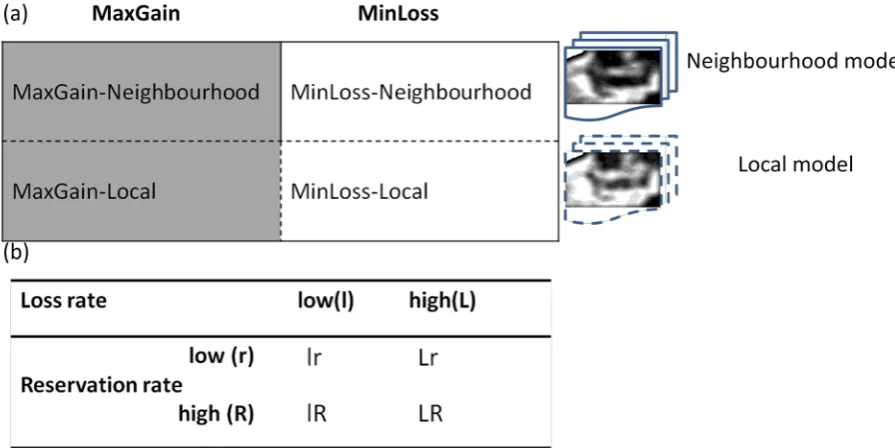
(26) 1.2.3 Conservation planning algorithms The concept of complementarity, together with the use of explicit, quantitative objectives is common to all systematic conservation planning algorithms. The first iterative heuristics relied on complementarity, often coupled with richness and rarity to solve the problem of representing certain species in the smallest number of reserves; this is a conservation application of the minimum set problem of operation research (Possingham et al. 1993) However, while iterative heuristics are more efficient than ad hoc methods or scoring approaches, they cannot guarantee an optimal solution (i.e., the most efficient solution). Because complementarity is an emergent property of a set, it can only be fully assessed if a whole set of candidate reserves is evaluated together rather than making iterative selections of the bestranking site according to the chosen criteria (Possingham et al. 2000). Global search methods such as simulated annealing (Kirkpatrick et al. 1983) and genetic algorithms (Goldberg 1989) can approximate optimal solutions by making random changes to an entire set of candidate reserves and gradually improving the overall efficiency of the proposed reserve network (note that optimality is not guaranteed because global search methods, despite the name, do not sample the entire solution space). They can quickly find solutions close to a global optimum of a minimum set problem and would typically outperform iterative heuristics, especially when spatial configuration is one of the objectives (Moilanen 2005; Possingham et al. 2000). In fact, spatial processes such as fragmentation and connectivity are emergent properties of a system, similarly to complementarity; as such they can be addressed more effectively when the entire set of proposed reserves is evaluated. There are many ecological and practical reasons why one would want a reserve system to be more compact rather than fragmented. One way to achieve this is to reduce the overall boundary of the reserve system (Possingham et al. 2000), thereby favouring compact reserves over thin, elongate ones and few large reserves over many small ones. This in turn would reduce edge-effects and isolation while improving manageability of the network.. To find global optimal solution to a conservation planning problem, one need to use algorithms that can solve the problem as a mathematical function, for example linear programming (Haight & Snyder 2009) or stochastic dynamic programming (Costello & Polasky 2004; Possingham et al. 1993). While these algorithms can guarantee to find an optimal solution, they can only solve 25.
(27) problems defined by a limited number of planning units (individual areas assessed in the prioritization process) and number of biodiversity features. In the case of stochastic dynamic programming, the planning units are normally less than 20. Linear programming can deal with larger problems (tens of thousands of planning units) but can only solve linear problems, thus excluding cases in which the benefits of incorporating any planning unit are not additive, for example when connectivity is taken into account (Moilanen 2008). Therefore, there exist two options for approaches that do not guarantee optimality. The first is based on a major simplification of a conservation planning problem into a problem solvable with optimal algorithms. This solution would be the most efficient for the simplified problem, and might involve substantial progress in the development of computational methods, but would be suboptimal or simply fail if evaluated with a more realistic model system. The second option is based on the solution of the more realistic and complicated problem, not solvable with optimal algorithms but with suboptimal heuristics. The latter solution would not be the most efficient but certainly more realistic (Moilanen 2008), and therefore I use this option in the chapters that follow. 1.2.4 Recent evolution of systematic conservation planning Systematic conservation planning has been evolving rapidly in the last decade. It began as a discipline focused on finding the most efficient, adequate and representative set of reserves to achieve a set of explicit objectives. While retaining those capabilities, it is broadening into socioeconomic and political considerations that assist the whole process of defining priorities, designing conservation plans and implementing conservation actions. Conservation planning algorithms have evolved to address more complex theoretical and practical planning needs. During the 90s and early 2000s, systematic conservation planning algorithms incorporated more complex theoretical issues such as economic costs (Ando et al. 1998; Naidoo et al. 2006; Polasky et al. 2001) measures of biodiversity such as abundance of a species (Rodrigues et al. 2000), probability of occurrence (Araujo & Williams 2000; Cabeza et al. 2004; Wilson et al. 2005b), and spatial aspects such as level of aggregation and minimum sizes of protected areas (Ball & Possingham 2000; McDonnell et al. 2002; Nicholls & Margules 1993; Possingham et al. 2000). In the late 2000s, systematic conservation planning evolved to address the needs of real-world conservation problems, including bridging the gap between planning and implementation. 26.
(28) (Knight et al. 2006; Pressey & Bottrill 2008). Consequent advances in problems and algorithms included the consideration of multiple conservation costs (Watts et al. 2009), multiple conservation actions and zoning (Watts et al. 2009), species-specific benefit functions (Arponen et al. 2005; Moilanen 2007), species-specific connectivity measures (Moilanen & Wintle 2007), probability of success of conservation (Guerrero et al. 2010; McBride et al. 2007), and species interactions (Rayfield et al. 2009). The advances in algorithms have been mirrored by the emergence and evolution of a more comprehensive operational framework for conservation planning. The 11 stages of conservation planning (Pressey & Bottrill 2009) elaborate on the 6 proposed by Margules and Pressey (2000) later expanded by Margules and Sarkar (2007). The new framework emphasizes the importance of goal-setting and stakeholder involvement to ensure maximum implementability of a conservation plan.. 1.3 Dynamic conservation planning Conservation plans in general, including those developed using a systematic approach are rarely implemented all at once because of limited funding, staff and implementation opportunities (Meir et al. 2004). Regional and local conservation plans are therefore implemented over a period of time during which new opportunities and threats commonly arise. For example, some of the areas flagged as priorities for conservation might lose their value before being protected because of conversion to agricultural land or urban development (Pressey & Taffs 2001). Such ongoing losses highlight the need for planners to prioritize conservation actions within the planning region according to the immediacy of threats to areas and species, their biological value, alternative options for protection, and implementation opportunities and costs. This prioritization process is called conservation scheduling, and the body of research addressing it comes under the area of research of Dynamic Conservation Planning (Costello & Polasky 2004). Scheduling conservation actions requires planners to anticipate future spatial patterns of threats, such as deforestation, and to evaluate how these patterns may change depending on the sequence of conservation actions implemented. This is done by modelling threats such as land-use change in parallel with reservation and letting the competing processes interact during the planning period (the period over which scheduling occurs). The best reservation strategy would be the one yielding the highest biodiversity value retained at the end of the planning period.. 27.
(29) Conservation scheduling is not only a theoretical exercise. It is implicitly or explicitly done in practical conservation every time choices are made about what to protect first and what to leave for later. Conservation NGOs, for example, use scoring methods to identify priorities within priorities, such as those within the Ecoregional Planning framework of TNC and WWF (The Nature Conservancy 2002; The Nature Conservancy and World Wildlife Fund 2006).. As with the minimum set problem, scheduling can be solved with heuristics (Moilanen & Cabeza 2007; Pressey & Taffs 2001; Pressey et al. 2004; Spring et al. 2007; Turner & Wilcove 2006; Wilson et al. 2006), or optimal algorithms such as Integer Linear Programming (Snyder et al. 2004) or Stochastic Dynamic Programming (Drechsler 2005; Spring et al. 2007; Strange et al. 2006; Wilson et al. 2006). Two heuristic approaches define the extreme of a spectrum of possible approaches to scheduling conservation actions: maximizing short-term gain and minimizing short-term loss (Murdoch et al. 2007; Wilson et al. 2006). Maximizing short-term gain (MaxGain) has been also called “pre-emptive” (Spring et al. 2007), benefit/cost targeting (Newburn et al. 2005) and “myopic” (Costello & Polasky 2004). Minimizing short-term loss (MinLoss) has been called, “fire-fighting” (Spring et al. 2007), benefit loss/cost targeting (Newburn et al. 2005), and “informed myopic” (Costello & Polasky 2004). MaxGain aims to maximize biodiversity benefit in conservation areas at a given cost (maximal coverage problem) or achieve conservation objectives in conservation areas at a minimum cost (minimum set problem). Benefit can be measured as richness, representation, abundance of species/habitats, or in other ways. MaxGain assumes that everything outside conservation areas will eventually be lost and therefore effective conservation will need to represent all the valued biodiversity in a network of conservation areas. On the other hand, MinLoss aims to minimize biodiversity loss in the entire planning region. This is equivalent to maximizing the retention of biodiversity value in the region and requires planners to account for the different levels of vulnerability of areas and biodiversity features to the threats being addressed. MaxGain is a proactive approach to conservation because it ignores threats and would tend to protect species where it is cheapest to do so, often in remote areas that are not immediately threatened (Newburn et al. 2005). MinLoss is a more reactive approach because it focuses on areas and species that are threatened now or at least within the planning horizon.. 28.
(30) 1.4 Emerging issues in dynamic conservation planning Dynamic conservation planning is arguably 18 years old - the first formulation of a dynamic conservation planning problem dates to 1993 (Possingham et al. 1993). However, most of the research in the field has been carried after 2004 following the publication of three key papers (Costello & Polasky 2004; Meir et al. 2004; Pressey et al. 2004). This is therefore a very young discipline and, as such, has explored only little of the complexity of real world scheduling problems – a limitation that I try to address in my thesis. Below are some gaps in knowledge and methodology that are relevant for this thesis. Other major gaps that were not specifically addressed in my thesis are discussed in the last chapter. 1.4.1 Conservation costs Conserving biodiversity with limited budgets stresses the need to be cost-efficient and requires allocating resources to actions that give the biggest return on investment (Ando et al. 1998; Carwardine et al. 2008; Murdoch et al. 2007; Naidoo et al. 2006; Polasky 2008; Polasky et al. 2001). Conservation costs can vary by many orders of magnitude across candidate areas for protection and this variation can be the main factor influencing conservation priorities based on return on investment (Bode et al. 2008). The need for accurate estimates of conservation costs at the appropriate scale applies to all conservation planning applications, but here I focus on dynamic conservation planning where the use of costs has been quite limited to date.. Some dynamic conservation planning studies have applied global datasets of conservation costs at the country-level (Wilson et al. 2006), others have used area as a surrogate for cost (Nicholson et al. 2006; Pressey et al. 2004), while others have ignored costs altogether (Cabeza 2003; Cowling et al. 2003). Ignoring costs is unsatisfactory from a theoretical point of view as the spatial variation in conservation costs can differ from that of threats and biodiversity values. Ignoring costs is also unsatisfactory from a practical point of view as unnecessarily expensive solutions are less likely to be implemented. Using coarse-resolution cost estimates with unknown accuracy is also inappropriate as these estimates are blind to variation in costs within planning units and can potentially misplace conservation actions in areas that are not cost-efficient. Fineresolution and accurate estimates of conservation costs are therefore ideal for cost-efficient conservation spending (Polasky 2008). Techniques for estimating costs at fine resolutions are 29.
(31) now available for both marine and terrestrial environments (Adams et al. 2011; Carwardine et al. 2008; Naidoo & Adamowicz 2006). Their incorporation into dynamic conservation planning is necessary to bridge the gap between research and implementation as well as to advance the theoretical understanding of optimal scheduling of conservation actions. I advance the thinking on conservation costs by including fine-scale estimates of costs, investigating the spatial relationship between cost and urgency to act and its implication for conservation scheduling (chapters 2-4). 1.4.2 Biodiversity processes Biodiversity is generated and maintained by long-term processes such as evolution, and faster processes such as population dynamics, dispersal, migration, species interaction and patch dynamics. These processes occur at all spatial scales, including regional and continental. At these scales they cannot be captured by a single conservation area but can only be maintained and managed by entire networks; ergo the value of reserve networks is more than the sum of their parts (individual reserves). These emergent properties of reserve networks are only evident when one looks at processes such as evolution (gene flow among populations and genetic isolation of distinct populations), population dynamics (metapopulation dynamics, source-sink dynamics), and patch dynamics (fire regimes, coral bleaching, nutrient upwelling). During the protracted time over which reserve networks are expanded, these emergent properties can be disrupted unless their persistence is explicitly considered among the conservation objectives (Pressey et al. 2007). Because the persistence of biodiversity processes requires large areas to be protected and managed, these can often only be maintained in remote areas, where the conflict with alternative uses is lower and so is the opportunity cost for conservation; this is often raised as an argument for proactive conservation (Laurance, 2005, Cantú-Salazar & Gaston 2010).. Only very few studies have accounted for processes in conservation planning. Static conservation planning studies have recently started to incorporate biodiversity processes such as diversification of lineages (Rouget et al. 2003), metapopulation dynamics (Nicholson et al. 2006), species interactions (Rayfield et al. 2009), climatic stability (Carroll et al. 2010), patch dynamics (Game et al. 2008), terrestrial inter-patch connectivity (Cerdeira et al. 2005; Moilanen & Wintle 2007; Van Teffelen et al. 2006), freshwater connectivity (Linke et al. 2008; Moilanen. 30.
(32) et al. 2008), and inter-realm connectivity (Beger et al. 2010). Little has been done on scheduling conservation actions while accounting for biodiversity processes and this has been limited to the incorporation of connectivity to minimize the level of isolation between reserves (Harrison et al. 2008; Sabbadin et al. 2007; Spring et al. 2010) and climatic stability (Iwamura et al. 2010). Other factors affecting local population persistence, such as the effects of fragmentation, have been so far neglected in dynamic conservation planning. I contribute towards filling this gap in chapter 3 by accounting for species-specific habitat fragmentation effects during simulated incremental protected area network expansion. 1.4.3 Methods to deal with uncertainty in biodiversity data, costs and threats Conservation planning, like any other scientific discipline, relies on models of the real world. These can approximate more or less well the complex ecological and socio-economic dynamics underpinning conservation decision-making. When testing and comparing conservation planning strategies, it is often forgotten that these tests reflect the apparent performance of prioritization methods based on models and simulated or estimated data, not on real and observed data (Grand et al. 2007; Halpern et al. 2006; Langford et al. 2009; Moilanen & Cabeza 2005; Moilanen et al. 2006a; Moilanen & Wintle 2006; Moilanen et al. 2006b). However, it is known that the relative performance of conservation planning strategies can be influenced by the accuracy of data and models (Langford et al. 2009; Moilanen & Wintle 2006). Because uncertainty is pervasive, it is therefore important to account for uncertainty in systematic conservation planning theory, if this is to be relevant to conservation practice (Regan et al. 2009).. Investigations of the sensitivity of conservation plans to inaccurate data have considered cost estimates (Carwardine et al. 2010), measures of biodiversity value (Grantham et al. 2008; Moilanen et al. 2006a; Moilanen et al. 2006b), land and funding availability (Meir et al. 2004) and likelihood of success (McBride et al. 2007), but there is no published study that investigated the effects of uncertainty about threatening processes. Vulnerability to threats underpins the difference between proactive and reactive conservation and between MaxGain and MinLoss conservation approaches. Thus it is intuitive that uncertainty about threats might affect the relative performance of one approach over the other. Therefore, understanding this relationship would be key to determining the best prioritization approach in a given conservation context.. 31.
(33) Robustness of the spatial location and effectiveness of conservation priorities to uncertainty in data and models is crucial to give planners, donors and other stakeholders the required confidence to defend and implement a conservation plan. There are several possible methods to deal with uncertainty in ecology and conservation (reviewed in Regan et al. 2009). The main ones are sensitivity analyses, info-gap theory and conservation scenarios. Sensitivity analyses, consist in perturbing the input data (cost, biodiversity data, threats) and assessing the variation in outputs (spatial priorities) and outcomes (e.g. biodiversity representation or persistence, Regan et al. 2009). This allows identification of the conservation approach most robust to uncertainty as well as the input parameters that most influence priorities and effectiveness of a proposed plan. Unless the entire possible parameter space is tested, sensitivity analyses require prior knowledge or assumptions about the likely distribution of parameter values to be used. I use this approach in my thesis to test which factors influence the most the choice between MaxGain and MinLoss conservation strategies (chapter 4). Another option is to use info-gap theory (Ben-Haim 2006). This approach flips the problem of robustness on its head because it estimates how wrong can one be and still get an acceptable result rather than, with sensitivity analysis, perturbing the input data and observing their influence on outcomes. Because info-gap theory explores the entire horizon of parameter's uncertainty, it is useful when there is little knowledge of the distribution, bias and magnitude of potential errors in data and models and when, therefore, sensitivity analyses are not feasible (Adams & Pressey 2011; Ben-Haim 2006; Nicholson 2007; Regan et al. 2005).. A third option to addressing uncertainty explicitly is to use scenarios to model a few plausible conditions in which conservation has to take place, that is, a few combinations of parameters and models. The outcomes of a conservation portfolio are then tested in each scenario. Scenarios are useful when there are many parameters to test at once and sensitivity analyses and info-gap become infeasible because of the required number of simulations to test all parameters interactions within the bounds of the sensitivity analysis or info-gap simulations. Scenarios are used to test a few plausible parameter combinations and learn about the effects of different factors with a limited, but representative, number of simulations. Scenarios represent individual points in the hypervolume defined by all parameter combinations of the model system and are 32.
(34) chosen based on specific assumptions about parameters and models. These assumptions make the exploration of uncertainty of several parameters at a time tractable.. While the use of scenarios has been advocated in conservation to identify conservation strategies more likely to be successful in a dynamic and uncertain future (Peterson et al. 2003), their use in dynamic conservation planning is still rare. In addition, in conservation planning there is a prevalence of single case studies relying on one or very few parameter combinations, which provide little guidance for conservation decisions outside the parameter space tested (Langford et al. 2009). I propose the use of scenarios to investigate the role of conservation assumptions in chapter 2 and put it in practice in chapters 3,4 and 5 to answer specific research question relevant to my thesis. 1.4.4 Incorporating conservation planning into future global change scenarios Anthropogenic biodiversity loss is ultimately caused by human consumption, which determines all the main threats to biodiversity, including habitat loss, direct killing and harvesting, spread of invasive species and climate change (Brook et al. 2008; Diamond 1984). Thus, to effectively abate threats to biodiversity, conservation planning scenarios need to include future development pathways, thereby taking into account the broader context in which conservation planning takes place. Even the most advanced methods and the best data to schedule conservation actions over time may not be sufficient to ensure biodiversity persistence if the main effect of these actions is to displace destruction elsewhere. This leakage of habitat destruction can have negative effects if the new areas destroyed are also important for biodiversity (Ewers & Rodrigues 2008). The advent of global and regional scenarios of socio-economic development with spatially explicit projections of land use and climate change, such as those created for the Millennium Ecosystem Assessment (Millennium Ecosystem Assessment 2005b) and the Global Environmental Outlook (UNEP 2007), provide unprecedented opportunities for conservation planning. They allow identification of conservation priorities based on information that goes beyond the spatial pattern of biodiversity, costs and local threats, but address also the opportunities and threats coming from improved technology, population growth, consumption, trade and other broad-scale considerations. I take advantage of these opportunities in chapter 5 by using scenarios from the Millennium Ecosystem Assessment to identify future hotspots of. 33.
(35) terrestrial mammal loss with different human development trajectories. .. 1.5 Thesis objectives The goal of my thesis is to advance the theory and practice of dynamic conservation planning by filling key knowledge and methodological gaps. These gaps are highlighted in the previous paragraphs. To achieve this goal, I identified the following research objectives: 1. Provide a framework to identify influential assumptions in dynamic conservation planning and test their effects on the spatial pattern of conservation priorities and on the effectiveness of a proposed plan. 2. Explicitly incorporate biodiversity processes (habitat connectivity) nd variable site costs in dynamic conservation planning. 3. Identify the conditions in which habitat vulnerability needs to be accounted for in dynamic conservation planning. 4. Consider the utility of future global change scenarios, involving models of biodiversity loss, for conservation planning by applying these to predict the future conservation status of terrestrial mammals.. 1.6 Thesis outline This thesis consists of six chapters (see Figure 1 for the links between thesis objectives and chapters). The present introductory chapter provides the context and objectives of the thesis. The second chapter (first research chapter) sets the scene by investigating the influence of assumptions on conservation-decision making with a focus on proactive and reactive approaches to priority setting. In this second chapter I propose that the process of making assumptions explicit and testing them with scenarios and sensitivity analyses can help in reconciling contrasting approaches to prioritization, and find an informed and more effective balance between proactive and reactive conservation. In the third chapter I test the influence of two assumptions when scheduling conservation actions: 1) that populations are viable in small fragments; and 2) that costs are homogeneous in the study area. In the fourth chapter I identify the conditions in which it is useful to incorporate habitat vulnerability in prioritization algorithms. I use computer simulations to investigate the role of various parameters in. 34.
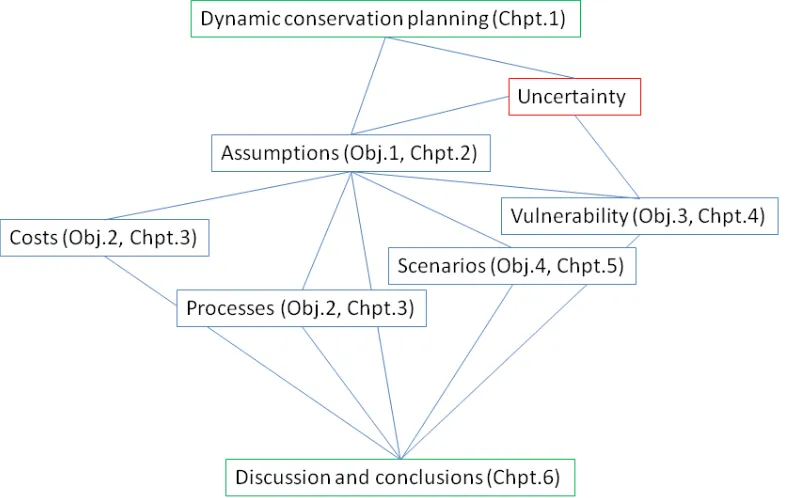
(36) determining the best choice between three options: 1) using existing vulnerability values when setting priorities; 2) investing in data collection to improve the accuracy of vulnerability estimates before selecting priority areas; or 3) discarding vulnerability altogether and selecting priority areas based only on biodiversity value and cost. In the fifth chapter I explore the implications for the conservation of terrestrial mammals of four global scenarios of human development from the Millennium Ecosystem Assessment (Millennium Ecosystem Assessment 2005b) and identify the future hotspots of global mammal conservation. In the sixth and concluding chapter I summarize the findings of my thesis, discuss the broader implications of my research, outline the lessons learnt, and suggest future research directions.. Figure 1.1 Thesis structure. Blue boxes represent data chapters, the red box is a context element, and green boxes depict the general introduction and discussion.. 35.
(37) Chapter 2. Balancing proactive and reactive conservation approaches: the role of assumptions Abstract Even though there is one fundamental goal for biodiversity conservation – to minimize biodiversity loss – different, and occasionally contradictory, approaches to conservation prioritization exist. For example, some approaches avoid vulnerable areas to invest in areas of comparative wilderness (proactive approaches), whilst others actively prioritize investments in threatened areas (reactive approaches). Assumptions about the relevance and quality of ecological and socio-economic data underpin contrasting approaches to conservation prioritization, although these assumptions are rarely made explicit. Here I demonstrate how different approaches to identifying conservation priorities, and their associated assumptions, can be evaluated with a simulation study that uses scenarios to evaluate the outcomes of changes to particular decision-making parameters. I selected three assumptions that I believe are both common and influential in conservation decision-making, and are applied at different spatial scales. I show how the relative benefits of proactive versus reactive approaches to conservation can change in response to a strengthening or relaxing of each of these assumptions. I found that assumptions about species overlap between wilderness and threatened areas and the viability of species in habitat fragments significantly affect the balance between proactive and reactive priority setting. All three assumptions potentially have severe negative consequences for conservation outcomes when they prove invalid. My analyses demonstrate that scenarios can be usefully applied to test assumptions and proposed conservation approaches in a "risk-safe" environment before applying them in the real world where every action and decision count.. 36.
Figure

+7


Related documents
One can precisely describe the degree of similarity between one entity and another entity, or the amount or content of information in a statement about another, such as statements
The User agrees that YLK makes no warranty that (a) the Services will be uninterrupted, timely, secure, error-free or compatible in any manner with the User’s software
However, when compared to non-palliative care patients, palliative care patients spent fewer nights in hospital, used fewer hours of home support, and had a greater number of
Over the recent years, foreign trade activities of the agricultural sector have shown surplus and increased rates of international trade, and later, provided
If several institutions are likely to receive the subsidies under the call for large-scale research infrastructure (Flemish universities, university colleges,
Those who provide, or m ay provide, resources to a not-for-profit organization usually need inform ation not only about sources of cha nges in its net assets—about transactions
nearsightedness between –3 diopters (D) to –15 diopters (D), and partially correct nearsightness up to 20 diopters in eyes with up to 2.5 diopters (D) of astigmatism If you
This study has important questions to be answered, namely how community empowerment in disaster risk reduction flood in Gampong Krueng Kala Lhong, Aceh Besar
