[26] W. B. Kleijn and K. Paliwal,Speech Coding and Synthesis. Amsterdam, The Netherlands: Elsevier, 1995.
[27] F. Itakura, “Line spectrum representation of linear predictor coefficients of speech signals,”J. Acoust. Soc. Amer., vol. 57, no. S35(A), 1975. [28] K. K. Paliwal and B. S. Atal, “Efficient vector quantization of LPC
param-eters at 24 bits/frame,”IEEE Trans. Speech Audio Process., vol. 1, no. 1, pp. 3–14, Jan. 1993.
[29] S. Bruhn, P. Blocher, K. Hellwig, and J. Sjoberg, “Concepts and solutions for link adaptation and inband signalling for the GSM AMR speech cod-ing standard,” inProc. Vehicular Technology Conf., Houston, TX, May 1999.
[30] R. A. Salami, C. Laflamme, J. P. Adoul, and D. Massaloux, “A toll quality 8 kb/s speech codec for the personal communications system (PCS),”IEEE Trans. Veh. Technol., vol. 43, no. 4, pp. 808–816, Aug. 1994.
[31] “Coding of Speech at 8 kbit/s Using Conjugate-Structure Algebraic Code-Excited Linear Prediction (CS-ACELP),” ITU Recommendation G.729, International Telecommunication Union, Geneva, Switzerland, 1995. [32] R. Steele and L. Hanzo, Mobile Radio Communications, 2nd ed.
Piscataway, NJ: IEEE Press, 1999.
[33] J. H. Chen and A. Gersho, “Adaptive postfiltering for quality enhancement of coded speech,”IEEE Trans. Speech Audio Process., vol. 3, no. 1, pp. 59– 71, Jan. 1995.
[34] GSM 05.09: Digital Cellular Telecommunications System (Phase 2+); Link Adaptation., ver. 7.0.0, Release, 1998.
[35] N. S. Szabo and R. I. Tanaka,Residue Arithmetic and Its Applications to Computer Technology. New York: McGraw-Hill, 1967.
[36] F. J. Taylor, “Residue arithmetic: A tutorial with examples,”IEEE Com-puter, vol. 17, no. 5, pp. 50–62, May 1984.
[37] H. Krishna, K. Y. Lin, and J. D. Sun, “A coding theory approach to error controlin redundant residue number systems—Part I: Theory and single error correction,”IEEE Trans. Circuits Syst. II, Analog Digit. Signal Process., vol. 39, no. 1, pp. 8–17, Jan. 1992.
[38] J. D. Sun and H. Krishna, “A coding theory approach to error controlin redundant residue number systems—Part II: Multiple error detection and correction,”IEEE Trans. Circuits Syst. II, Analog Digit. Signal Process., vol. 39, no. 1, pp. 18–34, Jan. 1992.
[39] L.-L. Yang and L. Hanzo, “Performance of residue number sys-tem based DS-CDMA over multipath channels using orthogonal se-quences,”Eur. Trans. Commun., vol. 9, no. 6, pp. 525–535, Nov./Dec. 1998.
[40] L.-L. Yang and L. Hanzo, “Residue number system arithmetic based orthogonal signalling schemes for AWGN and Rayleigh channels,” IEEE Trans. Veh. Technol. vol. 51, no. 6, pp. 1534–1546, Nov. 2002.
[41] L.-L. Yang and L. Hanzo, “Residue number system arithmetic based or-thogonal signalling schemes for AWGN and Rayleigh channels,”IEEE Trans Veh. Technol.vol. 51, no. 6, pp. 1547–1559, Nov. 2002.
[42] A. Klein, G. K. Kaleh, and P. W. Baier, “Zero forcing and minimum mean square error equalization for multiuser detection in code division multiple access channels,”IEEE Trans. Veh. Technol., vol. 45, no. 3, pp. 276–287, May 1996.
[43] C. Tang, “An intelligent learning scheme for adaptive modulation,” in Proc. IEEE Vehicular Technology Conf., Atlantic City, NJ, Oct. 2001, pp. 144–148.
[44] J. M. Torrance and L. Hanzo, “On the upper bound performance of adaptive QAM in slow Rayleigh fading channel,”Electron. Lett., pp. 169–171, Apr. 1996.
[45] M. Failli, “Digital Land Mobile Radio Communications COST 207,” European Commission, Luxembourg, Tech. Rep., 1989.
Multiuser Detection Assisted Time- and Frequency-Domain Spread Multicarrier Code-Division
Multiple-Access
Lie-Liang Yang, Wei Hua, and Lajos Hanzo
Abstract—In this contribution, we study a reduced-complexity mul-tiuser detection aided multicarrier direct-sequence code-division multiple-access (MC DS-CDMA) scheme, which employs both time (T)-domain and frequency (F)-domain spreading. We investigate the achievable de-tection performance in the context of synchronous TF-domain spread MC DS-CDMA when communicating over an additive white Gaussian noise (AWGN) channel. Five detection schemes are investigated, which include the single-user correlation based detector, the joint TF-domain decorrelat-ing multiuser detector (MUD), the joint TF-domain MMSE MUD, the sepa-rate TF-domain decorrelating/MMSE MUD, and the sepasepa-rate TF-domain MMSE/decorrelating MUD. Our simulation results show that the sepa-rate TF-domain MUD schemes are capable of achieving a similar bit error rate (BER) performance to that of the significantly more complexjoint TF-domain MUD schemes.
Index Terms—Code-division multiple-access (CDMA), decorrelating, frequency-domain spreading, joint detection, minimum mean square error (MMSE), multicarrier (MC), multiuser detection, separate detection, time-domain spreading.
I. INTRODUCTION
In the context of direct-sequence (DS) code-division multiple-access (DS-CDMA) communications, there are two types of spread-spectrum schemes. The first of these spread-spectrum schemes [1]–[3] spreads the originaldata stream using a signature code in the time (T)-domain, and the spread-spectrum signalis transmitted using a single-carrier. In contrast, the second DS spread-spectrum scheme [4]–[7] spreads the originaldata stream to a number of subcarriers using a signature code in the frequency (F)-domain, and each chip of the resultant spread-spectrum signalis transmitted by a different carrier. Hence, this scheme is also referred to as multicarrier CDMA (MC-CDMA) in the literature [5], [6], [8], [9]. Furthermore, there is a family of multicarrier CDMA in which each subcarrier signalconstitutes a T-domain DS spread signal, but no F-domain spreading is employed. This family of multicarrier CDMA is usually referred to as MC DS-CDMA [5], [10]–[16]. An amalgam of these spread-spectrum schemes was proposed in [17]. This extended spread-spectrum scheme spreads the transmitted data stream using two signature codes, where one of the signature codes corresponds to the T-domain spreading, while the other corresponds to the F-domain spreading. Since the proposed multicarrier DS-CDMA scheme employs both the previously mentioned T-domain spreading and F-domain spreading, it is referred to as TF-domain spread MC DS-CDMA.
The benefits of employing both T-domain spreading and F-domain spreading in MC DS-CDMA systems are multifold. First, the future generations of broadband multiple-access systems [18] are expected to have a bandwidth on the order of tens or even hundreds of MHz. When single-carrier based DS-CDMA or MC-CDMA using solely T-domain spreading or solely F-domain spreading is utilized, the total system bandwidth is related to either the T-domain spreading factor or to the
Manuscript received June 18, 2004; revised April18, 2005. This work was supported by the Virtual Centre of Excellence in Mobile and Personal Commu-nications, Mobile VCE, and EPSRC. The review of this paper was coordinated by Prof. T. Lok.
The authors are with the Department of Electronics and Computer Sci-ence, University of Southampton, Southampton, SO17 1BJ U.K. (e-mail: [email protected]).
F-domain spreading factor. Consequently, these broadband systems may inevitably require a high chip-rate and long spreading codes. In the proposed TF-domain spread MC DS-C MA scheme, the totalsystem bandwidth is related to the product of the T-domain spreading factor and the F-domain spreading factor, as we will see in our forthcom-ing discourse. Therefore, a relatively low-chip-rate and short spreadforthcom-ing codes can be employed in TF-domain spread MC DS-CDMA schemes. Second, the broadband multiple-access systems are expected to support a wide range of services and bit rates, as well as a number of simulta-neous users. It is widely recognized that in CDMA-based communica-tions, multiuser detection [19] is capable of suppressing the multiuser interference and of significantly increasing the system’s user capacity. When a single-carrier DS-CDMA or a MC-CDMA, which uses high spreading factors, is invoked for the sake of supporting a large number of users, the employment of advanced multiuser detection algorithms becomes impracticaldue to their high complexity. By contrast, in the proposed TF-domain spread MC DS-CDMA schemes, simultaneous users can be separated in both the T-domain and the F-domain direc-tions with the aid of unique signature codes. Furthermore, we will show that multiuser detection can be carried out separately in the T-domain and F-domain, while achieving a similar detection performance to that of joint TF-domain processing. Consequently, the detection plexity of the proposed scheme can be significantly decreased com-pared to that of a conventionalsingle-carrier DS-CDMA or MC-CDMA scheme.
In this contribution, we investigate various detection schemes suit-able for demodulating the TF-domain spread MC DS-CDMA signals, and study the detection performance of these detection schemes when communicating over additive white Gaussian noise (AWGN) channels. In addition to the conventional single-user correlator, we also con-sider two well-known linear multiuser detection algorithms, namely, the decorrelating algorithm [19] and the minimum mean square error (MMSE) algorithm [19]. As we mentioned previously, the TF-domain spread MC DS-CDMA signals can be jointly detected after accomplish-ing T-domain as well as F-domain despreadaccomplish-ing. However, detection can also be carried out in two steps, where the first detection step is accom-plished in the T-domain, and the second in the F-domain. Therefore, in this contribution, we refer to the former detection scheme as joint TF-domain detection, while to the latter as separate TF-domain detec-tion. Four multiuser detectors (MUD) are considered, which are listed as follows:
1) joint TF-domain decorrelating MUD; 2) joint TF-domain MMSE MUD;
3) separate TF-domain decorrelating/MMSE MUD, where decor-relating is invoked for T-domain detection and MMSE is used for F-domain detection; and
4) separate TF-domain MMSE/decorrelating MUD, where MMSE is used for T-domain detection, and decorrelating is employed for F-domain detection.
The remainder of this contribution is organized as follows: Section II describes the TF-domain spread MC DS-CDMA signal. Section III considers correlation based detection of the TF-domain spread MC DS-CDMA signals. By contrast, in Section IV, we investigate multiuser detections invoked in the context of TF-domain spread MC DS-CDMA system. In Section V, we consider the issue of detection complexity. In Section VI, we provide our simulation results, and in Section VII, we present our conclusions.
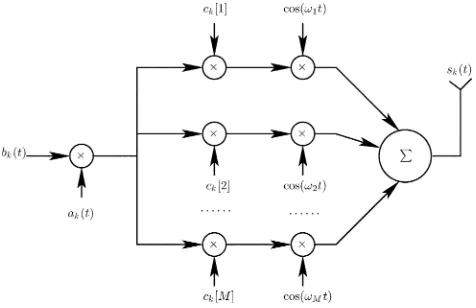
[image:2.612.321.559.67.221.2]II. MC DS-CDMA SIGNALSUSINGTF-DOMAINSPREADING The transmitter schematic of MC DS-CDMA using both T-domain and F-domain; i.e., TF-domain spreading, is shown in Fig. 1 in the
Fig. 1. Transmitter modelof MC DS-CDMA using both time-domain and frequency-domain spreading.
context of thekth user. At the transmitter side, the binary data stream
bk(t)is first direct-sequence (DS) spread using the T-domain signature sequenceak(t). Following T-domain DS spreading, the spread signal is divided intoM parallel branches, where each branch of the signal is multiplied by the corresponding chip value of the F-domain spread-ing sequenceck= [ck[1], ck[2], . . . , ck[M]]T of lengthM. Following F-domain spreading, each of theM branch signals modulates one of theMsubcarrier frequencies using binary phase shift keying (BPSK). Then, theMnumber of subcarrier-modulated substreams are combined for forming the transmitted signalsk(t). Hence, the transmitted signal of userkcan be expressed as
sk(t) =
2P M
M
m=1
bk(t)ak(t)ck[m] cos(ωmt), k= 1,2, . . . , K
(1)
whereP represents the identicaltransmitted power of each user, and
{ωm}Mm=1 represents the subcarrier frequency set. The binary data
stream’s waveform bk(t) = ∞
i=0bkPTb(t−iTb) consists of a
se-quence of mutually independent rectangular pulses of duration Tb, and of amplitude+1or−1, both having an equalprobability. In the T-domain spreading sequenceak(t) =
∞
j=0ak jPTc(t−jTc)of the
kth user,PTc(t)represents the rectangular T-domain chip waveform,
which is defined over the interval[0, Tc). We assume that the T-domain spreading factor isN=Tb/Tc, which represents the number of chips per bit-duration, and short T-domain spreading sequences are used. Furthermore, we assume that the subcarrier signals are orthogonal, and that the spectral main-lobes of the subcarrier signals are not overlapping with each other.
In the system studied,K synchronous TF-domain spread MC DS-CDMA signals obeying the form of (1) are transmitted over AWGN channels. We assume that the power received from each user is identical, implying perfect power control. Consequently, the received signal can be expressed as
r(t) =
K
k=1
2P M
M
m=1
bk(t)ak(t)ck[m] cos(ωmt) +n(t) (2)
wheren(t)represents the AWGN having zero mean and double-sided power spectrum density ofN0/2.
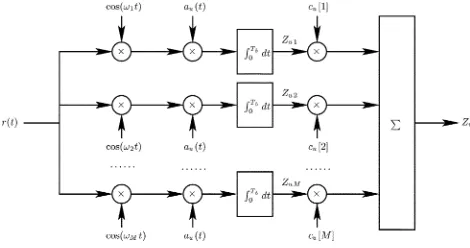
Fig. 2. Receiver modelof MC DS-CDMA using both time-domain and frequency-domain spreading.
T-domain, and the other in the F-domain. The employment of concate-nated TF-domain spreading is beneficialin the context of various detec-tion schemes, allowing us to achieve a satisfactory tradeoff between the affordable detection complexity and the achievable detection bit error rate (BER) performance. In the following two sections, we analyze the detection of TF-domain spread MC DS-CDMA signals by invoking various detection schemes. Specifically, in Section III, a single-user correlation detector is studied in order to show the similarity of the proposed TF-domain spread MC DS-CDMA and conventionalsingle-carrier DS-CDMA [20] using solely T-domain spreading, as well as that of conventional MC-CDMA [21] using solely F-domain spreading. By contrast, in Section IV, we first investigate two linear multiuser detec-tion schemes, namely the decorrelating MUD and the MMSE MUD in the context of joint TF-domain detection. Then, the combinations of the decorrelating and MMSE MUDs are studied in the context of separate TF-domain detection. Finally, these combined MUDs are compared to the joint TF-domain decorrelating MUD and to the joint TF-domain MMSE based MUD. We now consider the single-user detection of TF-domain spread MC DS-CDMA signals.
III. SINGLE-USERDETECTOR
Let theuth user be the user-of-interest, and consider the correlator-based receiver of Fig. 2, which carries out the inverse operations of the functions seen in Fig. 1. As shown in Fig. 2, the output variable related to the first data bit corresponding to themth subcarrier of theuth user can be expressed as
Zu m = Tb
0
r(t)au(t) cos(ωmt)dt
u= 1,2, . . . , K, m= 1,2, . . . , M. (3)
Upon substituting (2) into (3) and considering the orthogonality be-tween different subcarriers, it can be shown that the output variable
Zu m of Fig. 2 can be expressed as
Zu m =
P 2MTb
Du m +
K
k=1 k=u
Ik , m +Nu m
(4)
whereNu m is contributed byn(t)of (2), which is a Gaussian random variable having zero mean, and a variance ofM N0/2Eb, whereEb=
P Tb represents the energy per bit. In (4),Du m is the desired output derived by substituting (2) into (3) and setting k=u. Hence,Du m can be written asDm =bucu[m]. Finally, in (4),Ik , m represents the multiuser interference (MUI) imposed by thekth user, which can be
expressed as
Ik , m =
1 Tb
bk Tb
0
ak(t)au(t)ck[m]dt
=bkck[m]×
1 Tb
Tb
0
ak(t)au(t)dt. (5)
In (5),ρk u = (1)/(Tb) Tb
0 au(t)ak(t)dtrepresents the correlation factor between the T-domain spreading sequencesau(t)andak(t)of usersuandk. Hence, (5) can be rewritten as
Ik , m =bkck[m]ρu k, k= 1,2, . . . , K; m= 1,2, . . . , M. (6)
Consequently, the output variable corresponding to the first transmitted data bit, themth subcarrier, and theuth user can be expressed as
Zu m =
P 2MTb
bucu[m] + K
k=1
k=u
bkck[m]ρu k +Nu m
u= 1,2, . . . , K; m= 1,2, . . . , M. (7)
The decision variableZu of Fig. 2, which corresponds to the first transmitted data bit of the reference useru, is obtained by despreading each of theM branch outputs{Zu1, Zu2, . . . , Zu M}using theuth user’s F-domain spreading sequencecu, which can be expressed as
Zu = M
m=1
cu[m]Zu m
=
P 2MTb
M
m=1
cu[m]Du m + K
k=1
k=u
M
m=1
cu[m]Ik , m
+
M
m=1
cu[m]Nu m
=
P M 2 Tb
bu +
K
k=1
k=u bkρu k
1 M
M
m=1
cu[m]ck[m] +Nu
(8)
whereNu = (1)/(M) M
m=1cu[m]Nu m, which is a Gaussian ran-dom variable having zero mean and a variance ofN0/2Eb. In (8), we defineβu k = M1
M
m=1cu[m]ck[m], which is the correlation factor between the F-domain spreading sequencescuandckassigned to users
uandk. Then, (8) can be expressed as
Zu =
P M 2 Tb
bu+
K
k=1 k=u
bkρu kβu k +Nu
, u= 1,2, . . . , K.
(9)
SinceNu is a Gaussian distributed random variable,Zu is also a Gaussian random variable. Its mean is given by(P M)/(2)Tb{bu + K
k=1
k=u bkρu kβu k}, and its variance is given byM N0Tb/4. Finally,
single-user detector can be expressed as
Pb=
1 2K−1
b1∈{−1,+1}
· · ·
b k∈{−1,+1} k=u
· · ·
× bK∈{−1,+1}
Q
2Eb
N0 1−
K
k=1 k=u
bkρu kβu k
(10)
whereQ(x)is the GaussianQ-function. Furthermore, if the MUI can be approximated by an additive Gaussian variable, then the approximated BER can be expressed as
Pb≈Q 2Eb
N0 −1
+
K
k=1 k=u
ρ2u kβu k2
−1/2
. (11)
Equations (10) and (11) show that for a given signal-to-noise ratio (SNR) per bit value, the BER performance is determined by the MUI, which is a function of both the correlation factors{ρu k}of the T-domain spreading codes, as well as of the correlation factors{βu k} of the F-domain spreading codes. By contrast, the BER performance of the conventionalsingle-carrier DS-CDMA using T-domain spreading depends solely on the correlation factors of the T-domain spreading codes. Following a similar argument, the BER performance of conven-tional MC-CDMA using F-domain spreading depends solely on the correlation factors of the F-domain spreading codes. Furthermore, we can see that the BER performance of these CDMA schemes exhibits no substantialdifference, provided that the correlation properties of the T- and F-domain spreading schemes are similar, which results in similar MUI values.
IV. MULTIUSERDETECTOR
In the previous section we have considered single-user detection of the TF-domain spread MC DS-CDMA signals. In this section, we consider the detection of TF-domain spread MC DS-CDMA signals using two well-established MUD algorithms, namely, the decorrelat-ing and the MMSE algorithms, as well as their combinations. Both joint and separate TF-domain detection are investigated. The deci-sion statistics of joint TF-domain detections are obtained after both T-domain and F-domain despreading. By contrast, in the context of separate TF-domain detection, the multiuser TF-domain spread MC DS-CDMA signals are detected in a first step in the T-domain, fol-lowed by detection in the F-domain. Since, in this case, the T-domain and F-domain detections are carried out separately, various combi-nations of MUD algorithms may be invoked for balancing the trade-off between the achievable BER performance and the MUD com-plexity imposed. In this contribution, for the sake of comparison to joint TF-domain MUDs, we consider the combinations of decorre-lating/MMSE and MMSE/decorrelating MUDs, where the first de-tector in decorrelating/MMSE (or MMSE/decorrelating) is used for T-domain detection, while the second detector in decorrelating/MMSE (or MMSE/decorrelating) is for F-domain detection.
A. Joint TF-Domain Multiuser Detection
By observing (9) and considering the detection ofK users, it can be shown that after removing the common factor of(P M)/(2)Tb associated with all the different users, the decision variables of theK
users can be written as
Z=Rb+n (12)
where we have
Z= [Z1, Z2, . . . , ZK]T (13)
b= [b1, b2, . . . , bK]T (14)
n= [N1, N2, . . . , NK]T (15)
and
R=
1 ρ12β12 . . . ρ1Kβ1K
ρ21β21 1 . . . ρ2Kβ2K ..
. ... . .. ...
ρK1βK1 ρK2βK2 . . . 1
. (16)
Furthermore, in (12),nis a zero-mean random Gaussian vector having a covariance of
E[nnT] = N0 2Eb
R. (17)
Note that, the product of the T-domain spreading factor of N= Tb/Tcand the F-domain spreading factor ofMhas a degree of freedom ofM N. Therefore, the correlation matrixRis nonsingular, provided that the number of usersKdoes not exceedM N, i.e., if we haveK≤ M N. Furthermore, the multiuser detector of the TF-domain spread MC DS-CDMA system is capable of suppressing up to(M N−1)
number of interfering users when a T-domain spreading factor ofN
and an F-domain spreading factor ofMare employed.
Based on (12), theKnumber of TF-domain spread MC DS-CDMA signals can be detected by invoking different MUD algorithms [19]. Let us first consider the joint TF-domain decorrelating detector.
1) Joint TF-Domain Decorrelating Detector: In the context of the decorrelating MUD invoked for the detection of the TF-domain spread MC DS-CDMA signals, the final decision variables associated with
bk, k= 1,2, . . . , K are obtained by multiplying both sides of (12) with the inverse ofR, i.e., withR−1, which can be expressed as
R−1Z=b+R−1n (18)
and the corresponding data bit bk is classified according to ˆbk = sgn((R−1Z)k)fork= 1,2, . . . , K.
According to the analysis of [19, (5.43)], it can be shown that the BER of the joint TF-domain decorrelating MUD can be expressed as
Pb=Q 2E
b
N0
1−aT kR−k1ak
(19)
whereak is thekth column of the matrix generated by removing the diagonalelement ofR, andRkis the(K−1)×(K−1)matrix that results by striking out thekth row as well as thekth column ofR.
2) Joint TF-Domain MMSE Detector: The MMSE MUD imple-ments the linear mapping, which minimizes the mean-square error between the actualdata and the soft outputs of the conventionaldetec-tor; i.e.,Zof (12). It has been shown in [19] that the MMSE solution is arrived at by multiplying both sides of (12) with the inverse of
(R+ (N0)/(2Eb)I); i.e., with(R+ (N0)/(2Eb)I)−1, which can be expressed as
R+ N0
2Eb
I
−1
Z=
R+ N0
2Eb
I
−1
Rb+
R+ N0
2Eb
I
−1
n
(20)
while the corresponding data bitsbk are decided according toˆbk =
sgn(((R+ (N0)/(2Eb)I)−1Z)k)fork= 1,2, . . . , K.
B. Separate TF-Domain Multiuser Detectors
In the preceding section, the joint detection of the TF-domain spread MC DS-CDMA signals was considered based on the decision statistics obtained after both T-domain and F-domain despreading. The degree of freedom of the joint TF-domain detector is determined by the product of the T-domain spreading factor ofN and by the F-domain spread-ing factor of M. Therefore, joint TF-domain MUDs are capable of suppressing up to(N M−1)number of interferers. According to our analysis in Section IV-A, the joint TF-domain MUDs have to invert a matrix having a rank ofK, which may be as high asN M, if the sys-tem is fully loaded, i.e., supportingN Musers. This statement is valid for both the decorrelating and the MMSE MUDs. We now consider the separate T- and F-domain detection of the TF-domain spread MC DS-CDMA signals, where MUD is carried out first in the T-domain, followed by processing in the F-domain. It can be shown that for the separate TF-domain MUDs, the rank of the matrix invoked for T-domain detection is on the order ofN, while that used for F-domain detection is on the order ofM.
Note that, generally, in the context of separate TF-domain MUDs, the number of degrees-of-freedom is determined by the sum of the T-domain spreading factor of N and the F-domain spreading factor ofM. Therefore, a separate TF-domain MUD is only capable of suppressing up to (N+M−1) number of interfering signals. However, our analysis considering synchronous TF-domain spread MC DS-CDMA shows that separate TF-domain MUDs may also be rendered capable of suppressing up to (N M−1) number of interferers, as will now be discussed.
Let {a1(t), a2(t), . . . , aN(t)} and {c1,c2, . . . ,cM} be the N number of T-domain spreading sequences and M number of F-domain spreading sequences, respectively, where cu = [cu[1]cu
[2]. . . cu[M]]T, u= 1, . . . , M represents an F-domain spreading code. Furthermore, we assume that the number of active users isK, and we introduce a new variable ofK=K/N, wherex repre-sents the smallest integer not less thanx. Then, we have1≤ K ≤M, sinceK ≤N M. With these assumptions, theKnumber of users sup-ported can be grouped intoNuser groups, with each group supporting, at most,Kusers. Consequently, it can be readily shown that each of the N user groups can be distinguished by assigning one of theN
number of T-domain spreading sequences{a1(t), a2(t), . . . , aN(t)}. By contrast, the1≤ K ≤Mnumber of user signals of a given group are distinguishable with the aid of theKnumber of F-domain spread-ing sequences chosen from the set{c1,c2, . . . ,cM}. Specifically, for the users belonging to thenth group, the transmitted signals can be expressed as
sn(t) =
2P M
K
κ=1 M
m=1
bn κ(t)an(t)cκ[m] cos(ωmt)
n= 1,2, . . . , N (21) wherebn κ(t), n= 1,2, . . . , Nis the transmitted waveform of the user corresponding to thenth groupn= 1,2, . . . , N, which is distinguished by the T-domain spreading sequencean(t)using theκth F-domain spreading code forκ= 1,2, . . . ,K.
The received signalis the composite multiuser signalconstituted by the superposition signals of the N user groups, plus the AWGN contribution of the channel, which can be expressed as
r(t) =
2P M
N
n=1 K
κ=1 M
m=1
bn κ(t)an(t)cκ[m] cos(ωmt) +n(t).
(22) The transmitted data of a given user can be detected with the aid of its T-domain group signature sequence as well as its F-domain
spreading sequence, which can also be described as its user signature sequence. Since T-domain and F-domain detection are carried out sep-arately, various detection algorithms can be invoked in the T-domain and F-domain detection stages. In this contribution, as examples, the decorrelating and the MMSE based MUD algorithms are investigated. The decorrelating MUD has the advantage of simplicity—each user can be detected independently, without requiring the knowledge of the received signal’s amplitude, and without requiring the knowledge of the noise power. However, a disadvantage of the decorrelating MUD is that it amplifies the background noise. By contrast, the MMSE MUD is capable of suppressing the background noise with the aid of the knowledge of the SNRs associated with the users.
LetZu[m]represent the receiver’s output with respect to themth subcarrier in theuth user group, after despreading using theuth group’s T-domain signature sequenceau(t). Then,Zu[m]can be expressed as
Zu[m]
=
P 2MTb
K
κ=1
bu κcκ[m] + N
n=1 n=u
K
κ=1
bn κcκ[m]ρu n +Nu m
u= 1,2, . . . , N; m= 1,2, . . . , M (23)
whereNu m is a Gaussian random variable having zero-mean and a variance ofM N0/2Eb. Furthermore, theN number of outputs cor-responding to theN number of user group signals and to themth subcarrier can be written in a matrix form as
Z[m] =Rtbg +nm, m= 1,2, . . . , M (24)
where the common factor of(P)/(2M)Tbin (24) has been ignored for simplicity. In (24), the subscriptginbgis used for emphasizing that the current detection stage is at the group level, while the subscriptt
associated withRtemphasizes that it is the cross-correlation matrix of the T-domain spreading sequences. The rank ofRtisN. Furthermore, the terms in (24) are detailed as
Z[m] = [Z1[m], Z2[m], . . . , ZN[m]]T (25)
bg =
K
κ=1
b1κcκ[m], K
κ=1
b2κcκ[m], . . . , K
κ=1
bN κcκ[m] T
(26)
nm = [N1m, N2m, . . . , NN m]T (27)
Rt =
1 ρ12 . . . ρ1N
ρ21 1 . . . ρ2N ..
. ... . .. ...
ρN1 ρN2 . . . 1
. (28)
Note thatnmof (27) is a zero-mean Gaussian random vector having a covariance matrix of
EnmnTm
=M N0 2Eb
Rt. (29)
With the aid of (24), we now characterize the separate MUDs invoked for detecting the TF-domain spread MC DS-CDMA signals.
(24) with the inverse of the cross-correlation matrixRtof the T-domain spreading sequences, which is expressed as
zm =R−t1Z[m] =bg +R−t1nm, m= 1,2, . . . , M (30)
wherezmis aN-dimensionalvector representing the soft outputs of the group-signaldecorrelators corresponding to theN number of groups after the decorrelation process, andR−t1nm is a random Gaussian vector having the covariance matrix given by
E !R−t1nm " !
R−t1nm "T#
=M N0 2Eb
R−t1. (31)
After the decorrelation process, the composite multiuser signal con-tained in thenth user group is constituted by thenth element ofzm, which is represented as(zm)n and can be expressed as
(zm)n = K
κ=1
bn κcκ[m] + (R−t1nm)n
n= 1,2, . . . , N; m= 1,2, . . . , M. (32)
With the aid of (32), the K number of users contained in the
nth group can now be uniquely identified by their corresponding F-domain spreading sequences{c1,c2, . . . ,cK}. The F-domain de-spread signalcorresponding to thevth(v= 1,2, . . . ,K)user in the
nth(n= 1,2, . . . , N)group can be expressed as
Fn v =
1 M
M
m=1
(zm)n ·cv[m]
=bn v + K
κ=1 κ=v
bn κβv κ +
1 M
M
m=1
(R−t1nm)ncv[m]
n= 1,2, . . . , N; v= 1,2, . . . ,K (33)
whereβi jis the correlation factor of the F-domain spreading sequences
ciandcj, as defined in Section III. Considering that there areKnumber of users in thenth group, theKnumber of variables expressed in the form of (33) can be written in a compact matrix form as
Fn =Rfbn+nf (34)
where we have
Fn = [Fn1, Fn2, . . . , FnK]T (35)
bn = [bn1, bn2, . . . , bnK]T (36)
Rf =
1 β12 . . . β1K
β21 1 . . . β2K ..
. ... . .. ...
βK1 βK2 . . . 1
. (37)
In (34), the subscriptfassociated withRf emphasizes thatRf is the cross-correlation matrix of the F-domain spreading sequences. Further-more, in (34),nf is aK-dimensionalrandom Gaussian vector having a zero-mean and a covariance matrix given by
EnfnTf
= N0 2Eb
!
R−t1 "
n nRf. (38)
Since the variance of the last term in (33) is(N0)/(2Eb)(R−t1)n n, which is independent of the index v, the MMSE solution based
F-domain MUD can be implemented by multiplying both sides of (34) with(Rf + (N0)/(2Eb)(Rt−1)n nI)−1, which is expressed as
Rf +
N0
2Eb !
R−t1 "
n nI −1
Fn
=
Rf +
N0
2Eb !
R−t1 "
n nI −1
Rfbn
+
Rf +
N0
2Eb !
R−t1 "
n nI −1
nf (39)
while for each given user groupn, wheren= 1,2, . . . , N, the corre-sponding data bitsbn κ are decided according toˆbn κ = sgn(((Rf +
(N0)/(2Eb)(R−t1)n nI)−1Fn)κ)forκ= 1,2, . . . ,K.
2) Separate MMSE/Decorrelating Detector: If we first process the
Nnumber of user group signals obeying (24) with the aid of the MMSE algorithm in the T-domain, then the MMSE based MUD’s soft output can be expressed as
zm =
Rt+
M N0
2Eb
I
−1
Z[m]
=
Rt+
M N0
2Eb
I
−1
Rtbg+
Rt+
M N0
2Eb
I
−1
nm
m= 1,2, . . . , M. (40)
Let(Rt+ (M N0)/(2Eb)I)−1Rt ={qi j}. Then thenth element of
zm corresponding to the soft output matched to thenth group can be expressed as
(zm)n =qn n K
κ=1
bn κcκ[m] +In + $
Rt+
M N0
2Eb
I
−1
nm %
n
(41)
whereIn = N
i=1 i=n
qn i K
κ=1bi κcκ[m]is the residualinterference im-posed by the other(N−1)user groups after the MMSE processing.
Upon despreading(zm)n with the aid of the F-domain spreading sequences{c1,c2, . . . ,cK}employed by theKnumber of users in the
nth group, it can be shown that the despread outputs can be expressed as
Fn =qn nRfbn+nf +If (42)
wherebn andRf are given by (36) and (37), respectively, while
(nf)κ =
1 M
M
m=1 $
Rt+
M N0
2Eb
I
−1
nm %
n ·cκ[m]
κ= 1,2, . . . ,K (43)
(If)κ =
1 M
M
m=1
In·cκ[m], κ= 1,2, . . . ,K. (44)
Following the decorrelating-based processing of (42) using the in-verse ofRf, the decision variables associated with theKnumber of users in thenth group can be expressed as
Rf−1Fn =qn nbn+Rf−1nf +R−f1If (45)
and the transmitted data bits of the users in thenth(n= 1,2, . . . , N)
group can be decided according toˆbn κ=sgn((Rf−1Fn)κ)forκ=
V. DETECTIONCOMPLEXITY
We have investigated the detection of TF-domain spread MC DS-CDMA signals using the conventional decorrelating and/or MMSE multiuser detection algorithms. In the context of joint TF-domain MUDs, the joint TF-domain decorrelating detector and the joint TF-domain MMSE detector have been considered, which are char-acterized by (18) and (20), respectively. As shown in (18) and (20), the joint TF-domain decorrelating detector has to compute the inverse ofR, while the joint TF-domain MMSE detector has to determine the inverse of(R+ (N0)/(2Eb)I). The ranks of both of the preceding two matrices are determined by the number of usersK, which may be as high asM N. Therefore, the complexity of the joint TF-domain decor-relating and MMSE detectors is on the order ofO(K3)andO(M3N3), respectively, when the system operates under full load. Furthermore, the joint TF-domain decorrelating and MMSE detectors designed for TF-domain spread MC DS-CDMA have the same detection complex-ity as the conventionaldecorrelating and MMSE detectors contrived for single-carrier DS-CDMA and the complexity of conventional MC-CDMA using F-domain spreading.
By contrast, in the context of separate TF-domain MUDs discussed in Section IV-B, the detectors are characterized by (30) and (39) when using the separate decorrelating/MMSE detector and by (40) and (45) when invoking the separate MMSE/decorrelating detector. The rank of the correlation matrices associated with the T-domain detection is
N for both of these schemes, and the rank of the correlation matrices associated with the F-domain detection isK, whereKcan be as high as
M when the system is fully loaded. Hence, in the context of separate TF-domain detection, we have to compute the inverse of aN-rank ma-trix for the sake of T-domain detection associated with each of theM
subcarriers, as well as the inverse of aK-rank matrix associated with each of theNuser groups for the sake of the corresponding F-domain detection. Notice that the inverse of the N-rank matrix required for T-domain detection only has to be computed once, and it can be used for all subcarriers. Similarly, the inverse of theK-rank matrix required for F-domain detection is also computed only once, and it can be used for all user groups. Therefore, the complexity of the separate TF-domain detection schemes is on the order ofO(N3+K3), which is limited toO(N3+M3)when the system is fully loaded. For the sep-arate TF-domain, detectors have to determine the inverses associated with each of theMsubcarriers in the T-domain, and with each of the
N user groups in the F-domain, the associated complexity is, hence, on the order ofO(M N3+NK3).
Based on the preceding discussions, we argue that separate TF-domain detectors have a lower detection complexity than joint TF-domain detectors. If the number of users is high, the benefit of decreasing the detection complexity is substantial. In the next section, we compare the BER performance of the detection schemes considered in the previous sections.
VI. PERFORMANCERESULTS
[image:7.612.312.557.62.272.2]In this section, we provide a range of simulation results in order to illustrate the achievable performance of TF-domain spread MC DS-CDMA in conjunction with the various detection schemes consid-ered in Sections III and IV. As examples, we considconsid-ered two TF-domain spread MC DS-CDMA schemes which usem-sequences [3] for both T-domain spreading and F-domain spreading. The first scheme used a T-domain spreading factor ofN= 15and an F-domain spreading factor ofM = 7, while the second scheme used a T-domain spreading factor ofN= 7and an F-domain spreading factor ofM = 15. Since, in both cases, we hadN×M= 105, the maximum number of users supported is 105. We considered three types of user loads: a light user
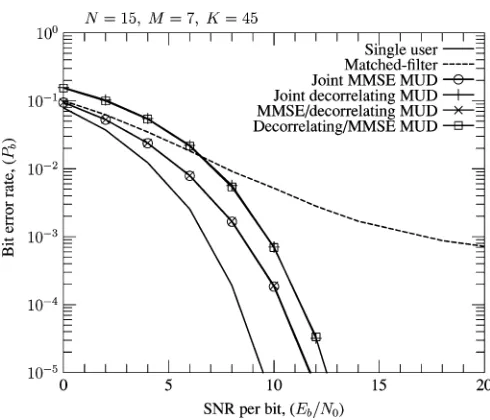
Fig. 3. BER performance comparison of the TF-domain spread MC DS-CDMA systems in conjunction with various detection schemes when using a T-domain spreading factor ofN= 15, F-domain spreading factor ofM= 7, and supporting a totalofK= 45users. The first of the detectors in the legends associated with separate TF-domain detection indicates the T-domain detection, and the second indicates the F-domain detection.
load associated withK= 45or 49 users, a moderate load associated withK= 75 or 77 users, and full load corresponding toK= 105
users.
Fig. 3 compares the BER versus SNR per bit ofEb/N0performance
of TF-domain spread MC DS-CDMA using the parameters ofN = 15, M= 7for the cases of load ofK= 45. The results show that for all three types of load, the joint TF-domain MMSE MUD achieves the best BER performance, which is close to the single-user BER curve. By contrast, the correlation based detector exhibits the worst performance, in particular whenEb/N0is high. The BER curve of the
correlation based detector exhibits an error floor at high SNR per bit value. The BER of the joint TF-domain decorrelating MUD is always higher than that of the joint TF-domain MMSE MUD, but as expected, it outperforms the correlation-based detector provided that the SNR per bit is sufficiently high. However, as seen in Fig. 3, the joint TF-domain decorrelating MUD may be outperformed by the correlation based detector if the SNR per bit value is very low. This is because it is widely recognized [19] that the decorrelating MUD amplifies the background noise while suppressing the multiuser interference. In the context of the separate TF-domain decorrelating/MMSE and the MMSE/decorrelating MUDs, we observe that both schemes outperform the joint TF-domain decorrelating MUD, while both both of them are outperformed by the joint TF-domain MMSE MUD. However, the BER performance of the separate TF-domain decorrelating/MMSE MUD is close to that of the joint TF-domain decorrelating MUD.
In Fig. 4, we compare the BER versus Eb/N0 performance
of TF-domain spread MC DS-CDMA using the parameters of
Fig. 4. BER performance comparison of the TF-domain spread MC DS-CDMA systems associated with various detection schemes when using a T-domain spreading factor ofN= 7, F-domain spreading factor ofM= 15, and supporting a totalofK= 49users.
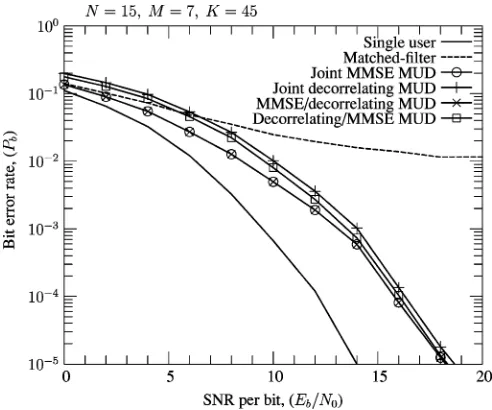
Fig. 5. BER performance comparison of the TF-domain spread MC DS-CDMA systems in conjunction with various detection schemes when using a T-domain spreading factor ofN= 15, F-domain spreading factor ofM= 7, and supporting a totalofK= 45users, where each subcarrier is experienced with uncorrelated flat Rayleigh fading.
performance of the separate TF-domain decorrelating/MMSE MUD is close to that of the joint TF-domain decorrelating MUD. By contrast, the BER performance of the separate TF-domain MMSE/decorrelating MUD is close to that of the joint TF-domain MMSE MUD.
[image:8.612.317.562.65.269.2]Finally, Figs. 5 and 6 illustrate the BER performance of the TF-domain spreading assisted MC DS-CDMA system in conjunction with different MUDs and a matched filter, when communicating over an uncorrelated Rayleigh fading channel. Comparing these figures to Figs. 3 and 4, we may conclude that all these MUD techniques ex-hibit similar performance trends in a Rayleigh fading channel to those experienced over AWGN channels.
Fig. 6. BER performance comparison of the TF-domain spread MC DS-CDMA systems in conjunction with various detection schemes when using a T-domain spreading factor ofN= 7, F-domain spreading factor ofM= 15, and supporting a totalofK= 49users, where each subcarrier is experienced with uncorrelated flat Rayleigh fading.
VII. CONCLUSION
In summary, in this contribution, we have proposed and studied a MC DS-CDMA scheme which employs both T-domain and F-domain spreading. We have investigated both joint and separate TF-domain detection of the TF-domain spread MC DS-CDMA signals. In order to characterize the performance and the advantages of the proposed TF-domain spread MC DS-CDMA scheme, we have investigated and compared its BER performance in conjunction with a range of detectors. These detectors include the single-user correlation based detector, the joint TF-domain decorrelating MUD, the joint TF-domain MMSE MUD, the separate TF-domain decorrelating/MMSE MUD, and the separate TF-domain MMSE/decorrelating MUD. The results of our study demonstrate that the separate TF-domain MUD schemes are capable of achieving a similar BER performance to that of the joint TF-domain MUD schemes, while imposing a significantly lower de-tection complexity than the joint TF-domain MUD schemes. Due to its low detection complexity, the employment of TF-domain spread MC DS-CDMA invoking separate TF-domain MUDs is beneficialin the context of broadband wireless systems supporting a large number of users.
REFERENCES
[1] M. B. Pursley, “Performance evaluation for phase-coded spread-spectrum multiple-access communication-Part I: System analysis,”IEEE Trans. Commun., vol. COM-25, no. 8, pp. 795–799, Aug. 1977.
[2] M. K. Simon, J. K. Omura, R. A. Scholtz, and B. K. Levitt,Spread Spec-trum Communications: Volume I. Rockville, MD: Computer Science, 1985.
[3] R. E. Ziemer and R. L. Peterson,Digital Communications and Spread Spectrum Systems. New York: Macmillan, 1985.
[4] A. Chouly, A. Brajal, and S. Jourdan, “Orthogonal multicarrier techniques applied to direct sequence spread spectrum CDMA systems,”Proc. IEEE GLOBECOM’93, pp. 1723–1728, Houston, TX, Nov. 1993.
[5] L. Hanzo, L.-L. Yang, E.-L. Kuan, and K. Yen,Single- and Multi-Carrier DS-CDMA: Multi-User Detection, Space-Time Spreading, Synchronisa-tion, Standards and Networking. Piscataway, NJ: IEEE Press, Wiley, 2003, p. 1060.
[image:8.612.53.299.345.550.2][7] K. Fazel and L. Papke, “On the performance of convolutionally-coded CDMA/OFDM for mobile communication systems,” inProc. PIMRC’93, 1993, pp. 468–472.
[8] X. Gui and T. S. Ng, “Performance of asynchronous orthogonalmulticar-rier CDMA system in frequency selective fading channel,”IEEE Trans. Commun., vol. 47, no. 7, pp. 1084–1091, Jul. 1999.
[9] R. Prasad and S. Hara, “Overview of multicarrier CDMA,”IEEE Commun. Mag., vol. 35, no. 12, pp. 126–133, Dec. 1997.
[10] E. S. Sousa, “Performance of a direct sequence spread spectrum mul-tiple access system utilizing unequal carrier frequencies,”IEICE Trans. Commun., vol. E76-B, pp. 906–912, Aug. 1993.
[11] L. Vandendorpe, “Multitone direct sequence CDMA system in an indoor wireless environment,” inProc. IEEE 1st Symp. Communications and Vehicular Technology, Benelux, Delft, The Netherlands, Oct. 1993, p. 4.1-–4.1-8.
[12] E. A. Sourour and M. Nakagawa, “Performance of orthogonalmulticarrier CDMA in a multipath fading channel,”IEEE Trans. Commun., vol. 44, no. 3, pp. 356–367, Mar. 1996.
[13] S. Kondo and L. B. Milstein, “Performance of multicarrier DS CDMA systems,”IEEE Trans. Commun., vol. 44, no. 2, pp. 238–246, Feb. 1996. [14] L.-L. Yang and L. Hanzo, “Blind joint soft-detection assisted slow frequency-hopping multicarrier DS-CDMA,” IEEE Trans. Commun., vol. 48, no. 9, pp. 1520–1529, Sep. 2000.
[15] L.-L. Yang and L. Hanzo, “Slow frequency-hopping multicarrier DS-CDMA for transmission over Nakagami multipath fading channels,” IEEE J. Sel. Areas Commun., vol. 19, no. 7, pp. 1211–1221, Jul. 2001. [16] L.-L. Yang and L. Hanzo, “Performance of generalized multicarrier
DS-CDMA over Nakagami-mfading channels,”IEEE Trans. Commun., vol. 50, no. 6, pp. 956–966, Jun. 2002.
[17] C. W. You and D. S. Hong, “Multicarrier CDMA systems using time-domain and frequency-time-domain spreading codes,”IEEE Trans. Commun., vol. 51, no. 1, pp. 17–21, Jan. 2003.
[18] M. Progler, C. Evci, and M. Umehira, “Air interface access schemes for broadband mobile systems,”IEEE Commun. Mag., vol. 37, no. 9, pp. 106– 115, Sep. 1999.
[19] S. Verdu, Multiuser Detection. Cambridge, U.K.: Cambridge Univ. Press, 1998.
[20] A. J. Viterbi,CDMA: Principles of Spread Spectrum Communications. Reading, MA: Addison-Wesley, 1995.
[21] V. M. Dasilva and E. S. Sousa, “Multicarrier orthogonal CDMA signals for quasi-synchronous communication systems,”IEEE J. Sel. Areas Com-mun., vol. 12, no. 5, pp. 842–852, Jun. 1994.
[22] H. V. Poor and S. Verdu, “Probability of error in MMSE multiuser detec-tion,”IEEE Trans. Inf. Theory, vol. 43, no. 3, pp. 858–871, May 1997.
Improved Channel Decoding for the CDMA Forward Link Chip-Level LMMSE Receiver
Geoffrey G. Messier and Witold A. Krzymien´
Abstract—This paper investigates how to improve channel decoder trellis path metric calculations when convolutional or turbo codes are combined with the chip-level linear minimum mean square error (LMMSE) code di-vision multiple access (CDMA) mobile receiver. These metric calculations require channel state information (CSI) that consists of desired signal am-plitude and interference plus noise variance. Several techniques suitable for use with the chip-level LMMSE receiver are presented for estimat-ing CSI. Chip-level simulations are used to evaluate CDMA forward link performance when these techniques are used by the mobile. The results indicate that the channel state estimation scheme that provides the best for-ward link performance depends on the type of channel code and channel decoder algorithm used in the system.
Index Terms—Channel state estimation, code division multiple access (CDMA), LMMSE equalization, Rake receiver, turbo codes.
I. INTRODUCTION
The work presented in this paper aims to improve the performance of both convolutional and turbo codes on the code division multiple access (CDMA) forward link when the chip-level linear minimum mean square error (LMMSE) receiver is used in the mobile. This im-provement is achieved by using estimation techniques that provide the mobile channeldecoder with better channelstate information (CSI). The chip-level LMMSE receiver has received considerable attention in the area of CDMA forward link advanced receiver research [1]–[3]. It cancels CDMA forward link intracell interference by equalizing the received chip waveform and restoring the orthogonality of the forward link Walsh spreading sequences.
The performance of turbo codes with chip-level LMMSE equaliza-tion and LogMAP decoding has been investigated by Hooliet al.[4]. In that paper, pilot symbols embedded in the traffic transmission are used to estimate CSI. However, Hooliet al.do not consider the variety of other CSI estimation schemes that could be used with the chip-level LMMSE receiver or investigate how these schemes could affect for-ward link performance. They also do not consider turbo decoding with the soft-output Viterbi decoder (SOVA) algorithm, which, as this paper will illustrate, has very different channel state estimation requirements than the LogMAP decoder.
Severalalternatives have been proposed for channelstate estimation when the mobile uses the conventional RAKE receiver. Wormet al.
advocate using the SOVA turbo decoder metric without any CSI [5]. Summers and Wilson [6] present an “online” SNR estimation technique for turbo decoding in a time-invariant AWGN channelthat has been extended by Rameshet al.to wireless applications [7], [8]. The authors have also developed channel state estimation techniques for the CDMA forward link that improve convolutional and turbo code performance for mobiles with conventional RAKE receivers [9], [10].
Manuscript received August 20, 2003; revised April15, 2004, November 22, 2004 and March 23, 2005. This work was supported by TRlabs, the Natural Sci-ences and Engineering Research Council(NSERC) of Canada, and the Alberta Informatics Circle of Research Excellence (iCORE). The review of this paper was coordinated by Prof. M. Juntti.
G. G. Messier is with the Department of Electrical and Computer Engineering, University of Calgary and TRLabs, Calgary, AB T2N 1N4, Canada (e-mail: [email protected]).
W. A. Krzymie´n is with the Department of Electrical and Computer Engi-neering, University of Alberta and TRLabs, Edmonton, AB T6G 2V4, Canada (e-mail: [email protected]).