A Comparative Study of Game Theoretic and Evolutionary Models of Bargaining for Software Agents
SHAHEEN S. FATIMA1, MICHAEL WOOLDRIDGE1
& NICHOLAS R. JENNINGS2
1Department of Computer Science, University of Liverpool, Liverpool L69 3BX, UK
(E-mail:{S.S.Fatima, M.J.Wooldridge}@csc.liv.ac.uk);2School of Electronics and
Computer Science, University of Southampton, Southampton SO17 1BJ, UK (E-mail: [email protected])
Abstract. Most of the existing work in the study of bargaining behavior uses tech-niques from game theory. Game theoretic models for bargaining assume that play-ers are perfectly rationaland that this rationality iscommon knowledge. However, the perfect rationality assumption does not hold for real-life bargaining scenarios with humans as players, since results from experimental economics show that humans find their way to the best strategy through trial and error, and not typically by means of rational deliberation. Such players are said to beboundedly rational. In playing a game against an opponent with bounded rationality, the most effective strategy of a player is not the equilibrium strategy but the one that is the best reply to the opponent’s strat-egy. The evolutionary model provides a means for studying the bargaining behaviour of boundedly rational players. This paper provides a comprehensive comparison of the game theoretic and evolutionary approaches to bargaining by examining their assump-tions, goals, and limitations. We then study the implications of these differences from the perspective of the software agent developer.
Keywords: bargaining, e-commerce, evolutionary algorithms, game theory, software agents
1. Introduction
many of the steps of the buying process still remain unautomat-ed. A human buyer is still responsible for collecting and interpret-ing information on merchants and products, makinterpret-ing decisions about them, and, finally, entering purchase and payment information and instructions.
Software agents can be used to automate several of the most time consuming stages of the buying process (Ma 1999; Maes et al. 1999; Sandholm 2000). For example, a company that needs to order a prod-uct could have a buying agent that goes through all the stages of the buying process. The agent can be designed to automatically collect information on vendors and products that may fit the needs of the company, evaluate the various offers, make a decision on which mer-chants and products to investigate, negotiate the terms of transactions with these merchants, and finally place orders and make automated payments.
Of these, negotiation forms the key stage in all electronic trans-actions during which agents communicate and compromise to reach mutually beneficial agreements. The negotiators have a common inter-est in cooperating, but have conflicting interinter-ests over exactly how to cooperate. Put differently, agents can mutually benefit from reach-ing agreement on an outcome from a set of possible outcomes, but have conflicting interests over the outcome that they prefer. The main problem that confronts agents in such a situation is to decide how to cooperate before they actually enact the cooperation, and obtain the associated benefits. On the one hand, each agent would like to reach some agreement rather than disagree and not reach any agreement. But, on the other hand, each agent would like to reach an agreement that is as favourable to itself as possible. The agents therefore make a series of offers and counter-offers before an agreement is actually reached. This makes negotiation a time consuming process. Software agents not only save the labour time of human negotiators, but also find solutions that are as beneficial as possible to all the parties (Sand-holm 2000).
context of self-interested agents, the term bargainingis used to refer to bilateral negotiations.
The problem of negotiation has long been studied by social sci-entists, resulting in the development of three main approaches that describe the strategy a negotiator should choose in different situations. The first approach is the formal game theoretic approach (Nash 1950; Harsanyi 1956; Roth 1979; Osborne and Rubinstein 1990). Game theory offers tools designed to help us understand how decision-mak-ers behave when they interact. The basic assumptions that underlie the theory are that decision-makers pursue well defined objectives in accordance with their self-interest (i.e., they are rational) and that they take into account their knowledge or expectations of other deci-sion-makers’ behaviour (i.e., they reason strategically). Under these assumptions, it provides strategy recommendations and solutions to games. As it is based on a formal theory, this approach can in prin-ciple be applied to software agents (Sandholm 2000; Jennings et al. 2001; Kraus 2001; Lomuscio et al. 2003).
The second approach, the negotiation guides approach, comprises informal theories that identify possible beneficial strategies for a nego-tiator (Fisher and Ury 1981; Raiffa 1982; Johnson 1993). Although this approach does not make such strong assumptions as the game theoretic approach, applying these methods to software agents is diffi-cult since they are not based on a formal theory.
The third and more recent approach is the evolutionary approach (Andreoni and Miller 1995; Ellingsen 1997; Binmore et al. 1998; Anthony and Jennings 2002). This approach begins by dropping the assumption that players are rational. Instead of assuming that play-ers always calculate the best strategy from a theoretical analysis of the game, players in the evolutionary approach learn how to play games through trial and error. They experiment with strategies, observe their payoffs, try other strategies and find their way to a strategy that works well. Such players are referred to as being boundedly rational, because they are not the perfect reasoners commonly assumed in classical game theory (Samuelson 1996).
In this paper we provide a comprehensive comparison of the game-theoretic and evolutionary approaches to bargaining by examining their assumptions, goals and limitations. We then study the impli-cations of the differences between them from the perspective of the agent developer.
section 4 we compare these two approaches. Finally, section 5 ends with some conclusions.
2. The Game Theoretic Bargaining Model
We begin by giving a description of games and solutions. A game is a description of strategic interaction that includes the constraints on the actions that the players can take and the players’ interests, but does not specify the actions that the players take (Osborne and Rubin-stein 1994). A solution is a systematic description of the outcomes that may result in a game under the assumption that the players are perfectly rational and that this rationality is common knowledge. Gen-erally speaking, game theory suggests reasonable solutions for games and examines their properties.
A game can be described in one of the two forms: normal form or extensive form. The normal form describes games of simultaneous offers. On the other hand, the extensive form describes games in which the players make a series of offers and counter-offers and cor-responds more closely to most real life bargaining situations than games of simultaneous offers. The model of an extensive game speci-fies the orders of events; each player can consider his plan of action not only at the beginning of the game but also whenever he has to make a decision. The following elements constitute a bargaining model (Osborne and Rubinstein 1994):
1. The bargaining protocol. 2. The bargaining strategies. 3. The information state of agents. 4. The bargaining equilibrium.
2.1. The bargaining protocol
1. Stability. No agent should have an incentive to deviate from the agreed upon strategies. In game theory, this is also known as the notion of strategies in equilibrium (Osborne and Rubinstein, 1994). The strategy that agents adopt forms a part of the negotiation mechanism. Once these strategies are determined, agents should not deviate from them. Otherwise agent developers would have the incentive to build agents with different manipulative strategies. 2. Simplicity. A well designed mechanism should make low
compu-tational demands on the agents, and require little communication overhead. This issue is related to both efficiency and stability. If the negotiation mechanism is simple, it increases the efficiency of the system, with fewer resources being used to carry out the nego-tiation itself. Similarly, with stable mechanisms, fewer resources need to be spent on outguessing the opponent, or trying to dis-cover his optimal choices. Stability reveals the behaviour publicly, and agents have nothing better to do than just carry it out. 3. Distribution. The negotiation mechanism should not require a
cen-tral decision-maker, since this causes a performance bottleneck, and can result in failure of the entire system due to the failure of a single node.
All these attributes together affect the agent designer’s choice of a negotiation protocol.
2.2. The bargaining strategies
decision-maker always gives the optimal action (i.e., the one that max-imizes its expected utility).
2.3. The information state of agents
An agent’s information state describes the information it has about negotiation parameters such as the players’ utility functions, their reserve values, their discounting factors, and their deadlines. The strategy selected by an agent depends on its information state. von Neumann and Morgenstern (1944) introduced the fundamental clas-sification of games into those of complete information and those of incomplete information. The former category is basic. In these games the players are assumed to know all relevant information about the rules of the game and players’ preferences that are represented by util-ity functions (Nash 1950).
The complete information assumption is limiting because uncer-tainty is endemic in most realistic applications. In the latter category, information may be lacking about a variety of factors in the bargain-ing problem. Each player may have some private information about his own situation that is unavailable to the other players, while hav-ing only probabilistic information about the private information about other players. Following Harsanyi (Harsanyi and Selten 1972), mod-els of games of incomplete information proceed from the assumption that all players start with the same probability distribution on this pri-vate information and that these priors are common knowledge.1 This
is modelled by having the game begin with a probability distribution, known to all players. Thus players not only have priors over other players’ private information, they also know what priors the other players have over their own private information. Strategic models of incomplete information thus include an extra level of detail, since they specify not only the actions and information available to the other players in the course of the game, but also their probability distribu-tions and information prior to the start of the game.
Another important model of strategic bargaining is Rubenstein’s infinite horizon alternating offers game (Rubinstein 1982). This takes the time preferences of bargainers into consideration, in the form of their discounting factors, but again assumes complete information. It was later extended in Rubinstein (1985) for bargaining with incom-plete information about time preferences.
Fatima et al. 2001). Fudenberg and Tirole (1983) analyse an infi-nite horizon bargaining game by taking the players’ valuations and a probability distribution over them as common knowledge. Fuden-berg et al. (1985) analyse buyer–seller infinite horizon bargaining games in which reserve prices are uncertain, but time preferences are known. Sandholm and Vulkan (1999) consider uncertainty over agent deadlines. A common feature of all these models is that they treat the information state of agents as common knowledge. Fatima et al. (200b, 2004) address uncertainty over two parameters, deadlines and reserve prices, by treating each agent’s information as its private knowledge. Each of these models is formulated for a different envi-ronment and the strategic behavior of rational agents is studied. The equilibrium of a game depends on the players’ information states, and changing the information state of a player results in a change in the equilibrium of the game (Fatima et al. 2002a).
2.4. The bargaining equilibrium
Perhaps the most crucial element of a bargaining model is its equi-librium. As mentioned earlier in this section, this is what makes a negotiation mechanism stable. The earliest concept of equilibrium was the Nash equilibrium. This was defined for games of simultaneous offers Nash 1950. Two strategies are in Nash equilibrium if each agent’s strategy is the best response to its opponent’s strategy. This is a necessary condition for system stability where both agents act strategically. For sequential offer protocols, the Nash equilibrium con-cept was strengthened in multiple ways by requiring that the strate-gies stay in equilibrium at every step of the game (van Damme 1983). In summary, rationality, as understood in game theory, requires that each agent will select an equilibrium strategy when choosing indepen-dently.
Finally, game theory not only provides the concept of equilibrium, but also studies the properties of the equilibrium solution. The follow-ing are desirable solution properties (Osborne and Rubinstein 1994; Rosenschein and Zlotkin 1994).
1. Individual Rationality. For both the players, the agreement must represent a situation at least as favourable as the conflict situation (i.e., no agreement). Otherwise the players would have no incentive to negotiate.
without decreasing the utility of other agents. Such an outcome is said to be Pareto-optimal.
3. Uniqueness. Uniqueness is a desirable property because it allows the solution to be identified unequivocally.
4. Symmetry. A bargaining mechanism is said to generate a symmet-ric solution if it does not treat the players differently on the basis of inappropriate criteria. Exactly what constitutes inappropriate criteria depends on the specific domain. For instance, a bargaining mechanism is said to possess the property of symmetry if the out-come does not depend on the identity of the first player, i.e., which player starts the process of negotiation.
3. The Evolutionary Model
While a perfectly rational player determines the equilibrium strategy from a theoretical analysis of the game, a boundedly rational player finds the most effective strategy by learning through trial and error. Evolutionary or genetic algorithms (GAs) provide a metaphor that can be used for economic learning (Reichmann 1999). GA learning is now being widely studied for applications that involve bargaining and markets (Andreoni and Miller 1995; Dawid 1996; Bullard and Duffy 1998; Anthony and Jennings 2002).
GAs are an abstraction of biological evolution, and provide a framework for learning and adaptation by moving from one popula-tion of genes to a new populapopula-tion by using natural selection together with the genetics-inspired operators of crossover and mutation. Before describing how learning is accomplished through these operators, we list the elements of an evolutionary model and then describe each ele-ment in detail. The following are the key eleele-ments of an evolutionary model (Goldberg 1989; Mitchell 2001).
1. A population of individuals 2. The player interactions
3. The set of evolutionary operators 4. The stable state
3.1. Population of individuals
analogous to genes, and strategies are the behaviours or characteris-tics with which these genes endow their hosts. The payoff of a gene is its ability to produce offspring. Those genes that lead to higher rates of reproduction will flourish in a population at the expense of those that lead to lower reproduction rates. Each agent is characterized by a strategy that it plays when it is matched against another player. As a game proceeds, each agent observes the payoff of its strategy. It also observes the payoffs and strategies of others, and has access to infor-mation concerning how others have played. In the light of these obser-vations, it adjusts its strategies. These adjustments involve experiments with strategies that it has not tried, but are overall designed to switch away from strategies that give low payoffs to strategies that give high payoffs. The task for the evolutionary model is to study this process of dynamic strategy adjustment.
Each genetic individual within the genetic population is assigned a fitness value. The fitness of an individual gives information about his performance according to the problem to be solved. The fitness usu-ally equals the value of a function, optimized by means of the genetic algorithm. For instance, in a bargaining scenario, the utility associated with a strategy represents the fitness value of the agent playing that strategy.
There are two types of population, viz., symmetric and asymmet-ric. The symmetric population is the simpler of the two and involves all the players having the same fitness function (Young 1993; Ellingsen 1997; Binmore et al. 1998). In the asymmetric population, players have different fitness functions. For example, in bargaining between a buyer and a seller, the utility functions of agents differ. Such scenarios are handled by having two separate subpopulations, one representing the buyer and the other representing the seller.
3.2. Player interactions
3.3. Evolutionary operators
In the evolutionary model, the players have access to the strategies played by other individuals and the associated payoffs. In the light of this information, they learn to play the most effective strategy. Learn-ing thus forms an essential element of the evolutionary model. GA learning is a way of socialrather than individual learning. Social learn-ing means learnlearn-ing from others, and is conceptually different from the conventional AI based learning, which involves learning by single, isolated agents, as typified by Lucas (1986) and Heinemann (2000). Learning in the evolutionary model is a compound of three basic types of learning, and is realised by means of three basic operators – selection, crossover, and mutation. The three different learning tech-niques that correspond to these three operators are: learning by imi-tation (selection/reproduction), learning by communication (crossover) and learning by experimentation (mutation) (Reichmann 1999). Each of these is explained below.
Reproduction is a means of deriving a new population from an old one. Reproduction is done by selecting particular individuals out of the pool of the old population. The assignment of fitness to each of the individuals is the crucial part of the learning process. It is the fit-ness of a strategy that determines whether it is reproduced. Selection is the process of passing on agents that have a high fitness value, rel-ative to the other agents, to the next generation. This is analogous to learning by imitation, since the good strategies are passed on without any change to the next generation. Learning by pure imitation will lead to stability, but optimality will occur only by pure chance.
The second operator (i.e., crossover) is a recombination operator. Crossover randomly chooses two genetic individuals, called parents, from the population and creates an offspring by combining parts of the bit strings of the two parents. Crossover can be interpreted as a form of learning by communication. Two agents meet, talk to each other about their strategies, and adapt parts of each other’s behav-iour. A complete strategy that is produced by crossover may not be the same as any of the strategies in the initial population, but parts of the strategy are those that are already there in the initial popula-tion.
(at least partially) by other individuals, mutation (experimentation) is able to find strategies that have never been used before. Mutation is the only operation that introduces completely new strategies into the system (i.e., those that were not present in the initial population). The initial population evolves as a result of selection, crossover, and muta-tion, and reaches a stable state in which a large majority of individu-als in the population play the most effective strategy.
3.4. Stable state
Stability is a situation in which – after some evolutionary changes – a state is established in which the population, as a whole, shows a uniform behaviour. The population is allowed to evolve until it reaches a stable state (i.e., almost all the individuals exhibit the same behaviour and play the same strategy). In this state, although new strategies may get generated through crossover and mutation, they cannot invade the population on account of their being inferior to the stable strategy played by a significant proportion of the population. The outcome generated by the stable strategy is the stable outcome.
Recall that the population in the evolutionary model can be either symmetric or asymmetric. If the population is symmetric, then no matter what strategies individuals play in the initial state, the three evolutionary operators always cause the population to evolve to a sta-ble state in which the players play the most effective strategy. For instance, a study of the evolutionary stability in a symmetric pop-ulation has been carried out in Young (1993), Ellingsen (1997) and Binmore et al. (1998).
4. A Comparison of Game Theoretic and Evolutionary Models
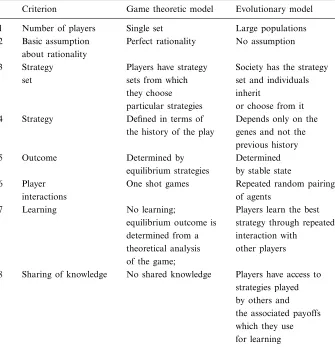
The similarity between the two models is that agents in both game theoretic and evolutionary models behave as expected utility maxi-mizers. While game theoretic agents show this behaviour by virtue of their self-interest and rationality, agents in the evolutionary model (although boundedly rational) show a similar behaviour on account of learning, since only the fittest (given that fitness is measured in terms of utility) agents survive and reach the stable state. The difference lies in how the agents maximize their utility. This is caused by the differ-ences that underlie these approaches, and their main characteristics. These are discussed in detail below. Table 1 provides a summary of the comparison.
The first difference lies in the number of agents. In the game theo-retic model a game is viewed as being played by a single set of play-ers, while the evolutionary model views the game as being played by a large2 population of players, so that the effect of an individual’s actions on the entire population can be ignored.
Second, the two models differ in terms of their basic assumptions. The main assumption in the game theoretic model is that the play-ers are perfectly rational, and that this rationality is common knowl-edge. On the basis of this assumption, agents find the equilibrium strategy from a theoretical analysis of the game, and always play the equilibrium strategy. Game theory need not apply to human behav-iour, since in practice humans do not always behave as the theory suggests (Roth 1995). An agent’s optimal actions may be quite differ-ent depending upon whether it is playing against a perfectly rational agent or an ordinary person. The outcome prescribed by game theory for the former may not be valid when playing against the latter. For instance, in a game of poker one plays differently against an inexperi-enced player than against an experiinexperi-enced one. If an experiinexperi-enced player plays against an inexperienced player, he can win the game by using a strategy that is the best response to the opponent’s strategy and not by using the equilibrium strategy. Game theory thus cannot always be used as a guide to behaviour (Samuelson 1996).
Table 1. A comparison of game theoretic and evolutionary models
Criterion Game theoretic model Evolutionary model 1 Number of players Single set Large populations 2 Basic assumption Perfect rationality No assumption
about rationality
3 Strategy Players have strategy Society has the strategy set sets from which set and individuals
they choose inherit
particular strategies or choose from it 4 Strategy Defined in terms of Depends only on the
the history of the play genes and not the previous history
5 Outcome Determined by Determined
equilibrium strategies by stable state
6 Player One shot games Repeated random pairing
interactions of agents
7 Learning No learning; Players learn the best equilibrium outcome is strategy through repeated determined from a interaction with
theoretical analysis other players of the game;
8 Sharing of knowledge No shared knowledge Players have access to strategies played by others and the associated payoffs which they use for learning
with strategies, observing their payoffs, and trying other strategies in the search space. The evolutionary algorithms make no assumption about the rationality of players. In this model, agents learn the best strategy by playing against a large population of agents and observ-ing their payoffs as well as those of others. The central assumption in the evolutionary model is that the population is very large, so that the effect of the behaviour of a single individual on the entire population can be ignored.
which it chooses a particular strategy. On the other hand, in the evolutionary model the entire population has a strategy set and indi-viduals inherit or choose from it.
The fourth difference lies in the way that strategies are defined. While the game theoretic model defines a strategy in terms of the his-tory of the play (i.e., the sequence of offers and counter offers), the evolutionary model defines a strategy in terms of the genes that con-stitute the strategy, and not in terms of previous history.
The fifth difference lies in the way in which an outcome is deter-mined. In the game theoretic model, the outcome is determined by the equilibrium strategies, while in the evolutionary model it is determined by the stable state of the population.
The sixth difference lies in way in which players interact. In the game theoretic model, a single set of players engage in one shot or repeated games, but in the evolutionary model there is repeated ran-dom pairing of agents.
The seventh difference lies in whether the agents can learn strat-egies through trial and error. In the game theoretic model, agents do not learn, but instead determine the outcome of a game from a theoretical analysis, which is possible because of the perfect rational-ity assumption. On the other hand, agents in the evolutionary model learn the best strategy through repeated interaction with other players, and through experimentation using selection, crossover, and mutation as the operators.
Second, in the game theoretic model, a game is played just once. In contrast, players in the evolutionary model need to repeatedly inter-act with each other until the stable state is reached. As the popula-tion size increases, the time it takes for the populapopula-tion to stabilize also increases.
The third issue is associated with learning, and in particular, whether or not it can be done offline. If learning can be done offline, the best strategy can be determined statically, and agents can be coded with this strategy. The actual bargaining process becomes simpler, since it does not involve online learning. Whether learning in the evo-lutionary model can be done offline depends on the population. If the population is symmetric (i.e., all individuals have the same utility function), then the stable outcome does not depend on the initial state of the population. It is therefore common to initialise the popula-tion randomly (Goldberg 1989; Koza et al. 1991). This allows learn-ing to be done offline and the agents can be encoded with the stable strategy.
number of player types increases. Thus in terms of the properties of the negotiation mechanism we see that the game theoretic model may be easier to implement than the evolutionary model.
5. Conclusions
A number of game-theoretic models have been explored that solve the bargaining problem. More recently, evolutionary approaches have been applied to the same problem. This paper describes these two approaches and provides a comparative study in terms of their under-lying assumptions and their main characteristics, such as the require-ment for common knowledge, the definition of strategy, the solution concepts, the kind of player interactions, the presence of learning, and whether it can be done offline. We then study the implications of these differences from the perspective of the software agent developer. More specifically, the discussion suggests the following main conclusions.
Although the game-theoretic model assumes perfect rationality, designing software agents is easier since the agents only need to play the equilibrium strategy. On the other hand, the evolutionary approach does not assume perfect rationality, but may require the software agents to learn the stable strategy every time there is a nego-tiation. If the stable outcome depends on the initial population, then learning cannot be done offline. On line learning results in excessive computation, communication, and time overheads that can become prohibitive, particularly in applications that require negotiation to end by a deadline. For one-to-many and many-to-many negotiations, these overheads become higher as the number of player types increases. Thus in terms of the properties of the negotiation mechanism we se that the game theoretic model may be easier to implement than the evolutionary model.
Notes
1. An event is said to be mutual knowledge in some state if in that state each player knows the event. An event is said to be common knowledge if not only is it mutual knowledge but also each player knows that all other players know it, each player knows that all other players know that all the players know it, and so on. 2. Yao and Darwen (2000) studies how the stability of an evolutionary model changes
References
Andreoni, J. & Miller, J. H. (1995). Auctions with Artificial Adaptive Agents. Games and Economic Behavior 10: 39–64.
Anthony, P. Jennings, N. R. (2002). Evolving Bidding Strategies for Multiple Auctions. In Proceedings of the 15th European Conferenceon Artificial Intelligence (ECAI-2002)178–182.
Binmore, K., Piccione, M. & Samuelson, L. (1998). Evolutionary Stability in Alter-nating-Offers bargaining Games.Journal of Economic Theory80: 257–291. Bullard, J. Duffy, J. (1998). A Model of Learning and Emulation with Artificial
Adap-tive Agents. Journal of Economic Dynamics and Control22: 179–207.
Dawid, H. (1996). Adaptive Learning by Genetic Algorithms: Springer. Berlin: Heidel-berg, New York.
Ellingsen, T. (1997). The Evolution of Bargaining Behavior. The Quarterly Journal of Economics 581–602.
Faratin, P., Sierra, C. & Jennings, N. R. (1998). Negotiation Decision Functions for Autonomous Agents. International Journal of Robotics and Autonomous Systems
24(3–4): 159–182.
Fatima, S. S., Wooldridge, M. & Jennings, N. R. (2001). Optimal Negotiation Strat-egies for Agents with Incomplete Information. In Meyer J. J. & Tambe, M. (eds.) Intelligent Agent VIII Springer Lecture Notes in AI, 377–392.
Fatima, S. S., Wooldridge, M. & Jennings, N. R. (2002a). The Influence of Information on Negotiation Equilibrium. In Padget, J., & Shehory, O. Parkes, D., Sadeh, N. & Walsh, W. E. (eds.) Agent Mediated Electronic Commerce IV - Designing Mecha-nisms and Systems, 180–193, Springer: Berlin.
Fatima, S. S., Wooldridge, M. & Jennings, N. R. (2002b). Multi-Issue Negotiation Under Time Constraints. In Castelfranchi, C. & Johnson, W. L. (eds.)International Conference on AutonomousAgents and Multi-Agent Systems. Bologna, Italy, 143– 150.
Fatima, S. S., Wooldridge, M. & Jennings, N. R. (2003). Comparing Equilibria for Game Theoretic and Evolutionary Bargaining Models. In proceedings of the Fifth International Workshop on Agent Mediated Electronic Commerce (AMEC-03). Melbourne, Australia, 70–77.
Fatima, S. S., Wooldridge, M. & Jennings, N. R. (2004). An Agenda Based Framework for Multi-Issue Negotiation. Artificial Intelligence Journal152(1): 1–45.
Fisher, R. & Ury, W. (1981).Getting to Yes: Negotiating Agreement Without Giving in. Houghton Mifflin, Boston.
Fudenberg, D., Levine, D. & Tirole, J. (1985). Infinite Horizon Models of Bargaining with One Sided Incomplete Information. In Roth A. (ed.)Game Theoretic Models of Bargaining. University of Cambridge Press: Cambridge.
Fudenberg, D. & Tirole, J. (1983). Sequential Bargaining with Incomplete Information. Review of Economic Studies 50: 221–247.
Goldberg, D. E. (1989).Genetic Algorithms.Addison-Wesley, Newyork.
Harsanyi, J. & Selten, R. (1972). A Generalized Nash Solution for Two-Person Bar-gaining Games with Incomplete Information. Management Science 18(5): 80–106. Harsanyi, J. C. (1956). Approaches to the Bargaining Problem before and After the
Heinemann, M. (2000). Adaptive Learning of Rational Expectations Using Neural Networks. Journal of Economic Dynamics and Control24, 1007–1026.
Jennings, N. R., Faratin, P., Lomuscio, A. R., Parsons, S. & Wooldridge, M. (2001). Automated Negotiation: Prospects Methods and challenges. Group Decision and Negotiation10(2): 199–215.
Johnson, R. (1993). Negotiation BasicsSage: Newbury Park.
Koza, J. R., Bennett, F. H., Andre, D. & Keane, M. A. (1999).Genetic Programming III Darwinian Invention andProblem Solving. Morgan Kaufmann Publishers. Kraus, S. (2001). Strategic negotiation in multi-agentenvironments The MIT Press:
Cambridge, MA.
Lomuscio, A., Wooldridge, M. & Jennings, N. R. (2003). A Classification Scheme for Negotiation in Electronic Commerce. International Journal of Group Decision and Negotiation12(1): 31–56.
Lucas, R. E. (1986). Adaptive Behavior and Economic Theory.Journal of Business59: S401–S426.
Ma, M. (1999). Agents in E-commerce. Communications of the ACM42: 79–80. Maes, P., Guttman, R. & Moukas, A. (1999). Agents that Buy and Sell.
Communica-tions of the ACM 42(3): 81–91.
Mitchell, M. (2001). An Introduction to Genetic Algorithms. The MIT Press, Cam-bridge, MA.
Nash, J. F. (1950). The Bargaining Problem. Econometrica18: 155–162.
Osborne, M. J & Rubinstein, A. (1990).Bargaining and Markets. Academic Press: San Diego California.
Osborne, M. J.: Rubinstein, A. (1994). A Course in Game Theory. The MIT Press: Cambridge.
Pruitt, D. G. (1981). Negotiation Behavior. Academic Press, New York.
Raiffa, H. (1982).The Art and Science of Negotiation. Harvard: University Press Cam-bridge, USA.
Reichmann, T. (1999). Learning and Behavioral Stability – An economic Interpreta-tion of Genetic Algorithms.Journal of Evolutionary Economics 9: 225–242. Rosenschein, J. S. & Zlotkin, G. (1994).Rules of Encounter. MIT Press:Cambridge. Roth, A. (1979). Axiomatic Models of Bargaining. Springer-Verlag Berlin.
Roth, A. E. (1995). Bargaining Experiments. In Kagel, J. & Roth, A. E. (eds.) Hand-book of Experimental Economics. Princeton University Press: Princeton, NJ. Rubinstein, A. (1982). Perfect Equilibrium in a Bargaining Model.Econometrica50(1):
97–109.
Rubinstein, A. (1985). A Bargaining Model with Incomplete Information About Time Preferences.Econometrica 53: 1151–1172.
Samuelson, L. (1996). Bounded Rationality and Game Theory. The Quarterly Review of Economics and Finance36: 17–35.
Sandholm, T. (1983). An Implementation of the Contract Net Protocol Based on Mar-ginal Cost Calculations. InProceedings of the AAAI-93Washington, DC, 256–262. Sandholm, T. (2000). Agents in Electronic Commerce: Component Technologies for Automated Negotiation and Coalition Formation. Autonomous Agents and Multi-Agent Systems 3(1): 73–96.
van Damme, E. (1983). Refinements of the Nash equilibrium concept. Springer-Verlag: Berlin.
von Neumann, J. & Morgenstern, O. (1944).Theory of Games and Economic Behavior. Princeton University Press: Princeton NJ.
Yao, X. & Darwen, P. (2000). Genetic Algorithms and Evolutionary Games. In Com-merce, Complexity and Evolution. Cambridge University Press: Cambridge, 313– 333.