Accommodating availability bias on line transect
surveys using hidden Markov models
∗D.L. Borchers†
Research Unit for Wildlife Population Assessment, The Observatory, Buchanan Gardens,
University of St Andrews, Fife, KY16 9LZ, Scotland
and
F.I.P. Samara
Summary. Maximum likelihood methods are developed which accommodate intermittent
animal availability of animals on line transect surveys. Existing “availability bias” correction
methods are shown to be inadequate in general. The new method is applied to an aerial
survey of whales, using a hidden Markov model to characterise the availability process.
Keywords: availability bias, surfacing pattern, hidden Markov model, line transect survey
1. Introduction
The methods developed in this paper are motivated by the problem of intermittent availability
of cetaceans on line transect surveys. Line transect methods are well developed for situations
in which animals are detected with certainty at zero distance. Mark recapture line transect
(MRLT) methods using two independent observers are also now well developed, but these
estimators may suffer from bias due to neglected heterogeneity in detection probability which
affects both observers. The bias arises if both observers tend to see the more detectable
animals and this is not taken into account in analysis. MRLT methods are able to deal
with such heterogeneity if the variable causing it can be recorded. One source of such
∗Technical Report 2007-5, Centre for Research into Ecological and Environmental Modelling,
St. Andrews University.
heterogeneity is animal availability - both observers will tend to see animals which are more
frequently available or are available in areas where they are more likely to be detected. This
kind of heterogeneity is particularly difficult to deal with because it is cause by animals’
pattern of availability and unlike sources of heterogeneity like animal distance or size, the
availability pattern is not observed (although bits of it are).
When animals are continuously available for detection, existing line transect methods
are adequate. When they are either continuously available or continuously unavailable for
detection for the whole period that they are within detection range, availability bias in
existing line transect method estimators can be “corrected” using estimates of the proportion
of time animals are available. However, when animals are intermittently available for
detection while within range using simple correction factors of this kind can produce very
biased estimates (as we show) and there is no generally-applicable method of correction with
sound statistical basis in the literature.
We develop methods to address this problem. The method is also readily able to deal
with surveys on which the transect line is obscured to the observer (as is the case with
many towed hydrophone surveys and aerial visual surveys). The methods we develop are
applicable to line transect surveys in which the transect line is searched and surveys in
which it is obscured; they allow perpendicular distance detection functions which may or
may not be monotonically decreasing with distance; they allow detection probabilities at
perpendicular distance zero to be one or to be less than one.
2. Key Notation
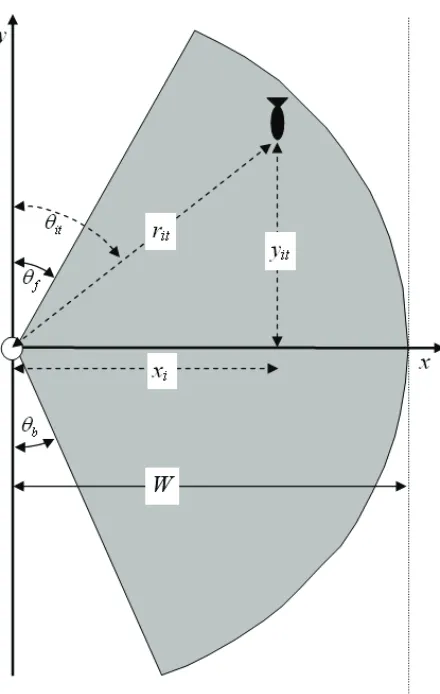
We define a Cartesian coordinate system which moves with the observer along a transect
line, and has the observer at (x = 0, y = 0). See Figure 1. Forward distance along the
transect line is denoted y and perpendicular distance from the line,x. At time t animali is
located at (xi, yit), at an angle θit from the transect line and at radial distance rit from the
observer. Animals are assumed not to move while within detectable range as the observer
moves along the transect line.
degrees from the trackline, out to maximum distance W (the shaded region in Figure 1).
[Figure 1 about here.]
Animals alternate between being available for detection for some random time and being
unavailable for some random time. We consider time in discrete units, with equal interval
between units. This allows us to model the availability process as a discrete time series with
two observable states: At = 1 if an animal is available at timet and At= 0 otherwise.
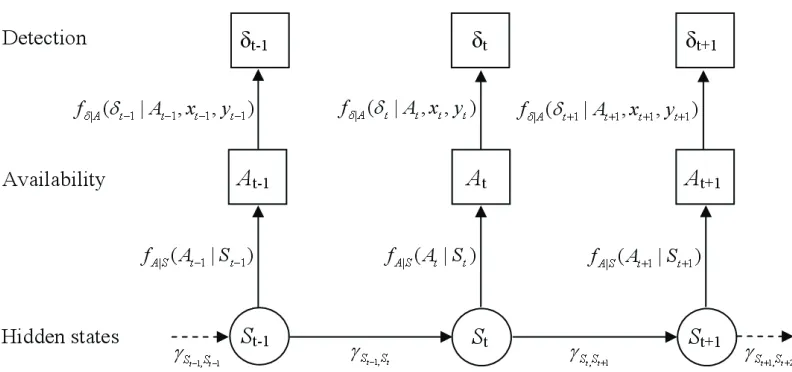
The animal avialability process is modelled by allowing animals to be in one ofmnotional
hidden states; the state at time t is denoted St. Given this state, the probability mass
function (pmf) of At is fA|S(At|St) = λAStt[1−λSt]1−At, where λ
St is the probability of the
animal being available, given its hidden state St. Sttakes on values 1, . . . , maccording to a
Markov process with m×m transition matrix
Γ = ⎛ ⎜ ⎜ ⎜ ⎜ ⎜ ⎝
γ1,1 · · · γ1,m ..
. . .. ...
γm,1 · · · γm,m
⎞ ⎟ ⎟ ⎟ ⎟ ⎟ ⎠ (1)
where γj,k is the transition probability from state j to state k (j, k ∈ {1, . . . , m}).
Unavailable animals are not detected and not all available animals are detected. The
farther an available animal is from the observer, the less likely it is that it is detected. To
deal with this, we introduce a random variable δt, such that δt= 1 if the animal is detected
at timet,δt = 0 otherwise and we define the pmf of δt to be
fδ|A(δt|At, xt, yt) =
⎧ ⎪ ⎨ ⎪ ⎩
h(xt, yt)δt[1−h(x
t, yt)]1−δt if At = 1
1−δt if At = 0
⎫ ⎪ ⎬ ⎪
⎭ (2)
We refer to h(xt, yt) as the detection hazard; it has a parameter vector β, which is to be
estimated.
3. Likelihood Formulation
We deal initially with situations in which perpendicular distancexi of theith detected animal
is observed, and only the first detection is recorded. Later we consider situations in which
forward distance at first detection, yi,t, is also recorded.
For the moment we consider the parameters Γ and λ= (λ1, . . . , λm) to be known.
3.1 Detection probability
Given only the state St and position (x, yt) of an animal at time t, the pmf for δt is
fδ|S(δt|St, x, yt) = [λSth(x, yt)]δt[1−λ
Sth(x, yt)]1−δt. We can therefore model the time series
of observedδs as a hidden Markov model (HMM) with states as above, but withδtconsidered
as arising directly from St, according to fδ|S.
An animal at perpendicular distance x is within detectable range on occasions t =
1, . . . , T(x), where T(x) is readily calculated from the speed of the observer, the width
of time intervals (δt−δt−1;t = 2, . . . , T(x)), and the geometry of Figure 1. The animal’s
positions (x, yt) relative to the observer at timest = 1, . . . , T(x) is similarly easily calculable.
We use data only up to the time of first detection. The observed δs for an animal first
detected at time t is therefore a series of (t −1) zeros, followed by a single 1. (It is in
principle possible to use data after first detection, although the detection function changes
after detection because observers become aware of animals’ presence.) Given the series of
states of an animal while in detectable range, ST(x) = (S1, . . . , ST(x)), and defining t to be 1
when the animal enters the detectable range, we can write the probability of first observing
the animal at time t as
Pr(δ1, . . . , δt|ST(x), x) =
t
u=1
fδu|S(δu|Su, x, yu) (3)
where δu = 0 for u < tand δt = 1.
The probability of an animal having the series of states ST(x) while within detectable
range is τS1Tt=2(x)γSt−1,St, where τS1 is the stationary distribution probability for state S1.
Using S
probability that an animal at x is first detected at time t as
p(x, yt) = ST(x)
τS1fδ|S(δ1|St, x, yt)
t
u=2
γSt−1,Stfδ|S(δu|Su, x, yu) (4)
Following MacDonald and Zucchini (1997), we note that Equation (4) has mT(x) terms and
is computationally very challenging except for small T(x). However, as they note, it can be
rewritten in a computationally more efficient form as follows:
p(x, yt) = τ
t
u=1Bu
(x, yu)
1 (5)
where, in our context,f(δu |x, yu) = diag(fδu|S(δu|Su = 1, x, yu), . . . , fδu|S(δu|Su =m, x, yu)), τ = (τ1, . . . , τm),Bu(x, yu) = Γf(δu |x, yu) and 1 is a column vector ofm 1s.
It follows that the probability of detecting an animal which is at perpendicular distance
x is the sum of Equation (5) over all possible ts at which it could be detected:
p(x) =
T(x)
t=1
τ
t
u=1Bu
(x, yu)
1 (6)
3.2 Only perpendicular distance observed
The detection function p(x) is a function of the availability process parameters Γ and
λ and the detection hazard parameters β. We treat the availability process parameters as
known for the moment and write the detection function as p(x;β) to make dependence on
β explicit. We can then write the likelihood for β, given that n animals were detected at
distances x= (x1, . . . , xn) as:
Lx(β|x) =
n
i=1
p(xi;β)π(xi)
W
0 p(xi;β)π(x)dx
(7)
3.3 Both perpendicular and forward distances observed
Let yiti be the forward distance at which animal i is first detected (i = 1, . . . , n), let
y= (y1t1, . . . , yntn), and make dependence ofp(x, yt) on β explicit by writing it asp(x, yt;β).
Then we can write the likelihood for β, given x and y as L(β | x, y) = Lx(β|x)Ly|x(β|x, y),
where
Ly|x(β|x, y) =
n
i=1
p(xi, yiti;β)
p(xi;β) (8)
4. Correction based on Proportion of Time Available
A common way of correcting for the fact that animals are not continuously avaiable for
detection is to multiply the line transect estimate is multiplied by the inverse of the proportion
of time animals are available. This is a valid correction if the survey is instantaneous because
this proportion is then a valid estimate of the probability that an animal is available for
detection. However, if the survey is not instantaneous correcting line transect estimators
in this way can lead to very biased estimation. A commonly-used alternative is to use a
method like that of Laake et al. (1997), which uses the estimated probability of an animal being available at least once while in view to correct for availability bias - obtaining the
estimate from the expected relative length of periods of availability and of unavailability
(i.e. effectively the proportion of time an animal is available).
One can show, however, that any correction factor based on the proportion of time an
animal is available or unavailable is not in general sufficient for unbiased correction. To
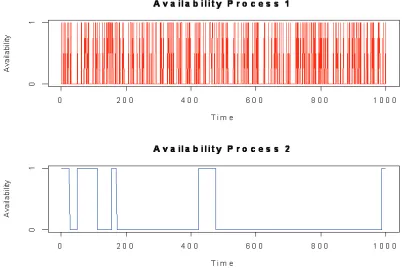
show this, we simulated two availability processes, both with animals being available 20% of
the time, but one with frequent short periods of availability, the other with infrequent long
periods of availability. Realisations of the availability processes are shown in Figure 3.
[Figure 3 about here.]
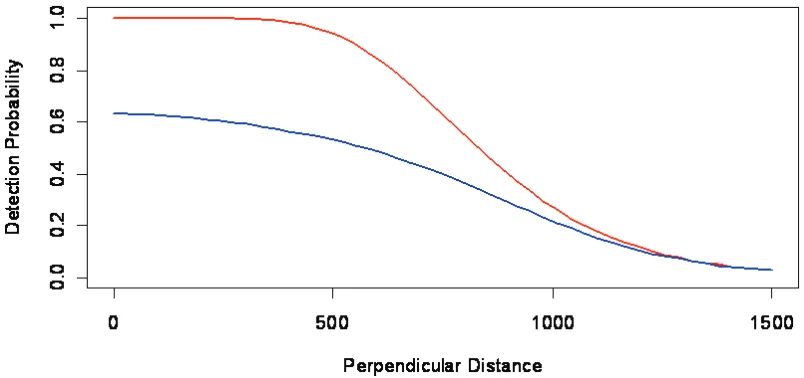
Animals were detected using a two-dimensional detection hazard function like that used
distance, y is forward distance, and γ1, γ2 and σ are parameters. An example of the
perpendicular distance detection functions resulting from use of identical detection hazard
functions with each of the availability processes illustrated in Figure 3 is shown in Figure 4.
Since the proportion of time animals are available isthe samein both cases, and the detection hazard functions are the same in both cases, it is apparent that a correction factor based
only on the proportion of time animals are available for detection is inadequate (even if that
proportion were known).
[Figure 4 about here.]
5. Application
The methods developed above were applied to an aerial survey of whales on which only
perpendicular distances were recorded. The availability process was estimated from tags
placed on 12 separate animals. A model like that described above for perpendicular distance
data only was fitted to the data by maximum likelihood, treating θf as a parameter to be
estimated and setting θb = 90o. The fit is shown in Figure 5.
The model was also fitted by resampling segments of the observed availability process
instead of fitting a HMM to it. Estimates differed by less than 5% from those obtained using
the HMM.
[Figure 5 about here.]
6. Discussion
Conventional methods for correcting for availability bias on line transect surveys of animals
with intermittent availability use only the proporiton of time animals are available (and the
proporiotn of time they are unavailable) for detection. While this provides a useful correction
when the surveys are effectively instantaneous (i.e. the time animals are within detectable
range is really very small compared to the length of periods of availability), it is in general
insufficient for correction of availability bias.
The method developed here provides a general-purpose method for dealing with availability
more than just the the mean lenght or proportion of time animals are available. This
characterisation can be via modelling availability data (from tags, for example) using hidden
Markov models, or by resampling from a sample of availability process realizations. The
method deals both with intermittent availability and with an area about the transect line
being obscured.
References
Laake, J.L., Calambokidis, J., Osmek, S.D. and Rugh, D.J. 1997. Probability of detecting
harbor poroise from aerial surveys: estimating g(0). J. Wildl. Manag. 61: 63-75.
McDonald, I.L. and Zucchini, W. 1997. Hidden Markov and other models for
discrete-valued time series. Chapman& Hall/CRC. London.
Skaug, H.J. and Schweder, T. (1999) Hazard models for line transect surveys with