REVIEW
November 2004
A systematic review of
pedagogical approaches that can
effectively include children with
special educational needs in
mainstream classrooms with a
particular focus on peer group
interactive approaches
This review is supported by the Teacher
Training Agency (TTA) to promote the use of
research and evidence to improve teaching
and learning
Review conducted by the TTA-supported SEN Review Group
Melanie Nind and Janice Wearmouth, with Janet Collins, Kathy Hall, Jonathan Rix and Kieron Sheehy
Review Team Membership
Ms Lini Ashdown, Open University Dr Janet Collins, Open University
Dr Jacqui Dean, Leeds Metropolitan University Professor Kathy Hall, Leeds Metropolitan University Dr Melanie Nind, Open University
Mr Jonathan Rix, Open University Dr Kieron Sheehy, Open University
Dr Jon Tan, Leeds Metropolitan University Dr Janice Wearmouth, Open University
EPPI-Centre Advisers
Ms Carole Torgerson, EPPI-Centre and the University of York
Professor Diana Elbourne, EPPI-Centre, Institute of Education, University of London
International Advisers
Dr Rosie Le Cornu, University of South Australia Dr Paid McGee, St Patrick’s College, Dublin University
Ms Mere Berryman, Pounamu Research Centre, Tauranga, New Zealand
ACKNOWLEDGMENTS
The research was commissioned by the Teacher Training Agency (TTA). The authors would like to thank Ms Carole Torgerson and Professor Diana Elbourne from the EPPI-Centre for their guidance and support during the conduct of the review. Thanks also to Dr Rosie Le Cornu (University of South Australia), Dr Paid McGee (St Patrick’s College, Dublin University) and Ms Mere Berryman
(Pounamu Research Centre, Tauranga, New Zealand) for their guidance on the international perspective; the advisory group for their interest and feedback and the Open University and Leeds Metropolitan University for contributing staff time.
CONFLICT OF INTERESTS
LIST OF ABBREVIATIONS
ANOVA Analysis of variance
ANCOVA Analysis of covariance
BERA British Education Research Association
CBA Curriculum-based assessment
CIRC Cooperative integrated reading and composition
CPD Continuing professional development
DES Department of Education and Science
DfE Department for Education
DfEE Department for Education and Employment
DfES Department for Education and Skills
EPPI-Centre Evidence for Policy and Practice Information and Co-ordinating Centre
ERIC Educational Research Information Clearinghouse GIsML Guided inquiry supporting multiple literacies
ITE Initial teacher education
RCO Revised curriculum only
SGRC Social group revised curriculum
SEN Special education needs
TAI Team-assisted individualisation
TTA Teacher Training Agency
UK United Kingdom
USA United States of America
WoE Weight of evidence
This report should be cited as: Nind M, Wearmouth J with Collins J, Hall K, Rix J, Sheehy K (2004) A systematic review of pedagogical approaches that can effectively include children with special educational needs in mainstream classrooms with a particular focus on peer group interactive approaches. In: Research Evidence in Education Library. London: EPPI-Centre, Social Science Research Unit, Institute of Education.
© Copyright
Authors of the systematic reviews on the EPPI-Centre website
SUMMARY ... 1
Background...1
Aims...1
Review questions...2
Methods ...2
Results...3
Conclusions ...4
1. BACKGROUND... 7
1.1 Aims and rationale for the current review ...7
1.2 Definitional and conceptual issues ...7
1.3 Policy and practice background...8
1.4 Research background...9
1.5 Authors, funders and other users of the review ...9
1.6 Review questions...10
2. METHODS USED IN THE REVIEW... 13
2.1 User-involvement...13
2.2 Identifying and describing studies...13
2.3 In-depth review ...17
3. IDENTIFICATION AND DESCRIPTION OF STUDIES: RESULTS... 21
3.1 Studies included from searching and screening ...21
3.2 Characteristics of the included studies (systematic map)...26
3.3. Identifying and describing studies: quality-assurance results...38
4. IN-DEPTH REVIEW: RESULTS... 39
4.1 Selecting studies for in-depth review ...39
4.2 Further details of studies included in the in-depth review...41
4.3 Final synthesis of studies...54
4.4 In-depth review: quality-assurance results ...66
4.5 Nature of actual involvement of users in the review and its impact ...67
5. FINDINGS AND IMPLICATIONS ... 68
5.1 Summary of principal findings...68
5.2 Strengths and limitations of this systematic review ...73
5.3 Implications...74
6. REFERENCES... 77
6.1 Studies included in map and synthesis...77
6.2 Other references...81
Appendix 1.1: Advisory Group Membership... 85
Appendix 2.3: Websites handsearched... 96
Appendix 2.4: EPPI-Centre Keyword sheet, including review-specific
keywords ... 97
Appendix 3.1: Studies not obtained... 99
SUMMARY
Background
The broad background to this review is a long history of concepts of special pupils and special education, and a faith in special pedagogical approaches. The rise of inclusive schools and some important critiques of special pedagogy (e.g. Hart, 1996; Norwich and Lewis, 2001; Thomas and Loxley, 2001) have raised the profile of teaching approaches that ordinary teachers can and do use to include children with special educational needs in mainstream classrooms. Inclusive education itself is increasingly conceived as being about the quality of learning and participation that goes on in inclusive schools rather than simplistic matters of where children are placed.
Policy and practice background
The policy of including pupils with special education needs (SEN) in mainstream schools and classrooms in England and Wales was importantly marked by the Warnock Report (DES, 1978) and has since gained momentum with Codes of Practice (DfE, 1994; 2001), government guidance (DfEE, 1997; 1998) and legislation (1981, 1993 and 1996 Education Acts; SENDA). There now is a statutory requirement on mainstream schools to provide effective learning opportunities for all pupils by setting suitable learning challenges, responding to pupils’ diverse learning needs and overcoming potential barriers to learning and assessment for individuals and groups of learners.
Research background
Previous systematic literature reviews related to the area of special educational needs and inclusion have focused on behavioural concerns and behaviour management in schools (Harden, 2003); the impact of paid adult support on the participation and learning of pupils in mainstream schools, including pupils with SEN (Howes et al., 2003); and school-level approaches to facilitating the participation by all pupils in the cultures, curricula and communities of schools (Dyson et al., 2002). Non-systematic (in technical terms) literature reviews have addressed the question of whether there is a particular pedagogy for special educational needs or each type of SEN, particularly types of learning difficulty, but not related to mainstream contexts (Norwich and Lewis, 2001), or asked about approaches that can effectively include children in mainstream schools beyond classroom pedagogy (Sebba and Sachdev, 1997). While research has sought to establish the effectiveness of particular pedagogies or the impact of school actions on pupil participation, there has been no prior systematic review that can answer the question of which pedagogical approaches can effectively include children with SEN in mainstream classrooms.
Aims
classrooms with children with special educational needs, aged 7–14 years. The main aim of this systematic review is to investigate which pedagogical
approaches can effectively include children with special educational needs in mainstream classrooms.
Review questions
Our review question is as follows:
What pedagogical approaches can effectively include children with special educational needs in mainstream classrooms?
Our in-depth review focuses on the following two related but more specific questions:
Question (a): Does a pedagogy involving a peer group interactive approach effectively include children with SEN in mainstream classrooms?
Question (b): How do mainstream classroom teachers enhance the academic attainment and social inclusion of children with special educational needs through peer group interactions?
Methods
When the review question had been agreed, a search was conducted. Search terms generated were aligned with the varying word usages in different countries and the British Education Thesaurus was used for selecting synonyms. All studies returned from searches were incorporated into EndNote bibliographic software, enabling good compatibility with the EPPI-Centre systems.
The studies were screened employing specific inclusion criteria to identify studies with a specific scope (a focus on pupils aged 7–14 who experience special educational needs, in mainstream classrooms, including pedagogical approaches and an indication of pupil outcomes); study type (empirical); and time and place (written in English and published after 1994) (see Appendix 2.1). A range of electronic databases and citation indexes were interrogated (see Appendix 2.2) and internet sites were searched (see Appendix 2.3). Screening was applied first to titles and abstracts (in two iterative stages) and then to full documents.
Screening was conducted by two independent screeners on all titles and studies, and the EPPI-Centre link-person on a sample for quality-assurance. For
pragmatic reasons, document retrieval ended on 31st March 2004; any studies
received after that time will need to be included in any update.
The identified studies were taken through a series of graduated filters,
culminating in the shortlist of studies. These were keyworded, using the EPPI-Centre (2003) Keywording Strategy (version 0.9.7) with review-specific keywords (see Appendix 2.4) in addition to EPPI-Centre keywords. This generated the ‘descriptive map’ of the studies in our review which provides a picture of the kinds of research that have been conducted together with details of their aims,
Discussion among the full review team and the advisory group of the most useful cluster of studies identified in the systematic map led to the re-focusing of the study onto two specific questions for the in-depth review. The in-depth review thus focuses on a group of pedagogical approaches characterised by peer group interactions that were conducted by mainstream teachers without necessitating additional staff resource; the review asked about their effectiveness and how teachers used the approaches. New inclusion and exclusion criteria were applied to the studies in the map leading to a subset of studies for the in-depth review. Data-extraction (using EPPI-Centre guidelines) was undertaken on these by two independent reviewers and any differences discussed and resolved.
The quality of studies and weight of evidence (WoE) were assessed using the EPPI-Centre data-extraction framework to assess the reliability and quality of each study, and focus judgements about the trustworthiness of study results and the weight of evidence that the study could contribute to answering the in-depth review questions. Judgements about the relative weight of evidence of each study were made using the following explicit criteria: the soundness of studies (internal methodological coherence); the appropriateness of the research design and analysis in relation to the review questions and the relevance of the study topic focus to the review questions. Taking into account quality of execution, appropriateness of design and relevance of focus, an overall weight of evidence judgement was made using a consistent formula (see Chapter 2). As quality-assurance, each study was independently reviewed and data-extracted by two different members of the review team or a member of the review team and the EPPI-Centre link person.
The findings of the individual in-depth studies were synthesised and conclusions and recommendations drawn. Synthesis took the form of eliciting a qualitative and quantitative overview for the effectiveness question and a structured narrative describing any overall, cross-study patterns or themes related to how teachers use peer group interactive approaches.
Results
A total of 2,095 potentially relevant reports were identified for the current review. Over half (1,156) were excluded in the first screening of titles and abstracts (see Table 3.1) and a further 238 were excluded in a second iteration of the process. A total of 450 were sent for and 14% of these (64) were not received within the timeframe of the review or were unavailable. A total of 383 full reports were screened, resulting in the exclusion of a further 315 reports, leaving 68 that met the criteria for inclusion in the mapping study.
In the application of exclusion/inclusion criteria to the collection of titles and abstracts, the measure of inter-rater reliability between the two members of the review team was good (Cohen’s Kappa 0.62). Nonetheless, for rigour all, rather than a sample of the titles and abstracts, were double-screened. There was 80% agreement for the two reviewers across the set of titles and abstracts. The kappa statistic for inter-rater reliability between each of the review members and our EPPI-Centre link person was lower but fair (Cohen’s Kappa 0.35). This difference is most plausibly explained by the difference in expert knowledge of the subject matter between the review team members and our EPPI-Centre link person.
evaluations and most were undertaken in the USA. The majority did not focus on curricular issues, but, of those that did, literacy dominated. Primary school contexts were twice as prevalent as secondary school contexts. The target groups were mostly mixed sex pupils with learning difficulties. Regular
mainstream teachers mostly carried out the teaching interventions, with special teachers and peers also often involved. The most common pedagogical approach was adaptation of instruction, often combined with other types of adaptation: materials, classroom environment and assessment. Just under a quarter of the studies involved peer group interactive approaches.
In-depth review
Ten studies were included in the in-depth review and nine of these were conducted in the USA. With the exception of two exploration of relationships studies, the studies were evaluations, mostly researcher-manipulated (six). Six of the studies focused on literacy and six were conducted in primary school settings.
Five studies were included in the synthesis for review question (a) and seven for review question (b). Question (a) studies researched cooperative learning, guided inquiry and Circle of Friends approaches. Outcomes measured include
engagement in classroom activities, curriculum performance and social interactions with peers/social acceptance. Effect sizes were reported in four studies, ranging from small to fairly large. Synthesis of question (b) studies led to five substantive themes emerging: the model of pupil-as-learner; integration of academic and social considerations; organisational and organised support; holistic views of 'basic skills', and shared philosophy.
Conclusions
Several studies were deemed to be medium or medium-high in terms of weight of evidence, but an issue remains about the scale of evidence available to address the research questions. Good quality studies, which incorporate empirical
validations of effectiveness, were, unsurprisingly, based on small samples. There were no studies with high weight of evidence for question (a) and only one for question (b). The strength of confidence we can have in the evidence is therefore measured. Despite these limitations, the review did lead to some substantive findings and offers a basis on which to make some recommendations for practice. The likely effectiveness of peer group interactive approaches for inclusion of children with special educational needs in mainstream classrooms can be established and we have an evidence base (albeit small) on how teachers use these approaches, that is some qualitative understanding of the processes at work.
All the studies show evidence of some learning and, with the exception of the Circle of Friends approach, this has included learning in the academic domain. Three studies provide explicit evidence of impact on both the academic learning and community participation of pupils with special educational needs. A further study provides evidence of academic rather than social gains. The evidence also indicates improved attitudes toward curriculum areas and children's own views of their competence, acceptance and self-worth. The evidence indicates that peer group interactive approaches that are effective in academic terms are also often effective in terms of social participation and children's attitudes to their learning. Teasing out the elements of the approaches that are functionally related with each outcome is difficult and perhaps unnecessary in professional rather than research terms.
The model of pupil as learner and having active agency in the construction of personal knowledge underpinned the studies and the interventions. Teachers fostered the co-construction of knowledge through scaffolding by, and dialogue with, peers. The studies’ authors recognised that a sense of belonging to and participation in the learning community has an important effect on young people’s learning in schools. Teachers made use of organisational support for community participation and organised support for peer group interactive approaches using peers and adults together with careful planning. An holistic approach to skill development underpinned many of the interventions in contrast to the isolated skill development associated with traditional remedial programmes for special needs. Making use of peers may bring with it a necessity to make skill
development socially meaningful. Finally, the studies indicate a role for shared philosophy and common concern with participation in the learning community, cooperation and collaboration.
Strengths and limitations
This systematic literature review had both strengths and limitations. It was strong in asking relevant questions of use to teachers where limited resource is an issue. It encompasses studies of pupils representing a wide range of SEN and there was high quality-assurance for the review: screening, data-extraction and quality-assessment was conducted by two independent review team members (or a review team member and EPPI-Centre link-person) at each stage. Confidence in the review findings is strengthened by the quality of the studies and the rigorous check on quality that were applied.
The literature review was limited in scope to material from 1994 and excluded pupils in the early years or post-14. The in-depth review was dominated by studies in primary contexts, meaning that as we move up through the school system to age 14, so our degree of confidence about the evidence for peer group interactive approaches drops considerably. Scope was also limited by the studies that did not arrive in time to be scrutinised in full. These tended to be unpublished theses and therefore may be systematically different from the studies included in the map and in-depth review, adding to the possibility of some distortion from publication bias. Negative or null outcomes are less likely to be published, which means the picture emerging from the systematic review may be over-optimistic.
The review is also limited in the strength of the evidence base arising from this systematic review. The lack of randomised control trials means that evidence of effectiveness is not as strong as it could be. The number of studies in the
studies to begin to judge generalizability, we know less about the teachers themselves and how representative they may be. We also know that the contexts for the studies are likely to differ from the contexts in which teachers in the United Kingdom (UK) may be working.
Implications for policy, practice and research
Policy-makers should be aware that there is a shortage of evidence about the nature of teaching approaches that effectively include children with special educational needs in mainstream classrooms. There is, however, some evidence that peer group interactive approaches can be effective and policy should not deter teachers from adopting such approaches. The research base generated about whether peer group interactive approaches are effective and in particular how teachers use them should be disseminated to teacher educators, advisers, student teachers and teachers.
Teachers should recognise that effective teaching for inclusion is complex, often combining attention to (subject-specific) adaptation of teaching or curriculum with attention to community participation, social grouping and roles within the group. According to this review, teaching approaches that effectively include children with special educational needs cannot be reduced to simplistic formulae but rather bring together teacher skills alongside a willingness and ability to utilise pupil skills. Given the complex nature of inclusive and peer group interactive pedagogy, teachers in training would need opportunities to reflect on their practices in the light of the existing research base.
Implications for research are that more rigorously designed studies are needed to evaluate teaching approaches to include children with special educational needs in mainstream classrooms. The small samples involved mean that a series of N=1 randomised interventions giving rise to high levels of trust would be
1. BACKGROUND
This chapter identifies the aims and rationale for the review as well as some definitional and conceptual issues. It describes the policy and practice context and considers the existing reviews in the field. It briefly describes the authors of the review, notes the funders and identifies the different users for whom it is intended. It concludes by specifying the review questions.
1.1 Aims and rationale for the current review
Despite a large literature, there is a lack of clarity about the appropriateness of empirical research and evidence regarding 'best practice' in the area of
pedagogical approaches for pupils with special educational needs in mainstream schools. A significant factor in this situation is the challenges for empirical
outcome studies where a multiplicity of environmental and interacting variables needs to be considered.
Teachers now also face an ever-widening diversity of pupils in mainstream schools (Audit Commission, 2002), meaning that they are likely to seek and want support in meeting special educational needs. In pursuing such support, teachers and teacher-trainers face countless claims of specialist techniques and materials that are often untested and have a poor theoretical basis. It was therefore
considered important to conduct a review of research to provide a sound evidence-base to inform practice and allow new entrants to the teaching
profession to meet classroom challenges in an informed and appropriate manner.
In the first review of a programme of three related literature reviews over three years, the question addressed in the review reported here is:
What pedagogical approaches can effectively include children with special educational needs in mainstream classrooms?
The aims of the review are to:
• Create a descriptive map of research undertaken in the area of effective pedagogical approaches that enable children with special educational needs to be included in mainstream classrooms
• Determine and examine the nature of pedagogical approaches, particularly classroom learning environments and teaching methods and styles, which enable children who experience difficulties in learning to participate fully in the community of learners in mainstream classrooms
1.2 Definitional and conceptual issues
preoccupation with needs rather than wants or rights (Roaf and Bines, 1989). Whilst not originally intended as such, the term has been used to refer to within-child difficulties rather than to difficulties that arise in an educational context.
One of the legacies of the long history of concepts of special pupils and special education is a faith in special procedures and approaches, and in turn continued growth of pedagogical practices that frequently fail to address the issue of inclusion (Skrtic, 1991). Norwich and Lewis' (2001) in-depth review of evidence, however, indicates that a taxonomy of appropriate pedagogic approaches for particular special educational needs is a construct unsupported by evidence. There is also a conceptual argument, strongly advocated from within the inclusion movement but not exclusive to it, that good teaching is, or can be, good teaching for all (Ainscow, 1997; Hart, 1996; Thomas and Loxley, 2001).
In addition to the conceptual debate about special educational needs and special pedagogical approaches there is conceptual confusion about what it means to include pupils effectively. Definitions of inclusion are often made in comparison with integration to distinguish between the school making (often radical)
adjustments to include children (inclusion) and children being required to change or be ready to fit into unchanged schools (integration) (Mittler, 2000). To include effectively in mainstream is defined as much more than a simple issue of
placement (Rouse and Florian, 1997): it is increasingly conceived as being about the quality of learning and participation that goes on in schools.
1.3 Policy and practice background
In England and Wales, the Warnock Report (DES, 1978) was the first of a series of markers that placed increasing emphasis on the policy of including pupils with SEN in mainstream schools and classrooms. This policy trend gained momentum in the 1990s with the 1994 Code of Practice on the Identification and Assessment of Special Educational Needs (DfE, 1994), the green paper Excellence for All Children (DfEE, 1997) and the subsequent Programme of Action (DfEE, 1998). This reflected more global trends characterised by the Salamanca Declaration and Framework for Action arising from the UNESCO (1994) World Conference on SEN.
The ‘General Statement for Inclusion’ in Curriculum 2000 (QCA, 2000), to which all teachers must adhere, places a statutory requirement on mainstream schools to provide ‘effective learning opportunities for all pupils’ and sets out three ‘key principles for inclusion’:
• Setting suitable learning challenges
• Responding to pupils’ diverse learning needs
• Overcoming potential barriers to learning and assessment for individuals and groups of learners
1.4 Research background
Previous systematic literature reviews related to the area of special educational needs and inclusion focus on:
• Issues concerned with appropriate responses to behavioural concerns and behaviour management in schools (Harden, 2003)
• The impact of paid adult support on the participation and learning of pupils in mainstream schools, including pupils with SEN (Howes et al., 2003)
• School-level approaches to facilitating the participation by all pupils in the cultures, curricula and communities of schools (Dyson et al., 2002)
These reviews focus on either (a) a more specific sub-category of children with SEN or (b) all children, including those with SEN. There will be some overlap in terms of studies of pedagogical approaches but classroom-level pedagogical approaches have not been their focus.
Similarly, previous research also includes non-systematic (in technical terms) literature reviews which have been more or less specific in the community of learners they focus on and their interest in pedagogy. Brahm Norwich and Ann Lewis (2001) addressed the question of whether there is a particular pedagogy for special educational needs or each type of SEN, but narrowed their scope to types of learning difficulty. They did not, however, address the particular issue of whether the pedagogical approaches can effectively include children in
mainstream schools. Sebba and Sachdev (1997) ask about what works in inclusive education, but looked outside the 7–14 age-range and beyond classroom pedagogy to wider policy, support and organisational dimensions.
While research has sought to establish the effectiveness of particular pedagogies or the impact of school actions on pupil participation, there has been no prior systematic review that can answer the question of which pedagogical approaches can effectively include children with SEN in mainstream classrooms.
1.5 Authors, funders and other users of the review
As the major agency in England with oversight of teacher education, the Teacher Training Agency (TTA) commissioned this review. The Evidence for Policy and Practice Information and Co-ordinating Centre (EPPI-Centre) at the Institute of Education, University of London worked closely with the TTA and the review team, training core team members and assuring quality. Funding of the review by the TTA was supported in kind by the Open University and Leeds Metropolitan University (LMU).
The review team comprised established academics with expertise in special and inclusive education, initial teacher education (ITE) and continuing professional development (CPD), and training and practice in systematic review procedures. It also included a qualified librarian, experienced in searching electronic databases and setting up data storage and retrieval systems. Team members had previously co-researched and co-authored on several research projects, including
capacity of teacher educators to carry out further reviews.
Janice Wearmouth's research has focused on the ‘problem space’ in mainstream school special educational provision. She has developed and tutored CPD modules in the areas of the co-ordination of special educational provision; difficulties in literacy development; developing inclusive curricula; and, in collaboration with the University of Waikato, New Zealand, behaviour
management. Her research includes evaluation of e-conferencing in CPD in the special needs field, home-school literacy partnerships to support children with difficulties, schools’ use of the SEN Register and explorations of pupils’ narrative of the experience of difficulties in literacy acquisition. Melanie Nind and Kieron Sheehy have also taught and produced distance-learning materials in the areas of special education and inclusive education at undergraduate and postgraduate levels. Melanie Nind's primary research focus has been the development and evaluation of interactive and inclusive pedagogy for pupils with severe and profound learning difficulties. With colleagues on the team, Janet Collins, Kathy Hall and Kieron Sheehy, she has also researched the process and cultures of inclusion in schools. Kieron Sheehy has broad experience in the field of special and inclusive education as both a teacher and educational psychologist. He has been involved in higher education provision across a range of professions in England and Ireland. His particular research interest is in technological assistance in addressing barriers to learning.
Janet Collins' main interests are primary education and, in particular, the
development of pedagogic approaches for children who exhibit non-participatory behaviour in school. Janet Collins and Jonathan Rix have worked on some of the Open University's first foundation degree courses for teaching assistants working in primary education. Jonathan Rix has taught in a wide variety of community settings, including prisons, day-centres and youth groups. He is a parent
representative for the National Portage Association and has research interests in intellectual access to Heritage sites and the value of simplified materials in the inclusive classroom.
Kathy Hall heads the Centre for Educational Research at LMU, contributes to ITT and CPD courses, and co-ordinates educational research awards. She led the ESRC-funded study of teacher assessment at Key Stage 1 and the British Council funded study of inclusive cultures in South African schools.
In examining effective teaching approaches for including pupils with special educational needs in mainstream classrooms, it is intended that the review will be especially useful to teacher educators who can employ the research synthesis in their initial teacher education (ITE) programmes. It will also be of use to serving teachers who wish to improve their inclusive practice through analysis and reflection. The review of studies will help teachers, and especially prospective teachers, understand better how to adopt teaching approaches that will be effective for diverse groups, fostering positive social and academic outcomes.
1.6 Review questions
Our review question was as follows:
More specifically, this involves seeking answers to important subsidiary questions, such as the following:
• What kind of classroom practices do pupils themselves feel support them and their learning in mainstream classes?
• What classroom environments enable all pupils to thrive and make progress?
• What approaches/techniques are used which set out to include the diversity of pupils in classrooms?
• Which of those approaches/techniques are the most successful in enabling the pupils with the lowest overall achievement levels to feel a sense of achievement/experience success?
• Which approaches/techniques/programmes are specially devised for particular pupils in mainstream classrooms?
• Which of these enable those individual pupils to experience success/achievement in the mainstream classroom?
Scope of the review
The review scrutinised and appraised research studies in the light of these questions and was based upon the following understanding of the key terms embedded in the key question.
The term ‘effectively include’ indicates a concern with the extent to which
particular pedagogical approaches can be shown to have a positive impact upon aspects of the learning and participation of children with special educational needs; for example, their attainment levels, progress, attitude, confidence and/or skills. As the review team anticipated, each of the studies scrutinised in the review employed its own criteria upon which pedagogical approaches were deemed ‘effective’ or were chosen for study. This review focuses closely upon the criteria used in the studies and the extent to which they had been made explicit. For some, effectiveness is seen in terms of tangible pupil achievements, whilst for others on the ratings of teachers, teaching assistants, parents and the pupils themselves. It was anticipated that a common thread connecting the studies in our review would be a judgement that the pedagogies employed are concerned with effective classroom practices and approaches for pupils with special educational needs, where effective is interpreted broadly in terms of learning, behavioural and/or community participation outcomes and processes. This was the case.
The term ‘pedagogical approaches’is used to mean, in the broadest sense: classroom practices, personnel deployment, organisation, use of resources, classroom environment and curriculum, that is, what occurs in classrooms that can be seen to impact on participation and learning.
these studies the pupils’ needs will be met in ordinary classrooms through a pedagogical approach. While it is acknowledged that there is much to be learned from research on teaching approaches for other diversity and difference in the classroom, and this may be explored in the later years, this was not included in the initial literature review reported here.
The particular contexts examined in the review are those whose impact could be demonstrated in classrooms in mainstream schools serving the 7–14 age range.
The particular age range encompasses, in the UK context, primary and middle schools and the first years of secondary schooling (Key Stages 2 and 3 in England and Wales). In the USA, this encompasses elementary, middle and junior high school classrooms. Studies from a range of countries were included in the search, as long as they were reported in English.
2. METHODS USED IN THE REVIEW
This chapter begins by briefly outlining how users were involved in the review. It then sets out the methods of the review, detailing how we defined our terms and how we narrowed our focus. It explains the criteria used to include and exclude studies, and describes the methods used for finding studies. It also describes the screening and the quality-assurance process. It then describes how we
progressed from a mapping of the studies to an in-depth review. An account is offered of how we assessed the quality of studies, how we conducted a synthesis of the evidence and the quality-assurance mechanisms we applied.
2.1 User-involvement
2.1.1 Approach and rationale
Regular contact with primary and secondary school teacher educators was maintained from the conceptualisation of the project to its conclusion. This deliberately included those with expertise in special educational needs and inclusive education, and those with little experience in this area in order to meet the needs of a range of users of the research. We also communicated directly with student teachers and teachers engaged in CPD about the focus of the review question and about the process of conducting a systematic review of the evidence.
The advisory group included teacher trainers, teachers, educational
psychologists, advisers and government inspectors, all of whom have a special interest in the area of special education needs and inclusive education. Thus decisions about focus and process were made following dialogue with potential users of the research. International consultants Rosie Le Cornu (Australia), Paid McGee (Republic of Ireland) and Mere Berryman (New Zealand) advised both on research in their contexts and issues for users in other contexts.
2.1.2 Methods used
The advisory group provided a sounding-board for key matters of discussion. It also ratified decisions made. Regular briefings and invitations to respond to a set of questions were used to foster dialogue. Key stages for feedback were
identification of the research question; identification of the major parameters; narrowing of criteria for the in-depth review; draft report; and development of user summary.
2.2 Identifying and describing studies
2.2.1 Defining relevant studies: inclusion and exclusion
criteria
The mapping exercise included those studies that met all the following criteria:
• Include a focus on pupils who experience special educational needs of some kind (as defined in section 1.6)
• Are conducted in mainstream classrooms
• Include pedagogical approaches
• Include an indication of pupil outcomes (as defined in section 1.6)
• Are concerned with the 7–14 age range or some part of it
Study type
• Are empirical – exploration of relationships, evaluations or systematic reviews
Time and place
• Are written in English
• Are published or produced (if unpublished) after 1994
Studies were excluded if they met oneof the following Stage 1 exclusion criteria:
Scope
• (Exclude 1) Not focused on pupils who experience special educational needs of some kind (as defined in section 1.6)
• (Exclude 2) Not conducted in mainstream classrooms
• (Exclude 3) Not concerned with pedagogical approaches
• (Exclude 4) Not indicating pupil outcomes (as defined in section 1.6)
• (Exclude 5) Not concerned with all or part of the 7–14 age range
Study type
• (Exclude 6) Descriptions, development of methodology or reviews other than systematic reviews
Time and place
• (Exclude 7) Not written in English
• (Exclude 8) Not produced or published after 1994
2.2.2 Identification of potential studies: search strategy
The following electronic databases and citation indexes were interrogated:
• ERIC (The Educational Research Information Center)
• BEI (The British Educational Index)
• PsycINFO
• AEI (Australian Education Index)
• BLPC (British Library Public Catalogue)
• Dissertation abstracts
• ECO (Education Collection Online)
• Education Research Abstracts
• Papers First
• Child Data
• Education On-line
Key internet sites were searched (see Appendix 2.3), including research organizations, government and voluntary organisations. It was anticipated that journals not appearing in the database would be handsearched but this
transpired to be unnecessary as the electronic search included all key journals. Sources from key informants were pursued.
A collection of appropriate search terms was generated for use in searching. Care was taken to vary the search terms to align with the varying word usages in different countries: for example, ‘mainstream’ school would be ‘regular’ school in some countries; 'difficulties in learning’/’learning difficulties’ would be ‘learning disabilities’. The British Education Thesaurus was used for selecting synonyms.
Search terms used for searching the bibliographic databases included the following sets in combination:
• Terms to indicate that the study was about children with special educational needs
• Terms to indicate that a study was about inclusive education
• Terms to indicate that a study was about pedagogical approaches
• Terms to indicate that the study involved pupils aged between 7–14
1 2 3 4
Special educational needs
Special education program
Disabilities Behaviour problems Disabled pupils/ students
Inclusion Participation Mainstream(ing) Regular
Ordinary Integration
Pedagogy Teaching style Learning environment Classroom organisation Educational intervention
Effective instruction
Schools
Primary school High school Secondary school Middle school Key Stage 2 Key Stage 3 NOT adult education NOT early years
The key terms were developed in collaboration with the specialist librarian, who advised on the use of indexing languages for specific databases.
2.2.3 Screening studies: applying inclusion and exclusion
criteria
Within the constraints of time and resources, the team followed as closely as possible the protocols governing systematic reviews as described in the EPPI-Centre documentation. The team first performed a screening and mapping of studies, followed by an in-depth appraisal of particular subset(s). Screening was conducted by two independent screeners; a random sample of 20 titles and abstracts and 10 full articles was also screened by the EPPI-Centre link person.
We focused on as wide and as comprehensive a range of research studies as we could and included work that was both quantitative and qualitative in orientation. Previous work had suggested that much of the relevant research would combine quantitative and qualitative methodologies, and that studies would commonly involve case studies of a single classroom or school, sometimes as part of bigger projects. We applied inclusion and exclusion criteria successively to (i) titles and abstracts (twice) and (ii) full reports. A second application of the criteria to titles and abstracts was conducted after the first screening, which, having operated on the basis of including those studies where one of the independent reviewers had scored ‘Include’, produced a high number of studies. In a second process, the titles and abstracts were re-examined, applying the criteria more rigorously and using additional information which was sought where it was missing. Exclusions from this second level screening were recorded separately.
We obtained full reports for those studies that appeared to meet the criteria. We entered the included items into a second database. We applied the inclusion and exclusion criteria to the full reports and excluded those that were found not to meet the inclusion/exclusion criteria. Again, two independent screeners applied the criteria, with a sample also screened by the EPPI-Centre link person.
The studies included in the review proceeded through a series of graduated filters. A database was made of all the studies retrieved from the electronic databases, electronically processed online journals and searches of websites. Initially, the inclusion and exclusion criteria were applied to the titles and abstracts of studies in this database. This was done independently by pairs of members of the review team who, working in collaboration with the EPPI-Centre link person, eventually shared and resolved any uncertainties that occurred about individual studies and then drew up a list of those studies which met the
inclusion/exclusion criteria. These studies were entered into a second database (EndNote 2). Full copies of all studies in this second database which appeared to meet the criteria were obtained and the criteria were re-applied so as to exclude any which, upon fuller scrutiny, did not meet the inclusion criteria.
2.2.4 Characterising included studies
All the studies which remained were keyworded, using the EPPI-Centre (2002a) Keywording Strategy (version 0.9.7) with review-specific keywords (see Appendix 2.4) in addition to EPPI-Centre keywords. This helped us to build a descriptive map of the studies in our review and provide a full and clear picture of the kinds of research that have been conducted together with details of their aims,
2.2.5 Identifying and describing studies: quality-assurance
process
As quality-assurance, two studies were keyworded by all five members of the review team new to the process, allowing for deliberation over the process and clarification of the guidance and protocol. Each study was then keyworded by two members of the review team, working first independently and then comparing their decisions and coming to a consensus. Three teams of two keyworders conducted this process and more novice review team members were paired with experienced or trained reviewers. A random sample of 10 studies was keyworded by the EPPI-Centre link person.
This keywording revealed the need to apply new, narrower criteria in order to isolate a particular subset of our studies for further in-depth scrutiny and review.
2.3 In-depth review
2.3.1 Moving from broad characterisation (mapping) to
in-depth review
During the course of the mapping, it became clear to the review team that there was a large number of studies in the field and that it would not be possible to review in depth all 68 studies found. In a meeting of the review team, it was agreed that the original research question would be refined to focus on a more specific theme within it.
The review team addressed the issue of narrowing down the focus for the in-depth review. Possible foci for the in-in-depth review were ruled out on the basis of being too broad (studies sharing a broad aim or broad collection of outcomes) or not generically useful (studies focused on a particular category of special
educational need). Some of the studies we had keyworded had involved interventions specifically focused only on those pupils with special educational needs or had involved investment of considerable resources and we judged these to be of limited usefulness for the users of the research. We wanted to focus the in-depth review on studies of pedagogical approaches used by ordinary teachers for the whole class and not requiring specialist resources. The
prominent categories of pedagogical approaches meeting these criteria were those keyworded as peer-group interactive and peer tutoring. It was essential that our views on the usefulness of these criteria and approaches were informed by the views of the advisory group. Review team members took responsibility for interviewing the consultants and advisory group members about this issue. The responses indicated endorsement of the potential of peer tutoring and particularly peer-group interactive approaches, which ordinary teachers could use without additional resource. An educational psychologist on the advisory group noted 'our education system is absolutely littered with examples of peer assisted learning from the very earliest schools and, although peer tutoring, etc. went out of fashion for a while, happily [it] is now appearing in all sorts of guises in our schools'. Similarly, an international consultant advised that peer group interactive
how children with special needs operate in such environments’.
Two related dimensions emerged from discussion of what it was we wanted to learn from studies of peer group interactive approaches: the dimension of evidence of the effectiveness of these approaches and the dimension of what they involved. Thus, the questions for the in-depth review became:
Question (a): Does a pedagogy involving a peer group interactive approach effectively include children with SEN in mainstream classrooms?
Question (b): How do mainstream classroom teachers enhance the academic attainment and social inclusion of children with special educational needs through peer group interactions?
On the above basis, inclusion and exclusion criteria on the scope of the studies for the in-depth review were drawn up to include studies:
• With a focus on a peer group interactive pedagogical approach beyond peer tutoring/behavioural prompting
• Conducted by mainstream classroom teachers without necessitating additional staff support
• Indicating academic and/or social interaction/involvement outcomes measured through systematic data-gathering
2.3.2 Detailed description of studies in the in-depth review
Pairs of independent reviewers applied the inclusion/exclusion criteria to all the studies in the descriptive map to elicit studies that satisfied requirements for inclusion in the in-depth review. Studies in the in-depth review were then data-extracted and quality appraised, using the EPPI-Centre guidelines (EPPI-Centre, 2002b). Any disagreements between the reviewers were discussed and resolved. In addition, a pair of reviewers appraised the weight of evidence judgements for all the studies to check for consistency of application of the agreed protocol. Information about the study population, sampling, data-collection and analysis, as well as the results and conclusions, were recorded and described in brief
accounts of the papers (see Chapter 4) and detailed summaries of the studies (see Appendix 4.1).
2.3.3 Assessing quality of studies and weight of evidence
for the review question
Each study was independently data-extracted by two team members using EPPI Reviewer, with two studies data-extracted by the EPPI-Centre link person for quality-assurance purposes. The quality of studies and weight of evidence (WOE) were assessed using the EPPI-Centre data-extraction framework and we turn to this now.
Judgements about the relative weight of evidence of each study were made using the following explicit criteria:
A. soundness of studies (internal methodological coherence) as they stand B. appropriateness of the research design and analysis in relation to the review
question
C. relevance of the study topic focus to the review question
D. taking into account quality of execution, appropriateness of design and relevance of focus, the overall weight of evidence provided by the study to address the question of the systematic review
In weight of evidence A, the soundness or trustworthiness of studies, the team considered the extent to which the study is adequately described, whether it has clear aims, whether it is clear about how its sample has been chosen, and the appropriateness of the sample design for the research focus. The team
considered the adequacy and appropriateness of the data-collection and analysis methods for the study focus. Overall, we rated a study as being of high, medium to high, medium, medium to low, or low soundness.
For weight of evidence B–D, judgements were made in relation to each of the two in-depth review questions. In weight of evidence B, the appropriateness of the research design and analysis in relation to review questions (a) and (b), the team again rated the studies as high, medium to high, medium, medium to low, or low, according to the extent to which we judged that the research design was
appropriate to each.
For weight of evidence C, the relevance of the study topic focus to the review questions, the team judged how well the data collected helped to answer each question and rated the studies as above, according to whether the team considered that the focus of the study was relevant to answering each review question.
The judgements for the three aspects were combined into an overall weight of evidence towards answering the review question. This was not done numerically but according to the formula below:
To gain a HIGH overall WoE D rating • the ratings for WoE A–C all have to be HIGH
To gain a MEDIUM–HIGH overall
WoE D rating • the ratings for WoE A–C all have to be MEDIUM–HIGH; or • WoE A–C have to include two highs and no lows (and
WoE B is of medium high); or
• MEDIUM–HIGH has to be the middle rating (as in one high, one medium–high and one medium) and WoE B is of at least medium high
To gain a MEDIUM overall WoE D
rating • the ratings for at least two of WoE A–C have to be MEDIUM, including WoE B; or • MEDIUM has to be the middle rating (as in one
medium and one either side of medium) and WoE B has to be at least medium rating
To gain a MEDIUM–LOW overall
• MEDIUM–LOW has to be the middle rating (as in one medium, one medium–low and one low) and WoE B is at least medium low rating
To gain LOW overall WoE D rating • the ratings for WoE A–C all have to be LOW; or • WoE B is a low rating
2.3.4 Synthesis of evidence
The synthesis has attempted to bring together the findings of the individual in-depth studies so as to enable the drawing of tentative conclusions and recommendations. It was agreed that for our audience and purpose the most appropriate synthesis would take the form of a structured narrative describing any overall, cross-study patterns or themes that were detected in the characteristics of our individual studies and in their findings. Themes were derived from those studies that had been subjected to the most rigorous interrogation using the EPPI-Centre data-extraction tool.
2.3.5 In-depth review: quality-assurance process
As quality-assurance, each study was independently reviewed and
3. IDENTIFICATION AND DESCRIPTION OF
STUDIES: RESULTS
This chapter describes how the searches produced the potential studies for inclusion in the review and outlines how the initial collection of studies was pruned to produce those that form the basis of the descriptive map.
[image:26.595.120.531.360.559.2]3.1 Studies included from searching and screening
Figure 3.1 summarises the filtering of papers from searching through systematic map to final synthesis.Papers (N=1,845) were identified for two-stage screening from electronic
searching. An additional 52 studies were identified from handsearching allowing immediate screening.
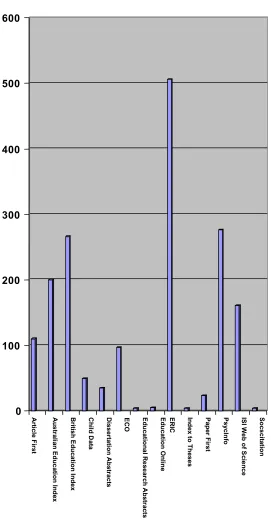
The database origins of 2,095 papers identified for screening (including duplicates) are shown in Figure 3.2.
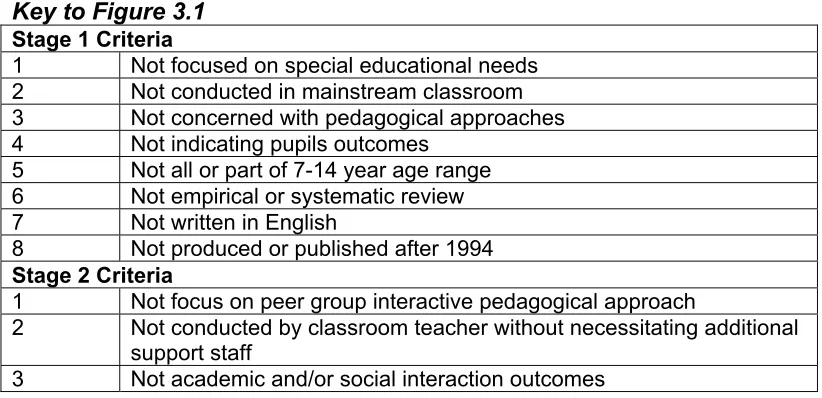
Key to Figure 3.1
Stage 1 Criteria
1 Not focused on special educational needs 2 Not conducted in mainstream classroom 3 Not concerned with pedagogical approaches 4 Not indicating pupils outcomes
5 Not all or part of 7-14 year age range 6 Not empirical or systematic review 7 Not written in English
8 Not produced or published after 1994
Stage 2 Criteria
1 Not focus on peer group interactive pedagogical approach
2 Not conducted by classroom teacher without necessitating additional support staff
Figure 3.1: Filtering of papers from searching to map to synthesis
Two-stage screening: Papers identified where there is not
immediate screening, e.g. electronic searching N =2,095 Criterion 4: S1 N=118 S2 N=54 Criterion 5: S1 N=62 S2 N=4 Criterion 6: S1 N=164 S2 N=102 Papers excluded Screen 1 N =1,156 Screen 2 N=238 Abstracts and titles screened
S1 N=1845
S2 N=689
Systematic map Papers/Studies includedN = 68
Full document screened N = 386 papers
(393 studies)
In-depth review
Papers/Studies included N = 10
1. Identification of
potential studies
2.
Application ofinclusion/ exclusion criteria
3. Characterisation
4. In-depth review
Potential includes
N =450
Excluded Papers N = 315 (Studies N=322) Duplicate
reports on same study N = 3
Criterion 1: N = 6
Criterion 2: N = 33
Criterion 3: N = 96
Criterion 4: N = 63
Papers not obtained
N = 64
One-stage screening: papers
identified in ways that allow immediate screening, e.g. handsearching
N = 25
Duplicate references
excluded
N = 26
In map but excluded
from in-depth review
N = 58 IDC1 N=46
IDC 2 N=9 IDC 3 N=3
Duplicate references excluded N =250 Criterion 2: S1 N=195 S2 N=26 Criterion 3: S1 N=453 S2 N=36 Criterion 7: S1 N=1 S2 N=0 Criterion 8: S1 N=0 S2 N=3 Criterion 5: N = 17
Criterion 6: N = 100 (107 studies)
Criterion 7: N = 0
Criterion 8: N = 0
S1 N=163 S2 N=13
[image:27.595.39.560.58.771.2]Figure 3.2: Database origins 0 100 200 300 400 500 600 A rti cl e F irs t A u s tr ali an E d uc at io n I n d ex B ritis h E d u cat io n I n de x Ch ild D at a D iss er ta tion A b str a cts EC O E d u cat io n a l R e se a rc h A b str act s E d u cat io n O n lin e ERI C In d ex t o T h ese s P aper Fir s t P sycI n fo IS I We b of S cie n c e S o cs ci ta tio n
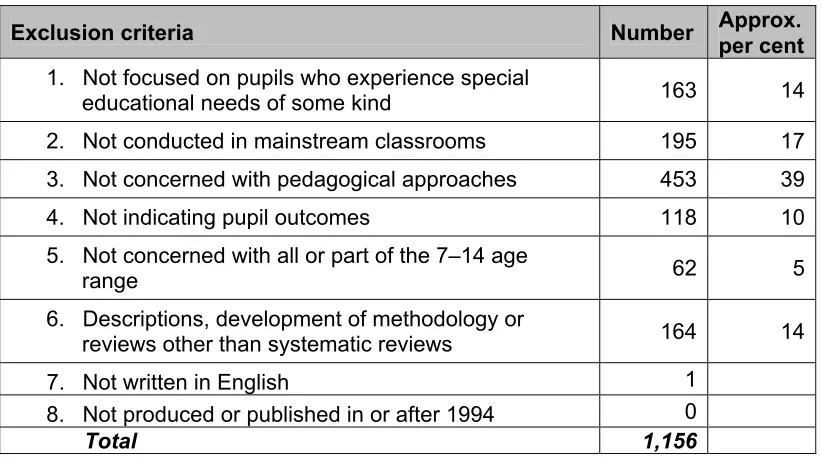
[image:28.595.155.426.105.632.2]Exclusion criteria (see Appendix 2.1) were applied to 52 one-stage screening items and to the titles and abstracts of 1,845 reports. The one-stage screening led to the exclusion of 27 items with 25 items remaining. Screening of the titles and abstracts led to the exclusion of 1,156 reports (see Table 3.1) and a remaining 683 reports which, on first screening, were considered to have satisfied the criteria for inclusion in the review and for entry into the second database, EndNote 2. Of the total of 1,156 reports excluded, the bases for the exclusions are set out in the table below. For each item only one exclusion criterion was applied; that is, the highest in the hierarchy of criteria. When the two independent screeners disagreed, the resolution meant that the criterion lower down the hierarchy and a safer basis for exclusion was selected.
Table 3.1: Exclusions at first stage
Exclusion criteria Number Approx. per cent
1. Not focused on pupils who experience special
educational needs of some kind 163 14
2. Not conducted in mainstream classrooms 195 17
3. Not concerned with pedagogical approaches 453 39
4. Not indicating pupil outcomes 118 10
5. Not concerned with all or part of the 7–14 age
range 62 5
6. Descriptions, development of methodology or
reviews other than systematic reviews 164 14
7. Not written in English 1
8. Not produced or published in or after 1994 0
Total 1,156
Table 3.2: Exclusions at second stage
Exclusion criteria Number Approx. per cent
1. Not focused on pupils who experience special educational needs of some kind
13 6
2. Not conducted in mainstream classrooms 26 11
3. Not concerned with pedagogical approaches 36 15
4. Not indicating pupil outcomes 54 23
5. Not concerned with all or part of the 7–14 age range 4 2 6. Descriptions, development of methodology or
reviews other than systematic reviews 102 43
7. Not written in English 0
8. Not produced or published in or after 1994 3 1
Total 238
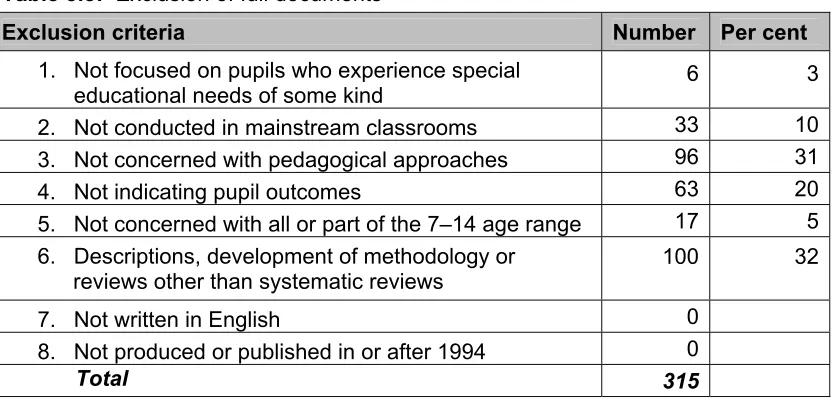
After filtering through these stages, the potential number of studies for inclusion in the descriptive map was 450. These were entered into a third database (EndNote 3). A cut-off date of 31 March 2004 was set for retrieval of the full documents for screening. Of these 450 full studies sought for screening, 64 were not obtained by the cut-off date. This meant that, although we had not set out to exclude theses, for example, they were not included by default. As 75% of the full documents screened were excluded, it could be postulated that approximately 20 potential studies for the map were missing. The list of material documents that were not obtained for screening can be found in Appendix 3.1. At the third stage of screening, 383 full documents were screened, again using the same criteria but now applied to full readings of the studies. This resulted in a total of 315 studies being excluded; the details of the exclusions and the bases for such exclusions are set out in the Table 3.3.
Table 3.3: Exclusion of full documents
Exclusion criteria Number Per cent
1. Not focused on pupils who experience special
educational needs of some kind 6 3
2. Not conducted in mainstream classrooms 33 10
3. Not concerned with pedagogical approaches 96 31
4. Not indicating pupil outcomes 63 20
5. Not concerned with all or part of the 7–14 age range 17 5 6. Descriptions, development of methodology or
reviews other than systematic reviews
100 32
7. Not written in English 0
8. Not produced or published in or after 1994 0
Total 315
[image:30.595.125.541.500.703.2]The series of ‘sieves’ through which the initial collection of potentially useful studies was filtered is summarised in the flowchart set out in Figure 3.1.
3.2 Characteristics of the included studies
(systematic map)
3.2.1 Database origins
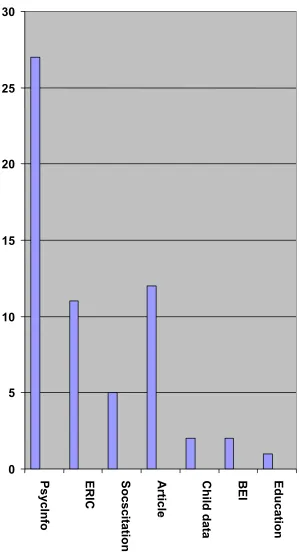
The graph (Figure 3.3) summarises the electronic database origins of the 63 studies which were included in the descriptive map and not identified through handsearching. Although originally studies may have been identified in more than one database, they were downloaded to the EndNote database from the
Figure 3.3: Database origins of studies in map
0
5
10
15
20
25
30
Psyc
Inf
o
ER
IC
Socsc
it
at
ion
Artic
le
Child dat
a
BE
I
Educat
ion
3.2.2 Study type
The descriptive map was generated through the EPPI-Centre process of
The graph below (Figure 3.4) shows the pattern of the 68 studies by study type. The methodological study type keywords were applied such that the keyword furthest along the hierarchy was applied (see Appendix 2.4). Thus evaluation studies are likely to involve some exploration of relationships, but exploration of relationships studies will not be evaluative.
Figure 3.4: Study type (N=68 studies)
0 5 10 15 20 25 30 35 40
Descri
p
ti
on
Explo
rat
ion
of
re
lat
ions
hips
E
val
uati
on: Natural
ly
occurri
ng
E
val
uati
on: Researcher-m
an
ip
ul
ated
Among the evaluations, there are 11 controlled trials, three of which are randomised controlled trials.
3.2.3 National contexts
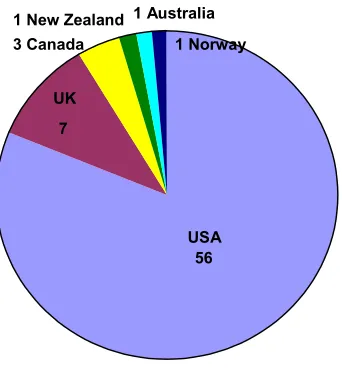
[image:33.595.169.440.198.668.2]instances, reviewer judgement was used to infer the country from the researchers' university base and other contextual clues. The categories are mutually exclusive in that no studies were conducted in more that one country. The USA is clearly predominant, accounting for 80% of the studies included in the map.
Figure 3.5: National contexts (N=68 studies)
1 New Zealand 1 Australia 1 Norway 3 Canada
USA 56 UK
7
[image:34.595.119.565.474.648.2]National context and study type were related as shown in Table 3.3. UK studies are spread across the study types, whereas in the USA, researcher-manipulated evaluations are more than four times as common as any other single study type. One each of the 11 controlled trials is from England, New Zealand and Canada, and the remainder are from the USA.
Table 3.3: Study type by country (N=68 studies)
Country Description Exploration of relationships
Evaluation: Naturally occurring
Evaluation: Researcher- manipulated
USA 8 6 7 34
UK 2 2 1 2
Canada 2 1
New Zealand 1
Australia 1 Norway 1
3.2.4 Curriculum focus
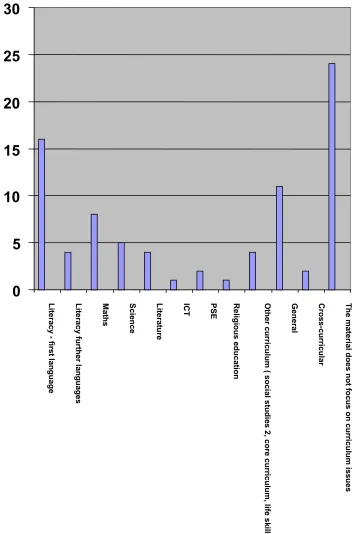
Figure 3.6 illustrates the curriculum focus of the various included studies. As can be seen, approximately one-third of the studies is not concerned with the
curriculum, and a further 16% are not concerned with particular curriculum
studies; much is written about inclusion in PE but this is not based on research evidence). The curriculum keywords are not mutually exclusive and 91 keywords were applied to the 68 studies.
Figure 3.6: Curriculum focus (N=68 studies)
0
5
10
15
20
25
30
Literacy - fi
rst l an guage Li teracy further la ng uages Ma th s Sc ie nc e L iteratu re IC
T PSE Rel
ig ious e ducat io n Other curri cu lu
m ( soci
3.2.5 Context of the studies
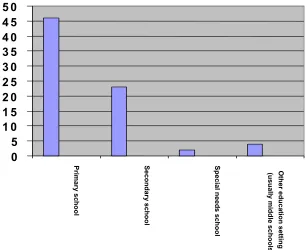
It is commonly asserted that inclusive education is easier in primary education where gaps between chronological age and performance are smaller and where outcome measures have less influence. The descriptive map shows that twice as many studies were conducted in primary/elementary schools as in
[image:36.595.150.457.267.517.2]secondary/high schools. Whether or not inclusive education is easier to achieve in the primary sector, the research evidence about successful inclusive teaching is greater, as illustrated in Figure 3.7.
Figure 3.7: Education setting (N=68 studies)
0 5 1 0 1 5 2 0 2 5 3 0 3 5 4 0 4 5 5 0
Primary
sc
hool
Secondary
sch
ool
Special need
s
sc
hool
O
ther
educa
tion
se
tting
(usua
lly
mi
ddle
schoo
ls
)
The categories are not mutually exclusive and in some studies the teaching intervention began in special contexts and moved to the mainstream; hence 75 keywords were applied to 68 studies.
3.2.6 Gender of the pupils
Figure 3.8: Gender of the target pupils (N=68 studies)
2 female only
14 male only
52 both male and female participants