This is a repository copy of
A bi-objective user equilibrium model of travel time reliability in
a road network
.
White Rose Research Online URL for this paper:
http://eprints.whiterose.ac.uk/79926/
Article:
Wang, JYT, Ehrgott, M and Chen, A (2014) A bi-objective user equilibrium model of travel
time reliability in a road network. Transportation Research Part B: Methodological, 66. 4 -
15. ISSN 0191-2615
https://doi.org/10.1016/j.trb.2013.10.007
Reuse
Unless indicated otherwise, fulltext items are protected by copyright with all rights reserved. The copyright exception in section 29 of the Copyright, Designs and Patents Act 1988 allows the making of a single copy solely for the purpose of non-commercial research or private study within the limits of fair dealing. The publisher or other rights-holder may allow further reproduction and re-use of this version - refer to the White Rose Research Online record for this item. Where records identify the publisher as the copyright holder, users can verify any specific terms of use on the publisher’s website.
Takedown
If you consider content in White Rose Research Online to be in breach of UK law, please notify us by
A Bi-objective User Equilibrium Model of Travel Time
Reliability in a Road Network
Judith Y.T. Wanga,c,∗, Matthias Ehrgottb,c, Anthony Chend
aSchool of Civil Engineering & Institute for Transport Studies, University of Leeds, Woodhouse Lane, Leeds LS2 9JT, United Kingdom
bDepartment of Management Science, Lancaster University, Bailrigg, Lancaster LA1 4YX, United Kingdom
cDepartment of Engineering Science, The University of Auckland, Private Bag 92019, Auckland 1142, New Zealand
d
Department of Civil and Environmental Engineering, Utah State University, Logan UT 84322-4110, USA
Abstract
Travel time, travel time reliability and monetary cost have been empirically
identi-fied as the most important criteria influencing route choice behaviour. We
concen-trate on travel time and travel time reliability and review two prominent user
equi-librium models incorporating these two factors. We discuss some shortcomings
of these models and propose alternative bi-objective user equilibrium models that
overcome the shortcomings. Finally, based on the observation that both models use
standard deviation of travel time within their measure of travel time reliability, we
propose a general travel time reliability bi-objective user equilibrium model. We
prove that this model encompasses those discussed previously and hence forms a
general framework for the study of reliability related user equilibrium. We
demon-strate and validate our concepts on a small three-link example.
Keywords: Route choice, user equilibrium, travel time reliability, bi-objective
∗Corresponding author. Tel.: +44 113 3433259 ; Fax: +44 113 343 3265.
Email addresses:[email protected](Judith Y.T. Wang),
user equilibrium, late arrival penalty, travel time budget.
1. Introduction
1
It is well known from empirical studies that the three most important
fac-2
tors influencing route choice behaviour are travel time, travel time reliability and
3
monetary cost. Abdel-Aty et al. (1995) performed statistical analysis to
deter-4
mine which route attributes that lead to the choice of a route are considered
im-5
portant by road users. The three most important factors are: (1) shorter travel
6
time (ranked as the first reason by 40% of respondents); (2) travel time
reliabil-7
ity (32%); and (3) shorter distance (31%). Although the effect of monetary cost
8
was not considered explicitly in this study, the third most important factor, i.e.
dis-9
tance, is directly related to vehicle operating cost for the trip. In more recent years,
10
the values of travel time (VOT) and travel time reliability (VOR) were estimated in
11
two road pricing demonstrations in southern California, on California State Route
12
91 (SR91) and Interstate 15 (I-15) (see Lam and Small, 2001; Liu et al., 2004;
13
Brownstone and Small, 2005). All the analyses on these two datasets share some
14
common observations. The estimated values of VOT and VOR from these studies
15
are comparably high. For instance, the best fitted model in Lam and Small (2001)
16
has a VOT of $22.87 per hour, while the VOR is $15.12 per hour for men and
17
$31.91 for women. Note that the VOR for women is 39.5% higher than the VOT.
18
Another common observation is that substantial heterogeneity in travellers’
prefer-19
ence of travel time and reliability is observed but it is difficult to isolate its exact
20
origin (Brownstone and Small, 2005). More recently, evidence from Australian
21
case studies also indicates that drivers are willing to pay more to reduce the
uncer-22
tainty of travel time than they are for the same reduction in mean travel time (Li
23
et al., 2010).
In order to model route choice behaviour realistically, the effect of uncertainty
25
associated with travel time needs to be incorporated in the traffic assignment
proce-26
dure. The conventional user equilibrium models, namely, the user equilibrium (UE)
27
model based on Wardrop’s principle, and the stochastic user equilibrium (SUE)
28
model (Daganzo and Sheffi, 1977), do not consider the variability of travel time
29
explicitly in general. The UE model assumes that users are minimising their
gener-30
alised costs, which is often expressed as a linear combination of time and monetary
31
cost, while the SUE model assumes that users are minimising their perceived
gen-32
eralised cost, which has a randomly-distributed component.
33
A few reliability-based equilibrium models do, however, exist. These
equi-34
librium models were developed based on the concepts of travel time uncertainty
35
modelling in the empirical models. There are two main theoretical frameworks,
36
as categorised in Li et al. (2010), namely, the mean-variance model (Jackson and
37
Jucker, 1982) and the scheduling model (Small, 1982).
38
Other reliability-based equilibrium models include the travel time budget (TTB)
39
models (Shao et al., 2006a,b; Lam et al., 2008), percentile user equilibrium (PUE)
40
model (Nie, 2011), and mean-excess traffic equilibrium (METE) models (Zhou
41
and Chen, 2008; Chen and Zhou, 2010; Chen et al., 2011; Xu et al., 2013). The
42
TTB model is defined as the average travel time plus an extra time (or buffer time)
43
such that the probability of completing the trip within the TTB is no less than a
44
predefined reliability threshold alpha. The general TTB model is formulated as a
45
variant of the chance constrained model (Shao et al., 2006a,b; Lam et al., 2008),
46
where the TTB is treated as the objective function to be minimised while satisfying
47
the chance (or on-time arrival) constraint. In essence, the TTB and PUE models
48
are equivalent for any continuous distributions of random sources, while the TTB
49
model of Lo et al. (2006) derived from the mean-variance model under the normal
50
distribution assumption of route travel time is a special case. Note that the PUE
model does not assume any probability distribution for modelling capacity
uncer-52
tainty. It resorts to some convolution methods and solves the route percentile travel
53
time (or route travel time budget) numerically through the application of Fourier
54
transform (Ng and Waller, 2010; Wu and Nie, 2011).
55
The METE model is defined as the conditional expectation of the travel time
56
exceeding the TTB is defined as the conditional expectation of the travel time
ex-57
ceeding the TTB (Zhou and Chen, 2008; Chen and Zhou, 2010). As a route choice
58
criterion, the METE model can be regarded as a combination of the “buffer time”
59
measure that ensures the reliability of on-time arrival, and the “tardy time” measure
60
that represents the unreliability impacts of excessively late trips. It is a risk-averse
61
traffic equilibrium model that seeks to address two questions: “How much time
62
do I need to allow?” and “How bad should I expect from the worse cases?” The
63
issue of perception error is also considered in the stochastic version of METE by
64
explicitly modelling the stochastic perception error within the METE framework
65
(Chen et al., 2011; Xu et al., 2013).
66
For other traffic equilibrium models under uncertainty, interested readers may
67
refer to the disutility/utility-based model (Mirchandani and Soroush, 1987; Yin
68
and Ieda, 2001; Chen et al., 2002; Di et al., 2008), game theory-based models (Bell,
69
2000; Bell and Cassir, 2002; Szeto et al., 2006), the expected residual minimisation
70
approach Zhang et al. (2011), and the prospect theory-based model (Connors and
71
Sumalee, 2009; Xu et al., 2011).
72
Tan et al. (2013) investigate many of the above mentioned reliability based
73
equilibrium models and determine the shape of the mean-standard deviation
in-74
difference curves in these models. They obtain results on Pareto efficiency of the
75
equilibrium solutions of these models in terms of their Pareto efficiency regarding
76
expected travel time and standard deviation of travel time.
77
In this paper, we focus on looking at the two main theoretical frameworks,
i.e. the mean-variance model and the scheduling model, from a multi-objective
79
perspective. Now we look into these two models in more detail.
80
In the mean-variance model, Jackson and Jucker assume that travel time
vari-81
ability leads to loss of utility. Every traveller has a prior estimate of the mean
82
and variance of the travel time and the objective of each traveller is expressed by
83
Equation (1).
84
min{E(Tk) +λmV (Tk) :k∈Kp}, (1)
whereλm is a non-negative parameter which represents the degree to which the
85
variability of travel time is undesirable to travellerm;E(Tk)is the expected travel
86
time on pathkfor O-D pairp;V (Tk)is the variance of the travel time on pathk;
87
andKpis the set of all paths for O-D pairp. Variations of the mean-variance model,
88
such as the mean-standard deviation model, constant relative risk aversion (CRRA)
89
model, and constant absolute risk aversion (CARA) model, have also been
consid-90
ered in de Palma and Picard (2005) to model different risk aversion preferences
91
towards travel time uncertainty.
92
In the scheduling model, Small assumes that not arriving at the destination at
93
the preferred arrival time (PAT) will cause disutility, and the consequence of
ar-94
riving early and late could be different. Naturally one would expect that travellers
95
would dislike being late more than being early. The utility function can be
ex-96
pressed as in Equation (2).
97
U(td;PAT) =α1T+α2SDE+α3SDL+α4DL, (2)
where td is the decision variable, the departure time choice; PAT is a preferred
98
arrival time;T is the travel time;SDEis the scheduling delay early as defined in
99
Equation (3);SDLis the scheduling delay late as defined in Equation (4); andDL
100
is a binary variable indicating whether it is a late arrival or not (DL= 1if and only
ifSDL >0); and the estimated parameters (α1, α2, α3andα4) are assumed to be
102
negative.
103
SDE = max (0,PAT−[T+td]), (3)
SDL = max (0,[T+td]−PAT). (4)
Now let us look at how these concepts have been applied in equilibrium models.
104
Based on the concept in the mean-variance model, Lo et al. (2006) formulated
105
a multi-class equilibrium model by considering a single objective as minimising
106
travel time budget, defined as the expected travel time plus a travel time margin
107
(or buffer time), with the travel time margin being dependent on the level of risk
108
aversion of each user class, as shown in Equation (5).
109
Bk=E(Tk) +λmσTk, (5)
for allk ∈ Kp (the set of all paths from origin to destination of O-D pairp) and
110
for allp ∈ Z (the set of all O-D pairs), whereBk is the travel time budget;Tk
111
is the random variable of travel time on routekfor O-D pairp;E(Tk) andσTk,
112
respectively, are the mean and standard deviation ofTk.λmis a parameter
associ-113
ated with the level of risk aversion of individualm. Note that although the travel
114
time budget model shares a similar mathematical form with the mean-variance (or
115
standard deviation) model, it has a different meaning defined by the travel time
116
reliability chance constraint such that the probability that travel time exceeds the
117
budget is less than a predefined confidence level specified by the traveller to
rep-118
resent his/her risk preference. Lo et al. (2006) called this the within budget time
119
reliability (WBTR) or the punctuality reliability. This definition is also similar to
120
the alpha-reliable route defined by Chen and Ji (2005) to indicate the route with
121
the minimum travel time budget.
Based on the concept of aschedule delaycomponent in the scheduling model,
123
Watling (2006) proposed a late arrival penalised UE (LAP-UE) which assumes
124
users minimise a composite path disutility, incorporating the generalised cost plus a
125
late arrival penalty. Watling (2006) assumes that travellers make their route choice
126
decision with a longest possible travel time in mind for their journey. If this is
127
exceeded, the inconvenience incurred will be modelled by the penalty component
128
of the utility function in Equation (6).
129
U(k;τm) =θ0dk+θ1E(Tk) +θ2E[max (0, Tk−τm)], (6)
wherekis the decision variable, the path choice, with a longest acceptable travel
130
timeτmin mind. Further,θ0dk+θ1E(Tk)is the standardgeneralised travel time
131
andθ2E[max (0, Tk−τm)]is the penalty component. In particular,dkrepresents
132
the composite of attributes (such as distance) that are independent of time and flow;
133
E(Tk) is the mean travel time on routek;θ2 is the value of being one time unit
134
later than acceptable; and the estimated parameters(θ0, θ1, θ2)are assumed to be
135
negative.
136
The models in Lo et al. (2006) and Watling (2006) both incorporate the effects
137
of travel time and its uncertainty. Lo et al. (2006) use the buffer time,λmσTk in
138
Equation (5), while Watling (2006) uses the penalty function,θ2E[max (0, Tk−
139
τm)] in Equation (6). Although they use two different measures to model the
140
effect of unreliability on route choice, the models share the same assumption that
141
the effects of these two factors can be combined into a single objective with a linear
142
disutility function. Based on the results from empirical studies as discussed earlier,
143
one would expect that a route choice decision is in fact a multi-criteria decision
144
based on important factors such as expected travel time and its variability. In fact,
145
combining the two key factors into one implicitly assumes the existence of a linear
146
(dis)utility function, and therefore pre-supposes a certain preference structure. As
an effect of this, there is the possibility that somereasonable choices are never
148
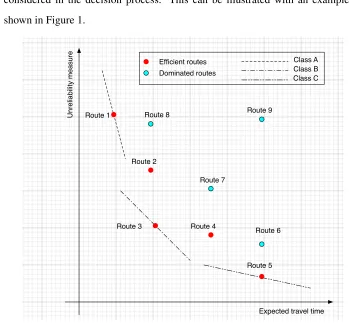
considered in the decision process. This can be illustrated with an example as
149
shown in Figure 1.
150
Class A Class B Class C
U
n
re
lia
b
ili
ty
me
a
su
re
Expected travel time Route 1
Route 2
Route 3 Route 4
Route 5 EfÞcient routes
Dominated routes
Route 9 Route 8
Route 7
[image:9.612.122.471.158.482.2]Route 6
Figure 1: Trade off between expected travel time and unreliability measure
In Figure 1, the travel time reliability of nine possible routes between one
151
origin-destination pair is plotted against their corresponding expected travel time.
152
The measures of reliability can be, say the buffer times,λmσTk, in Lo et al.’s
for-153
mulation or the late arrival penalty in Watling’s. As all travellers would want to
154
minimise these two objectives, a set of efficient options among the nine
alterna-155
tives can be identified, which are represented by Routes 1 to 5 in Figure 1. Routes
156
6 to 9 will not be considered by a rational traveller, as they are dominated by at
least one other route, which has no worse expected travel time and buffer time,
158
but is better in at least one of these criteria. In the equilibrium model of Lo et al.
159
(2006), the different levels of risk aversion are modelled by different values ofλm
160
for different user classes in the objective function, Equation (5). Graphically, the
161
objective functions of different user classes can be represented by the dotted lines
162
with different slopes in Figure 1, whereλmis the slope of the line. As a result, the
163
optimal choices of Classes A, B and C will all be different: They are Routes 1, 3
164
and 5, respectively. Although Routes 2 and 4 are bothefficientroutes in this case,
165
i.e. there are no other routes with expected travel time and travel time variability
166
less than or equal to those of Routes 2 and 4 and at least one of these criteria
bet-167
ter, they will never be chosen by any travellers according to this model. This is
168
because the linear combination ofE(Tk)andσTk in the objective function will not
169
be able to completely represent a bi-objective decision process. Replacing buffer
170
time by lateness penalty E[max(0, Tk−τm)], a similar argument can be made
171
for the LAP-UE model of Watling (2006). We note that Dial (1997) suggests a
172
similar formulation to Lo et al. (2006), without explicitly specifying the reliability
173
measure. Dial’s model will, therefore, have the same issue as illustrated in this
174
example.
175
While missing out somerational alternatives is a general problem that needs
176
to be addressed, there are some other properties of this decision process that a
177
single objective formulation might not be able to address. For instance, in the time
178
budget equilibrium model (Lo et al., 2006), all the used routes at equilibrium will
179
have equal travel time budget for the users in the same class. This means that the
180
used routes even for the same user class can have different expected travel times
181
as well as different travel time margin, as long as the sums, i.e. the travel time
182
budgets, are equal and minimal.
183
This condition implicitly implies two characteristics at equilibrium. Firstly,
since the travel time budget on all used routes is equal, the departure time relative
185
to the same desired arrival time window of users in the same class will all be the
186
same. Secondly, the choice set for users in the same class consists of routes with
187
different expected travel time but the users are indifferent towards these different
188
travel times as long as the travel time budget on each route is the same and
min-189
imal. In other words, a used route with a lower expected travel time but higher
190
variability is equally attractive as another route with a higher expected travel time
191
but lower variability as long as the travel time budgets on the two routes are the
192
same. This might not be true as some users might prefer to spend less time in
traf-193
fic on average. In that case, the route with the shortest expected travel time would
194
be the most attractive. Once we introduce the mathematical formulation of the late
195
arrival penalty user equilibrium model (Watling, 2006) in Section 3, it is easy to
196
see that a similar comment applies for that model, too.
197
In this paper, we address the possibility that users’ travel time margin not only
198
varies between different user classes but also within the same class and users’
pref-199
erence is not only dependent on travel time budget but on both the expected travel
200
time and travel time budget. We propose a new modelling framework to model
201
such conditions with a travel time reliability bi-objective user equilibrium
(TTR-202
BUE) model. The idea of bi-objective user equilibrium was introduced in Wang
203
et al. (2010) in the context of tolling analysis, but can be adapted to any modelling
204
framework in which we expect users might react differently to several objectives
205
influencing their route choices. Our research also contributes to the growing
liter-206
ature that uses multi-objective methods in a variety of transportation research
con-207
texts, such as Tan and Yang (2012), who study built-operate-transfer contracts in
208
the context of optimising social welfare and private profit; Chen and Yang (2012),
209
who consider minimising the conflicting social costs of congestion and emissions
210
with toll schemes and Yang et al. (2012), who consider speed limits to obtain
cient flow patterns in terms of reducing both total travel time and total emissions.
212
In Sections 2 and 3, we will describe the travel time budget and late arrival
213
penalty user equilibrium models mathematically. We also introduce bi-objective
214
versions of these models, and prove that the equilibrium solutions of the models
215
of Lo et al. (2006) and Watling (2006) are special cases of the corresponding
bi-216
objective user equilibrium models. In Section 4, we present a new general travel
217
time reliability bi-objective user equilibrium model, which eliminates the need for
218
user-class-specific parameters and preference assumptions. We prove that all four
219
models mentioned in Sections 2 and 3 are special cases of this general model.
220
Hence, the general model serves as a modelling framework for the study of travel
221
time reliability. We demonstrate our concepts on a small example in Section 5 and
222
draw some conclusions and suggestions for further work in Section 6.
223
2. Travel Time Budget User Equilibrium
224
The travel time budget user equilibrium focuses on modelling the travel
be-225
haviour of road users in response to the day-to-day variations in travel time
in-226
duced by disruptions on a minor scale, caused by traffic incidents. We, therefore,
227
adopt the results from Lo and Tung (2003), summarised as follows. Throughout
228
the paper, the Bureau of Public Roads (1964) link performance function
229
ta(fa) =t0a
1 +β
fa Ca
n
(7)
is adopted, wheret0ais the free-flow travel time and Ca is the capacity of linka.
230
Thus, ta(fa) is the link travel time with link flowfa andβ, n are deterministic
231
parameters.
232
Lo and Tung (2003) assume that link capacity follows a uniform distribution,
233
defined by an upper bound (the design capacity) and a lower bound (the
worst-234
degraded capacity), which is a fraction,φa, of the design capacity,¯ca, i.e.
Ca∼U(φa·c¯a,¯ca). (8)
Henceφaserves the role as a reliability parameter for travel time: As derived
236
in Lo and Tung (2003), the path travel time is normally distributed with mean and
237
standard deviation that can be written as
238
Tk ∼ N(E(Tk), σTk) (9)
E(Tk) = X
a h
δka·E(ta) i
(10)
σTk = s
X
a
[δk
a·var(ta)]. (11)
Hereδkais the usual link-path incidence, i.e.δka = 1if linkabelongs to pathkand
239
0 otherwise. By applying the assumption of uniformly distributed arc capacity as
240
expressed in Equation (8), the mean and standard deviation of the route travel time
241
distribution are
242
E(Tk) =X
a
δka·
t0a+βt0afan 1−φ 1−n a
¯
cn
a(1−φa) (1−n)
, (12)
σTk =
v u u t
X
a "
δk
a·β2(t0a)2fa2n (
1−φ1a−2n
¯
c2n
a (1−φa) (1−2n) −
1−φ1a−n
¯
cn
a(1−φa) (1−n) 2)#
.
(13)
The travel time budget model of Lo et al. (2006) is a multi-user class
equilib-243
rium model which considers both the expected travel timeE(Tk)and the variability
244
of travel time, as measured byσTk with users in classm minimising their travel
245
time budget Bk = E(Tk) +λmσTk. Mathematically, λm can be related to the
246
probabilityρmthat a trip arrives within the travel time budget,
247
After rearranging (14), we have
248
P
STk =
Tk−E(Tk) σTk 6λm
=ρm. (15)
Note that the left hand side in Equation (15) is the standard normal variate ofTk,
249
STk ∼N(0,1).
250
As pointed out in Section 1, in any solution of the travel time budget
equilib-251
rium problem, it is possible that for a given user classm, there are several paths
252
with equal and minimal time budget. As mentioned before, users in the same class
253
would be indifferent with respect to such paths. We believe that this might not
254
be realistic and suggest a bi-objective user equilibrium model that overcomes this
255
problem.
256
Now let us consider the formulation in Lo et al. (2006) from a bi-objective
per-257
spective. The travel time budget represents how much time needs to be allowed
258
for the trip while the expected travel time represents how much time is expected to
259
be spent in traffic. One would expect that users will always want: (1) to minimise
260
the expected travel time, i.e.minE(Tk); and (2) to minimise the travel time
bud-261
get, i.e.minBk, subject to an acceptable level of risk. As explained above, risk is
262
represented by the probability of the actual travel time being longer than the travel
263
time budget.
264
Mathematically, the two objectives are:
265
minE(Tk), (16)
minBk=E(Tk) +λmσTk,
whereBkis dependent on the level of risk aversion of the individual or user class
266
m, measured byρm, which determines the value ofλmas in Equation (15), i.e.Bk
267
is the objective function of the travel time budget model.
Based on the objective functions in (16), we can formulate the travel time
bud-269
get bi-objective user equilibrium (TTB-BUE) as follows.
270
“Undertravel time budget bi-objective user equilibriumconditions
271
traffic arranges itself in such a way that no individual trip maker can
272
improve either his/her expected travel time or travel time budget or
273
both without worsening the other objective by unilaterally switching
274
routes.”
275
We will show that every solution of the travel time budget equilibrium model
276
of Lo et al. (2006) is also a solution to at least the weak TTB-BUE model. To that
277
end, we define the weak TTB-BUE model.
278
“Underweak travel time budget bi-objective user equilibrium
con-279
ditions traffic arranges itself in such a way that no individual trip maker
280
can improve both his/her expected travel time and travel time budget
281
by unilaterally switching routes.”
282
Theorem 1. LetF be a path flow solution to the travel time budget equilibrium
283
model. ThenFalso satisfies the weak TTR-BUE condition.
284
Proof. Assume thatF does not satisfy the weak TTR-BUE condition. Then, for at
285
least one user classmthere must exist two used pathskandk′between some O-D
286
pairpsuch thatE(Tk′) < E(Tk)andE(Tk′) +λmσT
k′ < E(Tk) +λmσTk. The
287
second of these inequalities contradicts the assumption thatF satisfies the travel
288
time budget equilibrium condition.
289
3. Late Arrival Penalty User Equilibrium
290
Based on the concept ofschedule delay, as introduced by Small (1982), Watling
291
developed the idea of a schedule delay equilibrium model, known as LAP-UE
(Watling, 2006) as described earlier. The assumption behind this model is that
293
users are concerned about expected travel time as well as the expected schedule
294
delay given a longest possible travel timeτm(for user classm).
295
Based on Watling (2006)’s derivation, the schedule delayE[max(0, Tk−τm)]
296
in Equation (6) can be simplified to Equation (17) whereL(x)is given in Equation
297
(18).
298
E[max (0, Tk−τm)] =σTkL
τm−E(Tk) σTk
, (17)
L(x) = Z inf
x
(u−x)φ(u)du=φ(x) +xΦ (x)−x, (18)
where φ and Φ are the probability density function and cumulative distribution
299
function of aN(0,1)variate, respectively. In the LAP-UE model, users minimise
300
Equation (6). In this study, we are not concerned with attributes that are
indepen-301
dent of time or flow, hence we assume thatθ0 = 0and we can normaliseθ1 to 1.
302
This also puts the discussion of the model of Watling (2006) in the same framework
303
as that of Lo et al. (2006), where travel time independent factors are not considered.
304
The user objective becomes the disutility of pathk
305
minuk=E(Tk) +θ2L
τm−E(Tk) σTk
σTk. (19)
We have mentioned before that this model leads to a similar problem to that
306
of Lo et al. (2006): There might be several paths with the same minimal value
307
ofuk that have differing expected travel times (and, therefore, different late
ar-308
rival penalties). The model implicitly assumes that users are indifferent to these
309
paths. To avoid this, we can proceed in the same way as for the model of Lo et al.
310
(2006) by considering the model from a bi-objective perspective and separate the
311
two components ofukout. That is, we assume users would want: (1) to minimise
312
expected travel time; and (2) to minimise the expected schedule delay or lateness
313
penalty.
Mathematically, the two objectives are:
315
minE(Tk), (20)
minE[max (0, Tk−τm)].
With these objectives, we can define the late arrival penalty bi-objective user
316
equilibrium (LAP-BUE) as follows.
317
“Under late arrival penalty bi-objective user equilibrium
condi-318
tions traffic arranges itself in such a way that no individual trip maker
319
can improve either his/her expected travel time or late arrival penalty
320
or both without worsening the other objective by unilaterally
switch-321
ing routes.”
322
As for the time budget model, we now proceed to show that a solution to the
323
LAP-UE model is always a solution to the LAP-BUE model.
324
Theorem 2. LetFbe a path flow solution to the late arrival penalty user
equilib-325
rium model. ThenFalso satisfies the LAP-BUE condition.
326
Proof. Assume thatFdoes not satisfy the LAP-BUE condition. Then, for at least
327
one user classm there must exist two used paths k and k′ such that E(Tk′) 6
328
E(Tk) andL τ
m−E(Tk′)
σT k′
σTk′ 6 L
τm−E(Tk)
σTk
σTk, with at least one of these
329
inequalities strict. But this implies that
330
E(Tk′) +θ2L
τm−E(Tk′)
σTk′
σTk′ < E(Tk) +θ2L
τm−E(Tk) σTk
σTk
contradicting the LAP-UE condition.
331
Under the LAP-BUE condition, if several paths with the same minimal value
332
ofuk exist, users would always prefer the one which has lower expected travel
time. We may also use this LAP-BUE model as a tie-breaker in the conventional
334
user equilibrium model considering only (generalised) travel time: Faced with the
335
choice between two paths with equal expected travel time, users would prefer the
336
one which has lowest schedule delay.
337
4. The General Travel Time Reliability Bi-objective User Equilibrium
338
In Sections 2 and 3, we have briefly presented the travel time budget user
equi-339
librium (Lo et al., 2006) and late arrival penalty user equilibrium (Watling, 2006)
340
models as the main network equilibrium models in the literature that consider
ex-341
pected travel time as well as standard deviation of travel time in a network
equilib-342
rium model. We have illustrated that the implicit assumption of user indifference
343
towards the two components of the function used in these models creates
ambi-344
guity, and that it may not be realistic to assume that users are indifferent towards
345
the different expected travel times that used paths in an equilibrium solution may
346
have. We have suggested bi-objective user equilibrium models to overcome these
347
problems. In this section, we propose a general travel time reliability bi-objective
348
user equilibrium model (TTR-BUE) that incorporates both the original TTB-UE
349
and LAP-UE models, as well as their bi-objective counterparts (16) and (20) and
350
other possible reliability models. From now on, we omit the assumption of normal
351
distribution of travel time, which Watling used and which Lo and Tung (2003)
ob-352
tained from the assumption of uniform distribution of capacity, and only assume
353
that travel time follows a distribution such that expected (path) travel time as well
354
as standard deviation of (path) travel time are continuous and positive functions
355
of flow. Note that Equations (12) and (13) meet this assumption. Therefore, the
356
assumptions of the travel time budget model of Lo et al. (2006) are more restrictive
357
than the assumptions for our model.
The common feature of all models discussed so far is that they consider
ex-359
pected travel time E(Tk) as well as a reliability component, with the reliability
360
component modelled as either travel time margin in Lo et al. (2006) or lateness
361
penalty in Watling (2006).
362
We observe that both Equations (5) from Lo et al. (2006) and (6) from Watling
363
(2006) with the reformulation (17) contain the standard deviation of travel time
364
σTk weighted by either a constantλmor the constantθ2multiplied by functionL,
365
which itself depends onE(Tk) andσTk. Clearly, bothλm andL are user (class)
366
dependent. Recall that λm is derived from the level of risk aversion of user m
367
(see Equations (14) and (15)), and thatL in (19) containsτm as the maximum
368
conceivable travel time of usermas a parameter.
369
We now postulate that the essential components of travel time reliability
equi-370
librium models are expected travel time E(Tk) and standard deviation of travel
371
timeσTk. We will not make any further assumptions on how to combine these two
372
factors into a single objective function such as Equations (5) and (19) do. Hence,
373
we do not assume the existence of a valueλmthat allows a weighting of travel time
374
reliability (standard deviation) relative to expected travel time nor do we assume
375
that users make their path choice based on the schedule delay model. Instead, we
376
only assume that users will always want: (1) to minimise the expected travel time,
377
i.e.minE(Tk); and (2) to maximise travel time reliability, or alternatively, to
min-378
imise the standard deviation of travel time, i.e.minσTk. Note that based on this
379
assumption, we are modelling users who are either risk neutral or risk averse, but
380
not risk prone. As a result, the value ofλmwill always be greater than zero.
381
In this way, we consider the problem from a multi-objective point of view and
we can formulate a general TTR-BUE model with the two objectives
383
minE(Tk), (21)
minσTk.
We consider this formulation general in the sense that we assume that
trav-384
ellers perceiveunreliabilitysolely based on the variability of travel time, which is
385
measurable as the standard deviation. The general TTR-BUE condition reads as
386
follows.
387
“Undertravel time reliability bi-objective user equilibrium
condi-388
tions traffic arranges itself in such a way that no individual trip maker
389
can improve either his/her expected travel time or standard deviation
390
of travel time or both without worsening the other objective by
unilat-391
erally switching routes.”
392
Based on this definition, all the used routes between a given O-D pair are
effi-393
cient. For an efficient route, there does not exist any alternative route that has lower
394
expected travel time or lower standard deviation unless the other component is
big-395
ger. This means every routedominatedby an efficient route, i.e. one which has at
396
least the same or higher expected travel time as well as at least the same or higher
397
standard deviation of travel time, as compared with the efficient route should have
398
zero flow. This assumption appears to be realistic for rational users.
399
Next we give a mathematical statement of the TTR-BUE model as an
equilib-400
rium problem. For notational simplicity, we only state it for a single user class.
401
Let us first introduce the necessary notation. LetG= (N, A)be a network, where
402
N is a finite set of|N|nodes andA ⊂ N ×N is a set of|A|arcs or links. Let
403
Z ⊂N ×N be a set of origin-destination pairs (O-D pairs) and for allp∈Z, let
404
Dpdenote the demand for travel between O-D pairp. The set of all paths between
O-D pairpis denotedKpandK:=∪pinZKpis the set of all paths. LetF∈R|K|
406
be a path flow vector that satisfies demand, i.e. P
k∈KpFk = Dp for allp ∈ Z.
407
Finally, letCk(F) := (E(Tk), σTk)
T be the vector containing the expected travel
408
time and standard deviation of travel time of pathk.
409
Definition 1. Path flow vectorFis a travel time reliability bi-objective user
equi-410
librium flow ifFis feasible, i.e. F≥ 0,P
k∈KpFk = Dp for allp ∈Z, and the
411
following conditions hold.
412
1. If for anyp ∈ Z and any k, k′ ∈ Kp it holds that Ck′(F) ≤ Ck(F) and
413
Ck′(F)6=Ck(F)thenFk= 0.
414
2. If for anyp∈Z andk∈ Kpit holds thatFk >0then there is nok′ ∈ Kp
415
withFk′ >0such thatCk′(F)≤Ck(F)andCk′(F)6=Ck(F).
416
Notice that the TTB-BUE and LAP-BUE solutions in Sections 2 and 3 are
417
formally defined in the same way as TTR-BUE in Definition 1, but with the cost
418
functions of Equations (16) and (20) rather than (21). We now show that under
419
our assumptions thatE(Tk)andσTkare positive and continuous functions of flow,
420
travel time reliability bi-objective user equilibrium flows exist.
421
Theorem 3. LetG= (N, A)be a network,Z⊂N×N be a set of O-D pairs and
422
for allp∈Z, letDpbe the demand of O-D pairp. Assume that both cost functions
423
Ck(i)(F), i = 1,2 are positive and continuous. Then a travel time reliability
bi-424
objective user equilibrium flow exists.
425
Proof. Because of the assumption thatE(Tk)andσTk are positive and continuous
426
functions of flow, we know that the time budget function Bk(F) := E(Tk) +
427
λσTk for positive λ is positive and continuous. Hence an equilibrium flow F
∗
428
with respect toBk exists. We show that this equilibrium flowF∗ is a TTR-BUE
429
flow. Assume to the contrary that there is an O-D pairpand two pathsk, k′ ∈Kp
with positive flow such thatCk′(F∗) ≤ Ck(F∗) and Ck′(F) 6= Ck(F). Then
431
Bk′(F∗) < Bk(F∗) contradicting the fact that F∗ is an equilibrium flow with
432
respect toBk.
433
This model can capture all the possible equilibria based on our definition of
434
TTR-BUE without specifying how travellers might respond to the uncertainty in
435
travel time associated with each route as modelled by standard deviation of travel
436
time. We now prove that both the TTB-BUE model (and hence the TTB-UE model)
437
and the LAP-BUE model (and hence the LAP-UE model) are special cases of our
438
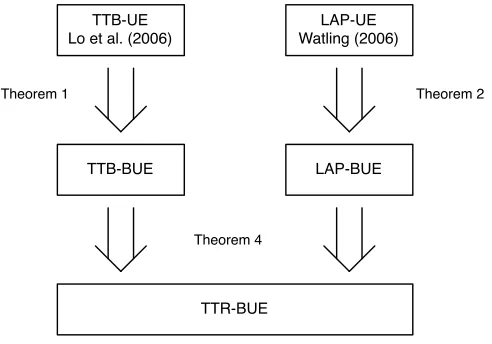
new general TTR-BUE model, see Figure 2, which summarises the results of
The-439
orems 1, 2 and 4.
440
Theorem 4. The following two statements hold.
441
1. LetFbe a path flow solution of the TTB-BUE model. ThenFalso satisfies
442
the TTR-BUE condition.
443
2. LetFbe a path flow solution of the LAP-BUE model. ThenFalso satisfies
444
the TTR-BUE model.
445
Proof. We prove both statements separately.
446
1. IfFdoes not satisfy the TTR-BUE condition, there must exist a user classm
447
and two pathskandk′between an O-D pairpsuch thatE(Tk′)6E(Tk)and
448
σTk′ 6σTk with at least one strict inequality. Then, becauseλmis positive
449
in the TTB-BUE model, we must haveE(Tk′) +λmσT
k′ < E(Tk) +λmσTk.
450
This combined withE(Tk′) 6E(Tk)shows thatFwould then also violate
451
the TTB-BUE condition.
452
2. AssumeFsatisfies the LAP-BUE but not the TTR-BUE conditions. Then,
453
as in the proof of the first statement, there must exist a user class m and
454
two pathskandk′ between an O-D pairpsuch thatE(Tk′) 6 E(Tk)and
σTk′ 6 σTk with at least one strict inequality. It is well known that L(x)is
456
a decreasing function ofx. HenceLτm−E(Tk)
σTk
increases as bothE(Tk)
457
andσTk increase and therefore
458
L
τm−E(Tk′)
σTk′
σTk′ 6L
τm−E(Tk) σTk
σTk,
which, with an analogous argument as in the proof of the first statement,
to-459
gether withE(Tk′)6E(Tk)and the fact that at least one of the inequalities
460
must be strict, contradicts the LAP-BUE condition.
461
462
TTB-UE Lo et al. (2006)
LAP-UE Watling (2006)
TTB-BUE LAP-BUE
TTR-BUE
Theorem 1 Theorem 2
[image:23.612.183.429.332.504.2]Theorem 4
Figure 2: The relationship between single objective and bi-objective user equilibrium models for
travel time reliability.
At this stage, we need to point out that the TTR-BUE model is not in itself
463
suitable to derive a particular equilibrium solution, but only serves as a framework,
464
identifying a range of solution within which any equilibrium based on expected
465
travel time and standard deviation of travel time as the route choice criteria must
fall. The computation of this range of solutions is difficult, and the development of
467
algorithms to do this is the subject of further research.
468
5. A Three-link Example
469
In this section, we demonstrate and validate our concepts with a simple
three-470
link example as follows.
471
5.1. Network Specification
472
Our test three-link network is shown in Figure 3, where the link parameters are
473
specified in Table 1. The parameters of the travel time function, Equation (7), are
474
β = 0.15andn = 4. The total demand is assumed to be fixed at 15,000 vehicles
475
per hour. For simplicity, we consider a single user class.
476
r s
1
2
[image:24.612.219.395.368.471.2]3
Figure 3: A three-link example network.
Note that in Table 1, we specify a travel time reliability parameter of φa for
477
routeaas defined in Equation (8). Theφ−value for the expressway is the lowest,
478
meaning that it is the route that could be most degradable although it is the shortest,
479
while the arterial route is assumed to be the most reliable with the highestφ−value.
480
5.2. The TTR-BUE Solution Space
481
As the demand is fixed, the solution space for this three-link network can be
482
represented two-dimensionally with the horizontal axis and the vertical axis
Table 1: Route characteristics of the three-link network.
Route Type Distance Free flow Capacity Reliability
travel time
a (km) (mins) (veh/hr) φa
1 Expressway 20 12 4000 0.5
2 Highway 50 30 5400 0.7
3 Arterial 40 40 4800 0.9
resenting the flows on Routes1 and2, respectively. In order to illustrate the set
484
of solutions of the three bi-objective user equilibrium models in this three-link
485
example, we first discretise the two-dimensional solution space and identify the
486
solutions for each of the three cases as formulated in Sections 2, 3 and 4. For each
487
feasible solution, we can evaluate the corresponding travel time and travel time
re-488
liability on each of the three routes. We can then determine whether all the three
489
data points are efficient based on the concept illustrated in Figure 1. If all three
490
routes are efficient, the solution is within the BUE region.
491
5.2.1. Travel Time Budget (TTB) Versus General (TTR) BUE
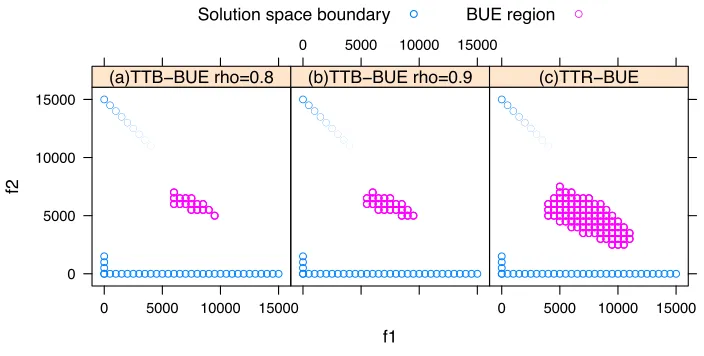
492
The solution sets of the TTB-BUE formulation for different levels of risk
aver-493
sion (withρ−values of 0.8 and 0.9) are compared with that of the general
TTR-494
BUE formulation in Figure 4. As predicted by Theorem 4, comparing Figures 4 (a)
495
& (b) with Figure 4 (c), the TTB-BUE solution sets are within the general
TTR-496
BUE region. By comparing Figures 4 (a) and (b), a higher level of risk aversion
497
leads to a bigger solution set.
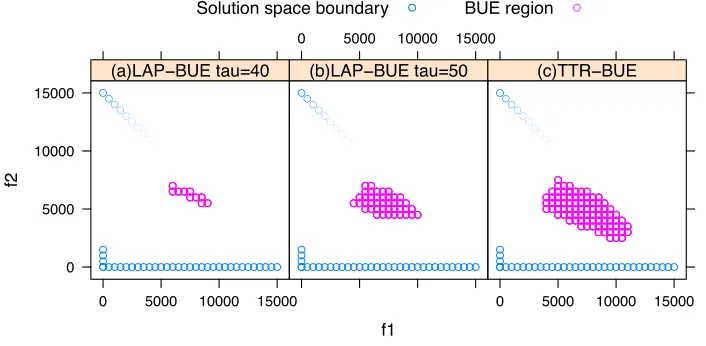
5.2.2. Late Arrival Penalty (LAP) Versus General (TTR) BUE
499
The solution sets of the LAP-BUE formulation for different levels of risk
aver-500
sion (withτ−values of 40 and 50 minutes) are compared with that of the general
501
TTR-BUE formulation in Figure 5. As stated by Theorem 4, comparing Figures
502
5 (a) & (b) with Figure 5 (c), the LAP-BUE solution sets are within the general
503
TTR-BUE region. By comparing Figures 5 (a) and (b), a higher time allowance
504
leads to a bigger solution set.
505 f1 f2 0 5000 10000 15000
0 5000 10000 15000 ● ● ● ● ● ● ● ● ● ● ● ● ● ● ● ● ● ● ● ● ● ● ● ● ● ● ● ● ● ● ● ● ● ● ● ● ● ● ● ● ● ● ● ● ● ● ● ● ● ● ● ● ● ● ● ● ● ● ● ● ● ● ●●●●●●●●●●●●●●●●●●●●●●●●●●●●●●● ● ● ● ● ● ● ● ● ● ● ● ● ● ● ● ● ● ● ● ● ● ● ● ● ● ● ● ● ● ● ● ● ● ● ● ● ● ● ● ● ● ● ● ● ● ● ● ●
(a)TTB−BUE rho=0.8
0 5000 10000 15000
● ● ● ● ● ● ● ● ● ● ● ● ● ● ● ● ● ● ● ● ● ● ● ● ● ● ● ● ● ● ● ● ● ● ● ● ● ● ● ● ● ● ● ● ● ● ● ● ● ● ● ● ● ● ● ● ● ● ● ● ● ● ●●●●●●●●●●●●●●●●●●●●●●●●●●●●●●● ● ● ● ● ● ● ● ● ● ● ● ● ● ● ● ● ● ● ● ● ● ● ● ● ● ● ● ● ● ● ● ● ● ● ● ● ● ● ● ● ● ● ● ● ● ● ● ● ● ● ● ● ● ● ● ● ● ● ● ● ● ● ● ● ● ●
(b)TTB−BUE rho=0.9
0 5000 10000 15000 ● ● ● ● ● ● ● ● ● ● ● ● ● ● ● ● ● ● ● ● ● ● ● ● ● ● ● ● ● ● ● ● ● ● ● ● ● ● ● ● ● ● ● ● ● ● ● ● ● ● ● ● ● ● ● ● ● ● ● ● ● ● ●●●●●●●●●●●●●●●●●●●●●●●●●●●●●●● ● ● ● ● ● ● ● ● ● ● ● ● ● ● ● ● ● ● ● ● ● ● ● ● ● ● ● ● ● ● ● ● ● ● ● ● ● ● ● ● ● ● ● ● ● ● ● ● ● ● ● ● ● ● ● ● ● ● ● ● ● ● ● ● ● ● ● ● ● ● ● ● ● ● ● ● ● ● ● ● ● ● ● ● ● ● ● ● ● ● ● ● ● ● ● ● ● ● ● ● ● ● ● ● ● ● ● ● ● ● ● ● ● ● ● ● ● ● ● ● ● ● ● ● ● ● ● ● ● ● ● ● ● ● ● ● ● ● ● ● ● ● ● ● ● ● ● ● ● ● ● ● ● ● ● ● ● ● ● ● ● ● ● ● ● ● ● ● ● ● ● ● ● ● ● ● ● ● ● ● ● ● ● ● ● ● ● ● ● ● ● ● ● ● ● ● ● ● ● ● ● ● ● ● ● ● ● ● ● ● ● ● ● ● ● ● ● ● ● ● ● ● ● ● ● ● ● ● ● ● ● ● ● ● ● ● ● ● ● ● ● ● ● ● ● ● ● ● ●
(c)TTR−BUE
[image:26.612.125.477.277.455.2]Solution space boundary ● BUE region ●
Figure 4: Travel time budget (TTB)-BUE versus general (TTR)-BUE solutions.
5.3. Travel Time Reliability BUE Versus Travel Time Budget and Late Arrival
506
Penalty UE Models
507
To compare our proposed bi-objective model with the single-objective
formu-508
lations of Lo et al. (2006) and Watling (2006), we first locate the single objective
509
solutions by applying the algorithm in Lo and Chen (2000). The objective function
510
in Lo et al. (2006) is given in Equation (5), i.e.
511
f1 f2 0 5000 10000 15000
0 5000 10000 15000 ● ● ● ● ● ● ● ● ● ● ● ● ● ● ● ● ● ● ● ● ● ● ● ● ● ● ● ● ● ● ● ● ● ● ● ● ● ● ● ● ● ● ● ● ● ● ● ● ● ● ● ● ● ● ● ● ● ● ● ● ● ● ●●●●●●●●●●●●●●●●●●●●●●●●●●●●●●● ● ● ● ● ● ● ● ● ●●●● ● ● ● ● ● ● ● ● ● ● ● ● ● ● ● ● ● ●
(a)LAP−BUE tau=40
0 5000 10000 15000
● ● ● ● ● ● ● ● ● ● ● ● ● ● ● ● ● ● ● ● ● ● ● ● ● ● ● ● ● ● ● ● ● ● ● ● ● ● ● ● ● ● ● ● ● ● ● ● ● ● ● ● ● ● ● ● ● ● ● ● ● ● ●●●●●●●●●●●●●●●●●●●●●●●●●●●●●●● ● ● ●●●●●●● ● ● ● ● ● ● ● ● ● ● ● ● ● ● ● ● ● ● ● ● ● ● ● ● ● ● ● ● ● ● ● ● ● ● ● ● ● ● ● ● ● ● ● ● ● ● ● ● ● ● ● ● ● ● ● ● ● ● ● ● ● ● ● ● ● ● ● ● ● ● ● ● ● ● ● ● ● ● ● ● ● ● ● ● ● ● ● ● ● ● ● ● ● ● ● ● ● ● ● ● ● ● ● ● ● ● ● ● ● ● ● ● ● ● ● ● ●
(b)LAP−BUE tau=50
0 5000 10000 15000 ● ● ● ● ● ● ● ● ● ● ● ● ● ● ● ● ● ● ● ● ● ● ● ● ● ● ● ● ● ● ● ● ● ● ● ● ● ● ● ● ● ● ● ● ● ● ● ● ● ● ● ● ● ● ● ● ● ● ● ● ● ● ●●●●●●●●●●●●●●●●●●●●●●●●●●●●●●● ● ● ● ● ● ● ● ● ● ● ● ● ● ● ● ● ● ● ● ● ● ● ● ● ● ● ● ● ● ● ● ● ● ● ● ● ● ● ● ● ● ● ● ● ● ● ● ● ● ● ● ● ● ● ● ● ● ● ● ● ● ● ● ● ● ● ● ● ● ● ● ● ● ● ● ● ● ● ● ● ● ● ● ● ● ● ● ● ● ● ● ● ● ● ● ● ● ● ● ● ● ● ● ● ● ● ● ● ● ● ● ● ● ● ● ● ● ● ● ● ● ● ● ● ● ● ● ● ● ● ● ● ● ● ● ● ● ● ● ● ● ● ● ● ● ● ● ● ● ● ● ● ● ● ● ● ● ● ● ● ● ● ● ● ● ● ● ● ● ● ● ● ● ● ● ● ● ● ● ● ● ● ● ● ● ● ● ● ● ● ● ● ● ● ● ● ● ● ● ● ● ● ● ● ● ● ● ● ● ● ● ● ● ● ● ● ● ● ● ● ● ● ● ● ● ● ● ● ● ● ● ● ● ● ● ● ● ● ● ● ● ● ● ● ● ● ● ● ●
(c)TTR−BUE
[image:27.612.126.479.131.304.2]Solution space boundary ● BUE region ●
Figure 5: Late arrival penalty (LAP)-BUE versus general (TTR)-BUE solutions.
We tested a range ofλvalues corresponding toρ−values of 0.50 to 0.95 in steps
512
of 0.05 in Equation (14).
513
On the other hand, as mentioned before, we simplify the objective function for
514
the LAP-UE formulation in Watling (2006) to include only the two components
515
corresponding to our two objectives in Section 3, i.e. the expected travel time and
516
the late penalty function:
517
minUk =E(Tk) +θ2E[max (0, Tk−τ)]. (23)
Hereθ2represents the penalty weighting as the relative importance of the schedule
518
delay to the expected travel time. We tested a range of this penalty weightingθ2to
519
be between 10 and 50 in steps of 10, i.e. the extent of being late would be 10 to 50
520
times more important than the expected travel time, with the maximum time fixed
521
atτ = 50minutes. We also tested a range of the maximum timeτ to be between
522
40 and 50 minutes in steps of one minute, keepingθ2 constant with value equals
523
30.
524
The resulting solutions are depicted in Figure 6. As implied by Theorems 1,
2 and 4, the solutions based on the single-objective formulations are all within the
526
general TTR-BUE model solution set. Each set of parameters in either Lo et al.
527
(2006)’s or Watling (2006)’s formulation corresponds to one identified solution.
528
By varying the model parameters, a curve can be located in the TTR-BUE solution
529
set as the possible solution region for each formulation.
530 ● ● ●● ● ● ● ● ● ● ● ● ● ● ●● ● ● ● ● ● ● ● ● ● ● ●● ● ● ● ● ● ● ● ● ● ● ●● ● ● ● ● ● ● ● ● ● ● ●● ● ● ● ● ● ● ● ● ● ● ●● ● ● ● ● ● ● ● ● ● ● ●● ● ● ● ● ● ● ● ● ● ● ● ● ● ● ● ● ● ● ● ● ● ● ● ● ● ● ● ● ● ● ● ● ● ● ● ● ● ● ● ● ● ● ● ● ● ● ● ● ● ● ● ● ● ● ● ● ● ● ● ● ● ● ● ● ● ● ● ● ● ● ● ● ● ● ● ● ●●●●●●●●●●●●●●●●●●●●●●●●●●●●●●●●●●●●●●●●●●●●●●●●●●●●●●●●●●●●●●●●●●●●●●●●●●●●
0 5000 10000 15000
0 5000 10000 15000 f1 f2 ● ● ● ● ● ● ● ● ● ● ● ● ● ● ● ● ● ● ● ● ● ● ● ● ● ● ● ● ● ● ● ● ● ● ● ● ● ● ● ● ● ● ● ● ● ● ● ● ● ● ● ● ● ● ● ● ● ● ● ● ● ● ● ● ● ● ● ● ● ● ● ● ● ● ● ● ● ● ● ● ● ● ● ● ● ● ● ● ● ● ● ● ● ● ● ● ● ● ● ● ● ● ● ● ● ● ● ● ● ● ● ● ● ● ● ● ● ● ● ● ● ● ● ● ● ● ● ● ● ● ● ● ● ● ● ● ● ● ● ● ● ● ● ● ● ● ● ● ● ● ● ● ● ● ● ● ● ● ● ● ● ● ● ● ● ● ● ● ● ● ● ● ● ● ● ● ● ● ● ● ● ● ● ● ● ● ● ● ● ● ● ● ● ● ● ● ● ● ● ● ● ● ● ● ● ● ● ● ● ● ● ● ● ● ● ● ● ● ● ● ● ● ● ● ● ● ● ● ● ● ● ● ● ● ● ● ● ● ● ● ● ● ● ● ● ● ● ● ● ● ● ● ● ● ● ● ● ● ● ● ● ● ● ● ● ● ● ● ● ● ● ● ● ● ● ● ● ● ● ● ● ● ● ● ● ● ● ● ● ● ● ● ● ● ● ● ● ● ● ● ● ● ● ● ● ● ● ● ● ● ● ● ● ● ● ● ● ● ● ● ● ● ● ● ● ● ● ● ● ● ● ● ● ● ● ● ● ● ● ● ● ● ● ● ● ● ● ● ● ● ● ● ● ● ● ● ● ● ● ● ● ● ● ● ● ● ● ● ● ● ● ● ● ● ● ● ● ● ● ● ● ● ● ● ● ● ● ● ● ● ● ● ● ● ● ● ● ● ● ● ● ● ● ● ● ● ● ● ● ● ● ● ● ● ● ● ● ● ● ● ● ● ● ● ● ● ● ● ● ● ● ● ● ● ● ● ● ● ● ● ● ● ● ● ● ● ● ● ● ● ● ● ● ● ● ● ● ● ● ● ● ● ● ● ● ● ● ● ● ● ● ● ● ● ● ● ● ● ● ● ● ● ● ● ● ● ● ● ● ● ● ● ● ● ● ● ● ● ● ● ● ● ● ● ● ● ● ● ● ● ● ● ● ● ● ● ● ● ● ● ● ● ● ● ● ● ● ●● ● ● ● ● ● ● ● ● ● ● ● ●
Solution space boundary TTR−BUE
[image:28.612.166.436.265.511.2]TTB−UE (with varying rho) LAP−UE (with varying theta) LAP−UE (with varying tau)
Figure 6: Single-objective solutions in TTR-BUE solution space
6. Conclusion and Outlook
531
In this paper, we discussed two network equilibrium models for travel time
re-532
liability, namely, the travel time budget model (Lo et al., 2006) and the late arrival
penalty model (Watling, 2006). We first pointed out some properties and
assump-534
tions of these models that may not be realistic. We then adapted the bi-objective
535
user equilibrium formulation of Wang et al. (2010) and proposed bi-objective
ver-536
sions of the two models to overcome the issues outlined before. Next, we
elab-537
orated on the common features of the models (namely the use of expected travel
538
time and standard deviation of travel time as reliability measure) and proposed a
539
general travel time reliability bi-objective user equilibrium model. We proved that
540
this model encompasses the single-objective as well as the bi-objective versions of
541
the TTB and LAP user equilibrium models.
542
The essence of our proposed model is to represent rational route choice
be-543
haviour with a BUE model but without a predetermined preference model. Based
544
on the two objectives, the efficient routes become the natural choice set that a
ratio-545
nal user will choose from and naturally only routes in this set should have positive
546
flow at equilibrium. The TTR-BUE condition identifies the region that represents
547
possible equilibrium solutions under rational behaviour with no specific
prefer-548
ence model such as the additive utility function in Lo et al.’s, Watling’s or Dial’s
549
model. The advantage of this modelling framework is that it can identify a range of
550
possible solutions under rational behaviour rather than one solution under the
as-551
sumption of preferences following a restrictive functional form. Once preferences
552
of users are known, a preference model can then be developed that singles out one
553
(or a set) of the solutions satisfying the TTR-BUE conditions as the one that is
554
compatible with the preference model.
555
Furthermore, if observations show a traffic pattern that does not lie within the
556
TTR-BUE solution set, then it is impossible to find a user preference model based
557
on expected travel time and travel time standard variation that agrees with the
ob-558
served behaviour. This in turn implies that users do not make decisions based on
559
these criteria, necessitating the consideration of different models of reliability or
the inclusion of other criteria, e.g. those related to monetary expenses.
561
In future research, we will also develop methods to compute the TTR-BUE
562
solution set in general networks. We also intend to extend our work to include the
563
third of the criteria mentioned at the beginning of our paper, namely, monetary cost.
564
Furthermore, we will investigate the use of criteria other than standard deviation
565
to measure reliability of travel time. This will allow us to compare new variants
566
of TTR-BUE equilibrium models with reliability based equilibrium models in the
567
literature as discussed in Section 1. This is of particular interest, because standard
568
deviation/variance may be a convenient, but not necessarily good measure of “risk”
569
in route choice decisions.
570
Acknowledgement
571
This research has been partially supported by the Marsden Fund under grant
572
number 9075 362506.
573
References
574
Abdel-Aty, M.A., Kitamura, R., Jovanis, P.P., 1995. Investigating effect of travel
575
time variability on route choice using repeated-measurement stated preference
576
data. Transportation Research Record 1493, 39–45.
577
Bell, M., 2000. A game theory approach to measuring the performance reliability
578
of transport networks. Transportation Research Part B 34 (6), 533–545.
579
Bell, M., Cassir, C., 2002. Risk-averse user equilibrium traffic assignment: An
580
application of game theory. Transportation Research Part B 36 (8), 671–681.
Brownstone, D., Small, K., 2005. Valuing time and reliability: Assessing the
evi-582
dence from road pricing demonstrations. Transportation Research Part A 39 (4),
583
279–293.
584
Bureau of Public Roads, 1964. Traffic Assignment Manual. U.S. Department of
585
Commerce, Urban Planning Division, Washington D.C.
586
Chen, A., Ji, Z., 2005. Path finding under uncertainty. Journal of Advanced
Trans-587
portation 39 (1), 19–37.
588
Chen, A., Ji, Z., Recker, W., 2002. Travel time reliability with risk sensitive
trav-589
elers. Transportation Research Record 1783, 27–33.
590
Chen, A., Zhou, Z., 2010. Theα-reliable mean-excess traffic equilibrium model
591
with stochastic travel times. Transportation Research Part B 44 (4), 493–513.
592
Chen, A., Zhou, Z., Lam, W., 2011. Modeling stochastic perception error in the
593
mean-excess traffic equilibrium model with stochastic travel times.
Transporta-594
tion Research Part B 45 (10), 1619–1640.
595
Chen, L., Yang, H., 2012. Managing congestion and emissions in road networks
596
with tolls and rebates. Transportation Research Part B 46 (8), 933–948.
597
Connors, R., Sumalee, A., 2009. A network equilibrium model with travellers
598
perception of stochastic travel times. Transportation Research Part B 43 (6),
599
614–624.
600
Daganzo, C.F., Sheffi, Y., 1977. On stochastic models of traffic assignment.
Trans-601
portation Science 11 (3), 253–274.
602
Di, S., Pan, C., Ran, B., 2008. Stochastic multiclass traffic assignment with
sideration of risk-taking behaviors. Transportation Research Record 2085, 111–
604
123.
605
Dial, R., 1997. Bicriterion traffic assignment: Efficient algorithms plus examples.
606
Transportation Research Part B 31 (5), 357–379.
607
Jackson, W., Jucker, J.V., 1982. Empirical study of travel time variability and travel
608
choice behaviour. Transportation Science 16 (4), 460–475.
609
Lam, T., Small, K., 2001. The value of time and reliability: Measurement from a
610
value pricing experiment. Transportation Research Part E 37 (2-3), 231–251.
611
Lam, W.H.K., Shao, H., Sumalee, A., 2008. Modeling impacts of adverse weather
612
conditions on a road network with uncertainties in demand and supply.
Trans-613
portation Research Part B 42 (10), 890–910.
614
Li, Z., Hensher, D.A., Rose, J.M., 2010. Willingness to pay for travel time
re-615
liability in passenger transport: A review and some new empirical evidence.
616
Transportation Research Part E 46 (3), 384 – 403.
617
Liu, H., Recker, W., Chen, A., 2004. Uncovering the contribution of travel time
618
reliability to dynamic route choice using real-time loop data. Transportation
619
Research Part A 38 (6), 435–453.
620
Lo, H.K., Chen, A., 2000. Traffic equilibrium problem with route-specific costs:
621
Formulation and algorithms. Transportation Research Part B 34 (6), 493–513.
622
Lo, H.K., Luo, X.W., Siu, B.W.Y., 2006. Degradable transport network: travel time
623
budget of travellers with heterogeneous risk aversion. Transportation Research
624
Part B 40 (9), 792–806.
Lo, H.K., Tung, Y.K., 2003. Network with degradable links: capacity analysis and
626
design. Transportation Research Part B 37 (4), 345 – 363.
627
Mirchandani, P., Soroush, H., 1987. Generalized traffic equilibrium with
proba-628
bilistic travel times and perceptions. Transportation Science 21 (3), 133–152.
629
Ng, M., Waller, S., 2010. A computationally efficient methodology to characterize
630
travel time reliability using the fast fourier transform. Transportation Research
631
Part B 44 (10), 1202–1219.
632
Nie, Y., 2011. Multi-class percentile user equilibrium with flow-dependent
stochas-633
ticity. Transportation Research Part B 45 (10), 1641–1659.
634
de Palma, A., Picard, N., 2005. Route choice decision under travel time uncertainty.
635
Transportation Research Part A 39 (4), 295–324.
636
Shao, H., Lam, W., Meng, Q., Tam, M., 2006a. Demand-driven traffic assignment
637
problem based on travel time reliability. Transportation Research Record 1985,
638
220–230.
639
Shao, H., Lam, W., Tam, L., 2006b. A reliability-based stochastic traffic
assign-640
ment model for network with multiple user classes under uncertainty in demand.
641
Networksand Spatial Economics 6, 173–204.
642
Small, K., 1982. The scheduling of consumer activities: work trips. American
643
Economic Review 72 (3), 467–479.
644
Szeto, W.Y., O’Brien, L., O’Mahony, M., 2006. Risk-averse traffic assignment
645
with elastic demands: Ncp formulation and solution method for assessing
per-646
formance reliability. Networks and Spatial Economics 6, 313–332.