City, University of London Institutional Repository
Citation
:
Veluru, S., Rahulamathavan, Y., Manandhar, S. and Rajarajan, M. (2014).
Correlated Community Estimation Models Over a Set of Names. Paper presented at the
IEEE Technically Co-Sponsored Science and Information Conference, 27-08-2014 -
29-08-2014, London, UK.
This is the accepted version of the paper.
This version of the publication may differ from the final published
version.
Permanent repository link:
http://openaccess.city.ac.uk/4477/
Link to published version
:
Copyright and reuse:
City Research Online aims to make research
outputs of City, University of London available to a wider audience.
Copyright and Moral Rights remain with the author(s) and/or copyright
holders. URLs from City Research Online may be freely distributed and
linked to.
Correlated Community Estimation Models Over a
Set of Names
Suresh Veluru
∗, Yogachandran Rahulamathavan
∗, Suresh Manandhar
†, and Muttukrishnan Rajarajan
∗∗Information Security Group, School of Engineering and Mathematical Sciences,
City University London, London, EC1V 0HB, United Kingdom.
E-mail:{Suresh.Veluru.1, Yogachandran.Rahulamathavan.1, R.Muttukrishnan}@city.ac.uk
†Department of Computer Science, University of York, Heslington, York, YO10 5GH, United Kingdom
E-mail: [email protected]
Abstract—Generally surnames (family name) or forenames are evolved over generations which can be used to understand population origins, migration, identity, social norms and cultural customs. These forenames or surnames may have hidden struc-ture associated with them called communities. Each community might have strong correlation among several forenames and sur-names. In addition, the correlation might be across communities of forenames or surnames. Popular statistical generative model such as Latent Dirichlet Allocation (LDA) has been developed to find topics in a corpus of documents. However, the LDA model can be proposed to identify hidden communities in names data set. This paper proposes several variants of latent Dirichlet allocation models to capture correlation between surnames and forenames within the communities and across the communities over a set of names collected at different locations. Initially, we propose surname correlated LDA model and forename correlated LDA model. These models identify communities in surnames or forenames and extract corresponding correlated forenames or surnames in each community respectively. Later, we propose surname community correlated LDA model and forename com-munity correlated LDA model. These models estimate correlation among each surname community to the communities of forenames and vice versa respectively. We experiment for India and United Kingdom names data sets and conclusions are drawn.
Keywords—Latent Dirichlet Allocation; Communities; Proba-bilistic Generative Models; Bayesian Statistics; Correlation;
I. INTRODUCTION
Due to rapid growth of digital data, knowledge discov-ery and data mining have great potential which would turn data into useful information and knowledge. Text mining (sometimes called ‘mining from text documents’) is to extract knowledge from a set of text documents [16]. Names analysis is popular in geography [15] which relay on the fact that family names (surnames) or names represent ethnic, geographic, cul-tural and genetic structures in human populations. However, these methods in geography use elementary statistical ap-proaches to analyse names data set. Many advanced statistical methods have limited applications in names analysis.
Knowledge discovery in names data set involves iden-tifying relationship among group of people (surnames) or identifying communities in names data set. It is a well known fact that people migrate from one location to other due to job prospects, economic prosperity, political unrest, etc. However, the surnames of migrants retain semantic similarity to surnames of the people at their original locations. In order to address this issue of identifying semantic surnames, Veluru et
al. [26] [25] recently applied statistical methods such as vector
space model and latent semantic indexing (LSI) in names data set. Further, email address categorization has been performed based on semantics of surnames. The generative probabilistic model can be applied to identify hidden communities in a names data set.
Generative probabilistic model such as Latent Dirichlet Allocation (LDA) becomes attractive and powerful in natural language processing for topic modelling [12]. It works on discrete data of words in a corpus of documents and overcomes the limitations of LSI and probabilistic LSI (pLSI). It assumes document contains“bag-of-words” which means the order of words in the document can be neglected and also assume that the order of documents can be neglected [12]. This is called
exchangeability assumption in the language of probability. de
Finette [3] established a classic theorem that states any collec-tion of exchangeable random variables has a representacollec-tion as a mixture distribution. Hence, LDA model estimates statistical inferences of topics via mixing distribution in a collection of documents.
A names data set contains a set of names collected at several locations in a country which does not depend on order of names collected at each location or order of locations in the data set. The assumption of exchangeability in a names data set is obvious since the order of names in each location and the or-der of locations can be neglected. Hence, LDA can be applied on names data set that identifies hidden structure associated in it called communities. However, name consists of forename and
surname. It is possible that several surnames highly correlate
to several forenames. For example, surname Smith is highly correlated to forename David in British community. Hence communities can be estimated either on surnames or forenames and corresponding correlated forenames or surnames can be extracted respectively.
Indeed, several forenames correlate across communities of surnames and viceversa. For example, Sarah and John correlate across many surname communities in United Kingdom. The challenge is to find correlation across communities of surnames or forenames. For example, especially with cross cultural marriages, it may be possible that a community of forenames share high likely with certain communities of surnames and less likely with some other communities of surnames.
and forename correlated LDA model are proposed. These two models find communities in surnames and forename respec-tively and extracts corresponding correlated forenames and surnames in each community respectively. Later, we propose
surname community correlated LDA model and forename community correlated LDA model. The surname community correlated LDA finds communities in surnames and extracts
correlated forename communities for each surname commu-nity. Similarly, the forename community correlated LDA model finds communities in forenames and extracts correlated sur-name communities for each foresur-name community.
This paper is organized as follows. Section II sets out the related work. Section III describes proposed models called
cor-related community estimation models. Section IV presents the
experimental results and finally Section V presents conclusion and future work of the paper.
II. RELATED WORK
This section describes related work for surname analysis. Many surname analysis techniques have been developed in geography such as identifying spatial concentration of sur-names [5], migrant surname analysis [19], uncertainty in the analysis of ethnicity classification [22], and ethnicity and popu-lation structure analysis [21]. However, statistical analysis that measures the degree of similarity between surname mixes has been developed by comparing relative frequencies of surnames at different locations such as isonymy [18] and Lasker
dis-tance [24]. These measures are complementary measures such
that the inverse natural logarithm of the isonymy creates a more intuitive measure called Lasker distance. These are applicable to study inbreeding between marital partners or social groups, but do not explicitly address the semantic similarity between surnames. Hence, an advanced statistical analysis method has been developed for email address categorization based on semantics of surnames [26].
E-mail address categorization based on semantics of sur-names has two phase [26]. In the first phase, the semantics of surnames are identified by representing a set of names at each location using a vector space model followed by latent semantic analysis. Further, clustering of surnames is done using average-link clustering method. In the second phase, suffix tree is constructed for an e-mail address which has been used to identify if any surname present in the email address as substring. If surname is present as substring in the email address then the email address is categorize into the cluster of surname. However, LDA and variants of LDA models have been proposed in text analysis which have not been developed in names analysis.
Several variants of LDA have been developed which in-corporates meta-data information in generative models that are classified into downstream models and upstream models [8].
Downstream models use standard document-topic distribution
and incorporates metadata-topic distribution in parallel to the standard topic-word distribution [6], [13], [29], [30], [9]. However, upstream models replace document-topic distribution with metadata-topic distribution which incorporate additional information and use standard topic-word distribution without any change [2], [20], [8], [7], [10], [11]. Several other variants of LDA models have been developed for several applications
such as topic modelling beyond bag-of-words [28], finding scientific topics [27], entity resolution [4] [17] [1], community identification in social networks [14], dynamic models for time series [31], and tag recommendation [23]. However, these variants of LDA models cannot be applied directly to identify communities and their correlation in name data set which is described in the following section.
III. CORRELATEDCOMMUNITYESTIMATIONMODELS
This section describes the proposed models over names data set. Initially, subsection III-A describes LDA model to estimate communities in either forenames or surnames. Sub-section III-B and III-C propose community correlated
estima-tion models and community-community correlated estimaestima-tion models respectively.
A. Community Estimation Model
This subsection describes the use of LDA for community estimation.
Consider the location space of a region or a country consisting of a set of locations where each location has a bag of names. Let a name can be represented as < f(i), s(i) >
where f(i) be forename and s(i)be surname of name i. Let there be L ={l1, l2, . . . , lm} locations and let be a location
hasN names. LetWsandWf be set of unique surnames and
forenames respectively.
LDA is a generative probabilistic model that can be ap-plied to estimate communities over a set of names where names could be either surnames or forenames. Without loss of generality, let us formulate community estimation model in surnames. Consider a community characterized by a distribu-tion over surnames and a locadistribu-tion contains a random mixtures of communities. Let φ(Ws) or φ(Wf) denotes multinomial
distributions of communities over the set of surnamesWsor a
set of forenamesWf respectively. Letθ(L)denotes a random
mixtures of communities over a set of locations. In statistical theory, if a location contains surnames as a random mixtures over latentKcommunities then the probability ofithsurname
si in a given location as
P(s(i)) =
K
X
j=1
P(s(i)|zs(i)=j)P(zs(i)=j) (1)
where zs(i) denotes community assignment for surnames(i),
P(s(i)|zs(i) = j) is the probability the surname s(i) given
community j, andP(zs(i)=j)is the probability of choosing
a communityjin the current location. HenceP(s(i)|zs(i)=j)
is φsj(i) andP(zs(i)=j)isθjl.
Each community estimation model using LDA works as follows. Location contains a distribution over communities that can be modelled using a Dirichlet distribution θ(L) with
hyper-parameterα. Surnames in each locationliare generated
by picking community j from distributionθ(li)and picking a
surnamesi from the communityjaccording toP(s(i)|zs(i)=
j) =φ(js(i))generated from a Dirichlet distribution with hyper-parameterβ. Hereαandβspecify the priori onθ(L)andφ(Ws)
The complete LDA model for community estimation over surnames data set is given by
s(i)|zs(i), φ(zs(i)) ∼ Discrete(φ(zs(i)))
φ(Ws) ∼ Dirichlet(β)
zs(i)|θ(li) ∼ Discrete(θ(li))
θ(L) ∼ Dirichlet(α)
Now, estimating θ(L) and φ(Ws) establishes distributions of
communities over a set of location L and distributions of communities over surnames Ws. The goal is to estimate
θ(L) and φ(Ws) by maximizing posterior distribution over
community assignments to surnames using Bayesian statistics as given by (2)
P(zs(i)|s(i)) =
P(s(i)|zs(i)).P(zs(i))
P
zs(i)P(s(i)|zs(i)).P(zs(i))
(2)
where φ(Ws) andθ(L) are multinomial Dirichlet distributions
with priori αandβ are given by (3) and (4) respectively
P(s(i)|zs(i)) =
Γ(| Ws|β) Γ(β)|Ws|
K K Y
j=1
Πs(i)Γ(n
s(i) (j) +β)
Γ(ns(j(.))+|Ws|β) (3) P(zsi) =
Γ(Kα) Γ(α)K
|L| |L| Y
li=1
ΠjΓ(n s(li)
(j) +α)
Γ(ns(li)
(.) +Kα)
(4)
Here ns(j(i)) is number of times surnames(i)belongs to com-munity j, nsj(.) is number of times all surnames belong to
community j, ns(li)
(j) is number of times any surname from
location li belongs to community j, and n s(li)
(.) is number of
times all surnames present in location li. Also, Γ(.) is the
gamma function and|.|is the size of the set.
000 000 000 000
111 111 111 111
K
N
L
zs(i)orzf(i)
s(i)orf(i)
θ(L)
φ(Ws)
[image:4.612.56.293.468.533.2]α β
Fig. 1. The Graphical representation of community estimation model.
The graphical representation of community estimation model using LDA is given in Figure 1. Each node is a random variable which is labelled according to its role in the generative process. Slashed nodes are observed variables. The rectangular ”plate” denotes replication.
Unfortunately, the distribution given in (2) cannot be computed directly since the sum in the denominator does not factorize. In this paper, we follow [27] and apply Gibbs sampling to estimate the distribution in (2).
Gibbs sampling applies Markov chain Monte Carlo (MCMC) in which the next state is reached by sequentially sampling all variables from their distribution when conditioned on the current values of all other variables and data. Hence, it converges to the posterior distribution on zs(i) or zf(i)
summing out to θ(L) and φ(Ws) using standard Dirichlet
Integrals as given in (5).
P(zs(i)=j|zs(−i), s(−i))∝
ns(−(ii,j) )+β
ns(−(.)i,j)+|Ws|β. ns(li)
(−i,j)+α
ns(li)
(−i,.)+K.α
(5) Note that ns(−(.)i,j)indicates the count that does not include the current assignment of zs(i). That isn
s(.) (−i,j)=n
s(.) (j) −1.
It can be observed from the posterior probability in (5) is proportionate to multiplication of the probability of surname
s(i) which belongs to community j and the probability of community j in location li. Hence, the distributions θ(L) and
φ(Ws) can be estimated as given in equations (6) and (7)
respectively.
ˆ θs(li)
j =
ns(li)
(j) +α
ns(li)
(.) +K.α
(6)
ˆ φsj(i)=
ns(j(i))+β
ns(j(.))+|Ws|β
(7)
Similarly, community estimation model using LDA can be performed over a set of forenames. However, these models do not estimate correlation between forenames or surnames within communities or across communities.
B. Community Correlated Estimation Models
This subsection proposes community correlated LDA mod-els that jointly identify correlated surnames and forenames within each community. For example, surname correlated LDA
model proposes to find communities in surnames and extracts
corresponding correlated forenames.
If a location contains a random mixtures of K commu-nities then the probability of ith correlated forename f∗(i) corresponding to the surnames(i)in a given location as
P(f∗(i)) =
K
X
j=1
P(f(i)|zs(i)=j)P(zs(i)=j) (8)
where P(f∗(i)|zs(i) = j) is the probability of correlated
forename f∗(i) corresponding to community assignment of surname zs(i) from which surname s(i) was drawn. Hence,
a new distribution φ(Wf)
j can be obtained which represents
communities in forenames that correlate with surnames under the communityj. Hence P(f∗(i)|z
s(i)=j)isφ
f(i)
j .
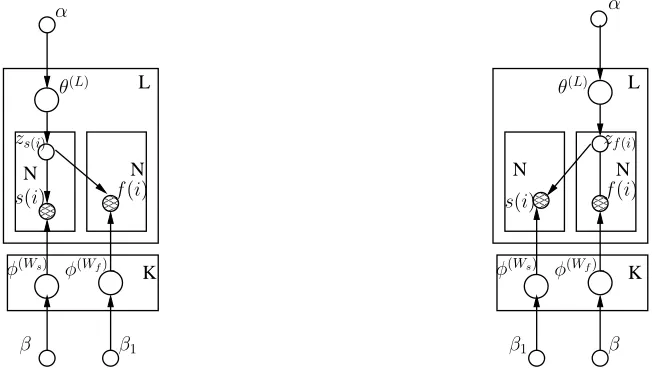
The complete surname correlated LDA model is given by
s(i)|zs(i), φ(zs(i)) ∼ Discrete(φ(zs(i)))
φ(Ws) ∼ Dirichlet(β)
zs(i)|θ(li) ∼ Discrete(θ(li))
θ(L) ∼ Dirichlet(α) f∗(i)|zs(i), φ(zf(i)) ∼ Discrete(φ(zf(i)))
φ(Wf) ∼ Dirichlet(β
1)
The posterior distribution on zs(i), the distributions of θ(L),
00 00 11 11 00 00 11 11
K N
L
N
β1
f(i)
β
φ(Wf)
φ(Ws)
θ(L)
α
s(i)
zs(i)
Fig. 2. The graphical representation of surname Correlated LDA model
00 00 11 11 0 0 0 1 1 1
L
N N
K
β
s(i) f(i)
β1
φ(Wf)
φ(Ws)
α
zf(i)
θ(L)
Fig. 3. The graphical representation of forename Correlated LDA Model
and (3) respectively. The new distribution φ(Ws) can be
obtained as given in (9) which is a multinomial Dirichlet distribution with a symmetric prior β1 that corresponds to
distribution of communities over correlated forenames.
P(f∗(i)|zs(i)) =
Γ(|Wf|.β1)
Γ(β1)|Wf|
K K Y
j=1
Πf(i)Γ(n
f(i) (j) +β1)
Γ(nf(j().)+|Wf|.β1)
(9) Here nf(j()i) is number of times forename f(i) belongs to communityj,nfj(.)is number of times all forenames belong to
community j. However, the estimation of φ(Ws) corresponds
to probability given in (9) can be obtained by (10)
ˆ φfj(i)=
nf(j()i)+β1
nf(j().)+|Wf|.β1
(10)
Similarly forename correlated LDA model can be estimated which gives correlated surnames for each community of fore-names. However, these models do not infer correlation between communities of forenames and communities of surnames. The following subsection proposes the community-community
correlated estimation models.
C. Community-Community Correlated Estimation models
This subsection proposes community-community corre-lated estimation models. We propose two models which are
surname community correlated LDA model and forename com-munity correlated LDA model.
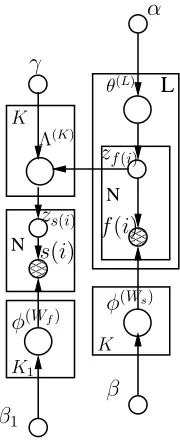
The surname community correlated LDA model initially estimates communities over surnames as explained in sub-section III-A. Let K be number of communities obtained in surnames. It can be seen that there might be many common correlated forenames across several surname communities and thus can form hidden communities in the correlated forenames. For example, forenames Sarah and Paul shared across many surname communities in United Kingdom.
The surname community correlated LDA model chooses proportions of several forename communities that correlate with each surname community whereas earlier models choose proportions of communities in a location. Hence the surname
community correlated LDA model can find forename
commu-nities such that the distribution of forenames in each forename community is based on correlation of forename community to several surname communities.
The surname community correlated estimation model using LDA works as follows. Surname communities correlate with several forename communities. If a surname community cor-relate with a random mixture of K1 forename communities
then the probability of ith forename f(i) that correlates with
a surname community as
P(f(i)|zs(i)) =
K1
X
j=1
P(f(i)|zf(i)=j)P(zf(i)=j|zs(i))
(11) where zf(i) denotes latent forename-community assignmentj
from which ith forename f(i) was drawn,P(f(i)|z
f(i)=j)
is the probability the correlated forename f(i) under the forename-community j, and P(zf(i) = j|zs(i)) is the
prob-ability of choosing forename-community j that correlates to a surname-community zs(i). The idea behind this model is that
the forenames that correlated with each surname-community are generated by picking the forename-community j from distributionΛ(K)and picking a forename from the
forename-community j according to P(f(i)|zf(i) = j). Hence a new
multinomial distribution Λ(K) with a Dirichlet prior γ
rep-resents proportions of several forename-communities shared over surname-communities and φ(Wf) denotes a multinomial
distribution of communities over a set of forenames with a Dirichlet priorβ1. Note thatγandβ1are symmetric Dirichlet
priori can take scalar values.
The complete surname community correlated LDA model is given by
s(i)|zs(i), φ(zs(i)) ∼ Discrete(φ(zs(i)))
[image:5.612.126.454.56.247.2]0 0
1 1
00 00 00
11 11 11
L
N
N
β
α
z
s(i)z
f(i)β
1γ
φ
(Ws)s
(
i
)
f
(
i
)
φ
(Wf)Λ(K) K
K1 K
[image:6.612.367.457.54.277.2]θ(L)
Fig. 4. Surname Community Correlated LDA model
0 0
1 1
00 00 00
11 11 11
L
N
N
β
α
φ
(Ws)K θ(L)
K1
φ
(Wf)β
1K
Λ(K)
γ
f
(
i
)
s
(
i
)
[image:6.612.124.210.58.276.2]z
s(i)z
f(i)Fig. 5. Forename Community Correlated LDA Model
zs(i)|θ(li) ∼ Discrete(θ(li))
θ(L) ∼ Dirichlet(α) f(i)|zf(i), φ(zf(i)) ∼ Discrete(φ(zf(i)))
φ(Wf) ∼ Dirichlet(β
1)
zf(i)|Λ(ki) ∼ Discrete(Λ(ki))
Λ(K)|z
s(i) ∼ Dirichlet(γ)
The posterior distribution on zs(i), the distributions of θ(L),
and the distributions ofφ(Ws)are given by equations (2), (4),
and (3) respectively. However, the community-community correlated estimation model can be performed to estimate
Λ(K) and φ(Wf) by maximizing community assignments to
forenames using (12)
P(zf(i)|f(i)) =
P(f(i)|zf(i)).P(zf(i)|zs(i))
P
zf(i)P(f(i)|zf(i)).P(zf(i)|zs(i))
(12)
where φ(Wf)andΛ(K) are multinomial Dirichlet distributions
with priori β1 andγ are given by (13) and (14) respectively
P(f(i)|zf(i)) =
Γ(|
Wf|.β1)
Γ(β1)|Wf|
K1 K1
Y
j=1
Πf(i)Γ(n
f(i) (j) +β1)
Γ(n(fj().)+|Wf|.β1)
(13)
P(zf(i)|zs(i)) =
Γ( K1γ)
Γ(γ)K1
K K Y
ki=1
ΠjΓ(n f(ki)
(j) +γ)
Γ(nf(ki)
(.) +K1γ)
(14)
Here nf(j()i) is number of times forename f(i) belongs to community j, nfj(.) is number of times all forenames belong
to community j, nf(ki)
(j) is number of times forename i that
correlates with surname-communityki belongs to community
j, and nf(ki)
(.) is number of times all forenames that correlate
with surname-communityki. Also,Γ(.)is the standard gamma
function and|.|is the size of the set.
We will use Gibbs sampling to find the posterior distribu-tion on zfi which integrating out to Λ
(K) and φ(Wf) using
standard Dirichlet Integrals as given in equation (15).
P(zf(i)=j|zf(−i), f(−i))∝
nf(−(ii,j) )+β1
nf(−(.i,j) )+|Wf|β1
. n
f(ki)
(−i,j)+γ
nf(ki)
(−i,.)+K1.γ
(15) Note that nf(−(.i,j) )indicates the count that does not include the current assignment of zf(i). That isn
f(.) (−i,j)=n
f(.) (j) −1.
It can be observed from the posterior probability in (15) is proportionate to multiplication of the probability of forename
f(i) which belongs to community j and the probability of forename-community j correlates with surname-communityi. Hence, the distributionsΛ(K) andφ(Wf) can be estimated as
given in equations (16) and (17) respectively.
ˆ Λf(ki)
j =
nf(ki)
(−i,j)+γ
nf(ki)
(−i,.)+K1.γ
(16)
ˆ
φfj(i)= n
f(i) (−i,j)+β1
nf(−(.i,j) )+|Wf|β1
(17)
Similarly forename community correlated LDA model esti-mates communities in forenames and introduces an additional multinomial distribution that captures correlation among com-munities in surnames over comcom-munities of forenames. The graphical
IV. EXPERIMENTALRESULTS
This section describes experimental results. We have two countries names data set, viz., United Kingdom (UK) and
In-dia. United Kingdom corpus has 0.924 million names collected
TABLE I. SURNAME CORRELATEDESTIMATION MODEL FORUNITEDKINGDOM DATA SET Community 5 Surname PROB. matos 0.000436 duff 0.000374 neves 0.000374 fevrier 0.000374 molina 0.000374 wallace 0.000313 roos 0.000313 springham 0.000313 asare 0.000313 decarvalho 0.000313 Forename PROB. john 0.005376 michael 0.003553 anna 0.003553 maria 0.003351 paul 0.003148 david 0.003047 peter 0.002946 james 0.002541 andrew 0.002338 sarah 0.002136 Community 10 Surname PROB. patel 0.02416 khan 0.01912 ali 0.01254 ahmed 0.01200 hussain 0.00935 singh 0.00909 shah 0.00860 begum 0.00738 kaur 0.00415 rahman 0.00321 Forename PROB. john 0.00591 mohammed 0.00589 david 0.00528 michael 0.00396 richard 0.00375 paul 0.00345 sarah 0.00340 muhammad 0.00314 ali 0.00308 susan 0.00294 Community 24 Surname PROB. derrick 0.000951 luo 0.000840 zhao 0.000784 trott 0.000562 jhon 0.000562 billy 0.000562 rosa 0.000562 venn 0.000562 skuse 0.000562 whyet 0.000562 Forename PROB. david 0.006408 paul 0.005975 susan 0.005802 sarah 0.005629 helen 0.005543 john 0.005111 emma 0.004332 karen 0.004332 xheng 0.003554 cheng 0.003467 Community 25 Surname PROB. smith 0.008004 wilson 0.007720 brown 0.007701 stewart 0.006923 campbell 0.006895 anderson 0.006639 robertson 0.006354 thomson 0.005842 murray 0.005691 scott 0.004998 Forename PROB. john 0.021779 david 0.018649 james 0.016307 robert 0.010693 margaret 0.010663 paul 0.009936 william 0.009744 andrew 0.009088 michael 0.008694 elizabeth 0.008310
TABLE II. FORNAME CORRELATEDESTIMATION MODEL FORUNITEDKINGDOM DATA SET
Community 4 Forename PROB. james 0.027032 john 0.026830 william 0.021617 margaret 0.020741 david 0.015551 elizabeth 0.014764 robert 0.013438 mary 0.012764 fiona 0.012068 thomas 0.010315 Surnames PROB. smith 0.009057 brown 0.006248 campbell 0.005285 wilson 0.004873 stewart 0.004834 robertson 0.004421 thomson 0.004362 anderson 0.004342 murray 0.004166 scott 0.003832 Community 7 Forename PROB. mohammed 0.021833 imran 0.006522 abdul 0.004561 muhammad 0.003928 mohammad 0.003739 salma 0.003485 shabana 0.003485 usman 0.002790 asif 0.002726 saima 0.002600 Surname PROB. khan 0.017968 hussain 0.015627 ali 0.012250 ahmed 0.010584 patel 0.009909 akhtar 0.005047 mahmood 0.004551 begum 0.004461 iqbal 0.003831 singh 0.003066 Community 20 Forename PROB. mandeep 0.004284 gurpreet 0.002254 jas 0.002040 hardeep 0.002040 harjinder 0.002040 kamaljit 0.002040 amandeep 0.001720 manjit 0.001613 sandeep 0.001506 harpreet 0.001506 Surname PROB. singh 0.008697 kaur 0.004890 khan 0.002543 patel 0.002353 hussain 0.002036 ali 0.001782 ahmed 0.001782 begum 0.001528 gill 0.001401 sandhu 0.001211 Community 25 Forename PROB. eugen 0.002144 rice 0.001576 dren 0.001434 yu 0.001292 hil 0.001292 smith 0.001150 feng 0.001150 robin 0.001150 srun 0.001008 hai 0.000866 Surname PROB. jones 0.002907 smith 0.002164 brown 0.001941 li 0.001792 luo 0.001271 david 0.001197 dong 0.001048 liu 0.000899 zhao 0.000825 ma 0.000751
locations chosen as train data set and names in 15 remaining locations chosen as test data set for United Kingdom. Similarly, names in 250 random locations chosen as train data set and names in 27 random locations chosen as test data set for India. Test data set consists of held-out names from several locations that evaluates the estimated model from training set.
Experiments are carried out using Gibbs sampler to es-timate communities and their correlations in UK and India names data set. The number of communities are chosen from
{15,20,25,30}. The hyper-parameters such as α, β, β1, and
γ are symmetric Dirichlet priori and each hyper parameter is chosen single value which is 0.1. Gibbs sampling runs over 1000 iterations.
A. Community Correlated Estimation Models
This subsection presents the result of surname correlated
LDA model and forename correlated LDA model. The results
of surname correlated LDA model present estimated commu-nities in surnames and correlated forenames in each surname communities. The results of forename correlated LDA model
present estimated communities in forenames and correlated surnames in each forename communities.
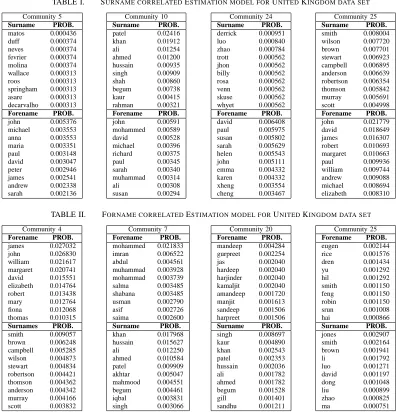
1) UK names data set: Table I shows the results of surname correlated LDA model. Communities 5, 10, 24, and 25 have
top 10 most likely surnames and their correlated top 10 most likely forenames for UK. Surnames belong to community 5 and 25 are British or European and the correlated forenames are also British or European. Surnames in community 10 seem to be Indian or Pakistani surnames and forenames
mo-hamad, muhammad, and ali are seem to be correlated Indian or Pakistani forenames and also with some other correlated British forenames. Similarly, surnames in community 24 seem
to be Chines along with some correlated Chines and British forenames. Some British forenames appear across many surname communities.
Table II shows the result of forename correlated LDA
model. Communities 4, 7, 20, and 25 have top 10 most likely
forenames and their correlated top 10 most likely surnames for UK. Forenames in community 4, 7, 20, and 25 are British,
Pakistani, Indian, and Chines and correlated surnames seem
TABLE III. SURNAME CORRELATEDESTIMATION MODEL FORINDIA DATA SET Community 8 Surname PROB. das 0.047381 ghosh 0.036121 roy 0.030650 banerjee 0.024349 chakraborty 0.024280 mukherjee 0.024237 saha 0.020182 sarkar 0.018965 dutta 0.018494 chatterjee 0.018213 Forename PROB. amit 0.006203 abhijit 0.004291 arindam 0.003975 anirban 0.003703 abhishek 0.003668 suman 0.003501 sanjay 0.003453 subrata 0.003447 partha 0.003381 kaushik 0.003284 Community 10 Surname PROB. sahoo 0.030447 mohanty 0.026827 mishra 0.025976 das 0.021119 nayak 0.020382 behera 0.019462 panda 0.019417 dash 0.017908 sahu 0.016069 mohapatra 0.014038 Forename PROB. santosh 0.001891 manoj 0.001464 deepak 0.001347 manas 0.001289 biswajit 0.001133 rajesh 0.001031 sanjay 0.000987 santoshkumar 0.000972 ashok 0.000963 manoranjan 0.000943 Community 12 Surname PROB. patil 0.032645 kulkarni 0.021224 joshi 0.012290 jadhav 0.011181 shinde 0.009799 pawar 0.009491 deshpande 0.009260 deshmukh 0.008316 gaikwad 0.006371 shaikh 0.006037 Forename PROB. sachin 0.007677 rahul 0.005960 amit 0.005789 prashant 0.005357 amol 0.004734 sandeep 0.004635 nitin 0.004469 santosh 0.004446 nilesh 0.004393 yogesh 0.004157 Community 25 Surname PROB. gogoi 0.002211 saikia 0.001997 baruah 0.001807 borah 0.001712 deka 0.001190 kalita 0.001118 hazarika 0.001071 bora 0.000857 sarmah 0.000738 phukan 0.000643 Forename PROB. lal 0.000244 ram 0.000157 rajesh 0.000107 amit 0.000088 pankaj 0.000082 pranjal 0.000082 sanjay 0.000075 manoj 0.000063 anil 0.000063 abhijit 0.000063
TABLE IV. FORNAME CORRELATEDESTIMATION MODEL FORINDIA DATA SET
Community 9 Forename PROB. amit 0.017765 rahul 0.010283 sandeep 0.009322 ashish 0.009181 deepak 0.009120 manish 0.008506 abhishek 0.008176 sanjay 0.007081 rajesh 0.007064 gaurav 0.006828 Surnames PROB. kumar 0.053129 singh 0.042147 sharma 0.030981 gupta 0.020334 jain 0.014350 shah 0.009734 mishra 0.008965 yadav 0.007624 verma 0.007109 agarwal 0.007090 Community 16 Forename PROB. patel 0.008988 jignesh 0.004512 chirag 0.003621 hardik 0.003603 dhaval 0.003272 bhavesh 0.003032 hiren 0.002983 mehul 0.002811 nirav 0.002512 kalpesh 0.002340 Surname PROB. patel 0.064114 shah 0.034320 parmar 0.008046 joshi 0.007688 mehta 0.007534 bhatt 0.007292 desai 0.006895 prajapati 0.006267 pandya 0.006218 panchal 0.006112 Community 18 Forename PROB. abhijit 0.004777 arindam 0.004504 biswajit 0.004138 subrata 0.004004 anirban 0.003980 partha 0.003934 suman 0.003932 sourav 0.003696 sandip 0.003603 kaushik 0.003564 Surname PROB. das 0.043842 ghosh 0.031245 roy 0.025780 banerjee 0.020718 chakraborty 0.020569 mukherjee 0.020309 saha 0.017109 sarkar 0.016326 dutta 0.015930 chatterjee 0.015577 Community 25 Forename PROB. amol 0.007978 nilesh 0.00500 sachin 0.004320 ashwini 0.004234 ganesh 0.003819 sagar 0.003708 swapnil 0.003667 amruta 0.003222 snehal 0.003169 rupali 0.003166 Surname PROB. patil 0.024298 kulkarni 0.017574 joshi 0.010838 jadhav 0.008986 shinde 0.007711 deshpande 0.007711 pawar 0.007203 deshmukh 0.006019 shaikh 0.005634 singh 0.005482
common surnames between Pakistani and Indian. Also, there are some common surnames in British and Chines.
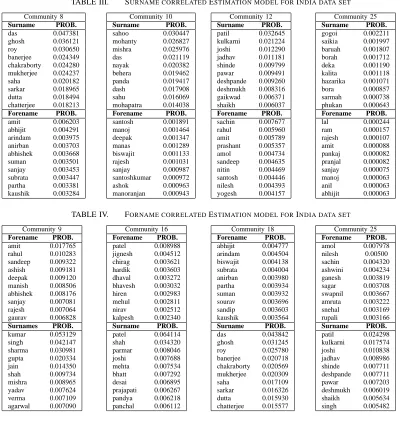
2) India names data set: Table III shows the results of surname correlated LDA model. Communities 8, 10, 12, and
25 have top 10 most likely surnames and their correlated top 10 most likely forenames for India names data set. Surnames in community 8, community 10, community 12, and community 25 are belong to Bengali, Orrisa, Marathi, and Assami sur-names. The correlated forenames correspond to each surname community are presented which share some forenames across two or more community groups. For example, forenames
abhijit, amith, and sanjay share across Bangali and Assami
surname communities. Forenames sanjay and manoj share across Orrisa and Assami communities.
Table IV shows the result of forename correlated LDA
model. Communities 9, 16, 28, and 25 have top 10 most likely
forenames and their correlated top 10 most likely surnames for India names data set. The distributions of surname com-munities can be interpreted easily in Indian names data set whereas the distributions of forename communities are hard to interpret since forenames can share across many surname
communities in Indian names data set. However, it is clear from the Table IV that the correlated surnames of each forename community appear in same surname community in Table III. Hence, the forename correlated LDA model clearly finding communities in forenames and correlated surnames.
B. Community-Community Correlated Estimation Models
This subsection presents the result of surname community
correlated LDA model and forename community correlated LDA model. In the subsection IV-A, it has been observed that
there could be several forenames or surnames that correlate across several surname communities or forename communities. It is important to establish communities in forenames or surnames that correlate with given communities of surnames or forenames. Hence the results of community-community
correlated estimation models provide interaction between
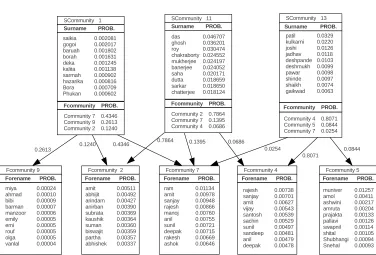
sur-name communities and foresur-name communities. The results of surname community correlated LDA model provide top 3 most likely correlated forename communities of each surname community. Similarly, The results of forename community
correlated LDA model provide top 3 most likely correlated
Fig. 6. Forename Community Correlated LDA Model for UK Names Data Set
[image:9.612.120.496.413.668.2]4 6 8 10 12 14 16
10 15 20 25 30
Perplexity
Number of Communities Perplexity Results for Indian names
Surname LDA Forename LDA Surname Correlated LDA Forename Correlated LDA Surname Community Correlated LDA Forename Community Correlated LDA
4 6 8 10 12 14
10 15 20 25 30
Perplexity
Number of Communities Perplexity Results for UK names
[image:10.612.111.510.55.242.2]Surname LDA Forename LDA Surname Correlated LDA Forename Correlated LDA Surname Community Correlated LDA Forename Community Correlated LDA
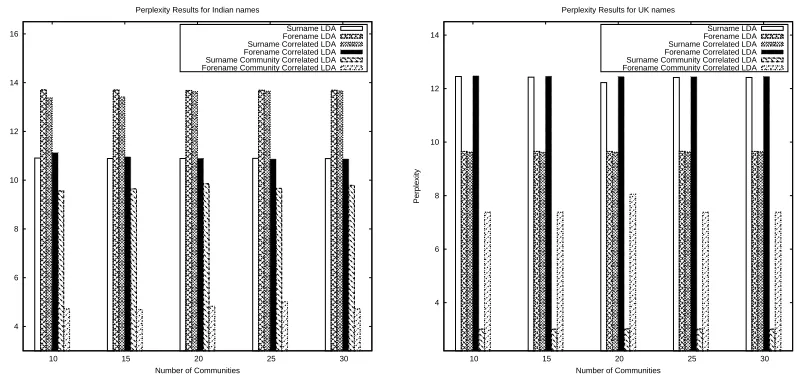
Fig. 8. Perplexity values for India and UK names data set for different probabilistic models
1) UK names data set: Figure 6 shows the results of forename community correlated LDA model. Forename
com-munities (FCommunity) 10, 16, and 17 have top 10 most likely forenames and their correlated top 3 surname communities where each surname community represents top 10 most likely surnames of that community for UK names data set. Forenames in community 10, 16, and 17 seem to be Indian, Chines, and British surnames respectively. It is observed that surname community 1 correlates with all three communities. However, it highly correlates to British forename community (0.8071) whereas surname community 6 and 4 are only correlate to
British community. Surname community 2 contains Indian or Pakistani surnames which highly correlates to Indian
fore-names with probability 0.7611. However, surname community 7 contains Chines surnames which are highly correlates to
Chines forenames with probability 0.6044.
2) India names data set: Figure 7 shows the results of surname community correlated LDA model. Surname
commu-nities (SCommunity) 1, 11, and 13 have top 10 most likely sur-names and their correlated top 3 forename communities where each foreanme community represents top 10 most likely fore-names of that community for India fore-names data set. Surfore-names in community 1, 11, and 13 are seem to be Assam, Bengali, and Marathi communities in India. It is observed that forename community 7 shares all these three surname communities and however it highly correlates to Assam surname community with probability 0.4346. Also, forename community 2 highly correlates to Bengali community with probability 0.7864 and forename community 4 highly correlates to Marathi surname community with probability 0.8071.
C. Performance Comparison
A held out test data set is used to compare the performance of the proposed models for Indian and UK names data set. Perplexity is a standard measure to compare the performance of a probabilistic model. A lower perplexity score indicates better generalization performance. The perplexity is defined as exponential of negative normalized predictive likelihood of test data under the model. Figure 8 represents perplexity compar-ison for probabilistic models against number of communities
for UK and India data sets. Perplexity can also be used to study the strengths of communities under different scenarios. For
India names data set, surname LDA model has less perplexity
than forename LDA model which means surnames capture better communities than forenames whereas UK names data set, forenames capture better communities than surnames.
The perplexity of the surname correlated LDA model has almost same performance as forename LDA since the correlated forenames probabilities are used to calculate per-plexity, but it extracts additional information such as correlated forenames of each surname community for both the names data set. Similarly, the proposed forename correlated LDA model has almost same performance as surname LDA, but it extracts correlated surnames for both the names data sets. However, the proposed surname community correlated LDA and
fore-name community correlated LDA have improved performance
compared to all other methods. These models also provide interaction among communities of surnames and communities of forenames.
For Indian names data set, the forename community
cor-related LDA model performs better than surname community correlated LDA model whereas for UK names data set, the surname community correlated LDA model performs better
than forename community correlated LDA model. It means surname capture good communities which interact across sev-eral forename communities in India whereas forename capture good communities which interact across several surname com-munities in UK. Intuitively, surname comcom-munities in India and forename communities in UK are well established in all the proposed methods. However, the performance of community-community correlated LDA models are better than all other models. The average perplexity of surname community
cor-related LDA model and forename corcor-related LDA model are
3.01944 and 7.6573 for UK names data set whereas these values are 9.66520 and 4.8298 for India names data set respectively
V. CONCLUSION ANDFUTURE WORK
at different locations. In addition, this paper proposed several variants of LDA models to capture correlation among surnames and forenames within the communities and across the commu-nities. Initially, this paper presented surname correlated LDA model and forename correlated LDA model. These models find communities in surnames or forenames and extracts corre-lated forenames or surnames respectively. The performance of surname correlated LDA model or forename correlated LDA model is similar to performance of LDA model to find commu-nities in surnames or forenames independently. However, these proposed models extract correlated forenames or surnames. Later, this paper proposed surname community correlated LDA model and forename community correlated LDA model. These models establish interaction among communities of forenames and communities of surnames. These two models have lower perplexity compared to all other related models which means the performance of these two models are better than all other related models in this paper. The experiments for proposed models are conducted against number of communities for India and UK names data set. It has been observed that surnames form good communities in India names data set and forenames form good communities in UK names data set. This paper assumes the number of communities are known in advance. In future work, we will propose to derive optimal number of clusters from the given names data set.
ACKNOWLEDGEMENTS
This work was supported through the EPSRC Grant- “The Uncertainty of Identity: Linking Spatiotemporal Information Between Virtual and Real Worlds” (EP/J005266/1).
REFERENCES
[1] A. M. Dai and A. J. Storkey. The grouped author-topic model for unsupervised entity resolution. In Proc. of the 21th international conference on Artificial neural networks, pages 241–249, 2011. [2] A. McCallum, X. Wang, and A. Corrada-Emmanuel. Topic and role
discovery in social networks with experiments on enron and academic email. Journal of Artificial Intelligence Research, 30(1):249–272, 2007. [3] B. de Finetti. Theory of probability. John Wiley & Sons Ltd., 1975. [4] Indrajit Bhattacharya and Lise Getoor. A latent dirichlet allocation
model for entity resolution. Technical report, University of Maryland, College Park, MD, USA, 2005.
[5] James A. Cheshire and Paul A. Longley. Identifying spatial concentra-tions of surnames. International Journal of Geographical Information Science, DOI:10.1080/13658816.2011.591291:1–17, 2011.
[6] D. M. Blei and M. I. Jordan. Modelling annotated data. In Proc. of the 26th annual international ACM SIGIR conference on Research and development in informaion retrieval, pages 127–134, 2003.
[7] D. Mimmo and A. McCallum. Expertise modeling for matching papers with reviewers. In Proc. of the 13th ACM SIGKDD international conference on Knowledge discovery and data mining, pages 500–509, 2007.
[8] D. Mimmo and A. McCallum. Topic models conditioned on arbitrary features with dirichlet- multinomial regression. In Proc. of UAI, 2008. [9] D. Newman, C. Chemudugunta, and P. Smyth. Statistical entity-topic models. In Proc. of the 12th ACM SIGKDD international conference on Knowledge discovery and data mining, pages 680–686, 2006. [10] D. Ramage, C. D. Manning, and S. Dumais. Partially labeled topic
models for interpretable text mining. In Proc. of the 17th ACM SIGKDD international conference on Knowledge discovery and data mining, pages 457–465, 2011.
[11] D. Ramage, D. Hall, R. Nallapati, and C. D. Manning. Labeled lda: a supervised topic model for credit attribution in multi-labeled corpora. In Proc. of the 2009 Conference on Empirical Methods in Natural Language Processing, volume 1, pages 248–256, 2009.
[12] David M. Blei, Andrew Y. Ng, and Michael I. Jordan. Latent dirichlet allocation. Journal of Machine Learning Research, 3:993–1022, 2003. [13] E. Erosheva, S. Fienberg and J. Lafferty. Mixed-membership models of scientific publications. In Proc. of the National Academy of Sciences of the United States of America, volume 101, pages 5220–5227, 2004. [14] H. Zhang, B. Qiu, C. L. Giles, H. C. Foley, and J. Yen. An lda-based community structure discovery approach for large-scale social networks. In Proc. of the 20th international joint conference on Artifical intelligence (IJCAI’07), pages 200–207. IEEE Intelligence and Security Informatics, 2007.
[15] J. Burt, G. Barder, and D. Rigby. Elementary statistics for geographers. Guilford Press, 2009.
[16] K. Aas and L. Eikvil. Text categorisation: A survey. In Technical Report 941. Norwegian Computing Center, 1999.
[17] L. Shu, B. Long, and W. Meng. A latent topic model for complete entity resolution. In Proc. of the 2009 IEEE International Conference on Data Engineering, pages 880–891, 2009.
[18] G. Lasker. Using surnames to analyse population structure. Naming, Society and Regional Identity, pages 3–24, 2002.
[19] Paul A. Longley, James A. Cheshire, and P Mateos. Creating a regional geography of britain through the spatial analysis of surnames. Geoforum, doi:10.1016, 2011.
[20] M. Steyvers, P. Smyth, and T. Griffiths. Probabilistic author-topic models for information discovery. In Proc. of the 10th ACM SIGKDD international conference on Knowledge discovery and data mining, pages 306–315, 2004.
[21] P Mateos, Paul A. Longley, and David O’Sullivan. Ethnicity and population structure in personal naming networks. PLoS ONE, 6(9):1– 12, 2011.
[22] P Mateos, A Singleton, and P A Longley. Uncertainty in the analysis of ethnicity classifications: Issues of extent and aggregation of ethnic groups. Journal of Ethnic and Migration Studies, 35(9):1437–1460, 2009.
[23] Ralf Krestel, Peter Fankhauser, and Wolfgang Nejdl. Latent dirichlet allocation for tag recommendation. In Proc. of the third ACM conference on Recommender systems (RecSys ’09), pages 61–68, 2009.
[24] A Rodriguez-Larralde, A. Pavesi, G. Siri, and I. Barrai. Isonamy and the genetic structure of sicily. Journal of Biosocial Science, 26:9–24, 1994.
[25] Suresh Veluru, R Yogachandran, and M Rajarajan. Surname identifica-tion and correcidentifica-tion in a corpus of forename surname dataset. In Proc. of the UK Workshop on Computational Intelligence 2012 (UKCI 2012), 2012.
[26] Suresh Veluru, R Yogachandran, P. Viswanath, P Longley, and M Ra-jarajan. E-mail address categorization based on semantics of surnames. In Proc. of the IEEE Symposium on Computational Intelligence and Data Mining (ICDM), pages 222–229, 2013.
[27] T. L. Griffiths and M. Steyvers. Finding scientific topics. In Proc. of the National Academy of Sciences of the United States of America, volume 101, pages 5228–5235, 2004.
[28] H. M. Wallach. Topic modeling : Beyond bag-of-words. In Proc. of the 23rd International Conference on Machine Learning, pages 977–983, 2006.
[29] X. Wang and A. McCallum. Topics over time: A non-markov continuous-time model of topical trends. In Proc. of the 12th ACM SIGKDD international conference on Knowledge discovery and data mining, pages 424–433, 2006.
[30] X. Wang, N. Mohanty and A. McCallum. Group and topic discovery from relations and their atrributes. In Proc. of the 3rd international workshop on Link discovery, pages 28–35, 2005.