Title: A Study on Security Level Management
Model for Information System
by
Tai-hoon Kim
Submitted in fulfilment of the
Requirements for the Degree of
Doctor of Philosophy
University of Tasmania
ii
STATEMENT OF ORIGINALITY
This thesis contains no material which has been accepted for a degree or diploma by the University or any other institution, except by way of background information and duly acknowledged in the thesis. To the best of my knowledge and belief, this thesis contains no material previously published or written by another person except where due acknowledgement is made in the text of the thesis, nor does the thesis contain any material that infringes copyright.
Tai-hoon Kim
iii
AUTHORITY OF ACCESS
iv
ABSTRACT
The attempts to protect information and Information System (IS) from the threats are progressing variously and systematically, and the necessity to build security countermeasures by considering the characteristics of IS is gathering strength. In fact, to satisfy the proposition of information security, we don't have to invest excessive budget.
Needless to say, it is important to protect information and IS, but it is not desirable to build uniform security countermeasures regardless of degree of importance. Depending on the purpose of building or operation, IS may have different degree of importance, meaning an IS may have higher degree of importance than other IS.
Systems in same office can even have different degree of importance. In other words, some systems should be protected from the attack, even though some systems can be compromised from the same attack.
In agreement with the degree of importance of IS, the strength of security countermeasure should be changed. For important systems, stronger security countermeasures should be selected, and stronger verification processes should be executed properly.
As we can reduce unnecessary budget for IS which has a lower degree of importance, we can increase investment to IS which has higher degree of importance with the budget saved from other IS.
v
In this thesis, after analysing previous research results, the author proposes some essential elements for security level definition and management of IS. After classifying, proper level was granted to threats and assets, and weights were assigned to each level. By summating these weights, the security level of an IS can be decided.
After deciding the security level, basic technical and non-technical requirements for security level management are proposed in detail. Some items needed to ensure basic security state of IS are listed in this requirements.
vi
DEDICATION
I dedicate this thesis to Loving God.
Your endless love and grace allowed me to endure all obstacles.
vii
Table of Contents
1. Introduction ...1
1.1 Background and Motivation ...1
1.2 Related Works ...3
1.2.1 Security Evaluation for IT Products ...4
1.2.2 Cryptographic Module Validation Program ...10
1.2.3 Developing Process ...12
1.2.4 Information Security Management Systems ...16
1.3 Challenging Issues ...18
1.4 Our Contributions ...20
1.4.1 Threat Level Definition Method ...21
1.4.2 Asset Level Definition Method ...22
1.4.3 Security Level Definition Method ...23
1.4.4 Security Level Management Model ...23
1.4.4.1 Level Dimension in Security Level Management Model ...24
1.4.4.2 Area Dimension in Security Level Management Model ...24
1.4.4.3 Continuous Model and Staged Model ...25
1.5 Comparison with Existing Works. ...27
2. Security Level Decision Method ...28
2.1 Definition of Threat level...30
2.1.1 Identification Activity ...31
2.1.2 Attack Activity ...32
2.1.3 Threat Level Decision By Sum of Weights ...50
2.2 Definition of Asset Level ...52
2.3 Definition of Security Level ...53
viii
3.1 SLMM Architecture Description ...55
3.2 The Basic Model ...55
3.3 The Security Practices...57
3.4 The Level Requirements ...59
4. Security Practices ...62
4.1 Security Management Part ...62
4.1.1 SA01 Human Resource ...63
4.1.2 SA02 Operation and Administration ...68
4.1.3 SA03 Physical Protection ...82
4.2 Security Technology Part ...86
4.2.1 SA04 Access Control Technology ...86
4.2.2 SA05 Cryptography Technology ...90
4.2.3 SA06 Identification and Authentication Technology ...93
4.2.4 SA07 Service Assurance Technology ...96
4.2.5 SA08 Shielding Technology ...99
5. Level Requirements ...102
5.1 Requirement of Level 1 Executed Basically ...103
5.2 Requirement of Level 2 Verified and Tracked ...106
5.3 Requirement of Level 3 Quantitatively Controlled ...114
5.4 Requirement of Level 4 Monitored and Improved ...120
6. Case Study ...126
6.1 Security Level Decision ...133
6.1.1 Definition of Threat Level ...133
6.1.2 Definition of Asset Level ...143
6.1.3 Definition of Security Level ...145
ix
6.2.1 Security Management Part ...147
6.2.2 Security Technology Part ...148
6.3 Checking of SL3 Requirements ...150
6.3.1 Level Feature for Management Part ...151
6.3.2 Level Feature for Technology Part ...155
6.4 Summary of Case Study...156
7. Future Work ...158
References ...160
Appendix Key Abbreviation List ...166
Acknowledgement ...169
Published Papers ...170
x
LIST OF TABLES
Number Page
Table 1 Security Requirements of TCSEC ...5
Table 2 Evaluation Assurance Level Summary ...9
Table 3 Model Types of CMMI ...13
Table 4 Differences Among SLMM and Some Existing Works ...27
Table 5 Potential Attacker ...35
Table 6 Weights for Identified Attacker's Capability ...37
Table 7 Weights for Attacker's Motivation ...39
Table 8 Examples of Passive Attacks ...41
Table 9 Examples of Active Attacks ...41
Table 10 Weights for Category of Attacks ...43
Table 11 Examples of Distribution Attacks ...45
Table 12 Examples of Close-In Attacks ...45
Table 13 Examples of Insider Attacks ...47
Table 14 Weights for Access ...48
Table 15 Weights for Tools and Equipments ...49
Table 16 Weights for Elapsed Time ...50
Table 17 Threat Level Definition ...51
Table 18 Example of Threat Level Decision ...52
Table 19 Example of Security Label Definition. ...52
Table 20 Security Level Definition...53
Table 21 Decision of Security Level ...54
Table 22 Security Level for Research Room ...146
Table 23 Summary of Security Management Practices ...147
Table 24 Summary of Security Technology Practices ...149
xi
LIST OF FIGURES
Number Page
Figure 1 Example of Staged Model ...26
Figure 2 Example of Continuous Model ...26
Figure 3 Security Concepts and Relationships ...29
Figure 4 Relationship Between Security Practices and Level Requirements ...56
1
1. INTRODUCTION
1.1 BACKGROUND AND MOTIVATION
Information system (IS) and the information processed by IS are very important to maintain all functions and keep the duty of organization. The problems derived from unauthorized disclosure, modification, and destruction of important information or compromise of IS should be considered very carefully because these can be connected to economical loss or the collapse of organizations.
IS carries out a critical role in the aspects of promptitude and exactitude, and most organizations rely on IS to sustain their existence. Therefore, in a competitive environment, a fatal error or compromise of IS can lead to a dangerous situation. To avoid this, most organizations invest a great amount of money and effort in security areas to protect their IS.
The most common investment in IT security is buying and installing of security systems made by others. Security systems are a type of system designed to perform security functions. This kind of investment is a very simple and relatively easy method. If the owners of IS have more budget, they can buy and install more products as much as they want. This behavior is based on the concept 'the more they install security products, the more IS can be secure.' Firewall systems, IDS (Intrusion Detection Systems), and anti-virus systems are representative security products. Installation and operation of these products are very useful if IS contains many legacy systems.
2
establishment of security countermeasure by using security products takes a major portion of the investment [1-5].
The weak point of security countermeasure materialized technically by using security functions is that it is very difficult to manage this countermeasure as the newest one. Trials for incapacitation of IS or depredation of information are always in existence and on the increase.
The keeping of security functions made by security products as a newest one is a very difficult decision because this requires additional investments. For example, the IDS designed to work in 10Mbps network environments may not protect 100Mbps network improved by using optical cable. In this case, to protect improved environments, new products should be bought and installed. To do like this, additional investments are needed.
Fortunately, this kind of investment can be easily decided if the IS is very important. Owners will invest additionally to overcome technical problems. Unfortunately, even though they improve the security countermeasures to protect IS by using some products containing security functions, security accidents will not be reduced under regular level.
To find the reason there were many researches, and most research-results pointed out that many security functions were not generated or managed properly. For example, many security accidents are originated from mis-configuration of IS or lack of update of important components. These are the problems not included in the information system itself, but arose from compound components like operation policy, culture, operator's mind, and work procedure of organization.
3
To cope with the new security problems occurring in every second, it is not a good idea to buy and install security products. This is because much time is needed to make decision for buying products, and the life-cycle of products is not long.
It is more important to build strategies and procedures can be used when a new threat is detected. By following these strategies and procedures, operators can manage IS optimally and encounter to the threat systematically. Since then implementation of security countermeasures and management systems were merged to be used together [6-7].
Here related works for protecting an IS safely from attacks are summarized.
1.2 RELATED WORKS
The concept of information system can be confused because the term 'system' is able to be defined in many different ways. This thesis used the concept of information system that "Information system is an aggregate of humans, procedures, and resources that gather, process, and transfer information for organization." [8][22]
Therefore, not only physical configuration consists of individual products, all sorts of policies, laws and procedures for operating and managing physical components but also human operators who operate system practically should be included in the systems.
When an organization sets up a special goal and wants to achieve this goal by using an IS, the organization should configure a trustable IS according to the importance of its goal. Security level management concept considering whole scope of IS can guarantee the construction and operation of proper security countermeasures.
4
management activities into some parts, requirements needed for each part should be derived and applied.
Security level management for IS will be accomplished by following 2 steps. The first step is a verification if security requirements needed for IS are truly implemented. Second step is a confirmation if the implementation of security requirements can meet the security level needed for IS. This concept is the same as ISO/IEC 15504 (SPICE, Software Process Improvement Capability determination) and ISO/IEC 21827 (SSE-CMM, System Security Engineering-Capability Maturity Model).
1.2.1 SECURITY EVALUATION FOR ITPRODUCTS
Basically an IS consists of various IT products and their combination. So the security level of IS is seriously affected directly by the security level of each product included in the IS. To make the whole IS secure, security level of all products included in IS should be checked.
Security evaluation of IT products was enforced for a long time, and each country has their own security evaluation systems and criteria commensurate with their environments. By using these systems and criteria, each country evaluates and certificates the security and trust of IT products, and opens evaluation results to the public for free use.
The fact that the security evaluation results of IT products may affect the security level management of IS cannot be ignored. So the evaluation results should be used fully to manage security level of IS effectively.
5
The TCSEC is a United States Government Department of Defense (DoD) standard 5200.28-STD that sets basic requirements for assessing the effectiveness of computer security controls built into a computer system. The TCSEC was used to evaluate, classify and select computer systems being considered for the processing, storage and retrieval of sensitive or classified information.
The TCSEC, frequently referred to as the Orange Book, is the centerpiece of the DoD Rainbow Series publications. Initially issued by the National Computer Security Center (NCSC) an arm of the National Security Agency in 1983 and then updated in 1985, TCSEC was replaced with the development of the Common Criteria international standard originally published in 2005.
The TCSEC defines four divisions: D, C, B and A where division A has the highest security. Each division represents a significant difference in the trust an individual or organization can place on the evaluated system. Additionally divisions C, B and A are broken into a series of hierarchical subdivisions called classes: C1, C2, B1, B2, B3 and A1.
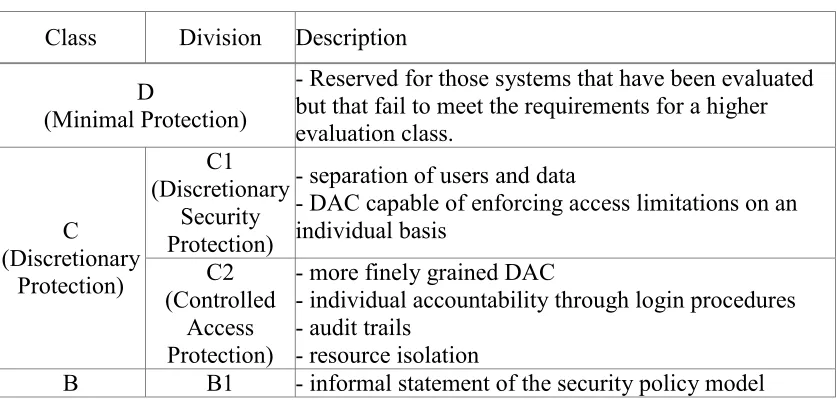
[image:16.612.110.529.506.706.2]Next Table 1 shows the requirements of the immediately prior division or class.
Table 1 Security Requirements of TCSEC
Class Division Description
D
(Minimal Protection)
- Reserved for those systems that have been evaluated but that fail to meet the requirements for a higher evaluation class. C (Discretionary Protection) C1 (Discretionary Security Protection)
- separation of users and data
- DAC capable of enforcing access limitations on an individual basis
C2 (Controlled
Access Protection)
- more finely grained DAC
- individual accountability through login procedures - audit trails
- resource isolation
6 (Mandatory
Protection) (Labeled Security Protection)
data sensitivity labels
- MAC over select subjects and objects - label exportation capabilities
- all discovered flaws must be removed or otherwise mitigated
B2 (Structured Protection)
- clearly defined and documented formal security policy model
- discretionary and mandatory access control enforcement be extended to all subjects and objects - covert storage channels are analyzed for occurrence and bandwidth
- carefully structured into protection-critical and non-protection-critical elements
- design and implementation enable more comprehensive testing and review
- authentication mechanisms are strengthened
- trusted facility management is provided administrator and operator segregation
- strict configuration management controls are imposed
B3 (Security Domains)
- satisfies reference monitor requirements
- structured to exclude code not essential to security policy enforcement
- significant system engineering directed toward minimizing complexity
- a security administrator is supported - audit security-relevant events
- automated imminent intrusion detection, notification, and response
- trusted system recovery procedures
- covert timing channels are analyzed for occurrence and bandwidth A (Verified Protection) A1 (Verified Design)
- functionally identical to B3 formal design and verification techniques including a formal top-level specification formal management and distribution procedures
7
was subsequently published in June 1991 by the Commission of the European Communities for operational use within evaluation and certification schemes.
The ITSEC is a structured set of criteria for evaluating computer security within products and systems. The product or system being evaluated, called the target of evaluation, is subjected to a detailed examination of its security features culminating in comprehensive and informed functional and penetration testing.
The degree of examination depends upon the level of confidence desired in the target. To provide different levels of confidence, the ITSEC defines evaluation levels, denoted E0 through E6. Higher evaluation levels involve more extensive examination and testing of the target.
Unlike the earlier criteria, notably the TCSEC developed by the US defense establishment, the ITSEC did not require evaluated targets to contain specific technical features in order to achieve a particular assurance level. For example, an ITSEC target might provide authentication or integrity features without providing confidentiality or availability. A given target's security features were documented in a Security Target document, whose contents had to be evaluated and approved before the target itself was evaluated. Each ITSEC evaluation was based exclusively on verifying the security features identified in the Security Target.
Since the launch of the ITSEC in 1990, a number of other European countries have agreed to recognize the validity of ITSEC evaluations.
The ITSEC has been largely replaced by Common Criteria, which provides similarly-defined evaluation levels and implements the target of evaluation concept and the Security Target document [22-24].
8
a framework in which computer system users can specify their security requirements, vendors can then implement and/or make claims about the security attributes of their products, and testing laboratories can evaluate the products to determine if they actually meet the claims. In other words, Common Criteria provides assurance that the process of specification, implementation and evaluation of a computer security product has been conducted in a rigorous and standard manner.
CC is composed of 3 parts. Detail specification of security functions is included in part 2, so the user of developer can use or recommend these functions [1-3]. When the security evaluation with CC and Common Evaluation Methodology (CEM, ISO/IEC 18045) is going on, security functions requested or certificated by users should be included. This is because there are some choices selected by users.
Important thing is that all security functions requested by users should be selected as the target of evaluation. After checking the implementation of security functions, evaluators should validate if these functions are enough to satisfy the level requested by IS.
The evaluation processes by using CC and CEM may satisfy these two considerations, but it cannot be sure. This is because the evaluation with CC and CEM focuses on not the implementation of security functions but level requirements. In other words, CC and CEM focus on the quality of implemented security functions not the existence of necessary security functions.
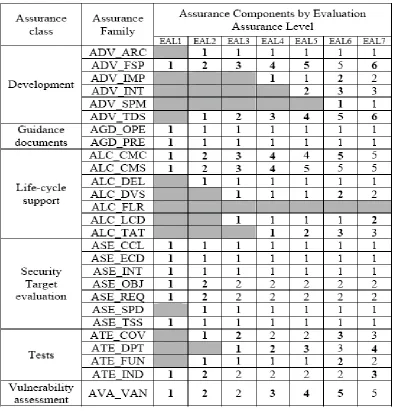
Evaluation Assurance Level (EAL) is recognized as security evaluation results of IT products. However there is a problem. Sometimes evaluation target is not the security functions requested by users but the functions implemented by developer. Therefore, if necessary security functions are not included in evaluation targets, this evaluation result cannot be used valuably.
9
Table 2. Evaluation Assurance Level Summary
It is not good idea to try to satisfy security level of IS by only using IT products. By increasing some investments for IT products, organizations will get some effects, but this is not enough. So organizations should prepare and operate systematic and manageable rules to complete insufficiencies.
10
The basic concept of the evaluation of security functions in IS is very similar to that of security level management of IS. The concept that first is the checking of the existence and nonexistence of security functions and second is the validation of security level management is the same as that of security level management.
1.2.2 CRYPTOGRAPHIC MODULE VALIDATION PROGRAM
The CMVP was established by the U.S. National Institute of Standards and Technology (NIST) and the Communications Security Establishment (CSE) of the Government of Canada in July 1995.
The Cryptographic Module Validation Program (CMVP) is a joint American and Canadian security accreditation program for cryptographic modules. The program is available to any vendors who seek to have their products certified for use by the U.S. Government and regulated industries (such as financial and health-care institutions) that collect, store, transfer, share and disseminate "sensitive, but not classified" information.
All of the tests under the CMVP are handled by third-party laboratories that are accredited as Cryptographic Module Testing Laboratories by the National Voluntary Laboratory Accreditation Program (NVLAP). Product certifications under the CMVP are performed in accordance with the requirements of FIPS 140-2.
NVLAP accredited Cryptographic Modules Testing (CMT) laboratories perform validation testing of cryptographic modules. Cryptographic modules are tested against requirements found in FIPS PUB 140-2, Security Requirements for Cryptographic Modules.
11
other areas that do not provide for different levels of security, a cryptographic module receives a rating that reflects fulfilment of all of the requirements for that area.
An overall rating is issued for the cryptographic module, which indicates (1) the minimum of the independent ratings received in the areas with levels, and (2) fulfilment of all the requirements in the other areas.
On a vendor's validation certificate, individual ratings are listed, as well as the overall rating. It is important for vendors and users of cryptographic modules to realize that the overall rating of a cryptographic module is not necessarily the most important rating. The rating of an individual area may be more important than the overall rating, depending on the environment in which the cryptographic module will be implemented (this includes understanding what risks the cryptographic module is intended to address) [25-26].
FIPS 140-2 defines four levels of security, simply named "Level 1" to "Level 4". It does not specify in detail what level of security is required by any particular application.
o Level 1 : The lowest which imposes very limited requirements. Loosely, all components must be "production-grade" and various egregious kinds of insecurity must be absent.
o Level 2 : Adds requirements for physical tamper-evidence and role-based authentication.
o Level 3 : Adds requirements for physical tamper-resistance (making it difficult for attackers to gain access to sensitive information contained in the module) and identity-based authentication, and for a physical or logical separation between the interfaces by which "critical security parameters" enter and leave the module, and its other interfaces.
12
For Levels 2 and higher, the operating platform upon which the validation is applicable is also listed. Vendors do not always maintain their baseline validations.
1.2.3 DEVELOPING PROCESS
It is not proper to discuss security level management after constructing an IS because an IS is a complex consists of many components. A vulnerability included in a component can be a security hole of an IS, and it is common that vulnerabilities are implicated in the products.
Even though a research to observe the development process and make up for insufficiency by applying software engineering is going on, this research was derived from the attempt to make more complete software by reducing the errors occurred when programmers wrote the codes.
However the purpose of this research is not to guarantee the integrity and completeness of software itself but to reduce the unnecessary budget and prevent the possibility of careless errors by controlling the whole development processes. All the researches were merged into CMMI (Capability Maturity Model Integration) and ISO/IEC 15504 (SPICE, Software Process Improvement Capability determination) [27-28].
The reason why the research related to the software area is going on actively is because the software development is more difficult than other things and software has a very special characteristic, "intangible."
Developers have some difficulties when they develop a software because the substantials of software may be not visible. These difficulties are connected to users' hardships because they cannot predict where and when the flaws will be found. To overcome these problems, process improvement tools such as CMMI and SPICE were developed.
13
(The System Engineering Capability Model), and IPD-CMM (The Integrated Product Development Capability Maturity Model).
CMMI is the successor of the CMM. In 2002 version 1.1 of the CMMI was released: v1.2 followed in August 2006. The goal of the CMMI project is to improve usability of maturity models for software engineering and other disciplines, by integrating many different models into one framework. It was created by members of industry, government and the SEI. The main sponsors included the Office of the Secretary of Defense (OSD) and the National Defense Industrial Association (NDIA) Systems Engineering Committee [29-30].
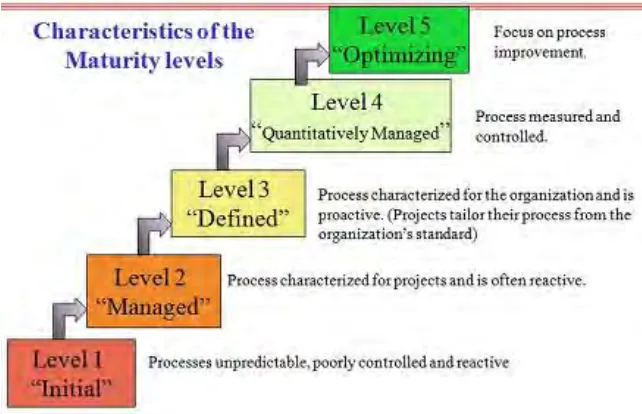
The CMMI comes with two different representations - staged and continuous. The staged model, which groups process areas into 5 maturity levels, was also used in the ancestor software development CMM, and is the representation used to achieve a "CMMI Level Rating" from a SCAMPI (Standard CMMI Appraisal Method for Process Improvement) appraisal. The continuous representation, which was used in the ancestor systems engineering CMM, defines capability levels within each profile. The differences in the representations are solely organizational; the content is equivalent.
The CMMI uses a common structure to describe each of the 22 process areas (PAs). A process area has 1 to 4 goals, and each goal is comprised of practices. Within the 22 PAs these are called specific goals and practices, as they describe activities that are specific to a single PA. There is one additional set of goals and practices that apply in common across all of the PAs; these are called generic goals and practices.
Next [Table 3] represents the model types of CMMI.
Table 3 Model Types of CMMI
14
Process Area Grouping by Capability Level Grouping by Maturity Level
Similar CMM
model SE-CMM SW-CMM
Maturity 0 ~ 5 Level 1 ~ 5 Level
The CMMI rated maturity as 5 or 6 level, and this rating is similar to those of SPICE.
A working group was formed in 1993 to draft the international standard SPICE. SPICE initially stood for "Software Process Improvement and Capability Evaluation", but the French concerns over the meaning of the last word meant that SPICE now means "Software Process Improvement and Capability Determination".
Even though the formal ISO standards number, ISO 15504, is now the correct reference, SPICE is still used for the user group of the standard, and the title for the annual conference. The first SPICE was held in Limerick, Ireland in 2000, "SPICE 2003" was hosted by ESA in Netherlands, "SPICE 2004" was hosted in Portugal, "SPICE 2005" was hosted in Austria, and "SPICE 2006" was hosted in Luxembourg.
The first versions of the standard were focused exclusively on software development processes. This was expanded to cover all related processes in a software business, for example, project management, configuration management, quality assurance, and so on. The list of processes covered, grew to cover six business areas such as organizational, management, engineering, acquisition supply, support, and operations.
In a major revision to the draft standard in 2004, the process reference model was removed and is now related to the ISO 12207 (Software Life-cycle Processes). The issued standard now specifies the measurement framework and can use different process reference models.
15
o Level 0: Incomplete, The process is not implemented or fails to achieve its purpose
o Level 1: Performed, The process is implemented and achieves its process purpose
o Level 2: Managed, The process is managed and work products are established, controlled and maintained.
o Level 3: Established, A defined process is used a standard process.
o Level 4: Predictable, The process is enacted consistently within defined limits.
o Level 5: Optimizing, The process is continuously improved to meet relevant current and projected business goals
It is a pity that CMMI and SPICE do not mention the security-related contents independently. So organizations should decide how they will manage security problems which can be included during the development processes of IT products or IS.
In a general way, for the evaluation with CC and CEM, all proofs related to development processes were documented and submitted to be checked. By evaluating these deliverables, evaluator can guess the development processes. Alternately, evaluators are used to visiting the development site and interviewing developers or engineers.
However to increase the trust about development processes and get valid conclusion, organizations can use the international standard ISO/IEC 21827, SSE-CMM (System Security Engineering-Capability Maturity Model) [9].
The SSE-CMM describes the essential characteristics of an organization's security engineering process that must exist to ensure good security engineering. The model is intended to be used as a:
16
o Standard mechanism for customers to evaluate a provider's security engineering capability.
o Basis for security engineering evaluation organization (e.g., system certifiers and product evaluators) to establish organization capability-based confidences (as an ingredient to system or project security assurance).
The SSE-CMM addresses security engineering activities that span the entire trusted product or secure system life cycle, including concept definition, requirements analysis, design, development, integration, installation, operations, maintenance, and decommissioning.
The SSE-CMM applies secure product developers, secure system developers and integrators, and organizations that provide security services and security engineering. The SSE-CMM applies to all types and sizes of security engineering organizations, such a commercial, government, and academic.
1.2.4 INFORMATION SECURITY MANAGEMENT SYSTEMS
After it was proven that the security countermeasures implemented by only technical materials could not encounter the rapid change of environments properly, researches about the comprehensive process for managing and operating various security countermeasures started to gain popularity.
To properly encounter the new security problems occurring in every short time, systematic strategies and procedures were requested. These are included in ISO/IEC 17799 (Information Technology - Code of Practice for Information Security Management) and ISMS (Information Security Management System) [33].
17
of Trade and Industry (DTI), and after several revisions, was eventually adopted by ISO as ISO/IEC 17799, "Information Technology - Code of practice for information security management" in 2000. ISO 17799 was most recently revised in June 2005 and is expected to be renamed ISO/IEC 27002 during 2007.
The second part to BS7799 was first published by BSI in 1999, known as BS 7799 Part 2, titled "Information Security Management Systems - Specification with guidance for use." BS 7799-2 focused on how to implement an Information security management system (ISMS), referring to the information security management structure and controls identified in ISO 17799. The 2002 version of BS 7799-2 introduced the Plan-Do-Check-Act (PDCA), aligning it with quality standards such as ISO 9000. BS 7799 Part 2 was adopted by ISO as ISO/IEC 27001 in November 2005. BS7799 Part 3 was published in 2005, covering risk analysis and management. It aligns with ISO 27001.
An Information Security Management System (ISMS) is, as the name suggests, a system of management concerned with information security. The idiom arises primarily out of ISO/IEC 17799, a code of practice for information security management published by the International Organization for Standardization in 2000 [34].
The best known ISMS is ISO/IEC 27001, published by the ISO, complementary to ISO/IEC 17799 (developed from BS 7799-1). A system for certification against BS-7799-2:2002 is well established.
18
Using SSE-CMM own words, SSE-CMM is "A tool for engineering organizations to evaluate their security engineering practices, a method by which security engineering evaluation organizations can establish confidence in the organizational capability; A standard mechanism for customers to evaluate a provider's security engineering capability", while ISM3 is a standard for security management (how to achieve the organization’s mission despite of errors, attacks and accidents with a given budget). They do not have the same subject matter.
1.3 CHALLENGING ISSUES
Combination of the security countermeasures and management systems is a good solution but is not perfect. Many vulnerabilities are included in IS as ever. These vulnerabilities can be found from either the sub-systems or the process for combination of sub-systems into whole systems.
Even though security countermeasures are designed and managed well, these vulnerabilities included in somewhere can be the cause of compromise of IS.
A new method that considers security from the initial concept design step was proposed to reduce potential vulnerabilities. By applying this method, we can derive and append security requirements when developing IS. By implementing these security requirements into development processes, we can complement security-related materials in the whole life-cycle of IS [8-9].
19
The attempts to protect information and IS from the threats are progressing variously and systematically, and the necessity to build security countermeasures by considering the characteristics of IS is gathering strength. In fact, to satisfy the proposition of information security, we don't have to invest excessive budget.
Needless to say, it is important to protect information and IS, but it is not desirable to build uniform security countermeasures regardless of degree of importance. Depending on the purpose of building or operation, IS may have different degree of importance, meaning an IS may have higher degree of importance than other IS.
Systems in same office can even have different degree of importance. In other words, some systems should be protected from the attack, even though some systems can be compromised from the same attack.
In agreement with the degree of importance of IS, the strength of security countermeasure should be changed. For important systems, stronger security countermeasures should be selected, and stronger verification processes should be executed properly.
As we can reduce unnecessary budget for IS which has a lower degree of importance, we can increase investment to IS which has higher degree of importance with the budget saved from other IS.
Therefore, the most important factor is the decision of degree of importance of IS. From now on, this degree of importance will be called required security level or security level briefly. Depending on the selected security level, strength of security countermeasures should be decided.
20
Security can be achieved after securing all areas to the same level. This is the only method for attaining and managing security level continuously for IS. As the only vulnerability included in a component of IS can comprise of whole IS, partial security countermeasures for a part in IS cannot protect whole IS.
So each organization installing and operating IS, to achieve the goal of organization, should decide on a security level, implement security countermeasure, and manage these countermeasures to maintain the effects [14-16].
To manage the security level of IS, organizations must be able to decide on a security level, then they must have procedures for building security countermeasures according to security level. For the next step, organizations must be able to select areas where security countermeasures should be applied. Last of all, organizations must be able to evaluate and improve the effect of security countermeasures [17-20].
Some methods for deciding the strength of security of IT products have already been proposed [21].
However, research for developing a method for deciding the security level has not been proposed actively yet. This is because too many unpredictable variables are contained in an IS.
1.4 OUR CONTRIBUTIONS
21
After deciding the security level, basic technical and non-technical requirements for security level management are proposed in detail. Some items needed to ensure basic security state of IS are listed in this requirements.
After this, level requirements to ensure security level required for each IS are proposed in detail. These level requirements should be applied differently for both technical and non-technical parts. Level requirements are designed by using step-model for technical areas, and continuous-model for non-technical areas.
1.4.1 THREAT LEVEL DEFINITION METHOD
Threat level is intimately associated with the possibility of potential attack and vulnerabilities included in IS. According to ISO/IEC 18045, CEM (Common Evaluation Methodology), threat level is able to be decided by the level of potential possibility of attacker's success, and this possibility can be analogized by solving the function constructed by the attacker's motivation, speciality, and available resource.
However, this is a method emphasizing attacker's situation mostly. Therefore, at least the analysis results of information system characteristics should be considered to decide the threat level at the same time.
There are many kinds of attack methods and purposes. General purpose of hacking is to get the administrator's privilege, but other purposes of attack are more serious. Some attacks tries to destroy the IS itself.
Unfortunately, CEM considers only electrical attacks, but in this thesis, the author extends the concept of attack to all possibilities of real attack. So the physical destruction should be considered as one of attack type.
22
1.4.2 ASSET LEVEL DEFINITION METHOD
In risk management researches, 'impact analysis' or other expressions are used instead of 'asset level'.
The impact analysis in risk management area means the calculation of possible losses when attacks are successful. This calculation result will be connected to the implementation of some countermeasure to prevent these losses.
However, there are some problems in general impact analysis processes :
The first, to do correct and effective impact analysis, specialists should have enough information. So, most or all important information of the organization should be opened to them.
The second, most of risk management specialists have enough knowledge about security, but they may not know about major market and competition environment of the organization. Therefore, it may be difficult to judge correct value of assets.
And the last, there can be the differences between the judgements of specialists and owners. Only owners can identify all assets, and know the correct and exact value of their assets, so owners must decide the asset value.
23
1.4.3 SECURITY LEVEL DEFINITION METHOD
The author proposes SL (Security Level) definition method by considering 2 factors, threat level and asset level defined above. About the security level, it should be notified that higher level threat level does not mean higher security level, and conversely, higher security level does not mean higher threat level.
Security Level should be decided by correct analysis of threat level and asset level, and should be changed by considering the changes of threat level and asset level.
Security level can be decided by using metrics in [Table 20], but details should be decided by considering operational environments and characteristics of IS.
1.4.4 SECURITY LEVEL MANAGEMENT MODEL
The author designed SLMM architecture to provide a guide to keep the security level of information system. The goal of the architecture is to provide characteristics of the security countermeasures should be implemented to keep information system. And the goal of this architecture is to clearly separate basic characteristics from its institutionalization characteristics. In order to ensure this separation, the model has two dimensions, called ―area‖ and ―level‖ as like many international models such as SSE-CMM [9] and CMM [14].
24
1.4.4.1 LEVEL DIMENSION IN SECURITY LEVEL MANAGEMENT MODEL
The author designed the level dimension which represents some ―level features‖ as they apply across a wide range of security areas by modifying SSE-CMM. The level features represent activities that should be checked and confirmed as a part of implementing security practices. Each level feature contains some level requirements. There are five levels in SSE-CMM, but four levels are enough for security level management, so level features of 5th level in SSE-CMM were merged to 4th level.
Design flow is listed below:
1. Characteristics of each level in six levels of SPICE were analyzed.
2. Characteristics of each level in five levels of CMMI were analyzed.
3. Characteristics of each level in five levels of SSE-CMM were analyzed.
4. Map between security level and analyzed level was made. To obtain a higher level, owners should invest more resources including financial investment.
5. As a result, each level requirement was selected and assigned to security levels
1.4.4.2 AREA DIMENSION IN SECURITY LEVEL MANAGEMENT MODEL
The author designed the area dimension, too. As like the CMM and SPICE, the area dimension is perhaps the easier of the two dimensions to understand. This dimension simply consists of all the security areas that can construct security countermeasure.
To design security areas, the author used area division form in SPICE, ISO/IEC 15504 and SSE-CMM, ISO/IEC 21827.
25
1. From SSE-CMM, totally 128 base practices in 22 practice areas were analyzed, and only the practices related to security were selected.
2. From SSE-CMM, all work products were analyzed, and only the work products related to security were selected.
3. From SPICE, all processes in five process dimension (customer-supplier, engineering, supporting, management, organization) were analyzed, and only the processes related to security were selected.
4. From the IATF, all technical items were analyzed, and only the items can be realized were selected.
5. From the ISMS, all controls were analyzed and selected.
6. All factors selected were grouped in 26 categories according to the characteristics.
7. Common expression and name can represent each category was decided, and each category was re-named as a security practice.
8. All security practices were grouped in 8 groups according to the characteristics.
9. Common expression and name can represent each group was decided, and each group was re-named as a security area.
10. All security areas were grouped in two parts according to the characteristics: management part and technology part.
26
[image:37.612.163.484.204.411.2]Continuous model is being used in SSE-CMM and SPICE, etc. In continuous model, to upgrade to higher level, only selected processes or basic practices should be satisfied with level requirements. In other words, only selected security practices in management part should be satisfied to get the target level.
Figure 1 Example of Staged Model
[image:37.612.198.459.503.647.2]27
1.5 COMPARISON WITH EXISTING WORKS.
Current standards approaches to information security and management can be classified as [23-59]:
• Process oriented: ISM3, CMMI, Cobit 4.0, ISO9001:2000, ISO20000, ITIL/ITSM, SSE-CMM, CMM, SPICE
• Controls oriented: BSI-ITBPM, ISO27001:2005, ISO13335-4, ISMS • Product oriented: CC/ISO15408, CEM/ISO18045, ITSEC, TCSEC
• Risk management oriented: AS/NZS 4360, CRAMM, EBIOS, ISO 27005, MAGERIT, MEHARI, OCTAVE, SP800-30, SOMAP
• Best practice oriented: ISO/IEC 17799:2005, Cobit, ISF-SoGP
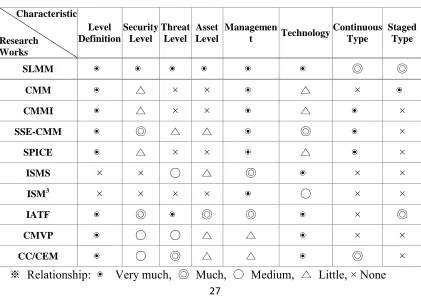
[image:38.612.109.530.429.726.2]Here the [Table 4] expresses the differences among SLMM and some existing works.
Table 4 Differences Among SLMM and Some Existing Works
Characteristic Research Works Level Definition Security Level Threat Level Asset Level Managemen t Technology Continuous Type Staged Type
SLMM ◉ ◉ ◉ ◉ ◉ ◉ ◎ ◎
CMM ◉ △ × × ◉ △ × ◉
CMMI ◉ △ × × ◉ △ ◉ ×
SSE-CMM ◉ ◎ △ △ ◉ ◎ ◉ ×
SPICE ◉ △ × × ◉ △ ◉ ×
ISMS × × ○ △ ◎ ◉ × ×
ISM3 × × × × ◉ ○ × ×
IATF ◉ ◎ ◉ ◎ ◎ ◉ × ◎
CMVP ◉ ○ ○ △ △ ◉ × ×
CC/CEM ◉ ○ ◎ △ △ ◉ ◎ ×
28
2. SECURITY LEVEL DECISION METHOD
Security level decision is a basic activity for developing and managing safe information systems, and core factor which can affect the investment for security countermeasures.
According to the security level of IS, important decisions such as where and how the security countermeasures are implemented, which security policies are selected, and who will manage them are able to be decided.
Security Level can be decided at the initial step of management processes and can be changed according to the change of environments at the later steps. It is possible to change security level at each management process, but the change of security level may affect whole security policy of IS itself, thus operators and owners' agreement is needed.
Security is concerned with the protection of assets, and assets are entities that owner places value upon. As the concept of asset is related to the owner's mind or decision, owner is endowed with responsibilities for protection.
This concept is described in 'common criteria' very well [1-3].
Many assets are in the form of information that is stored, processed and transmitted by IT products to meet requirements laid down by owners of the information. Information owners may require that availability, dissemination and modification of any such information is strictly controlled and that the assets are protected from threats by countermeasures. [Figure 3] illustrates these high level concepts and relationships.
29
Figure 3 Security Concepts and Relationships
The owners of the assets will perceive such threats as potential for impairment of the assets such that the value of the assets to the owners would be reduced. Security-specific impairment commonly includes, but is not limited to: loss of asset confidentiality, loss of asset integrity and loss of asset availability.
These threats therefore give rise to risks to the assets, based on the likelihood of a threat being realised and the impact on the assets when that threat is realised. Subsequently countermeasures are imposed to reduce the risks to assets. These countermeasures may consist of IT countermeasures (such as firewalls and smart cards) and non-IT countermeasures (such as guards and procedures).
In Figure 3, threat and asset are the more important factors that should be considered to decide security level of IS. Others are connected mutually and affect to security level indirectly.
30
SL=f(TL,AL) (1)
where, TL is the threat level and AL is the asset level.
When organizations decide the SL, threat level and asset level should considered as two important factors. Threat level can be decided by cooperation of owners, operators, and developers, but asset level should be decided by owner of IS and information.
In general case, the assets value can be analyzed and decided by the size, scope, or economic merits, but it is not easy to say this general analysis or counsel may be same with owner's opinion. This is because even though an asset seems to be unimportant to analyzers, this asset can be grouped as one of very important assets.
2.1 DEFINITION OF THREAT LEVEL
Threat level is intimately associated with the possibility of potential attack and vulnerabilities included in IS. According to ISO/IEC 18045, CEM (Common Evaluation Methodology), threat level is able to be decided by the level of potential possibility of attacker's success, and this possibility can be analogized by solving the function constructed by the attacker's motivation, speciality, and available resource.
On the other hand, this is a method emphasizing attacker's situation mostly, at least the analysis results of information system characteristics should be considered to decide the threat level.
Threat can be divided into two parts: identification activity to find attackable points of IS for future attack, and attack activity to do real assail.
31
this may not a dangerous one because it is possible that the method to exploit this vulnerability is very difficult or the development of attack tool needs too many resources and times or detection and defense method are already known.
So these two activities can be considered separately, and the threat level can be decided by solving the equation (2).
TL=f (ID,AT) (2)
where ID the is identification activity and AT is the attack activity.
2.1.1IDENTIFICATION ACTIVITY
Identification activity is similar to vulnerability analysis in a sense of finding weak points. But Identification activity is more related to real attack and this an activity to find potential attackable point. A subject, motivation, tool & equipment, and time are the factors can affect to identification activity, so these factors should be considered to decide the depth of identification activity. And other factors can be included according to the environments or importance of IS.
Identification activity can be decided by solving next equation (3) with basic 4 factors.
ID=f (SoI, MoI, EoI, ToI) (3)
Where, SoI is the subject of identification, MoI is the motive of identification, EoI is the equipments or tools for identification, and ToI is the time needed to identify.
32
The easiest way to solve the equation (3) is to give the weight value to each factor and sum these values. Weight value can be changed by considering environments if necessary.
According to the circumstances, new factors are able to be appended because environments or importance of IS can be changed. In this case, new factors can be inserted to equation (3).
If only four factors mentioned above are considered, the equation (3) is can be depicted like as equation (4). But the correlation function is omitted.
ID = f_SoI (SoI) + f_MoI (MoI) + f_EoI (EoI) + f_ToI (ToI) (4)
where, f_SoI (SoI) is a function of SoI,
f_MoI (MoI) is a function of MoI,
f_EoI (EoI) is a function of EoI, and
f_ToI (ToI) is a function of ToI.
As described earlier, threat level can be decided by identification activity and attack activity. But the weight of identification activity is very small when compared with that of attack activity. The equation (2) can be rewritten as like equation (5).
TL=f (AT) (5)
where AT is the attack activity.
2.1.2ATTACK ACTIVITY
33
In this paper, the concept of attack contains all possibilities of real attack, so the physical destruction should be considered as one of attack type.
The goal of attack can be divided into two parts: access to information and compromise or destruction of information systems. If the target were the information itself, attackers will try to obtain unauthorized access to the information or information systems, and if the target were destruction of information systems, attackers will try to cut important connection between components of IS or shut down whole systems. Depending on the importance of IS, potential attacks will be realized differently.
Attack activity is a real attack to the information and information system to compromise or destroy them. To categorize and decide the level of attack, after identifying potential attackers, assessors should consider some factors such as motivation and type of attack, accessibility to IS, tools and equipments, and compromise time estimation.
By using these factors, attack activity can be defined as the next equation (6).
Ex = f (Ai, Am, Ac, Aa, Ae, At) (6)
Where, Ai : Identification of Attacker,
Am : Attacker's motivation,
Ac : Category of attack
Aa : Attacker's Access to IS,
Ae : Attacker's equipments or tools,
34
Each element in equation (6) may have correlation or not. This correlation can not be induced as a formal type. But the possibility of correlation among the elements of attack activity is higher than that of identification activity. For example, if an attacker were the cyber-terrorist, he would have higher motivation for attack to destroy an IS, and he will invest more resources to get success in his attack. So some connected correlations can be formed.
Finally, to calculate equation (6), weights for not only each component but also correlation should be considered. However it is very difficult to say that this correlation can be applied fixedly. Therefore, the weights for correlation among each component should be considered according to the real environments of IS operation. It is possible to append new components into equation (6) according to the change of environment of IS. In this case, not only new components but also correlation among old components should be considered together.
In this paper, weights are given to each component by integer, but these value can be modified by considering real environments and characteristics of IS. The last component of equation (7), alpha means that the weights calculated by correlation among each component. Alpha can be changed by environments and characteristics of IS, in this paper, only the estimated result is included.
Ex = fai(Ai) + fam(Am) +fac(Ac)+faa(Aa)+fae(Ae) + fat(At) + ∑ fak(Uak) + α (7)
where, fai(Ai) is a weight function for identified attacker,
fam(Am) is a weight function for the attacker's motivation,
fac(Ac) is a weight function for attack type,
faa(Aa) is a weight function for accessibility to IS,
35
fat(At) is a weight function for compromise time,
fak(Uak) is a weight function for unknown components,
Uak is a k-th unknown component related to attack activity
α is a weight value decided from correlation among components
(1) Identification of Attacker
Generally speaking, attackers are thought of as having malicious intent. However, in the context of system and information security and protection, it is also important to consider the threat posed by those without malicious intent.
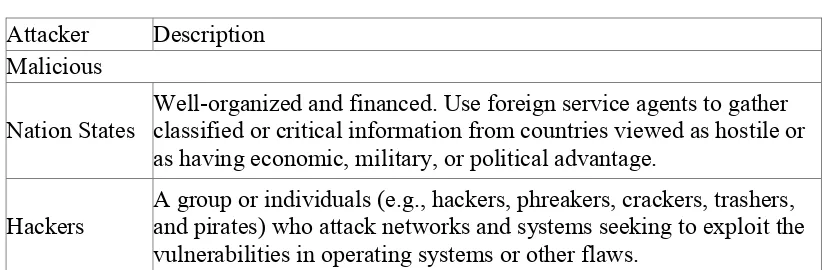
Next [Table 5] shows examples of individuals and organizations in both of these categories. Because attackers of [Table 5] did not categorized by the 'Target of attack', [Table 5] can not express the weights of each attacker. Some attackers want to get 'the right of superuser' to use systems resource, but other attackers want to destroy the IS themselves [36].
[image:46.612.117.528.556.691.2]So when we identify attackers and weight them, we should consider their scope of power.
Table 5 Potential Attacker Attacker Description
Malicious
Nation States Well-organized and financed. Use foreign service agents to gather classified or critical information from countries viewed as hostile or as having economic, military, or political advantage.
36 Terrorists/
Cyberterrorists
Individuals or groups operating domestically or internationally who represent various terrorist or extremist groups that use violence or the threat of violence to incite fear with the intention of coercing or intimidating governments or societies into succumbing to their demands.
Organized Crime
Coordinated criminal activities, including gambling, racketeering, narcotics trafficking, and many others. An organized and
well-financed criminal organization.
Other Criminal Elements
Another facet of the criminal community, but one that is normally not very well organized or financed. Usually consists of very few individuals or of one individual acting alone.
International Press
Organizations that gather and distribute news, at times illegally, selling their services to both print and entertainment media. Involved in gathering information on everything and anyone at any given time.
Industrial Competitors
Foreign and domestic corporations operating in a competitive market and often engaged in the illegal gathering of information from competitors or foreign governments through corporate espionage.
Disgruntled Employees
Angry, dissatisfied individuals who can inflict harm on the local network or system. Can represent an insider threat depending on the current state of the individual's employment and access to the system.
Nonmalicious Careless or Poorly Trained Employees
Users who, through lack of training, lack of concern, or lack of attentiveness, pose a threat to information and IS. This is another example of an insider threat or attacker.
37
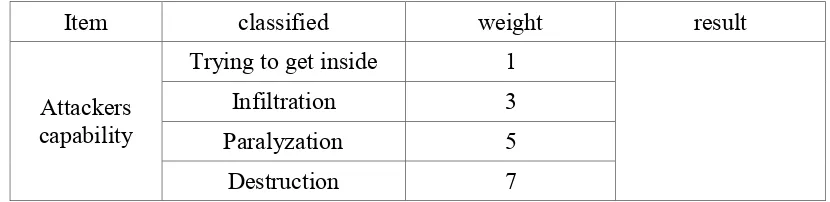
Table 6 Weights for Identified Attacker's Capability
Item classified weight result
Attackers capability
Trying to get inside 1
Infiltration 3
Paralyzation 5
Destruction 7
(2) Attacker's motivation
Individual motivations to attack are many and varied. In general case, because we think only the information processed by IS, attacker's motivation is defined like as 'Getting Inside'.
In this paper, attackers were classified and arranged into [Table 6]. If an attacker's capability is included in from Trying to get inside to Paralyzing, this attacker's motivations can be thought as getting inside. In this case, attackers with malicious intent who wish to achieve commercial, military, or personal gain are known as crackers or hackers.
At the opposite end side of the spectrum are people who may compromise the IS accidentally. Hackers range from inexperienced professional, college student, or novice (e.g., script kiddy) to the highly technical and capable. Most hackers pride themselves on their skill and seek, not to destroy, but simply to gain access so that the computer or network can be used for later experimentation. Hackers often believe that by exposing a hole or 'back-door' in a computer system, they are actually helping the organization to close the holes, providing a benefit to the Internet and a needed resource. Other hackers have less benign motives for getting inside.
38
o Gain access to classified or sensitive information. (Note: What is of high value to one person or organization might be of no value to another.)
o Track or monitor the target's operations (traffic analysis).
o Disrupt the target's operations.
o Steal money, products, or services.
o Obtain free use of resources (e.g., computing resources or free use of networks).
o Embarrass the target.
o Overcome the technical challenge of defeating security mechanisms.
From an information system standpoint, these motivations can express themselves in three basic goals: access to information, modification or destruction of information or system processes, or denial of access to information. In attacking an information processing system, an attacker accepts a certain amount of risk. This risk may be time dependent. The risk of loss to the attacker may far exceed the expected gain. Risk factors include
o Revealing the attacker's ability to perform other types of attacks.
o Triggering responses that might prevent the success of a future attack, especially when the gain is much greater.
o Incurring penalties (e.g., fines, imprisonment, embarrassment).
o Endangering human life.
39
being exposed to risks. This can be another kind of motivation, and most significant case. Next [Table 7] is the example of weighting for attacker's motivations.
[image:50.612.119.529.290.456.2]Attackers' capability and motivation is not the same concept. Even though an attacker has high capability, it is very difficult to say that attacker has strong motivation to attack an IS. Therefore, when we apply this table to a real IS, the weights should be corrected by checking the environment of IS and expected attackers' motivation.
Table 7 Weights for Attacker's Motivation
Item Classified weight result
Attacker's motivation Embarrassing 1
Attacker's motivation Obtaining of Resource 2
Attacker's motivation Stealing 3
Attacker's motivation Denial of service 4
Attacker's motivation Destruction 5
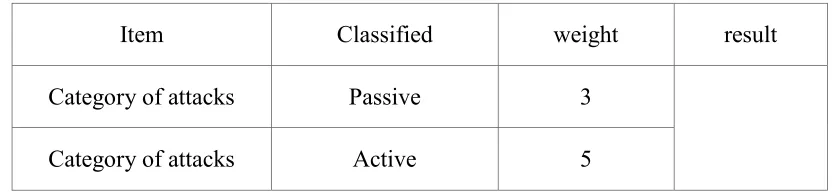
(3) Category of attack
In general case, IS and networks offer attractive targets to attackers. In an ideal case, IS should be resistant to attack from the full range of threat-agents from hackers to nation states. Moreover, they must limit potential damage and recover rapidly when attacks do occur. But in real case, it is very difficult to resistant to strong attacks, especially physical attacks. If attackers may use bombs to destroy the IS, there are few methods to protect them. Therefore, in this paper, physical destruction of IS are not considered.
40
o Passive
Passive attacks include traffic analysis, monitoring of unprotected communications, decrypting weakly encrypted traffic, and capturing authentication information (e.g., passwords). Passive intercept of network operations can give adversaries indications and warnings of impending actions.
Passive attacks can result in the disclosure of information or data files to an attacker without the consent or knowledge of the user. Examples include the disclosure of personal information such as credit card numbers and medical files.
Passive attacks involve passive monitoring of communications sent over public media (e.g., radio, satellite, microwave, and public switched networks). Countermeasures used against passive attacks include virtual private networks (VPN), cryptographically protected networks, and protected distribution networks (e.g., physically protected or alarmed wireline distribution network).
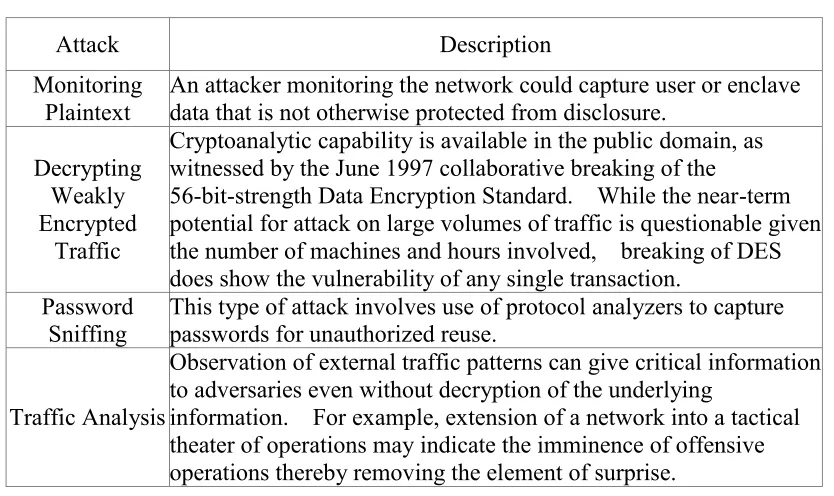
Next [Table 8] provides examples of attacks characteristic of this class. But these are not the all kinds of passive attacks but only examples.
But passive attacks are not limited to physical areas. Attackers can gather significant information about the target not only intercepting traffic but also hearing talk of administrators.
o Active
41
Table 8 Examples of Passive Attacks
Attack Description
Monitoring
Plaintext An attacker monitoring the network could capture user or enclave data that is not otherwise protected from disclosure.
Decrypting Weakly Encrypted
Traffic
Cryptoanalytic capability is available in the public domain, as witnessed by the June 1997 collaborative breaking of the
56-bit-strength Data Encryption Standard. While the near-term potential for attack on large volumes of traffic is questionable given the number of machines and hours involved, breaking of DES does show the vulnerability of any single transaction.
Password
Sniffing This type of attack involves use of protocol analyzers to capture passwords for unauthorized reuse.
Traffic Analysis
Observation of external traffic patterns can give critical information to adversaries even without decryption of the underlying
information. For example, extension of a network into a tactical theater of operations may indicate the imminence of offensive operations thereby removing the element of surprise.
Typical countermeasures include strong enclave boundary protection (e.g., firewalls and guards), access control based on authenticated identities (ID) for network management interactions, protected remote access, quality security administration, automated virus detection tools, auditing, and intrusion detection.
Next [Table 9] provides examples of active attacks characteristic of this class. But these are not the all kinds of active attacks but only examples.
Table 9 Examples of Active Attacks
Attack Description
Modifying Data in Transit
In the financial community, it would be disastrous if electronic transactions could be modified to change the amount of the transaction or redirect the transaction to another account. Replaying
(Insertion of Data)
[image:52.612.119.526.584.696.2]