Games for Learning
A Sabotage Approach
Nina Gierasimczuk, Lena Kurzen and
Fernando R. Vel´azquez-Quesada
Institute for Logic, Language and Computation, Universiteit van Amsterdam {N.Gierasimczuk|L.M.Kurzen|F.R.VelazquezQuesada}@uva.nl
July 7, 2009
Abstract
In formal approaches to inductive learning, the ability to learn is un-derstood as the ability to single out a correct hypothesis from a range of possibilities. Although most of the existing research focuses on the charac-teristics of the learner, in many paradigms the significance of the teacher’s abilities and strategies is in fact undeniable. Motivated by this observation, in this paper we highlight the interactive nature of learning by proposing a game-theoretical and logical approach. We consider learning as a sabotage-typegame betweenTeacherandLearner, and present different variants based on the level of cooperativeness and the actions available to the players. We characterize the existence of a winning strategy in such games by formulas ofSabotage Modal Logic, analyzing also their complexity. Our work consti-tutes the first step towards a unified game-theoretical and logical approach to formal learning theory.
1 Introduction
The objective of this paper is to investigate how logics for interaction in multi-agent systems can be used to reason about strategic abilities and information flow during the learning process. Formal learning theory (see e.g. [4]) is concerned with the process of inductive inference: it formalizes the process of inferring general conclusions from partial, inductively given information, as in the case of language learning (inferring grammars from sentences) and scientific inquiry (drawing general conclusions from partial experiments). We can think of this general process as a game between two players: Learnerand
We give a high-level analysis of the described process. First, we treat learn-ing as a procedure of slearn-ingllearn-ing out one correct hypothesis from a range of possibilities. Second, we see this procedure not as a one-move choice; instead, we allow many steps of update before the conclusion is reached. These two properties make our notion of learning different from the concept of learning formalized as epistemic update inDynamic Epistemic Logic(see e.g. [2]), where the word “learning” is often used as a synonym of “getting to know” and is usually represented as a one-step epistemic update. Moreover, in our approach we pay attention to the strategies for teaching, highlighting the fact that re-stricted power and knowledge of the learner can be compensated by additional insights and intentions of the teacher.
The paper is structured as follows. Section 2 introduces the framework of learning as Sabotage Games, shows how sabotage modal logic can express the existence of winning strategies in three different versions of Sabotage Learning Games and gives complexity results for them. Section 3 analyzes Sabotage Learning Games in which the players do not need to move in alternation. Section 4 presents a refined interactive view on teaching based on existing learning algorithms. Section 5 concludes.
2 Learning as a Sabotage Game
Our work is motivated by thelearning from queries and counterexamplesmodel [1]. In that paradigm, the goal of Learner is to recognize an initially unknown languageL. In order to do this, he is allowed to ask Teacher two types of ques-tions: about the membership of a certain string toL, and about the equivalence of his conjecture toL. When answering those questions, Teacher does not have any freedom — her responses are restricted byL. However, a negative answer to the second question is accompanied by a counterexample, which plays the role of a hint for Learner. This is the only point of the procedure in which Teacher has a relative freedom of choice, and in fact, the informativeness of the string given as a counterexample influences the effectiveness of the learn-ing process. We want to focus on this aspect of learnlearn-ing and show that the “profile” of Teacher is relevant for the learning process. We consider several possible scenarios — we describe games in which Teacher is either helpful or unhelpful, and Learner is either eager or unwilling to learn.
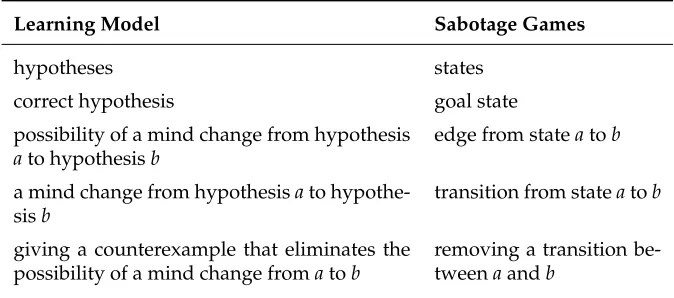
Let us consider a very simple “classroom” situation with one teacher and one learner. From our high-level perspective, learning is a step-by-step process through which Learner changes his information state, and the process is suc-cessful if he eventually reaches a state representing the goal. The information Teacher provides can be seen as feedback about Learner’s current conjecture, al-lowing him to rule out possible changes of mind. We can represent the situation as a graph whose vertices represent Learner’s possible information states and edges stand for transitions between them. During the learning process, Learner can change his information state by moving along the edges and Teacher can cut offedges, thereby preventing Learner from making certain transitions. One state is associated with the learning goal: if Learner reaches it, we say that the learning process has been successful. The correspondence between the learning model from formal learning theory and our proposal is described in Table 1.
counterex-Table 1: Correspondence with Learning Model
Learning Model Sabotage Games
hypotheses states
correct hypothesis goal state possibility of a mind change from hypothesis
ato hypothesisb
edge from stateatob
a mind change from hypothesisato hypothe-sisb
transition from stateatob
giving a counterexample that eliminates the possibility of a mind change fromatob
removing a transition be-tweenaandb
ample results in the absolute removal of some initially possible hypothesis. Our setting generalizes this idea: the removal of a transition need not make the target vertex unreachable.
2.1 Sabotage Games
Our perspective on learning leads naturally to the framework of Sabotage Games [6, 11]. A sabotage game is played in a directed multi-graph, with two players,RunnerandBlocker, moving in alternation with Runner being the first. Runner moves by making a single transition from the current vertex; Blocker moves by deletinganyedge from the graph. We begin by defining the structure in which a Sabotage Game takes place.
Definition 2.1([6]). Adirected multi-graphis a tuple G=(V,E)where V is a set of vertices and E:V×V→Nis a function indicating the number of edges between any two vertices.
The Sabotage Game is defined as follows.
Definition 2.2([6]). ASabotage Game SG = hV,E,v,vgi is given by a directed
multi-graph (V,E) and two vertices v,vg ∈ V. Vertex v represents the position of
Runner and vgrepresents the goal state.
Each match is played as follows: the initial positionhE0,v0i is given byhE,vi.
Round k+1from positionhEk,vkiconsists of Runner moving to some vk+1such that
E(vk,vk+1) > 0, and then Blocker removing an edge (v,v0) such that Ek(v,v0) > 0.
The new position is hEk+1,vk+1i, where Ek+1(v,v0) := Ek(v,v0)−1 and, for every
(u,u0), (v,v0), E
k+1(u,u0) := Ek(u,u0). The match ends if a player cannot make a
move or if Learner reaches the goal state, which is the only case in which he wins. Remark 1. It is easy to see that Sabotage Games have thehistory-free determinacy property: if one of the players has a winning strategy then she has a winning strategy that depends only on the current position. Then, each round can be viewed as a transition from a Sabotage Game SG=hV,Ek,vk,vgito another Sabotage Game SG0=
hV,Ek+1,vk+1,vgi, since previous moves become irrelevant. We will use this fact through
the whole paper. Also, by edges and vertices of SG=hV,E,v,vgi, we will mean edges
[image:3.595.128.465.157.306.2]In this definition of the Sabotage Game, Blocker removes an edge between two statesv,v0by decreasing the value ofE(v,v0) by 1. As we will see later, this
definition of the game based on the above definition of multi-graphs can lead to some technical problems when transforming such a graph into a Sabotage Model. Therefore, we will now present an alternative definition, which we later show (Theorem 1) to be equivalent with respect to the existence of a winning strategy.
Definition 2.3. Let Σ = {a1, . . .an} be a finite set of labels. Adirected labelled
multi-graphis a tuple GΣ=(V,E)where V is a set of vertices andE=(E
a1, . . . ,Ean),
whereEai ⊆V×V for each ai∈Σ.
In this definition, labels fromΣare used to represent multiple edges between two vertices; Eis simply an ordered collection of binary relations onVwith labels fromΣ. Then, the definition of the game is as follows.
Definition 2.4. A Labelled Sabotage Game SGΣ = hV,E,v,vgi is given by a
directed labelled multi-graph(V,E)and two vertices v,vg∈V. Vertex v represents the
position of Runner and vgrepresents the goal state.
Each match is played as follows: the initial positionhE0,v
0iis given by hE,vi.
Round k+1from positionhEk,v
kiwithEk=(Eka1, . . . ,E
k
an), consists of Runner moving
to some vk+1such that(vk,vk+1)∈ Ekaifor some ai∈Σ, and then Blocker removing an
edge((v,v0),a
j), where(v,v0)∈ Ekajfor some aj∈Σ. The new position ishE
k+1,v
k+1i,
whereEk+1
aj = E
k aj\ {(v,v
0)}andEk+1
ai = E
k
ai for all i , j. The match ends if a player
cannot make a move or if Runner reaches the goal state, with him winning only in the last case.
What is said in Remark 1 also holds for Labelled Sabotage Games.
In this definition of the game, it is easy to see that when Blocker removes an edge fromvtov0, it is irrelevant what is the label of the removed edge; what
matters for the existence of a winning strategy is the number of edges fromv
tov0that are left.
Observation 1. Let SGΣ =hV,E,v
0,vgiand SG0Σ =hV,E0,v0,vgibe two Labelled
Sabotage Games that differ only in the labels of their edges, that is,
∀(v,v0)∈V×V:|{Eai |(v,v 0)∈ E
ai}|=|{E 0
ai|(v,v 0)∈ E0
a}|,
where| · |stands for cardinality. Then Runner has a winning strategy in SGΣiffhe has a wining strategy in SG0Σ.
We will now show that the problems of deciding whether Runner has a winning strategy in each of the Sabotage GamesSGandSGΣare polynomially equivalent. We start by formalizing the problems.
Definition 2.5. The decision problem SABOTAGE is defined as follows.
• INPUT: A Sabotage Game SG=hV,E,v0,vgi.
• QUESTION: Does Runner have a winning strategy in SG?
Definition 2.6. The decision problemΣ-SABOTAGE is defined as follows.
• QUESTION: Does Runner have a winning strategy in SGΣ?
Theorem 1. SABOTAGE andΣ-SABOTAGE are polynomially equivalent.
Proof. We show that the problems can be polynomially reduced to each other. First we show that SABOTAGE can be reduced to Σ-SABOTAGE. Given a Sabotage Game SG = hV,E,v0,vgi, let m := max{E(u,u0) | (u,u0) ∈ (V×
V)}. Define the Labelled Sabotage Game f(SG) := hV,E,v0,vgiwhere E :=
(E1, . . . ,Em) and eachEiis given byEi:={(u,u0)∈V×V|E(u,u0)≥i}.
We show that Runner has a winning strategy (w.s.) inSGiffhe has one in
f(SG). The proof is by induction onn=P(v,v0)∈V×VE(v,v0), which is the number
of edges ofSG. Note that by definition of f,n=Pii==m1 |Ei|, that is, f(SG) has the
same number of edges.
The base case is straightforward since in both games Runner has a w.s. iff
v0 = vg. For the inductive case, from left to right, suppose Runner has a w.s.
in the gameSG = hV,E,v0,vgiwith n+1 edges. Then, there is somev1 ∈ V
such thatE(v0,v1)>0 and Runner has a w.s. for all gamesSG0=hV,E0,v1,vgi
that result from Blocker removing any edge (u,u0) withE(u,u0)>0. Note that
all such gamesSG0have justnedges, so by induction hypothesis Runner has a w.s. in f(SG0). But then, by Observation 1, Runner has also a w.s. in all games
f(SG)0that result from removing an arbitrary edge fromf(SG), because for any
removed edge (u,u0), the only possible difference betweenf(SG0) and f(SG)0is
in the labels of the edges betweenuandu0(in f(SG0) the removed label was the
largest, in f(SG)0the removed label is any). Now, by definition of f, choosing
v1is also a legal move for Runner in f(SG) and, since he can win every f(SG)0,
he has a w.s in f(SG).
From right to left, Runner having a w.s. inf(SG) means that he can choose somev1 with (v0,v1)∈ Eifor somei≤ msuch that he has a w.s. in all games
f(SG)0 resulting from Blocker’s move. Choosing v
1 is also a legal move of
Runner inSG. Suppose that Blocker replies by choosing (v,v0). Let us call the
resulting gameSG0. By assumption and Observation 1, Runner also has a w.s. in the game f(SG0) which is the result from Blocker choosing ((v,v0),E(v,v0)).
Since f(SG)0= f(SG0), we can apply the inductive hypothesis.
Let us see now howSGΣcan be polynomially reduced toSG. GivenSGΣ=
hV,E,v,vgiwithΣ ={a1, . . .am}, define f0(SGΣ) :=hV,E,v,vgi, whereE(v,v0) :=
|{Eai|(v,v 0)∈ E
ai}|.
Showing that Runner has a w.s. inSGΣiffhe has one in f(SGΣ) is
straight-forward, and can be done by induction on n := Pa∈Σ|Ea|. Both f and f0 are
polynomial.
2.2 Sabotage Learning Games
Based on the Sabotage Games framework, we define Sabotage Learning Games as follows.
Table 2: Sabotage Learning Games
Game Winning Condition
SLGUE Learner wins iff he reaches the goal state. Teacher wins otherwise.
SLGHU Teacher wins iffLearner reaches the goal state. Learner wins otherwise.
SLGHE Both players win iffLearner reaches the goal state. Both lose otherwise.
The different winning conditions correspond to different levels of Teacher’s helpfulness and Learner’s willingness to learn. We can have anunhelpfulteacher and aneagerlearner (SLGUE), but there is also the possibility of ahelpfulteacher and an unwilling learner (SLGHU). The cooperative case corresponds to the version with ahelpfulteacher and aneagerlearner (SLGHE).
We now show how Sabotage Modal Logic can be used for reasoning about Learner’s and Teacher’s strategic power in the learning games previously de-fined.
2.3 Sabotage Modal Logic
Sabotage Modal Logic (SML) has been introduced in [11]. Besides the standard modalities, it also contains “transition-deleting” modalities for reasoning about model change that occurs when a transition is removed. To be more precise, we have formulas of the form –^φ, expressing that it is possible to delete a pair from the accessibility relation such thatφholds in the resulting model at the current state.
Definition 2.8 (Sabotage Modal Language [11]). LetPROP be a countable set of propositional letters and letΣbe a finite set. Formulas of the language of Sabotage Modal Logic are given by
φ::=p| ¬φ|φ∨φ|^aφ|^–aφ
with p∈PROPand a∈Σ. We write^φforWa∈Σ^aφand –^φfor
W
a∈Σ^a– φ.
Definition 2.9([7]). Given a countable set of propositional lettersPROPand a finite set Σ = {a1, . . . ,an}, a Sabotage Model is a tuple M = hW,(Rai)ai∈Σ,Vali where
W is a non-empty set of worlds, each Rai ⊆ W×W is an accessibility relation and
Val:PROP→ P(W)is a propositional valuation function. The pair(M,w)with w∈W is called aPointed Sabotage Model.
For the semantics of SML, we first define the model that results from re-moving an edge.
Definition 2.10. Let M = hW,Ra1, . . .Ran,Vali be a Sabotage Model. The model
Mai
(v,v0)that results from removing the edge(v,v0)∈Raiis defined as
Mai
(v,v0):=hW,Ra1, . . .Rai−1,Rai\ {(v,v 0)},R
Definition 2.11. Given a Sabotage Model M = hW,(Ra)a∈Σ,Valiand a world w ∈
W, atomic propositions, negations, disjunctions and standard modal formulas are interpreted as usual. For the case of “transition-deleting” formulas, we have
M,w|=^a– φ iff ∃v,v0∈W: (v,v0)∈Ra&Ma(v,v0),w|=φ,
and –aφis defined to be equivalent to¬^a– ¬φ.
Theorem 2 ([7]). Combined complexity of model checking for SML is PSPACE-complete.
2.4 Sabotage Learning Games in Sabotage Modal Logic
For any given Sabotage Learning GameSGΣwe can construct a Pointed Sabo-tage ModelM(SGΣ) in a straightforward way.
Definition 2.12. Let SGΣ=hV,E,v0,vgibe a Sabotage Game withE=(Ea)a∈Σ. We
define the Pointed Sabotage Model(M(SGΣ),v
0)over the set of atomic propositions PROP:={goal}with
M(SGΣ) :=hV,E,Vali,
where Val(goal) :={vg}.
In the light of this construction, SML becomes useful for reasoning about players’ strategic power inSLGs. For each winning condition in Table 2, we can define a formula of SML that characterizes the existence of a winning strategy, that is, the formula is true in a given Pointed Sabotage Model if and only if the corresponding player has a winning strategy in the game represented by the model.
First we look at the gameSLGUE(the standard Sabotage Game of [11]), with Learner trying to reach the goal state and Teacher trying to prevent him from doing so. Inductively, we define:
γUE
0 :=goal, γUEn+1:=goal∨^–γUEn .
Our following result is a variation of Theorem 7 of [7], rephrased for Labelled Sabotage Games. We provide a detailed proof to show how our “labelled” definition avoids a technical issue present in the original proof.
Theorem 3. Learner has a winning strategy in the SLGUE game SGΣ =hV,E0,v
0,vgi
iffM(SGΣ),v0|=γUEn , for n:=
P
a∈Σ|E0a|(the number of edges in(V,E0)).
Proof. The proof is by induction onn.
Base case
(⇒)L having a w.s. inSGΣimplies thatv0 = vg. Thus,M(SGΣ),v0 |= goal
and hence,M(SGΣ),v
0|=γUE0 .
(⇐)M(SGΣ),v0|=γUE0 means thatM(SGΣ),v0 |=goal. Thusv0 =vg. Hence,
LwinsSGΣimmediately.
Inductive case
(⇒) Suppose thatSGΣhasn+1 edges, and assume thatLhas a w.s. There
M(SGΣ),v0 |= γUEn+1. (2) v0 is not the goal state. Since L has a w.s., there is
somev1 ∈ Vsuch that (v0,v1) ∈ E0ai for someai ∈ Σand no matter which pair
((u,u0),a
j)∈(V×V)×Σwith (u,u0)∈ E0ajTchooses,Lhas a w.s. in the resulting
game SG0Σ = hV,E1,v
1,vgi, with E1 = (E0a1, . . .E 0
aj−1,E 0
aj \ {u,u 0},E0
aj+1, . . .E 0
a|Σ|).
Now,SG0Σ hasnedges and thus by inductive hypothesis,M(SG0Σ),v1 |= γUEn .
This impliesM(SGΣ),v0|=^–γnand thusM(SGΣ),v0|=γn+1. (⇐)M(SGΣ),v0|=
goal∨^–γnimplies thatv0is the goal state (soLwins immediately) or else there
isv1accessible fromv0such thatM(SGΣ),v1|=–γn, that is,M(SGΣ)a(vi,v0),v1|=–γn
for any ((v,v0),a
i)∈(V×V)×Σ. By inductive hypothesis, this givesLa w.s. at
v1in a game that results from removing any edge fromSGΣ, and hence a w.s.
atv0in the gameSGΣ.
They key observation for the left-to-right direction of this proof is that the model that results from removing an edge fromM(SGΣ) is always a model that
results from transforming a Labelled Sabotage Game into a model. With the original definition of a Sabotage Game, this is not the case: after removing an edge betweenvand v0 with labelk, the resulting model does not need to be
the image of a multi-graph because the label of the removed edge does not need to be the biggest of them. Another way to look at it is the following: the multiple edges of the original multi-graph can be seen as implicitly labelled by numbers, and the existence of an edge labelled withkimplies the existence of edges labelled with 1, . . . ,k−1. This property is not preserved when Teacher removes an edge with an arbitrary label from the modelM(SG).
Consider now the gameSLGHU, with Teacher trying to force Learner to reach the goal state. Inductively, define
γHU
0 :=goal, γHUn+1:=goal∨(^> ∧^–γHUn ).
Now, we can show that this formula corresponds to the existence of a winning strategy for Teacher. Note that in order to win, Teacher has to make sure that Learner does not get stuck before he has reached the goal state. This is why we need the conjunct^>in the formula.
Theorem 4. Teacher has a winning strategy in the SLGUE game SGΣ =hV,E0,v
0,vgi
iffM(SGΣ),v0|=γHUn , for n:=
P
a∈Σ|E0a|.
Proof. Similar to the proof of Theorem 3.
Finally, consider SLGHE, with Teacher and Learner winning iff Learner reaches the goal state. The corresponding formula is defined as follows
γHE0 :=goal, γHEn+1:=goal∨^^–γHEn .
Theorem 5. Teacher and Learner have a joint winning strategy in the SLGHE game SGΣ=hV,E0,v
0,vgiiffM(SGΣ),v0|=γHEn , for n:=
P
a∈Σ|E0a|.
Proof. Note thatLandThave a joint w.s. iffthere is a path fromv0tovg. From
left to right this is obvious. From right to left, if there is such path, then there is also one without cycles; then, there is a joint w.s. that follows the path and at each step removes the edge that has just been used. The Theorem follows by observing thatγHE
n expresses the existence of such path.
Table 3: Winning Conditions forSLGin SML
Game Winning Condition in SML Winner
SLGUE γUE
0 :=goal, γUEn+1:=goal∨^–γUEn Learner
SLGHU γHU
0 :=goal, γHUn+1:=goal∨(^> ∧(^–γHUn )) Teacher
SLGHE γHE
0 :=goal, γHEn+1:=goal∨^^–γHEn Both
2.5 Complexity of Sabotage Learning Games
Intuitively, some versions of the Sabotage Learning Game are simpler than others. With a helpful teacher and an eager learner, the learning process should be easier than with an unhelpful teacher or a unwilling learner. This is indeed reflected in the computational complexity of deciding in a given game whether the winning condition is satisfied.
We have shown that our three winning conditions (Table 3) can be expressed in SML, and Theorem 2 (proved in [7]) tells us that model checking of SML is PSPACE-complete. This gives us PSPACE upper bounds for the complexity of the problems of deciding whether each winning condition is satisfied in a given game. For two of the winning conditions (SLGUE andSLGHE), we can also give tight lower bounds.
ForSLGUE– the standard Sabotage Game – PSPACE-hardness is shown by reduction from QBF [7].
Theorem 6([7]). SLGUE is PSPACE-complete.
As mentioned above, forSLGHUwe obtain a PSPACE upper bound.
Theorem 7. SLGHU is in PSPACE.
Proof. Follows from Theorem 2 and Theorem 4.
It remains to be shown whetherSLGHU is also PSPACE-hard. Whereas at first sight, SLGHUand SLGUE might seem to be duals of each other, the relationship between them is more complex due to the different nature of the players’ moves (Teacher moves globally, whereas Learner moves locally). Thus, a reduction fromSLGUE toSLGHUis not straightforward. Let us now look atSLGHE. This game is of a different nature than the two previous ones. It is cooperative, and a winning strategy is a joint strategy for both players. Such a strategy does not need to take into account all possible moves of the opponent. This suggests that this version should be less complex thanSLGUEandSLGHU. The following result shows that at least for the comparison ofSLGUEand
Theorem 8. SLGHE is NL-complete.
Proof. Polynomial equivalence ofSLGHE and REACHABILITY follows from
the argument given in the proof of Theorem 5.
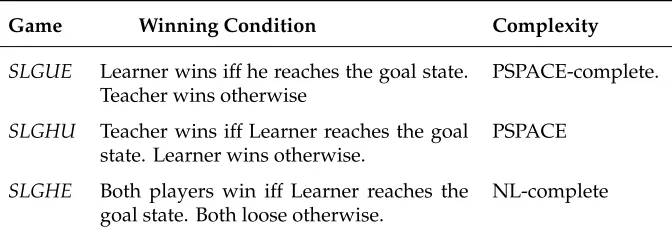
[image:10.595.129.465.228.346.2]Table 4 summarizes the complexity results for the different versions ofSLG.
Table 4: Complexity Results for Sabotage Learning Games
Game Winning Condition Complexity
SLGUE Learner wins iffhe reaches the goal state. Teacher wins otherwise
PSPACE-complete.
SLGHU Teacher wins iffLearner reaches the goal state. Learner wins otherwise.
PSPACE
SLGHE Both players win iff Learner reaches the goal state. Both loose otherwise.
NL-complete
The complexity results agree with our intuition when comparing the co-operative version of the Sabotage Game (SLGHE) with the non-cooperative ones (SLGUEandSLGHU). The easiest way to learn is indeed when Teacher is helpful and Learner — eager.
3 Relaxing strict alternation
As mentioned above, Learner’s moves in the graph are interpreted as changes of information states. Then, when Teacher removes an edge, she actually informs Learner which changes of information state should not be performed. In this perspective, Learner’s moves can be seen as internal ones while Teacher’s moves can be interpreted externally. Due to this asymmetry, each Learner’s move does not in principle need to be followed by a teacher’s move.
Definition 3.1. ASabotage Learning Game without strict alternation(for Teacher) is a tuple SLG∗ = hV,E,v
0,vgi. Moves of Learner are as in the Sabotage Learning
Game and, once he has chosen a vertex v1, Teacher has a choice between removing an
edge, in which case the next game is given as in SLG, and doing nothing, in which case the next game ishV,E,v1,vgi. We again distinguish between three versions, SLG∗UE,
SLG∗HU and SLG∗HE, with winning conditions given as before.
Though we provide Teacher with an additional possible move, this does not change her winning abilities. In the rest of this section we show that, for the three variations of a Sabotage Learning Game, a player has a w.s. inSLG∗iff
she has a w.s. inSLG.
Consider the case of an unhelpful teacher and an eager learnerSLG∗UE. Before we go into the details, note that if Learner can win the game, he can do so in a finite number of rounds.
Theorem 9. Consider the SLGhV,E,v0,vgiwith(V,E)a directed labelled multi-graph
and v,vgvertices in it. If Learner has a winning strategy in the corresponding SLGUE,
Proof. This can be shown by induction on the number of rounds. The idea is that in each roundL“pretends” thatThas removed some edge and then makes the move given by his strategy forSLGUE.
If L can win a SLG∗UE, then it is easy to see that he can also win the correspondingSLGUEby using his w.s. fromSLG∗UE.
Corollary 1. Consider the tuplehV,E,v0,vgiwith (V,E) a directed labelled
multi-graph and v,vg vertices in it. Learner has a winning strategy in the corresponding
SLG∗UE iffhe has a wining strategy in the corresponding SLGUE.
The case of a helpful teacher and an unwilling learner is more interesting. One might expect that the additional possibility of an empty move gives more power to Teacher since it allows her to skip a move in cases when removing an edge would have made the goal unreachable from the current vertex. However, we can show that this is not the case. First, we state the following lemmas.
Lemma 1. For any SLG∗HUhV,E,v0,vgi, if there is a path from v0to vgand there is
no path from v0to a state from where vgis not reachable, then T has a winning strategy.
Proof. By assumption, all states reachable fromv0are on paths tovg. Therefore,
even ifTwill refrain from removing any edge,Lwill always be on some path to the goal. There are two possibilities: either the path to the goal does not include a loop or it does. If it does not thenTcan simply wait untilLwill arrive to the goal. If it does, in order to winTcan remove the edges that lead into the loops in such a way thatvgis still reachable from any vertex.Lwill eventually
have to move tovg.
Lemma 2. Consider the SLG∗HU gamehV,E,v
0,vgi. If T has a winning strategy and
there is some edge(v,v0)∈ E
afor some a∈Σsuch that no path from v0to vggoes via
the edge(v,v0), then T also has a winning strategy inhV,E0,v
0,vgi, whereE0is the
result of removing(v,v0)fromE
a.
Proof. Ifvis not reachable fromv0, it is easy to see that the claim holds. Let us
consider the case thatvis reachable fromv0. Since there is no path tovgvisiting
v,T’s winning strategy should keepLaway from it (otherwiseLwould win). Hence,Tcan also win if the edge (v,v0) is not there.
Theorem 10. If Teacher has a winning strategy in the SLG∗HUhV,E,v
0,vgi, then
she also has a winning strategy in which she removes an edge in each round.
Proof. The proof proceeds by induction on the number of edgesn=Pa∈Σ|Ea|.
The base case is straightforward. For the inductive case, assume thatThas a winning strategy inSLG∗HUhV,E,v0,vgiwith
P
a∈Σ|Ea|=n+1.
Then ifv0 =vg, we are done. Thus, assume thatv0 ,vg. Then, sinceTcan
win, there is somev1∈Vsuch that (v0,v1)∈ Eafor somea∈Σand for all such
v1it holds that:
1. There is a path fromv1tovg, and
2. (a) Tcan winhV,E,v1,vgi, or
(b) there is some ((v,v0),a)∈(V×V)×Σsuch that (v,v0)∈ E
aandTcan
winhV,E0,v
1,vgiwhereE0 is the result from removing (v,v0) from
If 2b holds, sincePa∈Σ|E0
a| = n, we are done — we can use the inductive
hypothesis and conclude thatThas a w.s. in which she removes an edge in each round (in particular, she chooses ((v,v0),a) in the first round). This ((v,v0),a)
can be chosen in one of the following ways.
If there is some (v,v0)∈V×Vsuch that (v,v0)∈ E
afor somea∈Σand this
edge is not part of any path fromv1tovgthen by Lemma 2,Tcan remove this
edge and 2bholds and we are done.
If every edge in (V,E) belongs to some path fromv1tovg, from 1, there are
two cases: either there is only one, or there are more than one paths fromv1to
vg.
In the first case (only one path) (v0,v1) can be chosen since it cannot be part
of theuniquepath fromv1tovg.
Assume now that there is more than one path from v1 to vg. Let p =
(v1,v2, . . . ,vg) be the/a shortest path fromv1tovg. This path cannot contain any
loops. Then, from this path takevisuch thatiis the smallest index for which it
holds that fromvithere is a path (vi,vi0+1, . . .vg) tovg that is at least as long as
the path followingpfromvi(i.e. (vi,vi+1, . . . ,vg)). Intuitively, when following
pathpfromv1tovg,viis the first point at which one can deviate frompin order
to take another path tovg(recall that we consider the case where every vertex
in the graph is part of some path from v1 tovg). Now it is possible forT to
choose ((vi,v0i+1),a) such that (vi,v0i+1)∈ Ea. LetE0be the resulting set of edges
after removing (vi,v0i+1) fromEa. Then we are in the positionhV,E0,v1,vgi. Note
that because of the way we chose the edge that has been removed, in the new graph it still holds that fromv0 there is no path to a vertex from whichvg is
not reachable (this holds because fromvithe goalvgis still reachable). Then by
Lemma 1,Tcan winhV,E0,v
1,vgi, which then implies 2b.
Hence, we conclude that 2bhas to be the case and thus using the inductive hypothesis, we conclude thatTcan win the gamehV,E,v0,vgialso by removing
an edge in every round.
Corollary 2. Consider the tuplehV,E,v0,vgiwith (V,E) a directed labelled
multi-graph and v0,vgvertices in it. Teacher has a winning strategy in the corresponding
SLG∗HU, iffshe has a wining strategy in the corresponding SLGHU.
Finally, let us move to the case of a helpful teacher and an eager learner.
Theorem 11. Consider the tuplehV,E,v0,vgiwith(V,E)a directed labelled
multi-graph and v0,vg vertices in it. If Learner and Teacher have a winning strategy in
the corresponding SLG∗HE, then they have a wining strategy in the corresponding
SLGHE.
Proof. The proof of Theorem 5 provides the needed strategy.
Corollary 3. Consider the tuplehV,E,v0,vgiwith (V,E) a directed labelled
multi-graph and v,vg vertices in it. Learner and Teacher have joint winning strategy in
the corresponding SLG∗HE iffthey have a joint wining strategy in the corresponding SLGHE.
4 Refined view on teaching: learning algorithms
The perspective on learning that we have adopted is very general. To give a more refined view, let us go back to thequeries and counterexamplesparadigm (see [1]). In that approach, Learner is an algorithm that embodies a winning strategy in the game of learning (the learning procedure succeeds onallpossible
truedata). Teacher can significantly influence the learning process by giving counterexamples, and the time needed for learning depends on her choices. Therefore, the game of teaching in such a setting can be formalized in extensive form as presented in Figure 1.
C0 w1 w2 w3 w4 C1 C2 C3
w01
w02
w0
3
w001
w002
w00
3
w0001
w0002
w0003
paths ending in a position in which the learner makes a correct conjecture over all the other paths. Anunhelpfulteacher then prefers all the paths in which the learner does not learn over those in which he does learn.
5 Conclusions and further work
We have provided a game theoretical approach to learning that allows us to analyze different levels of cooperativeness between Learner and Teacher. We have definedSabotage Learning Gameswith three variations, representing diff er-ent didactic scenarios. Then, we have shown howSabotage Modal Logiccan be used to reason about these games and, in particular, we have identified certain formulas of the language with the existence of a winning strategy . We gave complexity results for the decision problems associated with each version of the game. These problems correspond to model checking for the associated formulas and models. Our complexity results support the intuitive claim that the cooperation of agents facilitates learning. We investigated an extension of the Sabotage Learning Games that relaxes the condition of the strict alternation of moves. Our results presented in Section 3 show that if we allow Teacher to skip a move, the winning abilities of the players do not change with respect to the original versions of the games. In the case of the helpful teacher and unwilling learner, this is quite surprising since it says that if Teacher can force Learner to learn in the game with nonstrict alternation, then even if she is forced to remove edges in each round she can do so without removing edges that are necessary for Learner to eventually reach the goal state.
From the perspective of Formal Learning Theory, several relevant extensions can be done. We have described the learning process aschanges in information states, without going further into their epistemic and/or doxastic interpretation. A deeper analysis can give us insights about how the learning process is re-lated to different notions of dynamics of information, such as belief revision or dynamic epistemic logic.
Moreover, it can be argued that in some natural learning scenarios, e.g. language learning, the goal of the learning process, e.g. a correct grammar, is concealed from Learner. In our approach we assume that Learner has at least some markers of the goal state, otherwise we could not introduce the two possible characteristics of Learner. The assumption of the absence of any ability to recognize the goal by Learner, leads to a model in which the Learner moves randomly. Some approaches that take into account randomness in Sabotage Games have already been introduced [8] and hopefully can be extended to deal with the aforementioned issue. What we can now hypothesize is that the complexity of the scenario with a random Learner and a helpful Teacher is bounded by the worst case scenario, in which Learner avoids the goal as long as possible, i.e. the gameSLGHU.
-calculus [10, 5], can provide us with tools to express this notion of learnability. In this case, epistemic and doxastic interpretations of learning would involve notions of stable belief and a kind of operational, non-introspective knowledge as a result of the process.
Acknowledgments
The authors would like to thank Johan van Benthem and Jakub Szymanik for their help and their useful comments on previous versions.
Fernando R. Vel´azquez-Quesada is supported by Consejo Nacional de Ciencia y Tecnolog´ıa(CONACyT), M´exico (scholarship # 167693).
References
[1] Dana Angluin. Learning regular sets from queries and counterexamples.
Information and Computation, 75(2):87–106, 1987.
[2] H. van Ditmarsch, W. van der Hoek, and B. Kooi.Dynamic Epistemic Logic. Springer Netherlands, 2007.
[3] E.M. Gold. Language identification in the limit. Information and Control, 10:447–474, 1967.
[4] Sanjay Jain, Daniel Osherson, James S. Royer, and Arun Sharma. Systems that Learn. MIT Press, Chicago, 1999.
[5] Dexter Kozen. Results on the propositional mu-calculus.Theoretical Com-puter Science, 27:333–354, 1983.
[6] Christof L ¨oding and Philipp Rohde. Solving the Sabotage Game is PSPACE-hard. InProceedings of the 28th International Symposium on Mathe-matical Foundations of Computer Science, MFCS ’03, volume 2474 ofLNCS, pages 531–540. Springer, 2003.
[7] Christof L ¨oding and Philipp Rohde. Solving the Sabotage Game is PSPACE-hard. Technical report, Aachener Informatik Berichte, Rwth Aachen, 2003.
[8] Dominik Klein, Frank G. Radmacher, and Wolfgang Thomas. The Com-plexity of Reachability in Randomized Sabotage Games. Proceedings of FSEN 2009, LNCS, 2009.
[9] Christos M. Papadimitriou. Computational complexity. Addison-Wesley, MA, 1994.
[10] Dana Scott and W. de Bakker. A theory of programs. Unpublished manuscript, IBM, Vienna, 1969.