Multi-Player Logics
MSc Thesis
(
Afstudeerscriptie
)
written by
Loes Olde Loohuis
(born May 15th, 1985 in Oss, Netherlands)
under the supervision of Dr Yde Venema, and submitted to the Board of Examiners in partial fulfillment of the requirements for the degree of
MSc in Logic
at theUniversiteit van Amsterdam.
Date of the public defense: Members of the Thesis Committee:
September 5, 2008 Prof. dr. Johan van Benthem
Contents
1 Introduction 2
2 Multi-Player Logics 6
2.1 Introduction . . . 6
2.2 Multi-Player Propositional Logic . . . 6
2.3 Multi-Player Modal Logic . . . 11
2.4 Multi-Player µ-Calculus (µMML) . . . 16
3 Multi-Player Algebras: The Propositional Case 22 3.1 Introduction . . . 22
3.2 Concrete Multi-Player Algebras . . . 22
3.3 Multi-Boolean Algebras (MBA) . . . 27
3.4 Representation theorem . . . 30
4 Multi-Player Algebras: The Modal Case 41 4.1 Introduction . . . 41
4.2 Multi-Modal Algebras (MMA) . . . 41
4.3 i-Prime Filter Frames . . . 44
4.4 Representation theorem; the modal case . . . 45
5 Computational Complexity 51 5.1 Introduction . . . 51
5.2 Decidability via Filtrations . . . 51
5.3 Complexity: MPL . . . 54
5.4 Complexity: MML . . . 58
6 Conclusion and Further Research 67 7 Appendix 71 7.1 Proofs of Chapter 2: Multi-Player Logics . . . 71
7.2 Proofs of Chapter 3: Multi-Player Algebras: The Propositional Case . . . 72
7.3 Proofs of Chapter 4: Multi-Player Algebras: The Modal Case . . 76
Chapter 1
Introduction
During the second half of the twentieth century, two-player games have become an important tool in many branches of logic. Examples of these games are back-and-forth games to compare structures (such as the Ehrenfeucht-Fra¨ıss´e games attributed to Ehrenfeucht and Fra¨ıss´e [7, 8, 5]), dialogue games to express formal proofs (originally due to Lorenzen [13]) and semantic games to define truth [9]. In (classical) game semantics, the truth of a formula is defined via a game between two players, commonly known as ‘Eloise’ and ‘Abelard’ (or ‘Myself’ and ‘(Evil) Nature’ [10]). It was Hintikka who, in [9], first introduced a two-person semantical gameGto define truth of propositional formulas in terms of winning strategies of the players. This game can be summarized as follows.
Given a propositional formulaφand a propositional valuationV, the game G(φ, V) starts at position φ. At this initial position, Eloise has the role of Verifier and Abelard that of Falsifier. At each position of the form φ1∨φ2 it
is Verifier who has a choice betweenφ1 andφ2, and the game continues at the
chosen subformula. At a conjunctionφ1∧φ2it is the Falsifier who chooses one
of the conjuncts. If a negation, ¬φ1, is encountered, the game continues at φ1
except that the roles of the players are reversed: Verifier becomes Falsifier and vice versa. The play ends when no further moves can be made, that is, when the game has reached an atomic subformula. At this point the current Verifier is deemed the winner if the resulting proposition is true, and the current Falsifier is considered to be the winner if it is false. The original propositional formula φis defined to be true given a valuation in case Eloise has a winning strategy for the game, and false whenever Abelard has one.
Later, Hintikka extended his original idea to natural language semantics and developed game semantics for imperfect information [11]. Semantic games, or sometimes called evaluation games, have also been applied to many other branches of logic. Examples are first and second order logic, infinitary logic, modal logic and fixpoint logics like the modalµ-calculus (see cf. [6]).
disjunction∨as a disjunction - or a choicepoint - for Eloise (∨∃) and the
con-junction∧as a disjunction for Abelard, (∨∀). The negation¬can be seen as a
role-switch operator permuting the roles of Eloise and Abelard (¬∃∀).
Having realized this, it takes only a small leap to enter a world of multi-player game semantics. A question that naturally arises in this context is: what would the game look like if there are more than two players? What if there are three, or maybe even an arbitrary finite set players? In other words, can we generalize the game semantics for various logics to a multiple-player setting? And, more importantly, what kind of logic arises in this context?
The first steps towards generalizing game semantics to the setting of multiple-player games were taken by Abramsky [1] and Tulenheimo and Venema [14]. In [1], a logic is developed, whose semantics is defined in terms of strategies for n-person games. This logic, calledLA, allows for a compositional analysis of
partial information constructs like Henkin-style branching quantifiers. In [14], two formulations of propositional logic are developed, whose semantics is de-scribed not by a two-player, but by a three-player game. Both [1] and [14] address the question: what kind of logic has a natural semantics in multi-player games? The two papers share the same starting point; they introduce connec-tives indexed by agents that allow for choices of that agent and negations as role-switch operators. However, methods and objectives quickly diverge. In [1], the main aim is to represent partial information constraints in a multi-player setting so as to obtain a compositional account of constructs of partial informa-tion. In [14], the main focus lies in studying multi-player systems from a logical point of view by revealing properties of the three-player logic and comparing these to properties of classical propositional logic. The pioneering contributions of [1] and [14] have opened doors towards studying logics in a multi-player set-ting.
In this thesis we continue the work of Tulenheimo and Venema [14] by devel-oping a multi-player propositional logic (MPL) and a multi-player modal logic (MML) for any finite set ofnplayers. To see how this works in practice let us introduce our most elementary multi-player logic, the logicMPL.
LetAbe a finite set of agents, or players. Intuitively, each playeri∈Ahas his own connective∨i, which in the game represents a choice for the player who
currently has the role of playeri. Also, for every two playersi, j∈Athere is a negation, or role-switch operator, permuting the roles ofiandj. Valuations of the logicMPLassign to each proposition letter a subset of players who, at the end of the play, will be the winners of the game. The semantics of the logic is defined by an n-player gameG(φ, V). This game is very similar to Hinitkka’s original game. Initially, all the players have their own role (that is, every player i plays the role of player i). Each move consists of allowing the owner of the dominant connective to pick one of its branches, after which the play continues in that subformula. Moreover, when a negation¬ij is encountered the playersi
are winning for p given the valuation V, are the winners of the match. The others lose.
In our multi-player logics, truth, satisfiability and validity are defined relative to the agent. We say that the MPL-formula φ is true for player i given a valuation V, if playeri has a winning strategy for the game G(φ, V). We say that a MPL-formulaφis i-satisfiable when there is a valuationV such thatφ is true for playerigivenV. A MPL-formulaφisi-valid iff there is a valuation V such thatφis true for playerigivenV.
Note that in case there are only two agents, the logic MPL is similar to the propositional logic PL. However, an important difference arises from the fact that we allow valuations to assign all (or none) of the players as the set of winners given a proposition letter p. Thus, in the most general case, given a
MPL-formulaφ, there are four different possible outcomes of the game: all the players win the game, either one of the players wins the game, and none of the players win the game. It turns out that if we identify these outcomes with the values in Belnap’s four-valued logic, the semantics of the two ‘disjunctions’ of
MPLagrees with that of the conjunction and disjunction in Belnap’s system, but the semantics of the negation differs [2].
We can extend MPL to a (basic) multi-player modal logicMML by intro-ducing a modal operator ♦i for every player i ∈ A. Formulas of MML are
interpreted over classical Kripke frames with multi-player valuations assigning to each proposition letter and each state a set of winners. These models will be called ‘multi-player models’. The semantics ofMMLsemantics is defined using an extension of the game defining the semantics ofMPL.
Because in our multi-player setting it no longer makes sense to talk about ‘valid’ formulas we should pause and reflect for a moment on what we actually mean when we refer to a multi-player logic. Given any multi-player logic we cannot simply think of it as a set of valid formulas. We can, however, think of the multi-player logic as the collection of i-valid formulas for each agent i. Moreover, we can think of two formulas φ and φ′ as being i-equivalent if for
player i, the formulas are i-satisfied in exactly the same situations. In case of MPLthis is the case if for every valuation V, φis i-satisfied by V iff φ′ is
i-satisfied byV. Two formulas are said to be equivalent if they arei-equivalent for all playersi∈A. A natural question that arises in this context is whether we can axiomatize the notion of (i-)equivalence. One of the main aims of this thesis is to solve exactly this issue. We will do so by studying the logics algebraically and developing a (quasi-)equational axiom system.
The second and main contribution are two algebraic representation theo-rems; a multi-player analogue of Stone’s representation theorem forMPL, and a multi-player analogue of J´onsson Tarski theorem forMML. Regarding the first theorem, we proceed as follows. On the one hand, we construct concrete multi-player algebras that exactly capture the semantics ofMPL. On the other, we introduce a (quasi-)equational axiom system forMPLand define ‘multi-Boolean algebras’ - abstract algebras satisfying these axioms. In the theorem we show that every multi-Boolean algebra is isomorphic to a concrete multi-player alge-bra.
Regarding the second theorem, we first give an axiomatic definition of the notion of abstract ‘multi-modal algebras’. Secondly, we show that every Kripke frame can be characterized as an algebra. We show that for every abstract multi-modal algebra A, there exists a frame (its 0-Prime Filter Frame) such that Ais embeddable in the algebraic representation of this frame. With this result we establish a deep relation between game semantics ofMMLdefined over relational structures and abstract multi-modal algebras.
Thirdly, we show decidability and prove some complexity results for the logics MPL and MML. We show that in the most general case, that is, in case valuations are arbitrary, thei-satisfiability problem ofMPLcan be solved in polynomial time. Moreover, we show thatMML with restricted valuations (meaning that for each proposition letter, there have to be both winners and losers at each state) lacks the polysize model property. We conclude this last chapter by proving that thei-satisfiability problem ofMML is inPSPACE.
Chapter 2
Multi-Player Logics
2.1
Introduction
In this chapter we will introduce multi-player propositional logic (MPL) and ex-tend it to multi-player modal logic (MML) and multi-playerµ-calculusµMML. In [14], Tulenheimo and Venema already introduced two logics for three players, P L3
0 andP L3. The main difference between the two approaches is the
follow-ing. In the first,P L3
0, each play is won by some players and lost by the others.
In general, any subset of the set of players can win the game. In line with Hintikka’s interpretation, negations ofP L3
0represent role-switch operations
be-tween two players. In the second generalization of propositional logic, P L3,
payoff is defined in terms of a ranking of the agents. Moreover, negations are slightly more complicated: they do not just permute roles of two players, but of all the players at the same time. In this chapter, we will define the syntax and semantics ofMPL(and laterMMLandµMML) along the lines ofP L3
0. That is,
valuations of the logicMPLassign to each proposition letter a subset of players. Moreover, for every two players i, j ∈A there is a role-switch operator, i.e. a ‘negation’, permuting the roles ofiandj.
2.2
Multi-Player Propositional Logic
In this section we will introduce the Multi-Player Propositional Logic (MPL).
LetAbe a finite set of agents or players andPthe set of proposition letters. Thesyntax ofMPLis defined as follows:
φ::=⊥i|p|(φ∨iψ)| ¬ijφ,
wherei, j∈Aandp∈P. Throughout the thesis, the symbol¬ijwill be referred
to as a ‘negation’. Also, we sometimes refer to∨i as a ‘disjunction’ for player
i. It turns out thatMPLis a syntactical fragment of Abramsky’s logic LA. A
V :P→(A→ {w,l}))
wherewandlstand forwin andloserespectively. Intuitively,V assigns to each proposition variablep∈Pa subset ofAof winners forp. We say that playeri winspif V(p)(i) =w and loses otherwise. To the constant⊥i each valuation
assignslto playeriandwto all players other theni. That is,V(⊥i)(i) =land
V(⊥i)(j) =w when i6=j. For convenience, we will assume that there is one
player, player 0, that is always inA.
Withndenoting the number of players, i.e., |A|=n, we define the seman-tics of MPLusing n-player games G(φ, V), where V is a valuation andφ is a formula. Positions of the game are of the form (ψ, ρ), where ψis a subformula ofφand ρa role distribution. A role distributionρis a bijection from the set of agents to the set of agents; ρ : A → A. If ρ is a role distribution then we define ρij such that ρij(i) = ρ(j), ρij(j) = ρ(i), and for all the other k ∈ A
such thatk /∈ {i, j} ρij(k) =ρ(k). Thus,ρij is the same function asρ, except
for the fact that the values (the roles) for playersiand j are switched. Given a position (ψ, ρ) we say that a player iassumes the role of player ρ(i). Equiv-alently, ρ−1(i) denotes the player that assumes role i. The initial position of
the gameG(φ, V) is (φ, Id), whereIddenotes the initial role distribution, the identity function. The instantiation of the gameG(φ, V) with starting position (φ, Id) will be denotedG(φ, V)@(φ, Id). The rules of the game are the following:
At any position (ψ, ρ)
• Ifψ∈Pthen the game has come to an end. A playeriis a winner if and only ifV(ψ)(ρ(i)) =w.
• Ifψ=⊥ithen the game has come to an end. All players except the player
that assumes the role ofi, i.e. ρ−1(i), win the game.
• Ifψ=χ1∨iχ2 then playerρ−1(i), the player who currently assumes the
role of i, choosesχj withj ∈ {1,2} and the next position of the game is
(χj, ρ).
• Ifψ=¬ijχthen nobody plays and the game continues at position (χ, ρij).
The rules of the game as described above are summarized in the following table:
Position Player Admissible moves Winners
(p, ρ) - - {i∈A|V(p)(ρ(i)) =w}
(⊥i, ρ) - - {j∈A|j 6=ρ−1(i)}
(χ1∨iχ2, ρ) ρ−1(i) {(χj, ρ)|j∈ {1,2}}
-(¬ijχ, ρ) - {(χ, ρij)}
-Table 2.1: The gameGforMPL
the game. An arbitrary position (φ, ρ) is said to bewinning for playeriif she has a winning strategy for the game G(φ, V)@(φ, ρ). We say that a formulaφ of MPL is i-satisfied by a valuation V, if player i has a winning strategy for G(φ, V)@(φ, Id). Following up on this we say that a formula φ is i-satisfiable
if there is a valuationV such that φ is i-satisfied byV. Similarly,φ is called i-valid if every valuation V i-satisfies φ. We define two formulas φ and φ′ of
MPL to bei-equivalent if for every valuation V, φ is i-satisfied by V iff φ′ is i-satisfied byV. φ and φ′ are equivalent if for every agent i the two formulas
arei-equivalent.
Note that the definition of valuation puts no restrictions on the number of winners a valuation assigns to a proposition letter. In particular, given a propo-sitional variablepit might be the case that V(p)(i) =w (or l) for all players. For such valuations and appropriate formulasφit could be that all (or none) of the players have a winning strategy for the gameG(φ, V)@(φ, Id). In order to prevent all of the players from having a winning strategy, we could make use of
restricted valuations. A valuationV is calledrestricted if for everyp∈Pthere exist i, j ∈ A such that V(p)(i) = w and V(p)(j) = l. The use of restricted valuations does not rule out the existence of formulae for which no player has a winning strategy, see for example 2.2.1(vi) below. In the sequel, unless stated otherwise, we will assume valuations are arbitrary. In chapter 5 it will turn out that the choice for arbitrary versus restricted valuations greatly influences the computational properties of the logic. However, this is jumping ahead. Let us first develop a feeling for the semantics ofMPL.
Example 2.2.1. LetAbe a set ofnplayers with 0,1∈Aand letV an arbitrary valuation. We will have a look at some examples of formulasφofMPL.
(i) Let φ = p. Only the players i such that V(p)(i) = w have a winning strategy.
(ii) Letφ=⊥0. Every player except for 0 has a winning strategy. Note that
⊥0is not 0-satisfiable and i-valid for alli6= 0.
(iii) Let φ = ¬01ψ. Player 0 has a winning strategy for G(φ, V) iff 1 has
a winning strategy forG(ψ, V), and vice versa. For all the other players j /∈ {0,1}jhas a winning strategy forG(φ, V) iffjhas a winning strategy forG(ψ, V). Observe that negations (¬jk) are permutations of the setA.
Note that in case φ = ¬ijψ with i = j, ρij = ρ and each player has a
winning strategy forG(φ, V) iff he/she has a winning strategy forG(ψ, V). Negations of this form can be seen as identity or empty permutations.
(iv) Letφ=ψ1∨1ψ2. Since player 0 is not in the position to make the first
move she has a winning strategy forG(φ, V) iff she has a winning strategy for both G(ψ1, V) and for G(ψ2, V). Player 1, on the other hand, can
forG(φ, V) iff he has a winning strategy for either one of G(ψi, V), with
i∈ {1,2}.
(v) Letφ=W0{⊥j |j∈A}. The only player that has a winning strategy is 0;
she can choose to play any⊥j such thatj6= 0 and win. Any other player
krisks the chance to lose because 0 can always choose to play⊥k. From
now on, instead of writing the formulaW0{⊥j |j∈A} we will make use
of the (obvious) short-hand notation⊤0.
(vi) Let φ=W0{⊤j | j 6= 0}. In this case no player has a winning strategy.
Clearly, 0 cannot win because for any of the ⊤j with j 6= 0 only j will
win. As for the other players, they don’t have a guarantee that 0 will play ‘their’⊤. Hence they do not have a winning strategy. From now on, instead of writing the formula W0{⊤j | j 6= 0} we will make use of the
short-hand notation⊥. It follows that there is no playeri∈Asuch that
⊥isi-satisfiable.
The abbreviated connectives that were introduced in the preceding example are summarized as follows:
Symbol Abbreviation for
⊤i Wi{⊥j|j ∈A}
⊥ W0{⊤j|j6= 0∈A}
Table 2.2: Abbreviated Symbols
Note that the player 0 used in the definition of⊥is a fixed player, a player always assumed to be inA.
There are correspondences between standard boolean/propositional constructs and multi-player propositional operators. For playerithe connective∨iis like a
classical disjunction since she can win the game for a∨i-formula iff she can win
one of the disjuncts. For all the other players however,∨i is like a conjunction.
That is, they would have to win both ‘conjuncts’ in order to win a game of the formφ1∨iφ2. Also, fori, ⊥i is like⊥and⊤i like⊤. For all the players other
thenihowever,⊥i is like⊤and⊤i is like⊥.
MPL
in the case of two players
MPLis developed for any set of agents of a finite sizen. It is interesting, how-ever, to pause for a moment and have a look at the special case in whichn= 2. LetA={0,1}. It is not difficult to see that in the case of restricted valuations the semantics ofMPLboils down to that of classical propositional logic (PL).
Given a (multi-player) valuationV we can define a propositional valuation V′ as follows: V′(p) = 1 iffV(p)(1) =w. If we now translate a formulaφ of
MPLwithA={0,1} into a formulaφ′ ofPLin the following way
• replace∨0with∧and∨1 with∨,
• replace¬01and¬01 with¬,
• delete¬00 and¬11,
we obtain that for any formulaφand (multi-player) valuationV, 0 has a winning strategy forG(φ, V) iffV′(φ) = 0 and 1 has a winning strategy for G(φ, V) iff V′(φ) = 1. This can be proved by an easy induction and is left to the reader.
We can obtain the converse direction by a similar construction. Given a formulaφ′and a valuationV′ofPLwe can define aMPLvaluationV as follows:
V(p)(1) =w iffV′(p) = 1. We can construct the corresponding formula φby
replacing⊥with⊥0,⊤with⊥1,∧with∨0,∨with∨1and¬with¬01. In section
5.3 we will again discuss the implications of allowing only restricted valuation in a slightly different setting. In this section we will show that allowing only restricted valuations implies that satisfiability of PL is polytime reducible to i-satisfiability ofMPL. But, again, let us try not to jump ahead to chapter 5.
In the case of arbitrary valuations the semantics of MPLwith A ={0,1} can be captured by the following ‘truth tables’
∨0 ∅ 0 1 01
∅ ∅ 0 ∅ 0
0 0 0 0 0
1 ∅ 0 1 01
01 0 0 01 01
∨1 ∅ 0 1 01
∅ ∅ ∅ 1 1
0 ∅ 0 1 01
1 1 1 1 1
01 1 01 1 01
¬01 ∅ 0 1 01
∅ 1 0 01
Here∅denotes that the set of player with a winning strategy forφis empty, 0 ( or 1) denotes that only 0 (or 1) has a winning strategy, and 01 denotes that both players have a winning strategy. Thus, in case of two players,MPLwith arbitrary valuations can be viewed as a four-valued logic (with values∅,0,1,01, the four possible combinations of players with a winning strategy).
inconsistent information, Belnap suggested the following system: each basic item in the database of the computer should be marked with one of the fol-lowing four values: None (our ∅); there is no information about the item,F
(our 0); the computer is told that the item is false, T (our 1); the computer is told that the item is true, Both (our 01); the computer is both told that the item is false and that it is true. The computer should not only be able to store information, but also answer questions. If the computer is faced with a question whether a basic item is true, it returns the mark for that item. But the computer should also be able to reason about compound items: that is, decide about the truth-value of a conjunction∧, or disjunction∨, of two items. Belnap suggested inference tables for∧and∨. These tables correspond directly to our ‘truth value’-tables above: our ∨0 corresponds to Belnap’s ∧ and ∨1
to∨. It is interesting to observe that despite the different motivations behind them, both formalisms, MPL and Belnap’s four-valued logic, give rise to the semantics for the two-placed connectives. Belnap also has negation (∼) in his system. This negation, however, does not correspond to our∼01 since in our
scheme∼0101 = 01 and∼01∅=∅whereas in Belnap’s system∼0101 =∅and
∼01∅= 01.
This observation, regarding the correspondence between Belnap’s four valued logic and the logicMPLwith two players, touches upon a more general (open) question: what is the relation between the logicMPLand various multi-valued logics (like for example Kleene’s three-valued logic)?
2.3
Multi-Player Modal Logic
As was already promised to the reader in the introduction, the logicMPLalso has a modal extension, Multi Modal Logic (MML). As before, we start by defining the syntax ofMML and then define its semantics using a multi-player gameG.
Let A, with |A| =n, be a finite set of agents, or players, and Pthe set of proposition letters. Thesyntax ofMMLis defined as follows:
φ::=⊥i|p|(φ∨iψ)| ¬ijφ|♦iφ,
wherei, j∈Aandp∈P. On a standard Kripke frameF = (W, R) a valuation
V is a function:
V :P→(W →(A→ {0,1}))
Intuitively,V assigns to each proposition letter p∈P and each states∈W a subset of A of winners for pat s. We say that an agent i ∈A wins pat s if V(p)(s)(i) =w, and loses otherwise. A (multi-player) model M is a standard Kripke frame (W, R) with a (multi-player) valuation V overW (notationM = (W, R, V)).
(ψ, t, ρ) whereψis a subformula ofφ,tis a state inW andρis a role distribu-tion. The initial position is (φ, w, Id), wherewis the state of evaluation in the model andId, as before, is the identity function. The instantiation of the game G(φ, M) with starting position (φ, w, Id) will be denotedG(φ, M)@(φ, w, Id). The rules of the game are essentially the same as forMPL plus an additional rule for the modal operators (♦i):
At any position (ψ, t, ρ)
• If ψ ∈ P then the game has come to an end. A player i is a winner if V(ψ)(t)(ρ(i)) =w.
• Ifψ=⊥ithen the game has come to an end. All players except forρ−1(i)
win the game.
• Ifψ=χ1∨iχ2then playerρ−1(i) choosesχj withj∈ {1,2}and the next
position of the game is (χj, t, ρ).
• Ifψ=¬ijχthen the game continues at position (χ, t, ρij).
• Ifψ =♦iχ then the player ρ−1(i) chooses au∈W such thatRtu in M
and the next position is (χ, u, ρ). It is possible that player ρ−1(i) cannot
choose such aubecausethas no successors inM. In this case we say that player ρ−1(i) gets stuck and the game has come to an end. The winners will be all the players other then ρ−1(i), that is, the winners will be all
players in{j∈A|j6=ρ−1(i)}.
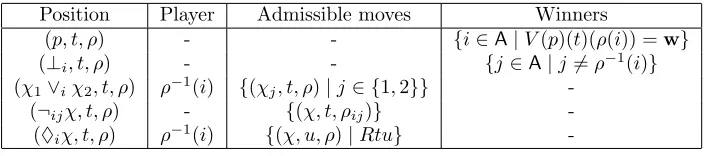
The rules of the ‘semantics’-game Gfor formulas of MMLare summarized in the following table:
Position Player Admissible moves Winners
(p, t, ρ) - - {i∈A|V(p)(t)(ρ(i)) =w}
(⊥i, t, ρ) - - {j ∈A|j6=ρ−1(i)}
(χ1∨iχ2, t, ρ) ρ−1(i) {(χj, t, ρ)|j∈ {1,2}}
-(¬ijχ, t, ρ) - {(χ, t, ρij)}
-(♦iχ, t, ρ) ρ−1(i) {(χ, u, ρ)|Rtu}
-Table 2.3: The gameGforMML
In accordance with our previous use of terminology, an arbitrary position (φ, t, ρ) is said to be winning for playeri if she has a winning strategy for the gameG(φ, M)@(φ, t, ρ). We say that a formulaφofMMLisi-satisfied inM at w(notationM, wiφ) if playerihas a winning strategy forG(φ, M)@(φ, w, Id).
Often we will make use of the shorthand notationM, wiφinstead of writing
[image:13.595.133.485.458.536.2]is defined to bei-valid if for every modelM and every statew∈M,M, wiφ.
We can also definei-satisfiability andi-validity with respect to a frame or with a state in a frame. That is, given a Kripke frame F = (W, R) we say that a formulaφisi-satisfiable inF iff there is a statew∈W and a valuationV such that (W, R, V), w i φ and φ is i-valid in F iff for every state w ∈ W every
valuation V, (W, R, V), w i φ. Lastly, a formula φ is i-satisfiable in F at w
iff there is a valuation V such that (W, R, V), w i φand φ is i-valid in F at
wiff for every valuation V, (W, R, V), wi φ. We define two formulas φand
φ′ of MMLto be i-equivalent if every multi-player model M and state w, φis
i-satisfied inM atwiffφ′ isi-satisfied inM atw. Andφandφ′areequivalent
if for every agentφand φ′ arei-equivalent. Next, we will have a look at some
examples of formulas ofMML.
Example 2.3.1. LetAbe a set ofnplayers with 0,1∈A, letM = (W, R, V) be a multi-player model andwa state inW.
(i) Let φ = ♦0ψ. Then M, w 0 φ iff there is a successor t of w such that M, t 0 ψ. Any other player j 6= 0 has a winning strategy for
G(φ, M)@(φ, w, Id) iff for all successors tofw,M, tjψ.
(ii) Let φ=♦0⊥1. In this caseM, w 0 φ iffw has a successor. If whas a
successor w′, then 0 can play this w′ in her first move. Since she has a
trivial winning strategy for⊥1 at any state in any model, it follows that
playingw′provides her with a winning strategy forG(φ, M)@(φ, w, Id). If
whas no successor 0 loses and all the other players win by definition of the game. For player 1,M, w1φiffwhas no successor. Ifwhas a successor
1 is guaranteed to lose the game for⊥1. All the other players j /∈ {0,1}
are guaranteed to win, whetherw has successors or not. To see why, let j be an agent distinct from 0 and 1 and supposewhas no successors. In this case 0 will get stuck in the initial position (♦0⊥1, w, Id). According
to the rules of the game, this implies that all the other players (including j) win the game. In case 0 can pick a successorw′ ofw, thenj will win at
the final position (⊥1, w′, Id). In other words, forj /∈ {0,1} the formula
φisj-valid.
The parallels between basic modal logic (ML) and multi- player modal logic should be clear by now: for a playeri,♦i is like a regular♦and for all players
j6=i,♦i is like a.
Given the logic MML we can define analogous concepts of bisimulation, bounded morphism and generalized submodel. It will turn out that MML is invariant under all these constructs. First we will define the concept of a sub-frame.
Definition 2.3.2. Given two multi-player models M = (W, R, V) and M′ =
(W′, R′, V′), we say that M′ is a subframe of M iff W′ ⊆ W and R′ is the
Definition 2.3.3. Let M = (W, R, V) and M′ = (W′, R′, V′) be two
multi-player models. A nonempty binary relationZ⊆W×W′ is called abisimulation
betweenM andM′ if it satisfies the following conditions:
(i) IfwZw′ thenV(p)(w)(i) =wiffV′(p)(w′)(i) =w.
(ii) IfwZw′ andRwvthen there is av′ such thatvZv′ andRw′v′.(The forth
condition)
(iii) IfwZw′ andRw′v′ then there is a v such that vZv′ and Rwv.(The back
condition)
The following two concepts of generated submodel and bounded morphism, are special cases of bisimulations.
Definition 2.3.4. Given two multi-player models M = (W, R, V) and M′ =
(W′, R′, V′), we say thatM′is a generated submodelofM iffM′ is a submodel ofM and the identity functionId:W′→W is a bisimulation.
Definition 2.3.5. Given two multi-player models M = (W, R, V) and M′ =
(W′, R′, V′), a functional bisimulation betweenM andM′ is called a bounded
morphism.
Claim 2.3.6. i-Satisfiability of formulas of MML is invariant under generated submodels, bounded morphism and bisimulation.
Proof. Each fact can be proved by an easy induction on the complexity of the formulaφ. Note that each concept is defined in exactly the same way as for the basic modal logic except for some modification of the clause taking care of the propositional case. Given the parallels observed between MML and standard
ML it is not surprising that the proofs of the various claims will structurally similar to the proofs of invariance results of (standard) modal logic that can be found in [3]. In the appendix 7.1, we provide the proof of invariance of i-satisfaction of MML under one of these concepts in some detail: we prove invariance ofi-satisfiablity of formulas ofMMLunder bisimilar models.
Odds and Ends
We would like to conclude this section onMMLby briefly discussing two topics related to the logic. The first is about an analogue to the cover modality ∇
used inMLand in modal µ-calculus. Secondly, we will briefly shed some light on multi-player models from a coalgebraic perspective.
A multi-player cover modality
Instead of using a model operators♦i for every agent, we could use a different
connective: the multi-player cover modality∇ij. This alternative connective,
∇ijΦ = (♦jWiΦ)∨j(Wj♦iΦ)
Given this definition, when is a∇ij- formulak-satisfied by at a statewin a
modelM? We will make a distinction between the various agents. For playeri, M, wi∇ijΦ if for every successorw′ofwthere is aφ∈Φ such thatM, w′iφ
andfor every formulaφ∈Φ there is a successorw′′such thatM, w′′
i φ. Note
that truth for player i corresponds to truth of∇Φ in the case of basic modal logic. For playerj,M, wj ∇ijΦ ifeither there is a successorw′′ofwsuch that
M, w′′
jφfor allφ∈Φor there is aφ∈Φ such that for every successorw′ of
w,M, w′
jφ. Note that it follows from this that the semantic interpretation of
∇ij is different from that of∇ji. For any playerkother theni, j,M, wk∇ijΦ
iffM, wkφfor every successorw′′ ofwand for every formulaφ∈Φ.
A question that arises, is whether we can express the operators♦iwith∇jk.
The answer is yes. If we let Φ = {φ,⊥j} with j 6= i then for all players k,
M, wk ♦iφiffM, wk ∇ijΦ. To see why this is so, let us make a distinction
between the agents. Ifk=i, it follows thatM, wk ♦iφiff there is a successor
w′ ofwsuch thatM, w′
iφ. Since all succesors ofw k-satisfy⊥j whenk6=j,
this holds iff M, w k ∇ijΦ. Since ⊥j is never j-satisfied it follows that for
k=j,M, wj∇ijΦ iff for every successorw′ ofw,M, w′ jφiffM, wj♦iφ.
For k /∈ {i, j} the result is easily obtained since for every successor w′ of w,
M, w′
k φandM, w′k ⊥j iffM, wk♦iφ.
A coalgebraic perspective
We would briefly like to elaborate on multi-player modelsM = (W, R, V) from a coalgebraic perspective.
We know that binary relations in a Kripke frame can be characterized by a functionR[ ] :W → P(W) mapping a pointw∈W to the set of its successors. Given that a multi-player valuation is a functionV :P→ {w, l}AW mapping a
proposition letter to a function assigning to each state a set of winners, it can also be seen as a functionV :W → {w, l}AP
assigning to each state and each proposition letter a set of winners. It follows that multi-player models can be identified with coalgebras of the functor Ω such that
Ω :X→ {w, l}AP
× P(X),
and a functionf :W →W′ is mapped to the image Ω(f) as follows
Ω(f)(v×X) =v×f[X],
wheref[X] ={f(x)|x∈X}. The transition mapσ:W →Ω(W), assigns to every statewan element v×S where v:P→(A→ {w,l}) is the valuation at wandS={w′ |Rww′}the set of successors ofw.
(W′, R′, V′) be two multi-player models and (W, σ) and (W′, σ′) their
coalge-braic interpretations. We need to show that for a functionf :W →W′,
f is a bounded morphism iff Ω(f)◦σ(w) =σ′◦f(w).
Letf(w) =w′,R[w] =T,R′[w′] =T′. Thenσ(w) =v×T andσ′(w′) =v′×T′.
Moreover, Ω(f)(v×T) = v×f[T]. Proving the claim boils down to showing that
v×f[T] =v′×T′.
Assume thatf is a bounded morphism. Then, by condition (i),v =v′. What
remains to be shown is thatf[T] =T′. Suppose that f(t)∈f[T], then t is a
successor ofwin M. By the forth condition (ii), it follows that f(t)∈R′[w′],
hence f[T] ⊆ T′. We can show that T′ ⊆ f[T] by using the back-condition
(iii). The other direction - that Ω(f)◦σ(w) = σ′ ◦f(w) implies that f is a
bounded morphism - follows by similar reasoning. Hence, homomorphisms of Ω-coalgebras correspond to bounded morphism between multi-player models.
2.4
Multi-Player
µ
-Calculus (
µ
MML
)
In this section we propose an extension of MML to µMML which will be a multi-player analogue of the modalµ-calculus. For each player there will be one ‘fixpoint operator’µi.
LetAbe the set of agents and Pthe set of proposition letters. The syntax ofµMMLis defined as follows:
φ::=⊥i|p|X |(φ∨iψ)| ¬ijφ|♦iφ|µiX.φ,
where i, j ∈A, T ⊆ A, p ∈ P, and X is a variable. The following restriction applies to the formulae of the form µiX.φ; within φ, the variable X cannot
occur under the scope of any multi-player negation¬ik or ¬ki with k6=i. In
order to make a distinction between the two types of variables, we will call a variable p∈ P a propositional variable, or a proposition letter, and a variable X /∈Psimply avariable.
Observe formulas like ¬ijµjX.(p∨i♦kX) andµjX.(p∨i♦k¬ikX) with j /∈
{i, k} are µMML-formulas. However, we claim that the syntactical restriction we put on formulas of the form µiX.φ is still a bit too restrictive. In remark
2.4.9, at the end of this chapter, we will briefly elaborate on this point.
On a Kripke frameF = (W, R) a valuationV is defined as in theMML-case: V :P→(W →(A→ {w, l}))
Definition 2.4.1. A formula φ of µMML is called clean if there are no two distinct fixpoint operators binding the same variable and no variables have both bound an free occurrences inφ. If X is a bound variable of a clean formulaφ, we denote withφX =µiXδX the unique subformula of φwhere X is bound by
µi. We say thatX is ani-variable.
Definition 2.4.2. Given a clean formulaφ, we define a dependency orderon the set of bound variables of φ as follows: the variableY ranks higher than X
(notation,X ≤φY) iff φX is a subformula of φY.
The intuition behind the notion of ‘dependency order’ is that X ≤φ Y if
the meaning ofφX is dependent on that ofφY. Observe that given a µMML
-formulaφ, there can be two variables X, Y that are incomparable in terms of dependency order, that is,X φ Y andY φX. An example of such a formula
is µiX.(p∨i♦jX)∨kµjY.(q∨j♦iX). Before extending the gameG to define
the semantics ofµMML, we will define one more concept, that of guardedness.
Definition 2.4.3. We say that variableX in aµMML-formula φ is guarded
with respect toφif every occurrence ofX inφis in the scope of a modal operator (a♦i for some playeri). We say that the formula φis guarded when for every
subformulaµiX.δX, the variable X is guarded with respect toδX.
The semantics µMML is defined using an extension of the gameG defined to evaluate MML-formulas. The (initial) positions and role distributions are defined in the same way as before. All the rules of the game stay the same, but we have two additional ones:
At any position (ψ, t, ρ)
• If ψ = µiXχ then nobody makes a move and the game continues at
position (χ, t, ρ). (The fixpoint rule)
• If ψ = X and X is a bound variable in φ with binding definition δX,
nobody makes a move and the next position of the game is (δX, t, ρ).
(The unfolding rule)
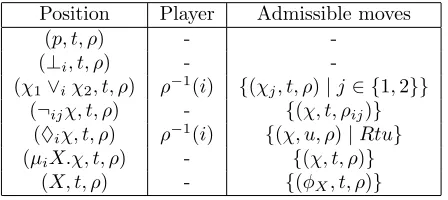
Adding these two rules to the game G we now obtain the following table describing the semantic game forµMML:
Position Player Admissible moves
(p, t, ρ) -
-(⊥i, t, ρ) -
-(χ1∨iχ2, t, ρ) ρ−1(i) {(χj, t, ρ)|j∈ {1,2}}
(¬ijχ, t, ρ) - {(χ, t, ρij)}
(♦iχ, t, ρ) ρ−1(i) {(χ, u, ρ)|Rtu}
(µiX.χ, t, ρ) - {(χ, t, ρ)}
[image:18.595.195.419.554.654.2](X, t, ρ) - {(φX, t, ρ)}
Note that contrary to the cases of MPL and MML we have not specified the winners of the game in table 2.4. The reason for this is that matches of formulae ofµMMLare no longer guaranteed to be finite because variables can be unfolded (infinitely often). Before, when describing the game G for MML
(and alsoMPL) we were imprecise about the definitions of a match of Gand winning conditions for matches ofG. Given aMML-formulaφ, a modelM and a statew∈M, a match was simply a ‘play’ ofG(φ, M) - a sequence of positions starting at a position (φ, w, Id). Because all matches were finite, for each match the winning conditions were fully specified at the last position of each match. In our current setting - that ofµMML- we are faced with infinite matches and therefore we need to be a bit more precise about who wins the game in which situations.
Definition 2.4.4. Given a clean µMML formula φ and a Kripke modelM = (W, R, V)andw∈W, a matchofG(φ, M)@(φ, w, Id)is an (in)finite sequence of positions
π= (φ, w, Id),(φ1, w1, ρ1),(φ2, w2, ρ2), . . . ,
which is in accordance with the rules of the gameG(φ, M)defined above. Given an infinite match π, we define U nf∞(π) as the set of variables that are
un-folded infinitely often inπ. With max(U nf∞(π))we denote the variable X in
U nf∞(π) that is highest in terms of dependency order, that is, forX it holds
thatY ≤φX for allY ∈U nf∞(π).
Remark 2.4.5. Observe that for every µMML-formulaφ, any matchπof G(φ, M)@(φ, w, Id), and any two variables X, Y ∈ U nf∞(π) there is a Z ∈
U nf∞(π) such that eitherX ≤
φZ orY ≤φZ. The proof of this little claim is
essentially the same as for the standard modalµ-calculus and can be found in [15].
There are a few things that we will note before getting to the winning con-ditions for G-matches. Given an infinite match π, there must be some finite kand a position (µiX.φ, wk, ρk) after which only variables from U nf∞(π) are
unfolded. It follows that after this point the role distribution will be ‘stable’. That is, for all later positions (φn, wn, ρn) withk≤nwe haveρ−1n (i) =ρ
−1
k (i).
We call thisρk the stable role distribution of the (infinite) match π (notation
ρπ). Finally, we are ready to define the winning conditions for matches of
µMML-formulas.
Definition 2.4.6. Given a clean µMML-formula φ, a multi-player model M, a state w ∈ M, and a match π of G(φ, M)@(φ, w, Id) we define the winning conditions forπas follows:
playerawins
πis finite (last(π)) is a winning position for a πis infinite max(U nf∞(π)) =X,X is aj-variable and ρ
[image:20.595.151.464.124.163.2]π(a) =j
Table 2.5: The winning conditions for theµMML-gameG
In words, the winning conditions state the following: for finite matches, the winning conditions are exactly the same as for MML and are specified at the final position of the game. An infinite matchπis won by a playerjif the highest variable unfolded infinitely often inπis ai-variable, andj assumes the role of iaccording to the stable role distributionρπ 1.
As before, we say that a formulaφofµMMLisi-satisfied inM atw,M, wiφ,
if player i has a winning strategy for G(φ, M)@(φ, w, Id). Now let us have a look at some examples ofµMML-formulas.
Example 2.4.7. LetAbe a set ofnplayers with 0,1,2∈A, letM = (W, R, V) be a multi-player model and w a state in W. We will have a look at some formulasφofµMML.
(i) Letφ =µ0X.(⊥0∨0♦0X). ThenM, w 0 φiff there is an infinite path
leading fromw. All the other players have a winning strategy iff there is no infinite path leading fromw: first of all, note that since there are no negations involved, the role distribution at each position of the game will beId. Note also that player 0 makes all the moves. Moreover, when forced to choose between⊥0and♦0X she will never prefer to play⊥0 since this
results in an immediate loss for her. If the model has an infinite path, 0 can always choose♦0X and play in such a way that the game remains
on the path. By definition of the winning conditions, player 0 is the only player that will win if the game is infinite. If there is no infinite path, then 0 is guaranteed to lose since she loses both in case of any position of the form (⊥0, t, Id) and of (♦0X, t, ρ) whenthas no successors. In the
last case, the rest of the players are guaranteed to win the game.
(ii) Let φ = µ0X.(p∨1 ♦0X). In this case 0 wins iff there is an infinite
path leading fromwsuch that for every statet on the pathV(p)(t)(0) =
w. Note that, as before, 0 will be the only winner of an infinite game. Moreover, at any position of the form (p∨1♦0X, t, Id), 0 is guaranteed
to ‘survive the round’ only if V(p)(t)(0) = w. Thus, when choosing a successor at position (♦0X, t, Id), 0 has to make sure thatpis satisfied at
this successor for 0. For player 1, M, w 1 φ iff every path that can be
reached fromwpasses through somew′ such thatV(p)(w′)(1) =w. The
1We realize that the winning conditions more resemble that of the greatest fixpoint ν,
reason for this is that at a position (p∨1♦0X, t, Id), 1 will only be willing
to play (p, t, Id) ifV(p)(w′)(1) =w. Otherwise, he is forced to play♦ 0X.
For all the other playersk,M, wkφiff there is no infinite path leading
from wand for all statest reachable fromw,V(p)(t)(k) =w. If there is an infinite path leading fromwplayerkrisks that player 1 will play♦0X
at each position (p∨1♦0X, t, Id). If there is a state t finitely reachable
fromwsuch thatV(p)(t)(k)6=wplayerkrisks that the game will end up here.
(iii) Let φ=¬01♦2µ0X.(p∨2X). In this case 0 has a winning strategy iffw
has no successors inM. The direction from right to left should be clear: if w has no successor, player 2 will get stuck and all the other players are guaranteed winners (note that 2 ∈ {/ 0,1} hence the negation before the modal operator does not change this fact). For the other direction, suppose there is a successorw′ ofw, that 2 chooses to play. In this case
we end up in a position (p∨2X, w′, ρ01). Sinceρ01(0) = 1 it follows that
all infinite matches are won by 1. Now player 0 risks that player 2 will play (X, w′, ρ
01) at all positions (p∨2X, w′, ρ01), in which case 0 looses the
game. For player 1,M, w1φiffwhas no successors or for all successors
w′ of w, V(p)(w′)(0) =w. This should be clear. Lastly, M, w 2 φ iff
there is a successor w′ of w such that V(p)(w′)(2) = w. If there is no
such a successor, she will lose in all possible scenarios: either because she cannot pick a successor in the first place, or because she playspat some point, or because she never playsp.
It should be observed that the semantics ofµMMLis only defined over clean formulas. At this point, there are µMML-formulas like µ0X.(µ1X.(X)) that
have no semantic interpretation.
Proposition 2.4.8. Just like the standard modal µ-calculus µM L, the multi-player versionµMML is bisimulation invariant and has the (bounded)tree model property.
Proof. The proof of these facts is left to the reader.
In this section, we have made a first attempt to formulate a multi-player variant of the modalµ-calculus. The formalism, as it was introduced here, can still be improved in many ways. We would like to conclude by making two remarks regarding possible improvements ofµMML.
Remark 2.4.9. First of all, we have defined formulas of the formµiX.φin such a
was that withinφ,X cannot occur under the scope of any multi-player negation
¬iksuch thati6=k. We have put this condition to ensure that at a position of
the form (µiX.φ, w, ρ), the player that assumes the role ofi, that isρ−1(i), wins
all the infinite matches. However, the formula constraint as formulated here is a bit too restrictive. To see why, take for example the formulaµiX.(¬ij¬ijX).
to define the notion ofi-positive occurrences and to improve on this syntactic restriction regarding the negations occurring within fixpoint formulas.
Chapter 3
Multi-Player Algebras: The
Propositional Case
3.1
Introduction
In the next two chapters we will study the logicsMPLandMMLalgebraically. In this chapter, we will first construct concrete multi-player algebras embody-ing the semantics ofMPL. After that, we define an abstract (quasi-)equational axiom system capturing the notion ofi-equivalence inMPL: algebras satisfying these axioms will be called ‘multi-Boolean algebras’. One of our main results is a representation theorem, analogue to Stone’s representation theorem that will link these two concepts together: we show that every multi-Boolean alge-bra is isomorphic to a concrete multi-player algealge-bra. In the next chapter we will study the logicMMLby algebraic means and define ‘multi-modal algebras’ axiomatically. By showing a multi-player version of the J´onsson-Tarski theo-rem, we establish a deep relation between game semantics ofMMLdefined over relational structures and abstract multi-modal algebras.
3.2
Concrete Multi-Player Algebras
Definition 3.2.1. Given a nonempty finite setA we define the similarity type
MBool(A) as the algebraic similarity type having one constant symbol ⊥i, one
binary function symbol∨i for every i such thati∈A, and one unary function
¬ij for each pair ofi, j∈A. Algebras of the MBool(A) type will often be denoted
asA= (A,∨i,¬ij,⊥i)i,j∈A.
Throughout the thesis we will assume that one element, 0, is always con-tained in A. We will make heavy use of abbreviations ⊤i and ⊥. Here ⊤i is
defined asWi{⊥j|j∈A}and⊥asW0{⊤j|j6= 0∈A}(and can also be found in
Given a finite set of players or agents A and a set S 1, we define the full
concrete multi-player algebraoverS as the structure
C(S) = (E,∪i,∼ij,∅i)i,j∈A.
where E denotes {w,l}AS
, A the set of all the agents, and w and lstand for
win and lose respectively. Thus, an element f of C(S) is a function f :S →
(A → {w,l}). That is, the function f assigns to every state s ∈ S and every agenti∈Athe value win or the valuelose. If f(s)(i) =w we say that player iwins at sgiven f, andloses otherwise. The symbol ∅i denotes the following
function: for each s ∈ S ∅i(s)(i) = l and ∅i(s)(j) = w if j 6=i. That is, for
all statess∈S, playeri loses given∅i and all the players distinct fromi win.
Moreover, the functionsf∪ig and∼ij f are given by:
(f ∪ig)(s)(i) =w ifff(s)(i) =worg(s)(i) =w
(f ∪ig)(s)(j) =w ifff(s)(j) =wandg(s)(j) =wforj6=i.
and,
∼ij f(s)(k) =
f(s)(i) ifk=j, f(s)(j) ifk=i,
f(s)(k) ifk6=iandk6=j.
Note that this algebra is of the MBool(A) similarity type (with ∪i
corre-sponding to∨i, ∼ij to ¬ij and ∅i to ⊥i). Any subalgebra of C(S), that is, a
subset ofEthat contains∅i for alli∈Aand is closed under∪i and∼ij for all
i, j∈A, will be called aconcrete multi-player algebra overS. WithCcMAwe denote the class of all concrete multi-player algebras.
Note that in the special case of∼ii, we have that for all f ∈E ∼ii f =f.
We will use the element♮i to denote the function♮i(s)(i) =w and♮i(s)(j) =l
ifj 6=ifor alls∈S. In words, for every states the only player that wins ats given♮i is player i, the rest loses. The function♮i can be defined from∪i and
∅j’s as follows: ♮i =Si{∅j|j ∈ A}. We can also consider the elements ∅ and
♮without indices. At each state s, all players lose ats given∅ and all players win ats given ♮. In symbols, for all i∈A, s∈S ∅(s)(i) =l and♮(s)(i) =w. Note that∅ equals S0{♮j|j = 06 ∈A} for anyi∈A. Observe that∅ is defined
using the fixed player 0, whereas the abbreviations of the other symbols like
∅i and♮i are defined relative to an agent. Note also that♮i corresponds to ⊤i
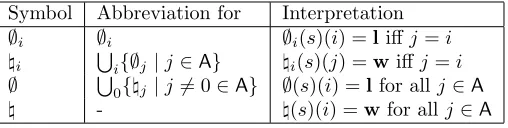
and that∅ corresponds to⊥. In the following table we give a summary of the abbreviations just introduced.
We do not give a definition in terms of the signature for the function♮. The reason for this is that do not know how to define♮from the signature. In fact, we believe that♮is not definable from the signature at all. Because we do not prove this claim here, we will not state it as a fact.
1Scan be thought of as the set of states of a Kripke frame. But in principle, this can be
Symbol Abbreviation for Interpretation
∅i ∅i ∅i(s)(i) =liffj =i
♮i Si{∅j |j∈A} ♮i(s)(j) =wiffj=i
∅ S0{♮j |j6= 0∈A} ∅(s)(i) =lfor allj∈A
[image:25.595.179.433.124.188.2]♮ - ♮(s)(i) =w for allj∈A
Table 3.1: Abbreviated Symbols
For any two functionsf, g∈Ewe say thatf ≤igiff∪ig=g(that is, if for
alls∈S,j ∈Af ∪ig(s)(j) =g(s)(j)). From this it follows thatf ≤ig iff for
alls∈S, f(s)(i) = wimplies g(s)(i) =w and f(s)(j) =l impliesg(s)(j) =l
for allj6=i. Intuitively,f ≤ig means that for all statess∈S,g is at least as
good asf fori, and for allj6=i g is at least as bad asf.
Remark 3.2.2. For any concrete multi algebraC(S) = (E,∪i,∼ij,∅i)i,j∈A with
E={w,l}AS
the following, maybe somewhat counterintuitive, inequalities hold:
∅i ≤i∅ and ♮≤i ♮i. To see why this is so, let us have a closer look at ∅i ≤i ∅.
We know that for alls∈S player i gets assigned the same value by∅ and ∅i:
∅i(s)(i) = ∅(s)(i) = l. Thus for all s, ∅i is at least as good as ∅ for i. Also,
∅i(s)(j) =limplies∅(s)(j) =lfor all j 6=i. The reason for this is that j6=i,
∅i(s)(j) = w for all s ∈ S and secondly, ∅(s)(j) = lfor all s ∈ S. Thus, for
allj6=i, the function∅ is at least as bad as∅i. More generally, for all f ∈E,
∅i≤if andf ≤i ♮i. It does not, however, generally hold that∅i≤jf orf ≤j♮i.
Also, the other directions,f ≤j ∅i and♮i≤jf are not valid.
We say that an equation f = g is valid in the full concrete multi-player algebraCover S (notation: C(S)f =g) if for each variable assingment each player has the same value assigned tof and g at each states ∈S. Similarly, f =i g is valid in the full concrete multi-player algebra if f ∪i ∅ = g∪i∅ is
valid in C(S). This implies that for player i, the value of f equals that of g at each state. Generalizing these concepts, we say that the class of concrete multi-player algebrasCcMA validatesf =g (notation: CcMAf =g) if for every setS, the algebraC(S) validatesf =g. And similarly, CcMAvalidates f =ig if for everyS, theC(S) validatesf =i g.
It follows from the definition of concrete multi-player algebras that:
Lemma 3.2.3. C({s})f =ig iffCcMAf =ig.
Proof. The direction from right to left is immediate. For the other direction: suppose CcMA 2 f =i g. Then there is a set S such that C(S) 2 f =i
g. This implies that there is an t ∈ S and a variable-assignment such that f(t)(i)6=g(t)(i). It follows that there is a variable assignment at ssuch that f(s)(i)6=g(s)(i), hence C({s})2f =i g.
sense:
Lemma 3.2.4. For any MPL formula φ,
φisi-valid iff CcMAφ′ =
i♮i
whereφ′ is the algebraic term equal toφusing the corresponding
concrete-multi-player symbols.
Proof. Both directions can be proved by induction onφ. For the direction from right to left, we use the above lemma 3.2.3. The key point to observe here is
thatCcMAφ′ =
i♮i iff for each set of statesS, each variable assignment and
s∈S, we haveφ′(s)(i) =w.
Next, we will define the ‘small’ algebraeA.
Definition 3.2.5. Given a finite setA, the algebraAe= (P(A),+i,−ij,0i)i,j∈A
is defined as follows: for any twoX, Y ∈ P(A) X+iY =
(X∩Y)∪ {i} ifi∈X∪Y X∩Y ifi /∈X, i /∈Y
Also,
−ijX =
(X− {i})∪ {j} if i∈X, j /∈X (X− {j})∪ {i} if j∈X, i /∈X X otherwise and0i=A− {i}
Note that for a fixed Athe algebras C(S) andAe are of the same signature. In the next proposition it will be shown that the small algebra eAcorresponds to concrete multi-player algebras in exactly the same way as the algebra 2of truth values corresponds to concrete set algebras.
Proposition 3.2.6. Given an arbitrary set S,C(S)is isomorphic to eAS
Proof. Fix an arbitrary setS and consider the following function
α:{w,l}AS
→AeS,
mapping elements from{w,l}AS
to functions fromS toP(A): α(f)(s) ={i∈A|f(s)(i) =w}.
First we will show that α is a bijection. To show injectivity, suppose f, g ∈ {w,l}AS with f 6= g, then there is an s ∈ S and an i ∈ A such that
f(s)(i)6=g(s)(i). From this it follows thatα(f)(s)6=α(g)(s), and thus we ob-tain injectivity ofα. To show surjectivity, letu∈(Ae)S and definef ∈ {w,l}AS
as follows
It follows from the definition ofαthatα(f) =u.
Next, we need to show thatαis a homomorphism from{w,l}AS toAeS. Let
us consider the +i operator. We need to show that for any j ∈ A, s∈S and
f, g∈ {w,l}AS
,j∈α(f∪ig)(s) if and only ifj ∈(α(f) +iα(g))(s). We
distin-guish two cases: j=i, and j6=i. Casej=i.
i∈α(f ∪ig)(s) ⇔ (f∪ig)(s)(i) =w
⇔ f(s)(i) =w org(s)(i) =w
⇔ i∈α(f)(s) ori∈α(g)(s)
⇔ i∈(α(f) +iα(g))(s)
Casej6=i.
j ∈α(f∪ig)(s) ⇔ (f ∪ig)(s)(j) =w
⇔ f(s)(j) =wandg(s)(j) =w
⇔ j∈α(f)(s) andj∈α(g)(s)
⇔ j∈(α(f) +iα(g))(s)
Considering the −ij operator, we need to show that k ∈ α(∼ij f)(s) if
and only if k ∈ −ijα(f)(s). Again, we distinguish two cases: k ∈ {i, j} and
k /∈ {i, j}.
Casek∈ {i, j}. wlog assumek=i.
i∈α(∼ijf)(s) ⇔ ∼ij f(s)(i) =w
⇔ f(s)(j) =w
⇔ j∈α(f)(s)
⇔ i∈ −ijα(f)(s)
Casek /∈ {i, j}.
k∈α(∼ijf)(s) ⇔ ∼ij f(s)(k) =w
⇔ f(s)(k) =w
⇔ k∈α(f)(s)
⇔ k∈ −ijα(f)(s)
Thus we may conclude that every concrete multi algebra forAis isomorphic to a power ofAe.
In fact, we may also conclude the converse direction, viz. that every power of eAis isomorphic to a concrete multi algebra for A, since it suffices that the inverse ofα, α−1, is an isomorphism from e
AS to {w,l}AS. This concludes the
3.3
Multi-Boolean Algebras (
MBA
)
Definition 3.3.1. Let A= (A,∨i,¬ij,⊥i)i,j∈A be an algebra of the similarity
type MBool(A). For each agent i∈A we define two orderings of the elements ofA: ≤i andi. We define
a≤i bif a∨ib=b
And,
aib if a∨ib∨i⊥=b∨i⊥
That is, ai b if a∨i⊥ ≤i b∨i⊥. Ifa i b and b i a we geta∨i⊥=
a∨ib∨i⊥=b∨i⊥and thus a∨i⊥=b∨i⊥. In this case we saya isi-equal
tob. Notation: a=ib.
At this point, we would like to make the reader aware of the fact that in the sequel, we will be constantly switching between the two equivalent notations: a=ib anda∨i⊥=b∨i⊥.
The intuition behind these two orderings is the following. The first,≤i can
be interpreted as follows: given two elements a, b we have that a ≤i b iff for
player i the element a is at least as good as b and for all other players j 6=i the elementa is at least as bad asb. The other relationi is a less restricted
relation: given two elements a, b, ai b iff a is at least as good as b for i. It
follows thata≤ibimplies thataib, but the two relations are not the same.
Definition 3.3.2. Let A = (A,∨i,¬ij,⊥i)i,j∈A be an algebra of the
multi-Boolean similarity type. The algebraAis called a multi-Boolean algebra(MBA) iff it satisfies the (quasi-)equations:
(MB0)x∨iy=y∨ix
(MB1)x∨i(y∨iz) = (x∨iy)∨iz
(MB2)x∨i(y∨jz) = (x∨iy)∨j(x∨iz)
(MB3)⊥i∨ix=x
(MB4)⊤i∨ix=⊤i
(MB5)(x∨jy)∨ix=ixforj 6=i
(MBn0)¬ijx=¬jix
(MBn1)¬iix=x
(MBn2)¬ik⊥i=⊥k,¬jk⊥i=⊥i if i /∈ {j, k} and¬jk⊥=⊥
(MBn3)¬ij¬jkx=i¬ikx
(MBn4)¬ij¬lkx=i¬ijxifj /∈ {l, k}
(MBn5)x=i ¬jkxfori /∈ {j, k}
(MBn6)¬ij¬lkx=¬lk¬ijxifi /∈ {l, k} andj /∈ {l, k}
(MBn7)¬ij(x∨iy) =¬ijx∨j¬ijy
(MBn8)¬ij(x∨ky) =¬ijx∨k¬ijy fork /∈ {i, j}
All (quasi-)equations are assumed to be universally quantified over both the variables and the agents. As mentioned before, ⊤i is a shorthand for Wi{⊥j |
j∈A}. Also, ⊥is short for the formulaW0{⊤j|j6= 0} for anyj∈A.
We call the class of all multi-Boolean algebrasMBA.
The following proposition highlights some properties of multi-Boolean alge-bras.
Proposition 3.3.3. Every multi-Boolean algebra A= (A,∨i,¬ij,⊥i)i,j∈A has
the following properties
(i) The relation≤i is a partial order onA for eachi.
(ii) The relationi is a quasi-order, i.e., it is reflexive and transitive.
(iii) ¬ik⊤i=⊤k and¬jk⊤i=⊤i wheni /∈ {j, k}.
(iv) ⊤j∨i⊥=⊥forj6=i.
(v) a=b⇔ ¬jka=¬jkb.
(vi) aib⇔ ¬ikak¬ikb.
(vii) a∨jbiafor all j6=i.
(viii) a≤ib impliesai bandbjafor allj 6=i.
(ix) a∨jb=ia∨kb wheni /∈ {j, k}
Proof. For the proof of this proposition we refer to the appendix 7.2.
Note that from the definition of≤iand the above proposition it follows that,
if for some agenti∈Aand for some elementsa, b∈A, a≤ibandb≤ia, then
a=b. Froma=b we infer that for allj ∈Aa≤jb andb≤ja. Of course, the
stronger statement,a≤ib impliesa≤j bdoes not hold.
Proof. Let A be a set of agents and S a set of states. Consider the concrete multi-player algebraC(S):
C(S) = (E,∪i,∼ij,∅i)i,j∈A.
HereEdenotes{w,l}AS
. We need to show that the concrete multi-player algebra
C(S) satisfies all the axioms of multi-Boolean algebras. Most axioms are easily verifiable. We will go through some of the axioms in detail.
- (MB2). To show that for anys ∈S and k ∈ A, (x∪i(y∪jz))(s)(k) =
((x∪iy)∪j (x∪iz))(s)(k). We need to distinguish three cases: k = i,
k=j andk /∈ {i, j}. Ifk=i we get
(x∪i(y∪jz))(s)(i) =w iff x(s)(i) =wor (y∪jz)(s)(i) =w
iff x(s)(i) =wor
(y(s)(i) =wand (z)(s)(i) =w) iff (x(s)(i) =wor y(s)(i) =w) and
(x(s)(i) =wory(s)(i) =w) iff ((x∪iy)∪j(x∪iz))(s)(i) =w.
The casesk=j andk /∈ {i, j} can be proved by similar reasoning. - (MB5). In order to show that for anys∈S andk∈A, ((x∪iy)∪jx∪j
∅)(s)(k) = (x∪j ∅)(s)(k) for j 6= i we need to distinguish three cases:
k=j,k=iandk /∈ {i, j}. Ifk=j we get
((x∪iy)∪jx∪j∅)(s)(j) =w iff x(s)(j) =wor∅(s)(j) =wor
(x∪iy)(s)(j) =w
iff x(s)(j) =wor∅(s)(j) =wor (x(s)(j) =w andy(s)(j) =w) iff x(s)(j) =w
iff x(s)(j) =wor∅(s)(j) =w
iff (x∪j∅)(s)(j) =w.
For all the other players ((x∪i y)∪jx∪j ∅)(s)(k) = w iff ((x∪iy)∪j
x)(s)(k) =wand ∅(s)(k) =w. By definition of∅, this is never the case. Thus, for every s∈S and k6=j ∈A, ((x∪iy)∪jx∪j∅)(s)(k) =l. For
the same reason also (x∪j ∅)(s)(k) =l for every s ∈S. Hence we may
conclude that ((x∪iy)∪jx∪j∅)(s)(k) = (x∪j∅)(s)(k).
- (MB6). Recall thataibiffa∪ib∪i∅=b∪i∅. This means that if player
i wins a∪ib at s, then i also wins b at s. Hencea i b iff a(s)(i) = w
impliesb(s)(i) =w. For all the other players j 6=i, we cannot conclude anything fromai b, sincejloses at anysgiven botha∪ib∪i∅andb∪i∅.
Now supposexi y andy j xfor all j 6=i. Then a(s)(i) = wimplies
b(s)(i) =w (b is at least as good foriasa) and for allj 6=i b(s)(j) =w
- (MBn3). In order to show that∼ij∼jkx∪i∅=∼ikx∪i∅it suffices to show
that for any s∈ S, (∼ij∼jk x)(s)(i) = w iff (∼ik x)(s)(i) =w (see the
discussion of soundness of axiom (MB6)). This follows from the definition of∼:
(∼ij∼jkx)(s)(i) =w iff (∼jkx)(s)(j) =w
iff x(s)(k) =w
iff (∼ikx)(s)(i) =w.
- (MBn6). Assume {i, j} ∩ {l, k} = ∅. We will show that for any s ∈ S andm∈A, (∼ij∼lk x)(s)(m) =wiff (∼lk∼ij x)(s)(m) =w. Distinguish
cases: m ∈ {i, j, k, l} and m /∈ {i, j, k, l}. Case m ∈ {i, j, k, l}. Assume wlog thatm=i:
(∼ij∼lk)x(s)(i) =w iff (∼lkx)(s)(j) =w
iff x(s)(j) =w
iff (∼ij x)(s)(i) =w
iff (∼jk∼ij x)(s)(i) =w.
Ifm /∈ {i, j, k, l}, the proof is even more straightforward: (∼ij∼lk x)(s)(m) =w iff (∼lkx)(s)(m) =w
iff x(s)(m) =w
iff (∼ij x)(s)(m) =w
iff (∼jk∼ijx)(s)(m) =w.
3.4
Representation theorem
Definition 3.4.1. Ani-filterof a multi-Boolean algebraA= (A,∨i,¬ij,⊥i)i,j∈A
is a nonempty subsetF ofA satisfying
(F1)⊤i∈F,
(F2) ifa, b∈F then a∨jb∈F for allj 6=i,
(F3) ifa∈F andaib thenb∈F.
An i-filter is called proper if ⊥i ∈/ F. An i-prime filter is a proper i-filter
such that
(F4) for every pair of elementsa, b∈A,a∨ib∈F implies a∈F orb∈F.
The collection ofi-filters ofAis denoted withFi(A). WithFip(A) we denote
Definition 3.4.2. Ani-idealof a multi-Boolean algebraA= (A,∨i,¬ij,⊥i)i,j∈A
is a nonempty subsetI ofA satisfying
(I1)⊥i∈I,
(I2) ifa, b∈I then a∨ib∈I,
(I3) ifa∈I andbiathenb∈I.
An i-ideal is called proper if ⊤i ∈/ I. An i-prime ideal is a proper i-ideal
such that
(I4) For every pair of elementsa, b∈A,a∨jb∈I for somej 6=i∈Aimplies
a∈I orb∈I
The collection ofi-ideals ofAis denoted withIi(A). WithIip(A) we denote
the collection ofi-prime ideals of A. It is important to observe that given an arbitraryi-filterF ofA= (A,∨i,¬ij,⊥i)i,j∈A and two elementsa, b∈A
a=ibimpliesa∈F iffb∈F. (3.1)
Remember that a=i b is shorthand notation forai b andb i a. Thus
wheneveraorbare inF it follows immediately from (F3) that the other element is inF as well. The same also holds for i-ideals. Note that, contrary to the standard ‘two-player’ filters and ideals,i-ideal andi-filters are not order-duals. That is, we cannot exchange⊤i with⊥i and∨iwith some∨j in the conditions
ofi-filters to obtain the conditions ofi-ideals. Because of this fact, we will not be able to restrict ourselves to the use ofi-filters or i-ideals only, we will need both concepts to prove our desired representation theorem.
Just like in case of classical ideals and filters, the complement of an (proper) i-filter is not necessarily an (proper) i-ideal. However, the complement of an i-primeideal is ani-primefilter. We will prove this fact in the next proposition.
Proposition 3.4.3. For any multi-Boolean algebra A = (A,∨i,¬ij,⊥i)i,j∈A,
I⊂A is ani-prime ideal if and only ifA\I is ani-prime filter.
Proof. For the direction from left to right, assume that I ⊂ A is and i-prime ideal. We have to show thatF =A\Idoes not contain ⊥i and satisfies
(F1)-(F4). (F1) follows immediately from the assumption thatI is proper. Let us have a look at (F2). Suppose thata, b∈F. We need to show thata∨jb ∈F
for allj 6=i. Suppose for contradiction that for some j 6=i, a∨jb /∈F. This
implies thata∨jb∈I. But sinceI is assumed to be a proper i-prime filter it
follows from (I4) that a ∈I or b ∈I, which contradicts our assumption that bothaandbare inF. In a similar fashion, (F3) follows from (I3) and (F4) can be proved using (I2). By our assumption thatI is ani-ideal and thus contains
⊥i by definition, it follows thatF is proper.