1
Drawing the object – a metaphor for,
and re‐forming of memory
by
Raelene Marr, B.F.A. Hons.
Submitted in partial fulfilment of the requirements for the Masters Degree in
Fine Arts
2
Declaration of Originality
I declare that this thesis contains no material which has been accepted for a degree or diploma by the University or any other institution, except by way of background information and duly acknowledged in the thesis, and to the best of my knowledge and belief no material previously published or written by another person except where due acknowledgement is made in the text of the thesis, nor does the thesis contain any material that infringes copyright.
Signed __________________________
Name ___________________________
Date ____________________________
3
Authority of Access
This thesis may be made available for loan and limited copying and communication in accordance with the Copyright Act 1968.
Signed __________________________
Name __________________________
Date ___________________________
4
Abstract
By investigating the connections between drawing, object and memory, this research project operates as an enquiry into processes of transition and transformation, and the significance of everyday objects to memory. Through practices of process‐based drawing, I focus on aged domestic objects to explore relationships between materiality and our awareness of and insights into past experience. I approach the drawing and casting of objects as a metaphor for the mental processes we experience in relation to memory. The project is supported by research into theories of memory, with particular focus on the capacity of memory to shift and change over time, and how the merging of past and present relates to the creation of new realities.
The practical research has resulted in a body of work that consists of a series of photocopy drawings, rubbings and three‐dimensional forms made from liquid latex, wax and tarlatan fabric. The
development of tangible, delicate forms and imagery reveals alternate approaches in drawing to create modified shapes and surfaces of domestic objects. The diverse works reflect the fluctuating processes of memory, evoking new meanings from prior experiences. The works are also an intimate, personal response to the vulnerable materiality of the objects from which they originate.
For my practical research I have drawn on a number of philosophical approaches from the following sources: Edward Casey’s research into the change‐inducing processes of remembering in
Remembering: A Phenomenological Study; Paul Ricoeur’s focus on the persistence of enduring traces in Memory, History, Forgetting; Henri Bergson’s philosophies regarding memory as an embodied experience in Matter and Memory; Michael Leyton’s ideas on the importance of shape to memory in Symmetry, Causality, Mind; and Maurice Merleau‐Ponty’s theories on embodied consciousness, touch as sensory surface, and the connection between memory and the material world in
Phenomenology of Perception. My study of this material has expanded my approach to drawing and my perception of an object’s materiality and its connection to the past.
5
Louise Bourgeois (2000‐2009) are a material expression of autobiographical memory and inspired my investigations of material potency in my studio work.
This research project expands on theoretical ideas that frame the ambiguous zone of the past and the present in memory. It emphasises strategies of making aligned with concepts of transformation, intimacy and the ephemeral. The partial and collapsed nature of the works, the use of disparate and yielding materials, and the capacity of the two and three‐dimensional forms to be read as matter in transition demonstrates their potential as catalysts for new form and meaning. The project
acknowledges the everyday object as a valuable referent for the complexities of memory and domestic items as a source for shape. The innovative application of drawing techniques undertaken within the studio research contributes to an ongoing pursuit within contemporary drawing practice to transform traditional drawing language into new art forms.
6
Acknowledgements
I would like to thank my supervisors, Dr Mary Scott and Lucy Bleach, for their invaluable guidance and support through the course of the project. I would also like to thank Graduate Research Coordinator Dr Megan Keating and the staff and students at the Tasmanian College of the Arts for their critique and encouragement of my project.
I would like to thank the ‘Dr Gwen Nettlefold Memorial Scholarship’ of which I was a recipient, and their ongoing support of female students in post‐graduate studies.
I would also like to thank Stephanie Houstein, Dr Eliza Burke and Juliet Beale for generously providing their time and expertise, and for their wonderful friendship. I would like to extend my gratitude to Helena, Carolyn, Sarah, Bronwen, Penny, Rose and Terence for their friendship and advice. I am grateful to numerous other friends, both old and new, for their belief in my work.
7
Contents
Declaration of Originality ...2
Authority of Access ...3
Abstract...4
Acknowledgements...6
List of Illustrations...8
Chapter 1 – Introduction and overview...12
Outline of practical enquiry ...13
Overview of the exegesis ...16
Chapter 2 – Theoretical Background ...17
Re‐forming of memory...17
Chapter 3 – Artistic Context ...23
Eva Hesse ...23
Giorgio Morandi ...27
Louise Bourgeois...32
Chapter 4 – Methodology...37
Rubbing Drawings...38
Latex Forms...44
The Wardrobe...53
Light Traces...62
Wax Impressions and Wax Drawings...67
Chapter 5 – Conclusion...72
Bibliography...76
Appendix...78
8
List of Illustrations
All images without an artist’s name are by Raelene Marr Chapter 1: Introduction and overview
Figure 1: Studio experiments, 2011, objects, latex, mixed media Chapter 2: Artistic context
Eva Hesse
Figure 2: Eva Hesse, Studiowork, 2010, installation view, Camden Arts Centre, London, exhibition dates: 11 December 2009 – 17 March 2010, cited 04.06.11,
www.hauserwirth.com/artists/34/eva‐hesse/images‐clips/
Figure 3: Eva Hesse, No title, 1969, cheesecloth, paper tape, 43 x 35.2 x 16.4 cm, cited 04.06.11, www.hauserwirth.com/exhibitions/506/eva‐hesse/view/
Giorgio Morandi
Figure 4: Atelier Giorgio Morandi, Bologna, 1989–90, image credit: Luigi Ghirri, colourprint, 50.5 x 65.5 cm, image from the 2011 Estorick Collection Exhibitions: United Artists of Italy, London, 22 June – 4 September 2011, cited 01.03.12, <http://painting.about.com/od/artmuseums/ ss/Estorick‐Collection_3.htm>
Figure 5: Giorgio Morandi, Still Life, 1964, oil on canvas, 25.5 x 30.5 cm, scanned from E‐G. Güse & F.A. Morat (eds) 2008, Giorgio Morandi, Prestel Publishing, Munich, Berlin, London and New York.
Figure 6: Giorgio Morandi, Still Life, 1962, pencil on paper, 16.9 x 24.1 cm, scanned from E‐G. Güse & F.A. Morat (eds) 2008, Giorgio Morandi, Prestel Publishing, Munich, Berlin, London and New York.
Figure 7: Giorgio Morandi, Still Life, 1962, pencil on paper, 19.3 x 27.2 cm, scanned from E‐G. Güse & F.A. Morat (eds) 2008, Giorgio Morandi, Prestel Publishing, Munich, Berlin, London and New York.
Louise Bourgeois
Figure 8: Louise Bourgeois, Untitled, 2008, fabric and fabric collage, 94.6 x 60.9 x 5 cm,
9
Figure 9: Louise Bourgeois, Untitled, 2002, red ink and pencil on paper, 22.9 x 29.5 cm, cited 02.05.12, www.cheimread.com/artists/louise‐bourgeois/?view=selected&subgallery=3> Figure 10: Louise Bourgeois, Untitled, 2003, fabric, 29.2 x 38.1 cm, cited 02.05.12,
www.hauserwirth.com/artists/1/louise‐bourgeois/images‐clips/59/ Chapter 3: Methodology
Rubbing Drawings
Figure 11: Rubbings, 2011, paper, charcoal, dimensions variable Figure 12: Papier‐mâché test, 2011, tissue paper, flour, salt
Figure 13: Papier‐mâché test, 2011, tissue paper, flour, salt, dimensions variable Figure 14: Studio research, 2011, ink, tarlatan, mixed media, dimensions variable Figure 15: Test for Traces, 2011, masking tape, graphite, dimensions variable Figure 16: Traces, 2011, masking tape, graphite, kozo paper, 140 x 69 cm Figure 17: Drawing experiment, 2011, plain flour, ink, graphite powder Figure 18: Rubbing Drawings in progress, 2011, graphite block on kozo paper Figure 19: Untitled (rubbing), 2011, graphite block on kozo paper, 60 x 97 x 15 cm Figure 20: Untitled (rubbing), 2011, pencil on kozo paper, 60 x 97 cm
Figure 21: Untitled (rubbing), 2011, graphite block on kozo paper, 60 x 97 x 15 cm Figure 22: Untitled (rubbing), 2011, pencil on kozo paper, 60 x 97 cm
Latex Forms
Figure 23: Latex Forms, 2011, latex, mixed media, dimensions variable Figure 24: Untitled, 2011, latex, white ink, 20 cm in diameter approximately
Figure 25: Untitled, 2011, latex, white ink, graphite powder, 20 cm in diameter approximately Figure 26: Untitled, 2011, latex, ink, graphite powder, pencil, masking tape, 20 cm in diameter
approximately
Figure 27: Untitled, 2012, latex, ink, graphite powder, masking tape, 30 cm in diameter approximately
10
Figure 30: Untitled, 2012, latex, ink, 40 cm in diameter approximately
Figure 31: Latex Forms (flat or bunched works), 2012, latex, mixed media, dimensions variable Figure 32: Latex Forms (pinned works), 2012, latex, mixed media, dimensions variable
The Wardrobe
Figure 33: Wardrobe (before starting), 2011, acrylic paint on wood surface, 220 x 110 x 35 cm Figure 34: Wardrobe, (a), (with graphite applied), 2011, graphite on acrylic paint and wood surface,
220 x 110 x 35 cm
Figure 35: Wardrobe, (a), (detail), 2011
Figure 36: Wardrobe, (b), 2012, tarlatan fabric, graphite, 205 x 110 x 35 cm approximately Figure 37: Wardrobe, (b), (detail), 2012, tarlatan fabric, graphite, wardrobe
Figure 38: Wardrobe, (b), (detail), 2012, tarlatan fabric, graphite Figure 39: Wardrobe, (c), 2013, latex, graphite
Figure 40: Wardrobe, (c), (detail), 2013, latex, graphite, wardrobe
Figure 41: Wardrobe, (b and c), (detail), 2013, latex, tarlatan fabric, graphite, dimensions variable
Light Traces
Figure 42: Light Traces, 2011–12, ink, charcoal, pencil on kozo paper, 90 x 60 cm each Figure 43: Untitled, 2011, ink, charcoal, pencil on kozo paper, 90 x 60 cm
Figure 44: Untitled, 2011, ink, charcoal, pencil on kozo paper, 90 x 60 cm Figure 45: Untitled, 2011, ink, charcoal, pencil on kozo paper, 90 x 60 cm
Figure 46: Light Traces, 2012, ink, charcoal, pencil on kozo paper, 90 x 60 cm each
Wax Impressions and Wax Drawings
Figure 47: Untitled, 2012, wax, graphite powder, 60 cm in diameter approximately Figure 48: Untitled, 2012, wax, 60 cm in diameter approximately
Figure 49: Untitled, 2012, wax, graphite, ink, 60 cm in diameter approximately Figure 50: Untitled, 2012, wax, 60 cm in diameter approximately
11 Figure 53: Untitled, 2012, wax, photocopy, 20 x 10 cm Figure 54: Untitled, 2012, wax, photocopy, 20 x 10 cm
12
Chapter 1 – Introduction and overview
The past is hidden somewhere outside the realm, beyond the reach of the intellect, in some material object (in the sensation which that material object will give us) which we do not suspect.1
Marcel Proust
In this Research Masters project I investigate connections between drawing, objects and memory. The premise of the project is to make artworks that visually express the complex states of memory, and how our memories of both the past and the present combine to create stories of our lives. This enquiry into memory is principally based on aged domestic objects; these are used to explore relationships between materiality and our insights of past experience. The methods used are largely process‐led, and material forms are explored principally through processes of transition and
transformation. The project is supported by research into theories of memory, particularly concepts relating to how memories shift and change over time and how the merging of past and present relates to the creation of new realities.
Old domestic objects have the capacity to retain impressions of past human interaction because many of them are made from materials vulnerable to decay over time, such as tin, wood and cardboard. As such, ordinary objects with dense material markings are universal in the way they rouse the imagination and trigger thoughts of past experiences.
Like these objects, human memory preserves impressions, imprints and traces of experience that are constantly evolving and changing through the processes of memory. Within the act of
remembering, the past and the present become interconnected. This meeting or merging of past and present through the act of remembering alters our memories and brings about new
perspectives on and perceptions of our actual lived experience. Ambiguity develops through the contact of past and present, and notions such as virtual and actual representation, and of absence and presence, add to this feeling of ambiguity within memory.
The philosopher Edward Casey has suggested that in memory’s “action of uncovering the past … we regain the past as different each time. Or, more exactly, we regain it as different in its very
1 Proust, M. 1913, Vol. 1, ‘Swann’s Way’ in Remembrance of Things Past, translated by C.K. Scott Moncrieff and revised by
13
sameness”.2 Casey’s thoughts on memory, how memories shift and change over time, contextualises the practical work undertaken in this research project. I have explored ideas of memory and
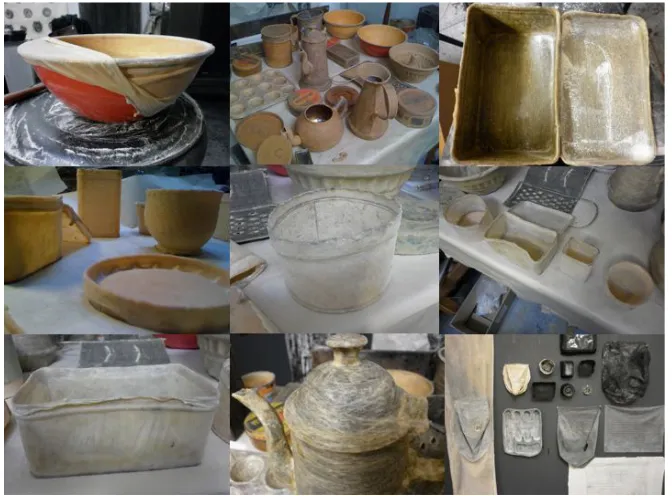
experience through use of a few select source objects. These objects have been transformed through multiple material forms and processes such as drawing, casts and imprints. This extensive process‐based enquiry was pivotal to drawing out the unique features and qualities of the objects so as to evoke the vulnerable and changing nature of our memories.
Outline of practical enquiry
The framework for initial enquiry was directed by my early experimentation with objects and the choice of objects and processes was directed by my research into the relationship between objects and memory. Items of a domestic nature were sourced mostly from recycled and second‐hand goods shops and were the starting point for my research. I decided early in the process to exclude personal objects or mementos, in order to circumvent subjective associations. The use of items whose history or circumstances were unknown to me provided neutral subject matter and increased the opportunity for objective artistic exploration.
An important development occurred when I recognised that aged domestic objects – rather than contemporary items made from impervious materials like plastic, from which I had also been drawing – were marked with the patina and grooves of use that provided valuable residual textures for visual exploration. As a record of the past, these surface impressions signified lived experience and emotional resonances that added to the potency of the aged domestic objects as mediators of memory.
I identified that items made from soft tin or porous wood materials had surfaces most likely to show signs of embedded human touch. This was significant to building an understanding of materials that absorb tangible human traces, and materials vulnerable to being reshaped or transformed into new forms. The scale of objects was also important – I chose small domestic items (i.e. small relative to the size of my hand), because these invited further associations of touch and its embodied
relationship to memory.
Apart from their domestic nature, materials and scale, initially the selection of objects was broad. As the work progressed it became evident that containers, mostly round or square boxes, gave the greatest scope for aesthetic and conceptual enquiry; their inside and outside surfaces when
2 Casey, E.S. 1987 and 2000, Remembering: A Phenomenological Study, second edition, Indiana University Press,
14
flattened pictorially as drawings referenced the two‐dimensional shape of the objects. A consistent objective of the research was to keep methods simple and direct and to maintain a strong visual connection with the objects with which I was working.
[image:14.595.120.456.143.391.2]
Figure 1: Studio Experiments, 2011, objects, latex, mixed media
I chose to work primarily in drawing because it is appropriate to gradual and subtle tonal layering and for taking rubbings. The medium of drawing played a vital role in the physical and aesthetic qualities of works. Gestures and thought processes were made visible through different drawn marks, erasures and re‐workings, and create tangible pieces that are an embodiment of drawings activity and transformed objects via drawing’s trace. Unique features of drawn marks and incidental smudges or stains offer alternative readings in the exploration of the new images and forms, and are the material trace of my artistic intentions to create pieces that reflect experiential qualities.
Research works show drawing’s capacity to reveal aspects of touch and experience and to
conceptually create a space for the viewer to engage in the formation of works imagery and evoke personal responses through works materiality.
15
Various mediums – graphite, charcoal and pencil – were explored for their combined effect with other substances, and various thicknesses and weights of these mediums added tonal variation to the mark‐making. The choice of a mostly monochromatic palette reflected the aged tones and hues of the second‐hand objects and was also a deliberate means for foregrounding surface details and shape over colour. Beeswax and industrial materials like latex and tarlatan were used because of their fragile, lightweight and porous qualities, providing ample scope for investigation. The tangible forms made of these materials had an ambiguous collapsed and deflated appearance and could be seen as a reference to the uncertainty and distortion of our memories.
Techniques used also included wrapping and photocopying, which, like rubbing and casting, were instrumental for lifting textures and surface markings and capturing the shapes of objects. Together these techniques, in combination with process‐led and formal enquiry, enabled me to develop a broad suite of methods with strong physical and visual meanings linked with fragility, ambiguity and ephemerality.
The significance of this project lies in the connections between our personal memories and the objects to be transformed. Despite the continual transformative processes of drawing and casting object’s material and formal qualities, I discovered there remains a persistent remnant / trace of the object. Additionally, I explored shifting objects’ forms between three and two dimensions, thereby reinterpreting the forms and how they are perceived.
Within my studio practice it was the recurring remnant left embedded within the material transition of each object that I found the most engaging, because it suggested new readings of the original objects. The recurring remnant became a potential catalyst for triggering personal memories and to form new meanings and experiences.
Through my exploration with drawing and sculptural techniques I also blurred the lines between two dimensionality and three dimensionality and consequently challenged the traditional way we
16
This enquiry highlights the physical processes of drawing and casting of objects that reflect the fluctuating processes of memory. It also shows everyday objects as valuable resources for artistically exploring the relationships between materiality of objects and our awareness of past
experiences. The studio research carried out as part of this enquiry emphasises the relationships between the disciplines of drawing and sculpture and their combined capacity to transform objects and to create a series of visual works that evoke the complexity of our memories.
Overview of the exegesis
Chapter 1, Introduction and Overview, has touched on the main approaches used in this research project and its major themes.
Chapter 2, Theoretical Background, provides a theoretical framework for the project through a study of writings about memory. The writings that inform this chapter were appropriate for practical exploration of two areas: transformative and transitional states of memory, and the capacity of objects’ residual materiality to create new types of materials and visual impressions.
Chapter 3, Artistic Context, contextualises the project through an exploration of the studio works of Eva Hesse (1966‐1969), the still life paintings and drawings of Giorgio Morandi and the fabric works of sculptor Louise Bourgeois (2000‐2009). My study of their works was particularly influential in the development of various methods I used for wrapping or covering objects, partial forms and enduring marks. Each of these artists have produced images and forms evocative of vulnerability and
ephemerality through the use of soft materials and/or tactile surfaces. Of contextual relevance, too, was the autonomous place of drawing in the practice of each of these artists; namely, drawing played an influential role in the development of their primary practices in painting and sculpture.
Chapter 4, Methodology, explicates the methods developed and used throughout the development and finessing of this project. It is divided into five sections, with each referring to a discrete series of works that I created for the project (Rubbing Drawings, Latex Forms, The Wardrobe, Light Traces and Wax Impressions/Wax Drawings). Within each section I outline the materials and techniques of studio research used and how these connect to the conceptual framework underpinning these series of works.
17
Chapter 2 – Theoretical Background
The formal and material relationships that arose through the various drawing methods used in this project led me to research concepts of memory and to test the relevance of these concepts to my practice. In this chapter I provide a theoretical framework of memory relevant to my research, particularly relating to memory’s transient nature and the merging of past and present. Shape theory is outlined and notions of nostalgia and sensory experience are mentioned in connection to objects.
Re‐forming of memory
French author Marcel Proust, in his early twentieth‐century novel Remembrance of Things Past, explored ideas about the power of objects to trigger and influence memories. In the following passage the author expresses the enduring quality of material traces as long‐forgotten childhood memories are reawakened when the story’s narrator partakes of tea and a madeleine biscuit:
As soon as I recognised the taste of the piece of madeleine soaked in her decoction of lime‐ blossom which my aunt used to give me … immediately the old grey house upon the street, where her room was, rose up like a stage set to attach itself to the little pavilion opening on to the garden which had been built out behind it for my parents … and with the house the town, from morning to night in all weathers, the Square where I used to run errands, the country roads we took when it was fine … in that moment all the flowers in our garden and in M. Swann’s park, and the water‐lilies on the Vivonne and the good folk of the village and their little dwellings and the parish church and the whole of Combray and its surroundings, taking shape and solidity, sprang into being, town and gardens alike, from my cup of tea.3
Here, Proust gives a descriptive and fitting proposition that the past is transformed through the sensory experience of tasting a madeleine. The fact that the memories are triggered by taste
highlights the embodied nature of memory and how everyday experiences are formative of memory. Proust connects a present experience to a past one that progressively unfolds different dimensions of time and space to do with the narrator’s childhood home. Through recognition of familiar shapes and textures, long‐term or buried memories are located and sustained as the narrator merges and extends experiences from the past into the present.
3 Proust, M. 1913, Vol. 1, ‘Swann’s Way’ in Remembrance of Things Past, translated by C.K. Scott Moncrieff and revised by
18
At the same time Proust was writing his renowned novel on memory, the French philosopher Henri Bergson was investigating the interconnection of past and present through the description of different types of memory‐impressions. In his research Bergson suggested two types of memory: pure memory, which he described as virtual, latent and without sensation, and actual memory.4 The former is a memory autonomous due to its self‐contained nature, while the second, the author suggests, is pure memory transformed by being brought forward into life’s presence to represent images of the past, as exemplified in the experience of Proust’s narrator. Thus the concept of pure memory implies a particular repositioning from its latent containment into features of the present that are familiar and recognisable. Tactile elements of texture, shape and dimension transform latent memory into a perceived ‘memory‐image’ so concrete that it feels real. Thus, Bergson’s definition of the memory‐image is that of a mixed memory, a sharing between pure memory and “the perception in which it tends to embody itself”.5 The idea of this intermediary form of memory resonated with me in terms of the development of ambiguity and the uncertainty of images and tangible forms in practical research. Together with those of Bergson, Edward Casey’s observations on memory greatly influenced my choice of research themes, particularly his ideas on the transformative processes of remembering that restructure past experiences. Casey writes: “instead of a mechanical rehashing of what has happened in its pointillistic detail, this transformative remembering presents us with the brunt, the force or thrust, of what occurred.”6 Casey’s explanation of how we experience truth in memory harks back to Bergson’s proposition on the meaningful role of the present in making manifest an authentic and tangible interpretation of the past. Bergson extends this thought by suggesting pure memory remains “ineffectual” and “powerless” unless “it borrows life and strength from the present sensation in which it is materialised”.7
In addition Casey makes the point that in the process of remembering we are not simply visualising or recalling the past, but creating impressions of difference and development: “the past provides the very depth of memory, yet is continually reshaped in the present … in short, the past develops, thanks to the delaying action of remembering.”8 (emphasis in original). Casey’s description of remembering as “delaying action” suggests a gradual development in forming the past. He further
4 Bergson, H. 1911, Matter and Memory, 1994, fourth edition, translated by N.M. Paul and W.S. Palmer, Zone Books, New
York, p.140
5 Bergson, Matter and Memory, p.133
6 Casey, E.S. 1987 and 2000, Remembering A Phenomenological Study, second edition, Indiana University Press,
Bloomington and Indianapolis, p.283
7 Bergson, Matter and Memory, p.127
19
writes: “the memory‐trace is revised belatedly so as to adjust either to new experience or to a new vision of experience.”9 The contradiction between the two terms delaying and action conjured for me an image of memory evocative of both experiences – forms simultaneously evolving but suspended because of their vulnerability over time. Similarly, Bergson proposes that the capacity of memory to reveal experiences through incomplete impressions or partial appearances is vital to memory’s existence and its recall of the past. Accordingly he argues that “the integral survival of the past has its origin, then, in the very bent of our psychical life – an unfolding of states wherein our interest prompts us to look at that which is unrolling, and not at that which is entirely unrolled”.10 These ideas are exemplified by the fragment nature of works in the practical study that are a sign of forming processes. They also support the concept of Proust’s narrator, whose past memories continued to unfold within the present and bring to the narrator new interpretations of his past.
A further aspect of memory that is relevant to this research project is the concept of trace. Paul Ricoeur has explored the concept of enduring traces through features commonly valued within memory, such as ‘persistence’,11 which he sees as a key to the past being recognised. He writes: “something of the original impression has to have remained for me to remember it now. If a memory returns, this is because I had lost it; but if, despite everything, I recover it and recognise it, this is because its image had survived.”12 What I conclude from Ricoeur’s comments is that without some kind of surviving imprint or trace the past can be overlooked and the potential for its
development is left incomplete.
Ricoeur also refers to dialectics of presence and absence in memory. He has explored this as
problematic in representing the past.13 To illustrate his thoughts, Ricoeur refers to Plato’s metaphor of a wax writing tablet, which the philosopher used to demonstrate how impressions and traces within memory are altered or erased due to the taxing nature of time. Ricoeur’s example reveals that memory is by nature vulnerable to change, and his ideas of trace were pivotal to my studio practice and the production of delicate forms that maintain a trace of an object through the use of sensitive, yielding materials.
9 Casey, E.S. 1987 and 2000, Remembering: A Phenomenological Study, second edition, Indiana University Press,
Bloomington and Indianapolis, p.275
10 Bergson, H. 1911, Matter and Memory, 1994, fourth edition, translated by N.M. Paul and W.S. Palmer, Zone Books, New
York, p.150
11 Ricoeur, P. 2004, Memory, History, Forgetting, translated by K. Blamey and D. Pellauer, paperback edition, 2006, The
University of Chicago Press, Chicago and London, p.417
20
Casey has similarly explored how persistent traces within memory act as points of reference to the past. He suggests that this quality of endurance is profoundly anticipatory of our future
understanding of a previous event. Casey writes: “memory moves us as surely into the realm of what shall be as it moves us back to what has been; by extracting what is indeterminately lasting from the latter. It allows the former to come to us.”14 Casey and Ricoeur proposed, thus, for meaning to be established within our memories there must be a surviving trace of past elements. Bergson depicts memory as an abstract image that takes form through the elements of shape and surface. Bergson writes: But our recollection still remains virtual; we simply prepare ourselves to receive it by adopting the appropriate attitude. Little by little it comes into view like a condensing cloud; from the virtual state it passes into the actual; and as its outlines become more distinct and its surface takes on colour, it tends to imitate perception. But it remains attached to the past by its deepest roots, and if, when once realised, it did not retain something of its original virtuality, if, being a present state, it were not also something which stands out distinct from the present, we should never know it for a memory.15
Bergson’s picturing of memory through everyday features is similarly explored in the work of philosopher Gaston Bachelard, whose in‐depth analysis of domestic objects as a common vernacular for describing the complexity of memory – through dialectics of open and closed, and inside and outside – also links memory to the material world. Of particular relevance is Bachelard’s focus on domestic objects such as containers or chests. He argues that the interiors of such objects provide further space for imaginative engagement, a kind of private space to inhabit metaphorically.16 The capacity for objects to embody emotional experiences is expressed by Bachelard as an opportunity for merging the particular and the ordinary lived
experience: “it is through their ‘immensity’ that these two kinds of space – the space of intimacy and world space – blend. When human solitude deepens, then the two immensities touch and become identical.”17 The perception that objects evoke intimate thoughts, particularly containers with their internal perimeters, highlights that we, too, are containers of ephemeral materiality and intimate spaces in which experiences – conscious or unconscious – enter and mark our surfaces of being.
14 Casey, E.S. 1987 and 2000, Remembering: A Phenomenological Study, second edition, Indiana University Press,
Bloomington and Indianapolis, p.279
15 Bergson, H. 1911, Matter and Memory, 1994, fourth edition, translated by N.M. Paul and W.S. Palmer, Zone Books, New
York, p.134
21 Susan Stewart has likewise proposed that intimate experiences are retained through objects that are miniature and close to human scale. Stewart suggests that these objects fascinate us because of what they reveal – other moments, times or places – and also because they are a metaphor for the inner mind: The miniature offers a world clearly limited in space but frozen and thereby both particularised and generalised in time – particularised in that the miniature concentrates upon the single instance and not upon the abstract rule, but generalised in that the instance comes to transcend, to stand for, a spectrum of other instances.18
Bachelard’s and Stewart’s thoughts on the perceived intimacy and reflective quality of objects influenced my choice of subject matter – small‐scale boxes and containers – as a source for exploring shape as well as both inside and outside surfaces. Bachelard and Stewart were also influential for me in that they provided a framework for the more imaginative and poetic potential of the research work. Locating memory through features of shapes is also a feature of the work of shape theorist Michael Leyton, who claims that “an important means by which the mind recovers the past is shape”.19 Leyton presents the notion that physical shapes retain evidence of former experiences through recognisable asymmetrical changes. His shape theory holds that objects and their spatial features “form a basis for memory”20 from which the past is gained. A further dimension was added to my project by Leyton’s suggestion that “memory is always some physical object”.21
The intention to use common, non‐descript objects was determined by a desire to avoid sentimental nostalgia. Casey connects the pleasure we take in recollecting the past to moods of
‘ruminescence’,22 describing it as “a special yield of pleasure in recalling such a memory – a pleasure that is tinged by a wistful quality”.23 Such bittersweet conflict in yearning for the past – a longing for a particular past – and a fixed type of memory in terms of time and place is different to my project’s investigation of memory as a process of transition and transformation.
18 Stewart, S. 1984, On Longing Narratives of the Miniature, the Gigantic, the Souvenir, the Collection, Johns Hopkins
University Press, Baltimore, Maryland, p.48
19 Leyton, M. 1992, Symmetry, Causality, Mind, Massachusetts Institute of Technology Press, Cambridge, p.2 20 Leyton, Symmetry, Causality, Mind, p.2
21 Leyton, Symmetry, Causality, Mind, p.1
22 Casey, E.S. 1987 and 2000, Remembering: A Phenomenological Study, second edition, Indiana University Press,
Bloomington and Indianapolis, p.47
22
French theorist Maurice Merleau‐Ponty was interested in the nature of consciousness, and his theories on phenomenology, in particular sensory knowledge, were influential on my practical explorations. Merleau‐Ponty suggests sensory knowledge as another type of surface, a way of connecting the material world and the inner self: “sensation as it is brought to use by experience … is one of our surfaces of contact with being, a structure of consciousness.”24
Merleau‐Ponty’s theories place the development of the conscious experience through an encounter with worldly matter. He maintains that tactile sensation is central for acquiring knowledge as experience lived, and argues that the senses are crucial in obtaining information about shape, materiality and space. He writes: “the unity of the senses … is no longer anything but the formal expression of a fundamental contingency: the fact we are in the world.”25
Throughout this exegesis I refer to the theoretical concerns of each of these authors in order to broaden the contextual understanding behind the series of studio works I discuss in this exegesis. The authors’ philosophical insights have enriched my understanding and influenced the practical decisions I made and strategies I used for developing new forms from the surfaces and shapes of everyday domestic objects.
24 Merleau‐Ponty, M. 1962, Phenomenology of Perception, translated by C. Smith, Routledge & Kegan Paul, London and
New York, p.257
23
Chapter 3 – Artistic Context
For a contextual understanding of my project I focused on the works of three artists: the studio works of Eva Hesse (1966‐1969), the still life paintings and drawings of Giorgio Morandi and the fabric works of Louise Bourgeois (2000‐2009).
Studying each artist’s works was significant to my project because the works exemplified the immediacy and potency of drawing to express and record ideas and their immediate environment, as well as the encounter of the inner self with objective reality. Their works challenge conventional ways of perceiving the world and explore various interpretative modes of making. My study of the diverse materials, methodologies and processes of each artist informed my project and provided fresh perspectives on the methods I used to further this research.
Eva Hesse
It’s what’s important to me – finding a quantity for myself and whatever problem I might get with it. I might find something else, answer some question, or find some new form or
thought.26
Eva Hesse
[image:23.595.144.408.479.681.2]
Figure 2: Eva Hesse, Studiowork, 2010, installation view, Camden Arts Centre, London
26 Interview with Cindy Nemser, 1970, in ‘A Conversation with Eva Hesse’ in M. Nixon (ed) 2002, Eva Hesse October Files,
24
Between 1966 and 1969, Hesse developed a series of small, handmade, explorative objects. In her notebooks she referred to them as ‘samples’.27 Recently there has been an academic inquiry and international touring exhibition of the objects undertaken by art critic and historian Briony Fer, who coined the title of Hesse’s experimental series, Studiowork.28 The title aptly captures the
investigative nature of the studio and the development of forms, whose hybrid materiality reflects a contemplative quality. Hesse’s studio works were highly relevant to my research, which was concerned with an intensive process‐based study of materials and the creation of intimate forms. The various materials that Hesse investigated throughout the series included an assortment of industrial and/or natural substances such as wax, fibreglass, resin, cheesecloth, newspaper, masking tape, liquid latex, papier‐mâché, plaster and wire mesh. The tactile and visceral qualities of these materials clearly affected Hesse, so much so that the conceptual artist Mel Bochner, a personal friend of Hesse’s, described her work as having “the smell of the studio about it”.29
My interest in Hesse’s studio work lay in the interrelationships between the works and her artmaking processes, in how shapes and material elements correlate to form links that are repeated and continue throughout the series but which lead to many variable forms. The relevance of the series to my research also lay in how these intimate forms link conceptually and materially to drawing. Drawing was an ongoing practice throughout Hesse’s career, and there are a number of academic references to her sculptural pieces as ‘three‐dimensional working drawings’ or
diagrammatic sketches for ideas.30
Hesse sought connections between art forms and disciplines, recognising the potential for drawing elements to be transferred and interpreted within three dimensions.31 The art critic Catherine de Zegher referred to the central positioning of drawing within Hesse’s practice as follows:
27 Fer, B. 2006, ‘Sculpture as sample’, in C. De Zegher (ed) 2006, Eva Hesse Drawing, The Drawing Center, New York and
Yale University Press, New Haven and London, p.274
28 In 2009–11, Eva Hesse Studiowork, curated by Briony Fer, was first exhibited in Edinburgh at the Fruitmarket Gallery, 5
Aug – 25 Oct 2009, and continued on to London, Barcelona and Toronto. Fer, B. 2009, Eva Hesse Studiowork, Fruitmarket Gallery, Edinburgh, published on the occasion of the exhibition, p.19
29 The interview was recorded in New York in 1992 at the time of the exhibition Eva Hesse: A Retrospective at the Yale
University Art Gallery, organised by Helen A. Cooper, quoted in M. Nixon (ed) 2002, Eva Hesse October Files,
Massachusetts Institute of Technology Press, Cambridge and London, from the chapter, ‘About Eva Hesse: Mel Bochner interviewed by Joan Simon’, p.43
30 Quote: “They are clearly sketches of ideas, even ‘models’, and can be thought of as three‐dimensional working
drawings” – E. Sussman, 2006, ‘Works on paper/works in the paper’, in C. De Zegher (ed) 2006, Eva Hesse Drawing, The Drawing Center, New York and Yale University Press, New Haven and London, p.173
31 Briony Fer writes: “a drawing from her notebook from 1967 shows her thinking of ways to connect wall and floor and she
writes on the drawing, ‘three dimensional drawing’. And if she was thinking of her sculpture as three‐dimensional drawing, it is feasible that she also thought of drawing as a way of ‘sculpting’ a flat surface”; B. Fer, 2004, The Infinite Line Re‐making
25
The expanded field of drawing – drawing in all its manifestations: as writing and sketching in journals, as tracing with pen and ink, as winding with wire and strips of cloth, as wrapping and binding, as tying knots, as forming webs suspended in space – became hers.32
[image:25.595.145.329.145.289.2]
Figure 3: Eva Hesse, No title, 1969, cheesecloth, paper tape
Figure 3 is an example of one of the later studio pieces in which Hesse foregrounded the materiality of paper and simplicity of form which stems from her drawing practice.33 In this work there is a visible layering of numerous strips of paper, one next to the other creating a grid‐like structure that gives the form its shape. The lines of paper can be thought of as functioning as rendered contour lines, loosely articulating the general character of the subject.34 There is a clear relationship between drawing and sculpture as the paper form shifts between referencing a square shape and a cube. This shifting duality between two and three‐dimensions I am exploring in my practice.
Fer claims Hesse’s later paper constructs are “the shell rather than the surface for another shell to encase”;35 their carcass structures appear as remnants of something other by their fragmentary state. Similar to the way a smudge in a drawing becomes integral to the drawn composition, or incidental marks act as a memory trace of the artist’s handling, the paper constructs incite
imaginative potential. Fundamental to the series is the way Hesse allows for the materials to speak for themselves and to be a part of the discovery of each new surface, shape and structure.
Hesse’s explorations in exposing structural underpinnings or foundational elements contradict common artistic investment in ideas of completeness or wholeness, and attitudes that place value on finished artworks. Her ideas on this matter greatly interested me, and were relevant to my
32 De Zegher, C. 2006, ‘Drawing as binding/bandage/bondage’, in C. De Zegher (ed) 2006, Eva Hesse Drawing, The Drawing
Center, New York and Yale University Press, New Haven and London, p.93‐99
33 Hesse explains that her earlier drawings are “incredibly related to what I’m doing now” (sculptural work) – interview
with Cindy Nemser, 1970, in ‘A Conversation with Eva Hesse’ in M. Nixon (ed) 2002, Eva Hesse October Files, Massachusetts Institute of Technology Press, Cambridge, p.5
34 My conclusions are drawn from the photographic evidence.
26
explorations into how different meanings can be drawn out through fragment shapes rather than whole forms.
De Zegher has touched on the phenomenological aspect of Hesse’s drawing practice and its transformative quality, writing:
For the artist, the primary medium of drawing speaks more through its tracing than in its trace, more through its process than as a product. This ambiguity generates an oscillation between drawing’s basic concepts of immediacy and meditation, touch and gesture, the tactile and the visual. Being attributed to memory rather than to perception, at the moment of its so‐called origin, drawing appears to have exceeded what subsequently passes for drawing itself.36 (emphasis in original)
Hesse’s experiments with drawing mediums were applied to her technique of layering fluid
substances, such as latex or resin, and applying them over materials like cheesecloth. These methods were exceptional to the traditional sculptural methods of carving out shapes or mould‐making,37and imbued her artworks with intriguing topographies and yielding materiality.
Of Hesse’s penchant for unusual materials Fer suggested “it could look like both heaven and hell; it could be abject or evanescent, opaque or translucent; visceral and ephemeral … not just to do with the thinness of the layers themselves, but also with the almost imperceptible layers between things; where the something and the nothing switch around in the blink of an eye.”38 Hesse’s layering techniques highlight the transparent properties of the materials and the poetic alchemy of liquids as they become solid things. Both these were areas of inquiry within my practical work, especially the use of various materials, such as liquid latex.
Hesse has spoken of conceptual themes of ‘interiority’ and ‘the interior’39 in relationship to her work, suggesting, “they’re for the inside because they are much closer to soul or introspection – to inner feelings”.40 And certainly, for me, gathered materials that Hesse bound together offer an
36 De Zegher, C. 2006, ‘Drawing as binding/bandage/bondage’, in C. De Zegher (ed) 2006, Eva Hesse Drawing, The Drawing
Center, New York and Yale University Press, New Haven and London, p.111
37 “In the process, I’d like to be … true to whatever I use and use it in the least pretentious and most direct way”, Eva
Hesse, interview with Cindy Nemser, 1970, in ‘A Conversation with Eva Hesse’ in M. Nixon (ed) 2002, Eva Hesse October
Files, Massachusetts Institute of Technology Press, Cambridge and London, p.20
38 Fer, Eva Hesse Studiowork, p.150. In a discussion on her use of latex Hesse said, “life doesn’t last; art doesn’t last” –
interview with Cindy Nemser, 1970, in ‘A Conversation with Eva Hesse’ in M. Nixon (ed) 2002, Eva Hesse October Files, Massachusetts Institute of Technology Press, Cambridge and London, p.18
39 Wagner, A. 2006, ‘The life of language: How Hesse named her work’, in C. De Zegher (ed) 2006, Eva Hesse Drawing, The
Drawing Center, New York and Yale University Press, New Haven and London, p.321
40 Hesse, E. interview with Cindy Nemser, 1970, in ‘A Conversation with Eva Hesse’ in M. Nixon (ed) 2002, Eva Hesse
27
intimate refuge for private contemplation and there is an intriguing sensation in the sense of the familiar that lies in the ambiguity of their material softness and rounded edges. Even the most geometric of her shapes appear alluring because of their suppleness. These and others of Hesse’s artworks remind me of other things, of sensory experiences or forms distant within memory. Casey describes the significance of feeling at ease in places, and with things as a question of appropriating, “of making something one’s own by making it one with one’s ongoing life”.41 Speaking to ideas of in‐ habitation, Casey suggested “we only inhabit that which comes bearing the familiar; and the familiar in turn entails memory in various forms”.42
Hesse’s particular binding processes were intriguing artistic methods. Wrapping, tying, folding and winding seemed to be her primary ways for negotiating the making of unusual shapes, as well as establishing a type of unity throughout the series. Her interest in undefined borders, and the effect of shapes which appear to have no right way up, strengthens her ideas of continuity and
interrelationships through an absence of formal hierarchies.
Through research, and my own art practice, I have gained knowledge of how material qualities can evoke particular emotive responses. I find it compelling that the particular private, material forms of Hesse’s employ the human instinct to respond to small things with emotions, and that these feelings resonate in one’s experience of her works. Also of value to study was her use of disparate materials to create tangible forms that are layered in their different meanings, her processes of making two‐ and three‐dimensional forms, and how each artwork materially/formally/conceptually informs the other.
Giorgio Morandi
The objects seem to be bathed in the light of memory yet they’re painted with such solidity and real feeling that you can almost touch them.43
Federico Fellini
In 2009 English artist Tacita Dean was invited by the Museo d’Arte Moderna di Bologna to capture on film Giorgio Morandi’s Bologna studio, where the painter had lived and worked for most of his life. Dean produced two film works concentrating on Morandi’s objects and his methodologies. The
41 Casey, E.S. 1987 and 2000, Remembering: A Phenomenological Study, second edition, Indiana University Press,
Bloomington and Indianapolis, p.192
42 Casey, Remembering: A Phenomenological Study, p. 191
43 Fellini, F. 1960, La Dolce Vita, cited in J. Abramowicz 2004, Giorgio Morandi: The Art of Silence, Yale University Press,
28
first is a black and white film, Still Life (2009), that focuses on the paper Morandi placed under his objects, drawing around their base as a method for particular placement in his still life compositions. Day for Night (2009), Dean’s second film within the series, centres on the appearance of the actual objects.44 The following extract gives Dean’s impressions on entering Morandi’s studio:
At a certain point, standing in the tiny studio of Giorgio Morandi … I knew I had to make a decision. His objects were everywhere, grouped on the tables and under the chairs and gathered together on the floor. They were as recognisable to me as if they had belonged in the outhouses of my own family, and aged with us into comfortable familiarity: face powder boxes, conical flasks, vases of cotton flowers, gas lamps and oil cans, pots, jars and bottles, and containers whose function we no longer recognise. Were they of his time or had he scoured the flea markets himself looking for them? We have only ever known them with dust. Giorgio Morandi was the painter who could paint dust.45
Dean’s poignant emphasis on objects inhabited by dust brings to light the unusual methods employed by Giorgio Morandi for homogenising objects prior to painting or drawing them. Through wrapping or covering three‐dimensional surfaces with various materials, Morandi regulated an object’s appearance, concealing individual marks and eliminating reflections. The ordinary matter of household dust was only one type of modifying element used by Morandi. Other methods included enclosing an object within blank paper, or coating its surface with white or light‐coloured paint. At times, Morandi laid coloured pigments into the object’s interior,46 changing its opacity from inside out as dust does naturally.
Dean’s description of Morandi as “the painter who could paint dust” highlights how Morandi’s initial methods not only redefined objects but established different perspectives and extended our
perceptual experience of his still life works. In 1919 Mario Broglio, Morandi’s first dealer,
commented on the artist’s unconventional and intimate treatment with his domestic collection: “he not only chooses his models, he builds them”47 (emphasis in original)
Morandi’s treatment of objects, covering particular details in order to focus on shape and surface, was a strategic method designed to reveal a new type of object for his creative vision. By reducing
44 Dean, T. 2009, Still Life, a solo exhibition of fourteen films by Tacita Dean, May 2009, commissioned and produced by the
Fondazione Nicola Trussardi, cited 01/11/11, available at www.fondazionenicolatrussardi.com/exhibitions/still_life/ Day_for_Night.html
45 Dean, Still Life, cited 01/11/11, available at www.fondazionenicolatrussardi.com/exhibitions/still_life/
Day_for_Night.html