Synthesis, Judgment and the Categories of Quantity
MSc Thesis (Afstudeerscriptie)
written by
Sylvia Pauw
(born August 14th, 1986 in Amsterdam, The Netherlands) under the supervision of Prof. Dr. Michiel van Lambalgen, and
submitted to the Board of Examiners in partial fulfillment of the requirements for the degree of
MSc in Logic
at theUniversiteit van Amsterdam.
Date of the public defense: Members of the Thesis Committee:
October 2nd, 2013 Dr. Elsbeth Brouwer
Dr. Maria Aloni
Riccardo Pinosio, M.Sc.
Abstract
Acknowledgments
Writing this thesis has not been easy, and if it weren’t for the support of some important people, it probably wouldn’t have been written.
First of all, I am very grateful to my supervisor Michiel van Lambalgen. I am glad that I have attended his and Dora Achourioti’s inspiring course ‘Kant, Logic and Cognition’. I want to thank both him and Dora for showing me how extremely interesting Kant is. Moreover, I would like to thank Michiel for his patience, trust, and ever interesting insights. This has not only enabled me to write a better thesis than I thought I would be able to, but it has also helped me greatly to improve my capacity to do reseach.
Additionally my gratitude goes to my committee members Elsbeth Brouwer, Riccardo Pinosio and Maria Aloni. I would like to thank them for reading my thesis and for the interesting comments and questions they have raised at my defence. I hope some of our discussions will be continued at a later moment.
Sara Murawski, Jens van ’t Klooster and Matthijs Westera have spent a lot of time and effort on reading and commenting on important parts of this thesis. I want to thank them all for doing this. I am also indebted to Colin King for his useful comments to the paper I wrote for his course ‘Kategorienlehren’, which dealt with a subject related to my thesis.
Contents
Introduction 4
1 The Categories and the Logical Forms 10
1.1 The Inaugural Dissertation . . . 10
1.2 Objects and the Categories . . . 13
1.3 Forms and Functions of Judgment . . . 19
1.4 Judgment and Objectivity . . . 22
1.5 Sensible Forms of Objectivity . . . 24
1.6 Judgment and Time . . . 27
1.7 The Categories and the Logical Forms . . . 32
1.8 Friedman’s Criticism . . . 32
1.9 Conclusion . . . 38
2 Quantity 40 2.1 Elementary Syntheses . . . 41
2.2 Quantitative Synthesis . . . 42
2.2.1 Relational Synthesis and Apprehension . . . 42
2.2.2 Apprehension . . . 46
2.2.3 Quantitative vs. Qualitative Synthesis . . . 48
2.2.4 Other Applications of Quantitative Synthesis . . . 50
2.3 The Logical Forms of Quantity . . . 52
2.4 The Schema of Quantity . . . 56
2.4.1 Generating the Extension of a Subject Concept . . . . 56
2.4.2 Number as the Schema of Quantity . . . 58
2.5 Different Kinds of Quantities . . . 61
2.6 Conclusion . . . 65
3.2 Thompson on Mathematical Objects . . . 69
3.3 Thompson on Empirical Objects . . . 74
3.4 Two Notions ofAllness . . . 81
3.5 Conclusion . . . 82
4 Evaluation 83 4.1 Discrete and Continuous Magnitudes . . . 83
4.2 Thompson’s Argument: Universal Judgments . . . 88
4.3 Thompson on the Transcendental Ideal . . . 92
4.4 Allness asUniversitas: a Category? . . . 97
4.5 Conclusion . . . 102
5 Judgment and Quantity 103 5.1 Judgment and the Categories of Quantity . . . 103
5.2 Kant’s Definition of the Categories . . . 104
5.3 The Quantitative Forms of Judgment . . . 111
5.3.1 Universal and Singular Judgments . . . 113
5.3.2 Particular Judgments . . . 117
5.4 Quantitative Synthesis and Judgment . . . 118
5.5 The Categories and the Logical Forms . . . 119
5.6 Implications . . . 128
5.7 Conclusion . . . 132
Conclusion 134
Introduction
In the part of theCritique of Pure Reason that is usually called the ‘Meta-physical Deduction’ of the categories, Kant introduces his ‘Table of Cate-gories’. The categories are twelve concepts Kant calls ‘pure concepts of the understanding’ (reine Verstandesbegriffe) (A80/B106).
1. Of Quantity
Unity Plurality
Totality
2. Of Quality 3. Of Relation
Reality Of Inherence and Subistence
Negation substantia et accidens
Limitation Of Causality and Dependence (cause and effect) Of Community (reciprocity between agent and patient)
4. Modality
Possibility Existence Necessity
ball 1 hits billiard ball 2, billiard ball 2 will roll away, but it cannot – in itself – teach us that billiard ball 1 hitting billiard ball 2 caused billiard ball’s 2 rolling away. Saying ‘event A caused event B’ means that event
B necessarily follows event A. This, experience alone cannot teach us. Experience can teach us that event A follows event B, but not that this is necessary. The categories, therefore, are not abstracted from experience, but have their source in human understanding itself.
Why we are justified to apply empirical concepts like ‘red’ to objects given in experience is relatively easy to understand: a concept like ‘red’ applies to precisely those kinds of objects we have abstracted this concept from. For the categories, this is more complicated. Because a concept like ‘cause’ is not abstracted from experience, it is unclear why we are justified to apply it to experience. There is not, as is the case for a concept like ‘red’, a specific group of objects that has led me to form this concept. Still, Kant thinks that under certain conditions we are justified to apply the concept ‘cause’ to objects given in experience and to judge that ‘A causes B’. The question is: why?
The reason the categories can be applied to experience is that the cate-gories are “a prioriconditions of the possibility of experiences” (A94/B126).1 The categories are not derived from experience, but – in some way – they
make experiencepossible. Why this is the case, Kant explains in the ‘Tran-scendental Analytic’ in theCritique of Pure Reason. His explanation, how-ever, is rather obscure and open to multiple interpretations. How exactly Kant sees this is therefore still an open question.
A part of the Transcendental Analytic Kant-scholars tend to spend rel-atively little attention to, is the so called ‘Table of Judgments’.2 In the Metaphysical Deduction, where Kant introduces his Table of Categories, he claims to derive this table from this Table of Judgments. The Table of Judgments seems to provide a list of ‘logical forms’ a judgment can ‘contain’: 1In this thesis I use double quotes to cite Kant. For other purposes I use single quotes. 2
1. Quantity of Judgments
Universal Particular
Singular
2. Quality 3. Relation
Affirmative Categorical
Negative Hypothetical
Infinite Disjunctive
4. Modality
Problematic Assertoric Apodictic
A judgment like ‘All mammals are mortal’, for instance, ‘contains’ the uni-versal, the affirmative, the categoric and the assertoric judgment forms.3 A judgment like ‘If it rains, the streets become wet’, on the other hand, contains different logical forms, like the hypothetical form.
The Table of Judgments has an important function in theCritique. Kant claims that his Table of Judgments is complete: the table lists all possible logical forms a judgment can contain. There exists a certain relationship between the logical forms and the categories that enables us to derive the categories from the forms of judgment. The completeness of the Table of Judgments therefore guarantees the completeness of the Table of Categories. Within Kant’s larger project, this is highly important. Kant does not only want to prove that the categories can be applied to experience. He also wants to show that the application of certain other concepts isnot justified. However: even though the Table of Judgments is of great importance to Kant’s larger project, it does not seem that relevant to the question why the categories are a priori conditions for experience. Why this is the case, it seems, Kant explains onlyafter the Metaphysical Deduction, in the so called ‘Transcendental Deduction’ and the ‘System of Principles’. For this reason,
3
it is understandable that many authors that investigate this question do not pay much attention to the Table of Judgments.
[image:9.612.167.445.445.530.2]An author who sees this differently, is B´eatrice Longuenesse. Longue-nesse thinks that we can only understand why the categories are a priori conditions of experience, if we consider Kant’s Table of Judgments.4 We need to understand why Kant thinks the categories can be derived from this table. In her book Kant and the Capacity to Judge, Longuenesse attempts to show this.
Even though Longuenesse’sKant and the Capacity to Judge is very well received, her interpretation has been criticized as well. One critic of her interpretation is Michael Friedman. Friedman (2000) argues that Longue-nesse’s interpretation contains some important problems, and claims these problems result from her focus on the logical forms of judgment. Longue-nesse’s focus on the logical forms of judgment leads her to adopt a too empiricist reading of Kant. Such a reading is bound to lead to certain prob-lems. A more rationalistic interpretation of Kant avoids these probprob-lems.5
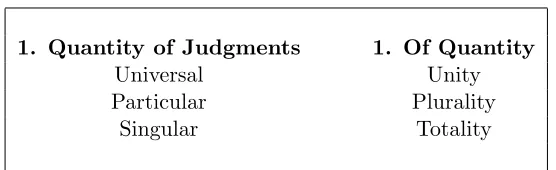
In this thesis, I look at a specific aspect of the debate between Longue-nesse and Friedman. One of the problems in LongueLongue-nesse’s interpretation Friedman points to concerns her ideas about the relationship between the judgment forms and categories of Quantity. The relationship between this group of logical forms and categories is puzzling. Kant presents the logical forms and categories of Quantity in the following orders:
1. Quantity of Judgments 1. Of Quantity
Universal Unity
Particular Plurality
Singular Totality
The way Kant presents the categories and logical forms of Quantity suggests he links the category ‘unity’ touniversal logical form, the category ‘plurality’ to theparticular logical form and ‘totality’ to thesingularlogical form. In as far as we see there is a relationship between the categories and the forms of judgment, we would expect the category ‘totality’ to be linked touniversal
4SeeKCJ: 5. 5
judgments, and the category ‘unity’ to singular judgments. The categories of Quantity have therefore led to much discussion.
In her explanation of the relationship between the categories and the logical forms of Quantity, Longuenesse makes use of an argument Michael Frede and Lorenz Kr¨uger have provided in their article ‘ ¨Uber die Zuordnung der Quantit¨aten des Urteils und der Kategorien der Gr¨oße bei Kant’ (1970). In this article, Frede and Kr¨uger argue that Kant does not – as his judgment and category table suggest – link the categoryunity to universal judgments and the categorytotality to singular judgments, but that – in fact – he links
unity to singular judgments and totality to universal judgments. Longue-nesse uses this idea to explain the relationship between the logical forms and categories of Quantity. One of the problems Friedman points to in his criti-cism of Longuenesse is that Manley Thompson (1989) seems to have refuted Frede and Kr¨uger’s argument. Thompson shows that Kant sees the corre-spondence between the categories and logical forms of Quantity precisely as his tables in the Critique suggest. Friedman argues that Longuenesse’s empiricist Kant-interpretation cannot do justice to the role Kant ascribes to the categories of Quantity. That Longuenesse’s interpretation partly relies on a refuted argument confirms this claim.
In this thesis, I reconstruct the debate around the categories and logical forms of Quantity, and investigate the implications of this debate for Longue-nesse’s Kant-interpretation. In chapter 1, I discuss LongueLongue-nesse’s general interpretation of Kant’s Transcendental Analytic. Longuenesse regards the categories as concepts that express marks of objects that are generated by an activity of our human understanding: figurative synthesis. Figurative synthesis is an activity that helps generating the empirical objects we en-counter in our day to day lives. These are the objects we can form judgments about. Figurative synthesis is an activity of the understanding that aims at forming such judgments. In chapter 1, I clarify these ideas, and explain why Friedman thinks Longuenesse’s interpretation is rather empiricist.
also discuss which role Frede and Kr¨uger’s argument plays in Longuenesse‘s theory.
In chapter 3, I discuss Friedman’s criticism of Longuenesse’s interpreta-tion of the relainterpreta-tionship between the logical forms and categories of Quantity. Longuenesse’s ideas, Friedman argues, lead her to regard discrete magni-tudes as prior tocontinuous magnitudes. To understand the role of the cat-egories of Quantity, however, we must see continuous magnitudes as prior. Thompson’s refutation of Frede and Kr¨uger’s argument forms a second prob-lem for Longuenesse’s analysis. We will see what Thompson’s argument consists in.
In chapter 4, I evaluate the various arguments that play a role in the debate concerning the categories of Quantity. I argue, first, that Friedman’s criticism of Longuenesse is not completely justified. I show, moreover, that Thompson’s theory about the categories of Quantity is problematic. It is, therefore, possible to defend Longuenesse’s theory against these lines of crit-icism. Her theory, however, does lead to a serious problem. Longuenesse’s analysis of the categories of Quantity cannot be reconciled with Kant’s idea that judgments arerules.
Chapter 1
The Categories and the
Logical Forms
The reason we are justified to apply the categories to experience, we saw in the introduction, is that the categories are “a priori conditions of the possibility of experiences” (A94/B126). According to B´eatrice Longuenesse we can only understand why the categories make experience possible by looking at their relation to the logical forms of judgment. In this chapter, I will explain how Longuenesse interprets Kant’s claim that the categories make experience possible, and clarify how she sees the relation between the categories and the logical forms of judgment. At the end of this chapter, I will discuss Michael Friedman’s claim that Longuenesse’s ideas lead to a too empiricist reading of theCritique.
1.1
The
Inaugural Dissertation
To understand Longuenesse’s interpretation of theCritique of Pure Reason, it is useful to take a look at Kant’s Inaugural Dissertation: a book he wrote eleven years before theCritique. Having a look at this work will also help us understanding, at the end of this chapter, Friedman’s criticism of Longuenesse’s interpretation.
In the Inaugural Dissertation, Kant attempts to unite two important thought systems of his time: the metaphysical systems of Leibniz and Wolff on the one hand, and Newtonian physics on the other.1 In theDissertation, Kant presents some of the ideas that later became crucial to theCritique of
1
Pure Reason. For instance, he introduces the idea that we should distinguish between a sensible and an intellectual cognitive faculty, and the idea that space and time areforms of the sensible faculty.
By means of the sensible cognitive faculty, Kant states, objects can be
given to us. This, however, only provides us with representations of objects “as they appear” (Dissertation,§4, Ak.: 2:392). It does not provide us with representations of “things as they are” (ibid): ofnoumena. Objects are only given to us “as they appear” precisely because they are given by means of our sensible faculty. How an object is given by a being’s sensible faculty depends on the nature of that being’s sensible faculty. Different beings can have different kinds of sensible faculties, and thus sensibility only provides us with objects as they appear to us.
Specific to our sensible cognitive faculty, is that it has a certain form. Space and time are the forms of our sensible cognitive faculty. Everything we experience we must order into spatial and temporal relations. Therefore, the objects that are given to us necessarily stand in space and time. Because space and time are the forms of our sensible cognitive faculty, they are ‘transcendentally ideal’, notreal. Space and time do not exist independently from us. Although objects must be given to us in space and time, for beings with sensible faculties different from ours, this might be different. This is what makes space and time transcendentally ideal.
Kant calls theintellectual cognitive facultyunderstanding. In the Disser-tation, Kant distinguishes between two possible ‘uses’ of the understanding: thereal use (usus realis) and the logical use (usus logicus). The logical use of the understanding consists in the acts of judging and of reasoning. By means of these acts, Kant says, a “cognition”2 that “has been given, no matter how, [...] is regarded either as contained under or as opposed to a characteristic mark common to several cognitions” (§5, 2: 393). By means of the logical use of the understanding, we can, for instance, regard a sen-sible representation of a strawberry as “contained under” the characteristic mark ‘red’, or as “opposed to” the characteristic mark ‘blue’. The concept ‘red’, we can again order under higher concepts like ‘colour’. In the logical use of the understanding, we perform acts of these kinds.
The logical use of the understanding can be applied to different kinds of “cognitions”: to sensible representations and to concepts. If we apply it to sensible representations: cognitions provided by the sensible faculty, we bring those representations under concepts. In sensibility, objects are
2
given to us as mere “appearances”. By comparing multiple appearances and reflecting them under empirical concepts we generate experience. Objects we have brought under concepts are “objects of experience” orphenomena
(§5, 394). In the Dissertation, Kant does not say much about the relation between appearances and phenomena. The distinction between these two kinds of objects, however, returns in theCritique and is of great importance to Longuenesse’s interpretation. We will return to this distinction in the next section. For now, it is important to see that by means of the logical use of the understanding, we progress from sensibly given appearances to
experience: sensible cognition that is brought under concepts.
Although the intellectual faculty (understanding) is necessary to gener-ate experience of phenomena, our cognition of phenomena, Kant says, must be seen as sensitive, not asintellectual (ibid.). The reason for this is that the source of these cognitions is sensibility. Actually, this does not only hold for our empirical cognitions. Geometry provides us with sensitive cog-nitions too. It gives us “the principles of sensitive form” (393). Because the cognitions geometry and our experience of phenomena provide us with are sensible, they do not provide us with cognitions of things as they are in themselves, ofnoumena. Because we rely on sensibility for these cognitions, they are partly determined by the specific nature of our sensible faculty. They cannot, therefore, be cognitions of things in themselves.
This brings us to thereal use of the understanding. By means of the real use of the understanding concepts are not merely subordinated to each other, but – instead – “given” (ibid). By means of its real use, the understanding generates concepts whose source is not sensibility, but understanding itself: “concepts of the understanding” (§9, 395). Examples of such concepts are
possibility,existence,necessity,substance,cause (§8, 2:395) and alsonumber
(§12, 397). These concepts are not innate. Their source is the understanding itself, but they are “abstracted from the laws inherent in the mind” (§8, 395). It is in this sense that the understanding is the source of these concepts.
By means of the concepts of the understanding, pure intellectual cogni-tion is possible. Pure intellectual cognicogni-tion, contrary to the sensitive cog-nition of empirical science and geometry, can provide us with cogcog-nition of
noumena, or “things as they are” (§4, 392). The goal of metaphysics is to acquire knowledge by means of precisely these concepts (§9, 395-6). Meta-physics acquires knowledge by analyzing these concepts (KCJ: 27).
129-35) that it is unclear how the concepts of the understanding or categories
can have a relation to an object (KCJ: 27). It is this question the Critique
tries to answer (26).
1.2
Objects and the Categories
Although many ideas of theInaugural Dissertationreturn in theCritique of Pure Reason, there is one crucial idea that Kant revises: he abandons the idea that the concepts of the understanding, the categories, apply to “things
as they are” (noumena). If the categories have a relation to objects at all, they have a relation to phenomena. However, Longuenesse points out, how the categories can have a relation to phenomena does not become clear from theDissertation either: why would concepts that are “abstracted from the laws inherent in the mind” relate to empirical objects outside the mind? (ibid)
Kant’s answer to this question, Longuenesse argues, is closely related to another question: what enables representations in general to relate to objects? In the Critique, Kant distinguishes two kinds of ‘objective’ repre-sentations: intuitions and concepts.3 These two representations are closely connected to the two kinds of objects we saw in the previous section: ap-pearances and phenomena. The objectivity of intuitions and concepts re-sults from a complex interaction between these two kinds of representations. Without intuitions, concepts do not relate to objects, but without concepts, intuitions do not have a real relation to an object either.4 The objectivity of both concepts and intuitions is again generated by certain acts of the under-standing: precisely those acts the understanding performs in its logical use. The “laws inherent in the mind” from which the categories are abstracted are the laws that govern these acts (ibid). In this section, we will see what the interaction between intuitions, concepts and categories consists in.5
In theCritique Kant thinks (as he did in theDissertation) that objects outside our cognition ‘affect’ our sensible cognitive faculty. These ‘objects’
3See A320/B376-7 4
We could see this idea as Longuenesse’s interpretation of Kant’s famous dictum “Thoughts without content are empty, intuitions without concepts are blind” (A51/B75)
5
are probably the ‘things in themselves’ or noumena (300). Kant’s point in the Critique is that being affected by such objects is not, in itself, enough torepresent an object. When an object affects us, this generates so called
sensations. Sensations are representations, but they do not – in themselves – represent an object.6 They are – as Longuenesse puts it – mere ‘state[s] of the subject’ (219). An object can, for instance, generate the sensation of warmth in me, but my sensation of warmth is not, in itself, a representation of an object. To represent an object on the basis of such a sensation, we need to fulfil certain extra conditions.
The first condition that needs to be fulfilled to represent an object Kant discusses in the part of theCritique that is called the ‘Transcendental Aes-thetic’ (23). The main idea from the Transcendental Aesthetic we already encountered in theDissertation: our sensible faculty necessarily represents objects in space and in time. The first condition that needs to be fulfilled to represent an object is therefore that the sensations the affecting object generates are ordered into space and time. Ordering sensations into space and time generatesintuitions, orempirical intuitions, to be precise (219-20). Space and time themselves – the forms of the sensible faculty – arepure in-tuitions (A20/B34-5). Placing sensations into space and time is necessary to represent objects, but it is not sufficient. If we would only order sensa-tions into space and time, we would represent objects, but we would only representappearances, notphenomena (KCJ: 24). The relation between ap-pearances en phenomena becomes clearest if we look at an example. Imagine the situation in which I have never seen a house in my entire life, and now see one for the first time. In this situation, I will see the house, but I will not see the houseas house. I will see a collection of shapes and colours, but this is something different than seeing the house as house. Empirical intu-itionsalone would only provide us with such representations of shapes and colours, not with a representation of a house ‘as house’.7 For this reason, in-tuitions in themselves do not have a real connection to an object. Inin-tuitions represent an object, but they do not represent it “‘as” object’ (24).
What is it that provides intuitions with a connection to an object ‘as object’ ? This is what aconcept does. Let us return to the house-example. Most of us will, when we see a house, see the houseas house. The reason for this is that most of us have formed the concept ‘house’. Because we have formed the concept ‘house’, houses are given to us asphenomena. An
6
See again A320/B376-7.
7Longuenesse discusses this particular example atKCJ, p. 117-8 and a similar example
empirical concept like ‘house’, Kant thinks, expresses a so called empirical
schema. A schema that belongs to an empirical concept is a kind of ‘rule’ that tells me which features an object that can be thought under this con-cept has. Here, one should not think of some explicit, discursive rule, but something that we could call a ‘sensitive rule of thumb’. Kant himself gives the example of the schema of the concept ‘dog’:
The concept of a dog signifies a rule in accordance with which my imagination can specify the shape of a four-footed animal in general, without being restricted to any particular shape that experience offers me or any possible image that I can exhibit in concreto. (A141/B180)
If I am given the intuition of a house, the schema of ‘house’ will lead me to expect the house to have certain features, because – as a rule of thumb – houses have these features. It will make me concentrate on certain marks of the house, and will make me ignore others (KCJ: 118). I will expect the house to have a backside, a roof and an entrance, and I will expect it to be impossible to walk through its walls. This is what it means to represent a house as house. When I see a house as house, the shapes and colours given to me in intuition become part of the house as object. The concept ‘house’, or – rather – the schema this concept expresses, thus provides the intuition with a relation to an object as object.8 It relates the intuition to a phenomenon (24-5). This what Kant means when he says:
But there are two conditions under which alone the cognition of an object is possible: first, intuition, through which it is given but only as appearance; second,concept, through which an ob-ject is thought that corresponds to this intuition. (A92/B125)9 8Another example that might be helpful to understand the working of empirical
schemata is the duck-rabbit picture Wittgenstein famously uses in hisPhilosophical In-vestigations. If we would neither have the concept of ‘rabbit’, nor the concept of ‘duck’, all we would see in this picture would be a collection of lines. Because we have developed the concepts of ‘rabbit’ and ‘duck’, however, we are capable of seeing both a duck and a rabbit in this picture. If we bring the sensibly given lines under the concept of ‘rabbit’ this makes us see certain lines in the picture as the long ears we expect the rabbit to have. If we bring the intuition under the concept ‘duck’, on the other hand, we take those same lines to be the beak we expect ducks to have. This example shows that what we perceive is underdetermined by what is sensibly given, and that our perception is partly determined by concepts.
9
We now understand in which sense concepts are necessary to relate intuitions to objects. The question we are trying to answer in this section is why the
categories relate to objects. To understand this, we need to consider under which conditions forming empirical concepts and the empirical schemata these empirical concepts express is possible (KCJ: 51n.).10 The schema that belongs to the concept ‘house’, we saw, makes me expect certain things about objects I recognize as houses. However: to have such expectations, I must have seen a considerate amount of houses before (117-8). Now the problem is that if all that would be given to me were intuitions of a house, no representation of a houseas house would be given to me. I would, therefore, not be able to have any repeated observations of houses as houses either, and thus I would not be able to form the schema of a house (44-7). As I do have formed empirical schemata, the question is what has enabled me to acquire those schemata.
I will start with a brief answer to this question. What is necessary to form empirical schemata, Longuenesse thinks, is an activity Kant callsfigurative synthesis or synthesis speciosa. This activity consists in an “effect” the understanding has on sensibility (B125). In section 2.5, I will say more about figurative synthesis. For now, we are interested in theresultof this synthesis. Due to the activity of figurative synthesis, we do not represent objects as mere appearances before we have formed empirical concepts. Before we have formed empirical concepts, we already represent some sort of phenomena. If I have not yet formed the concept ‘house’, then still some sort of house will be given to me by figurative synthesis. My representation of the house might not be as clear as that of a person who does possess the concept ‘house’, but at least I represent some object.11 We could call this object
10
Here, I present Longuenesse’s theory slightly differently that she herself does. Longue-nesse suggests that Kant provides a theory about how concepts are formed (see, for in-stance,KCJ: 51n.; 111-22). I do not think this is the case, or at least I do not think Longuenesse provides a successful reconstruction of such a theory. A theory that explains how concepts are formed should provide us with necessary and sufficient conditions for concept formation. This is not what Kant, according to Longuenesse’s reading, provides us with. What Kant presents are certainnecessaryconditions for concept formation. For Longuenesse’s reconstruction of Kant’s arguments, this suffices. As we will see, she aims to show that the categories are necessary conditions for concept formation.
11Longuenesse does not explicitly explain these points in this way. That this is how she
sees this we can infer, in particular, from her analysis of the A-Deduction (esp. KCJ: 38-52) in combination with her interpretation of Kant’s ideas about concept-formation (esp.
a ‘proto-phenomenon’.12 Representing houses as proto-phenomena enables us to encounter a great number of these objects, to compare them, and to abstract certain common features that will eventually form the schema of ‘house’. These ideas help understand one of Kant’s puzzling remarks in the Metaphysical Deduction:13
Prior to all analysis of our representations these must first be given, and no concepts can arise analytically as far asthe con-tent is concerned. The synthesis of a manifold, however, (whether it be given empirically or a priori) first brings forth a cognition, which to be sure may initially still be raw and con-fused, and thus in need of analysis; yet the synthesis alone is that which properly collects the elements for cognitions and uni-fies them into a certain content [...] (A77-8/B103)
Figurative synthesis provides us with cognitions that may “still be raw and confused”. These representations I have called the ‘proto-phenomena’. Analysis is the process by means of which we compare these proto-phenomena and form an empirical schema on the basis of them. This enables us to bring these proto-phenomena under an empirical concept.
We now see why intuitions only acquire a real relation to an object by means of a concept. Moreover, we see that empirical concepts themselves are made possible by the act of figurative synthesis. To understand what provides the categories with a relation to an object, we have to look at another dependency relation: concepts themselves needintuitions to relate to objects.
To be a concept, Kant thinks, a representation needs to fulfil one de-mand: the representation needs to be general. This means that it needs to express a mark that multiple representations can have in common. This mark must be ‘contained in’ these representations, like ‘red’ is contained in the representation of a tomato.14 For a concept to be a concept, it suffices that it represents a mark several other concepts have in common. For a concept to be related to anobject, however, the concept must also express a mark that multipleintuitions can have in common.15 The reason for this
in A-Deduction with ’figurative synthesis’ atibid: 35-6).
12My terminology. 13
See also Longuenesse, 1998b: 150-2
14
This example I derive from Wolff (1995): 65-6. Longuenesse uses a similar example in Longuenesse, 1998b: p. 136.
15
is that objects can only be given to us by means of an intuition. If a con-cept relates to an object, it relates – by definition – to an object given in intuition.
So: to relate to an object, a concept must express a common mark of various objects given in intuition. Such a common mark must be ‘contained in’ the intuition. Now Wolff (1995) points out that intuitions can have dif-ferent kinds of ‘contents’ (Longuenesse sees this similarly: see Longuenesse, 1998b: 136-7, but she does not provide such a systematic overview). For this reason, different kinds of ‘objective’ concepts are possible. First, concepts like ‘red’ are objective. Objects given in intuition contain matter, which is given to us by means of sensations. A concept like ‘red’ is objective, because it expresses the matter that is contained in certain objects given in intuition. Second, geometrical concepts like ‘round’ are objective. The fact that ob-jects are given in the pure forms of space and time provides these obob-jects with a kind of content too: it provides them with certain spatial and tempo-ral marks. This provides concepts like ‘round’ with a relation to an object. The categories form the third kind of objective concepts. Objects can have a third kind of content: “transcendental content” (A79/B105). This content is generated because the objects that are given to us are partly generated by figurative synthesis. This too provides these objects with certain marks.16 The reason the categories have a relation to an object, is that they express those aspects of objects that are generated by figurative synthesis: As Kant says: “pure synthesis, generally represented, yields the pure concepts of the understanding.” (A79/B104) (Wolff, 1995: 67-9)
We now see what the complex interaction between intuitions, concepts and categories consists in. Intuitions only relate to phenomena because of
concepts. Concept formation is again made possible because the activity of figurative synthesis provides us with what I have called ‘proto-phenomena’. Figurative synthesis provides these proto-phenomena and the phenomena we form on the basis of them with certain marks. Concepts relate to objects because they express a mark that various objects can have in common. This enables us to answer our main question: The categories relate to objects be-cause they express those marks that are generated by figurative synthesis (see Figure 1).
=
⇒
analysis
=
⇒
figurative synthesis
n n n proto-phenomena
n n n z }| { 0000000000000000000000000
‘House’
transcendental content
transcendental content
6
category
Figure 1
1.3
Forms and Functions of Judgment
We now understand what provides the concepts of the understanding, the categories, with a relation to an object: The categories express those marks of objects that result from the act of figurative synthesis by means of which the understanding helps generating these objects. We do not yet grasp, however, what the relation between the logical forms of judgment and the categories consists in. To understand this, we need to have a closer look at these logical forms.
The reason Kant derives the categories from the logical forms of judg-ment, is that, for some reason, these logical forms can tell him which cat-egories there are. Why would this be the case? The catcat-egories, we saw, express the result of the act of figurative synthesis. According to Longue-nesse, Kant reasons as follows: If we want to know which categories there are, it is important to know how this act of figurative synthesis functions. If we know more about this act, it might become possible to say which con-cepts express the results of this act. Now Kant believes, for some reason, that the table of logical judgment forms provides us with information about the act of figurative synthesis. In this section and the following, we will see why this would be the case.
that, I think, underlie Longuenesse’s theory are explained very clearly by Wolff (1995).17 In this section, I will explain these ideas. This will help us understanding Longuenesse’s interpretation.
How does Kant provide us with a systematic overview of types of acts the understanding can perform? According to Kant the only act the un-derstanding can perform is judging. Kant says: “[T]he cognition of every, at least human, understanding is a cognition through concepts” (A68/B93). The understanding, however, “can make no other use of these concepts than that of judging by means of them” (A68/B93) (Wolff, 1995: 105). The act of judging is the act we perform in what Kant – in the Dissertation, but also in theCritique – calls the “logical” use of the understanding. The un-derstanding can only judge, but we can judge in different ways.18 Within
the act of judging, moreover, we can perform certain other acts. Actions in general often ‘contain’ other acts. The act of cycling, for instance, ‘contains’ the acts of steering and moving one’s legs (22).19 The act of judging, like the act of cycling, is a complex act that contains certain other, elementary acts (27). Kant wants to give a systematic overview of theelementary acts the understanding can exercise within the act of judging.
Kant partly acquires this systematic overview by looking at the result
of the act of judging. The result of the act of judging is ajudgment: a cer-tain linguistic object. Judgments as linguistic objects have a cercer-tainlogical form. The logical form of a judgment is what we get if we abstract from the content of the concepts contained in it (121). A judgment like ‘All mam-mals are mortal’ has the same logical form as the judgment ‘All humans are rational’. The form of both judgments, however, differs from the form of the judgment ‘If an animal gets no food, it dies’. We can distinguish between complex and elementary forms of judgment. What we get if we abstract from the content of the concepts contained in a certain judgment, is thecomplex logical form of that judgment. The complex logical form of a judgment contains different ‘moments’. The judgment ‘All mammals are mortal’ has the complex logical form of a universal, affirmative, categorical, assertoric judgment.20 The ‘moments’ contained in this form are the univer-sal logical form, the affirmative logical form, the categorical logical form and
17
Wolff’s (1995) main project is to provide a reconstruction of Kant’s completeness proof for the table of judgments. I will not, here, evaluate Wolff’s project. The reason I discuss Wolff is that, in the course of his project, he provides a very clear analysis of certain aspects of Kant’s thought.
18
What these ways are will become clearer later on.
19
Wolff’s example.
the assertoric logical form. These logical forms areelementary logical forms. Kant’s Table of Judgments lists the twelve possibleelementary logical forms of judgments (12). The table divides these twelve forms into four groups: the quantitative, the qualitative, the relational and the modal logical forms. Kant’s table of twelve elementary judgment forms provides him with what he is looking for: a systematic overview of the possible elementary
action-types performed in judgments. The table of judgment forms can fulfil this function, because it is supposed to be complete. Wolff believes that the Metaphysical Deduction provides a completeness proof for this table. Here, I will not discuss Wolff’s reconstruction of Kant’s proof. What is of interest to us is the following: assuming that the table of judgment forms is complete, why would it provide us with a systematic overview of possible action-types the understanding can perform?
This, Wolff explains as follows. The act of judging is a complex action that ‘contains’ certain elementary actions. The elementary action-types that can be exercised within the act of judgment Kant calls functions of the un-derstanding. The action of judging itself, Kant calls a function too. The action of judging we can regard as acomplex function that contains certain elementary functions (26-27). Within one judgment-act, we can exercise dif-ferent elementary functions. Now the idea is that the elementary functions we can exercise in the act of judging stand in a one to one correspondence to the elementary logicalforms a judgment as linguistic object can contain. Just like there are twelve elementary forms of judgment, there are twelve elementary functions of the understanding we can exercise in judgment. The idea is that the elementary functions we exercise in a judgment determine the logical form of the resulting judgment. If the complex logical form of a judgment contains a certain elementary logical form, this means that in forming this judgment, we exercise the corresponding function (20). So, in forming the judgment ‘All mammals are mortal’, we exercise the uni-versal function, the affirmative function, the categorical function, and the assertoric function.
concept ‘humans’. This already provides us with two different ways in which a concept can be used: the concept ‘rational’ is used ‘predicatively, the con-cept ‘humans’ is used ‘non-predicatively’ (80-1). Now the idea is that we can use concepts in a ‘quantitative’, a ‘qualitative’, a ‘relational’ and a ‘modal’ way. The quantitative functions of the understanding all consist in pred-icative uses of concepts in judgments. In the predicative use of concepts, we order the non-predicatively used concept under the predicatively used one. This act can again be exercised in three different ways: We can order ‘this human’, ‘some humans’ or ‘all humans’ under the concept ‘mortal’. This provides us with three different ‘elementary’ ways of using concepts in judgments (77). These uses are what the quantitative functions consist in. The qualitative, relational and modal functions can also be understood as specific uses we make of concepts in judgments.
The role of Kant’s Table of Judgments is now getting slightly clearer. The table provides us, first, with the twelve possible elementary results of the act of judging: the twelve elementary logical forms a judgment can have. More importantly, however, it provides us with the twelve elemen-tary acts that can be exercised in judging: the elemenelemen-taryfunctions of the understanding. As the understanding can only judge, this provides us with a systematic overview of acts the understanding can perform. Kant, we saw, needs such a systematic overview to get insight in the act of figurative synthesis. Because figurative synthesis is an activity the understanding ex-ercises, and the understanding can only perform actions that are contained in the act of judging, figurative synthesis and judgment must somehow be closely related. In the next sections, we will see what their relationship consists in.
1.4
Judgment and Objectivity
To get insight into the relationship between the activity of judging and fig-urative synthesis, we need to look at a specific aspect of the act of judging. This aspect of judging is itsobjectifying role. In the Transcendental Deduc-tion (B-ediDeduc-tion), Kant defines judgments as follows: “a judgment is nothing other than the way to bring given cognitions to the objectiveunity of ap-perception.” (B141)21 This definition, Longuenesse thinks, expresses the objectifying role Kant assigns to judgments.
21As I said before, Longuenesse assumes the A- and B-Deduction complete each other
To understand what the ‘objectifying’ role of judgment consists in, we must first note that not everything that we might call a judgment confirms to Kant’s definition of judgment. Only if concepts are combined according to certain (complex) logical forms they “bring given cognitions to the objective unity of apperception”. The table of judgments only lists the elementary logical forms that such judgments can contain.
We can see what distinguishes Kant’s judgments from other sentences by looking at an example. First, consider the sentence ‘I hold this stone and I feel warmth’. A sentence like this expresses a combination of two representations (the representation of the stone and the representation of warmth), but it expresses a subjective combination. It expresses that the representations ‘stone’ and ‘warmth’ are combined inmy consciousness (con-sciousness is an aspect of apperception). Now compare this judgment with a Kantian judgment like “Bodies are heavy” (Kant’s example in B142). This judgment, contrary to the previous one, expresses that the representations ‘body’ and ‘heavy’ are connected in an object (KCJ: 88-9). It expresses, therefore, that the representations ‘body’ and ‘heavy’ are combined inde-pendently from me. It states that this combination holds not just for my
consciousness, but for any consciousness. Not just for me, but for anyone (88). This is typical for what Kant calls judgments: Judgments express an
objective unity of representations, not a mere subjective one.
Now what is important to note, is that the objectivity of a judgment relies on its form. We need to distinguish, therefore, between the objective form of a judgment, and the ‘matter’ of that judgment. A judgment that has an objective form may not be true. If I have only encountered white swans, I might form the judgment ‘All swans are white’. This judgment is false, but it is an objective judgment as to its form. The material ‘filling’ of the form of a judgment depends on accidental empirical circumstances, in this case: the circumstance that I have never encountered a black swan. Still, the judgment ‘All swans are white’ expresses that the concepts ‘swan’ and ‘white’ are related this way not just for me, but for everyone. In this sense, the judgment still is ‘objective’ (82-3).
We can now see what the ‘objectifying’ role of the activity of judging consists in: The activity of judging generates judgments with the logical forms which link concepts to objects.
1.5
Sensible Forms of Objectivity
We now see that there is a relationship between logical form and objectiv-ity. The objectivity of judgments is due to their form. Now Longuenesse thinks that the sensibly given ‘proto-phenomena’ are made possible by cer-tain forms too. Recall the house example, and again imagine we see the house for the first time in our lives. The house will be given to us by means of an intuition. This intuition will only provide us with a certain aspect of the house: its front, for instance. Other aspects of the house can be given to us as well. If, for instance, we walk around the house, this will provide us with intuitions of the other sides of the house. The problem is, however, that merely perceiving the aspects of the house does not – in itself – make us represent the house as an object (as a ‘proto-phenomenon’22). If we only perceive those various aspects, we represent those aspects, but we do not represent them as the various aspects ofone object. This, however, is what is required to represent the house as object. Kant makes this point when stating:
Without consciousness that that which we think is the very same as what we thought a moment before, all reproduction in the series of representations would be in vain. For it would be a new representation in our current state, which would not belong at all to the act through which it had been gradually generated, and its manifold would never constitute a whole [...] (A103)23
Now how can a “series of representations” ever “constitute a whole”? How can we represent the various aspects of an object as the aspects of one object? We will only represent the various aspects of an object as forming a “whole”, if we take a combination of those representations to be in some sensenecessary, not arbitrary. We must take our representations to belong together according to arule.24 This idea has to do with Kant’s ideas about the relationship between objects and concepts. In section 1.2, we saw that we only really represent an object ‘as object’ (as phenomenon) if we have developed an empirical concept and the empirical schema belonging to that concept. The schema of an empirical concept, we saw, is a kind of ‘rule’ 22Remember that the term ‘proto-phenomenon’ is mine, not Kant’s or Longuenesse’s. 23
KCJ: 44-7
24
that tells us which characteristics we should expect from an object thought under this concept. Now if I represent an object as proto-phenomenon, this actually means that I take it to be possible to form an empirical schema on the basis of this object. This means that I take certain representations (my representations of the various aspects of the house) to belong together according to a rule.25
If I represent certain representations according to a rule, this does not yet provide me with an empirical schema. To acquire an empirical schema, I must first observe various proto-phenomena of a specific kind. Regarding certain representations as belonging together according to a rule, however, is necessary to represent these proto-phenomena. We could say that these proto-phenomena containpotentialschemata or ‘proto-schemata’. If we have encountered a considerate amount of proto-phenomena of a certain kind, we ‘actualize’ the schema they contain and acquire the corresponding concept (118-20).
So, if I take a combination of sensible representations to form an object, then I take the combination of these representations to benecessary. How-ever: What makes me take a combination of sensible representations to be necessary? This, Kant seems to say, I do by taking them to be representa-tions of anobject:
We find, however, that our thought of the relation of all cognition to its object carries something of necessity with it, since namely the latter is regarded as that which is opposed to our cognitions being determined at pleasure or arbitrarily rather than being determined a priori, since insofar as they are to relate to an object our cognitions must also necessarily agree with each other in relation to it, i.e., they must have that unity that constitutes the concept of an object. (A104-5)
But this would mean that we represent objects because we link our repre-sentations to an object. This sounds circular. This explanation can become non-circular if we distinguish the various kinds of objects we have seen from a new kind of object: the transcendental object.26
25This I infer fromKCJ: 44-7, although Longuenesse explains these points differently. 26
What I have called ‘proto-phenomena’ are, in essence combinations of sensible representations: ofappearances(109). We want to explain how these proto-phenomena are generated. Now consider sensible representations A,
B, C and D. Although a proto-phenomenon is a combination of sensible representations, not every combination of sensible representations is a proto-phenomenon. The idea is that representations A, B, C and D can only form a proto-phenomenon if I take the combination of these representations to be in some sense ‘necessary’. What Kant seems to say in the above passage, is that what can bestow necessity upon a certain combination of representations is the “thought of the relation” of these representations to their “object”. This object is a different kind of object: thetranscendental
object. Although proto-phenomena cannot be entirely given to us at once (we always see, for instance, only one side of the house), they are still given to us in the sense that the different representations they are built up from are given to us. Thetranscendental object, on the other hand, is not given to us at all. It is “an object corresponding to and therefore also distinct from the cognition” (A104). Kant says:
It is easy to see that this object must be thought of only as something in general = X, since outside our cognition we have nothing that we could set over this cognition as corresponding to it.’ (A104)
So, unlike the proto-phenomena, this “something in general = X” is not given to us at all. Now in what sense can representationsA,B,C andDbe said to have a relation to a transcendental object “X”, if this object is not itself given to us? That what provides representationsA,B,C and Dwith a relation to a transcendental object can only be some ‘cognitive act’:27
It is clear, however, that since we have to do only with the man-ifold of our representations, and that X which corresponds to them (the object), because it should be something distinct from all of our representations, is nothing for us, the unity that the object makes necessary can be nothing other than the formal
circular by considering Kant’s use of the notion ‘object’. Here she does not explicitly link this explanation to Kant’s notion of atranscendental object. In her discussion of the A-Deduction, however, she states that the ‘necessity’ that plays a role in the A-Deduction is clarified in the Analogies (seeibid: 49n.).
27
unity of the consciousness in the synthesis of the manifold of the representations. Hence we say that we cognize the object if we have effected synthetic unity in the manifold of intuition. (A105) What makes a combination of representations A, B, C and D a necessary
combination, is that Itake each of the representationsA,B,C andDto be representations of an object “X” not itself given to us. TakingA,B,Cand
D to be representations of an object “X”, however, consists in a cognitive act. By means of this act, I effect “synthetic unity” in the manifold of the representationsA,B,C andD. This is what combines these representations into a proto-phenomenon.
The cognitive act by means of which I link representations to an object =X is, of course, the act of figurative synthesis. The act of figurative syn-thesis is similar to the act of judging. The act of judging, we saw in the previous section, consists in combining concepts in a way that links them to an object. The act of judgment links concepts to an object by combining these concepts according to the (complex)logical forms of judgment. In the act of transcendental synthesis, we do something similar. In transcendental synthesis, we combine sensible representations according to certain forms. We do not combine them according to the discursive logical forms of judg-ment but according to certainsensible forms (KCJ: 184-5). If we combine sensible representations according to these sensible forms, this links these representations to a transcendental object “X”. This provides us with the objects I have called ‘proto-phenomena’. It generates combinations of repre-sentations that contain ‘potential’ schemata. In judgment, we could say, we combine concepts according todiscursive forms of objectivity. In figurative synthesis, we combine sensible representations according to sensible forms of objectivity.
1.6
Judgment and Time
In 2.5, we saw that figurative synthesis, like judgment, must consist in an objectifying activity. Because figurative synthesis is exercised by the un-derstanding, and the understanding can only judge, judgment and synthesis must be closely related. The question is: what does their relation consist in?
In the Metaphysical Deduction, Kant states:
The same function that gives unity to the various representa-tions in a judgment also gives unity to the mere synthesis of different representationsin an intuition,which, expressed gen-erally, is called the pure concept of understanding. The same understanding, therefore, indeed by means of the very same ac-tions through which it brings the logical form of a judgment into concepts by means of the analytical unity, also brings a transcen-dental content into its representations by means of the synthetic unity of the manifold of intuition in general, on account of which they are called pure concepts of the understanding that pertain to objectsa priori [...] (A79/B104-5)
We now understand this passage to a certain extent. We know that the understanding “introduces a transcendental content into its representations by means of the synthetic unity of the manifold in intuition”: in figurative synthesis, the understanding generates those marks of objects the categories express. This is transcendental content. So, in figurative synthesis, the understanding “gives unity to the mere synthesis of various representations
in an intuition, and this unity, universally represented, we entitle the pure concept of the understanding”: The categories express the “synthetic unity” the understanding generates.28 The question is: what does it mean that “[t]he same function which gives unity to the various representations in a judgment also gives unity to the mere synthesis of various representations
in an intuition”?
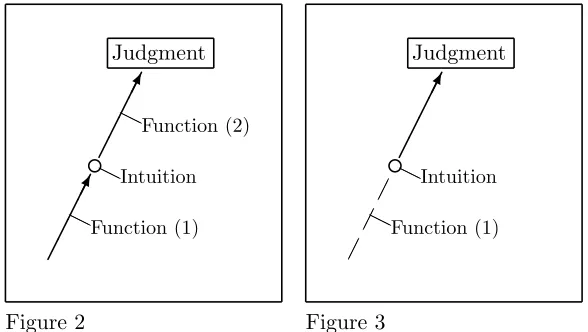
The first question we need to answer, is what Kant means when he says that “the same function” generates two kinds of “unity”. The “function” Kant mentions in this passage is the complex function we exercise in the act of judging. The question is in what sense “the same” complex func-tion that combines concepts into a discursive unity, can combine sensible representations into a certain unity.
It seems we can interpret this passage in at least two ways. One way we could interpret this passage is to say that in actions of synthesizing a
sensible manifold, we exercise the same kind of action that we exercise in acts of judging. This would mean that Kant means by “the same function” that we exercise one type of action (function) twice: we exercise it in two distinct actions. (see Figure 2) Another possibility is that the act of judging begins ‘earlier’ than we might think. This would mean that synthesizing a sensible manifold and forming a discursive judgment consists – somehow – in
one action, in which we perform one type of action (function) and exercise itonce (see Figure 3).
[image:31.612.146.440.248.414.2]Function (1) H H Function (2) H H Intuition H H e Judgment Function (1) H H Intuition H H e Judgment
Figure 2 Figure 3
Longuenesse chooses the latter interpretation: ‘Only insofar as we strive to form judgments (combinations of concepts) do we generate in the sen-sible given of intuition the forms of unity providing their content to the categories.’ (KCJ: 201) What this means exactly will become clearer later on.
A second, related, question we need to ask, is what exactly the sensi-ble objective forms i.e. the forms according to which we combine sensisensi-ble representation in figurative synthesis,are. How can the understanding gen-erate other forms besides the discursive forms of judgment? This question, Longuenesse thinks, Kant answers in§24 and §26 of the B-Deduction (185-6). The functions of the understandingalone would not be able to generate sensible objective forms. The understanding alone, Kant says, would only be able to perform a synthesis that is “purely intellectual” (B150). Such an intellectual synthesis (synthesis intellectualis) is the synthesis of concepts that takes place in judgment. However:
can determine the manifold of given representations in accord with the synthetic unity of apperception, and thus think a pri-ori synthetic unity of apperception of the manifold of sensible intuition[...] (B150)
The understanding does not generate the sensible forms of objectivity on its own, but it generates these forms in cooperation with the sensible faculty, with the “form of sensible intuition a priori”. The understanding has an “effect” on sensibility (B152). The understanding generates the sensible forms of objectivity by affecting thea priori forms of sensibility.29
The sensible forms figurative synthesis generates are forms by means of which we take sensible representations to be standing in one objective time, and – by means of that – in one objective space.30 To understand this, we must first note that there is a difference between ‘objective’ and ‘subjective’ time. Kant calls time the form of “inner sense”. This means, basically, that for us to become conscious of a representation, it must be placed in time.31 So, for me to become conscious of the various sides of a house, I must successively represent each of these sides. This process necessarily takes place in time: I must represent each side at a different moment. Now time as form of inner sense should be distinguished from ‘objective’ time. That the various sides of a house are successively given to me, does not imply that these sides ‘objectively’ succeed each other. Objectively, these various sides all exist at the same time. For this reason, we should distinguish between objective and subjective temporal relations among our sensible representations.32
Now Kant’s idea is that without figurative synthesis, I would not rep-resent objective temporal relations. There would be no distinction between the situation in which I successively perceive the various aspects of a house, and the situation in which I perceive, for instance, the successive states of a 29These points I infer from Longuenesse’s analysis inKCJ, chapter 8 (in particular: p.
216-8 and p. 241n.)
30
Longuenesse does not say this very clearly. That this is how she sees this, I infer fromKCJ, chapter 8, in particular p. 241n., fromibid: p. 184-5 and fromibid: p. 324. How exactly Longuenesse sees the relationship between time and space remains slightly unclear.
31
See Hannah (2005) p. 260-1 for an enlightening discussion of this point.
32“The apprehension of the manifold of appearance is always successive. The
moving ship. The objective sensible forms according to which we combine sensible representations in figurative synthesis consist in objective tempo-ral relations like succession and simultaneity.33 Combining sensible repre-sentations in sensible synthesis consists in taking these reprerepre-sentations to be standing in such objective temporal relations. Transcendental synthesis makes me take the different sides of a house to existsimultaneously, whereas I take the different representations of a sailing ship to besuccessive states of that ship.34
An interesting result of this is that transcendental synthesis can also provide us with deceptive perceptions. In judgments, we saw, we had to distinguish between the objective form of that judgment and its subjective ‘filling’. For the sensible forms, we need to make the same distinction. We have to distinguish between the objective form that temporal relations have, and the subjective filling of these forms. According to Longuenesse, even deceptive experiences are a result of ‘filling’ objective sensible forms. That I first see lightning, and then hear thunder, for instance, is the result of the fact that I have ‘filled’ the objective temporal form ‘a succeeds b’ with my representations of lightning and thunder (184-5). Even though our representation of objective temporal relations may in some cases lead to deceptive experiences, representing such objective temporal relations is a condition for the acquisition of more reliable experience. If we would not represent objective temporal relations, we would not have experience at all. So: the sensible objective forms consist in objective temporal relations. Now what exactly is the relationship between these temporal relations and the categories? In section 2.2, I stated that the categories express the ‘result’ of figurative synthesis. According to Longuenesse, the result of figurative synthesis has different aspects.35 The transcendental schemata, or “tran-scendental time-determinations” (A139/B197) that Kant introduces in the Schematism-chapter form the various aspects of the result of figurative syn-thesis (245). The different categories express these different aspects of the result of figurative synthesis. In the next chapter, we will have a closer look
33This I infer fromKCJ: 185. Kant discusses the ship-example at A192-3/B237-8. 34
Some readers may ask whether this is not only the task of one specific group of categories: the categories of Relation. This is correct. However, as figurative synthesisin generalalwayscontainsan act of synthesis according to the categories of Relation (among other acts of synthesis), objective temporal relations form thegeneral result of figurative synthesis. I will say more about this point in the next chapter.
35
at this idea.
1.7
The Categories and the Logical Forms
We are now, finally, in the position to see how Longuenesse understands the relationship between Kant’s two tables: his ‘Table of Judgments’, and his category table. The Table of Judgments, we saw in section 2.3, not only lists the twelve elementary logical forms of judgments, but also the twelve logical functions of the understanding. The logical functions of the under-standing are the twelve elementary types of actions the underunder-standing can perform. The understanding applies these functions when it combines con-cepts according to the logical forms of judgment. Before the understanding applies its functions in combining concepts, however, these functions affect sensibility in figurative synthesis. This figurative synthesis generates the very objects about which we can form judgments.
According to Wolff, we saw in section 2.3, Kant sees the act of judgment as a complex act that ‘contains’ various elementary actions. In judgment we exercise a complex function that consists of various elementary functions. Although Longuenesse does not explicitly say this, her idea seems to be that the act of figurative synthesis should be seen as a complex act too. This complex act of synthesis, ‘contains’ various elementary acts of synthesis. These elementary acts generate the different transcendental schemata: the different aspects of the result of transcendental synthesis. Kant’s categories express these transcendental schemata. In the next chapter, we will have a closer look at the various elementary acts of synthesis. First, however, we will consider why Longuenesse’s general interpretation has raised criticism.
1.8
Friedman’s Criticism
We now understand how Longuenesse sees the relationship between the log-ical forms of judgment and the categories. Also, we understand how she interprets the idea that the categories are “a priori conditions of the possi-bility of experiences” (A94/B126). Longuenesse’s ideas about the relation-ship between the categories and the logical forms lead her to adopt a quite specific interpretation of the first Critique. She understands Kant’s claim that the categories are “a priori conditions of the possibility of experiences” in a quite specific way.
notion ‘category’. What makes experience possible are the functions of the understanding. These functions affect sensibility, and this enables us to represent objects. In as far as the categories make experience possible, therefore, they arenot the categories Kant lists in his Table of Categories: concepts like ‘cause’, ‘substance’ or ‘unity’. They are not the categories as ‘full-fledged concepts’, as Longuenesse calls them (KCJ: 12). The categories as full-fledged concepts only express the result of synthesis: that what is generated when the functions of the understanding affect sensibility (244-4).
Friedman (2000) points out that Longuenesse does not only interpret the notion ‘category’ in a special way. She also uses a quite specific inter-pretation of Kant’s conception ofexperience. Longuenesse assumes that in theCritique, Kant still uses the same notion of experience as he does in the
Dissertation. Experience arises, simply, when we bring the objects given to us under concepts (21336). The categories make experience possible because they warrant that objects are given to us in such a way that they can be brought under concepts.
Friedman criticizes Longuenesse’s interpretation. According to Fried-man, Longuenesse’s interpretation leads her to adopt a too empiricist read-ing of Kant (204). This becomes clear, among other thread-ings, from her in-terpretation of Kant’s notion of experience. Friedman denies that Kant’s notion of experience in theCritique can be equated with his conception in theDissertation (213). In theCritique, Kant uses a much stronger concep-tion of experience. Experience isscientific knowledge. The categories make experience possible because they make scientific knowledge possible.
In which sense do the categories make scientific knowledge possible? The categories provide us with so-calleda priori principles. These are the princi-ples Kant presents in his System of Principrinci-ples, such as “All alterations occur in accordance with the law of the connection of cause and effect” (B232) and “All substances, insofar as they can be perceived in space as simultaneous, are in thoroughgoing interaction” (B256).37 Experience arises when we link our empirically formed judgments to these principles in a systematic way (Friedman, 2000: 213-4). When we do this, we form judgments that are not merely empirical, butgenuinely scientific (213).
Linking our empirical judgments to the a priori principles we must do 36SeeKCJ: 26.
37