...
Genetic variants underlying risk
of endometriosis: insights from
meta-analysis of eight genome-wide
association and replication datasets
Nilufer Rahmioglu
1,*, Dale R. Nyholt
2, Andrew P. Morris
1,3,
Stacey A. Missmer
4, Grant W. Montgomery
5, and Krina T. Zondervan
1,61Wellcome Trust Center for Human Genetics, University of Oxford, Roosevelt Drive, Oxford OX3 7BN, UK2Neurogenetics, QIMR Berghofer
Medical Research Institute, Brisbane QLD 4029, Australia3Department of Biostatistics, University of Liverpool, Duncan Building, Daulby Street,
Liverpool L69 3GA, UK4Department of Obstetrics, Gynecology and Reproductive Biology, Brigham and Women’s Hospital and Harvard Medical
School, 75 Francis Street, Boston, MA 02115, USA5Molecular Epidemiology, QIMR Berghofer Medical Research Institute, Brisbane QLD 4029,
Australia6Nuffield Department of Obstetrics and Gynaecology, University of Oxford, John Radcliffe Hospital, Oxford OX3 9DU, UK
* Correspondence address. Tel:+44-18-65-28-76-76, E-mail: [email protected] (N.R.); Tel:+44-18-65-28-76-27;
E-mail: [email protected] (K.T.Z.)
Submitted on December 6, 2013; resubmitted on February 16, 2014; accepted on February 26, 2014
table of contents
† Introduction
GWAS of endometriosis Sources of heterogeneity † Methods
Descriptions of GWAS and replication studies and populations Meta-analysis of genome-wide significant results across the studies Investigation of other reported GWAS associations in endometriosis loci † Results
Consistency and heterogeneity of genetic associations between studies and populations Results for clinical sub-phenotypes
Current understanding of biological mechanisms of the genetic loci † Conclusions and future directions
Detailed and standardized disease phenotype Larger sample sizes
Better coverage of genomic variation Functional studies
background:
Endometriosis is a heritable common gynaecological condition influenced by multiple genetic and environmental factors.Genome-wide association studies (GWASs) have proved successful in identifying common genetic variants of moderate effects for various complex diseases. To date, eight GWAS and replication studies from multiple populations have been published on endometriosis. In this review, we investigate the consistency and heterogeneity of the results across all the studies and their implications for an improved understanding of the aetiology of the condition.
&The Author 2014. Published by Oxford University Press on behalf of the European Society of Human Reproduction and Embryology.
This is an Open Access article distributed under the terms of the Creative Commons Attribution License (http://creativecommons.org/licenses/by/ .0/), which permits unrestricted reuse, distribution, and reproduction in any medium, provided the original work is properly cited.
Human Reproduction Update, Vol.20, No.5 pp. 702 – 716, 2014
Advanced Access publication on March 27, 2014 doi:10.1093/humupd/dmu015
4
at Oxford University on January 13, 2015
http://humupd.oxfordjournals.org/
methods:
Meta-analyses were conducted on four GWASs and four replication studies including a total of 11 506 cases and 32 678 controls,and on the subset of studies that investigated associations for revised American Fertility Society (rAFS) Stage III/IV including 2859 cases. The data-sets included 9039 cases and 27 343 controls of European (Australia, Belgium, Italy, UK, USA) and 2467 cases and 5335 controls of Japanese ancestry. Fixed and Han and Elkin random-effects models, and heterogeneity statistics (Cochran’sQtest), were used to investigate the evidence of the nine reported genome-wide significant loci across datasets and populations.
results:
Meta-analysis showed that seven out of nine loci had consistent directions of effect across studies and populations, and six out of nineremained genome-wide significant (P,5×1028), including rs12700667 on 7p15.2 (P¼1.6×1029), rs7521902 nearWNT4(P¼1.8× 10215), rs10859871 nearVEZT(P¼4.7×10215), rs1537377 nearCDKN2B-AS1(P¼1.5×1028), rs7739264 nearID4(P¼6.2×10210) and rs13394619 inGREB1(P¼4.5×1028). In addition to the six loci, two showed borderline genome-wide significant associations with Stage III/IV endometriosis, including rs1250248 inFN1(P¼8×1028) and rs4141819 on 2p14 (P¼9.2×1028). Two independent inter-genic loci, rs4141819 and rs6734792 on chromosome 2, showed significant evidence of heterogeneity across datasets (P,0.005). Eight of the nine loci had stronger effect sizes among Stage III/IV cases, implying that they are likely to be implicated in the development of moderate to severe, or ovarian, disease. While three out of nine loci were inter-genic, the remaining were in or near genes with known functions of biological relevance to endometriosis, varying from roles in developmental pathways to cellular growth/carcinogenesis.
conclusions:
Our meta-analysis shows remarkable consistency in endometriosis GWAS results across studies, with little evidence ofpopulation-based heterogeneity. They also show that the phenotypic classifications used in GWAS to date have been limited. Stronger associa-tions with Stage III/IV disease observed for most loci emphasize the importance for future studies to include detailed sub-phenotype information. Functional studies in relevant tissues are needed to understand the effect of the variants on downstream biological pathways.
Key words:endometriosis / genetics / GWAS / sub-phenotypes / heterogeneity
Introduction
Endometriosis is a common, estrogen-dependent, inflammatory condi-tion associated with chronic pelvic pain, subfertility and dysmenorrhoea (Giudice and Kao, 2004;Berkleyet al., 2005). Its estimated prevalence rates range from 5 – 10% in women of reproductive age in the general population to 35 – 50% among women with chronic pelvic pain and subfertility (Eskenazi and Warner, 1997). The causes of the condition are largely unknown, but are likely to be complex, involving multiple environmental and genetic factors. Based on a study of 3096 twins, the heritability of endometriosis, the proportion of disease variance due to genetic factors, has been estimated at around 52% (Treloaret al., 1999). To elucidate causal genetic variants underlying endometriosis, many investigators have used so-called ‘candidate gene’ study approaches over the past decades. Candidate gene study approaches are based on a hypothesis, which can be biological or positional. In biological candidate gene studies, genes with an inferred biological relevance to the disease are selected and genetic variants in these genes are tested for association with the disease of interest. In positional candidate gene studies, variants and genes are selected on the basis of prior evidence that a specific genomic region is implicated, for example through hypothesis-free linkage studies described below. Few such positional candidate gene studies have been performed in endometriosis (Treloaret al., 2007; Zhaoet al., 2008;Linet al., 2011). Biological candidate gene studies in endometriosis have been abundant and, similar to other complex dis-eases, it is fair to say that they have been generally unsuccessful, with limited replicated results (Montgomeryet al., 2008;Rahmiogluet al., 2012). Reasons for the general failure of candidate gene studies to eluci-date genetic mechanisms in complex disease are clear: (i) they are based on a biological hypothesis that may not be true; (ii) only one or a few genes in a relevant biological pathway are typically tested; (iii) usually only a few variants in a gene are tested, and no attempt is made to com-prehensively cover the gene; (iv) cases and controls used are often poorly
defined, or definitions vary and (v) sample sizes are usually inadequate to detect the effect sizes that are expected for variants influencing a complex trait (Zondervanet al., 2002).
Rather than following hypotheses with little a prioriprobability of success, many investigators have turned to hypothesis-free approaches to uncover genetic variants underlying disease on a genome-wide scale. There are two such hypothesis-free approaches: (i) family-based linkage studies and (ii) population-based genome-wide association studies (GWASs). Family-based linkage studies are aimed at identifying genomic regions harbouring genetic variants that are typically rare in the general population, and responsible for the aggregation of a disease in families with multiple affected individuals.
Linkage studies have been very successful in identifying genetic variants responsible for rare, monogenic disorders, in which a mutation confers a very high risk of disease, but they have not generally been very successful in complex diseases, where genetic variants confer modest increases in susceptibility to disease. Exceptions are scenarios in which families are identified with strong familial aggregation of what is generally considered a complex disease. A well-known example of such a scenario is the identification of theBRCAgenes habouring rare variants conferring high risk of familial breast and ovarian cancer (Easton, 1999;Palet al., 2005;Campeauet al., 2008). In 2005, the Inter-national Endogene Study published evidence of significant linkage of endometriosis to chromosome 10q26 from analysis of 1176 affected sister-pair families (Treloaret al., 2005); subsequent fine-mapping asso-ciation analyses of 10q26 suggested possible assoasso-ciation of common variants nearCYP2C19(Painteret al., 2011a,b), but rare variants that could explain the linkage signal remain to be identified. In 2007, the same study identified significant linkage to chromosome 7p13-15 in a sub-analysis of 248 families with more than 3 affected members (Zondervanet al., 2007), suggesting the presence of one or more rare variants conferring high risk; analyses are ongoing to identify the variants responsible (Linet al., 2011).
at Oxford University on January 13, 2015
http://humupd.oxfordjournals.org/
Population-based GWASs are founded on the principle that common diseases, such as endometriosis, are caused by genetic variants that are common themselves (common disease-common variant hypothesis). Thus, they can be seen as a complementary approach to linkage studies, which are designed to find rare variants contributing to familial disease. The principle of GWAS is simple, in that a set of several 100 000 common single nucleotide polymorphisms (SNPs or single DNA base pair changes), selected to provide the maximum coverage of the genome, is genotyped in a large set of cases and controls and their frequencies are compared between the two groups. This SNP se-lection is based on ‘linkage disequilibrium’ (LD) between SNPs, which is the non-random correlation of genetic variants in a population that exists due to shared ancestry of chromosomes. SNPs selected to ‘tag’ (represent) parts of the genome can be used to predict the allelic status of a genetic variant nearby because of shared ancestry of that par-ticular genomic segment. Thus, several 100 000 s of tagSNPs can be used to provide information on most of the 10 million common SNPs present in the human genome. In the past 5 years, GWAS have proved to be very successful in identifying many common genetic variants asso-ciated with complex disease, as demonstrated by the NHGRI Catalog of published GWAS (http://www.genome.gov/gwastudies/; Fig. 1)
(Hindorff et al., 2009; Visscher et al., 2012). The current catalogue includes association results for 11 751 SNPs from 1738 publications (No-vember 2013). Notably, 88% of identified SNPs are either in inter-genic regions (43%) or located in intronic (non-coding) regions (45%) of genes, demonstrating that the interpretation of the signals typically requires further studies exploring the functionality of these regions (Hindorff
et al., 2009). Indeed, the ENCODE project has shown that80% of non-coding regions are likely to have functionality regulating gene expression (ENCODE Project Consortium, 2012).
GWAS of endometriosis
In 2010, the first endometriosis GWAS was published on a Japanese dataset of 1907 cases and 5292 controls (Unoet al., 2010), providing genome-wide significant evidence for association of a variant in
[image:3.612.50.561.331.693.2]CDKN2B-AS1 (cyclin-dependent kinase inhibitor 2B antisense RNA) [rs10965235; odds ratio (OR)¼1.44 (95% confidence interval (CI): 1.30 – 1.59),P¼5.57×10212]. This publication was quickly followed by that of a smaller Japanese GWAS of 696 cases and 825 controls that did not find a significant signal (Adachiet al., 2010). The first GWAS in women of European ancestry was published in 2011 by the
Figure 1 Schematic overview of all genome-wide associations (P≤5×1028) across all chromosomes (small window) and endometriosis associations (large window), presented in 17 trait categories (colour coded), generated from the NHGRI GWA Catalog (Hindorffet al., 2009). Available at:www .genome.gov/gwastudies(accessed 11 October 2013).
704
Rahmiogluet al.at Oxford University on January 13, 2015
http://humupd.oxfordjournals.org/
International Endogene Consortium (IEC), involving 3194 surgically con-firmed cases and 7060 controls from Australian and UK datasets, with independent replication in a US dataset of 2392 cases and 2271 controls (Painteret al., 2011a,b). This study provided genome-wide significant evidence for an inter-genic locus on chromosome 7 [rs12700667; OR¼1.22 (95% CI: 1.13 – 1.32), P¼1.4×1029], and combined with the published results fromUnoet al.(2010), for association with an SNP near WNT4 (wingless-type MMTV integration site family member 4) [rs7521902; OR¼1.19 (95% CI: 1.12 – 1.27),P¼4.2× 1028]. Both signals showed much stronger evidence for association with moderate-to-severe [revised American Fertility Society (rAFS) Stage III/IV] endometriosis: rs12700667, OR¼1.38 (95% CI: 1.24– 1.53); rs7521902: OR¼1.25 (95% CI: 1.12–1.27). The IEC study could not replicate the signal for rs10965235 seen in the Japanese GWAS by Unoet al.(2010), as this variant was monomorphic (non-variable) in indivi-duals of European ancestry, nor could they find association with variants nearby. In 2012, a meta-analysis of summary results, combining the evidence from the Japanese and IEC GWAS datasets, was conducted. This analysis confirmed the three loci published by the two original papers, and provided evidence for a further four (Nyholtet al., 2012): rs10859871 nearVEZT
[OR¼1.20 (95% CI: 1.14–1.26); P¼5.1×10213]; rs4141819 in an inter-genic region on 2p14 [OR¼1.15 (95% CI: 1.09–1.21),P¼8.5× 1028]; rs7739264 near ID4 (inhibitor of DNA binding 4) [OR¼1.17 (95% CI: 1.11–1.23), P¼3.6×10210] and rs1537377 near
CDKN2B-AS1[OR¼1.15 (95% CI: 1.10–1.21),P¼2.4×1029]. Since theNyholtet al.(2012)meta-analysis, a fourth GWAS in women of European ancestry was published, involving 2019 cases and 14 471 controls from the USA (Albertsenet al., 2013). This large study reported lack of significant replication of the IEC signal for rs12700667 on chromo-some 7 (P¼0.12), and found two genome-wide significant signals: (i) nearWNT4(rs2235529;P¼8.65×1029), tagging the same locus for which association was reported by the IEC/Japanese meta-analyses (r2¼0.66 with rs7521902) and (ii) a novel intergenic signal 280Kb up-stream ofRND3-RBM43 (rs1519761;P¼4.70×1028). In addition, two replication studies were published, which genotyped some of the implicated SNPs in women of European ancestry. A study involving 1129 surgically confirmed cases and 831 controls from Belgium ( Sundq-vistet al., 2013) did not find significant evidence either for rs12700667 on chromosome 7 (P¼0.46), or for rs7521902 in WNT4 (P¼0.17). A second replication study in 305 surgically confirmed cases and 2710 controls from Italy (Pagliardini et al., 2013) also could not replicate rs12700667 (P¼0.80) but did find significant evidence for WNT4
(rs7521902, P¼5.6×10²³),FN1 (fibronectin 1) (rs1250248, P¼
9.0×10²³) and an SNP in CDKN2B-AS1 (rs1333049, P¼1.7× 10²³). Results in these more recent papers have been interpreted as showing evidence for heterogeneity in the genetic loci underlying endo-metriosis in different populations, even when sampled from women with similar ethnic ancestry.
Sources of heterogeneity
Genetic population heterogeneity
Association studies assume that the allele frequency differences of genetic variants (SNPs) observed between cases and controls reflect genetic factors underlying the disease. Common SNPs (population allele frequency.0.05) genotyped throughout the genome for the asso-ciation studies are selected on the basis of LD. Different patterns of LD
exist between populations due to differing mutational events and selec-tion pressures experienced by different populaselec-tions throughout history. The International HapMap Project has determined LD patterns of SNPs across the genome through characterizing the genetic variants, and their frequencies and correlations, in DNA samples from 11 different ethnic populations (The International HapMap Consortium, 2005, 2010). This has enabled the discovery of common genetic risk variants indirectly through testing tagSNPs that are highly predictive of the status of other SNPs, providing very dense coverage of the genome without genotyping all the variants in the region of interest, in each reference population.
Due to population history differences, some of the disease risk var-iants implicated in one ethnic population may not be associated, or asso-ciated with a greater or lesser extent, with disease risk in another population. This problem is worse for more recent mutations, deleteri-ous mutations that are found at lower frequencies and which tend not to be shared between populations (making most of the rare mutations private to different ethnic populations), or those that affect traits with reduced reproductive fitness/fertility. Arguably, endometriosis could be an example of such a trait, although it is unknown whether endomet-riosis would have affected the fertility of women in early reproductive years in previous centuries.
Phenotypic heterogeneity: disease definition
Variability in phenotypic characterization of endometriosis cases between studies is likely to contribute to the heterogeneity in findings, and may result in genetic risk variants going undetected due to dilution of the strength of association. Variability may arise because of differences in the proportions of endometriosis sub-phenotypes such as endome-trioma, recto-vaginal and peritoneal disease, or different frequencies of rAFS stage (American Society for Reproductive Medicine, 1997), which may have different genetic origins. In addition, some GWASs have included endometriosis cases that were diagnosed through methods other than the gold standard of laparoscopic surgery, such as ultra-sound imaging or clin-ical symptoms. Furthermore, women with endometriosis in the studies may vary according to pain or subfertility phenotypes which, if available at all, are likely to have been assessed through different, non-standardized, means. Also, the route to diagnosis can vary greatly between clinics and countries, due to referral patterns and cultural and socio-economic differ-ences, all of which could introduce heterogeneity in terms of the type of cases that are included in the studies.
Given the suggested heterogeneity in genetic signals from endometri-osis GWAS and replication studies, and the potential for genetic and phenotypic variability to influence results, we investigated the heterogen-eity and consistency of results across all published GWAS and replication datasets from Australia, Belgium, Italy, Japan, the UK and the USA through meta-analyses of 11 SNPs in 9 loci that reached genome-wide significance in at least 1 study.
Methods
Descriptions of GWAS and replication studies
and populations
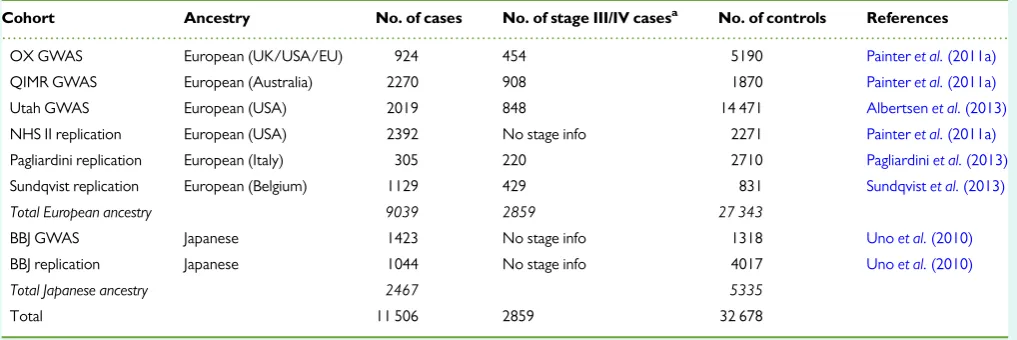
For this meta-analysis, we identified all the GWAS of endometriosis and rep-lication studies published up to 1 December 2013. A systematic literature search in PubMed for English language publications was performed using the terms ‘endometriosis’ and ‘GWAS’ and/or ‘replication’. TableIshows
at Oxford University on January 13, 2015
http://humupd.oxfordjournals.org/
all four GWAS and four replication datasets included in the meta-analysis, and their population origins. One GWAS dataset was of Japanese origin, and con-sisted of 1423 case and 1318 controls obtained from the BioBank Japan (Uno
et al., 2010). Individuals were genotyped on the Illumina 550 K BeadChip array. Cases were diagnosed through the presence of multiple clinical symp-toms, physical examinations and/or laparoscopic surgery; no information on disease stage or other sub-phenotypic disease data was available. The remaining three GWAS datasets are of European ancestry, with all cases lap-aroscopically confirmed: 2270 (40% rAFS Stage III/IV) cases and 1870 con-trols from Australia (‘QIMR’); 924 (49% Stage III/IV) cases and 5190 concon-trols from the UK (‘OX’) (Painteret al., 2011a), and 2019 (42% Stage III/IV) cases and 14 471 controls from the USA (‘UTAH’) (Albertsenet al., 2013). The control sets in all GWAS datasets were population based and unscreened for endometriosis cases. The IEC Australian and UK datasets were geno-typed on Illumina 610/670 K and 670 K/1M chips, respectively, while the US dataset was genotyped using Illumina OmniExpress 730 K BeadChip. The IEC datasets were imputed up to 1000 Genomes Pilot reference panel (B36, June 2010). From the SNPs included in this meta-analysis, only rs1333049 was an imputed SNP in the QIMR Australian dataset.
Of the four replication studies, one was conducted in women of Japanese, and three in women of European ancestry (TableI). The datasets comprised: (i) 2392 self-reported surgically diagnosed cases (no disease stage informa-tion) and 2271 unscreened population controls from the Nurse’s Health Study II (NHS II) in the USA (Painteret al., 2011a); (ii) 305 laparoscopically confirmed cases (72% Stage III/IV cases) and 2710 population-based con-trols (90% unscreened for endometriosis) from Italy (Pagliardini et al., 2013); (iii) 1129 laparoscopically confirmed cases (38% stage III/IV cases) and 831 laparoscopy-negative controls from a subfertility clinic population in Belgium (Sundqvistet al., 2013) and (iv) 1044 cases (no disease stage infor-mation) and 4017 unscreened population controls from BioBank Japan (Uno
et al., 2010); 653 of these 1044 cases had been used in a small GWAS of 696 cases and 825 controls, which had not provided a genome-wide significant result (Adachiet al., 2010).
Meta-analysis of genome-wide significant
results across the studies
We performed a meta-analysis of association results for SNPs passing the P-value threshold,5×1028(‘genome-wide significance’) in at least one of the studies, across all of the endometriosis GWAS and replication datasets, including a total of 11 506 cases and 32 678 controls, employing a fixed-effect
model in the first instance, using GWAMA software (Ma¨gi and Morris, 2010). ORs and 95% CIs and the sample size of the studies for each SNP were used as input to the model. SNPs that maintained aP-value,5×1028on meta-analysis were considered genome-wide significant. Given the evidence for a substantially increased contribution of genetic factors to moderate/ severe (rAFS Stage III/IV) compared with minimal/mild (rAFS Stage I/II) endometriosis (Painter et al., 2011a, b), additional meta-analyses were conducted on ‘Stage III/IV enriched’ and ‘Stage III/IV only’ datasets. The ‘Stage III/IV-enriched’ analysis included association results from QIMR, OX, UTAH, Pagliardini and Sundqvist Stage III/IV cases (n¼2859) versus controls, combined with all-stage endometriosis versus controls association results from the BBJ, BBJ replication and NHS II replication datasets (for which stage information on cases was not available). Thus, the ‘Stage III/IV-enriched’ analysis was based on 7718 cases and 32 678 controls. The Stage III/IV-only analysis included association results from 2859 Stage III/IV cases (QIMR, OX, UTAH, Pagliardini and Sundqvist) versus 32 678 controls.
Heterogeneity of allelic effects across studies was examined using the Cochran’sQtest (Cochran, 1954). Between-study heterogeneity was indi-cated byQstatisticPvalues,0.1 (Ioannidiset al., 2007), as well as theI2 index, which indicates the percentage of variance attributable to heterogen-eity (Higgins and Thompson, 2002). Given that the nine loci represented nine independent tests, a Bonferroni correction (0.05/9) was applied to the threshold for significant evidence of heterogeneity (P,0.005). Meta-analysis of SNPs that showed evidence of effect heterogeneity was also carried out using the Han and Eskin random-effects model, which increases power to detect associations under heterogeneity, implemented in METASOFT software (Han and Eskin, 2011). Beta effect sizes, standard errors and sample sizes for each SNP were used for input to the model.
The variance explained by the established loci associated with endometri-osis was calculated by transformation of dichotomous disease risk onto a continuous liability scale that assumes a disease prevalence rate and a multiplicative model (Wrayet al., 2010;Morriset al., 2012).
Investigation of other reported GWAS
associations in endometriosis loci
[image:5.612.52.561.83.253.2]For each endometriosis SNP included in the meta-analysis, we determined the chromosomal band it is located in, using UCSC build 19. We then extracted all GWAS that reported genome-wide significant SNP associations with any disease or trait for the respective chromosomal segments from the
... Table I Summary of the eight published endometriosis GWAS and replication studies included in the meta-analysis.
Cohort Ancestry No. of cases No. of stage III/IV casesa No. of controls References
OX GWAS European (UK/USA/EU) 924 454 5190 Painteret al.(2011a)
QIMR GWAS European (Australia) 2270 908 1870 Painteret al.(2011a)
Utah GWAS European (USA) 2019 848 14 471 Albertsenet al.(2013)
NHS II replication European (USA) 2392 No stage info 2271 Painteret al.(2011a)
Pagliardini replication European (Italy) 305 220 2710 Pagliardiniet al.(2013)
Sundqvist replication European (Belgium) 1129 429 831 Sundqvistet al.(2013)
Total European ancestry 9039 2859 27 343
BBJ GWAS Japanese 1423 No stage info 1318 Unoet al.(2010)
BBJ replication Japanese 1044 No stage info 4017 Unoet al.(2010)
Total Japanese ancestry 2467 5335
Total 11 506 2859 32 678
a
rAFS III and IV disease only. OX, Oxford University; QIMR, Queensland Institute of Medical Research; NHS II, Nurses’ Health Study II; BBJ, BioBank Japan.
706
Rahmiogluet al.at Oxford University on January 13, 2015
http://humupd.oxfordjournals.org/
NHGRI resource (http://www.genome.gov/gwastudies/) (Hindorffet al., 2009). We determined the distance between each endometriosis SNP and SNPs associated with other diseases/traits in each chromosomal segment, and assessed LD (correlation,r2) between each SNP pair in the Caucasian and Japanese populations using the 1000 Genomes Pilot CEU and JPT data reference panels, implemented in Haploview (Barrettet al., 2005). An r2.0.2 was used as the threshold for SNPs that were in moderate LD (1000 Genomes Project Consortium, 2010).
Results
Consistency and heterogeneity of genetic
associations between studies and populations
Of the 11 SNPs in 9 loci associated with endometriosis in at least one of the 8 studies, the meta-analysis showed genome-wide significant evi-dence (P,5×1028) for seven SNPs (six loci), with consistent direc-tions of effect across studies and populadirec-tions (TableII, Fig.2). These included rs7521902 nearWNT4[OR¼1.18 (95% CI: 1.13 – 1.23)P¼
1.8×10215]; rs13394619 inGREB1(growth regulation by estrogen in breast cancer 1) [OR¼1.13 (95% CI: 1.07 – 1.20),P¼2.9×1028]; rs7739264 near ID4 [OR¼1.11 (95% CI: 1.08 – 1.15), P¼6.2× 10210]; both rs12700667 [OR¼1.10 (95% CI: 1.06 – 1.14), P¼
1.6×1029] and rs7798431 [OR¼1.13 (95% CI: 1.09 – 1.18), P¼
5.4×1029] in an inter-genic region on chromosome 7 (correlationr2
between SNPs¼0.8); rs1537377 near CDKN2B-AS1 [(OR¼1.12 (95% CI: 1.08 – 1.17), P¼1.0×1028] and rs10859871 [OR¼1.18 (95% CI: 1.13 – 1.22), P¼4.8×10215] in VEZT. Interestingly, rs1250248 in FN1 showed a strong association with Stage III/IV disease (P¼8.0×1028), had consistent directions of effect across all studies and populations, but just fell short of the genome-wide signifi-cance threshold.
The results show that genetic heterogeneity between populations is not governing these six confirmed endometriosis loci. For three of the seven SNPs, the between-study heterogeneityQtestP-value was borderline sig-nificant (0.01,P,0.1) when considering that nine independent tests were conducted; however, the results from the random-effects model allowing for heterogeneity showed negligible difference from those obtained using fixed-effect meta-analysis, and they reached genome-wide significance under both models, demonstrating the lack of evidence for significant heterogeneity of signals between studies (TableII). One of the directionally consistent loci is rs12700667, in an inter-genic region of high LD (48Kbr2.0.8) with rs7798431 on chromosome 7. The pre-viously reported lack of significant association of rs12700667 and rs7798431 variants in the individual Belgian (Sundqvist et al., 2013), Italian (Pagliardiniet al., 2013) and Utah datasets (Albertsenet al., 2013) is therefore likely to be due to stochastic fluctuations that typically can be seen between individual datasets. It also highlights an important point about the need to interpret study results as probabilities, and demonstrates the complex issue of what (lack of) ‘replication’ means when a fixedP-value threshold such asP,0.05 is used. A variant with an associationP.0.05 does not imply the variant is not associated; rather, it means that, assuming the variant has no effect, if we conducted the same study 100 times, we would see the result in at least 5% of instances.
Two inter-genic loci, both on chromosome 2, showed evidence of heterogeneity (P,0.005) between studies: rs4141819 (closest gene:
ETAA1) and rs6734792 (closest gene:RND3). Random-effects analyses substantially increased the significance of rs4141819, most notably for association with Stage III/IV disease (enriched analysis: P¼9.2× 1028), but had little effect on association with rs6734792 (all endomet-riosis:P¼2.2×1026).
An intriguing genomic region, because of the differences in allele frequencies and LD structure between individuals of Japanese and European ancestry, is the CDKN2B-AS1 locus on chromosome 9 (TableII, Fig.3). In the first Japanese GWAS of endometriosis byUno
et al. (2010), the authors reported association with rs10965235 in
CDKN2B-AS1gene. This SNP, however, is monomorphic in individuals of European ancestry, and therefore direct replication of this signal was not possible in datasets of this ancestry. However, in the Nyholtet al.
meta-analysis of the BBJ, QIMR and OX datasets, genome-wide signifi-cant association was reported across these datasets for rs1537377 [P¼1.0×1028, OR¼1.22 (95% CI: 1.14 – 1.30], 55 kb away from rs10965235. LD (correlation) between rs10965235 and rs1537377 in the Japanese HapMap reference population is very low (r2¼0.01) (Fig.3).Nyholtet al.(2012)conducted conditional association analysis in the Japanese dataset, providing suggestive evidence for rs1537377 to be a second, independent, risk variant in theCDKN2B-AS1region for endometriosis. Our present meta-analysis certainly suggests that rs1537377 is a risk variant across Japanese and European ancestry datasets, showing the strongest association with Stage III/IV disease (Stage III/IV enriched: P¼5.8×10212). In the Italian replication study, Pagliardini et al. genotyped rs1333049 in the CDKN2B-AS1
region, based on its location in the same Japanese LD block as rs10965235 (Fig.3) and on its common frequency in the Italian popula-tion [HapMap minor allele frequency in Tuscans in Italy (TSI)¼0.48]. In our meta-analysis including unpublished data from UK (OX GWAS) and Australian (QIMR GWAS) datasets, rs1333049 did not reach genome-wide significance (Stage III/IV enriched:P¼0.05).
Assuming a population prevalence for endometriosis of 8% (Zondervanet al., 2001,2002;Missmeret al., 2004), these nine loci together account for 1.67% of variance in ‘all’ endometriosis suscep-tibility (Wrayet al., 2010). Therefore, they currently have no immedi-ate role in risk prediction.
Results for clinical sub-phenotypes
Of the seven genome-wide significantly associated SNPs in our meta-analysis (six loci), six SNPs (five loci) showed an increasing effect size (OR) as the proportion of cases with Stage III/IV disease included in analyses increased from all endometriosis to ‘Stage III/IV-enriched’ to ‘Stage III/IV-only’ (Table II). Figure 2shows forest plots for the results of these loci from individual studies, for association with all endometriosis and Stage III/IV disease, highlighting the point that for most loci, effect sizes were greater for association with Stage III/IV disease. These results imply that the loci are likely to be implicated pre-dominantly in the development of moderate/severe disease. The most striking observation of an association that became close to genome-wide significance when limiting cases to the much smaller subset with known Stage III/IV disease (n¼2859) is rs1250248 inFN1, which had an asso-ciation OR¼1.11 (95% CI: 1.04 – 1.18,P¼1.1×1024) with all endo-metriosis, and an OR of 1.27 (95% CI: 1.16 – 1.38),P¼8.0×1028) with Stage III/IV disease.
at Oxford University on January 13, 2015
http://humupd.oxfordjournals.org/
...
...
Table II Results of the meta-analysis of the 11 published SNPs genome-wide significantly associated with endometriosis in at least one study.
Chr SNP Position (HG19)
RA RAF in CEU
RAF in JAP
Case selectione
No. of studies
Meta-analysis results Nearest
gene
Pmeta
b
Direction Q
Phet
I2** ORMeta
(95% CI)
(distance)
1 rs7521902a 22490474 A 0.23 0.33 All 7 1.8×10215 +++++++ 0.83 0 1.18 (1.13 – 1.23) WNT4
III/IV enriched 7 2.7×10217 +++++++ 0.81 0 1.23 (1.17 – 1.28) (21 kb)
III/IV only 4 1.8×10210 ++++ 0.80 0 1.25 (1.16 – 1.33)
2 rs13394619c 11727257 G 0.53 0.42 All 6 4.5×1028(2.9×1028) ++++++ 0.04* 56.1 1.13 (1.07 – 1.20) GREB1
III/IV enriched 6 3.5×1028 ++++++ 0.13 39.8 1.15 (1.09 – 1.20) (0)
III/IV only 3 2.1×10²³ +++ 0.34 25.6 1.18 (1.11 – 1.24)
2 rs4141819 67864425 C 0.27 0.22 All 5 2.1×1024(8.8×1026) ++++2 0.004* 70.6 1.08 (1.04 – 1.12) Intergenic
III/IV enriched 5 2.5×1025(9.2×1028) ++++2 0.02* 66.0 1.15 (1.09 – 1.21) (ETAA1:
III/IV only 3 6.9×1026(1.0×1026) +++ 0.003* 81.9 1.16 (1.09 – 1.24) 227 kb)
2 rs1250248 216286843 A 0.21 0.03 All 6 1.1×1024 ++++++ 0.21 23.0 1.11 (1.04 – 1.18) FN1
III/IV enriched 6 1.3×1025 ++++++ 0.86 0 1.13 (1.07 – 1.19) (0)
III/IV only 3 8.0×1028 +++ 0.86 0 1.26 (1.16 – 1.38)
2 rs6734792 151624632 C 0.38 0.32 All 4 9.7×1025(2.2×1026) +++? 0.003* 78.3 1.10 (1.06 – 1.16) Intergenic
III/IV enriched 4 5.5×10²³ ++++ 0.13 49.8 1.08 (1.02 – 1.15) (RND3:
III/IV only 3 6.5×1025(2.7×1025) +++ 0.002* 84.4 1.10 (1.05 – 1.15) 281 kb)
6 rs7739264 19785338 T 0.55 0.77 All 6 1.9×10210(6.2×10210) ++++++ 0.05* 50.9 1.11 (1.08 – 1.15) ID4
III/IV enriched 6 6.7×10210(3.1×10210) ++++++ 0.02* 61.0 1.14 (1.10 – 1.19) (52 kb)
III/IV only 3 1.2×1028 +++ 0.56 0 1.20 (1.13 – 1.28)
7 rs12700667 25901389 A 0.76 0.20 All 8 1.9×1029(1.6×1029) ++++++++ 0.05* 51.0 1.13 (1.08 – 1.17) Intergenic
III/IV enriched 8 7.0×10211(4.2×10211) ++++++++ 0.02* 57.9 1.17 (1.11 – 1.22) (NFE2L3:
III/IV only 4 4.5×1028(3.6×1028) ++++ 0.02* 69.5 1.22 (1.14 – 1.31) 290 Kb)
7 rs7798431d 25860562 G 0.79 0.49 All 5 5.4×1029 +++++ 0.14 37.0 1.13 (1.09 – 1.18) Intergenic
III/IV enriched 5 8.5×10210 +++++ 0.15 40.8 1.19 (1.13 – 1.26) (NFE2L3:
III/IV only 3 9.7×1028 +++ 0.10 58.3 1.24 (1.14 – 1.33) 331 Kb)
9 rs1537377 22169450 C 0.40 0.39 All 5 1.0×1028 +++++ 0.30 18.8 1.12 (1.08 – 1.17)
CDKN2B-III/IV enriched 5 5.8×10212 +++++ 0.25 23.8 1.18 (1.13 – 1.23) AS1
III/IV only 3 8.1×1028(2.3×1027) +++ 0.09* 58.1 1.18 (1.11 – 1.26) (48 Kb)
9 rs1333049 22125253 G 0.54 0.02 All 3 0.25 (0.12) ++2 0.01* 77.3 1.04 (0.98 – 1.10)
CDKN2B-III/IV enriched 3 0.05 (0.03) ++2 0.03* 70.9 1.08 (1.00 – 1.17) AS1
III/IV only 2 0.55 (0.60) ++ 0.47 0 1.03 (0.94 – 1.12) (4 Kb)
708
Rahmioglu
et
al.
Current understanding of biological
mechanisms of the genetic loci
Figure4depicts the genes nearest to the nine loci (eleven SNPs) analysed in our meta-analysis, showing the location of each SNP in relation to the gene and its functional structures. Also shown is the location of known SNPs within the gene reported to be genome wide associated with other traits and diseases (source: NIHGR GWAS database, http ://www.genome.gov/gwastudies/; November 2013), that are in LD (r2.0.2) with any of the endometriosis SNPs. A comprehensive list of all published GWAS variants that are located in the genes but do not correlate (r2,0.2) with endometriosis SNPs, or are in LD with endometriosis variants outside genes, is provided in Supplementary data, Table SI.
A total of four SNPs in three genetic loci, rs12700667/rs7798431 on chromosome 7p15.2, rs4141819 on 2p14 and rs6734792 on 2q23.3 are in inter-genic regions with no known genes within 200 kb. Recent evi-dence from the ENCODE project has strongly suggested that these regions are likely to play an important role in gene transcription regula-tion (The ENCODE Consortium, 2012), and variants located in these regions may be involved incis- ortrans-regulation of genes distantly located. Although we report the genes nearest to the associated variants (Fig.4), this does not necessarily imply that it is the regulation of these genes that is affected by the variants. Further studies on the effect of the variants on gene expression (eQTL studies) are required to under-stand how they affect biological pathways.
Intergenic rs12700667 on 7p15.2 is in high LD with rs1055144 (P¼
1.0×10224;r2¼0.5, 1000G pilot CEU data; Fig.4) that was previously associated with waist-to-hip ratio adjusted for body mass index (WHRadjBMI), a measure of fat distribution, in an independent GWAS of190 000 individuals (Heidet al., 2010). The 7p15.2 region contains several potential candidate genes.NFE2L3[Nuclear factor (erythroid-derived 2-like 3] is a transcription factor suggested to be involved in cell differentiation, inflammation and carcinogenesis (Chevillard and Blank, 2011).NFE2L3mRNA levels were found to be up-regulated in human breast cancer cells (Rheeet al., 2008) and testicular carcinoma tissue samples (Almstrup et al., 2007). Also, interferon-gamma has been shown to increaseNFE2L3mRNA levels in human uterine endo-thelial cells (Kitayaet al., 2007). However, its potential role in endomet-riosis aetiology remains to be discovered. A second locus of interest in this region is a microRNA,miRNA_148a, with a purported role in the Wnt/b-catenin signaling pathway (Qinet al., 2010). Wnt/b-catenin sig-naling has an important role in communication between epithelial and stromal cells in endometrium (Tulacet al., 2003), and may have a role in endometriosis-related infertility, and/or its development through sex hormone homeostasis regulation (Matsuzakiet al., 2010; Wang
et al., 2010) and fibrogenesis (Matsuzaki and Darcha, 2013).In vitro
studies have also shown that, through targeting Wnt/b-catenin pathway, cellular mechanisms known to be involved in endometriotic lesion development, such as cell proliferation, migration and invasion of endometrial and endometriotic epithelial and stromal cells, can be inhibited (Matsuzaki and Darcha, 2013). Moreover, the Wnt/
b-catenin pathway is involved in development, tissue self-renewal and in various cancers and other disease such as type II diabetes and osteo-porosis (Clevers, 2006;Klaus and Birchmeier, 2008;Clevers and Nusse, 2012).MiRNA_148ahas been shown to regulate adipogenesis through modulation of Wnt/b-catenin signaling pathway (Qin et al., 2010),
12 rs10 859871 957116 26 C 0.30 0.29 All 5 4.8 × 10 2 15 +++++ 0.69 0 1.18 (1 .13 – 1.22) VEZT III/IV enriche d 5 3.0 × 10 2 13 +++++ 0.94 0 1.20 (1 .15 – 1.27) (17Kb) III/IV only 3 6.8 × 10 2 7 +++ 0.88 0 1.19 (1 .11 – 1.27) RA, risk allele; RAF , risk allele fr equency; CEU, Caucasian; JPT , Japanese; OR, odds ra tio; 95% CI, 95% confidence interval. aAlso, in modera te LD with rs2235529 ( r 2¼ 0.7), which w as identified as genome-wide significant in the Utah da taset ( Albertsen et al. , 2013 ). bMeta-analysis P -value is reported fr om the fixed-effects model as implemented in GW AMA softwar e ( Ma ¨gi and Morris, 2010 ). Where significant heter ogeneity is detected, the res ults fr om the ran dom-effects model optimized to detect associat ions under heter ogeneity ar e report ed in par enthesis as implemented in MetaSoft softwar e ( Han and Eskin, 2011 ). cThe meta-analysis for rs13394619 includes res ults published in Ada chi et al. (2010 ), obtained fr om combined analysis of 500 K and 6.0 arr ays in 696 cases and 825 controls. Mor eo ver, rs13394619 w as an imputed SNP in the QIMR Aus tr alian da taset. dRs12700667 and rs7798431 ar e highly corr ela ted SNPs with r 2¼ 0.8; rs7798431 does not repr esent an independent signal ( P ainter et al. , 2011a ). eFor ea ch SNP , the res ults fr om three separa te meta-analyses ar e reported including: (i) all endometriosis cases to controls, (ii) Stage III/IV enric hed cases to contr ols and (iii) Stage III/IV only cases to contr ols (see Methods). *Significant heter ogeneity detected by Cochr an’s Q tes t, P value , 0.1. **In addition to Cochr an’s Q tes t, I 2heter ogeneity inde x is giv en which indica tes the per centage of variance attributable to heter ogeneity.
at Oxford University on January 13, 2015
http://humupd.oxfordjournals.org/
Figure 2 Forest plots showing the effects of risk alleles for SNPs in six loci reaching genome-wide significance for association with all endometriosis and two loci reaching borderline genome-wide significance with only Stage III/IV cases in the meta-analysis. BBJ_Rep, BioBank Japan replication.
710
Rahmiogluet al.at Oxford University on January 13, 2015
http://humupd.oxfordjournals.org/
emphasizing the potentially important role of this pathway for both endo-metriosis and fat distribution. More distant candidate genes for this 7p15.2 endometriosis association signal includeHOXA10(Homeobox A10) andHOXA11(Homeobox A11) which are1.35 Mb downstream.
HOXA10 and HOXA11are members of the homeobox A family of
transcription factors that play a role in uterine development (Taylor
[image:10.612.50.566.56.620.2]et al., 1999;Wuet al., 2005). It is possible that the 7p15.2 signal influ-ences the regulation of interactive expression of a number of these genomic loci; functional studies targeting this region will need to be con-ducted to further elucidate its role in endometriosis pathogenesis.
Figure 3 Linkage disequilibrium structure for the region containing rs1537377, rs1333049 and rs10965235 in/near CDKN2BAS on chromosome 9 in individuals of European ancestry (bottom panel) and of Japanese ancestry (top panel) (Source:http://hapmap.ncbi.nlm.nih.gov).
at Oxford University on January 13, 2015
http://humupd.oxfordjournals.org/
Two further inter-genic loci did not reach genome-wide significance of association with endometriosis on meta-analysis, even when allowing for heterogeneic effects across studies. Rs6734792 on 2q23.3,P¼
2.2×1026with all-stage endometriosis, is located 280 kb upstream ofRND3(Rho Family GTPase 3). The signal showed similar strength of association for all-stage and Stage III/IV endometriosis, implying a poten-tial role in the aetiology of both minimal/mild and moderate/severe disease.RND3encodes a member of a subgroup of Rho family of small GTP-binding proteins. Rho GTPases are key regulators of the actin cyto-skeleton and stress fibre formation. In addition,RND3is also involved in the regulation of cell-cycle progression, cell transformation (Chardin, 2006) and cell migration (Guaschet al., 1998). The third inter-genic signal, rs4141819 on 2p14 (borderline significant withP¼9.2×1028 in Stage III/IV-enriched analysis) is located 227 kb away fromETAA1
(Ewing’s tumor-associated antigen 1) that encodes a tumour-specific cell surface antigen in Ewing family of tumours (EFTs). EFTs is a group of cancers that form in bone or soft tissue that share common features as they develop from the same type of stem cell in the body (Borowski
et al., 2006). Rs4141819 is located in an intronic region of a long non-coding RNA (lncRNA) AC007422.1, which is 118 kb long. Non-non-coding RNAs are functional RNA molecules that are not translated into proteins but have a regulatory role in gene expression. The biological role of this particular lncRNA is not yet known.
The remaining seven variants in six loci are located in or near (within 50 kb) genes (Fig.4):WNT4,GREB1,FN1,ID4,CDKN2B-AS1
andVEZT. These variants are likely to be involved in the ‘cis’-regulation of expression of neighbouring genes and/or transcripts. The current knowledge on the biological function of the implicated genes, which vary fromWNT4andFN1in developmental pathways to functions of
VEZT,GREB1,ID4,NFE2L3,FN1,ETAA1andCDKN2B-AS1in carcinogen-esis, is described below.
WNT4 (Wingless-type MMTV integration site family member 4)
Rs7521902 is located 21 kb up/downstream ofWNT4(Fig.4).WNT4is a protein-coding gene that is vital for development of the female reproduct-ive organs. In knockout mice, the loss ofWNT4leads to complete absence of the Mu¨llerian duct and its derivatives (Vainioet al., 1999). A previous study investigated the expression of genes playing decisive roles during the female reproductive tract development includingWNT4in peritoneal tissue from endometriosis cases and controls. They showed thatWNT [image:11.612.49.560.63.382.2]genes are expressed in normal peritoneum in addition to endometrium, suggesting that endometriosis can arise through metaplasia and can in the process make use of the developmental steps involved in the embryonic development of the female reproductive tract (Gaetjeet al., 2007). As mentioned before,Wnt signaling is important for epithelial – stromal cell communication in the endometrium, and is likely to be important for
Figure 4 Diagrams showing the 9 genes closest to each of the 11 endometriosis SNPs included in the meta-analysis. Exons (coding regions) are presented with grey coloured boxes; lines between the exons present introns (non-coding genic regions); empty white boxes at the ends of the genes represent the 3′ and 5′UTR regions. Each endometriosis SNP is illustrated in red, along with its distance to the gene where relevant (red arrows). SNPs genome wide asso-ciated with other trait/disease associations, that are in linkage disequilibrium (r2.0.2) with any of the endometriosis SNPs are illustrated in blue. See Sup-plementary data, Table SI for a complete list of all published SNP associations for these genomic regions including independent signals.
712
Rahmiogluet al.at Oxford University on January 13, 2015
http://humupd.oxfordjournals.org/
endometrial development, differentiation and embryonic implantation (Tulacet al., 2003). Furthermore, the endometriosis variant rs7521902 has also been genome-wide significantly associated with bone mineral density (Estradaet al., 2012), highlighting this variant as a potential pleio-tropic locus (Fig.4).
GREB1 (Growth regulation by estrogen in breast cancer 1)
Rs13394619 is located in an intronic region between exon 9 and exon 10 inGREB1. GREB1encodes for an early response gene in the estrogen regulation pathway that is involved in hormone-dependent breast cancer cell growth (Rae et al., 2005). Furthermore, Pellegrini et al.
(2012) showed increased expression ofGREB1in peritoneal eutopic endometriotic lesions compared with eutopic endometrium, implicating its transcription in estrogen-dependent growth in endometriosis. The underlying biological mechanism by which GREB1 plays a role in hormone-responsive tissues especially estrogen-stimulated cell prolifer-ation in endometriosis remains to be elucidated. TheGREB1region har-bours many other SNPs reported to be genome-wide significantly associated with other traits and conditions, withGREB1in particular associated with obesity-related traits (Supplementary data, Table SI). However, none of these SNPs are in LD with endometriosis SNP rs13394619.
FN1 (Fibronectin 1)
Rs1250248 is located in an intronic region between exon 10 and exon 11 inFN1(Fig.4).FN1is involved in cell adhesion and migration processes including embryogenesis, wound healing, blood coagulation, host defense and metastasis (Pankov and Yamada, 2002). Recently, it has been shown that SOX2, a gene encoding a transcription factor that targetsFN1, is a key gene regulating cell migration in ovarian cancer (Louet al., 2013). Furthermore, anin vitrostudy has shown thatFN1 mod-ulates CpG motif-dependent cytokine production in macrophages, supressing the immune resposiveness throughTLR9pathway (Yoshida
et al., 2012). TheFN1region has been associated with many other traits in GWASs (Supplementary data, Table SI); however, none of these SNPs are in LD with endometriosis SNP rs1250248.
ID4 (Inhibitor of DNA binding 4)
Rs7739264 is located in an intronic region of lncRNARP1 – 167F1.2
(794 bp), for which the biological function remains to be discovered. It is located 52 kb downstream ofID4(Fig.4).ID4is an ovarian oncogene that is over-expressed in most primary ovarian cancers but not in normal ovary, fallopian tube and other tissues. Furthermore, it has been impli-cated, through methylation-related regulatory pathways, in breast car-cinogenesis (Verschuur-Maes et al., 2012) and is overexpressed in most ovarian, endometrial and breast cancer cell lines (Ren et al., 2012). Potential mechanisms by which ID4 induces transformation include, through regulation ofHOXA9andCDKN1A(cyclin-dependent kinase inhibitor 1A), transcriptional programmes to disrupt the normal regulation of cell proliferation and differentiation (Ren et al., 2012).
HOXAgenes have been shown to play essential roles in specifying region-al differentiation of the Mu¨llerian duct into oviduct, uterus, cervix and vagina (Kobayashi and Behringer, 2003). The region around endometri-osis SNP rs7739264 contains a large number of reported SNPs asso-ciated with different traits and conditions in GWASs (Supplementary data, Table SI), none of which are in LD with rs7739264.
CDKN2B-AS1 (Cyclin-dependent kinase inhibitor 2B antisense RNA)
Rs1537377 is located 48 kb upstream ofCDKN2B-AS1, while rs1333049 is located in the 3′UTR region of the gene and rs10965235, that is mono-morphic is in the European populations, is in the intron between exons 16 and 17 of the gene (Fig.4). TheCDKN2B-AS1locus encodes for cyclin-dependent kinase inhibitor 2B antisense RNA. In the same LD block with this gene areCDKN2A (P16),CDKN2B (P15) andARF (P14), which are all recognized tumour suppressor genes. CDKN2B-AS1has been shown to be involved in the regulation ofCDKN2B,CDKN2AandARFexpression (Pasmantet al., 2007;Jarinovaet al., 2009;Liuet al., 2009). Inactivation ofCDKN2A, through loss of heterozygosity or hypermethy-lation of its promoter, has been reported in endometriosis and endomet-rial cancer (Goumenouet al., 2000;Martiniet al., 2002;Guidaet al., 2009). SNPs in or near theCDKN2B-AS1locus have been associated with many other traits and disease (Supplementary data, Table SI), with a number in LD (r2.0.2) with the endometriosis SNPs (Fig.4), including rs1063192 and rs2157719 with glaucoma (Osman et al., 2012; Wiggset al., 2012), rs4977756 with glioma (Rajaramanet al., 2012), rs10757269 with ankle-brachial index (Murabitoet al., 2012), rs6475606 and rs10757272 with intracranial aneurysm (Foroudet al., 2012;Lowet al., 2012), rs1537370 with coronary artery calcification (van Settenet al., 2013) and rs7865618, rs10757274, rs1333042 and rs944797 with coronary heart disease (Wild et al., 2011; Lu et al., 2012;Takeuchiet al., 2012;Leeet al., 2013); because of these diverse associations, its function is an area of research for many investigators.
VEZT (Vezatin)
Rs10859871 is located 17 kb upstream ofVEZT(Fig.4). The locus was the second signal that showed similar strength of association for Stage III/IV disease [OR¼1.19 (95% CI: 1.11 – 1.27), P¼6.8× 1027] versus all endometriosis [OR¼1.18 (95% CI: 1.13 – 1.22,P¼
4.8×10215]. VEZT encodes an adherens junction transmembrane protein. Vezatin expression has been shown to be down-regulated in gastric cancer patients through methylation of its promoter (Guoet al., 2011;Miaoet al., 2013). It is a putative tumour suppressor gene, targeting cell migration and invasion genes, growth genes, cellular adhesion genes and a functionally validated cell cycle progression gene called TCF19
(transcription factor 19) (Miaoet al., 2013).TCF19was found to be asso-ciated with lymphocyte count, mean cell hemoglobin, white blood cell count, hematocrit count and eosinophil count (Ferreiraet al., 2009) hinting at a potential role ofTCF19regulation throughVEZTin maintaining immunological balance. In the Japanese population, Rs10859871 is in LD with rs12310399 (r2¼0.57; Fig.4, Supplementary data, Table SI) located 121 kb downstream ofVEZT, a variant that has been associated with adverse response to chemotherapy (Lowet al., 2013) (Fig.4).
Conclusions and future directions
Our meta-analysis demonstrated directionally consistent, genome-wide as-sociation of SNPs in six genetic loci with endometriosis across European an-cestry populations in Australia, Belgium, Italy, the UK, the USA, as well as Japanese ancestry populations: rs12700667 on 7p15.2, rs7521902 near
WNT4, rs10859871 nearVEZT, rs1537377 nearCDKN2B-AS1, rs7739264 nearID4and rs13394619 inGREB1. Five of the six loci showed stronger effect sizes of association with Stage III/IV disease, with the exception of
VEZT. Of the remaining three loci, two (FN1and inter-genic 2p14) were
at Oxford University on January 13, 2015
http://humupd.oxfordjournals.org/
borderline genome wide significant for association in Stage III/IV-only or Stage III/IV-enriched analyses, respectively. Except for inter-genic rs4141819 and rs6734792 on chromosome 2, none of the other SNPs/ loci showed significant evidence of heterogeneity across datasets (P.
0.005) showing that the significantly associated risk variants of endometriosis are pertinent to all studied populations.
It was notable that of the 11 SNPs included in the meta-analysis, 5 were in LD (r2.0.2) with an SNP that has also robustly been associated with different diseases and traits in other GWASs: in or near WNT4 with bone mineral density; in CDKN2B-AS1 with glaucoma, glioma, ankle-brachial index, intracranial aneurysm, coronary artery calcification and coronary heart disease; in VEZT with adverse response to chemo-therapy and in 7p15.2 with fat distribution. This information is important, as the investigation of other established disease variants in genomic regions associated with endometriosis can aid in revealing the potentially biological mechanisms through which the variant may act upon endomet-riosis pathogenesis, and can lead to new investigations of joint aetiology and co-morbidity.
Detailed and standardized disease phenotype
Our results showing stronger associations with Stage III/IV endometri-osis emphasize the importance of detailed sub-phenotype collection to allow analyses for the identification of further variants associated with sub-types of endometriosis. Currently, datasets with detailed surgi-cal and clinisurgi-cal sub-phenotype information are not available on a large scale, but such information collected in a standardized manner is required to enable future genomic research. The global WERF Endomet-riosis Biobanking and Phenome Harmonisation Project (EPHect), cur-rently involving 32 clinical and basic endometriosis research centres and 3 industrial collaborators, is developing freely available data collec-tion tools to enable standardized data colleccollec-tion, and thus foster future collaborative analyses across endometriosis research centres (http ://www.endometriosisfoundation.org/ephect).
Larger sample sizes
Although this may be surprising, the sample sizes of the endometriosis GWASs to date are at the lower end of GWASs in other complex disease fields, and an increased sample size for genome-wide meta-analysis of GWAS studies is predicted to increase the number of genome-wide significant loci (Visscher et al., 2012). For instance, recent meta-GWAS analyses of type 2 diabetes have included close to 100 000 cases, and have identified around 65 genome-wide significant variants associated with disease (Morris et al., 2012); the count of genome-wide significant loci associated with inflammatory bowel disease, involving up to 37 000 cases and controls, is as high as 163 (Jostinset al., 2012). This further emphasizes the need for collaborations between centres, which collect standardized characteristics of the disease as well as detailed symptoms, to increase endometriosis case numbers and allow further GWAS datasets to be generated. Undoubt-edly, larger GWASs and meta-analyses in different populations will allow the detection of additional common causal variants of modest effects on endometriosis risk.
Better coverage of genomic variation
GWASs are limited with regard to their ability to detect only the effect of common variants (MAF.0.05). It is likely that some of the unexplained
genetic variation may be due to rarer variants (MAF,0.05), either single sited or structural, that are not captured by current GWA genotyping arrays (Visscher et al., 2012). As mentioned before, family-based linkage studies of endometriosis have successfully identified two linkage regions that are likely to harbour rare causal variants, on chromo-some 10q26 (Treloaret al., 2005) and on chromosome 7p13-15 ( Zon-dervanet al., 2007). Systematic resequencing studies of these regions are required to identify the rare variants involved.
Functional studies
To understand the roles of the identified genetic variants in endometri-osis, functional studies are needed tissues relevant to endometriendometri-osis, such as eutopic and ectopic endometrium. Functional studies aim to understand how changes in the DNA level of variation translate to the (regulation of) RNA transcript levels, protein levels and metabolite levels. These studies are crucial in revealing the biological mechanisms by which the genetic variations detected are causally related to the disease end-points. To allow replication of findings between studies, and collaborative analyses, centres collecting tissues for the purpose of endometriosis research need to use similar, standard-operating proto-cols (SOPs) for collection, processing and storage of samples. In addition to guidelines and standards for data collection, the EPHect also provides freely available consensus SOPs for biological sample collection that will allow large-scale collaborative functional studies contributing to bio-marker and drug target discovery research.
Supplementary data
Supplementary data are available athttp://humupd.oxfordjournals.org/.
Acknowledgements
We acknowledge with appreciation all the women who participated in the endometriosis studies that formed the basis of our analyses, the many staff, gynaecologists, general practitioners and pathology services who provided assistance with the confirmation of diagnoses, and the many research assistants and interviewers for assistance with the studies. We also thank Dr Kenneth Ward and Dr Hans Albertsen from Juneau Biosciences Ltd, Utah, USA for providing us with further in-formation on their published GWAS results.
Authors’ roles
N.R., D.R.N., A.P.M, S.A.M, G.W.M., K.T.Z.: additional data generation; N.R., A.P.M., K.T.Z.: meta-analysis; N.R., D.R.N., A.P.M, S.A.M., G.W.M., K.T.Z.: manuscript preparation.
Funding
D.R.N. is supported by the NHMRC Fellowship (339462 and 613674) and the ARC Future Fellowship (FT0991022) schemes. A.P.M. is ported by a Wellcome Trust Senior Research Fellowship. G.W.M. is sup-ported by the NHMRC Fellowships Scheme (339446, 619667). K.T.Z. is supported by a Wellcome Trust Research Career Development Fellow-ship (WT085235/Z/08/Z). Funding to pay for the Open Access publi-cation charges for this article was provided by the Wellcome Trust.
714
Rahmiogluet al.at Oxford University on January 13, 2015
http://humupd.oxfordjournals.org/
Conflict of interest
There are no conflict of interests to declare.
References
Adachi S, Tajima A, Quan J, Haino K, Yoshihara K, Masuzaki H, Katabuchi H, Ikuma K,
Suginami H, Nishida Net al.Meta-analysis of genome-wide association scans for
genetic susceptibility to endometriosis in Japanese population.J Hum Genet2010;
12:816 – 821.
Albertsen HM, Chettier R, Farrington P, Ward K. Genome-wide association study link
novel loci to endometriosis.PLoS One2013;8:e58257.
Almstrup K, Leffers H, Lothe RA, Skakkebaek NE, Sonne SB, Nielsen JE, Rajpert-De Meyts E, Skotheim RI. Improved gene expression signature of testicular carcinoma
in situ.Int J Androl2007;30:292 – 302.
American Society for Reproductive Medicine. Revised American Society for
Reproductive Medicine classification of endometriosis: 1996.Fertil Steril1997;
67:817 – 821.
Barrett JC, Fry B, Maller J, Daly MJ. Haploview: analysis and visualization of LD and
haplotype maps.Bioinformatics2005;21:263 – 265.
Berkley KJ, Rapkin AJ, Papka RE. The pains of endometriosis. Science 2005;
308:1587 – 1589.
Borowski A, Dirksen U, Lixin L, Shi RL, Go¨bel U, Schneider EM. Structure and function
of ETAA16: a novel cell surface antigen in Ewing’s tumours. Cancer Immunol
Immunother2006;55:363 – 374.
Campeau PM, Foulkes WD, Tischkowitz MD. Hereditary breast cancer: new genetic
developments, new therapeutic avenues.Hum Genet2008;124:31 – 42.
Clevers H. Wnt/beta-catenin signaling in development and disease. Cell 2006;
127:469 – 480.
Clevers H, Nusse R. Wnt/b-catenin signaling and disease.Cell2012;149:1192 – 1205.
Chardin P. Function and regulation of Rnd proteins.Nat Rev Mol Cell Biol2006;7:54 – 62.
Chevillard G, Blank V. NFE2L3 (NRF3): the Cinderella of the Cap’n’Collar transcription
factors.Cell Mol Life Sci2011;68:3337 – 3348.
Cochran WG. The combination of estimates from different experiments.Biometrics
1954;10:101 – 129.
Easton DF. How many more breast cancer predisposition genes are there?Breast
Cancer Research1999;1:14 – 17.
ENCODE Project Consortium. An integrated encyclopedia of DNA elements in the
human genome.Nature2012;489:57 – 74.
Eskenazi B, Warner ML. Epidemiology of endometriosis.Obstet Gynecol Clin North Am
1997;24:235 – 258.
Estrada K, Styrkarsdottir U, Evangelou E, Hsu YH, Duncan EL, Ntzani EE, Oei L,
Albagha OM, Amin N, Kemp JPet al.Genome-wide meta-analysis identifies 56
bone mineral density loci and reveals 14 loci associated with risk of fracture.Nat
Genet2012;44:491 – 501.
Ferreira MA, Hottenga JJ, Warrington NM, Medland SE, Willemsen G, Lawrence RW,
Gordon S, de Geus EJ, Henders AK, Smit JHet al.Sequence variants in three loci
influence monocyte counts and erythrocyte volume. Am J Hum Genet2009;
85:745 – 749.
Foroud T, Koller DL, Lai D, Sauerbeck L, Anderson C, Ko N, Deka R, Mosley TH,
Fornage M, Woo Det al.Genome-wide association study of intracranial aneurysms
confirms role of Anril and SOX17 in disease risk.Stroke2012;43:2846 –2852.
Gaetje R, Holtrich U, Engels K, Kissler S, Rody A, Karn T, Kaufmann M. Endometriosis may be generated by mimicking the ontogenetic development of the female genital
tract.Fertil Steril2007;87:651 – 656.
Giudice LC, Kao LC. Endometriosis.Lancet2004;364:1789 – 1799.
Goumenou AG, Arvanitis DA, Matalliotakis IM, Koumantakis EE, Spandidos DA. Loss
of heterozygosity in adenomyosis on hMSH2, hMLH1, p16Ink4 and GALT loci.Int J
Mol Med2000;6:667 – 671.
Guasch RM, Scambler P, Jones GE, Ridley AJ. RhoE regulates actin cytoskeleton
organization and cell migration.Mol Cell Biol1998;18:4761 – 4771.
Guida M, Sanguedolce F, Bufo P, Di Spiezio Sardo A, Bifulco G, Nappi C, Pannone G. Aberrant DNA hypermethylation of hMLH-1 and CDKN2A/p16 genes in benign,
premalignant and malignant endometrial lesions. Eur J Gynaecol Oncol 2009;
30:267 – 270.
Guo X, Jing C, Li L, Zhang L, Shi Y, Wang J, Liu J, Li C. Down-regulation of VEZT gene expression in human gastric cancer involves promoter methylation and miR-43c.
Biochem Biophys Res Commun2011;404:622 – 627.
Han B, Eskin E. Random-effects model aimed at discovering associations in
meta-analysis of genome wide association studies.Am J Hum Genet2011;88:586 –598.
Heid IM, Jackson AU, Randall JC, Winkler TW, Qi L, Steinthorsdottir V, Thorleifsson G,
Zillikens MC, Speliotes EK, Ma¨gi Ret al. Meta-analysis identifies 13 new loci
associated with waist-hip ratio and reveals sexual dimorphism in the genetic basis
of fat distribution.Nat Genet2010;42:949 – 960.
Higgins JPT, Thompson SG. Quantifying heterogeneity in a metaanalysis.Stat Med2002;
21:1539 – 1558.
Hindorff LA, Sethupathy P, Junkins HA, Ramos EM, Mehta JP, Collins FS, Manolio TA. Potential etiologic and functional implications of genome-wide association loci for
human diseases and traits.Proc Natl Acad Sci USA2009;106:9362 – 9367.
Ioannidis JP, Patsopoulos NA, Evangelou E. Heterogeneity in meta-analyses of
genome-wide association investigations.PLoS ONE2007;2:e841.
Jarinova O, Stewart AF, Roberts R, Wells G, Lau P, Naing T, Buerki C, McLean BW,
Cook RC, Parker JSet al.Functional analysis of the chromosome 9p21.3 coronary
artery disease risk locus.Arterioscler Thromb Vasc Biol2009;29:1671 – 1677.
Jostins L, Ripke S, Weersma RK, Duerr RH, McGovern DP, Hui KY, Lee JC, Schumm LP,
Sharma Y, Anderson CAet al.Host-microbe interactions have shaped the genetic
architecture of inflammatory bowel disease.Nature2012;491:119 – 124.
Kitaya K, Yasuo T, Yamaguchi T, Fushiki S, Honjo H. Genes regulated by
interferon-gamma in human uterine microvascular endothelial cells.Int J Mol Med
2007;20:689 – 697.
Klaus A, Birchmeier W. Wnt signalling and its impact on development and cancer.Nat
Rev Cancer2008;8:387 – 398.
Kobayashi A, Behringer RR. Developmental genetics of the female reproductive tract in
mammals.Nat Rev Genet2003;4:969 – 980.
Lee JY, Lee BS, Shin DJ, Woo Park K, Shin YA, Joong Kim K, Heo L, Young Lee J, Kyoung
Kim Y, Jin Kim Yet al.A genome-wide association study of a coronary artery disease
risk variant.J Hum Genet2013;58:120 – 126.
Lin J, Zong L, Kennedy SH, Zondervan KT. Coding regions of INHBA, SFRP4 and HOXA10 are not implicated in familial endometriosis linked to chromosome
7p13-15.Mol Hum Reprod2011;17:605 – 611.
Liu Y, Sanoff HK, Cho H, Burd CE, Torrice C, Mohlke KL, Ibrahim JG, Thomas NE, Sharpless NE. INK4/ARF transcript expression is associated with chromosome
9p21 variants linked to atherosclerosis.PLoS One2009;4:e5027.
Lou X, Han X, Jin C, Tian W, Yu W, Ding D, Cheng L, Huang B, Jiang H, Lin B. SOX2 targets fibronectin 1 to promote cell migration and invasion in ovarian
cancer: new molecular leads for therapeutic intervention.OMICS2013;17:510 –518.
Low SK, Takahashi A, Cha PC, Zembutsu H, Kamatani N, Kubo M, Nakamura Y. Genome-wide association study for intracranial aneurysm in the Japanese population identifies three candidate susceptible loci and a functional genetic
variant at EDNRA.Hum Mol Genet2012;21:2102 – 2110.
Low SK, Chung S, Takahashi A, Zembutsu H, Mushiroda T, Kubo M, Nakamura Y. Genome-wide association study of chemotherapeutic agent-induced severe
neutropenia/leucopenia for patients in Biobank Japan. Cancer Sci 2013;
104:1074 – 1082.
Lu X, Wang L, Chen S, He L, Yang X, Shi Y, Cheng J, Zhang L, Gu CC, Huang Jet al.
Genome-wide association study in Han Chinese identifies four new susceptibility
loci for coronary artery disease.Nat Genet2012;44:890 – 894.
Nyholt DR, Low SK, Anderson CA, Painter JN, Uno S, Morris AP, MacGregor S,
Gordon SD, Henders AK, Martin NGet al.Genome-wide association meta-analysis
identifies new endometriosis risk loci.Nat Genet2012;44:1355–1359.
Ma¨gi R, Morris AP. GWAMA: software for genome-wide association meta- analysis.
BMC Bioinformatics2010;11:288.
Martini M, Ciccarone M, Garganese G, Maggiore C, Evangelista A, Rahimi S, Zannoni G, Vittori G, Larocca LM. Possible involvement of hMLH1, p16INK4a
and PTEN in the malignant transformation of endometriosis.Int J Cancer2002;
102:398 – 406.
Matsuzaki S, Darcha C. In vitro effects of a small-molecule antagonist of the Tcf/ ß-catenin complex on endometrial and endometriotic cells of patients with
endometriosis.PLoS One2013;8:e61690.
Matsuzaki S, Darcha C, Maleysson E, Canis M, Mage G. Impaired down-regulation of E-cadherin and beta-catenin protein expression in endometrial epithelial cells in
the mid-secretory endometrium of infertile patients with endometriosis. J Clin
Endocrinol Metab2010;95:3437 – 3445.
Miao R, Guo X, Zhi Q, Shi Y, Li L, Mao X, Zhang L, Li C. VEZT, a novel putative tumor
suppressor, suppresses the growth and tumorigenicity of gastric cancer.PLoS One
2013;8:e74409.
at Oxford University on January 13, 2015
http://humupd.oxfordjournals.org/