to,. evaluating the quality
of machine tPanslation
Final ,.epo,.t
Prepared for
Commission of the European Communities
Directorate General Scientific and Technical Information and Information Management
Bul'eau
Mat-eel
van
Dijk
lngenieurs Conseils en Methodes de Direction Avenue Louise 409 Bte 1
l_Bu,.eau
Mal'eel
yanDijl(
I N G E N I E U R S • ·C 0 N S E I L. S E N M E T H 0 0 E S 0 E D I R E C T I 0 N
s o c I E T E ANONYME:
.... c . • . 3 5 5 . 1 J 8 1
T V. A . .o406.1J511i.S80
STUDY
1050 §RUXELL.ES, AVEN()E LOUISE 409 TEL.. co2> f54S ee 97
30 November
OF
METHODS
FOR
1979
EVALUATING
THE
QUALITY OF
MACHINE
TRANSLATION
,...---FINAL
BR 19142
I. J,
2-OEPARTEMENT • ORGANISATION ET GESTION •
REPORT
~
By Georges Van S1ype
TOUTlE L.'OAGANISATION ADMINISTRATIVE: • STRUCTUIIl£ OlE L.'IENTIIIIEIDIIliSE • GIESTION BUOGETAIRI!: ET I"AI'I Oa.JECTIFS • AID"'LICATIONS INFOI'IMATIQUES • CHOIX OI"TIMUM OES EOUIIDEMENTS • IDLANNING.
OEPARTEMENT • SYSTEMES O'INFOAMATION ET OE DOCUMENTATION • :
CONCEIDTION lET MISE lEN IDLACE • EXIDEATISE • CONSTRUCTION DE LANGAGES OOCUMENTAIAES- AIEIDIIlOGAAI"HIE-lllEC HE AC HIES ISIBL.IOGAAIDHIQUES - IN FOIIlMATIQUE OOCUM E NTAIAE - !IE MINAI IllES OE IDE AFECTION HEM ENT • ANALY& E ET 1 N OEXATION i>. ,....,.c;oN.
CEPARTEMENT • PROGRAMMES OE FORMATION POUR ET OA.NS L.'ENTREPRISE • :
1
C 0 N T E N T S
1. Summary
1.1 Broad lines of the study 1.2 Aims of the study
1.3 Summary of the study
1.31 State of the art
1.311 Definition of the aims of evaluation 1.312 Definition of translation quality 1.313 Text typology
1.314 Effectiveness and efficiency of evaluation 1.315 Macroevaluation- criteria and methods 1.316 Microevaluation- criteria and methods 1.317 Sampling
1.32 Recommendations
1.321 Evaluation methodology 1.322 Applied research programme
1.33 MT evaluation- coverage
1.4 Rapid scan of the study
2. Introduction
2.1 Outline 2.2 Aims
2.3 Methodology of the study 2.4 Structure of the report
3. Assessment
3.1 Aims of evaluation
3.11 Introduction
3.12 Table of intended aims
3-13 Description of intended aims
3-131 General aims with respect to the recipients of the evaluation
3.131.1 A. ANDREEWSKY 3.131.2 G. VAN SLYPE
3.132
General aims with respect to the users of the translation3.132.1
R. KUHLEN3.132.2
J. WEISSENBORN3.133
Specific aims : effectiveness and usefulness3.133.1
F. KNOWLES3.133.2
W. LENDERS3.133.3
A.J. PETIT26
26
27
27
27
27
28
3-134
Specific aims capacity and priorities for improvement28
3-134.1 R.
GREEN3-134.2
Z.L. PANKOWICZ3.134.3
G. VEILLON3.14
Assessment3.2
Translation quality3.21
Introduction3.22
Table of proposed definitions3.23
Discussions on the concept of translation and ontranslation quality
3.231
Definition of translation3.232
Translation quality3.232.1
L'Association Jean FAVARD3.232.2
H. BRUDERER3.232.3
R.L. JOHNSON3-232.4 R.
KUHLEN3.232.5
Z.L. PANKOWICZ3.232.6
A.J. PETIT3.232.7
Y. WILKS3.233
Relationship between translation qualities andevaluation
3.233.1
G. BOURQUIN3.233.2
M. MASTERMAN3.233.3
A.J. PETIT3.233.4
PHILIPS3.24
Assessment3.3
Text typology3
3-31
Introduction3-32
Table of proposed typologies3·33
Description of proposed typologies3-3301
G. BOURQUIN3.3302
H. HOFSTETTER3.3303
J. HOUSE3-3304
R.L. JOHNSON3.3305
A.W. LEAVITT3.3306
PHILIPS3.3307
L. ROLLING3.3308
J.C. SAGER3.3309
G. VAN SLYPE3.3310
J. WEISSENBORN38
38
39
39
40
41
41
41
43'
45
46
48
49
3-34
Assessment50
3.4
Effectiveness and efficiency of the evaluation51
3.41
Introduction51
3.42
Table of analyses of the effectiveness and theefficiency of evaluation methods
51
3-43
Description of effectiveness and efficiency factors51
3-431
Characteristics of an evaluation system51
3.431.1
R.L. JOHNSON52
3.431.2
A.W. LEAVITT52
3.432
Efficiency of an evaluation system53
3-433
Correlation between criteria54
3.433.1
J.B. CARROLL54
3.433.2
J.M. LEICK54
3.433.3
H.W. SINAIKO55
3.44 Assessment
55
3·5
Macroevaluation - criteria and methods56
3.51
Introduction56
3.52
Table of criteria and methods of macroevaluation57
3.521
Cognitive level57
3.521.1
Intelligibility57
3.521.2
Fidelity58
3.521.3
Coherence59
3-521.4
Usefulness59
3.521.5
Acceptability60
3.522.1 Reading time 60
3.522.2 Correction time 60
3.522.3 Production time 60
3-523 Linguistic level 60
3-524 Operational level 61
3·53 Description of criteria and methods of macroevaluation 61
3-531 Cognitive level 61
3.531.1 Intelligibility 61
3.531.11 Definitions of the criteria 61
3.531.12 Methods of evaluation 62
3.531.12.01 J.B. CARROLL : Measurement of intelligibility by rating sentences on a 9-point scale 63 3.531.12.02 CROOK
&
BISHOP : Measurement of intelligibilityby rating complete texts on a 7-point scale 64 3.531.12.03 CROOK
&
BISHOP : Measurement of readabilityby the Cloze test 65
3-531.12.04 T.C. HALLIDAY : Measurement of readability
by the Clozentropy method 65
3.531.12.05 T.C. HALLIDAY : Measurement of comprehension
by the noise test 66
3.531.12.06 A.W. LEAVITT : Measurement of comprehensibility by a multiple-choice questionnaire 66 . 3.531.12.07 A.W. LEAVITT : Measurement of intelligibility
by rating texts on a 9-point scale 67 3.531.12.08 ORR : Measurement of comprehension by a
multi-ple-choice questionnaire 67
3.531.12.09 PFAFFLIN : Measurement of clarity by rating
sentences on a 3-point scale 67
3.531.12.10 H.W. SINAIKO : Measurement of clarity by
rating sentences on a 9-point scale 68 3.531.12.11 H.W. SINAIKO : Measurement of comprehension
by the knowledge test 69
3.531.12.12 H.W. SINAIKO : Measurement of readability by
a combination of various methods 70
3.531.12.13 G. VAN SLYPE : Measurement of intelligibility by rating sentences on a 4-point scale 70 3-531.12.14 B. VAUQUOIS : Measurement of intelligibility
of sentences on two scales : 3-point and
5
3.531.2 Fidelity 72
3.531.21 Definitions of the criterion 72
3.531.22 Evaluation methods 72
3.531.22.1 J.B. CARROLL : Indirect measurement of fidelity by rating the informativeness of sentences on a
9-point scale 72
3·531.22.2 CROOK
&
BISHOP : Measurement of fidelity byrating on a 25-point scale 74
3.531.22.3 T.C. HALLIDAY : Measurement of fidelity by assessment of the correctness of the
informa-tion transferred 75
3·531.22.4 A.W. LEAVITT : Indirect measurement of fidelity by rating the informativeness of textual units
on
a
9-point scale 753.531.22.5 MILLER
&
BEEBE-CENTER : Measurement of fidelity of the translation by rating on a 100-pointscale 75
3.531.22.6 MILLER
&
BEEBE-CENTER : Measurement of fidelity by a method based on Shannon's theory of thequantity of information 76
3.531.22.7 H.W. SINAIKO Measurement of fidelity by
re-translation 76
3.531.22.8 G. VAN SLYPE Measurement of fidelity by
rating on a 4-point scale 78
3.531.3 Coherence 78
3-531.~ Usability 79
3-531.41 Definition of the criterion 79
3-531.42 Evaluation methods 79
3-531.42.1 B.H. DOSTERT : Measurement of the quality by
direct questioning of the final users 79
3-531.42.2 R.L. JOHNSON 81
3·531.42.3 F. KROLLMANN 83
3-531.42.4 A.W. LEAVITT : Measurement of usability by Task Importance Rating and the relative
usefulness of the texts 83
3-531.42.5 W. LENDERS : Measurement of usability by
assessment of the possibilities for actual use 84 3·531.42.6 J. HOUSE : Measurement of translation quality
by the method of analysis of situational
dimensions 86
3·531.42.7 PFAFFLIN : Measurement of adequacy by rating
3-531.42.8
H.W. SINAIKO : Measurement of usefulnessby performance test
91
3·531.42.9
SZANSER : Measurement of usefulness byrating on an 8-point scale
92
3-531-5
Acceptability92
3.531.51
Definition of the criterion92
3.531.52
Evaluation methods93
3.531.52.1
B.H. DOSTERT : Measurement of acceptabilityby analysis of user motivation
93
3.531.52.2
G. VAN SLYPE : Measurement of acceptabilityby direct questioning of users
93
3-532
Economic level94
3.532.1
Reading time95
3·532.11
B.H. DOSTERT3.532.12
J.B. CARROLL3.532.13
G. VAN SLYPE3-532.14
PFAFFLIN and ORR3.532.15
H.W. SINAIKO3-532.2
Correction time3.532.21
A. ANDREEWSKY : Measurement of the ease ofpost-95
95
95
95
95
95
editing by measuring the post-editing time
95
3.532.22
A. HOFSTETTER : Measurement of total performanceby measuring correction time
96
3.532.23
G. VAN SLYPE : Measurement of revision andpost-editing time
98
3.532.3
Translation production time98
3-533
Linguistic level99
3.533.1
A. ANDREEWSKY : Measurement of the reconstructionof semantic relationships
99
3.533.2
Association Jean FAVARD : Measurement of syntacticand semantic coherence 99
3.533.3
T.C. HALLIDAY : Assessment of the absolutequality of the translation
100
3.533.4
MILLER&
BEEBE-CENTER : Lexical evaluation100
3·533·5
MILLER&
BEEBE-CENTER : Syntactic evaluation101
3.533.6
J. WEISSENBORN : Measurement of the power of atranslation system
101
3-533·7
J. WEISSENBORN : Analysis of morphological,7
3·534
Operat~onal level103
3-534.1
T.C. HALLIDAY : Automatic language identification103
3-534.2
Z.L. PANKOWICZ : Verification of claims104
3.54
Assessment3-54.01
Intelligibility3-54.02
Fidelity3-54.03
Coherence3-54.04
Usability3-54.05
Acceptability3-54.06
Reading time3-54.07
Correction time3-54.08
Translation production time3-54.09
Linguistic criteria3-54.10
Operational criteria3.6
Microevaluation - methods and criteria3.61
Introduction3~62 Table of microevaluation methods
3.63
Description of microevaluation methods3.631
Statement of the "errors"3.631.1
Definition3.631.2
Evaluation methods3.631.21
Association Jean FAVARD3.631.22
J. CHAUMIER3.631.23
R. GREEN3.631.24
F. KNOWLES3.631.25
M. MASTERMAN3.632
Calculation of the correction rate3.632.1
Definition3.632.2
Evaluation methods3.632.21
J. CHAUMIER3.632.22
R.C.
DEHAVEN3.632.23
G. VAN SLYPE3.633
Analysis of causes3.633.1
Definition3.633.2
Evaluation methods3.633.21
G. VAN SLYPE3.633.22
B. VAUQUOIS3.634
Improvability3-634~1 Definition
3-634.2
Evaluation method3.635
Measurement of actual improvements, or dynamic analysis3.635.1
Definition3.635.2
Evaluation methods3.635.21
T.C. HALLIDAY3.635.22
A.J. PETIT3.635.23
B. VAUQUOIS3.64
Critical assessment3.641
Listing of "errors"3.642
Calculation of the correction rate3.643
Analysis of the causes3.644
Improvability3.645
Measurement of the improvements made3-7
Sampling3.71
Introduction3.72
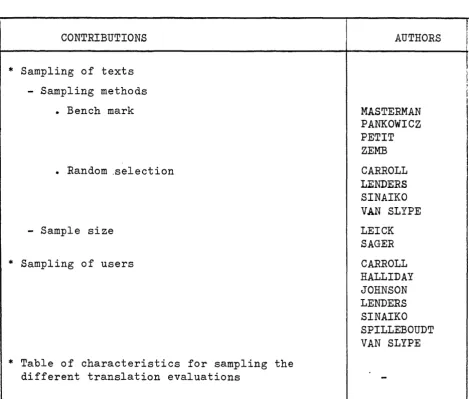
Table of contributions on sampling3-73
Description of sampling methods3-731
Text sampling3.731.1
Sampling method3.731.11
Bench mark3-731.11.1-M.
MASTERMAN3.731.11.2
Z.L. PANKOWICZ3.731.11.3
A.J. PETIT3-731.11.4
J.M. ZEMB
3·731.12
Random choice3.731.12.1
J.B. CARROLL3.731.12.2
W. LENDERS3.731.12.3
H.W. SINAIKO3-731.12.4
G. VAN SLYPE3-731.2
Dimension of the samples3.731.21
J.M. LEICK3.731.22
J.C. SAGER3-732
Sampling of evaluators3-732.1
J.B. CARROLL3-732.2
T.C. HALLIDAY3-732-3
R.L. JOHNSON3-732.4
W. LENDERS3-732-5
H.W. SINAIKO3-732.6
R. SPILLEBOUDT3-732-7
G. VAN SLYPE9
3-733
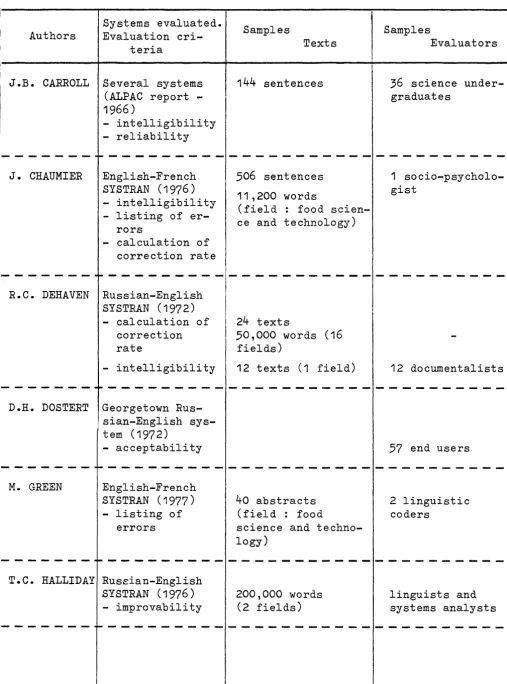
Table of the sampling characteristics of various translation evaluations3-74
Assessment4.
Summary, conclusions and recommendations4.1
Summary and conclusions4.11
Aims of evaluation 4.12 Translation quality4.13
Text typology4.14
Effectiveness and efficiency of the evaluation4.15
Macroevaluation - criteria and methods4.151
Cognitive level4.152
Economic level4.153
Linguistic level4.154
Operational level4.16
Microevaluation - methods and criteria4.161
Analysis of grammatical errors4.162
Analysis of formal errors4.163
Analysis of causes of errors4.164
Analysis of improvability4.165
Actual improvement4.17
Sampling4.2 Recommendationg
4.21
Background considerations 4.22 Orientations4.23
Evaluation methodology4.231
Superficial evaluation4.231.1
Criteria4.231.2
Text sample4.231.3
Sample of evaluators4.232
In-depth evaluation4.232.1
Criteria4.232.2
Text sample4.232-3
Sample of evaluators4.24
Main lines of research5.
Bibliography178
179
180
182
182
182
182
11
1.1 Broad lines of the study.
The Commission of the European Communities has set up a programme aimed at lowering the barriers between the languages of the
Community.
Within the scope of this programme, major resources are being utilized for :
- the acquisition and implementation of a first-generation MT system giving rough output : SYSTRAN
- the design of a European second-generation machine translation system : EUROTRA.
To manage these resources under the best conditions, the Commission has to be able to evaluate on an on-going basis the quality of these translation systems, in particular in the light of the
successive improvements on the linguistic and the data-processing sides.
After arranging, on
28
February1978,
an international seminar on the problems of evaluation of translation, it asked the Bureau Marcel van Dijk to carry out a critical review of the methods of evaluating machine translation; this review to be based on the presentations made at the seminar and on the studies on eva-luation of translation already published.1.2
Aims of the study.The present critical study meets two requirements :
-to establish the current state of themethodology of evaluation of machine translation
- to make to the Commission a series of recommendations concern-ing
• the methodology to be used to evaluate its translation systems
1.3 Summary of the study.
The question of the evaluation of machine translation (MT) and human translation (HT) comprises seven facets :
1.311 Definition of the aims of evaluation.
Evaluation of translation may have two distinct groups of aims :
- Macroevaluation (total evaluation)
• acceptance of a translation system
• comparison of the quality of two translation systems or two versions of the same system
• assessment of the usability of a translation system. - Microevaluation (detailed evaluation)
• assessment of the improvability of a translation system • establishment of an improvement strategy.
Translation quality is not an absolute concept, and has to be assessed
- relatively, applying several distinct criteria illuminat-ing each special aspect of the quality of the translation - allowing for the specific nature of MT, which is a
pro-duct quite different from HT and for which a quite dif-ferent market may open up.
13
In the medium term, research into the typology of texts might well lead to a more effective classification, which might even be automatic.
The criteria for evaluating the translation have to be chosen according to
their effectiveness in measuring effectively the various facets of translation quality
- their efficiency, or in other words the ratio between their effectiveness and the cost of implementing them.
1.315
Macroevaluation- criteria and methods.The large number of criteria proposed or applied by the authors quoted can be classified into four groups :
- cognitive level : intelligibility, fidelity, coherence, usability, acceptability
economic level lation time
reading time, correction time,
trans-- linguistic level reconstruction of semantic relation-ships, syntactic and semantic coherence, "absolute"
quality, lexical evaluation, syntactic evaluation, analysis of errors
- operational level : automatic language identification, verification of the claims of the manufacturer.
Critical analysis of these criteria leads to the conclusion that those underlined in the list above have the most favour-able cost effectiveness ratio.
Among the methods quoted of measuring the first two criteria (intelligibility and fidelity) on the cognitive level (rating on an intelligibility scale, Close test, multiple-choice
questionnaire, knowledge test, noise test), the first (rating) appears the most effective from the point of view of an
evaluation by or for the Commission.
The reading and correction times can easily be obtained as functions respectively of the evaluation of intelligibility and the correctness of the texts.
1.316
Microevaluation- criteria and methods.The methods proposed or applied can be classified into five groups, of which we have underlined the most effective
- grammatical symptomatic level : analysis of the gramma-tical errors detected in the translated texts
- formal symptomatic level : tally of the deletions, addi-tions, modificaaddi-tions, shifts and replacements of words by the revisers and editors (i.e. revision and post-edition rates)
- diagnostic level : analysis of the causes of errors : input, analysis of the source language, dictionary, etc. - forecast level : analysis of the improvability of the
system
- therapeutic level : detection of the improvements to the system following an upgrading operation.
1.317
Sampling.
~---The samples of text (5 to 10,000 words) and evaluatorR must be constituted in such a way as to give both a valid and a
cost-effective operation.
The use of texts especially prepared, and identical from one evaluation to the other is an attractive idea, but un-fortunately one which must probably be excluded because it would be too easy to adapt a translation system to give excellent results on the standard sample, without any guar-antee as to quality for translation of any other texts.
15
The evaluation methodology comprises three types of evaluation :
- the first, "superficial evaluation", will be applied each time a new version of an MT system (whether with new lin-guistic or new data-processing features) has to be appro-ved on delivery.
It makes use of criteria characterized by a high degree of effectiveness, low cost and universality of applica-tion (to all MT systems and even to HT) : intelligibility, fidelity, reading time, correction time, correction rate - the second, "in-depth evaluation", will be utilised only
at "turning points" in the development of an MT system (decision on experimental or operational implementation, decision on an important improvement contract),and in addition to the criteria already used for the superficial evaluation, it makes use of criteria characterized by a very high effectiveness, but also a high cost and a cer-tain specificity of application (detail of the methodology specific to each MT system) : (acceptability to users and improvability of the system), and a further criterion which is less effective but also less expensive (actual improve-ment in the system following dictionary updating). The cost of the evaluation, however, has to remain within reasonable limits, and for this reason, it is esse~tial to distinguish
clearly between :
-• evaluation of acceptab~lity and market research • evaluation of improvability and development of the
system
- the third, "pinpoint evaluation", will be undertaken whenever there is a need to access the impact of certain specific changes to the system. The selection of the evaluation criteria will be a function of the changes concerned, and will thus be specific to each case.
- on the one hand, a study of text typology leading to a classification, preferably automatic, of the texts ac-cording to the translation process suited to them : with or without pre or post-editing, interactive mode, use of specialized dictionaries, etc. (This research should not be started until the various possible methods of translation which EUROTRA will offer have been studi-ed and definstudi-ed)
- on the other hand, a study of the methodology for evaluat-ing the improvability of an MT system, which should lead to the definition of a strategy for improving the system, making it possible to choose the improvements leading to the best results (under the heading of intelligibility, fidelity and correction rate) at the lowest cost.
This methodology will without doubt vary from tern to another.
The diagram below shows plainly the relationships between the concepts of
- evaluation, market research and system development - macro and microevaluation
- superficial and in depth evaluations.
1.4
Rapid scan of the study.The reader in a hurry will be able to obtain a summary picture of the results of this study by simply reading
- § 2 (Introduction), in its entirety
- §
3
(Assessment), only sections :• 3·
x 1 (i.e.3.11, 3.21, •••• 3.71) :
introduction toeach of the seven elements of MT evaluation considered
• 3·
x2
(i.e.3.12, 3.22, •••• 3.72) :
summary, tablesof the contributions of the various authors quoted (the detailed analysis of which is given in
3·
x3)
• 3·
x4
(i.e.3.14, 3.24, •••• 3.74) :
assessment ofthe contributions of the authors quoted
z 0 H E-1 < :::::> ...:I < > r£1 0 p::j 0 H ::=E:: /
I
I
II
I
17
MARKET STUDY
acceptability
intelligibility
fidelity
reading time
correction time
correction rate
improvability
DEVELOPMENT OF MT SYSTEM
! ; (.
I
I
I
I
I
/ \I -,_
\ \ •, \.
\
i iI
t
II
l I
2. Introduction.
2.1 Outline.
The Commission of the European Communities has undertaken a series of long-term actions as regards machine translation, in particular :
- acquisition of a translation system already operational in the United States : the SYSTRAN system. The English-French, French-English and Eng~~sh-Italian versions were bought and the acquisition of other_versions is envisaged
- construction of dictionaries comprising several tens of thousands of terms for each of these versions
- a Community programme aimed at developing a European trans-lation system, EUROTRA.
A systematic evaluation of the quality and improvability of these systems has to be carried out :
- on the one hand to enable the decision-takers and managers • to carry out technical acceptance tests of the various successive versions delivered by the manufacturers of MT systems
• to decide on the desirability of asking the manufacturers or other contractors to make improvements to these ver-sions and/or the total system
- on the other hand, to obtain data useful
• to the implementation of MT pilot operations within the Commission or other organizations
• to the development of marketing studies on MT.
A certain number of MT systems have been used in the United States and in Europe for more than ten years, and have been evaluated many times.
19
The Commission of the European Communities, concerned to use the most adequate evaluation methods, sought to gather the maximum information available :
on the one hand by arranging in Luxembourg, on 28 February 1978a ''Seminar on evaluation problems in machine transla-tion" attended by 35 experts from Germany, Belgium, Canada, Denmark, France, the United Kingdom, Italy, Luxembourg, the Netherlands, Switzerland and the United States.
The majority of these experts made a presentation; these being listed in the bibliography of this report (§ 5) - on the other hand by requesting this critical review.
2.2 Aims.
The aims of this study are threefold :
- to present an outline of the methods of evaluation of MT practised or proposed in the world
- to provide a critical appraisal of these methods
- to recommend to the Commission the adoption of a methodology of evaluation of MT suitable to its specific requirements. The examination of the evaluation methods was intended to stop at the problem of the appreciation of the quality of MT and not to cover economic evaluation.
The literature in this field is very limited, and the Commission in any case already has a methodology for calculating the costs of MT.
2.3 Methodology of the study.
The study comprised three phases, corresponding to each of the aims above :
- collection of the existing literature (cf. bibliography
- critical analysis of these contributions. This criticism was done as impartially as possible; but it must be stressed that it is not neutral, having been undertaken :
• within the specific context of the requirements of the Commission as regards evaluation of MT. The role of the Commission departments which ~re interested in MT,
DG IX-D (Translation, documentation, reproduction and library), and DG XIII (Scientific and technical infortion and informainfortion management) is to optimize the ma-nagement of the translation services and to facilitate the transfer of information between Community languages. It is not their function to support linguistic or data-processing research. This, of course, affects the stra-tegic and tectical choices available when it becomes necessary to decide which method of MT evaluation to apply
• taking into account the experience gained by the author of this report during work on evaluation of MT carried out for the Commission
- study and drafting of recommendations as regards the metho-dology of MT evaluation to be used by the Commission to assess the quality both of SYSTRAN (currently) and of EUROTRA (later).
2.4
Structure of the report.The presentation of the experiments and the suggestions of the various authors and the critical analysis of these -inputs are grouped in a single chapter (§ 3 : Assessment so that the reader can examine the criticism while the text to which it refers is still familiar.
However, to avoid any confusion, the original contribution of the authors and the criticism thereof are presented in two distinct parts of each of the paragraphs of our assessment.
Each of these paragraphs covers a specific point of the question of the evaluation of MT :
- ~i~s_o! lhe ~val~ali~n (§ 3.1) : a certain number of authors
21
- lr~nslatio~ su~litz (§
3-2) :
in certain fields of technology,the quality of a product or a method has a precise and unam-bigous definition, one agreed to by all concerned (the phrase moreover is then "quality control" and not "quality.evaluation"). As regards translation, whether by the machine or not, things are different. However, to evaluate something, it is at the very least necessary to know that which is to be evaluated; many authors discerned this problem, and it is essential to underline their contribution in this field
- !e~t_t~ol~gz (§
3.3) :
in translators' experience, the textswhich are presented to them offer very different levels of translation difficulty. Similarly, the quality of MT varies considerably with the types of text submitted for machine translation. It would thus be important to have a typology indicating which texts are machine-translatable or, in the case of EUROTRA, are candidates for specific MT procedures (pre-editing, interactive mode, post-editing).
Several authors tackled this question, and their contributions are grouped in this paragraph
- !.f.fe_£tJ:.v!.n~s~ ,!n,!! !.ffi_£i~ncy_o.f~v~l~a!i~n (§
3.4)
:when applying a method such as one for MT evaluation, it is use-ful to consider the effectiveness (the measure to which the method meets the assigned aim) and the efficiency (effective-ness at lowest cost) of the method.The decision between the various methods available can be made on the basis of these two factors
- macroevaluation - methods and criteria (§
3.5) :
this is the mo;t-important-part of-thi; -;e-;iew7the part which lists allthe criteria and all the methods used or proposed to date to assess the "static" quality of an MT system, i.e. its quality at the moment of evaluation, and regardless of the manner by which this quality has been reached
- .!!!,i.,£r_£e,!al:,u,! t,io,!! .:. .!!!.e!hods !_nd ..sri t~r2:_a ( §
3.6) :
here we review the methods, unfortunately still too rare, used or proposed to assess the "dynamic" aspect of an MT system i.e.- ~a~ling (§
3.7) :
this paragraph covers the methods used to sample the texts for MT and the evaluators who assess the resultsEach of these paragraphs in the assessment comprises
- an introduction clarifying the content of the paragraph and presenting the structure adopted to classify the authors' contributions according to the nature or orientation thereof - the list of authors quoted
- the extracts or summaries of these authors' contributions, classified according to the structure of the paragraph and alphabetically inside the groups thus delimited (*)
- our assessment.
The assessment (§
3)
is followed by the conclusions (§4)
to be drawn from this wide-ranging study of MT evaluation methods, including the methodology we recommend to the Commission for its evaluation work.The bibliography is in §
5.
23
3·
Assessment.3.1 Aims of evaluation.
The writings of ten authors, who had considered the question of the goal to be aimed at when envisaging carrying out an eva-luation of translation, were analysed and the significant
passages of their text extracted for publication here.
Two groups can be distinguished
the authors who sought to count all the possible aims which an evaluation of translation may have
• with respect to the recipients of the evaluation • with respect to the users of the translation - the authors who concentrated on a specific aim.
Aims
*
Overall aims.- with respect to the recipients of the evaluation
- with respect to the users of the evaluation
*
Specific aims.- effectiveness and usefulness
- system potential for improvement and establishment of improvement priorities
Authors
ANDREEWSKY VAN SLYPE
KUHLEN
WEISSENBORN
KNOWLES LENDERS
PETIT
3.131 Genera! ~i~s_w~t~ ~e~p=c~ ~o_t~e_r~c!p!e~t~ ~f_t~e_e~a~u~
tion:
3.131.1 A. ANDREEWSKY considers that the evaluation of a transla-tion system can vary widely according to the standpoint from which it is viewed :
- that of the user : evaluation regardless of uprating of the system
- that of the manufacturer : evaluation to improve the system.
It is necessary, moreover, to consider the question of defining the moment from which a system may be regarded as having left the initial development stage.
Allowance must also be made, -finally, for the point of view of the post-editor
- acceptability of the task
quality threshold below which MT is refused.
3.131.2 G. VAN SLYPE thinks that the aims of an evaluation depends on the types of persons concerned and on their motivation. It is therefore essential, before setting out the aims of
the evaluation, to know for whom it is being done and what each of the recipients expects of it.
Groups involved
Final users of raw MT
---Post-editors correcting MT
~---Decision-makers (res-ponsible for the deve-lopment of an MT sys-tem)
~
---System technicians (data-processing spe-cialists, linguists, coders)
~---Linguists
---Heads of translation services
25
Aims of evaluation
- effective transfer of information from one lan-guage to another
- acceptability
- service conditions
- acceptability (allied to the scale and type of corrections)
- potential market
error diagnosis (by type -elements of the specific MT system concerned ) - correctibility
error diagnosis (by type -grammatical and stylistic)
- number of corrections, per-haps classified by type - comparison of the features
of the MT/post-edition cir-cuit with those of the HT/ revision circuit
Criteria
- fidelity
- intelligibility
- legibility - reading time - cost - production·time ~--- post~---edition rate - post-edition time ~--- acceptability - cost - improvability (in synthesis)
~--- errors by causes
- improvability (analytical)
~--- errors by
linguistic type
3.132.1 R. KUHLEN enumerates the twelve points which he feels may interest the users of the translation and which affect the evaluation criteria to be used
- interlingual transfer of the words in the text which are essential to comprehension, regardless of syntac-tic relationships (with subsequent HT once the rele-vance of the text is established)
- interlingual transfer based on a pre-defined syntactic andsemantic standardization of the source text
- interlingual transfer based on a factual syntactic and semantic standardization of the summarized source text
- interlingual transfer of unprepared complete texts in areas with a specialized terminology, to obtain a general idea of the contents of the document
- interlingual transfer of standardized press releases by news agencies or official bodies with post-editing by the recipient
- interlingual transfer of routine texts, the recipients of which will simply scan rapidly
- interlingual transfer of texts for classification by subjects
- interlingual transfer of the semantic and pragmatic information of texts into a logical network incor-porating a multilingual question-and-answer system - conversion of texts into an international structure
permitting production of multilingual abstracts - translation to check the efficiency of linguistic
models
- translation as a method of simulating human intelli-gence in defined situations
27
3.132.2
J. WEISSENBORN defines the evaluation criteria to be used according to translation types and their qualitative aims- translation intended for publication : • qualitative aim : perfectly correct
• criterion : cost of post-editing, which in turn is a function of the number of translation errors - translation intended to inform the specialist of the
contents of a text :
• qualitative aim : errors and gaps permissible • criterion : number of translation errors
- translation intended to give an overall picture of the contents of a text :
• qualitative aim : low quality permissible criterion
syntax.
number of errors of morphology and
effectiveness and usefulness.
3.133.1
F. KNOWLES feels that the checks on the quality of an MT system must guarantee a sufficient level to enable a monolingual reader whose mother tonge is the target lan-guage, to undertake the necessary post-editing without risk of disaster.3.133.2
For W. LENDERS, the aim of the evaluation is to assess the practical usefulness of MT rather than its linguistic exactitude.It is necessary to consider first of all that MT is, generally, defective.
Nevertheless, it can be assumed that these translationscan be used with care and rationally, either just as they
are, or in a revised form.
3.133.3
A.J. PETIT. When evaluating a translation produced by a machine to determine if a system under development meets the requirements or if a system proposed by a supplier is in accordance with the description given of it, it is not a matter of evaluating justa text, but the cha-racteristics of a production tool.The evaluation method has to be based on a knowledge of the problems and their scale, and has to make it possible to check point by point whether the system comprises all the characteristics necessary to translate effectively. Instead of taking a text and trying to classify the
errors, the evaluator will establish requirements corres-ponding to each of the evaluation criteria and will seek in the translated text all the errors which can be as-signed to this criterion. In certain cases, each time the machine successfully resolves a problem, the cause
of this success will be ascertained by means of a checktest and if it becomes evident that it can be assigned to a human intervention (coding, for example), the test will be repeated on a similar example which has not been coded. Any on-the-spot correction has to be regarded as a fai-lure and the use of on-the-spot corrections (or specific coding) will result in the irrevocable refusal of the system.
3-134.1
For R. GREEN, one of the essential aims of an evaluation is to detect the errors in translation, and assess their seriousness, so as to be able to decide priorities as regards improvement of the system.3-134.2
Z.L. PANKOWICZ notes that, up to now, all evaluations of MT have had a political aim.Their results are consequently dubious, being based as they are on a prior bias, either against MT in general, or in favour of a particular MT system.
29
However, it is essential, for the users and the purchasers of such systems, to know their capacity for improvement and the limits thereon.
Improvement work can not, in fact, be carried out infini-tely, and this work should therefore be directed in such a manner as to optimize its results.
3-134.3
For G. VEILLON, an MT programme has the unfortunatepro-perty of never being finally correct, of being in perpe-tual evolution. It is thus on this "potential" aspect which the evaluation must bear : a programme has value precisely in its possibilities for enrichment and impro-vement.
It is necessary consequently to evaluate :
- from the point of view of the user who is not a com-puter specialist : ease of detection and correc-tion of errors resulting from
• pre-edition and input • dictionaries (*)
• grammars (*)
from the point of view of the computer specialist the design of the software, making it possible
• to integrate it into text-handling, and in par-ticular text-editing systems
• to extend the programme with new modules which improve its performance
• to transfer it to other computers
- from the point of view of the cost of the human ope-rators responsible :
• for pre-editing and post-editing the texts • for updating the dictionaries and the grammars.
Apart from the contribution of A.J. PETIT, the aim of which seems to be above all to show the impossibility of MT, the contributions of the authors who cons1ctered the aims of the evaluation are either convergent, or complementary.
It appears agreed that :
- one essential aim of MT is to be useful to its users (F. KNOWLES and W. LENDERS)
machine translation can be undertaken with the aim of translating various types of texts, each of these types having a specific qualitative aim and consequently re-quiring the app~ication of specific evaluation criteria (R. KUHLEN and J. WEISSENBORN)
- evaluation of MT has to be done in the light of the various categories of recipients of the evaluations, each category having one or more specific aims, and the methodology of the evaluation having thus to be specific to each group
(A. ANDREEWSKY and G. VAN SLYPE)
- the evaluator of MT has to concern himself not only with the quality of the system, but also with its improvability
31
3.2
Translation quality.Logically, an evaluator has to start by asking himself what is actual object of its activity. It is consequently normal that the majority of the studies on evaluation of MT and the commu-nications submitted to the Luxembourg conference of February
1978
should include a discussion and/or a proposal for adefi-nition of the quality of translation. In certain cases, a link is made between qualities to be measured and the measuring criteria.
The dozen contributions below on this subject, have been broken down into three groups :
- a definition of translation
- a series of summaries or extracts on translation quality - contributions on the relation between translation qualities
and evaluation criteria.
Definitions Authors
1 Concept of translation J. HOUSE
I
~---~---Quality of translation ASSOCIATION J. FAVARD H. BRUDERER
R.L. JOHNSON
R.
KUHLEN Z.L. PANKOWICZ AoJ. PETIT Y. WILKS
---~---Link between translation qualities and evaluation criteria
3.23
Di~cEs~i~n~~n_the_c~n£eEt_o1 lr~nsl~tio~~nd ~n_t£a~slali£n_qualitz.
3.231
Definition of translation.J. HOUSE.
Translation is the replacement of a text written in a seurce language by a semantically and pragmatically equivalent text written in the target language.
(The translation of oral texts is different activity, namely interpretation).
3.232.1
L'Association Jean FAVARD distinguishes :- the intrinsic qualities, which are independent of the reader
- the extrinsic qualities, which are related to the "text-reader" couple.
A text, even badly translated(and thus of low intrinsic quality) can nevertheless, for an informed reader, be as clear as if it had been well translated.
However, beyond a certain deterioration in intrinsic quality, the extrinsic quality becomes very poor.
3.232.2
For H. BRUDERER, quality is a relative concept, i.e. onerelated to a specific object •••• Quality can apparently be measured, at least in part, but it remains much more difficult to quantify abstract (conceptual, subjective) phenomena than concrete (perceptible, real, tangible) things.
Quality can be evaluated :
- either positively : assessment of merits, advantages - or negatively : assessment of deficiences, errors,
disadvantages
33
The evaluation of the translation quality - whether human or computerised - has to take into account the following intra-linguistic and interintra-linguistic factors : morphology, syntax, content, terminology, style, conformity.
A faithful translation reproduces the sense of the original text, but it does not necessarily, if it is to be consi-dered an intelligent translation, have to be identical to the original text. Given that they partially overlap, content and fidelity should be evaluated on an overall basis. Similarly, it is difficult to differentiate clearly syntax and semantics. Style, on the other hand, influences all levels (morphology, syntax, semantics, terminology).
3.232.3
R.L. JOHNSON defines translation quality by three factors fidelity, intelligibility and elegance. The importance of these three factors may vary with the type of text consi-dered.Features can be observed :
- superficially, via linguistic elements such as lexical and syntactic exactitude
- indirectly, via the reactions of the users to the translated text.
3-232.4
R.
KUHLEN stresses that there is not a universal criterion for MT evaluation :- on the one hand because it does not seem that MT can ever reach the level of quality of human translation - on the other hand, because the evaluation criteria have
to be chosen according to the aim in view
- finally, because the individual parameters, which taken together permit an assessment of the quality of MT, often contradict each other, with the result that an overall rating would not be significant to the speci-fic performance of the components.
3.232.5
Z.L. PANKOWICZfeels that usefulness of MT and HT has to be based on quality, speed and cost. Determination of the op-timal balance between these three parameters depends on the environment of each translation activity.lations to be supplied raw to the final user and 2
%
of the sentences in the case of texts to be revised before submission to the users. This tolerance is intended to allow for normal risks of error or accident.3.232.7
Y. WILKS thinks that the purist who feels that the least translation defect nullifies the translation is often mistakes in two of his postulates :- he exaggerates the attention and comprehension which the average reader achieves with a technical document (consequently, errors of translation do not negate the value of the text)
- he exaggerates the quality of the mass of human trans-lations produced on an enormous scale and at high speed.
3.233
Relationship between translation qualities and evaluation criteria:-3.233.1
According to G. BOURQUIN, the criteria for evaluating atransl~tion will vary according to whether it is produced
by a ii'uman translator or by the machine :
- from the human, "finesse" will be required : open to the ethnoculture and to work on linguistics, the human translates with his sensivity, his intuition, his common sense
- the computer will be expected to offer regularity, precision, infallibility, speed, and encyclopaedic exhaustiveness.
35
3.233.3
A.J. PETIT.A product is acceptable only if it meets the requirements of its users. As regards texts (original texts or human or machine translations), the principal requirements are :
- utility technical texts (maintenance or user manuals) : • no errors
• homogeneity
• clarity, without ambiguity or gibberish which might obscur the sense of the message
• simple correct style, without extravagances or
/
recherche elements
• use of the terms recognized in the relevant sector educational technical texts
• no technical errors
• adaptation of the text to the reader and cultural transposition of any reference or any comparison whose aim is to render comprehensible the material being taught
• simple correct style
• introduction to the terms recognized in the rele-vant sector
- documentary scientific texts :
• clear exposition of theory, without errors
• flowing style without excessively long s~tences
incorporating several different ideas
• use of the basic terminology of the discipline.
These requirements have however to be viewed from a dif-ferent angle according to whether the translation is in-tended :
- to be revised : in this case, the translation system (human or machine) has to be aware of its own short-comings, and indicate by itself all the ambiguities which it was not able to resolve : it delivers an in-complete product, but one without serious defects - to be supplied direct to the final user : the
lation must then be complete (experienced human trans-lator or a computerised system producing a complete translation, without any misconstruction) and without serious defects (human error or accident both being
3.233.4
The authors of the report presented by PHILIPS distinguish between evaluation of translations with and without compa-rison with the source text.In the first case, it is necessary to assess in what measure the translation :
reproduces which is stated in the original (for example contractual texts)
- reproduces what the author of the original intends to say, with the certainty that the message is properly understood (for example : translation of manuals).
To assess the quality of a translation, it is necessary to answer the following questions
- on the aim of the translation
• does the translation reproduce the content of the original ?
• does the translation reproduce the formulations of the original ?
• does the translation reproduce the intention of the author ?
- on the type of text
is all the information presented ?
• can the translation achieve the desired effect ? • have the necessary corrections been made in such
a way that communication has the best chance of success ?
In the second case (evaluation of the translation without reference to the original), the assessment of the quality of the translation has to cover
- the grammatical correctness - style and idioms
the use of current words, expressions and structures in the target language
37
The concept of the quality of a manufactured product is, in general, unambiguous : the product has to correspond to the specifications and a battery of quality control tests can easily be arranged, and made the responsibility of controllers often relatively unqualified.
The concept of translation quality is much more indeterminate, and the authors' contributions can be summarized fairly brief-ly :
- the quality has to be assessed, not in the absolute, but according to the aims of the writer of the texts to be translated and by those who decide how it is to be distri-buted
- the quality achieved by HT can not be expected of MT, and the latter has thus to be used for more limited aims than the former (which does not mean that, within the scope of these limited aims, there does not exist a major potential demand)
- the evaluation criteria have to be chosen according to these specific aims
We gathered ten extracts from documents dealing with the pro-blem of text typology.
These extracts can be classified in two different ways, accord-ing to consideration either :
- of the criterion or criteria proposed as a basis for the typology of the documents
- or of the purpose proposed for this typology.
These two methods of classification are equally useful. Thus, in order not to lenghthen this report by covering the extracts twice, we drew up a double-entry grid, indicating, for each author, the type of criteria and the purpose proposed. The extracts themselves are then presented in author alphabetical order.
~ : the typologies whose author's name is underlined have actually been used on an experimental basis by their author.
Purpose
Evalua .. Assessment of\ Detection of Determination tion of MT difficulty machine-trans- of translation Criteria of texts latable texts methods
Pragmatics ROLLING VAN SLYPE SAGER
External form JOHNSON
Functions HOUSE
Role of textual
units LEAVITT
Source language
grammar WEISSENBORN
Scale of
diffi-culties PHILIPS
Formal structures HOFSTETTER
Linguistic
cha-racteristics BOURQUIN
39
3.3301
G. BOURQUIN feels that in order to evaluate objectively the fidelity of a translation, it is necessary, as a preliminary, to clarify what in the source product has to reappear in the target product : one can measure the adequacy of Bwith respect to A only after specifying that with respect to which B is held to be adequate. For these reasons, the way to a defini-tion of methods and criteria of evaluadefini-tion as regards trans-lation is via construction of a typology of discourse.G. Bourquin proposes to consider four criteria for text
classification; stressing, however, that these criteria cons-titute research topics rather than final answers : operative typologies will be obtained only by successive approximations based on obstacles actually encountered in translation.
Text classes and error classes will be progressively set in statistical correlation, which will lead eventually to more realistic criteria. At the end of this process - which is likely to be lengthy and to involve many investigators - it will perhaps be possible to set less subjectively than is the case today the limits of what is translatable and qualitative standards.
The criteria for text classification proposed by Bourquin are
- according to the refential function :
• discourse with isolable functions i.e. independent of the mode of expression
• auto-referential discourse turned in on itself and referring only to its own internal structure
o mixed discourse, spanning the whole range between these
two poles, either simultaneously or successively - degree of normality (texts with isolable referential
function only)
• referential function belonging to an existing configu-ration
• referential function running counter to known ideas (latest research, epistemic breakdown)
• immediate (transparent) relation between the vehicular language and the logico-conceptuel referent (purely denotative formulation; direct translation)
- information density :
• when the relation between the language and referent is opaque, the redundancy is integrated into the heuristic process,
• but, otherwise the redundancy is useless, and the translator must eliminate it : in this case a faith-ful translation is one reproducing what was said, not the way of saying it
- nature of the text-author relationship :
• utility or technological discourse : factual, descrip-tive, argumentadescrip-tive, explanatory, etc •
• uniformly impersonal discourse or discourse containing personalized passages.
On a first analysis, it seems that :
- the human translator is best suited to text which is not conformist, and/or is argumentative and/or is strongly personalized
- the computer is better adapted to translation of text which is conformist (with a peredictable and stable phraseo-logy), factual and not personalized.
3.3302 H. HOFSTETTER proposes that the texts to be translated should be characterized not by classifying them in a limited number of extrinsic classes, but by analysing the formal structure number of words per sentence, number of words of less than four characters, number of conjunctions, of prepositions, of subordinate clauses, of noun expressions, etc.
3·3303
J. HOUSE proposes and actually uses (on a sample of eight documents) a typology based on the functions fulfilled by the texts, i.eo on the use made of them by the recipients. She actually makes use of this typology during an evaluation of human translation, and we have therefore classified the summary of her work in the chapter on evaluation criteria(§
3-5).
3-3304
R.L. JOHNSON feels that a typology based only on the stylis-tic or linguisstylis-tic characterisstylis-tics of the texts would be of less practical utility than one based on the external form; for example : memorandum, scientific paper, technical speci-fications, etc.It will in fact be on the basis of this categorization that translation services wil~ decide whether to have a text translated by MT or HT.
3-3305
A.W. LEAVITT advances a classification not of the documents, but of sections within each document, called "textual units",intended for MT evaluation purposes.
The textual unit results from a progressive subdivision of the document up to the point where any additional division would cause the author's intention to be obscured.
A textual unit has the following characteristics :
- taken alone, it retains its capacity to communicate a meaningful item of information
- it expresses a complete thought and may be withdrawn from its context without fully losing its meaning
if it is subdivided any further, it loses its meaning.
List of the textual units.
- method : description of the activities of the
investiga-te;
and justification of these activities- c~n~iii~n~ : statement of the context of the work, includ-ing a description of the surroundinclud-ing characteristics pre-sumed to influence certain results, definitions, concepts involved by the work, and statement of the constraints showing the limits of the technical work
- ~r~p~sal~ : assumptions, axioms, lemmas, theorems and
statements of a priori technical specifications
- ~e~u!t : data, derivations, corollaries, proofs and
entities arising from the subject or from previous inputs
~o~clu~i~n : statement of an interpretation or a convic-tion concerning the reality, the confidence or the appli-cability of a discovery.
~ : thus defined, the textual units could extend over one or several paragraphs. In reality, from the examples provided, it appears that they are no longer than one or two sentences. The interest of this internal document typology is that it makes it possible to judge the importance of each category of textual unit with respect to the functions which can be fulfilled hereby, in particular :
- selection of relevant documents
- identification of relevant parts of documents - expansion or improvement of knowledgeo
The experimental implementation of this method by Leavitt has shown up the difficulties of it :
- lack of consistency in the subdivision into textual units of the same documents by several persons
- lack of consistency in the classification (according to the six categories above) of the same textual units by several persons
lack of consistency in the weighting of the same semantic unit classes with respect to the functions which can be fulfilled thereby.
3-3306 The authors of the PHILIPS report present a table of the scale of difficulty of the translation, based on difficulty factors, taken from of a publication of K. REISS (*)
Difficulty factors
Linguistic
- Language level
- Syntactic-se-mantic struc-ture
- Translation from - to
- Function of the text
- Function of the translation
Content
- Content of the text
Scale of difficulty
1st grade
erdinary language (cultivated and colloquial language)
Clear, simple me-thod of expression
1 and development of
I
1 ideas
From the foreign language into the mother tongue
Informative (pri-marily referring to the content)
Expressing the sense
Field open to general expe-rience
2nd grade
Technical and special languages
Hermetical, com-plex expression and development of ideas
From the foreign (which is not the mother tongue of the author) iYl.to the mothertongue
Expressive (pri-marily referring to the form)
Expressing the sense and ade-quate reproduc-tion of the form
Field can only be dealt with after technical train-ing
3rd grade
Poetic (artistic-ally shaped)lan-guage
Defective expres-sion and develop-ment of ideas
From the mother tongue into the foreign language
Operative (pri-marily referring to behaviour)
Expression of the sense, adequate formal and analo-gous statistic or operative forma-tion
Field only to be dealt with if the translator is con-genial in his ap-proach