Proceedings of the
WESTERN JOINT COMPUTER CONFERENCE
February
7-9, 1956
San Francisco, Calif.
Sponsors:
THE AMERICAN INSTITUTE OF ELECTRICAL ENGINEERS
Committee on Computing Devices
THE ASSOCIATION FOR COMPUTING MACHINERY
THE INSTITUTE OF RADIO ENGINEERS
Professional Group on Electronic Computers
Printed in the United States of America
T.85
PROCEEDINGS OF THE
WESTERN JOINT COMPUTER CONFERENCE
PAPERS
PRESENTED~AT
THE JOINT ACM-AIEE-IRE COMPUTER CONFERENCE,
SAN FRANCISCO, CALIF., FEBRUARY
7-9, 1956
Sponsors
THE AMERICAN INSTITUTE OF ELECTRICAL ENGINEERS
Committee on Computing DevicesTHE ASSOCIATION FOR COMPUTING MACHINERY
THE INSTITUTE OF RADIO ENGINEERS
Professional Group on Electronic Computers
Published by the
American Institute of Electrical Engineers
33 West 39th Street, New York
18,
N. Y.for the
ADDITIONAL COPIES
Additional copies may be purchased from the following
sponsoring societies at $3.00 per copy. Checks should
be made payable to anyone of the following societies:
AMERICAN INSTITUTE OF ELECTRICAL ENGINEERS
33 West 39th Street, New York
18,
N. Y.
ASSOCIATION FOR COMPUTING MACHINERY
2
East 63d
Stree~,New York
21,
N. Y.
INSTITUTE OF RADIO ENGINEERS
1 East 79th Street, New York
21,
N. Y.
Copyright 1956
Foreword
The ninth Joint Computer Conference which was the fourth Western Meeting under joint sponsorship, was held for the first time in San Francisco this year. The change in the site for this Western Meeting from Los Angeles to San Francisco bespeaks the in-creased activity and interest in computers on the West Coast.
Mor.e emphasis was placed this year than at the past few conferences on the strictly engineering phases of computers. Thirty-eight technical papers were presented, with parallel sessions being used on four occasions. As has become the custom, exhibits of computer systems and components formed a part of the conference program together with a number of inspection trips to local computer installations. The registration of over 1,000, as well as members of the public, was able to inspect exhibits in 39 booths prepared by 25 companies prominent in the computer field.
Oliver Whitby
Joint Computer Committee of the AIEE-IRE-ACM
Secretary-Treasurer: M. M. Astrahan
ROBERTR. BENNETT J. G. BRAINERD
Representing AlEE
Representing IRE
D. C. ROSS P. L. MORTON
DANIEL HAAGENS W. F. GUNNING
J. R. WEINER, Chairman-East OLIVER WHITBY, Chairman-West
C. W. ADAMS J. BARNES
Representing ACM
Ex-Officio Representatives
D. H. LEHMER H. F. MITCHELL, JR.
E. L. HARDER, AlEE A. S. HOUSEHOLDER, ACM
J. H. FELKER, IRE-PGEC
Conference Management Committees
Conference Manager
OLIVER WHITBy ... Stanford Research Institute
Secretary- Treasurer
J. W. HAANSTRA ... IBM Corporation
Technical Program
B. J. BENNETT ... Stanford Research Institute
Publications
A. S. HOAGLAND, Chairman ... University of California, Berkeley GORDON MORRISON ... University of California, Berkeley
Exhibits
G. E. HULSTEDE, Chairman ... Pacific Telephone & Telegraph Co. H. K. FARRAR ... Pacific Telephone & Telegraph Co.
Publicity
D. C. HOLMES, Chairman ... Shell Development BILL EISENLORD ... Shell Development
Registration
H. W. HARRISON, Chairman ... NACA Ames Aerodynamics Laboratories ALAN VOORSANGER. . . .. ... .. Sperry-Rand Corporation
JACK MAUGHMER . . . , ... University of California, Berkeley
Hotel Arrangements
DEXTER STONER, Chairman ... Pacific Gas & Electric Co. DENNIS FINNIGAN. . . '" . . . .. . ... Stanford Research Institute A. M. PETERSON.... . . . ... Stanford University
Trips
LIST OF EXHIBITORS
Contents
Page Keynote Address
Computers-From Youth to Manhood ... ... " ... Norman H. Taylor
Programming and Coding
Gestalt Programming: A New Concept in Automatic Programming . ... Douglas T. Ross 5
A Truly Automatic Computing System ... ... Mandalay Grems, R. E. Porter 10 lincoln Laboratory Utility Program System (Abstract) ... H. D. Bennington, C. H. Gaudette 21 An Automatic Supervisor for the IBM 702 . ... : ... Bruse Moncrieff 21
Auxiliary Equipment
Magnetic Recording Head Design . ... A. S. Hoagland 26 A Terminal for Data Transmission Over Telephone Circuits ... . Enoch B. Ferrell 31 The Use of the Charactron With ERA 1103 . ... Ben Ferber 34 A New Tape Handler for Computer Applications ... ... R. M. Brumbaugh 36
Machine Design
Requirements for a Rapid Access Data File . ... George Eisler 39 Engineering Design of a Magnetic-Disk Random-Access Memory . ... T. Noyes, W. E. Dickinson 42 Print I-A Proposed Coding System for the IBM Type 705 ... . R. W. Bemer 45 The IBM Type 705 Autocoder ... " ... Roy Goldfinger 49 Program Interrupt on the Univac Scientific Computer . ... Jules Mersel S2
Systems
A Pulse-Duration-Modulated Data-Processing System .... ... J. R. Lowe, J. P. Middlekauff 53 A PDM Converter . ... W. R. Arsenault 57 An Improved Multichahnel Drift-Stabilization System . ... P. G. Pantazelos 62 Combined Analogue and Digital Computing Techniques for the Solution of Differential Equations . ...
· ... P. A. Hurney 64 Design, Programming, and Coding
An Experimental Monitoring Routine for the IBM 705 ... ... H. V. Meek 68 The Logical Design of a Digital Computer for a Large-Scale Real-Time Application . ... .
· ... M. M. Astrahan, B. Housman, J. F. Jacobs, R. P. Mayer, W. H. Thomas 70 Computer Design to Facilitate Linear Programming . ... R. C. Gunderson 75 Considerations in Making a Data-Gathering System Computer Compatible (Abstract) ... B. L. Waddell 77
Scientific Application
Using a Variable-Word-Length Computer for Scientific Calculation . ... .
· ... Fred Gruenberger and E. H. Coughran 77 Unusual Problems and Their Solutions by Digital Computer Techniques ... .... Lawrence Rosenfeld 79 A Progress Report on Computer Applications in Computer Design . ... S. R. Cray, R. N. Kisch 82 A Topological Application of Computing Machines ... ... Ascher Opler 86
Applications
Applications of the Small Digital Computer in the Aircraft Industry . ... H. M. livingston, E. L. Lyons 89 Traffic Simulator with a Digital Computer ... ... " ... S. Y. Wong 92 Integrated Data Processing with the Univac File Computer . ... R. P. Daly 95 A Fixed-Program Data Processer for Banking Operations . ... Jack Goldberg 99
Circuits .
The .Logical Design of a 1-Microsecond Parallel Adder, Using 1-Megacycle Circuitry . ... .
... ... ... ... . A. Weinberger, J. L. Smith 103 The TransFluxor . ... , .... " ... J .A. Rajchman, A. W. Lo 109 Bilateral Magnetic Selection Systems for Large-Scale Computers (Abstract) ... A. H. Sepahban 118 The Megacycle Ferractor (Abstract) ... T. H. Bonn 118
RCA BIZMAC System
Purpose and Application of the RCA BIZMAC System .. ... .
· ... W. K. Halstead, J. W. Leas, J. N. Marshall, E. E. Minett 119
Function~1 Organization of Data in the RCA BIZMAC System .. ... .
· ... A. D. Beard, W. K. Halstead, J. F. Page 124 The RCA BIZMAC System Central. . . , ... : ... J. L. Owings 126 Characteristics of the RCA BIZ MAC Computer ... .
· ... A. D. Beard, L. S. Bensky, D. L. Nettleton, G. E. Poorte 133 Programming the Variable-Item-Length RCA BIZMAC Computer ... ... .
Computers-From Youth to Manhood
NORMAN H. TAYLOR
Y
OU are very kind to honor me with the invitation to speak here today, and it is a pleasure to be here. I always appreciate a good excuse for leaving myover-coat and galoshes behind in Boston and coming out to sunny California. Furthermore, we are beginning to re-alize that although Boston is still of course the hub of the universe, nevertheless there are some pretty good ideas generated out here on the West Coast; and I hope I shall not return to New England without a few dozen of them in my carpet-bag.At the first Joint Computer Conference in 1951 at Philadelphia, the computer industry was turning a corner. you might say that after a well-protected infancy, it was putting on short pants and getting outdoors and the neighbors were beginning to be aware of it. The ma-chines, like some children I know, could be made to put on their "company manners" when their rich uncles came around, but this was all too often the result of intensive grooming and stern disciplinary measures behind the scenes. Our audience, while sympathetic and hopeful, still could not help feeling skeptical, and some may even have feared that we were raising a little monster who would turn out to be more of a liability than an asset.
Five rapid years of growth have served to vindicate our claims of 1951.
r
could easily spend an hour giving you chapter and verse on this, but suffice it to say that more than 75 large machines are in full-scale useful operation, and hundreds of smaller machines are doing important jobs for office and industry. The attendance figures at these professional conferences should be some sort of index; there were 880 of you at that first conference in 1951, now we are holding two conferences a year, and the 1955 Eastern Joint Computer Conference alone had approximately 2,000 people in attendance. This Western J oint Computer Conference and its counterpart, the Eastern Joint Computer Conference, will undoubtedly set a new record.Thus, I think we can say that the computer business is getting out of its childhood, and putting on long pants. Adolescence is upon us, and although some of us, I am sure, look back with a certain nostalgia on the happy childhood days, nevertheless, like good parents we can-not shirk the problems of the present, and must try as best we can to prepare for the future. By and large, we are proud, you and I, of what we've done so far. But no engineer worth his salt is going to devote his time to admiring his past work. What the good engineer lives
Full text of the keynote address presented at the Western Joint Computer Conference, San Francisco, Calif., February 7, 1956.
NORMAN H. TAYLOR is with the Lincoln Laboratory of the Massachusetts Institute of Technology, Lexington, Mass.
The author wishes to acknowledge the helpful suggestions of W. A. Hosier in the preparation of this address.
Taylor-Computers-From Youth to Manhood
for, the air he breathes and the meat he eats, is the chal-lenge of new problems. It is not too much to say that without new problems he suffocates and starves, and pro-fessionally he might as well be dead. If there were an engineer's Bible, I think this ought to be one of the two great commandments, so, using this text, my little sermon today is going to deal with the problems ahead of us. Please note that I'm presenting problems and asking questions, not trying to give you the answers. Even if I thought I knew a few of them, I'd be spoiling your fun, and that would be a dismal thing to do! I'll save my clairvoyance act for private chats, where I won't be em-barrassed by seeing :t in print and having to eat it five years later. You fellows are the ones who will have to answer these questions, just as today you have given us answers to some of the questions asked five years ago.
Let me return now and then to that notion of looking at computers as children that we've raised-it isn't really a bad analogy, if I don't squeeze it too hard; you know how children outgrow things, first their shoes, then their pants, then their coats, and so on. Or how a boy's mind in a way outgrows his body, and he imagines him-self beating up all the tough guys in the neighborhood and fascinating all the pretty girls. Well, our computers have had and are still having just this sort of growing pain, the parts like arithmetic element, memory, and terminal equipment don't keep pace with each other, and we haven't yet got a mature, harmonious, balanced system. Until recently, our worst shortcoming has been the size, reliability, and speed of central memories; and we have put a lot of effort into improving them. The magnetic-core memory which has come out of this is now fairly wen accepted as the central h'gh-speed element of present-day machines, and is probably the largest single change of these past few years. Even so, we haven't quite caught up with arithmetic element speeds; the logical structure of most machines has been aimed at using mem-ory time and capacity to the hilt. Elaborate buffer memories serve the purpose of emptying and filling the: high-speed memory, and tricky instructions use other hardware to do jobs that might be done in the centra] memory if its time weren't so valuable.
At that, we haven't yet exploited magnetic-core mem-ory to the full; the 64 by 64 memmem-ory plane is now pretty common, but one naturally asks the question, how much bigger can you build it? Preliminary work leads us to believe that the 64 by 64 plane can be extended to 128 by 128 and probably to 256 by 256 without any serious loss in speed or reliability. If this expectation becomes a reality, we shall have a 256 by 256 by 36 memory, that is to say, 2.5 million bits of storage with 6 to 7 micro-seconds random access. Surely this will be a handy tool for the future. How shall we use it? It certainly ought
to' affect Qur present cQncept of prQviding large buffers feeding a small high-speed memQry; it has abQut the ca-pacity Qf eight cQnventiQnal magnetic drums. DQes this mean that drums are QbsQlescent?
But can the memQry designer relax? Is he gQing to' be free Qf demands fQr mQre speed and capacity frQm the di-rectiQn Qf the arithmetic element? Vacuum tubes have been fQr several years the principal limitatiQn Qn arith-metic element speed: we have pushed adders up to' 1 Qr 2 megacycles, and with multipliers it is cQmmQnly felt that a law Qf diminishing returns sets in sQmewhere in the regiQn Qf 1/2 to' 1 micrQsecQnd per bit. I think the memQry peQple, with the 6-micrQsecQnd memQries, have prQvided, PQtentially at least, a gQQd match fQr such cir-cuits in speed and reliability.
But what abQut the future? Surface barrier transistQrs already give prQmise Qf Qperating at 5 megacycles in arithmetic and switching QperatiQns. What will CQme with the new gaseQUS diffused Qr drift transistQrs? I'm afraid the answer is inevitable: MemQry will lag behind and the race will be Qn again. Why all this speed? DO' we really need it? We are already being pressed to' design larger and faster machines to' tackle prQblems that are bulky and cQmplex and have to' be sQlved quickly. One way Qr anQther, I'm sure we'll
try
it. But if we had speed an Qrder Qf magnitude over what we've gQt nQW, cQuldn't we dO' mQre time-sharing and substitute speed fQr equipment? Surely if sQmething like this can be dQne, machines will be simpler, smaller, less expensive, and mQre reliable. This is a prQblem for the IQgical de-signer.I have dwelt here Qn a few aspects Qf the internal CQn-sti utiQn Qf cQmputers. In Qur analQgy to' the child, these WQuld be his health, grQwth, and internal develQpment. These are gQing well, with gQod mQmentum. I dQn't think we have any cause to' fear that these children Qf Qurs are sickly Qr stunted. But as we all knQw, this is, if anything, the small end Qf the prQblem Qf rearing children: as they grQW up, they leave mQre and mQre their Qld sheltered envirQnment; they must be educated, they must (usually) dO' useful wQrk, they must gradually accept mQre resPQnsibility. I'm sure this isn't all, but these three requirements give me a cQnvenient handle fQr the remaining things I have to' say. Let's talk abQut this subject Qf useful wQrk.
Y QU can divide wQrk rQughly intO' twO' kinds: the kind that deals with symbQls which yQU might call "white-cQllar wQrk," and the kind that deals with matter and energy, which I suppose yQU would call manual labQr Qr sQmething like that. The kind Qf wQrk that deals with peQple I dQn't feel has gQt intO' the picture yet. When we ask a cQmputer to' do the first kind Qf wQrk, we call it data-processing; when: t dQes the secQnd kind, the current terminQIQgy WQuid seem to' be "autQmatiQn." I am aware that the last wQrd is Qften used mQre IQQsely, and that the dividing line between the twO' kinds Qf wQrk is fuzzy in SPQts, nevertheless the divisiQn is a help in thinking abQut the prQblems, because the prQblems in the twO' cases are essentially different, and since there is nO' better wQrd fQr the secQnd kind, call it autQmatiQn.
2 .
Data-prQcessing deals with symbols, and symbQls fQr the most part are discontinuous, discrete things: they cO' me in chunks, and are grist fOil" the digital cQmputer mill. We are getting high-speed printers to' grind them Qut. If we can get high-speed readers Qf print to grind them in withQut going through the clumsy media of punched cards Qr paper tape Qr the volatile and intangible medium of magnetic tape, we shall have gQne a IQng way toward making the "white-cQllar" bQys happy. SO' much for data-prQcessing. Let's consider autQmation.
This field sQmetimes is referred to' as real-time cQntrQI, and it is quite a different stQry frQm data-prQcessing. I t seems to me to' be the mQst challenging area of the future, heavy with prQblems, but alsO' glittering with prQmised rewards The newspapers say it's here already, qUQting frQm Mr. Kenney in the
Christian Science
Monitor:!
"In this contemporary fantastic era of research and automation, people today are better fed, clothed, housed, heated, cooled, pro-pelled, entertained, and defended than at any time in all history.
The Alice in Wonderland, razzle-dazzle of new methods and processes are zooming living conditions and industrial activities into a never-never land undreamed of a decade ago and even today are leaving the most dramatic prognosticators almost baffled in attempts to describe what is coming up in the future.
Automation is in its infancy. Yet the pattern is taking form. Transportation demands magic controls. Airplanes both com-mercial and military are speeding through the skies so fast that human reaction is not keen enough for proper operation. Elec-tronic, radar, and automatic controls are guiding the giant ships through storm and fog, over land and sea .... . ... .
COMPUTER SETS PACE,
"One of the most dramatic and important developments in the automation field is the computer. It is often called the electronic 'brain.' The computer can do just that at enormous speeds. It
can add, subtract and multiply, etc.
This puts me in mind Qf an experience we had with radar during the war, which SQme Qf YQumayhaveheard Qf: The Admiral Qn Qne Qf Qur battleships, flagship Qf a task fQrce in 1942, didn't put much stQck in the repQrts Qf his radar man. But Qne night the radar man called up to' flag pilQt, saying, "Carrier SaratQga 2,000 yards Qff the starbQard bQw." The SaratQga in SQme aspects gave a characteristic dQuble-humped blip Qn an A-scQpe that an experienced QperatQr CQuid easily identify. But the Admiral kneyv different. "YQu're crazy as Hell," he said, "The Sara's been Qff the PQrt bQW all night." But the radar man stuck to' his guns, so the Admiral finally had a blinker message flashed, asking the ship to' identify herself, and, sure enQugh, damned if it wasn't the SaratQga Qff the starbQard bQw. Well, that really cQnverted the Admiral to electronics. So much so, that when the radar man a half hQur later said, "DestrQyer 4,000 yards dead ahead," the Admiral asked, "What's its number?"
I'm sure yQU call' see the moral for us cQmputer en-gineers in this little tale. If we're not well aware of our limitations and can't explain them intelligibly to others, we're likely from time to time to be asked to bite off more than we can chew. And believe me, in this automation field we have plenty Qf limitations at the present time.
For one thing, the computer is no longer operating in a vacuum. It's got to operate in somebody else's system, and if you just try to plop the comput::r into the middle of the system the odds are about 99 to 1 you can't make it work. You've got to study the whole problem and probably re-engineer a large fraction of the system before you reach any sort of harmonious solution. And this process has to be detailed and careful, not general or hasty. For the engineer on this sort of job, a fast, reliable central computer is not enough: he must take off the blinders and look at a whole new group of problems; in short, we need systems engineers.
For another thing, the sort of information that the system feeds to the computer is not usually a nice chopped-up bunch of easily-digitized symbols. It is on the other hand usually a nasty continuous rope of information from something like a thermocouple, a strain gauge, or a radar set; these analogue inputs are apt to be as embarrass-ing as a long continuous piece of spaghetti if we can't devise ways of handling them. What I'm asking you is this, have we put enough effort in~o analogue-to-digital conversion devices?
Not only does our young computer have to learn how to simplify information so that he can comprehend it, he also has to learn to be discriminating, to tell the truth from lies, to tell the important from the trivial. This is the noise problem. It's almost negligible when you're dealing with symbols, but when sensitive analogue meas-uring instruments and transmission lines from remote places come into the picture, it can become pretty bother-some. Communications engineers over the years have devised means, such as statistical processes, for coping with noise. We are likely to need closer liaison with them, and doubtless will have to help to extend their work.
Finally, of course, this computer out in the world of work not only requires eyes and ears and a centr:al ner-vous system, as it were; it also must have muscles and tools. The azimuth and elevation of a gun, the force of a hammer blow, the degree of opening of a valve, the current in a welding arc-here we are again with physical variables, continuous functions, analogue devices. So here we require digital-to-analogue converters and servo-mechanisms. Are we attacking these problems as hard as we ought to be?
Return for a moment to the problems of the adolescent child, in particular, education. For a digital computer, t4is means one thing: programming. This area of pro-gramming is a complex problem. I would like to be able to make a few sage comments and dispose of it quickly, but I cannot. I have talked with several program people in an attempt to define just what basic problems they have which might be relieved by machine organization or electronic aid. I have been unable to recognize any single great weakness but here are some of the problems that could be relieved.
In an automatic control system the efficiency'desired in a program is high. Many parts of programs run over and over again. The program must be written to ac-complish its results in a period of time compatible
Taylor-Computers-From Youth to Manhood
with the demands of the system which is under control. The program must be versatile; it must take into count the human monitor when he acts, yet proceed ac-cording to the established routines when he does not. I t must be flexible. As We learn about new variables perti-nent to a given problem we advertise that our general-purpose computer can take these into account by a simple change in program. The program must be written to allow such program changes without a complete rewrite for the problem.
The cost of such programs is high, and time to get them is long. It may surprise you to learn that, in general, the cost of programming a computer for an automation job is roughly the same as the cost of the machine. The cost is justifiable and defendable, but I feel sure that I should ask the question: What are we going to do about simplifying the process? Some advances have been made by using the computer itself to do the bookkeeping tasks and program assembly, register assignment, and the like. What else can it be used for?
In the strictly mathematical area the language needed to express procedure to the machine is fairly well under-stood and can be generalized and automatized. This is not true in all areas. Can we learn enough about the problems in automatic control to express the variables so that the machine can understand without being given every detail?
Our childhood analogy here becomes tantalizing. As the child grows he learns. After having solved one lem he uses the previous knowledge to attack a new prob-lem. Can we design a machine to learn? Enough work has gone into this to show that the road is hard. The present crop of computers are fast and frisky, but they have the intelligence of an earthworm. I shall not pur-sue this further, lest I be quoted to my sorrow.
When I compared our situation with these fledgling machines of ours to that of parents with children about to be thrust out to take their place in the adult social fabric, I mentioned one last aspect of the situation; the need for gradual increase of responsibility. Noone expects a callow youth to be running much of a show on his own; for a long time he inevitably relies on the supervision and judgment of more experienced hands. In the com-puter's case, the experienced hands can only be human beings, and the early automation systems are going to require extensive human monitoring. To be sure, in the fullness of time we may hope to build such sound judg-ment into some of these systems that they can tick along unattended all by themselves, but that day, the day of the truly automatic "no hands" system, is not yet. The need to know what is going on is more than just curiosity; it is part of the evolution towards complete automation and provides the means of correcting and improving our understanding of present concepts. Human judgment is needed in the more complex 1956 central sys-tems for several reasons. First, in order to be com-pletely automatic one has to understand a process with all possible contingencies well enough to tell a computer how to respond in any combination of events. Second, many people have to be confident that this situation does.
in fact, exist. There are other problems too, but these two alone demand an adequate monitoring system and my question to this conference is: How do we provide adequate monitoring systems to help our computer through adolescence?
How can the important Charactron and Typotron dis-play tubes which are now available best be used on this problem? More important: What information must be presented to the human monitor, and in what form? Have you looked in a modern airplane cockpit lately? This is a good example of the monitoring problem with literally hundreds of meters, scopes, lights and knobs. We have so much information to give to the monitor that we ask: How can he absorb it all? Once he has received intelligent and accurate information and made a decision he must make this known to the system. What tech-niques can be used for this? The famed pushbutton cer-tainly is effective, but has limitations of speed and ac-curacy. Certain electronic aids, such as the photo-electric pickup; have shown promise. Here is an area where new ideas and ingenuity are welcome.
Could we possibly consider using human voice to talk back to a computer to tell it what to do? How difficult would this be? The telephone people are considering voice-operated dialing. Why not talk to the computer in some similar way?
Another suggestion, less ambitious, proposes that a manual typewriter be used and the computer be pro-grammed to decode the English language for its instruc-tions.
Conclusion
I have posed some difficult problems to accomplish the education, and to increase the usefulness, and responsi-bility of our adolescent computers.
In 1951, the coming childhood of these infant com-puters seemed fraught with problems, but we have
con-4
quered most of them with determination and enthusiasm. -Now in 1956 we have added to that determination and enthusiasm the confidence that the child is healthy and growing and fairly well accepted in society.
If you step back and look at it with a proSpective of a few hundred years it seems to me that this being in on the childhood and adolescence of the digital computer art is a rare privilege _which most of us here are sharing. Haven't you ever wished that you'd been living back in the days when some of the great sweeping syntheses were made that changed man's viewpoint and ways of think-ing? I mean, for example, Faraday's discovery of mag-netic induction, Maxwell's mathematical handling of radiation, Descartes' analytical geometry or Newton and Leibniz's early calculus, or, in our own time, relativity, quantum theory and all that has proceeded from them. There was always a time, but it had to be just one time and for rather few interested people, when these concepts were hot off the griddle and were the meat of red-blooded arguments, then, for all time to come, they got taken for granted and salted away in textbooks. N ow I'm not flattering myself into believing that digital techniques are as far-reaching as Maxwell's equations (or as neat either), but I do believe they will have many unforeseen conse-quences that none of us dreamed of when we started playing with them, and for digital techniques the time is now, the people are you, and who knows, Joe Doakes' prin-ciple of binary substitution may be something your grand-children will sweat over in first-year graduate courses!
And thus it is, gentlemen, that I am sure these pre-cocious adolescents of ours are here to stay and to make their presence increasingly felt, it is up to you and me to make first-class citizens out of them.
Reference
1. AUTOMATION WIDENS VISTAS OF RESEARCH POTENTIALITIES, H. C. Ken-ney. The Christian Science Monitor, Boston, Mass., Jan. 4, 1956, p_ 16.
Gestalt Programming: A New Concept
in Automatic Programming
DOUGLAS
T.
ROSS
Synopsis: In any human endeavor there are three major phases: conception, ex-pression, and execution. Gestalt pro-gramming is an attempt to make these three phases as nearly identical to each other as possible with respect to computer programming. In this paper the word Gestalt is used to mean a concept of a task to be performed by a computer. In a Gestalt system of programming, the Gestalt, or idea, is expressed simply and unambigu-ously in a special language, rather than through the laborious assembling of machine codes, pseudocodes, subroutines, etc. Using a Gestalt system, the expression itself in effect ties together integrated units of computer behavior, which function singly or in interrelation, to achieve the desired effect. The purpose of a Gestalt system is to facilitate the transmission of general ideas as in a conversation, between a human and a computer, so that the maximum use of their respective capabilities can be made.
After presenting the abstract theory of Gestalt programming this paper discusses several Gestalt systems in use today at the Massachusetts Institute of Technology (MIT) and describes briefly the types of computer hardware which are best suited to this application.
A
s
computer techniques have de-veloped over the last few years, there lIas been a growing trend toward more sophisticated methods for connecting the fiuman, who states the problem, to the computer, which is to solve the problem. Great strides in automatic coding schemes and algebraic coding schemes have been made, and the feasibility and value of these techniques are now well established. Out of this trend has come, as a natural consequence of the maturing technology, a desire to use computers for solving problems which cannot be completely specified in terms which the computer can handle. This type of problem is united with automatic problem stating, referred to in the foregoing, in the general problem of using humans and computers together to solve problems. In the one case, the goal is to state the problem so that the computer can execute the solu-tion, and in the other case, the goal is not only to state the problem to thecom-DOUGLAS T. Ross is with the Massachusetts Insti-tute of Technology, Cambridge, Mass.
Ross-Gestalt Programming
puter, but also to assist the computer in obtaining the solution. In both cases, the human and the computer do only those parts for which they are best suited.
If the human and computer are to work together to solve a problem, there must be some means provided for the transmission of ideas or results between the two, since the contributions of each. will depend upon the actions of the other. There is no known way in which ideas can be transmitted directly, so that an intermediate stage of expressing the idea in some language is always required. A language consists of two parts; a vocab-ulary and a set of syntactical rules. An idea is then transmitted by transmitting the expression of the idea; i.e., a sequence of words from the vocabulary. The final stage in the transmission is recognition by the receiver.
A major problem, then, in using humans and computers together is to choose an appropriate language for the interchange of ideas. This language must bridge the gap between the fundamentally incompatible characteristics of the two parties. The human is quick-witted but slow, while the computer is slow~witted
but extremely fast.
Most people connected with the com-puter business seem to be superbly equipped for voluble discussion on any topic. It would therefore appear at first that the language should be chosen for the convenience of the slow-witted computer. Such is definitely not the case, however, because once the computer has been given a language, it becomes a very formidable associate, firing questions and answers at a rate which very quickly be-comes alarming to the human. For this rea~on the first rule in establishing a lan-guageis that it must be as natural and con-venient as possible for the human to use, not only in the interest of reliability, but for psychotherapeutic reasons as well. Programmers with persecution complexes are already far too numerous.
Since the language is to be used for the transmission of ideas, the most natural way to obtain convenience for the human is to have the language operate entirely at the idea or concept level. In other words, the language should be designed
so that general statements can be made easily by the human, with the computer itself filling in the necessary details. This, concept should work in the other direction too, i.e., the statements made by the-computer to the human should be perti-nent digests at the idea level, and not detailed reports.
In order to use the human and com-puter together efficiently, a statement in. the language must lead to direct and!. immediate recognition and reaction. This may be accomplished by designing the language so that when a statement expressing an idea is made, the receivi~ party, human or computer, is able to recognize immediately the elemental concepts which are to be united to give: the desired idea.
A word already exists which carries aIr of the connotations of simultaneity anet sudden bringing-together of basic units. into a single entity or pattern, and that word is "Gestalt" as it is used in the-Gestalt theory of psychology. Since' there is no single word in the existing: computer terminology which works both ways between human and computer. and! includes the connotations of being at a high level of communication and implic-itly including active execution, the word Gestalt will be borrowed from psychology, and win be used in this. paper with very nearly the same mean-ing in connection with computer program-ming.
The decision to introduce this new word' is not capricious in any way, but is made to facilitate the presentation, and to assist in the establishment of a new emphasis and point of view with respect to the' general problem of the inter-connections between humans and com-puters. The actual material discussed in this paper is, for the most part, not new, but the way in which it is discussed is new. This new approach has been found to be very fruitful and clarifying, and is the primary motivation for this paper. Although the idea of using humans and computers together to solve problems is reJativelynew, enough examples have been. developed by various groups through-out the United States to demonstrate that these techniques show considerable promise. After mentioning a number of applications, (some of which have not yet been tried), to motivate the dis-cussion, this paper considers in some detail the various stages involved in designing computer systems of this type by solving a hypothetical example. The abstract structure of such systems is then outlined, using the example for illustration. Finally several systems in
daily use at MIT are described. and some conc1uding remarks about the probable impact of these techniques upon computer technology are made.
Conversation Versus Communication
A suitable definition of the word Gestalt as it appJies to. computer pro-gramming is that it is a concept of a task. This definition is meant to imply that the Gestalt is not the task itself nor even how the task is to be performed, but merely the idea or concept of that task. For example a Gestalt might be "Inte-grate f(x)," and this idea certainly is not equivalent to the task of integration nor does it ten how the integration is to be performed. The more specific Gestalt <lIntegrate f(x) using Simpson's ru1e" still does not prescribe detailed steps of applying Simpson's rule to the particular function in question.
Fig. 1. Communication from human to computer
Fig. 2. Communication from computer to human
Fig. 1 shows schematically how a Gestalt is transmitted from the human to the computer. The human simply expresses his idea by pushing buttons which correspond to words or phrases in a special language, the Gestalt language. The Gestalt system then translates the expression into terms which the com-puter can understand, and the comcom-puter can then proceed with the execution of the task.
6
Fig. 2 shows the analogous situation from· the computer to the human. By means of the Gestalt system the com-puter's idea is expressed in a special language which the human can easily understand. The human is then prepared to perform the task required by the com-puter.
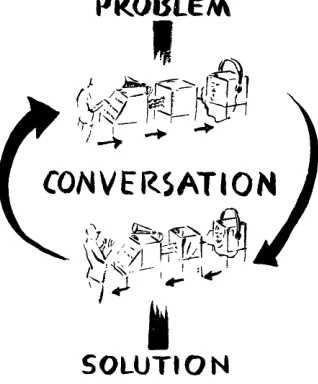
These two illustrations show the proc-ess of communication from the human to the computer and communication from the computer to the human. If the human and computer are to work to-gether to solve the problem, the inter-mediate languages and translating sys-tems must be designed not merely for the purpose of communication, but for the convenience of fluent. conversation. In other words, as Fig. 3 shows, the solution to the problem will, in general, be found only by a more or less extended conversation between the two working as a team, work being divided up so that optimum efficiency and reliability are achieved.
The remarkable flexibility of modern computers makes it possible for them to assume many guises. When more than one role is assumed by a computer in the solution of a problem, it sometimes becomes difficult to talk about the general aspects of that solution because the same mechanism has such different character-istics. This is quite definitely the case when Gestalt programming is discussed, because the computer serves in two capacities; one with respect to stating the problem and one with respect to solving the problem. In this paper the word "computer" usually means the aspect of the computer which is con-cerned directly with the problem to be solved. The term "Gestalt system" usually means the set of computer pro-grams which aid in the stating of the problem by performing the necessary translation between the Gestalt language and the computer, as shown in the afore-mentioned illustrations .. Often, however, the meaning of Gestalt system is expanded to include the Gestalt language and the physical representation of that language as well, as in the statement, "This prob-lem can be solved by the design of an appropriate Gestalt system." The con-text makes clear which is intended.
Applications
Before developing the theory of Gestalt programming, several examples of prob-lems will be presented which require or could greatly benefit from the use of human participation. I t should 'be borne in mind, however, that although it is
Fig. 3. Solution by conversation
problems such as these which have led to the concept of Gestalt programming, many problems which at present are not considered to require human participa-tion could more effectively be attacked through the use of these techniques.
In almost any control application of computers, whether air-traffic control or automatic factory control, it is necessary to have at least human monitoring with the ability to make sudden changes in the computing scheme. This type of application usually places high priority on reliability and speed.
Large-scale data-reduction problems, basically automatic, often require a human choice between several alternate procedures, a choice dependent in a com-plex and sometimes whimsical way upon a number of intermediate resu1ts. Often partial resu1ts can be salvaged from an otherwise worthless set of data, providing appropriate techniques are chosen. By using an appropriate Gestalt system and human participation, these results can be obtained at almost normal processing speed.
Even in strictly computational work a human could greatly expedite the obtain-ing of solutions if the proper techniques are used. For example, in the solution of complicated partial differential equations or in linear programming problems and game theory, it seems probable that methods could be devised whereby the human could "steer" the computer directly to the solution, rather than obtaining an enormous mesh of solutions, most of which are not of real interest. This type of operation could very well be instrumental in the application of com-puters to aid in management decisions. A properly designed language would allow executives to converse with
[image:13.612.383.542.24.216.2] [image:13.612.28.192.297.585.2]computer directly and without costly delays.
Perhaps the most intriguing application of human participation in this sense is the use of a Gestalt system in experimental programming, since such a system can be used to generate other Gestalt systems. By experimental programming is meant the programming of a large, complicated program for which the basic steps in the solution are not known. As the pro-gramming develops, the programmer must be able to do his design work at the con-cept level, leaving to the Gestalt system all of the details of translating his grow-ing concepts into actual computer be-havior.
Additional applications for human-computer team work can easily be found, but this brief listing should serve to show that the possible uses cover a wide range of problems. This paper does not treat pro-gramming details, for these will vary widely for each application, but does try to establish the general problems which are common to all of these applications. In addition to recognizing these problems, a general methodology or plan of attack for solving them is formulated.
Example of Gestalt System Design
The general principles of the design of a Gestalt language are best illustrated by carrying a single example through all of the various stages. Consider the case of an automatic factory whose main features are shown in Fig. 4. Three main proc-esses are involved, followed by an assem-bly process. These processes are flanked by a raw materials input section and a shipping output section. Besides the primary product, it may be desired to ship directly the outputs from processes two and three. The main duty of operating this factory is ~o be the responsibility of a computer, but a human operator is to be in charge of setting the requirements for the various stages and overseeing the entire operation.
Present-day computers are not equipped for oral input so that some means other than a spoken language must be used to enable the operator to converse with the computer. Written languages using an intermediate medium such as punched tape or cards have long been used for communieating with computers, but a closer approach to the ease, speed, and flexibility of a spoken language can be achieved by letting each word or phrase which is to be used be represented by a single unique switch or push button. A statement is then "spoken" by pushing appropriate buttons.
Ross-Gestalt Programming
Fig. 4. Diagram of automatic factory
In the automatic factory it will at times be necessary for the operator to refer to each part of the diagram of Fig. 4. The easiest way to do this is to construct a panel with a toggle switch associated with each part as shown in Fig. 5. Now assume that the statements about the factory which the operator must make are of the form: "Increase, decrease, hold, or set the rate, amount, or storage of the input, output, or mixture of the products at the points indicated by switches which are on." The facilities for making such statements are shown in Fig. 5, where the circles connected by lines indicate push buttons with mechanical linkages so that only one button in the column can be pushed at anyone time. Provisions should also be made for specify-ing numerical quantities so that a partic-ular rate or amount can be specified. This facility might be in the form of key-boards or perhaps dials which can be set.
To continue the example, a statement of the foregoing form may be a demand, meaning that the computer is to jeopard-ize the efficient operation of other sections of the factory, if necessary, in order to comply with the statement. On the other hand, the operator may wish the computer to adjust the factory gradually to comply with the statement, but at all times maintain previous requirements; i.e., the statement is a goal toward which the computer should strive. Finally, the operator may have an estimate from a market survey, that a certain product may be in greater demand soon, so he wishes the computer to adjust the factory toward this tentative condition if it can do so with no loss of efficiency at any point. These three qualifications may be placed on the general statement by pressing one of the buttons labelled demand, goal, or estimate. In other words, the meaning of the state-ment expressed in the other buttons is modified by these buttons as in a language: e.g., "Run to the store, slowly."
Another whole level of meaning is made possible by considering the computer to be able to simulate the factory as well as control it. The general statement, modi-fied as shown, may be further modimodi-fied by requesting the computer either to evaluate the effect of the statement, by simulation,
or to execute the statement by controlling the factory. This is assumed to be the final modification of the statement so that, the words evaluate and execute are associated with special buttons called activate buttons.
The panel should be wired so that the computer does not look at any of the buttons until one of the activate buttons has been pushed. At this time all of the items necessary to express the idea have been pushed so that when the computer looks at the buttons it is immediately con-fronted with a complete Gestalt. For example the Gestalt might be, "Evaluate the effect of a demand for an increase in the amount of output from process 2."
The completed panel, shown in Fig. 5, is the physical representation of the Gestalt language for this example. That it does in fact constitute a language may be seen by noting that it does have both a vo-cabulary and grammatical rules. The vocabulary consists of the various buttons and keyboards, and the rules are con-tained in the mechanical linkages of the columns of buttons and the fact that buttons modify the meanings of other buttons.
The corresponding language from the computer to the ~uman will not be given in detail. It probably would consist of graphical displays, numerical displays, flashings of indicator lights, and audible alarms. The indicator lights probably would be located in the control panel be-side the toggle switches to give them easily understood meanings. For example, the computer might reply to the foregoing Gestalt by saying that if the amount of output from process 2 is increased by de-mand, the rate of mixture at process 3 must be increased, which will require an increase in one of the raw materials. This Gestalt might be shown by lights at process 3 and the raw material arrow, and a graph showing the dependence of these quantities on the amount of increase at process 2. The computer would not only be able to answer questions posed by the operator but could ask policy-type de-cisions on operating the factory when two
i
lNCREASEDECREASE RATE INPUT HOLD AMOUNT OUTPUT RESET
~
STORAGE~
MIXTURE~
DEMAND @ EVALUATE GOAL @ EXErUTE ESTIMATE
Fig. 5. Gestalt language for automatic factory
equally efficient modes of operation were discovered by the computer. Naturally the computer would keep track of all in· ventories and would request new supplies of raw materials whenever necessary, with sufficient lead time to maintain operation. Note that the Gestalt language in both directions has been designed for the con-venience of the human operator. In this way the human can always keep his think· ing at the problem level and never has to be concerned with how a given task is to be accomplished. Because the language is more a human than a computer lan-guage, there is a routine but complicated translation to be done before the computer can actually use the language. This translation is the job of the Gestalt system proper, which is mechanized as a com-puter program on the same comcom-puter which controls the factory. Besides the major job of translating between the Gestalt language and the basic computer characteristics, the Gestalt system also must check statements made by the opera-tor for consistency and completeness. In other words, the Gestalt system supple-ments the mechanical linkages and layout of the push buttons in ensuring that the rules of the language are obeyed. In this way any ambiguous st:;ttements made by the operator are caught before they are acted upon and, in the other direction, the computer cannot speak gibberish.
Principles of Gestalt System Design
With the experience of the example given in the foregoing, the basic principles of designing Gestalt systems can briefly be summarized. The general field to which the system is to be applied may be considered as a topic for conversation be-tween the human and the computer. Usually this topic will be a broad general-ization of the problem which initiates the interest in a Gestalt system. In the example, the topic would be control of an automatic factory. At the present state of the art, it is essential that the scope of discussion about a topic be limited to only those aspects which are of immediate interest; in the example, the scope is restricted to the particular factory.
The topic for conversation is broken down into the finest logical divisions nec-essary to cover the entire scope unambig-uously and with a minimum of rules for <;ombination. In the example these divi-sions are the words, numbers, and loca-tions which were assigned buttons and the various basic units of the computer to human language. All of these various types of basic units will be called items, and the complete set of items forms the
8
vocabulary of the Gestalt language. Thus a Gestalt is expressed in this language by combining items according to syntactical rules. In particular, an item may modify other items. A well-designed language will have a proper balance between items with very specific meanings, to give entry to broad areas of discussion, and items with very general meanings and thus high modifying poten-tialities, so that a very large and compre-hensive body of Gestalts can be expressed with very little equipment.
When a Gestalt language is being de-signed, the items are always chosen for the convenience of the human, the goal being to have a language which is as natural to use as is possible. This statement may lead to the question why the language should not be English since that is cer-tainly the most natural for the human. This question is clearly answered by the automatic factory example, since obviously it is more natural to select a switch associated with a box Qr line in a diagram than to try to describe that box by an English phrase. A similar remark applies to the computer-to-human lan-guage because a graph or diagram often conveys a complicated idea more readily than a description.
One basic principle on the choice of items cannot be overemphasized, and that is that their meanings must be unique. In other words, a button labelled "in-crease" must never result in a decrease as a result of modification by another item. Note that this requirement of uniqueness of meaning of individual items does not conflict with previous statements that the meaning of an item is modified by an-other item, since the modification is an elaboration of meaning, not a change of meaning. For a complicated problem it is often very difficult to find the minimum set of items which completely cover the scope with absolutely invariant meanings, but it is foolhardy to stop short of this goal since the only way to have a work-able system is to have the human remem-ber the pathological cases, which de-feats the fundamental principle of having the human always think only at the problem level.
Implementing a Gestalt System
The considerations of the previous sec-tion have shown that the special Gestalt language is designed entirely on the basis of the problem and the convenience of the human. Once this language has been designed the human is allowed to discuss the problem only in that language so that, in effect, a part of the programming of
the problem has been accomplished by programming the human. Note that this is not purely a characteristic of Gestalt languages, since every time any coding scheme or particular computer is applied to a. problem, a large number of possible solutions are automatically eliminated by the characteristics of the computer or coding scheme. The aspect which is characteristic of Gestalt languages is that ideally, at least, the programming of the human is entirely beneficial.
The next step, and it is by no means a trivial one, is to program the computer so that it can converse in the Gestalt lan-guage as well, i.e., to construct the Gestalt system proper. Because the language was designed for the convenience of the human, it is usually a difficult pro-gramming task, but since everything is well defined, it can always be done.
Almost every recognized programming technique can be used to advantage in the realization of Gestalt systems. On the other hand, as might be expected, the peculiar problems which arise often lead to new techniques, or to strong desires for modification of computer logic itself. The cross-fertilization between advanced programming techniques and computer design will be more and more fruitful as these applications expand.
The final important part of the imple-mentation of a Gestalt is the choice of a suitable medium to represent the lan-guage. The automatic factory example has already shown the advantages of dia-grams and push buttons, but each problem will have its own most appropriate media. The governing criteria on the choice of representations are the rate at which the conversation is to take place and the com-plexity of the Gestalts when expressed as statements in the Gestalt language.
For low rates of conversation and very complex expressions, the standard input-output media, such as punched tapes or cards and high-speed printers, are prob-ably most appropriate. The spectrum of possibilities also includes intervention switch devices fOF high rates of conversa-tion. These devices, of which toggle switches and activate buttons are ex-amples, are all characterized by the fact that a unique binary digit accessible to the computer is set toa Oora 1 by the setting of the device. Finally, at the ultrahigh con-versation rate, there are such mechanisms as steering wheels and joysticks whose positions can be sensed by the computer. For the computer-to-human vocabulary there is a large number of audible and visual indicators, and, of course, the high-speed, very flexible oscilloscope-type out-put tubes.
In many applications it is desirable to give the human a variety of media for expressing the same Gestalt so that he may choose the most convenient at the time. In all cases, whatever medium is used, the principle of uniqueness should always be observed and the rules of syntax should be positively included by either mechanical or programmed inter-locks.
The major steps in the design of Gestalt systems are summarized in the following. In any particular application the con-siderations of the various sections would undoubtedly be intermingled, but this listing can be used as a check-list sum-mary of the basic points.
Steps in Design of Gestalt System
From the problem:
Pick a topic for conversation. Restrict the scope of discussion. Design the Gestalt language:
Choose items which cover the scope. Define rules of syntax for combining
items.
Design the Gestalt system: Determine rate of conversation. Choose unique representations for items. Establish interlocks by programs or
linkages.
Present-Day Examples of Gestalt
Systems
There is, of course, a growing number of computer systems which have many of the attributes which have been discussed. 111- general, however, most of these systems operate at medium to low rates of con-versation. Three systems which operate at high rates and are in daily use on the MIT Whirlwind I computer will be briefly described to illustrate more con-cretely than the applications cited pre-viously, that these techniques are not futuristic in any way, but are sound, practical investments for today.
THE COMPREHENSIVE SYSTEM
The MIT comprehensive system (CS), with the topic of "operating a computing facility," has elaborate utility programs, as wen as automatic programming aids, under intervention-switch control. In this system Gestalts from the human to the computer may be expressed either in typewritten form, using appropriate mnemonic codes, or by pushing sequences of buttons. These Gestalts automatically call in anyone of many programming systems including the CS system for the Whirlwind computer, several simulated computers used in academic courses in programming, a system for programming the Univac Scientific 1103 computer, and
Ross-Gestalt Programming
a system for programming numerically controlled machine tools. In addition, a large number of post-mortem and error~
diagnosis programs are instantly avail-able, as well as a growing number of data-handling and computer-operating routines. Through the use of one of these routines, the director tape program, it is possible to replace the human operator by written Gestalts to operate any number of pro-grams in any sequence with the pushing of only one button.
THE AUTOMATIC TROUBLE LOCATOR
The automatic trouble locator program, with the topic of "maintaining a com-puting facility," is a good example of humans and computers working together. This program is primarily under inter-vention-switch control and automatically operates the marginal checking equipment of the Whirlwind I computer. The hu-man sets up the general sequence of tests which are to be made by expressing his desires to the computer. The computer then proceeds with the tests, and, since the computer does not have facilities for visual input, it may ask the human to look at the wave forms at critical points, which are displayed on a monitoring scope. The operator need only tell what general type of wave form is being displayed and then the computer proceeds with the analysis. If the computer encounters a marginal piece of equipment, it types out English phrases telling which individual tubes or components require replacement, and then tells how long it took to do the job by a phrase such as "That only took 2 minutes and 33 seconds, are you sure you did it right?", which must be acknowl-edged by the Gestalt "Yes" before the checking can continue.
The Gestalt system approach will prob-ably find its widest application, at least initially, in the, development of similar elaborate systems for greatly improved routine operation and maintainance of other computing facilities. Experience has shown that the results are well worth the effort of devising such systems.
DATA REDUCTION AND EXPERIMENTAL
PROGRAMMING
The third Gestalt system in use at MIT is one whose topic is "automatic reduction of armament test data and ex-perimental programming for armament controL" This system is the one which has led to the analysis of this paper and is being developed for the Air Force Weapons Guidance Laboratory by the Servomechanisms Laboratory, MIT, us-ing the Whirlwind I computer as a re-search tool.
This system is so designed that it in-cludes all of the facilities of the MIT comprehensive system. Besides the com-prehensive system vocabulary, this system has a large and growing vocabulary of items represented by uniquely assigned push buttons and switches. The rules of syntax which must be remembered by the human are almost entirely conjunctive in nature, the other syntactical rules being inherent in mechanical and programmed interlocks. Any syntactical error, i.e., a meaningless or contradictory combination of switches set by the human, is imme-diately followed by a unique and explana-tory alarm. Conversely, any meaningful statement is properly understood by the computer. The computer-to-human vo-cabulary primarily uses output oscillo-scope displays to express Gestalts, but in-dicator lights and audible alarms are used where appropriate. The rules of syntax are almost entirely programmed into the computer, i.e., the computer cannot speak gibberish or give misleading information. Every item in each vocabulary requires a section of programming in the Gestalt system, some absurdly simple and some extremely elaborate. The combined sec-tions are much too large to fit into the magnetic core memory of the computer, so that an essential part of the system is a control program which establishes the proper connections between the various program sections. This facility is so designed that individual sections can be changed easily at any time using the comprehensive system, and still mesh properly with all other sections.
This Gestalt system also has a logging program which provides a written record of the complete conversation between hu-man and computer. This log can also be played back by the Gestalt system, the computer simulating the human actions for rerun purposes. It}. this way, an inter-rupted conversation can automatically be resumed.
In operation this system is designed so that the human can interject comments or questions into the computer's operation almost instantaneously and at any time. Some alarm conditions are automatically corrected, with suitable indication, and various types of trouble-shooting can automatically be carried out by the com-puter on request.
This Gestalt system is in a continual state of flux and improvement. As soon as a new feature is completed, it is usually obsolete in terms of future plans. There are an amazing number of challenges which appear with each new phase, but the results are rewarding. One of the biggest deterrents to progress is the