This is a repository copy of
A collaborative e-Science architecture towards a virtual
research environment
.
White Rose Research Online URL for this paper:
http://eprints.whiterose.ac.uk/1819/
Book Section:
Pham, T.V., Lau, L.M.S., Dew, P.M. et al. (1 more author) (2005) A collaborative e-Science
architecture towards a virtual research environment. In: Cox, S.J. and Walker, D.W., (eds.)
Challenges of Large Applications in Distributed Environments, 2005. CLADE 2005.
Proceedings. EPSRC , pp. 13-22. ISBN ISBN 1-904425-53-4
[email protected] https://eprints.whiterose.ac.uk/
Reuse See Attached
Takedown
If you consider content in White Rose Research Online to be in breach of UK law, please notify us by
A Collaborative e-Science Architecture towards a Virtual
Research Environment
Tran Vu Pham
α, Lydia MS Lau
α, Peter M Dew
βand Michael J Pilling
χα
School of Computing, University of Leeds, Leeds LS2 9JT
β
Informatics Institute, School of Computing, University of Leeds, Leeds LS2 9JT
χ
School of Chemistry, University of Leeds, Leeds LS2 9JT
Abstract
This paper presents a novel Collaborative e-Science Architecture (CeSA) to address two challenging issues in e-Science that have arisen from the management of heterogeneous distributed environments. By combining the capabilities of peer-to-peer and Grid computing, the architecture provides an environment for scientific collaborations within distributed, loosely coupled research communities and brings computation and data intensive resources to the desktops of the scientists in these communities. The Reaction Kinetics research community had been used as a case study to capture realistic requirements. A prototype based on the architecture was developed for user experiment and evaluation. The results of these experiments were promising. It has provided further motivation to evolve CeSA towards a Virtual Research Environment.
1. Introduction
This paper addresses two challenging issues of an e-Science community: firstly, how to satisfy the need for easy access to large-scale computational and data resources, and secondly, how to provide a collaborative research environment to support research activities from heterogeneous distributed communities. Such requirements were noted during a study on the Reaction Kinetics Research Community. Scientists from this community strongly needed access to computation and data intensive resources for their time consuming simulations on chemical reaction mechanisms. They also required support for exchanging different types of datasets directly with other scientists in the field.
Clearly, a Virtual Research Environment needs to satisfy all the above requirements. In the “Roadmap for a UK Virtual Research Environment” produced for the JISC in 2004 [1], grids were identified as the most promising infrastructure to provide computationally extensive resources and storages for large-scale datasets. A Service Oriented Architecture was proposed for the virtual research environment, which links the resources on grids to the scientists via web-based portals.
Using the web-based portals, the scientists can virtually logon the virtual environment from anywhere with a browser and an Internet connection. However, with the portal approach, scientists of a research community are required to pre-register at a centralised administration of the
environment in order to utilise the available resources or collaborate with other scientists. This centralised management does not seem to fit well with the decentralised, or loosely coupled, nature of research activities, where collaborations across different ‘communities’ can also happen (e.g. a scientist may want to share a dataset with some other scientists from another related research discipline, but these scientists are not members of the same research community covered by the portal).
Peer-to-peer, on the other hand, is a decentralised computing model. It has been very successful in many commercial file-sharing applications at the user end, such as Napster1 and currently Kazza2 or eMule3. This computing model has the potential to bridge the gap between the current centralised approach for the collaborative environments and the loosely coupled research activities amongst the scientists.
In this paper, a novel Collaborative e-Science Architecture (CeSA) is proposed. The aim is to bring together services from the grids beyond boundaries of web-based portals into a collaborative peer-to-peer environment, leveraging advantages of both Grid and peer-to-peer technologies. The architecture focuses on the support for general collaborative activities for scientists as well as for the sharing of computational capability and storages (e.g. for simulations and analyses) required by the
1http://www.napster.com 2
http://www.kazza.com
3 eMule project: http://www.emule-project.net
community. This paper also reports on the requirements of the Reaction Kinetics research community. A prototype was developed to evaluate the architecture in a realistic environment. The result has shown the feasibility of this approach and the potential benefits to the scientists. Some related projects and future work will also be discussed at the end of the paper.
2. The Collaborative e-Science
Architecture (CeSA)
The architecture described in this paper had been extended from an earlier version of the CeSA as presented at CLADE 2005 [2]. The new version was driven by a deeper understanding of the work practices in the user community involved in the prototyping and new features had been added to bring it a step closer towards an architecture for a virtual research environment.
2.1 Architecture Overview
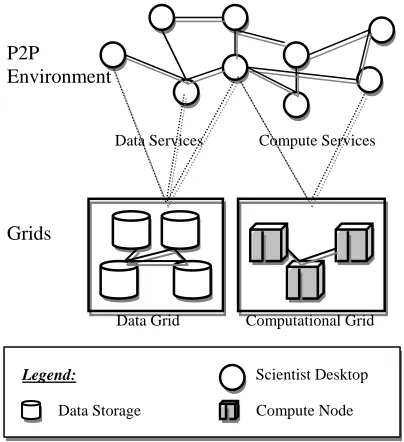
The CeSA is composed of a peer-to-peer collaborative environment on top of a collection of grids (Fig. 1). The management within the grids is often complex and requires tight security control, whereas, the peer-to-peer environment is in a public domain and self-managed by individual users. The design of this architecture is aimed at separating the complex management within the grids from day-to-day collaborations in the peer-to-peer environment. This is made possible by adopting a flexible service oriented architecture.
In the peer-to-peer environment, each scientist has a copy of the desktop peer-to-peer application. This desktop application is designed as a window to an integrated research environment, from which a scientist can make queries and get access to computational resources and data provided by the grids. The desktop application also allows the scientists to collaborate with each other in a peer-to-peer fashion, such as forming common interest groups, direct sharing of working data and information available on grids and so on.
In the architecture, the grids are main providers of computational intensive resources and research datasets for the research community in the peer-to-peer environment.
2.2 Grids
The Grid environment can have more than one computational or data grids acting as resource providers for the scientist community in a peer-to-peer environment.
Each of these grids has a service container, called High Level Service Container (Fig. 2), which provides high level services to the scientist community. These high level services can be built by wrapping resources on the grid or they can be ‘composite services’ composed of other services or workflows available on the grids. The difference between these high level services and the basic Grid services, such as Grid job submission services, is that the former aim to deliver final output to the users, such as results from a simulation on chemical data or a chemical dataset, whereas the latter usually deliver intermediate output to another computer application or service.
Grids P2P
Environment
Data Services Compute Services
[image:3.595.83.285.497.718.2]Computational Grid Data Grid
Fig. 1: Physical view of the Collaborative e-Science Architecture
Scientist Desktop
Data Storage Compute Node
Legend:
High Level Service Container
Grid Workflows
Grid Services
Grid Resources
Grid Fabric
P2P Environment
High Level Services Public Registry Service
Grid
Fig.2: Relationships between a High Level Service Container and other grid components
[image:3.595.326.488.515.688.2]In addition to the high level services, a High Level Service Container also contains a Public Registry Service, which allows the peer users (i.e. scientists) to make queries on services available on the grid. The information about the services can then be published within the peer-to-peer environment so that other peer users can locate and use these services on the grids.
Service Publication
& Discovery
Agent
2.3 Peer-to-Peer Environment
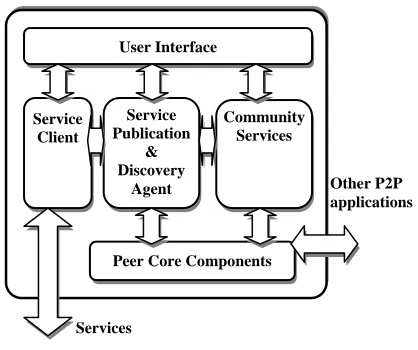
The peer-to-peer environment is composed of a network of peer-to-peer applications. Each of the peer-to-peer applications (Fig. 3) consists of a User Interface, a Service Client, a Service Publication and Discovery Agent, a set of Community Services and a set of Peer Core Components.
User Interface is the main gateway for a user to access the functionalities of the peer-to-peer application.
The Service Client interfaces with high level services and registry services provided by the grids. It allows a user to browse, via the user interface, services available in the grid environment.
The Service Publication and Discovery Agent has a very important role in the collaborative architecture. It provides two basic functions: publishing information about services available on grids to the peer-to-peer environment and discovering information about services previously published by other peers. Information about a service published in peer-to-peer environment consists of information such as service name, service URI (Universal Resource Indicator, the identifier that identifies a particular service from a service container), its required input data and its output data. The published information also includes information about the grid that provides the service. The structure of a discovery query is similar to the structure of published information about services. A matching algorithm between the published information and the discovery query will be used during a service discovery process. Because of its important role, the Service Publication and Discovery mechanism needs to be as effective as possible.
Community Services consist of components to support the day-to-day collaborations within a community. Examples include components for file sharing, community/group formation and instant messaging. Through these components, a scientist can set up ad hoc interest groups or a research community. The scientist can then establish sharing resources directly with other scientists in his/her working group or community.
Peer Core Components include components for communication with other peers, peer identification and peer resources discovery. Service Publication and Discovery Agent and Community Services rely on these core components to communicate with other peers in a peer-to-peer environment.
2.4 Specification of High Level Services for Peer-to-Peer Applications
The design of the CeSA aims to make it independent of implementation technologies. Therefore, the concept of ‘high level service’ (or sometimes referred as ‘service’ in this paper) in the CeSA is not coupled with any particular type of services. It can be implemented as a Web Service or a Grid Service.
As discussed earlier in section 2.2, high-level services provided by the grids enable peer users to perform tasks such as simulation or analysis. However, to use such services is often rather challenging for the users. It is necessary to have a simple user interface for users to easily execute services from grids on their desktops. For example, it is not feasible to give them a service handler (e.g. an identification of a Grid service) and ask them to build a service client application to execute the service. This task is difficult even for programmers who have no knowledge about Web Services or Grid Services.
Fortunately, there are commonly two main categories of services in a scientific environment: computational services and data services. The first category is often associated with simulations and analyses used in scientific communities. These services share common characteristics such as using files as input and output. Hence, a simple unified service interface can be developed which consists of the following operations:
[image:4.595.316.525.89.264.2]Services
Fig. 3: Components of a Peer-to-peer Application
Service Client
Peer Core Components Community
Services
- List input required: allows service client to
query in advance the input files required. - Load input: to upload input files required to the
- quired
- of output files
- end the output to the user.
discovery and t a high level, a unified discovery service interface ca
virtually any se
earch Community
ive
e-Scie y was conducted
to test the architecture. The Reaction Kinetics re
prob on mechanisms.
Different research activities are taking place on di
on mechanisms, as de
. Research in one area of Reaction Kinetics depends on data produced by several
on Kinetics community is an iterative process. A
en
(ii) Provide efficient support for timely
(iii)
amount of experimental
3.2
T tion will describe how the CeSA can be employed to support a collaborative research environment for the Reaction Kinetics research community.
service server prior to execution.
Execute: to run the services after all re
input are uploaded.
List output: to query the number
produced by the service.
Transfer output: to s
The second category is about
delivery of research data held in the data grids. A
n be developed for all data discovery services. Similarly, a unified service interface can also be built for all data delivery services.
Once all the services conform to a standard set of interfaces service clients can be developed in a way that they can interact with
rvice.
3. Case Study: Reaction Kinetics
Res
Having established a generic Collaborat nce Architecture, a case stud
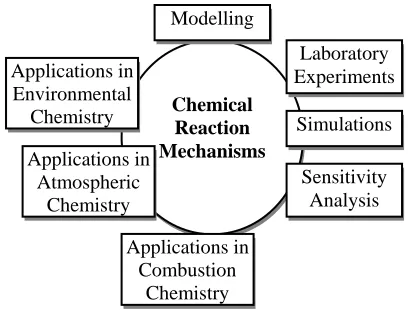
search community was chosen and a prototype was built. Reaction Kinetics researchers study the elementary and complex chemical reactions and their applications. This is a multidisciplinary research subject, spanning across Combustion, Atmospheric and Environmental Studies. The main activities are shown in Fig. 4.
3.1 Requirements of Reaction Kinetics
Research Community
A central object in an applied reaction kinetics lem is the chemical reacti
fferent aspects of reaction mechanisms. A research group in the community may undertake one or more of these activities. The allocation of activities in the groups often depends on the expertise and the resources at the institutions where the groups are based.
As research activities in Reaction Kinetics are inter-related and tied together by the common interests in chemical reacti
picted in Fig. 4, research groups that undertake these activities also need to collaborate with each other.
There is a very close working relationship amongst the research groups in Reaction Kinetics research
related areas. Data exchange within the Reacti
delay caused by one individual or one research group might affect several other people and groups and eventually the whole community. Collaboration amongst individual scientists as well as research groups in Reaction Kinetics from many locations worldwide is very important. A range of computational intensive resources is required for running simulations and analysis. Storages of huge volume of experimental and field data also exist all over the world.
Through the collaboration with chemists in the Reaction Kinetics research group at the School of Chemistry, the University of Leeds, the following requirements for a collaborative research
vironment were identified:
(i) Allow scientists who are working on the same or similar research activities to dynamically form working groups.
collaborations within and across working groups in the community for sharing expert knowledge, day-to-day working data, such as experimental data, chemical reaction mechanisms and related input data for reaction modelling.
Provide easy access to computational intensive resources for time and resource consuming simulations and analyses and for archiving of large
data.
A Potential Application of the CeSA
his sec
Laboratory Experiments Modelling
Applications in Environmental
Chemical
Rea n
Mechanisms
Chemistry Simulations
ctio
Sensitivity Analysis Applications in
Atmospheric Chemistry
Applications in Combustion
[image:5.595.307.511.83.238.2]Chemistry
Fig. 4: An Ex search Activities in Reaction Kinetics Research Community
The requirements (i) and (ii), as identi ion 3.1, can be
fied in
sect met by the peer-to-peer
collaborative environment of the architecture. U
services dealing with computational resources r-to-peer environment. l services developed for the pr
mec into Grid services.
These applications use files as input and output, an
on 3.0.2 (GT3). This Grid Service Container ra
to-peer ap n Kinetics
wing explain briefly how the main components were built using JX
The service browser interacts with GT3 C
e result will be displayed to users via th
rs was for the Factory Service an
sed on JXTA protocols [5].
sing the peer-to-peer applications, with functionalities described in section 2.3, chemists in Reaction Kinetics community will be able to form ad hoc interest groups. Once the relationship is established, chemists will be able to share their working documents or chemical datasets (e.g. a reaction mechanism under review) with other chemists in a peer-to-peer fashion. If a web-based community were used, all participants will have to register with a central website before any community activities can take place. Centralised rules would need to be followed for uploading or downloading. However, in a peer-to-peer environment, that relationship can be formed straight away by participants, without bothering any third party. In terms of sharing working documents or datasets, sharing in a peer-to-peer environment is more direct and convenient than via a centrally controlled website.
With regard to requirement (iii), access to computational resources for simulations of reaction mechanisms can be done through high-level services provided by the computational grids. Archives of stable versions of chemical reactions mechanisms and other type of data in Reaction Kinetics such as reaction rate coefficients can also be stored on the data grids via data services. Grids are well known with the ability to support computationally intensive calculations and storages for large-scale datasets.
4. Prototype
The purpose of prototyping was to provide an insight into the technical challenges as well as testing the applicability of the CeSA for the user community. In this version of the prototype, only
were integrated to pee The high leve
ototype were Grid Services and the High Level Service Container was based on Grid Service Container of OGSA [2].
The peer-to-peer prototype, based on JXTA [4], consisted of generic tools for collaborations, such as file sharing, chatting, group formation, publishing and discovering of information about high level services available on grids. It also provided a graphical interface for the chemists to execute computational services.
4.1
Conversion of Existing Applications
into Grid Services
A few applications used in the community for simulations and analyses of chemical reaction
hanisms were wrapped
d could also produce console output. When wrapping these programs into Grid services using Java, input and output (including console output) were mapped to the input and output parameters of Grid services. These Grid services conformed to the unified service interface as specified in section 2.4.
After being wrapped into Grid services using Java, these new services were deployed in a Grid Service Container provided in Globus Toolkit versi
n on one machine, played the role of a computational grid providing simulation and analysis services for the peer-to-peer community.
4.2
CeSA Prototype System
The CeSA prototype system is basically a peer-plication for the Reactio
Research Community. The follo
TA and how the GT3 services were integrated to the application.
Service Client: The Service Client consisted of
two parts: a service browser and a service executor.
ontainer Registry Service to retrieve a list of service handlers of the services provided by the container. Th
e User Interface.
The service executor could invoke a service from a service handler. Globus Toolkit 3.0.2 had two types of service handlers for a Grid service. One type of handle
d the other type was for the Grid service instance. The service executor can be used to generate new instances of a service from a factory service handler or to execute the service using the handler of a service instance. In this prototype, the service executor could interact with any of the services, as described in section 4.1, for chemical reaction simulations as they all conformed to the unified service interface.
Service Publication and Discovery Agent: The
All information about a service, such as service name, service provider, input, output, and so on, was enclosed in a JXTA advertisement. The advertisement about the service was then pu
ovided with JXTA di
r environment. The function for the formation of working gr
JX
wo peers would be set up first. Then, th
n a peer, such as a w
to collect from the research community on the functionalities of the prototype based on the C
for collaborations within the user community.
- general attitude to the new
5
cted at a Reaction iversity of rom Reaction Kinetics research community participating in the in
out a sample of day-to-day co
vided into se
blished in JXTA peer-to-peer network using JXTA discovery protocol.
The discovery of information about services, however, was not based on JXTA discovery, but using JXTA resolver protocol, because the default discovery mechanism pr
scovery protocol [6] was not flexible enough to deal with complex query requirements. In the prototype, users are able to query using any information about the services or a combination of them. If the JXTA default discovery protocol were used, only a few indexed attributes could be searched. With JXTA resolver protocol, a query could be distributed to the other peers in the environment. On receiving the query, a peer could then search through its cache for service advertisements that matched the criterion specified in the query, such as service name, service provider, etc. The results would be sent back directly to the query issuer.
Community Services: Community Services
consisted of a number of components for collaboration within a peer-to-pee
oups or communities was developed upon JXTA Peer and Peer Group concepts. An individual peer user was mapped to a peer in the
TA peer-to-peer network. Similarly, a working group or community is corresponding to a JXTA Peer Group.
Tools for file sharing and instant messaging were built using JXTA pipe. To send a message or a file from one peer to another peer, a pipe between the t
e message or file would be sent over the pipe. Each peer had a unique pipe advertisement, which was the necessary information for setting up a pipe connection. This information would be published to the peer-to-peer environment when the peer entered the network.
There were also additional components for managing the ‘share relationships’ amongst the peers and for the searching of shared resources. Shared resources available o
orking data file, were more dynamically managed than a shared service. A file might be set to share to a group only at a particular time. Therefore, the approach to resource discovery, more specifically the file search, was different from the method used for service publication and discovery. There was no publication of these resources. As only the owner of the resources could say whether he/she had resources being
shared for the query issuer, the query message had to be distributed to every potential resource owner. Hence, the prototype used broadcasting method to distribute query messages. Scope of a query could also be limited to particular working groups of interest, where the answers most likely could be found.
5. Experiment and Evaluation
5.1 Objectives
The main aim of this experiment was feedback from a number of researchers Reaction Kinetics
eSA. User comments were invited to compare this new way of working with their current practice. More specifically, the objectives of this experiment were:
- To evaluate the effect of using peer-to-peer collaborative functionalities provided by CeSA prototype system
- To assess how users can benefit from the access to remote simulations and analyses in Reaction Kinetics using remote services.
To capture user’s
collaborative infrastructure.
.2 The Experiment Process
The experiment was condu
Kinetics research laboratory at The Un Leeds. There were three chemists f
itial experiment.
A few copies of CeSA prototype system were installed in the laboratory for the experiment. During the experiment, participants used the prototype to carry
llaborative activities and to run simulations using Grid Services, which were provided by a grid service container located remotely.
A questionnaire was issued to each participant to record his/her feedback on the CeSA prototype system. The questionnaire consisted of a mixture of open and closed questions and was di
questionnaire. There were discussions during the experiment to clarify the questions in the questionnaire.
5.3 Results and Analysis
The following is a summary of the findings in aluation. peer collaborative functionalities, all three participants had a need fo
g the C
- Spontaneous sharing of file-in-progress is
- hared data. They can
us
current way, such via email or a common website, especially when the shared files were being up
be important to provide a se
network to
ta.
, especially for jobs that re
they could search and use the service straight
colleagues. This way w
would benefit from a system like this. A
problem issues.
project [7][8][9] has been working on metadata infrastructure to facilitate the di
interface of N
that enabled co
e applications in bio-informatics into w
relation to the objectives of this ev Firstly, on the use of
peer-to-r shapeer-to-ring wopeer-to-rking data with theipeer-to-r colleagues. All participants recognised the benefits of usin
eSA prototype system for sharing working data because of the following reasons:
- A file can be shared directly from the user machine. Therefore, there is no need to move a file around for sharing.
possible. This allows other users to be able to copy the latest version of the file.
Users have control over s
choose to share with a group or a specific person. They can also easily revoke a file from sharing.
The participant recognised the advantages of ing peer-to-peer for file sharing, over their
dated frequently.
One participant expressed his concern about security of peer-to-peer environment. When the access controls are decentralised to individual machines, it will
curity mechanism to protect user’s own computing resources and personal data.
There was also a worry about the stability of the peer-to-peer environment. As JXTA is a decentralised peer-to-peer environment, it takes some time for the community on JXTA
reach a stable condition. This is actually a trade-off for the dynamics and flexibility of peer-to-peer computing.
A suggestion on documenting and tracking changes was made, as there are times when different users might be working collaboratively on the same set of da
Secondly, on the use of Grid Services for accessing remote simulations and analyses, the participants recognised the benefit of freeing their desktops for other work
quired long execution time. They all agreed that it would be very useful for them to run their simulations in this way.
They also agreed that when using remote services in the way that provided in this prototype,
away. They could also easily share information about useful services to their
as more convenient than sharing traditional software.
Finally, on the general feedback, the functionalities of the CeSA prototype system had made a good impression on all participants. The participating chemists believed that their research community
lthough there were concerns about security issues and the stability of peer-to-peer network, they would be happy to use it if the system was fully implemented and widely accepted by their community. This “acceptance by the community” is a vital condition that any peer-to-peer system has to satisfy. A user-friendly graphical interface was also identified as an important characteristic to encourage the users to use the system.
6. Related Work
There are a number of projects related to this work due to the similarity either in the
domain or in the architectural The NERC DataGrid
scovery and delivery of environmental datasets, which are held in a loosely coupled federation of distributed locations. The main user
ERC DataGrid was planned to be web-based portal. The NERC DataGrid can be plugged into the CeSA as one of data grids, providing data services for the user community.
In e-Science programme, myGrid [10][11] and Smart Tea [12], a sub project of Comb-e-chem [13], also aimed at supporting scientists directly. myGrid project focused on the middleware components and services
llaborations on Web Services and composition of these services into workflows. The goal of Smart Tea was to produce a paperless eLab, which enabled publication of experimental data at source using pervasive computing devices. Smart Tea is being extended to interact with myGrid to support researchers in bio-informatics in the myTea project [14]. Using the peer-to-peer approach of the CeSA can enhance the support to individual researchers in some of their collaborative activities.
On the architectural issue, projects such as Chinook [15] and Triana[16] also used Service Oriented Architecture and peer-to-peer computing model. The goal of Chinook was to convert command-lin
CeSA and these projects is that CeSA emphasises strongly on supporting direct user collaborations within scientific community.
7. Conclusions and Future Work
This paper has introduced the CeSA as a potential architecture for a collaborative research
ction
illustrate the applicability of the CeSA in a re
to work inter-operably with w
ny Stanton and other researchers netics group at School of
f Leeds, who have been offering us great help on requirement collection, ex
http://www.jisc.ac.uk/uploaded_documents/VRE%
environment. The case study from Rea Kinetics research community was used to
alistic environment. The experiment and evaluation on the CeSA prototype conducted by a group of Reaction Kinetics researchers have also been reported. The notable results were that the ability to provide an environment for direct user collaborations and access to remote computational resources of the CeSA was recognised as an advantage. This initially confirmed the correctness of the approach. As the Reaction Kinetics research community is typical of e-Science communities, the architecture therefore has the potential of wider deployment.
The CeSA is being considered to integrate the portal approach within the peer-to-peer application. The aim is to allow ‘plug-in remote portlets’ from other portals. With this ability, the CeSA will be able
eb-based portal approach.
On the implementation side, prototype of data services for delivering datasets from data grids to peer-to-peer environment is being developed. These data services will later be used in further experiments.
Acknowledgement
Many thanks to Dr. Andrew Rickard, Dr. Lisa Whalley, Jen
working in Reaction Ki Chemistry, University o
periments and evaluation of this work.
References
[1] Allan, R. and et al., Roadmap for a UK Virtual Research Environment,
20roadmap%20v4.pdf (last accessed June, 2005). Lau, L.M.S., Dew, P.M and Pilling,
[3]
[2] Pham, T.V.,
M.J., Collaborative e-Science Architecture for Reaction Kinetics Research Community, in the Proceedings of the Challenges of Large Applications in Distributed Environments 2005
, (CLADE2005), Research Triangle Park, NC, USA July 2005.
Globus Toolkit, http://www-unix.globus.org/toolkit/, (2005). Project JXTA:
[4] http://jxta.org, (2005). Project JXTA
[5] : Java Programmer’s guide,
ProgGuide_v2.3.pdf
http://www.jxta.org/docs/Jxta ,
oul, E., “A ker”,
[7] NERC ataGrid, http://ndg.badc.rl.ac.uk/ (2005).
[6] Traversat, B., Abdelaziz, M., and Pouy Loosely-Consistent DHT Rendezvous Wal Sun Microsystems Inc., March 2003.
D (2005).
e-ox(Ed).
[10]
[8] Woolf A., et al., "Enterprise Specification of the NERC DataGrid", Proceedings of the U.K. science All Hands Meeting, 2004. S.J.C
[9] Lawrence, B., et al., "Googling secure data", Proceedings of the U.K. e-science All Hands Meeting, 2004. S.J.Cox(Ed).
myGrid, http://www.mygrid.org.uk, (2005). [11] Goble, C.A., Pettifer, S., Stevens, R., and
Greenhalgh, C., “Knowledge Integration: In si Experiments in Bioinformatic
lico s”, The Grid:
e,
[12] /
Blueprint for a New Computing Infrastructur Second Edition eds. Ian Foster and Carl Kesselman, 2003, Morgan Kaufman, November 2003.
The Smart Tea Project, http://www.smarttea.org
[13] (2005).
Combechem, http://www.combechem.org/, (2005). the my
[14] Tea project, http://mytea.org.uk/ (2005). [15] GSC-Chinook, http://www.bcgsc.bc.ca/chinook/
(2005).
[16] The Triana Project,
http://www.trianacode.org/index.html (2005). [17] Wang, I., Shields, M., Taylor, I. and Philp, R. Distributed P2P Computing within Triana: A
Test Case, Proceedings of 3. Galaxy Visualization