BYZANTINE CAPPADOCIA:
the planning and function of its ecclesiastical structures
Sue-Anne Wallace Canberra
February 1991
I I
BYZANTINE CAPPADOCIA:
I V
A C K N O W L E D G E M E N T S
Without the unfailing support and patience of my supervisor, Dr Alexander D. Grishin of the Department of Art History, the research for this topic could not have been undertaken. Dr Grishin encouraged me when I needed reassurance and continued to raise pertinent questions, forcing me to clarify my arguments. I have benefitted considerably from our intellectual discussions on Byzantine Cappadocia, a region which he knows intimately. No acknowledgement can summarize my debt to his supervision. Professor Graeme W. Clarke, Director of the Humanities Research Centre, has been called upon to provide assistance with problems concerning archaeological methodology, among other matters. He has made himself freely available, his advice has always been constructive and I deeply appreciate his encouragement with this project. Thanks are also due to Dr Ann Moffatt, Depanment of Art History, whose independent criticisms and frequent assistance have been much appreciated, and to Mr Robert Barnes, Department of Classics, for occasional advice. Mrs Elizabeth Jeffries of the Department of Modem Greek, University of Sydney has provided articles which were otherwise difficult to obtain as well as offering useful suggestions in the translation of Greek texts. Some ideas from the research for this project were presented to meetings of the Australian and New Zealand Medieval and Renaissance Studies and the Australian Byzantine Studies Conferences. I thank colleagues of these associations for their useful criticisms.
Support for this project has been gratefully received from the Australian National University in the form of the Janet Wilkie Memorial Fellowship and Postgraduate Research Award Travel Grants, without which the fieldwork required for the study could not have been undertaken. More recently, I have received the encouragement of my present employer, the Australian National Gallery and wish particularly to
Betty Churcher, Director, who approved my leave of absence, enabling the pro ject to be brought to a conclusion. Mr Robert Patterson of the Photography Department at the Australian National Gallery has worked tirelessly during weekends over the past year to print the one and a half thousand photographs required for this study, often working with negatives whose quality was less than desirable. My sincere thanks go to him for his cheerful assistance and his professional approach to my requests.
During periods overseas I have been accorded a warm welcome by a number of scholars whose assistance I acknowledge. In Paris, Madame Nicole Thierry made available her photographic archives and was exceedingly generous with her time, discussing with me her present research, including unpublished material. Dr Catherine Jolivet-Levy has similarly provided much needed information, especially concerning the location of particular monuments, some of which still escaped me, and introducing me to Turkish guides who could assist with fieldwork in the region. Both Mme Thierry and Dr Jolivet-Levy have continued to support my work and inform me of their most recent research. Professor Jean-Paul Sodini made available his doctoral dissertation and provided scholarly advice on the liturgical furnishings and architectural disposition of Early Christian foundations, which has proved relevant to the understanding of Cappadocian arrangements. Without the assistance of the Bibliotheque Byzantine in Paris my research would have been difficult, if not incomplete, and I would like to express my gratitude to the late Madame Helene Cerf, who accommodated my requests without hesitation during two periods of research in the library. Madame Suzy Dufrenne offered very sensible advice at the beginning of this project which I have found useful as a guide to dealing with an enormous volume of material, while Dr Tania Velmans' support was encouraging.
V I
thorough in his critical assessment of my work. I owe to him considerable gratitude for the time he has given to this project and for his enthusiastic responses.
In Turkey, without the guidance of a number of local residents, I would have been unable to locate many of the rock-cut monuments. In panicular I thank Mr Ali Sagli, Mr. Gok Mehmet, Mr Gurbiiz Ova, formerly Director of the Urgup Museum, and Mr Berhan Avci, Director of the Urgiip Tourist Museum.
Finally, I thank my friends and colleagues who have supported me over the length of the project and particularly my family, who have endured much in order to see its completion and Janet Wilson, whose assistance in the final stages of preparation of this study has been invaluable and exceedingly generous. I dedicate this work to my father who saw the beginning and would have enjoyed seeing the results of my study.
POSTSCRIPT
V I I
BYZANTINE CAPPADOCIA:
the planning and function of its ecclesiastical structures
ABSTRACT
In this thesis the rock-cut monuments of Byzantine Cappadocia on the central Anatolian plateau of modem-day Turkey are considered from a new perspective and within a new structure. Studies which have investigated the churches of Cappadocia have not hitherto been framed around theoretical considerations, largely because of the absence of written sources which relate directly to the region. However, there is a body of documentary evidence contemporary with the majority of the Cappadocian churches which can be profitably analyzed to provide a framework within which the architectural disposition and liturgical planning of churches are considered.
The documentary evidence of liturgical practices drawn from liturgical commentaries, hagiographic texts, typika and episcopal lists, together with all available evidence of patronage included in epigraphic sources in the churches is considered and analyzed. Discussion proceeds from documentary to archaeological evidence, focussing on the critical elements, the altar and the apse screen, the use of which is described in the literary evidence. In this synthetic approach, particular architectural dispositions and liturgical arrangements are shown to cluster in geographical patterns, the reason for which is demonstrated through an examination of other structures including refectories and funerary chambers.
including thirty-five hitheno unpublished and forty previously incompletely-published churches. A glossary in the appendix defines the relevant architectural terminology.
I X
CONTENTS VOLUME I • THE TEXT
Acknowledgements iv Abstract vii
Figures and Tables xi Abbreviations xii
1 • INTRODUCTION:
'THE VOICE OF THE MONUMENTS' 1 2 . THE SHAPE OF THE LITURGY 17
Introduction 17 Centre and Periphery 18
Liturgical inscriptions in Byzantine Cappadocia 25 Liturgical traditions 30
Liturgical developments: before iconoclasm 33 Liturgical developments: post-iconoclasm 39 Liturgical commentaries 41
Historia Ecclesiastica:
St Germanos of Constantinople on The Divine Liturgy 44 Discussion 48
3 • MONASTICISM AND LITURGICAL PRACTICES:
LITERARY AND EPIGRAPHIC SOURCES 55 Introduction 55
Monasticism in Cappadocia 57 Epigraphic sources 63 Monastic patronage 71
Documentary evidence in monastic typika 73
Ktetorikatypika 76 Summary 98 Discussion 100
4 . LITURGICAL FURNISHINGS ESf CAPPADOCIAN CHURCHES:
ARCHAEOLOGICAL EVIDENCE 110 Introduction 110
The altar in rock-cut churches 112 The apse screen in rock-cut churches 115
Liturgical furnishings in Cappadocian rock-cut churches 118 The Pigeon House Church Cavujin 118
Liturgical furnishings in single-aisled churches 122 Free-standing altars in Cappadocian churches 129 Solid apse screens in Cappadocian churches 149 Summary 157
5 • ROCK-CUT CHAMBERS ASSOCIATED WITH CAPPADOCIAN CHURCHES:
ARCHAEOLOGICAL EVIDENCE 167 Introduction 167
Monastic sites 168 Funerary sites 174
Rock-cut refectories in Cappadocia 178 Refectories in areas other than Goreme 180 Refectories in Goreme 185
Rock-cut tombs in Cappadocia 192 Summary 207
Discussion 210
6 • CONCLUSION
BYZANTINE CAPPADOCIA:
PATRONAGE AND FUNCTION 230
BIBLIOGRAPHY 256 1 • CAPPADOCIA 256
2 • GENERAL BIBLIOGRAPHY 272
X I
FIGURES and TABLES
Unless otherwise acknowledged, all figures and tables are by the author. Figures
Fig. 1.1 Fig. 2.1 Fig. 4.1 Fig. 4.2 Fig. 4.3
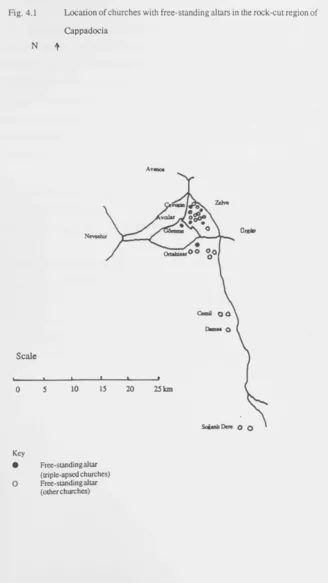
The rock-cut region of Cappadocia 3 The Byzantine Empire c. 1025 20 Location of churches with free-standing altars in the rock-cut region of
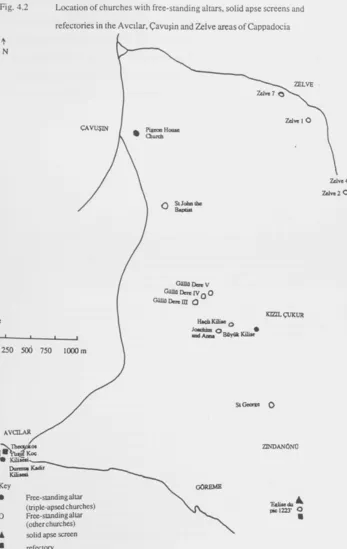
Cappadocia 133 Location of churches with free-standing altars, solid apse screens and
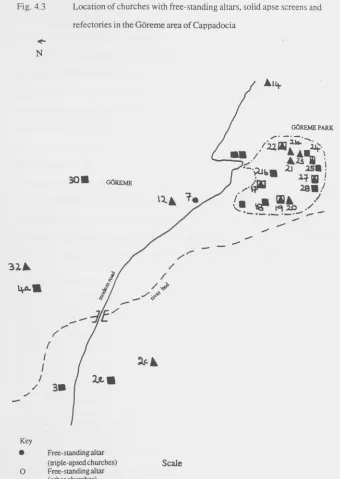
refectories in the Avcilar, Cavujin and Zelve areas of Cappadocia 135 Location of churches with free-standing altars, solid apse screens and
refectories in the Goreme area of Cappadocia 150
Tables
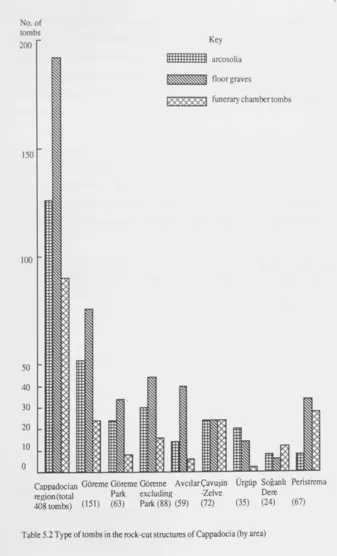
Table 4.1 Churches with free-standing altars 131 Table 5.1.1 Location of tombs in the rock-cut structures of Cappadocia (by area) 194
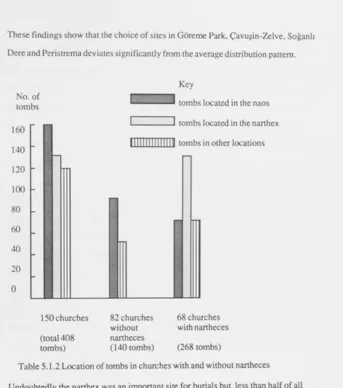
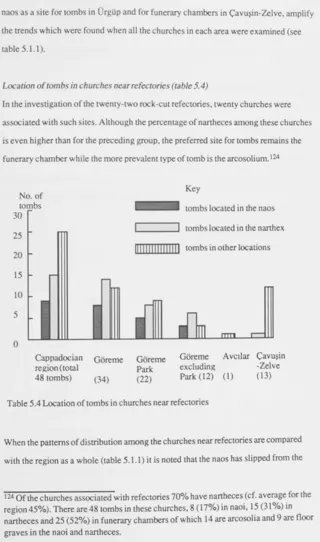
Table 5.1.2 Location of tombs in churches with and without nartheces Table 5.2 Type of tombs in the rock-cut structures of Cappadocia (by area) Table 5.3 Location of tombs in churches with free-standing altars Table 5.4 Location of tombs in churches near refectories
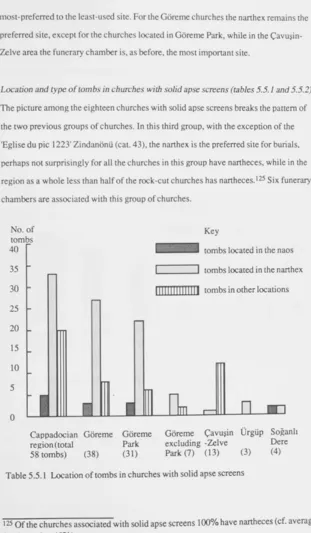
Table 5.5.1 Location of tombs in churches with solid apse screens Table 5.5.2 Type of tombs in churches with solid apse screens
X I I
ABBREVIATIONS
BAR BCH Byz BZ CArch CRAI
DACL
DMA
DOP JBAA JOB Meditarch
PG RAC
RBK REB
British Archaeological Reports
Bulletin de conespondance hellenique Byzantion
ByzantinischeZeitschrift Cahiers arch^ologiques
Comptes rendus des seances de I'Academie des Inscriptions et Belles-Lettres
Dictionnaired'ArcheologieChr6tienneetdeLiturgie, F. Cabrol -H. Leclercq (Paris 1907-1953) ISvols
Dictionary of the Middle Ages, ed. J. R. Strayer (New York 1982-1989) 12 vols
Dumbarton Oaks Papers
Journal of the British Archaeological Association Jahrbuch desosterreichischen byzantinistik
Mediterranean Archaeology Australian and New Zealand Journal for the Archaeology of the Mediterranean World
Patrologiae cursus completus. Series graeca, ed. J. P. Migne
Reallexikon fiiiAntike und Christentum, ed. F. J. Dolger et. al. (Stuttgart 1950-)
Reallexikon zur byzantinischen Kunst, ed. K. Wessel (Stuttgart 1966-)
1 • INTRODUCTION:
'THE VOICE OF THE MONUMENTS'i
While the Middle Byzantine period (843-1204)2 was the golden age of Byzantine mural painting we know relatively little concerning artistic developments in Constantinople at the time and even less about how these developments were received in the provinces. Nevenheless, scholars have frequently tumed to Cappadocia as a possible source for post-iconoclastic art.^ Viewed in this light, Cappadocian painting has been evaluated in terms of imperial patronage and Constantinopolitan traditions, against which it has been described as provincial and rustic although metropolitan patronage has been
acknowledged.^ With this approach the value of the Cappadocian region lay in its rich variety of painting, which could be placed within a hierarchical system emanating from
1 G. de Jerphanion, La voix des monuments. Notes etdtudes d'archSologie chretienne 1 (Paris and Brussels 1930); id. La voix des monuments. Etudes d'archiologie. Nouvelle serie n (Rome and Paris 1938) [hereafter cited as Jerphanion, La voix des monuments,
landH].
2 This period commences with the re-establishment of the use of icons in 843 and concludes with the collapse of the capital in 1204. For a review of documents relating to artistic practices during the period, see C. Mango, The Art of the Byzantine Empire 312-1453. Sources and Documents (Englevjood cms 1972) 181-240 [hereafter cited as C. Mango, The Art of the Byzantine Empte].
3 A. J. Wharton, Artof Empire. Painting and Architecture of the Byzantine Periphery. A Comparative Study of Four Provinces (University Park and London 1988) [hereafter cited as A. J. Wharton, Art of Empire]; A. D. Grishin, 'Constantinople and Cappadocia in the Eleventh Century: Center and Periphery', in World Art Themes of Unity in Diversity, ed. L Lavin (University Park and London 1989) I 81-84.
4 For example see A. W. Epstein, Tokali Kilise. Tenth Century Metropolitan Art in Byzantine Cappadocia, publ. as Dumbarton Oaks Studies 22 (Washington 1986) [hereafter cited as A. W. Epstein, TokaliKilise].
the capital.5 However, the focus on the hegeinony of Constantinople precluded an independent evaluation of Cappadocian art and virutally ignored its architecture.
Studies of liturgical planning have focussed on Early Christian monuments in the capital and demonstrated that the organization of liturgical space acknowledged the processional form of the liturgy.^ Nevertheless, in Constantinople, while there is a body of contemporary documentary evidence describing the liturgical performance, the furnishings have largely disappeared. In Cappadocia, the opposite position appears to exist, that the architectural disposition and liturgical furnishings have survived while the documentary evidence, if it existed, has not. However, if the usual caveats are applied to using sources from another period or a different geographical location a careful reading of available documentary sources does provide a theoretical basis for analysis of archaeological evidence, revealing patterns of patronage and function in the rock-cut churches.
5 As A. J. Wharton has observed the Cappadocian churches with decorations have survived in lelatively large numbers, 'allowing the rhythms both of stylistic development and also of artistic impetus to be charted' with a minimum of risk from 'gaps' in their chronology. Further, the churches are located within a 'geographically circumscribed area'. See Whanon, Art of Empire, 18.
CAPPADOCIA
Scattered across Cappadcx;ia on the Anatolian plateau of modem Turkey in an area of approximately eighty square kilometres bordered by the Turkish towns of Nevjehir, Avanos, Urgiip, Soganli Dere, Nigde and Aksaray, the Cappadocian monuments are remarkable for their variety and their number. The region considered in this study is a strip approximately forty by fifteen kilometres where the highest density of the rock-cut monuments is located, from Avanos in the north to Soganli Dere in the south, and from Avcilar in the west to Urgiip in the east. (Fig. 1.1)^
The preservation of the Cappadocian churches is a characteristic of the material out of which they are excavated for the region was the site of volcanic activity in the recent geological past. Pyroclastic deposits which were laid across the plateau have weathered the soft magma, exposing hard cores of volcanic spurs and cones which have proved to be ideal material for excavation, providing secure locations sheltered from harsh climatic conditions. The rock-cut structures vary from small chambers to monumental spaces, reflecting a complexity of architectural organization frequently lost in existing masonry churches. The interior spaces, protected from the ravages of nature, have largely preserved their architectural organization including rock-cut furnishings as well as frescoed decorations and inscriptions.
Because Cappadocia represents such a rich field much of the early research focussed on the primary stage of exploration, gathering and codifying data, rather than interpreting it. Father Guillaume de Jerphanion, author of the pioneering study undertaken in Cappadocia,^ referred to metropolitan parallels in architecture, iconography and paleography in his analysis of the rock-cut monuments but his principal task was one of exploration in the region and categorization of the churches, their paintings and inscriptions. Jerphanion undertook voyages of exploration in 1906,1907,1908,1911
and 1912,9 returning again to the region in 1927, following the expulsion of the orthodox Christian community. For its scholarship and comprehensiveness, Jerphanion's corpus remains the most valuable reference available to any scholar working on Cappadocian material. Indeed in some instances Jerphanion's
documentation is the only record of churches which have since collapsed or can no longer be located. The region was examined almost simultaneously by Hans Rott,'" Henri Gregoire'' and Guillaume de Jerphanion'^ but the exploratory role which Jerphanion pursued developed a more thorough investigatory method than had been previouslyattempted.i^ Jerphanion's methodological approach has remained the foundation of Cappadocian study assiduously adopted by other scholars,^" including Nicole Thierry and Gunter Paulus Schiemenz.'^ Working with her husband, J. M. Thierry, Nicole Thierry has explored many previously-unknown monuments as well as
9 For the itineraries which Jerphanion followed, see Les dglises rupestres de Cappadoce, I i xxix-xxxii.
10 Rott included Cappadocian monuments in his study of wall-painting in Asia Minor. See H. Rott, KleinasiatischeDenkmalerausPisidien, Pamphylien, Kappadokien und Lykien (Leipzig 1908).
11H. Gregoire, 'Rapport sur un voyage d'exploration dans le Pont et en Cappadoce', B C H 3 3 (1909) 3-169.
12 The first publications by Jerphanion followed his work in the region in 1906 and 1907. See Jerphanion, "Un pays de Troglodytes', Etudes 113 (Paris 1906) 705-714; id.,
'Les eglises souterraines de Gueureme et Soghanle (Cappadoce)', CR>4/(1908) 7-21. 13 For a summary of the explorations undertaken in the region by the 18th and 19th century travellers, including Paul Lucas, Anastasios M. Levidis, Charles Texier and J. Ivanovitch Smimov and a bibliographical note on secondary sources, see A. W. Epstein, Tokali Kilise, 81-86.
1-* Concise but nevertheless significant contributions to exploration in the region have been made by a number of scholars including J. Lafontaine-Dosogne, particularly in her paper 'Nouvelles notes cappadociennes', Byz 33 (1963) 121-183; M. Gough and Y. Otuken. A catalogue of relevant papers is included in the bibliography under the name of each author.
undertaking a thorough survey of Peristrema Valley and the churches in ihlara and Belisirma and more recently a study of the churches in the Cavujin area.'®
Recent scholarly research has furthered investigation into some of the findings initially proposed by Jerphanion such as the categorization of churches according to their architectural plan, I'^iconographic programme'^ orchronologyJ' A major contribution
N. Thierry remains one of the most prolific publishers of Cappadocian material. A catalogue of relevant papers and monographs is included in the bibliography under her name. In addition to valuable surveys of previously-unpublished or incompletely-published churches, Thierry has vmtten two monographs, see N. and M. Thierry,
Nouvelles egUses nipestres de Cappadoce. Region du Hasan Dagi (Paris 1963) [hereafter cited as N. and M. Thierry, Nouvelles dglises rupestres de Cappadoce] and N. Thierry, Haut moyen-age en Cappadoce. Les eglises de la region de Qavufin vol I, publ. as BibliothequeArchdologiqueetHistorique 102 (Paris 1983) [hereafter cited as N. Thierry, Haut moyen-age en Cappadoce].
The churches in the Peristrema Valley were ignored by Jerphanion and H. Gregoire. Hans Rott included a number of the churches and recorded their inscriptions in his study. See H. Rott, KleinasiatischeDenkmalerausPisidien, Pamphylien, Kappadokien und Lykien ,269-276.
I'' A. W. Epstein, 'Rock-cut chapels in Goreme Valley, Cappadocia: The Yilanli Group and the Column Churches', CArch 24 (1975) 115-136; id., 'The Fresco Decoration of the Column Churches, Goreme Valley, Cappadocia- A Consideration of their Chronology and their Models', CArch 29 (1980-1981) 27-46.
Ch. Walter, Art and Ritual of the Byzantine Church (London 1982) 225-232 and
passim, [hereafter cited as Ch. Walter, Art and Ritual]; C. Jolivet-Levy, 'Lapeinture byzantine en Cappadoce de la fm de I'iconoclasm k la conquete turque', in Le aree omogeneedella CiviltkRupestrenellambitodell'ImperoBizantino-.la Cappadocia, ed. C. D. Fonseca (Galatina 1981) 159-197; N. Thierry, Peintures dAsie Mineure etde TranscaucasieauxXeetXIes. (London 1977); iy.,'LaBible illustreeen Cappadoce' in
Le monde grec ancien etla Bible, ed. C. Mondesert (Paris 1984) 257-297; A. D. Grishin, Index of Middle Byzantine Ornament (project undertaken from 1985-1989, awaiting publication); for a preliminary report, id., 'Constantinople and Cappadocia in the Eleventh Centuiy: Center and Periphery', in World Art Themes of Unity in Diversity, ed. L Lavin, I 81-84.
R. Cormack, 'Byzantine Cappadocia: The Archaic Group of Wall-Paintings', JBAA
30 (1967) 19-36; J. Cave 'A re-evaluation of the sources of the 'Archaic Group' of Wall-Paintings in Cappadocia', (abstract)Fourt/i Annual Byzantine Studies Conference
(Ann Arbour 1978) 32-33; id.. The Byzantine Wall-PaintingsofKiliQlarKilise: Aspects of Monumental Decoration in Cappadocia (unpublished PhD dissertation, Pennsylvania 1984); A. W. Epstein, The Date and Context of Some Cappadocian Rock-cut Churches
(unpublished PhD dissertation, London 1974); id., 'The Iconoclast Churches of Cappadocia', in Iconoclasm, ed. A. Bryer-J. Herrin (Birmingham 1977) 103-111; N. Thierry, 'Mentalite et formulation iconoclastes en Anatolie', Journal des Savants (1976) 81 -130; id., 'L'iconoclasme en Cappadoce d'aprfes les sources archeologiques. Origines et modalit6s', in Rayonnmentgrec. Hommages k Charles Delvoye, ed. L. Hadermann-Misguich- G. Raepsaet with the collaboration of G. Cambier (Brussels 1982) 389-403;
to cataloguing and analyzing the iconography of the apsidal programmes is found in the unpublished doctoral thesis of Catherine Jolivet-Levy .^o Jolivet-Levy has included one hundred and twenty churches located throughout the rock-cut region. In view of her focus on iconographic programmes, undecorated churches, even if large, have been excluded. In an innovative approach to the study of the decoration Marcel Restle has investigated technical aspects of the paintings alongside a consideration of their iconography and comparative stylistic analyses with manuscript illuminations^^ on the basis of which he posited a chronology which is different from that proposed by Jerphanion and not universally accepted.^^ Restle examined seventy-six churches located in all areas of Cappadocia but his catalogue is not comprehensive, a fact which he has readily acknowledged.
The concentration of the rock-cut churches in tight clusters and loose groups located within the topographical limits of broad valleys makes it possible to isolate
geographically one site from the next, while recognizing that links such as walking tracks enabled easy communication between valleys. Accordingly the rock-cut region is
C. Jolivet-Levy, La peinture byzantine en Cappadoce: Problemes d'ensemble et introduction k I'etude de I'iconographie absidale (unpublished PhD dissertation, Paris 1980) 2 vols [hereafter cited as C. Jolivet-Levy, La peinture byzantine en Cappadoce]. Further to her research Jolivet-Levy has published a number of papers on the
Cappadocian churches, including L a peinture en Cappadoce de la fin de I'iconoclasme a la conquete turque', in Le aree omogenee della CivHitk RupestreneU ambito dell'Impero Bizantino: la Cappadocia, ed. C. D. Fonseca, 159-198; 'Le riche decor peint de Tokah Kilise k Goreme', HistoheetArchiologie 63 (1982) 61-72; Tine nouvelle chapelle byzantine pres d'Avcilar (Cappadoce). Sa decoration absidale', CMch 32 (1984) 39-48; 'Peintures byzantines inedites de Cappadoce', Arch6ologia 229 (1987) 36-46;
'Nouvelles d^couvertes en Cappadoce: les ^glises de Yuksekli', CArch 35 (1987) 113-142; 'L'image du pouvoir dans I'art byzantin i I'epoque de la dynastie macedonienne (867-1056)', Byz51 (1987) 441-470.
21 M. Restle, Byzantine Wall Painting in Asia Minor, trans. I. R. Gibbons (Shannon 1969) first published as Die byzantinische Wandmalerei in Kleinasien (Recklinghausen 1967).
divided into five areas, Urgup, Cavujin and Zelve, Avcilar and Goreme,^ Soganh Dere and lastly, Belisirma and ihlara in the Peristrema V a l l e y O u t s i d e these areas there are additional isolated monuments. At the outset it must be acknowledged that geographical boundaries defined by twentieth-century scholars may not have been the demographic boundaries of the earlier communities. For all that, some of the structures in each area appear to relate to valleys, rivers and the supply of water, justifying the consolidation of material within areas and implying that such ordering of the documentation is
theoretically sound and not arbitrarily convenient. Dividing the region in this way has been the pattern adopted by scholars in order to organize the overwhelming volume of material into a manageable and coherent corpus.
Studies which view Cappadocia within the broader geographical and historical framework provide an entry into considerations and approaches other than the methodologies of an historians.Recently Fredrich Hild and Marcel Restle have published a historical geography of Cappadocia,^^ which although considering the
23 Between 1986 and 1988 the name of Avcilar was changed to Goreme. In order to avoid confusion between the two centres now called Goreme in the present study the old nomenclature is retained, ie. Avcilar is the village and the site of a number of rock-cut churches, whUe Goreme is the area east of Avcilar in which other rock-rock-cut churches are located including the churches in the Goreme Open Air Museum. There is no present rural habitation on this site.
24 Churches in two of these areas, Soganh Dere and Peristrema Valley, are not included in the catalogue of churches in the appendix, but are considered when necessary in the thesis.
25 For example Le aree omogenee della CiviM Rupestre nellambito deU'Impero Bizantino: la Cappadocia ed. C. D. Fonseca.
26 F Hild-M. Restle, Tabula Imperii Byzantini 2 Kappadokien [Kappadokia, Charsianon, Sebasteia und Lykandos], (Vienna 1981) [hereafter cited as F. Hild-M. Restle, Tabula Imperii Byzantini 2 Kappadokien ]. This volume is the second in the Tabula Imperii Byzantini series on Cappadocia. For the study on communications see F. Hild, Die byzantinische Strassensystem in Kappadokien. Tabula Imperii Byzantini 2
(Vienna 1977). A third volume also contributed to investigation of Cappadocian monuments but focusses on the masonry-built churches, see M. Restle, Studien zui MhbyzantinischenArchitekturKappadokiens. Tabula Imperii Byzantini 3 (Vienna
towns in the rock-cut region unfortunately ignores the rock-cut churches.^''Art5 of Cappadociai^ includes essays on Anatolia and Cappadocia, compendia of classical, Byzantine and Ottoman monuments, and catalogues of the rock-cut churches.^' Together with Jerphanion's classification of the churches, the value of these catalogues has been recognized by scholars who have adopted this system as a basis to identify hitherto-unpublishedchurches.2°
The marginalization of Cappadocia to a fringe of the Empire has been emended in recent studies which have moved to investigate Cappadocian art and architecture
independendy of the capital. One of the challenges to investigation in the Cappadocian region is the extent of the rock-cut excavations, now believed to number around six hundredchurches,^' in addition to which there are hundreds of other cavities, the purpose of which is often unclear. However, consideration of only those churches
The immense value of the work by Hild-Restle has been acknowledged, although its shortcomings, particularly the exclusion of the rock-cut churches and a lack of synthesis of the data, have been criticized. See the reviews by C. Foss in Speculum 59 (1984) 656-662; N. Thierry in Turcica (1982) 298-302.
Arts of Cappadocia, ed. L. Giovanni (Geneva 1971) [hereafter cited as Arts of Cappadocia].
29 The catalogues were compiled by N. Thierry. See Arts of Cappadocia, plan nos. 2-6, pages 198-205. In order to catalogue the churches in two areas, Goreme and Soganli Dere, Nicole Thierry drew on the earlier charts compiled by Jerphanion, enriching his corpus of material with the inclusion of churches located since Jerphanion's exploration of the region was undertaken. Documentation of the other four areas was previously inadequate and Thierry's plans provide an ordered catalogue, based in large part upon her fieldwork in two areas, the Cavujin and Zelve area and the Peristtema Valley. See Jerphanion, Les dglises rupestres de Cappadoce, plates 2 (region of Urgiip), 3 (Magan, until recently known as Avcilar, and Goreme) and 180 (Soganli Dere).
30 As far as I am aware the only change to the early catalogue concerns the church now known as Balkan Deresi IV but previously identified by Jerphanion as Balkan Deresi
m. See the note to this effect in Ch. Walter, Art and Ritual, 229 n.341.
31 As to the number of churches in the region, L. Rodley has suggested that there are 'perhaps 600 in all', while A. D. Grishin has observed that there are' between 600 and 1000 cavities with evidence of Christian usage within an area of roughly 100 square kilometres bordered by the Turkish towns of Nevjehir, Aksaray, Avanos and Soganli'. See L. Rodle:y,Cave Monasteries of Byzantine Cappadocia (Cambridge 1985) 7; A. D. Grishin, 'The church of Yusuf Ko<; near Goreme Village in Cappadocia', Meditarch 3 (1990) [forthcoming]. Y. Otuken, in a reference unavailable to me but quoted by Rodley, has listed 703 monuments, although not all are rock-cut (Rodley, op. cit, 1
1 0
which are decorated ignores the greater part of the rock-cut region and its contribution to the Cappadocian milieu. Clearly in the absence of any decoration, methodologies other than iconographic must be considered.
Notwithstanding the present revision in approach to Cappadocia, its interpretative philosophy was signalled by Guillaume de Jerphanion, who encouraged art historians to code the architectural material according to its archaeology, iconography and epigraphy32 and to interpret the direct voice of the monument from the fabric of the building and its indirect voice from the intangible qualities, such as philosophical or liturgical considerations, which gave shape to the monument. The concept that architectural organization can be read in terms of functional requirements has sparked functionalist studies of the Cappadocian material.^^ Most recently, in a typological analysis which has broken away from the iconographic methodology, Lyn Rodley has focussed on architectural arrangements of twenty complexes selected from the five rock-cut areas, supplemented with a survey of the monuments at Agik Saray.^'' Although documenting the architectural disposition and liturgical furnishings of the churches more thoroughly than earlier scholars, Rodley's study may be called exclusive as within each area it ignores both the isolated churches and those monuments which are not clustered around a refectory or c o u r t y a r d . ^ ^ while the empiricism of early research has given way in recent years to evaluation of the broader issues of the cultural
32 Jerphanion, La voix des monuments, 17-29.
33 For example, the identification of monastic foundations by S. Kostof, Caves of God. The Monastic Envtonment of Byzantine Cappadocia (Cambridge, Massachusetts and London 1972); and the investigation of funerary monuments by N. Teteriatnikov, 'Burial Places in Cappadocian Churches', Greek Orthodox Theological Review 29 (1984) 141-174.
34 L. Rodley, Cave Monasteries of Byzantine Cappadocia. For an earlier survey of Agik Saray see H. Rott, KleinasiatischeDenkmalerausPisidien, Pamphylien, Kappadokien und Lykien ,242-245.
and social history of Cappadocia and concerns relating to patronage,^^ the position remains, with few exceptions, that inadequate consideration has been given to the type of foundation and its function.
Like other Byzantine foundations, Cappadocian monuments may be identified with two lives; one the dynamic life of the liturgical performance, the other the static life of the architectural form.3'' Over time evidence of the dynamic life of the churches has slipped into apparent obscurity, while the static life has been preserved in the organic fabric of the monuments. Nevertheless in Cappadocia the fabric of the monument has only rarely been considered in what may be called interpretative archaeology.^^ This is surprising because the intrinsic nature of the volcanic tuf into which the monuments are excavated has largely preserved the chambers as if freezing their architectural disposition and liturgical furnishings in a manner not possible in masonry-built monuments, where furnishings are easily moved or replaced. However, recent writing of art history has brought the study of Byzantine art to an appreciation of the position enunciated by Jerphanion, that the 'voice of the monument', the signified of today's critical studies, can
36 See J. Lafontaine-Dosogne, 'La Kale Kilisesi de Selime et sa representation de donateurs', in Zetesis Album Amicorum (Antwerp 1973) 741-753; G. P. Schiemenz, •Herr, hilf deinem Knecht Fragen nimbiener Stifter in den Kappadokischen
Hohlenkirchen',R6mjscAe(?uarta/sc/irift71 (1976) 133-174; M. Kaplan, 'Les grands proprietaires de Cappadoce (Vie - Xle siecles)', in Le aree omogenee della CivilM RupestTeneHambitodeU'ImperoBizantino:la Cappadocia, ed. C. D. Fonseca, 125-158; G. Dedeyan, 'Les armeniens en Cappadoce aux Xe et Xle siecles', ibid., 75-96; A. W. Wharton, 'Tenderness and Hegemony: Exporting the Virgin Elousa', in World Art. Themes of Unity in Diversity, ed. I. Lavin, 171 -80; A. D. Grishin, 'The Church of Yusuf K09 nearGoreme Village in Cappadocia', Meditarch 3 (1990) [forthcoming]. 37 This analogy was suggested by T. Mathews, The Early Churches of Constantinople: Architecture and Liturgy, 3. In its philosophical stance, it reflects Jerphanion's earlier comments (discussed above).
1 2
be read from its fabric, the signifier.39 In view of this position a new approach to the investigation of the roclc-cut churches of Byzantine Cappadocia is warranted.
In this thesis the Cappadocian monuments are considered from a new perspective and within a new structure. Studies which have investigated the rock-cut churches have not hitherto been framed according to theoretical considerations/^ largely because of the absence of documentary evidence which relates directly to Cappadocia. However, there is a body of evidence from other regions of the Empire, contemporary with the majority of the churches, in addition to fragmentary sources belonging to the Cappadocian region, both of which can be profitably exploited to provide the framework of architectural disposition and liturgical planning within which the churches may be considered.
The purpose of the present study of the rock-cut structures is to record systematically and to identify, where possible, the architectural disposition and liturgical furnishings of those chambers which can be securely identified with liturgical practices;''^ and to examine these foundations within their cultural and social context. In a scholarly study of liturgical planning in Early Byzantine churches, Thomas Mathews has suggested that the 'stations [of] ceremonial action' in the churches were the synthronon, altar, chancel
39 For discussion of the debate surrounding methodology see J. Haldon, '"Jargon" vs. "the facts"? Byzantine History-Writing and Contemporary Debates', Byzantine and
Modem Greek Studies 9 (1984/5) 95-132; for a reply see R. Cormack, 'Critical
studies. "New Art History" vs. "Old History": Writing Art History', Byzantine and
Modem Greek Studies 10 (1986) 223-231. Cormack observed that the iconographic
analysis undenaken by Ch. Walter in Art and Ritijal was apparently based on a conceptual framework of linguistic methodologies, Cormack, op. ciL, 227-228. 40 For discussion on this approach to other Byzantine studies see R. Cormack, 'Aristocratic patronage of the arts in 11 th- and 12th- century Byzantium', in The
Byzantine Aristocracy, IX to XIII centuries: Papers of the 16th Spring Symposium of Byzantine Stiidies (Edinburgh 1982), ed. M. Angold, publ. as BAR International Series 221 (1984) 158-172. Cormack has proposed that there is an advantage to 'using
texts as a staning point rather than formulating problems in relation to observable stylistic nuances', ibid., 165.
1 3
barrier, solea and ambon,''^ each of which is considered in the present study. With regard to the synthronon, ambon and solea in Cappadocia, however, few examples are located in the rock-cut churches. The archaeological material in the region is enriched, nevertheless, by additional chambers associated with the churches and these are investigated together with the liturgical furnishings. Comparative material from other Byzantine centres is introduced where it elucidates the Cappadocian evidence. Statistical analyses of such a body of data are inappropriate unless adequately structured. The philosophy accompanying cultural archaeological investigations provides useful guidance to data interpretation'*^ but the most appropriate models have been found to be mathematical as they synthesize data, exposing patterns in form and clusters in space"^ from which observations on patronage and function can be formulated.''^
Fieldwork was undertaken between 1986 and 1988, surveying both published and unpublished churches. In spite of the exhaustive nature of Guillaume de Jerphanion's survey he did not systematically record the architectural disposition of liturgical furnishings in the rock-cut churches. As much of the material concerning liturgical planning in the churches has received inadequate attention, each church is described in detail and supporting evidence of its location, ground plan, interior views and apsidal arrangements is provided in the appendix to the present study. A chart of the liturgical
T. Mathews, The Early Churches of Constantinople: Architecture and Liturgy, 4. '•3 See C. Renfrew, Transformations. Mathematical Approaches to Culture Change
(New York 1979). Renfrew has described cultural archaeology as 'the observation of affinities of form', which adopt diachronic or static modes of investigation, ibid. , 16. He proposed the use of analytical methods for cultural archaeology may be seen as 'la comddie humaine...[because of the] problem of distinguishing the underiying regulanty from the accompaning fortuitous occurrences: the signal from the noise, the wood from the trees', ibid., 37. Analytical methods and interdiscipUnary models which may be considered in art-historical research have been explored by S. Sinding-Larsen,
Iconography and Ritual A Study of the Analytical Perspectives (Oslo 1984).
1 4
furnishings includes measurements of individual furnishings in the apse and naos and
dimensions of the apse.'*^
All available documentary evidence is considered including literary and non-literary evidence in order to provide a framework of liturgical practices, planning and patronage which is as complete as possible. Archaeological evidence is considered against this theoretical background and analyzed. A complete picture of the rock-cut structures cannot, however, be satisfactorily reconstructed as losses have been considerable and are continuing. Nevertheless there is no reason to assume that the material which is extant is not representative of the situation which once existed in Cappadocia.
As has already been remarked, in earlier studies Cappadocia has been considered as a provincial reflection of metropolitan art. In chapter two I discuss the question of 'centre and periphery' as a model for the investigation of the Cappadocian foundations. Further, I consider liturgical traditions and examine literal and symbolic interpretations of the liturgy.The development of the liturgy and its influence on the disposition of the church is a vast subject beyond the scope of the present study. However, the changes to the liturgy effected on the eve of iconoclasm were accounted for in foundations built aftericonoclasm,'*^ the period into which the majority of the Cappadocian monuments falls. It is not known whether the liturgy practised in Cappadocia was the Liturgy of St John Chrysostom or the Liturgy of St Basil as inscriptions located in the churches have drawn on both sources. Accordingly I consider sources of both liturgies in chapter two and examine the references therein to architectural disposition and liturgical planning.
46 Each structure is given a catalogue number (cat.#) by which it is cited in the study, in addition to the usual nomenclature. Alldocumentation (archaeological description, plans, chart of liturgical furnishings and photographs) are included under the catalogue number.
1 5
Although a relationship with liturgical practice in Constantinople is demonstrated, and indeed expected, I suggest that in order to understand their liturgical planning and function the rock-cut structures need to be examined within a different context.
In spite of their value liturgical commentaries are couched in literary forms which can obfuscate specific details such as indications of liturgical furnishings. Therefore, in chapter three I turn to examine other documentary evidence such as foundation charters (ktetorika typika), the composition of which was not constrained by principles of rhetoric. With one exception, the typika provide information concerning patronage in monuments constructed outside Cappadocia. For all that, typika provide a valuable contribution to the body of theoretical knowledge concerning architectural disposition and liturgical planning. Moreover, they pertain to churches whose patronage by individuals is likely to find parallels among the Cappadocian churches. For this reason the inscriptions, including dedications, invocations and epitaphs, and the donor portraits in the Cappadocian churches are examined in chapter three, as they also offer evidence of patronage by individuals. I conclude the chapter with an examination of the
archaeological evidence which can be related directly to the documentary evidence in the typika and a discussion of burial traditions for monastic and lay patrons.
1 6
performance of the liturgy but give no indication whether these were permanent furnishings or architectural members or indeed if this distinction was important.
In approaching the archaeological evidence in this way, I am exploring the region for typological clusters, which are found to exist in churches with particular apse screens, the purpose of which I demonstrate in chapter five, by examining other rock-cut chambers such as refectories and funerary chambers. In concluding chapter five I bring together the archaeological evidence, establishing a set of guidelines by which the function of the ecclesiastical structures may be identified and characteristics by which monastic and lay patronage may be distinguished.
1 7
2 • THE SHAPE OF THE LITURGY 1
INTRODUCTION
In order to have a better understanding of the dynamic functional life of the Cappadocian monuments the shape of the ceremony for which the churches were planned needs to be explored. However, there is no clear indication of the liturgical practices which took place in the Cappadocian churches, as literary evidence, if it existed, has not survived. Nevenheless, there is non-literary evidence in the form of inscriptions in the churches, which do provide an indication of liturgical practices, investigation of which has been largely neglected.
There is an assumption that Cappadocia is a provincial reflection of the hegemony of Constantinople. While the culturally dominant role of Constantinople is acknowledged and, indeed, in part accounts for the overall unity of the visual and liturgical expression of the Byzantine religion, the methods of transmission and possible transformations between centre and periphery are less clear.
Initially I consider earlier studies in which Cappadocian art has been viewed as a peripheral reflection of metropolitan traditions and examined within the context of provincialism. In questioning whether this is the most appropriate approach to the Cappadocian monuments, I turn to the evidence found within the rock-cut churches and examine the liturgical expressions preserved in epigraphic evidence from which it is evident that the liturgical practices in Cappadocia must be considered within the context of liturgical traditions of the capital. There are both literal and symbolic descriptions of the Divine Liturgy in texts which are investigated for evidence of liturgical planning. I
conclude with an examination of the architectural disposition and liturgical planning indicated in such literary sources.
CENTRE A N D PERIPHERY
The homogeneity of Byzantine art in both the capital and provinces points to the hegemonic role of Constantinople as centre of the Byzantine Empire which extended in the Middle Byzantine period from Russia and Bulgaria in the north to Cyrpus and Crete in the south, from Antioch and Trebizond in the east to Sicily in the west. Within this Empire the position of Cappadocia oscillated between frontier and hinterland, military zone and region of relative security, until lost to the Empire toward the close of the eleventh century.
Cappadocia lay on the eastern border of the Byzantine Empire until the second half of the ninth century when, beginning with the Byzantine victory over Omar, the emir of Melitene in 863,^ successful military campaigns advanced the frontier eastward to Armenia.3 Nikephoros Phokas, a Cappadocian whose image appears in the apse of the
2 G. Ostrogorsky, History of the Byzantine State, trans. J. Hussey (Oxford 1956, second ed. 1968) 227.
3 For discussion of Armenian influence in Cappadocia, see G. Dedeyan, 'Les armeniens en Cappadoce aux Xe et Xle siecles' in Le aree omogenee della Civilta Rupestre nell ambito dell'Impero Bizantino: la Cappadocia, ed. C. D. Fonseca, 75-96. An Armenian general is depicted in the north apse of the Pigeon House Church at Cavujin. For discussion of his identity, see H. Gregoire, 'Notes epigraphiques VII. Melias le Magistie', Byz 8 (1933) 79-88; L. Rodley, 'The Pigeon House Church, Cavujin', JOB 33 (1983) 301-339. The church is investigated in chapter 4.
The question of eastern influence in the iconographic programmes of the Cappadocian churches has been considered by a number of scholars, including N. Thierry, 'L'art monumental byzantin en Asie Mineure du Xle siecle au XFVe', DOP29 (1975) 75-111; id., 'Iconographie cappadocienne et georgienne similitudes', BediKartlisa 38 (1980) 96-112; id., 'Art Chretien d'Asie Mineure de Georgie et d'Armenie. Recherches et
1 9
Pigeon House Church Cavusin," is credited with victories in the tenth century which employed peasant soldiers and armed cavalry to expand both eastern and western borders.^ In acknowledgement and commemoration of the 'noble knight' who fought for Byzantium,^ innovations in both literary and artistic traditions saw a bias from the tenth century toward the inclusion of military saints in the iconographic repertoireJ The period of the Macedonian dynasty (867-1056), from the middle of the ninth to the third quarter of the eleventh century, has generally been viewed as a time of 'limited prosperity and a modest urban life'.® Then defeats were suffered, first at Manzikert in 1071 then at Kayseri in 1082,' precipitating the loss of the central Anatolian plateau from the Empire to the Sultanate of Rum.
4 See L. Rodley, 'The Pigeon House Church, Cavujin', JOB 33 (1983) 301-339; C. Jolivet-Levy, 'L'image du pouvoir dans I'art byzantin a I'epoque de la dynastie macedonienne', Byz 57 (1987) 458,465-466.
5 A. Kazhdan- G. Constable, People and Power in Byzantium. An Introducton to Modem Byzantine Studies (Washington 1982) 151-152 [ hereafter cited as A. Kazhdan- G. Constable, People and Power in Byzantium],
6 A. Kazhdan- G. Constable, People and Power in Byzantium, 110-112.
Military saints including Demetrius, George, Prokopios, Theodore and Hieron, with whom a local cult has been proposed, are depicted in the Cappadocian churches. For a summary of locations and names of saints see the hagiographic index, which includes military saints, in Jerphanion, Les eglises rupestres de Cappadoce, II ii 499-512. Many of the military saints are less well known, such as Hesychios and Eunoikos. A list of military saints depicted in the Pigeon House Church at Cavujin has been compiled by L. Rodley, JOB 33 (1983) 315. There appears to be a particular trend toward iconography incorporating military saints in this church. For further discussion concerning St Hieron, see chapter 3.
8 C. Foss, 'Anatolia', DMA, 1239-242.
3 iw'
to
o D3 ^
s D cr.
n
ra 3 •o p o NJ Ln
Although the Byzantine Empire was Constantinopole-centred, scholars of Byzantium need to turn to the provinces for evidence which is lacking in the capital.From the late ninth to the end of the eleventh century the excavation of the Cappadocian churches was undertaken at an apparently unprecedented rate as the majority of the rock-cut churches is attributed to this period of approximately two hundred years." After the fail of Kayseri in 1082, although there is epigraphic evidence of continuing Christian
presence,'^ its extent is unknown,^^ while there is documentary evidence attesting to the
10 An example of one such study is by A. J. Wharton, Art of Empire, in which the provincial regions of Cappadocia, Cyprus, Macedonia and South Italy are considered as peripheries of the Empire.
11 The chronological breakdown of the churches is given as follows: 10-15% pre-iconoclastic and pre-iconoclastic periods; 45% from the end of iconoclasm (843) to 1000; 30% in the 11th century; 8-10% in 13 th century. See N. Thierry in Arts of Cappadocia ,
147-161; id., 'Les enseignements historiques de I'archeologie cappadocienne', Travaux etM^moires 8 (1981) 503.
The question of dating the churches continues to be debated. Pre-iconoclastic and iconoclastic attributions have been claimed for some churches. See G. Millet, 'Les iconoclastes et la croix a propos d'un inscription de Cappadoce', BCH34 (1910)
96-109; A. W. Epstein, 'The Iconoclast Churches of Cappadocia' in Iconoclasm, ed. A. Bryer-J. Herrin, 103-111; N. Thierry, 'Peintures paleochretiennes en Cappadoce. L'eglise no. 1 de Balkan Dere', in Synthronon. Art et Archeologie dela fin de Antiquite
et du Moyen Age. Recueil d'dtudes par A. Grabar et un group de ses disciples (Paris
1968) 53-59; id., 'Mentalite et formulation iconoclastes en Anatolie', Journaldes Savants (1976) 81-130; id., 'L'iconoclasm en Cappadoce d'apres les sources archeologiques. Origines et modalites', in RayonnementGrec. Hommagesa Charles
Delvoye, ed. L. Hadermann-Misguich- G. Raepsaet, 389-403; id., 'Peintures
pre-iconoclastes en Cappadoce, JOB 32/5 (1982) 371-380.
12 Inscriptions and graffiti in some churches attest to continuing activity in the region: in 1148/9 in Goreme 11 and in 1212 the dedication of Kar?! Kilise Guljehir. See
Jerphanion, Les Sglises rupestres de Cappadoce, I i 166-170 and 11 i 2-9. This epigraphic evidence is considered in chapter 3. In his review of L. Rodley, Cave
Monasteries of Byzantine Cappadocia, A. Bryer has suggested that the area was under
the control of the Turkomans and Danishmendids until the third quarter of the 12th century when the Seljuks took Kayseri, in 1168, and that there was therefore little direct conflict during the 11th century. See Times Literary Supplement 14 November 1986. 13 Arguments for and against a demographic decline in the 11th century are summarized by A. Kazhdan- A. W. Epstein, Change in Byzantine Culture in the Eleventh and
Twelfth Centuries (Berkley 1985) 24-26. However, there is little evidence to
demonstrate that a decline did not occur. Even in the 10th century, Ibn Hauqal observed that although water was abundant, there were no towns except Kayseri on the route from Constantinople to Trebizond, the population was in a precarious situation, revenues were mediocre, resources thin and finances bad. See Ibn Hauqal,
Configuration de la terre, ed. and trans. J. H. Kramers- G. Wiet (Beirut and Paris,
exodus from the region of both ecclesiastics and lay patrons."* From this time the demarcation between Christian and Moslem communities may have been rather blurred.
The subsequent preservation of these rock-cut structures provides scholars with a rich body of ecclesiastical architecture, representing a phase which has scant manifestation in the capital. For all that, identifying the centre and periphery,'® or metropolitan and provincial traditions''' is not usually an exact science,'^ depending as it does on our
Meletios, who came originally from Cappadocia, founded a monastery in 1081 in Greece, rather than Cappadocia. See J. Darrouzes, 'Le mouvement des foundations monastiques au Xle siecle', Travaux etMemokes 6 (1976) 166. A Latin text
(Historiens des Croisades, Occ. V 295-298) recounts the flight of the archdeacon
Mesopotamius from the Turkish invasion in Cappadocia, ibid., 170. A similar situation may have confronted Eustathios Boilas, who sponsored foundations in Iberia, although his mother had founded a church in Cappadocia. See S. Vryonis Jr., 'The Will of a Provincial Magnate, Eustathius Boilas (1059)', OOP 11 (1957) 263-277; P. Lemerle, 'Le testament d'Eustathios Boilas (Avril 1059)', Cinq etudes suile Xle siecle byzantin (Paris 1977) 13-63. This document is further discussed in chapter 3.
For example Thamar, one of the donors depicted in Kirk Dam Ala Kilise, Belisirma in the Peristrema Valley, although shown presenting a model of a Christian church to St George alongside an amir of the Seljuk state, is wearing Moslem dress, having apparently converted to Islam. See S. Vryonis Jr., 'Another note on the inscription of the church of St George of Beliserama', Byzantina 9 (1979) 11-22; for earlier considerations, see V. Laurent, 'L'inscription de I'eglise saint-Georges de Beliserma',
REB 26 (1968) 367-371; N. and M. Thierry, Nouvelles 6glises rupestres de
Cappadoce, 201-213. The decoration of the church is epigraphically dated to the period
1282-1308.
The opposites centre and periphery refer to the structure of integrated systems, where the centre is defined as the area which is more developed and controls skills and ideology, while the periphery lacks these attributes. The relationship is not necessarily, however, a passive one. For an overview see M. Rowlands, 'Centre and periphery: a review of a concept', in Centre and Periphery in the Ancient World, ed. M. Rowlands-M. Larsen- K. Kristiansen (Cambridge 1987) 1-11. The notion of centre, or core, and periphery is characteristic of the interrelations and interactions which occur under hierarchical or egalitarian systems. See I. Wallerstein, The Modem World-System (New York, San Francisco and London 1974-1989) 3 vols.
" A provincial monument has been defined as one located in the provinces, in which there are responses to both local and metropolitan impetuses. In this way provincialism is not a derogatory term but one which describes creative processes. See A. J. Wharton,
Art of Empire, 12.
own 'culturally determined visions of the past''' as well as aesthetic considerations, which are frequently structured to favour the capital^" and imperial patronageWhile aesthetic appreciation based on stylistic analysis may indicate patterns of patronage across the Empire it avoids addressing the question of a local perception of the monument and its function.^^
As far as rock-cut architecture is concerned the architectural forms undoubtedly have metropolitan parallels but the nature of the troglodytic architecture is such that it is inevitable that the interpretation for the rock-cut monuments lay with the local population used to the negative principles of excavated structures, rather than imponed masons who worked with positive designs in masonry-built monuments. Occasionally restrained sculptural details in the rock-cut foundations mimic the architectonic organization of masonry-built monuments such as the multiple cornices in Durmu? Kadir Kilisesi Avcilar (cat. 59) and figural forms, which are located in the church and an adjacent chamber of Hallap Manastir near Ortahisar (cat. 9)^3 as well as the exterior
T. C. Champion, 'Introduction', in Centre and Periphery. Comparative Studies in Archaeology, ed. T. C. Champion (London 1989) 15. Champion has suggested that one reason for the popularity of the 'new archaeology' of the 1960's and 1970's was the stimulation in developing conceptual frameworks. Consideration of the 'centre-periphery' provides an alternative model, which reduces excessive abstract modelling, ibid., 1 - 2 1 .
For example see R. Cormack, Monumental Painting and Mosaic in Thessaloniki in the Ninth Century (unpublished PhD dissertation, London, 1968). For subsequent discussion. See id., 'Additional notes and comments: Study VI', in The ByzantineEye: Studies in Art and Patronage (London 1989) 10-12; and the discussion presented by A.J. Wharton, Tenderness and Hegemony: Exporting the Virgin Elousa', in World Art.
Themes of Unity in Diversity ,171-80
21 R. Cormack, 'Patronage and New Programs of Byzantine Iconography', Major Papers. 17th International Byzantine Congress (Washington 1986)609-638. 22 In a later study R. Cormack has integrated textual and iconographic studies in order to evaluate social and cultural context. See Cormack, Writing in Gold. Byzantine Society and Its Icons (London 1985).
walls of two structures in Goreme.^'^ In contrast to these forms, which have parallels in masonry-built architecture, the applied ribs across the narthex vault of the Biiyiik Kilisesi at Kizil Cukur (cat. 36) are decorative and exclusive to rock-cut techniques. Such expressive elements are, however, rare in the rock-cut chambers. In other provincial sites such as Byzantine Italy, local idiosyncracies in the rock-cut architecture are also i n d i c a t e d . ^ ^ what these examples show is that indigenous character played a
role in each location. Relying on documentary evidence from one provincial location in order to demonstrate effects in another may, therefore, be unreliable unless direct relationships between the two provinces can be demonstrated. Provincialism, as defined above, implies that an idiosyncratic response to the metropolitan model has occurred in the province and to ignore this undervalues the local impetus. It is clear that although investigations of the centre and periphery enrich our understanding of the style of Byzantine art they are less useful for indicating function and may indeed be inappropriate.
Semi-figural forms are carved on the walls adjacent to the entrances of Goreme Necropolis 2 and 4. For the first see the description included with Goreme 2d (cat. 69), for the second see Goreme Necropolis 5, Lower Church (cat. 123). Both structures have been described by N. Thierry, 'Decouvertes k la Necropole de Goreme
(Cappadoce)', Ci?A/(1984) 661-663 and fig. 3 (Necropolis 2) and 663-664 and fig. 7 (Necropolis 4). Thierry has attributed the sculptures to the Roman period, ibid., 661, n. 14. For the present, the question of their dating must remain open, as there is little evidence by which the chambers may be securely dated.
In order to test the connection between Cappadocia and Constantinople, A. W. Epstein turned to the rock-cut churches of another region. See Epstein, The Date and Context of Some Cappadocian Rock-cut Churches, 160-171, later reported as, 'The Problem of Provincialism: Byzantine Monasteries in Cappadocia and Monks in South Italy', Journal of the Warburg and Courtauld Institutes 41 (1978) 28-46. In spite of considerable differences in the architectural disposition and liturgical planning of the churches in Cappadocia and Byzantine Italy, Epstein proposed that there were 'certain dialectical differences [but the churches] speak the same liturgical and architectural language' (Epstein, The Date and Context of Some Cappadocian Rock-cut Churches,
LITURGICAL INSCRIPTIONS IN BYZANTINE CAPPADOCIA The present study will turn to the static life of the architectural forms and the
archaeological evidence of the rock-cut monuments in chapters four and five but first it is proposed to fully explore the evidence of their dynamic ceremonial life in all documentary sources. Therefore I tum to the epigraphic evidence in rock-cut churches for although scant literary sources concerning the foundations are available, a number of inscriptions, some of which are liturgical, has survived, providing a basis for the consideration of liturgical practices in the rock-cut structures.
Inscriptions in the Cappadocian monuments are dedicatory, invocatory and funerary texts,^^ manifesting the intentions of the founder or donor.^'' In addition there is a number of graffiti, providing direct indications for the use of the churches. These will be considered for evidence of patronage by individuals in chapter three, while inscriptions which quote from liturgical sources^^ and iconographic programmes with liturgical associations are examined below.
The Middle Byzantine liturgy was framed around the Liturgy of St Basil.^' Although there is no literary evidence as to which liturgy was practised in Cappadocia, St Basil was one of the Cappadocian fathers, whose cult is attested in frequent representations in Cappadocian monuments. His liturgy provided the text for inscriptions in at least three
For the inscriptions see Jerphanion, Les 6glises rupestres de Cappadoce, II ii 389-395; J. Lafontaine-Dosogne, 'Nouvelles notes cappadociennes', Byz 33 (1963) 182-183; N. Thierry, "Les enseignements historiques de I'archdologie cappadocienne', Travaux etMemoires 8 (1981) 504-506. A relevant article by N. Thierry was unavailable to me['Remarques sur la peinture populaire et la pratique de la foi dans les eglises rupestres de Cappadoce' in Artistes, artisans et production artistique au may en-age (Rennes 1983) II703-730], Inscriptions concerning individuals are considered in chapter 3.
27 See Jerphanion, Les 6glises rupestre de Cappadoce I i, xxi-xxiii.
28 For a summary of the monuments in which liturgical quotations are located see Jerphanion, Les Eglises rupestres de Cappadoce, II ii 517-518.
of the churches,20 while the life of St Basil is illustrated in iconographic programmes in two further foundations one of which has an inscription from the Menologion of St Basil.3i However quotations from the Liturgy of St Basil are not the only liturgical texts located in the rock-cut structures. Other inscriptions from the Euchologion draw on the Liturgies of St John Chrysostom^^ and the older Liturgy of St Mark.33 Nevertheless, although the lives of saints other than St Basil are depicted in the Cappadocian
30 Tavjanh Kilise Mustafapajakoy (cat. 18), New Tokah Kilise Goreme (cat. 79) and Karaba? Kilise Soganli Dere. See Jerphanion, Les dglises nipestres de Cappadoce, II i 83,1 ii 324 and II ii 341. For the liturgical text see F. E. Brightman, Liturgies Eastern
and Western. I Eastern Liturgies (Oxford 1896) 323 [hereafter cited as F. E. Brightman, Liturgies Eastern and Western , I].
31 Scenes from the life of St Basil are depicted in New Tokali Kilise Goreme and Balkan Deresi 4. See Jerphanion, Les iglises nipestres de Capapdoce, I ii 358-365, 604, n i 52-53. Inscriptions drawn from the Menologion of St Basil are located in New Tokah Kilise Goreme.
For the life of St Basil in Cappadocian decorations see Jerphanion, 'Histoires de saint Basile dans les peintures cappadociennes et dans la peinture romaine du moyen age', in La voix des monuments, II 153-173; Ch. Walter, 'Biographical Scenes of the Three Hierarchs', REB 36 (1978) 243-250.
32 Inscriptions from the Liturgy of St John Chrysostom are located in Tavsanli Kilise Mustafapasakoy (cat. 18) and Karaba? Kilise Soganh Dere. See Jerphanion, Leseglises
rupestres de Cappadoce, II i 83 and II ii 341. An invocation in the apse of Karjii Becak
Avcilar is close to the text of the chant before the Kiss of Peace (ibid., I ii 510 and correction at 608). For the liturgical text see F. E. Brightman, Liturgies Eastern and
Western, I 382.
churches,34 scenes from the life of St John Chrysostom are not.^S The books of service of the Horologion, the Menaia,^^ Pentekostarion^'' and Triodion^® were sources for
34 For example the life of St Symeon is depicted in the church of St Symeon the Sty lite Zelve (cat. 52). See Jerphanion, Les eglises rupestres de Cappadoce, I ii 557-567 and 609; id., 'Les inscriptions cappadociennes et le texte de la Vita Simeonis auctore Antonio', in La voix des monuments, II 134-152. For the iconography of the saint's life see J. P. Sodini, 'Remarques sur I'iconographie de Symeon I'Alepin, le premier stylite'. Monuments etMSmoires 70 (1989) 29-53.
Isolated scenes from the lives of St Eustathios and St George are also depicted in the churches; St George, most frequently shown fighting the dragon, in Goreme 9,15, 16, 21, 28, in Soganh Dere in St Barbara and Gok Kilise and in Yilanh Kilise Belisirma; St Eustathios, most frequently pursuing the stag, in New Tokali Kilise Goreme, Goreme
11, Ballik Kilise and Gok Kilise Soganli Dere, the Church of St George at Ortakoy and Tavjanli Kilise Mustafapajakoy. For discussion of the iconography of the scene of St Eustathios pursuing the stag see N. Thierry, 'Un probleme de continuite ou de rupture. La Cappadoce entre Rome, Byzance et les Arabes', CRAI{\911) 122-127. The Synaxarium Ecclesiae Constantinopolitanae is cited in inscriptions on the east wall of Old Tokali Kilise Goreme and the Church of the Forty Martyrs Jahinefendi. See Jerphanion, op. cit, II i 167 n.3. In the latter church the text is from St Basil, PG 31,516 (Homilia in Quadraginta Martyres) and St Gregory of Nyssa, PG 46,778 (De Pauperibus Armandis).
35 Although the life of St John Chrysostom is not shown, an individual image of the saint is depicted in a number of churches including Goreme 11,13,19,21,22,23, GuUu Dere I and m, Balkan Deresi IV, St Symeon the StyUte Church Zelve, St Barbara, Ballik Kilise and Karaba? Kilise in Soganli Dere and the church at Tagar. Hagiographical scenes of St John Chrysostom are, however, rare and preserved in manuscript illuminations, rather than monumental art. See Ch. Walter, 'Biographical Scenes of the Three Hierarchs',REB 36 (1978) 250-259.
36 Texts from the Menaia, or book of annual fixed feasts, are located in Goreme 9, Goreme 19,22,23,29, the Monastery of the Archangel St Michael at Cemil and the Church of the Forty Martyrs Sahinefendi. For the liturgical books see J. G. Davies, A New Dictionary of Liturgy and Worship (London 1986) 96-98.
further liturgical inscriptions from psalms,^' Gospel'"' and patristic texts.'" Some inscriptions are found on the liturgical scrolls held by priests, whose position in the decoration of the church is an integral part of the iconographic programme.''^ Some of the inscriptions were transcribed more accurately than others; some were subjected to local adaptations and appear confused.'*^
Although an excursus into the iconography of apsidal programmes is not intended as it constitutes a separate study,'*'* there are liturgical indications in the apse decorations which cannot be excluded from this discussion. It has been suggested that liturgical among other considerations may have been responsible for the change in apse
In Karji Becak Avcilar, verses and responses are inscribed on the walls of the naos at cornice height. See Jerphanion, Les eglises rupestres de Cappadoce, I ii 505-506 and correction at 608. A similar text is found in Hagios Stephanos Cemil, ibid., I i 151-155. A number of liturgical inscriptions and biblical borrowings accompanies a dedicatory text in the first layer of decoration on the archivault of the apse in Karji Becak, ibid., I ii 504-510.
Two inscriptions above the door on the exterior fapade of Zelve 2 evoke the Litany of the Cross from Psalms 117, 20.
40 For inscriptions from the Evangelion in Goreme 7 (both Old and New Tokali Kilise), see Jerphanion, Les eglises rupestres de Cappadoce, I i 111-, I ii 333, 336-342. In the New Tokali Kilise the scene depicting the wise men observing the star shows each with the roll of the prophet Balaam, as indicated in Matthew 2, 2; Numbers 24,17, while the scene of Christ in the temple is from the offices of mid-Pentecost, ibid., I ii 329 n. 2, 333 n. 2.
''1 The text in Gok Kilise Soganh Dere (see Jerphanion, Les 6glises rupestres de
Cappadoce, n i 371) is taken from the Homily of Niketas of Paphlagonia, PG 105, 381 (OratioXVin. In Laudem S. Eustathii).
In Goreme 9 (Jerphanion, op. cit., I i 127-128) scenes from the life of the Virgin include the depiction of a miracle which is found in all homilies of the Virgin, including Germanos, PG98, 316 (In Praesentationem SS. Deiperae II).
In Goreme 23, Karanlik Kilise (Jerphanion, op. oil, I ii 415) the text accompanying the image of the Anastasis, or Descent into Limbo, is from the Homily of
Pseudo-Epiphany, PG 43,453 (Homilia Hin Sabbato Magno), while the Crucifixion in Goreme 19, Elmali Kilise (Jerphanion, op. cit., I ii 446) includes borrowings from PG 120, \ \29 {JoannesEuchaitarumMetropolita, Versuslambici).
G. Babic- Ch. Walter, 'The Inscriptions upon Liturgical Rolls in Byzantine Apse Decoration', REB 34 (1976) 269-280.
43 For example in Goreme 22, Cankli Kilise, graffiti alongside 3 donor figures on the west wall is not an exact scriptural quotation. See Jerphanion, Les 6glises rupestres de
Cappadoce, I ii 470-472. In a few churches, such as Damsa Kilise Tajkinpasakoy and
St Barbara Soganh Dere, it is unclear whether the inscription is in fact liturgical, ibid., II i 180,312.