Kung-Kiu Lau
Winfried Lamersdorf
Ernesto Pimentel (Eds.)
123
LNCS 8135
Second European Conference, ESOCC 2013
Málaga, Spain, September 2013
Proceedings
Service-Oriented
Commenced Publication in 1973 Founding and Former Series Editors:
Gerhard Goos, Juris Hartmanis, and Jan van Leeuwen
Editorial Board
David Hutchison
Lancaster University, UK Takeo Kanade
Carnegie Mellon University, Pittsburgh, PA, USA Josef Kittler
University of Surrey, Guildford, UK Jon M. Kleinberg
Cornell University, Ithaca, NY, USA Alfred Kobsa
University of California, Irvine, CA, USA Friedemann Mattern
ETH Zurich, Switzerland John C. Mitchell
Stanford University, CA, USA Moni Naor
Weizmann Institute of Science, Rehovot, Israel Oscar Nierstrasz
University of Bern, Switzerland C. Pandu Rangan
Indian Institute of Technology, Madras, India Bernhard Steffen
TU Dortmund University, Germany Madhu Sudan
Microsoft Research, Cambridge, MA, USA Demetri Terzopoulos
University of California, Los Angeles, CA, USA Doug Tygar
University of California, Berkeley, CA, USA Gerhard Weikum
Ernesto Pimentel (Eds.)
Service-Oriented
and Cloud Computing
Second European Conference, ESOCC 2013
Málaga, Spain, September 11-13, 2013
Proceedings
Kung-Kiu Lau
The University of Manchester, School of Computer Science Oxford Road, Manchester M13 9PL, UK
E-mail: [email protected]
Winfried Lamersdorf
Universität Hamburg, Fachbereich Informatik/VSYS Vogt-Kölln-Straße 30, 22527 Hamburg, Germany E-mail: [email protected]
Ernesto Pimentel
University of Málaga, Department of Computer Science Boulevard Louis Pasteur 35, 29011 Málaga, Spain E-mail: [email protected]
ISSN 0302-9743 e-ISSN 1611-3349
ISBN 978-3-642-40650-8 e-ISBN 978-3-642-40651-5 DOI 10.1007/978-3-642-40651-5
Springer Heidelberg New York Dordrecht London
Library of Congress Control Number: 2013946368
CR Subject Classification (1998): H.3.4-5, D.2.11, K.6.5, K.6.3, H.2.8, C.2.4, J.1
LNCS Sublibrary: SL 2 – Programming and Software Engineering
© Springer-Verlag Berlin Heidelberg 2013
This work is subject to copyright. All rights are reserved by the Publisher, whether the whole or part of the material is concerned, specifically the rights of translation, reprinting, reuse of illustrations, recitation, broadcasting, reproduction on microfilms or in any other physical way, and transmission or information storage and retrieval, electronic adaptation, computer software, or by similar or dissimilar methodology now known or hereafter developed. Exempted from this legal reservation are brief excerpts in connection with reviews or scholarly analysis or material supplied specifically for the purpose of being entered and executed on a computer system, for exclusive use by the purchaser of the work. Duplication of this publication or parts thereof is permitted only under the provisions of the Copyright Law of the Publisher’s location, in its current version, and permission for use must always be obtained from Springer. Permissions for use may be obtained through RightsLink at the Copyright Clearance Center. Violations are liable to prosecution under the respective Copyright Law.
The use of general descriptive names, registered names, trademarks, service marks, etc. in this publication does not imply, even in the absence of a specific statement, that such names are exempt from the relevant protective laws and regulations and therefore free for general use.
While the advice and information in this book are believed to be true and accurate at the date of publication, neither the authors nor the editors nor the publisher can accept any legal responsibility for any errors or omissions that may be made. The publisher makes no warranty, express or implied, with respect to the material contained herein.
Typesetting: Camera-ready by author, data conversion by Scientific Publishing Services, Chennai, India Printed on acid-free paper
Service-oriented computing – together with Web services as its most important implementation platform – has become the most important paradigm for dis-tributed software development and application for a number of years now. The former ECOWS (European Conference on Web Services) conference series ad-dressed key issues of service-oriented computing, in particular Web services, in nine successful conferences until 2011.
In the meantime, as services are increasingly used remotely, i.e., in the “cloud,” the focus of the conference series has shifted slightly. Accordingly, ECOWS was re-launched in 2012 as the “European Conference on Service-Oriented and Cloud Computing” (ESOCC) in Bertinoro, Italy, addressing the state of the art and practice of service-oriented computing and cloud computing.
The second European Conference on Service-Oriented and Cloud Computing, ESOCC 2013, was held in M´alaga, Spain, during September 11–13, 2013.
This volume contains the technical papers presented at the conference. The conference consisted of two tracks: a Research Track and an Industrial Track. There were a total of 44 submissions to the Research Track, from which 11 papers were selected (yielding an acceptance rate of 25%), together with four short papers. The review and selection process was performed rigorously, with each paper being reviewed by at least three Program Committee (PC) members (sometimes with the help of additional reviewers).
The Industrial Track selected three papers for presentation, and also invited two presentations from industry.
There were three excellent invited talks at the conference, given by Gian-luigi Zavattaro (University of Bologna, Italy), Kenji Takeda (Microsoft Research, Cambridge, UK), and Florian Rosenberg (IBM Thomas J. Watson Research Cen-ter, Yorktown Heights, USA).
Five workshops were co-located with the conference: Cloud for IoT (CLIoT 2013), Cloud Storage Optimization (CLOUSO 2013), Foundations of Coordina-tion Languages and Self-Adaptative Systems (FOCLASA 2013), the First Work-shop on Mobile Cloud and Social Perspectives (MoCSoP 2013), and the Third International Workshop on Adaptive Services for the Future Internet (WAS4FI 2013).
A PhD Symposium was held on the same day as the workshops.
industrial track, the workshops and the PhD Symposium, as well as the people who helped organize these events. Last, but not least, we are grateful to the local Organizing Committee for their efficient organization and warm hospitality. To all of you: we say a heart-felt “Thank you”!
July 2013 Kung-Kiu Lau
ESOCC 2013 was organized by the the Department of Computer Science of the University of M´alaga, Spain.
Organizing Committee
General Chair
Ernesto Pimentel University of M´alaga, Spain
Program Chairs
Kung-Kiu Lau University of Manchester, UK Winfried Lamersdorf University of Hamburg, Germany
Industrial Track Chairs
Judith Bishop Microsoft Research USA
Aljosa Pasic ATOS, Spain
Workshop Chairs
Massimo Villari University of Messina, Italy Carlos Canal University of M´alaga, Spain
PhD Symposium Chair
Wolf Zimmermann University of Halle, Germany
Program Committee
Marco Aiello University of Groningen, The Netherlands Farhad Arbab CWI and Leiden University, The Netherlands Luciano Baresi Politecnico di Milano, Italy
Sami Bhiri Digital Enterprise Research Institute, Ireland Mario Bravetti University of Bologna, Italy
Antonio Brogi University of Pisa, Italy Christoph Bussler VoxeoLabs Inc., USA
Manuel Carro Technical University of Madrid and IMDEA Software Institute, Spain Wojciech Cellary Poznan University of Economics, Poland Javier Cubo University of M´alaga, Spain
Juergen Dunkel Hannover University for Applied Sciences and Arts, Germany
Schahram Dustdar TU Wien, Austria
Rik Eshuis Eindhoven University of Technology, The Netherlands
David Eyers University of Otago, New Zealand
George Feuerlicht University of Technology Sydney, Australia Chris Giblin IBM Research Z¨urich, Switzerland
Claude Godart LORIA, France
Michael Goedicke University of Duisburg-Essen, Germany Thomas Gschwind IBM Research Z¨urich, Switzerland Martin Henkel Stockholm University, Sweden
Dionisis Kehagias Centre for Research and Technology Hellas, Greece
Ernoe Kovacs NEC, Germany
Akhil Kumar Penn State University, USA
Birgitta K¨onig-Ries Friedrich Schiller University of Jena, Germany Peep K¨ungas University of Tartu, Estonia
Frederic Lang INRIA Rhˆone-Alpes/VASY, France Heiko Ludwig IBM Almaden Research Center, USA Welf L¨owe Linnaeus University, Sweden
Ingo Melzer DaimlerChrysler AG, Germany
Roy Oberhauser Aalen University, Germany Guadalupe Ortiz University of C´adiz, Spain Claus Pahl Dublin City University, Ireland George Papadopoulos University of Cyprus, Cyprus Cesare Pautasso University of Lugano, Switzerland
Wolfgang Reisig Humboldt-Universit¨at zu Berlin, Germany Ulf Schreier Furtwangen University, Germany
Rainer Unland University of Duisburg-Essen, Germany Massimo Villari University of Messina, Italy
Erik Wilde EMC Corporation, USA
Gianluigi Zavattaro University of Bologna, Italy Wolf Zimmermann Universit¨at Halle, Germany
Olaf Zimmermann Rapperswil University of Applied Sciences, Switzerland
Christian Zirpins University of Karlsruhe, Germany
Additional Reviewers
Vasilios Andrikopoulos Juan Caballero Marco Comerio Ando Emerencia
Christian Gierds Eirini Kaldeli Pedro Lopez-Garcia Faris Nizamic
Invited Talk
Aeolus: Mastering the Complexity of Cloud Application Deployment . . . 1
Michel Catan, Roberto Di Cosmo, Antoine Eiche, Tudor A. Lascu, Michael Lienhardt, Jacopo Mauro, Ralf Treinen, Stefano Zacchiroli, Gianluigi Zavattaro, and Jakub Zwolakowski
Research Track
A Service Delivery Framework to Support Opportunistic
Collaborations. . . . 4
Gregory Katsaros, Erik Wittern, Birgit Gray, and Stefan Tai
Probabilistic Topic Models for Web Services Clustering and
Discovery. . . . 19
Mustapha Aznag, Mohamed Quafafou, El Mehdi Rochd, and Zahi Jarir
Managing Imprecise Criteria in Cloud Service Ranking with a Fuzzy
Multi-criteria Decision Making Method . . . . 34
Ioannis Patiniotakis, Stamatia Rizou, Yiannis Verginadis, and Gregoris Mentzas
Modeling Quality Attributes of Cloud-Standby-Systems: A Long-Term
Cost and Availability Model. . . . 49
Alexander Lenk and Frank Pallas
Cloud4SOA: A Semantic-Interoperability PaaS Solution for Multi-cloud
Platform Management and Portability. . . . 64
Eleni Kamateri, Nikolaos Loutas, Dimitris Zeginis, James Ahtes, Francesco D’Andria, Stefano Bocconi, Panagiotis Gouvas, Giannis Ledakis, Franco Ravagli, Oleksandr Lobunets, and Konstantinos A. Tarabanis
Implementation and Evaluation of a Multi-tenant Open-Source ESB. . . . 79
Steve Strauch, Vasilios Andrikopoulos, Santiago G´omez S´aez,
and Frank Leymann
Putting the Customer Back in the Center of SOA with Service Design
and User-Centered Design. . . . 94
RAFT-REST - A Client-Side Framework for Reliable, Adaptive
and Fault-Tolerant RESTful Service Consumption. . . 104
Josef Spillner, Anna Utlik, Thomas Springer, and Alexander Schill
Contract Compliance Monitoring of Web Services. . . . 119
Gregorio D´ıaz and Luis Llana
Service-Oriented Distributed Applications in the Future Internet:
The Case for Interaction Paradigm Interoperability. . . . 134
Nikolaos Georgantas, Georgios Bouloukakis, Sandrine Beauche,
and Val´erie Issarny
An App Approach Towards User Empowerment in Personalized Service
Environments . . . . 149
Mario Hoffmann
Short Papers
A Life-Cycle Model for Software Service Engineering . . . . 164
Erik Wittern and Robin Fischer
A Tale of Millis and Nanos: Time Measurements in Virtual and
Physical Machines . . . . 172
Ulrich Lampe, Markus Kieselmann, Andr´e Miede,
Sebastian Z¨oller, and Ralf Steinmetz
A UML Profile for Modeling Multicloud Applications. . . . 180
Joaqu´ın Guill´en, Javier Miranda, Juan Manuel Murillo,
and Carlos Canal
Towards Cross-Layer Monitoring of Multi-Cloud Service-Based
Applications. . . 188
Chrysostomos Zeginis, Kyriakos Kritikos, Panagiotis Garefalakis, Konstantina Konsolaki, Kostas Magoutis, and Dimitris Plexousakis
Industrial Track
A Reliable and Scalable Service Bus Based on Amazon SQS. . . . 196
Sergio Hern´andez, Javier Fabra, Pedro ´Alvarez, and Joaqu´ın Ezpeleta
A Comparison of On-Premise to Cloud Migration Approaches . . . . 212
Claus Pahl, Huanhuan Xiong, and Ray Walshe
Migration of an On-Premise Application to the Cloud:
Experience Report . . . . 227
Pavel Rabetski and Gerardo Schneider
of Cloud Application Deployment
Michel Catan1, Roberto Di Cosmo2, Antoine Eiche1, Tudor A. Lascu3,
Michael Lienhardt2, Jacopo Mauro3, Ralf Treinen2, Stefano Zacchiroli2, Gianluigi Zavattaro3, and Jakub Zwolakowski2
1 Mandriva SA
{mcatan,aeiche}@mandriva.com
2 Univ Paris Diderot, Sorbonne Paris Cit´e, PPS, UMR 7126, CNRS
[email protected], [email protected], {treinen,zack,zwolakowski}@pps.univ-paris-diderot.fr
3 Lab. Focus, Department of Computer Science/INRIA, University of Bologna
{lascu,jmauro,zavattar}@cs.unibo.it
Cloud computing offers the possibility to build sophisticated software systems on virtualized infrastructures at a fraction of the cost necessary just few years ago, but deploying/maintaining/reconfiguring such software systems is a serious challenge. The main objective of the Aeolus project, an initiative funded by ANR (the French “Agence Nationale de la Recherche”), is to tackle the scientific problems that need to be solved in order to ease the problem of efficient and cost-effective deployment and administration of the complex distributed architectures which are at the heart of cloud applications.
The approach taken in Aeolus is to bridge the gap between Infrastructure as a Service and Platform as a Service. In fact, as shown in the picture, applications leveraging the power of the Cloud need to allow efficient deployment and config-uration of their components at the level of IaaS and at the level of Services. For this, it is necessary to develop advanced tools that propose a deployment config-uration according to the requirements of the user or of a higher level application.
Integrated solutions to this problem needs to deal at the same time with both fine grained software components, like packages to be installed on one single virtual machine, and coarse grained ser-vices possibly obtained as composition of distributed and properly connected sub-services. To this aim, in [3] we have proposed the Aeolus component model: a component is a grey-box showing rel-evant internal states and the actions that
K.-K. Lau, W. Lamersdorf, and E. Pimentel (Eds.): ESOCC 2013, LNCS 8135, pp. 1–3, 2013. c
can be acted on the component to change state during deployment and reconfigura-tion, each state activates provide, require and conflict ports, active require ports must be bound to active provide ports of other components and active conflict ports prohibit the presence of components with specific active ports.
In the Aeolus component model, as depicted, one can express also numerical constraints indicating the maximal num-ber of require ports that can be connected to a provide port, as well as a minimal number of provide ports that need to be connected to a require port. In the exam-ple, for instance, the wordpress ser-vice require two instances of themysql
database (for example, to have both a pri-mary and a backup instance).
Based on the Aeolus formalization of software components, we have studied the reconfigurability problem: given an initial configuration, an universe of avail-able components, and a target compo-nent, verify the existence of a sequence of low-level actions that bring the initial configuration to a new one in which the target component is correctly deployed. This study (see [3,2] for the details) allowed us to precisely characterize the theoretical limits of the reconfigurability problem: it is unde-cidable in the general case, EXP-Space hard if no numeric constraints are considered, and Polytime if also conflicts are not taken into account.
The current research in Aeolus is devoted to the identification of efficient solutions. We plan to gain effectiveness by identifying interesting sub-cases in which feasible solutions are possible. The Zephyrus tool [1] is a first achievement along this direction.
and desired optimization criteria (e.g. minimize the amount of deployed machines and, hence, the total cost of operation). Zephyrus is guaranteed to find an optimal solution if one exists, and to do so relies on an external constraint solver. Description of the soft-ware components that Zephyrus can grasp includes information about their dependen-cies, as well as resource consumption information (e.g. memory, bandwidth, disk space, etc.) and the distribution packages which they require to work properly. Thanks to this last piece of information, Zephyrus can assign components to virtual machines guar-anteeing that they are actually installable there. We are currently extending Zephyrus with simple internal states like installed, running, and stopped. We have already imple-mented a prototype that computes a sequence of state transitions under the assumption that the initial configuration is empty and that the numerical constraint and the conflicts are considered only in the final configuration.
In order to practically experiment and trial our tools in an industrial environment, we are currently developing a n-tiers application deployment engine. This engine applies, on an IaaS, a final configuration proposed by the Zephyrus tool. First, this tool provi-sions the required virtual machines thanks to the cloud operating system Openstack. When the virtual machines are running, we go to the second step which is installation and configuration. In this step, the engine will connect to each virtual machine involved in the n-tiers application to install required packages and configure services. This is done using the deployment tool MSS (Mandriva Server Setup). Finally, the third step consists of launching each services in order to have an application running. These steps are performed, without any human interaction, by combining the MSS configuration informations and the Zephyrus solution. Currently, we have already deployed a varnish load balancer with several instances of Wordpress. We are now integrating more exam-ples with complex databases configuration containing master and slave requirements.
As future work, we plan to extend the Aeolus model to deal also with different ad-ministrative domains to support a more realistic representation of complex and possi-bly multi-cloud applications. In fact, different administrative domains could impose to contemporaneously deal with different deployment and reconfiguration policies. At the moment, the unique form of heterogeneity that we are able to deal with in the Zephyrus model is at the level of virtual machines: those could provide different resource levels as well as different universes of basic packages depending on the installed operating system.
References
1. Di Cosmo, R., Lienhardt, M., Treinen, R., Zacchiroli, S., Zwolakowski, J.: Optimal provision-ing in the cloud. Technical report, Aeolus project (Juin 2013),
http://hal.archives-ouvertes.fr/hal-00831455
2. Di Cosmo, R., Mauro, J., Zacchiroli, S., Zavattaro, G.: Component reconfiguration in the presence of conflicts. In: Fomin, F.V., Freivalds, R., Kwiatkowska, M., Peleg, D. (eds.) ICALP 2013, Part II. LNCS, vol. 7966, pp. 187–198. Springer, Heidelberg (2013)
to Support Opportunistic Collaborations
Gregory Katsaros1, Erik Wittern1, Birgit Gray2, and Stefan Tai1
1 FZI - Research Center for Information Technology, Berlin, Germany
{katsaros,wittern,tai}@fzi.de
2 DW - Deutsche Welle, Germany
Abstract. The wide spread use of computing devices, such as smart phones, cameras, and sensors results in abundance of available informa-tion. When such information flows occur in a specific place, at a certain time, and with the participating entities working together or sharing information to achieve common goals, we refer to the outcome of an op-portunistic collaboration. In this paper we define and analyse this new collaboration domain and present a framework through which oppor-tunistic collaboration services can be provisioned. We describe in detail the processes that the framework supports, including the modeling of opportunistic collaborations, the collaboration service creation, and the participation management. We evaluate the framework through a use case scenario in the context of participatory journalism in high-profile news events.
Keywords: opportunistic collaborations, services, collaboration, model-driven engineering, Cloud platform.
1
Introduction
Collaboration is the social paradigm of people working together towards achiev-ing a common goal. From an IT perspective, collaboration is “[...] the process in which entities share information, resources and responsibilities to jointly plan, implement and evaluate a program of activities to achieve a common goal” [1]. The same principle can be applied when describing distributed sys-tems, with their contributing entities sharing and exchanging information, ser-vices, resources and responsibilities in order to reach a desired outcome (i.e., as outlined by the corresponding application requirements).
In collaboration networks, nowadays, human participants can exchange infor-mation through different channels, including mobile phones, tablet computers, connected cameras or wearable sensors. The adoption of such smart devices transforms each of the participants into a moving gateway of information (to be consumed or being produced), resulting in a mesh of active, communicating things. Besides, an increasing number of real-world entities are equipped with sensors and actuators and are connected with the Internet, forming the so called
Internet of Things (IoT) [2]. Through the effective utilization of available
in-formation flows in terms of collaborations, everyday challenges can be tackled
K.-K. Lau, W. Lamersdorf, and E. Pimentel (Eds.): ESOCC 2013, LNCS 8135, pp. 4–18, 2013. c
and new opportunities can be realized. For example, the visitors of a high pro-file sports event, by sharing their position, they could create a real-time map of people participation around the stadium premises. Therefore, the digital infor-mation that is produced by all entities of a community could be exploited either for the creation of ICT services (e.g. best route), which could be offered directly back to the people, or for knowledge creation on behalf of the organizers, in a crowd-sourcing manner. [3]
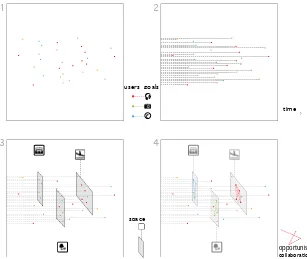
These new circumstances create novel types of collaborations which are
op-portunistic. We define opportunistic collaborations in the following way:
Definition 1. Opportunistic collaborations take place at a certaintimeand a
cer-tainlocation. In them, participants aim to achieve common and/or compatible
goals.
space
€
goals users
time
collaboration opportunistic
1
2
[image:15.439.79.386.221.480.2]3
4
Fig. 1.The Opportunistic Collaboration realization through the intersection of goals, time and space
location (Figure 1, graph 3), for example, a specific venue or geographic location. Participants may only take part in a collaboration if they are situated within the area. The high level ofvolatilityof the participants even challenges the establish-ment of collaboration in this dynamic and constantly evolving environestablish-ment. To what is more, the different technical requirements and capabilities of each ticipant in a collaboration hardens the interoperability, hence the increased par-ticipation. Finally, the usage patterns of an opportunistic collaboration is based on open and massive participation, thus, the mechanism serving the collabora-tion should be flexible in terms of capacity. Therefore, a centralized service-based solution is more appealing than an ad-hoc collaboration implementation.
In this context, our motivation for this work lies on the the need of tools and mechanisms to design and deploy collaboration services that support such opportunistic collaborations. These services must have short development cycles and short time-to-market, should take into consideration the diversity of data and resources, and use Cloud-enabled technologies to allow the scalability and reconfiguration during runtime.
Definition 2. A collaboration service is an on-line offering that allows for the participants of an opportunistic situation to engage themselves in the collabora-tion and to share or consume informacollabora-tion and resources in a dynamic manner.
In this publication we present a framework which allows the modeling and provisioning of opportunistic collaboration services. In section 2 we present the framework in detail, in section 3 we validate our approach by conceptualizing a use case from the domain of participatory journalism. We discuss related work from diverse areas in section 4, before we conclude in section 5.
2
Collaboration Service Creation Framework
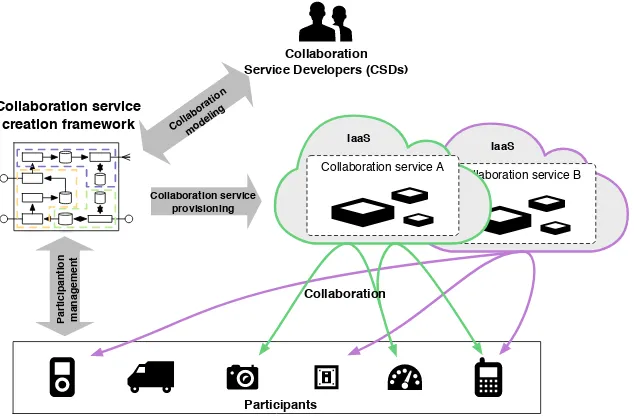
The proposed framework envisions the rapid development and provision of ser-vices to serve collaboration scenarios as illustrated in Figure 2. The stakeholders in the designed system are on the one hand theparticipants in the opportunistic collaboration scenario (consumers of the service) and on the other hand the
col-laboration service developers(CSDs) that are designing and offering the service.
The participants are represented by entities that offer their resources (stor-age, computation, video streams etc.), which make themselves available to the framework by registering through provided interfaces.
Consequently, the modeling of collaboration services and the definition of the goals are performed by the CSD. Given that the CSD identifies the opportunity, he specifies a collaboration model and rules that will guide the participants to-wards achieving the corresponding goals in the scenario. Therefore, the resulting
collaboration serviceis owned and managed by him. One CSD can own multiple
Collaboration Service Developers (CSDs)
Collaboration service B Collaboration service A
Collaboration service creation framework
IaaS
IaaS
Collaboration service provisioning
Participantion management
Collaboration modeling
Collaboration
[image:17.439.63.380.56.266.2]Participants
Fig. 2.Realization of opportunistic collaboration services
of producing data (for example, location data, photos and videos) and also con-suming data, and based on the selected role, they can act as bothconsumerand
producer of information.
The motivation of the CSDs in order to engage themselves and use such frame-work is that they could fast and simple provision custom services for specific events or situations. Those services would allow information exchange between participating entities either for enhancing the user-experience of the visitors / participants to the event or in order to assist the organizers by providing them additional information and therefore better perspective.
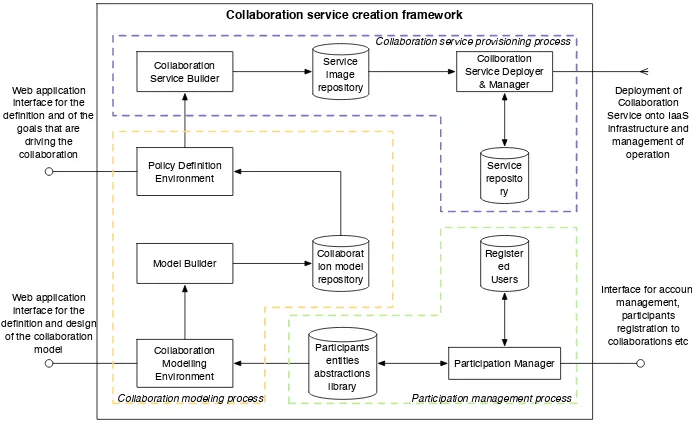
The collaboration service provisioning that is offered by the framework is divided into three major scientific and technical processes: 1) participation man-agement, 2) collaboration modeling and 3) collaboration service provisioning. Each process is being accomplished be a set of components of the framework as is being presented in the architecture diagram illustrated in Figure 3.
Collaboration service creation framework
Participation Manager Register
ed Users
Participants entities abstractions
library Collaboration
Modelling Environment
Model Builder Collaboration model repository Policy Definition
Environment
Service image repository Collaboration
Service Builder
Collboration Service Deployer
& Manager
Web application interface for the definition and design
of the collaboration model Web application interface for the definition and of the
goals that are driving the collaboration
Service reposito
ry
Interface for account management,
participants registration to collaborations etc
Deployment of Collaboration Service onto IaaS infrastructure and management of
operation
Participation management process Collaboration modeling process
[image:18.439.46.392.129.340.2]Collaboration service provisioning process
Fig. 3. Architecture of our framework for provisioning opportunistic collaboration services
In the following sections we present the framework’s architecture and describe each process in detail.
2.1 Participation Management Process
The first element of the collaboration service provisioning framework is the man-agement of participation of the framework itself as well as of the collaboration service during runtime (smart devices, IoTs etc.). All involved entities must be registered using a respective profile of participation. TheParticipation Manager
to the framework, the participation of the CSDs must be managed in order for them to have access to the tools and services of the framework. The registered users and the abstracted interfaces are being stored in theRegistered users and
Participants entities abstractions library repositories, as illustrated in Figure 3.
target: gpsCoordinates radius: Integer
Location
type: participantType name: String
location: gpsCoordinates timestamp: Date
Participant
type: roleType access: access
Role
1…*
startDate: Date endDate: Date
Time
description: String
Goal
type: interfaceType state: state
Interface
type: resourceType ...
Resource
title: String
Opportunistic Collaboration
1…* 1…* 1…*
Producer Consumer
roleType <<enumeration>>
mobile camera sensor Web service Web HTML editor e.t.c.
interfaceType <<enumeration>>
photo file video stream HTML file e.t.c.
resourceType <<enumeration>>
Enabled Disabled
state <<enumeration>>
1…* 1…* 1…*
Public Private
[image:19.439.81.359.120.365.2]access <<enumeration>>
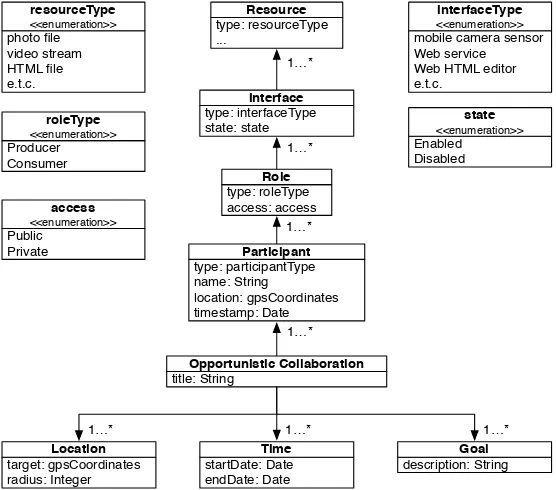
Fig. 4.Opportunistic collaboration reference model
2.2 Collaboration Modeling Process
The main offering of the framework results from its support mechanisms for CSDs to accelerate the creation of new collaboration services. The first task in that con-text is to identify and analyze the requirements of an opportunistic collaboration. Hence, the CSD creates a collaboration model that describes the potential par-ticipants, the information flows between them, and their roles. The time and the location factors of an opportunistic collaboration are being explicitly expressed within the model while the goal of it is being captured by the model through the constraints definition as well as by the overall model structure.
Figure 4 illustrates the reference model for modeling opportunistic collab-orations. Every participant has a certain role and an interface that supports information exchange. TheresourceType and theinterfaceType are enumeration types that are being defined during the registration process by theParticipation
Manager. Furthermore, the state of an interface can either be enabled (in the
To model a prosumer, the participant is modeled twice with different roles each time. Every role can be accessed publicly or privately. In a public role partici-pants are allowed to join it during runtime while in aprivate one the CSD must define the participant’s information during design-time. Additional roles can be defined by the CSD by extending the model.
The modeling process is realized through theCollaboration Modeling Environ-ment component of the proposed framework. Using this component, the CSD can design the collaboration scenario, specify the requirements and constraints, and generate the specification file that will be used for the service development. An instance of a collaboration model depicts effectively the collaboration sce-nario and application that the CSD wants to realize and after the design process is being built and stored in a repository.
The application logic and coordination of any possible information process-ing functions is beprocess-ing introduced in the collaboration modelprocess-ing process through
thePolicy Definition Environmentcomponent. In corresponding tasks, the CSD
can add on top of the designed model certain rules and constraints that help him achieve the goals of the opportunistic collaboration. Those policies will be incor-porated into the collaboration service that will be instantiated later and triggered automatically based on the information flow between the participants. The real-ization of this mechanism is done through a syntax inspired by theObject
Con-straint Language (OCL)[4] and adjusted to our needs. Through this descriptive
[image:20.439.61.378.356.593.2]syntax the CSD can define rules, operations or execute functions on top of the model. The syntax of our rule definition language is presented in Table 1.
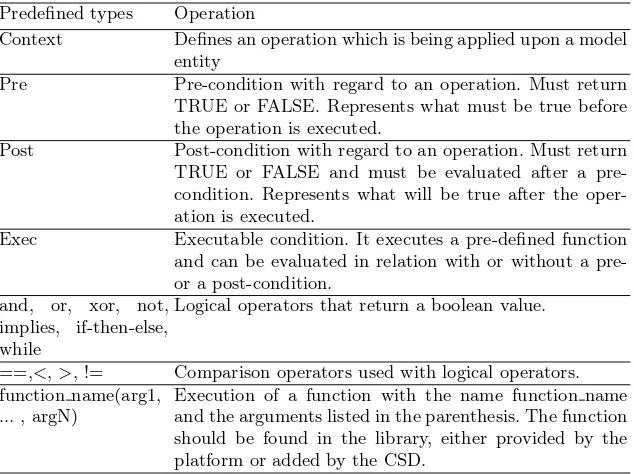
Table 1.Rules and constraints definition notation
Predefined types Operation
Context Defines an operation which is being applied upon a model entity
Pre Pre-condition with regard to an operation. Must return TRUE or FALSE. Represents what must be true before the operation is executed.
Post Post-condition with regard to an operation. Must return TRUE or FALSE and must be evaluated after a pre-condition. Represents what will be true after the oper-ation is executed.
Exec Executable condition. It executes a pre-defined function and can be evaluated in relation with or without a pre-or a post-condition.
and, or, xor, not, implies, if-then-else, while
Logical operators that return a boolean value.
==,<,>, != Comparison operators used with logical operators. function name(arg1,
... , argN)
An example syntax for constraining the location of the opportunistic collab-oration is the following:
Context: Opportunistic Collaboration
Pre: withinRange(opportunistic_collaboration->Participant.location, opportunistic_collaboration->Location.target,
opportunistic\_collaboration->Location.radius)
In this example, the participant must be within the range of the defined location. The context specifies the entity of the model that the policy is being applied to and thePre stands for apre-condition constraint. There can be
post-conditions as well as executables (exec). The developer, depending on the type
of the resources in the modeled collaboration, can introduce, for example, a rule on a video streaming resource to not transmit the video if the brightness of the image is too low. This feature will also enable the introduction of security restrictions on the data transmitted from each information node. At this point we should note that the definition of the constraints might seem complicated and time consuming but in the final developed system such complexity would be hidden behind graphical rule definition interfaces (e.g. rule definition within email clients). Hence, here we are explaining the logic and the concept behind that functionality.
2.3 Collaboration Service Provisioning Process
In order to allow open participation, improve the interoperability and also re-move the participation overhead from the end user, the realization of the col-laboration is necessary to be realized through a centralized service and not in a P2P fashion. To this end, the provisioning of the opportunistic collaboration process is an important part of the framework and is being achieved through a set of components described bellow. The Collaboration Service Builder and
theCollaboration Service Deployer & Manager are responsible for the
respec-tive tasks. In the beginning, the model of a scenario along with the policies defined are being transformed to a virtual machine image (VMI) throughModel
Transformation Toolsintegrated into the framework. This image can then be
3
Use Case: Supporting Data-Driven Reporting
from Predictable, High Profile News Events
To illustrate how our framework functions with actual collaboration opportuni-ties and to show its applicability, we here present a realistic use case from the domain of data-driven reporting [5].
3.1 The Application Domain
News events and other happenings of public interest often draw large media au-diences. They include, for example, major sports championships, cultural perfor-mances, speeches by politicians, election debates, event-driven press conferences, organized demonstrations, or the aftermaths of sudden news events.
News journalists report from such events. They have to deal with an ever
increasing volume of data in order to conduct their work in the digital age, stemming from digital devices, social networks, open sensor networks, smart city objects, or even publicly operated drones. These data sources must be managed in addition to traditional data streams from correspondents, news agencies, or outside broadcast vans. A news editor is regularly tasked with planning for predictable, high profile news events.
Journalists and editors should consider any available information for inclusion in their reports. They would ideally require tools, which allows them to select, combine and receive real-time data feeds from digital devices, sensor networks, or sensor-enabled objects. For the date or period in question, news editors need to know which data feeds are available, i.e. which are physically present in the location and which are reliable as well as legally compliant.
target: 37 23.516 -122 02.625 radius: 2km
Location
type: Field journalist name: Birgit location: 48.2188°N, 11.6248°E
timestamp: 2012-04-13 T 10:45
Participant type: Producer access: Private
Role
description: Sport event coverage
Goal type: Video
stream Resource
Title: Data driven journalism Opportunistic Collaboration
name: mobile camera sensor state: Enabled Interface type: Photo file
Resource
type: Editor name: Erik location: 52.5233°N, 13.4127°E
timestamp: 2012-04-13 T 10:45 Participant type: Consumer access: Private Role name: Web service state: Enabled Interface type: Photo file
Resource
type: Visitor name: Greg location: 48.2188°N, 11.6248°E
timestamp: 2012-04-13 T 10:45 Participant name: mobile camera sensor state: Enabled Interface type: Photo file
Resource type: Producer access: Public Role name: Web service state: Enabled Interface type: Video Stream Resource startDate: 12/04/2012 endDate: 15/04/2012 Time type: Consumer access: Private Role type: Photo file
Resource
name: mobile camera sensor state: Enabled Interface
type: Photo file Resource
type: Static Camera name: NWCorner location: 48.2188°N, 11.6248°E
[image:22.439.53.392.369.579.2]timestamp: 2012-04-13 T 10:45 Participant name: CCTV camera sensor state: Enabled Interface type: Video stream Resource type: Producer access: Private Role
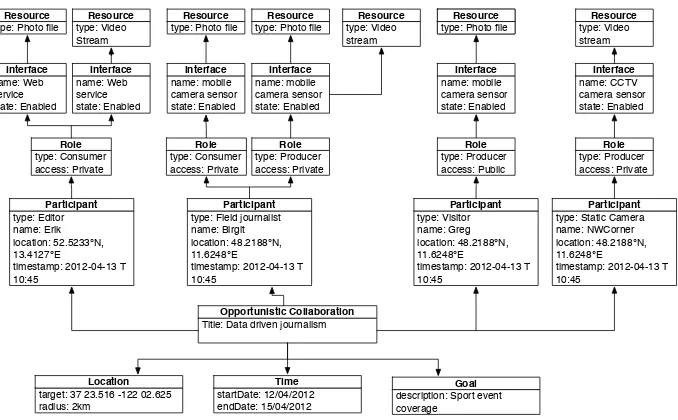
Specifying the Use Case’s Collaboration
The scenario that we are going to present is referring to timely limited high profile athletics event that is taking place in a sport facility (e.g. stadium). The specified participants of this scenario are:
– Visitorsof the sports event act as participants in the collaboration service. They dynamically enter and leave the collaboration and share resources with other participants through their mobile camera sensors, thus acting as pro-ducers of information.
– Field journalists located at the premises of the sport’s facility report to the editor using their smart, mobile devices. They produce information using their smart phones (e.g., they stream video) and also consume information provided by visitors. Thus, field journalists obtain a real-time overview of the on-going activities and can therefore better organize the on-site coverage in total.
– News editorresponsible for this event acts as a consumer alone. He receives the information produced by the field journalists as well as the dynamic visitor participation. By utilizing this information flow, he can orchestrate the movement of the journalist and produce in real-time the reportage for the sport event. He is also fulfilling the role of the CSD for the offline design of the collaboration model.
– Static Camera provided by the organizers of the sports event located in the NW corner of the stadium. It is acting as a producer participants and is able to send live video stream through its interface.
The collaboration model of the described opportunistic collaboration scenario is presented in Figure 5. We should note that for the actual implementation of this conceptual use case there might be extra tools need that are built on top of our framework. To this end we are assuming that participants (consumers or producers) of this opportunistic collaboration are using a client application to visualize the collaboration itself. Through such application the editor and the field journalist can request resources from the producer entities. The following set of constraints is defined on top of the presented scenario:
Context: Opportunistic Collaboration
Pre: ((opportunistic_collaboration->Participant.type == "Field Journalist") AND (opportunistic_collaboration->Participant.type == "Visitor")
AND (opportunistic_collaboration->Participant.type == "Static Camera")) AND (inRange(opportunistic_collaboration->Participant.location,
opportunistic_collaboration->Location.target, opportunistic_collaboration->Location.radius))
Post: opportunistic_collaboration->Participant->Role->Interface.state = Enabled
Context: Role
Pre: self.type=="Producer"
Exec: applyImageFilter(self->Interface)
“Field Journalist”, “Visitor” and “Static Camera” must be within the range of the defined collaboration location (Interface.state=Enabled). As a result the “Editor” of the scenario could be in a different location but still receive the feeds from the information producers which are restricted to a certain location. The second constraint applies to the Role entity of the model and has the pre-condition that the role type should be “Producer”. In that case the exec pre-condition must be applied as well, which in this case is the execution of the function “applyImageFilter” on the interface of the “Producer” role. In other words, the content transmitted from the producers will subject to an image correction filter that will be applied by this function. The function is being provided by the CSD during the constraint definition step and is being incorporated within the collaboration service image.
Through this conceptual validation of the opportunistic collaboration model-ing we can verify the applicability of the proposed approach in scenarios with certain usage patterns. Thelocation and time specific requirements of the news event are captured by the model and the presented constraint. The participants, the field journalists and the static camera must be within the specified range, while the editor could be anywhere. The concrete realization of information transmission, on the other hand, depends on the implementation of the
infor-mation interfaces. Thus, our model is principally capable of handling diverse
information transmission technologies by defining specific interfaces in the re-spective entities. To what is more, successful adaptation of collaboration services in the data-driven journalism context requires processing ofreal-time
informa-tion flows. Our model specifies the creation and transfer of information in terms
of involved roles being producer or consumer. In addition, handling potentially
tremendous amounts of information requires effective processing means like
fil-tering of legally or quality-wise inappropriate information. Using our frame-work’s proposed constraint definition, we are able to specify the (automatic) pre-processing of information, which can be used for the outlined purposes.
4
Related Work
We focus related work on two areas: first, we consider existing approaches in the area ofcollaboration modeling, which is at the heart of our approach. Second, we consider related work regardingCloud service deployment.
4.1 Collaboration Modeling
Reference Model for Collaborative Networks” (ARCON) is a modeling framework for capturing collaborative networks [7]. Its goal is to provide a generic abstract representation of collaborative networks a) to better understand their involved entities and relations among them and b) to provide basis for more spe-cific models for manifestations of collaborative networks. While ARCON provides a very complete reference model, it does not specifically focus on opportunistic col-laborations. In the field of ad-hoc networks there have been modeling structures presented for workflows[8] as well as opportunistic service compositions[9]. Such solutions usually propose decentralized strategies, which in our case could not ful-fill our requirements as we explained in previous section. Other approaches focus more specifically on modeling the collaboration in the context ofcollaboration models for the Internet of Things. It has been proposed to use agent models to capture how sensors in a network can collaborate [10]. The model includes var-ious types of software agents that realize sensor collaboration. Other approaches model collaboration between Internet of Things (IoTs) entities [11]. For collabora-tions, devices are abstracted as device-oriented Web services which are composed in process models. Further, this approach does not include aspects like temporal or local validity, which we address. The “pervasive computing supported collabora-tive work” model (PCSCW) aims to seamlessly integrate smart devices to enable the collaboration of users [12]. Atask model defines collaboration processes that make use of resources defined in aresource model, under consideration of device collaboration rules [13]. These rules define behavior of resources within a collab-oration, for example, to switch the means of data communication given a certain threshold is reached. Despite not targeting opportunistic collaborations specifi-cally, PCSCW’s approach is very similar to our perception of collaboration mod-eling and did and will continue to influence our work.
Some ideas exist with regard to utilizing smart phones (and their vari-ous sensors) in collaboration scenarios. It is proposed to use smart phone cameras for collaborative road advisories [14], or in combination with online social networks for collaboration in the context of opportunistic scenarios [15].
4.2 Cloud Service Delivery
Cloud computing can be beneficially combined with MDE in two ways [18]: First, MDE can be utilized to automate the development of Cloud services. On the infrastructure level, it has been proposed to use MDE for the configura-tion, deployment, and management of virtual machines [19]. The approach uses feature models from the software engineering domain to capture the configura-tion opconfigura-tions of virtual machines and uses these models to drive the deployment process. On the application level, for example, the “model-driven approach for the design and execution of applications on multiple Clouds” (MODAClouds) has been presented [20]. By using MDE, the approach aims to enable the cre-ation of services specific for different (and potentially multiple) Clouds. Second, MDE can be performed using Cloud services. Multiple service providers offer integrated development environments that can be accessed as Software-as-a-Service1. Also, modeling capabilities can be offered as Software-as-a-Service2.
Related research addresses questions like collaboration, revision control, and con-tinuous integration [21]. In the context of IoT, it has been proposed to simplify the development and deployment of radio-frequency identification (RFID) re-lated applications [22]. The approach uses blueprints, which act as architectural patterns, to abstract from and ease the utilization of Cloud services. Software modules, representing for example the RFID sensors, can then be combined using a Cloud-based mash-up editor.
As far as the services lifecycle concerns specifications from OSLC (Open Ser-vices for Lifecyle Collaboration) have being proposed for the development of model-based methodologies for service discovery[23]. The proposed technique for code generation and service orchestration would be considered for the implemen-tation of the Collaboration Service Manager component of our framework. Our framework foresees both approaches to combine MDE and Cloud computing for Cloud service delivery: a platform that provides means for the model-driven de-velopment of opportunistic collaboration services, using MDE to automatically create, deploy, and operate the resulting services in the Cloud.
5
Conclusion
The high dynamics in which nowadays devices are created and their increased interconnectedness, enabled by their interfaces, result in an active information mesh. The effective collaboration between the members of that mesh could be highly productive and raise new opportunities.
To this end, we presented an architectural framework through which one can develop services to support opportunistic collaborations. The suggested method-ology incorporates three processes: (a) the participation management, (b) the opportunistic collaboration modeling, and (c) the service provisioning. In this context, we designed and proposed a reference model for opportunistic collab-orations. On top of that model, we defined a constraint language and syntax
1 For example the ”Cloud9 IDE”, see:https://c9.io/
2 For example Signavio’s BPMN process modeling offers, see:http://www.signavio.
that can be used in order to express the logic and operation of an opportunistic collaboration.
Furthermore, we performed a conceptual validation of the proposed method-ology by applying the modeling process of the suggested system on a use case from the data-driven reporting sector. In the specific scenario an opportunistic collaboration between the field journalists, the visitors and the editor of a me-dia/news agency is formed in order to facilitate and enhance the coverage of a high-profile sports event. Using our modeling approach we were able to capture all the necessary interactions that characterize the scenario. The time and lo-cation constraints could be effectively expressed through the policy definition language that we introduced.
Our future steps include the implementation of a user friendly interface3for
the modeling of opportunistic collaborations through which even non-experts could design a collaboration scenario. In addition, we aim at implementing the management components (participation and service manager) as RESTful ser-vices that would keep resources for every entity. The evaluation of the proposed implementation will be done in terms of: (a)time to publish a collaboration service, (b) ease of collaboration modeling methodology, (c) capacity of partici-pation, and (d) communication interfaces supported.
Overall, we strongly believe that our framework could be the baseline of a platform to accelerate the development of opportunistic collaborations.
References
[1] Camarinha-Matos, L., Afsarmanesh, H.: Taxonomy of Collaborative Networks. Technical report, Future Internet Enterprise Systems (FInES) Task Force on Col-laborative Networks (March 2012)
[2] Kortuem, G., Kawsar, F., Sundramoorthy, V., Fitton, D.: Smart objects as build-ing blocks for the internet of thbuild-ings. IEEE Internet Computbuild-ing 14(1), 44–51 (2010) [3] Leimeister, J.M., Huber, M., Bretschneider, U., Krcmar, H.: Leveraging crowd-sourcing: Activation-supporting components for it-based ideas competition. J. Manage. Inf. Syst. 26(1), 197–224 (2009)
[4] OMG: Object Constraint Language v2.0. Technical report, Object Management Group (2006)
[5] Mirko, L.: Status and Outlook for data-driven journalism. European Journalism Center: Driven Journalism: What is there to learn? A Paper on the Data-Driven Journalism Roundtable Held in Amsterdam on 24 August (2010) [6] Poltrock, S., Handel, M.: Modeling Collaborative Behavior: Foundations for
Col-laboration Technologies. In: Proceedings of the 42nd Hawaii International Con-ference on System Sciences (HICSS), pp. 1–10 (2009)
[7] Camarinha-Matos, L., Afsarmanesh, H.: The ARCON modeling framework. In: Collaborative Networks: Reference Modeling. Springer, New York (2008) [8] Huth, C., Smolnik, S., Nastansky, L.: Applying topic maps to ad hoc workflows
for semantic associative navigation in process networks. In: Proceedings of the Seventh International Workshop on Groupware, pp. 44–49 (2001)
[9] Groba, C.: Towards opportunistic service composition in dynamic ad hoc envi-ronments. In: Pallis, G., et al. (eds.) ICSOC 2011 Workshops. LNCS, vol. 7221, pp. 189–194. Springer, Heidelberg (2012)
[10] Biswas, P.K., Qi, H., Xu, Y.: A Mobile-Agent-Based Collaborative Framework for Sensor Network Applications. In: 2006 IEEE International Conference on Mobile Adhoc and Sensor Systems (MASS), pp. 650–655 (October 2006)
[11] Chen, F., Ren, C., Dong, J., Wang, Q., Li, J., Shao, B.: A Comprehensive Device Collaboration Model for Integrating Devices with Web Services under Internet of Things. In: Proceedings of the 19th IEEE International Conference on Web Services (ICWS). IEEE Computer Society, Los Alamitos (2011)
[12] Hamadache, K., Lancieri, L.: Role-Based Collaboration Extended to Pervasive Computing. In: International Conference on Intelligent Networking and Collab-orative Systems (INCOS 2009), pp. 9–15. IEEE Computer Society (November 2009)
[13] Hamadache, K., Lancieri, L.: Dealing with device collaboration rules for the PC-SCW model. In: Kolfschoten, G., Herrmann, T., Lukosch, S. (eds.) CRIWG 2010. LNCS, vol. 6257, pp. 233–248. Springer, Heidelberg (2010)
[14] Koukoumidis, E., Martonosi, M., Peh, L.S.: Leveraging Smartphone Cameras for Collaborative Road Advisories. IEEE Transactions on Mobile Computing 11(5), 707–723 (2012)
[15] Liu, C.H., Hui, P.: Mobile Sensing for Social Collaborations. Technical report, Deutsche Telekom Laboratories (2011)
[16] Schmidt, D.C.: Model-Driven Engineering. IEEE Internet Computing 39(2), 25– 31 (2006)
[17] Sommerville, I.: Software Engineering, 9th edn. Addison-Wesley (2011)
[18] Bruneliere, H., Cabot, J., Jouault, F., et al.: Combining Model-Driven Engineer-ing and Cloud ComputEngineer-ing. In: ModelEngineer-ing, Design, and Analysis for the Service Cloud-MDA4ServiceCloud 2010: Workshop’s 4th edn. (Co-Located with the 6th European Conference on Modelling Foundations and Applications-ECMFA 2010) (2010)
[19] Le Nhan, T., Suny´e, G., J´ez´equel, J.-M.: A Model-Driven Approach for Virtual Machine Image Provisioning in Cloud Computing. In: De Paoli, F., Pimentel, E., Zavattaro, G. (eds.) ESOCC 2012. LNCS, vol. 7592, pp. 107–121. Springer, Heidelberg (2012)
[20] Ardagna, D., Di Nitto, E., Mohagheghi, P., Mosser, S., Ballagny, C., D’Andria, F., Casale, G., Matthews, P., Nechifor, C.S., Petcu, D., et al.: MODAClouds: A model-driven approach for the design and execution of applications on multiple Clouds. In: 2012 ICSE Workshop on Modeling in Software Engineering (MISE). IEEE Computer Society (2012)
[21] Mikkonen, T., Nieminen, A.: Elements for a cloud-based development environ-ment: online collaboration, revision control, and continuous integration. In: Pro-ceedings of the WICSA/ECSA 2012 Companion Volume, WICSA/ECSA 2012. ACM, New York (2012)
[22] Guinard, D., Floerkemeier, C., Sarma, S.: Cloud Computing, REST and Mashups to Simplify RFID Application Development and Deployment. In: Proceedings of the 2nd International Workshop on the Web of Things (WoT 2011). ACM, San Francisco (2011)
for Web Services Clustering and Discovery
Mustapha Aznag1, Mohamed Quafafou1, El Mehdi Rochd1, and Zahi Jarir2
1 Aix-Marseille University, LSIS UMR 7296, France
{mustapha.aznag,mohamed.quafafou,el-mehdi.rochd}@univ-amu.fr
2 University of Cadi Ayyad, LISI Laboratory, FSSM, Morocco
Abstract. In Information Retrieval the Probabilistic Topic Models were originally developed and utilized for topic extraction and document mod-eling. In this paper, we explore several probabilistic topic models: Prob-abilistic Latent Semantic Analysis (PLSA), Latent Dirichlet Allocation (LDA) and Correlated Topic Model (CTM) to extract latent factors from web service descriptions. These extracted latent factors are then used to group the services into clusters. In our approach, topic models are used as efficient dimension reduction techniques, which are able to capture se-mantic relationships between word-topic and topic-service interpreted in terms of probability distributions. To address the limitation of keywords-based queries, we represent web service description as a vector space and we introduce a new approach for discovering web services using latent factors. In our experiment, we compared the accuracy of the three prob-abilistic clustering algorithms (PLSA, LDA and CTM) with that of a classical clustering algorithm. We evaluated also our service discovery approach by calculating the precision (P@n) and normalized discounted cumulative gain (NDCGn). The results show that both approaches based on CTM and LDA perform better than other search methods.
Keywords: Web service, Data Representation, Clustering, Discovery, Machine Learning, Topic Models.
1
Introduction
The Service Oriented Architecture (SOA) is a model currently used to pro-vide services on the internet. The SOA follows the find-bind-execute paradigm in which service providers register their services in public or private registries, which clients use to locate web services. SOA services have self-describing inter-faces in platform-independent XML documents. Web Services Description Lan-guage (WSDL) is the standard lanLan-guage used to describe services. Web services communicate with messages formally defined via XML Schema. Different tasks like matching, ranking, discovery and composition have been intensively studied to improve the general web services management process. Thus, the web services community has proposed different approaches and methods to deal with these
K.-K. Lau, W. Lamersdorf, and E. Pimentel (Eds.): ESOCC 2013, LNCS 8135, pp. 19–33, 2013. c
tasks. Empirical evaluations are generally proposed considering different simu-lation scenarios. Nowadays, we are moving from web of data to web of services as the number of UDDI Business Registries (URBs) is increasing. Moreover, the number of hosts that offer available web services is also increasing signifi-cantly. Consequently, discovering services which can match with the user query is becoming a challenging and an important task. The keyword-based discov-ery mechanism supported by the most existing services search engines suffers from some key problems: (1) User finds difficulties to select a desired service which satisfies his requirements as the number of retrieved services is huge. (2) Keywords are insufficient in expressing semantic concepts. This is due to the fact that the functional requirements (keywords) are often described by natural language. To enrich web service description, several Semantic Web methods and tools are developed, for instance, the authors of [9,19,1] use ontology to anno-tate the elements in web services. Nevertheless, the creation and maintenance of ontologies may be difficult and involve a huge amount of human effort [2,12].
To address the limitation of keywords-based queries, we represent web service description as a vector and introduce a new approach for discovering web services using a semantic clustering approach. Service Clustering aims to group together services which are similar to each other. Our clustering approach is based on probabilistic topic models. By organizing the web service data into clusters, services become easier and therefore faster to be discovered and recommended [17].
Probabilistic topic models are a way to deal with large volumes of data by discovering their hidden thematic structure. Their added value is that they can treat the textual data that have not been manually categorized by humans. The concept of ”topic” consists on discovering clusters of textual data on similar subjects. These clusters are obtained by calculating the occurrences of words emerging together frequently in different independent texts. Formally, proba-bilistic topic models use their hidden variables to discover the latent semantic structure in large textual data.
In this paper we investigate using probabilistic machine-learning methods to extract latent factorszf∈Z={z1, z2, ..., zk}from service descriptions. We will
explore several probabilistic topic models : PLSA (Probabilistic latent semantic analysis), LDA (Latent Dirichlet Allocation) and CTM (Correlated Topic Model) and use them to analyze search in repository of web services and define which achieves the best results. By describing the services in terms of latent factors, the dimensionality of the system is reduced considerably. The latent factors can then also be used to efficiently cluster services in a repository. In our experiments, we consider that web services are mixtures of hidden topics, where a topic defines a probability distribution over words.
2
Related Work
In this section, we briefly discuss some of research works related to discovering Web services. Although various approaches can be used to locate and discover Web services on the web, we have focused our research on the service discovery problem using a clustering method. The clustering methodology is a technique that transforms a complex problem into a series of simpler ones, which can be handled more easily. Specifically, this technique re-organizes a set of data into different groups based on some standards of similarity. Clustering analysis has been often used in computer science, as in data mining, in information retrieval, and in pattern classification.
In [1], the authors proposed an architecture for Web services filtering and clustering. The service filtering mechanism is based on user and application profiles that are described using OWL-S (Web Ontology Language for Services). The objectives of this matchmaking process are to save execution time and to improve the refinement of the stored data. Another similar approach [15] concentrates on Web service discovery with OWL-S and clustering technology. Nevertheless, the creation and maintenance of ontologies may be difficult and involve a huge amount of human effort [2,12].
Generally, every web service associates with a WSDL document that contains the description of the service. A lot of research efforts have been devoted in utilizing WSDL documents [8,2,12,13,7,14,17]. Dong et al. [8] proposed the Web services search engine Woogle that is capable of providing Web services similarity search. However, their engine does not adequately consider data types, which usually reveal important information about the functionalities of Web services [11]. Liu and Wong [13] apply text mining techniques to extract features such as service content, context, host name, and service name, from Web service description files in order to cluster Web services. They proposed an integrated feature mining and clustering approach for Web services as a predecessor to discovery, hoping to help in building a search engine to crawl and cluster non-semantic Web services. Elgazzar et al. [7] proposed a similar approach which clusters WSDL documents to improve the non-semantic web service discovery. They take the elements in WSDL documents as their feature, and cluster web services into functionality based clusters. The clustering results can be used to improve the quality of web service search results.
various clustering approaches [17]. This proximity measure applies cosine of the angle between two vectors. It reaches from the origin rather than the distance between the absolute position of the two points in vector space.
Ma et al. [14] proposed an approach similar to the previously discussed ap-proaches [8,1,15] where the keywords are used first to retrieve Web services, and then to extract semantic concepts from the natural language descriptions in Web services. Ma et al. presented a service discovery mechanism called CPLSA which uses Probabilistic Latent Semantic Analysis (PLSA) to extract latent factors from WSDL service descriptions after the search is narrowed down to a small cluster using a K-Means algorithm. The PLSA model represents a significant step towards probabilistic modelling of text, it is incomplete in that it provides no probabilistic model at the level of documents [3]. The Latent Dirichlet Allo-cation (LDA) [3] is an attempt to improve the PLSA by introducing a Dirichlet prior on document-topic distribution.
Cassar et al. [5,6] investigated the use of probabilistic machine-learning tech-niques (PLSA and LDA) to extract latent factors from semantically enriched service descriptions. These latent factors provide a model which represents any type of service’s descriptions in a vector form. In their approach, the authors assumed all service descriptions were written in the OWL-S. In [5], Cassar et al. showed how latent factors extracted from service descriptions can be used directly to cluster services in a repository; obtaining a more efficient clustering strategy than the one obtained by a K-Means algorithm. The results obtained from comparing the two methods (PLSA and LDA) showed that the LDA model provides a scalable and interoperable solution for automated service discovery in large service repositories. The LDA model assumes that the words of each document arise from a mixture of topics, each of which is a distribution over the vocabulary. A limitation of LDA is the inability to model topic correlation [4]. This limitation stems from the use of the Dirichlet distribution to model the variability among the topic proportions.
3
Web Service Clustering and Discovery Approach
In this section, we will first describe the necessary pre-processing of WSDL docu-ment to construct a web service representation. We then discuss the probabilistic machine-learning techniques used to generate the latent factors. Finally we ex-plain how these latent factors are used to provide an efficient clustering and discovery mechanism.
3.1 Web Service Representation
Generally, every web service has a WSDL (Web Service Description Language) document that contains the description of the service. The WSDL document is an XML-based language, designed according to standards specified by the W3C, that provides a model for describing web services. It describes one or more ser-vices as collections of network endpoints, or ports. It provides the specifications necessary to use the web service by describing the communication protocol, the message format required to communicate with the service, the operations that the client can invoke and the service location. Two versions of WSDL recom-mendation exist: the 1.11 version, which is used in almost all existing systems,
and the 2.02 version which is intended to replace 1.1. These two versions are
functionally quite similar but have substantial differences in XML structure. To manage efficiently web service descriptions, we extract all features that describe a web service from the WSDL document. We recognize both WSDL versions (1.1 and 2.0). During this process, we proceed in two steps. The first step consists of checking availability of web service and validating the content of WSDL document. The second step is to get the WSDL document and read it directly from the WSDL URI to extract all information of the document.
Before representing web services as TF-IDF (Text Frequency and Inverse Fre-quency) [18] vectors, we need some preprocessing. There are commonly several steps:
– Features extractionextracts all features that describe a web service from the
WSDL document, such as service name and documentation, messages, types and operations.
– Tokenization: Some terms are composed by several words, which is a
com-bination of simple terms (e.g., get ComedyFilm MaxPrice Quality). We use therefore regular expression to extract these simple terms (e.g., get, Comedy,
Film, Max, Price, Quality).
– Tag and stop words removal: This step removes all HTML tags, CSS
compo-nents, symbols (punctuation, etc.) and stop words, such as ’a’, ’what’, etc. The Standford POS Tagger3 is then used to eliminate all the tags and stop
words and only words tagged as nouns, verbs and adjectives are retained. We also remove the WSDL specific stopwords, such as host, url, http, ftp,
soap, type, binding, endpoint, get, set, request, response, etc.
1 http://www.w3.org/TR/wsdl
2 http://www.w3.org/TR/wsdl20/