Data Mining
AMSTERDAM • BOSTON • HEIDELBERG • LONDON NEW YORK • OXFORD • PARIS • SAN DIEGO SAN FRANCISCO • SINGAPORE • SYDNEY • TOKYO
Morgan Kaufmann Publishers is an imprint of Elsevier
Data Mining
Practical Machine Learning
Tools and Techniques
Third Edition
Ian H. Witten
Eibe Frank
Copyright © 2011 Elsevier Inc. All rights reserved.
No part of this publication may be reproduced or transmitted in any form or by any means, electronic or mechanical, including photocopying, recording, or any information storage and retrieval system, without permission in writing from the publisher. Details on how to seek permission, further information about the Publisher’s permissions policies and our arrangements with organizations such as the Copyright Clearance Center and the Copyright Licensing Agency, can be found at our website: www.elsevier.com/permissions.
This book and the individual contributions contained in it are protected under copyright by the Publisher (other than as may be noted herein).
Notices
Knowledge and best practice in this field are constantly changing. As new research and experience broaden our understanding, changes in research methods, professional practices, or medical treatment may become necessary.
Practitioners and researchers must always rely on their own experience and knowledge in evaluating and using any information, methods, compounds, or experiments described herein. In using such information or methods they should be mindful of their own safety and the safety of others, including parties for whom they have a professional responsibility.
To the fullest extent of the law, neither the Publisher nor the authors, contributors, or editors, assume any liability for any injury and/or damage to persons or property as a matter of products liability, negligence or otherwise, or from any use or operation of any methods, products, instructions, or ideas contained in the material herein.
Library of Congress Cataloging-in-Publication Data Witten, I. H. (Ian H.)
Data mining : practical machine learning tools and techniques.—3rd ed. / Ian H. Witten, Frank Eibe, Mark A. Hall.
p. cm.—(The Morgan Kaufmann series in data management systems) ISBN 978-0-12-374856-0 (pbk.)
1. Data mining. I. Hall, Mark A. II. Title. QA76.9.D343W58 2011
006.3′12—dc22 2010039827
British Library Cataloguing-in-Publication Data
A catalogue record for this book is available from the British Library.
For information on all Morgan Kaufmann publications, visit our website at www.mkp.com or www.elsevierdirect.com
Printed in the United States
11 12 13 14 15 10 9 8 7 6 5 4 3 2 1
Contents
LIST OF FIGURES ...xv
LIST OF TABLES ...xix
PREFACE ...xxi
Updated and Revised Content ...xxv
Second Edition ...xxv
Third Edition ...xxvi
ACKNOWLEDGMENTS ...xxix
ABOUT THE AUTHORS ...xxxiii
PART I INTRODUCTION TO DATA MINING
CHAPTER 1
What’s It All About? ... 31.1 Data Mining and Machine Learning ...3
Describing Structural Patterns ...5
Machine Learning ...7
Data Mining ...8
1.2 Simple Examples: The Weather Problem and Others ...9
The Weather Problem ...9
Contact Lenses: An Idealized Problem ...12
Irises: A Classic Numeric Dataset ...13
CPU Performance: Introducing Numeric Prediction...15
Labor Negotiations: A More Realistic Example ...15
Soybean Classification: A Classic Machine Learning Success ....19
1.3 Fielded Applications ...21
Web Mining...21
Decisions Involving Judgment ...22
Screening Images ...23
Load Forecasting ...24
Diagnosis ...25
Marketing and Sales ...26
Other Applications ...27
1.4 Machine Learning and Statistics ...28
1.5 Generalization as Search ...29
1.6 Data Mining and Ethics ...33
Reidentification ...33
Using Personal Information ...34
Wider Issues ...35
1.7 Further Reading ...36
CHAPTER 2
Input: Concepts, Instances, and Attributes ... 392.1 What’s a Concept? ...40
2.2 What’s in an Example? ...42
Relations ...43
Other Example Types ...46
2.3 What’s in an Attribute? ...49
2.4 Preparing the Input ...51
Gathering the Data Together ...51
ARFF Format ...52
Sparse Data ...56
Attribute Types ...56
Missing Values ...58
Inaccurate Values ...59
Getting to Know Your Data ...60
2.5 Further Reading ...60
CHAPTER 3
Output: Knowledge Representation ... 613.1 Tables ...61
3.2 Linear Models ...62
3.3 Trees ...64
3.4 Rules ...67
Classification Rules ...69
Association Rules ...72
Rules with Exceptions ...73
More Expressive Rules ...75
3.5 Instance-Based Representation ...78
3.6 Clusters ...81
3.7 Further Reading ...83
CHAPTER 4
Algorithms: The Basic Methods ... 854.1 Inferring Rudimentary Rules ...86
Missing Values and Numeric Attributes ...87
Discussion ...89
4.2 Statistical Modeling ...90
Missing Values and Numeric Attributes ...94
Naïve Bayes for Document Classification...97
Discussion ...99
4.3 Divide-and-Conquer: Constructing Decision Trees ...99
Calculating Information ...103
Highly Branching Attributes ...105
Contents vii
4.4 Covering Algorithms: Constructing Rules ...108
Rules versus Trees ...109
A Simple Covering Algorithm ... 110
Rules versus Decision Lists ... 115
4.5 Mining Association Rules ... 116
Item Sets ... 116
Association Rules ... 119
Generating Rules Efficiently ...122
Discussion ...123
4.6 Linear Models ...124
Numeric Prediction: Linear Regression ...124
Linear Classification: Logistic Regression ...125
Linear Classification Using the Perceptron ...127
Linear Classification Using Winnow ...129
4.7 Instance-Based Learning ...131
Distance Function ...131
Finding Nearest Neighbors Efficiently ...132
Discussion ...137
4.8 Clustering ...138
Iterative Distance-Based Clustering ...139
Faster Distance Calculations ...139
Discussion ...141
4.9 Multi-Instance Learning ...141
Aggregating the Input ...142
Aggregating the Output ...142
Discussion ...142
4.10 Further Reading ...143
4.11 Weka Implementations ...145
CHAPTER 5
Credibility: Evaluating What’s Been Learned ... 1475.1 Training and Testing ...148
5.2 Predicting Performance ...150
5.3 Cross-Validation ...152
5.4 Other Estimates ...154
Leave-One-Out Cross-Validation ...154
The Bootstrap ...155
5.5 Comparing Data Mining Schemes ...156
5.6 Predicting Probabilities ...159
Quadratic Loss Function ...160
Informational Loss Function ...161
5.7 Counting the Cost ...163
Cost-Sensitive Classification ...166
Cost-Sensitive Learning ...167
Lift Charts ...168
ROC Curves ...172
Recall–Precision Curves ...174
Discussion ...175
Cost Curves ...177
5.8 Evaluating Numeric Prediction ...180
5.9 Minimum Description Length Principle ...183
5.10 Applying the MDL Principle to Clustering ...186
5.11 Further Reading ...187
PART II ADVANCED DATA MINING
CHAPTER 6
Implementations: Real Machine Learning Schemes ... 1916.1 Decision Trees ...192
Numeric Attributes ...193
Missing Values ...194
Pruning ...195
Estimating Error Rates ...197
Complexity of Decision Tree Induction ...199
From Trees to Rules ...200
C4.5: Choices and Options ...201
Cost-Complexity Pruning ...202
Discussion ...202
6.2 Classification Rules ...203
Criteria for Choosing Tests ...203
Missing Values, Numeric Attributes ...204
Generating Good Rules ...205
Using Global Optimization ...208
Obtaining Rules from Partial Decision Trees...208
Rules with Exceptions ...212
Discussion ...215
6.3 Association Rules ...216
Building a Frequent-Pattern Tree ...216
Finding Large Item Sets ...219
Discussion ...222
6.4 Extending Linear Models ...223
Maximum-Margin Hyperplane ...224
Contents ix
Support Vector Regression...227
Kernel Ridge Regression ...229
Kernel Perceptron ...231
Multilayer Perceptrons ...232
Radial Basis Function Networks ...241
Stochastic Gradient Descent ...242
Discussion ...243
6.5 Instance-Based Learning ...244
Reducing the Number of Exemplars ...245
Pruning Noisy Exemplars ...245
Weighting Attributes ...246
Generalizing Exemplars ...247
Distance Functions for Generalized Exemplars ...248
Generalized Distance Functions ...249
Discussion ...250
6.6 Numeric Prediction with Local Linear Models ...251
Model Trees ...252
Building the Tree ...253
Pruning the Tree ...253
Nominal Attributes ...254
Missing Values ...254
Pseudocode for Model Tree Induction ...255
Rules from Model Trees ...259
Locally Weighted Linear Regression ...259
Discussion ...261
6.7 Bayesian Networks ...261
Making Predictions ...262
Learning Bayesian Networks ...266
Specific Algorithms ...268
Data Structures for Fast Learning ...270
Discussion ...273
6.8 Clustering ...273
Choosing the Number of Clusters ...274
Hierarchical Clustering ...274
Example of Hierarchical Clustering ...276
Incremental Clustering ...279
Category Utility ...284
Probability-Based Clustering ...285
The EM Algorithm ...287
Bayesian Clustering ...290
Discussion ...292
6.9 Semisupervised Learning ...294
Clustering for Classification ...294
Co-training ...296
EM and Co-training ...297
Discussion ...297
6.10 Multi-Instance Learning ...298
Converting to Single-Instance Learning ...298
Upgrading Learning Algorithms ...300
Dedicated Multi-Instance Methods ...301
Discussion ...302
6.11 Weka Implementations ...303
CHAPTER 7
Data Transformations ... 3057.1 Attribute Selection ...307
Scheme-Independent Selection ...308
Searching the Attribute Space ... 311
Scheme-Specific Selection ...312
7.2 Discretizing Numeric Attributes ...314
Unsupervised Discretization ...316
Entropy-Based Discretization ...316
Other Discretization Methods ...320
Entropy-Based versus Error-Based Discretization ...320
Converting Discrete Attributes to Numeric Attributes ...322
7.3 Projections ...322
Principal Components Analysis ...324
Random Projections ...326
Partial Least-Squares Regression ...326
Text to Attribute Vectors ...328
Time Series ...330
7.4 Sampling ...330
Reservoir Sampling ...330
7.5 Cleansing ...331
Improving Decision Trees ...332
Robust Regression ...333
Detecting Anomalies ...334
One-Class Learning ...335
7.6 Transforming Multiple Classes to Binary Ones ...338
Simple Methods ...338
Error-Correcting Output Codes ...339
Contents xi
7.7 Calibrating Class Probabilities ...343
7.8 Further Reading ...346
7.9 Weka Implementations ...348
CHAPTER 8
Ensemble Learning ... 3518.1 Combining Multiple Models ...351
8.2 Bagging ...352
Bias–Variance Decomposition ...353
Bagging with Costs ...355
8.3 Randomization ...356
Randomization versus Bagging ...357
Rotation Forests ...357
8.4 Boosting ...358
AdaBoost ...358
The Power of Boosting ...361
8.5 Additive Regression ...362
Numeric Prediction ...362
Additive Logistic Regression ...364
8.6 Interpretable Ensembles ...365
Option Trees ...365
Logistic Model Trees ...368
8.7 Stacking ...369
8.8 Further Reading ...371
8.9 Weka Implementations ...372
Chapter 9
Moving on: Applications and Beyond ... 3759.1 Applying Data Mining ...375
9.2 Learning from Massive Datasets ...378
9.3 Data Stream Learning ...380
9.4 Incorporating Domain Knowledge ...384
9.5 Text Mining ...386
9.6 Web Mining...389
9.7 Adversarial Situations ...393
9.8 Ubiquitous Data Mining ...395
9.9 Further Reading ...397
PART III THE WEKA DATA MINING WORKBENCH
CHAPTER 10
Introduction to Weka ... 40310.1 What’s in Weka? ...403
10.2 How Do You Use It? ...404
10.3 What Else Can You Do? ...405
CHAPTER 11
The Explorer ... 40711.1 Getting Started ...407
Preparing the Data ...407
Loading the Data into the Explorer ...408
Building a Decision Tree ...410
Examining the Output ... 411
Doing It Again ...413
Working with Models ...414
When Things Go Wrong ...415
11.2 Exploring the Explorer ...416
Loading and Filtering Files ...416
Training and Testing Learning Schemes ...422
Do It Yourself: The User Classifier ...424
Using a Metalearner ...427
Clustering and Association Rules ...429
Attribute Selection ...430
Visualization ...430
11.3 Filtering Algorithms ...432
Unsupervised Attribute Filters ...432
Unsupervised Instance Filters ...441
Supervised Filters ...443
11.4 Learning Algorithms ...445
Bayesian Classifiers ...451
Trees ...454
Rules ...457
Functions ...459
Neural Networks ...469
Lazy Classifiers ...472
Multi-Instance Classifiers ...472
Miscellaneous Classifiers ...474
11.5 Metalearning Algorithms ...474
Bagging and Randomization ...474
Boosting ...476
Combining Classifiers ...477
Cost-Sensitive Learning ...477
Optimizing Performance ...478
Retargeting Classifiers for Different Tasks ...479
11.6 Clustering Algorithms ...480
11.7 Association-Rule Learners ...485
11.8 Attribute Selection ...487
Contents xiii
Single-Attribute Evaluators ...490
Search Methods ...492
CHAPTER 12
The Knowledge Flow Interface ... 49512.1 Getting Started ...495
12.2 Components...498
12.3 Configuring and Connecting the Components ...500
12.4 Incremental Learning ...502
CHAPTER 13
The Experimenter ... 50513.1 Getting Started ...505
Running an Experiment ...506
Analyzing the Results ...509
13.2 Simple Setup ...510
13.3 Advanced Setup ... 511
13.4 The Analyze Panel ...512
13.5 Distributing Processing over Several Machines ...515
CHAPTER 14
The Command-Line Interface ... 51914.1 Getting Started ...519
14.2 The Structure of Weka ...519
Classes, Instances, and Packages ...520
The weka.core Package ...520
The weka.classifiers Package ...523
Other Packages ...525
Javadoc Indexes ...525
14.3 Command-Line Options ...526
Generic Options ...526
Scheme-Specific Options ...529
CHAPTER 15
Embedded Machine Learning ... 53115.1 A Simple Data Mining Application ...531
MessageClassifier() ...536
updateData() ...536
classifyMessage() ...537
CHAPTER 16
Writing New Learning Schemes ... 53916.1 An Example Classifier ...539
buildClassifier()...540
makeTree() ...540
computeInfoGain() ...549
toSource() ...550
main() ...553
16.2 Conventions for Implementing Classifiers ...555
Capabilities ...555
CHAPTER 17
Tutorial Exercises for the Weka Explorer ... 55917.1 Introduction to the Explorer Interface ...559
Loading a Dataset ...559
The Dataset Editor ...560
Applying a Filter ...561
The Visualize Panel ...562
The Classify Panel ...562
17.2 Nearest-Neighbor Learning and Decision Trees ...566
The Glass Dataset ...566
Attribute Selection ...567
Class Noise and Nearest-Neighbor Learning ...568
Varying the Amount of Training Data ...569
Interactive Decision Tree Construction ...569
17.3 Classification Boundaries ...571
Visualizing 1R ...571
Visualizing Nearest-Neighbor Learning ...572
Visualizing Naïve Bayes ...573
Visualizing Decision Trees and Rule Sets ...573
Messing with the Data ...574
17.4 Preprocessing and Parameter Tuning ...574
Discretization ...574
More on Discretization ...575
Automatic Attribute Selection ...575
More on Automatic Attribute Selection ...576
Automatic Parameter Tuning ...577
17.5 Document Classification ...578
Data with String Attributes ...579
Classifying Actual Documents ...580
Exploring the StringToWordVector Filter ...581
17.6 Mining Association Rules ...582
Association-Rule Mining ...582
Mining a Real-World Dataset ...584
Market Basket Analysis ...584
REFERENCES ... 587
xv
Figure 1.1 Rules for the contact lens data. 12
Figure 1.2 Decision tree for the contact lens data. 13
Figure 1.3 Decision trees for the labor negotiations data. 18 Figure 2.1 A family tree and two ways of expressing the sister-of relation. 43
Figure 2.2 ARFF file for the weather data. 53
Figure 2.3 Multi-instance ARFF file for the weather data. 55
Figure 3.1 A linear regression function for the CPU performance data. 62 Figure 3.2 A linear decision boundary separating Iris setosas from Iris
versicolors. 63
Figure 3.3 Constructing a decision tree interactively. 66
Figure 3.4 Models for the CPU performance data. 68
Figure 3.5 Decision tree for a simple disjunction. 69
Figure 3.6 The exclusive-or problem. 70
Figure 3.7 Decision tree with a replicated subtree. 71
Figure 3.8 Rules for the iris data. 74
Figure 3.9 The shapes problem. 76
Figure 3.10 Different ways of partitioning the instance space. 80
Figure 3.11 Different ways of representing clusters. 82
Figure 4.1 Pseudocode for 1R. 86
Figure 4.2 Tree stumps for the weather data. 100
Figure 4.3 Expanded tree stumps for the weather data. 102
Figure 4.4 Decision tree for the weather data. 103
Figure 4.5 Tree stump for the ID code attribute. 105
Figure 4.6 Covering algorithm. 109
Figure 4.7 The instance space during operation of a covering algorithm. 110
Figure 4.8 Pseudocode for a basic rule learner. 114
Figure 4.9 Logistic regression. 127
Figure 4.10 The perceptron. 129
Figure 4.11 The Winnow algorithm. 130
Figure 4.12 A kD-tree for four training instances. 133
Figure 4.13 Using a kD-tree to find the nearest neighbor of the star. 134
Figure 4.14 Ball tree for 16 training instances. 136
Figure 4.15 Ruling out an entire ball (gray) based on a target point
(star) and its current nearest neighbor. 137
Figure 4.16 A ball tree. 141
Figure 5.1 A hypothetical lift chart. 170
Figure 5.2 Analyzing the expected benefit of a mailing campaign. 171
Figure 5.3 A sample ROC curve. 173
Figure 5.4 ROC curves for two learning schemes. 174
Figure 5.5 Effect of varying the probability threshold. 178
Figure 6.1 Example of subtree raising. 196
Figure 6.2 Pruning the labor negotiations decision tree. 200 Figure 6.3 Algorithm for forming rules by incremental reduced-error
pruning. 207
Figure 6.4 RIPPER. 209
Figure 6.5 Algorithm for expanding examples into a partial tree. 210
Figure 6.6 Example of building a partial tree. 211
Figure 6.7 Rules with exceptions for the iris data. 213
Figure 6.8 Extended prefix trees for the weather data. 220
Figure 6.9 A maximum-margin hyperplane. 225
Figure 6.10 Support vector regression. 228
Figure 6.11 Example datasets and corresponding perceptrons. 233
Figure 6.12 Step versus sigmoid. 240
Figure 6.13 Gradient descent using the error function w2+ 1. 240
Figure 6.14 Multilayer perceptron with a hidden layer. 241
Figure 6.15 Hinge, squared, and 0 – 1 loss functions. 242
Figure 6.16 A boundary between two rectangular classes. 248
Figure 6.17 Pseudocode for model tree induction. 255
Figure 6.18 Model tree for a dataset with nominal attributes. 256 Figure 6.19 A simple Bayesian network for the weather data. 262 Figure 6.20 Another Bayesian network for the weather data. 264
Figure 6.21 The weather data. 270
Figure 6.22 Hierarchical clustering displays. 276
Figure 6.23 Clustering the weather data. 279
Figure 6.24 Hierarchical clusterings of the iris data. 281
Figure 6.25 A two-class mixture model. 285
Figure 6.26 DensiTree showing possible hierarchical clusterings of a given
dataset. 291
Figure 7.1 Attribute space for the weather dataset. 311
Figure 7.2 Discretizing the temperature attribute using the entropy
method. 318
Figure 7.3 The result of discretizing the temperature attribute. 318 Figure 7.4 Class distribution for a two-class, two-attribute problem. 321
Figure 7.5 Principal components transform of a dataset. 325
Figure 7.6 Number of international phone calls from Belgium, 1950–1973. 333 Figure 7.7 Overoptimistic probability estimation for a two-class problem. 344
Figure 8.1 Algorithm for bagging. 355
Figure 8.2 Algorithm for boosting. 359
Figure 8.3 Algorithm for additive logistic regression. 365
Figure 8.4 Simple option tree for the weather data. 366
Figure 8.5 Alternating decision tree for the weather data. 367
Figure 9.1 A tangled “web.” 391
Figure 11.1 The Explorer interface. 408
Figure 11.2 Weather data. 409
List of Figures xvii
Figure 11.4 Using J4.8. 411
Figure 11.5 Output from the J4.8 decision tree learner. 412 Figure 11.6 Visualizing the result of J4.8 on the iris dataset. 415
Figure 11.7 Generic Object Editor. 417
Figure 11.8 The SQLViewer tool. 418
Figure 11.9 Choosing a filter. 420
Figure 11.10 The weather data with two attributes removed. 422 Figure 11.11 Processing the CPU performance data with M5′. 423 Figure 11.12 Output from the M5′ program for numeric prediction. 425
Figure 11.13 Visualizing the errors. 426
Figure 11.14 Working on the segment-challenge data with the User
Classifier. 428
Figure 11.15 Configuring a metalearner for boosting decision stumps. 429 Figure 11.16 Output from the Apriori program for association rules. 430
Figure 11.17 Visualizing the iris dataset. 431
Figure 11.18 Using Weka’s metalearner for discretization. 443
Figure 11.19 Output of NaiveBayes on the weather data. 452
Figure 11.20 Visualizing a Bayesian network for the weather data
(nominal version). 454
Figure 11.21 Changing the parameters for J4.8. 455
Figure 11.22 Output of OneR on the labor negotiations data. 458 Figure 11.23 Output of PART for the labor negotiations data. 460 Figure 11.24 Output of SimpleLinearRegression for the CPU performance
data. 461
Figure 11.25 Output of SMO on the iris data. 463
Figure 11.26 Output of SMO with a nonlinear kernel on the iris data. 465
Figure 11.27 Output of Logistic on the iris data. 468
Figure 11.28 Using Weka’s neural-network graphical user interface. 470 Figure 11.29 Output of SimpleKMeans on the weather data. 481
Figure 11.30 Output of EM on the weather data. 482
Figure 11.31 Clusters formed by DBScan on the iris data. 484
Figure 11.32 OPTICS visualization for the iris data. 485
Figure 11.33 Attribute selection: specifying an evaluator and a search
method. 488
Figure 12.1 The Knowledge Flow interface. 496
Figure 12.2 Configuring a data source. 497
Figure 12.3 Status area after executing the configuration shown in
Figure 12.1. 497
Figure 12.4 Operations on the Knowledge Flow components. 500
Figure 12.5 A Knowledge Flow that operates incrementally. 503
Figure 13.1 An experiment. 506
Figure 13.2 Statistical test results for the experiment in Figure 13.1. 509
Figure 13.3 Setting up an experiment in advanced mode. 511
Figure 13.5 Rows and columns of Figure 13.2. 514
Figure 14.1 Using Javadoc. 521
Figure 14.2 DecisionStump, a class of the weka.classifiers.trees package. 524
Figure 15.1 Source code for the message classifier. 532
Figure 16.1 Source code for the ID3 decision tree learner. 541 Figure 16.2 Source code produced by weka.classifiers.trees.Id3 for the
weather data. 551
Figure 16.3 Javadoc for the Capability enumeration. 556
Figure 17.1 The data viewer. 560
Figure 17.2 Output after building and testing the classifier. 564
xix
Table 1.1 Contact Lens Data 6
Table 1.2 Weather Data 10
Table 1.3 Weather Data with Some Numeric Attributes 11
Table 1.4 Iris Data 14
Table 1.5 CPU Performance Data 16
Table 1.6 Labor Negotiations Data 17
Table 1.7 Soybean Data 20
Table 2.1 Iris Data as a Clustering Problem 41
Table 2.2 Weather Data with a Numeric Class 42
Table 2.3 Family Tree 44
Table 2.4 Sister-of Relation 45
Table 2.5 Another Relation 47
Table 3.1 New Iris Flower 73
Table 3.2 Training Data for the Shapes Problem 76
Table 4.1 Evaluating Attributes in the Weather Data 87
Table 4.2 Weather Data with Counts and Probabilities 91
Table 4.3 A New Day 92
Table 4.4 Numeric Weather Data with Summary Statistics 95
Table 4.5 Another New Day 96
Table 4.6 Weather Data with Identification Codes 106
Table 4.7 Gain Ratio Calculations for Figure 4.2 Tree Stumps 107 Table 4.8 Part of Contact Lens Data for which astigmatism= yes 112 Table 4.9 Part of Contact Lens Data for which astigmatism= yes and tear
production rate= normal 113
Table 4.10 Item Sets for Weather Data with Coverage 2 or Greater 117
Table 4.11 Association Rules for Weather Data 120
Table 5.1 Confidence Limits for Normal Distribution 152
Table 5.2 Confidence Limits for Student’s Distribution with 9 Degrees
of Freedom 159
Table 5.3 Different Outcomes of a Two-Class Prediction 164
Table 5.4 Different Outcomes of a Three-Class Prediction 165
Table 5.5 Default Cost Matrixes 166
Table 5.6 Data for a Lift Chart 169
Table 5.7 Different Measures Used to Evaluate the False Positive versus
False Negative Trade-Off 176
Table 5.8 Performance Measures for Numeric Prediction 180
Table 5.9 Performance Measures for Four Numeric Prediction Models 182 Table 6.1 Preparing Weather Data for Insertion into an FP-Tree 217
Table 6.2 Linear Models in the Model Tree 257
Table 7.1 First Five Instances from CPU Performance Data 327
Table 7.2 Transforming a Multiclass Problem into a Two-Class One 340
Table 7.3 Nested Dichotomy in the Form of a Code Matrix 342
Table 9.1 Top 10 Algorithms in Data Mining 376
Table 11.1 Unsupervised Attribute Filters 433
Table 11.2 Unsupervised Instance Filters 441
Table 11.3 Supervised Attribute Filters 444
Table 11.4 Supervised Instance Filters 444
Table 11.5 Classifier Algorithms in Weka 446
Table 11.6 Metalearning Algorithms in Weka 475
Table 11.7 Clustering Algorithms 480
Table 11.8 Association-Rule Learners 486
Table 11.9 Attribute Evaluation Methods for Attribute Selection 489
Table 11.10 Search Methods for Attribute Selection 490
Table 12.1 Visualization and Evaluation Components 499
Table 14.1 Generic Options for Learning Schemes 527
Table 14.2 Scheme-Specific Options for the J4.8 Decision Tree Learner 528
Table 16.1 Simple Learning Schemes in Weka 540
Table 17.1 Accuracy Obtained Using IBk, for Different Attribute Subsets 568 Table 17.2 Effect of Class Noise on IBk, for Different Neighborhood Sizes 569
Table 17.3 Effect of Training Set Size on IBk and J48 570
Table 17.4 Training Documents 580
Table 17.5 Test Documents 580
Table 17.6 Number of Rules for Different Values of Minimum Confidence
xxi The convergence of computing and communication has produced a society that feeds on information. Yet most of the information is in its raw form: data. If data is char-acterized as recorded facts, then information is the set of patterns, or expectations, that underlie the data. There is a huge amount of information locked up in data-bases—information that is potentially important but has not yet been discovered or articulated. Our mission is to bring it forth.
Data mining is the extraction of implicit, previously unknown, and potentially useful information from data. The idea is to build computer programs that sift through databases automatically, seeking regularities or patterns. Strong patterns, if found, will likely generalize to make accurate predictions on future data. Of course, there will be problems. Many patterns will be banal and uninteresting. Others will be spurious, contingent on accidental coincidences in the particular dataset used. And real data is imperfect: Some parts will be garbled, some missing. Anything that is discovered will be inexact: There will be exceptions to every rule and cases not covered by any rule. Algorithms need to be robust enough to cope with imperfect data and to extract regularities that are inexact but useful.
Machine learning provides the technical basis of data mining. It is used to extract information from the raw data in databases—information that is expressed in a comprehensible form and can be used for a variety of purposes. The process is one of abstraction: taking the data, warts and all, and inferring whatever structure under-lies it. This book is about the tools and techniques of machine learning that are used in practical data mining for finding, and describing, structural patterns in data.
As with any burgeoning new technology that enjoys intense commercial atten-tion, the use of data mining is surrounded by a great deal of hype in the technical— and sometimes the popular—press. Exaggerated reports appear of the secrets that can be uncovered by setting learning algorithms loose on oceans of data. But there is no magic in machine learning, no hidden power, no alchemy. Instead, there is an identifiable body of simple and practical techniques that can often extract useful information from raw data. This book describes these techniques and shows how they work.
We interpret machine learning as the acquisition of structural descriptions from examples. The kind of descriptions that are found can be used for prediction, expla-nation, and understanding. Some data mining applications focus on prediction: They forecast what will happen in new situations from data that describe what hap-pened in the past, often by guessing the classification of new examples. But we are equally—perhaps more—interested in applications where the result of “learning” is an actual description of a structure that can be used to classify examples. This struc-tural description supports explanation and understanding as well as prediction. In our experience, insights gained by the user are of most interest in the majority of practical data mining applications; indeed, this is one of machine learning’s major advantages over classical statistical modeling.
The book explains a wide variety of machine learning methods. Some are peda-gogically motivated: simple schemes that are designed to explain clearly how the basic ideas work. Others are practical: real systems that are used in applications today. Many are contemporary and have been developed only in the last few years.
A comprehensive software resource has been created to illustrate the ideas in this book. Called the Waikato Environment for Knowledge Analysis, or Weka1 for short, it is available as Java source code at www.cs.waikato.ac.nz/ml/weka. It is a full, industrial-strength implementation of essentially all the techniques that are covered in this book. It includes illustrative code and working implementations of machine learning methods. It offers clean, spare implementations of the simplest techniques, designed to aid understanding of the mechanisms involved. It also provides a work-bench that includes full, working, state-of-the-art implementations of many popular learning schemes that can be used for practical data mining or for research. Finally, it contains a framework, in the form of a Java class library, that supports applications that use embedded machine learning and even the implementation of new learning schemes.
The objective of this book is to introduce the tools and techniques for machine learning that are used in data mining. After reading it, you will understand what these techniques are and appreciate their strengths and applicability. If you wish to experiment with your own data, you will be able to do this easily with the Weka software.
The book spans the gulf between the intensely practical approach taken by trade books that provide case studies on data mining and the more theoretical, principle-driven exposition found in current textbooks on machine learning. (A brief descrip-tion of these books appears in the Further Reading secdescrip-tion at the end of Chapter 1.) This gulf is rather wide. To apply machine learning techniques productively, you need to understand something about how they work; this is not a technology that you can apply blindly and expect to get good results. Different problems yield to different techniques, but it is rarely obvious which techniques are suitable for a given situation: You need to know something about the range of possible solutions. And we cover an extremely wide range of techniques. We can do this because, unlike many trade books, this volume does not promote any particular commercial software or approach. We include a large number of examples, but they use illustrative data-sets that are small enough to allow you to follow what is going on. Real datadata-sets are far too large to show this (and in any case are usually company confidential). Our datasets are chosen not to illustrate actual large-scale practical problems but to help you understand what the different techniques do, how they work, and what their range of application is.
The book is aimed at the technically aware general reader who is interested in the principles and ideas underlying the current practice of data mining. It will also
1Found only on the islands of New Zealand, the weka (pronounced to rhyme with “Mecca”) is a
Preface xxiii
be of interest to information professionals who need to become acquainted with this new technology, and to all those who wish to gain a detailed technical understanding of what machine learning involves. It is written for an eclectic audience of informa-tion systems practiinforma-tioners, programmers, consultants, developers, informainforma-tion tech-nology managers, specification writers, patent examiners, and curious lay people, as well as students and professors, who need an easy-to-read book with lots of illustra-tions that describes what the major machine learning techniques are, what they do, how they are used, and how they work. It is practically oriented, with a strong “how to” flavor, and includes algorithms, code, and implementations. All those involved in practical data mining will benefit directly from the techniques described. The book is aimed at people who want to cut through to the reality that underlies the hype about machine learning and who seek a practical, nonacademic, unpretentious approach. We have avoided requiring any specific theoretical or mathematical knowledge, except in some sections that are marked by a box around the text. These contain optional material, often for the more technically or theoretically inclined reader, and may be skipped without loss of continuity.
The book is organized in layers that make the ideas accessible to readers who are interested in grasping the basics, as well as accessible to those who would like more depth of treatment, along with full details on the techniques covered. We believe that consumers of machine learning need to have some idea of how the algorithms they use work. It is often observed that data models are only as good as the person who interprets them, and that person needs to know something about how the models are produced to appreciate the strengths, and limitations, of the technol-ogy. However, it is not necessary for all users to have a deep understanding of the finer details of the algorithms.
We address this situation by describing machine learning methods at successive levels of detail. The book is divided into three parts. Part I is an introduction to data mining. The reader will learn the basic ideas, the topmost level, by reading the first three chapters. Chapter 1 describes, through examples, what machine learning is and where it can be used; it also provides actual practical applications. Chapters 2 and 3 cover the different kinds of input and output, or knowledge representation, that are involved—different kinds of output dictate different styles of algorithm. Chapter 4 describes the basic methods of machine learning, simplified to make them easy to comprehend. Here, the principles involved are conveyed in a variety of algorithms without getting involved in intricate details or tricky implementation issues. To make progress in the application of machine learning techniques to particular data mining problems, it is essential to be able to measure how well you are doing. Chapter 5, which can be read out of sequence, equips the reader to evaluate the results that are obtained from machine learning, addressing the sometimes complex issues involved in performance evaluation.
machinery that is required for a few of the algorithms). Although many readers may want to ignore such detailed information, it is at this level that the full, working, tested Java implementations of machine learning schemes are written. Chapter 7 describes practical topics involved with engineering the input and output to machine learning—for example, selecting and discretizing attributes—while Chapter 8 covers techniques of “ensemble learning,” which combine the output from different learning techniques. Chapter 9 looks to the future.
The book describes most methods used in practical machine learning. However, it does not cover reinforcement learning because that is rarely applied in practical data mining; nor does it cover genetic algorithm approache, because these are really an optimization technique, or relational learning and inductive logic pro-gramming because they are not very commonly used in mainstream data mining applications.
Part III describes the Weka data mining workbench, which provides implementa-tions of almost all of the ideas described in Parts I and II. We have done this in order to clearly separate conceptual material from the practical aspects of how to use Weka. At the end of each chapter in Parts I and II are pointers to related Weka algorithms in Part III. You can ignore these, or look at them as you go along, or skip directly to Part III if you are in a hurry to get on with analyzing your data and don’t want to be bothered with the technical details of how the algorithms work.
Java has been chosen for the implementations of machine learning techniques that accompany this book because, as an object-oriented programming language, it allows a uniform interface to learning schemes and methods for pre- and postpro-cessing. We chose it over other object-oriented languages because programs written in Java can be run on almost any computer without having to be recompiled, having to go through complicated installation procedures, or—worst of all—having to change the code itself. A Java program is compiled into byte-code that can be executed on any computer equipped with an appropriate interpreter. This interpreter is called the Java virtual machine. Java virtual machines—and, for that matter, Java compilers—are freely available for all important platforms.
Preface xxv
UPDATED AND REVISED CONTENT
We finished writing the first edition of this book in 1999, the second edition in early 2005, and now, in 2011, we are just polishing this third edition. How things have changed over the past decade! While the basic core of material remains the same, we have made the most opportunities to both update it and to add new material. As a result the book has close to doubled in size to reflect the changes that have taken place. Of course, there have also been errors to fix, errors that we had accumulated in our publicly available errata file (available through the book’s home page at http://www.cs.waikato.ac.nz/ml/weka/book.html).
Second Edition
The major change in the second edition of the book was a separate part at the end that included all the material on the Weka machine learning workbench. This allowed the main part of the book to stand alone, independent of the workbench, which we have continued in this third edition. At that time, Weka, a widely used and popular feature of the first edition, had just acquired a radical new look in the form of an interactive graphical user interface—or, rather, three separate interactive interfaces—which made it far easier to use. The primary one is the Explorer interface, which gives access to all of Weka’s facilities using menu selection and form filling. The others are the Knowledge Flow interface, which allows you to design configurations for streamed data processing, and the Experimenter interface, with which you set up automated experiments that run selected machine learning algorithms with different parameter settings on a corpus of datasets, collect performance statistics, and perform signifi-cance tests on the results. These interfaces lower the bar for becoming a practicing data miner, and the second edition included a full description of how to use them.
It also contained much new material that we briefly mention here. We extended the sections on rule learning and cost-sensitive evaluation. Bowing to popular demand, we added information on neural networks: the perceptron and the closely related Winnow algorithm, and the multilayer perceptron and the backpropagation algorithm. Logistic regression was also included. We described how to implement nonlinear decision boundaries using both the kernel perceptron and radial basis function networks, and also included support vector machines for regression. We incorporated a new section on Bayesian networks, again in response to readers’ requests and Weka’s new capabilities in this regard, with a description of how to learn classifiers based on these networks and how to implement them efficiently using AD-trees.
support vector machines, and new methods for combining models such as additive regression, additive logistic regression, logistic model trees, and option trees. We also covered recent developments in using unlabeled data to improve classification, including the co-training and co-EM methods.
Third Edition
For this third edition, we thoroughly edited the second edition and brought it up to date, including a great many new methods and algorithms. Our basic philosophy has been to bring the book and the Weka software even closer together. Weka now includes implementations of almost all the ideas described in Parts I and II, and vice versa—pretty well everything currently in Weka is covered in this book. We have also included far more references to the literature: This third edition practically triples the number of references that were in the first edition.
As well as becoming far easier to use, Weka has grown beyond recognition over the last decade, and has matured enormously in its data mining capabilities. It now incorporates an unparalleled range of machine learning algorithms and related tech-niques. This growth has been partly stimulated by recent developments in the field and partly user-led and demand-driven. This puts us in a position where we know a lot about what actual users of data mining want, and we have capitalized on this experience when deciding what to include in this book.
As noted earlier, this new edition is split into three parts, which has involved a certain amount of reorganization. More important, a lot of new material has been added. Here are a few of the highlights.
Chapter 1 includes a section on web mining, and, under ethics, a discussion of how individuals can often be “reidentified” from supposedly anonymized data. A major addition describes techniques for multi-instance learning, in two new sections: basic methods in Section 4.9 and more advanced algorithms in Section 6.10. Chapter 5 contains new material on interactive cost–benefit analysis. There have been a great number of other additions to Chapter 6: cost-complexity pruning, advanced associ-ation-rule algorithms that use extended prefix trees to store a compressed version of the dataset in main memory, kernel ridge regression, stochastic gradient descent, and hierarchical clustering methods. The old chapter Engineering the Input and Output has been split into two: Chapter 7 on data transformations (which mostly concern the input) and Chapter 8 on ensemble learning (the output). To the former we have added information on partial least-squares regression, reservoir sampling, one-class learning, decomposing multiclass classification problems into ensembles of nested dichotomies, and calibrating class probabilities. To the latter we have added new material on randomization versus bagging and rotation forests. New sections on data stream learning and web mining have been added to the last chapter of Part II.
Preface xxvii
xxix
Acknowledgments
Writing the acknowledgments is always the nicest part! A lot of people have helped us, and we relish this opportunity to thank them. This book has arisen out of the machine learning research project in the Computer Science Department at the Uni-versity of Waikato, New Zealand. We received generous encouragement and assis-tance from the academic staff members early on in that project: John Cleary, Sally Jo Cunningham, Matt Humphrey, Lyn Hunt, Bob McQueen, Lloyd Smith, and Tony Smith. Special thanks go to Geoff Holmes, the project leader and source of inspira-tion, and Bernhard Pfahringer, both of whom also had significant input into many different aspects of the Weka software. All who have worked on the machine learn-ing project here have contributed to our thinklearn-ing: We would particularly like to mention early students Steve Garner, Stuart Inglis, and Craig Nevill-Manning for helping us to get the project off the ground in the beginning, when success was less certain and things were more difficult.
The Weka system that illustrates the ideas in this book forms a crucial component of it. It was conceived by the authors and designed and implemented principally by Eibe Frank, Mark Hall, Peter Reutemann, and Len Trigg, but many people in the machine learning laboratory at Waikato made significant early contributions. Since the first edition of this book, the Weka team has expanded considerably: So many people have contributed that it is impossible to acknowledge everyone properly. We are grateful to Remco Bouckaert for his Bayes net package and many other contribu-tions, Lin Dong for her implementations of multi-instance learning methods, Dale Fletcher for many database-related aspects, James Foulds for his work on multi-instance filtering, Anna Huang for information bottleneck clustering, Martin Gütlein for his work on feature selection, Kathryn Hempstalk for her one-class classifier, Ashraf Kibriya and Richard Kirkby for contributions far too numerous to list, Niels Landwehr for logistic model trees, Chi-Chung Lau for creating all the icons for the Knowledge Flow interface, Abdelaziz Mahoui for the implementation of K*, Stefan Mutter for association-rule mining, Malcolm Ware for numerous miscellaneous contributions, Haijian Shi for his implementations of tree learners, Marc Sumner for his work on speeding up logistic model trees, Tony Voyle for least-median-of-squares regression, Yong Wang for Pace regression and the original implementation of M5′, and Xin Xu for his multi-instance learning package, JRip, logistic regression, and many other contributions. Our sincere thanks go to all these people for their dedicated work, and also to the many contributors to Weka from outside our group at Waikato.
service by his enthusiasm and encouragement; and Kai Ming Ting, who worked with us for two years on many of the topics described in Chapter 8 and helped to bring us into the mainstream of machine learning. More recent visitors include Arie Ben-David, Carla Brodley, and Stefan Kramer. We would particularly like to thank Albert Bifet, who gave us detailed feedback on a draft version of the third edition, most of which we have incorporated.
Students at Waikato have played a significant role in the development of the project. Many of them are in the above list of Weka contributors, but they have also contributed in other ways. In the early days, Jamie Littin worked on ripple-down rules and relational learning. Brent Martin explored instance-based learning and nested instance-based representations, Murray Fife slaved over relational learning, and Nadeeka Madapathage investigated the use of functional languages for express-ing machine learnexpress-ing algorithms. More recently, Kathryn Hempstalk worked on one-class learning and her research informs part of Section 7.5; likewise, Richard Kirkby’s research on data streams informs Section 9.3. Some of the exercises in Chapter 17 were devised by Gabi Schmidberger, Richard Kirkby, and Geoff Holmes. Other graduate students have influenced us in numerous ways, particularly Gordon Paynter, YingYing Wen, and Zane Bray, who have worked with us on text mining, and Quan Sun and Xiaofeng Yu. Colleagues Steve Jones and Malika Mahoui have also made far-reaching contributions to these and other machine learning projects. We have also learned much from our many visiting students from Freiburg, including Nils Weidmann.
Ian Witten would like to acknowledge the formative role of his former students at Calgary, particularly Brent Krawchuk, Dave Maulsby, Thong Phan, and Tanja Mitrovic, all of whom helped him develop his early ideas in machine learning, as did faculty members Bruce MacDonald, Brian Gaines, and David Hill at Calgary, and John Andreae at the University of Canterbury.
Eibe Frank is indebted to his former supervisor at the University of Karlsruhe, Klaus-Peter Huber, who infected him with the fascination of machines that learn. On his travels, Eibe has benefited from interactions with Peter Turney, Joel Martin, and Berry de Bruijn in Canada; Luc de Raedt, Christoph Helma, Kristian Kersting, Stefan Kramer, Ulrich Rückert, and Ashwin Srinivasan in Germany.
Mark Hall thanks his former supervisor Lloyd Smith, now at Missouri State University, who exhibited the patience of Job when his thesis drifted from its original topic into the realms of machine learning. The many and varied people who have been part of, or have visited, the machine learning group at the University of Waikato over the years deserve a special thanks for their valuable insights and stimulating discussions.
Acknowledgments xxxi
Our research has been funded by the New Zealand Foundation for Research, Science, and Technology and the Royal Society of New Zealand Marsden Fund. The Department of Computer Science at the University of Waikato has generously sup-ported us in all sorts of ways, and we owe a particular debt of gratitude to Mark Apperley for his enlightened leadership and warm encouragement. Part of the first edition was written while both authors were visiting the University of Calgary, Canada, and the support of the Computer Science department there is gratefully acknowledged, as well as the positive and helpful attitude of the long-suffering students in the machine learning course, on whom we experimented. Part of the second edition was written at the University of Lethbridge in Southern Alberta on a visit supported by Canada’s Informatics Circle of Research Excellence.
xxxiii Ian H. Witten is a professor of computer science at the University of Waikato in New Zealand. His research interests include language learning, information retrieval, and machine learning. He has published widely, including several books: Managing Gigabytes (1999), Data Mining (2005), Web Dragons (2007), and How to Build a Digital Library (2003). He is a Fellow of the ACM and of the Royal Society of New Zealand. He received the 2004 IFIP Namur Award, a biennial honor accorded for “outstanding contribution with international impact to the awareness of social implications of information and communication technology,” and (with the rest of the Weka team) received the 2005 SIGKDD Service Award for “an outstanding contribution to the data mining field.” In 2006, he received the Royal Society of New Zealand Hector Medal for “an outstanding contribution to the advancement of the mathematical and information sciences,” and in 2010 was officially inaugurated as a “World Class New Zealander” in research, science, and technology.
Eibe Frank lives in New Zealand with his Samoan spouse and two lovely boys, but originally hails from Germany, where he received his first degree in computer science from the University of Karlsruhe. He moved to New Zealand to pursue his Ph.D. in machine learning under the supervision of Ian H. Witten, and joined the Department of Computer Science at the University of Waikato as a lecturer on completion of his studies. He is now an associate professor at the same institution. As an early adopter of the Java programming language, he laid the groundwork for the Weka software described in this book. He has contributed a number of publica-tions on machine learning and data mining to the literature and has refereed for many conferences and journals in these areas.
Mark A. Hall was born in England but moved to New Zealand with his parents as a young boy. He now lives with his wife and four young children in a small town situated within a hour’s drive of the University of Waikato. He holds a bachelor’s degree in computing and mathematical sciences and a Ph.D. in computer science, both from the University of Waikato. Throughout his time at Waikato, as a student and lecturer in computer science and more recently as a software developer and data mining consultant for Pentaho, an open-source business intelligence software company, Mark has been a core contributor to the Weka software described in this book. He has published a number of articles on machine learning and data mining and has refereed for conferences and journals in these areas.
PART
I
3
Data Mining: Practical Machine Learning Tools and Techniques Copyright © 2011 Elsevier Inc. All rights of reproduction in any form reserved.
CHAPTER
1
What’s It All About?
Human in vitro fertilization involves collecting several eggs from a woman’s ovaries, which, after fertilization with partner or donor sperm, produce several embryos. Some of these are selected and transferred to the woman’s uterus. The challenge is to select the “best” embryos to use—the ones that are most likely to survive. Selec-tion is based on around 60 recorded features of the embryos—characterizing their morphology, oocyte, and follicle, and the sperm sample. The number of features is large enough to make it difficult for an embryologist to assess them all simultane-ously and correlate historical data with the crucial outcome of whether that embryo did or did not result in a live child. In a research project in England, machine learn-ing has been investigated as a technique for maklearn-ing the selection, uslearn-ing historical records of embryos and their outcome as training data.
Every year, dairy farmers in New Zealand have to make a tough business deci-sion: which cows to retain in their herd and which to sell off to an abattoir. Typically, one-fifth of the cows in a dairy herd are culled each year near the end of the milking season as feed reserves dwindle. Each cow’s breeding and milk production history influences this decision. Other factors include age (a cow nears the end of its pro-ductive life at eight years), health problems, history of difficult calving, undesirable temperament traits (kicking or jumping fences), and not being pregnant with calf for the following season. About 700 attributes for each of several million cows have been recorded over the years. Machine learning has been investigated as a way of ascertaining what factors are taken into account by successful farmers—not to automate the decision but to propagate their skills and experience to others.
Life and death. From Europe to the Antipodes. Family and business. Machine learning is a burgeoning new technology for mining knowledge from data, a technology that a lot of people are starting to take seriously.
1.1
DATA MINING AND MACHINE LEARNING
this stuff—we simply get more memory and keep it all. Ubiquitous electronics record our decisions, our choices in the supermarket, our financial habits, our comings and goings. We swipe our way through the world, every swipe a record in a database. The World Wide Web (WWW) overwhelms us with information; mean-while, every choice we make is recorded. And all of these are just personal choices— they have countless counterparts in the world of commerce and industry. We could all testify to the growing gap between the generation of data and our understanding of it. As the volume of data increases, inexorably, the proportion of it that people understand decreases alarmingly. Lying hidden in all this data is information— potentially useful information—that is rarely made explicit or taken advantage of.
This book is about looking for patterns in data. There is nothing new about this. People have been seeking patterns in data ever since human life began. Hunters seek patterns in animal migration behavior, farmers seek patterns in crop growth, politi-cians seek patterns in voter opinion, and lovers seek patterns in their partners’ responses. A scientist’s job (like a baby’s) is to make sense of data, to discover the patterns that govern how the physical world works and encapsulate them in theories that can be used for predicting what will happen in new situations. The entrepre-neur’s job is to identify opportunities—that is, patterns in behavior that can be turned into a profitable business—and exploit them.
In data mining, the data is stored electronically and the search is automated—or at least augmented—by computer. Even this is not particularly new. Economists, statisticians, forecasters, and communication engineers have long worked with the idea that patterns in data can be sought automatically, identified, validated, and used for prediction. What is new is the staggering increase in opportunities for finding patterns in data. The unbridled growth of databases in recent years, databases for such everyday activities as customer choices, brings data mining to the forefront of new business technologies. It has been estimated that the amount of data stored in the world’s databases doubles every 20 months, and although it would surely be difficult to justify this figure in any quantitative sense, we can all relate to the pace of growth qualitatively. As the flood of data swells and machines that can undertake the searching become commonplace, the opportunities for data mining increase. As the world grows in complexity, overwhelming us with the data it generates, data mining becomes our only hope for elucidating hidden patterns. Intelligently analyzed data is a valuable resource. It can lead to new insights, and, in commercial settings, to competitive advantages.
1.1 Data Mining and Machine Learning 5
to identify customers who might be attracted to another service the enterprise pro-vides, one they are not presently enjoying, to target them for special offers that promote this service. In today’s highly competitive, customer-centered, service-oriented economy, data is the raw material that fuels business growth—if only it can be mined.
Data mining is defined as the process of discovering patterns in data. The process must be automatic or (more usually) semiautomatic. The patterns discovered must be meaningful in that they lead to some advantage, usually an economic one. The data is invariably present in substantial quantities.
And how are the patterns expressed? Useful patterns allow us to make nontrivial predictions on new data. There are two extremes for the expression of a pattern: as a black box whose innards are effectively incomprehensible, and as a transparent box whose construction reveals the structure of the pattern. Both, we are assuming, make good predictions. The difference is whether or not the patterns that are mined are represented in terms of a structure that can be examined, reasoned about, and used to inform future decisions. Such patterns we call structural because they capture the decision structure in an explicit way. In other words, they help to explain something about the data.
Now, again, we can say what this book is about: It is about techniques for finding and describing structural patterns in data. Most of the techniques that we cover have developed within a field known as machine learning. But first let us look at what structural patterns are.
Describing Structural Patterns
What is meant by structural patterns? How do you describe them? And what form does the input take? We will answer these questions by way of illustration rather than by attempting formal, and ultimately sterile, definitions. There will be plenty of examples later in this chapter, but let’s examine one right now to get a feeling for what we’re talking about.
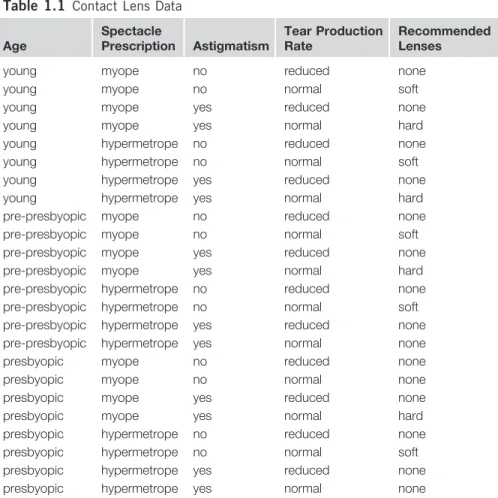
Look at the contact lens data in Table 1.1. It gives the conditions under which an optician might want to prescribe soft contact lenses, hard contact lenses, or no contact lenses at all; we will say more about what the individual features mean later. Each line of the table is one of the examples. Part of a structural description of this information might be as follows:
If tear production rate = reduced then recommendation = none Otherwise, if age = young and astigmatic = no then
recommendation = soft
Structural descriptions need not necessarily be couched as rules such as these. Deci-sion trees, which specify the sequences of deciDeci-sions that need to be made along with the resulting recommendation, are another popular means of expression.
Table 1.1 Contact Lens Data
Age Spectacle Prescription Astigmatism Tear Production Rate Recommended Lenses
young myope no reduced none
young myope no normal soft
young myope yes reduced none
young myope yes normal hard
young hypermetrope no reduced none
young hypermetrope no normal soft
young hypermetrope yes reduced none
young hypermetrope yes normal hard
pre-presbyopic myope no reduced none
pre-presbyopic myope no normal soft
pre-presbyopic myope yes reduced none
pre-presbyopic myope yes normal hard
pre-presbyopic hypermetrope no reduced none
pre-presbyopic hypermetrope no normal soft
pre-presbyopic hypermetrope yes reduced none
pre-presbyopic hypermetrope yes normal none
presbyopic myope no reduced none
presbyopic myope no normal none
presbyopic myope yes reduced none
presbyopic myope yes normal hard
presbyopic hypermetrope no reduced none
presbyopic hypermetrope no normal soft
presbyopic hypermetrope yes reduced none
presbyopic hypermetrope yes normal none
values of age and two values each for spectacle prescription, astigmatism, and tear production rate (3 × 2 × 2 × 2 = 24). The rules do not really generalize from the data; they merely summarize it. In most learning situations, the set of examples given as input is far from complete, and part of the job is to generalize to other, new examples. You can imagine omitting some of the rows in the table for which the tear production rate is reduced and still coming up with the rule
If tear production rate = reduced then recommendation = none
preceding rules classify the examples correctly, whereas often, because of errors or noise in the data, misclassifications occur even on the data that is used to create the classifier.
Machine Learning
Now that we have some idea of the inputs and outputs, let’s turn to machine learn-ing. What is learning, anyway? What is machine learning? These are philosophical questions, and we will not be too concerned with philosophy in this book; our emphasis is firmly on the practical. However, it is worth spending a few moments at the outset on fundamental issues, just to see how tricky they are, before rolling up our sleeves and looking at machine learning in practice.
Our dictionary defines “to learn” as
• To get knowledge of something by study, experience, or being taught. • To become aware by information or from observation
• To commit to memory
• To be informed of or to ascertain • To receive instruction
These meanings have some shortcomings when it comes to talking about computers. For the first two, it is virtually impossible to test whether learning has been achieved or not. How do you know whether a machine has got knowledge of something? You probably can’t just ask it questions; even if you could, you wouldn’t be testing its ability to learn but its ability to answer questions. How do you know whether it has become aware of something? The whole question of whether computers can be aware, or conscious, is a burning philosophical issue.
As for the last three meanings, although we can see what they denote in human terms, merely committing to memory and receiving instruction seem to fall far short of what we might mean by machine learning. They are too passive, and we know that computers find these tasks trivial. Instead, we are interested in improvements in performance, or at least in the potential for performance, in new situations. You can commit something to memory or be informed of something by rote learning without being able to apply the new knowledge to new situations. In other words, you can receive instruction without benefiting from it at all.
Earlier we defined data mining operationally, as the process of discovering terns, automatically or semiautomatically, in large quantities of data—and the pat-terns must be useful. An operational definition can be formulated in the same way for learning:
• Things learn when they change their behavior in a way that makes them perform better in the future
This ties learning to performance rather than knowledge. You can test learning by observing present behavior and comparing it with past behavior. This is a much more objective kind of definition and appears to be far more satisfactory.