EARLY ONSET SCHIZOPHRENIA: A COMPARATIVE
STUDY OF CLINICAL FEATURES AND PREMORBID
FUNCTION WITH ADULT ONSET GROUP
Dissertation submitted to the
TAMIL NADU DR. M.G.R. MEDICAL UNIVERSITY
in part fulfillment of the requirements for
M.D
(PSYCHIATRY)
BRANCH XVIII
MARCH
2007
MADRAS MEDICAL COLLEGE
CERTIFICATE
This is to certify that the dissertation titled “EARLY ONSET
SCHIZOPHRENIA: A COMPARATIVE STUDY OF CLINICAL FEATURES
AND PREMORBID FUNCTION WITH ADULT ONSET GROUP” is the
bonafide original work of DR. DEEPA .V in part fulfillment of the requirements
for M.D. Branch – XVIII (Psychiatry) Examination of the Tamilnadu DR. M.G.R
Medical University to be held in March 2007. The Period of study was from
November 2005 to August 2006.
THE DIRECTOR,
INSTITUTE OF MENTAL HEALTH,
CHENNAI-10
THE DEAN
MADRAS MEDICAL COLLEGE.
CHENNAI – 3
DECLARATION
I, DR. DEEPA .V , solemnly declare that dissertation titled “EARLY
ONSET SCHIZOPHRENIA: A COMPARATIVE STUDY OF
CLINICAL FEATURES AND PREMORBID FUNCTION WITH
ADULT ONSET GROUP” is a bonafide work done by me at The Institute
Of Mental Health, Chennai during November 2005- August 2006 under the
guidance and supervision of Prof. M. Murugappan,M.D.,D.P.M., Professor of
Psychiatry, Madras Medical College.
This dissertation is submitted to Tamilnadu DR. M.G.R Medical
University towards part fulfillment of requirements for the award of M.D.
Degree (Branch – XVIII ) in Psychiatry.
Place : Chennai.
Date :
ACKNOWLEDGEMENTS
I thank Prof Kalavathy Ponniraivan,M.D., Dean, Madras Medical College
for permitting me to conduct this study.
I owe my thanks to Professor Dr.M.Murugappan,M.D.,D.P.M.,
Director, Institute of Mental Health, Chennai for his encouragement,
immeasurable help and guidance.
I thank Professor Dr.S.Nambi,M.D.,D.P.M., Additional Professor,
Institute of mental Health for having guided and encouraged me throughout this
study.
I thank Professor Dr.N.Vijaya,M.D.,D.P.M., Deputy Superintendent,
Institute of Mental Health for her valuable advice and help.
My immense thanks to Assistant Professor Dr.M.Malaiappan,M.D., for
his help and valuable suggestions.
My sincere thanks to all the Professors and Assistant Professors of the
Institute of Mental Health for their valuable suggestions.
I thank all the patients and their relatives, without whose participation the
INDEX
Sl.No. TOPIC Page No.
1 INTRODUCTION 1
2 REVIEW OF LITERATURE 3
3 AIMS AND OBJECTIVES 19
4 HYPOTHESIS 20
5 MATERIALS AND METHODS 21
6 RESULTS AND DISCUSSION 27
7 SUMMARY AND CONCLUSIONS 50
8 LIMITATIONS AND FUTURE DIRECTIONS 54
9 REFERENCES
INTRODUCTION
Schizophrenia is a devastating chronic disorder that typically presents
in early adult life. Clinicians are circumspect about making this ominous
diagnosis in children and adolescents. The relative rarity of the disorder in
this age group together with atypical presentations complicate the picture
further.
Over the past decade research activity in children and adolescents has
been sparked by several factors .Awareness of the greater clinical severity of
Schizophrenia in childhood and adolescence and the possibility of greater
etiological liability have encouraged researchers to investigate genetic and
neurobiological correlates in early onset cases(Jacobsen and Rapoport,1998)
The emergence of neuro developmental formulation of Schizophrenia
(Weinberger, 1987) and the perspective of developmental psychopathology
have focused attention on early developmental processes and the premorbid
childhood course of Schizophrenia from birth to onset. The disorder is
associated with deficits in cognition, affect and social functioning. Onset of
illness rarely occurs before 13years, but then increases steadily during
adolescence. Accurate diagnosis and treatment requires familiarity with
clinical presentation, phenomenology and course of the disorder.
Adolescent schizophrenia is considered as a more severe variant of
adult schizophrenia. Early diagnosis and treatment can prevent devastating
often enables the examination of a more genetically homogenous and less
environmentally influenced disease condition.As such, understanding early
onset schizophrenia may possibly provide useful information about etiology
and course of adult onset schizophrenia.
While ongoing research continues our understanding of biological and
environmental factors associated with and contributing to the disorder, the
rarity of the condition has resulted in only modest gains in understanding.
Factors associated with early onset schizophrenia such as basic demographics,
phenomenology, course and outcome still remain as areas of mystery.
Research in adolescent schizophrenia has needed to address the key
questions of 1. continuity and discontinuity with adult schizophrenia.
2. The clinical and aetiological significance of atypically early onset of
schizophrenia in adolescence.
In several studies the terms childhood onset, adolescent-onset and
early-onset were used interchangeably. In response to lack of precise
definitions, Werry(1991) proposed the use of term Early onset (EO) to
describe adolescent onset schizophrenia between ages 13 to 17(both
included).According to practice parameters issued by American Academy of
Child and Adolescent Psychiatry, early onset schizophrenia(EOS)(adolescent
schizophrenia) is defined as onset before 18 yrs age, with very early onset
REVIEW OF LITERATURE
The issue of whether neuropathology in schizophrenia differs among
those with onset in childhood, adolescence,adulthood and late life remains
unresolved after a century of debate.
Schizophrenia with onset in adolescence( Early onset schizophrenia)
constitute an aetiologically less heterogeneous variant of Schizophrenia.
Most published studies in child and adolescent psychosis use the upper
age cut off limit of 18 which also happens to be the lower age limit for most
adult studies.
Research studies in Schizophrenia in adolescents is confounded by
several methodological limitations. Early studies did not distinguish
childhood Schizophrenia from autism and thus are confounded by diagnostic
overlap. In studies using the current diagnostic standards, most have focused
on childhood onset Schizophrenia, even though onset during
adolescence(EOS) is more common.
Other methodological difficulties include use of retrospective study
design, lack of standardized assessment such as diagnostic interview, small
subject pools and lack of comparison groups( Werry 1992).
Early onset Schizophrenia being a relatively less heterogeneous group,
it is useful for examining heterogeneity in Schizophrenia. Probably because of
its rarity Schizophrenia has been researched little.(Beitchman 1983, Asarnow
The early onset schizophrenia with pre schizophrenic developmental
problems showed a younger onset of psychosis . This subgroup (EOS) needs
further investigation. It might constitute a clearer expression of concept of
neuro developmental theory of Schizophrenia and consequently would bring
about sharper biological distinctions between EOS and adult onset
Schizophrenia.( AOS).
Concept of adolescent schizophrenia
From the 1970’s onwards the consensus view is that Schizophrenia in
children and adolescents should be defined by unmodified adult criteria. From
the ICD 9(WHO 1978) and DSM III (APA 1980) onwards, the same
diagnostic criteria have been used for Schizophrenia regardless of the age of
onset.
From the historical perspective both Kreplin and Bleuler believed that
Schizophrenia presents in similar form, albeit more rarely in childhood and
adolescence. Kreplin (1919) found that 3.5% cases of dementia precox began
before age of ten, with a further 2.75 arising between ages ten and fifteen.
Bleuler (1911) suggested that about 15% cases of Schizophrenia had their
onset prior to age fifteen.
From 1930’s until 1990’s the concept of childhood Schizophrenia
broadened to encompass autism and other developmental disorders that were
This lumping together of different disorders under the common rubric
of childhood Schizophrenia makes research carried out during this period very
difficult to interpret.
Developmental issues in diagnosis
Although the use of same diagnostic criteria aids comparability across
age ranges, it does not exclude the possibility that Schizophrenia may present
rather differently in childhood and adolescence. Developmental variation in
symptoms occurs in other neuropsychiatric disorders like Wilson’s and TLE
and so it is not unreasonable to consider this possibility in Schizophrenia.
The main argument against proposition of ‘developmental variant’ is the
finding that diagnosis of Schizophrenia can be made reliably in children using
unmodified adult criteria.
Diagnostic criteria
The diagnosis in children and adolescents is made using the same
criteria as in adults.
DSM IV Diagnostic Criteria: Schizophrenia
A. Characteristic Symptoms: At least two of the following are needed,
each present for a significant period of time during a 1-month period:
(1) Delusions
(2) Hallucinations
(4) Grossly disorganized or catatonic behavior
(5) Negative symptoms (e.g., affective flattening, alogia, avolition)
Note: Only one (A) symptom is needed if (1) the delusions are bizarre
or the hallucinations include a voice providing a running commentary on the
person’s behaviour or thinking, or two or more voices are conversing with
each other.
B. Social/Occupational Dysfunction. For a significant portion of the
time since onset of the disorder, one or more major areas of functioning such
as work, interpersonal relations, or self care markedly deteriorated below the
level achieved prior to the onset.
(Or when the onset is in childhood or adolescence, the failure to
achieve age-appropriate levels of interpersonal, academic, or occupational
achievement)
C) Duration: Continuous signs of the disturbance persist for at least 6
months. This six month period must include at least one month of symptoms
that meet criterion A, and may include periods of prodromal or residual
symptoms. During the prodromal or residual periods, the signs of the
disturbance may be manifested by only negative symptoms or two or more
symptoms listed in criterion A present in an attenuated form (e.g., odd beliefs,
D) Schizoaffective and Mood Disorder Exclusion. Schizoaffective
disorder and mood disorders with psychotic features have been ruled out
because either:1) no major depressive or manic episodes have occurred
concurrently with active phase symptoms or 2) if mood episodes have
occurred during active phase symptoms, their total duration has been brief
relative to the duration of the active and residual periods.
E) Substance Abuse/General Medical Condition Exclusion: The
disturbance is not owing to the direct effects of a substance (e.g., drugs of
abuse, medication) or a general medical condition.
F) If there is history of autistic disorder or other pervasive
developmental disorder, then the additional diagnosis of schizophrenia is
made only if prominent delusions or hallucinations are also present for at least
1 month(or less if successfully treated).
Diagnostic stability
In a follow up study; 110 cases of adolescent onset psychosis
presenting as a consecutive series to Maudsley hospital from 1973 to 1991
were assessed.(Hollis 2000). The cases were reassessed 11years after first
admission and Positive predictive value for Schizophrenia was 80%. These
findings suggest a diagnosis of Schizophrenia using standard diagnostic
Onset of illness
According to the practice parameters of American Academy of Child
and Adolescent psychiatry, adolescent Schizophrenia, otherwise called Early
onset Schizophrenia refers to the group with age of onset between 13 to 18
years. If the onset is less than 13 years, they belong to the Very Early Onset
Schizophrenia group. Adult onset is defined as patients with onset of illness
after 18 years.
According to Schultz et al (2000) the adult onset group is further
divided in to early adult onset (18-30years) and intermediate onset (30-40
years). Several studies have attempted to compare Schizophrenia with onset
in different age groups.
According to Ropcke et al (2005) the clinical features of early and
adult onset Schizophrenia were similar qualitatively and the early onset
Schizophrenia seemed to represent a more severe form of the adult onset
disorder.
Schultz et al (2000) compared young onset Schizophrenia with the
intermediate onset group i.e. onset between 30 and 40 years. They concluded
that, compared with young onset subjects intermediate onset patients will
have fewer negative and disorganization symptoms.
Mayer et al (1993) compared age of onset of Schizophrenia to
psychopathology and found out that patients with early onset disease had
Castle et al (1997) compared patients with first manifestation of
Schizophrenia after 60 years with onset before the age of 25 years. They
found that early onset group compared to their late onset counterparts were
more likely to have poor premorbid function and developmental history, more
negative symptoms, to have a positive family history of Schizophrenia.
According to Yang et al (1995), who studied the adult manifestations
of Schizophrenia with onset before and after 15 years of age, early onset cases
scored significantly higher on scales for assessment of negative symptoms.
They suggested that when early onset patients grew up, phenomenologically
they resembled the Schizophrenia of usual early adult onset in the positive
symptom dimension, but with more negative symptoms, which may be
fundamental in this age group.
Adolescent Schizophrenia frequently presents with an insidious onset
(Greater than six months) as opposed to acute onset . Non specific
behavioural changes including social withdrawal, declining school
performance, uncharacteristic odd behaviour which begins on an average, a
year before onset of positive psychotic symptoms. In retrospect, it was often
apparent that non specific behavioural changes were frequently early negative
symptoms, which in turn had their onset well before positive clinical features
Boys have been reported to be more likely to show early signs of
abnormal development and have an insidious onset relative to girls with the
disorder. (Alaghband- Rad et al 1995, Asarnow et al 1995, Hollis 1995)
The rate of onset of Schizophrenia increases sharply during
adolescence with peak ages of onset between 15 – 30 years.( APA 1997).
Distinctions between Early onset schizophrenia and adult onset group
can made with respect to gender ratio. Early onset Schizophrenia occurs
predominantly in males, with ratios of approximately 2:1.(Green et al 1992;
1986;Kolvin 1971;McClellan & McCurry 1998; Russell et al 1989; Werry et
al 1991).
Clinical features of Early onset Schizophrenia
Schizophrenia has been characterized as having two broad sets of
symptom clusters, positive and negative. Positive symptoms refer to the more
florid hallucinations, delusions and thought disorders. Negative symptoms are
those of flat affect, anergy, paucity of speech and thought.( American
Psychiatric association 1997).
Recent research has suggested that disorganized behaviour may
represent an independent dimension, which include disorganized speech,
bizarre behaviour and poor attention. Hallucinations, thought disorder and
flat affect have been found in early onset Schizophrenia, while systematized
delusions and catatonic clinical features may be less frequent.(Green et al
among youth with Schizophrenia are not well studied. Werry et al (1992)
indicated that 61 % of their sample reported hallucinations,( of this 57% had
auditory hallucinations) and 55 % reported delusions. The authors also noted
that delusions tend to be less well formed compared to adults.
Early onset Schizophrenia is characterized by more prominent negative
symptoms and disorganization and relatively fewer well systematized
delusions and hallucinations when compared with adult Schizophrenia.
(Hollis et al 2000, Ballageer et al 2005)It has been hypothesized that
compared to young and adolescent onset subjects, intermediate onset (age
group 30-40 years) will have fewer negative symptoms.(Schultz et al).
Subtypes
DSM IV mentions five major subtypes for Schizophrenia which are as
follows: Paranoid, Disorganized, Catatonic, Undifferentiated and Residual.
Beratis et al(1994) found that disorganized and undifferentiated
subtypes were predominantly adolescent onset, whereas the paranoid subtype
was most frequently first diagnosed in adult life.
Although all subtypes can occur in adolescence, there is a relative
predominance of the disorganized subtype.
Premorbid functioning
Schizophrenia markedly disrupts an individual’s psychosocial
area of investigation but is confounded by the disease process itself.
Therefore, considerable research has focused on assessment of individual’s
psychosocial functioning before the onset of disease process,i.e., the
premorbid period.
Schizophrenia is considered to be a neurodevelopmental disorder with
early central nervous system lesions affecting normal maturational process.
(McCurry 1998; Weinberger 1987).
According to Larsen et el (2004), patterns of premorbid development in
schizophrenia suggest both neurodevelopmental and neuro regressive
pathways to illness. Knowledge about premorbid development in psychosis
can shed light upon theories about etiology and Schizophrenic heterogeneity,
and form the basis for early detection initiatives.
Larsen et al (2004) assessed the social and academic dimensions of
premorbid functioning in patients with first episode of non affective
psychosis. They found that patients with a stable social course compared with
a deteriorating one had a shorter duration of untreated psychosis, were older,
had more friends and less negative symptoms. Patients with a stable academic
course were older at admission. They found that social and academic
functioning form fairly independent dimensions of premorbid functioning.
Levels of social and academic functioning in childhood may be determined
early in life, largely by neurodevelopmental processes related to genetics and
on, especially in adolescence, may be determined by neuroregressive
processes such as developmentally determined reductions in cortical synaptic
connectivity. The latter processes have traditionally been labelled as
deterioration and have been thought to arise from loss of brain neurons
(neurodegeneration).But since post mortem studies have found loss of
neuropil but no loss of neurons in the cortex of patients with Schizophrenia,
the term neuroregression is preferred for this process. The study clearly
illustrates that the heterogeneity of Schizophrenia begins early, long before
the onset of psychosis. In their sample of patients, Larsen et al found that as
many as 40 % reported ‘ good stable’ social functioning. This is an argument
against seeing Schizophrenia as an entirely neurodevelopmental disorder with
social dysfunction being an obligatory early manifestation. Second, it seems
that having social problems, especially when they worsen over time, is a risk
factor for late detection of psychosis. It may be that the social network has
adapted to the person having problems and thus does not react when the
transition to psychosis is taking place, or it may be that the person’s social
network is so small that the likelihood of someone becoming worried is
greatly reduced.
Larsen et al(2004) also found that only 57 % of patients were stable at their
original childhood level of social functioning. Deterioration describes a
relatively high fraction of the sample. This suggests that it is important to
possible for signs of early psychosis. Schizophrenia is a heterogeneous
disorder with neurodevelopmental and neuroregressive pathways to
psychosis, processes that may be qualitatively distinct in their neurobiological
origins but interactive in their contribution to the pathophysiology of
Schizophrenia.
The occurrence of premorbid abnormalities may represent early
neuropathological manifestations of the disorder.
Adolescent Schizophrenia has been associated with poor premorbid
functioning.(Alaghband-Rad et al 1995; Hollis 1995,Nicholson 2000)
In a study conducted at Maudsley hospital,(Hollis 2000) about
one-third cases of adolescent Schizophrenia had significant difficulty in social
development affecting the ability to make and keep friends. Similar but less
frequent difficulties with premorbid sociability have been noted in
representative population samples of adult Schizophrenia. However,
premorbid social and behavioural difficulties are not specific to
Schizophrenia. Premorbid difficulties also occur in adolescent affective
psychosis, at a lower rate than in Schizophrenia, but more frequently than in
non psychotic psychiatric controls.
They also found that premorbid developmental impairments show
longitudinal continuity with negative symptoms and poor adult outcome. This
suggests that premorbid social and developmental impairments may have
The negative symptom dimension was specifically associated with
premorbid impairment.
Majority of the patients with adolescent Schizophrenia (some reports
mention as high as 90%) have premorbid abnormalities.(Eggers 1987;
McClellan & McCurry 1998).
Hollis (1995) found that adolescent ( Early onset ) Schizophrenia had
significantly higher rates of premorbid social, motor and language
impairments than matched psychiatric controls.
McClellan and McCurry (1998) found that social withdrawal and
aberrant peer relationship, are characteristics that equate to negative
symptoms.
Studies by Asarnow et al 1994; Nicolson et al 2000,Ballageer et
al(2005); have also reported increased risks of premorbid impairment in
adolescent onset Schizophrenia.
Premorbid characteristics such as being shy, introvert, withdrawn have
been linked with poor prognosis in adolescent Schizophrenia.( Remschmidt
2000).
Associated features
A) Family history of Schizophrenia
The increased clinical severity of adolescent Schizophrenia is
disorder. Increased family history of Schizophrenia has been found in
relatives of patients with adolescent Schizophrenia.( Eggers 1978; Green et al
1992; Kolvin 1971 ; McClellan 1993; Werry 1991).
Early onset of schizophrenia seems associated with high genetic
loading for the disorder. Research has borne out this relation, noting an
increased risk of schizophrenia among the relatives of children with
schizophrenia (Asarnow et al 2001).
Asarnow and colleagues (2001) reported that the relatives of youth
with schizophrenia in their study were 17 times more likely to have a
schizophrenia spectrum disorder in relation to controls. This risk is obviously
far greater than the risk in the general population, as well as greater than that
found in similar studies of relatives of adults with schizophrenia (three to six
times more likely among relatives of adults with schizophrenia).
Findings from this report suggest an increased genetic component to
early onset schizophrenia over and above that found in adult schizophrenia.
In a similar report, Nicolson and colleagues (2003) advanced this line of study
by including relatives of patients with adult onset schizophrenia as a control
group.
Findings confirmed speculations made by Asarnow et al. (2001) that
youth with schizophrenia are more likely to have relatives with a
schizophrenia. Collectively, these findings support the strong role of genetic
contributions to early onset schizophrenia.
A positive family history of Schizophrenia among first degree
relatives was found in 20 % of adolescent probands with Schizophrenia. This
is about double the rate reported in comparable studies in adult Schizophrenia.
Interestingly it has been found that , it is the presence of negative symptoms
in the proband that predicts family history of Schizophrenia. This suggests
that negative symptoms may represent the genetically transmitted phenotype
in Schizophrenia.(Hollis 2000).
However most studies are plagued with limitations due to lack of
standardized instruments in assessment and diagnosis in relatives.
B) Socio economic status
It is not possible to say whether there is any relation to socioeconomic
status. The available studies have a selection bias towards in patient samples,
with higher rates of lower socioeconomic status in some studies,(Green et al
1992; Kolvin 1971) but not in others.( Russell et al 1989; Werry 1991).
C) Gender Ratio
Although male predominance is the consistent finding in incident
samples of early adult onset Schizophrenia; the picture is far less clear in
adolescent Schizophrenia, with some studies reporting a male predominance
and others finding no gender difference.(Jacobsen & Rapoport 1998).
According to some studies (Green et al 1992; Kolvin 1971;McClellan
& McCurry 1998; Russell et al 1989; Werry et al 1991)Adolescent
2:1.Previous research suggests a male-to-female ratio ranging from 2:1 to
5:1(Hollis, 1995; Green et al., 1992; Werry, 1992; Beitchman, 1985;). This
range of gender ratios conflicts with general prevalence estimates of adult
schizophrenia that suggest approximately equal gender distribution, but is
consistent with the notion that males typically have an earlier age of onset
than females. Kolvin and colleagues (1971) suggested that the predominance
of males among youth with schizophrenia is a distinguishing characteristic of
early onset schizophrenia.
It is possible that the differences between the studies may be the result
of referral bias and at present good population based epidemiological studies
of adolescent Schizophrenia are lacking.
D) Duration of untreated psychosis (DUP)
Duration of untreated psychosis is defined as time from the onset of
first psychotic symptom till initiation of first treatment.
According to Hollis (1995) ;Duration of untreated psychosis is a
predictor of poor outcome in adolescent Schizophrenia. Ballageer et al (2005)
suggested that the adolescent group experienced longer duration of
AIMS AND OBJECTIVES
Following are the aims and objectives of the study:
1. To evaluate the differences in clinical features between
adolescent(EOS) schizophrenia and the adult onset group.
2. To compare the premorbid adjustment of the two groups.
3. To assess the differences between the two groups with respect to the
following variables:
a) Type of onset b) gender distribution c)Family history of
schizophrenia in first degree relatives d)DUP- Duration of untreated
psychosis.
4. To correlate family history with clinical symptom dimensions and
HYPOTHESIS
1. Patients with early onset Schizophrenia do not differ from adult onset
group in type of illness onset.
2. There is no difference in duration of untreated psychosis between the
early onset and the adult onset groups.
3. There is no difference in severity of illness between early onset and
Adult onset Schizophrenia.
4. There is no difference between the early onset and adult onset group
with respect to subtype of Schizophrenia.
5. There is no difference between the two groups based on negative
symptoms.
6. There is no difference between the two groups based on
disorganization symptoms..
7. Early onset Schizophrenia patients do not differ from adult onset group
in the degree of premorbid impairment.
8. Poor premorbid function is not related to the presence of negative
symptoms.
9. The early onset Schizophrenia group do not differ from adult onset
group with respect to family history of Schizophrenia in first degree
MATERIALS AND METHODS
Study design- cross sectional study
Inclusion criteria:
a) Cases : Early onset Schizophrenia (adolescent Schizophrenia)
1. Patients satisfying the DSM IV criteria for Schizophrenia .
2. Age group 13-18 years (adolescent) were included in the study. The
age of onset of illness also between 13-18 years.
3. 30 consecutive patients attending the Adolescent clinic, Institute Of
Mental Health, Chennai who fulfilled the inclusion criteria were
chosen.. All the cases selected for the study were drug naive and
experiencing first episode of psychosis.
b) Controls (Adult onset Schizophrenia)
2. Patients satisfying the DSM IV criteria for Schizophrenia.
3. Age group 30-40 years. Age of onset of illness also between
30 – 40 years.
4. 30 consecutive patients attending the new case out patient department
of Institute of Mental Health, Chennai were chosen based on inclusion
criteria.
5. All patients were drug naïve and experiencing first episode of
Exclusion criteria:
1. Presence of co morbid substance abuse.
2. comorbid psychiatric illness.
3. Associated medical or neurological illness.
Instruments used:
1. Proforma for sociodemographic data, illness details.
2. Brief psychiatric rating scale (BPRS).
3. Scale for assessment of positive symptoms (SAPS).
4. Scale for assessment of negative symptoms (SANS).
5. Premorbid adjustment scale (Cannon- Spoor et al, 1982).
6. Global assessment of functioning scale (GAF).
7. Family history research diagnostic criteria.
Brief Psychiatric Rating Scale (BPRS)
The brief Psychiatric Rating Scale was developed in late 1960’s and
covers a broad range of areas including thought disturbance, emotional
withdrawal and retardation, anxiety and depression, hostility and
suspiciousness. It has 18 items, rated on a seven point, item specific Likert
scale from 0-6, with the total score ranging from 0 – 108.Validity of the scale
is good as measured by correlations with other measures of symptom severity,
Scale for the Assessment of Positive Symptoms (SAPS)
The scale was developed by Nancy C Andreasen and is designed to
provide a detailed assessment of positive symptoms of Schizophrenia. The
domains include hallucinations, delusions, bizarre behaviour, and thought
disorder and inappropriate affect. The scale has 35 items, each item scored
from 0-5.
Psychotic symptom score represented the sum of SAPS global ratings
of hallucinations and delusions. Disorganization score represented the sum of
SAPS global ratings of bizarre behaviour, positive formal thought disorder
and inappropriate affect.
Scale for the Assessment of Negative Symptoms ( SANS)
The scale was developed by Nancy C Andreasen and helps to
characterize the negative symptoms of Schizophrenia. The domains include
affective flattening, alogia, avolition- apathy, anhedonia- asocialty and
attention.. The scale has 24 items, each item scored from 0-5. Negative
symptom score represented the sum of SANS global scores of alogia,
avolition, affective flattening and anhedonia.
Premorbid Adjustment Scale( PAS) Cannon- Spoor et al (1982)
Premorbid Adjustment Scale is a rating scale which was designed to
evaluate the degree of achievement of developmental goals at each of several
periods of a subject’s life before onset of Schizophrenia. The scale assesses
subject’s life : isolation, peer relationships, ability to function outside family,
and capacity to form intimate socio-sexual ties. Items evaluating age
appropriate functioning in these areas are repeated for each period of a
subject’s life. The four life periods are as follows: Childhood up to 11years,
Early Adolescence 12-15 years, Late adolescence 16-18 years, Adulthood 19
years and beyond, and a final section labelled as general.
The scale is intended to measure only Premorbid function : with
Premorbid period being defined as the period ending six months before
evidence of characteristic florid psychotic symptomatology including
delusions, hallucinations, thought disorder, inappropriate or bizarre
behaviour, or gross psychomotor behaviour. Only those life periods that are
premorbid by this definition should be rated on the scale regardless of the
present age of the subject. Ratings are based on histories derived from
subject’s hospital records or family members.
Rating : Each section contains number of items with scoring ranging
from 0-6, 0 denoting hypothetically the healthiest and 6 the least healthy end.
Scoring .The rating received for each item in a section are summed and
expressed as total score divided by possible score. ( subscale score )
The possible score indicates the highest score obtainable by adding the
maximum score for all items completed. When no information is available on
An over all score for the whole scale might be calculated by averaging
subscale score for the subscales rated for the patient. An average is preferred
to a total score in order to avoid bias that would occur in cases in which sum
of a few highly scored subscales would result in the same score as the sum of
several moderately or low scored subscales ,when age of onset of illness or
lack of information leads to some subscales being left out.
Global Assessment of Functioning Scale ( GAF)
The Global assessment of Functioning Scale was developed in the
early 1990’s to rate Axis V of DSM IV and provides a measure of overall
functioning related to psychiatric symptoms. The scale is rated on a 100 point
scale based on all available information, with clear descriptions of each ten
point interval.
The scores are grouped in to three categories: a) Good: score 100 - 71
b) Moderate: score 70 - 41 c ) Poor : score 40-0 .
Family History Research Diagnostic Criteria
The Family History Research Diagnostic Criteria was put forth by
Andreasen et al in 1977. It was used to make diagnosis according to DSM
criteria on all first degree relatives of patients. The instrument provides the
METHODOLOGY
Thirty patients satisfying the DSM IV criteria for Schizophrenia in
the age group 13-18 years (Early onset Schizophrenia group) were evaluated.
The cases were chosen from consecutive patients attending the Adolescent
Clinic and controls from the out patient department of Institute of Mental
Health, Chennai. The Period of the study was between November 2005 and
August 2006. The sociodemographic data, clinical features and premorbid
function was compared to a control group which consisted of patients with
Schizophrenia in the age group 30- 40 years( Adult onset Schizophrenia).Both
cases and controls were experiencing their first episode of psychosis and were
drug naïve.
The thesis and its methodology were discussed and approved by the
ethics committee of the research panel of Institute of Mental Health,
Chennai.Informed consent was obtained from all patients and guardians in
case of adolescents. The patients and informants were interviewed clinically
and rating scales applied. Information regarding Premorbid function and
Family history of Schizophrenia was sought from relatives.
The data thus collected was tabulated and discussed. Statistical
analysis of the data was carried out using chi square test for categorical
variables and Student-t test for continuous variables. Pearson correlation test
RESULTS
TABLE 1 : DISTRIBUTION BASED ON AGE OF ONSET
group
EOS AOS
Mean SD Mean SD
Student t-test
age of onset 16.20 .64 33.15 2.53 t=35.6 P=0.001 (s)
EOS - Early onset Schizophrenia ( Adolescent Schizophrenia) AOS - Adult onset Schizophrenia.
The mean age of onset in Early onset group was 16.20, SD(0.64).
The mean age of onset in Adult onset group was 33.15, SD( 2.53).
TABLE 2 : DISTRIBUTION BASED ON GENDER
group
EOS AOS Total
Male 16 18 34
Sex
Female 14 12 26
Total 30 30 60
EOS - Early onset Schizophrenia ( Adolescent Schizophrenia)
AOS - Adult onset Schizophrenia.
χ2 =0.27 P=0.60 (NS)
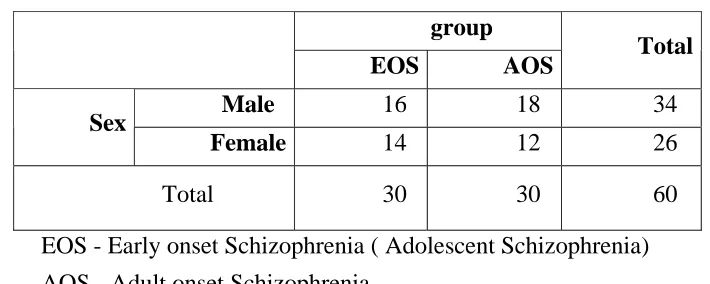
In the Early onset Schizophrenia group 53.3% ( n = 16) were males
[image:32.612.134.489.418.560.2]In the adult onset Schizophrenia group 60 % were males ( n=18) and
40 % (n = 12) were females.
The gender ratio was found to be 1.14:1 in the Early onset group and
1.5:1 in the adult onset group.
Males have a predominant representation in both early onset and adult
onset Schizophrenia.
There was no statistically significant gender difference between the
[image:33.612.134.495.358.455.2]two groups.
TABLE 3 :COMPARISON BASED ON EDUCATIONAL STATUS
group
EOS AOS
Mean SD Mean SD
Student t-test
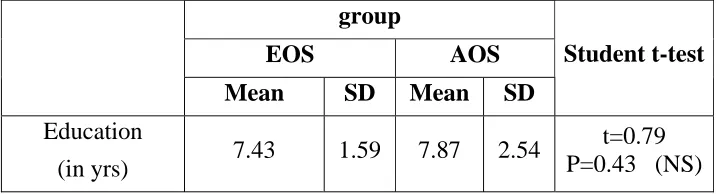
Education
(in yrs) 7.43 1.59 7.87 2.54
t=0.79 P=0.43 (NS)
EOS - Early onset Schizophrenia ( Adolescent Schizophrenia) AOS - Adult onset Schizophrenia.
There was no statistically significant difference in educational status
TABLE 4 : COMPARISON BASED ON DURATION OF UNTREATED
PSYCHOSIS ( DUP )
group
EOS AOS
Mean SD Mean SD
Student t-test
DUP(months) 9.93 4.61 8.67 2.58 t=1.31 P=0.90 (NS)
EOS - Early onset Schizophrenia ( Adolescent Schizophrenia) AOS - Adult onset Schizophrenia.
The mean duration of untreated psychosis (months) in early onset
group was 9.93( SD= 4.61) and in the adult onset group it was 8.67
(SD = 2.58 ).
Duration of untreated psychosis was longer in the early onset group
compared to adult onset group .No statistically significant difference was
observed in our study.
TABLE 5 : DISTRIBUTION BASED ON TYPE OF ONSET OF
ILLNESS
Group Onset of illness
EOS AOS Total
Insidious 28 21 49
Type of
onset Acute 2 9 11
Total 30 30 60
EOS - Early onset Schizophrenia ( Adolescent Schizophrenia) AOS - Adult onset Schizophrenia.
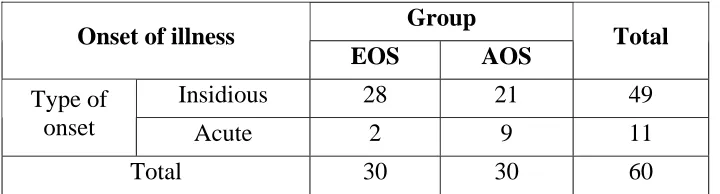
[image:34.612.120.480.533.630.2]In the early onset group 93.3 % ( n= 28 ) had an insidious type of
illness onset and 6.6 %.( n= 2 ) had acute onset.
In the adult onset group 70 % ( n= 21) had insidious onset and 30 %
(n= 9) had acute onset of illness.
The early onset Schizophrenia patients had predominantly insidious
type of illness onset and the results were statistically significant with P
Value of 0.02.
TABLE 6:DISTRIBUTION BASED ON SUBTYPE OF
SCHIZOPHRENIA
group
SUBTYPE EOS AOS Total
Catatonic 0 1 1
Disorganized 15 0 15
Paranoid 4 16 20
Undifferentiated 11 13 24 Total 30 30 60
EOS - Early onset Schizophrenia ( Adolescent Schizophrenia) AOS - Adult onset Schizophrenia.
χ2 =23.67 P=0.001 (S)
In the Early onset group 50 %( n = 15 ) had Disorganized
Schizophrenia, 36.6 %( n= 11) had Undifferentiated subtype and 13.3 %
(n= 4) had paranoid subtype. None of the subjects were diagnosed to have
In the adult onset group 53.3 % ( n=16) had paranoid Schizophrenia,
43.3 % (n=13) had Undifferentiated subtype and 3.3% (n=1) had catatonic
Schizophrenia.
The subtype of Schizophrenia predominant among the Early onset
group was Disorganized type and in the Adult onset group it was Paranoid
[image:36.612.122.513.294.426.2]Schizophrenia. The results were statistically significant. ( P= 0.001).
TABLE 7: COMPARISON BASED ON BPRS SCORE
group
EOS AOS
BPRS
Mean SD Mean SD
Student t-test
Mean BPRS 21.40 6.46 15.60 3.50 t=4.32
P=0.001 (S)
EOS - Early onset Schizophrenia ( Adolescent Schizophrenia) AOS - Adult onset Schizophrenia.
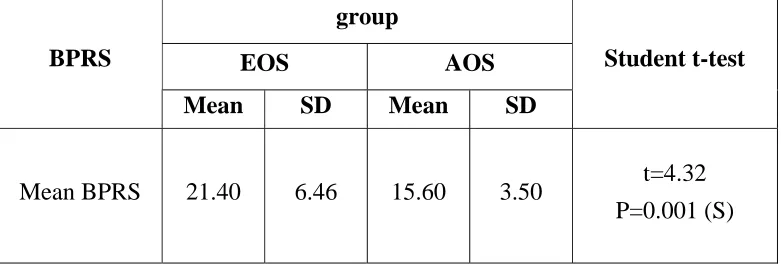
The Mean BPRS Score in the early onset group was 21.40( SD = 6.46)
and in the Adult onset group was 15.60 (SD = 3.50). The difference between
TABLE 8 : COMPARISON BASED ON SAPS SCORES
group
EOS AOS
SAPS
Mean SD Mean SD
Student t-test
Mean SAPS 27.70 12.70 25.40 12.23 t=0.71
P=0.48 (NS)
Mean SAPS Scores in the early onset group was 27.70 ( SD = 12.70)
where as in the adult onset group it was 25.40 ( SD = 12.23 ). Although the
mean score was higher in the early onset the difference was not found to be
statistically significant ( P = 0.48)
TABLE 9 : COMPARISON BASED ON PSYCHOTIC SYMPTOM
SCORE
group
EOS AOS
SAPS
Mean SD Mean SD
Student t-test
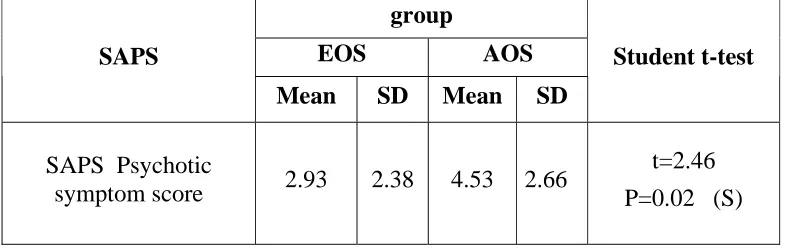
SAPS Psychotic
symptom score 2.93 2.38 4.53 2.66
t=2.46 P=0.02 (S)
EOS - Early onset Schizophrenia ( Adolescent Schizophrenia) AOS - Adult onset Schizophrenia.
The Psychotic symptom score was calculated as sum of SAPS global
[image:37.612.120.515.437.561.2]The mean score in the early onset group was found to be 2.93
(SD =2.38 ) and in the adult onset group it was 4.53 ( SD = 2.66).
Thus the mean psychotic symptom score was higher in the adult onset
[image:38.612.122.500.302.439.2]group and the difference found to be statistically significant ( P = 0.02)
TABLE 10 :COMPARISON BASED ON DISORGANIZATION SCORE
group
EOS AOS
SAPS
Mean SD Mean SD
Student t-test
SAPS Disorganization
score
6.10 3.52 3.30 1.12 t=4.16 P=0.001(S)
EOS - Early onset Schizophrenia ( Adolescent Schizophrenia) AOS - Adult onset Schizophrenia.
The disorganization score was calculated as the sum of SAPS global
ratings of disorganized/bizarre behaviour, positive formal thought disorder
and inappropriate affect.
The mean score was 6.10 (3.52) in the early onset group and 3.30
(SD=1.12) in the adult onset group. Disorganization score was found to be
higher in the early onset group and the result was statistically significant. (P=
TABLE 11 : COMPARISON BASED ON SANS SCORE
group
EOS AOS
SANS
Mean SD Mean SD
Student t-test
Mean SANS
Score 46.27 18.10 30.73 15.82
t=3.54
P=0.001 (S)
EOS - Early onset Schizophrenia ( Adolescent Schizophrenia) AOS - Adult onset Schizophrenia.
The Mean SANS score in early onset Schizophrenia group was
46.27(SD = 18.10) and in the adult onset group it was 30.73(SD = 15.82).
The score was significantly higher in the early onset group and the
results were statistically significant at P = 0.001.
TABLE 12 : COMPARISON BASED ON NEGATIVE SYMPTOM
SCORE
group
EOS AOS
SANS
Mean SD Mean SD
Student t-test
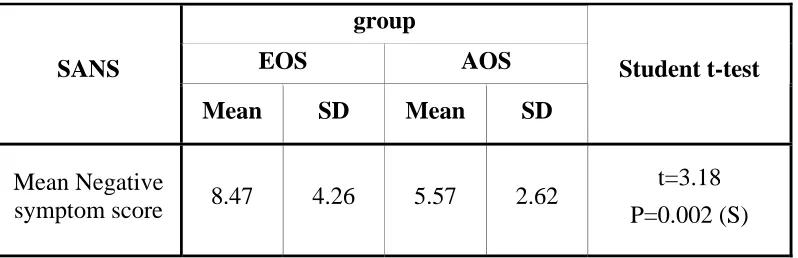
Mean Negative
symptom score 8.47 4.26 5.57 2.62
t=3.18 P=0.002 (S)
[image:39.612.123.522.474.603.2]The Negative symptom score was calculated as the sum of SANS
global ratings of alogia, avolition, anhedonia and affective flattening.
In the early onset group the mean negative symptom score was 8.47
( SD = 4.26) and it was 5.57 ( SD = 2.26) in the adult onset group.
The score was higher in early onset group and the results were
[image:40.612.120.530.326.473.2]statistically significant .( P = 0.002 ). (Figure 5)
TABLE 13 : COMPARISON BASED ON FAMILY HISTORY OF
SCHIZOPHRENIA
group Family History
EOS AOS
Total
negative 21 27 48
FHRDC positive 9 3 12
Total 30 30 60
EOS - Early onset Schizophrenia ( Adolescent Schizophrenia) AOS - Adult onset Schizophrenia.
χ2 =3.84 P=0.05 (S)
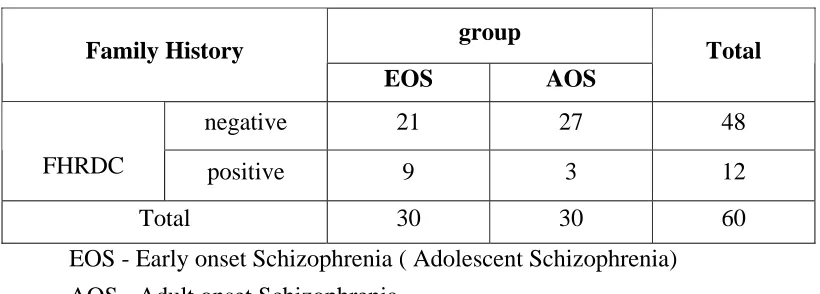
The family history was assessed by applying Family history research
diagnostic criteria (FHRDC) to first degree relatives of patients with
Schizophrenia.
In the early onset group 30 % ( n= 9 ) had positive family history of
Schizophrenia and in the adult onset group it was 10 % ( n= 3).
Applying Chi Square test the difference was found to be statistically
The positive family history of Schizophrenia in early onset group was
[image:41.612.118.482.175.273.2]three times the rate found in adult onset group.
TABLE 14 : COMPARISON BASED ON GAF SCORES
Group Total
EOS AOS
GAF Poor 23 16 39
Moderate 7 14 21
Total 30 30 60
EOS - Early onset Schizophrenia ( Adolescent Schizophrenia) AOS - Adult onset Schizophrenia.
χ2 =3.84 P=0.05 (S)
The patients were grouped based on the GAF Scores in to three
categories.
100 - 71 = good, 70- 41= moderate and 40 - 0 = poor.
None of the patients in both the groups had scores in range of 100-71.
Moderate GAF score was found in 23.3 % (n=7) in the early onset
group and 46.6% ( n=14)in the adult onset group.
Poor GAF score was seen in 76.6 %( n=23)of the early onset group
and 53.3% (n=16) of the adult onset group.
The differences between the two groups was statistically significant
TABLE 15 : ASSOCIATION BETWEEN GAF SCORE AND
NEGATIVE SYMPTOM SCORE
Group Negative symptom
score SANS
EOS GAF Pearson Correlation -.365(*)
Sig. (2-tailed) .048
N 30
AOS GAF Pearson Correlation -.226*
Sig. (2-tailed) .050
N 30
Correlation is significant at the 0.05 level (2-tailed).
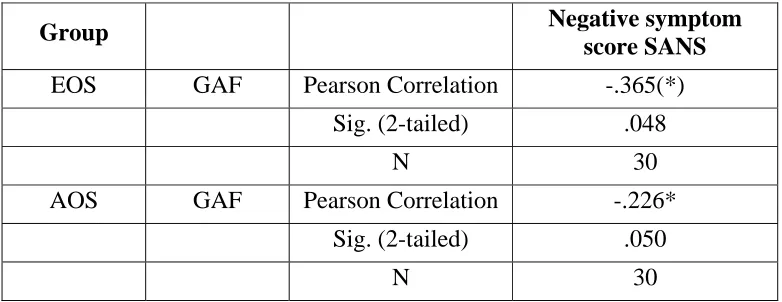
Association between GAF Score and SANS Negative symptom score
was calculated using Pearson Correlation. The Correlation was found to be
statistically significant .
Hence it is evident that patients with the higher negative symptom
TABLE 16 : COMPARISON BASED ON PREMORBID ADJUSTMENT
SCALE (PAS) SCORES
group
EOS AOS
PAS SCORE
Mean SD Mean SD
Student t-test
Average PAS
score .57 .08 .32 .08
t=12.42 P<0.001 (S)
EOS - Early onset Schizophrenia ( Adolescent Schizophrenia) AOS - Adult onset Schizophrenia.
The average PAS Score was calculated from the subscale scores
relevant for each age group.
The average PAS score was 0.57( SD = 0.08) in the early onset group
and 0.32(SD=0.08) in the adult onset group.
The rating in PAS is such that in each item zero denotes hypothetically
the healthiest and six denotes the least healthy end. So higher scores on PAS
is suggestive of poorer premorbid function.
The Average PAS Score was higher in the Early onset group compared
to adult onset group and the difference was statistically significant.
TABLE 17 : ASSOCIATION BETWEEN PAS SCORE AND
NEGATIVE SYMPTOM SCORE
Group Average PAS Score
EOS Negative Symptom
Score SANS Pearson Correlation .415(*)
Sig. (2-tailed) .023
N 30
AOS Negative Symptom
Score SANS Pearson Correlation .305
Sig. (2-tailed) .102
N 30
EOS - Early onset Schizophrenia ( Adolescent Schizophrenia) AOS - Adult onset Schizophrenia.
* Correlation is significant at the 0.05 level (2-tailed).
** Correlation is significant at the 0.01 level (2-tailed).
Association between Average PAS Score and Negative symptom score
was calculated using Pearson correlation .
In the Early onset group a significant association was found . It was
found that patients with higher negative symptom scores had poorer
TABLE 18: ASSOCIATION BETWEEN SEVERITY OF ILLNESS, NEGATIVE SYMPTOMS AND PREMORBID FUNCTION
* Correlation is significant at the 0.05 level (2-tailed).
A significant correlation was found between Mean negative symptom
score and average PAS scores, but both scores did not correlate with Mean
BPRS score which represents severity of illness.
Group Score Correlation Mean BPRS Mean Negative Symptom Score Average PAS Score Pearson
Correlation 1 .069 .191
Sig. (2-tailed) . .715 .313
Mean BPRS
N 30 30 30
Pearson
Correlation .069 1 .415(*)
Sig. (2-tailed) .715 . .023
Mean Negative Symptom Score
N 30 30 30
Pearson
Correlation .191 .415(*) 1 Sig. (2-tailed) .313 .023 . EOS
Average PAS Score
N 30 30 30
Pearson
Correlation 1 .320 .236
Sig. (2-tailed) . .085 .209
Mean BPRS
N 30 30 30
Pearson
Correlation .320 1 .305
Sig. (2-tailed) .085 . .102
Mean Negative Symptom Score
N 30 30 30
Pearson
Correlation .236 .305 1
Sig. (2-tailed) .209 .102 . AOS
Average PAS Score
TABLE 19 : COMPARISON OF NEGATIVE SYMPTOMS AND
SEVERITY OF ILLNESS BASED ON FAMILY HISTORY
Group Family
History N Mean
Std. Deviation
Student t-test
Positive 9 12.89 3.408 Mean Negative
Symptom Score Negative 21 6.57 3.010
t=5.10 P=0.001
Positive 9 22.94 4.21
EOS Mean
BPRS
Score negative 21 18.24 3.46
t=2.01 P=0.01
Positive 3 8.67 1.528
Mean Negative
Symptom Score Negative 27 6.22 2.501
t=0.71 P=0.48
Positive 3 15.00 2.646
AOS Mean
BPRS
Score negative 27 15.67 3.616
t=0.308 P=0.760
EOS - Early onset Schizophrenia ( Adolescent Schizophrenia) AOS - Adult onset Schizophrenia.
In the Early onset group there was significantly higher mean negative
symptom score if the family history of Schizophrenia was positive.( P=0.001).
Mean BPRS Score which represents the severity of illness also was
significantly higher in the presence of positive family history.( P=0.01)
In the Adult onset group the above scores were not Significantly higher
DISCUSSION
The mean age of onset in Early onset Schizophrenia (Adolescent)
group was 16.20, SD (0.64).This is comparable with most of the previous
studies by Kolvin (1971) and Volkmar et al(1988).(Table 1,Figure 1).
Regarding gender differences males have a predominant representation
in both early onset and adult onset Schizophrenia. There was no statistically
significant gender difference between the two groups.(Table 2)The results of
the study are on par with study by Jacobsen and Rapoport (1998) which
found no gender difference. Our study brought out a gender ratio of 1.14:1 in
the early onset group and 1.5:1 in the adult onset group. However studies by
Kolvin (1971) and Werry et al(1991) have reported gender ratios of
approximately 2:1.
Our study found no significant difference between the adult and early
onset Schizophrenia with respect to educational status.(table 3)
Duration of untreated psychosis in months(DUP) (Table 4) was longer
in the early onset group 9.93( SD= 4.61) compared to adult onset group 8.67
(SD = 2.58 ) which is consistent with other studies by Hollis(2000) &
Ballageer et al(2005).
However, no statistically significant difference was observed in our
This being a hospital based study, a berksonian bias is present in
assessing DUP and hence the results are not comparable to community
studies. The actual duration of untreated psychosis is much longer in the
community samples and is the target of Early Psychosis Prevention and
Intervention Programmes which aim at early detection and initiation of
treatment to improve outcome.
The early onset Schizophrenia patients had predominantly insidious
type of illness onset (93.3%) compared to adult onset group(70%) and the
results were statistically significant with P Value of 0.02.(Table 5)(figure2)
The findings are on par with studies by Hollis(1995,2000), Asarnow et
al(1994) & Alaghband- Rad et al(1995). Insidious onset has been found to be
a prognostic predictor for poor outcome in the early onset ( adolescent )
group according to Hollis(2000).
The subtype of Schizophrenia predominant among the Early onset
group was Disorganized type and in the Adult onset group it was Paranoid
Schizophrenia. The results were statistically significant. ( P= 0.001).(Table
6,Figure 3)The findings are similar to studies by Beratis et al (1994) Hollis
(1995) and the Practice guidelines put forth by American Academy Of Child
The mean BPRS score in the early onset group was higher and the
difference was statistically significant( P<0.001).The results are similar to
studies by Yang et al(1995), Hafner et al(1995).
The mean SAPS score was higher in early onset Schizophrenia group
but the difference was not found to be statistically significant ( P = 0.48)
(table 8)
The results are similar to those reported by previous studies by Werry
et al(1991) Schultz et al(2000) and Ballageer et al (2005).
The Psychotic symptom score was calculated as sum of SAPS global
ratings of hallucinations and delusions.
The mean score in the early onset group was found to be 2.93
(SD=2.38) and in the adult onset group it was 4.53( SD = 2.66). (Table 9;
figure 4)
Thus the mean psychotic symptom score was higher in the adult onset
group and the difference found to be statistically significant ( P = 0.02).
This finding is similar to studies by Schultz et al(2000), McClellan et
al(2000) who reported that Early onset Schizophrenia ( adolescent
Schizophrenia) patients have fewer positive symptoms compared to adult
The disorganization score was calculated as the sum of SAPS global
ratings of disorganized /bizarre behaviour, positive formal thought disorder
and inappropriate affect.The mean score was 6.10 (SD= 3.52) in the early
onset group and 3.30 (SD=1.12) in the adult onset group. Disorganization
score was found to be higher in the early onset group and the results were
statistically significant. ( P= 0.001)(Table 10;figure 4)
This finding is in keeping with studies by Hollis(2000), Schultz et
al(2000), Beratis et al(1994), Ballageer et al(2005), McClellan et al(2000)
and Nicolson et al(1999). According to Hollis(2000) Disorganization is a
predictor of poor outcome in adolescent Schizophrenia.
The Mean SANS score was significantly higher in the early onset
group and the results were statistically significant at P = 0.001.(Table 11)
The results are thus similar to studies by Hollis(2000), Ballageer et
al(2005), Schultz et al(2000),Werry et al(1991), Russell et al(1989) and Green
et al(1992)
The presence of greater negative symptoms at onset has been found to
be a predictor of poor outcome in the early onset group. This would have
implications in choosing the class of antipsychotics . Predominance of
negative symptoms leads to a delay in seeking health care and a consequent
In the early onset group the mean negative symptom score was
46.27(SD = 18.10) and it was 30.73 ( SD = 15.82) in the adult onset group.
The score was higher in early onset group and the results were
statistically significant .( P = 0.001 ).(Table 12)(figure 5) These findings are
consistent with studies by Schultz et al(2000) who have reported that negative
symptom score is higher in early onset ( adolescent ) Schizophrenia.
The family history was assessed by applying Family history research
diagnostic criteria (FHRDC) to first degree relatives of patients with
Schizophrenia.
In the early onset group 30 % ( n= 9 ) had positive family history of
Schizophrenia and in the adult onset group it was 10 % ( n= 3).Applying Chi
Square test the difference was found to be statistically significant( P=
0.05).(Table 13)
The positive family history of Schizophrenia in early onset group was
three times the rate found in adult onset group.
The results are consistent with studies by Eggers(1978) , Green et
al(1992), Kolvin(1971) , McClellan et al (1993)and Werry et al (1991) which
reported that increased family history of Schizophrenia has been found in
On assessing the Global functioning, Moderate GAF score was found
in 23.3 % (n=7) in the early onset group and 46.6% ( n=14)in the adult onset
group.
Poor GAF score was seen in 76.6 %( n=23)of the early onset group
and 53.3% (n=16) of the adult onset group. The differences between the two
groups was statistically significant with a P value of 0.05.(Table 14)
The results are comparable to study by Rabinowitz et al(2005) who
found that GAF scores were poor in adolescent group before hospitalization
and it would be a predictor of length of hospital stay and future outcome.
Association between GAF Score and SANS Negative symptom score
was calculated using Pearson Correlation. The Correlation was found to be
statistically significant in the both groups. (Table 15)
Hence it is evident that patients with the higher negative symptom
scores had poorer GAF Scores in both adult and early onset group.
The average PAS (Premorbid adjustment scale) score was 0.57( SD =
0.08) in the early onset group and 0.32(SD=0.08) in the adult onset group.
The rating in PAS is such that in each item zero denotes hypothetically the
healthiest and six denotes the least healthy end. So higher scores on PAS is
in the Early onset group compared to adult onset group and the difference was
statistically significant.( P Value < 0.001).(table 16)
The results are on par with studies by Hollis (1995),Alaghband-Rad et
al(1995),Nicholson et al(1999), who reported higher rates of premorbid
impairment in Early onset (Adolescent ) Schizophrenia compared to the adult
onset group. Other studies which have similar conclusions include those by
Eggers et al(1978),Asarnow et al(1994),McClellan & McCurry et
al(1998).According to Remschmidt et al (2002) degree of premorbid
impairment is linked to poor prognosis in Adolescent Schizophrenia.
Association between Average PAS Score and Negative symptom score
was calculated using Pearson correlation. (Table 17)In the Early onset group a
significant association was found. It was found that patients with higher
negative symptom scores had poorer premorbid function. This correlation was
not significant in adult onset group.The results are on par with study by
Hollis (1995).
A significant correlation was found between Mean negative symptom
score and average PAS scores, but both scores did not correlate with Mean
BPRS score which represents severity of illness.(Table 18)This is consistent
In the Early onset group there was significantly higher mean negative
symptom score if the family history of Schizophrenia was positive
(P=0.001).Mean BPRS Score which represents the severity of illness also was
significantly higher in the presence of positive family history.( P=0.01)(Table
19;Figure 6)
In the Adult onset group the above scores were not significantly higher
if the family history of Schizophrenia was positive.
Interestingly it has been found that, it is the presence of negative
symptoms in the proband that predicts family history of Schizophrenia.
(Hollis 2000) This suggests that negative symptoms may represent the
genetically transmitted phenotype in Schizophrenia. The study highlights the
importance of assessing negative symptoms at onset of illness.
However most studies are plagued with limitations due to lack of
Standardized instruments in assessment and diagnosis in relatives. Our study
used Family history Research diagnostic criteria in an attempt to overcome
SUMMARY
Thirty patients with Adolescent Schizophrenia (Early onset group; age
13-18 years) drug naïve, first episode were compared with thirty patients with
adult onset schizophrenia (30-40 years) based on socio demographic profile,
illness onset, subtype of schizophrenia, clinical features, family history and
premorbid function.
We found that there were no significant differences between the
groups with respect to education and duration of untreated psychosis. Most of
the patients with Early onset (adolescent) Schizophrenia had insidious onset
compared to adult onset group.
Disorganized Schizophrenia was the predominant subtype in
adolescents compared to paranoid in adults. The severity of illness was more
in Early onset (adolescent) Schizophrenia. The Early onset group had higher
disorganization and negative symptom scores.
Early onset Schizophrenia group had positive family history (30 %)in
first degree relatives; rate three times that in adult onset group(10%).The
global function scores and premorbid adjustment scores of adolescent onset
group was poorer .The premorbid adjustment was poorer in the presence of
The group of Early onset Schizophrenia with positive family history
had greater negative symptoms at presentation. In Early onset Schizophrenia
positive family history of Schizophrenia is associated with greater negative
CONCLUSIONS
• Most of the patients with Early onset (adolescent)
Schizophrenia had insidious onset compared to adult onset
group.
• Disorganized Schizophrenia was the predominant subtype in
adolescents compared to paranoid in adults.
• The severity of illness was more in Early onset (adolescent)
Schizophrenia.
• The Early onset group had higher disorganization and negative
symptom scores.
• Early onset Schizophrenia group had positive family history
(30%)in first degree relatives; rate three times that in adult onset
group(10%).
• The global function scores and premorbid adjustment scores of
adolescent onset group was poorer .
• The premorbid adjustment was poorer in the presence of
negative symptoms only in the early onset group.
• The group of Early onset Schizophrenia with positive family
• In Early onset Schizophrenia positive family history of
Schizophrenia is associated with presence of greater negative
symptoms and greater illness severity at onset.
The study highlights the importance of factors like negative
symptoms, disorganization, positive family history of Schizophrenia and poor
premorbid function all of which have been put forth in previous studies as
LIMITATIONS AND FUTURE DIRECTIONS
1. Small sample size
2. This is a hospital based study- a community study would give the
correct representation of variables like duration of untreated
psychosis(DUP).
3. Since the sample consisted of patients referred to a tertiary service, our
patients could be more severely ill and therefore it might not be possible
to generalize the results to community samples.
4. The role of prognostic predictors has to be validated through
REFERENCES
1. Alaghband-Rad J, McKenna K,Gordon CT.(1995) Childhood onset
Schizophrenia: The severity of premorbid course.Journal Of The American
Academy Of Child And Adolescent Psychiatry,34(10):1273-1283.
2. Albus M, Scherer J, Heuber S.(1994)The impact of familial loading on
gender differences in age at onset of Schizophrenia.Acta Psychiatrica
Scandinavica, 82(20:132-4.
3. Alda M, Abrens B,Lit W.(1996) Age of onset in familial and sporadic
Schizophrenia.Acta Psychiatrica Scandinavica,93(6):447-50.
4. American Psychiatric Association (1994) : Diagnostic and Statistical
Manual of mental disorders, 4th edition. Washington DC,American
Psychiatric Association.
5. Andreasen N C.(1989) Scale for assessment of negative
symptoms.British Journal of Psychiatry,155 Supplement 7:53-58.
6. Andreasen N C.(1982) Negative symptoms in Schizophrenia-
Definition and reliability. Archives Of General Psychiatry,39(7):784-788.
7. Andreasen N C, Endicott J, Spitzer R L,Winoker G.(1977) The family
history method using diagnostic criteria.Archives Of General
Psychiatry,34:1229-1235.
8. Armenteros J L, Fennelly B W,Hallin A,et al.(1995b) Schizophrenia in
hospitalized adolescents:clinical diagnosis,DSM III R, DSM IV and ICD-10