Open Access
Research article
Asymptomatic bacteriuria in sickle cell disease: a cross-sectional
study
Vanessa Cumming*
1, Susanna Ali
1, Terrence Forrester
1, Karen Roye-Green
2and Marvin Reid
1Address: 1Sickle Cell Unit, Tropical Medicine Research Institute, University of the West Indies, Mona Campus, Kingston 7, Jamaica and 2Department of Microbiology, University Hospital of the West Indies, Mona, Kingston 7, Jamaica
Email: Vanessa Cumming* - [email protected]; Susanna Ali - [email protected]; Terrence Forrester - [email protected]; Karen Roye-Green - [email protected]; Marvin Reid - [email protected]
* Corresponding author
Background: It is known that there is significant morbidity associated with urinary tract infection and with renal dysfunction in sickle cell disease (SCD). However, it is not known if there are potential adverse outcomes associated with asymptomatic bacteriuria (ASB) infections in sickle cell disease if left untreated. This study was undertaken to determine the prevalence of ASB, in a cohort of patients with SCD.
Methods: This is a cross-sectional study of patients in the Jamaican Sickle Cell Cohort. Aseptically collected mid-stream urine (MSU) samples were obtained from 266 patients for urinalysis, culture and sensitivity analysis. Proteinuria was measured by urine dipsticks. Individuals with abnormal urine culture results had repeat urine culture. Serum creatinine was measured and steady state haematology and uric acid concentrations were obtained from clinical records. This was completed at a primary care health clinic dedicated to sickle cell diseases in Kingston, Jamaica. There were 133 males and 133 females in the sample studied. The mean age (mean ± sd) of participants was 26.6 ± 2.5 years. The main outcome measures were the culture of ≥ 105 colony forming units of a urinary
tract pathogen per milliliter of urine from a MSU specimen on a single occasion (probable ASB) or on consecutive occasions (confirmed ASB).
Results: Of the 266 urines collected, 234 were sterile and 29 had significant bacteriuria yielding a prevalence of probable ASB of 10.9% (29/266). Fourteen patients had confirmed ASB (prevalence 5.3%) of which 13 had pyuria. Controlling for genotype, females were 14.7 times more likely to have confirmed ASB compared to males (95%CI 1.8 to 121.0). The number of recorded visits for symptomatic UTI was increased by a factor of 2.5 (95% CI 1.4 to 4.5, p < 0.005) but serum creatinine, uric acid and haematology values were not different in patients with confirmed ASB compared with those with sterile urine. There was no association with history of gram negative sepsis.
Conclusion: ASB is a significant problem in individuals with SCD and may be the source of pathogens in UTI. However, further research is needed to determine the clinical significance of ASB in SCD.
Published: 15 March 2006
BMC Infectious Diseases2006, 6:46 doi:10.1186/1471-2334-6-46
Received: 20 September 2005 Accepted: 15 March 2006
This article is available from: http://www.biomedcentral.com/1471-2334/6/46 © 2006Cumming et al; licensee BioMed Central Ltd.
Background
The definition of asymptomatic bacteriuria (ASB) is con-troversial as some have defined it as the quantitative growth of bacteria, greater than or equal to 105 colony
forming units per milliliter urine of the same organism, on aseptically collected midstream urine specimens, in the absence of symptoms of urinary tract infection on two or more consecutive occasions [1,2] while for others a sin-gle occasion is sufficient [3-5]. The prognostic significance of ASB resides in the observation that persons with ASB in certain medical conditions, such as diabetes mellitus and pregnancy, are at increased risk of pyelonephritis and renal impairment [5-7].
In sickle cell disease renal disease and dysfunction are common and increase morbidity and mortality [8,9]. Additionally, symptomatic urinary tract infection (UTI) is associated with painful crisis, bacteraemia, pneumonia, and osteomyelitis in SCD [10-13]. Whether ASB is a prel-ude to more serious renal disease and dysfunction in SCD is unclear. This present study was undertaken to estimate the prevalence and possible risk factors of ASB in the Jamaican sickle cell cohort.
Methods
Patients
The sample comprised a group of patients in the Jamaican Sickle Cell Cohort attending the 2004 Annual Sickle Cell Cohort Review conducted at the Sickle Cell Unit Clinic at the University of the West Indies, Kingston, Jamaica. The Jamaican Sickle Cell Cohort includes patients with sickle cell diseases detected using standard criteria during screening of 100,000 consecutive non-operative deliveries at a large maternity hospital (the Victoria Jubilee Hospi-tal) between 1973 and 1981. This screening yielded 580 patients with different sickle genotypes, of which 315 had HbSS disease, 201 Sickle cell-haemoglobin C, 33 Sickle cell-β+ thalassaemia, 14 Sickle cell-β0 thalassaemia and 17
sickle variants. They have been followed clinically since birth [14]. At the 2004 cohort review 267 of 302 patients eligible to attend the annual cohort review were seen. The reasons for being absent were: Twenty-two of the patients did not attend the review that year, 11 were lost to follow up, or incarcerated, and 2 were ill at the time of review. One patient refused to leave a sterile urine sample during the cohort review period, thus the final participating patient sample for this study was 266 patients. Ethical approval was granted for this study by the University Hos-pital of the West Indies, University of the West Indies Fac-ulty of Medical Sciences Ethics Committee.
Measurements
Aseptically collected midstream urines (MSUs) were obtained from the symptom free attendees of 2004 cohort review and sent on the same day for microbiological
cul-ture. Urinalysis was performed on aliquots of the MSU specimen using the QuickVue UrinChek™10+SG test
strips. Bacterial culture was performed by streaking 0.002 mL of midstream collected urine with a calibrated loop on MacConkey and 5% sheep blood agar plates. These agar plates were incubated at 35°C for 24 hours under aerobic conditions. Isolates were considered significant if there were ≥ 105 colony forming unit/mL (CFU/mL) with 2 or
less isolates, doubtful significance if 104 – 105 CFU/mL,
insignificant if < 104 CFU/mL. Mixed growths, in any
count, of more than two organisms were considered to be contaminated. Significant isolates were selected for iden-tification and antimicrobial susceptibility testing using the vitek (biome'rieux' version R06.01, Missouri USA). Proteinuria was defined as a protein reading of trace or greater on dipstick urinalysis.
Patients complaining of any symptoms, whether related or unrelated to the urinary tract, were not included in the study on that day. Rather, these patients were treated for their complaint and studied on another day when they were without symptoms. Subjects whose urine microbio-logical report was abnormal were asked to return to the unit for a repeat midstream urine collection and culture.
Blood samples were also taken for the measurement of serum creatinine. Serum creatinine were measured in the Tropical Medicine Research Institute laboratory with an Abbott ALCYON 300I, using the alkaline picrate method.
The clinical records of all cohort patients in the sickle cell unit database were examined and the following informa-tion extracted: age, gender, steady state haematology, steady state uric acid levels, history of urinary tract infec-tion, and history of gram negative sepsis.
Definition of asymptomatic bacteriuria
Probable ASB was defined as the presence of at least 105
colony forming units of a urinary tract pathogen per mil-liliter of urine in a culture of a midstream urine specimen obtained from a patient during the cohort review visit. A confirmed episode of asymptomatic bacteriuria was defined as two or more consecutive cultures with evidence of asymptomatic bacteriuria due to the same urinary tract pathogen with the same sensitivity pattern. A sample was deemed grossly contaminated if it grew more than two urinary tract pathogens even if in significant quantities.
Statistical methods
according to the Wilson score method without continuity correction [15]. For continuous outcome variables differ-ences in means between ASB status (confirmed ASB group vs. sterile urine group) and genotype were determined by two factor analysis of variance. Associations between cat-egorical exposures and ASB status were adjusted for geno-type by Mantel-Haenszel methods. Logistic regression was used to examine the relationship between potential pre-dictors (age, history of urinary tract infection, genotype, steady state haematology, uric acid and serum creatinine) and probability of having ASB. Likelihood ratio tests were used to determine which predictors would be included in the final model. We assessed differences in the frequency of past attendance for symptomatic urinary tract infection between ASB status and genotype using a negative bino-mial regression model. Clinic visits less than 14 days apart were considered the same event. Visits were assumed to be independent between individuals but repeat visits by indi-viduals were not assumed to be independent. Data were analyzed using the Stata statistical software version 8 (Statacorp, TX, USA). Tests were considered significant if p < 0.05.
Results
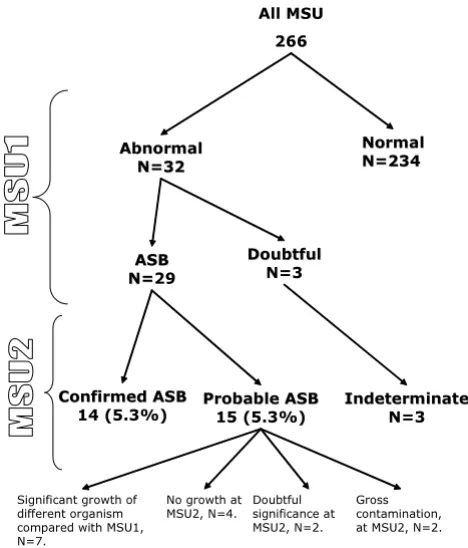
A total of 267 patients attended the 2004 cohort review. One person refused to participate in the study. Thus 266 patients had screening clean-catch MSU (Figure 1), of
which 50% were male. One woman was pregnant at the cohort review visit; and another became pregnant during follow-up of the first abnormal MSU.
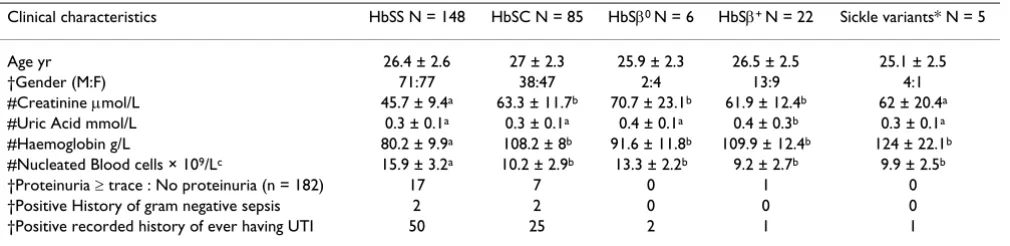
As expected there were significant differences in the hae-matological values by genotype with the mean steady state haemoglobin levels of HbSS group being signifi-cantly lower than sickle cell-haemoglobin C group, sickle cell-β+ thalassaemia, and sickle variants but having higher
steady state nucleated cell counts (Table 1). The steady state serum creatinine values were significantly lower in the HbSS group compared with other genotypes except the sickle variant group. In addition the mean uric acid values were lower in the HbSS group compared with sickle cell-β+ thalassaemia group (Table 1).
There were 32 patients with abnormal first MSUs: 29 were positive MSU samples growing identifiable pathogens (Figure 1), 2 were grossly contaminated and one grew bac-teria of doubtful significance (growth of a urinary tract pathogen between 104 and 105 per mL). Of the 29 positive
cultures 15 re-grew the same organisms in the next culture but one of these grew the same organism (E. coli) but with a different sensitivity pattern and was therefore classified as a probable ASB. Thus 14 samples satisfied the criteria for a confirmed episode of asymptomatic bacteriuria (Fig-ure 1) yielding a prevalence of 5.3% (95% CI 0.8% to 29.4%). Fifteen subjects were classified as probable ASB. The probable ASB group consisted of seven samples which grew organisms that were different from the first MSU sample, 2 grew bacteria in insignificant quantities, four were no growth and two were grossly contaminated spec-imens (Figure 1). None of the patients were on antibiotic therapy during this study and all of the patients with iden-tified ASB had at least one follow-up visit.
Sixteen of the 29 positive first MSU samples (55%) grew
E. coli in significant quantity. This was the commonest organism cultured in this study. Other urinary tract path-ogens identified in this study included: group B Streptococ-cus, Enterobacter aerogenes, coagulase negative Staphylococcus, Enterobacter cloacae, Proteus mirabilis, Micro-aerophilic streptococcus and Bacteroides (mixed), group B
Streptococcus and Streptococcus viridans (mixed), Entero-bacter species, group D Streptococcus, Klebsiella pneumoniae, and Enterobacter koseri. All of these organisms were grown in pure cultures with only the two exceptions listed above. Fifteen of the patients with probable ASB (52%) had evi-dence of a host response, as evievi-denced by pyuria. Of those with confirmed ASB, 13 of 14 patients (93%) had a host response as evidenced by pyuria in the second midstream urinalysis.
There were no significant differences for mean haemo-globin and nucleated blood cell counts between the
[image:3.612.57.291.88.362.2]con-Number of urine samples by microbiological classification
Figure 1
Number of urine samples by microbiological classification.
All MSU 266
Abnormal Abnormal
N=32 N=32
Normal Normal N=234 N=234
ASB ASB N= N=29
Doubtful Doubtful
N=3
Confirmed ASB Confirmed ASB
14 (5.3%) Probable ASBProbable ASB15 (5.3%) Indeterminate Indeterminate
N=3
Significant growth of different organism compared with MSU1, N=7.
Doubtful significance at MSU2, N=2. No growth at
MSU2, N=4.
firmed ASB group and sterile urine group (86.4 ± 15.2 g/L vs. 92.6 ± 17.4 g/L and 14.0 ± 4.5 × 10⁹/L vs. 13.4 ± 4.1 ×
109/L) respectively. Similarly there were no differences in
mean serum creatinine and uric acid values between the confirmed ASB group and sterile urine group (Table 2). Twelve and a half percent (1/8) of patients with ASB had proteinuria of trace or greater on dipstick urinalysis. How-ever there was no association between having proteinuria measured by dipstick and ASB (Table 2).
The proportion of subjects with HbSS in the confirmed ASB group (64%) was not statistically different from the proportion of HbSS in the sterile group (55%). However controlling for genotype, females were 14.7 times more likely to have confirmed ASB compared to males (95%CI 1.8 to 121.0) but having a recorded history of ever having a symptomatic UTI was not associated with current ASB status (Odds ratio 2.5, 95%CI 0.79 to 7.76). The numbers of recorded episodes of gram negative sepsis were few. Notwithstanding, there were 148 clinic visits for sympto-matic urinary tract infections (Table 2). Compared to the sterile urine group the expected number of visits for symp-tomatic UTI in the confirmed ASB group is increased by a factor of 2.5 (95% CI 1.4 to 4.5, p < 0.005).
The relationship between the various predictors and prob-ability of having ASB were explored with a series of logistic regression models. Likelihood ratio tests were used to determine which variables should be incorporated into a final regression model with ASB as the response variable. The results indicated that the absence of the variables HbSS genotype (coded as 1 for homozygous βs, 0
other-wise), steady state haematology, and serum creatinine from the full model which included these variables along with age, gender (coded as 1 for female, 0 otherwise) and steady state uric acid concentrations as predictors did not
significantly reduce the log likelihood. Thus the model which best predicted ASB from the data included the pre-dictors age OR 1.37 (95 % CI: 0.99 1.64), female gender OR 15.3 (95% CI: 1.94, 120.1), and uric acid concentra-tion OR 21.5 (95% CI: 0.64, 722.2) (Table 3).
Discussion
The prevalence of probable ASB was 10.9% and the prev-alence of confirmed ASB was 5.3% with 95% CI 0.8% to 29.4% in this sample of Sickle Cell patients. These preva-lence rates are comparable to other prevapreva-lence estimates of ASB in non-sickle cell healthy populations [5,16]. The major determinants of ASB status were gender, age and steady state serum uric acid concentrations. Additionally there were increased numbers of recorded clinical visits for symptomatic UTI in the confirmed ASB group. The effect of genotype status on these relationships was not statistically significant.
The strength of this study is related to the cohort design which resulted in the selection of a representative popula-tion based sample. This reduces the ascertainment bias associated with symptomatic recruitment from a clinic based population. In addition, the participation rates at this cohort review were >99%, thus strengthening our confidence in extrapolating our findings to the wider sickle cell population. However the small number of patients identified with confirmed ASB represents a limi-tation of the present study. This was partly due to our con-servative definition of confirmed ASB. The consequence of having a small numerator is that the precision of our prevalence estimate is affected and this is reflected in a wide 95% confidence interval.
[image:4.612.55.560.100.223.2]The sexual dimorphism in the prevalence of ASB has been reported before in healthy adults [6]. It is thought that this
Table 1: Clinical Characteristics of enrolled subjects by genotype (N = 266).
Clinical characteristics HbSS N = 148 HbSC N = 85 HbSβ0 N = 6 HbSβ+ N = 22 Sickle variants* N = 5
Age yr 26.4 ± 2.6 27 ± 2.3 25.9 ± 2.3 26.5 ± 2.5 25.1 ± 2.5
†Gender (M:F) 71:77 38:47 2:4 13:9 4:1
#Creatinine µmol/L 45.7 ± 9.4a 63.3 ± 11.7b 70.7 ± 23.1b 61.9 ± 12.4b 62 ± 20.4a
#Uric Acid mmol/L 0.3 ± 0.1a 0.3 ± 0.1a 0.4 ± 0.1a 0.4 ± 0.3b 0.3 ± 0.1a
#Haemoglobin g/L 80.2 ± 9.9a 108.2 ± 8b 91.6 ± 11.8b 109.9 ± 12.4b 124 ± 22.1b
#Nucleated Blood cells × 109/Lc 15.9 ± 3.2a 10.2 ± 2.9b 13.3 ± 2.2b 9.2 ± 2.7b 9.9 ± 2.5b
†Proteinuria ≥ trace : No proteinuria (n = 182) 17 7 0 1 0
†Positive History of gram negative sepsis 2 2 0 0 0
†Positive recorded history of ever having UTI 50 25 2 1 1
Values are means ± sd ; † values are counts. Abbreviations – HbSS = Homozygous sickle cell disease, HbSC= Sickle cell-haemoglobin C, HbSβ0 =
Sickle cell-β0 thalassemia, HbSβ+ = Sickle cell-β+ thalassemia; UTI= Urinary Tract Infections.
* Sickle variants include sickle cell-hereditary persistence of foetal haemoglobin, sickle cell -haemoglobin O Arab, sickle cell -haemoglobin Lepore-Boston.
may be related a relative deficiency of secretory IgA anti-body response from the mucosal surface in the urogenital tract of females compared with males [6].
In non pregnant females the presence of confirmed ASB has a high sensitivity and specificity of predicting a future symptomatic episode of UTI [5,6]. However in the absence of anatomical or functional abnormalities of the urinary tract, ASB per se is not associated with renal scar-ring, renal dysfunction or hypertension [17]. In adults with SCD, anatomical abnormalities such as renal cortical scarring, enlarged glomeruli, vascular disorganization of the medulla and renal functional abnormality such as increased effective renal blood flow and hyperfiltration are common [8]. These pathophysiological changes are thought to contribute to sickle cell nephropathy and the high prevalence of renal failure observed in subjects with sickle cell disease [8]. In this context, one might expect persons with ASB to have more UTI and worse renal func-tion. Thus the finding of an increased number of expected visits for symptomatic UTI in subjects with ASB compared to those without as well a trend for a significant associa-tion between ASB status and a history of UTI is not sur-prising. On the other hand, the absence of significant differences in measures of renal function between those with ASB and those without ASB was unexpected. How-ever, serum creatinine and uric acid are not sensitive measures of renal function as glomerular filtration rate
has to fall by up to 50% before there are changes in serum creatinine [18,19]. Additionally variation in creatinine production due to differences in muscle mass may alter serum creatinine levels independent of renal functional status [20,21]. Notwithstanding, further prospective stud-ies are needed to define the renal risk posed by ASB in sickle cell disease and to inform therapeutic strategies.
In sickle cell disease, the increased purine turnover associ-ated with accelerassoci-ated erythropoesis results in the greater production of uric acid [22]. This is counterbalanced by increased renal clearance of urate. It is possible that the increased renal clearance may play a predisposing role for ASB by promoting the formation of microcrystals which damage the uroepithelium thereby facilitating coloniza-tion.
[image:5.612.67.555.99.224.2]The infecting organisms identified in this study are in keeping with commonly isolated bacteria in other studies [1-3,5,10,11]. The presence of bacteria in the urine in the absence of a major inflammatory response and hence symptoms, suggest that there are alterations in the host-pathogen interaction. For example it has been reported that uropathogenic strains of microbes have evolved mechanisms to promote survival in the urinary space. Fea-tures of these adaptive mechanisms include presence of adhesion which promote attachment to the urogenital tract, and the production of factors such as α-haemolysin,
Table 2: Clinical characteristics of enrolled subjects with confirmed ASB and sterile urine (N = 248)*
Clinical characteristics Confirmed ASB N = 14 Sterile urine N = 234
Age yr 27.9 ± 2.3 26.4 ± 2.5
†Gender (M:F) 1:13 124:110
#Genotype frequency (HbSS:HbSC:HbSβ0:HbSβ+: sickle variants) 9:2:1:2:0 130:75:5:19:5
Creatinine µmol/L 49.1 ± 12.4 53.7 ± 14.3
Uric Acid mmol/L 0.36 ± 0.29 0.33 ± 0.08
†Proteinuria ≥ trace : No proteinuria (n = 168) 1:7 22 :138
†Positive History of gram negative sepsis 1 1
†Positive recorded history of ever having UTI 7 25
†Cumulative number of recorded clinic visits for symptomatic UTI* 18 49
*Values of subjects with probable ASB excluded from table. † Values are counts. Abbreviations : ASB = asymptomatic bacteriuria; HbSC= Sickle cell-haemoglobin C, HbSβ0 = Sickle cell-β0 thalassemia, HbSβ+ = Sickle cell-β+ thalassemia; UTI = Urinary Tract Infections
#Sickle variants include sickle cell-hereditary persistence of foetal haemoglobin, sickle cell -haemoglobin O Arab, sickle cell -haemoglobin Lepore-Boston;
Table 3: Model predicting asymptomatic bacteriuria in the Jamaica Sickle Cell Cohort.
Variables Odds ratio P value Lower 95% CI Upper 95% CI
Age years 1.37 0.057 0.99 1.64
Female (coded as 1) 15.3 0.010 1.94 120.12
[image:5.612.57.555.655.729.2]and cytotoxic necrotizing factor 1 (CNF1) [6]. On the other hand the host factors in SCD that increases suscep-tibility to bacterial colonization are unclear but in Diabe-tes Mellitus altered leukocyte function contribute to the susceptibility to ASB in this disease [23].
Conclusion
In summary ASB is a significant problem in individuals with SCD and is associated with UTI. However, further research is needed to determine the clinical and renal sig-nificance of ASB in SCD.
Abbreviations
SCD: sickle cell disease, ASB: asymptomatic bacteriuria, MSU: midstream urine, UTI: urinary tract infection, CFU: colony forming unit.
Competing interests
The author(s) declare that they have no competing inter-ests.
Authors' contributions
SA and MR coordinated and supervised the cohort review at the Sickle Cell Clinic; VC collected data, managed the patients with ASB, and wrote the paper in collaboration with TF, MR and KRG. All authors read and approved the final manuscript.
Acknowledgements
We are grateful to the nurses at the Sickle Cell Clinic in Kingston, Jamaica, who helped to coordinate lab reports and advised patients on sample col-lection in the Clinic. Mr. Tyrone Keldo, the driver at the Sickle Cell Clinic, who drove patients in to the Clinic and who drove VC to follow up some patients at home. No funding was sought or received for this study.
References
1. Nicolle LE: Asymptomatic bacteriuria--important or not? N Engl J Med 2000, 343:1037-1039.
2. Harding GK, Zhanel GG, Nicolle LE, Cheang M: Antimicrobial treatment in diabetic women with asymptomatic bacteriu-ria. N Engl J Med 2002, 347:1576-1583.
3. Makuyana D, Mhlabi D, Chipfupa M, Munyombwe T, Gwanzura L:
Asymptomatic bacteriuria among outpatients with diabetes mellitus in an urban black population. Cent Afr J Med 2002,
48:78-82.
4. Stein G, Funfstuck R: [Asymptomatic bacteriuria]. Med Klin (Munich) 2000, 95:195-200.
5. Hooton TM, Scholes D, Stapleton AE, Roberts PL, Winter C, Gupta K, Samadpour M, Stamm WE: A prospective study of asympto-matic bacteriuria in sexually active young women. N Engl J Med 2000, 343:992-997.
6. Stein G, Funfstuck R: Asymptomatic bacteriuria--what to do. Nephrol Dial Transplant 1999, 14:1618-1621.
7. Pastore LM, Savitz DA, Thorp JMJ: Predictors of urinary tract infection at the first prenatal visit. Epidemiology 1999,
10:282-287.
8. Saborio P, Scheinman JI: Sickle cell nephropathy. J Am Soc Nephrol
1999, 10:187-192.
9. Bruno D, Wigfall DR, Zimmerman SA, Rosoff PM, Wiener JS: Geni-tourinary complications of sickle cell disease. J Urol 2001,
166:803-811.
10. Wierenga KJ, Hambleton IR, Wilson RM, Alexander H, Serjeant BE, Serjeant GR: Significance of fever in Jamaican patients with homozygous sickle cell disease. Arch Dis Child 2001, 84:156-159.
11. Magnus SA, Hambleton IR, Moosdeen F, Serjeant GR: Recurrent infections in homozygous sickle cell disease. Arch Dis Child
1999, 80:537-541.
12. Ander DS, Vallee PA: Diagnostic evaluation for infectious etiol-ogy of sickle cell pain crisis. Am J Emerg Med 1997, 15:290-292. 13. Asinobi AO, Fatunde OJ, Brown BJ, Osinusi K, Fasina NA: Urinary
tract infection in febrile children with sickle cell anaemia in Ibadan, Nigeria. Ann Trop Paediatr 2003, 23:129-134.
14. Serjeant GR, Serjeant BE, Forbes M, Hayes RJ, Higgs DR, Lehmann H:
Haemoglobin gene frequencies in the Jamaican population: a study in 100,000 newborns. Br J Haematol 1986, 64:253-262. 15. Newcombe RG: Two-sided confidence intervals for the single
proportion: comparison of seven methods. Stat Med 1998,
17:857-872.
16. Tencer J: Asymptomatic bacteriuria--a long-term study. Scand J Urol Nephrol 1988, 22:31-34.
17. Ottolini MC, Shaer CM, Rushton HG, Majd M, Gonzales EC, Patel KM: Relationship of asymptomatic bacteriuria and renal scar-ring in children with neuropathic bladders who are practic-ing clean intermittent catheterization. J Pediatr 1995,
127:368-372.
18. Norden G, Bjorck S, Granerus G, Nyberg G: Estimation of renal function in diabetic nephropathy. Comparison of five meth-ods. Nephron 1987, 47:36-42.
19. Hood B, Attman PO, Ahlmen J, Jagenburg R: Renal hemodynamics and limitations of creatinine clearance in determining filtra-tion rate in glomerular disease. Scand J Urol Nephrol 1971,
5:154-161.
20. Cocchetto DM, Tschanz C, Bjornsson TD: Decreased rate of cre-atinine production in patients with hepatic disease: implica-tions for estimation of creatinine clearance. Ther Drug Monit
1983, 5:161-168.
21. Heymsfield SB, Arteaga C, McManus C, Smith J, Moffitt S: Measure-ment of muscle mass in humans: validity of the 24-hour uri-nary creatinine method. Am J Clin Nutr 1983, 37:478-494. 22. De Ceulaer K, Morgan AG, Choo-Kang E, Wilson WA, Serjeant GR:
Serum urate concentrations in homozygous sickle cell dis-ease. J Clin Pathol 1981, 34:965-969.
23. Balasoiu D, van Kessel KC, van Kats-Renaud HJ, Collet TJ, Hoepelman AI: Granulocyte function in women with diabetes and asymp-tomatic bacteriuria. Diabetes Care 1997, 20:392-395.
Pre-publication history
The pre-publication history for this paper can be accessed here: