This is a repository copy of ‘Education is not just teaching’: learner thoughts on Exploratory Practice.
White Rose Research Online URL for this paper: http://eprints.whiterose.ac.uk/83637/
Version: Accepted Version
Article:
Hanks, JI (2014) ‘Education is not just teaching’: learner thoughts on Exploratory Practice. ELT Journal. ISSN 0951-0893
https://doi.org/10.1093/elt/ccu063
[email protected] https://eprints.whiterose.ac.uk/ Reuse
Unless indicated otherwise, fulltext items are protected by copyright with all rights reserved. The copyright exception in section 29 of the Copyright, Designs and Patents Act 1988 allows the making of a single copy solely for the purpose of non-commercial research or private study within the limits of fair dealing. The publisher or other rights-holder may allow further reproduction and re-use of this version - refer to the White Rose Research Online record for this item. Where records identify the publisher as the copyright holder, users can verify any specific terms of use on the publisher’s website.
Takedown
If you consider content in White Rose Research Online to be in breach of UK law, please notify us by
Education is not just teaching
learner
thoughts on Exploratory Practice in EAP
Judith Hanks
Abstract: Exploratory Practice (EP) has recently been established as an innovative form of practitioner research in language education, one which includes learners alongside their teachers as co-researchers. However, to date, little attention has
been given to learners perspectives of/on this approach. This article focuses on the experiences of learners engaging with EP for the first time in an English for
Academic Purposes (EAP) context.
Introduction
The Exploratory Practice (EP) framework is based on a set of principles for
practitioner research honed over 20 years of working with teachers, learners,
and researchers. Developed in the early 1990s, EP is distinctive in that it seeks to
integrate pedagogy and research (Allwright 1993) for and by learners and
teachers, with little or no involvement from third party researchers. It places
puzzling and working for understanding before problem-solving, and aims to
develop collegial working in language education by positioning teachers and
learners as co-researchers (Allwright 2003) investigating their learning and
teaching lives. In doing so, EP prioritizes quality of life (Gieve and Miller 2006)
in the language classroom, emphasizing the need for those most closely
concerned to be involved in classroom research.
The EP framework is based on seven principles for inclusive practitioner
research:
The what issues
1 Focus on quality of life as the fundamental issue.
2 Work to understand it, before thinking about solving problems.
The who issues
4 Work to bring people together in a common enterprise.
5 Work cooperatively for mutual development.
The how issues
6 Make it a continuous enterprise.
7 Minimise the burden by integrating the work for understanding into normal pedagogic practice. (Allwright and Hanks 2009: 260, original emphases)
Firmly rooted in the traditions of experience, empowerment, and social
interaction outlined by, for example, Freire (1973), EP foregrounds the
contributions that practitioners can make in the research enterprise. Through
inviting learners to participate in the research work alongside teachers, EP takes
the notion of practitioner research (Cochran-Smith and Lytle 1999; Zeichner and
Noffke 2001) one step further. Learners are encouraged not only to investigate
questions that have puzzled their teachers, but also to formulate their own
questions and investigate issues themselves using normal pedagogic practices as
investigative tools. Thus EP is:
process-oriented, integrated within everyday ways of working rather than something added to it and driven by the local concerns and needs of both teachers and learners. (Breen 2006: 216)
EP then represents an explicit attempt to move away from the problem
-to-solution paradigm presented in many forms of practitioner research )t
recommends instead an attitude of puzzlement as teachers and learners set
their own agendas to explore what puzzles them about their language
learning/teaching experiences, and investigate their own classrooms. EP offers
opportunities to develop greater understandings of issues in the classroom
creating pedagogical time and space for the discourse of puzzlement to be
understood as syllabus (Miller 2009: 90, original emphases).
practitioners when they try out EP in their own classrooms? How does EP fit
into a pre-existing syllabus, particularly in the intense, goal-oriented atmosphere
of English for Academic Purposes (EAP) pre-sessional courses? Such questions
informed my approach as I tried out EP for the first time with colleagues
(teachers and learners) in our institution in the UK. In this article, I report on the
perspectives of two learners in particular, studying on an EAP pre-sessional
programme and trying EP for the first time. I draw on a set of qualitative data,
framed along the lines of Stake s view of a case study to illustrate these
experiences.
The study context (EP in EAP for undergraduates)
The study took place in a language centre at a British university. With the
encouragement of the course director and teachers, EP was implemented during
the third term of a year-long pre-sessional programme designated P here
designed to prepare individuals for undergraduate study in the UK.
P3 is a relatively young course, both in the sense of the course (it first ran in
2002) and the age of the participants (18 22 years old). Students typically come
from the Far East (mainly China and Japan), the Middle East, and North Africa.
Typical of many EAP programmes, P3 aims to develop students academic skills
alongside language skills in preparation for study at a British university. Strands
focus on language development, academic writing, and seminar skills (see Table
1). Normal EAP pedagogic activities include essay/assignment writing, oral
presentations, listening to lectures, and project work.
Monday Tuesday Wednesday Thursday Friday
9.30 11.00 Language development Language development Language development Academic reading skills Academic project 11.30 13.00 Academic listening skills Academic writing skills Accuracy in English Academic writing skills Academic writing skills 14.00 15.30
Table 1 Generic timetable for P3
One question P3 teachers faced was how to make the third term just as
compelling for students who believed that they had already achieved in the
second term what they needed (in terms of IELTS scores) to go on to academic
study. Simply attaining the required IELTS score is clearly not enough for
students to be ready to face the academic challenges ahead, yet many students
displayed a drop in motivation once they had achieved the magic 6.0 (or
equivalent). It was hoped that EP would help to address this issue. Consequently,
EP was implemented with one class of 15 students during their Options strand
(two to three classes per week), while the other groups were doing IELTS
preparation classes.
I knew P3 well, having previously worked on it as a tutor, and although at this
point I was not teaching on this particular course, I was working in the centre,
teaching on parallel courses. Thus, in addition to knowing the course, I was
well-known to the tutors and the students alike as a colleague and tutor.
Methodology
My research questions were as follows:
1 What are the challenges faced by practitioners (teachers and learners) when they try to conduct EP in an EAP context?
2 What is the relationship between principles and practices in EP?
As a practitioner-researcher, I took an interpretive approach, working closely
with the teachers and learners. I interviewed volunteers at regular intervals,
kept a research journal, and collected other artefacts, including timetables,
posters, and assignments.
Six learners, Chiho Ted Yumi Ahmad Kai and Kelly (pseudonyms are
used throughout), volunteered to participate in the study. Also, two teachers
were involved Bella and Jenny. Jenny led the EP strand; Bella took the more
traditional EAP topics of Recycling , The legal system , and Education . For an
on two learners, Ted and Ahmad.
Procedure
I began with a formal presentation to the class (a taste of their future lectures on
academic courses). I introduced EP principles, described the ideas behind EP,
and asked what puzzled them about their own language learning/teaching
experiences.
This presentation had a dual purpose: (1) to give learners practice in listening
and note-taking from a live talk, and writing summaries and (2) to introduce the
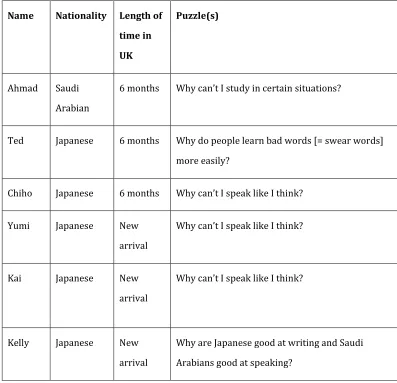
EP framework and invite volunteers for the study. Table 2 indicates the learners
pseudonyms, nationality, length of time in the UK, and the question(s) that
puzzled each of them.
Name Nationality Length of
time in
UK
Puzzle(s)
Ahmad Saudi
Arabian
6 months Why can t ) study in certain situations
Ted Japanese 6 months Why do people learn bad words [= swear words]
more easily?
Chiho Japanese 6 months Why can t ) speak like ) think
Yumi Japanese New
arrival
Why can t ) speak like ) think
Kai Japanese New
arrival
Why can t ) speak like ) think
Kelly Japanese New
arrival
Why are Japanese good at writing and Saudi
[image:6.595.83.480.334.717.2]Arabians good at speaking?
I interviewed participants at regular intervals, asking them to describe their
feelings on starting EP, discuss their ongoing investigations, and reflect on the
experience at the end of the course. The interviews were conducted in English
(i.e. their target language) and although this meant they sometimes struggled to
express themselves clearly, there was an added benefit for the learners: extra
opportunities to practise the language they had come to the UK to study.
Following the initial presentation, the learners mingled in their Options class,
comparing their different puzzles, looking for areas of commonality, and forming
groups. For example if their questions related to issues around speaking, they
formed a group; if considering study habits, another group formed. Their teacher
invited them to think about ways in which they could investigate and they began
to prepare interview schedules or questionnaires (typical activities in EAP
programmes). After piloting these, the learners went outside the classroom,
visiting the library, talking to other students and teachers, and using the internet
to research their questions. Over the next two weeks they analysed their data
and prepared their poster presentations.
Each group presented their poster to the rest of the class. Presentations lasted 20
minutes (each member of the group spoke) and were followed by a discussion
with the rest of the class. The presentations were videoed and uploaded to a
private space on the institution s virtual learning environment (VLE), so that individuals could assess their own performance. Finally, the groups worked
together to write an assignment describing and analysing their investigations.
[image:7.595.85.508.623.749.2]This was marked and returned to them in the last week of the course.
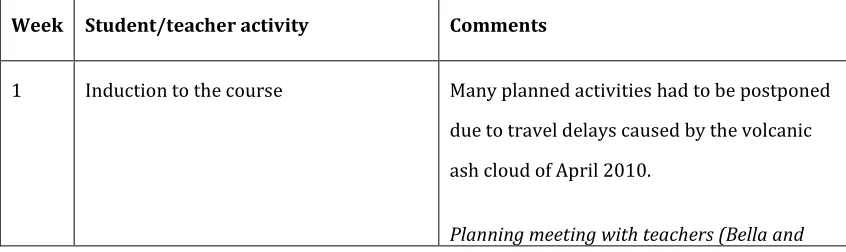
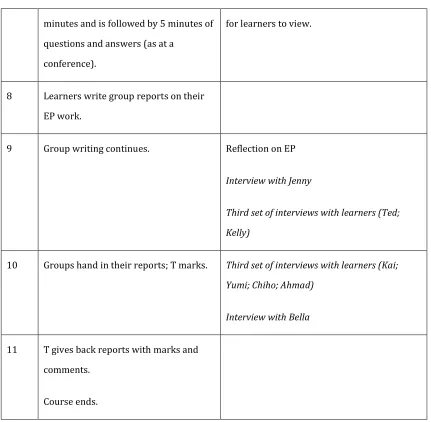
Table 3 summarizes the data collection procedure over the 11 weeks of the
course.
Week Student/teacher activity Comments
1 Induction to the course Many planned activities had to be postponed
due to travel delays caused by the volcanic
ash cloud of April 2010.
Jenny)
Interview with Bella
2 Presentation about the principles and
ideas of EP to learners and teachers.
Learners write down their own puzzles
about language learning experiences.
Homework: learners writea summary
of the talk.
Dual purpose:
practice in listening and note-taking from a
live talk
introduce the ideas and principles of EP to
the audience and recruit volunteers.
Interview with Jenny
3 Learners compare puzzles in class, look
for any commonality, and form groups.
Learners think about how to investigate
puzzles.
Four groups formed around the puzzles with
between two and five members in each.
Interviews with Jenny
4 Learners write questions for interviews
or questionnaires. Learners pilot
questions and make adjustments.
Late arrivals fitted into the pre-existing
groups (their own choice of group).
First set of interviews with learners: Kai, Ted, Chiho, Yumi, Ahmad, Kelly
5 Learners go into community and collect
data (including
interviews/questionnaires, going to the
library, using internet).
Jenny informed me that students often stayed
late (up to two hours) after class to work on
their puzzles.
6 Learners collate data, analyse it,
prepare for poster presentations.
Second set of interviews with learners: Kai, Ted, Chiho, Yumi, Ahmad, Kelly
Interview with Jenny
7 Learners give group poster
presentations to the rest of their class.
Each presentation lasts approx. 20
Jenny and I attended the poster presentations
held in class. Presentations were recorded
minutes and is followed by 5 minutes of
questions and answers (as at a
conference).
for learners to view.
8 Learners write group reports on their
EP work.
9 Group writing continues. Reflection on EP
Interview with Jenny
Third set of interviews with learners (Ted; Kelly)
10 Groups hand in their reports; T marks. Third set of interviews with learners (Kai; Yumi; Chiho; Ahmad)
Interview with Bella
11 T gives back reports with marks and
comments.
[image:9.595.84.515.64.486.2]Course ends.
Table 3 Data Collection Procedure
It is worth emphasizing that first of all normal EAP pedagogic practices were
used throughout and secondly, learners were practising key language skills and
key academic skills at all times. Projects are typical activities on EAP courses, but
this does not mean that EP is solely a project-based approach. EP simply uses the
normal pedagogic practices in this case project work and poster
presentations) to enable learners (and teachers) to investigate their own puzzles
about language learning and teaching. Thus the EP process here draws on
project-like activities, but EP can be pursued in other ways, such as using an
upcoming unit in the course book eg on Likes Dislikes for class
investigation/discussion, asking teachers to include puzzles as part of
programmes of continuing professional development, or getting learners and
diaries, journals or blogs.
What did the learners think about EP?
One of the worries for the teachers was that the youth and perceived lack of
maturity of the learners would lead to them not taking the EP work seriously.
There was a concern that they would either ask What are we doing this for or that they would simply accept whatever they were told to do, without reflecting
more deeply on the process. However, the learners engaged with EP and even
puzzles that seemed at first to be challenging or humorous emerged as profound
opportunities for learning.
In initial interviews, learners cited the novelty of being asked to think of their
own questions about language learning. Kelly, for example, stated:
That is very fresh for me very stimulatedi.
This was echoed by others who welcomed the chance to set their own agenda.
Some students also noted the egalitarian approach, with Chiho particularly
pleased by the notion of teachers learning from learners:
Of course we can learn a lot of things from the lecture but ) think we are studying, the teachers are also studying, so interaction is very beneficial to both teachers and studentsii.
Ted s story
Ted s story is illustrative of the EP principles in action )n his first interview he
contrasted EP puzzling with the more typical topics found in EAP, such as
Recycling, where the answer is well-known to students and teachers alike. EP
offered the opportunity to think about something new and relevant to his own
learning:
We know we have to do recycling and we know we have to reduce many
rubbish so ) can t find any point to write an essay but something new ) can
As a young man going to parties and mixing with many nationalities, Ted had
noticed the prominence of taboo words used as a social mechanism and
wondered why:
Many people teach me bad words and they are having fun with me ) mean having fun when I say something bad in their language.
Although the topic could have been interpreted as a challenge to classroom
discipline, with students sniggering over taboo language, his teacher (Jenny)
encouraged him to investigate:
Ted really wanted to know why do people learn bad language before anything else and ) said the others were going err err err and ) said that
would be a really good puzzle.
Ted worked with his group, searching for books and articles on the use of taboo
language. After a week Ted described his frustration with published work stating
) couldn t find good article
Consequently, he and his group began to ask other learners about their
experiences of swear words in language learning. They used a questionnaire to
gather student opinions on why swear words were so prominent in their
language learning lives. This generated deeper questions for Ted:
Many people said learning bad words is silly, okay but why And why do they think it s a bad thing And I asked one of the in my group the guy in my group and he did research about is it really bad thing or not?
In turn, this further motivated Ted to continue Some parts of that research I did,
really ) didn t know that
He became so interested that he exported EP to another class in the P3
programme, persuading a group of learners to investigate British attitudes to
swearing as part of their British culture project.
As more information was collected, the learners became engrossed. The
critical inquiry. He did not simply accept the view that learning bad words is
silly , instead he opted to probe further. In their poster presentation, Ted s group
focused on the social aspects of learning swear words. The poster (see below),
though simple is insightful )t presents the group s understandings of the topic
so far, with headings taken from the results of their investigations (for example
fun express emotions breaking down barriers, etc.).
The conclusions that Ted was beginning to draw were serious. It is clear that he
was not being mischievous or trying to derail the lessons by focusing on taboo
words. Instead, he appeared to be making genuine connections between the
attitudes to swearing held by students. He was intrigued by the ways in which
taboo language can help to break down barriers for language learners, using
swear words as a kind of social glue. And he liked the open-ended nature of the
approach. In contrast with typical EAP topics (such as Recycling) where the
answers are well-known, Ted was motivated by the chance to explore a subject
entirely new to him, one without obvious answers:
I found it interesting to know something like something common but you
don t know any answer so using swear words it s common ) know everyone do it but ) don t know why they do it so it s very interesting to
Ahmad s
story
Thus far, I have shown the positive aspects of EP, but I also want to take a more
critical look: what happens when the principles clash with other pressures in the
classroom?
One student, Ahmad, found collegial working less congenial. He chose to work
with a group on their question: Why do I find it difficult to study in different
situations? . As he did so, he established his independence in deciding how to
proceed, and who to work with. He repeated his preference for lone working
several times in the initial interview, but also acknowledged the need to work
with other people:
Usually in my life ) prefer to work alone that s why ) don t like groups work
because ) m naturally ) don t like participate in others but I think in this project I have to work in groups because you know I need to make questionnaires, surveys and some interviews some people that s why ) think I need to work with other people rather I think if I did it myself I will wouldn t get anything.
However, as time went on, Ahmad seemed to forget his initial reluctance, and in
Week 6 he spoke enthusiastically about the work he had been doing with his
group:
We ve been working on the puzzle how could different places affect us yes for studying, um main main points were working under time
pressure, um working some different places That s where we are And we made our questionnaire asked some people we got some useful answers;
now we are going to interview some people We didn t decide yet who to
interview.
His extensive use of the word we seemed an indication that he had integrated
himself fully into the group, and that he was working as part of a team. He
sounded relaxed and happy, and was focused on the work in hand.
Ahmad described how the group moved from reflecting on their own study
Our topic was about Why do I find it difficult to study in different
situations and we asked many people around the university from different
nationalities, different genders er we really wanted to do that because all
happened to us and we wanted to see if that s different from other
nationalities or not especially our group or all our group And we found that happened to many, many students.
Despite his stated preference for working alone, Ahmad worked well with his
group in the poster presentation. They did not attempt to provide solutions or
advice in their poster (see below). Instead there was an emphasis on the
question Why and analysis of study conditions (at home or at university) and
student experiences.
However, Ahmad later returned to his earlier stance. In the penultimate weeks,
students were writing up their EP work in group assignments. Most seemed
happy, but the teacher noticed Ahmad had distanced himself by sitting apart
from his group and refusing to participate in discussions.
Jenny attributed this behaviour to a personality trait suggesting that he was a
loner who found group work challenging. But at the end of the cycle of
interviews, Ahmad provided his own interpretations:
end everyone just write and we will correct the essays together. But we
found that it s very difficult and will take a long time so we decided that
each two will have a specific parts and they write their parts after that we come together and put all our pieces together and to write the final report
Ahmad then surprised me by commenting on the joint-writing process:
Er always in my essays I tried to use complicated sentences, long sentences three lines or four lines like that and make all of them many areas in one sentence but what I found that some er members of my group, they have the same idea but may be they are they write the areas in different sentences but they use connection words perfectly when I look at their sentences they write eight and ten but they are all connected in good way.
He valued what he was learning from his partners and identified areas where
they could teach him. Moreover, his estimation of his partners had increased:
Ahmad: I opened my e-mail I found the report honestly ) was really surprised.
Judith: Why?
Ahmad:) didn t expect it to be that good.
Judith: Really?
Ahmad: Yes [smiling]
Judith: Yeah!
Ahmad: To be that clear many opinions but ) found it very, very clear. Specially using connection words And ) don t know who wrote the conclusion but he wrote the conclusion in very, very good way xxx include
the main ideas So ) was very surprised.
of collegiality and mutual development, despite his desire to work alone. His
story illustrates the mutual respect that developed as a result of working
together to develop understandings. Through EP, Ahmad had become involved
and the empathy that he shows not only for his fellow students but also for his
teachers is striking. He focuses on the need for both sides to engage in the
educational enterprise, mutual development writ large:
Yes and ) think it s very important because the education is not just
teaching it s teaching from one side and learning from other side.
So what does it all mean?
The poster presentations and comments from learners in the interviews showed
that learners had really engaged with their EP work They were not just going
through the motions, they were motivated and excited by what they were doing. Themes that emerged were
the novelty of being asked to puzzle about their own experiences (many said they had never been asked to do this before);
the pleasure of being in a position to help others (teachers and learners);
the enjoyment that this new work promised.
A number of participants commented that they enjoyed working on questions
where the answer was not yet known (not even by the teacher). Ted, for
example, contrasted EPs open-ended nature with more routine
question-and-answer displays. He attributed his enjoyment of EP work to this sense of
not-knowing; EP puzzling gave meaning to his investigations and thence his studies.
Ahmad, on the other hand, struggled with the collegial elements of EP. Working
in groups involves complex social interactions, as Slimani-Rolls (2003, 2009) has
shown. There is no guarantee that all will contribute equal amounts of work or
enthusiasm, as evidenced by the experiences of students above. If EP is to
continue to develop, these are areas that require further scrutiny. Nevertheless,
Ahmad was able to learn from his classmates, and like Chiho, he commented on
learners too.
Conclusions
I began by wondering if EP was feasible in my EAP context; the responses from
the participants provided a resounding yes Learners welcomed the
responsibilities of setting the agenda (via their puzzles) and driving the EP work
forward. They described their experience of EP in emotive terms: fantastic ,
fresh , saying that no one had ever asked them to consider what puzzled them
about teaching and learning. They described a release from the usual grind of
lessons about the environment or recycling where both questions and answers
are already known.
The EP principles of working for understanding puzzling before
problem-solving, involving everyone, bringing people together, and working for mutual
development were foregrounded in responses to the work. Integrating this work
for understanding into normal pedagogic practice meant that the learners were
using the language as they investigated. EP, then, through encouraging
practitioners to set their own research agendas, makes the work directly
relevant to the participants themselves.
Final version received August 2014
References
Allwright, D. 1993. Integrating research and pedagogy : appropriate criteria and practical possibilities in J. Edge and K. Richards (eds.). Teachers Develop Teachers Research. Oxford: Heinemann.
Allwright, D. 2003. Exploratory practice: rethinking practitioner research in language teaching . Language Teaching Research 7/2: 113 41.
Allwright, D. and J.Hanks. 2009. The Developing Language Learner: An Introduction to Exploratory Practice. Basingstoke: Palgrave Macmillan.
Breen, M. P. 2006. Collegial development in ELT: the interface between global processes and local understandings in S. Gieve and I. K. Miller (eds.).
Understanding the Language Classroom. Basingstoke: Palgrave Macmillan.
later . Educational Researcher 28/7: 15 25.
Freire, P. 1973. Education for Critical Consciousness. New York, NY: Seabury Press.
Gieve, S. and I. K.Miller. 2006. What do we mean by quality of classroom life ? in S. Gieve and I. K. Miller (eds.). Understanding the Language Classroom. Basingstoke: Palgrave Macmillan.
Hanks, J. Forthcoming. Language teachers making sense of Exploratory Practice .
Language Teaching Research.
Miller, I. K. 2009. Puzzle-driven language teacher development: the contribution of Exploratory Practice in T. Yoshida, H. Imai, Y. Nakata, A. Tajino, O. Takeuchi, and K. Tamai (eds.). Researching Language Teaching and Learning: An Integration of Practice and Theory. Bern: Peter Lang.
Slimani-Rolls, A. 2003. Exploring a world of paradoxes: an investigation of group work . Language Teaching Research 7/2: 221 39.
Slimani-Rolls, A. 2009. Complexity and idiosyncrasy of classroom life in T. Yoshida, H. Imai, Y. Nakata, A. Tajino, O. Takeuchi and K. Tamai (eds.), Researching Language Teaching and Learning: An integration of practice and theory. Bern: Peter Lang.
Stake, R. E. 2003. Case studies in N. K. Denzin and Y. S. Lincoln (eds.). Strategies of Qualitative Inquiry. Thousand Oaks, CA: Sage Publications Ltd.
Zeichner, K. M. and S. E. Noffke. 2001. Practitioner research in V. Richardson (ed.).
Handbook of Research on Teaching (fourth edition). Washington, DC: American Educational Research Association.
The author
Judith Hanks has worked in EFL since 1987 and in EAP since 1999, moving to the School of Education, University of Leeds, in January 2013. She has worked as a teacher and teacher educator in China, Italy, Singapore, and the UK. Her interests are in practitioner research, with particular focus on EP, and intercultural issues in language education.
Email: [email protected]
i Quotes are taken unedited and without linguistic corrections from recorded interviews in English with participants as part of my doctoral studies.