Designing Twister2: Efficient Programming Environment
Toolkit for Big Data
Supun Kamburugamuve
School of Informatics and ComputingIndiana University Bloomington, IN, USA
[email protected]
Geoffrey Fox
School of Informatics and Computing Indiana University
Bloomington, IN, USA
[email protected]
ABSTRACT
Data-driven applications are required to adapt to the ever-increasing volume, velocity and veracity of data generated by a variety of sources including the Web and Internet of Things devices. At the same time, an event-driven compu-tational paradigm is emerging as the core of modern sys-tems designed for both database queries, data analytics and on-demand applications. MapReduce has been generalized to Map Collective and shown to be very effective in ma-chine learning. However one often uses a dataflow comput-ing model, which has been adopted by most major big data processing runtimes. The HPC community has also devel-oped several asynchronous many tasks (AMT) systems ac-cording to the dataflow model. From a different point of view, the services community is moving to an increasingly event-driven model where (micro)services are composed of small functions driven by events in the form of Function as a Service(Faas) and serverless computing. Such designs allow the applications to scale quickly as well as be cost effective in cloud environments.
An event-driven runtime designed for data processing con-sists of well-understood components such as communication, scheduling, and fault tolerance. One can make different de-sign decisions for these components that will determine the type of applications a system can support efficiently. We find that modern systems are designed in a monolithic approach with a fixed set of choices that cannot be changed easily af-terwards. Because of these design choices their functionality is limited to specific sets of applications. In this paper we study existing systems (candidate event-driven runtimes), the design choices they have made for each component, and how this affects the type of applications they can support. Further we propose a loosely coupled component-based ap-proach for designing a big data toolkit where each compo-nent can have different implementations to support various applications. We believe such a polymorphic design would allow services and data analytics to be integrated seamlessly and expand from edge to cloud to high performance com-puting environments.
1.
INTRODUCTION
Big data has been characterized by the ever-increasing ve-locity, volume and veracity of the data generated from vari-ous sources, ranging from web users to Internet of Things de-vices to large scientific equipment. The data have to be pro-cessed as individual streams and analyzed collectively both in streaming and batch settings for knowledge discovery with both database queries and sophisticated machine learning.
These applications need to run as services in cloud envi-ronments as well as traditional high performance clusters. With the proliferation of cloud-based systems and Internet of Things, fog computing [12] is adding another dimension to these applications where part of the processing has to occur near the devices.
Parallel and distributed computing is essential to pro-cess big data owing to the data being naturally distributed and processing often requiring high performance in com-pute, communicate and I/O arenas. Over the years, the High Performance Computing (HPC) community has devel-oped frameworks such as message passing interface (MPI) to execute computationally intensive parallel applications efficiently. The HPC applications target high performance hardware, including low latency networks due to the scale of the applications and the required tight synchronous parallel operations. Big data applications have been developed tar-geting commodity hardware with Ethernet connections seen in the cloud. Because of this, they are more suitable for executing asynchronous parallel applications with high com-putation to communication ratios. Lately we have observed that more capable hardware comparable to HPC clusters is being added to modern clouds due to increasing demand for cloud applications in deep learning and machine learning. These trends suggest that HPC and cloud are merging, and we need frameworks that combine the capabilities of both big data and HPC frameworks.
There are many properties of data applications that in-fluence the design of those frameworks developed to pro-cess them. There are many application classes including database queries, management, and data analytics from com-plex machine learning to pleasingly parallel event processing. Common issues include that the data can be too big to fit into the memory of even a large cluster. Another important aspect is that it is impractical to always expect a balanced data set from the processing standpoint across the nodes. This follows from the fact that initial data in raw form are usually not load balanced and often require too much time and disk space to balance the data. Also the batch data pro-cessing is not enough as much data is streamed and needs to be processed online with reasonable time constraints before being stored to disk. Finally the data may be varied and have processing time that varies between data points and across iterations of algorithms.
in order to express communication in a big data application. Adding to this mix is the increasing complexity of hardware, with the explosion of many-core and multi-core processors having different memory hierarchies. It is becoming bur-densome to develop efficient applications on these new ar-chitectures using the low-level capabilities provided by MPI. Meanwhile, the success of Harp [62] has highlighted the im-portance of the Map-Collective computing paradigm.
The dataflow [31] computation model has been presented as a way to hide some of the system level details from the user in developing parallel applications. With dataflow, an application is represented as a graph with nodes doing com-putations and edges indicating communications between the nodes. A computation at a node is activated when it re-ceives events through its inputs. A well-designed dataflow framework hides the low-level details such as communica-tions, concurrency and disk I/O, allowing the developer to focus on the application itself. Every major big data pro-cessing system has been developed according to the dataflow model, and the HPC community has also developed asyn-chronous many tasks (AMT) systems according to the same model. AMT systems mostly focus on computationally in-tensive applications, and there is ongoing research to make them more efficient and productive. We find that big data systems developed according to a dataflow model are ineffi-cient in computationally intensive applications with tightly synchronized parallel operations [38], while AMT systems are not optimized for data processing.
At the core of the dataflow model is an event-driven ar-chitecture where tasks act upon incoming events (messages) and produce output events. In general a task can be viewed as a function activated by an event. The cloud-based ser-vices architecture is moving to an increasingly event-driven model for composing services in the form of Function as a Service (FaaS). FaaS is especially appealing to IoT appli-cations where the data is event-based in its natural form. Coupled with microservices and serverless computing, FaaS is driving next generation services in the cloud and can be extended to the edge.
Because of the underlying event-driven nature of both data analytics and message-driven services architecture, we can find many common aspects among the frameworks de-signed to process data and services. Such architectures can be decomposed into components such as resource provision-ing, communication, task schedulprovision-ing, task execution, data management, fault tolerance mechanisms and user APIs. High-level design choices are available at each of these layers that will determine the type of applications that the frame-work composed of these layers can support efficiently. We observe that modern systems are designed with fixed sets of design choices at each layer, rendering them only suitable for a narrow set of applications. Because of the common underlying model, it is possible to build each component separately with clear abstractions supporting different de-sign choices. We propose to dede-sign and build a polymorphic system by using these components to produce a system ac-cording to the requirements of the applications, which we term the toolkit approach. We believe such an approach will allow the system to be configured to support different types of applications efficiently. The authors are actively pursuing a project called Twister2, encompassing the con-cept of the toolkit. Serverless FaaS is a good approach to building cloud native applications [3, 27] and in this way,
Twister2 will be a cloud native framework.
This paper provides the following contributions: 1) A study of different application areas and how a common com-putation model fits them; 2) Design choices of different sys-tems and how they affect each application area; 3) Present-ing a vision of a big data toolkit (Twister2) that can execute applications from each area efficiently. Furthermore the pa-per provides comparisons of big data and MPI styles of pro-grams to gain better insight into the system requirements.
2.
RELATED WORK
Hadoop [58] was the first major open source platform de-veloped to process large amounts of data in parallel. The map-reduce [19] functional model introduced by Hadoop is well understood and adapted for writing distributed pleas-ingly parallel and one-pass applications. Coupled with Java, it provides a great tool for average programmers to process data in parallel. Soon enough, though, the shortcomings of Hadoopˆa ˘A´Zs simple API and its disk-based communica-tions [21] became apparent, and systems such as Apache Spark [61] and Apache Flink [15] were developed to over-come them. These systems are developed according to the dataflow model and their execution models and APIs closely follow dataflow semantics. Some other examples of batch processing systems include Microsoft Naiad [48], Apache Apex and Google Dataflow [6]. It is interesting to note that even with all its well-known inefficiencies, Hadoop is still being used by many people for data processing. Apart from the batch processing systems mentioned above, there are also streaming systems that can process data in real-time which also adhere to the dataflow model. Some examples of open source streaming systems include Apache Storm [57], Twitter Heron [41], Google Millwheel [5], Apache Samza [53] and Flink [15]. Note that some of the systems process both streaming and batch data in a unified way such as Apache Apex, Google Dataflow, Naiad and Apache Flink. Apache Beam [6] is a project developed to provide a unified API for both batch and streaming pipelines. It acts as a com-piler and can translate a program written in its API to a supported batch or streaming runtime. Prior to modern distributed streaming systems, research was done on shared memory streaming systems, including StreamIt [56], Bore-alis [8], Spade [28] and S4 [50].
There are synergies between HPC and big data systems, and authors [24, 25] among others [36] have expressed the need to enhance these systems by taking ideas from each other. In previous work [22, 23] we have identified the gen-eral implications of threads and processes, cache, memory management in NUMA [11], as well as multi-core settings for machine learning algorithms with MPI. DataMPI [42] uses MPI to build Hadoop like system while [7] uses MPI communications in Spark for better performance. A toolkit approach as in Twister2 makes interoperability easier at the usage level as one can change lower level components to fit different environments without changing the programmatic or user interface.
as dataflow graphs and use shared memory and threading to achieve best performance out of many-core machines. Some examples of such systems are OCR [47], DADuE [13], Charm++ [37], COMPS [17] and HPX [54], all of which focus on dynamic scheduling of the computation graph. A portability API is developed in DARMA [35] to AMT sys-tems to develop applications agnostic to the details of spe-cific systems. They extract the best available performance of multicore and many-core systems while reducing the burden of the user writing such programs using MPI. Prior to this, there was much focus in the HPC community on developing programs that could bring automatic parallelism to users such as Parallel Fortran [14]. Research has been done with MPI to understand the effect of computer noise on collective communication operations [34, 33, 4]. For large computa-tions, computer noise coming from an operating system can play a major role in reducing performance. Asynchronous collective operations can be used to reduce the noise in such situations, but it is not guaranteed to completely eliminate the burden.
In practice, multiple algorithms and data processing appli-cations are combined together in workflows to create com-plete applications. Systems such as Apache NiFi [1], Ke-pler [45], and Pegasus [20] were developed for this purpose. The lambda architecture [46] is a dataflow solution to design-ing such applications in a more tightly coupled way. Amazon Step functions [2] is bringing the workflow to the FaaS and microservices.
3.
BIG DATA APPLICATIONS
Here we highlight four types of applications with different processing requirements: 1) Streaming, 2) Data pipelines, 3) Machine learning, and 4) Services. With the explosion of IoT devices and the cloud as a computation platform, fog computing is adding a new dimension to these applications, where part of the processing has to be done near the devices.
Streaming applicationswork on partial data while batch applications process data stored in disks as a complete set. By definition, streaming data is unlimited in size and hard (and unnecessary) to process as a complete set due to time requirements. Only temporal data sets observed in data windows can be processed at a given time. In order to han-dle a continuous stream of data, it is necessary to create summaries of the temporal data windows and use them in subsequent processing of the stream. There can be many ways to define data windows, including time-based windows and data count-based windows. In the most extreme case a single data tuple can be considered as the processing gran-ularity.
Data pipelines are primarily used for extract, trans-form and load (ETL) operations even though they can in-clude steps such as running a complex algorithm. They mostly deal with unstructured data stored in raw form or semi-structured data stored in NoSQL [32] databases. Data pipelines work on arguably the largest data sets possible out of the three types of applications. In most cases, it is not possible to load complete data sets into memory at once and we are required to process data partition by par-tition. Because the data is unstructured or semi-structured, the processing has to assume unbalanced data for parallel processing. The processing requirements are coarse-grained and pleasingly parallel. Generally we can can consider a data pipeline as an extreme case of a streaming application,
where there is no order of data and the streaming windows contain partitions of data.
Machine learning applicationsexecute complex alge-braic operations and can be made to run in parallel using synchronized parallel operations. In most cases the data can be load balanced across the workers as curated data is being used. The algorithms can be regular or irregular and may need dynamic load balancing of the computations and data.
Servicesare moving towards an event-driven model for scalability, efficiency and cost effectiveness in the cloud. The old monolithic services are being replaced by leaner mi-croservices. These microservices are envisioned to be com-posed of small functions arranged in a workflow [2] or dataflow to achieve the required functionality.
3.1
Dataflow Applications
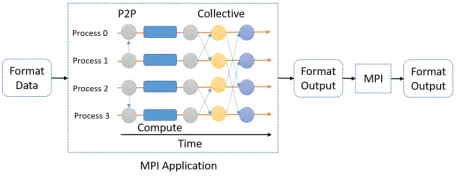
[image:3.612.322.551.440.529.2]Parallel computing and distributed computing are two of the general computing paradigms available for doing com-putations on large numbers of machines. MPI is the de facto standard in HPC for developing parallel applications. It pro-vides a basic but powerful tool to develop parallel applica-tions. An MPI programmer has to consider low-level details such as I/O, memory hierarchy and efficient execution of threads to write a parallel application that scales to large numbers of nodes. With the increasing availability of multi-core and many multi-core systems, the burden on the programmer to get the best available performance has increased dramat-ically [23, 22]. Because of the load imbalance and velocity of the big data applications, an MPI program written with tight synchronized operations across parallel workers may not perform well. An example HPC application is shown in Fig. 1 where a workflow system such as Kepler [45] is used to invoke individual MPI applications. A parallel worker of an MPI program does computations and communications within the same process scope, allowing the program to keep state throughout the execution.
Figure 1: MPI applications arranged in a workflow
3.1.1
Dataflow Application APIs
Over the years, there have been numerous languages and different types of APIs developed for creating dataflow appli-cations. Task-based programming and data transformation-based programming are two popular approaches for dataflow parallel applications.
[image:4.612.386.487.55.159.2]Data transformation APIs are used primarily by big data systems. Data transformation APIs employ a func-tional programming approach to create the dataflow graph implicitly. In this approach, distributed data is represented in some abstract form and functions are applied to it that re-turn other distributed data. A function takes a user defined operator as an argument and defines the communication be-tween the operators. An example function is a partition function, often called a map in data flow runtimes. A map function works on partitions of a data set and presents the partitioned data to the user defined operators. The out-put of a user defined operator is connected to another user defined operator by way of another function.
Figure 2: Left: User graph, Right: execution graph of a data flow
Task-based APIsare primarily used by the HPC com-munity with AMT systems. A task-based API usually cre-ates the dataflow tasks at the runtime as the program pro-gresses. A normal program is used to create the tasks, which can use complex control operations such as ’if/else’ and ’for’ loops to control the dataflow dynamically at runtime.
3.1.2
Execution Graph
The graph executed by the dataflow runtime is termed execution/physical graph. This is created by the framework when the user graph is deployed on the cluster. For exam-ple, some user functions may run in larger numbers of nodes depending on the parallelism specified. Also when creating the execution graph, the framework can apply optimization to make some dataflow operations more efficient by reduc-ing data movement and overlappreduc-ing I/O and computations. Fig. 2 shows the execution graph and the user graph where it runs multipleW operations andSoperations in parallel. Each user defined task runs on its own program scope with-out access to any state regarding other tasks. The only way to communicate between tasks is by messaging, as tasks can run in different nodes.
3.1.3
Data Partitioning
[image:4.612.369.509.204.264.2]A big data application requires the data to be partitioned in a hierarchical manner due to memory limitations. Fig. 4 shows an example of such partitioning of a large file con-taining records of data points. The data is first partitioned according to the number of parallel tasks and then each par-tition is again split into smaller parpar-titions. At every stage of the execution, such smaller examples are loaded into the memory of each worker. This hierarchical partitioning is im-plicit in streaming applications, as only a small portion of the data is available at a given time.
Figure 3: Load imbalance and velocity of data
Figure 4: Hierarchical data partitioning of a big data application
3.1.4
Hiding Latency
It is widely recognized that computer noise can play a huge role in large-scale parallel jobs that require collective oper-ations. Many researchers have experimented with MPI to reduce performance degradation caused by noise in HPC en-vironments. Such noise is much less compared to what typ-ical cloud environments observe with multiple VMs sharing the same hardware, I/O subsystem and networks. Added to this is the Java JVM noise which most notably comes from garbage collection. The computations in dataflow model are somewhat insulated from the effects of such noise due to the asynchronous nature of the parallel execution. For streaming settings, the data arrives at the parallel nodes with different speeds and processing time requirements. Be-cause of these characteristics, dataflow operations are the most suitable for such environments. Load balancing [49] is a much harder problem in streaming settings where data skew is more common because of the nature of applications.
3.2
Dataflow for Big Data Applications
3.2.1
Streaming Applications
Streaming applications deal with load imbalanced data coming at different rates to parallel workers at any given mo-ment. Having an MPI application processing this data will increase the latency of the individual events. Fig. 3 shows this point with an example where three parallel workers pro-cess messages arriving at different speeds and sizes(different processing times). If an MPI collective operation is invoked, it is clear that the collective has to wait until the slowest task finishes, which can vary widely. Also, to handle streams of data with higher frequencies, the tasks of the streaming computation must be executed in different CPUs arranged in pipelines. The dataflow model is a natural fit for such asynchronous processing of chained tasks.
3.2.2
Data Pipelines
[image:4.612.58.285.267.323.2]stream-Figure 5: Dataflow application execution, Left: Streaming execution, Middle: Data pipelines executing in stages, Right: Iterative execution
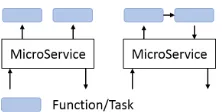
Figure 6: Microservices using FaaS, Left: Functions using a workflow, Right: Functions in a dataflow
ing applications. They work on hierarchically partitioned data as shown in Fig 4. This is similar to streaming where a stream is partitioned among multiple parallel workers and a parallel worker only processes a small portion of the as-signed partition at a given time. Data pipelines deal with the same load imbalance as streaming applications, but the scheduling of tasks is different in streaming and data pipeline applications. Usually every task in a data pipeline is exe-cuted in each CPU sequentially so only a subset of tasks are active at a given time in contrast to all the tasks being active in streaming applications. Streaming communication operations only need to work on data that can be stored in memory, while data pipelines do communications that re-quire a disk because of the large size of data. It is necessary to support iterative computations in data pipelines in case they execute complex data analytics applications.
3.2.3
Machine Learning
Complex machine learning applications work mostly with curated data that are load balanced. This means tight syn-chronizations required by the MPI-style parallel operations are possible because the data is available around the time the communication is invoked. It is not practical to run complex machine learning algorithms (> O(n2)) on very large data
sets as they have polymorphic time requirements. In those cases it is required to find heuristic approaches with lower time complexities. There are machine learning algorithms which can be run in a pleasingly parallel manner as well. Because of the expressivity required by the machine learn-ing applications, the dataflow APIs should be close enough to MPI-type programming but should hide the details such as threads and I/O from users. Task-based APIs as used by AMT systems are suitable for such applications. We note that large numbers of machine learning algorithms fall into the map-collective model of computation as described in [16, 29].
3.2.4
Services
The services are composed of event-driven functions which can be provisioned and scaled without the user having to know the underlying details of the infrastructure. The func-tions can be directly exposed to the user for event driven ap-plications or by proxy through microservices for request/response applications. Fig. 6 shows microservices using functions ar-ranged in a workflow and in a dataflow.
4.
RUNTIME ARCHITECTURE
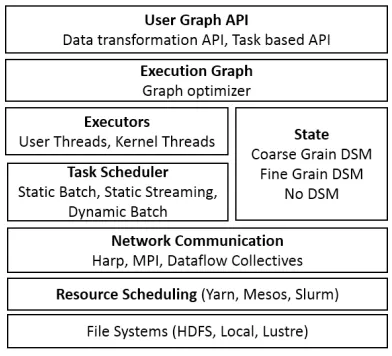
The general architecture of a runtime designed for big data is shown in Fig. 7. An application is created using a graph API and an optimizer can be used to make the graph execution efficient. A resource scheduler then allocates the required computing resources to run the processes required, including a master process to manage the job and a set of executors to execute the tasks. There can be additional processes to manage state and gather statistics but these are not essential. The executors use threads to invoke the tasks and manage the communications. The task scheduler can be distributed to run in each executor or be central. The task execution model adopted is a hybrid model where both processes and threads are used. A single executor can host multiple tasks of the execution graph and execute them using threads.
Figure 7: Dataflow runtime architecture
4.1
Communication
[image:5.612.119.230.208.264.2] [image:5.612.326.540.474.622.2]are termed collective communications. These patterns as identified by the parallel computing community are available through frameworks such as MPI [26]. Some of the heavily used communication patterns are Broadcast, Gather, Re-duce, AllGather and AllReduce [55].
The naive implementation of these communication pat-terns using point-to-point communication in a straightfor-ward way produces worst-case performance in practical large-scale parallel applications. These communication patterns can be implemented using algorithms that minimize the bandwidth utilization and latency of the operation. In gen-eral they are termed collective algorithms.
4.1.1
MPI Collective Operations
In MPI, collective operations and other point-to-point com-munication operations are driven by control operations. This means the programmer knows exactly when to execute the send or receive functions. Once the program is ready to re-ceive or send data, it can initiate the appropriate operations which will invoke the network functions. The asynchronous communications are slightly different than synchronous op-erations in the sense that after their invocation, the program can continue to compute while the operation is pending. It is important to note that even with asynchronous operations the user needs to use other operations such as wait/probe to complete the pending operation. MPI has clear standard APIs defined for collective communication patterns and all MPI implementations follow these specifications. The un-derlying implementation for such a communication pattern can use different algorithms based on factors including mes-sage size among others. Significant research has been done on MPI collectives [55, 52] and the current implementations are optimized to an extremely high extent. A comprehen-sive summary of MPI collective operations and possible al-gorithms is found in [59].
4.1.2
Dataflow Collective Operations
A communication pattern defines how the links are ar-ranged in the dataflow graph. For instance a single node can broadcast a message to multiple nodes in the graph when they are arranged in a broadcast communication pat-tern. One of the best examples of a collective operation in dataflow is Reduce. Reduce is the opposite of broadcast op-eration and multiple nodes link to a single node. The most common dataflow operations include reduce, gather, join [9] and broadcast.
MPI and big data have adopted the same type of collec-tive communications but sometimes they have diverged in supported operations. Table 1 shows some of the collective operations and their availability in MPI and dataflow sys-tems. Even though some MPI collective operations are not present in big data systems, they can be effective. Harp [62] is a machine learning focused collective library and supports the standard MPI collectives as well as some other opera-tions like rotate, push and pull.
It is important to observe that dataflow applications use keyed collective operations. Unlike in MPI where the opera-tions happen in-place, dataflow operaopera-tions happen between individual tasks. Without keyed operations, it is not possi-ble to direct the outcome of a collective operation to a task.
4.1.3
Optimized Dataflow Collective Operations
[image:6.612.331.540.52.153.2]Each task in a dataflow graph can only send and receive
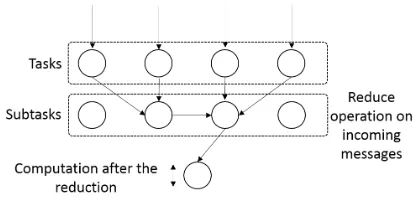
Figure 8: Collective operation with sub-tasks ar-ranged in a tree
data via its input and output ports and parallel tasks can-not communicate with each other while performing compu-tations. The authors of this paper propose collective op-erations as a dataflow graph enrichment, which introduces sub-tasks to the original dataflow graph. Fig??and Fig. 8 show the naive implementation and our proposed approach for dataflow collective operations. In this approach, the col-lective operationˆa ˘A´Zs computation is moved to a sub-task under which the collective operation depends. These sub-tasks can be connected to each other according to differ-ent data structures like trees and pipes in order to opti-mize the collective communication. This model preserves the dataflow nature of the application and the collective does not act as a synchronization barrier. The collective operation can run as data becomes available to each indi-vidual task, and the effects of unbalanced load and timing issues in MPI are no longer applicable. For collective oper-ations such as broadcast and scatter, the original tasks will be arranged according to data structures required by such operations. We identify several requirements for a dataflow collective algorithm.
1. The communication and the underlying algorithm should be driven by data.
2. The algorithm should be able to use disks when the amount of data is larger than the available memory.
3. The collective communication should work on parti-tions of data and need to finish only after all the par-titions are processed.
4.1.4
High Performance Interconnects
Table 1: MPI and big data collective operations
MPI Big Data Algorithms available
Small Messages Large Messages Reduce Reduce, Keyed
Reduce
Flat/Binary/N-ary/Binomial Tree Pipelined/Double/Split Binary Tree, Chain
AllReduce N/A Recursive Doubling, Reduce followed by Broadcast
Ring, Rabenseifner Algorithm, Recur-sive Doubling, Vector Halving with Distance Doubling
Broadcast Broadcast Flat/Binary Tree Pipelined/Double/Split Binary Tree, Chain
Gather Aggregate, Keyed Aggregate
Flat/Binary/N-ary/Binomial Tree Pipelined/Double/Split Binary Tree, Chain
AllGather N/A Recursive Doubling, Reduce followed by Broadcast
Ring, Rabenseifner Algorithm, Recur-sive Doubling, Vector Halving with Distance Doubling
Barrier N/A Flat/Binary/Binomial Tree
Scatter N/A Flat/Binary Tree Pipelined/Double/Split Binary Tree, Chain
N/A Join Distributed radix hash, sort merge
4.2
Task Scheduling, Threads & Processes
Task scheduling is a key area in which MPI, static and dynamic dataflow systems differ. From an MPI perspec-tive, the task scheduling is straightforward, as MPI only spawns processes to run. It is the responsibility of the user to spawn threads and assign the computations appropriately. This process becomes harder for the MPI programmer when designing applications to run on many-core and multicore systems. Here it is worth noting that the vast majority of programmers are not comfortable with threads, let alone possess the skill to get good performance from them by ef-ficient use of locks.Static and dynamic scheduling are the two main paradigms used in scheduling tasks.
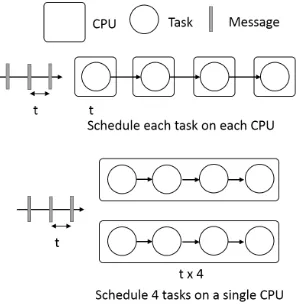
Figure 9: Top: Stream task scheduled in 4 CPU in a chain. Bottom: All streaming tasks scheduled in a single CPU.
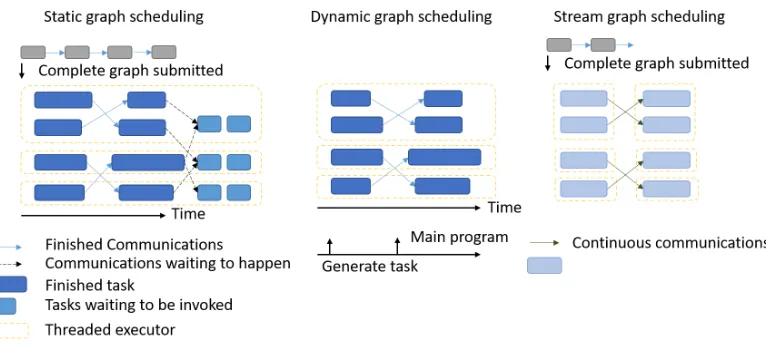
Static graph schedulingnecessitates the graph be avail-able from the beginning. Because streaming systems require the entire graph to run continuously, this is the only way for such systems to operate. However that does make it harder to express complex applications, especially when containing
loops. So this approach is suitable for data parallel applica-tions such as streaming and data pipelines. Because the en-tire graph is available upon submission, graph optimization techniques can be applied to obtain the execution graph.
Dynamic graph schedulingallocates and schedules tasks at the run-time as the computation progresses. Because the graph is generated on the fly by a control program, more complex operations can be specified easily. AMT systems are dynamic graph execution systems. Being driven by a normal program, this method is not suitable for streaming data applications.
4.2.1
Streaming & Batch Task Scheduling
Streaming systems need to allocate all the tasks of the graph to run continuously, as well as optimize for latency. To illustrate requirements of stream task scheduling, let us take a hypothetical example where we have 4 computations to execute on a stream of messages with each computation takingtCPU time. Assume we have 4 CPUs available and the data rate is 1 msg per t CPU time. If we run all 4 tasks on a single CPU as shown in Fig. 9, it takes t×4 time to process one message and the computation cannot keep up with the stream using 1 CPU. So we need to load balance between the 4 CPUs and the order of the processing is lost unless explicitly programmed with locks to keep the state across 4 CPUs. But it is worth noting that the data remains in a single thread while the processing happens, thus preserving data locality. If we perform the schedule as in Fig. 9 the data locality is lost but the task locality is preserved. [40] describes stream computation scheduling on multicore systems in great detail.
For batch dataflow applications, the tasks are executed as the computation progresses. This means sequential tasks can run on a single CPU as time passes, unlike in a streaming system. Usually a single thread is scheduled to run on a single core and when the tasks become ready to run, this thread can execute them.
4.2.2
Execution of Tasks
[image:7.612.98.247.455.608.2]Figure 10: Task scheduling and execution of dataflow frameworks
is used for executing the tasks of the dataflow. This al-lows both pipelined execution of tasks and sharing of data through memory. Such pipelined execution of tasks is crit-ical for streaming and data pipeline application to achieve efficient computations. Because of the large number of cores available in modern systems, it is required to strike a balance between the number of executor processes run in a single node. If fewer executors run in a node, that means a single executor has to cope with larger memory, which can lead to TLB misses and long JVM GC pauses. If more executors are used, the data has to be moved among the processes.
4.3
Data Management & Fault Tolerance
Big data applications work with input data and interme-diate data generated through calculations. Apart from this, some state has to be maintained about the computations. In most applications the input data is not updated and model data is updated frequently. A MPI application delegates the complete data management to user, allowing her to load data, partition the data and place the data as needed. The same data set can be updated though-out the computations allowing efficient use of memory. Because partitioning and placement of the data is controlled by the user, this approach allows the best possible optimizations.Even-though MPI approach is flexible, user needs to work with low level details in-order to write such applications. Distributed shared memory architectures have been pro-posed to ease some of the burdens of data management from user. Dataflow runtimes can use distributed shared mem-ory [51] (DSM) for data and state management. In general a DSM presents distributed memory as a continuous global address space to the programmer. In such systems, the tasks of the graph are only allowed to work with DSM and no lo-cal process level state is kept. This permits the tasks of a dataflow graph to be migrated freely among the nodes. The migration allows the system to recover from node fail-ures and balance load at runtime. HPC community has developed systems such as partitioned global address space (PGAS) [18] distributed memory. The big data community developed DSM technologies like RDD [60] for the same pur-pose.
RDD and other big data DSMs are a relaxed
implementa-tion of general DSM architecture where only coarse-gained operations are allowed. These DSMs are immutable, mean-ing once created they cannot be changed. Because tasks of a dataflow application work on partitions of such distributed memory, when a task fails it can be migrated and recal-culated without any side effects. If there are global data dependencies for a partition of such a distributed data set, complete operations may be required to execute again, so checkpointing mechanisms are employed to save state in or-der to reduce deep recalculations. Because these data sets are immutable, they need to be created every time there are updates to them. This can lead to unnecessary resource con-sumption for complex iterative application where the models change frequently during calculations. These DSMs do not allow random access and fine grained control of data, which can lead to inefficiencies in complex applications [38]. It is worth noting that, they work extremely well for pleasingly parallel data pipeline type applications.
Fault tolerance is tightly coupled with how the state is managed. If fine-grained control of state is allowed, the checkpointing has to take these into account. The frequency of such checkpointing is mostly given as an option to the application developer. Such an architecture would require recalculation of large portions of the application in case of a failure depending on the rate of checkpointing.
5.
SYSTEMS DESIGN
Table 2: Design choices of current runtimes
Frameworks
MPI HPX-5 Spark Flink Naiad Storm/Heron
Task Scheduling Static Dynamic Dynamic Static Static Static Execution User control Task-based
threads
Task-based threads
Task-based threads
Task-based threads
Task-based threads API In-place
com-munication
Task-based Data transfor-mation
Data transfor-mation
Data transfor-mation
Explicit graph creation
Optimized commns Yes Yes No No No No
RDMA Yes Yes No No No No
DSM No Fine grained Coarse
Grained
Coarse Grained
Coarse Grained
No
Streaming No No Yes - high
la-tency
Yes Yes Yes
Data pipelines No No Yes Yes Yes N/A
Machine learning Yes Yes Performance can be poor
Performance can be poor
N/A N/A
5.1
A Toolkit for Big Data
Our study has identified high level features of a big data runtime that determine the type of application which can be executed efficiently. This toolkit aims to compose sys-tems using well-defined components, and has the following implications: 1) It will allow developers tochoose only the componentsthat they need in order to develop the appli-cation. For example, a user may only want MPI-style com-munication with a static scheduling and distributed shared memory for their application; 2) Each component will have
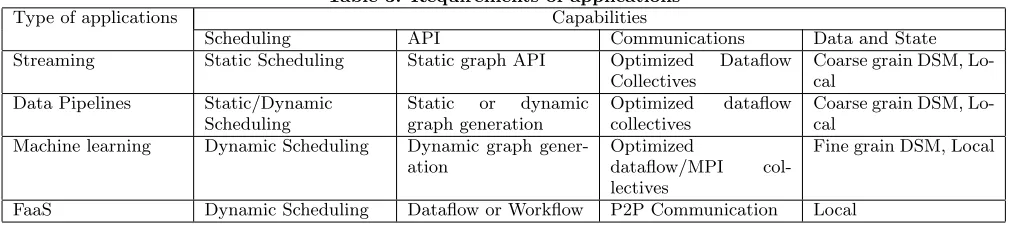
[image:9.612.75.271.487.665.2]multiple implementations, allowing the user to support different types of applications, e.g., the toolkit can be used to compose a system that can perform streaming computa-tions as well as data pipelines. We observed that communi-cations, task scheduling and distributed shared memory (if required) are the three main factors affecting the applica-tions. The API needs to adapt to each of these choices as well. Table 3 shows the different capabilities expected from different types of big data applications described herein.
Figure 11: The toolkit approach
We propose a high performance communication library including both MPI and dataflow style communications, a
task scheduler capable of scheduling according to different requirements, a thread-based task executor, and a low-level graph representation API as the basis of the toolkit. This can be further enhanced with a distributed shared memory implementation supporting coarse-grained and fine-grained operations. Different APIs can be built on top of such a system including low-level and high-level APIs to support different use cases. High level APIs can be in the form of languages, SQL queries or domain specific APIs. The sup-port of classic HPC communications such as MPI will further enhance the system’s adaptability to existing legacy appli-cations.
Table 3: Requirements of applications
Type of applications Capabilities
Scheduling API Communications Data and State Streaming Static Scheduling Static graph API Optimized Dataflow
Collectives
Coarse grain DSM, Lo-cal
Data Pipelines Static/Dynamic Scheduling
Static or dynamic graph generation
Optimized dataflow collectives
Coarse grain DSM, Lo-cal
Machine learning Dynamic Scheduling Dynamic graph gener-ation
Optimized
dataflow/MPI col-lectives
Fine grain DSM, Local
FaaS Dynamic Scheduling Dataflow or Workflow P2P Communication Local
Acknowledgments
This work was partially supported by the Indiana Univer-sity Precision Health Initiative and by NSF CIF21 DIBBS 1443054 and NSF RaPyDLI 1415459. We thank Intel for their support of the Juliet system, and extend our grati-tude to the FutureSystems team for their support with the infrastructure.
7.
REFERENCES
[1] Apache NiFi. https://nifi.apache.org/. Accessed: July 19 2017.
[2] AWS Step Functions.
https://aws.amazon.com/step-functions/. Accessed: July 19 2017.
[3] Cloud Native Computing Foundation. https://www.cncf.io/. Accessed: 2017-Aug-06. [4] S. Agarwal, R. Garg, and N. K. Vishnoi.The Impact
of Noise on the Scaling of Collectives: A Theoretical Approach, pages 280–289. Springer Berlin Heidelberg, Berlin, Heidelberg, 2005.
[5] T. Akidau, A. Balikov, K. Bekiro˘glu, S. Chernyak, J. Haberman, R. Lax, S. McVeety, D. Mills, P. Nordstrom, and S. Whittle. Millwheel:
Fault-tolerant stream processing at internet scale.
Proc. VLDB Endow., 6(11):1033–1044, Aug. 2013. [6] T. Akidau, R. Bradshaw, C. Chambers, S. Chernyak,
R. J. Fern´andez-Moctezuma, R. Lax, S. McVeety, D. Mills, F. Perry, E. Schmidt, and S. Whittle. The Dataflow Model: A Practical Approach to Balancing Correctness, Latency, and Cost in Massive-scale, Unbounded, Out-of-order Data Processing.Proc. VLDB Endow., 8(12):1792–1803, Aug. 2015. [7] M. Anderson, S. Smith, N. Sundaram, M. Capot˘a,
Z. Zhao, S. Dulloor, N. Satish, and T. L. Willke. bridging the gap between hpc and big data frameworks.
[8] M. Balazinska, H. Balakrishnan, S. R. Madden, and M. Stonebraker. Fault-tolerance in the Borealis Distributed Stream Processing System.ACM Trans. Database Syst., 33(1):3:1–3:44, Mar. 2008.
[9] C. Barthels, I. M¨uller, T. Schneider, G. Alonso, and T. Hoefler. Distributed Join Algorithms on Thousands of Cores.Proc. VLDB Endow., 10(5):517–528, Jan. 2017.
[10] M. S. Birrittella, M. Debbage, R. Huggahalli, J. Kunz, T. Lovett, T. Rimmer, K. D. Underwood, and R. C. Zak. Intel x00AE; Omni-path Architecture: Enabling
Scalable, High Performance Fabrics. In2015 IEEE 23rd Annual Symposium on High-Performance Interconnects, pages 1–9, Aug 2015.
[11] S. Blagodurov, S. Zhuravlev, A. Fedorova, and A. Kamali. A Case for NUMA-aware Contention Management on Multicore Systems. InProceedings of the 19th International Conference on Parallel
Architectures and Compilation Techniques, PACT ’10, pages 557–558, New York, NY, USA, 2010. ACM. [12] F. Bonomi, R. Milito, J. Zhu, and S. Addepalli. fog
computing and its role in the internet of things. [13] G. Bosilca, A. Bouteiller, A. Danalis, T. Herault,
P. Lemarinier, and J. Dongarra. DAGuE: A generic distributed DAG engine for High Performance Computing.Parallel Computing, 38(1):37 – 51, 2012. Extensions for Next-Generation Parallel Programming Models.
[14] Z. Bozkus, A. Choudhary, G. Fox, T. Haupt, and S. Ranka. Fortran 90D/HPF Compiler for Distributed Memory MIMD Computers: Design, Implementation, and Performance Results. InProceedings of the 1993 ACM/IEEE Conference on Supercomputing,
Supercomputing ’93, pages 351–360, New York, NY, USA, 1993. ACM.
[15] P. Carbone, A. Katsifodimos, S. Ewen, V. Markl, S. Haridi, and K. Tzoumas. Apache flink: Stream and batch processing in a single engine.Bulletin of the IEEE Computer Society Technical Committee on Data Engineering, 36(4), 2015.
[16] C.-T. Chu, S. K. Kim, Y.-A. Lin, Y. Yu, G. Bradski, A. Y. Ng, and K. Olukotun. Map-reduce for machine learning on multicore. InProceedings of the 19th International Conference on Neural Information Processing Systems, NIPS’06, pages 281–288, Cambridge, MA, USA, 2006. MIT Press.
[17] J. Conejero, S. Corella, R. M. Badia, and J. Labarta. task-based programming in compss to converge from hpc to big data.
[18] M. De Wael, S. Marr, B. De Fraine, T. Van Cutsem, and W. De Meuter. partitioned global address space languages.
[19] J. Dean and S. Ghemawat. MapReduce: A Flexible Data Processing Tool.Commun. ACM, 53(1):72–77, Jan. 2010.
Scientific Programming, 13(3):219–237, 2005. [21] J. Ekanayake, H. Li, B. Zhang, T. Gunarathne, S.-H.
Bae, J. Qiu, and G. Fox. Twister: A Runtime for Iterative MapReduce. InProceedings of the 19th ACM International Symposium on High Performance Distributed Computing, HPDC ’10, pages 810–818, New York, NY, USA, June, 2010. ACM.
[22] S. Ekanayake, S. Kamburugamuve, and G. C. Fox. Spidal java: High performance data analytics with java and mpi on large multicore hpc clusters. In
Proceedings of the 24th High Performance Computing Symposium, HPC ’16, pages 3:1–3:8, San Diego, CA, USA, 2016. Society for Computer Simulation International.
[23] S. Ekanayake, S. Kamburugamuve,
P. Wickramasinghe, and G. C. Fox. Java thread and process performance for parallel machine learning on multicore hpc clusters. In2016 IEEE International Conference on Big Data (Big Data), pages 347–354, Washington, DC, USA, Dec 2016. IEEE.
[24] G. Fox, J. Qiu, S. Jha, S. Ekanayake, and
S. Kamburugamuve.Big Data, Simulations and HPC Convergence, pages 3–17. Springer International Publishing, Cham, 2016.
[25] G. Fox, J. Qiu, S. Kamburugamuve, S. Jha, and A. Luckow. Hpc-abds high performance computing enhanced apache big data stack. InCluster, Cloud and Grid Computing (CCGrid), 2015 15th IEEE/ACM International Symposium on, pages 1057–1066, New York, NY, USA, May 2015. IEEE.
[26] E. Gabriel, G. E. Fagg, G. Bosilca, T. Angskun, J. J. Dongarra, J. M. Squyres, V. Sahay, P. Kambadur, B. Barrett, A. Lumsdaine, R. H. Castain, D. J. Daniel, R. L. Graham, and T. S. Woodall.Open MPI: Goals, Concept, and Design of a Next Generation MPI Implementation, pages 97–104. Springer Berlin Heidelberg, Berlin, Heidelberg, 2004.
[27] D. Gannon, R. Barga, and N. Sundaresan. Cloud Native Applications.IEEE Cloud Computing Magazine special issue on cloud native computing, to be published.
[28] B. Gedik, H. Andrade, K.-L. Wu, P. S. Yu, and M. Doo. SPADE: The System s Declarative Stream Processing Engine. InProceedings of the 2008 ACM SIGMOD International Conference on Management of Data, SIGMOD ’08, pages 1123–1134, New York, NY, USA, 2008. ACM.
[29] A. Ghoting, R. Krishnamurthy, E. Pednault, B. Reinwald, V. Sindhwani, S. Tatikonda, Y. Tian, and S. Vaithyanathan. Systemml: Declarative machine learning on mapreduce. In2011 IEEE 27th
International Conference on Data Engineering, pages 231–242, April 2011.
[30] P. Grun, S. Hefty, S. Sur, D. Goodell, R. D. Russell, H. Pritchard, and J. M. Squyres. A Brief Introduction to the OpenFabrics Interfaces - A New Network API for Maximizing High Performance Application Efficiency. In2015 IEEE 23rd Annual Symposium on High-Performance Interconnects, pages 34–39, Aug 2015.
[31] N. Halbwachs, P. Caspi, P. Raymond, and D. Pilaud. The synchronous data flow programming language
LUSTRE.Proceedings of the IEEE, 79(9):1305–1320, 1991.
[32] J. Han, H. E, G. Le, and J. Du. Survey on nosql database. In2011 6th International Conference on Pervasive Computing and Applications, pages 363–366, Oct 2011.
[33] T. Hoefler, T. Schneider, and A. Lumsdaine. The impact of network noise at large-scale communication performance. In2009 IEEE International Symposium on Parallel Distributed Processing, pages 1–8, May 2009.
[34] T. Hoefler, T. Schneider, and A. Lumsdaine. Characterizing the Influence of System Noise on Large-Scale Applications by Simulation. In
Proceedings of the 2010 ACM/IEEE International Conference for High Performance Computing,
Networking, Storage and Analysis, SC ’10, pages 1–11, Washington, DC, USA, 2010. IEEE Computer Society. [35] D. Hollman, J. Lifflander, J. Wilke, N. Slattengren,
A. Markosyan, H. Kolla, and F. Rizzi. Darma v. beta 0.5, Mar 2017.
[36] N. S. Islam, M. W. Rahman, J. Jose,
R. Rajachandrasekar, H. Wang, H. Subramoni, C. Murthy, and D. K. Panda. High performance rdma-based design of hdfs over infiniband. In
Proceedings of the International Conference on High Performance Computing, Networking, Storage and Analysis, SC ’12, pages 35:1–35:35, Los Alamitos, CA, USA, 2012. IEEE Computer Society Press.
[37] L. V. Kale and S. Krishnan. Charm++: A portable concurrent object oriented system based on c++. In
Proceedings of the Eighth Annual Conference on Object-oriented Programming Systems, Languages, and Applications, OOPSLA ’93, pages 91–108, New York, NY, USA, 1993. ACM.
[38] S. Kamburugamuve, P. Wickramasinghe,
S. Ekanayake, and G. C. Fox. anatomy of machine learning algorithm implementations in mpi, spark, and flink.
[39] E. Kissel and M. Swany. Photon: Remote Memory Access Middleware for High-Performance Runtime Systems. In2016 IEEE International Parallel and Distributed Processing Symposium Workshops (IPDPSW), pages 1736–1743, May 2016. [40] M. Kudlur and S. Mahlke. Orchestrating the
Execution of Stream Programs on Multicore
Platforms. InProceedings of the 29th ACM SIGPLAN Conference on Programming Language Design and Implementation, PLDI ’08, pages 114–124, New York, NY, USA, 2008. ACM.
[41] S. Kulkarni, N. Bhagat, M. Fu, V. Kedigehalli, C. Kellogg, S. Mittal, J. M. Patel, K. Ramasamy, and S. Taneja. Twitter heron: Stream processing at scale. InProceedings of the 2015 ACM SIGMOD
International Conference on Management of Data, SIGMOD ’15, pages 239–250, New York, NY, USA, 2015. ACM.
2014, Salt Lake City, USA, March 1, 2014 and Hangzhou, China, September 5, 2014, Revised Selected Papers, pages 111–123, Cham, 2014. Springer
International Publishing.
[43] X. Lu, N. S. Islam, M. Wasi-Ur-Rahman, J. Jose, H. Subramoni, H. Wang, and D. K. Panda. High-performance design of hadoop rpc with rdma over infiniband. In2013 42nd International Conference on Parallel Processing, pages 641–650, New York, NY, USA, Oct 2013. IEEE.
[44] X. Lu, D. Shankar, S. Gugnani, and D. K. D. K. Panda. High-performance design of apache spark with RDMA and its benefits on various workloads. In2016 IEEE International Conference on Big Data (Big Data), pages 253–262, Dec 2016.
[45] B. Lud ˜Ad’scher, I. Altintas, C. Berkley, D. Higgins, E. Jaeger, M. Jones, E. A. Lee, J. Tao, and Y. Zhao. Scientific workflow management and the Kepler system.Concurrency and Computation: Practice and Experience, 18(10):1039–1065, 2006.
[46] N. Marz and J. Warren.Big Data: Principles and Best Practices of Scalable Realtime Data Systems. Manning Publications Co., Greenwich, CT, USA, 1st edition, 2015.
[47] T. G. Mattson, R. Cledat, V. Cav ˜Al’, V. Sarkar, Z. Budimli ¨A ˘G, S. Chatterjee, J. Fryman, I. Ganev, R. Knauerhase, M. Lee, B. Meister, B. Nickerson, N. Pepperling, B. Seshasayee, S. Tasirlar, J. Teller, and N. Vrvilo. The open community runtime: A runtime system for extreme scale computing. In2016 IEEE High Performance Extreme Computing Conference (HPEC), pages 1–7, Sept 2016. [48] D. G. Murray, F. McSherry, R. Isaacs, M. Isard,
P. Barham, and M. Abadi. naiad: A timely dataflow system.
[49] M. A. U. Nasir, G. D. F. Morales, D. Garcia-Soriano, N. Kourtellis, and M. Serafini. The power of both choices: Practical load balancing for distributed stream processing engines. In2015 IEEE 31st International Conference on Data Engineering, pages 137–148, April 2015.
[50] L. Neumeyer, B. Robbins, A. Nair, and A. Kesari. S4: Distributed Stream Computing Platform. In2010 IEEE International Conference on Data Mining Workshops, pages 170–177, Dec 2010.
[51] B. Nitzberg and V. Lo. distributed shared memory: a survey of issues and algorithms.Computer.
[52] J. Pjeˇsivac-Grbovi´c, T. Angskun, G. Bosilca, G. E. Fagg, E. Gabriel, and J. J. Dongarra. Performance analysis of MPI collective operations.Cluster Computing, 10(2):127–143, 2007.
[53] R. Ranjan. streaming big data processing in datacenter clouds.IEEE Cloud Computing.
[54] T. Sterling, M. Anderson, P. K. Bohan, M. Brodowicz, A. Kulkarni, and B. Zhang.Towards Exascale
Co-design in a Runtime System, pages 85–99. Springer International Publishing, Cham, 2015.
[55] R. Thakur and W. D. Gropp.Improving the Performance of Collective Operations in MPICH, pages 257–267. Springer Berlin Heidelberg, Berlin, Heidelberg, 2003.
[56] W. Thies, M. Karczmarek, and S. Amarasinghe.
StreamIt: A Language for Streaming Applications, pages 179–196. Springer Berlin Heidelberg, Berlin, Heidelberg, 2002.
[57] A. Toshniwal, S. Taneja, A. Shukla, K. Ramasamy, J. M. Patel, S. Kulkarni, J. Jackson, K. Gade, M. Fu, J. Donham, N. Bhagat, S. Mittal, and D. Ryaboy. Storm@twitter. InProceedings of the 2014 ACM SIGMOD International Conference on Management of Data, SIGMOD ’14, pages 147–156, New York, NY, USA, 2014. ACM.
[58] T. White.Hadoop: The Definitive Guide. O’Reilly Media, Inc., Sebastopol, CA, USA, 1st edition, 2009. [59] U. Wickramasinghe and A. Lumsdaine. A survey of
methods for collective communication optimization and tuning.arXiv preprint arXiv:1611.06334, 2016. [60] M. Zaharia, M. Chowdhury, T. Das, A. Dave, J. Ma,
M. McCauley, M. J. Franklin, S. Shenker, and I. Stoica. Resilient Distributed Datasets: A Fault-tolerant Abstraction for In-memory Cluster Computing. InProceedings of the 9th USENIX Conference on Networked Systems Design and Implementation, NSDI’12, pages 2–2, Berkeley, CA, USA, 2012. USENIX Association.
[61] M. Zaharia, M. Chowdhury, M. J. Franklin, S. Shenker, and I. Stoica. Spark: Cluster computing with working sets. InProceedings of the 2Nd USENIX Conference on Hot Topics in Cloud Computing, HotCloud’10, pages 10–10, Berkeley, CA, USA, 2010. USENIX Association.
[62] B. Zhang, Y. Ruan, and J. Qiu. Harp: Collective Communication on Hadoop. In2015 IEEE