COM(88) 99 final
Brussels, 9 March 1988
Second Report by the Commission
on the implementation of Council Regulation (EEC, Euratom, ECSC) No 2892/77 of 19 December 1977 implementing in respect of own resources accruing from
value added tax the Decision of 21 April 1970 on the replacement of financial contributions from Member States by the Communities• own
resources, as Last amended and extended by Council Regulation <ECSC, EEC, Euratom) No 3735/85 of 20 December 1985
ProposaL for a
COUNCIL REGULATION (ECSC, EEC, Euratom)
on the definitive uniform arrangements for the collection of VAT own resources
CONTENTS
-
...--
.... . Part One: Second report by the Commission on the implementation ofRegulation No t892/77 as amended
1. General context and approach ~dopted in report
2. Background
2.1 Implementation of the own resources system
2.2 Development of rules
3. Analysis of the revenue·method
3.1 Basic feature~
3.2 Problems and solutions
4. Analysis of 'the returns method
4.1 Basic features
4.2 Special cases
4.3 Reasons for abandoning the returns method·
5. The statistical metho~ .. <lFO study)
6. The Commission's control operations
6.1 Procedures
6.2 Results
7. Choice of the definitive Lr'liform rrethod 8. Conclusions
Annexes: Statistical tables
Part Two: Proposal for a Council Regulation on the definitive uniform ar_r:-angements for the collection of VAT own resources. ·
Part One
Second report by the Commission on :·tne iniplementation"o'f Regulation No-'2892/77' as amended.
1. General context and approach adopted in report
When it adopted Regulation No 3735/851 in December 1985 to extend the validity . of Regulation No 2892/77 2 untiC"3'1'"oece'riibe'r 1'988,"the 'counciT set. the co'irimission
the task of presenting a report on the implementation.of this regul~tion
by
31 December 1987 together with proposals for a uniform method for determining the collection base for. own resources 'acc'ruing. from VAT (VAT resources).This report comes at a time when a nex p~~specrive ror· Community finance has .
b~en opened up(~~ the agreements reached at. the European Council of 11th to 13th
February 1988 • _ _ · ... ___ _ · ·
However, the operation of the VAT resources arrangements - which, by virtue of the tax tink, directly involve all Euro~ean taxpayers in the finan~ing of the Community - should be made easier by the future harmonization of the VAT assessment base planned by the Commission as ·cz.rte ·of the main tax measures needed for completion of the internal market~)
. In this general context, the time has no~ come to go a stage further in the VAT resources system and choose a uniform method for det~rmining the collection base and amend the existing rules in line·with the many years' experience now acquired.
Since the first report presented by the Commission in 19855 already gave a detailed analysis of how the own resources system operates, this report will .deal, in the main, with the following:
1 OJ L 356, 31.12.1986. 2oJ L 33::,, 27.12.1977.
3,doc. SI (88) 81..qf..22.2.1988:.
' ' ' I I' •
4 Commission White Paper: COMC87) 310 final.
Proposal for a Directive completing the common VAT system, removal of fiscal frontiers: COMC87) 322 final.
- description of the situation arising from implementation of Regulation No 2892/77, as amended;
- general review of experience gained by the Commissio~ from its control operations;
- explanation of the reasons for choosing the revenue method as the uniform method of calculating the base.
' . ' . . .
2. Background
2.1 Implementation of the own resources system
2.1.1 The financial contributions paid by Member States were replaced by the Communities' own resources under the Council Decision of 21 April 1970, 1 which was ratified by the national parli~ments.
On~ component of the own resources provided for by this decision was obtained by applying a rate not exceeding 1t. to a VAT assessment base
determined uniformly for each Member State. This rate progressed as follows over the years:
- 1979 0~7888 {, - 1980 0.7322: I.
- 1981 0.7868 {,
- 1982 0,9247 {, - 1983 0.9989 Yo - 1984 1 {, - 1985 1
r.
From 1 January 1986 the Council Decision of 21 April 1970 was replaced by that of 7 May 19852 after ratification by the national parliaments.
As regards VAT resources, the Council Decision of 7 May 1985 on the Communities' system of own resources differs fro~ the former Decision on only two points: the VAT o~1n resources rate and the adjustment of this rate in favour of the United Kingdom.
The initial maximum rate of 1t. was increased to 1 •. 4."1. to. ~over the n~~ds of the ~.q_rn(lli,Jn~ty budget.
1
This rate was then reduced for the United Kingdom to compensate for the imbalance in its budgetary position. The amount conceded to the United Kingdom is divided between the other Member States, with a reduction then being made in the share of the Federal Republic of Germany. In the 1986 budget this produced a VAT own resources rate of 0.6766 for the United Kingdom, 1.3370 for Germany and 1.3~99 fpr the other Member States with
the exception of Portugal, which makes a financial contribution whilst the Sixth VAT Directive1 is not ~pplicable there.
2.1.2 It had been planned that the Community budget would be fully financed by the Communities' own resources from 1 january 1975.
However, before the budget could be financed by VAT resources, it was first necessary that all the hember States should apply VAT in ~ccordance with common ~tandards; it was only with. the Sixth VAT Directive <77/388) of 17 May 19771 that theSe were laid down. The enlargement of the Community to nine Member States held up the plan for full financing, since gradual adjustment was~. Since then, the accession of Greece, followed by Spain and Portugal, have meant that still in 1987 not all· the Member States are paying VAT resources to finance the Comm~nity budget.
The Member States started or will start paying VAT resources on the following dates:
- Belgium, Denmar~, France, Italy, Netherlands, United Kingdom: 1 January 1979;
- Germany, Ireland, Luxembourg: 1 January '1980;
- Greece, Spain: 1 January 1986.
Because of the delay in introducing VAT in Greece, its payments in 1986 were not VAT resources in the strict sense of the term but financial contributions calculated as if VAT had been applied.
- Portugal: 1 January 1989 (the Act of Accession of Portugal to the Communities contains a special provision to this effect).
2.2 Development of rules on VAT resources
Council Regulation (EEC, Euratom, ECSC) No 2891/77 of 19 December 19772 laid down the r~les governing the entry in accounts, payments and control of own resources ,n general; the specific provisions for VAT resources were laid
down in Council Regulation (EEC, Euratom, ECSC) No 2892/77 of 19 December 1977. 3
1
oJ L 145, 13.6.1977.
2
Regulation No 2892/77 was extended to 31 December 1~85 by Council Regulation CECSC, EEC, Euratom) No 3550/82 of 28 December 1982 and was then amended by Council Regulation CEEC, Euratom, ECSC) No 3625/83 of 19 December 1983.2
Application of the amended Regulation was extended to 31 December 1988 by Council Regulation CECSC, EEC, Euratom) No 3735/85 of 28 December 1984.3
However, as the changes made since Regulation No 2892/77 wa~ adopted concern only a limited number of technical p,rovisions, it may be ccnside;ed that the same set of rules has applied from when the· VAT resources system was
introduced up to the moment when this report was drawn up.
Finally, it should oe remembered that
.~~e.-legislation
which is at present infor~e leaves the Member States the ~ho1ce between two methods to calculate the VAT own resources base: the ''revenue" and "retQrns" methods.
3. Analysis of the revenue method
3.1 Basic features
3.1.1 The aim of this method is to reconstruct the VAT resources base from each ~ember
State's VAT receipts by incorporating the corrections to receipts and compensations in the base which hcve to be ~alculated in order to obtain what the base would have been if
a
fully harmonized VAT system had been uniformly applied in all the Member States.3.1.2 Weighted average rate
Under the revenue method, the VAT resources base is calculated by dividing total net revenue by each Member State's VAT rate.
However, since all the Member States with the exception ~f _Denmark app~y. ~Qr~ than one VAT .r_a_~~, a weighted_..a.v_ersHie __ r.ate ·cw~~.R.) has to be deterrnined, including
a.l.!io. ;r;e_ro...::.rated ~ra[lS~r;:.tiqn.s ~-exemp_tjo.r with deduction of-fnput tax) other than •
expor~s •.
ihe basic principle for calculating the weighted average rate is that all the transactions on which non-deducti.ble VAT is charged, corresponding to the VAT collected by the Member State, have to be divided between the different VAT rates for the following categories:
10J L 373, 31.12.1982.
·' 2
oJ
L 360, 23.12.1983. 3- final consumption of households;
- intermediate consumption of private non-profit institutions and other sectors;
- gross fixed-capital formation of general government and other sectors;
-building land;
- consumption on the farm by flat-rate farmers and their sales to final consumers.
lhe breakdown of operations by category is determined from the figures obtained from the national accounts drawn up in accordance with the European System of Integrated Economic Accounts. CESA); the version of these accounts used must, with certain exceptions, be that of the last year but one before the financial year for which theweighted average rate is being calculated.
This amounts to applying the VAT legislation in force in year n - the year under consideration - to the national accounts of year n-2. Because of the ti·me needed to produce these accounts and accompanying data, it is impossible. to avoid this time difference. However, since consumption structures remain more or less the same over a short period the situation may be considered acceptable.
But it must be borne in mind that the national accounts were not designed tor tax purposes and so the breakdown'by VAT rate of the operations they record has inevitably to be calculated using informat.ion from other sources.
Where necessary, the breakdown is therefore calculated by means of figures obtained from sources complementary to the ESA (e.g. internal national accounts> or from any other appropriate source <e.g. statistics based on VAT returns, household budget surveys).
In certain cases of minor importance, the breakdown of statistics has to be based on reasonable estimates since no more accurate figures are available.
Corrections to receipts and compensations in the base
ln the annual statements that they present, the Member States have to make a number of upward or downward adjustments in order to arrive at the
harmonized VAT resources base. These adjustments take the form of corrections to revenue or compensations in the base.
- fines and interest on Late payment;
collection costs and recovery charges;
- arrangements for small firms (exemptions up t~ 10 000 ECU, graduated relief);
- arrangements for flat-rate farmers;
-other specific cases: e.g. r~ceipts·collected on certain territories excluded from payment of VAT resources, tax aid to farmers, VAT refunds to local authorities and exporters.
The base itself is subject to positive or negative compensations in line with the possibilities avail~ble to the Member States-under Annexes E <operations which may still be taxed althc.ugh they should be exer.,pted) and F (operations ... :hie~ may still be exempted although they should be taxed) to the Sixth VAT Di1'ective.
Uther compensations are calculated where restrictions are imposed on the right to deduct in respect of motor vehicles and petroleum products.
In a limited number of cases, positive compensations have to be determined to prevent the Membe~ States concerned from deriving financial advantages from infringements of Com~unity rules.
These corrections and compensations are usually aetermined by means of calculations based on the use of appropriate data which give an accurate picture of the situation; in some ·cases, however, the Member States are authorized to use ~pproximate data·or even estimates.
3.2 Problems and solutions
3.2.1 Several years• experiencr: hasshown that the revenue method involves the operation of a delicate mechanism for reconstructing the uniform base, a process which has proved difficult and complicated in a number of cases.
3.2.2 Corrections to receipts
3~2.2.1 Small firms
Transactions performed by taxable persons with an annual turnover not exceeding 10 000 ECU should, in principle, be excluded from the uniform base. However, since in practice the Sixth VAT Directive allows Member States to choose what method they wish to apply to small firms, a method that was logical, consistent and reliable in the light of what was technically feasible had to.be found so that this "own resources relief"· could. be properly granted.
3.2.2.2 The calculation of the weighte"d average rate <see 3.2.3> covers all taxable transactions, irrespective of the size of the firms involved. This weighted average rate has to be applied to revenue from all taxable transactions,including revenue which would accrue if small firms were not exempted. A correction should therefore be made to the taxable amount. However, a method of this type is impractical. As it is probable that the breakdown by rate of transactions
performed by small firms is the same as that .for large firms, the lack of precision resulting from a different m~thod is acceptable.
A correction is therefore made to receipts when there is no exemRtion limit or where it is less than 10 000 ECU. Compensation. is niad·e··in the base w_hen· the exe.mptlcin .l1ini t. excee.ds 10 000 Ec·u. ... .. . . .
(a) "There"i~ no exemptf6~-(iniit for small fir~s or where it is less than
1
o uuu
Ecu.
. . · · ·
-The correction consists in subtracting from.receipts collected the receipts relating to supplies by these small firms to the final consumer.
As they are subject to VAT, these small firms make returns. The amount of VAT which they have paid can therefore be determined from these returns.
However, if they are to be used, these returns must have been processed by May of the following year at the latest, since the
statement of own resources must reach the Commission by 1 July.
~s this is not normally the case, previous years' returns, updated in the same way as the statistics <see 3.2.3.2>, are used.
Cb) The exemption limit for small firms exceeds 10 000 ECU. Instead of a correction to receipts, in this case there is a compensation in the base: the own resources base must be increased by _the value add~d
up to final consumption by n·o·n-registered firms with a turnover exceeding
10 DOD ECU. · ·
As non-registered firms do not make returns, other sources have to be used. The regulation provides for the use of "appropriate data•• such as other tax returns, professional accounts or complete statistical series - a wide range of possible sources. As a result, the results obtained are often imprecise.
\
The value added by these fir.ms must be derived from these data. This value added figure must itself be corrected as follows:
- a deduction is made in respect of the value added in transactions
with taxable persons when the non-registered firms cannot invoice their sales to taxable persons, who cannot therefore deduct the input tax. lf this correction were not made, these purchases by taxable persons would be counted twice for own resources.
- A deduction is made in respect of the value added in transactions for consumption by firms which, although they need not be registered, have opted for the .normal scheme. This value added is already
incorporated in the own resources base. As registered firms make returns, this value added can be determined.
(c) Graduated relief
Corrections due in respect of the special arrangements for graduated relief have to be made only when they concern firms with a turnover exceeding 10 DOD ECU. If the firms have a turnover below 10 ODD ECU, the corrections are included with those described above.
As the firms concerned make returns, it is possible, from this source, to determine the amount of VAT which they have not paid as a result of the graduated relief. However, as a rul~ the returns for year n cannot be used when the statement of own resources is drawn up. An updating coefficient is then applied to a previous year. If, because of a change in legislation, no earlier reference data are available from which a coefficient of this type can be calculated, estimates have to be made.
3.2.2.3 Flat-rate agricultural arrangements
When, under the flat-rate agricultural arrange~ents provi~ed for by the sixth VAT Directive, a Member State del1berate~y f1~es the
rate of the flat-rate refund to farmers at a level_whlch w1ll not cover all the VAT they paid on their inputs, the d1ffere~ce between the amount of VAT on inputs and the amount actually_repald mus~ be deducted from VAT receipts so that, in accord~nce w1th Regulat1on No 2892/77, there is no unwarranted increase 1n the VAT base.
The "mop-up" rate <i.e. the.rate which, if applied to sales by flat-rate farmers, wou~d mop up the VAT on their inpu~s) must therefore be calculated in accordance with .the rules 1n Annex C to the Sixt~ Directive.
The difference between this mop-up rate and the actual rate of repayment is applied to the taxable turnover of flat-r~te f~r~ers in transactions with taxa~le persons. The amount obta1ned 1s deducted tram receipts.
By the same method, the correct amount of VATreceipts can be
reconstructed in cases where the rate of the flat-rate repayment is higher than the mop-up rate,• contrary to th~- pro\iisions of the· Sixth Directive~
3.2.2.4 The most notable of the specific corrections occasioned by special nationa~ conditions is the .addition to receipts made each y~ar under a Commission Decision on the VAT resources payable by the
Federal Republic of Ger!llany by reason
oi.
the app\ication of Lhe 20th Council Directive .~o ~.5/361 o~. 16 J~ly 1985 •Under this Directive, Germany is provisionally authorized to use VAT to grant farmers special aid in compensation for the dismantling of the compensatory amounts in the agricultural sector. The data and method of calculation ~sed to uetermine this compensation were set out in the two annual reports which the Commission has already submitted to the Council and Parliament.2
3.2~3 ~eighted average rate
3.2.3.1 The breakdown of operat1ons taxed according to the various VAT rates is the bi~mest and most complex administrative task imposed 'tiy th"e
re.venue method. Howe·v-er:· 's'{n.ce' the approach is' the ·s-ame. each year~ . s'ome 'nat"fona l admi"ni sfradc)ns have mariage·d-'to "de"iifse c'ompu'ter" .. ·-app Lfcatlons .. whi ch ·-makethefr -wo-rk a Lot easier~
1
3.2.3.2
• 2.3.3
However, the quest for better statistics is constant. The amounts to be broken down by rate and by category have to be taken from the national accounts drawn up in accordance with the European System of Integrated Economic Accounts (ESA>, but these accounts may not be sufficiently detailed to permit a breakdown by rate, especially if the Member State in question has a large number of
rates.
Similarly, the input-output tables may not be ~ufficientl~
detailed to reveal the intermediate consumption and gross fixed-capital formation of exempted branches. Other statistical sources are used in this case, in particular the internal·national accounts or, failing these any other appropriate statistical source such as surveys of household consumption or statistics compiled by trade organizations. Finally, estimates sometimes have to be made
in a number of extreme cases•where no statistics are available.
The statistics used must be public in nature, i.e. they must be published. In principle, t~is rules out the use of special surveys conducted solely for the purpose of establishing own resources. Finally, they must be available when the statement of the base is produced. ·No corrections are made in the light of new statistics; otherwise adjustments would be never-ending.
In ~any cases, the statistics for the year in question are not ava1lable when the d~finitive ~w~resources base is established. Use is then made of the latest statistics avai table, updated by means of a coefficient. If there are no figures more recent than those for year n-2 (198.4 figures for 1986, for example>, a coefficient reflecting the change between year n-4 and year n-2 is applied to these figures. This method for updating the figures assumes that the change between year n-2 and year n is the same as that between year n-4 anrl year n-2. As this cannot, of course, be absolutely true, the actual changes are felt with a two-year time-lag •
Change in VAT rates
If there is a change in rates or in legislation affecting receipts during the year in question, Regulation No 2892/77 as amended states that·a new weighted average rate must be calculated to take account of the new rate or the new legislation.
In practice, the need to calculate more than one weighted average rate for one and the same year and to reconstruct the receipts to which each weighted average rate should apply makes this method virtually inapplicable.
Another, simpler method has therefore been applied. Only one
3.2.4
3.2.4.1
3.2.4.2
Cor
~on-deductible
intermediate consumptionor_gr~ss~fixe~ capit~~
formation etc.> the average period between the entry. into. force of tr~ n~w rate or new a;rangements,and the collection of rece1~ts 1s t~ken. t echange enters into force on 1 July and the _tlme-lag 1s one month, seven twelfths of the figure is allocated to the old arrangements and five twelfths to the new arrangements.
To simplify calculation, this average period may be rounded off to the nearest month upwards or downwards. This method is applied even if the new system enters into force on 1 January since the time-lag is the same. It may also straddle two years if, for example, the new system enters into force on 1 December and the average time-lag is two months. All
consumption in th~ old year will then be allocated to the old rate, but in the new year one twelfth will be ~Llocated to the old rate and eleven twelfths to the new rate.
Compensations in the base
As a transitional arrangement, the· Sixth Directive authorizes the Member States
- to tax certain goods and services which should in principle be exempted (list in Annex
E>;
- to exempt certain goods and services which should be taxed (list in Annex F);
- to restrict the right which firms normally enjoy to deduct VAT on their purchases.
Positive or negative compensations must be effected in respect of these operations to ensure that the base is uniform for all the Member States.
Operations under Annex E
When Member States tax certain transactions which they should normally exempt (Annex
E>,
it is necessary to find what would be the situation if these operations were exempted.A distinction must be made between supplies to taxable persons and those for final consumpt~on.
In the case of supplies to taxable persons, the supplier adds VAT to his invoice and deducts the VAT charged on his inputs.
The purchaser himself deducts this VAT from that charged on his sales. If the goods or services had·been exempted, the supplier would not have charged VAT on sales and would not have deducted the VAT charged on his inputs.
3.2.4.3
the additional VAT relates to the v~lue added. The correction to the own resources base thus consists of subtracting the amount of va~ue ad~ed •
.
~· : ..
~.
In practice; the. same goods or services are often supplied both to the taxable' sector and to final consumption.
Since the turnover is known, the breakdown between these two sectors is calculated from statistics. It is assumed that inputs of goods and services used to generate this output have the same breakdown. For example, if 107. of output is supplied to the taxable sector, it is assumed that 107. of inputs are used i~ generating this output.
To reconstruct the uniform VAT resources base; it is therefore necessary:
- to add the vatue of inputs corresponding to the proportion of turnover accounted for by the taxable sector;
-to subtract the value added in supplies to· finalconsumption.
The compensation is therefore equal to the amount of inputs
corresponding to supplies to taxable persons, less the value added in supplies to final consumption; this compensation can thus be positive or negative •.
Operations under Annex F
Yhen Member States exempt certain transactions which should normally be taxed, it is necessary to find what would be the situation if these operations were taxed.
The correction mechanism is the reverse of that applied for operations under Annex E. Again, a distinction must be made
between supplies to taxable persons and those to final consumers.
It is therefore necessary:
- to deduct from the VAT resources base the amount of deductible inputs corresponding to supplies to taxable persons;
- to add to this base the value added in supplies to final consumers.
3.2.4.4 Restriction of the right to deduct
The laws of some Member States restrict or even deny the right to deduct in respect of motor vehicles for business use and petroleum products. Compensations must therefore be determined to correct the uniform base to the level it would be at if this deduction applied in full.
It has proved rather difficult tQ calculate this compensation in respect of motor vehicles. Not only is it necessary to eliminate vehicles not qualifying for deduction (those used in connection with exempted activities such as banking and insurance services>, but a distinction must also be made between actual business use and private use.
In the absence of precise and common definitions, the distinction between private and business use cannot be drawn in accordance with uniform criteria. Furthermore, in some Member States this
compensation is specially calculated whereas oth~r Member States utilize statistics of the private. use of business vehicles under
household consumption.
4. Analysis of the returns method
4.1 Basic features
Under the returns method, the VAT resources base is determined by means of the returns made by taxable persons in the course of the year.
As the statement of own resources for a given year must be
presented to the Commission by 1 July of the following year, the tax authorities in a country using this method must process all the VAT returns
early enough for the statement to be ready at the end of June.
For it to be possible to use the returns,they must indicate the turnover subject to VAT during the yearn question and the total inputs of goods or services in respect of which VAT may be deducted.
4.2
4.2.1
4.2.2
4.2.3
As with the revenue method, some of these adjustments derive from the options available to the Member States under the Sixth VAT Directive (corrections for small firms, compensations under Annexes E and F, etc.>; othe~are specific to the returns method.
Special cases
Zero rate
When the Member States apply a zero·rate, i.e. when the goods or services are exempt and the input tax is refunded, calculations have to be made to find what the own resources base would have been if these goods or services had been taxed.
However, the VAT returns of firms which supply zero-rated goods (e.g. foodstuffs) or services are in many cases not very
reliable; their returns are made for the sole purpose of
obtaining a refund of the VAT on imputs; the tax authorities do not check the returns very closely as no tax will be due. The margin of error contained in these returns must therefore be estimated. If this margin of error is found acceptable, the returns are used withou~ any adjustment to establish the own resources base. If not, the figures they contain are corrected in order to reduce this margin of error as much as possible. This correction is based on whatever statistics are available.
Estimated assessments
The returns method assumes. that all taxable persons ~ake regular and correct returns. When the taxable persons fail to make a
return, or if the return contains understatements, an estimated assessment for VAT is made. The amount of value added involved in the
estimated assessment must then be added to the own resources
base. Since the tax authorities generally over-estimate the amount of VAT when making an estimated assessment, the taxable person often claims a correction. If this correction is allowed, the initial estimated assessment will be reduced. This correction then has to be taken into account for own resources, usually in the subsequent years.
Flat-rate farmers
4.3.
4.3.1
4.3.2
If, on the other hand, the flat-rate refund to the farmers is made by the authorities, or if no refund is provided for, the purchaser may not deduct the amount of his purchases from flat-rate farmers. The value added by these farmers must then be deducted from the base for calculating own resources. The agricultural accounts are used for this purpose. As these accounts cover the entire agricultural sector, the inputs and outputs of farmers subject to the. normal VAT arrangements must be d~ducted.1he difference between the output and input totals after these deductions is the value ·added to be subtracted from the own resources base. However, as consumption on the farm by flat-rate farmers and direct sales to the consumer are final consumption, the amount of these two items must first be
subtracted from the amount of value added .to be deducted from the own resources base.
Reasons for abandoning the returns method
~hen the VAT own resources system was introduced, seven of the nine Member States opted at the time for the revenue method. There were two main reasons why the majority were against the returns method:
- the returns were not suited to the needs of this method;
- the data supplied in the returns could not all be centralized and processed in time to produce the annual statements.
None of these seven member States have changed their mind, while two new Member States - Spain and Greece - later opted for the revenue method. Although it still has to be confirmed by a final decision, the information available to the Commission suggests that Portugal too will use the revenue method.
The two Member States whichoriginallyopted for the returns method later decided to use the alternative method - Denmark from
1983 and Ireland from 1986.
Denmark's original choice of the returns method had been prompted by the fact that its system of accounts was already perfectly suited to this method. However, Denmark was then forced to
1..3.3
These are in fact cancelled only if the taxable person dies or if the firm is wound up. By their nature, the estimated
assessments are often for higher amounts than the tax actually due.
The Danish authorities therefore felt that, under the returns method, the VAT resources base was excessively inflated by estimated assessments which, ~ltho~~h not correct, remained in the Danish tax accounts.
In Ireland, the real returns method was qnly partly applied because of the extensive application of zero-rating. The proportion of zero-rated transactions in total consumption was around SOX in 1982, 44X in 1983, 36X in 19~4 and 33Y. in 1985.
The revision of the information relating to zero-rated operations in the returns made by taxable persons was based on consumption statistics and produced, over the years, corrections of between 25 and SOX in the declared zero-rate base.
Although a problem involving smaller amounts, the revision of estimated assessments involved the Irish authorities in a good deal of ~d~inistiative ~ork.~ach year. ·
In any year, about 8 to 10% of the overall value added
determining the VAT base derives from estimated assessments made by the authorities. In subsequent years, following controls and appeals by the taxable persons, some of these estimated assessments are reduced. Hence the base for each year has to be repeatedly corrected downwards in the following years, imposing an additional administrative burden.
This mechanism also meant that each year Ireland paid amounts of VAT resour~es which subsequently have to be reduced, and did not recover the ·overpayments unti'l ·several years later.
It is therefore understandable that the Irish authorities finally opted for the revenue method in order to obtain annual results which would not have to be changed significantly in subsequent years and in order to simplify their administrative work.
5. The Statistical method (IFO study)
5.1 The German authorities brought to the Commission's attention a study dated October 1981. conducted by the Institut fur
IFO's calculation is based on the principle that the VAT resources base can be derived from the uses of gross national product. However,
as the determination of uses subject to tax in accordance with the Sixth VAT Directive requires a highly detailed breakdown, IFO had to refer to each Member State's national accounts, which may not always be fully consistent with the ESA.
From these figures, IFO calculated total uses including and excluding VAT for each of the sectors of final consumption listed in Article 7 of Regulation No 2892/77. T~is approach is similar to that applied for calculating the weighted average rate under the revenue method.
5.2 The general principle of the methodology of. the IFO study appears to be in keeping with the desired objective; it is in fact the method used by the Statistical Office of the European Communities for estimating the VAT bases from national accounts aggregates, as described in Annex III to the Commission's first report
CCOMC85) 170 final).
5.3 No comments are made here on the findings 9f the IFO study. However, it should be noted that the study related to 1979, 1980 and 1981 and the situation has changed considerably since (see statistical tables I, II, III and IV). .
5.4 The basic problem with the IFO method, as well as with any other method for the statistical r~construction of the VAT resources base, is one of principle. The own resources system was designed and adopted in order to guurantee the Community's financial
autonomy and eliminate any reliance on national contributions. Even though the character of "tax receipts'' which the Council Decision of 21 April 1970 assigned to VAT resources has
admittedly not been entirely respected because of unavoidable technical constraints, under the two methods provided for by
Regulation No 2892/77 VAT resources are calculated either from returns or from receipts, i.e. real tax-related elements.
However, the IFO method clearly severs all connections with real taxation. The Commission cannot therefore consider this or any similar statistical method as an acceptable alternative for determining the VAT base.
6.
6. 1
6.1. 1
At statistical level, this method aims to reconstruct a new national accounts aggregate - uses subject to tax as specified by the Sixth VAT Directive - which makes it necessary to refer to exclusively national statistical sources. This poses the problem of whether the figures used by the Member States are perfectly harmonized,
with the attendant risk that Member States may be treated differently.
- At operational level, the statistical base for a given year could not be reconstructed for at least eighteen months, while the current time-lag is six montm. However, since it has already been found that the statistics needed to calculate'the weighted average rate are not available until· two or even three years· later, it would be ~ore realistic to conclude that the statistical base for year n would not be available until year n+3. This delay would obviously lead to a :number of budgetary difficulties.
- At administrative Level, application of IFO's statistical method could be expected to be just as complicated as application of the curren't methods: the tasks of the national authorities and the
Commission's control operation~ would be just as difficult as before, even if these difficulties were of a dif~erent nature.
The Commission•s control operations
Procedures
Under the rules in force, the powers of control granted to the Commission as regards VAT resources are clearly defined.
It is for the Member States to lay down whatever laws and rules are needed to implement the common VAT system, to control taxpayers, to collect receipts Con tax returns), to determine the VAT resources base and make
the resources available to the Commission in accordance with Community rules.
6.1.2
6.1.3
6.1.4
in those sectors not covered by Community law. This is the case, for example, with the control of persons subject to VAT and the application of enforcement measures for the recovery of tax debts; the Commission does not therefore possess any means of direct action as regards VAT frauds.
Each Member State determines its own resources base every year by a uniform method covering each of·the constituent elements in turn. The statements are sent to the Commission by 1 July of the following year together with documents relatirig to the figures and the
calculations used for establishing the bases.
These documents are normally fairly sizeable, with a large number of pages of calculations and lists of statistics, especially for the calculation
of the weighted average rate.
Every year the Commission control begins with the examination of each country's statement ~nd the data submitted. A control
visit organized by the competent national au~horitiei then allows
the Commission officials to conduct an on-site check of all accounting. statistical and other figures_ from_ which have determined the items ,appearing in the statement. During this visit, they discuss with the national
experts any legal or statistical problems involved in applying Community rules to the specific situation ineach Member State.
As required by council Regulation CEEC,Euratom, ECSC> No 165/74(1) of
21 January 1974 determining the poweri and obligations of the officials appointed by the Commission, a report containing the findings of the on-site control is sent to the Member State within two months.
The national authoritieSthen also have two months to send th~ ComMission their comments on the control report. After receiving this reply,
the Commission drafts the summary document of the conclusions of the annual control which specifies the corrections to the statement accepted by the Commission and the Member State and matters on which agreement has still not been reached.
These three documents - which together make up the annual control report - are submitted to the Advisory Committee on Own Resources.
All Member States are thus informed not only of the findings of the Commission's controls but also of problems, solutions and any disputes in the determination of each country's base.
The discussions at the Committee's meetings have allowed the national authorities to establish that the Commission's prime concern in its control activities is to see that all the Member States are treated equally; the comparison of situations in different countries and
6.1.5
6.1.6
6.1.7
discussions of certain problems. when each Member State and the Commission are given the opportunity to state their views have often Led to solutions which all parties can accept.
When corrections have to be made to the statements following a control, they are incorporated in an aggregate statement adopted on 30 June each year. The adjustments to the amounts to be paid as a result of the corrections to the annual statements are generally made at the same time as the technical adjustments which are normally made on 1 August bring the amount of VAT resources already paid by
reference to the estimated base into line wit~ the amount resulting from the base calculated in the annual statment.
In the·case of disagreement between the Commission and the Member State, it is for the Commission to take 'the measures necessary to ensure that the Community legisl~tion is correctly-applied.
However, in the case of disagreement on wh~t are Primarily technical problems, such as the choice of figures or the correct method for calculating compensation, the Commission's usual course has been not to initiate the infringement procedure provided for in Article 169 of EEC Treaty untit it has pursued its discussions with the national authorities in the hope of finding a mutually acceptable solution.
This course has proved worthwhile in most cases, even though
sometimes discussions have not ended'until after a number of controls.
In cases where the incorrect application of provisions of Community law Cin particular the Sixth VAT Directive) leads to a reduction in own resources, the Commission has had to issue a formal request to the Member States concerned to pay the VAT resources involved.
In some cases the Member States have responded favourably to these requests and the problems have thus been settled at the
pre-liti~ation stage.
Of the casesin which the infringement procedure has had to be initiated:
- 1 case was dropped as it did not affect own resources;
- in 3 cases the Court of Justice did not consider that there was any infringement of the Sixth VAT Directive;
- in 11 cases the Member States concerned accepted the
Commission's arguments without waiting for the Court's judgement;
6. 1. 8 Interest on late payment
Whenever the provisions of Article 11 of Council Regulation
No 2891/77 of 12 December 1977 have had to be applied, the Commission has claimed the interest due for any delay in the making available of VAT resources.
These provisions place a clear obligation on the Member States and determine the rate of interest to be charged. However, they do not
lay down the rules of procedure for demanding and paying this interest and do not define explicitly what is meant by "any delay in making the entry".
The Commission has therefore gradually had to develop a doctrine on application of the Regulation. As a res~lt of differences which emerged between the Commission and certain Member States, reference was also made to the Court of Justice to lay down certain
conditions for applying Atti~l~ 11 of Regulation No 2891/77
(judgment of 20 March 1986 in Case 303/84; judgment of 18 December 1986 in Case 93/85>. These rulings endorsed the Commission's approach.
Commission practice, ~hich is applied uniformly to all Member States, is therefore as follows:
(a) General mechanism
A distinction must be drawn between •two situations:
- An amount is credited to the Commission after th~ due date: only the interest on late payment is demanded.
- An amount is not paid: the principal and the interest on late payment are demanded.
ln both these cases, the procedure is initiated (pre-litigation phase> by a "demand" from the Director-General for Budgets to the appropriate Permanent Representative's Office. When only the interest on late payment is demanded, the demand indicates the amount and asks for it to be credited by the end of the second month following despatch. When both principal and interest are due, the demand calls for the amount to be credited, if it is known, or to be calculated and credited if it is not known to the Commission, by the end of the third month following the demand. The Member State is also warned that the interest on late payment provided for in Article 11 will be charged on expiry of this time limit •
- letter of formal notice;
- reasoned opinion;
- referral to the Court of Justice.
Whatever stage the case has reached, the procedure may be terminated when the sums demanded by the Commission are credited or when the Commission accepts the arguments put forward by the Member State. Payment of the sums demanded obviously terminates the period for which interes"ton late payment is counted. ·
(b) Practical application as regards VAT resources
6.1.9
6.2
6.2.1
o.2.2
If the Commission finds that an infringement of the tax regulations or Regulation No 2891/77 as amended involves a loss of VAT resources and that there is no further hope
of
a direct solution with the Member State, it asks the Member ·State to calculate the VAT · resources involved and to pay them by th~ erid of the third month following the demand. After this deadline, interest will be charged.The procedure initiated ends when the Member State makes available the VAT resources it has calculated before expiry of the deadline or the VAT resources plus interest in late payment after expiry,
subject to a subsequent check of the Member State's calculations in line with normal procedures.
As a result of the Commission's demands, over 10.6 million ECU has been paid in interest on late payments in the VAT sector alone. Virtually all the Member States have been concerned; however, some member States paid the interest demanded while expressing a
reservation concerning the basic issue. Other Member States refused to pay the principal and interest on late payment as long as the Court had not ruled on the infringement procedure in respect of the tax regulations.
Results of the Commission's control operations
~ince the prime objective is to ensure correct application of Community rules, the Commission officials not only request that corrections be made to the VAT base in the Community's favour but also draw the attention of the national authorities to cases where corrections should be made in favour of the Member States.
The differences between the bases declared in the annual statements sent in by the Member States and the definitive bases incorporating all
6.2.3
however, be pointed. out fhat certain Member States indicate the need for a
limited number of corrections on their own initiative. Subject to this .reservation, the percentage d"ffferences by Member States and by year are as follows:
Definitive bases in relation to declared bases (declared bases
=
100)1980
Germany 101.1
Belgium 99.9
Denmark 101.1
France 100.7
Ireland 1 105.6
Italy 107.4
Luxembourg 106.2
Netherlands 104.5
United Kingdom 101.7
1981 100.2 99.2 99.9 99.9 102.1 106.9 100.2 100 99.6 1982 99.9 100.1 '100 100 "102. 4 107.1 100.1 101.5 100.6 1983
' 99.8
100 99.2" 100•3 86.3 99.9 99.1 100.9 100.5 1984 1.00.2 100 100.1 100.1
97.8
101.7 100.2 100.3 102.11985 '
100.2 100 100 99.9 99.5 102.6 100.1 99.9 100.4
The various corrections made to the statements have, since VAT resources were introduced, led to the collection of additional VAT resources of 608 million ECU.
Although significant in itself, the result of the -Commission's controls in terms of amounts is less important than its result in terms of application of the rules.
All the legal and pr~ctical procedures m~king up the Commission's control activities which have been introduced over the years have made it possible to achieve the objectives pursued.
- All Member States apply the rules in the same way.
- Uniform or broadly equivalent methodi are used in the statistical work which plays an essential role in the determination of the base.
- Most of the corrections to receipts and compensations in the base concerning more than one Member State are determined in identical or comparable manner.
1) The changes in the Ir1.'sh bases from 1983 are largely d
f ue to the elimination
It should, however, be added that not only do a number of specific problems remain to be settled while others may arise in future as regards nine
Member States, but also the Commission has not yet begun its controls in Spain, Greece and Portugal.
6.2.4 The Commission would stress that this relatively satisfactory result. could not have been achieved without the collaboration and technical
assistance of the national authorities~ notably in the Advisory Committee on Own Resources. The spirit of mutual understanding which has grown up
between the national authoritie~ and the Commission departments has helped to resolve a great many of the difficulties which are bound to arise in a situation where the parties involved .are defending their Legitimate interests.
7. Choice of the definitive uniform method
7.1 This report has already analysed three methods for establishing the VAT own resources base: the method based on VAT receipts, the method based on the value added declared by taxable persons and the method based on statistics on final consumption.
As far as the Commission can see the two .methods provided for in Regulation No 2892/77 as amended and the statistical method analysed in Chapter 5 of this report exhaust all the technical possibilities.
7.2 In practice, the choice of a uniform method has already been made, since eleven Member States now apply the revenue method and Portugal plans to use it in the future.
However, Parliament has, on a number or occasions, expressed a preference for the returns method which the Commission originally proposed as the sole method for determining the VAT resources base. ·
7.3 In view of this situation and in the light of experience gained, the Commission is realistic enough to recognize that only extremely convincing and clear arguments in favour of the returns method could justify upheaval of the harmonization that has come about. No such arguments exist.
7.4 First of all, as regards the basic objectives behind the creation of Community own resources, it should be pointed out that the VAT resources system was designed to provide a source of Community finance which
established a direct Link between European taxpayers and the Community budget.
retain this Link. Application of the method based on national VAT receipts, by contrast, tended to make the Member States themselves the real European taxpayers.
Experience has shown, however, that, because of the many technical
constraints <zero rate, special arrangements, temporary derogations, etc.), the base determined by the returns method must be reconstructed, in part at
Least, using figures other than those contained in the returns.
The Link between taxpayers and the ~inancing of the Community is thus
partly broken and the main advantage of .the returns method is considerably diminished.
It should, however, be added that even when calculated by the revenue method, VAT resources still have a definite political and psychological impact since they derive from the first tax to be .harmonized at European Level.
7.5 Secondly, the returns method certainly presents no lesser technical difficulties than the revenue method. Without. repeating the comments already made in Chapter 4, it is sufficient here to draw attention to one problem specific to the returns method.~ .the corrections in respect of estimated assessments, which entail revisions of the base over a number of years •.
7.6 As regards the work and costs for national administrations, the two methods can only be compared by the two Member States which have used each in turn; however, the fact that these Member States considered it preferable to switch from the returns method to.the revenue method suggests that the revenue method is not more cumbersome to administer than the returns method.
7.7 As regards taxable persons, however, the administrative repercussions of the two methods are by no means comparable since only the returns method requires them to record and declare the amount of deductible inputs and taxed supplies.
These figures - which have no other purpose than to determine value added for tax purposes - are secondary to the amounts of VAT on inputs and outputs, which must be recorded and declared for the tax to be collected.
If all the Member States were obliged to implement the returns method, the administrative responsibilities of taxable persons would therefore increase
7.8 Finally, from the evidently very important angle of financial yield, there is no evidence to show that the returns method can provide more own resources than the revenue method.
From the information at its disposal, the Commission would tend to think that the two methods give identical- or at any rate similar- yields, as is confirmed by the development of the Danish and Irish bases.
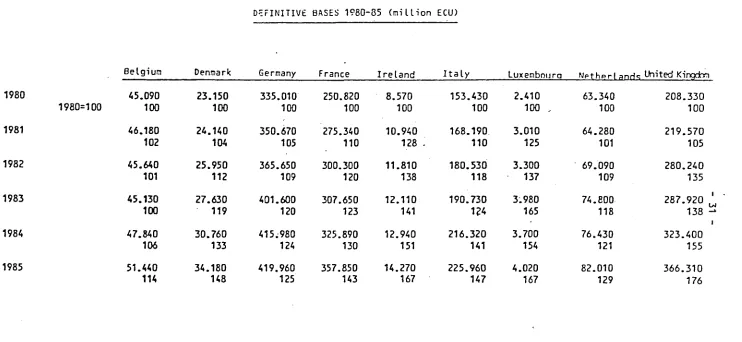
As Tables I and II show, the rate of increase in Denmark's base, which has been steady each year, did not slacken abnormally in 1983 with the changeover from the returns method to the revenue method.
In Ireland's case too, the base reported in the 1986 statement - the first year in which the revenue method was applied - is larger, subject to confirmation after the control, than the 1985 base, which was determined by the returns method.
However, precise comparison of the yield from the two methods is particularly difficult in Ireland's case, since the essential component of the revenue method is the VAT receipts collected during the reference period (a figure which should not need to be revised), while the returns method also takes account of value added from estimated assessments, an item which has to be corrected in subsequent years.
7.9 The conclusions to be drawn is that the returns method does not offer the Community or the Member States any definite and obvious advantage compared with the revenue method.
The Commission therefore considers that' a formal decision should be taken to confirm the revenue method as the sole definitive method, a choice already made by all the Member States.
8. Conclusions
8.1 In 1988, eleven years after it was adopted by the Council, Regulation No 2892/77 will cease to be the legal base for the collection of own
resources accruing from VAT.
The shortcomings and lack of prec1s1on in this legislation - inevitable in such an extremely complex area where there were no precedents to rely on - have almost all been remedied by amendments and more significantly
b Y t h e many pract1cal solutions worked out by the Commission and the . , ,
8.2 The results of these years of experience can be summed up as follows:
Despite the numerous difficulties encountered, the rules contained in Regulation No 2892/77 have proved technically viable, with
around 101,320 million ECU being collected in VAT resources between 1979 and 1987 and all the ~e~ber States being treated alike.
Within the legal limits laid down by Community law, the Commission's control operations have, all in all, been effective in verifying the amounts due and in ensuring compliance with the rules.
Of the two methods available to the Member States for determining the VAT resources base, the revenu~ method was ultimately adopted by all of them because of the more reliable result obtained in comparison with the returns method, which is no less complicated for the national authorities to apply and far more of a burden for taxable persons.
8.3 To conclude, the Commission considers that the decision on the definitive unform arrangements for the collection of VAT resources should not upset
this broadly favourable situation which has evolved. It therefore proposes that the new regulation to apply from 1 January 1989 should take the revenue method as the sole method and leave unchanged the provisions contained in the current legislation, .except for a number of necessary· technical amendments and the introduction of a very limited number of new provisions .to dP.nl with questions of substance raised by Parliament and the Court of Auditors.
Table I
DEFINITIVE BASES 1980-85 ~national currencies)
Belgi11111 Denmark Germany France Irelanrl Italy LIJxembourg Netherlands Bfr million Dkr million D~ million FF million IRL million Lit billion Lfr million Hfl million
1980 1.830.719 181.163 845.558 1.472.056 5.793 182.461 97.675 174.832
1980=100 100 100 100 100 100 ' 100 100 100
1-181 1.906.961 191.230 881.594 1.663.052 7.558 212.473 124.394 178.379
104 106 104 113 130 116 127 102
1982 2.040.535 211.712 868.783 1. 931.199 8.145 238.989 147.481 180.607
111 117 103 131 140 131 151 103
1983 2.050.550 224.654 912.031 2.083.113 8.656 257.473 180.692 189.762
112 124 108 142 149 141 185 109
1984 2.174.025 250.540 930.957 2.239.525 9.392 298.821 168.343 192.833
119 138 110 152 162 164 172 110
1985 2.310.346 274.057 934.820 2.431.590 10.203 327.197 180.343 205.917
126 151 111 165 176 179 185 118
rn
U>
Lhited Kinq:hl UKL million
124.683 100
121.445 97
157.077 126
169.008 136
190.999 153
215.756 173
~
D~FINITIVE BASES 1980-85 (million ECU)
Belgium Denmarlc Germany France Ireland Italy luxer.1boura NPthPrL aods United Kingd:t:J
1980 45.090 23.150 335.010 250.820 8.570 153.430 2.410 63.340 208.330
1980=100 100 100 100 100 100 100 100 J 100 100
1981 46.180 24.140 350.670 275.340 10.940 168.190 3.010 64.280 219.570
102 104 105 110 128 . 110 125 101 105
1982 45.640 25.950 365.650 300.300 11.810 180.530 3.300 69.090 280.240
101 112 109 120 138 118 137 109 135
I
1983 45.130 27.630 401.600 307.650 12.110 190.730 3~980 74.800 287.920 VJ
100 119 120 123 141 1~4 165 118 138 ~
1984 47.840 30.760 415~980 325.890 12.940 216.320 3.700 76.430 323.400
106 133 124 130 151 141 154 121 155
1985 51.440 34.180 lt19.960 357.850 14.270 225.960 lt.020 82.010 366.310
[image:31.828.51.793.106.448.2]DEFINITIVE BASES Cpercenta9e of GOP)
Belgiur.1 Dent;Jar~ Germany France Ireland Italy luxer.1bourg NAtherlands Unit~d ~inorla
1980 53,1 48,5 57,2 53,2 61,9 46,7 73,5 51,9 54,3
1981 53,6 46,9 57,2 53,5 66,5 45,4 87,4 50,6 48,0
1982 52,6 45,6 54,4 54,1 61, 1 43,8 92,3 49,0 57,0
1983 54,4 40,8 . 101,7 49,8 56,3 VI
49,8 43,8 52,9 59,5 N
1984 49,4 44,7 53,1 52,3 58,3 41,5 84,5 48,4 59,8
1985 49,1 44,7 50,8 53,0 59,1 40,6 85,2 49,6 61,6
Source: ESA national nr.counts
1980
1981
1982
1983
1984
1985
DEFINITIVE BASES (percentage of final consu~ption of households)
Belgium Denmark GP.rmany France IrP.land Italy luxembourq Netherl~nns Uni~Prl ~jnndom
84,4 87,5 91,8 84,8 94,2
81,7 84,4 90,4 83,1 100,9
80,7 83,5 86,3 84,2 101,6
76,6 81,1 86,4 82,2 100,0
75,6 82,7 84,5 81,8 101,7
75,6 82,6 81,6 82,2 104,1
76,6
74,5
71,6
67,0
68,1
66,4
125,1 85,0
144,2 83,7
154,0 81,4
173,1 82,6
150,5 82,2
152,1 84,1
Source: ESA national accounts
Aggreg~te~ 10nQ-HS
89,1
80,1
94,4
93,0
98,2
[image:33.829.164.773.166.453.2]Belgium
1980 13,58
1981 14,48
1982 14,20
1983 15,01
1984 14,89
1985 14,81
WEIGHTED AVERAGE RATE
Denmark Germany France·· Italy Luyembourg NethPrlands United Kingdom
11,46 15,73 10,28 7,46 14,23 9,37
11,46 15,83 10,74 7,37 14,16 9,40
11,67 16,06 11,41 7,71 14,07 9,23
22 1?,04 16,26 12,48 8,48 14,07 9,33
22 12,51 16,31 12,62 9,34 14,92 9,44
22 12,49 16,22 12,54 9,25 15,03 9,77
VJ
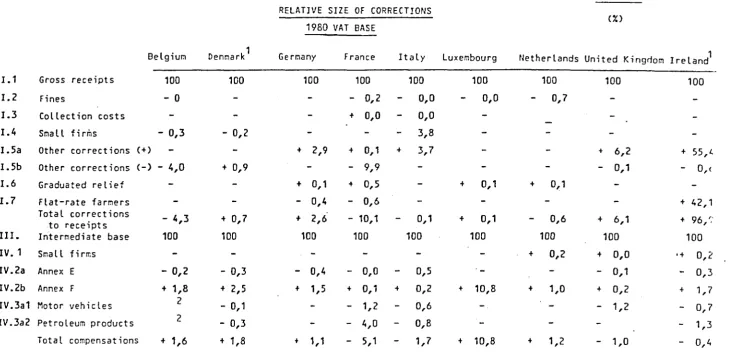
RELATIVE SIZE OF CORRECTIONS
(~)
1980 VAT BASE
Belgium Denmark 1 Germany France Italy luxembourg Netherlands United Kingrlom IrelanJ
!.1 Gross receipts 100 100 100 100 100 100 100 100 100
I.2 Fines - 0
-
-
-
0,2-
0,0-
0,0-
0,7I.3 Collection costs
-
-
-
+ 0,0-
0,01.4 S~:~all firms - 0,3 - 0,2
-
-
-
3,8I.5a Other corrections (+)
-
-
+ 2,9 + 0,1 + 3,7-
-
+ 6,2 + 55,L.I.5b Other corrections (-) - 4,0 + 0,9
-
-
9,9-
-
-
-
0,1-
0,<I. 6 Graduated relief
-
-
+ 0,1 + 0,5-
+ 0,1 + 0,1I. 7 Flat-rate farmers
-
-
-
0,4-
0,6-
-
-
-
+ 42,1Total corrections - 4,3 + 0,7 + 2,6 - 10,1
-
0,1 + 0,1-
0,6 +6,1 + 96,':' to receipts
III. I~termediate base 100 100 100 100 100 100 100 100 100
IV. 1 Small firrr.s
-
-
-
-
-
-
+ 0,2 + 0,0 •+ 0,2IV.2a Annex E - 0,2 - 0,3
-
0,4-
0,0-
0,5-
-
-
0,1-
0,3IV.2b Annex F + 1,8 + 2,5 + 1,5 + 0,1 + 0,2 + 10,8 + 1,0 + 0,2 + 1,7
IV.3a1 Motor vehicles 2 - 0,1
-
-
1,2-
0,6-
-
-
1,2-
0,7IV.3a2 Petroleum products 2 - 0,3
-
-
4,0-
0,8-
-
-
-
1,3Total compensations + 1,6 + 1,8 t 1,1
-
5,1-
1, 7 + 10,8 + 1,2-
1,0-
0,4 1oenmark and Ireland were the only countries to use method A. The figures are therefore not for gross receipts but for 2the intermediate
ba~~-Corrections Made to receipts.
I
LN
[image:35.830.53.784.60.415.2]