FINANCIAL REPORT 1981
ECSC
~uropean
Coal and Steel
This publication is also available in the following languages: DE ISBN 92-825-3050-7
FR ISBN 92-825-3052-3 IT ISBN 92-825-3053-1 NL ISBN 92-825-3054-X
Cataloguing data can be found at the end of this publication
Manuscript completed: 27 May 1982
Luxembourg: Office for Official Publications of the European Communities, 1982 ISBN 92-825-3051-5
Catalogue number: CB-35-82-077-EN-C
Articles and texts appearing in this document may be reproduced freely in whole or in part so long as their source is mentioned.
Contents
Activities
Introduction . . . . . . . 8
ECSC lending and guarantee operations . . . 11
Changes in reserves and provisions . . . 30
ECSC borrowing operations . . . 31
Other ECSC activities. . . 37
ECSC financial statements ECSC balance sheets at 31 December 1 981 and 1980 Revenue and expenditure accounts for years ending 31 December 1 981 and 31 December 1980 .... Allocation of surplus of revenue over expenditure for years ending 31 December 1981 and 31 De-cember 1980 . . . . ECSC budget 1981 - Implementation at 31 December 1 981 . . . . Annexes to financial statements 39 40 41 43 Changes in financial situation for year ending 31 December 1981 (Annex I) . . . 46
Allocation of net operating income for 1981 (Annex II) . . . 4 7 Statement of consolidated debt at 31 December 1 981 (Annex Ill l . . . 48
Main characteristics of borrowings outstanding at 31 December 1 981 (Annex IV) . . . 50
Analysis of loans outstanding (Annex V) . . . 56
Operations under the ECSC operating budget (Annex VI) . . . 59
Notes to financial statements at 31 December 1981 and 1980 (Annex VII) . . . 64
ECSC
The European Coal and Steel Community was established under a Treaty signed in Paris on 18 April 1951
by the Federal Republic of Germany, Belgium, France, Italy, Luxembourg and the Netherlands. The Treaty came into force in 1952 for a period of 50 years. On 1 January 1973, Denmark, Ireland and the United Kingdom became members of the ECSC. Greece acceded to the Treaty on 1 January 1981. The ten member countries are hereinafter referred to as the 'Member States'.
Commission
The Single Commission of the European Communities exercises the powers and responsibilities devolving upon 1he former High Authority in accordance with the rules laid down by the ECSC Treaty.
The present Members of the Commission, whose renewable term runs for four years, are:
Gaston Thorn
Franc;ois -Xavier Ortoli Wilhelm Haferkamp Lorenzo Natali Etienne Davignon Christopher Tugendhat Antonio Giolitti ~ Georgios ContogEwrgis Karl-Heinz Narjes Frans Andriessen lvor Richard Poul Dalsager Edgard Pisani
President Vice-President Vice-President Vice-President Vice-President Vice-President Member Member Member Member Member Member Member
The credit and investments sector is the special responsibility of Mr Franc;ois-Xavier Ortoli.
Directorate-General for Credit and Investments
ECU
By virtue of the Commission Decision of 19 December 1980(1
) the ECU replaced the EUA for operations
under the ECSC Treaty from 1 January 1 981 .
The ECU is a 'basket' unit made up of specific amounts of Member States' currencies, determined mainly by reference to ~he size of each Member State's economy. The equivalent of the ECU in any national cur-rency is equal to the sum of the equivalents in that curcur-rency of the following amounts:
German mark Pound sterling French franc Italian lira Dutch guilder Belgian franc Luxembourg franc Danish krone Irish pound
0,828 0,0885 1 '1 5 109,00 0,286 3,66 0,14 0,217 0,00759
The value of the ECU is determined daily. (Telex 23.789 at Brussels).
The calculation is made on the basis of representative rates for each Community currency against the dol-lar, which is used simply as a common reference for expressing exchange rates. These rates are taken daily on each exchange market by the central bank concerned; on the basis of these rates the Commission establishes an ECU equivalent in the Community currencies and in the other major currencies.
Activities
Introduction
General economic situation
While scarcely over the effects of the second oil shock of 1979-80, the Community economy in 1981 had to contend with two adverse factors: the strong appreciation of the dollar and the con-comitant rise in interest rates throughout the world. As a result, activity was more sluggish than had been expected. The slackening which first appeared in the second quarter of 1980. went on for longer than expected. For the first time since 1975 economic activity in the Community fell away in 1981.
In the closing months of 1981 industrial produc-tion showed a few faint signs of recovery. But this recovery will be slow. Real disposable in-comes fell and private consumption declined or re-mained level in most of the Member States. An-xious to limit their budget deficits the govern-ments allowed their current expenditure to in-crease only very slowly. Fixed investments have been falling since the middle of 1980 and stock-building has gradually lost momentum. Because of the situation on world markets Community ex-ports dropped sharply during the second half of 1980 but have more than recovered since then.
Gross domestic product, which fell by 0,5% in 1981 as compared with 1980, could increase by 1,6% in 1982. With world demand gradually ris-ing, Community exports should pick up. At the end of 1981 the number of unemployed had passed the 1 0 million mark. Since the recovery is expected to be slow, unemployment in the Com-munity will continue upwards. Towards the end of the year the rise in unemployment rates might slacken.
The current balance of payments deficit fell from almost 27 000 million ECU in 1980 to 19 000 million ECU in 1981. The terms of trade for the Community might improve in 1982. The volume of exports and imports is expected to continue growing in 1982, maintaining the upward move-ment already evident - notably for exports - in the second half of 1981.
8
Since world demand is expanding and export prices are not rising quite as sharply as import prices, the improvement for the Community will produce a deficit of 9 500 million ECU on current account.
Steel
In the Community a slight improvement in the net positive balance of the Community's foreign trade in steel was observed in 1981, despite the per-sisting depression on the world market. This was due to the appreciable decline in imports, the weakness of demand and the very low level of prices in the earlier part of the year.
Demand for steel fell more than demand in the economy as a whole, with both demand and pro-duction over the first three quarters of 1981 re-maining generally low. Orders booked during the first two quarters of 1981 were 6% and 3% lower than in the same periods of the previous year.
Though orders in July and August were 20% higher than in July and August 1980, they barely returned to the 1979 level. As a result of the pro-duction controls introduced by the Commission on 30 October 1980 the fall in prices for the main steel products was halted at the beginning of 1981 and prices were raised on 1 July and 1 Oc-tober. But taken over a longer reference period steel prices have hardened only very slightly.
After bottoming out at 58% during the last quar-ter of 1980, the capacity utilization of steel manu-facturers improved somewhat in 1 981 , and the relative rate for the whole of the year should be somewhere around 63,5%. However, the efforts that firms had to make to eliminate inefficient and non~competitive capacity inevitably had serious repercussions on employment. The cyclical diffi-culties, on top of the effects of the structural crisis, reduced the number of jobs in the steel in-dustry by almost 20% between 1978 and 1981 .
the survey conducted by the Commission early in
1981 showed that despite their financial difficul-ties the investment expenditure of steel compa-nies rose from 2 1 00 million ECU in 1979 to
2 400 million ECU in 1980. The increase was par-ticularly sharp in the Federal Republic of Germany and in Belgium. At constant 1970 prices expendi-ture for the entire Community was 2 000 million ECU in 1980 as against 1 100 million in 1979.
The same survey revealed that the final results of companies for 1981 should show a further in-crease in steel investments up to a volume of 2 900 million ECU. But when viewed against the production capacity which must be kept in opera-tion, the level of investment is still cause for con-cern. Even if the bulk of the investment is put into the most competitive and most profitable plant, it is unlikely that the European steel industry will be able to modernize even the substantially reduced capacity required to meet the demand envisaged in the general objectives. It must also be borne in mind that the rationalization drive now under way in the European steel industry will not have any positive and significant impact on companies' fi-nancial results for a number of years. In 1982 and
1983 at least, it is more than likely that firms will be able to finance only a very small proportion of their investments themselves and will have to turn to the public sector, in the form of govern-ment agencies or Community financial instru-ments.
Latest estimates would indicate that crude steel production potential in the Community - 202,5
million tonnes in 1980 - will fall to 196,8 million tonnes in 1984. Though desirable, this reduction will have only a marginal effect on the problems posed at present by surplus capacity. The fore-cast increase in capacity for finished products is
3,3 million tonnes - 168,6 million tonnes in
1 980 and 1 71 , 9 million tonnes in 1 984. A propor-tion of this increase could be attributed to the growth in quantities of semi-finished products as a result of the expansion of continuous casting. But production potential for finished products is still tending to rise. More fundamental measures
Coal
Even more so than in· 1980 the Community coal market in 1981 was affected by the general eco-nomic gloom. In the first nine months of 1981
gross energy consumption in the Community was
6,4% down on the same period in 1980. Coal consumption fell less (-3,6%) than that of other fossil fuels (oil -11,6%, gas -4,4%), which accentuates the trend observed a year ago.
Total consumption of coal in the Community de-clined from 313 million tonnes in 1980 to 305
million tonnes in 1981 and· should rise again to
309 million tonnes in 1982. Demand for coal from the non-producer countries rose from 37 to 40 million tonnes. Their share of imports from non-member countries represented roughly 48% of a total cif some 71 million tonnes, 4 million tonnes less than in 1980. Community availability (pro-duction plus recovery) stood at 250 million tonnes in 1981 against 254 million in 1980, thus meet-ing 80% of the needs as opposed to 82% in
1980. The fall in production was, however, limit-ed to 1 ,6 million tonnes. The share of the produ-cer countries in imports from non-member coun-tries decreased in 1981 by 4 million tonnes and could fall by a further 5 million tonnes in 1982. In-tra-Community trade in coal and coke represented roughly 10% of Community availability; between
1980 and 1981 trade in coal rose by 3 million tonnes and fell slightly for coke; there was again considerable trade in Community coal for the steel industry and an increase in coal sold for power stations in the Community. Stocks in general rose again; at the end of 1981 pithead stocks stood at over 46 million tonnes, a record figure equivalent to nearly 70 days' production.
The results of the Commission's survey on invest-ments early in 1981 showed that investment ex-penditure in the Community coal industry increas-ed by 44%, rising from 1 150,3 million ECU in
fur-Lastly, extraction potential increased very slightly in 1980 but is set to fall from 246.4 million tonnes to 238,5 million tonnes between 1980 and 1984. Extraction potential could thus level out between 235 and 245 million tonnes. This
)
Loans
ECSC lending and guarantee operations
1. The general trend in 1981
At 387,6 million ECU, the total amount of loans disbursed by the ECSC in 1981 was some 62% down on the 1980 figure of 1 030,7 million ECU. This drop is accounted for by a number of factors, notably sharp reductions in the number of loan applications and in the number of approvals of loans to the steel industry and for industrial conversion.
TABLE 1
(million ECU!
Loans approved(1) Loans approved
but not yet paid New loans approved Loans paid but not yet paid at the beginning duririg the year in 1981 at the end
of the. year of the year
1980 •. 2 523 .1 223 1 031 2 715
1981 2 715 1 098 325 3 488
(1) The Commission takes a decision of principle approving a loan to a firm to finance an investment. Within the limit approved by
this decision, the Commission raises funds on terms suiting the firm. It signs a contract with the firm for all or part of the loan whenever an instalment is paid.
TABLE 2
ECSC loans to the various sectors
(million ECU)
1977 1978 1979 1980 1981 1980 as
%of 1981
Coal industry 216,9 262,4 237,6 233,? 30,1 -87%
Steel industry 493,4 370,3 316,4 424~0 223,6 -47%
Thermal power
stations - 31 '1 41 '1 90,0 26,6 -70%
Industrial
conversion 16,4 113,3 59,1 266,1 86,0 -68%
Subsidized housing 12,0 16,7 21,6 7,9 14,7 +86%
Iron-ore mines
-
2,0 - - --Other 2,8 1,3 - 9,6 6,1 -36%
Total 741,5 797,1 675,8 1 030,8 387,6 -62%
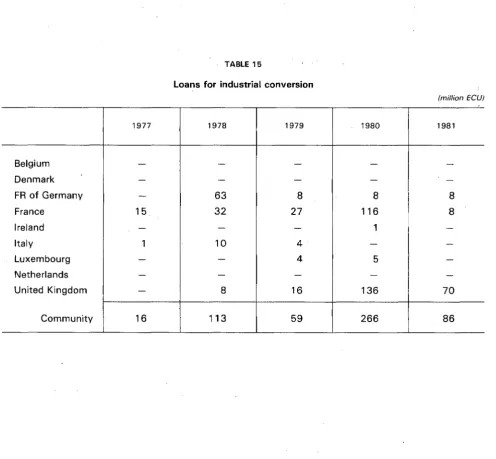
The considerable fall (68%) in conversion loans from 1980 to 1981 is mainly a function of the general re-luctance to invest.
However, although investment in most sectors declined in 1981, as it had in the previous year, in the steel industry and the coal industry there was a slight upturn. The Commission restricted loans to the steel industry to those projects which formed part of restructuring programmes designed to make a signi-ficant reduction in the overall capacity of the firm or group of firms and to concentrate production in the most competitive plants.
The main thrust of the Commission's aid in directing ECSC finance towards the coal industry was to assist modernization and rationalization projects designed to maintain or increase the yield of mines in the most productive coalfields. Under paragraph 2 of Article 54 of the ECSC Treaty it also helped to finance power stations and schemes for converting industrial plant and heating installations to coal. ·
TABLE 3
Loans in 1981 by country
(million ECU)
.~ E
15 >- Ol
"'
0>-:::l c :; "0 "0 .:>< ....
a.ro E Ql 0 c Ol "0 (;; Ql ·;:
<ll E :::l CJ. >- .0
"'
c c u :::la: ~ . ·o, c- n;· E ~ Q
"'
E Ql E- Ql
"'
.... a; c Ql~(.9 a;
u:
-
Ql £ "0 .!::: Ql ~ EQ l - co X :::l Ql -~ 0 .u 0
"0 0 ---' z c
Ql :::>
u..
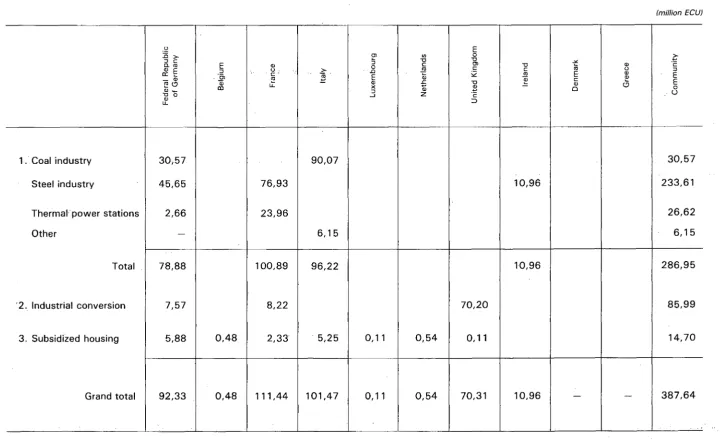
l. Coal industry 30,57 90,07 30,57
Steel industry 45,65 76,93 10,96 233,61
Thermal· power stations 2,66 23,96 26,62
Other - 6,15 6,15
Total 78,88 100,89 96,22 10,96 286,95
'2. Industrial conversion 7,57 8,22 70,20 85,99
[image:11.837.78.800.87.527.2]TABLE 4
Loans for industrial investment (Article 54)
(million ECU)
Total loans
New loans Total loans paid Balance outstanding paid at
in1981(1)
31.12.1980(1 )
Position at 31 .12. 1981
Belgium 216,79
-
216,79 118,61Denmark 55,48 - 55,48 37,62
FR of Germany 1 767,89 78,88 1 846,77 972,39
Greece
-
- --France 1 217,49 100,89 1 318,38 1 058,23
Ireland 18,43 10,96 29,39 29,39
Italy 1 154,49 96,22 1 250,71 935,97
Luxembourg 156,57 - 156,57 145,90
Netherlands 160,88 - 160,88 120,49
United Kingdom 2 050,28 - 2 050,28 1 723,76
Non-Community 6,96 - 6,96 6,96
Total 6 805,26 286,95 7 092,21 5 149,32
(1) After adjustment for the new rates for converting national currencies into ECU (seep. 64).
TABLE 5
Investment expenditure in the steel industry and the. coal industry 1977-80 and estimates for 1981 (1 )
I 1 000 million ECU)
1977 1978 1979 1980 1981
Coal industry 0,8 0,9 1,2 1 '7 1,8
Steel industry 2,4 2,0 2,1 2,4 2,9(2)
( 1) See Investment in the Community coalmining and iron and steel industries. Report on the 1981 survey, November 1981, Com-mission.
[image:12.580.46.542.608.718.2]ECSC loans paid out in 1981
(Amount in million ECU)
IRL 11,0
I 101,5
NB. In this graph, loans from the Pension Fund to
officials of the European Communities (22.41 million ECU), balance sheet adjustments (swap
operation - 5,64 million ECU) and provision
against debtors (9,65 million ECU) have been
excluded.
ECSC loans outstanding at
31 December 1981
(Amount in million ECU)
IRL 31,3
L 156,8
NL 136,5
1995,2
TOTA
L
387
,
6
TOTAL
5997,0
D 92,3
DK-D 1 168,0
TABLE 6
Proportion of investment in the steel and coal industries financed by ECSC loans
(%)
1977 1978 1979 1980 1981
Coal industry 26 28 21 14 0,2
Steel industry
-
5 18 15 18 8('1(1) Steel industry investments in Greece have not been included since ECSC lending operations in Greece have only just commenced.
2. Financing of investments in the steel industry (Article 54, paragraph 1 of ECSC Treaty)
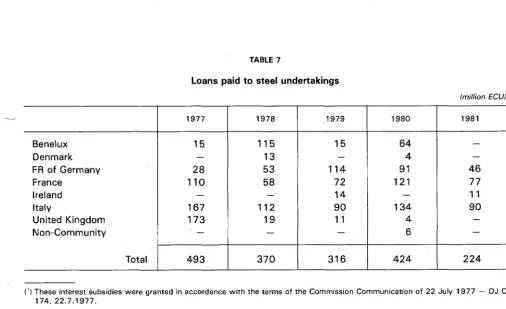
ECSC loans to the steel industry fell from 424,0 million ECU in 1980 to 223,6 million ECU in 1981. A total of 28 loans were made during the year, .13 of which received interest subsidies,C) being for projects which contributed to the restructuring of the Community steel industry.
Undertakings in four Member States - Italy, France, Federal Republic of Germany and Ireland - received payments in 1981.
The contribution of ECSC loans towards the cost of financing investments in the steel industry remained modest, however, except in the cases of France (18%) and Italy (12%).
New decisions approving loans in the steel sector were limited to the 'part-financing of four projects, only two of which received interest subsidies. ·
TABLE 7
Loans paid to steel undertakings
(million ECUI
1977 1978 1979 1980 1981
Benelux 15 115 15 64
-Denmark
-
13 - 4-FR of Germany 28 53 114 91 46
France 110 58
72
121 77Ireland -
-
14 - 11Italy 167 112 90 134 90
United Kingdom 173 19 11 4
-Non-Community
-
- - 6-Total 493 370 316 424 224
(1) These interest subsidies were granted in accordance with the terms of the Commission Communication of 22 July 1977- OJ C
[image:14.580.44.551.450.759.2]TABLE 8
Proportion of investment in the steel industry financed by ECSC loans
C)
(%)
1977 1978 1979 1980 1981
Benelux
6
45
3
14
-Denmark
1977-1981 53
FR of Germany
5
I
12
I
22
I
13
I
6
France
30
15
23
35
19
Ireland
1977-1981 : 31
Italy
33
25
21
28
12
United Kingdom
24
4
4
1
-Community
5
18
15
18
8
{1) Steel industry investments in Greece have not been included since ECSC lending operations in Greece have only just commenced.
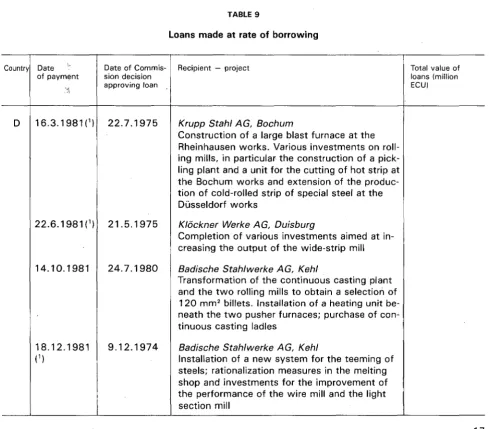
Loans paid for steel industry investments in
1981
were allocated as follows:TABLE 9
Loans made at rate of borrowing
Country Date Date of Commis- Recipient - project Total value of
of payment sian decision loans (million
. '~ approving loan ECU)
'-~
D
16.3.1981 (
1)
22.7.1975
Krupp Stahl AG, BochumConstruction of a large blast furnace at the Rheinhausen works. Various investments on roll-ing mills, in particular the construction of a pick-ling plant and a unit for the cutting of hot strip at the Bochum works and extension of the produc-tion of cold-rolled strip of special steel at the Dusseldorf works
22.6.1981 (
1)21.5.1975
Klockner Werke AG, DuisburgCompletion of various investments aimed at in-creasing the output of the wide-strip mill
14.10.1981
24.7.1980
Badische Stahlwerke AG, KehlTransformation of the continuous casting plant and the two rolling mills to obtain a selection of
1 20
mm2 billets. Installation of a heating unitbe-neath the two pusher furnaces; purchase of con-tinuous casting ladles
18.12.1981
9.12.1974
Badische Stahlwerke AG,
Kehl [image:15.580.33.523.337.766.2]Country Date of Date of Com- Recipient - project Total value
payment mission decision , of loans
approving loan (million ECU)
F 25.2.1981 27.11.1980 Usinor, Paris
Installation of a third 85-tonne OBM converter, addition of a vacuum ladle refining unit and a continuous slab casting unit at the Rehon works
25.2.1981
]
Sacilor, Paris22.5.1981 27.11.1980 Rationalization of the pig iron capacity at the Gandrange-Rombas works; improvement of the sintering plant which supplies this works; con-struction of a continuous bloom casting plant.
15.4.1981
17.3.1981 So/mer, Paris
22.5.1981 Recuperation of the gas produced in the LD con-verters, repair and improvement of No 1 blast furnace; installation of a reheating furnace at the Fos works.
I 15.1.1981
]
20.2.1979 lrfird SpA, Rome
14.7.1981 Completion of the construction of a new direct reduction plant.
2.2.1981
}
16.11 .1979 La Magana d'ltalia SpA, Florence 28.7.1981 Installation of a pre-lacquering line.
27.2.1981 15.12.1980 Falck SpA, Milan
Installation of a continuous bloom casting plant; modernization of the hoop, billet and light sec-tion mills.
14.7.1981 26.9.1979 Dalmine SpA, Milan
New rolling plant including a modern process for the production of seamless tubes.
Total of loans made at rate of borrowing under Article 54, paragraph 1 - steel industry 102,5
(1) Loans already made for a duration of less than eight years which have been extended for a limited period by reference to the
original timescale of the investment.
Loans at reduced interest rates granted in accordance with the communication of
22
July 1977(1 ); (steel industry restructuring projects)
Country Date Date of Com- Recipient - project Total value
of payment mission decision of loans
approving loan (million ECU)
D 24.8.1981 27.11.1980 Thyssen Edelstahlwerke AG, Dusseldorf
Country Date Date of Com- Recipient - project Total value
of payment mission decision of loans
approving loan (million ECU)
D 13.11.1981 26.7.1979 Klockner Werke AG, Duisburg
Construction of a KS plant (Kleckner steelmak-ing process) at the Georgsmarienhutte works, following shutdown of the OH melting shop.
F 16.1.1981 27.11.1980 Usinor, Paris
(for description, see 'Loans made at rate of borrowing')
14.4.1981 27.11.1980 Sacilor, Paris
(for description, see 'Loans made at rate of borrowing')
IRL 8.5.1981 5.6.1979 Irish Steel Ltd, Hawbowline
Modernization of the works by the installation of a new electric furnace, a continuous billet cast-ing plant and a section mill.
I 15.1.1981 4.7.1979 Ace. Piombino SpA, Piombino
Construction of a new blast furnace to replace two old blast furnaces; installation of a tree-strand continuous casting plant for blooms and a new 850 and 550 mill.
15.1.1981 4.9.1980 Teksid SpA, Turin
Installation of a five-strand continuous casting plant for billets.
15.1.1981
J
4.9.1980 Ace. Ferrero SpA, Turin14.7.1981 Installation of a 30-tonne electric furnace and a four-strand continuous casting plant for billets to replace obsolete plant.
5.3.1981
J
19.12.1980 IIssa Viola SpA, Milan14.7.1981 Replacement of an old hot rolling mill by a Steckel mill for the production of stainless steel coils.
23.3.1981 27.11.1980 ltalsider SpA, Genoa
Restructuring and modernization programme for the steel centre at Bag noli.
27.5.1981 15.12.1980 Ace. Ferr. Lombarde, Falck SpA, Milan
(for description, see 'Loans made at rate of borrowing')
Total of loans at reduced interest rates under Article 54, paragraph 1 - steel industry 1 21 '1
Total of all loans under Article 54, paragraph 1 - steel industry 223,6
3. Financing of investments in the coal industry (Article 54, paragraph 1 of ECSC Treaty)
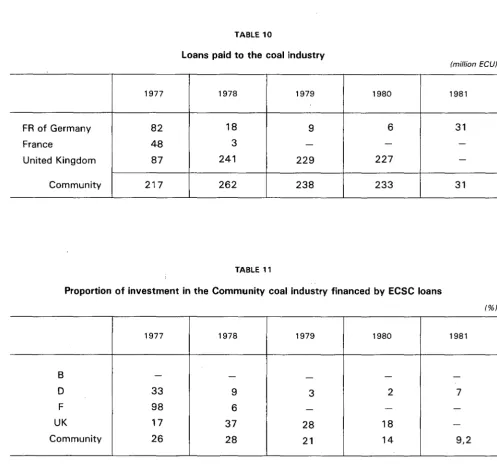
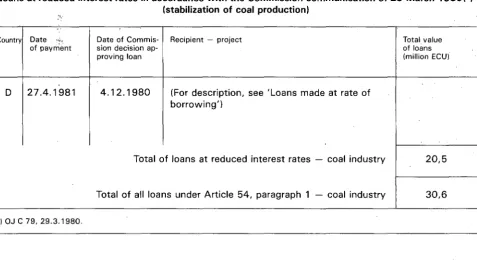
Two loans, totalling 31 million ECU, were granted to the coal industry in 1981. One of these loans was granted at a reduced interest rate because the project financed will help to consolidate production in the coalfield in question and hence indirectly help to stabilize coal production in the Community at its present level.
Despite the slight increase in investment in the coal industry in 1981, only the Federal Republic of Ger-many received ECSC loans during the year. No loans were paid to the coal industries of the other Member States, although several decisions to grant loans were taken at the beginning of the year.
The interest subsidy was granted in accordance with the communication from the Commission of 29 March 1980(1
) on the promotion of investment in the coal industry.
TABLE 10
Loans paid to the coal industry
(million ECU)
1977 1978 1979 1980 1981
FR of Germany 82 18 9 6 31
France 48 3 - -
-United Kingdom 87 241 229 227
-Community 217 262 238 233 31
TABLE 11
Proportion of investment in the Community coal industry financed by ECSC loans
(%)
1977 1978 1979 1980 1981
B - - - -
-0
33 9 3 2 7F 98 6 - -
-UK 17 37 28 18
-Community 26 28 21 14 9,2
[image:18.582.48.546.245.718.2]Loans paid for coal industry investments in 1981 were allocated as follows:
TABLE 12
loans made at rate of borrowing
Country Date Date of Com- Recipient - project Total value
of payment mission decision of loans
approving loan (million ECU)
D 16.3.1981 4.12.1980 Increasing pit capacity and driving a connection to the Westfalen pit (Cologne, Munster).
Total of loans made at rate of borrowing - coal industry 10,1
loans at reduced interest rates in accordance with the Commission communication of 29 March 1980(1 )
(stabilization of coal production)
I
..
Country Date .,;I Date of Commis- Recipient - project Total value
of payment sian decision ap- of loims
proving loan (million ECU)
D 27.4.1981 4.12.1980 (For description, see 'Loans made at rate of borrowing')
Total of loans at reduced interest rates - coal industry 20,5
Total of all loans under Article 54, paragraph 1 - coal industry 30,6
11 I OJ C 79, 29.3.1980.
4. Financing of thermal power stations under Article 54, paragraph 2 of ECSC Treaty
Three projects involving thermal power stations received ECSC loans (totalling 26,6 million ECU) in 1981. The total of loans granted under this heading was also considerably less than in 1980 (90,0 million ECU).
[image:19.580.43.521.370.646.2]The loans paid under this heading were allocated as follows:
TABLE 13
Country Date Date of Com- Recipient - project Total value of
of payment mission decision loans !million
approving loan ECU)
'
D 1:8.12.1981 24.9.1979 Steag, Essen
Construction of a new stack at the Walsum power station.
F 29.7.1981 5.6.1980 Richemont steelworks power station
Power station to generate electricity from blast-furnace gas produced by several steelworks: renovation of the power station.
20.11.1981 3.3.1978 Charbonnages de France, Paris
Construction of a new 600 MW generating unit at Carling.
Total of financing for thermal power stations 26,6
5. Financing for other sectors under Article 54, paragraph 2 of ECSC Treaty
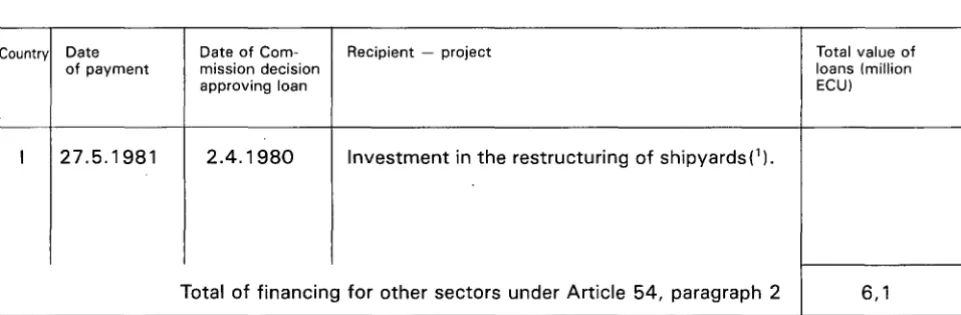
In 1981 the Commission granted only one loan under paragraph 2 of Article 54 of the ECSC Treaty for areas other than thermal power stations. The loan· in question was for the modernization of shipyards in Italy. It received an interest subsidy from special funds available in the general budget of the European Communities in view of the significant efforts being made in the shipyards in question to carry out re-structuring operations.
Five decisions were taken in 1981 approving new loans under paragraph 2 of Article 54 bf the ECSC Treaty. Two concern the conversion of industrial processes to coal, two others the supply of raw materials to the steel industry and the fifth is to finance railway wagons specially designed for the carriage of
coking coal and steel products. ,..
T~e
loans paid for investmentsi~
other sectors (in this case the shipbuildingindo~iry)
were allocated as follows:TABLE 14
Country Date Date of Com- Recipient - project Total value of
of payment mission decision loans !million
approving loan ECU)
I 27.5.1981 2.4.1980 Investment in the restructuring of shipyards
e
l.Total of financing for other sectors under Article 54, paragraph 2 6,1
11
) This loan received an interest subsidy from Article 772 of the general budget of the European Communities which contains an
[image:20.580.60.541.564.721.2]6. Loans for industrial conversion (Article 56)
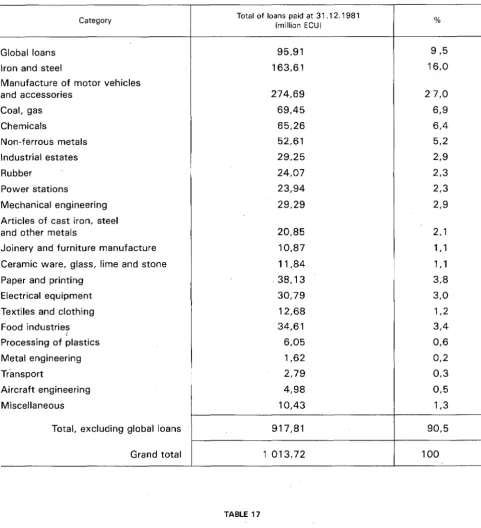
The restructuring of the steel industry has already resulted in a considerable reduction in the number of jobs, which fell from 792 000 in 1974 to 547'00ii/ in 1981. As in the past, the Commission tried in 1981 to encourage the creation of new jobs in other seCtors by mea:ns of loans at reduced rates of interest. It also increased its support for small and medium-sized businesses. For the sake of efficiency it acted through financial institutions, to which it granted global loans which were then on-lent to such busi-nesses.
During 1981 the Commission paid 30 conversion loans, 1 7 of them in the form of global loans to promote investment by small and medium~sized businesses. Loans granted pursuant to Article 56 of the ECSC Treaty may qualify for interest subsidies on all or part of .the amount. The interest rate payable· ori ·such loans for five years is then three points below the normal rate, which matches the rate on the borrowed funds. The reduced rate is granted on condition that some of the new jobs created will be reserved .prima-rily for workers made redundant in the ECSC industries. ·
Under the Treaty, requests for loans of this type are submitted to the Commission by the government of the Member State concerned. The geographical distribution of the loans granted therefore largely reflects the national policies on conversion.
The Commission decided to grant 28 new conversion loans during the year: 11 global loans and 17 direct. They should create 13 580 new jobs.
TABLE 15
Loans for industrial conversion
(million ECU) ,.
1977 1978 1979 1980 1981
Belgium - - - -
-Denmark - - - -
-FR of Germany
-
63 8 8 8France 15 32 27 116 8
Ireland - -
-
1-Italy 1 10 4 -
-Luxembourg - - 4 5
-Netherlands - - -
-
-United Kingdom - 8 16 136 70
[image:21.579.33.529.302.760.2]TABLE 16
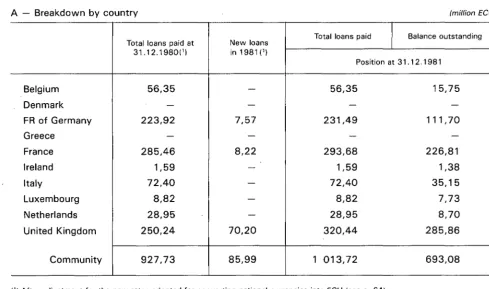
Loans for industrial conversion (Article 56)
A - Breakdown by country (million ECUI
Total loans paid at New loans Total loans paid
I
Balance outstanding 31.12.1980(1) in 1981 (1)Position at 31.12.1981
Belgium 56,35 - 56,35 15,75
Denmark - - -
-FR of Germany 223,92 7,57 231,49 111 '70
Greece - - -
-France 285,46 8,22 293,68 226,81
Ireland 1,59
-
1,59 1,38Italy 72,40 - 72,40 35,15
Luxembourg 8,82 - 8,82 7,73
Netherlands 28,95 - 28,95 8,70
United Kingdom 250,24 70,20 320,44 285,86
Community 927,73 85,99 1 013,72 693,08
[image:22.579.48.537.87.376.2]8 - Breakdown by industry
Category Total of loans paid at 31.12.1981 %
(million ECU)
Global loans
95,91
9,5
Iron and steel
163,61
16,0
Manufacture of motor vehicles
and accessories
274,69
2 7,0
Coal, gas
69,45
6,9
Chemicals
65,26
6,4
Non-ferrous metals
52,61
5,2
Industrial estates
29,25
2,9
Rubber
24,07
2,3
Power stations
23,94
2,3
Mechanical engineering
29,29
2,9
Articles of cast iron, steel
and other metals
20,85
2,1
Joinery and furniture manufacture
10,87
1 '1Ceramic ware, glass, lime and stone
11,84
1
'1Paper and printing
. 38,13
3,8
Electrical equipment
30,79
3,0
Textiles and clothing
12,68
1,2
Food industries
34,61
3,4
Processing of plastics
6,05
0,6
Metal engineering
1,62
0,2
Transport
2,79
0,3
Aircraft engineering
4,98
0,5
Miscellaneous
10,43
1,3
Total, excluding global loans
917,81
90,5
Grand total
1 013,72
100
TABLE 17
ECSC industrial conversion loans paid by the Commission in 1981 J?Ursuant to Article 56
Country Date Date of Com- Recipient Project Total value
of payment mission decision of loans
approving loan (million ECU)
D
27.2.1981
2.5.1980
Westfalenbank Small investment in steel AG, Bochum industry for: [image:23.579.35.517.70.599.2]Country Date Date of Com- Recipient Project Total value
of mission decision of loans
payment approving loan {million ECU)
0
5.6.1981
2.5.1980
Westfalenbank For Lueg, Bochum AG, Bochum (first global loan)5.6.1981
19.12.1977
Saarlandische For small and medium-sized lnvestitions- businessesKreditbank, (first global loan) Saarbri.icken
30.6.1981
2.5.1980
Westfalenbank For Badische Stahlwerke, AG, Bochum Kehl(first global loan)
9.11.1981
20.5.1980
Westfalenbank For Badische Stahlwerke, AG, Bochum Kehl(first global loan)
7,6
F
19.3.1981
9.11 .1979
Societe de deve- For small and medium-sized loppement re- businessesgional du Nord (first global loan) et du
Pas-de-Calais, Lille
8.5.1981
18.7.1979/
Garolor SA, (Lorry grouping centre at10.4.1981
Metz Ennery)8.5.1981
21.5.1980
Credit national, For small and medium-sizedParis businesses
(first global loan)
15.5.1981
13.7.1979
Banque popu- For small and medium-sized laire du Nord, businessesLille (first global loan)
29.5.1981
5.11 .1979
Societe de deve- For small and medium-sized loppement re- businessesgional de Lor- (second global loan) raine (Lordex),
Nancy
8,2
UK
10.3.1981
13.7.1979
Finance for In- For small and medium-sized dustry, London businesses(Kinloch Anderson Ltd) (second global loan)
27.5.1981
13.7.1979
Finance for In- For small and medium-sized dustry, London businesses(second global loan)
Country Date Date of Com- Recipient Project Total value
of mission decison of loans
payment approving loan (million ECUI
:
UK
5.6.1981
25.6.1980
Yates Circuit New works Foil Co. Ltd,Silloth, Carlisle
16.7.1981'
13.7.1979
Finance for In- For small and medium-sized dustry, London businesses(second global loan)
4.8.1981
25.6.1980
Yates Circuit New works Foil Co. Ltd,Silloth, Carlisle
4.8.1981
19.12.1980
Daniel Don- New works in Leeds caster & SonsLtd, Sheffield
11.11.1981
13.7.1979/
Finance for In- For small and medium-sized18.7.1980
dustry, London businesses (second and third global loans)23.11.1981
18.7.1980
Oxford Univer- Book repository shy Press, Corby23.11.1981
21.4.1980
Deeside -~ Manufacture of titanium Titanium, Gwent granules23.11.1981
10.12.1979
McKellar Watt Manufacture and deep Ltd, Gla~gow freezing of meat products23.11.:1981
17.12.1979
Alfred Teves Ltd, Manufacture of disc:.. London brakes, etc.
7.12,1.981
26.6.1981
Tetra Pak Ran- Manufacture of printed sing & Co. Ltd, cardboard, etc.London '
7.12.1981
3.7.1981
Barclays· Bank For small and medium-sized Ltd, London businesses, global loan7.12.1981
3.7.1981
Welsh Develop- For small and medium-sized ment Agency, businesses, global loan Cardiff7.12.1981
19.12.1980
Scottish For small and medium-sized· Development businesses, global loan Agency,Glasgow
7.12.1981
22.7.1981
Cooperative For small and medium-sized Bank Ltd, businesses, global loan Manchester14.12.1981
10.4.1981
Mitel Telecom Telephone exchanges, Ltd, Newport, microelectronic products Gwent23.12.1981
28.7.1981
Optical fibres Manufacture of optical Ltd, Shotton, fibres forClwyd telecommunications
23.12.1981
28.11.1980
Sony UK Ltd, Television tubes7. Housing loans (Article 54, paragraph 2 of ECSC Treaty)
The housing finance policy continued in 1 981. Loans for this purpose are normally drawn from the ECSC's own funds at an interest rate of 1% per annum on a lbng-term basis. As a rule, they are granted in the currency of the country concerned to avoid exchange risks to recipients.
In 1981 the Commission paid out a total of 14,6 million ECU for ECSC subsidized housing, 9,3 million ECU under the eighth scheme and 5,3 million ECU under the ninth scheme which is now in operation.
The 1% loans paid from own funds totalled 9,4 million ECU in 1981; this was boosted by a further 5,4 million ECU from borrowed funds. These amounts enabled the Commission to finance around 3 000 new subsidized qwellings, bringing the total number financed by the ECSC to 170 000.
The very low interest rates charged enable borrowers to combine this type of loan with other loans raised on national markets on the prevailing terms. Borrowers thus have much larger sums to draw on but still benefit from an advantageous average rate.
TABLE 18
Loans for subsidized housing (Article 54, paragraph 2)
(million ECUJ
Total loans paid
I
Balance outstanding Total loans paid at New loans31.12.1980(1 )
Position at 31.12.1981
Belgium 37,99 0,48 38,47 9,98
Denmark 1,44 - 1,44 0,93
FR of Germany 144,83 5,88 150,71 82,88
Greece - -
-France 37,67 2,33 40,00 21,85
Ireland 0,64 - 0,64 0,54
Italy 27,22 5,25 32,47 24,03
Luxembourg 6,61 0,11 6,72 3,12
Netherlands 14,45 0,54 14,99 7,17
United Kingdom 12,34 0,11 12,45 9,21
Community 283,19 14,70 297,89 159,71
(1) After adjustment for the new rates for converting national currencies to ECU (seep. 64).
8. Guarantees
Redemption of the initial loans granted by third parties and guaranteed by the ECSC under Article 54 of the Treaty reduced commitments to 4,44 million ECU at 31 December 1981 .
[image:26.578.55.548.297.625.2]9. Summary of lending and guarantee operations (1954-81}
From the start of its financing operations up to 31 December 1981 the ECSC granted loans totalling 8 417,6 million ECU, of which 8 177,9 million ECU was from borrowed funds and 239,7 million ECU from own resources (special reserve and former pension fund).
Guarantees provided over the same period bring the total amount of ECSC financial operations to 8 482,5
million ECU by the end of 1981 as compared with 7 316,7 million ECU at 31 December 1980. The signifi-cant difference between the figures for the two years reflects exchange rate adjustments (
+
778,2 million ECU) rather than new payments (+
387,6 million ECU).TABLE 19
Loans paid and guarantees granted up to 31 December 1981 by type of investment and country
Initial amounts
e)
(million ECU)Loans
Total loans Breakdown
From bor- From own Guarantees and guarantees % rowed funds resources Total
Type of investment
Coal industry 1 920,89 - 1 920,89 - 1 920,89 22,65
Iron-ore mines 126,32 - 126,32 - 126,32 1,49
Steel industry · 4 673,81 3,45 4 677,26 64,81 4 742,07 55,90
Thermal power stations 332,34 - 332,34 - 332,34 3,92
Industrial conversion 1 010,35 3,36 1 013,71 - 1 013,71 11,95
Workers' housing 78,80 219,09 297,89
-
297,89 3,51Miscellaneous 35,40 13,77 49,17 0,14 49,31 0,58
Total 8 177,91 239,67 8 417,58 64,95 8 482,53 100,00
Country
Belgium 299,05 13,11 312,16 312,16 3,68
Denmark 55,48 1,44 56,92 56,92 0,67
FR
of Germany 2 104,43 135,37 2 239,80 55,49 2 295,29 27,06Greece -
-
- - --France 1 612,27 40,80 1 653,07 9,32 1 662,39 19,60
Ireland 30,98 0,64 31,62 31 ,62' 0,37
Italy 1 339,92 15,76 1 355,68 0,14 1 355,82 15,98
Luxembourg 167,42 5,63 173,05 - 173,05 2,04
Netherlands 190,68 14,47 205,15 - 205,15 2,42
United Kingdom 2 370,72 12,45 2 383,17 - 2 383,17 28,10
Non-Community 6,96 - 6,96 - 6,96 0,08
Changes in ECSC reserves and provisions between 31 December
1980 and 31 December 1981
TABLE 20
(million ECUJ
Position at
Changes in 1981 Position at
31.12.1980 31.12.1981
Reserves
Guarantee fund 260,00 40,00 300,00
Special reserve 143,50 6,50 150,00
Former pension fund 41,85 1,00 42,85
Budgetary provisions
(a) Redeployment of workers 215,28 36.45 251,73
(b) Social aspects of restructuring - 48,63 48,63
(c) Technical and economic research 77,99 0,37 7!:~,36
(d) Interest subsidies (Article 56) 43.71 -6,60 37,11
(e) Interest subsidies (Article 54) 35,88 -2,57 33,31
(f) Assistance to coking coal 3,88 -0,29 3,59
Other provisions 119,26 66,51 185,77
Total 941,35 190,00 1 131,35
Unallocated balance 0,14 0,32 0.46
Grand total 941.49 190,32 1 131,81
Revenue from the levy, which has been set at 0,31% since 1 January 1980, amounted to 126,5 million ECU in 1981, as compared with 114,5 million ECU in 1980. This is made up of 33.4 million ECU from coal production and 93,1 million ECU from steel production.
Income from the management of liquid assets, in other words interest on own resources invested, was
124.4 million ECU, and income from borrowed funds not yet disbursed was 17.4 million ECU.
[image:28.579.56.541.196.536.2]Borrowings
ECSC borrowing operations
Under the impact of inflationary pressures and of the highly restrictive monetary and fiscal policies pur-sued in the United States and elsewhere, interest rates on the capital markets in 1 981 settled at very high levels. In addition, some capital markets, notably the dollar market, were generally unstable.
While the volume of business on international bond markets expanded briskly, variable-rate and 'zero' coupon operations showed even more rapid growth. Leaving aside public issues, a growing number of borrowers resorted to private placings, bank lending and government financing.
Under these difficult circumstances, the Commission contracted borrowings totalling 325,4 million ECU in 1981. Out of 23 borrowing operations (141,3 million ECU), 19 were on Member States' capital markets, three on the Swiss market and one on the Eurodollar market. Four were public issues and 19 were private placings (seep. 34).
The large share of the value of total borrowings accounted for by private placings (43%) and the relatively modest average size of each operation ( 14,2 million ECU) were due to. a combination of factors: the slower rate and smaller volume of applications for payment in each currency from the firms receiving ECSC loans, very high interest rates and the generally unstable conditions on a number of capital markets.
Tt'Je two currencies accounting for the largest shares of borrowed funds were the German mark (33,5%) and the Swiss_ franc (20,5%). Notable developments were the increase in the number of operations de-nominated in Dutch guilders (57,8 million ECU, or 7,8%) and in Luxembourg francs (33,5 million ECU, or
TABLE 21 (11
(million ECU)
Currencies borrowed Total borrowings contracted(21 Repayments Balance outstanding
USD 3 352.47 870,16 2 482,31
OM 2 163,56 670,57 1 492,99
SFR 1 257,78 646,30 611.48
FF 572,58 88,20 484,38
LFR 283,97 90,72 193,25
HFL 274,22 87.46 186,76
BFR 234;03 66,20 167,83
UKL 140,33 4,69 135,64
LIT 118,90 62,90 56,00
EMU$ 74,87 74,87 0,00
CAD 58,26 0,00 58,26
u.a. 41,85 27,20 14,65
Total borrowings received 8 572,82 2 689,27 5 883,55 (3
)
at 31 . 1 2. 1 9 81
Borrowings contracted but not yet received at
31.12.1981
FF 1,61
Total 8 574.43
(1) The main characteristics of the borrowings issued and/or contracted by the ECSC up to 31 December 1981 and details of the u.a.
and E! are given in Annex 4.
(2) After adjustment for the new rates for converting national currencies into ECU (seep. 64).
[image:30.578.54.542.72.465.2]ECSC borrowings in 1981
(Amounts in million ECU)
NB. In this graph repurchased bonds with a nominal value of 67,57 million ECU withdrawn from the market have been excluded.
Current ECSC borrowings at 31 December 1981
(Amounts in million ECU)
FF 84
UKL 16,77
LFR 33,54
HFL 57,77
LFR 193,25
SFR 611
DM 1 492,99
TOTAL
325,42
TOTAL
5883
,
55
w
.j:>.
Type of borrowing and redemption
Public issues
From 1987, five equal instalments
From 1986, five instalments of 8 million and one of 40 million
Whole amount in 1 988
From 1983 , five instalments of 30 million, three of 60 million and one of 270 million
Private p/acings
Whole amount in 1986
From 1986, three equal instalments
From 1986, one instalment of 50 million and two of 100 million, four instalments of 0,06 million, one of 0,08 million, four of 0,2 million and one of 0,88 million
From 1987, four equal instalments
From 1986, four equal instalments
From 1987, five equal instalments
From 1984, ten equal instalments
Whole amount in 1986
From 1986, four equal instalments
Date of contract 18.2. 1.4. 3.4. 15.1 0. 23.2. 12.3. 3.4. 7.4. 15.4. 25.5. 10.6. 24.6. 29.6. 13.7. 30.7.
TABLE 22
ECSC borrowings in 1981
Amount (millions)
in
bor-Currency equivalent
rowing
in ECU(1 )
currency
DM 120 49,09
SFR 80 40,99
USD 40 36,86
LFR 600 14,37
FF 20 3,22
LFR 300 7,19
LFR 250 5,99
UKL 2 3,53
HFL 60 22,36
DM 10 4,09
HFL 50 18,64
HFL 45 16,77
SFR 30 15,37
DM 26 10,64
DM 12,27
Coupon(%) Duration Issue price Stock exchange listing (years)
10 10 100 Frankfurt-
Berlin- Munich- Hamburg-Dusseldorf
Zurich-
Basle-63/4 10 1001
/2
Geneva-Lausanne- Bern
14 7 991
/2
Luxembourg13 10 100 Luxembourg
15 5 -
-131
/2
7 --131/4 7 -
-141/4 9 -
-115/s 10
-
-111/4 8 -
-117 /s 10
-
~127 /s 12
-
-73/4 5 -
-111/2 8 -
-From 1983, five equal instalments
F~om 1986, four equal instalments From 1986, four equal instalments
Whole amount in 1 987
Ten equal half~yearly. instalments
Ten equal half-yearly instalments
From 1986, two instalments of 30 million and one of 40 million
I
Whole amount in 1986
(1) Parity on 31 December 1981.
(2) Borrowings contracted but not yet received.
15.10. LFR
16.10.
OM
2.11. UKL
5.11. SFR
3.12. FF
3.12. FF
3.12.
-1
LFRI
15·.12.
OM
150 3,59 15 6
70 28,64 10,39 8
7,5 13,24 163
/a
820 10,25 61/2 6
5(2) 0,81 143
/4 7
5(2) 0,81 143
/4 7
100 2.40
I
15I
710,5 4.30 93
/4 5
Total borrowings and breakdown of loans up to 31 december 1981
Amounts in million European units of account
8600-
8400-8200
-
8000-
7800-
7600-7400
-
7200-7000
-
6800-
6600-
6400-6200
-
6000-5800
-5600
-
5400-
5200-
5000-
4800-
4600-
4400-
4200-
4000-3800
-
3600-
3400-
3200-
3000-
2800-
2600-
2400-2200
-2000
-1800
-
1600-
1400-
1200-
10008 0 0
6 0 0
4 0 0
2 0 0
-36
LOANS L! _ _ ___,! Miscellaneous
I
Readaptation and industrial~~~-' redevelopment and reconversion
- Workers' housing
._ _ _ _,,Industrial loans
-Other ECSC activities
These activities are not financed through the ECSC's borrowing and lending operations but through the ECSC operating budget. They involve aid for the redeployment of workers, for coal and steel research and for social research.
Aid for the redeployment of workers
(Article 56(2)(b) of the ECSC Treaty)
The ECSC gives financial assistance to alleviate the hardship suffered by workers made redundant as a result of restructuring operations and to redeploy them in other sectors of the economy. The detailed rules for this financial assistance are laid down in a series of bilateral conventions with the Memb·er States.
Redeployment aid largely takes the form of income support for the workers affected, whether they are unemployed, employed in a different job or undergoing vocational training. The ECSC also contributes to-wards the cost of organizing training courses and helps to facilitate employment by paying travel or re-settlement allowances for redeployed workers .
. In 1981 aid applications granted under the bilateral conventions totalled a record 124 million ECU, com-pared with no more than 67 million ECU in both 1979 and 1980. This increase was particularly marked in the steel industry, where commitments of 11 0 million ECU reflect the scale of the labour movements in this sector in recent years. A breakdown by country and sector of commitments in 1981 is given in Table 38.
With the introduction by the Council in June 1981 of the steel industry social measures to accompany the market control measures, it has been possible to widen the range of redeployment aids by adding a number of temporary measures. In order to cover the cost of early retirement and short-time working by workers affected by restructuring programmes, the Commission has requested an exceptional additional sum of 212 million ECU spread over a period going up to the end of 1984. The Council has granted a first instalment of 50 million ECU on the basis of national ad hoc contributions, of which 48,6 million ECU had actually been allocated before the end of the year to aid programmes in different Member States.
Table 37 shows provisions for redeployment aid (traditional aid as well as steel industry social measures) at 31 December 1981 .
Steel industry research
(Article 55 of the ECSC Treaty)
A total of 172 proposals for steel research projects were submitted to the Commission under Article 55(2)(c) of the ECSC Treaty for financial aid under the 1981 budget. After detailed examination by Com-mission departments and the Iron and Steel Technical Research Committee, 71 proposals were given a priority rating.
(i) iron production (5%). (ii) steel production (31 %).
(iii) rolling mills and mechanical working (12,4%), (iv) measurements and analyses (13%),
(v) properties and in-service behaviour (34,2%). (vi) plant availability (3,6%).
Coal industry research
(Article 55 of the ECSC Treaty)
Atting under Article 55(2) of the ECSC Treaty, the Commission, after consulting the ECSC Consultative Committee and with the assent of the Council, decided, on 20 May 1981, to grant 15 867 300 ECU for the execution of 37 projects and to allocate 132 700 ECU to the dissemination of research results and re-lated costs.
In pursuance of this decision the Commission has signed contracts worth 15 867 300 ECU for 19 pro-jects on mining engineering and 18 propro-jects on product beneficiation. From 1981 onwards the Commis-sion no longer counts the value of the investment in equipment as the research cost, but the depreciation of the investment. This provides a reasonable solution to the sore problem of assessing the residual value of equipment at the end of the research project.
Social research
(Article 55 of the ECSC Treaty)
ECSC research in the social field developed in 1 981 under the outline programmes adopted by the Com-rrlission.
Di.~ring the year the Commission granted financial aid to research in the following fields:
Mining safety
Industrial hygiene in mines
Anti-pollution measures in the steel industry
Fourth ergonomics programme
Total
12 projects
14 projects
22 projects
32 projects
80 projects
683 650 ECU
2 097 400 ECU
2 553 530 ECU
3 665 420 ECU
9 000 000 ECU
In the same year the Commission authorized the implementation of a fourth five-year medical research programme to which it has allocated 9 million ECU.
ECSC financial statements
ECSC balance sheets at 31 December 1981 and at 31 December 1980
TABLE 23
IECU) '
l ~~( ) ":
1981 1980
.··.··:. \'.
Assets
Cash in harld and balances with
central banks 4 169 589 5 760 379
Claims on credit institutions
- repayable on demand 29810005 24 838 983
- with agreed maturity dates or periods of notice 567 947 306 523 345 753
597 757 311 548 184 736
Debt securities held in portfolio (Notes 2 and 3) 288 063 142 264 243 139
Loans outstanding (Note 4) 6 011 262 106 5514673415
Recoverable issuing costs and redemption
premiums (Note 2) 62 233 630 72 722 065
Bank deposits for coupons and bonds due but
not yet presented for payment 45 020 909 55 471 293
Land and buildings (Note 5) 345 626 286 389
Other assets (Note 6) 54 610 710 25 201 409
Accruals and deferred income (Note 7) . 198 976 051 155 563 851
7 262 439 074 6 642 106 676
Liabilities
Coupons and bonds due but not yet presented
for payment 45 015 376 55471223
Long-term and medium-term debts (Note 8) 5 815 974 032 5 405 735 297
Other liabilities 15 242 985 14 823 929
Accruals and deferred income (Note 9) 254 398 040 224 587 699
Total liabilities towards third parties 6 130 630 433 5 700 618 148
Commitments for ECSC operating budget (Note 1 0)
- financial assistance 452 734 774 376 741 857
- other 185 766 737 119 259 059
Reserves (Note 11) 638 501 511 496 000 916
- Guarantee fund 300 000 000 260 000 000
- Special reserve 150 000 000 143 500 000
- Former pension fund 42 850 240 41 847 043
492 850 240 445 347 043
Unallocated balance 456 890 140 569
[image:37.579.34.514.124.733.2]Revenue and expenditure accounts for years ending 31 December
1981 and 31 December 1980
TABLE 24
(ECUJ
1981 1980
Expenditure
Interest payable 530 613 518 429 401 595
Commissions payable 4 738 377 3 870 354
Administrative expenditure
(fixed amount) (Note 12) 5 000 000 5 000 000
Value adjustment for losses on claims and provisions for general risks connected
with ECSC operations (Note 2) - 11 572 097
Value adjustments in respect of securities 1 214 330 580 265
Capital losses on securities 256 452 941 235
Amortization of issuing costs and
redemption premiums (Note 2) 15 764 106 16 052 529
Other expenditure 1 236 291 439 909
Research expenditure 40 539 845 40 962 596
Redeployment expenditure 64 870 914 35 667 540
Expenditure on coking coal and
metallurgical coke 6 134 678 10 942 478
Expenditure on interest subsidies
(Article 54) 10257451 7 437 504
Expenditure on interest subsidies
(Article 56) 12 867 705 10 593 799
Exchange losses
-
1 691 396Surplus of revenue over expenditure 190 199 113 114 483 290
883 692 780 689 636 587
Revenue
Interest receivable (Note 13) 677 420 627 538 682 392
Gains on repurchased bonds (Note 3) 11 117 285 4 110 303
Issuing premiums 4411610
-Other revenue 11 119 2 239 285
Levies and fines (Note 14) 138 567 937 116 604 607 Contributions from Member States 52 879 000 28 000 000
Exchange gains 9 285 212
-883 692 780 689 636 587
NB. The notes on page 64 are an integral part of these financial statements.
[image:38.579.64.544.120.738.2]Allocation of surplus of revenue over expenditure for years ending
31 December 1981 and 31 December 1980
TABLE 25
IECU)
1981 1980
Surplus not allocated at 1 January 140 569 419 033
Surplus for the year to be allocated 190 199 113 114 483 290
Total for allocation 190 339 682 114 902 323
Allocations (Annex I, Table 28)
Guarantee fund 40 000 000 30 000 000
Special reserve 6 500 000 3 500 000
Former pension fund 882 197 316 081
Financial assistance 75992917 66 720 520
Other 66 507 678 14 225 153
Total allocations 189 882 792 114 761 754
Surplus not allocated at 31 Decembe'r 456 890 140 569
NB. The notes on page 64 are an integral part of these financial statements.
European Coal and Steel Community Commission of the European Communities
A. NICOLETTI
Director-General
F.-X. ORTOLI
Vice-President
[image:39.576.32.516.176.442.2]ECSC budget 1981 -
Implementation at 31 December 1981
At 31 December 1981 the rate of utilization was very low in relation to the Commission's forecast of 10 November 1981 (60,5 million ECU on the requirements side). The reason for this low rate is that the Council of Ministers did. not agree to a transfer of 62 million ECU from Chapter 54 of the 1981 general budget to the ECSC operating budget; this amount represented the second tranche of appropriations to fi-nance the steel industry social measures. Consequently the provision of appropriations for these social measures remained at 48,6 million ECU, financed by direct contributions from the Member States. Apart from this low utilization rate for the steel industry social measures, there was a small surplus of 1 ,3 mil-lion ECU made up as follows:
Requirements:
appropriations for conversion aid overspent by 1 ,2 million ECU plus an unforeseen 1, 7 million ECU for the revaluation of assets and liabilities, giving a total of 2,9 million ECU.
Resources:
against a slight shortfall of
OA
million ECU in the levy yield, revenue from fines was 1 ,9 million ECU above the Commission forecast and revenue from cancelled commitments 2, 7 million ECU above the fore-cast, giving a total of 4,2 million ECU on the resources side.The net surplus is therefore 1 ,3 million ECU.
TABLE 26 .
Implementation of the ECSC operating budget for 1981
(million ECUI
Budget Budget
Requirements
Fore-
;I
Out- Resources Fore-I
Out-cast(') i turn cast(~) turn
1 . Administrative expenditure 5 5 1 . Current revenue ..
2. Social expenditure 236 1 . 1 . Yield from levy
2.1. Aid for redeployment at 0,31% 127 129,6
(Article 56) 124 124 1 .2. Interest on investments '
''
2.2. Social measures in con- and on loans from '
nection with the restruct- non-borrowed funds 40
AO
uring of the steel industry 112 48,6 1 .3. Fines and surcharges
for late payment - 1,9
3. Aid for research 1 .4. Miscellaneous ~
-(Article 55) 44
3.1. Steel 19 19
3.2. Coal 16 16 2. Cancellation of commitments
3.3. Social 9 9 unlikely to be implemented 25 27,7
4. Aid in the form of interest
subsidies 32 3. Revenue uQused in 1981
4.1. ln\,lestment 3.1. Interest subsidies 10,7 10,7
(Article 54) 7 7 3.2. Miscellaneous 0,7 0,7
4.2. Conversion
(Article 56) 25 26,2
4. Exceptional revenue 112 48,6
5. Aid for coking coal and
metallurgical coke (Article 95) 6 6
5. Drawings on contingency
6. Revaluation of assets reserve 7,6 7,6
and liabilities - 1 '7
Subtotal 32~ 263,8
Subtotal 323 262,5 Deficit -
-Surplus - 1,3
Budget total 323 263,8
Budget total 323 263,8
Origin of non-borrowed funds Operations financed by loans
from non-borrowed funds
6. Special reserve .and former