RIT Scholar Works
Theses
Thesis/Dissertation Collections
9-1-1972
Printmaking: a phenomenological art
Nancy Keehn
Follow this and additional works at:
http://scholarworks.rit.edu/theses
This Thesis is brought to you for free and open access by the Thesis/Dissertation Collections at RIT Scholar Works. It has been accepted for inclusion in Theses by an authorized administrator of RIT Scholar Works. For more information, please [email protected].
Recommended Citation
NANCY L. KEEHN
Candidate for the Master of Pine Arts
in the College of Fine and Applied Arts
of the Rochester Institute of Technology.
INDEX OF ILLUSTRATED MATERIAL iv
INTRODUCTION vi
VIEWPOINT 1
I. BEGINNING CONCEPTS .
3
II. EUROPEAN PRINTMAKING MATERIALS of the
fourteenth and fifteenth centuries.
13
III. COMMERCIAL DEVELOPMENTS at the end of the fifteenth century and the
beginning
of the sixteenth century 32
IV. TECHNIQUES for the representation of TONE.
43
V. THE EXPRESSIVE and THE NON-COMMERCIAL
55
VI. THE REVIVAL OF PRINTMAKING
69
VII. THE ARTIST PRINTMAKERS . .
88
CONCLUSION 9k
BIBLIOGRAPHY
97
Appendix 1.
RUBBINGS,
method 100Appendix 2. KINDS OF BOOKS 102
Appendix 3. THOMAS BEWICK and subsequent
develop
ments in commercial printing
105
Appendix4.
PHOTOGRAPHY,
a briefhistory
108Illustrations
113
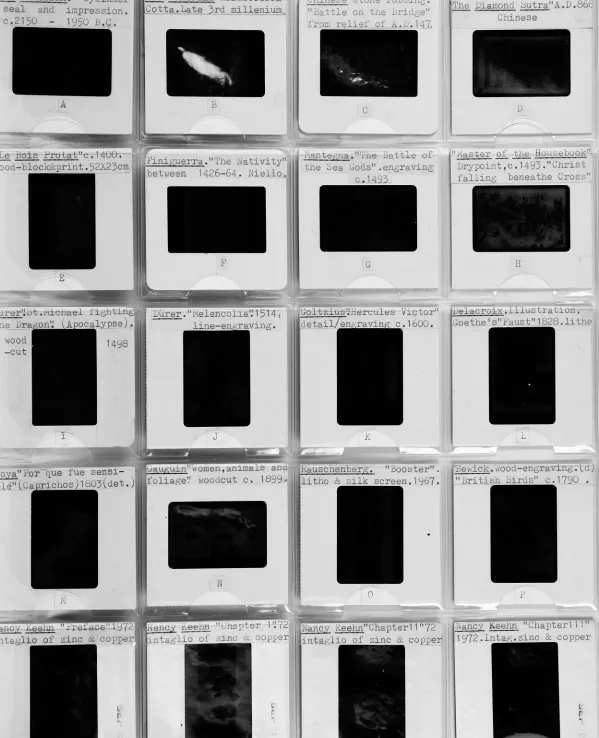
A.
Neo-Sumerlan.
Cylinder seal and impression, c. 2150-1950B. Neo-Sumerian. Figure plaque. Terra Cotta mold. Late 3rd milleniura.
c* Chinese stone rubbing.
"Battle
on thebridge".
From the tomb of WuLiang-tz'u, Shantung Province,
A.D. 147-168.D,
"The
Diamond Sutra".Chinese,
A.D.868.
British Museum.E.
"Le
Bois Protat". Woodblock and print. 1" X 23"X 9". ~~
c7~T4TC
F. Piniguerra.
"The
Nativity". Center piece of a niello silver ornament. 72 X59
mm. Executed between 1426 and 1464.G. Mantegna.
"The
Battle of the Sea Gods", copperplateengrav-IngT
c. 1493.H.
"Master
of the Housebook"(or "The
Master of the Amsterdam Cabinet*').
dry
point,"Christ
falling
beneathe the Cross"c, 1493.
I. Purer.
"St
Michaelfighting
the Dragon"(Apocalypse).
Woodcut,
1498.15
1/2" X 11 1/16".J. Durer. "Melencolia". Copperplate line-engraving.
?
7/16"X
6 5/8",
1514.K. Goltzius.
"Hercules
Victor". Detail of copperplate line-engraving, c. 1600.L. Delacroix. Illustration to Goethe's
"Faust".
Lithograph,
IB25T
M. Goya. Detail of
"Por
que feu sensible"(Caprichos).
Aquatint,
1803.N. Gauguin
"Women,
animals and foliage". Woodcut c.1899.
0. Rauschenberg.
"Booster".
Lithograph and silk-screen,1967.
P. Bewick. Detail of wood -engraving of the
Solitary
Snipe made for Bewick's"British Birds",
Newcastle,
1797-1804.Q.
Nancy
Keehn."Preface
IV".Etching
on zinc, with central section on copper. Central sectionby
Photofabrica-tion technique.1972.
12"across x 32 1/2"
high.
tion
technique.
1972 across X23
wide.S.
Nancy
Keehn."Chapter
11"Etching
on zinc, with central section on copper. Central sectionby
Photofabrica-tiontechnique.
1972 21"across X
23
high.T.
Nancy
Keehn."Chapter
111".Etching
on zinc, with central section on copper. Central sectionby
Photofabrica-tion technique. 1972. 23"THESIS PROPOSAL:
I would like to Investigate the uses of photography in
printmaking
and to design a set of intaglio plates,exhibiting some of these possibilities.
My
research work for this Thesis will include the reading of photographic literature and technical manuals of bothprintmaking
and photography, as well as visiting Kodaklaboratories
to observe their relevant work. I will also betaking
"Independent
Study"in photography and
"Multi-media
techniques".I wish to concentrate on metal intaglio printmaking and for my Thesis Project to design three or four large color works, as a portfolio edition. These prints will exhibit some of the research and techniques described in the Thesis Report.
They
also will be used to Illustrate the above report, should it be published in bookform,
as one of a series of manuals on printmaking techniquesby
R.I.T. graduate students.PHOTOGRAPHY AND PRINTMAKING
The above proposal was intended to be fulfilled as
part of an attempt to clarify for myself the position of
photography - a
"symbolic
communication withoutsyntax" as
Ivins calls it - both in the
history
ofprintmaking and In
relation conceptually to another printmaking method, namely that of intaglio.
This clarification is an attempt to make reference
making. It brings into account the fact that printmaking,
or replication of
images,
was not just a Chinese or fifteenthcentury European
invention,
but that the phenomenologicalorigins of modern
printmaking
were in prehistory.Phenomenology
is the study of direct experience, as distinct from athing
itself or how it is
known,
and contemporary photography iscapable of presenting this quality of its
images,
just asmetal plates or wood blocks contain inherent material quali
ties also.
After 500 years of other uses for the woodcut and
the copper plate we are now back at the position of cavemen
searching out valid uses of new materials.
Photography
asmentioned has
it's
place within this phenomenological approach,both as a printmaking medium with film as i^.s' matrix, and as
a photomechanical medium with a metal plate as it's matrix.
The camera's capacity for the documentation of reality may be
implemented compos
itionally
in many ways,by
juxtapositionor
by
a serial sequence of severalimages,
for instance. Ofall the possible structures, it is not only the above men
tioned, however,
or any intellectual relationships which areonly of
interest,
but also the organic qualities of a connec tion between the realities of photographed materials andabstractly designed metal plates. In this media-mixing there
is presumably a tension which is created between two visually
close yet quite different qualities of direct physical
with the historic origins of printmaking.
Of necessity, in this
thesis,
much information has been forfeited in order to maintain a clearer frameworkover a vast period of printmaking time.
When It is accepted that a print is a design on any
material that can be made from any matrix that permits an
identical design or designs to be reproduced from
it,
andthe relevant historical facts are specified, then it becomes
clear that the present print renaissance is actually a rever
sion to the phenomenological attitudes conceived in prehistory,
Contemporary
use of computer graphics, collaged shirts,vacuum
forming
and folded prints is part of this process andexploration.
Photography
is also a part of this renaissancenot only because of it*3 informational or expressive capacity,
but because of the viewer's phenomenological experience
projected from
itj'^
images.Printmaking
is normally assumed to have started withthe development of the woodcut in China. In Europe
print-making supposedly appeared about the start of the 15th cen
tury
with the beginnings of massliteracy
there. But variousprinciples of printing were implemented and understood
long
before
this,
and evolved from the quality of the only materials available at the time.
From the 15th century to the present century print
-making has been considered mainly for communicating informa
tion or for reproduction. Since the reproduction of visual
techniques
printmakers are released from these roles. Thisleaves them free to consider aesthetically the Intrinsic values
of each process and of any material.
Cavemen discovered the concept of replication on
cave walls. The Sumerians and the Egyptians extended the use
of it with clay, and the Chinese eventually used it for print
ing
information with wood and paper. The original conceptsof printmaking are replication and appropriate use of each
material. Some artists now redirect their expression and
experiments to this end. This paper attempts to plot the
main incidents and links in this development from the original
BEGINNING CONCEPTS
PREHISTORY:
Several forms of printing existed in 25,000-18,000 B.C.
On the walls of the caves of Cougnac and Altamira are differ
ing
kinds of handprints from this period. It is not knownprecisely how these prints were achieved any more than it is known how contemporary paintings were applied. But it is
clear that in one case hands were dipped in paint
(earth
pigments mixed with either
fat,
urine orhoney)
and then applied to the wall. This could be said to represent the letter
press principle of printing from the surface of a matrix.
Some hands were printed in the negative,
however,
and pressedagainst the cave wall to act as a stencil or a screen, while
pigment in either liquid or powder form was blown around the fingers. In both cases either a right hand or a left was
the matrix. Sometimes one or two fingers are missing. Pos
sibly
they
were folded underduring
printing for some symbolicreason or had been lost altogether in an animal fight before
hand. These are prints that in concept make use of the prin
ciple of replication. Other techniques essential to later
printmaking, such as engraving or cutting designs into bone
or stone, were also developed then but not with any aim of
replication.
By
the time of the first historical cultures in thevalleys of the Tigris and the
Euphrates,
and in the valleysof the rivers Nile and
Indus,
replication of images was begun in another
fashion,
with other materials and for otherpurposes.
Trade relations developed extensively between certain
of these regions in oil, wood, metal and many other commodi
ties.
Populations increased along the commuting rivers andland became a precious commodity to be passed from father to
son and therefore to be protected
legally
. As the conceptof ownership developed seals and small matrices were invented
from which innumerable like images could be printed on clay
or papyrus. These created permanent records of ownership.
Stamped around the necks of oil jars for instance
they
established ownership. Deeds and private property could be
marked in similar fashion.
SEALS were first devised
by
the Sumerians of theJemdet Nasr and Uruk period about 3500-2800 B.C. There are
examples in the Louvre of cylinder seals to be rolled along
a surface and of stamp seals of the late fourth millenium
and early third millenium B.C. Some seals were made before
the invention of writing
(3000
B.C. inMesopotamia),
andimages or symbols were cut into hard materials such as stone,
marble and gems, cast or engraved and tooled in metal to Im
legal evidence or as
decoration
(illustration
A.).The importance of clay is obvious in the development
of the Mesopotamian civilisations. The scarcity of stone
and wood for
building
led to the invention of bricks madefrom clay. At first molded
by
hand and sun driedthey
werelater cast from molds
during
the Pre-Sargonid period in theearly third millenium B.C. and
finally
baked.
Some haveIndentations on one side and some have patterns stamped on
them.
Developed Into standardised formsby
molds, bricksbecame in concept prints.
According
to contemporary burial practices, figurinesrepresenting ancestors and servants were required to be placed in tombs along with the
deceased.
These figurineswere molded
by
handduring
the Pre-Sargonid and Sargonid periods(Sargon 2340-2305
B.C.) but,
possibly because the demand for them
increased,
the Neo-Sumerians(from
the end ofthe Akkadian
Dynasty
in the 23rd century B.C. to the fall ofthe third
Dynasty
of Ur in the 20th centuryB.C.)
inventedmolds for these
figures.
They
introduced the concept of massproduction, and each figurine could also be called a print in
concept therefore. Most of the terra cotta plaques or figurines discovered are between 8" and
4
1/2"high.
Very
few molds have been discovered but the terra cotta plaques
have been discovered
"by
the million"from the period up to
the first
Dynasty
ofBabylon,
after whichbusiness
slackenedapparently1
and the concept of private property became codifiable in law.
With the invention of writing the course of
history
could becharted. Because of the marking of ownership, and because
of writing, historical recording and all mass information
became possible. In this way It can be seen how the concept
of printing used so far for structure, belief and possession
became
incorporated
into a proliferation of verbal communication and
facts.
It often lost sight in the process of someof printmaking's intrinsic
qualities. The West has mainly
understood printing to be for this purpose until the present
century .
CHINA AND JAPAN:
To hew each stone, to mold each
brick,
or to carveevery image or letter separately not only would be very time
consuming but would cause each to be at least slightly dif
ferent.
All repeated hand drawn information was thereforelikely
to be inaccurate.Printing
overcame such problems aseach image Is in principle the same from any given matrix.
However,
to utilise this specificquality,
that of a reliabletransference of
information,
required a material cheaper andmore easily come
by
than stone, cloth, skin, wood or papyrus. pSuch a material did not exist until
105
A.D. in China.Ts'ai
Lun,
who invented paper, first made it from rags thoughlater the Chinese made it from mulberry, bark of
trees, hemp,
5is a
laminated
material, made from stalks of reeds, and isnot considered to be paper for this reason. One thousand
years later paper was made in Europe for the first time. It
was not until paper was invented that printing could
truly
be used as a disseminator of information. It was not untilthe need for mass information became established also that
printing became necessary as a disseminator of information.
STONE:
This was the first matrix to be used for the spread
of
Information,
before the use of woodblocks and before the invention of movable type. As far back as the Chi'inDynasty
(221
B.C.-206B.C.)
it was the practice among the Chinese to carve inscriptions on stone tablets ordirectly
onto rocks. In the year
175
A.D. the Emperor of the Eastern Han empire,Ling
Ti,
ordered the inscription of the seven Confucian classics to be erected in front of the ImperialAcademy
at Loyang. This was the first formal publication of the official texts of these writings.They
became known as the"Stone
Classics". Before the advent of printing calligraphy such as this was on
display
in metropolitan centers tobe seen and copied
by
anyone. With the invention of paper in105
A.D. it became possible to circulate accurate textsby
taking
rubbings from them and pilgrims would interrupt their4
journeys to take such rubbings. In this way the edicts of
spread to the frontiers of the Empire. Rubbings also pre
served for centuries the calligraphic style of the greatest
scholars.
(Rubbings
are better for this than most otherprint methods for there is no need to reverse letters when
making the matrix). The earliest rubbing that exists
today
dates from the 7th centuryA.D.,
but according to historiansit Is possible that the art's origins were about 300 B.C.
(illustration C).
However,
the use of the rubbing techniquewas certainly coincidental with the intellectual growth and
artistic development of China and was doubtless instrumental
in her great expansion
during
the Han period(206
B.C.-220 A.D.).
WOOD:
Wood block printing was, according to some sources,
well established in the period between the fall of the Han
Dynasty
in 220 A.D. and819
A.D.(after
which Buddhist persecutions occurred until
845
A.D,Around
1907
Pelliot and Aurel Stein discovered agroup of one volume woodcuts that were mass-produced
during
the
Tang
period(618-907 A.D.)
as copies of religious paintings. Aurel Stein also
discovered,
in"The
Caves of theThousand Buddhas" near
Tunhuang
in KansuProvince,
a Buddhisttext called
"The
DiamondSutra"
(illustration
D). This isconsidered to be the world's earliest extant printed book or
of the The year 594 A.D. is the
legendary
Chinese datefor
the invention of printing from a negative surface. Thereis
however,
adescription
of Taoist rites which was includedin a
history
of the SuiDynasty
(589-618A.D.)
which says"The
priest makes charms out of woodby
engraving them withconstellations,
the sun and the moon. Then grasping them in their hand andholding
their breaththey
make the imprints.Many
invalids have been cured."This not only suggests an earlier date for the printing from a negative surface, but a
stamping technique for printing.
There is some possibility that printing was not a Chinese
Invention,
but came instead fromIndia,
Central Asiaor even Tibet. However printing developed faster where
literacy
was more common, which wasChina,
where it was perpetuated
by
the need for textbooksby
the Civil Service.Oral and unorganized exams had been used since the Han period for the Civil
Service,
but systematic exams were begun in theSui period of 589-618 A.D. and were stabilised
during
theThang
period of618-907
A.D.Another impetus to the invention of woodblock print
ing
was, according toNeedham,
the advent ofThang
Buddhism in China. Buddhism was taken to Chinaduring
the 2nd or 3rdcenturies B.C. from
India,
where it had developedduring
the 5th and6th
centuries B.C. It used an unending repetition ofEjaculations
and a quicker method than stone carving andrubbings was
doubtless
needed to cope with this need. Inthis way,
by
the8th
century
A.D. printing was widespread in China and expertly donethere.
Though the Chinese are reputed to have invented
paper, wood block
printing
andlater,
in the 11th century,movable type too
(1041-49
A.D.)
it was apparently due to an epidemic of smallpox in Japan in the year735 A.D.,
or tothe revolution that occurred after It in
764,
that the first(extant)
text printing took place. Whatever the reason theEmpress Shotoku of Japan ordered 116 priests to her eourt to
drive out the demons and also ordered the printing of one
million paper prayers or
"dharanis",
which were distributedto various temples where each prayer was enshrined in its own
small three storey pagoda. A Japanese scholar called
Kibi-no-Mabi, trained in culturally superior China for
twenty
years, became the tutor of the Empress and it was under his
lead that the first wood block text printing was carried out
in Japan. Some authorities have suggested that copper plates
were used and others consider that the blocks were made
by
pouring metal into molds of clay, while still others think
that stone was used as the matrix. The Nara period
(mid
7thcentury-end of
8th
centuryA.D.)
inJapan,
especially
the8th
century, was the golden age of Japanese Buddhist art. It was
dominated
by
Chinese thought of theTang
period.multiple blocks had developed in
China,
samples of whichreached
Japan,
andby
1590 full polychrome printing was knownthere though registry was poor at that
time.
Not until 1482was printing in color from multiple blocks attempted in
FOOTNOTES
1.
Andre"
Parrot,
Sumer. New York: GoldenPress,
1961.
Andre"Parrot,
The Arts of Assyria. New York: GoldenPress,
1961.
2.
Unfortunately
the Invention of woodblock printing and movable type occurred several hundred years after theinvention of paper in China.
Consequently
many manuscripts written on fragile paper Instead of skins for example willhave been lost or have
disintegrated.
The samething
did not occur inEurope,
where the two inventions coincided atthe same time.
3
. JosephNeedham,
Science and Civilisation in China. London:Bentley House,
l^T
4.
"Rubbings"is a comparatively recent term for what was known as "Ta-pen" or ink squeeze. It Is a distinctive form of Chinese art. Though "Rubbing" became popular throughout the Far
East,
It never even in Japan achieved the popularity and use it had in China.EUROPEAN
PRINTMAKING
MATERIALS OF THEFOURTEENTH
AND FIFTEENTH CENTURIESA. WOODCUT:
As in the East there was already an obscure
history
of printing in Europe on cloth and leather that prepared the way for the development of printing on paper when it arrived.Printing
was first introduced Into Europeby
caravantraders and
by
Christian missionaries, and because it arrivedin Europe before paper mills started and before paper was
readily available the technique of wood cutting was first
used for printing on fabrics. It was not till the end of
the 14th century that the manufacture of paper in Europe per mitted the cheap production of prints there. The first known
mill in Europe was at Xativa near Valencia in Spain. It was
Italy,
however,
that became the most important source ofsupply for paper in Europe throughout the l4th century with
Its first mill at Fabriano in east central Italy. This mill was established in
1276.
First Uses:
The oldest extant European woodcut
"Le
Bois Protat" is dated 1370-90(illustration
E)
and is an example of the early application of woodcuts for FABRIC PRINTING. Theblock was found in 1898 In a monastery in eastern Europe
which was
being
demolished.
It has been cut on both sidesbut only on one side has it lasted well enough to print from.
The style of the armour on the figures Is
Burgundian,
andsince the size of the complete scene measured at least two
feet square - larger
than any medieval paper - the block
must have been used to print a
BANNER,1
(for
instance thesize of the paper used
by
Caxton in the mid-15th century was15
3/4" X 22")
or an altar hanging. From the second half ofthe l4th century there are occasional examples of woodcuts
that correspond more nearly to the early woodcuts on paper.
One of the most important of these is the
"Sion
textile" ofthe second half of the 14th century, but opinion is divided
as to where it comes from - France in the Avignon
area, or
northern Italy. In Europe as in the East small blocks were
used for
STAMPING,
and preceeded the printing from blocksby
the press probably.
Royalty
made use of stamps for SIGNATURESfrom the time of Charlemagne If not before
(8th
century A.D.).In
600
A.D. paper was first made outsideChina,
in Korea.It was then taken to Japan in
610
by
a Buddhist monk. In awesterly route the craft of making paper travelled via The
Old Silk Route through
Tunhuang
and Samarkand In 751 A.D.This was the year of a battle on the banks of the river
Tharaz in
Turkestan,
from which some Chinese prisoners wereleft behind.
They
happened to be paper makersby
trade.
From
Morocco
it travelled with the Arabs to Spain in 1100and from there to France
by
115
1,
Italy
by 1275,
and to Germany and England in
1495,
Scandinavia in the 17th centuryand to
U.S.A.
in1690.
Papermaking
was at first distrustedin Europe because it was introduced
by
Jews and Arabs and ittherefore suggested the Moslem
invasions.
Paper only becameplentiful In Europe around 1400.
On paper FLOCK PRINTS1
were made especially for chil
dren.
They
had the appearance of velvet. The block wasinked with glue, printed and then dusted with a
fluffy
mincedwool. Some of these flock prints have survived on paper and
have been found pasted on the inside of book covers or the
inside of a cabinet. For book covers the designs for both
covers and spine were printed from a single
block.
As paperbecame generally used and accepted
by
the European clothprinters, woodcuts were
frequently
pasted inside deedboxes,
which lawyers and merchants used to
keep
documentsin.
Sometravellers pasted or sewed them inside clothes as amulets for
personal safety, or
they
may have been pasted onto the BACKSOF CHOIR STALLS or doors and later on used as CEILING AND
WALL
DECORATION.1
In Ulra a declaration of property was made in
1430.
It listed
"WOODBLOCKS
FOR PLAYING CARDS AND SAINTS".1 Thisprobably indicates the most important and earliest uses for
printed pictures.
Playing
cards seem to have been the leaderBernardino
of Sienna is thought to bear thetheory
out although it occurred in
1423.
The saint is said to havepreached so eloquently against gambling cards that a manufac
turer asked
"How
shall I earn my living?" The saint repliedto this
by drawing
the sacred monogram on a piece of papersaying,
"Make
pictures like this."Cards for playing were probably invented
by
theEuropeans and emerged
by
the mid1300s.
In the 1400s cheapwoodcut cards were made for the masses, while engraved ones
were for the
6llte
or middle classes.Cards,
like musicalnotation, had to be
quickly
recognised and consequently theforms of these early, especially the woodcut, figures were
simple and standardised. Since the Italians made paper a
century before the Germans it might be expected that
they
should be the first to print woodcuts. If this were so none
has survived and Northern Europe led the way. There are no
playing cards printed from woodblocks that have survived from
earlier than 1460 but the word "palter" or maker of playing
cards occurs in German documents from 1402 onwards.
Woodcutters had no guilds of their own in the early
Middle Ages.
They
were originally grouped with the largerclass of carpenters. This class was
fairly
low In the socialand educational scale and their position was often insecure
due to
fluctuating
religious beliefs of the period. The word"
formschneider"
or cutter of
forms
or blocks does not occurAlternatively
there are reasons forbelieving
thatreligion was the first to utilize printing for the reproduc
tion of
images.
It is known that when the Popes were inAvignon between
1309
and 1376they
diverted pilgrims fromRome
by
the granting of indulgences to northern shrines.These shrines sold enough
holy
pictures to establish thewoodcut as a medieval
industry
and perhaps to cause its majordevelopment
to occur in the north. The citadel ofNuremberg,
for
instance,
preserved the lance-head that was supposed tohave pierced Christ's side. This was the Emperor of Germany's
most treasured and sacred possession, and pilgrims were sold
woodcuts of the sacred heart which had supposedly been
stabbed
by
thelance.
This particular print was made on vellum so that It would last longer as an amulet for health pur
poses. Most
holy
pictures havedisappeared,
however. Somewere printed on linen to bind wounds and sores and some were
pinned to shrouds to
help
the dead in purgatory and otherswere pasted on wafers to be swallowed
by
sick men and cattle.In 1520 Martin Luther complained of monasteries that
were deserted except for a single friar
"who
sits allday
inthe church to sell souvenirs and little pictures to the pil
grims"
. Nevertheless Illustrations in early books and prints
on cards and indulgences gradually prepared the north
European to read.
Early
woodcutillustrations,
especially in Northerncarelessly
with color.Especially,
the single sheet woodcuts seem to have been made for a very simple people, and the
identification of personages in them was often accomplished
by
the use of respective symbols or attributes. Differentsaints would often have Identical bodies clothes and acces
sories but
Interchangeable
heads. These methods were alsoprinters'
shortcuts in book production.
They
used varyingwooden plugs and Inserted them appropriately to adapt blocks
to other subject matter. Most of these early woodcuts were
made of pear wood, beech and sometimes of
boxwood.
Prints possible to date precisely are so few in num
ber up until
1460,
and of such diverse characteristics, thatit is impossible to form any integrated series. After 1460
the
history
of the woodcut is knownby
a whole series of closely
dated documents and prints,B. THE BOOK:
It is assumed that in the 1440s movable type was used
3
in Europe for the first time. This is the time that
GUTENBERG
(born
1394-99
and died1468)
began to experimentwith such printing in
Strasbourg
where he was a politicalrefugee from Mainz. He was not the only one working with the idea. In
Avignon,
Bruges,
and Bologna other people were alsoengaged in methods of producing an
"artificial
script". Themultiplication of texts had become a lucrative trade for
scribes
by
Gutenberg's time and the need for printed bookscase
by
block-book.
HoweverGutenberg
perfected his Invention in 1450 in time to exploit it commercially, and his
"42
line Bible"
(the
only work that can be with certaintyattributed to
him)
was set up from 1452 and published before1456 from movable type.-*
Gutenberg's main invention lies not in his invention
of movable type but rather in his synthesis of all the dif
ferent
trends,
needs and techniques already known at his time:Goldsmiths had always cut punches
(Gutenberg's
father was agoldsmith)
from metal, the wine press was alreadyinvented,
and so was paper.
By
applying the principle of replica casting,
he overcame the problem of Innumerable letters whichwere required for even one page of type. Letters could be
cast and recast exactly alike
by
pouring molten lead Into anintaglio form or matrix ("female
die").
This is one of thetwo genuine inventions that he made. The second was the pre
paration of an Ink that would adhere well to metal.
Before 1501 few books were printed in editions
larger than one thousand copies. This was the same a3 some
handwritten manuscripts were editioned. After this began a
proliferation of information
books,
herbals,
almanacs"Bibles
of the
Poor"
and
"The
Arts of Dying" as well as novels, andthese began to direct the way of printing
(See
Appendix2).
m 1462 the Sack of Mainz scattered young printers who had
been trained
by
Gutenberg
around Europe. Meanwhile GuntherZainer (died
1478)
inAugsburg
began the first mass producAfter 1462 Germans made a great concentration of
presses in northern
Italy.
Among
the refugees was the sonof an
Augsburg
sculptor,
Ratdolt. He made the first sheet oftype specimens printed in gold, probably the first metal
casts of woodblocks and the first modern title page. More
important,
however,
were his first pictures printed in threecolors. While In
Venice,
Ratdolt 3awliturgical
textsbeing
printed in black and red through stencils. He took the next
technical step in 1482 and printed the phases of the moon
from three separate woodblocks in
black,
red and yellow.After mastering the art of color registration in
Venice,
Ratdolt was summoned home
by
theBishop
ofAugsburg
tomodernise German church printing. His first real color
print Imitates a Gothic painted woodcut,
by
overprintingpatches of printed red, olive and yellow with a complete
design in black
lines.
This book's success in1487
establishedAugsburg
as Germany's center for printing in color and forexpensive church books. Some 15th century prints were printed
in black and colored
by
stenciling.In the
1490s,
as well as InAugsburg
andUlm,
thereburst out a widespread production of fine woodcut illustra
tions and printing in
Florence,
Milan,
Paris, Nuremberg, Basel,
Lubeck and Venice. Book printing stimulated the development
of printmaking but the intrinsic quality of the woodcut was
not
long
to survive because due to work pressures a divisionto draw their designs on paper which was then stuck onto the
block and cut
by
"formschneiders" or cutters of patternblocks.
These craftsmen were asked to cut around pen linesand create
tonal
values achievedby
other mediums.By
1550the woodcut had reached
l%*^
limits of minuteness of detailon account of the coarseness of the paper and the method of
inking
(which
wasby
large leather balls charged with Ink).A few 15th century books were Illustrated with engravings,
but mainly woodcuts were used. About 1550 more and more
books began to contain etchings or engravings, presumably be
cause greater detail could be obtained and printed without
limitations
from the paper andink,
though the copper plateyielded smaller editions than wood
did.
By
the 1600s pictorialwoodcuts were only to be found in small elegant
books,
in chapbooks and broadsheets for the peasants, and artist's single
sheet woodcuts.
They
were not to be revived from the end ofthe 16th century until i860 when Millet cut his first
long
grain block and when, a little
later,
Gaugin^inspired
othersto use the woodcut as an art
form.
C. THE ENGRAVING OF METAL:
Though woodcuts were made before engravings were
printed,
by
the mid century both were practised widely, andbefore the end of the century etchings were also made in
south Germany.
Woodcuts are examples of relief printing for the most
as also Is etching. Its origins are obscured
by
antiquity asare those of the woodcut and all other techniques of
print-making except those of
lithography.
While the woodcutterswere
originally
taken from the carpenters'guilds, a class of
artisans,
the metal engravers, were a part of the goldsmiths'guilds.
Socially
they
were verydifferent,
and goldsmithswere given artistic
training
during
apprenticeship. Engraving
was used on metaldishes, jewellry
and armour among otherthings.
As a technique it goes along
way back Intohistory
and until about
1430,
before printing from them occurred, itwas customary either to leave the lines open or to fill them
with another metal.
It Is not known how the Idea of
taking
prints frommetal first started. Giorgio VASARI
(1511-74)
attributed thediscovery
of this use to a Florentine goldsmith, MasoFINIGUERRA,
Who was working around1449
(illustration
F).Small engraved silver plates known as "nielli" were filled
with a black substance
(nigellum)
and polished so that the design showed black against a bright silver ground. It isfrom these plates, It is
thought,
that engraved prints werefirst made.
Despite these developments in
Italy,
and despiteVasari's claims, there is proof that engraving for prints was
first practised north of the Alps. The earliest known engraver
called
"THE
MASTER OF THE PLAYINGCARDS"
is thought to have
from about
1430-1450.
Besidesprinting religious subjects
he also made a set of
playing
cards now mostly in Dresden orParis.
The earliest date on an Italian engraved print is
1461.
Most of the early metal prints fromItaly,
including
those that seem to date from a few years before the mid 15th
century, were the production of
Florence,
which was thecenter of the goldsmiths trade and craft.
There,
from thetechniques of the nielli workers, the
"Fine
Manner"of engrav
ing
developed and was dominant until 1470 to1475.
Thismanner consisted of fine lines cut close together and irregu
larly
crosshatched. After that time the alternate engravingstyle of Florence developed
"The
BroadManner",
which consisted of open parallel slanted shading, often with a light
return stroke between the
lines.
It gave more the impressionof a pen
drawing
than"The
FineManner",
and must havedeveloped from other workshops - from the
copying of
silver-point drawings it has been suggested. POLLAIUOLO'S famous
engraving
"The
Battle of the Naked Men"of the late 1460s is
tooled In the
"Broad
Manner".Prints
by
"The
Master of thePlaying
Cards"are re
ferred to in manuscripts of
1446.
It is possible thatthey
are earlier however than the earliest known dated intaglio
print of
1446,
"The Flagellation",
from a Passion series inthe Berlin Print Room
by "THE
MASTER OF THE YEAR1446".
laying
theirlines.
As trained draughtsmen began to use theprint mediums their styles became
influential.
The technical advances made
by
"The
Master of thePlaying
Cards"were
mainly
developedby "THE
MASTER E.S.".He is the earliest engraver to sign his work - in 1466. His
home was in
Strasbourg
or nearby and it is possible that heserved his
apprenticeship
at Basle as a goldsmith, or on theUpper Rhine where
"The
Master of ThePlaying
Cards"had his
school. His most ambitious work is
"The
Madonna of Einsiedeln"It was probably sold as memorial prints to pilgrims at that
place.
Martin
SCHONGAUER,
(1445-91)
the first German engraverknown to have been more of a painter than a goldsmith, was
probably a pupil of
"The
Master E.S.".Colmar,
where helived,
is not far from Strasbourg. The first northern engravers worked on copper, mainly, and with tentative strokes,
but
"The
Master E.S."started to vary his burin strokes and
Martin Schongauer organised a basic rhythm of lines
including
long
curves as well as crosshatching,
which could only havebeen produced with the
help
of a hard leather pillow to pivota copper plate on while
keeping
the burin hand steady.Schongauer could be called the first virtuoso engraver. He
assimilated the painting techniques of Flanders and Rogier
VAN DER
WEYDEN,
and he began to draw people andfurniture
convincingly situated In their relative spaces. His techniques
Florence and on
MICHELANGELO,
who copied his print"The
Bedevilling
of St.Anthony",
when young. The"Master
E.S."had engraved all subjects but Schongauer really specialised
in saints and in the New Testament.
Printing
was pioneered inItaly
mainlyby
immigrantnortherners about
1465
but the art of engraving, though possibly suggested
by
Flemish or German work, developed individually
there,
and it was not until several decades afterits inception that the northerners influenced the engravers
of
Italy
much.Especially
until 1470 the Italian printers didnot possess the technical proficiency of the others. But
while the northerners used prints mainly for devotional work,
the output from the south was a lot wider in scope, composi
tion and subject matter. From the
beginning
and contrary tothe north of
Europe,
painters had dominated printing inItaly
and this caused different styles todevelop
in theirrespective works. The Italians spent most of their time on
outlines and their shading was mainly a rapid way of produc
ing
an added sense of three dimensionality. TheGermans,
onthe other
hand,
went in for mechanical neatness in theirshading and tried to combine all sorts of information and
local detail. POLLAIUOLO and MANTEGNA drew firm careful out
lines and shaded
by
means of parallel lines tilted fromright to left without regard for the direction of the outlines
This gave a flat wash effect to their work whereas the German
and shaded with lines that had a
tendency
to follow theshapes.
They
hated any pictorial vacuum and felt the honestworkman should fill his plate from corner to corner. The great Italians saw
something
the Germans neverdiscovered,
that space was the relation between the objects. Neither
the Italians nor the Northerners
habitually
scraped the burrfrom their
lines.
This gave an added richness to the earlyprints.
Paintings were copied and reproduced
by
printmakingin the late 15th century, mostly
by
a few Italians. VANMECKENEM and F.V.B. seem to have been the only non-Italians
at that time to do so. Also the art of engraving was used
by
several great Italians who possibly felt thatby
its meanstheir work could travel where their paintings could not.
Mantegna's engravings exerted a great
influence,
being
thefirst important Italian works of art to cross the Alps
(Illus
tration G).
They
were collectedby
artists such asRembrandt,
Ribera and D&rer. His paintings had only a local effect at
that time. Mantegna
(1431-1506)
established the paintersdominance over Italian printmaking. He forced his hired
professional engravers to unlearn their craft conventions in
order to use the graver like a quill and to work in the
"Broad
Manner". Professionals tended to work the whole platebut Mantegna reserved areas of space to contrast with packed
areas of visual energy.
By
these means Mantegna raised theto use
printmaking
as a means of reproducing work from othermediums,
while thenortherners,
for the most part, developedthe
techniques
ofprinting
to impartinformation.
BOTTICELLI(1444-1510)
as Mantegna was influential on Italian printing.His
illustrations
for"The
Divine Comedy"were perhaps the
first attempts to use copper engravings instead of woodcuts
to illustrate a
book.
By
mounting them on woodthey
would bemade type high and so printed at the same time as the text.
By
the1490s,
after all this development and after Florentineengraving had somewhat acquired a personality, it was dis
rupted
by
Dflrer from the north,D. DRYPOINT:
This technique is an extension of the engraving
process. It was first used
by
"THE
MASTER OF THE AMSTERDAMCABINET"
(or "The
Master of theHousebook"),
probably In1480 (Illustration H). Drypoint was not a commercial proposi
tion,
and wasinfrequently
usedtherefore,
especially on leadas his are. In
1857
electroplating developed and the vulner able surface and burr could be protected to permit reasonableeditions to be pulled.
E. ETCHING:
This metal technique was conceivably brought back
by
the Crusaders from the East. The name "etching" comes from the German word
"aetzung"
meaning
biting,
or from the dutchword
"efcsen"
with oil paint and the bare steel around the paint pattern
often rusted
down.
Perhaps,
noticing
this,
armourers after1400 began to decorate swords and armour
by
scratching a waxcoating with
designs.
After applying salammoniac, vinegar
and vitriol for three to four days to the bare metal revealed
by
these scratches, a design was etched in the iron plates.A second course was also available to the armourer, that of
painting the design onto the armour with a protective medium
while
leaving
the background to be etched away. That thereis a strong link between etched prints on paper and the etch
ing
on armour is suggestedby
the fact that most early etchingswere on
iron,
and also that the signature of at least one etcher known for his prints, DANIEL HOPFER ofAugsburg
(14?-1536),
appears on armour.'' He worked on Iron as armourersdid and is probably the earliest worker in the medium of
etching for prints whose work has survived. The practice of
taking
impressions from etched plates may possibly go backto the last few years of the 15th century. However there Is
no authenticated date for an etching earlier than 1513. This
is the year given to Urs GRAF'S
"Girl
bathing
her feet" ofwhich the only known Impression is in Basle. Durer also made
five of the earliest dated etchings on iron between
1515
and1518.
One of these is"The
Canon" of1518,
but he dislikedthe coarseness of the material.
The use of acids goes back to the development of al
being
produced only in very small quantities until the 18thcentury,
and artists used other concoctions to bite theirplates. Most early etchings were made, as mentioned, on iron.
The first artist to use copper to etch on was LUCAS van LEYDEN
(1493-1533).
His work in etching was done in about 1520 andhe sometimes combined it with engraving. Lucas copied Durer's
woodcut of Maximilian 1 very soon after the latters death so
that It was on sale while his death was still news. It also
Incidentally,
Initiated the concept of pieture journalism atthe same
time.
Lucas used to rapidly etch most of his plate and re
serve the graver for the head and hands.
By
using copper hemanaged to etch lines neat enough to blend with the engraved
additions.
Etching
was quicker than engraving and thismixed technique was to become standard practice later for
copperplate work. After 1700 all so-called engravings were
really etchings touched up with the graver to smooth transi
tions. In the 18th century etching was practically abandoned
to return about
1873
with a renewed interest in mediums andoriginality.
Before the end of the 15th century,
then,
the use ofprintmaking to copy work from other mediums was started. Some
of the inevitable misuses of the materials of printmaking
though not yet obvious, which were to be accentuated in the
FOOTNOTES
1.
Arthur M.Hind,
An Introduction to aHistory
of Woodcut. Vol.1.
2 vols. NewYork:
Dover PubTications,
~T9o37~^
2. It is very probable that early prints were sold
"penny
plain and tuppence colored", as was theNuremberg
Chronicle of
1493.
3.
S.H.Steinberg,
Five Hundred Years of Printing.Middlesex,
England: PenguinBooks,
190b.4.
A block-book is printed from page sized woodblocks on whichbook text and illustrations are cut.
5. The "Edelsteln" of Ulrich
Boner,
a book of popular tales decorated with woodcuts, was printed in 1461by
Ulrich Pfister at Bamberg. Pfister apparently had no connectionwith
Gutenberg
and his circle.6. Nigellum,
or powdered niello, is copper, silver, lead and sulphur laid on an engraved surface. It is then melted, cooled and hardened andfinally
polished, to shine out black against thebackground.
It was known to the Romans and the Anglo-Saxons but was not much used till the 15thcentury.
7. Etched ornament on armour was derived from
Italy
where it appears on suitsdating
from the last quarter of the 15th century. The use of It spread fromItaly
to the famous armourers ofAugsburg
and Greenwich and became more intri cate in the 16th century when tournaments became more amdmore extravagant.
8.
J.F.Hayward,
Armour. London: H.M.Stationery Office,
for The Victoria and AlbertMuseum,
1951.9. At the end of the first century A.D. the study of alchemy arose among the Greek scholars in Alexandria and spread to the Eastern Mediterranean and especially Syria before the
rise of Islam. "Alchemy" Is an arab word, and the arabs took the knowledge of it from the Middle East to
Spain,
from where it travelled toItaly
and NorthernEurope,
10.
Nitric acid(aqua
fortis)
was made from vinegar orpyroligeous acid
by
1650.
Hydrochloric acid(aqua
regia,or spirits of salts) was made soon after from sal am
moniac plus nitric, or from salt and alum, or salt and
vitriol.
Acids were not made on a commercial scale until 1750
when sulphuric was also manufactured as well as glass bottles to store acid in.
The early etchers used, at
first,
the acids made forseparating gold and silver, sulphuric, saltpetre and alum, distilled
together.
A more controllable mixture described
by
Abraham Bosse replaced this mixture in the 17th century, and wasprobably the one used
by
Rembrandt,
Seghers and Callot. It Is an example of a boiled acid, and contains whitevinegar, sal ammoniac, salt, verdigris
(from
the action of lees of wine on copper). This solution was pouredover a plate continually. It is similar to Dutch Mordant in that both attack the metal without producing bubbles
COMMERCIAL
DEVELOPMENTS
AT THE END OF THE FIFTEENTH CENTURYAND THE
BEGINNING
OF THE SIXTEENTH CENTURYIn 1490
forward-looking
publishers opened up a newmarket
by
publishing books to catch the general reader, theway the
Augsburg
publishers had done in the 1470s and 1480s.These opportunities led to the extension of the crafts of
printmaking and to the rise of several major artists, and to
a more literate public. DURER
(1471-1528),
the son of agoldsmith of Hungarian origin, was apprenticed to Wolgemut
and was the first major producer of WOODCUTS.
Durer had many print styles . He mastered the tech
niques of wood-cut, engraving and etching and invented
water-color work. He in fact drew in every medium except red chalk.
D&rer completed the transformation started
by
Mantegna and"The
Master of The AmsterdamCabinet",
that of entirely freeing
printmaking from Its craft origins. AfterDurer,
print-makers were trained as
draughtsmen,
not as workers in woodor metal, and all the different kinds of print media fused
together under the
leadership
of painters for a short time.D&rer's work developed at a time when the woodcut was just be
ginning to stand on its own as a black and white picture with
out coloring. His work made a tremendous advance on anything
previously done. It was able to incorporate the rounder
softer style of the Italians with the angular gothic style
of the north. The cutters of the period had become so skil ful that artists like Durer took
hardly
any account of thelimitations
of their craft, and drew on the blocks andcross-hatched in a completely free way.
They
permitted,
therefore,
Durer's rhythmic organisation of lines of shading plus his
power of
draughtsmanship
todevelop
and be a great advanceon printwork that was just
beginning
to emerge from outliningand shading with cursory diagonal strokes.
In
1495,
after returning toNuremberg
from his firsttrip
toItaly,
Durer started cutting(by
himselfPanofsky
believes)
the sixteen blocks(based
on the Illustrations tothe
"Quentell
Bible"of
1479)
for"The
Apocalypse"issued in
1498
(illustration
I). These were soon followedby
a"Large
Passion"
of twelve blocks and a
"Life
of the Virgin"of
twenty
blocks.
They
were printed In 1511 on his own press. Theinfluence of these on the outside world can be seen
by
thespeed with which
they
were copied(by
Marcantonio,
forexample). A set of
thirty
six smaller woodcuts that D&rermade in 1511 is known as the
"Little
Passion"
and these also
were very widely copied.
D&rer's father
being
a goldsmith must have taught hisson his craft, and the first ENGRAVINGS attributed to Durer
are placed as early as 1494.
"The
Four Witches" is the firstto bear a
date,
though,
which is 1497. His work, especiallySchongauer-Of all his engravings three are referred to as his
"master
prints". These are
"The
Knight death and the devil"of 1513.
"St.
Jerome"of 1512 and "Melancholia" of 1514 (illustration
J). These three have been classified as representing moral,
scholastic and intellectual virtues respectively. The last
contains a number of symbols relating to the Aristotelian
theory
that all superior men are subject to melancholy.As LEONARDO
(1452-1519)
and GIORGIONE did in painting,Durer in printmaking helped to precipitate the development
chiaroscuro from the previous daylight scenes. But because
each medium creates it's own style the linear web of Durer 's
engravings is not the same as that of his etchings nor of his
woodcuts. He used drypoint sometimes on his engravings but
did not, as Mantegna did not, scrape off the burr always
(eg.
"The
Promenade"). From this time on artists tired ofMantegna's and Schongauer's equivalents for various kinds of
quill
drawings,
and the imitations of silverpoint drawings inthe Florentine
"Broad
Manner". Light and shade, not merelyto model form with, became important.
When Durer went to
Italy
in1505,
it was supposedlyto stop the piracy of some engravers such as Marcantonio
RAIMONDI and Guilio
CAMPAGNOLA,
who had copied hisdesigns.
He appealed to the Signoria for protection in 1506 because
Marcantonio had copied his
"Life
of the Virgin".(It
hassince been established that Durer really had gone to Venice
censure
by
the Signoriahowever
did not deter Marcantoniofrom copying
"The
Little Passion"and also to substitute his
own tablet in place of Durer's monogram at the bottom of the
print, which the Signoria had forbidden him to use. Because
of all
this, however,
certain of Durer 's methods(for
examplehis translations of tonal qualities into
lines,
which avoidedthe mere slanted or diagonal shading within a
heavy
outlineof the
"Broad
Manner")
influenced Marcantonio a great dealand through him passed on to all the
following
schools ofprocess engravers.
The breadth of Durer 's woodcut lines taught Marcan
tonio how to indicate form without particularising
textures,
and he also assimilated the work of Lucas van der Leyden.
From these influences his line became so clear that it could
surround a shape without
drawing
attention to Itself as aline.
The French called Marcantonio?s work"Interpretative
engraving"
and he has been blamed for
inaugurating
the almostcompletely interpretative role which line engraving now be
gan to assume. He went to Florence from Venice and then on
to Rome where he made a fine engraving of
"The
death ofLucretia"
from a
drawing
by
RAPHAEL.This,
according toVasari,
inspired Raphael to Issue prints after his own designs. The printing of these was entrusted to II
Baviera,
who had been employed
by
Raphael as aboy
to mix colors.MARCANTONIO was born In Bologna in 1480 and he died
Francesco Franc
ia,
and he has been classed with Durer andLucas van der Leyden as one of the three greatest early en
gravers. He was not however an original
artist,
but ratherthe first of the
"Interpretative
engravers"who reduced
line-engraving from an original form of art to a
largely
subordinate role ... a means of reproducing the work of others.
Marcantonio s adaptation of northern engraving styles made
his prints more comprehensible and therefore more influential
for northern artists than Raphael's original drawings or
paintings. The earlier copyist engravers who worked for
Mantegna simply copied the pen lines of Mantegna. Raphael's
drawings were a different matter however. His outlines were
broken and within there was no close system of shading but
they
conveyed great volume. From his experience in copyingDurer,
Marcantonio worked out a method of shading that represented the humps and hollows on a surface not
by
lightfalling
across it nor
by
localtexture,
butby
a kind of geographicalsurvey type of drawing. From this developed the syntax or
grammar used
by
all thefollowing
schools of process engravers.The German Influence was in the
laying
of the lines and theselines interpreted the Italian sense of volume.
Marcantonio's almost anonymous crew of assistants
perfected a system of collaboration that was practised until
about
1875,
2 when reproductive engraving and printmaking be gan to give way to the cheaper and more accurate photomechanithousand engravings after
Raphael, Romano,
Del Sarto etc.,projecting the Italian Renaissance into the rest of Europe.
Marcantonio s shop ran until the German and Spanish sack of
1527
when It scattered. The most individual of his assistants,CARAGLIO,
went as far as Poland. All of these printers andapprentices carried with them Marcantonio 's systems of engrav
ing.
COMMERCIAL AND REPRODUCTION BUSINESSES DEVELOP IN THE SIXTEENTH CENTURY:
After 1510 when trade with the Americas and the new
route to India round Africa swung commerce away from Venice
towards
Antwerp,
andfollowing
the success of II Baviero inpublishing Marcantonio s engravings after other artists, a
number of people established similar businesses in
Rome,
Antwerp
and elsewhere. Such mannerist print designers asHEEMSKERCK in Haarlem and SPRANGER
(1546-1611)
inAntwerp
allworked for print publishers such as LAFRERI in Rome and COCK
In Antwerp. These publishers and their hack engravers gave
the world all the visual information possible at that time.
In the process
they
also standardised engraving and the performance of technique began to tyrannise over the creative
use of technique.
COCK
(1510-1570)
established his famous publishinghouse at the sign of
"The
Four Winds"and employed a number
of engravers and artists. His publications after BOSCH and
accomplishments. Cock trained several artists and engravers.
Among
them was Cornelius CORT(1530-1578).
Cort continuedthe northern
line-engraving
tradition which had evolvedthrough Master E.S.
Schongauer,
Durer and Lucas of Leyden.Many
artists since Raphael and Mantegna saw the useof printing their paintings to sell and spread their influence.
Not least among these were TITIAN
(1477-1576),
and he employedCort,
retrained him for his own purposes and lodged him inVenice in
1565
to engrave his paintings as advertisementsfor princely
distribution.
Cort affected printhistory
by
hisamalgamation of the styles that he handed on to his pupils
and
followers,
such asGoltzius,
Vlllamena and Carracci.Hendrlk GOLTZIUS
(1558-78)
was the last of the professional engravers who drew with individual authority and the
last to Invent pictures for others to copy. His style sur
vives
today
on dollar bills and his style of reproduction engraving flourished till the end of the nineteenth century
for show pieces, when photography began to supplant reproduc
tion printmaking (illustration K). He imitated the muscles
of Michelangelo's work and those of antique marbles in Rome
by
developing
a network of swelling lines. VILLAMENA was adirect pupil of Cort. He flowed lines in parallels in a style
which was later to be developed
by
Charles MELLAN and theFrench engravers. Vlllamena also made the first heroic en
gravings of beggars
(possibly
because at that time AnnibaleIntro-duced low life subjects to Rembrandt. In
Italy,
Cort'sgreatest follower was the engraver Agostlno CARRACCI of
Bologna. Most Italian printmakers however followed Parmigiano
preferring to etch Instead of engrave, and generally all over
Europe engraving began to deteriorate as a craft