Hewett, R. and Liefooghe, Andreas and Visockaite, G. and Roongrerngsuke,
S. (2018) Bullying at work: cognitive appraisal of negative acts, coping,
wellbeing, and performance. Journal of Occupational Health Psychology 23
(1), pp. 71-84. ISSN 1076-8998.
Downloaded from:
Usage Guidelines:
Please refer to usage guidelines at or alternatively
COGNITIVE APPRAISAL OF NEGATIVE ACTS
Bullying at Work: Cognitive Appraisal of Negative Acts, Coping, Wellbeing and
Performance
Hewett, Rebecca1; Liefooghe, Andreas2; Visockaite, Gintare2; Roongrerngsuke, Siriyupa3
1 Business School, University of Greenwich, London, UK; 2 Department of Organizational
Psychology, Birkbeck, University of London, UK; 3Sasin Graduate Institute of Business Administration of Chulalongkorn University, Bangkok, Thailand
Accepted for publication at Journal of Occupational Health Psychology, October 2016.
Author Note:
Earlier versions of this paper were presented at the 9th International Conference on
Workplace Bullying and Harassment in Milan, Italy (June 2014), the 17th European Congress
of Work and Organizational Psychology in Oslo, Norway (May 2015), and the 75thAnnual
Abstract
The negative outcomes of experiencing workplace bullying are well documented, but a strong
theoretical explanation for this has been relatively neglected. We draw on cognitive appraisal
theory to suggest that individuals’ appraisals of and responses to negative acts at work will
moderate the impact of said acts on wellbeing and performance outcomes. In a large study (N
= 3217) in Southeast Asia, we examine moderators in the form of 1) the extent to which
individuals identify themselves as being bullied and 2) the coping strategies that individuals
employ to deal with negative acts. We find that these factors do moderate the impact of
experiencing negative acts, in particular work-related negative acts. When individuals are
subject to work-related negative acts but do not see themselves as being bullied they report
higher levels of performance than those who do identify themselves as being bullied.
Problem-focused coping was found to be effective for those sometimes targeted, but for
persistent targets was detrimental to wellbeing. The present research has important
implications for bullying research in examining factors which contribute to outcomes of
bullying.
Bullying at Work: Cognitive Appraisal of Negative Acts, Coping, Wellbeing and
Performance
Much research has been carried out over the past 20 years or so about the outcomes of
workplace bullying (Einarsen, Hoel, Zapf, & Cooper, 2011; Samnani & Singh, 2012). We
know, for example, that victims of bullying report outcomes such as higher levels of burnout,
physical symptoms of stress, and turnover intention, and lower levels of job satisfaction and
organizational commitment (Bowling & Beehr, 2006). It is also apparent that there is some
variability in how individuals respond to being bullied at work (e.g. Cortina & Magley, 2009;
Nielsen, Matthiesen, & Einarsen, 2008). However, the theoretical explanation for this has
been relatively neglected (Bunk & Magley, 2013; Parzefall & Salin, 2010) and we know little
about the factors which moderate the impact of being bullied on individual or organizational
outcomes (Samnani, Singh, & Ezzedeen, 2013). In the present study, we draw on cognitive
appraisal theory (Lazarus & Folkman, 1984) to suggest that the impact of being a target of
bullying on performance and wellbeing outcomes is moderated by individuals’ appraisal of
(Folkman, Lazarus, Gruen, & DeLongis, 1986) and coping responses to (Folkman, 1984) the
bullying.
Workplace bullying research broadly identifies victims of bullying in one of two
ways; either through self-labeling where individuals identify themselves as being bullied
(Rayner, 1997) or through behavioral measures based on individual’s experiences of negative
acts in terms of frequency and over time (Nielsen, Notelaers, & Einarsen, 2011). Both
methods have different strengths and weaknesses (Nielsen, Matthiesen, & Einarsen, 2010),
and the debate in the literature has generally been concerned with which of these truly
identifies bullying (Liefooghe & Mackenzie Davey, 2001). However, we know little about
how the two interact (Parzefall & Salin, 2010). In other words, does the extent to which
outcomes? Cognitive appraisal theory would suggest that individuals’ responses to an
encounter are influenced by their primary appraisal about whether or not it is a threat
(Lazarus & Folkman, 1984). As such, we suggest that, with respect to bullying, this primary
appraisal can be conceptualized as the extent to which the target explicitly identifies
themselves as being bullied.
When targeted with bullying behaviors individuals can adopt a number of strategies in
an attempt to minimize the negative outcomes of the experience (Folkman & Moskowitz,
2004). Drawing on Lazarus and Folkman’s (1984) distinction between active, or
problem-focused, and passive, or emotion-problem-focused, coping we examine the extent to which these
different approaches moderate the impact of being bullied on outcomes. Research has
suggested that the magnitude of the bullying experienced does not impact on the coping
strategies employed (Hogh & Dofradottir, 2001) although coping can be seen as a process
which evolves as bullying persists (Glasl, 1982) and there is a possibility that some coping
strategies might be more successful than others (Dehue, Bolman, Völlink, & Pouwelse,
2012).
The present research therefore makes important contributions to our knowledge of
bullying and wellbeing at work. Firstly, by developing a strong theoretical explanation for
how individuals can effectively respond to negative workplace acts. Secondly, in suggesting
that both negative acts and self-labeled bullying are important, this paper has implications for
future bullying research.
Workplace bullying and outcomes
Workplace bullying is predominantly defined through four criteria (Fox & Stallworth, 2005).
It is firstly the experience of negative acts which may be work-related (e.g. withholding
work) or personal (e.g. gossiping about someone) in nature (Einarsen, Raknes, & Matthiesen,
one-off (Leymann, 1996) and, thirdly, they must happen over a period of time and therefore be
not only repeated but persistent (Zapf & Gross, 2001). As to how repeated and prevalent the
acts must be in order to constitute bullying, Leymann (1996) has suggested that the acts must
be experienced at least weekly, for 6 months or more. Although, Mikkelsen and Einarsen
(2001) adopt a more conservative definition of two negative acts per week over the same
period. The final criterion is that there must be a power distinction between the perpetrator of
the negative acts and the target (Agervold, 2007; Salin, 2003; Saunders, Huynh, &
Goodman-Delahunty, 2007) which makes the acts difficult for the recipient to defend against (Einarsen
et al., 1994). It is important to note that this definition also precludes negative acts which are
linked to gender or sexual conflict, which are seen as distinct experiences (Einarsen et al.,
1994).
Intertwined with the discussion over how bullying can be defined is the question
about how bullying should be measured in quantitative studies. Broadly, there are two
approaches to measuring the experience of being bullied (Nielsen et al., 2011); the
self-labeling method and the behavioral experience method. The self-self-labeling method asks
respondents whether or not they have been bullied within the last 6 months. This is normally,
and most effectively (Nielsen et al., 2010), accompanied by a definition of bullying. The
benefit of the self-labeling approach is that it is easier to administer, often involving only one
or two question items. It also taps directly into individuals’ subjective perceptions about
whether or not they have been bullied, which are likely to be important in defining the
affective response to the bullying behavior (Folkman, Lazarus, Dunkel-Schetter, DeLongis,
& Gruen, 1986). While this subjective perception provides insight into the experience of
workplace bullying, it is likely that some people who do not label themselves as being
bullied, yet experience the same negative behaviors, are not identified. This means that
The second approach focuses instead on the exposure to bullying behaviors and
presents respondents with a list of negative behaviors without making specific reference to
bullying (Einarsen, Hoel, & Notelaers, 2009). One of the most common behavioral measures
is the Negative Acts Questionnaire – Revised (NAQ-R; Einarsen et al., 2009) which includes
work-related, personal and physical intimidation acts. Some may seem relatively trivial if
experienced only once, but over time would constitute bullying (Leymann, 1996). This can be
seen as an example of a causal approach to measurement (Spector & Jex, 1998), in that each
item captures a distinct but interrelated experience. The causal approach implies that
someone may experience one of the negative acts, without necessarily experiencing another.
The behavioral experience method deals with the criticism that self-labeling provides no
information about the type of bullying and also reduces the risk of priming that is inherent in
self-report measures (Nielsen et al., 2011). This method, however, brings additional
complications about the way in which the individual negative acts are analyzed. Cut-offs
have been suggested based on the Leymann (1996) definition that negative acts should be
experienced at least weekly for six months or more (Notelaers & Einarsen, 2013). However,
using the cut-off approach to analyzing the NAQ-R implies that bullying is an either/or
experience (Einarsen et al., 2009). In addition, it examines only whether or not someone is
bullied, not the nature of the bullying experienced (Notelaers, Einarsen, De Witte, &
Vermunt, 2006). More recently, several studies (e.g. Leon-Perez, Notelaers, Arenas,
Munduate, & Medina, 2013; Notelaers et al., 2006) have adopted a latent class cluster
approach (Vermunt & Magidson, 2002), which identifies clusters of responses to the NAQ-R
according to the level and nature of the negative acts reported. We adopt this approach as it
overcomes the criticisms of the other approaches and has been found to have improved
Numerous studies have found links between experiencing bullying behavior and
negative wellbeing and performance outcomes. In their meta-analysis of 90 studies, Bowling
and Beehr (2006) found that experiencing workplace bullying explained unique variance in
burnout, physical symptoms of stress, job satisfaction, organizational commitment and
turnover intention. This was the case even after controlling for role ambiguity and role
conflict, which are other common workplace stressors. Victims of bullying have also been
found to report lower organizational citizenship behaviors and higher counter-productive
work behaviors (Devonish, 2013) and longer term psychiatric distress and symptoms of
post-traumatic stress disorder (Matthiesen & Einarsen, 2004). Considering the impact of the
magnitude of bullying experienced, those classified as experiencing severe or pervasive
bullying reported higher levels of psychological strain (Leon-Perez et al., 2013), lower levels
of pleasure and higher worrying at work, and poorer sleep quality (Notelaers et al., 2006)
than those who experienced negative acts only sometimes or rarely, indicating that magnitude
is an important consideration. On the basis of these findings, and on the assumption that our
latent class cluster analysis will reveal a similar pattern as these previous studies, we make
the following hypothesis:
Hypothesis 1: Individuals more frequently bullied experience more negative
performance and wellbeing outcomes.
Self-labeling as an appraisal mechanism
Although research has consistently supported a negative relationship between being the target
of bullying and wellbeing and performance outcomes, very little research has examined the
mechanisms which moderate this relationship (Samnani et al., 2013). As outlined above,
cognitive appraisal theory proposes that an individual’s interpretation of an event shapes their
personal and emotional response to it (Lazarus & Folkman, 1984). One primary appraisal that
Magley, 2013). If it is not a threat, then no action is required to mitigate it. However, if it is
deemed to be a potential threat, the secondary appraisal is then to assess how to cope with it
(Lazarus & Folkman, 1984). With respect to primary appraisal, Magley and colleagues (Bunk
& Magley, 2013; Cortina & Magley, 2009) suggest that individuals’ responses to negative
experience in the workplace will be defined by a complex set of emotions and appraisals.
These authors focus on emotional appraisal as a response to workplace incivility and find that
emotional responses do explain differential responses to incivility. As well as their affective
response, individuals’ attribution of the negative acts is also important (Catterson & Hunter,
2010). We suggest that an important indicator of this attribution is whether or not the
individual self-labels themselves as being bullied.
It has been argued that the differences in results reported in some bullying studies is a
product of the instrument used to measure bullying (Nielsen et al., 2010; Notelaers et al.,
2006). In other words, the behavioral and self-labeling methods are measuring different
things. As suggested by Magley, Hulin, Fitzgerald, and DeNardo (1999), identifying oneself
as a victim of bullying is likely to result in more negative outcomes than not identifying with
this label, even if the target of the same negative acts. In particular, the identity of being a
victim may imply stigmatization and have negative connotations such as perceived weakness
(Agervold, 2007; Lewis, 2004). In support of this, Hershcovis and Barling (2010) found that
victims of workplace aggression personalized their mistreatment and therefore experienced
negative health outcomes. Likewise, Ireland (1999) found that prison inmates who attributed
hostile reasons to negative acts experienced higher levels of conflict escalation. As such, we
would argue, based on cognitive appraisal theory, that self-labeling can be seen as an
indicator of a threat appraisal when experiencing negative acts and therefore labeling oneself
as being bullied is likely to moderate the impact of experiencing negative acts, which are
The importance of the attributions that individuals make about negative acts that they
experience is particularly important when the possible interpretation of the act is ambiguous
(Bowling & Beehr, 2006). In particular, research would suggest that there is some ambiguity
about whether experiencing work-related negative acts (e.g. excessive workload) are
perceived to be bullying, or not (Baillien, Neyens, De Witte, & De Cuyper, 2009; Fox &
Stallworth, 2005; Nielsen et al., 2011). For example, a target of “repeated criticism with
respect to your work and effort” might perceive this to be an aspect of performance
management (Samnani et al., 2013) and as such might increase their performance in order to
avoid these criticisms, but only if they do not perceive the behavior to be bullying (Parzefall
& Salin, 2010). In these circumstances, therefore, some work-related negative acts may
actually result in higher performance when individuals do not perceive the act to constitute
bullying (Samnani et al., 2013).
The interaction between behavioral and subjective reports of being bullied has not been
examined before, that we are aware of. For example, Leon-Perez et al (2013) included both a
self-label measure and the NAQ in their latent class cluster analysis, but did not examine the
interaction between the two. Likewise, research into victimization has conceptualized the
appraisal of threat as a mediator between being victimized and emotional responses, although
with little empirical support (Anderson & Hunter, 2012; Catterson & Hunter, 2010). As this
is conceptualized as a mediation it fails to consider the impact on individuals who have the
same negative experience but do not appraise it as a threat. Based on the theory set out above,
we make two hypotheses about the moderating effect of self-labeling. The first relates to
wellbeing outcomes, for which we expect that self-labeling will predict negative outcomes
regardless of the type or frequency of negative acts experienced. We suggest the same for
believe that work-related negative acts could positively predict performance if not perceived
to be bullying:
Hypothesis 2: The relationship between being targeted with negative acts and
wellbeing outcomes is moderated by self-labeling such that those who self-label as
being bullied will report the lowest levels of wellbeing, regardless of the frequency of
acts reported.
Hypothesis 3: The relationship between being targeted with negative acts and
performance outcomes is moderated by self-labeling such that a) those who self-label
as being bullied will report the lowest levels of performance, regardless of the
frequency of acts reported, with the exception of b) those targeted with work-related
negative acts who will report lower levels of performance if they self-label, and higher
levels of performance if they do not.
The effectiveness of coping strategies
Coping derives from the stress literature and can be seen as “the cognitive and behavioral
efforts to master, reduce, or tolerate the internal and/or external demands that are created by
the stressful transaction” (Folkman, 1984, p. 843). In social psychology, these efforts are
most commonly seen as situational, triggered by demands, and it is recognized that
individuals respond to these demands in different ways (Lazarus & Folkman, 1984). We
follow Folkman and Lazarus (1980), who identify two functions of coping; problem-focused
coping and emotion-focused coping. Problem-focused coping involves trying to take steps to
reduce the stressor by finding a solution to the problem and, as such, can be seen as an active
approach to coping (Richman, Rospenda, Flaherty & Freels, 2001). Emotion-focused coping,
ignore the problem (known as ‘selective coping’) or manage ones affective state in order to
reduce the negative impact of the stressor (referred to as ‘resigned coping’).
As to the effectiveness of different coping strategies from the perspective of wellbeing
and performance, Dewe and colleagues (2010) have suggested that there are inconsistencies
in research approach and findings meaning that the picture is not clear. It is generally
suggested that more active, problem-focused strategies are more effective than passive
strategies for guarding against negative outcomes (e.g. Dehue et al., 2012). This is on the
basis that more active strategies attempt to remove or control the stressor, whereas passive or
emotion-focused strategies aim to modify individuals’ emotional responses to the stressor,
rather than addressing the source (Folkman & Mozkowitz, 2004). Empirical research has
supported this, particularly with regard to health and wellbeing outcomes, which have been
found to be improved with more active strategies (e.g. Folkman, Lazarus, Gruen, et al., 1986;
Lechner, Bolman, & van Dalen, 2007). Although there is also counter evidence that active
coping is often unsuccessful, leading to heightened feelings of stress (Fitzgerald et al., 1995;
Richman et al., 2001), hostile reactions from the target which can have adverse effects on
wellbeing (Glasl, 1982; Lee & Brotheridge, 2006; Zapf & Gross, 2001), and negative
alcohol-related behaviors (Richman et al., 2001).
Previous studies influenced by cognitive appraisal theory (e.g. Folkman, Lazarus,
Dunkel-Schetter, et al., 1986; Folkman, Lazarus, Gruen, et al., 1986) have examined coping
as a mediator between stressors and outcomes. The challenge with this approach is that it
would assume that the magnitude of negative acts experienced would predict different coping
strategies. This assumption was tested in several studies which found that the magnitude of
bullying did not predict the type of coping strategy employed (Dehue et al., 2012; Hogh &
Dofradottir, 2001; Jóhannsdóttir & Ólafsson, 2004). Even if severity does predict coping,
multiple situational and dispositional factors (for reviews see; Carver & Connor-Smith, 2010;
Dewe & Cooper, 2007; Dewe, O’Driscoll & Cooper, 2010; Folkman & Moskowitz, 2004). In
line with this, we would suggest that it is the interaction between the severity or type of
bullying (i.e. the latent class clusters) and the coping strategy employed that will define the
effectiveness with respect to these outcomes (Cox, Johnson, & Coyle, 2015; Samnani et al.,
2013). This proposal recognizes the fact that the choice of coping strategy employed can vary
from individual to individual, regardless of the severity (Folkman & Moskowitz, 2004), and
would explain some of the mixed findings with respect to the effectiveness of coping because
these strategies work in some situations, but not others (Dewe et al., 2010).
Prior research has only occasionally examined coping as a moderator between
bullying-related stressors and individual outcomes and, as such, there is limited theory upon
which to base predictions about how different types or magnitude of bullying might interact
with different coping strategies. In general, as argued by Leymann and Gustafsson (1996),
when stressors are severe, attempts to cope might result in negative outcomes because these
attempts lead to resource depletion. Likewise, although problem-focused coping is generally
believed to be more effective for reducing the negative outcomes of stressors (e.g. Folkman,
Lazarus, Gruen, et al., 1986) this approach has been found to be more effective when
individuals feel that the situation can be changed, perhaps when it is less severe (Lazarus &
Folkman, 1984). As such, it is possible that problem-focused coping for more severe bullying
might be unsuccessful, which would predict negative outcomes, as discussed above (e.g.
Fitzgerald et al., 1995). In more general terms, Dehue et al., (2012) have followed the
reasoning that active coping is more effective than passive in reducing the negative outcomes
of bullying because it attempts to solve the problem. These authors found that targets who
used passive coping strategies reported higher levels of health-related problems, and active
effective although active coping is not perhaps as resource depleting. It is important to note,
though, that these authors adopt a simplistic either/or definition of bullying, so we do not
know about the impact of severity or type of bullying experienced. Most recently, Cox and
colleagues (2015) examined coping as a moderator to the impact of experiencing community
violence. They found that social coping (e.g. seeking out others for advice) positively
moderated the relationship with turnover intention, solitary coping (e.g. distracting oneself
with work) was ineffective for job performance, and victims of violence adopting
maladaptive coping (e.g. substance use, disengaging) reported higher levels of psychological
strain. Although the study adopts a different conceptualization of coping, it is evident that
different coping strategies might be effective in different situations, or with respect to
different outcomes.
As there is no consistent theoretical proposition or empirical findings with regards to
the interaction between types of coping and the severity or type of bullying we do not make
specific predictions about interactions between these factors but rather state hypotheses based
on the previous research which suggests that problem-focused coping strategies are more
effective than passive strategies:
Hypothesis 4: Coping moderates the relationship between being targeted by bullying
and performance and wellbeing outcomes such that a) bullied individuals adopting
problem-focused coping experience less negative outcomes than those who don’t and;
b) bullied individuals adopting selective or resigned coping experience more negative
outcomes than those who don’t
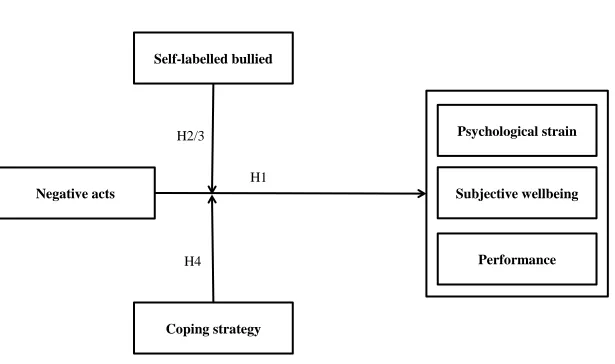
The theoretical model and hypotheses are depicted in figure 1.
Methods
Data reported here is compiled from four cross-sectional studies in Southeast Asia
(total N = 3,217); Vietnam (N = 1,044), Cambodia (N = 821), Thailand (N = 800), and
Philippines (N = 552) carried out between May 2012 and March 2013. Respondents were
recruited by approaching organizations in key industry sectors; education, healthcare,
manufacturing, and hospitality, in each of the four countries. Respondents were not
pre-selected as to whether or not they had experienced bullying, thereby reducing the potential
bias found in more selective samples (Nielsen et al., 2010). Self-reports were collected
through questionnaires administered by trained researchers in each country. Translations in
Thai, Khmer (Cambodia) and Vietnamese, were carried out by professional, bilingual
translators. In Philippines questionnaires were administered in English. Workers were from
four sectors; Manufacturing (N = 906, 28%), Education (N = 836, 26%), Hospitality (N =
798, 25%) and Healthcare (N = 676, 21%). The mean age was 31.6 years (SD = 9.59) with a
range of 18 to 70, mean organizational tenure was 5 years (SD = 6.12) and 46.5% of the
sample were female.
Measures
Self-labeled bullied. A single item measured respondents’ beliefs about whether or
not they were bullied; ‘do you consider yourself to have been bullied at your workplace over
the past 6 months’. The question was scored on a 5-point Likert scale. Scale labels were; ‘no’
(1), ‘yes, but only rarely’ (2), ‘yes, now and then’ (3), ‘yes, several times a week’ (4) and
‘yes, almost daily’ (5). This question was asked after the negative acts questionnaire, to avoid
the potential for priming identified by Nielsen and colleagues (2011). In line with Einarsen
and Skogstad (1996) a definition of bullying was provided. This definition of workplace
bullying is adapted from Olweus and his bullying at school research (Olweus, 1978, 1993),
and has been adapted for the workplace as follows (Einarsen, Hoel, Zapf, & Cooper, 2003, p.
Bullying at work means harassing, offending, socially excluding someone or negatively
affecting someone's work tasks. In order for the label bullying to be applied to a particular
activity, interaction or process it has to occur repeatedly and regularly (e.g. weekly) and over
a period of time (e.g. about six months). Bullying is an escalating process in the course of
which the person confronted ends up in an inferior position and becomes the target of
systematic negative social acts. A conflict cannot be called bullying if the incident is an
isolated event or if two parties of approximately equal "strength" are in conflict.
Negative acts. The Negative Acts Questionnaire-Revised (NAQ-R; Einarsen et al.,
2009) comprises 22 items describing different negative acts. Items include work-related acts
(e.g. “being ordered to do work below your level of competence”), personal acts (e.g. “being
the subject of excessive teasing and sarcasm”) and intimidation or aggressive acts (e.g.
“being shouted at or being the target of spontaneous anger (or rage)”). Respondents were
asked how frequently they personally experienced each negative act and response categories
were ‘never’, ‘now and then’, ‘monthly’, ‘weekly’ and ‘daily’.
Coping strategies. Items from the Copenhagen Psychosocial Questionnaire
(COPSOQ; Pejtersen, Kristensen, Borg, & Bjorner, 2010) were used to measure three types
of coping; problem-focused (4 items), resigned (2 items) and selective (4 items) coping.
Alpha coefficients for the three scales were; .79, .73 and .76 respectively. Example items
include ‘tried to find out what you could do to solve the problem’ (problem-focused), ‘tried to
think of something else or did something you enjoy’ (selective) and ‘accepted the situation
because there was nothing to do about it anyway’ (resigned). The stem question was: ‘please
think about your personal efforts to reduce bullying toward you. Indicate how often you have
done each of the following over the past 6 months’. Scale labels were ‘never’ (0), ‘now and
then’ (1), ‘monthly’ (2), ‘weekly’ (3), and ‘daily (4). All respondents were asked about their
Subjective wellbeing. Subjective wellbeing (SWB) was measured with 15 affect
items, taken from Warr’s (1990) scale. Eight items indicated positive affect (e.g. calm,
optimistic) and 7 negative affect (e.g. tense, miserable). In line with the procedure followed
by O’Driscoll et al (2011) SWB was calculated by reverse coding the negative affect items
and calculating a mean score for all 15 items. Alpha coefficient for the SWB scale was .79.
Psychological strain. This was measured with 12 items from the General Health
Questionnaire (Goldberg, 1978; Jackson, 2007). In response to the question ‘over the past 6
months, to what extent have you felt each of the following’ on a 4-point Likert scale (1 = ‘not
at all’, 4 = ‘much more than usual’). Six items were positively worded (e.g. ‘been able to
concentrate on what you were doing’) and six negatively worded (e.g. ‘felt consistently under
strain’). Negatively worded items were reverse coded before a mean score was calculated.
Coefficient alpha for this scale was .70.
Performance. Two items from the work performance questionnaire (Kessler et al.,
2003) measured individual performance in response to the question; ‘on a scale of 1-10,
where 1 = worst performance anyone could have at your job and 10 = the performance of a
top worker, how would you rate each of the following’. Items were; ‘your own usual job
performance over the past 6 months?’ and ‘your overall job performance on the days you
have worked during the past 4 weeks?’ Coefficient alpha for the items was .90.
Control variables. Age and gender have both been found to have a small but
significant influence choice of coping strategy (Jóhannsdóttir & Ólafsson, 2004) so were
included as controls. Country was also included to control for any cross-national differences
Results
Latent profiles
Latent class cluster analysis (LCC; Vermunt & Magidson, 2002) was performed on all of the
NAQ-R items in MPlus (Muthén & Muthén, 2012). LCC empirically classifies respondents to
mutually exclusive groups which are not direct observed (i.e. latent). The aim of LCC is to
identify the smallest number of clusters which can explain the variance of dependent
variables (Vermunt & Magidson, 2002). Based on the profile of answers to the NAQ-R
displayed in each cluster, the researcher then labels the cluster to describe the characteristics
of the respondents in that group, informed by theory and previous research (Notelaers et al.,
2006). LCC begins with the assumption that all respondents below to the same group so a 1
cluster solution is first tested, then 2, 3 and so on until no significant improvement in fit is
achieved. Five clusters proved to be the best fit. As one would expect in a non-selective
sample (Nielsen et al., 2010), the majority of respondents were not subjected to negative acts
and were therefore labeled as ‘not targeted’ (N = 2026 / 63%). Three of the other clusters
identified different frequencies of acts experienced across all of the items from more to less
often; ‘persistently targeted’ (N = 97 / 3%), ‘frequently targeted’ (N = 202 / 6%), ‘sometimes
targeted’ (N = 773 / 24%). Finally, one cluster reported a high frequency of only certain,
work-related negative acts; “being ordered to do work below your level of competence”,
“someone withholding information which affects your performance”, “being humiliated or
ridiculed in connection with your work”, “having your opinions and views ignored” and
“having key areas of responsibility removed or replaced with more trivial or unpleasant
tasks”. As such, this cluster was labeled ‘targeted with work-related bullying’ (N = 119 /
4%). Using the same method, Notelaers and colleagues (2006) revealed only four clusters,
which may account for the difference. A table of all 22 negative acts with mean frequencies
by each cluster is included as an appendix.
---
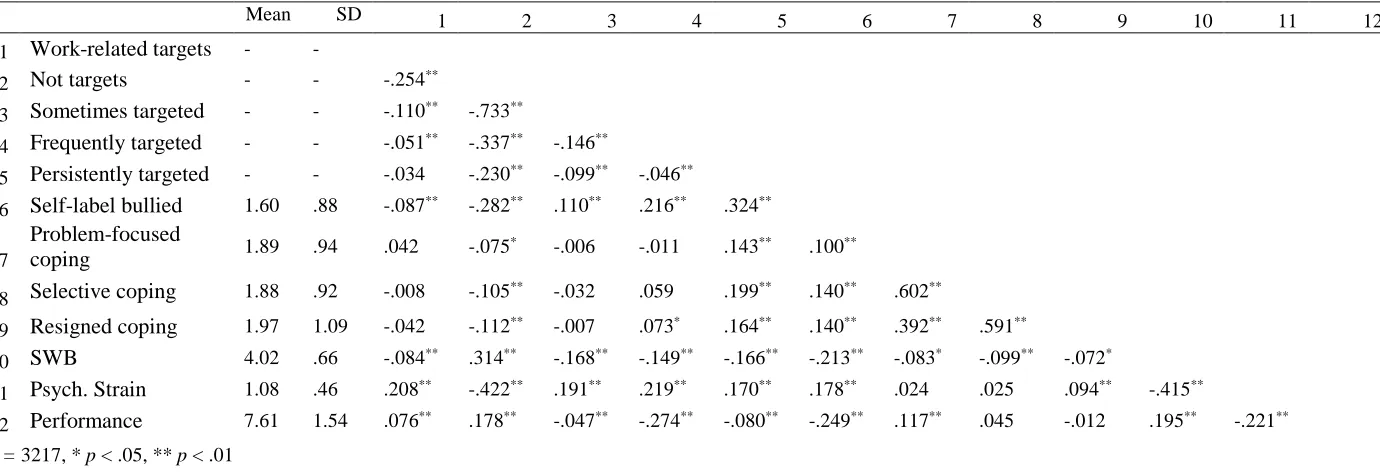
Table 1 about here
---
Hypothesis testing
Correlation coefficients, means and standard deviations are presented in Table 1. Hypothesis
1 predicted that being bullied more frequently would result in more negative outcomes. This
was tested through one-way multivariate analysis of variance (MANOVA) as the dependent
variables (SWB, psychological strain and performance) were expected to be correlated. The
significance of the differences between the clusters was examined using Tukey’s posthoc
analysis (Tukey, 1949). MANOVA revealed a significant difference in all outcome variables
explained by the clusters with an overall main effect of; F (3, 3155) = 30490.06, p < .001;
Wilk's Λ = 0.03, partial η2 = .97. The main effects of the clusters on each outcome were also
significant; SWB (F (3, 3155) = 99.78, p < .001; partial η2 = .11), psychological strain (F (3,
3155) = 211.91, p< .001; partial η2 = .21), and performance (F (3, 3155) = 83.43, p < .001; partial η2 = .10).
With respect to wellbeing outcomes, the pattern of relationships is as expected (Table
2). Those who were persistently targeted experienced the lowest levels of wellbeing (M =
3.44) and high levels of psychological strain (M = 1.53), although neither were significantly
different from those frequently targeted. The relationships then follow the expected pattern in
that those less frequently targeted reported more positive wellbeing outcomes. Individuals
who were targeted with work-related acts did not experience significantly different levels of
subjective wellbeing (M = 3.75) than those sometimes or frequently targeted, as expected
levels of psychological strain (M = 1.57), not significantly different from those frequently or
persistently targeted. With respect to the performance outcomes, the pattern was more mixed.
Those who were frequently targeted reported the lowest levels of performance (M = 5.99),
lower than those who were persistent victims of negative acts (M = 6.91). Surprisingly,
respondents who were victims of workplace negative acts reported the highest levels of
performance (M = 8.22), contrary to hypothesis 1b.
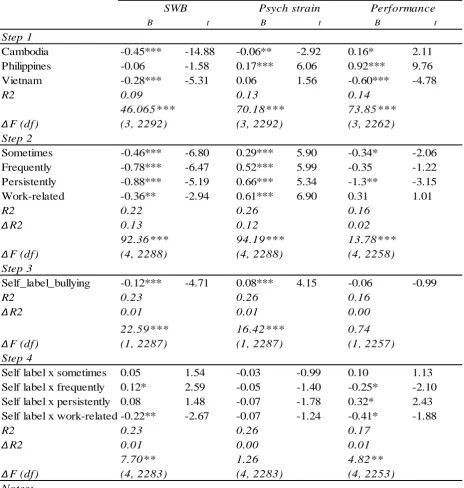
--- Table 2 about here ---
Ordinary least squares regression analysis was carried out to examine the
hypothesized moderating effects (hypotheses 2, 3 and 4) with the models estimated in stages;
1) control variables, 2) the main effect of the bullying cluster on outcomes, 3) self-labeling or
coping strategies and then 4) the predicted interaction effects. Neither age or gender were
found to significantly predict the outcomes so were excluded from further analyses. In
hypothesis 2, we predicted that individuals more frequently targeted who self-labeled as
being bullied would report more negative wellbeing outcomes than those who did not
self-label. As expected, self-labeling did moderate the impact of experiencing negative acts on
some outcomes, although not consistently across all latent profiles (Table 4). Beginning with
wellbeing outcomes; self-labeling had no impact on reported levels of psychological strain. In
addition, somewhat contrary to the hypothesis, the impact of the frequently x self-labeling
interaction on subjective wellbeing (β = 0.12, p < .05), while significant, indicates that
self-labeling makes no difference to the level of wellbeing for those frequently targeted (simple
slopes analysis; Figure 2). Targets of work-related bullying reported lower levels of
subjective wellbeing when they self-labeled (β = -0.22, p < .05), in support of the hypothesis.
With respect to performance (hypothesis 3), the interactions between self-labelling
interaction for those frequently targeted was as expected; those who also self-labeled as being
bullied reported lower levels of performance than those who did not (β = -0.25, p < .05). The
relationship with respect to persistent targets was somewhat surprising. As expected,
persistent targets reported far lower levels of performance than those who were not persistent
targets. However, those who also self-labeled reported higher levels of performance than
those who did not self-label (β = 0.32, p < .05), although this difference was only very
marginal. In support of hypothesis 3b, the interaction between work-related targets and
self-labeling (Figure 3) revealed that targets of work-related bullying reported lower levels of
performance when they self-labeled as being bullied and higher levels when they did not (β =
-0.41, p < .05).
--- Table 3 about here ---
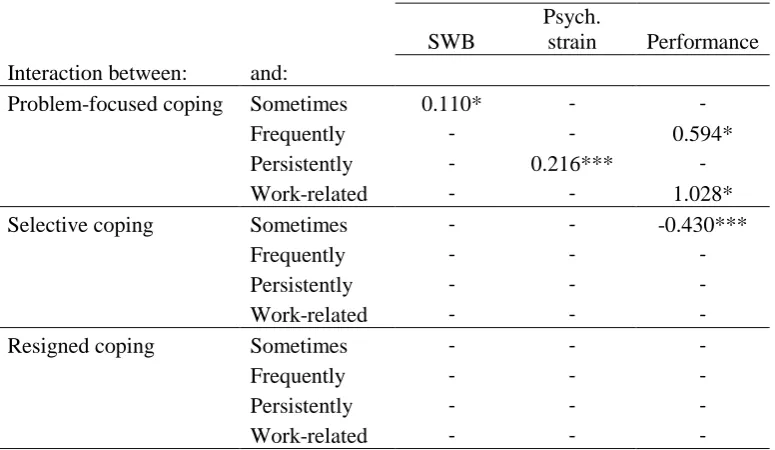
Hypothesis 4a predicted that individuals experiencing negative acts would report less
negative outcomes if they adopted problem-focused coping. Due to the number of potential
interactions, only significant interactions are summarized in table 4. In support of the
hypothesis, individuals sometimes targeted reported marginally higher subjective wellbeing
when adopting problem-focused coping (β = 0.11, p < .05) than those who did not. Also in
support of the hypothesis, those who were frequently targeted reported higher levels of
performance (β = 0.26, p < .05) than those who did not. This pattern was also supported with
respect to performance; those targeted with work-related negative acts reported higher
performance (β = 1.03, p < .05) when adopting a problem-focused strategy. However,
persistent targets reported higher levels of psychological strain when they adopted a
problem-focused strategy (β = 0.22, p < .001), contrary to the hypothesis. In hypothesis 3b, we
predicted that resigned and selective coping would not be effective moderators, expecting
significantly interact with any of the latent classes to predict any outcomes, indicating no
moderation effect. Only one interaction was significant with respect to selective coping.
Individuals sometimes targeted with negative acts predicted lower levels of psychological
strain (β = -0.43, p < .001) but there was only a very marginal difference in their reported
level of strain when adopting this strategy. Hypothesis 4b is therefore not supported, although
these coping strategies did not effectively moderate the impact of negative acts on outcomes.
--- Table 4 about here ---
Discussion
The dominant approach to operationalizing the experience of workplace bullying is to
examine the extent to which individuals are targeted with negative acts at work (Nielsen et
al., 2011). A significant body of research supports the theory that experiencing more frequent
and persistent negative acts predicts negative outcomes in relation to both wellbeing and
performance (Bowling & Beehr, 2006). However, we know little about how individual
reactions to these negative acts moderate the impact of them on outcomes (Bunk & Magley,
2013). We set out to examine the extent to which individuals’ primary appraisal of the
experience of negative acts (as indicated by them self-labeling as being bullied), and the
coping strategies employed to deal with the negative acts moderated the impact of these acts
on wellbeing and performance outcomes.
Adopting the latent class cluster technique of analyzing the NAQ-R we identified five
clusters of negative acts; not targeted, sometimes targeted, frequently targeted, persistently
targeted and targeted with work-related bullying. When examining the direct relationships
between the clusters of negative acts, we found that, as expected, those targeted with more
labeling only moderated some of the relationships between the clusters and outcomes.
Self-labeling made little difference to wellbeing outcomes. With respect to performance, while
those frequently targeted reported lower performance when they self-labeled as being bullied,
as expected, persistent targets were the opposite. Persistent targets who self-labeled reported
higher levels of performance.
Unlike the clusters relating to the frequency of negative acts (‘sometimes’,
‘frequently’, ‘persistently’), those targeted with work-related negative acts reported higher
levels of performance. When examining the moderating effect of self-labeling, we found that
higher performance was only reported for those who did not self-label as being bullied
whereas those who did self-label reported lower levels of performance. This is an important
finding as it would support the argument that work-related negative acts can sometimes be
construed as performance enhancing or developmental (Samnani et al., 2013) but only when
individuals believe that there is not malicious intent (Parzefall & Salin, 2010). Although this
may be a controversial suggestion, it supports the importance of understanding not only the
perception that the behavior is taking place, but also the way that it is perceived. It is also
important to note, though, that while individuals experiencing work-related negative acts
without identifying as being bullied reported higher levels of performance, they also reported
low levels of subjective wellbeing, so this still comes at a cost (Dewe et al., 2010).
With respect to coping strategies, problem-focused coping was more effective on the
whole than resigned or selective coping, which had little or no significant moderating effect
on outcomes. Problem-focused coping was effective in reducing the negative impact for those
sometimes targeted with negative acts with respect to wellbeing and those frequently targeted
with respect to performance. It was less effective, however, for those persistently targeted
and targets of work-related bullying. Persistent targets employing problem-focused coping
levels of these stressors, this would support the theory that coping with stressors involves
self-control and is therefore resource depleting (Muraven & Baumeister, 2000). Likewise, it
in line with Richman et al.’s (2001) findings that victims of harassment (i.e. persistent
exposure to negative acts) reported higher levels of alcohol use when adopting
problem-focused coping. However, those targeted with work-related negative acts reported higher
performance when adopting focused coping. It could be therefore that
problem-focused coping with respect to work-related negative acts manifests as higher performance
(Samnani et al., 2013).
Theoretical Importance
This paper makes a number of important contributions to the workplace bullying literature.
Firstly, we echo Magley and colleagues (Bunk & Magley, 2013; Cortina & Magley, 2009) in
suggesting that individuals’ appraisals of negative experience are an important consideration
in understanding how they respond. We suggest that cognitive appraisal theory (Lazarus &
Folkman, 1984) should be considered a valuable theoretical framework for understanding
individuals’ responses to negative acts at work. We support this theoretical approach in
finding that self-labeling, as an indicator of primary appraisal, moderates the impact of
negative acts on wellbeing and performance outcomes. This also has methodological
implications in that we suggest that behavioral and self-labeling measures of bullying should
not be considered separate but rather interactive definitions of bullying. This approach
recognizes that individuals’ attributions are an important consideration as suggested by
Samnani et al. (2013).
Secondly, we further our knowledge of coping with bullying. Rather than seeing
coping as a mediator between being bullied and outcomes, which assumes that bullying
Jóhannsdóttir & Ólafsson, 2004), we would rather suggest that it is the interaction between
experiencing negative acts and the coping strategy employed that defines the outcomes. Our
findings with respect to the different clusters of negative acts also offers a more nuanced
view of the success of coping strategies than previous research (Dehue et al., 2012) in
suggesting that active strategies are only successful for moderate levels of bullying, not more
severe (Carver & Connor-Smith, 2010). This might explain the prior findings that we
discussed at the outset which in some cases found problem-focused coping to be effective
(e.g. Folkman, Lazarus, Gruen, et al., 1986) and in others not (e.g. Richman et al., 2001). The
present study would therefore support a definition of bullying behaviors which examines both
the frequency and type of negative acts experienced, not simply whether or not someone is a
victim of bullying.
Thirdly, we support recent research which has found that both the prevalence and type
of bullying experienced is important (Jóhannsdóttir & Ólafsson, 2004). In particular, in
finding that experiencing work-related negative acts might predict positive performance
outcomes, we suggest that there might be some ambiguity in the experience of these at work
(Samnani et al., 2013). This has implications for research which considers only the
prevalence of negative acts, and might therefore be missing nuance. It is therefore important,
within the domain of workplace bullying research, to recognize this distinction.
Practical Importance
As highlighted by Samnani et al. (2013) one particular challenge is that bullying can be
difficult to detect and this particularly seems the case with work-related bullying. On the one
hand, asking someone whether or not they are bullied is a valuable and important step in
trying to understand the outcomes of bullying and such attributions should be taken seriously.
However, on the other, serious work-related negative acts could be taking place without the
issue, awareness campaigns or training might help in identifying these bullying behaviors
(Fox & Cowan, 2015). Secondly, our finding that problem-focused coping is more effective
only for more moderate, not persistent, levels of bullying has implications for bullying
awareness and interventions. Any training, guidance or policy which aims to help targets to
cope with bullying might helpfully emphasize problem-solving, but should also encourage
targets to seek outside help so that they are not left to solve the problem by themselves. Our
findings would suggest that victims left to solve the problem themselves are likely to
experience higher levels of strain.
Limitations and future research
Although the present research offers valuable insights into how individuals respond to
negative acts, it is important to recognize some limitations. In particular, the present research
is cross-sectional and, as such, inferences about causality cannot be made. Although,
individual appraisals of negative acts can be seen as a simultaneous process (Lazarus &
Folkman, 1984), so our findings still shed light on individual interpretations of negative acts,
future longitudinal research would enable an examination of appraisal as a process, which has
had attention in the stress literature (Folkman, 1984). Future research would also benefit from
using an objective or manager rating of performance, which reduces the risk of single method
bias and would also strengthen causal inferences (Podsakoff, MacKenzie, & Podsakoff,
2012). This is a limitation of our self-report performance measure.
Secondly, it is important to recognize some climate-related factors which might
impact on the generalizability of our findings. Firstly, with respect to the positive
performance outcomes of work-related bullying, one factor which we are not able to account
for in the present research is work climate, which is likely to moderate this relationship. For
norm, and may therefore result in greater performance increases (Samnani & Singh, 2014)
although higher performance demands are also associated with higher levels of stress
(Samnani & Singh, 2012). Likewise, we did not account for the potential impact of other
stressors arising from the work environment, such as role conflict or ambiguity (Bowling and
Beehr, 2006), which might influence individuals’ appraisal of the situation. Secondly, in
interpreting the findings of the present study, we should also recognize the cultural context of
Southeast Asia. Although research into bullying in Southeast Asia is very limited, there is
evidence that the kind of negative acts that constitute bullying are prevalent in Asian
countries (Yeung & Griffin, 2008). However, cross-cultural research has also suggested that
cultural differences explain variation in both the prevalence (Van de Vliert, Einarsen &
Nielsen, 2013) and the perceived acceptability of bullying (Power et al., 2013). The countries
in the present study (Vietnam, Cambodia, Thailand and Philippines) have relatively low
levels of individualism and high power distance compared to Western European and US
contexts (Hofstede, 2001) where bullying research is prevalent and, as such, there is evidence
from cross-cultural studies which would suggest that our results regarding the outcomes of
bullying might be conservative compared to these other cultural contexts. For example, Loh,
Restubog and Zagenczyk (2010) found that countries high in power distance are likely to
respond less negatively to workplace bullying. Likewise, research suggests that individuals in
more collectivist cultures less freely express emotions (Eid & Diener, 2001) and that
collectivism buffers against the potential negative effects of workplace bullying (Seo, Leather
& Coyne, 2012). It has also been observed that, in Asian cultures characterized by high
collectivism and power distance, there is likely to be a ‘modesty bias’ (Heidemeier & Moser,
2009) which suppresses self-reported performance which could likewise influence our results
believe that the insights into the influence of appraisal and coping of negative acts apply to
any cultural context but would nonetheless benefit from replication in other cultural contexts.
In the present study, we have suggested one indicator of primary appraisal. It is, of
course, likely that there are other factors which will influence how individuals respond to the
experience of negative acts in the workplace. In particular, it is possible that individuals
might appraise negative acts as threatening without self-labeling as being bullied. The
explicit perception of threat (cf. Anderson & Hunter, 2012; Catterson & Hunter, 2010) might
therefore further moderate the impact of experiencing bullying behavior on performance and
wellbeing outcomes. Further research would therefore be valuable to examine individuals’
perceptions of threat in relation to the experience of negative workplace acts as well as other
types of primary appraisal such as control or blame (Catterson & Hunter, 2010). In addition,
we focus in the present study on cognitive appraisal but, as demonstrated by Bunk and
Magley (2013), individuals’ affective responses to workplace incivility also impact on the
outcomes of these experiences. Future research might, therefore, examine both self-labeling
and affective responses to negative acts, in particular the nature of the relationship between
affect and self-labeling (e.g. direction of causality, or level of reciprocity).
There are also a number of ways in which our conceptualization of coping could be
expanded. Firstly, prior research influenced by cognitive appraisal theory has demonstrated
that, before adopting specific coping behaviors, individuals evaluate their potential to cope
with the situation, which can be seen as a form of secondary appraisal (Smith & Kirby,
2009). In other words, once individuals have identified themselves as being bullied, they then
evaluate their potential to cope with the bullying (Lowe & Bennett, 2003) which is likely to
influence the outcomes of the experience of being bullied, including the type of coping
employed. Future research might valuably examine coping potential in order to build a more
have adopted a measure which captures Folkman and Lazarus’s (1980) definition of the
functions of coping as problem-focused or emotion-focused. However, there are multiple
ways to conceptualize coping, for example relating to specific coping behaviors, or in
acknowledging that coping is a process which involves adaptation (cf. Dewe & Cooper,
2007; Dewe et al., 2010). As such, we believe that future research could expand upon this
model to examine more specific forms of coping relating to the differentiated view of
bullying that we adopt here.
Finally, it is important to acknowledge that while we examined the experience of
negative acts at work we did not ask respondents about the source of these acts (e.g. manager,
coworker) as this was not the primary focus of the paper. This is an important consideration
because it is likely that bullying perceived to originate from different sources, particularly
with differing levels of power distance (Agervold, 2007; Salin, 2003; Saunders et al., 2007),
will lead to different behavioral and attitudinal responses (e.g. Bowling & Beehr, 2006;
Samnani et al., 2013). We would suggest, therefore, that considering the source alongside the
other possible attributions suggested above would help scholars to formulate a more complete
theory of cognitive appraisal in relation to being a target of bullying.
Conclusions
In this paper we have drawn on Cognitive Appraisal Theory (Lazarus & Folkman, 1984) and
theories of coping to suggest that individuals’ primary appraisals of and reactions to negative
acts will moderate the impact of said acts on outcomes. In summary, we found that individual
appraisals of negative acts are an important consideration when examining the outcomes of
bullying, but particularly with respect to performance outcomes. Work-related negative acts,
in particular, might result in higher performance if individuals do not believe the acts to be
bullying but lower if they do. With respect to coping, we found problem-focused coping
targets, problem-focused coping predicted higher levels of psychological strain. These
findings suggest, firstly, that it is not simply enough to examine either objective or subjective
definitions of bullying but rather to examine the interaction between the two. Secondly, it
suggests that while passive coping strategies do not mitigate the impact negative acts on
References
Agervold, M. (2007). Bullying at work: a discussion of definitions and prevalence, based on
an empirical study. Scandinavian Journal of Psychology, 48(2), 161–172.
http://doi.org/10.1111/j.1467-9450.2007.00585.x
Anderson, S., & Hunter, S. C. (2012). Cognitive appraisals, emotional reactions, and their
associations with three forms of peer-victimization. Psicothema, 24(4), 621–627.
Baillien, E., Neyens, I., De Witte, H., & De Cuyper, N. (2009). A qualitative study on the
development of workplace bullying: Towards a three way model. Journal of
Community & Applied Social Psychology, 19(1), 1–16.
http://doi.org/10.1002/casp.977
Bowling, N. A., & Beehr, T. A. (2006). Workplace harassment from the victim’s perspective:
a theoretical model and meta-analysis. The Journal of Applied Psychology, 91(5),
998–1012. http://doi.org/10.1037/0021-9010.91.5.998
Bunk, J. A., & Magley, V. J. (2013). The Role of Appraisals and Emotions in Understanding
Experiences of Workplace Incivility. Journal of Occupational Health Psychology,
18(1), 87–105. http://doi.org/10.1037/a0030987
Carver, C. S., & Connor-Smith, J. (2010). Personality and Coping. Annual Review of
Psychology, 61(1), 679–704. http://doi.org/10.1146/annurev.psych.093008.100352
Catterson, J., & Hunter, S. C. (2010). Cognitive mediators of the effect of peer victimization
on loneliness. British Journal of Educational Psychology, 80(3), 403–416.
Cortina, L. M., & Magley, V. J. (2009). Patterns and Profiles of Response to Incivility in the
Workplace. Journal of Occupational Health Psychology, 14(3), 272–288.
Cox, C. B., Johnson, J., & Coyle, T. (2015). Coping styles moderate the relationships
between exposure to community violence and work-related outcomes. Journal of
Occupational Health Psychology, 20(3), 348–358. http://doi.org/10.1037/a0038556
Dehue, F., Bolman, C., Völlink, T., & Pouwelse, M. (2012). Coping with bullying at work
and health related problems. International Journal of Stress Management, 19(3), 175–
197. http://doi.org/10.1037/a0028969
Devonish, D. (2013). Workplace bullying, employee performance and behaviors: The
mediating role of psychological well-being. Employee Relations, 35(6), 630–647.
http://doi.org/10.1108/ER-01-2013-0004
Dewe, P. J., & Cooper, C. L. (2007). Coping research and measurement in the context of
work related stress. In G. Hodgkinson & J. K. Ford (Eds.), International Review of
Industrial and Organizational Psychology (Vol. 22, pp. 141–191). Cambridge, MA:
Wiley-Blackwell.
Dewe, P. J., O’Driscoll, M. P., & Cooper, C. L. (2010). Coping with Work Stress: A Review
and Critique. John Wiley & Sons.
Eid, M., & Diener, E. (2001). Norms for experiencing emotions in different cultures: Inter-
and intranational differences. Journal of Personality and Social Psychology, 81(5),
869–885. http://doi.org/10.1037/0022-3514.81.5.869
Einarsen, S., Hoel, H., & Notelaers, G. (2009). Measuring exposure to bullying and
harassment at work: Validity, factor structure and psychometric properties of the
Negative Acts Questionnaire-Revised. Work & Stress, 23(1), 24–44.
http://doi.org/10.1080/02678370902815673
Einarsen, S., Hoel, H., Zapf, D., & Cooper, C. (2003). The concept of bullying at work: the
European tradition. In Bullying and Emotional Abuse in the Workplace: International
Einarsen, S., Hoel, H., Zapf, D., & Cooper, C. (2011). Bullying and Harassment in the
Workplace: Developments in Theory, Research, and Practice, Second Edition. CRC
Press.
Einarsen, S., Raknes, B. I., & Matthiesen, S. B. (1994). Bullying and harassment at work and
their relationships to work environment quality: An exploratory study. European
Work and Organizational Psychologist, 4(4), 381–401.
http://doi.org/10.1080/13594329408410497
Einarsen, S., & Skogstad, A. (1996). Bullying at work: Epidemiological findings in public
and private organizations. European Journal of Work and Organizational Psychology,
5(2), 185–201. http://doi.org/10.1080/13594329608414854
Fitzgerald, L. F., Swan, S., & Fischer, K. (1995). Why didn’t she just report him? The
psychological and legal implications of women’s responses to sexual harassment.
Journal of Social Issues, 51(1), 117–138.
Folkman, S. (1984). Personal control and stress and coping processes: a theoretical analysis.
Journal of Personality and Social Psychology, 46(4), 839–852.
Folkman, S., & Lazarus, R. S. (1980). An Analysis of Coping in a Middle-Aged Community
Sample. Journal of Health and Social Behavior, 21(3), 219.
http://doi.org/10.2307/2136617
Folkman, S., Lazarus, R. S., Dunkel-Schetter, C., DeLongis, A., & Gruen, R. J. (1986).
Dynamics of a stressful encounter: Cognitive appraisal, coping, and encounter
outcomes. Journal of Personality and Social Psychology, 50(5), 992–1003.
http://doi.org/10.1037/0022-3514.50.5.992
Folkman, S., Lazarus, R. S., Gruen, R. J., & DeLongis, A. (1986). Appraisal, coping, health
status, and psychological symptoms. Journal of Personality and Social Psychology,
Fox, S., & Cowan, R. L. (2015). Revision of the workplace bullying checklist: the importance
of human resource management’s role in defining and addressing workplace
bullying. Human Resource Management Journal, 25(1), 116–130.
http://doi.org/10.1111/1748-8583.12049
Folkman, S., & Moskowitz, J. T. (2004). Coping: Pitfalls and promise. Annual Review of
Psychology, 55, 745–774. http://doi.org/10.1146/annurev.psych.55.090902.141456
Fox, S., & Stallworth, L. E. (2005). Racial/ethnic bullying: Exploring links between bullying
and racism in the US workplace. Journal of Vocational Behavior, 66(3), 438–456.
http://doi.org/10.1016/j.jvb.2004.01.002
Hofstede, G. (2001) Culture's Consequences: Comparing Values, Behaviors, Institutions and
Organizations Across Nations. 2nd Edition, Thousand Oaks CA: Sage Publications,
2001
Glasl, F. (1982). The process of conflict escalation and roles of third parties. In G. B. J.
Bomers & R. B. Peterson, Conflict management and industrial relations (pp. 119–
140). Kluwer-Nijhoff Pub.
Goldberg, D. P. (1978). Manual of the general health questionnaire. Nfer.
Heidemeier, H., & Moser, K. (2009). Self–other agreement in job performance ratings: A
meta-analytic test of a process model. Journal of Applied Psychology, 94(2), 353–
370. http://doi.org/10.1037/0021-9010.94.2.353
Hershcovis, M. S., & Barling, J. (2010). Comparing victim attributions and outcomes for
workplace aggression and sexual harassment. Journal of Applied Psychology, 95(5),
874–888. http://doi.org/10.1037/a0020070
Hogh, A., & Dofradottir, A. (2001). Coping with bullying in the workplace. European
Journal of Work and Organizational Psychology, 10(4), 485–495.
Ireland, J. L. (1999). Bullying behaviors among male and female prisoners: A study of adult
and young offenders. Aggressive Behavior, 25(3), 161–178.
http://doi.org/10.1002/(SICI)1098-2337(1999)25:3<161::AID-AB1>3.0.CO;2-#
Jackson, C. (2007). The General Health Questionnaire. Occupational Medicine, 57(1), 79–79.
http://doi.org/10.1093/occmed/kql169
Jóhannsdóttir, H. L., & Ólafsson, R. F. (2004). Coping with bullying in the workplace: the
effect of gender, age and type of bullying. British Journal of Guidance &
Counselling, 32(3), 319–333. http://doi.org/10.1080/03069880410001723549
Kessler, R. C., Barber, C., Beck, A., Berglund, P., Cleary, P. D., McKenas, D., … Wang, P.
(2003). The World Health Organization Health and Work Performance Questionnaire
(HPQ). Journal of Occupational and Environmental Medicine / American College of
Occupational and Environmental Medicine, 45(2), 156–174.
Lazarus, R. S., & Folkman, S. (1984). Stress, Appraisal, and Coping. New York: Springer
Publishing Co Inc.
Lechner, L., Bolman, C., & van Dalen, A. (2007). Definite involuntary childlessness:
associations between coping, social support and psychological distress. Human
Reproduction (Oxford, England), 22(1), 288–294.
http://doi.org/10.1093/humrep/del327
Lee, R. T., & Brotheridge, C. M. (2006). When prey turns predatory: Workplace bullying as a
predictor of counteraggression/bullying, coping, and well-being. European Journal of
Work and Organizational Psychology, 15(3), 352–377.
http://doi.org/10.1080/13594320600636531
Leon-Perez, J. M., Notelaers, G., Arenas, A., Munduate, L., & Medina, F. J. (2013).
approaches into a latent class cluster model. Journal of Interpersonal Violence,
0886260513506280.
Lewis, D. (2004). Bullying at work: the impact of shame among university and college
lecturers. British Journal of Guidance & Counselling, 32(3), 281–299.
http://doi.org/10.1080/03069880410001723521
Leymann, H. (1996). The content and development of mobbing at work. European Journal of
Work and Organizational Psychology, 5(2), 165–
184. http://doi.org/10.1080/13594329608414853
Leymann, H., & Gustafsson, A. (1996). Mobbing at work and the development of
posttraumatic stress disorders. European Journal of Work and Organizational
Psychology, 5, 251 – 275
Liefooghe, A. P. D., & Mackenzie Davey, K. (2001). Accounts of workplace bullying: The
role of the organization. European Journal of Work and Organizational Psychology,
10(4), 375–392. http://doi.org/10.1080/13594320143000762
Loh, J., Restubog, S. L. D., & Zagenczyk, T. J. (2010). Consequences of Workplace Bullying
on Employee Identification and Satisfaction Among Australians and Singaporeans.
Journal of Cross-Cultural Psychology, 41(2), 236–252.
http://doi.org/10.1177/0022022109354641
Lowe, R., & Bennett, P. (2003). Exploring coping reactions to work-stress: application of an
appraisal theory. Journal of Occupational and Organizational Psychology, 76(3),
393–400.
Magley, V. J., Hulin, C. L., Fitzgerald, L. F., & DeNardo, M. (1999). Outcomes of
self-labeling sexual harassment. Journal of Applied Psychology, 84(3), 390–402.
Matthiesen, S. B., & Einarsen, S. (2004). Psychiatric distress and symptoms of PTSD among
victims of bullying at work. British Journal of Guidance & Counselling, 32(3),
335–356. http://doi.org/10.1080/03069880410001723558
Mikkelsen, E. G., & Einarsen, S. (2001). Bullying in Danish work-life: Prevalence and health
correlates. European Journal of Work and Organizational Psychology, 10(4), 393–
413. http://doi.org/10.1080/13594320143000816
Muraven, M., & Baumeister, R. F. (2000). Self-regulation and depletion of limited resources:
Does self-control resemble a muscle? Psychological Bulletin, 126(2), 247–259.
http://doi.org/10.1037/0033-2909.126.2.247
Muthen, L. K., & Muthen, B. O. (2012). Mplus User’s Guide. Seventh Edition. Los Angeles,
CA: Muthen & Muthen.
Nielsen, M. B., Matthiesen, S. B., & Einarsen, S. (2008). Sense of coherence as a protective
mechanism among targets of workplace bullying. Journal of Occupational Health
Psychology, 13(2), 128–136. http://doi.org/10.1037/1076-8998.13.2.128
Nielsen, M. B., Matthiesen, S. B., & Einarsen, S. (2010). The impact of methodological
moderators on prevalence rates of workplace bullying. A meta-analysis. Journal of
Occupational and Organizational Psychology, 83(4), 955–979.
http://doi.org/10.1348/096317909X481256
Nielsen, M. B., Notelaers, G., & Einarsen, S. (2011). Measuring exposure to workplace
bullying. In S. Einarsen, H. Hoel, D. Zapf, & C. Cooper, Bullying and Harassment in
the Workplace: Developments in Theory, Research, and Practice, Second Edition.
CRC Press.
Notelaers, G., & Einarsen, S. (2013). The world turns at 33 and 45: Defining simple cutoff